

CHAPTER 11
–
‘Lisa, if you don’t like your job you don’t strike. You just go in every day and do it really half-assed.’
–
Homer Simpson
IAM LUCKY. I work in a job that I love. There are good days and bad days of course, but on balance the good outweighs the bad. How can you beat a job that combines teaching the next generation with being a scientist?
A recent survey in Ireland has revealed that 83 per cent of Irish workers think about quitting their job every day.1 An astonishing 94 per cent of workers in China and Japan say they are not engaged in their work,2 while 51 per cent of Americans say they have no meaningful connection with their jobs and tend to do a minimum.3 Yet, another survey has revealed that 85 per cent of Americans say that they are either somewhat or very satisfied with their jobs (perhaps because they get away with doing little).4 And what about that much-maligned group, the millennials? Well, 71 per cent are either not engaged in or are actively disengaged from their jobs.5 All that education, hope, motivation, treks around the world to find themselves and youthful exuberance, and yet the majority are not happy in their jobs. Why is this? Why hasn’t all the education, career guidance, expensive tuition, life coaching and mindfulness (for those who can afford it) not worked for most people when it comes to what they spend one-third of their time doing? Do people just complain anyway when they’re asked, even when they might be somewhat happy in their work?
(Perhaps The Matrix got it right. In that movie, the character Agent Smith describes how the first Matrix was designed to be perfect, with no human suffering. It failed, and Smith concluded that humans define their reality through suffering and misery and so the programme is redesigned to accommodate that.)
For centuries, of course, there has been drudgery. The grunts who built Stonehenge or Newgrange or the pyramids were hardly happy, although it’s possible that working in a group brought some satisfaction, given humans’ sociable nature. The invention of agriculture seems to be partly to blame for the state of affairs, whereby there was a tiny minority lording it over the masses, making them work hard. There is now a consensus that agriculture gave rise to huge inequality.6 The haves had the seeds, land, know-how and power to control agriculture and made the less smart or able or less well-connected people in their community work for them, and didn’t share out the spoils equally. Slavery was invented to make sure the grunts kept working. The Romans knew that if the workers were given ‘bread and circuses’ (read gladiatorial combat), they would keep working and not rebel. Perhaps the equivalent of all this today is working in Facebook, being allowed to sit in nicely coloured chairs, eating a meat-free burger and watching a series on Netflix that involves the ritual humiliation of fellow human beings.
Things began to change somewhat when the idea of the Protestant work ethic began to emerge. Protestants, beginning with the man himself, Martin Luther, viewed work as a duty that benefited both the individual and society as a whole. The Catholics had spoken of ‘good works’, which meant helping your fellow human beings through your deeds and actions. These good works, combined with faith, ensured a one-way ticket to heaven. For Protestants, though, hard work was an indicator that you were ‘elect’, which meant you were predestined to go to heaven. Interesting idea to make people work hard, right? What this might have meant in practice was that even if you felt lazy, or tempted to do ‘bad works’ like, say, commit a crime – you could defy that because you were predestined to go to heaven. This might, in turn, have meant that you were less likely to hate your job as you were doing it as a precursor to going to heaven when you died. This might suggest that unhappiness at work is a consequence of people not having faith in God.

MARTIN LUTHER (1483–1546), WHO KICKED OFF THE REFORMATION, WAS OF THE VIEW THAT WORK IS A DUTY THAT BENEFITS BOTH THE INDIVIDUAL AND SOCIETY, INSPIRING WHAT BECAME KNOWN AS THE ‘PROTESTANT WORK ETHIC’. THIS HAS BEEN USED TO ANNOY LAZY CATHOLICS FOR CENTURIES.
Work–life balance refers to the balance that we apparently need between work and non-work things like hobbies and spending time with friends and family. It’s seen as critical for our physical and mental health. There’s no doubt that work is hard. You set your alarm clock to make sure you get up on time, make yourself presentable, commute in a crowded train, spend the day working – which for the vast majority means spending time in front of a computer screen – punctuated by meetings with people you either have to be with (because they decide your bonus) or actively dislike. You often get tied up in needless bureaucracy. You spend the day adding value to your company, and then you traipse home again, happy to be away from work. The statistics for who is doing what jobs bear out this description.
There are 400,000 office workers in the square mile of the City of London alone.7 These are the people T.S. Eliot described in ‘The Wasteland’: ‘A crowd flowed over London Bridge, so many, I had not thought death had undone so many.’ Mind you, nowadays those people have earbuds in and are listening to all kinds of things to stop them from feeling dead. They are also holding almond-milk flat whites, which is perhaps the new comfort blanket. Two hundred million people in 40 developed countries currently work at desks in offices.8 That’s a lot of Post-it notes (if they still use such a primitive thing). The corporate office is the engine room of global economic growth. People commute to the office, spend around eight hours there, and commute home. Some life. (COVID-19 has, of course, changed this dynamic, with fewer people commuting and the interminable meetings being held on Zoom instead of in person. Progress! Or maybe not.)
It is intriguing to look at office design over the decades.9 In the early twentieth century offices were all about efficiency – row upon row of typists and clerks. In the 1980s, big-haired office workers were stuffed into cubicles. Today, most offices are open plan, and many companies are moving towards ‘hot desks’, where no one has their own desk and instead sit at a different desk each day. You can’t leave your favourite furry toy on it. Goldman Sachs recently moved 12,000 workers into a new $1.2 billion European headquarters in London.10 It’s all open plan, noise-reduction glass, hot-desking, dynamic air-conditioning and stairwells that optimise interactions between staff. They must now be wondering whether the design is safe in the wake of COVID-19. The British Council for Offices (yes, there is such a thing. I wonder where their offices are?) have estimated that average desk space has fallen by 10 per cent over the past nine years.11 To compensate, employers provide ping-pong tables, climbing walls (where you can literally be driven up the walls) and pods you can sleep in should the need arise. The goal is to reduce workplace illness – on average, 10 per cent of a company’s wage bill goes on sick pay.12 Unilever recently calculated that every $1 spent on staff well-being results in an increase in productivity worth $2.50.13 However, a study of 600,000 office workers revealed that 40 per cent felt that their office actually prevented them from working productively.14 Given how much hot-desking is in vogue, the question is, does it work? It turns out that people don’t like it. One study of a hot-desking office has shown that people spend on average 18 minutes trying to find a vacant desk, which adds up to 66 wasted hours per year.15 They don’t like having to clear their desks every night either. People are happier in surroundings that are familiar to them, marked by their own pot plant and novelty mug.
Whatever way you look at people’s working lives, the bottom line remains the same: the majority find work hard and disengaging, and so we need to examine how to change that. It turns out it doesn’t have to be this way, or at least you should aim to work at something you love, where the whole idea of life–work balance is nonsense. Did Neil Armstrong worry about work–life balance on his way to the moon? Mind you, he did say, ‘The one thing I regret was that my work required a lot of travel.’ Did Marie Curie worry about balance in her life when she made pioneering discoveries about radioactivity? And what about Picasso – did he feel like a long break after painting Guernica? I suspect not. Not that everyone can be like these people, but we can at least strive not to feel that our working life is so awful that we feel tremendous relief when we are away from it. As comedian Bill Hicks said, ‘There are two drugs that western civilisation tolerates: caffeine from Monday to Friday to energise you enough to make you a productive member of society, and alcohol from Friday to Monday to keep you too stupid to figure out the prison that you are living in.’ Survey after survey confirms the crisis in the workplace. In another major study, carried out in 142 countries, the average level of engagement in work stood at 13 per cent.16 A major reason turns out to be the latest bête noire of modern life: digital technology, which is exposing people to an unending flood of information they feel they have to respond to.

A REPRODUCTION OF GUERNIC A, WHICH WAS PAINTED BY PABLO PICASSO IN 1937 IN RESPONSE TO THE BOMBING OF THE BASQUE TOWN OF GUERNICA BY NAZI GERMANY AND FASCIST ITALY AT THE REQUEST OF DICTATOR FRANCO.
This leads us to consider what motivates us to work. Clearly, we need to make money to pay for things like food and shelter – our basic needs. But that is no longer a key reason for work. Many studies on happiness have shown that once we reach a certain level of income, we reach a level of happiness that won’t be surpassed by earning additional income.17 Some of us may have the drive to make a lot of money in order to buy a bigger house or car and lord it over our peers, but it turns out that money is not a significant motivating factor for many. We know deep down that such extra money will not necessarily make us any happier. And the idea of a universal basic income is gaining traction. This means the state will pay all its citizens a certain amount of money, which they can then spend in the economy. The idea actually goes back a long way: it was first proposed by Thomas Paine, the eighteenth-century radical who in 1797 suggested that all 21-year-olds be paid a £15 grant.
One motivation for a universal basic income nowadays is increasing automation. Mark Zuckerberg has argued that the increase in automation will create a greater need for a basic income for all. This especially applies to people currently working in low-paid jobs. A report to the US Congress in 2010 concluded that people in jobs earning less than $20 per hour were at an 83 per cent probability of losing their job to automation.18 Some argue that if everyone were given an income, it would lead to increased consumption of alcohol or other drugs. In 2014 the World Bank commissioned a review of 30 separate studies into this issue, which concluded that this was not the case.19 A post-capitalist society (which we may well be moving towards) would allow for a distribution of profits from companies that are publicly owned to the entire population, representing a return to each citizen on the capital owned by society. The Initiative on Global Markets Economic Experts panel at the University of Chicago has proposed that if every American citizen over the age of 21 were given a basic income of $13,000 per year this would bring all kinds of benefits to a society currently ravaged by inequality.20 People with a basic income still get jobs in the economy and generate economic activity and growth. Advocates of a basic income argue that it will liberate workers from the tyranny of wage slavery and allow people to pursue different occupations, tap into their creativity, overcome the alienation they feel in their working lives and increase their leisure time.
But would it work? Finland is the most recent country to try it out. The Finnish government over a two-year period provided 2,000 unemployed people between the ages of 25 and 58 with a €560 per month salary.21 It replaced unemployment benefit and people received it whether they got a job or not. One idea was that unemployed people might take on part-time work without fear of losing benefits. The Finns have long been seen as being at the cutting edge of social innovation. Their renewed interest in it stemmed from concerns about the increasingly fragmented nature of the labour market. Many people work in low-paid, low skilled work with growing wage inequality and unscrupulous employers getting away with exploitative practices. Social welfare systems are also becoming increasingly punitive. Predictions about the end of work are of course nothing new. In 1891 Oscar Wilde described a world where machines do all the work in his essay ‘The Soul of Man Under Socialism’. Economist John Maynard Keynes predicted in the 1930s that people would have an average working week of 15 hours. So did the Finnish experiment work? Well, up to a point. Importantly it made people happier and healthier (surely an excellent outcome?), but it didn’t make them more likely to become employed. This may have been because they were unemployed at the start of the experiment due to low skill levels or health issues. Yet many on the trial were positive about it, with one participant even writing two books.
A final interesting aspect of the idea of a universal basic income concerns the COVID-19 pandemic. Because of the mass unemployment that the pandemic brought, governments actually provided a basic income to many in order to stave off personal economic disaster, as well as social unrest. Who would have thought that it would be a virus, and not something like automation, that would have caused the first widespread example of a universal basic income in society? It’s not clear yet what this has done for society, or indeed the economy, but it will be fascinating to find out.
If money is not a major motivating factor for us to work, then what is? This brings us to Maslow’s hierarchy of needs. In 1943 psychologist Abraham Maslow wrote a highly influential treatise called ‘A Theory of Human Motivation’22 and followed it up in a book called Motivation and Personality. He used a pyramid to describe what motivates us, with the biggest, most fundamental needs at the bottom and the truly human, highest order needs at the top. At the bottom he put physiological needs, which include food, water, warmth, sex and rest. We are driven to seek these and without them we die. Next comes safety needs, which means keeping ourselves out of harm’s way and being aware of threats. These needs protect us from injury. Next are what are termed ‘belongingness and love needs’. We are a social species and we like to be with others. We also have an urge to procreate and need to love and be loved. Being in isolation has severely negative effects on our mood, causing depression and anxiety, although these aren’t necessarily life-threatening. The lockdown that happened during the COVID-19 crisis led to a lot of people being isolated. It’s not fully clear yet what negative consequences have happened as a result of the lockdown because of isolation, but signs are that there was a big increase in mental health difficulties for many. This need for belonging occurs in most other social animals. Then we get to the higher-order needs, which are largely specific to Homo sapiens. These include ‘esteem needs’. We crave the respect of others and a sense of accomplishment in what we do. Finally, we get to the highest need, ‘self-actualisation’: what this means is that we need to live a life true to our own interests and abilities. It can be achieved through things like parenting or in finding a mate. If you are a musician, you achieve this by playing music. If you are a mathematician, you achieve it through doing maths. You live a life that is true to your own calling. You fully realise your potential as a human being.

A PROTEST IN FAVOUR OF A UNIVERSAL BASIC INCOME FOR ALL.
Maslow also wrote about self-actualisation leading to transcendence. You move beyond yourself into another realm, which can be thought of in a spiritual sense but can also involve altruism – you go beyond yourself. If any of these needs are threatened, we might either die (with the more basic needs) or be unhappy in our lives. I suspect few people achieve transcendence in the workplace … but what motivates us to work is to meet the requirements of this hierarchy of needs. Work will provide us with the wherewithal to buy food, put a roof over our heads. It makes us feel secure. Job security is, in fact, something we all seek, and if that is threatened, it leads to unease. Losing one’s job is a major risk factor for depression and anxiety. Being in a job usually involves working with others and so we fulfil our social needs. We also are granted esteem and accomplishment from work. Finally, we might actually achieve self-actualisation and hey presto, all our needs are met. Phew!
The sad thing is, for most people only some of these needs are met, and so it’s no wonder many feel unhappy in work. There is data to back this up. In a recent study of 12,000 white-collar workers, employees were vastly more satisfied when their emotional and spiritual needs were being met – ‘spiritual’ in this context is the feeling of a higher purpose from their work.23 This might relate to the discussion above about how some religions value work ethic and good works. It ties work into a spiritual dimension. The more effectively leaders and organisations met these needs, the greater the workers performed. In 2012 a meta-analysis, using 263 research studies across 192 organisations in 49 industries and 34 countries,24 revealed that where staff felt engaged, there was 22 per cent higher profitability than companies who didn’t have high engagement, along with 10 per cent higher customer ratings, 28 per cent less theft and 48 per cent fewer safety incidents. In simple terms, the way people feel at work has a huge effect on how they perform. A big negative was overwork. If employees take a break every 90 minutes, they reported a 30 per cent increase in their ability to focus. If people worked more than a 40-hour week they felt less engaged.

PSYCHOLOGIST ABRAHAM MASLOW PLACED THE THINGS THAT MOTIVATE US IN A PYRAMID. PHYSIOLOGICAL NEEDS WERE PLACED AT THE BOTTOM, AND HIGHER ORDER NEEDS ARE AT THE TOP, CULMINATING IN ‘SELF-ACTUALISATION’.
A major reason for people not having their emotional and spiritual needs met at work is that they are working in what has been termed a bullshit job. This term was popularised in 2018 by anthropologist David Graeber in his book entitled Bullshit Jobs: A Theory.25 Graeber contends that over half the jobs in our modern world are pointless. He describes five types of jobs that have no meaning but in which the workers pretend their job is not as meaningless as they know it to be: flunkies, goons, duct-tapers, box-tickers and taskmasters. Flunkies make their superiors feel important. Goons act with aggression on behalf of their employer (this category includes corporate lawyers and public relations people). Duct-tapers deal with preventable problems – an example here is the airline desk person who calms a customer down if their luggage doesn’t arrive. Box-tickers use paperwork as a proxy for actual work. They include performance managers and in-house magazine writers. They spend a lot of time sending memos to each other in a never-ending cycle. Finally, the taskmasters are managers who create extra work for people with poor justification for the extra work.
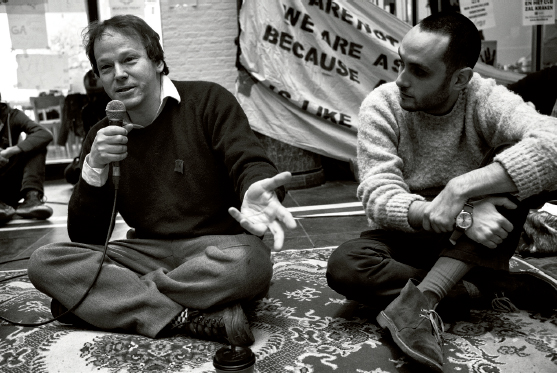
ANTHROPOLOGIST DAVID GRAEBER (LEFT) SPEAKING AT A CONFERENCE IN AMSTERDAM IN 2015. HIS BOOK BULLSHIT JOBS: A THEORY CLAIMS THAT HALF THE JOBS IN OUR MODERN WORLD ARE COMPLETELY POINTLESS. WHAT ABOUT PEOPLE WHO MAKE CHAIRS, DAVID?
Terrifyingly, as many as half of all jobs fit into these categories. If the people doing these jobs were lost from an organisation it wouldn’t affect the productivity of the organisation. And worryingly, many people in these jobs know that the jobs are bullshit, either consciously or subconsciously. It reminds me of Golgafrincham Ark Fleet Ship B in Douglas Adams’s The Restaurant at the End of the Universe. It was designed to relocate people from the planet Golgafrincham, which was being destroyed, to planet Earth, and was filled with what was termed the largely useless, redundant part of the population. In Adams’s world he deemed these to be telephone sanitisers, account executives, hairdressers, tired TV producers, insurance salesmen, public-relations executives and management consultants. Ark Fleet ships A and C carried the rulers, or people who do useful work. Ship B was programmed to crash into the earth since it was full of ‘useless idiots’. The other two ships are lost, but Ark Fleet Ship B makes it to Earth. The Captain can’t remember why he has to crash the ship, but he does it anyway. After the crash, half the people die of a virulent disease contracted from a dirty telephone. The rest survive and continue their useless ways, giving rise to the Earth we see today. I wonder if this story is actually true?
Yet again, however, the COVID-19 pandemic has led to a change in our society in relation to how we view different jobs. Jobs that were perhaps thought to be not especially important suddenly became viewed as essential. This included jobs like hairdressers (up yours, Adams), delivery drivers, supermarket workers and cleaners. Jobs that were often overlooked or looked down upon. Perhaps Adams was being satirical in his list of people deemed useless, when the loss of telephone sanitisers led to disease from a contaminated phone that killed off half the people on Earth. Doesn’t that sound familiar? His view of management consultants would probably not have changed much, however. If he were putting professions into Ark Fleet Ship B now, would he include hedge fund managers, insurance advisers and lifestyle gurus, who, in the post-COVID-19 world, are clearly useless.
Somewhat unexpectedly, most of Graeber’s bullshit jobs are in the private sector, despite the widely held view that market forces should root them out. The constant cry of waste and inefficiency in the public sector is not necessarily justified. Graeber puts the phenomenon of bullshit jobs down to what he calls ‘managerial feudalism’ where underlings are needed to make managers feel important. Bullshit jobs also serve political goals: politicians only worry about numbers of people in jobs rather than what those jobs actually are. Following the publication of his book, a survey was carried out in the UK, which revealed that 37 per cent of people felt that their jobs had no meaning. Graeber is a keen advocate of a universal basic income to do away with bullshit jobs. He is of the view that increasing automation, instead of freeing us, has led to this state of affairs. Everyone knows it, including governments, but no one wants to do anything about it.
What can we do about this parlous state of affairs? One area that has been explored is remote working. Again, the COVID-19 pandemic brought this to the fore, with millions of people working from home during the lockdown. Before the pandemic, a study has revealed that in Europe, 70 per cent of professionals work remotely at least one day a week, while 53 per cent work remotely for at least half the week.26 This is all a consequence of technology. Conference-call programmes such as Zoom are an increasing part of working life and became essential during the pandemic. All over the world right now, millions of people are dialling in, putting their phones on mute and waiting for their turn to speak. Is this the answer? No more commuting; freedom to organise your day as you see fit; getting the work/life balance right. People certainly seem to want it, with 70 per cent of millennials more likely to choose an employer who offered remote working.27
Sadly, though, surveys are showing that all may not be rosy in the remote working garden.28 A 2017 United Nations report found that 41 per cent of remote workers reported high levels of stress, compared to 25 per cent of office workers. This is a concern to employers, where in the UK stress, depression and anxiety leads to £100m in losses every year. Why do remote workers feel stressed? One reason is ‘out of sight, out of mind’. If you’re not in the office you worry that you are being left out, that others are talking about you behind your back and that you are not trusted by your boss to be working hard. One study of 1,100 workers found that 52 per cent who worked from home even for some of the time felt left out, poorly treated, and were unable to deal with conflict with colleagues.29 Navigating sensitive issues can really only be done face to face. Otherwise issues fester, emails are misinterpreted as rude and the absence of body language makes it difficult to communicate true meaning.

A DEPICTION OF WHAT IT MIGHT BE LIKE TO WORK FROM HOME. THE PERSON WHO DREW THIS PICTURE DIDN’T ANTICIPATE THE REALITY, WHERE WORKING FROM HOME MEANS SQUEEZING YOUR LAPTOP ONTO THE KITCHEN TABLE, WITH LAUNDRY AND PESKY CHILDREN A CONSTANT DISTRACTION.
Another negative aspect of remote working is that when managers deal with remote workers, they are inclined to focus on tasks and not relationships. With an emphasis on deadlines, remote workers can feel like cogs in a big machine rather than an essential part of the team. Remote workers also sometimes have difficulty in switching off – their email is always on and they feel obliged to respond rapidly. (Interestingly, women were inclined to find remote working more stressful than men.) Crucially, physical face-to-face interaction is also a net de-stressor. A survey carried out by Google on what makes an effective meeting revealed something interesting – meetings in which the first 10–15 minutes were spent small-talking about the weekend, or how the kids are doing, were much more effective in achieving their goals.30 Those colleagues who spend time in their busy day socialising (physically face-to-face, although it may well be that doing that online may work too) will be happier and therefore more productive.31 This brings us back to Maslow: we have a basic need to socialise and remote working often doesn’t meet this need. Remote working can work – but only if you check into the office physically from time to time.
Corporate leaders can have an influential role in defining the purpose of each job carried out in their organisation. When John F. Kennedy visited the NASA space centre in 1962, he noticed a janitor carrying a broom. He went over to the man and said to him ‘Hi, I’m Jack Kennedy. What are you doing?’ ‘Well, Mr President,’ the janitor replied, ‘I’m helping put a man on the moon.’ The key message here is no matter how large or small your role is, you are contributing to the larger story.
Then there is the fable of the three bricklayers, all working on the same wall. Someone asks the bricklayers what they are doing. One says, ‘I’m laying bricks,’ another says, ‘I’m building a wall’ and the third says, ‘I’m building a great cathedral for God.’ Which of these do you think felt most fulfilled in their job? The leader of the project is often the one who articulates the bigger purpose of the work being done and this can bring job satisfaction. If the leader can illustrate to the worker how their work is meaningful for the company then all the better.32 A study of a call centre in the University of Michigan produced an interesting result.33 The job was to cold-call alumni and ask for money. Yet when call-centre staff met a student who had received a scholarship in the programme, their weekly revenue increased by 400 per cent. In another example, when radiologists received a patient file that included that patient’s photo, accuracy of diagnosis improved an incredible 46 per cent. And when workers who assemble surgical kits met the end users, they worked 64 per cent longer hours and made 15 per cent fewer errors.

JOHN F. KENNEDY VISITING THE MERCURY SPACE CENTRE.
It is also useful to match a person with a job they might find fulfilling. Career counselling has become a major growth area, with coaches (sometimes also called ‘life coaches’) advising on career choice and development. Career counselling has a long history, going back to the nineteenth century. Various approaches are taken to try and find where a person’s true vocation might lie, from multiple-choice questionnaires, aptitude testing to essay writing to careful questioning and probing by the counsellor. Evidence suggests that it is useful, with counselling improving the chances of someone obtaining a fulfilling job by 32 per cent in one meta-analysis of 57 separate studies.34 Counsellors can put qualifications and experience in a broader context, which might include desired salary, interests outside work and educational possibilities. So, if you can’t decide how you might self-actualise in the workplace, or if you’re in a rut in your job, go and see a career counsellor. At a minimum, you’ll keep them in a job.
Lucy Kellaway is a great example of how to find the right job. Lucy is a journalist who worked for The Financial Times and used to write a regular column about the workplace. In 2016, after 31 years working as a journalist, she decided to leave and start a new career as a maths teacher. Having spent years slagging off the corporate workplace, she jumped ship. She co-founded a new charity called Now Teach, which aims to recruit experienced, mainly high-flying businesspeople, into teaching, particularly maths and the sciences. Now Teach is of the view that there is a crisis in teaching, and that helping people change profession to become a teacher will bring great benefits, both to the person themselves and also for the pupils, who will have a teacher bringing a lifetime’s experience to the profession. Lucy retrained and took a job in a challenging London secondary school. Although she loved journalism, she didn’t want to spend her whole life doing it. She took to the new task with gusto but after a year said she had found it ‘hell’. She found working full-time as a teacher extremely demanding, but when she switched to part-time and changed from maths to business studies and economics, she found that she ‘really loves it’. She jumped from one career into another that she had always wanted to do, and then figured out how best to work in that new career. Lessons for us all in that.
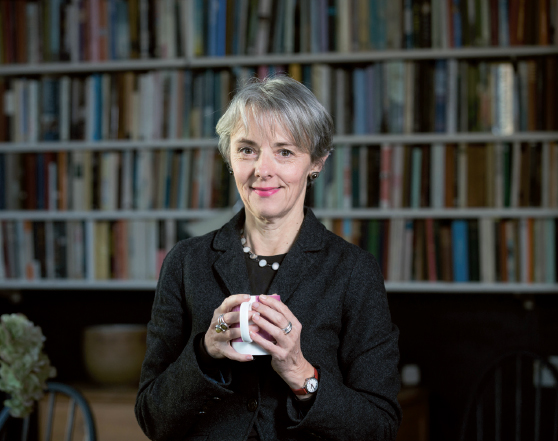
LUCY KELLAWAY, FORMER JOURNALIST WITH THE FINANCIAL TIMES TURNED SECONDARY SCHOOL TEACHER, WHO WRITES A LOT ABOUT THE ABSURDITIES OF WHITE-COLLAR LIFE.
Another lesson from Lucy35 concerns the rewards she found in a particular job, as backed up by many books and studies on how to find meaning in the workplace. She came home from work one night and sat on a beloved antique chair, which had been left to her by an aunt. To her horror, the chair collapsed, and she fell on the floor. Because the chair was so important to her, she decided to try and fix it herself. It took her months. She had to obtain all the special materials. She tried to source materials from chairs of a similar vintage to maintain authenticity. She had to learn all kinds of new skills, from stuffing a chair with hessian to how to hammer in special nails to secure the leather seating. She had to learn how to varnish and preserve wood, and clear any woodworm from the old wood that was in the chair. It was tough and she almost gave up on occasion. At the end of it, she had fixed her chair, and had somewhere to sit. She felt a major sense of accomplishment and could enjoy her cup of tea.
So why did this activity, which involved such hard work, bring such satisfaction? She says there were three crucial elements. First, she had autonomy. She could decide when and where she would work on the chair. She could choose the material. Second, she had mastered a new set of skills. Mastery turns out to give us huge satisfaction. In the workplace, we will hopefully have gone through an elaborate education and mastered a set of skills whether by learning things of use or skills with our hands. Mastery is a key element of all jobs. And third, she had a purpose: to have something to sit on. This broader purpose brought a whole new dimension. It wasn’t just about sanding wood or spending forever banging tiny nails into wood. It was about fixing a valuable thing. It was also about losing yourself in a task, which she found was often the case while fixing the chair. This is where we achieve what psychologists call ‘flow’. It’s an important goal for our overall mental health. When we achieve flow, we stop worrying about the kids, or the bills we have to pay, or why a colleague is trying to undermine us.
So there you have it. If your job has these three features: autonomy, mastery and purpose, you won’t go far wrong. A key feature is for the worker to have some measure of control and power, otherwise they will be unhappy. (It must be emphasised, though, that even though people might feel unhappy in work, unemployment is far worse and engenders greater misery.)36
Luckily, my own job (although I don’t call it a job) as an academic and scientist involves all three features. I can choose to spend my time among multiple different tasks, from teaching to scientific research. I have a degree in biochemistry and a PhD in pharmacology, which required mastery of both subjects. My purpose is clear: to inspire the young for their own and, hopefully, society’s benefit, and to make meaningful scientific discoveries that might lead to new medicines for inflammatory diseases. This is why you’ll sometimes find me on the night shift until 2 a.m., or spending endless time in airports on my way to meet other scientists or to give lectures. Or writing books like this – because I love to communicate science, too. The bottom line: you can avoid or escape a bullshit job and lead a full and rewarding life. And won’t that make your time on earth worth the hassle? And who knows, the COVID-19 pandemic might change our working lives and how we view different jobs forever – and for the better.
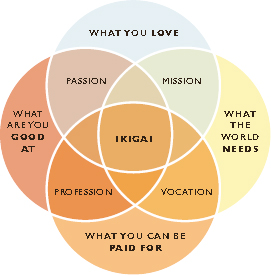
IKIGAI IS A JAPANESE TERM MEANING ‘A REASON FOR BEING’. IT’S A COMBINATION OF DOING SOMETHING THE WORLD NEEDS, THAT YOU LOVE, THAT YOU ARE GOOD AT, AND THAT YOU GET PAID FOR. IF AN INDIVIDUAL HAS IKIGAI, THEY WILL TAKE SPONTANEOUS AND WILLING ACTIONS WHICH WILL GIVE THEIR LIVES MEANING.