

CHAPTER 12
–
‘If you do good, people will accuse you of selfish ulterior motives. Do good anyway.’
–
The Paradoxical Commandments by Kent Keith
IGIVE TO CHARITY from time to time. Sometimes I’m guilted into it. Sometimes I do it because a friend involved in a particular charity asks me. Sometimes it even makes me feel good. But why don’t I give away lots of my money, keeping just enough back for my family and me to live a modest life? I could do that, and yet I don’t. Why not?
The fact is that the world is badly divided. Half of the world’s net worth belongs to 1 per cent of the world’s population.1 Or how about this fact: the collective net worth of the world’s poorest half (3.6 billion people) is equivalent to that of just eight of the world’s wealthiest men – 8 = 3.6 billion.2 Possibly the world’s most unequal equation. Or this fact: the top 10 per cent of adults hold 85 per cent of all the wealth, with the other 90 per cent holding the remaining 15 per cent.3 Nothing much seems to have changed over thousands of years, except perhaps during the occasional revolution. A tiny minority has held all the riches and lorded it over the peasants. How can this be? Why don’t the top 1 per cent give up much of their wealth and spread the money around more evenly, especially when they know that many millions of people are suffering from poverty? And what about those of us who have more money than we need to maintain a good standard of living? Why don’t we give up a lot of that wealth to others? Are we innately greedy or are we fearful of becoming poor or sick? Or is there something else going on? What can we do to redress this major inequality that exists in our world?
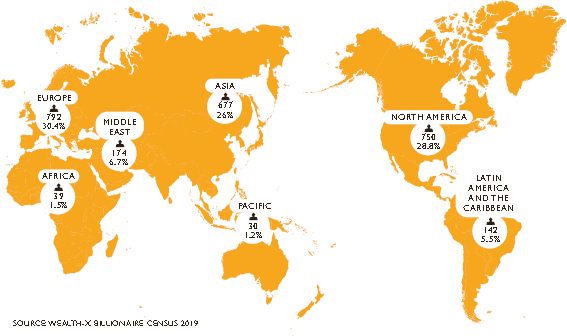
NUMBERS OF BILLIONAIRES IN DIFFERENT PARTS OF THE WORLD, AS OF 2019.
Let’s examine the numbers a bit more closely. First, the super-wealthy. According to the Wealth-X Billionaire Census 2019 (now there’s a list to be on), there are currently 2,604 billionaires in the world.4 A billionaire has a net worth of at least $1 billion – a thousand million dollars. Over 25 per cent of them live in the US, which hosts 705 of them. China has the next biggest proportion with 285. Germany comes next with 146. The report has found that since 2018, the combined wealth of billionaires dropped by 7 per cent to a measly $8.6 trillion. Some of these people are so rich that a new number had to be coined to capture how much money they have; Jeff Bezos, who founded Amazon, hit a net worth of $112 billion in 2017 and is now known as a ‘centibillionaire’. And all because he invented a delivery service. He is currently the richest person in the world, overtaking Microsoft’s Bill Gates, who held that title for a number of years. However, he’s not the richest person of all time. That title goes to oil magnate John D. Rockefeller, who became a US dollar billionaire in 1916, which makes him history’s wealthiest person if we adjust his wealth to today’s money.

JOHN D. ROCKEFELLER (1839– 1937), AMERICAN BUSINESSMAN AND PHILANTHROPIST. HE IS WIDELY REGARDED AS THE WEALTHIEST AMERICAN OF ALL TIME. HE WAS THE FIRST MODERN PHILANTHROPIST, FUNDING MEDICINE, EDUCATION AND SCIENTIFIC RESEARCH.
Ninety per cent of billionaires are men, but the trend for billionaire women is on the up. In the last five years, the number of female billionaires has grown by 46 per cent, which is more than the growth in male billionaires in that period, which stands at 39 per cent.5 There are now 233 female billionaires in the world, up from 160 in 2013. Only 11 billionaires are of black African ancestry, the wealthiest being Aliko Dangote, a Nigerian businessman with multiple business interests, who is worth $8.9 billion. Oprah Winfrey is also on the list with a net worth of $2.7 billion.
There are a lot of metrics when it comes to measuring billionaires, and it is a topic of endless fascination for many. I wonder why? One interesting aspect is which universities produce the most billionaires.6 The US again dominates this list: Harvard has provided 188, followed by Stanford with 74. In fact, all of the top ten billionaire-producing universities are US-based. It’s no coincidence that 39 of the top 100 universities in the world are in the US, according to The Times Higher Education World University Rankings 2020. Graduates in the US give a lot of money back to their universities. In 2018 Harvard received $1.42 billion in donations. Stanford came next with $1.10 billion. In 2018 Trinity College Dublin announced a donation of €25 million from the Naughton family, the single largest philanthropic donation in the history of Ireland. Irish universities need more Naughton families.
As of 2019 there are nine billionaires in Ireland.7 Number one is Pallonji Mistry, an Indian-born Irish construction tycoon with a net worth of $14.4 billion. He became an Irish citizen after marrying Irish national Patsy Dubash, and he lives in Mumbai. Hilary Weston is at number two and is worth $8.6 billion. She was born and raised in Dublin and married Canadian Galen Weston in 1966, who made his money in the food industry. American-born John Grayken comes in at number three and is worth $5.9 billion. He is chairman of private equity firm Lone Star Funds and in 1999 became an Irish citizen for tax purposes. (Welcome, John, and make sure to pay your taxes.)
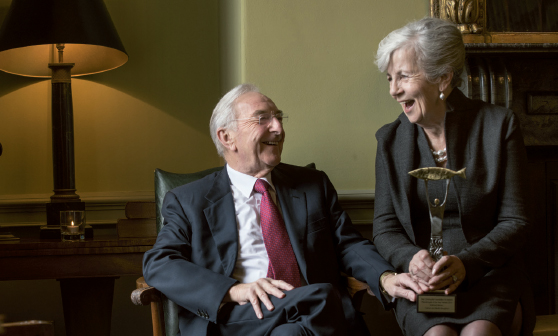
MARTIN AND CARMEL NAUGHTON HAVE MADE NUMEROUS PHILANTHROPIC DONATIONS TO MANY CAUSES, INCLUDING SUBSTANTIAL DONATIONS TO TRINITY COLLEGE DUBLIN. IN 2016, HE AND CARMEL WERE NAMED PHILANTHROPISTS OF THE YEAR BY THE COMMUNITY FOUNDATION OF IRELAND.
As for millionaires, there are just over 47 million of them in the world, with the US again dominating with 18.6 million millionaires.8 This number is difficult to estimate, though, as it includes assets such as property. In 2019 the number of Irish millionaires rose to 78,000, an increase of 3,000 on the previous year mainly due to increasing asset and property values.9 Of these, 1,029 have more than $30 million, which places them in the ‘ultra-high-net-worth individual (UNHWI)’ category.
So where did these people get their money?10 Globally, for men, 62 per cent are self-made, which mainly includes entrepreneurs who set up their own businesses, 7.9 per cent inherited their wealth and 30.1 per cent are a combination of the two. For women, the difference is remarkable – 16.9 per cent are self-made, 53.3 per cent inherited their wealth, and 29.6 per cent are a combination. These percentages will change as we see more female entrepreneurs enter the list. As we move down the scale to millionaires, we see that there is a range of reasons for how people manage to accumulate wealth. In western countries, entrepreneurship has been shown to account for three-quarters of new millionaires. Other ways to become wealthy include pursuing a career with the end goal of becoming what is called a C-level executive in a company, such as a Chief Executive Officer (CEO), Chief Operating Officer (COO) or Chief Financial Officer (CFO). People who become a leading professional in a specific field or a top corporate salesperson often become millionaires. Only around 1 per cent of new millionaires become wealthy by other means, such as sports, show business or in the arts. It is rare to become wealthy in these fields of endeavour. So, it can be concluded that becoming a billionaire is extremely rare; becoming a millionaire less so, but it is still uncommon in the general population.
Now let’s examine people giving their money away. We enter the world of philanthropy. This is defined as the desire to promote the welfare of others, especially by the generous donation of money to good causes. Another definition is private initiatives for the public good, focusing on quality of life. It is somewhat different from charity, which aims to relieve specific social concerns. Philanthropy seeks to address the root cause of a problem. The difference is captured in the well-known metaphor of giving a fish to a hungry person as opposed to teaching him how to fish. Philanthropists generally teach a man to fish, if you know what I mean.
First, the good news. There has been an upward trend in philanthropic activity over the past decade, which correlates with the increasing number of billionaires. The Wealth-X Billionaire Census has concluded that this is also due to increased awareness of global environmental and social issues, ‘consternation over rising inequality’ and a more diverse and multi-generational billionaire population. Nice to read that some billionaires, at least, are feeling consternation. The numbers show that globally the top 20 billionaires donated 0.8 per cent of their total wealth in 2018.11 Not much, is it? Some give discreetly for personal, cultural or religious reasons. More than half, though, are involved in philanthropic giving either through organisations that they themselves have established or by other means. Thirty-five per cent of them have their own charitable foundations.
When we examine where the money goes, we see some interesting trends.12 Education comes out tops. Two-thirds of billionaires give money to scholarships, educational support, outreach programmes and teacher training, and, in total, 29 per cent of all billionaire donations go to education. This is because it’s a major way in which education is funded in the US. Healthcare comes in next, with 14 per cent of donations. Ten per cent goes to arts, culture and sports, and 8 per cent is donated to environmental issues (one has to wonder if that figure will increase with the recent major increase in awareness of climate change). Finally, 5 per cent goes to religious organisations.
An interesting development in the world of philanthropy occurred in 2010 when Bill and Melinda Gates and Warren Buffet (then the world’s number one and number two in terms of wealth) started the Giving Pledge initiative.13 The aim of this campaign was to get wealthy people to donate at least half their wealth, in their lifetime or in their will, to charitable causes. Initially, 40 people signed up, all in the US. As of April 2020, the number rose to 209, from 23 different countries. This translates into a total pledge of $600 billion by 2022 – not bad going, provided it happens.
According to its website, the Giving Pledge was inspired by the example set by ‘millions of people at all income levels, who gave generously – and often at great personal sacrifice – to make the world better’. This is an interesting statement as it suggests that what Gates is trying to do is guilt the hugely wealth into giving more. If poorer people can do it, then you should too. The organisation aims to ‘shift the social norms of philanthropy among the world’s wealthiest people and inspire people to give more’. The pledge recognises that the challenges the world faces are highly complex and need input from governments, non-profits, academic institutions and businesses. It aims to act as a catalyst to promote investment in areas that governments and business can’t or won’t fund. But it has its critics: it’s a ‘moral’ rather than a ‘legal’ pledge, so no one is actually obliged to give any money. Attention has also been focused on the size of the pledge rather than what it will go towards. It’s yet another attempt to convince rich people to part with their money for the greater good, and it may well work.

BILL AND MELINDA GATES AND WARREN BUFFETT STARTED THE GIVING PLEDGE INITIATIVE, WHICH AIMS TO CONVINCE THE WORLD’S WEALTHIEST PEOPLE TO GIVE HALF OF THEIR WEALTH IN THEIR LIFETIME TO CHARITABLE CAUSES. BY 2020, OVER 200 PEOPLE HAD JOINED THE PLEDGE, WHICH WILL RESULT IN A TOTAL DONATION OF $600 BILLION, PROVIDED THE BILLIONAIRES ALL COUGH UP.
Encouraging people to give money to charitable and philanthropic causes has, of course, a long history. The word ‘charity’ originated in late Old English and meant ‘Christian love of one’s fellow’. It, in turn, comes from the Latin ‘caritas’, which describes a particular form of love for your fellow humans. Charitable giving was an act or duty in several religions and was referred to as almsgiving or tithing. A tithe was defined as one-tenth of something (usually income but also goods), to be given to a religious organisation or government. Traditional Jewish law included tithing, and Orthodox Jews still give one-tenth of their income to charity, as do Mormons. In Christianity, Jesus taught ‘tithing must be done in conjunction with a deep concern for justice, mercy and faithfulness’. The fact that 10 per cent was a suitable amount to give is interesting – perhaps not too much to put people off or encourage them to evade giving, and not so little that it wouldn’t make much difference to the cause being supported. In medieval Europe during the twelfth and thirteenth centuries, rich people built hospitals for the sick and poor. Religious orders were founded, whose main mission was to engage in charitable works. The first children’s charity was established in England in 1739 by Thomas Coram of the Foundling Hospital, which looked after ‘unwanted orphans’. Another noted philanthropist of that era, Jonas Hanway, established The Marine Society, for seafarers down on their luck, and the Magdalene Hospital, which aimed to help prostitutes. In the nineteenth century we see the emergence of campaigners, notably William Wilberforce, who championed the cause of the abolition of slavery. By 1869 there were over 200 charities in London, with a combined income of £2 million.14 A sample of 466 wills in the 1890s revealed a total wealth of £76 million, of which £20 million was left to charities.

THE IVEAGH TRUST WAS ESTABLISHED IN 1890 BY EDWARD GUINNESS, FIRST EARL OF IVEAGH, WITH A DONATION OF £200,000.
Philanthropy starts to take off with a vengeance from the late 1800s, a notable example being the Guinness Trust. It was founded in 1890 by Edward Guinness, 1st Earl of Iveagh, the great-grandson of Arthur Guinness himself. He donated £200,000 – the equivalent of £25 million in today’s money.15 This initiative included The Iveagh Trust in Dublin, which aimed to provide affordable housing in and around Dublin. As of 2018 the Guinness Trust owns and manages around 66,000 homes and provides services to more than 140,000 people in the UK and Ireland.16
How much is currently being given by philanthropy? The US has the best statistics on donations.17 In 2018 Americans gave $427.71 billion, an increase of 0.7 per cent on 2017; $290.84 billion of this came from individual philanthropists, followed by $75.86 billion from foundations, with $39.71 billion coming from bequests. Corporate giving in 2018 was $20.05 billion, a 5.4 per cent increase on 2017. There are currently 1.5 million charitable organisations in the US. In Ireland, registered charities (which number around 10,000, and include hospitals and universities) raised €14.5 billion.18 Government and public bodies are the primary source of this income, accounting for €7.7 billion of funds raised. Hospitals received €3.1 billion and universities just under €3 billion. Because the government is the main source of funding, this doesn’t really count as philanthropy. Half of the registered charities had an income of less than €250,000.
Historically, the largest philanthropic donations in Ireland by far have been made by Atlantic Philanthropies,19 a private foundation created in 1982 by Irish-American businessman Chuck Feeney. Its main goal is to provide funding for health, as well as socially and politically liberal causes. In 1982 Feeney transferred all his assets and the entire ownership of his company, Duty Free Shoppers, to Atlantic Philanthropies. For the first 15 years of its existence, these donations remained anonymous. The total amount of money given by Atlantic Philanthropies to date is $7.5 billion – that is a remarkable amount to come from just one person. Over $1 billion was invested in third-level education in Ireland, including major donations to the University of Limerick, Dublin City University and Trinity College Dublin. This funding had the effect of leveraging a further $1.3 billion from the Irish government for the third-level sector in Ireland – a striking achievement. The investments are considered an important part of the stimulus that happened in the Irish economy in the 1990s. That one philanthropic foundation could have such an impact on a whole country is an example for others to follow. Other funding included a donation of $11.5 million for political advice to the Gay and Lesbian Equality Network. In 2015 Atlantic donated $177 million to University of California San Francisco and Trinity College Dublin to create the Global Brain Health Institute, which aims to stem the rise in dementia by connecting researchers and physicians in this area.

CHUCK FEENEY, AN IRISH-AMERICAN BUSINESSMAN AND PHILANTHROPIST. HE FOUNDED ATLANTIC PHILANTHROPIES, WHICH HAS DISTRIBUTED MORE THAN $7.5BN.
The big question that arises from philanthropic donations (and indeed all charitable donations) is how to determine the impact of the donations being made. Atlantic Philanthropies may be one of the best examples, where a clear impact on the Irish education system can be seen, which has paid dividends for Ireland and indeed the rest of the world. A recent analysis has concluded that philanthropists are effectively ‘flying blind’. An example of this is Facebook co-founder Mark Zuckerberg’s $100 million donation towards building new schools in Newark, New Jersey, which has been accused of achieving little – $20 million of the $100 million went to consultants.20 Teachers and parents became resentful over what was being proposed and the end result was less investment in public schools in Newark, with teachers actually being laid off. So what has been proposed is a ‘science of philanthropy’ to examine the best way for philanthropists to fund projects or initiatives.21
The Centre for Effective Philanthropy, which is based in Cambridge, Massachusetts, has recently reported that the time spent on preparing and then managing ten grants of $10,000 each is six times as long as the time spent on one grant of $100,000.22 The London-based consultancy firm nfpSynergy examined UK charities and found that the charities value £2 of unconditional funds (meaning that the money is given with no strings attached) as the same as £3 of conditional funds (meaning that the money is given to a charity with conditions attached). The Shell Foundation has found that three times as many of its grants succeeded when it was involved in creating and managing the work, rather than when it came from someone who sent in an application for funding. Another important question for funders is how big a grant should be. A study on the impact of arthritis research found that large grants were no more effective than small ones. This may be because smaller grants fund a more diverse range of projects.
The unrelenting question if you’re a philanthropist becomes: how do I know my money is achieving the goal I want? To give them credit the eight wealthiest men whose wealth equals the 3.5 billion poorest people are actually mega-philanthropists, funding billions of dollars’ worth of medical research, public health, education and a range of humanitarian causes. They include Bill Gates, who as of 2019 had donated $35.8 billion worth of stock in Microsoft to the Gates Foundation,23 Mark Zuckerberg, who with his wife Priscilla Chan has pledged to give 99 per cent of their Facebook shares (which at current market value equals $48 billion) to the ‘cause of human advancement’24 and Jeff Bezos, who gave an estimated $2 billion to launch the Bezos Day One Fund, which aims to help homeless families and support pre-schools in low-income communities.25 Bezos has yet to join the Giving Pledge. Health issues are squarely in the sights of these mega-rich people. A large proportion of the Gates money has been spent on vaccine development and global health. Zuckerberg has set aside $3 billion to ‘cure, prevent or manage’ disease. Michael Bloomberg, American businessman, politician, philanthropist, and author has allocated $1 billion to decrease smoking and traffic deaths.
One interesting development is the age at which the mega-rich become rich. It used to be old guys who gave their money away, be it John D. Rockefeller or Andrew Carnegie. But now we have Mark Zuckerberg, whose donation will exceed that of Rockefeller, Ford and Carnegie combined. Zuckerberg is 35 years old. John D. Rockefeller only set his foundation up when he was 76, and Andrew Carnegie opened his first library when he was 68. All of this seems good: lots of money being invested into good causes, and quickly. But there is criticism, especially in the US where previously, governments used to collect billions from the wealthiest people and then democratically redistribute the money. This is less and less the case. We now have a scenario where the wealthiest pay much less tax than before and then donate their money as they see fit, in an essentially undemocratic manner. There is no clear way to assess whether the money is being spent effectively or on the right things, which has led to a call in the US to rein in the mega-billionaires and go back somewhat to the old way of doing things: tax them and redistribute the wealth that way.26

JEFF BEZOS HAS MADE SO MUCH MONEY THAT A NEW TERM TO DESCRIBE HOW RICH HE IS HAD TO BE INVENTED: CENTIBILLIONAIRE.
And yet there are remarkable success stories, such as Atlantic Philanthropies and the Irish education system. Another is a project funded by the Gates Foundation in 2001,27 which gave $70 million to the global vaccine organisation PATH and the World Health Organization over a ten-year period in order to develop a vaccine for meningitis A and make it affordable for everyone who needs it. A successful vaccine was developed at a cost of 50 cents per dose and by 2013, less than a decade after a meningitis outbreak had killed 25,000 people (mainly young people), four cases have been reported. The reason this succeeded is because of the sustained funding (there are many setbacks in research and long-term funding is key) and a hands-off approach by the Gates Foundation. Give money to the experts and let them get on with it.
Whatever about the high-net-worth individuals giving money away, what about the general public? A lot of work has gone into examining what it is that people need in order to give to charity and reasons why they don’t.28 Understandably, the first concern people have is to themselves and their own families. People might worry about saving money for their children’s education (especially in the US) and, increasingly, their own retirement. In Ireland, a recent survey demonstrated that over 80 per cent of people worry about their own financial security in retirement.29 Only one in six are confident about being financially sound when they retire. This is a higher level of confidence than in other European countries, which could be because of the relatively high state pension in Ireland. This currently stands at €238 per week, as opposed to €126 per week in the UK, for example. Fear of financial troubles in retirement impedes people from giving to charity.
People also think that any donation they make will be too small to make a difference, or that the money they give will be misused in some way. Charities make a great effort in stating how much bang donors will get for their bucks. In 2018 an analysis was made of those charities that benefit the most from donations.30 Charity recommenders such as GiveWell, Charity Navigator and GuideStar rate charities in terms of which of them will use the money you give most effectively and who has the highest funding needs. Top of the list was the Malaria Consortium, which helps provide anti-malarial medication to children. Malaria is seen as a key issue to solve in Africa because it is the single biggest drag on the African economy. Why was that particular charity singled out? It has a clear goal: to distribute preventive anti-malarial drugs to children age 3–5 years during the high transmission season. There is substantial evidence that this charity makes a major difference, with 95 per cent of children receiving at least one month’s treatment. The charity specifies that $6.80 provides four months of treatment to a single child. GiveWell were also of the view that further investment would have a massively beneficial effect on the Malaria Consortium. Second on the list was the Against Malaria Foundation, which provides insecticidal bed nets in Africa and Papua New Guinea: $4.59 will buy an anti-malarial bed net, which will protect two people for three years.
In 2016 The Irish Times analysed where money given to various Irish charities ended up.31 Charities had been getting something of a bad press in Ireland. Misappropriation of funds by staff had become a concern and Charities Institute Ireland was launched in 2016 to promote best practice and restore public trust in the sector. A key issue was how much of the money people gave actually went towards direct activities. The charity ALONE, which helps older people, was found to give 100 per cent of what was donated to frontline services. Oxfam Ireland was found to put 80 cents of each euro donated towards easing poverty around the world. Concern, which also fights poverty, was also found to perform well, with 91.1 cent of every euro donated going directly towards charitable works. Other charities didn’t perform as well using this metric. In the UK, a similar and rather damning report revealed that of more than 5,000 charities surveyed, one in five were spending less than 50 cent per euro on charitable work.32 This metric has been criticised, though, as some charities have to spend a proportion of their income on fundraising efforts – this can include running shops, which comes with an overhead.
Global charities that aim to help relieve poverty in the developing world face many challenges.33 People often feel it’s the responsibility of governments more than charities. This led the United Nations to launch, in 2000, the United Nations Millennium Development Goals, which asked the governments of all developed nations to allocate 0.7 per cent of gross national income to overseas development assistance.34 Only five countries have reached this goal: Denmark, Luxembourg, the Netherlands, Norway and Sweden, with the UK and Finland almost hitting the target. The argument goes that individuals in each country can make up the difference by donating. A number of goals were established and there has been progress on several, although this varies from country to country. A major goal reached was to halve the proportion of people in the world living on less than $1 per day, which was achieved in 2008 and continues to see improvement. Since 2015, the aims have been refocused and gender equality is now a key underpinning objective for all of the goals. Other barriers to people giving to global charities include a perception that aid makes countries depend on foreign resources and that giving leads to overpopulation. Arguments are made against both of these points, with a partnership model between charities and governments being important (for example, the Bill and Melinda Gates Foundation often leverages government funding when it invests in projects) and clear evidence that economic development actually lowers the birth rate. Educating girls to as late an age as possible has been proven to lower the birth rate.35
To turn the question around: why do people give? A major recent study has pulled together 500 studies in order to examine the key factors that drive giving.36 For 85 per cent of donations, the main reason for giving was ‘I was asked.’ This reason might seem obvious enough, but it doesn’t answer why the donor chose to say yes to a specific charity. Most people give to affirm important personal values, which include compassion to those in need. Donors also report that giving makes them feel good, or makes them look good in the eyes of others. In one study of 819 Americans who had given to charity in the previous month, five main reasons emerge, which have been given the acronym TASTE.37 First, trust: the donor has to trust the charity they are contributing to. Second, altruism: the need to help others. Third is social: donations should matter to someone the donor knows and cares about – for example, you might know someone who has a disease, so you support research into that disease; or someone invites friends to a fundraising event and there is a collective donation. Tax is fourth: if people get a tax break, they are more likely to give. Many governments provide tax relief for donations to charities. In Ireland, the Charitable Donation Scheme allows charities to claim back tax paid on a donation of over €250. The fifth and final reason is egotism: people want to feel a personal benefit, say, by looking good in the eyes of others. Overall, though, people are more likely to be motivated by helping others rather than getting something back.
What might the future for philanthropy and charitable giving look like? The trend for philanthropy looks good, with an upward trend evident, but this will depend on the state of the global economy. Yet again, COVID-19 might have changed things. The billionaires of the world are giving lots of money to projects related to COVID-19. According to Forbes magazine, 77 of them gave often undisclosed but substantial amounts.38 Jack Dorsey, CEO of Twitter, gave $1bn. Bill Gates committed $105 million. Even Donald Trump has given $100,000. They appear to be stepping up.
Yet for charity overall, some disturbing trends are emerging. In the UK in 2019, the proportion of people saying they had given to charity had dropped from 61 per cent to 57 per cent over a three-year period.39 When this was investigated, one reason was a decrease in charities directly asking for donations because of GDPR legislation lowering the rates of direct mailing, which charities had heavily relied upon. On a brighter note, there was an increase in legacies and community fundraising initiatives. Digital engagement is also on the rise, which should help. Giving will fluctuate but will hopefully continue and grow in the future.
Through history there have been numerous critiques of charity, which persist today. One thing Oscar Wilde was well known for (other than his poetry and plays) was an essay he wrote entitled ‘The Soul of Man Under Socialism’. In it, he calls charity ‘a ridiculously inadequate mode of partial restitution, usually accompanied by some impertinent attempt on the part of the sentimentalist to tyrannise over the poor’s private lives’. He was of the view that charity prolongs the ‘disease’ of poverty, rather than curing it. Oscar got it wrong, although perhaps one of his goals was to urge governments to do more. What else should rich people do with their money other than help humanity? And the same applies to all of us. Bottom line: give what you can and pay your taxes as an act of philanthropy. As a famous good guy once said, ‘For it is in giving that we receive.’