
CHAPTER 1
–
‘We operate on autopilot and end up, whatever, with a house and family and job and everything else, and we haven’t really stopped to ask ourselves, “How did I get here?”’
–
David Byrne on his song ‘Once in a Lifetime’
YOU PROBABLY THINK you’re reading this book because you chose to. You probably think you’re free. You move through your life weighing up options and deciding what to do. Which football team will I support? What career will I pursue? Will I get married? Will I try for a baby? Will I drop out, wear a nose ring and promise myself never to own a lawnmower?
On the face of it, we seem to go through life in control of our own destinies. And yet, when you scratch the surface, it’s not quite so simple. For instance, there may be a parasite in your brain controlling your behaviour. Or if conspiracy theorists are to be believed, you’ve been controlled since childhood to ensure you end up a productive tax-paying citizen. Certainly, you are being played by social media, but then you know that, don’t you? The truth of the matter is your life is governed not so much by the stars but by random statistical fluctuations in a universe that is cold and unthinking. Or by Google. Cheering, isn’t it? And look what happened with COVID-19. That particular bundle of random statistical fluctuations put paid to so many of your plans. But it’s not too late – we will win the war against it and you will be able to take back control of your life and be truly free. Won’t you?
Free will is an important concept in western civilisation. It’s defined as the ability to choose between different options unimpeded. Many philosophers have tied themselves up in knots debating it. In some ways, it is the central question of philosophy.1 Some contemporary philosophers gloomily complain about how little progress has been made on the issue over the centuries. Maybe philosophers have lost the (free) will to explore it further. We all have a strong sense of freedom, which makes us intuitively believe that we have free will. Spinoza felt that we are conscious of our actions (and interpret this as free will) but are unconscious of the causes by which our actions are determined. Also, if prior conditions determine everything that happens to us, then our future can be predicted with accuracy – we have no control over our future at all. Is it all predetermined? See what I mean by philosophers being troubled by all of this?
If you grew up in a stable family, with a parent who had a professional occupation, and if you are sent to a certain type of school and then on to a reputable university, all of these pre-conditions will most likely lead to you having a professional occupation and living a life predetermined by the circumstances you grew up in. If you are part of a religious community with strict laws, say, the Amish community in the US, then you will grow up to lead a life consistent with those laws. You will marry another Amish person. You will never own a car. On average, no free will. Some religions believe that we live in a world that is predetermined or predestined, where all events are determined in advance. Lutherans believe that Christians live a predetermined life, with salvation after you die being predestined for those who seek God. Calvinists take a more extreme view. They believe that God picked those who will be saved before the earth was even created. Hard luck if your soul wasn’t picked – you might live a blameless life, but you still won’t make it.
The German philosopher Friedrich Nietzsche, hero to many a disaffected teenager, didn’t believe in free will at all and, judging from his writings, was annoyed by the range of teachings on the matter.2 He put free will down to the pride of man (he didn’t say much about women). He called the whole idea of free will ‘crass stupidity’. Even though he declared ‘God is dead’, he wrote about how free will absolves God (if there is one) of responsibility when humans misbehave: if humans are free, they can be deemed guilty by God if they sin. Nietzsche was also a fan of chance. He was of the view that much of what happens to us is governed by chance, as opposed to us deciding things. One of his big arguments was that ‘if both humans and God actively will good things to happen, why is evil a constant in the affairs of man?’ This question then led him to ask: where is this ‘freedom of will’ and why aren’t we doing more with it?

FRIEDRICH NIETZSCHE (1844–1900), GERMAN PHILOSOPHER AND HERO TO TEENAGERS EVERYWHERE, WHO SAID, ‘GOD IS DEAD’ AND ‘TO LIVE IS TO SUFFER’. HE ALSO SAID, ‘WITHOUT MUSIC, LIFE WOULD BE A MISTAKE’, REVEALING THAT HE HAD NEVER HEARD JUSTIN BIEBER.
And so, science enters the fray. Physicists are all about laws of nature – everything in nature can be predicted based on these laws. So all subsequent events, even those involving us humans, should be wholly predictable from first principles if we know the rules of the game: this was one of Newton’s great insights. Science allows you to predict the future if you know the prior conditions. If you fire a cannonball of a particular weight, with a particular force, you can predict, using equations, exactly where it will land after you’ve fired it. The ability to predict what will happen (usually using mathematics) gave science primacy for many people. One problem is that in the spooky quantum world, predictions are made based on probabilities. This counters the notion of things being fully deterministic. Some philosophers have suggested that the quantum world and free will are somehow entangled, but trying to explain that is well above my pay grade. And some physicists believe in parallel universes, where every decision leads to two alternative universes.3 So why worry? You’re living multiple alternative lives somewhere else.
Neuroscientists have studied what it is that makes people make decisions and take action and agree that – guess what? – free will does not exist.4 A good illustration of this conclusion was an experiment performed in the 1980s by neuroscientist Benjamin Libet.5 He asked people to choose a random moment to flick their wrist while measuring electrical activity in their brains. Specifically, he measured something called ‘the readiness potential’, which is brain activity in the lead-up to a voluntary muscle movement. It was well known that the readiness potential could predict the subsequent physical action (in this case, the wrist flick). Libet wondered if he could record this activity before the conscious intention to move. He asked the subjects to record the time when they felt they were about to move (as in, when they became conscious of the move that they were about to make). He noticed that brain activity preceded the conscious awareness that a movement would be made: the person’s declaration of intention to move occurred after the brain had decided to move, which the person wasn’t aware of. The person thought they were making a decision to flick their wrist (and to exert their free will), but the movement was being controlled subconsciously. How this subconscious control might extend into other behaviours is not known, and although both the design of the experiment and the interpretation are controversial, it remains a fascinating experiment.
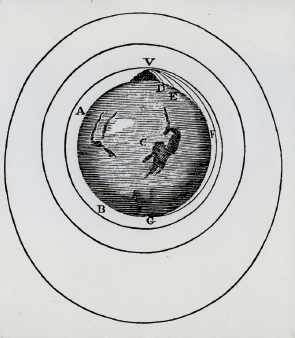
‘NEWTON’S CANNONBALL’ WAS A THOUGHT EXPERIMENT THAT ISAAC NEWTON USED TO SHOW THAT IT MIGHT BE POSSIBLE TO FIRE A CANNONBALL SO FAR THAT IT WOULD NEVER LAND, INSTEAD GOING INTO ORBIT AROUND EARTH.
Does the Libet experiment extend to social engagement? Say you’re in a bar and see someone you like the look of and engage them in conversation: you think you’re making a decision to approach them for a chat and take the matter further, but perhaps your brain just fired a readiness potential. So it’s not you that makes the decision at all; it’s your brain. This is a hot topic in neuroscience, and the jury is still out because of issues with the design of some experiments.6
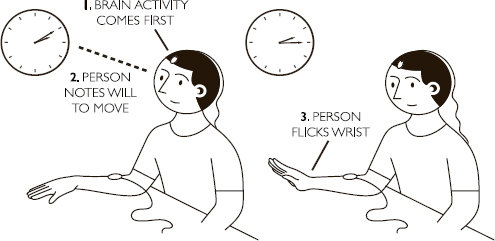
BENJAMIN LIBET’S EXPERIMENT ON FREE WILL. BRAIN ACTIVITY PRECEDES THE PERSON’S AWARENESS THAT THEY ARE ABOUT TO MOVE.
We spend much of our adult lives working in jobs we don’t want to do and wasting our money buying things we don’t need. We eat way too much even though we know that half the world is starving. If free will were real, surely we would make better decisions? How we make decisions is governed by a complex mix of external events and our own internal world. The mixture of influences on us is vast – chief among them are our evolved natures, our genetics, our hormones, how we were raised as children and the kinds of things we were exposed to and maybe even whether we have recently eaten. A Swedish study demonstrated that a hormone called ghrelin, produced by the digestive system when the stomach is empty, makes rats much more impulsive.7 Studies have also shown that when we are hungry, we are inclined to make decisions that will lead to instant gratification, rather than weighing up the situation and making a decision based on a long-term gain.8 You might think to yourself, ‘I am making this decision by using my free will’ whereas you are actually making it because you are hungry and ghrelin is making you change your behaviour.
Psychologists advise that before making a decision, you should keep a few things in mind. First, sleep on it: this will give added perspective. Second, never make a decision if you are feeling overwhelmed or low in energy: these feelings often give rise to a decision you will later regret. Third, it’s probably best to make a decision on a full stomach.9 And then there is the Irish proverb ‘A man should never make a decision without consulting a woman.’ Another version might be ‘without consulting a scientist’. My wife Margaret is an outstanding biochemist. I often consult her on scientific issues (smart of me, huh?). Science tries to provide clarity for decision-making by using statistics, verifiable sources and conclusions based on evidence. Compare this to politicians, who might just write something on the side of a bus.
So even when we decide to act on something, the decision might be governed by how hungry or tired we are. But what if there were a parasite in your body controlling you? Toxoplasma gondii is a common parasite in cats,10 and fascinating to microbiologists. It infects the brains of many species, including humans, all over the world, but cats are the only animals that can support the sexual stage of the parasite. To Toxoplasma, the cat is the love shack. Once a person or animal is infected (from the faeces of the cat, or from eating an infected animal), the parasite can remain in the host body for life in the form of latent cysts. These cysts are found in the brain, heart and muscle. When mice become infected, something curious happens: their behaviour changes dramatically. They become more reckless and are actually attracted to the smell of cats, which usually ends badly for the mouse. Darwin would love this example – a complex interplay between three species: cat, mouse and parasite. The mouse’s behaviour has been modified by the parasite in order to promote transmission to the cat and also provide a tasty snack.
Humans infected with Toxoplasma are more prone to outbursts of aggression.11 Those with a latent infection also do better in cognitive tests.12 The level of infection also differs between countries: around 7 per cent of Irish people are infected, whereas 67 per cent of Brazilians are.13 Might this make Brazilians more hot-headed? Men and women also respond differently to the infection: men become less risk-averse but more dogmatic, while women become more outgoing.14 Yet again, you might think what you’re doing is based on your own free will, but in reality, you are the pawn of a parasite in your brain.
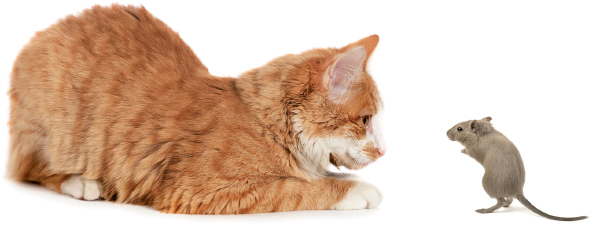
MICE INFECTED WITH THE PARASITE TOXOPLASMA BECOME ATTRACTED TO CATS. THE PARASITE THEN JUMPS INTO THE CATS, WHERE IT CAN REPRODUCE. DO HUMAN CAT-LOVERS HAVE PARASITES CONTROLLING THEM?
Or maybe a pawn in a world governed by statistical probability. When something happens to us, we often say ‘What are the odds of that happening?’ We are often amazed by coincidences or apparently random events determining our lives: ‘If I hadn’t picked up that newspaper on the DART and read about that job, I wouldn’t have applied’ or ‘If I hadn’t gone to that party, I wouldn’t have met the person who I ended up marrying.’ The road not taken might have made all the difference, but there is a probability of these things happening, and they may not be as unpredictable as you think.
Our amazement with coincidence largely comes from a poor understanding of probability. If you meet someone with the same birthday as you, you might say, ‘Wow! That’s a huge coincidence!’ The probability of that happening is 1 in 365. And here’s an interesting piece of maths: how many people need to be in a room for there to be a 50/50 chance that two will have the same birthday? The answer is 23 people,15 which looks like a tiny number. But there are seven billion people on earth and, given that large a sample size, there is a large probability of outrageously unlikely things happening somewhere. If lots of people buy a lotto ticket, one will win – no surprise there. The surprise is only for the person who won.
What happened to Violet Jessup is extraordinary because she survived the sinking of three famous ships.16 Violet was on board the Olympic when it crashed into HMS Hawke in 1911. The following year, 1912, she survived the sinking of the Titanic. Then in 1916 she survived the sinking of the Britannic. How could this be? Surely the probability of one woman being in three of the most famous sinkings in history is vanishingly small? It is, until you learn that she was a nurse who worked for the White Star Line and was assigned to these three ships.
What all this means is that things will happen to you based on probability, so just sit back and let them happen. You might change your fate if you actually do the lotto, or if you join a club in the hope of meeting new friends. Both appear to involve you expressing your free will, but they really aren’t. You are drawn to the lotto because the adverts are aimed at you and you think you might have a chance and we could all do with extra cash. Choosing to do the lotto is almost out of your control. Your penchant for the lotto may be part of an addictive personality that you partly inherited from one of your parents. Addiction is, in fact, sometimes seen as evidence for free will, since it robs us of the capacity to make a choice, say, not to take a specific drug. However, another viewpoint is that people who are addicted are making choices every day to avoid the distress of withdrawal and to choose the pleasure of the drug. You might well make new friends at a new club, but that’s highly likely because you’ll be with like-minded people. Your interest in the club may have been preordained from your childhood. It was inevitable that you joined that club – your life history led you to it.
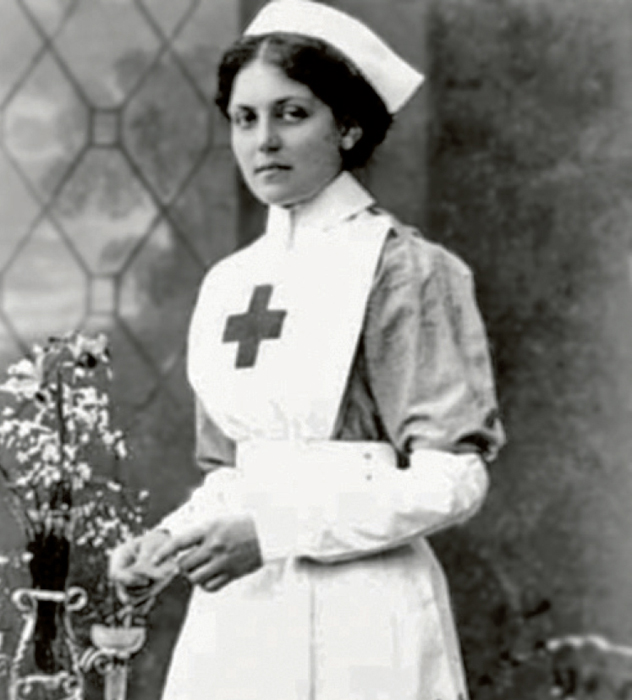
THE UNSINKABLE VIOLET JESSUP (1887–1971). VIOLET SURVIVED THE SINKING OF THREE FAMOUS SHIPS: THE OLYMPIC, TITANIC AND BRITANNIC. SHE WAS A NURSE WHO WORKED FOR THE WHITE STAR LINE, WHICH OWNED THE THREE SHIPS.
Apart from random events (which have a probability of happening) and decisions we make based on our history or perhaps our genetic makeup or maybe even a parasite we are carrying, how else are our lives controlled? Think about an average day. You get out of bed (after a solid seven hours sleep), choose what to eat (a fibre-based cereal with extra goji berries), choose what to wear (big meeting today, so a neat suit), go to the gym before work (because you’ve read it will make you more effective in your working day, not to mention that your Fitbit tells you to do so), go to work (to make money and achieve self-actualisation), have a glass of wine with friends on your way home (one glass only) and then binge-watch Game of Thrones to de-stress. You constantly make decisions as you go about your day, but on what are those decisions based? Many are based on advice you’ve read or heard. You can always choose not to heed the advice, of course, but most of us do, at least most of the time. We can live our lives by numbers if we choose:17 we’re told we need five portions of fruit and vegetables per day and if we don’t get them, all kinds of awful things will befall us. We’re told not to drink more than 14 alcohol units a week for women and 21 for men. We’re told to get at least seven hours of sleep per night. We need 30 minutes of exercise, five times a week. These numbers are well supported by science in terms of being highly beneficial to us. It makes sense to follow them. Many millions of people try to follow them, usually falling off and then back onto the wagon. An alien looking at human behaviour when it comes to these health-based activities would conclude that the directive of a higher order is at play here, rather than people exercising free will.
If children are raised in a certain way, they will turn into adults with particular traits, governed as much by their upbringing as the choices they apparently make using free will. This belief, of course, lies at the heart of many religions. As Aristotle famously said, ‘Give me a child until he is seven and I will show you the man.’ (St Ignatius Loyola, who founded the Jesuits, plagiarised the phrase.) The resulting adult may well think that all their decisions have been conscious, when they were in fact preordained. In a study of 700 people from across the US aged between kindergarten age and 25, a significant correlation was found between the social skills of children and their success two decades later.18 Children who could cooperate with their peers without prompting and who were helpful to others were far more likely to obtain a college degree by the age of 25 than those with limited social skills. The study shows that helping children develop emotional and social skills is key to future success. In another study, it was shown that daughters of working mothers went to school for longer and were more likely to have a job in a supervisory role and earn more money – up to 23 per cent more – compared to peers who had stay-at-home mothers.19 Sons of working mothers pitched in more with household chores and also childcare later in life. And in a study that deserves the label No Shit, Sherlock, it was shown that the higher the parents’ income, the better the child does in school, especially in a metric called the SAT score, which is the result of a standardised admissions test done by students who wish to go to university.20 Another major predictor for gaining a college place was encouragement from parents at an early age. This is known as the Pygmalion effect – what one person expects of another can come to serve as a self-fulfilling prophecy.21
Advertisers exploit the fact that childhood influences can shape adult choices. A number of studies in the US show how children under the age of seven who are exposed to advertisements for fast food or sugary drinks develop a habit for these foodstuffs that becomes hard to break. If you give 3–5-year-olds identical foods, they will identify those in the McDonald’s wrapper as tasting better.22 The World Health Organization (WHO) has said that food giants are exploiting loopholes in regulation to advertise fast food to children through adverts on YouTube and Facebook.23 A recent study in the UK found that 75 per cent of under-16s are being exposed to such adverts on social media.24 It’s a serious issue and the WHO has concluded that there is unequivocal evidence that exposure to fast food and sugary drinks in childhood is a major cause of the current obesity epidemic.25 In the UK, products high in fat or sugar can only be advertised if the audience is at least 75 per cent adult,26 and a poll in Ireland recently concluded that 71 per cent are in favour of completely banning advertising fast food to children.27 There is conclusive evidence of a causal link between fast-food marketing to children and childhood obesity. One former advertising executive who has since joined the effort to ban fast-food advertising said that ‘junk food advertising has become a monster, manipulating young people’s emotions and their choices’.28 As yet, there are no rules governing the advertising of junk food in Ireland. Even worse, the consumption of fat and sugar can cause behavioural changes, including an increase in impulsivity,29 which is likely to lead to yet more bad decision-making.
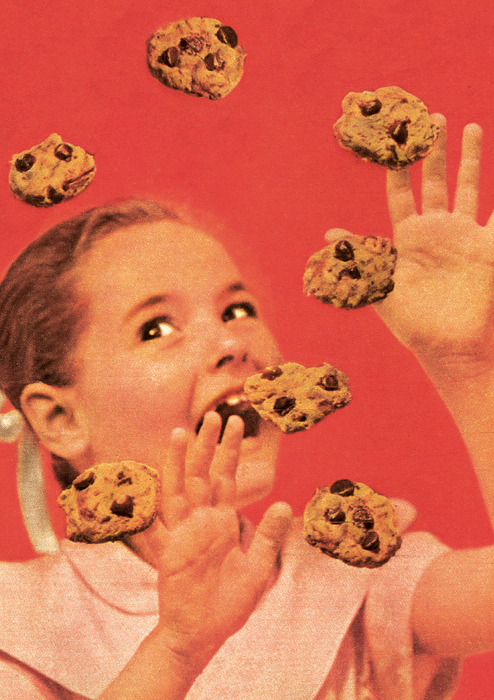
The battle to control advertisers has moved to social media – the directive of a higher order mentioned earlier. Social media is a relatively recent and exponentially growing influence on our lives. The overwhelming evidence is that we are ceding control of our lives to the machines we use to access social media sites. Our smartphones are insinuating their way into our lives and consciousness. They are having a greatly disruptive effect on our sleep. Again, we seem to have control over this (just turn it off), yet many of us are addicted to our iPhones and check them constantly, including when we should be asleep. An amazing 40 per cent of teenagers report checking their phones twice during the night.30 This means severely disrupted sleep with all the obvious negative consequences, including increased risk of anxiety and depression. The most insidious way social media controls us is through advertising. The economic model of companies like Facebook and Google is blatantly obvious – and enormously lucrative. These companies collect data on their users and then sell it to advertisers who use it to target likely customers. It’s the one thing advertisers have always wanted: to target their ads at the right person. This is a good thing, right? You get to see ads you actually want to see and buy products you really want. Well, not quite, as it turns out. There is mounting evidence that advertisers can determine all kinds of things about you – things you may not want them to know (such as, say, the fact that you like Italian food because you order a pizza online every Friday night).
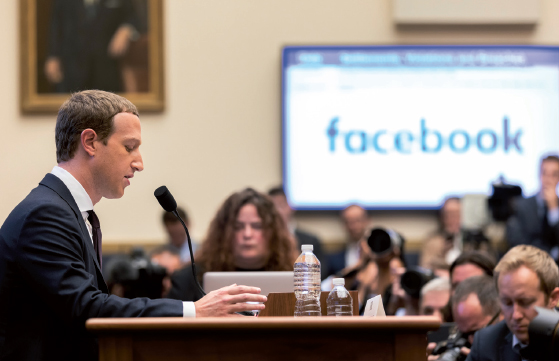
MARK ZUCKERBERG, THE MAN WHO SINGLE-HANDEDLY DESTROYED ALL OUR LIVES BY INVENTING FACEBOOK, AT A CONGRESS HEARING IN OCTOBER 2019.
You unwittingly reveal an awful lot about yourself on social media, including personality traits and political leanings. In a recent study, Facebook users’ ‘likes’ were examined and, from that, people could be categorised into ‘extrovert’ or ‘introvert’.31 Ads were then tailored to each group. For instance, beauty companies sent ads to the introverts with phrases such as ‘Beauty isn’t always about being on show,’ whereas to extroverts they sent phrases like ‘Love the spotlight and feel the moment.’ The campaign reached 3.5 million users, attracted 10,346 clicks and ultimately 390 purchases. Those who saw an ad tailored to their personality type were 1.54 times more likely to make a purchase. This technique is known as psychological mass persuasion. The selling of beauty products is one thing, but what if it’s sending ads for gambling to people who might be at risk of gambling addiction? Or what if you’re a Russian agent and you want to stir up trouble by sending ads or messages to people who you feel might be sympathetic? It’s difficult to know what to do about all this. Once you’ve revealed who you are (which is what social media is all about), you are open to being exploited.
The issue becomes especially important when we look at democracy. There have been accusations that Russian intelligence officials manipulated people in the US via social media during the last presidential election, and that Cambridge Analytica also influenced the election. Cambridge Analytica was a British consulting firm that combined data analysis (largely gleaned from social media) with strategic communication during electoral processes. This company was paid £5m by the Trump campaign to help them target swing voters.32 The Cambridge Analytica website boasted, ‘We collect up to 5,000 data points on over 220 million Americans, and use more than 100 data variables to model target audience groups and predict the behaviour of like-minded people.’ There is also evidence that Cambridge Analytica did work for the Leave campaign and UKIP ahead of the 2016 Brexit referendum. What is alleged to have happened is that Cambridge Analytica obtained data from millions of Facebook users, without their consent, and used that information to target them with pro-Brexit advertisements.33 Facebook has since been fined $5 billion for its role in the data scandal, standing accused of not sufficiently protecting its users.34 The controversy led to the closure of Cambridge Analytica in 2018. What they did is actually part of a growing trend for political groups to use digital political campaigning – targeting people with highly sophisticated messages – as a key strategy. And Cambridge Analytica is not the only culprit: both Barack Obama and Hillary Clinton employed behavioural profiling companies. But the big question is: does it work? Simon Moores, a world expert on cybersecurity, is of the view that behavioural modelling that involves big data analysis has passed an inflexion point. He says we can ‘look forward to a future that’s made up of equal parts Orwell, Kafka and Huxley’.35 When you go to the ballot box, then, will you be voting with no free will at all?
When we read about the likes of Cambridge Analytica, we have to wonder about the level of control we have over our lives. It seems that we’re being manipulated by algorithms. iPhone users of the world, unite – you’ve nothing to lose but your devices. Alternatively, you could try net-based services that avoid the metadata miners and free yourself from their clutches. Whatever about the decisions we make and the lives we lead, many things in our lives are for definite beyond our control. We blame fate for events such as serious illness, loss of loved ones, accidents, macro-economic downturns, famine and war. We can, of course, try to limit the risk of these things happening if we, say, look after our health and follow advice from experts, but we need to escape the hold social media has over us. We need to use science to help us make the right decisions, including when it comes to the threat posted by COVID-19. The bottom line: don’t get married to a stranger in Las Vegas while jet-lagged after bingeing on social media. In all probability we can regain control over our lives and a brighter universe will be around the corner. Now, keep reading. Go on, go on, go on, you know you want to.