
Section 2
Soviet romanticism—romantika—was at once an attitude, a style, and an exclamation. After an era of terror and cultural stagnation, many young people felt optimistic about their future. Their romantic attitude could be glimpsed in their conviction that communism was still a force for progress, their striving for new experiences in the country’s wilderness, and their search for new forms of kinship and their resistance to hierarchy. As a style, romanticism was present in the prominence of unvarnished nature in the visual arts, the growing popularity of the guitar poets, and the rehabilitation of romanticism amongst literary critics, for whom the very ideal of communism was inherently romantic.1 But by the late 1950s, romantika had almost become a short-cut to profundity, harnessed by propagandists who used it to drive the Party’s reconstruction agenda. Newspaper headlines—especially in the youth press—resounded with romantika: ‘Romantics!’, ‘Isn’t that Romantic?’, ‘This is the Romance of our Time!’ It almost become a formula: ‘stick in the word ‘romantika’, some Komsomols, and bingo!’ suggested one journalist, who said he had always ‘hated’ the term.2
Such comments suggest that romantika was a cultural phenomenon that Soviet propagandists wanted to exploit—even if they struggled to pin down its exact meaning. In 1959, at the phenomenon’s height, Sasha Didusenko recalled asking colleagues what romantika meant, only to encounter confusion. ‘The fact of the matter’, he said, ‘is that we often understand “romantika” as anything under the sun’.3 Decades later, in an iconic book on the Soviet sixties, Petr Vail’ and Aleksandr Genis admitted that definitions of the term were ‘fuzzy’.4 Yet romantika’s enigmatic quality was in many respects highly appropriate. To speak of romantika meant to search for the ineffable, to express the inexpressible, to search for one’s hidden depths. The ‘romantic socialism’ examined in this section was neither a consistent editorial line, though journalists often talked about romanticism, nor a worked-out political programme, though it responded to political stimuli. Rather, it should be seen as a site upon which diverse groups could express their goals in life and their hopes for the future in the wake of Stalin’s death. However, as I will suggest, the adherents of Soviet romanticism were prone to disappointment as glowing ideals met with harsh reality.
The paper’s copious references to romantika suggest that journalists were trying to find ways to re-connect with audiences. Editorials in the professional press did not need to mention Stalin directly for readers to understand that references to identikit editorials, a hectoring tone, and a profusion of officialese were really about the country’s recent past.5 Journalists, it was suggested, had to cultivate a new, more friendly relationship with readers, which would restore their trust in the Soviet press—and prevent them from rejecting it altogether. At the dawn of the Soviet Union’s media age, more discerning audiences, faced with a variety of stimuli, were beginning to exercise a kind of consumer choice—and they sometimes chose foreign media.6 Print journalists were never able to pivot to entertainment in the same way as broadcast journalists—the newspapers remained a ‘collective propagandist and a collective agitator’ until the 1980s—but the press still made concerted attempts to capture readers’ attention. At some titles, like Trud and the newly created Sovetskaia Rossiia, reporters deviated from the familiar model of news reporting by printing human-interest stories.7 Komsomol’skaia pravda, meanwhile, tried to entertain readers by printing a Sunday supplement containing reader-interest stories, short fiction, and puzzles—an innovation only curtailed by that perennial obstacle: paper shortages.8
One sure way for newspapers to become more enticing to readers was change the way they spoke and the way they looked. Journalists tried to create for newspapers ‘their own unique face’, which could be glimpsed in the form of tantalising headlines and more eye-catching design.9 Stalinist newspapers had been created in a climate of shortage, and were often seen as sources of information for activists. Small font sizes, tightly crowded columns, and lack of illustration reflected this.10 By the end of the 1950s, however, the design of newspapers had changed significantly. Designers experimented with different typefaces, employed banner headlines, and, most noticeably of all, they printed more photographs. The paper could, on occasion, push things too far: a Central Committee resolution of 1958 upbraided the paper for illustrating a Party address with photographs.11 Official documents remained sacrosanct. But, as Figure 3.1 shows, the paper’s designers were able to use visuals to convey key messages—in this case, about the friendship of peoples, the country’s industrial might, and Soviet happiness.
The press’s changing face signalled that journalists were communicating with their audiences in new ways. Such relationships were particularly important for Komsomol’skaia pravda’s journalists, whose young readers were thought to be especially susceptible to foreign temptations. The paper’s journalists began to address using the familiar form, asked for their input, and created new spaces for readers to discuss and debate.12 Letters and other reader contributions became a treasured means of forging links and the paper devised a good half dozen different rubrics to cover different kinds of contribution, from brief reports from youth correspondents (‘Print This, It’s Interesting!’) to letters about morals and ethics (‘True Stories’). The growing size of the paper’s postbag suggests that readers’ interest was also growing. In 1950, the paper received just over 50,000 letters, but a decade later, that figure had risen to 200,544, rising to more than 332,000 by 1965.13 This new-found rapport, which aimed to make the newspaper into a hospitable space for readers, allowed journalists to cultivate ‘para-social’ relationships where readers could consider the newspaper to be a ‘media friend’.14 By allowing new possibilities for interaction and ‘bricolage’, newspapers like Komsomol’skaia pravda allowed young people to steer their own path through official narratives.15
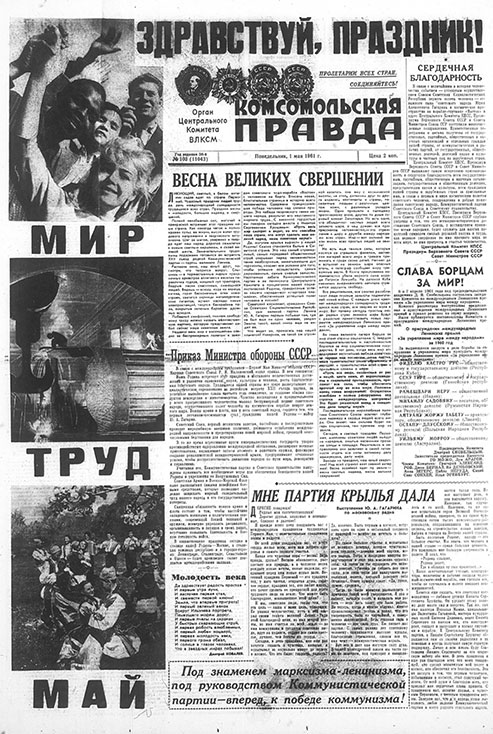
Figure 3.1 Komsomol’skaia pravda front page, May Day, 1960
Much of the credit for these shifts must go to Aleksei Adzhubei.16 After the failure of the paper’s critical line in 1956, Dmitrii Goriunov was moved to a role as head of the news agency TASS, to be replaced as Editor-in-Chief by the inexperienced 33-year-old. Late at night, Adzhubei’s father-in-law, who had just finished work in the Kremlin, would sometimes allow Aleksei to hitch a ride home in his official car: Nikita Khrushchev.17 Adzhubei’s rapid ascent made him the butt of jokes about nepotism, but it would be unfair to attribute his success to family connections alone. As journalists who worked with him attest, Adzhubei was an unusually talented editor who was able to get the best from his team—both at Komsomol’skaia pravda, which he led until 1959—then, most famously, at Izvestiia.18 Lively and readable propaganda was at the heart of Adzhubei’s journalistic credo: it was part of his philosophy that every issue should contain a ‘bomb’ or ‘nail’, which would make the reader want to read on.19 He also gave literary journalists free rein to write the kinds of stories that they found interesting. Vasilli Peskov, the paper’s much-loved nature reporter and photographer; Inna Rudenko, whose articles reflected on morals and ethics; and Vera Benderova, the schools reporter whose tear-jerking editorial ‘Mama’ became one of the key documents of Thaw journalism, all found their creative voice under Adzhubei’s tutelage.20 It could be argued, then, that Thaw journalism was forged in the corridors and offices of Adzhubei’s Komsomolka.
But the glorification of a single individual underplays the role played by Adzhubei’s successors, Iurii Voronov (1959–1965) and Boris Pankin (1966–1973), under whose command the newspaper continued to make new connections with readers and introduce new rubrics. It also significantly underplays the importance of the paper’s journalistic team in implementing change. Even after the paper was criticised at the end of 1956, journalists became less worried about reprisals from the authorities and more inclined to take creative risks. Young gazetchiki reaped the rewards of the opening of new journalism faculties in the last years of Stalinism, and played an enthusiastic part in conversations prompted by the creation of a Union of Journalists in 1959. Discussions of journalistic craft, ethics, style and activism may have involved only an elite stratum of the profession, but those conversations tricked down to the rank-and-file through articles in the professional journal Soviet Press [Sovetskaia pechat’] and in press reviews, where leading newspapers would discuss, and often criticise, the work of colleagues lower in the hierarchy.21 The popular path taken by Komsomol’skaia pravda’s journalists in the wake of their defeat in 1956, and which is outlined in the next two chapters, was not just the work of a few editorial superstars, but resulted from a climate of experimentation that became increasingly entrenched in the country’s newsrooms.
1 Matteo Bertelé, ‘Soviet “Severe Romanticism” at the 1962 Venice Biennale: The Case of Viktor Popkov’, Eksperiment, 23 (2017), 158–72; Rachel Platonov, Singing the Self: Guitar Poetry, Community, and Identity in the Post-Stalin Period (Evanston: Northwestern University Press, 2012); Lauren Leighton, ‘The Great Soviet Debate Over Romanticism, 1957–1964’, Studies in Romanticism, 22.1 (1983), 41–64.
2 16 Feb. 1958, RGASPI, f.98M, op.1, d.244, l.30.
3 18 May 1959, RGASPI, f.98M, op.1, d.247, l.45.
4 Petr Vail’, Aleksandr Genis, 60-e: Mir sovetskogo cheloveka (Moscow: Novoe literaturnoe obozrenie, 1998), 126.
5 ‘Zhurnalist i chitatel’’, Sovetskaia pechat’, 6 (1956), 1–3.
6 Kristin Roth-Ey, Moscow Prime Time: How the Soviet Union Built the Media Empire that Lost the Cultural Cold War (Ithaca: Cornell University Press, 2010); Sergei Zhuk, Rock and Roll in the Rocket City: The West, Identity, and Ideology in Soviet Dniepropetrovsk, 1960–1985 (Baltimore: Johns Hopkins University Press, 2010).
7 On this shift see Simon Huxtable, ‘Making News Soviet: Rethinking Journalistic Professionalism after Stalin, 1953–1970’, Contemporary European History, 27.1 (2018), 59–84 [68–72].
8 On newsprint shortages in the 1920s see Matthew Lenoe, Closer to the Masses: Stalinist Culture, Social Revolution, and Soviet Newspapers (Cambridge, MA: Harvard University Press, 2004), 57–69. Shortages in the Khrushchev era threatened publication of local-level and even national newspapers (Agitprop spravka, Aug. 1960, RGANI, f.5, op.34, d.72, ll.111–18), and prevented KP from covering stories in as much depth as journalists wished (KP letuchka, 14 Aug. 1961, d.303, l.4).
9 A. Romanov, ‘Khranit’ i razvivat’ leninskie traditsii nashei pechati’, SP 5 (1957), 5–10 [9]; B. Burkov, ‘Kazhdoi gazete—svoe litso’, SP 5 (1957), 11–13.
10 Lenoe, Closer to the Masses, 145–81.
11 ‘O nepravil’noi praktike chrezmernoi illiustratsii nekotorykh gazet’, 11 Feb. 1958, in Sovetskaia pechat’ v dokumentakh (Moscow: Gospolitizdat, 1961), 286–7.
12 E.g. ‘Alyi parus’, 24 Sep. 1963, 4.
13 Prilozhenie k dokladu D.P. Goriunova na Vsesoiuznom slete iunkorov, 29 Oct. 1956, RGASPI, f.98M, op.1, d.180, ll.6, 13; Postanovlenie sekretariata TsK VLKSM, ‘Zapiska o rezul’tatakh proverki raboty s pis’mami v redaktsii gazety Komsomol’skaia pravda’, 30 May 1961, RGASPI, f.98M, op.1, d.293, ll.2, 10–16; KP to TsK KPSS (Proekt postanovleniia), n/d 1966, RGASPI, f.98M, op.1, d.440, l.47.
14 The term ‘media friend’ is taken from Joshua Meyrowitz, ‘From Distant Heroes to intimate Friends: Media and the Metamorphosis of Affection for Public Heroes’, in Heroes in a Global World, ed. by Susan J. Drucker, Gary Gumpert (Creskill: Hampton Press, 2008), 99–128. See also Meyrowitz, No Sense of Place: The Impact of Electronic Media on Social Behaviour (Oxford: Oxford University Press, 1985).
15 Martina Winkler, ‘Czechoslovakia: Children’s Media in Transition’, Strenæ: Recherches sur les livres et objets culturels de l’enfance, 13 (2018), para. 29, https://journals.openedition.org/strenae/1783 [Accessed: 2 Oct. 2020]; Roth-Ey, Moscow Prime Time, 71–130.
16 Two accounts that place Adzhubei at the centre of change are Thomas C. Wolfe, Governing Soviet Journalism: The Press and the Socialist Person after Stalin (Bloomington: Indiana University Press, 2005), 38–45; N.L. Volkovskii, Otechestvennaia zhurnalistika 1950–2000 (St. Petersburg: Izd. Sankt-Peterburgskogo universiteta, 2006), 57–79.
17 William Taubman, Khrushchev: The Man and His Life (London: Simon & Schuster, 2003), 225.
18 Aleksei Adzhubei v koridorakh chetvertoi vlasti, ed. Dmitrii Mamleev (Moscow: Izvestiia, 2003).
19 ‘Piat’ printsipov Alekseia Adzhubeia’, Izvestiia, 6 Jan. 2004. https://iz.ru/news/285551 [Accessed: 2 Oct. 2020].
20 Peskov won the Lenin prize for Shagi po rose (Moscow: Molodaia gvardiia, 1963). For his complimentary views on Adzhubei see ‘Vse bylo neprosto’, in Aleksei Adzhubei v koridorakh chetvertoi vlasti, 51–3; Vera Benderova, ‘Mama’, 7 Aug. 1958, 1.
21 Mary-Catherine French, ‘Reporting Socialism: Soviet Journalism and the Journalists’ Union, 1955–1966’, Unpublished PhD Dissertation, University of Pennsylvania, 2014.
3
In 1930, after the debacle of the previous year’s self-criticism campaign, the Central Committee met to discuss how the press should proceed. Over the course of 1928 and 1929, newspapers like Komsokmol’skaia pravda pushed the limits of criticism too far, their journalists convinced of the rightness of their actions despite the objections of Party authorities.1 That episode ended badly for the paper: its editor Taras Kostrov was removed alongside a number of editorial board members; Stalin wrote to warn the paper that the goal of self-criticism was ‘not to weaken leadership, but to strengthen it.’2 When Viacheslav Molotov and Lazar Kaganovich, members of the CC’s Orgburo, discussed the path forward for the press, they concluded that the newspapers needed to shift focus from ‘shadows’ to ‘light’, by emphasising achievements over shortcomings.3
More than a quarter of a century later, the paper’s attempt to foster change through criticism met with similar results. A report drafted by the Komsomol’s Department of Agitation and Propaganda in January 1957 criticised the paper for its ‘excessive search for shortcomings’ which, it claimed, ‘could lead readers to harmful conclusions’.4 The report’s conclusions were clear: the paper should ensure that Soviet life, ‘a dream for many young men and women’, was depicted far more positively.5 Like Kostrov before him, Goriunov was removed from his post, leaving the floor open for the paper’s new editor, Aleksei Adzhubei.
History does not repeat itself but it sometimes rhymes. The search for heroes in the 1930s led journalists to pioneer a wave of ‘Soviet sensations’, based on the Soviet people’s heroism on collective farms, the factory floor, and the building sites of the first Five-Year Plan.6 Thaw journalists similarly tried to create a new cast of heroes, replacing Magnitogorsk and Dneprostroi with the Virgin Lands and Bratsk. There was an element of mimicry to this new heroic discourse, born not so much of nostalgia as the hope that the Thaw generation might be capable of the same feats as the generations of the 1930s and 1940s.7 But times had changed in the intervening decades, and even if there was something familiar about the heroic discourse of the Thaw, it acquired new meanings in the era of the scientific technological revolution.
In this chapter, I pursue the paper’s new heroes through a series of autobiographical texts—letters, diaries, and testimonies—in which individuals who travelled to the country’s extremes wrote about their experiences. On construction sites, collective farms, in mines and on railroads, these individuals incarnated the most positive traits of Soviet youth: devotion to the Komsomol cause, an ability to laugh in the face of hardship, and boundless sincerity. By publishing their accounts, journalists offered a space for young people to talk about this personal quest in their own words (though much editing occurred), while offering an alluring portrait of the personal rewards to be won by participating in the Party and Komsomol’s mass-construction projects.
Such texts are an ideal site to explore one of the most powerful trends in Thaw culture: romanticism. As I suggested earlier, even for contemporary observers, romantika was difficult to distil into a satisfying definition. From its cultural manifestations, such as wild camping and guitar poetry, it is possible to identify a desire for escape, a love of severe nature, an optimistic belief in the future but also a rebellious impulse that is difficult to pin down.8 Artists, intellectuals and young people have generally been seen as the main carriers of the Thaw’s romanticism, but this chapter shows that journalists were equally seduced by the country’s romantic turn. In article after article, they breathlessly depicted the seductions of Soviet nature, the joy of overcoming hardship, and the prospect of individual fulfilment.
But the paper’s version of romantika, which emphasised revolutionary asceticism, back-breaking labour, and green tents against a starlit sky—seemed to be swimming against emerging currents in post-Stalinist society. As Serguei Oushakine has argued, romantika was a rebellion against scientific rationality; it was an attempt to escape the straitjacket of the ‘logically planned society’.9 In this sense, heroes’ flight from rigid planning can also be read as an expression of doubt about the country’s new direction. Equally, the Party’s commitment to improving citizens’ quality of life begged the question of whether communism was still an ideology of self-sacrifice, demanding constant activity and permanent mobilisation, or a politics of stabilisation, whose greatest allure was to offer citizens job security, material plenty, and a life without unnecessary alarms. To the romantics of the Soviet sixties, with their rallying cry ‘to hell with everything material’, this was no offer at all.10 The escape to the mountains of the Caucasus, the endless nights of the Arctic, and the snowstorms of Siberia was a flight from Soviet modernity. But to journalists propagandising the Soviet future, the romantics’ constant search for extremes seemed to contradict the regime’s promises of material plenty and consumer comfort. Socialist romanticism was an expression of yearning for a better future but, even in the sanitised variant published in the official press, it still seemed to rebel against mainstream values.
The Virgin Lands Campaign
Launched less than a year after Stalin’s death, in February 1954, the Virgin Lands campaign was one of the iconic policies of the Khrushchev era. Launched with little regard for forward planning or economic rationality, the plan to make Kazakhstan into the country’s breadbasket was an attempt to reconstruct the country’s agriculture through enthusiasm and self-sacrifice. The policy targeted young people in particular. After the paper printed an appeal to Soviet youth on 18 February, thousands of youths made their way east, eager to heed the Party’s call.11 Over the course of a month in which the paper published little else, readers saw photo reportages, interviews, and sketches about the country’s ‘richest natural larder’.12
Reading the comments of journalists, it is hard to escape the conclusion that the campaign succeeded in spite of, rather than because of, the paper’s coverage. Editorial staff lamented their inability to find a way to promote the government’s priorities. Leafing through editions for 1954, one finds little of the human interest that characterised later campaigns. Excitement, in as much as journalists tried to create it, tended to consist most of all in the headlines: ‘We’re Going to Sow the Virgin Lands!’ ‘To a New Land, Dear Friends!’ ‘We’re Waiting for You, Comrades!’ ‘Let’s Get to Work!’13 The articles themselves were formulaic: young Komsomols were ‘brave people’, driven by a ‘feeling of deep patriotism, consciousness, and a deep sense of duty to the Fatherland’; the train to Kazakhstan was always filled with the sound of harmonicas and accordions, the welcome they received was always friendly, and unfolded to the sound of brass bands playing folk songs.
On the rare occasions when reader-penned texts were published, they suffered from similar maladies. Indicative of this lack of inspiration was the diary of agronomist Anatolii Kuzulin, who was shortly to travel to Kazakhstan to answer the Party’s call.14 The diary describes his attempts to persuade colleagues from his farm in the Kimovsky region to accompany him to the Virgin Lands. Dialogue was stilted and narrative tension was entirely absent: every call for action was enthusiastically heeded, any difficulty was confidently overcome. Amongst the many rumbles of discontent within the redaktsiia, it was this lack of inspiration that journalists latched on to. The main problem was that the paper’s coverage lacked excitement: it was guilty of the Stalinist sin of ‘conflictlessness’, claimed Natella Lordkipanidze. As the paper’s theatre critic, Lordkipanidze knew all about drama, and argued for a more poetic form of discourse: ‘To dream is a characteristic of youth’, she said, paraphrasing Kalinin, before asserting ‘I think that we need to be a bit more romantic’.15
There were others at the paper who, rather than thinking of how the campaign could be better promoted, expressed guilt about the policy’s lack of organisation. Far from the brass bands and bonhomie that the Soviet media promised, many young people arriving in Kazakhstan found a dispiriting lack of preparation.16 Trainloads of Komsomols arrived at rural stations to find their hosts in a state of confusion. Once settled, they encountered a lack of housing, food, and equipment, mass drunkenness, and were frequently targeted by the ‘special settlers’ who had been the victim of Stalin’s deportation policies.17 Years later, one woman recalled her thoughts on arriving in the Virgin Lands: ‘Why did they tell us it was so great here? On the radio it said how in Kazakhstan, how it couldn’t be better than that.’18
The paper’s ‘romantic’ mission sat uncomfortably with journalists, who were by now well aware of the conditions in which their young readers now found themselves. An April 1954 report sent to Dmitrii Shelepin, the First Secretary of the Komsomol, by two of the paper’s correspondents described appalling conditions in Kustanai and Akhmolinsk.19 Mass hooliganism and drunkenness were rife; individuals were allocated to roles without regard to speciality; there was a lack of equipment and spare parts and, above all, a complete lack of organisation: one group was stranded at a local railway station in the snow, with nobody from the local Komsomol having been informed of their arrival. But the paper’s coverage continued to tell a very different story, tempting thousands of Komsomols to wend their way to Kazakhstan unawares. In June 1954, Semen Garbuzov, the paper’s Responsible Secretary, spoke of the paper’s ‘enormous guilt’ before the young people to whom they had promised a life of adventure.
We sent a large brigade of Komsomols on this large and important task. And we forgot about them…. People came to a new place completely unprepared for having to live in such basic cultural conditions. People are not offended by the absence of living quarters, nor by the sometimes bad supplies. They’re offended by the lack of organisation…thanks to which they cannot give what they would like to give.20
‘We forgot about them’: Garbuzov’s words suggest that the paper had a duty to publicise and rectify the problems encountered by volunteers, faintly echoing the paper’s line two years later when the rectification of social problems became a fundamental part of the paper’s de-Stalinisation campaign. Indeed, 1956 was the year that the tension between romanticism and realism emerged into the open once again. The immediate cause was a second Komsomol resolution, issued in April, which appealed for young people to build the future in the Virgin Lands, the Arctic, Siberia, and the Donbass.21 At the next letuchka journalists ran into the very same problems of balancing romanticism with criticism. Il’ia Kotenko saw something ‘frightful’ in a conversation he had with a tenth grade student, who was about to depart for Siberia but had learned everything he knew from old guidebooks. He noted bitterly that students came away from reading the press and their lessons in school with ‘a completely incorrect conception of Siberia’.22 For veteran journalist Tobii Karel’shtein, a correspondent in the letters department, the limitations of romanticism were even clearer:
Romantika is a good thing. But when a person comes across great difficulties, when things at work aren’t going well and in day-to-day life some things don’t run smoothly, it’s bad. A valuable and important thought is that we need to prepare people for an important job, not just talk about romantika, about living in tents and so on.23
However, Vladimir Chachin, a veteran of World War II, disagreed, citing parallels with his wartime experiences:
If your daughter expressed a desire to go to Siberia what would you do? You’d say: ‘live here for three years and study’. But where’s the romantika? In my opinion, you need to go there immediately, like it was during the war: people will teach them, they won’t need much instruction; they’ll have their training there.24
Chachin’s invocation of romantika was hardly surprising: he later authored a book of heroic stories for young people. His romanticism didn’t impair his ability to see the downsides, however. Reporting to colleagues on conditions in Bratsk, even he felt that the ‘romantika of green tents’ was a cover for inadequate provision of living quarters.25 In September, perhaps swept along by the paper’s critical line, he complained that the paper had not printed his critical article on problems with facilities and a lack of work for new arrivals in the Donbass region and summed up the paper’s choice starkly: ‘What should we do? Either varnish reality or write the truth without fear.’26 Over the course of 1956 many journalists reported back to the editorial collective about problems in the regime’s novostroika projects.27 But staff could not agree about how to balance negative articles with the needs of a mobilisation campaign. Having heard a harrowing account of drunkenness and knife fights in Taishet from correspondent Kochergin, Adzhubei, at the time still Deputy Editor, commented meekly that the issue was ‘complicated’, and added that the paper needed to cover ‘the romanticism in the everyday’.28 He explained that Chachin’s critical article had been shelved by the editors for fear of antagonising the authorities and warned journalists to ‘write about shortcomings wisely’.29 By the time he ascended to the editor’s chair in April 1957, the paper’s nascent critical line had been curtailed. Instead of criticism, the paper began to move in a new direction, full of the sort of material he had demanded a year earlier on the heroism and romanticism of Soviet youth.
The Revolutionary Baton
In late 1960, civic-minded schoolchildren in the town of Kirovograd (today Kropyvnytskyi) clearing junk from a building were surprised to find a cigarette case.30 Inside was a letter, apparently penned by a group of soldiers. They wrote of heroic deeds carried out by a private who had single-handedly saved a group of political commissars from execution by the occupying Germans. Though they did not know his name—he burned his Party documents to avoid detection—in the charred remains the pupils managed to find the number of his Party card. The excited children reported on their find to local journalists and before long the army newspaper Krasnaia zvezda [Red Star] was asking readers for help identifying this unnamed ‘hero’.31 A day later, a front-page story reported that the soldier had been found: A.S. Krishovskii, a museum worker in a nearby town.32 Positive evaluations began to flood the paper from those who had fought alongside Krishovskii; officials rushed to praise him. Journalists who visited Krishovskii’s new home of Korshun’-Shevchenkovskii found many people who spoke highly of him and confirmed that the events described had taken place.33
The paper promised further details in future editions, but the expected follow-up never appeared. Readers called the paper to complain that Krishovskii was not the lily-white hero the paper had made out.34 In 1953, he forced young students at a local institute to live with him and ‘commit pornographic acts’. When one refused, he shot at the window, causing permanent injury to a passer-by. For rape and the wounding of the student he received a ten-year sentence and was excluded from the Party. Worse still, Krishovskii had never joined the Partisans: on the contrary, he spent the occupation working as a forest warden for the Nazi occupiers. When quizzed by two journalists sent to investigate, Krishovskii—who had previously confirmed the paper’s account—gave ‘confused’ answers. They concluded that although the events described in the letter had really taken place, Krishovskii had nothing to do with them.35 Upon further investigation, KGB workers expressed suspicion that Krishovskii had written the letter himself.36
One feels considerable sympathy for Krasnaia zvezda’s unfortunate editor, summoned to Agitprop for a dressing down.37 For a short while, he must have thought he had landed an exclusive which would be the envy of his rivals. Precisely this sort of sensation, which mixed the allure of dusty documents with the bravery of the Soviet hero, counted as good journalism after 1956. Although the archival evidence does not get to the bottom of Krishovskii’s motives, we might argue that in planting the letter, left to be discovered by others at a later date, he betrayed a knowledge both of the media’s thirst for such documents (the letter requested that whoever found it should deliver it to the editors of Pravda, Izvestiia, Krasnaia zvezda and Komsomol’skaia pravda) and of the Thaw’s cultural logic. In a climate where historical canons had become increasingly unstable, both intellectuals and amateur ‘enthusiasts’ were seized with the compulsion to preserve a disappearing past.38 Newspapers latched on to this trend, and were especially fond of providing their readers with documents presenting mysteries to be solved. A pertinent example occurred almost two years before the Krishovskii incident, when Komsomol’skaia pravda informed readers about a mystery individual whose poems had been found scrawled in an exercise book in Sachsenhausen concentration camp and asked readers to help identify him.39
Another set of found documents came from the pen of poet and activist Sergei Chekmarev. Over the course of 1956 in a series of articles, first in April and then—over five days—in September, Komsomol’skaia pravda printed excerpts from Chekmarev’s diary, letters, and poems, written in the 1920s and 1930s before his untimely death in 1933.40 In these writings, Chekmarev detailed his thoughts as he wandered from place to place and task to task, teaching villagers to read, helping to collectivise local farms, and giving medical attention to individuals in need. As the paper’s editors stated in their brief introduction, Chekmarev’s life was an example to readers because of ‘his devoted service to the communist cause, his sincere love for the Motherland, to people, and his enthusiastic eagerness to overcome any difficulty in the battle to strengthen everything that is new, beautiful and pure’.41 The resonance of these writings came not just from the heroic acts that Chekmarev detailed, but their simplicity of expression. His texts combine the ordinary and extraordinary, and mix the charm of everyday chit-chat (‘Seen any good films lately?’) with emotional depth. The woes of Chekmarev’s doomed romance with ‘Tonia’ could be the sufferings of any love-struck teenager; his self-questioning about the meaning of life expressed universal human sentiments; his doubt in the face of difficulty could be understood by any reader about to embark on a challenging undertaking.
Autobiographical exemplars from past and present helped counter fears about the safe transmission of the revolutionary baton between generations. The very existence of ‘contemporaries’ seemed to prove that, even in the absence of a wartime trial by fire, Soviet youth had inherited the old fighting spirit. During 1950s and 1960s, the paper frequently printed documents from the heroes of past and present. This autobiographical mania, be it for diaries, letters, memoirs, or poems, tapped into the Thaw’s ‘factographic’ impulse.42 It was as if these documents came ready-historicised: they were both contemporary and ready to be inserted into an imagined history of the Revolution. A letter sent to the paper by two young Virgin Lands volunteers points to this self-historicising trend: they suggested creating a ‘chronicle of the Virgin Lands’ which would provide lessons for ‘ourselves and then for our children too’ about the ‘bravery, tenacity and devotion to our homeland’ displayed by the first Virgin Lands settlers.43
Even before this appeal, the paper had already tried to weave such a narrative. One article took readers from Moscow to the new hydro-electric power station on the River Angara, where recent graduate Ol’ga Popkova had decided to work. In letters to her classmate in Moscow, Popkova discussed her work in Siberia, detailing her activity in helping to build the new power station and new housing, and her work in the local Komsomol organisation. Such letters achieved the difficult task of combining the Thaw demand for sincerity with romanticism. Her letters are candid about the difficulties she faced, from the sexism of colleagues to homesickness. These moments of doubt—which were frequent in the autobiographical texts of the 1950s and 1960s—read as authentic, and were a welcome contrast to the flawless heroes of the Stalin era. But Popkova’s diary was equally a document of romanticism where problems could be overcome by an encounter with nature: ‘Oh, how far away Moscow is! I can almost feel the distance physically—and Siberia, and the taiga, but on the other hand the beauty here is unbelievable! We just have to make sure we don’t lose our enthusiasm. But don’t worry, we won’t!’44
Chekmarev’s writings and Popkova’s letters were milestones in the paper’s search for romantika. Chekmarev bounded around the Soviet Union, fuelled by the joy of nature and the spirit of adventure, while also displaying the ‘striving for an ideal’ that one critic considered to be the essence of romantika.45 Popkova’s journey into wild nature painted a similarly idealistic version of reality which helped her through difficulties and enabled her to find meaning. Both articles received high praise from journalists, who believed that their combination of sincerity and adventure would resonate with the paper’s audience. ‘The sort of things this person dealt with in his life are the sort of things that excite young people’, said one journalist of Chekmarev’s writings. More than one staff member compared him to Pavel Korchagin, the hero of Nikolai Ostrovsky’s iconic How the Steel Was Tempered; another added that Chekmarev’s personality was the key to the article’s success: ‘His personal life, his social life, his dreams, his creative flights of fancy and his work—it’s all so vividly drawn that you can’t help but be moved to the very depths of your soul.’46 Journalists strongly praised Popkova’s letters, too, seeing in them, to use Shatunovskii’s words, ‘the image of a real Soviet person…a hero of our time’.47 Iurii Voronov, the paper’s Deputy Editor, was sufficiently impressed with this ‘real, human document’ to ask staff to make such texts a priority, and to capitalise on readers’ ‘many heroic expeditions’ to the Virgin Lands.48
Considered together, then, the writings of Chekmarev and Popkova were indicative of a shift in the paper’s approach to heroism. Popkova’s autobiographical writings were the first of dozens printed after 1956, the vast majority as part of the enduring ‘Letters, Diaries, and Notebooks of our Contemporaries’ series, which began in 1959 and ran until the early 1970s. These texts, which will be discussed in greater detail below, showed Soviet youth on collective farms, building sites, factories and power stations—the one constant being their pilgrimage far from Moscow. At the same time, the printing of Chekmarev’s writings was indicative of a search for more compelling exemplars to link the heroic past and a more uncertain present.
Autobiographical narratives were thus situated in a dialogue with the past which was both explicit and implicit. After the paper’s dressing down in 1956, journalists rushed to provide new historical exemplars for readers, who were now offered an endless parade of heroes, under rubrics with names like ‘Songs of our Fathers’, ‘People with Burning Hearts’, and ‘Komsomols Must Know their Names’. Through short biographies of Old Bolsheviks, Civil War fighters, heroes of the first Five-Year Plan and Great Patriotic War, young people would learn of their revolutionary ancestors, and be inspired to follow in their footsteps. Journalists at the paper stated that young people had been inspired by the example of the heroes of Magnitogorsk and Komsomolsk, and highlighted their resemblance to the heroes of the Great Patriotic War.49 As these articles outlined the humdrum interests of their heroes—a love of sport, of photography, boyfriends, girlfriends, friendships—all tragically cut short by the country’s enemies, readers understood it was their duty to compensate for the curtailed existences of their predecessors by living their own lives to the full.50
By the late 1950s, then, the pages of Komsomol’skaia pravda had become a site for a re-heroisation of the country’s past and present. The flip side of this obsession with the heroism of the past was amnesia about the darker sides of Soviet history. Plotted on a map, the archipelago of locations covered in readers’ diaries and letters recalled the country’s unhappy history. Viewing Magadan or Taishet as spaces of adventure was only possible by closing one’s eyes to the history of Soviet incarceration. Many journalists did. Vsevolod Bogdanov, later to become president of the Union of Journalists, recalled his surprise at being told that the city of Severodvinsk had been the centre of the Gulag network, rather than the ‘dream city’ he had described:
I was really upset. I thought that Severodvinsk truly was a romantic city of youth, with white nights and enormous industrial enterprises. But someone from another generation remembered something else. For the first time, I felt the mismatch between what I saw and immediately felt, and the underlying principles of what had happened in the past.51
The logic of romanticism didn’t just mean forgetting about the past. It also meant closing one’s eyes to the legacies of these carceral policies in the present. A correspondent who had just returned from komandirovka to Bratsk GES reported to colleagues about the negative impact of mixing camp labour (Bratsk was in the vicinity of five large camps), ex-convict labour, and young enthusiasts from the cities. Construction sites like Bratsk were split into ‘zones’ which housed ‘criminal’ and ‘civilian’ elements respectively.52 But, as the correspondent reminded colleagues, ‘there’s no need to write about that in the newspaper’—a recommendation the paper faithfully observed.53 To be faithful to the logic of romantika, one needed both to forget the past and stay blind to its legacies in the present. As Inna Rudenko, one of Komsomol’skaia pravda’s senior essayists, recalled in 2003:
My romantic elation clearly prevented me from seeing life in its real, contradictory complexity. That is, I saw—I knew, for example, how many prisoners, how many newly released political prisoners there were on the construction sites of Communism—but to write about it? The thought never came into my head.54
The Thaw’s romantic impulse therefore possessed a conflictual relationship to the past. On the surface, newspapers were saturated with references to history. Civil war and Five-Year Plan, Great Patriotic War and reconstruction: all of these offered a heroic past with which readers could identify, and a cast of characters whose feats they could emulate. And yet the Thaw’s obsessive search for the past came from the fear that it was disappearing: the Revolution had made history but set into motion a train of events that destroyed traces of the past. From the razing of historical artefacts in the wake of the revolution, to the destruction of lives in the Terror and World War, the compulsion to collect and to reproduce was a symptom of loss. The logic of romantika, with its obsessive dialectic of remembering the country’s glorious history and its striving to forget its troubling episodes should be seen as part of the same impulse: to rescue a useable past from the rubble of Soviet history.
Edited Subjects
The printing of diaries and other autobiographical texts in Komsomol’skaia pravda in the 1950s and 1960s was one episode in a decades-long fascination with autobiography in Soviet culture. In the early decades of Soviet power, with intellectuals obsessed with the creative potential of the ‘ordinary’ proletarian, cultural figures encouraged workers to narrate their own experiences. A number of works published around the time of the first Five-Year Plan similarly collected the testimonies of workers, and published them as collective biographies of factories and enterprises.55 And towards the end of the 1930s, leading newspapers published a handful of autobiographical texts which allowed readers to reflect on their hopes and dreams.56 But one’s private diary also provided a powerful lever for disciplining the self towards an ideal personhood.57 Party discipline had always been centred around autobiographical practices, with individuals enjoined to produce a public account of their lives and works in order to enter the Party or retain their membership. Their authors described a journey from ignorance to consciousness—from ‘darkness to light’—and this normative biographical progression became a trope in other narrative contexts too.58 While these practices are closely associated with the tense and prescriptive environment of the Stalin years, even after 1953 writers and intellectuals continued to use diaries to discipline the individual towards a ‘normative selfhood’.59 Traces of this state-mandated introspection are present in the diaries, letters, and notebooks published by Komsomol’skaia pravda in the 1950s and 1960s.
As their comments on Chekmarev and Popkova’s texts suggest, it was their sincerity that attracted journalists to these autobiographical fragments. By offering propaganda-friendly messages without didacticism, they satisfied the injunction often heard by creative writing students: ‘show, don’t tell’. Journalists at the paper played up these texts’ status as ‘authentic’ documents, offering communion with the ‘inner world’ of their protagonists.60 ‘You asked me to pluck up courage and write everything in detail. So I wrote about everything, I kept nothing secret’, wrote tractor driver Valia Chunikhina to her mentor in ‘I love you, life!’, a correspondence published in 1962.61 This promise of absolute openness offered readers the opportunity to connect with a transparent and truthful soul—what Lidia Ginzburg described as their ‘orientation toward authenticity’.62
This preoccupation with ‘authenticity’ was part of a broader cultural context in which intellectuals frequently spoke of the need for innovation in cultural production. Since the publication of Vladimir Pomerantsev’s essay on sincerity and Ol’ga Berggol’ts’ defence of lyric poetry in 1953, intellectuals had sought new forms of expression that would avoid the stilted language and predictable forms of the Stalin era.63 One way out of these problems was to once again laud the virtues of amateur writers, whose lack of skill was equated with a lack of artifice. Critics often attributed authenticity to the writings of non-professional authors, because of an assumed investment in truth-telling. Proof of that authenticity, suggests Marianne Liljeström, could be glimpsed in their artlessness, such that ‘the degree of truth-telling [was] directly connected…to the texts’ literary insufficiency.’64 Similar claims were made for the texts published in Komsomol’skaia pravda: the diary of construction-site manager, Valia Demikhina, was composed of ‘rushed, sometimes scrappy’ notes made ‘in the heat of the moment’, and written not for an audience but for herself.65 The posthumously published diaries of the 25-year-old Viktor Golovinskii were introduced with a similar disclaimer about how ‘scrappy’ and ‘contentious’ his thoughts could be, but its editor claimed that this showed ‘how rich was his heart, how wide open to all of life’s joys and labours’.66 Journalists enthusiastically endorsed the work of these amateur writers, seeing their simplicity and lack of pretension as more authentic than journalists’ own writing. Vitalii Ganiushkin, a correspondent in the Student Youth Department, said of Golovinskii’s diary: ‘It would be one thing if it had been written by a journalist—but it wouldn’t have been as effective as the way a person writes about himself and his path in life.…It’s believable because it’s written sincerely’.67
The credentials of diary-writers were demonstrated not only by their lack of literary pretension but also by a lack of physical presence. The unassuming, vulnerable heroes of the Thaw were an obvious antidote to the Stakhanovite bogatyrs of the 1930s, with their square jaws and supreme confidence. They were also different from the mutilated heroes of literature and film in the 1930s and 1940s, whose injuries resulted from Stalinism’s incessant, impossible demands, or the physical and spiritual wounds left by war.68 But for the Thaw’s new heroes, weakness never reached the point of physical incapacity, and timidity and inarticulacy were indexes of sincerity and a sign that willpower could conquer weakness. In an introduction to the diary of a young field doctor, the ‘frail’ Rita Vlasova, correspondent Aleksandr Murzin addressed its protagonist and asked how she managed not to ‘take fright’, living for a year ‘at the ends of the earth, overcoming everything: distance, separation, discomfort, pangs of doubt in yourself, in your strengths, in your abilities?’69 Murzin also interviewed Liana Danlienko but reported that she ‘got embarrassed—she started to talk about how and when it all began, but got muddled up.’70 The message to readers was clear: Danilenko’s lack of erudition and Vlasova’s physical weakness were no impediment to the accomplishment of great feats.
While journalists frequently spoke of ‘authenticity’, both on the pages of the paper and in private, their understanding of the term was complex. Speaking about the ‘Contemporaries’ rubric, science correspondent A. Biriukov explained to colleagues the need to ‘work with’ diaries:
[Diarists] can’t always explain or talk in bombastic words about why they went. They went, so they’ve got conviction. That means that we definitely need to work with these people’s diaries, to help them so that any foolishness [gluposti] is cleaned up, so that they’re as cogent as they ought to be. We should support these authors because they are real heroes and for that we should sing their praises. That doesn’t mean that illegibility is permissible.71
Journalist-editors were not guardians, but sculptors: they did not try to preserve an author’s original text but moulded it into the image of the Soviet contemporary. The journalist’s duty to the diary-writer was not to their original words, but to their public image: they would edit and re-draft their ideas so that the stupidities of youth were eliminated. Through the journalist’s expert editing job, diary-writers would become the heroes they had already proved themselves to be.
Journalists were caught in two minds about the need for such editing. Rewriting authors’ material, it was thought, drained them of spontaneity and wisdom. Articles in the professional press even claimed that rewriting material from amateur authors was a ‘consequence of the cult of personality’ whose end result was the ‘deception of public opinion’.72 There existed an unwritten rule that letters from readers could be edited, but that this should not involve invention.73 Nevertheless, when it came to the paper’s diaries, journalists’ interventions could be significant. Aleksandr Murzin, a regional correspondent in Dnepropetrovsk who was frequently sent diaries and letters from readers, was criticised for having rewritten nearly 80 percent of Liana Danilenko’s diary. Responding to claims of ‘fabrication’, Editor-in-Chief Iurii Voronov, while conceding that rewriting four-fifths was excessive, insisted that Murzin had merely ‘prepared’, the diary, rather than writing it, and added that one of the country’s most famous journalists, Iurii Zhukov, had called the paper to offer his congratulations.74 Though editorial staff were prepared to defend the practice of re-writing in private, they were determined to keep this editing process from readers. When the paper’s ‘preparation’ of a diary was mentioned in print, Iurii Zerchaninov criticised the paper’s candour: ‘That’s an editorial secret’, he argued.75 And, as Biriukov’s earlier vow to eliminate ‘foolishness’ might suggest, even though autobiographical texts offered something sincere, it was not necessary to retain the author’s original words to remain faithful. ‘He expressed himself. Having read it, we made corrections. But we still understand this person’s feelings’, said Deputy Editor Boris Pankin of one such diary.76
If these texts cannot be mined for evidence of readers’ original intentions, how should historians read them? In the following discussion, I use these texts to show how journalists, working to promote the Party and Komsomol’s construction priorities, tried to edit an ideal life from the raw material they received from readers. To the extent that an author, like a subject, comes into being through a range of social, legal, and political practices, journalists helped to bring these putative authors into conformity with normative ideals of the self. In doing so, they created what might be called an ‘edited subject’.77 The ‘authors’ of the articles that appeared in the paper bore the name of their original authors and ostensibly presented their unmediated thoughts. However, at least some of these ideas were invented by journalists. For many readers, these idealised autobiographical accounts were inspiring, turning these idealised portraits into exemplars. Diarists like Valia Chunikhina and Zoia Abramova received sacks full of mail from readers inspired by their stories. Chunikhina, a young floriculturalist who had travelled to Chita to work as a tractor driver, became a minor celebrity.78 The paper reported that it had received over three hundred letters the day after her letters appeared, and more than two thousand in the six weeks that followed.79 In the weeks that followed, Chunikhina’s portrait appeared on the front page of the paper, along with a letter from the proud Komsorg of her local school; on the next page were printed a series of letters inspired by Valia’s example. Meanwhile, TV dramatists adapted the diaries of Rita Vlasova, the ‘frail’ field doctor we encountered earlier, into a film for Central Television.80
By ‘working with’ authors’ texts, journalists made diarists’ experiences culturally legible by adhering to representational conventions. It was through editing that the heterogeneous selection of diary entries, letters, and notebooks acquired a purposeful narrative trajectory, though the example of other texts probably influenced subsequent authors’ presentation of events. Through this editing, autobiographical narratives appearing on the pages of Komsomol’skaia pravda came to possess a close resemblance to the plot of the socialist realist Bildungsroman, in which individuals begin in ignorance and eventually find maturity.81 Such narratives, with their highly ritualised plotlines, are significant not for their literary uniqueness, but rather because of their adherence to an established plot trajectory. Just as news stories were expected to conform to the socialist realist Weltanschauung in which the future could be seen in the present, literary narratives envisioned a life course in which an individual would move from spontaneity to consciousness, darkness to light. But, as Thomas Lahusen’s work shows, literary texts—even when they came from the author’s own experience—were prone to change as they came into contact with the views of different Soviet publics, be they readers, authors, or officials.82 During the Thaw, just like during Stalinism, life wrote the book, but ‘experts’ had a stake in editing, censoring and adapting it.
The narratives published in the ‘Contemporaries…’ series were stripped-down versions of the typical socialist realist narrative, and they contained a number of deviations characteristic of the more individualistic post-Stalin era. Nevertheless, many of the familiar landmarks still remained.83 The idea of a life as a series of decisive moments, in which life-changing choices needed to be made, came across strongly in these articles. Narratives were set in motion by the decision to leave home, a choice often accompanied by breathless exclamations: ‘The Trans-Siberian! The Mainline! I’m going!’; ‘Great, I’m going to Bratsk!’; ‘I’m going! I’m going!’84 Sometimes this decision came after a bout of soul-searching; more often, it was as if it had required no thought whatsoever—as if heroism was something already residing within the hero. Making this decision required a steely will. Friends or family members tried to warn protagonists against going to the wilds of the country, but were overruled: these writers had chosen a public over a private identity. Valentina Demikhina recalled how her mother fled in tears after seeing her daughter’s inhospitable living conditions.85 Liana Danilenko wondered how to persuade her sick mother to allow her to go to Siberia, but wrote that if she went, she would never be able to forgive herself for her ‘callousness’. Despite this, she overrode her mother’s objections, writing defiantly: ‘No, I won’t rethink!’86 Her mother was not mentioned again. This clearly displayed a commitment to public values over the trifles of private life, but it could also make authors seem wilful—perhaps even cruel, and thus at odds with the intelligentsia’s advocacy of a more humane version of human relations.87 Danilenko was willing to give a ‘piece of her heart’ to the locals, but such sentiments were notably absent when it came to her own family. And while workplace relationships, albeit sometimes fractious, were revealed as a source of spiritual strength, romantic relationships were unreliable, unfulfilling, and often ended in failure. Frequent references to unreliable girlfriends who wanted to ‘live the good life’, boyfriends who denounced ‘fanatics’ and called on their beloved to come home, and ‘friends’ who ridiculed diarists for their ideals, betray a suspicion that heroes were swimming against the cultural tide.88 Personal relationships—whether with friends, lovers, or family—were unreliable: to go east or north, one could only rely on oneself. Though autobiographical texts provided considerably more psychological depth than in the Stalin era, private life remained problematic in the writings of ‘Contemporaries’. Texts were constructed not upon the binary of private and public, but on a division between the inner and the outer world: could an individual conquer their doubts, their inexperience, and their physical frailty to play a full part in the construction of communism?
With personal relationships conveniently sidelined, the majority of autobiographical narratives saw their protagonists reach a point of crisis. Were they strong enough to survive difficult conditions? Could they overcome setbacks? One diarist wrote that he had ‘started to regret ever coming to Siberia’.89 Liana Danilenko, faced with the fact that ‘Siberians [had] turned out to be not as romantic as they were in [her] imagination’ confessed: ‘Right now I hate myself completely’. Her solution was to ‘cast-iron timetable’ and to ‘keep to it with Tolstoian diligence’.90 Repeating a historical pattern that runs from Chernyshevsky to the diarists of the Stalin era, doubts were to be assuaged through self-discipline and self-criticism. Diarists frequently upbraided themselves. ‘I’m a gossip. I need to reproach myself for that. I don’t read many books, I don’t embroider, I don’t go anywhere—not even to the cinema’,91 wrote Valia Chunikhina, and readers seemed to respond in kind. Replying to Valia, Lialia from Sochi confessed to the crime of having borrowed a friend’s book and not returned it.92
The path forward, as we will discuss in the next section, was through work. Labour offered an opportunity to cast aside introspection and to find community with others. This theme of collective belonging was visible in the diary of Tadeusz Skibinskii, who in one impassioned episode overcame his doubts about coming to Siberia:
You’re looking for romantika? Here it is before your very eyes. You’re looking for romantics? Here they are, sixty odd people. They’ve worked ten hours today and they’re going to work another ten. You won’t hear anyone complain that they’re tired, or that they’re sorry they came to Siberia.
I became terribly ashamed. ‘An hour ago you said you were sorry you came to Siberia’, a voice opposite said. ‘No, I’m not sorry’, replied another voice. ‘Are you sorry you came?’ ‘No, I’m not sorry’, I said loudly. ‘Brother [zemliak], who are you talking to?’ asked Nina. ‘To you, Nina…to myself, to everybody!’ ‘I understand’, she proffered, amazed.93
‘To you…to myself, to everybody’: the great feat [podvig] represented the moment when individual loneliness and self-doubt gave way to the discovery of the collective. Through the podvig, public and private, collective and individual, were cathected into a single instant and a single space: individuals were not just building a dam, or a new house, but history itself. It was usually the construction site where the processes of history were ‘made flesh’—where physical space was shown to be the product of human processes. But it was also the place where young people reached consciousness and blended into the collective. Great feats became moments of narrative crystallisation, after which diarists and letter-writers reached an understanding of their own possibilities in life.
Given that correspondence, diaries, and notebooks constitute an open-ended narrative form, endings presented a problem for journalists. Though their young authors were at the end of their texts, they were far from the end of their life journey. Journalists responsible for editing needed to contrive an ending to these texts, which is perhaps why the final paragraphs of articles often appeared so much more artificial and implausible than the remainder. Young people who submitted their intimate writings had gone through an important process of maturation, in which they had often accomplished a great feat. But what should happen next?
One of the staples of newspaper discussions—an innovation discussed in the next chapter—was the question of whether a great feat was a ‘moment or a lifetime’. The consensus was that, having accomplished something great, one could not simply bask in the glow: one should work to ensure that one’s whole life constituted a great feat.94 Thus, the endings of diaries are full of plans for the future, and stories of how they would continue to serve the Soviet Union. Chunikhina’s diary ended with her summing up her year on the kolkhoz: ‘At first, some reacted with disbelief, with amazement: how could I refuse white-collar [chistoi] work in the city, a well-equipped apartment and a solid salary to work as a tractor driver? But now we’ve befriended all those who want to live better in the kolkhoz. And we’re going to work to make it happen’.95 But the endings of these texts contained an implicit message about individual development. They turned public-spirited narratives into stories of personal transformation, suggesting that ‘contemporaries’ had found wisdom—and that they had defied the barbs of doubters. Aleksandr Mishchenko’s account of his year-long geological expedition to Siberia ends with a conversation with a ‘loafer’, who asked him ‘Hey, romantic, did you find the philosophers’ stone?’ ‘Yes I found it. I discovered people, I discovered myself’.96 Rita Vlasova’s correspondence offered a more traditional route to happiness: while expressing her joy at having helped transform the lives of those living in Verkhoiansk, she mentions that, since her previous entry, she has started a ‘happy family’, and that her two best friends married each other.97
By placing authors’ texts within a familiar socialist realist framework, journalists framed the adventures of young people as a journey of self-discovery, in which protagonists learned about themselves and, in the process, became ever more closely intertwined with the process of constructing communism. On the surface, their narratives seemed to possess a simple exemplary function as encouragement for readers thinking about travelling East or North. As Mikhail Khvastunov said of Andrei Bogachuk’s diary: ‘it’s clear that if one of the waverers reads this material—someone who has been sent there but doesn’t know whether to go or not—they’ll go’.98 And yet, as the next section will show, it was far from clear whether these ‘enthusiasts’, with their rejection of material comfort and their savouring of difficulty, were exemplars of the modern age. Was the rejection of thought in favour of physical labour in line with the scientific-technological revolution, or did their obsessive pursuit of hardship somehow undermine the requirements of Khrushchev-era culturedness? As the next section will show, as they discussed these committed constructors of communism, journalists were forced to think about the nature of Soviet modernity as it entered a new phase.
Is It Easy to Be Modern?
What did it mean to be modern in the Khrushchev era? For Susan Reid, ‘Khrushchev modern’ was signified by the shiny surfaces of the new home, full of new ‘time-saving’ appliances and tasteful interiors.99 The central place of ‘things’ in the post-Stalinist world view was confirmed by the new political leadership which first shifted production towards consumer goods, then promised that Soviet prosperity would match that of the USA by the end of the decade. This was explicitly and unapologetically a materialistic discourse. As Khrushchev put it in his report to delegates of the Twenty-Second Party Congress in 1961: ‘the cup of Communism is the cup of abundance, and it must always be full to the brim.’100 Science and technology came to typify Thaw modernity just as much as material plenty. In the age of the space race, of cybernetics, and the atom, the scientist became one of the iconic romantic figures, whose obsessive commitment to knowledge became a much-used media trope. After a long and bloody period in which community, ritual, and the leader’s wisdom provided the royal road to the future, the Khrushchev era witnessed the emergence of a more sober path, in which information, derived through scientific experiments, and sociological and cybernetic research, would point the way forward.
For the romantics of the fifties and sixties, such a world lacked pathos. The new utopias of science and technology, with their preference for rational calculation over the ‘time transcendence’ of Soviet ‘charismatic socialism’, seemed to stand at odds with socialism’s voluntaristic thrust.101 Considerations of self-enrichment and ease were a long way from the thoughts of Komsomol’skaia pravda’s plucky diarists, who had travelled across the country and baulked at the very thought of comfort. In a universe of values where comfort was akin to philistinism, soft furnishings—armchairs, beds, and couches—became objects of scorn.102 In their place, the paper’s diarists constructed an alternative system of values, where Moscow’s bright lights were replaced with the beauty of wild nature, and where community ties were a more-than-adequate substitute for comfort.
Tensions between consumption, science, and spiritual values were at the heart of the well-known fiziki-liriki debate of autumn 1959, which went from the pages of Komsomolka into the dormitories of universities up and down the country.103 The debate began with a letter to the writer Ilya Ehrenburg from a Leningrad student called Nina about her fiancé. Iurii, an engineer who prized work over his relationship, was a careerist, and believed that art and poetry were obsolete.104 Nina’s complaint threaded a number of issues—scientific beliefs, disdain for the arts, emotional coldness, and neglect of the family—into an implied question: was science a threat to the country’s spiritual values? In the ensuing discussion, which spanned several weeks, most readers sided with Nina. However, Iurii had a powerful defender in the form of ‘engineer’ I. Poletaev, who claimed that society would be better if there were more Iuriis and fewer Ninas:
We live not for feelings, but for the creativity of reason, for the poetry of ideas, experiments, construction. That’s our age. It demands the whole person without remainder, and there’s no time for us to exclaim: ‘Ah, Bach! Ah, Blok!’ Sure enough, they’ve grown old, and aren’t at the level of our life. Like it or not, they’ve become leisure and entertainment, not life.105
In real-life, Igor’ Poletaev was not an engineer, but a computer expert and advocate of cybernetics.106 No philistine (he played musical instruments, and was no stranger to Bach and Blok), Poletaev nevertheless believed that art and culture had ceded their leading role to science: a ‘language of objectivity’, which might offer a greater role for empirical data in decision-making.107 The real-life Nina was a young aesthetician, Nina Dmitrievna, who had already published her first book on ‘aesthetic education’ and written an influential article on the ‘contemporary style’ in painting. Nina, too, felt that art was facing a ‘crisis of representation’, and called for new artistic forms to reflect social change.108
While both Dmitrievna and Poletaev agreed that times were changing, at the heart of the debate was a split between two epistemologies, backed by two competing social imaginaries. For those who supported Poletaev, science was not only a discourse of objective truth, but the search for that truth possessed its own romanticism. In films like Mikhail Romm’s Nine Days in One Year (1962), scientists’ tireless search for solutions to pressing social problems was presented as heroic and meaningful.109 Over the course of the 1960s, Komsomol’skaia pravda’s journalists discussed the problem of ‘obsessed’ intellectuals who neglected culture in favour of their own search for truth, and did not always judge them harshly.110 In this view of the world, scientists’ turn away from social, cultural, and political questions was not only necessary but deeply moral.
For those who supported Nina, by contrast, the question was whether Soviet values of self-sacrifice, culture and community could survive in the face of scientific rationality. Was there room for beauty, for ethics, and for morality in this world of numbers, calculations, and formulae? On the pages of Komsomol’skaia pravda, the debate rapidly hit a dead end in which journalists pushed the predictable line that one needed both scientific and cultural knowledge to be a cultured person.111 Nevertheless, the longevity of the discussion, and its expansion beyond the pages of Komsomol’skaia pravda, shows how the emergence of a technocratic society, for good and for bad, had been registered by the Soviet public.
The fiziki-liriki debate was the product of a shift in the Soviet social imaginary, in which science was increasingly seen to hold the answer to social and political questions. In an age of space travel and atomic energy, the Igors of the world seemed to be in the ascendancy. However, for those not so invested in scientific rationality, the supremacy of science raised the spectre of a technocratic society without culture and feeling. This was not just a Soviet problem. In Britain, the well-known ‘two cultures’ debate hinged on whether science was a force for progress or the destroyer of civilised values.112 In West Germany, the Frankfurt School philosopher Herbert Marcuse gained a strong following among left-leaning youth for his denunciation of a world of ‘technocratic rationalism’ in which workers were bribed with consumer trinkets to forget their lack of freedom.113 In the Soviet Union, meanwhile, changing patterns of social stratification and work, in which education and class were increasingly intertwined, offered new possibilities but also hatched new anxieties. While the growing professionalisation of Soviet society offered individuals a more comfortable and predictable path in life, for others it intensified a sense of being trapped. To be romantic meant to possessing freedom to leave for an expedition at any moment, but those who performed well at school were locked into a particular life course. In the introduction to a long article on a group of five youths who decided to work at the Krasnoiarsk hydro-electric power station, correspondent Klara Skopina observed how the pursuit of career advancement had nullified young people’s sense of possibility:
When we wrote graduation essays that said ‘Before us all paths lay open, choose one and move along it’, what we meant was just one single path: to the institute. We chose and moved along; we went and we studied. Even those who understood after a year that they hated it, this institute. We completed and worked, even when our chosen speciality seemed alien and joyless.114
This trajectory, school—institute—career, seemed to offer young people no outlet for adventure; no prospect of emulating the great feats of older generations. ‘[P]rofessionalism was incompatible with romantika’, claimed Vail’ and Genis, ‘because attachment to one’s occupation was also a form of unfreedom’.115 Anatolii Shelkopliasov, writing to Valia Chunikhina, talked of how his intellectual abilities ‘almost ruined [his] life’ because they offered him a ‘clean little job’. Resisting the lure of the office, Shelkopliasov eventually became a geologist-scout in the Arctic.116 The plaintive call of romanticism thus seemed to offer a way out of the ‘alien and joyless’ administered life, and into the pantheon of Soviet heroes.
It is no coincidence that contemporaries needed to travel ‘far from Moscow’ to inscribe themselves in the heroic narrative. As the romantics understood it, genuine values could only be found far away from the city’s bright lights. With this change of mood came a change in geographical emphasis, as newspapers began to devote increasing amounts of column space to stories from Siberia and the Arctic. Such a shift signified a change in the symbolic hierarchy of west and east: now, the distance travelled from civilisation signified the size of one’s soul. Komsomol’skaia pravda both reflected and drove this overturning of the Moscow-centric hierarchy. Though Moscow was still depicted as the symbolic centre—‘The Stars of the Kremlin are the Planet’s Beacon’ proclaimed one headline117—the youth press frequently subverted this Moscow-centrism by printing articles about the troublesome and subversive behaviour of Muscovites. A letter from a reader in Amur, published in 1956 in the youth monthly Iunost’, was indicative: its author claimed to like the town because it was full of workers, and free of the sort of ‘idlers’ characteristic of Moscow.118 The equation of Moscow with idleness and debauchery became so widespread that at the Twenty-Second Party Congress of 1961, Aleksandr Tvardovskii, editor of Novyi mir, felt compelled to speak out against the denigration of the nation’s capital ‘as a kind of Babylon, full of all sorts of temptations and supreme vanities, and as the antithesis, as it were, of the righteous’.119
The contemporaries’ journey was contradictory, however. Having denounced the city and its compromised values, intellectuals’ expedition to the far corners of the country was a kind of civilising mission where they would bring urban values to the outer edges of the Union. This process, a variation of the long tradition of internal colonisation, saw the periphery as hopelessly backward, and in dire need of expertise and culture from the centre. Aside from economic (industrial and agricultural) motives, many autobiographical texts contained primary or secondary ‘plotlines’ in which protagonists attempted to bring culture, knowledge, science, and political enlightenment to the village. On the one hand, such stories showed that young intellectuals were able to connect with individuals across boundaries of space and class. On the other, they were taking the lead in a civilising process which implicitly placed urban intellectuals above workers and peasants in the periphery.
The main attraction of Siberia and the Arctic—at least as it was depicted in these texts—was personal, however. It allowed intellectuals to find meaning beyond the intellect and in the body. The Soviet wilderness functioned as a kind of ‘adventure space’ in which the urban ‘mechanised future’ could be replaced by ‘purity and authenticity’.120 Unforgiving nature needed a firm hand to tame it. In a society raised on images of dynamic heroes—those who had built Komsomol’sk-na-Amure and Magnitogorsk, defeated the Nazis in the Great Patriotic War, and rebuilt the country with their own hands—it was through the body that one could resist the siren call of a comfortable job. Perhaps it was for this reason that diarists expressed such a disdain for the life of the mind. Golovinskii saw introspection as unhealthy: ‘A man should not live by his thoughts and feelings alone. A man must remain a man’, he said.121 One graduate who wrote a letter to Valia Chunikhina claimed to have been ‘oppressed by the feeling of being of little use, and ashamed by [his] hands, which were soft and delicate—not like a man’s hands’.122 Thinking was seen not only unhealthy but emasculating: only by acting, making a physical mark on the world (and, in turn, by being physically marked by it) could these diarists prove their worthiness.123
The romanticism of labour allowed these young enthusiasts to forget their vocational destiny and instead strike out on a new path. The will to work was a feature of all the texts published in the series, whether drafted by brawny male builders, or ‘frail’ female doctors. Articles written by women homed in on their difficulties in coping with the harshness of the elements, and the triumph of their overcoming these ordeals. But in texts by male correspondents, physical labour seems to have played a much more vital role in determining their identity. Through back-breaking labour, these highly educated authors were accepted as part of the working class—something akin to acceptance into the Soviet community as a whole. The testimony of Otar Ioseliani, a Georgian filmmaker whose second film, April (1961) was denounced for formalism, clearly illustrates this mentality. In some ways, his fate mirrors that of the post-1956 artistic intelligentsia, whose ill-starred experiments were to be rectified by encounters with salt-of-the-earth peasants and workers.124 Accused of being divorced from ‘real life’, Ioseliani was sent to Rustaveli to work in an iron ore factory. In his article, Ioseliani’s advocacy of action over thought, and of manual over intellectual labour, was a rejoinder to young intellectuals. His induction into the world of manual labour stood as proof of its redemptive power, and seemed to offer a more authentic community than that of effete urban intellectuals. Ioseliani’s testimony (which, transcripts indicate, was ‘corrected’ by journalists), argues that:
a feeling of life in its fullness, a feeling of beauty and joy, as well as a feeling of closeness to people, a feeling of spiritual communion with any person (important: with precisely anyone, with everyone!) is possible only when you’ve finished work, when you sit opposite them and lay your tired hands on your knees.125
The logic of body over mind, physical labour over intellectual, can be glimpsed most clearly in the diary of Tadeusz Skibinskii, a 20-year-old from Mogilev in Belarus, who journeyed to Bratsk to lay rails. Having left his home town without a second thought, Skibinskii is warned not to expect luxury, but seems disappointed that his new home is more comfortable than expected: ‘We expected that it would be just tents and wagons, but there are so many houses with two floors. And the dirt is something temporary: they’ll soon asphalt the streets’.126 After a while, he travels to the nearby town of Taishet. On his way to Bratsk months earlier, he passed the town and found that it was made up of antiquated buildings and huts. But, in the intervening period, things had changed: ‘Cleanliness, wardrobes with mirrors, lace curtains on the wall, rugs, a bathroom and toilet…just like in Mogilev. After wagons and tents it’s kind of unusual. I’d got used to them.’ Before long, Skibinskii, tiring of all this comfort, decides to leave:
I was bored in Taishet. A warm room, clean bed-sheets, a shower, a cinema—I had all that in Mogilev, and now it was the same thing there. Why did I come here? I could have stayed at home. There’s no difference. No, that sort of life’s not for me.
By the end of the diary, Skibinskii has moved on to a smaller station in an even more remote location. Happily for him, because of the renovation of the dormitories, the head of personnel can only offer him a wagon to sleep in. ‘Is that okay?’ he asks. ‘Did I come here to work or to be comfortable?’ replies Skibinskii, who has finally made his sleeping arrangements accord with his values.
Skibinskii found an ‘authentic’ life, exemplified by material deprivation and geographical desolation, almost impossible to find. He went in search of new challenges, new things to construct, but, once completed, they became the very thing he was fleeing from. Skibinskii thus became a nomad, escaping the logic of communist development: asceticism today in the name of comfort tomorrow. Wardrobes, mirrors, and lace curtains were central to visions of culturedness.127 But for a man who lived in public view, these items, like curtains which partitioned inside from outside, private from public, were tantamount to an emasculation from which Skibinskii needed to flee.128
While senior staff at the paper praised both Skibinskii’s and Ioseliani’s articles, there were a number of dissenters who were troubled by the values under which they sweated.129 Commenting on a widespread fetishisation of discomfort in diaries, Iurii Zerchaninov argued that ‘[w]ork…shouldn’t negate comfort. If you have work, whatever it is, you want people to have comfort so that they work well.’130 Aleksandr Egorov argued that Ioseliani’s article led to an unwanted conclusion: that it would be impossible to depict intellectuals unless they themselves were prepared to ‘become a steel founder, a milkmaid, [work on] a fishing vessel, or break their back with tiredness’. Such a view was ‘amateur philosophising’ he claimed, concluding that ‘Creative labour is equal to physical labour’.131 Nor did Skibinskii’s flight from comfort go unnoticed within the paper’s editorial team. Tamara Afanas’eva argued that Skibinskii was a poor exemplar of Soviet kul’turnost’:
This person is running away from elementary sanitary requirements. He left Mogilev because he had a room there, he left Taishet because there were clean bed-sheets and a warm bathroom.…He runs wherever the most minimal of conveniences are lacking. I don’t know how it looks to journalists, but for me, the creation of discomfort as a goal in itself is strange. It reeks of feeble-mindedness.132
According to an ethical constellation that equated discomfort with morality, Skibinskii’s actions were to be applauded. But ascetic self-sacrifice was no longer the only game in town. By resisting the goal of comfort and rational consumption, Skibinskii seemed to be rebelling against the new logic of Soviet modernity.133
Journalists’ discussions thus expose the fault lines in the imaginary of Thaw communism. In a changing political context, mass media were being asked to describe and promote the consumer comforts that the socialist system could provide. Indeed, this was crucial if the Soviet Union was to triumph in the cultural Cold War. But, given that those trinkets were also available in the west—in greater number, and higher quality—material objects could not be the last word on communism. At a letuchka in January 1960, Sof’ia Bol’shakova explained how communism had to mean more than just materialism:
In a number of countries—Sweden, America—they’ve already reached a level of production of material goods that in certain circumstances it would be possible to talk about prosperity in every home. But of course, even if a social revolution occurred in these countries, we couldn’t talk about communism existing, for communism is, above all, communist consciousness.134
Sweden was on the agenda once more in June, as journalists discussed an article on a crisis amongst the youth of Sweden, entitled ‘The Fruits of a Free Education’.135 Such articles were common: they allowed the paper to turn the spotlight on a perceived moral crisis in the west, while deflecting attention from journalists’ own sense of malaise. Kira Nikiforova, the Deputy Head of the Department of Letters, argued that Soviet citizens differed from their western counterparts in terms of moral outlook:
Nikiforova: Everybody who has been abroad has come across the fact that young people from capitalist countries, who are wonderful on the outside, bring about a feeling of sympathy…very often they’re somehow without aspirations, without ideas.
Khvastunov: Sweets without fillings…
Nikiforova: If you like, sweets without fillings.136
For Bol’shakova and Nikiforova, the discourse of communism required a moral supplement, since its promises of prosperity had already been enacted elsewhere. Propagandists needed figures like Skibinskii, Vlasova and Chunikhina, just like they needed the Moral Code of the Builder of Communism, Khrushchev’s socialist Ten Commandments, to prove that Soviet young people contained the moral filling that the youth of other nations did not.137 Although they saw the potential of diaries and letters for propagandising the Party and Komsomol line, journalists were unsympathetic to ascetic attitudes which seemed to run counter to—perhaps even subvert—socialism’s new acquisitive strain. Those tensions would only grow wider over time.
Conclusion: Romantics ‘In’ and ‘Out’ of the Soviet System
Romantika was one of the keywords of the Thaw: it expressed the spiritual needs of a generation seeking its own path in life—its own values, its own signifiers, and its own spaces. The Virgin Lands campaign, and subsequent campaigns to rekindle the spirit of faraway construction, were a crucial component of the period’s romantic mood. As interviews with young people who travelled to Kazakhstan show, romanticism was an important factor prompting these idealists to answer the Party and Komsomol’s call.138 Komsomol’skaia pravda’s version of this grass-roots phenomenon was both a reflection and a motor of romantika. Its coverage showed young people kissing goodbye to the city, travelling east to the sound of patriotic songs, and forming spiritual communities glued together by shared toil. These young people were painted as the inheritors of the baton of previous generations, for whom the Virgin Lands and Bratsk GES would join Magnitogorsk and Dneprostroi in the great chronicle of Soviet achievements.
Romantika was founded on an implied opposition between actions undertaken for personal fulfilment and those carried out simply for the ‘long rouble’, which rendered the paper’s plaintive romantic appeals paradoxical. Articles were premised on the idea that young people would bring modern life to the periphery, but the periphery’s lack of modernity made it seem more authentic than the centre. In this sense, we could see sotsromantizm—at least as it appeared in the Soviet fifties and sixties—as a reaction to a post-Stalinist modernity which, especially in the era of so-called ‘developed socialism’, seemed to possess troubling symmetries with the alienated lifestyles seen in the west. The Soviet Union and the United States may have been very different in terms of their economic and political systems, but, as the Kitchen Debate of 1959 showed, the terrain on which they were fighting—the terrain of consumer wellbeing—was similar. By rejecting this vision of the good life, Komsomol’skaia pravda’s romantic heroes were asserting their own vision of Soviet utopia—one which applied traditional Soviet values of like self-sacrifice, asceticism, and comradeship to try to build a new country upon the ruins of the old—even if that meant ignoring some of the dark stains of Soviet history. The problem was that both logics—of sacrifice and of stability—were immanent to the logic of Soviet socialism as it entered its post-Stalinist ‘middle age’.139 Communism’s endpoint was a land where material and spiritual needs would be amply catered for. For many would-be heroes, however, a predictable career path and the allure of new consumer trinkets offered not so much liberation as an iron cage.
In this respect, we might see the Soviet periphery as a kind of escape route. Historians have recently become interested in the alternative spaces of late Soviet society, from underground artists to the sistema of the hippies.140 But, rather than ‘dropping out’, there also existed spaces that allowed individuals to exist ‘in’ and ‘out’ of socialism.141 The building sites of the Arctic and Siberia were the Soviet project writ large: it was here, literally, that a new society was being built. Yet the individuals who went east were rebels (if not consciously) against Soviet notions of progress, both in their rejection of the city, that bastion of socialist civilisation and culture, and in their refusal of consumption and the logic of the bureaucratised world. Young women defied the elements to prove their mettle; young men fought to achieve great feats and regain a masculinity compromised by the bureaucratic life. The journey to the construction site constituted a line of flight which, on the one hand, offered compelling evidence of communism’s superiority, but on the other, presented a clear challenge to the logic of post-Stalinist modernity. Indeed, after October 1964, with the passion for faraway places a remnant of Khrushchev’s voluntarism, romantika began to look like part of the problem. Epic journeys to remote regions were economically inefficient, patronising towards locals, and seemed to act merely as a flight from one’s personal deficiencies. But journalists’ turn away from romanticism left them with a dilemma that they never quite solved. As the promises and optimism of the Khrushchev period turned to dust, would the sober values of the Brezhnev era, which promised prosperity and comfort, but little drama, capture the hearts of the country’s young adventurers? And, if not, which new lines of flight would they pursue?142
News from Moscow: Soviet Journalism and the Limits of Postwar Reform. Simon Huxtable, Oxford University Press. © Simon Huxtable 2022. DOI: 10.1093/oso/9780192857699.003.0004
1 Lenoe, Closer to the Masses, 182–211.
2 Ibid., 190.
3 Ibid., 209–11.
4 ‘O kriticheskikh materialakh gazety ‘Komsomol’skoi pravdy’’, 15 Jan. 1957, RGASPI, f.1M, op.32, d.847, l.133.
5 Ibid., l.138.
6 Lenoe, Closer to the Masses, 212–44; Elena Shulman, Stalinism on the Frontier of Empire: Women and State Formation in the Soviet Far East (Cambridge: Cambridge University Press, 2008).
7 E.g. Iurii Zhukov, Liudi 30-x godov (Moscow: Izd. Sovetskaia Rossiia, 1966), 5–38.
8 Vail’, Genis, 60-e, 126–38; Christian Noack, ‘Songs from the Wood, Love from the Fields: The Soviet Tourist Song Movement’, in The Socialist Sixties: Crossing Borders in the Second World, ed. by Anne Gorsuch, Diane Koenker (Bloomington: Indiana University Press, 2013), 167–92; Rachel Platonov, Singing the Self: Guitar Poetry, Community, and Identity in the Post-Stalin Period (Evanston: Northwestern University Press, 2012).
9 Serguei Oushakine, ‘Sotsromantizm and its Theaters of Life’, Rethinking Marxism, 29.1 (2017), 13.
10 Klara Skopina, ‘Piatera otpravliaiut za mechtoi’, 11 Jan. 1963, 2.
11 ‘Obrashchenie uchastnikov Vserossiiskogo soveshchaniia peredovikov sel’skogo khoziaistva, sozvannogo TsK KPSS, Sovetom Ministrov SSSR i Sovetom Ministrov RSFSR’, 18 Feb. 1954, 1.
12 ‘Tselinnye i zalezhnye zemli—bogateishie kladovye prirody’, 25 Feb. 1954, 2.
13 V. Repkin, ‘Edem podnimat’ tselinu!’, 19 Feb. 1954, 1; ‘Na novye zemli, dorogie druz’ia!’, 23 Feb. 1954, 2; ‘Zhdem Vas, tovarishchi!’, 26 Feb. 1954, 1; V. Repkin, O. Zakharova, ‘Skoree za delo!’, 2 Mar. 1954, 1.
14 Anatolii Kuzulin, ‘Nachalo puti’, 22 Feb. 1954, 2.
15 15 Feb. 1954, d.127, ll.92–3.
16 Michaela Pohl, ‘The Virgin Lands Between Memory and Forgetting: People and Transformation in The Soviet Union, 1954–1960’, Unpublished PhD Dissertation, Indiana University, 1999, 210–13.
17 Ibid., 159–160, 210–36.
18 Michaela Pohl, ‘The Planet of One Hundred Languages: Ethnic Relations and Soviet Identity in the Virgin Lands’, in Peopling the Russian Periphery: Borderland Colonization in Eurasian History, ed. by Nicholas B. Breyfogle, Abby Schrader, Willard Sunderland (London: Routledge, 2007), 245.
19 N.Drachinskii, Iu.Falatov to A.Shelepin. 3 Apr. 1954, RGASPI, f.98M, op.1, d.135, ll.65–71.
20 28 Jun. 1954, d.129, ll.176–7.
21 ‘Obrashchenie ko vsem kolkhoznikam i kolkhoznitsam, rabochim i rabotnitsam sovkhozov, rabotnikam MTS, nauchno-issledovatel’skikh institutov, opytnykh stantsii, k agronomam i zootekhnikam, ko vsem rabotnikam i spetsialistam sel’skogo khoziaistva’, 8 Apr. 1956, 1–3.
22 21 May 1956, d.172, l.76.
23 Ibid. l.83.
24 Ibid. l.81.
25 26 Mar. 1956, d.170, l.36.
26 3 Sep. 1956, d.176, l.21.
27 16 Apr. 1956, d.171, l.99; 7 May 1956, d.172, ll.22–5; 20 Aug. 1956, d.175, ll.104–5; Goriunov to TsK VLKSM, 4 Dec. 1956, RGASPI, f.1M, op.32, d.821, ll.176–8; 28 Apr. 1958, d.225, ll.58–63.
28 20 Apr. 1956, d.175, ll.104–5, 125.
29 3 Sep. 1956, d.176, ll.4–5.
30 A. Romanov to TsK KPSS, 3 Feb. 1961, RGASPI, f.5, op.33, d.173, ll.31–2.
31 ‘Kto on, etot geroi?’, Krasnaia zvezda, 29 Dec. 1960, 4.
32 ‘Imia geroia ustanovleno’, Krasnaia zvezda, 30 Dec. 1960, 1.
33 N. Makeev to Agitprop, 26 Jan. 1961, RGANI, f.5, op.33, d.173, ll.26–7.
34 I. Katrich to Otdel pechati, 5 Jan. 1961, Ibid., ll.22–3.
35 A. Romanov, T. Kuprikov, ‘Spravka’, 3 Feb. 1961, Ibid., ll.31–2.
36 Ibid., l.27.
37 Ibid., l.32.
38 Denis Kozlov, ‘The Historical Turn in Late Soviet Culture: Retrospectivism, Factography, Doubt’, Kritika, 2.3 (2001), 577–600.
39 ‘On vernulsia k tebe, Rossiia!’, 14 Jan. 1959, 3 and 15 Jan. 1959, 4.
40 Sergei Chekmarev, ‘Na perednem krae’, 2, 7, 9, 12, 14 Sep. 1956, 4.
41 Ibid., 2 Sep. 1956, 4.
42 Kozlov, ‘Historical Turn’.
43 ‘Sozdaem letopis’ tseliny’, 10 Jan. 1957, 2; Demikhina, ‘Tak my zhivem’.
44 Ol’ga Popkova, ‘Eto i est’ nastoiashchaia zhizn’!’, 15 Jun. 1956, 2.
45 I. Dubrovina, ‘Romantika’, Voprosy literatury, 11 (1964), 3–15 [7].
46 26 Mar. 1956, d.170, ll.25–6.
47 18 Jun. 1956, d.173, l.51.
48 18 Jun. 1956, d.173, l.51.
49 M. Ingor, ‘Kak v boiu’, 25 Apr. 1961, 4. The battle with the Siberian elements was also sometimes called a ‘war’ (Vail’, Genis, 60-e, 72–3).
50 E.g. Valentin Mal’tsev, ‘Zhivym zhit’ na zemle’, 15 Jun. 1958, 4, where the author dreams of becoming an artist but dies at the hands of the Nazis.
51 V. Bogdanov, ‘“Ia chelovek postoianno vlubliennyi…”’, Zhurnalist, 2 (2004), 66. [Originally quoted in Natalia Roudakova, ‘From the Fourth Estate to the Second Oldest Profession: Russia’s Journalists in Search of Their Public After Socialism’, Unpublished PhD Dissertation, Stanford University, 2007, 86–7, translation modified].
52 28 Apr. 1958, d.225, l.63.
53 Ibid.
54 Inna Rudenko, ‘Nado pomnit’, chto est’ liudi, kotorye luchshe tebia’, in Zhurnalisty XX veka: liudi i sud’by (Moscow: Olma-press, 2003), 760.
55 E.g. Kak my stroili metro. Istorii metro im. L.M. Kagnovich (Moscow: Istoriia fabrik i zavodov, 1935). On this phenomenon see Josette Bouvard, ‘L’injunction autobiographique dans les années 1930: G.A. Medynskij et l’histoire du métro de Moscou’, Cahiers du Monde russe, 50.1 (2009), 69–92; Sergei Zhuravlev, Fenomen ‘Istorii fabrik i zavodov’: gor’kovskoe nachinanie v kontektste epokhi 1930-kh godov (Moscow: Institut, 1997).
56 Anna Krylova, ‘Imagining Socialism in the Soviet Century’, Social History, 42.3 (2017), 333–9.
57 Jochen Hellbeck, Revolution on My Mind: Writing a Diary Under Stalin (Cambridge, MA: Harvard University Press, 2006); Irina Paperno, Stories of the Soviet Experience: Memoirs, Diaries, Dreams (Ithaca: Cornell University Press, 2009).
58 Igal Halfin, From Darkness to Light: Class, Consciousness, and Salvation in Revolutionary Russia (Pittsburgh, PA: Pittsburgh University Press, 1999).
59 Anatoly Pinsky, ‘The Diaristic Form and Subjectivity under Khrushchev’, Slavic Review, 73.4 (2014), 805–27.
60 30 Mar. 1959, d.245, l.68.
61 Valia Chunikhina, ‘Liubliu tebia, zhizn’!’, 16 Nov. 1962, 2, 4. See also Svetlana Serdiuk, ‘Dariu liudiam sad’, 30 Jun. 1963, 2.
62 Lidya Ginzburg, On Psychological Prose, trans. Judson Rosengrant (Princeton: Princeton University Press, 1991), 6.
63 Ol’ga Berggol’ts, ‘Razgovor o lirike’, Literaturnaia gazeta, 16 Apr. 1953, 3 and ‘Protiv likvidatsii liriki’, Literaturnaia gazeta, 28 Oct. 1954, 3–4; Vladimir Pomerantsev, ‘Ob iskrennosti v literature’, Novyi mir, 12 (1953), 218–45.
64 Marianne Liljeström, ‘Monitored Selves: Soviet Women’s Autobiographical Texts in the Khrushchev Era’, in Women in the Khrushchev Era, ed. by Melanie Ilič, Susan E. Reid, Lynne Attwood (Basingstoke: Macmillan, 2004), 135.
65 Valia Demikhina, ‘Tak my zhivem!’, 29 Oct. 1963, 3.
66 Viktor Golovinskii, ‘Stranitsy odnoi zhizni’, 29 Mar. 1959, 3.
67 30 Mar. 1959, d.245, ll.68–70.
68 Lilya Kaganovsky, How the Soviet Man was Unmade: Cultural Fantasy and Male Subjectivity Under Stalin (Pittsburgh: Pittsburgh University Press, 2008); Anna Krylova, ‘Healers of Wounded Souls: The Crisis of Private Life in Soviet Literature, 1944–1946’, Slavic Review, 73.2 (2001), 307–33; Claire E. McCallum, The Fate of the New Man: Representing & Reconstructing Masculinity in Soviet Visual Culture, 1945–1965 (DeKalb: Northern Illinois University Press, 2018).
69 Rita Vlasova, ‘Adres schast’e, Sever!’, 3 Oct. 1962, 1, 3.
70 Danilenko, ‘Ia poliubila’.
71 30 Sep. 1963, d.349, l.15’a’ (unnumbered).
72 E. Kamenetskii, ‘“Orginapu” – net!’, Sovetskaia pechat’, 4 (1962), 22–5.
73 13 Jan. 1958, d.219, ll.99–102.
74 8 Oct. 1962, d.326, ll.70–1, 118–20.
75 13 Mar. 1961, d.291, l.41. See also Sergei Ivanov, ‘Nash poezd idet dal’she’, 27 Nov. 1957, 2, “prepared for the press” by A. Vinogradov.
76 24 Feb. 1964, d.361, l.72.
77 See Choi Chatterjee and Karen Petrone, ‘Models of Selfhood and Subjectivity: The Soviet Case in Historical Perspective’, Slavic Review 67.4 (2008), 967–8; Michel Foucault, ‘What is an Author?’, in The Foucault Reader: An Introduction to Foucault’s Thought, ed. by Paul Rabinow (Harmondsworth: Penguin, 1984), 101–20.
78 Chunikhina, ‘Liubliu tebia, zhizn’!’.
79 ‘My liubim zhizn!’, 26 Dec. 1962, 1–2.
80 Adres Schast’e?—Sever! (dir. I. Kartashev, Central Television, TX: 17 Jul. 1965).
81 The Bildungsroman is a coming-of-age narrative which enacts the protagonist’s journey towards maturity. Katerina Clark has suggested that, while sharing aspects of the form, the Soviet novel was not a Bildungsroman because the ‘hero’s progress is never individual nor self-valuable’ (Soviet Novel, 16–17). My analysis suggests that this renunciation of the self had become problematic by the 1960s.
82 Thomas Lahusen, How Life Writes the Book: Real Socialism and Socialist Realism in Stalin’s Russia (Ithaca: Cornell University Press, 1997).
83 On the typical Socialist Realist plot see Clark, Soviet Novel, 159–76.
84 Danilenko, ‘Ia poliubliu’; Tadeush Skibinskii, ‘Dogoniaite nas, poezda’, 26 Sep. 1963, 2–3; Ivanov, ‘Nash poezd’; Tamara Prokopenko, ‘Postigaia azbuka truda’, 17 Sep. 1963, 1–2.
85 Demikhina, ‘Tak my zhivem’.
86 Dalinenko, ‘Ia poliubila’.
87 On this point see Liljeström, ‘Monitored Selves’, 137.
88 E.g. Danilenko, ‘Ia poliubila’; Aleksandr Mishchenko, ‘Filosofskii kamen’’, 18 Nov. 1964, 2.
89 Tadeush Skibinskii, ‘Dogoniaite nas, poezda!’, 26 Sep. 1963, 2–3.
90 Danilenko, ‘Ia poliubila’.
91 Chunikhina, ‘Liubliu tebia’.
92 ‘My liubim zhizn’!’, 2.
93 Skibinskii, ‘Dogoniaite’, 3. See also examples in Al’bert Miftakhutdinov, ‘Kliuch ot zapoliaria’, 30 Nov. 1967, 2.
94 ‘Forum nashikh chitatelei. Podvig—mgnovenie ili zhizn’?’, 8 Jun. 1960, 3.
95 Chunikhina, ‘Liubliu tebia’.
96 Aleksandr Mishchenko, ‘Filosofskii kamen’’, 18 Nov. 1964, 2. A similar, more stilted, exchange can be found at the end of V. Shaikin, ‘V odnom metre ot Moskvy’, 19 Apr. 1959, 3.
97 Vlasova, ‘Adres schast’e’.
98 15 Jun. 1959, d.248, l.113. The diary is Andrei Bogachuk, ‘Utro stroiki’, 14 Jun. 1959, 3.
99 Susan Reid, ‘Khrushchev Modern: Agency and Modernization in the Soviet Home’, Cahiers du Monde russe, 47, 1–2 (2006), 227–68.
100 N.S. Khrushchev, ‘On the Program of the Communist Party of the Soviet Union: Report at the 22nd Congress of the CPSU, 18 Oct. 1961’, in Current Soviet Policies IV: The Documentary Record of the 22nd Congress of the Communist Party of the Soviet Union, ed. by Charlotte Saikowski, Leo Gruliow (New York: Columbia University Press, 1962), 89.
101 Stephen E. Hanson, Time and Revolution: Marxism and the Design of Soviet Institutions (Chapel Hill: University of North Carolina Press, 1997), 129–79.
102 Vail’, Genis, 60-e, 130. See also Victor Buchli, An Archaeology of Socialism (London: Berg, 2000), 44–5.
103 Susan Costanzo, ‘The 1959 Liriki-Fiziki Debate: Going Public with the Private?’, in Borders of Socialism: Private Spheres of Soviet Russia, ed. by Lewis H. Siegelbaum (Basingstoke: Macmillan, 2006), 251–68.
104 Il’ia Erenburg, ‘Otvet na odno pis’mo’, 2 Sep. 1959, 2–3.
105 I. Poletaev, ‘V zashchitu Iuriia’, 11 Oct. 1959, 4.
106 Vladislav Zubok, Zhivago’s Children: The Last Russian Intelligentsia (Cambridge, MA: Belknap Press, 2009), 133–7. See also Konstantin A. Bogdanov, ‘Fiziki vs. liriki: k istorii odnoi ‘pridurkovatoi’ diskussii’, Novoe literaturnoe obozrenie, 111 (2011). Available online: http://magazines.russ.ru/nlo/2011/111/ko7.html [Accessed: 24 Jul. 2017].
107 Zubok, Zhivago, 134.
108 On Dmitrieva see Susan Reid, ‘Modernising Socialist Realism during the Khrushchev Thaw: The Struggle for a “Contemporary Style” in Soviet Art’, in The Dilemmas of Destalinization, ed. by Polly Jones (Abingdon: Routledge, 2006), 209–30; on Poletaev see Matthew Jesse Jackson, The Experimental Group: Ilya Kabakov, Moscow Conceptualism, Soviet Avant-Gardes (Chicago: Chicago University Press, 2010), 35, 256.
109 Deviat’ dnei odnogo goda (d. Mikhail Room, 1962). On the ideology of the scientific and technological intelligentsia, see Mark Lipovetsky, ‘The Poetics of ITR Discourse: In the 1960s and Today’, Ab Imperio, 1 (2013), 109–39.
110 E. Vorontsova, ‘Pro Alika i ego liniiu’, 4 Dec. 1964, 4.
111 Costanzo, ‘Liriki-Fiziki Debate’.
112 On the controversy see Guy Ortolano, The Two Cultures Controversy: Science, Literature and Cultural Politics in Postwar Britain (Cambridge: Cambridge University Press, 2009).
113 Herbert Marcuse, One Dimensional Man: The Ideology of Industrial Society (London: Routledge, 1964); Detlev Siegfried, ‘Protest am Markt: Gegenkultur in der Konsumgesellschaft um 1968’, in Wo ‘1968’ liegt: Reform und Revolte in der Geschichte der Bundesrepublik, ed. by Christina von Hodenberg, Detlef Siegfried (Göttingen: Vandenhoeck & Ruprecht, 2006), 48–78. For a Soviet response to Marcuse and the Frankfurt School see Iu. N. Davydov, ‘“Frankfurtskaia shkola” i sovremennaia levoradikal’naia sotsiologiia’, Sotsiologicheskie issledovaniia, 2 (1974), 153–66.
114 Skopina, ‘Piatero otpravliaiutsia za mechtoi’, 2.
115 Vail’, Genis, 60-e, 128.
116 ‘My liubim zhizn’!’, 2.
117 ‘Zvezdy Kremlia—maiak planety’, 3 Sep. 1963, 3.
118 ‘Pervye pis’ma’, Iunost’, 11 (Nov. 1956), 69.
119 Saikowski, Gruliow, Current Soviet Policies, 189.
120 Yuri Slezkine, Galya Diment, ‘Introduction’, in Between Heaven and Hell: The Myth of Siberia in Russian Culture, ed. by Galya Diment, Yuri Slezkine (New York: St. Martin’s Press, 1993), 6.
121 Ibid.
122 ‘My liubim’, 2.
123 See, for example, the poem ‘Byl li ty molodym’, where ‘squeeze[ing] blisters by the palmful’ becomes a marker of true youthfulness (6 May 1959).
124 Vol’fram Eggeling, Politika i kul’tura pri Khrushcheve i Brezhneve, 1953–1970 gg. (Moscow: AIRO-XX, 1999), 87; M. Khrapchenko, ‘Mirovozzrenie i tvorchestvo’, Voprosy literatury, 9 (1957), 71–101.
125 Otar Ioseliani, ‘Geroi, vy riadom so mnoi’, 21 Feb. 1964, 2–4.
126 Skibinskii, ‘Dogoniaite’.
127 Catriona Kelly and Vadim Volkov, ‘Directed Desires: Kul’turnost’ and Consumption’, in Constructing Russian Culture in the Age of Revolution, 1881–1940, ed. by Catriona Kelly, David Shepherd (Oxford: Oxford University Press, 1998), 299.
128 On domesticity as emasculation see Christine Varga-Harris, ‘Homemaking and the Aesthetic and Moral Perimeters of the Soviet Home during the Khrushchev Era’, Journal of Social History 41.3 (2008), 571–2. For a counter-argument, see Susan E. Reid, ‘Happy Housewarming! Moving into Soviet Apartments’, in Petrified Utopia: Happiness Soviet Style, ed. by Marina Balina, Evgeny Dobrenko (London: Anthem Press, 2009), 150–1.
129 30 Sep. 1963, d.349, ll.2, 15a; 24 Feb. 1964, d.361, l.72.
130 13 Mar. 1961, d.298, ll.24–5.
131 Ibid., ll.62–3.
132 30 Sep. 1963, d.349, ll.6–7.
133 On attempts to square comfort with communist values see Susan Reid, ‘Cold War in the Kitchen: Gender and the De-Stalinization of Consumer Taste in the Soviet Union under Khrushchev’, Slavic Review, 61.2 (2002), 211–52.
134 18 Jan. 1960, d.268, l.153.
135 M. Arkad’ev, ‘Plody ‘svobodnogo vospitaniia’, 12 Jun. 1960, 4.
136 13 Jun. 1960, d.273, l.87.
137 On the 1961 Moral Code see Deborah A. Field, Private Life and Communist Morality in Khrushchev’s Russia (New York: Peter Lang), 9–26.
138 Pohl, ‘Virgin Lands’, 206–10.
139 The idea of Soviet socialism’s ‘middle age’ is covered in Amir Weiner, ‘Robust Revolution to Retiring Revolution: The Life Cycle of the Soviet Revolution, 1945–1968’, Slavonic and East European Review, 86.2 (2008), 208–31.
140 Jackson, Experimental Group; Juliane Fürst, Flowers Through Concrete: Explorations in Soviet Hippieland (Oxford: Oxford University Press, 2021).
141 Susan Costanzo, ‘Amateur Theatres and Amateur Publics in the Russian Republic, 1958–71’, Slavonic and East European Review, 86.2 (2008), 372–94; Christian Noack, ‘Coping with the Tourist: Planned and “Wild” Mass Tourism on the Soviet Black Sea Coast’, in Turizm: The Russian and East European Tourist under Capitalism and Socialism, ed. by Anne Gorsuch, Diane Koenker (Ithaca: Cornell University Press, 2006), 281–304.
142 For more on the battle between romanticism and rationality see Chapter 6.