
4
Welcome, or Keep Out!, Elem Klimov’s hit comedy of 1964, tells the story of a young Pioneer who disobeys camp rules. A meeting is held to ‘discuss’ the boy’s conduct, at which Comrade Diunin, the camp leader, addresses the assembled (and silent) Pioneers:
Diunin:…Look around you. What magnificent buildings we have built. What wonderful lawns. Running water. Television. Gas cookers. Greenhouses, gardens, entertainment. Children! You are the masters of the camp. You! In return, what do we ask of you, friends? [Gestures towards Pioneers]
Pioneers: [In chorus] DIS-CI-PLINE!
Diunin expels the boy from the camp but, rather than go back to his grandmother (whom he thinks would die of shock) the Pioneer sneaks back into the camp. The remainder of the film sees the camp attendees run rings around the authorities in a bid to hide their comrade. The film ends with the children victorious and Diunin packing his bags: childish exuberance has triumphed over Stalinist discipline.
Klimov’s film shows a relationship between children and authority in flux. While humiliation of bureaucrats was not absent from Stalinist comedy, Diunin’s downfall nodded to a fundamental clash of values.1 The conflict was evident from Diunin’s speech, which mixes a Stalinist register, implying that running water and television were a gift, with a contemporary language proclaiming children the ‘masters of the camp’.2 By the film’s end, the children have decisively asserted their mastery over the forces of the past.
Planned activities played an important role in this new world of childhood. Children’s spaces were reconceived as zones of freedom and independence, where children would encounter fun and adventure. In new buildings like the Pioneer Palace in Moscow, or in the newly-refurbished Artek, the child’s importance was expressed spatially. There, transparent, airy architecture allowed free passage, while the building’s slogan asserted that children really were the building’s masters.3 The question was how mastery could be encouraged while ensuring that children adhered to communist ideals. Freedom was good for rhetoric, but how could educators ensure that liberty didn’t run amok?
The Thaw was characterised by a constant tension between independence and discipline. By the early 1960s, journalists’ discussions of Soviet youth were still fraught with anxiety. They saw fights on the streets and the emergence of worrying youth subcultures and feared a collapse of discipline. But they also worried about the damage that the Stalin cult had caused. Was the cowed Stalinist citizen, whose main priority was to fulfil orders, capable of building communism? In a period where hierarchical visions of civic action, such as parades, were supplemented by a horizontal conception of citizen-driven activity, the communist individual needed to display not just deference, but initiative and creativity.4
This chapter’s central case study illustrates the difficulties of forging a new Thaw subject. It focuses on the ‘Communards’, a Leningrad-based pedagogical movement which received vocal support from Komsomol’skaia pravda journalists between 1962 and 1966. The Communard movement’s proponents argued that young people brought up to value initiative, play, and creativity would be better equipped to create a communist society. Putting into practice the idea that children should be in charge of youth activity, the movement offered children a space to experiment without the interference of adults: ‘The masters are children and they, sometimes even by behaving incorrectly and then correcting what they’ve done, learn to be masters in their own way’.5 By encouraging debate, and by placing emphasis on practice, rather than rote learning, as the road to communist consciousness, the Communard movement offered a tentative challenge to Soviet youth policy.
The Communard movement’s story demonstrates the fault-lines of civic activity during the Thaw. These ruptures are visible both in the paper’s attempts to publicise the movement and in its sometimes fraught interactions with official organs; they can also be seen through close reading of the paper’s attempts to popularise the pedagogy. But the movement also demonstrates the new possibilities available to journalists. Soviet newspapers acted as institutional niches in which journalists had freedom to undertake independent projects and to make their results available to the public. They travelled far and wide, spoke to innovators, and tried to bring those people and those ideas to a new audience. The case of the Communards shows that grass-roots ideas could gain national traction—but equally shows how these new movements were left exposed when the political winds changed direction.
Formalism and the Problem of Boredom
To understand why Komsomol’skaia pravda journalists took such an interest in new forms of youth activity, we first need to understand the broader context in which youth were socialised. For this reason, the first two sections of this chapter move away from life at the paper to discuss widespread dissatisfaction at the ‘formalism’ of Komsomol and Pioneer activities, before turning to conversations about young people’s inadequate preparation for the world of work. These conversations centred on the need for initiative over discipline as a means of overcoming the focus on rules and regimentation that characterised so much youth activity during the dying days of Stalinism.
The emergence of the Communard movement was a response to a continuing crisis in the organs of Soviet socialisation. For the Soviet authorities, the young Soviet citizen was to be forged in the classroom and the Komsomol.6 Through school, homework, and meetings, authorities could ensure that much of the child or adolescent’s week was spent living in ‘socialist time’—that is, time devoted to publicly-oriented activities.7 But anyone who read a newspaper was well aware that some youngsters were living in another time and space, skipping school or spending their evenings engaged in activities the state considered anti-social. Commentators noted a rise in classroom indiscipline, and blamed inadequate teaching, poor parenting, and incoherent policies from the Ministry of Education.8 They also reproached the Komsomol’s local branches, which seemed far more concerned with ticking boxes than providing moral and political guidance. This inability to organise interesting activities weakened the organisation’s ability to mould young people’s moral and political consciousness; its reliance on repetitive activities created citizens who were ill-prepared to think creatively in the workplace and society.
‘Who opened the door to grey boredom and how can we evict this uninvited guest?’ asked the author of an article on the Pioneers in 1954.9 It was a question that journalists and officials often asked. Boredom was a problem inherited from the Stalin era, but the problem of excessive regimentation and box-ticking became more pressing after 1953.10 Over the course of 1953 and 1954, the paper regularly published articles and readers’ letters on the malaise within the Komsomol. Writers continued to discuss scripted speeches, dull activities, the excessive prescriptiveness of Komsomol vozhatye and its consequences: passivity within the rank-and-file.11 There was even a return to the discussion on how the Komsomol could overcome speakers’ reliance on crib-sheets.12 The catch-all term to describe this bureaucratic impulse was ‘formalism’—a term which could be used for just about any activity carried out just for show. Formalism had its roots in a Stalin era where officials feared reprisals for not meeting higher-ups’ demands and indulged in box-ticking exercises. It was also used to discuss breaches of the Party’s duty of ‘care’: the exclusion of members for minor infractions, or the heartless application of disciplinary measures showed that formal requirements had become more important than the individual.13
The real danger, as far as the Party was concerned, was that formalism aggravated the gap between Soviet young people and the political structures that represented them. By working to the letter of the law, rather than its spirit, officials made official activities seem meaningless and created young people who were ‘lost’ in the workplace because their education had encouraged them to ‘ask for advice at every step’.14 But the end result of formalism was not just bored youths and bad workers, but also bad citizens. In a speech after the Twentieth Party Congress, Komsomol official Nikolai Mesiatsev spoke of the ‘drown[ing] out’ of young people’s independence, meaning that their ‘initiative sometimes found an outlet in untoward acts’.15
By 1956, as Mesiatsev’s comments suggest, formalism had become a political issue. Top-down forms of governance, it was argued, produced either passive individuals or malign ones. To combat these dangers, officials tried to revive certain traditions of Soviet democracy as a means of involving the rank-and-file. In practice, that meant restoring a competitive element to Komsomol elections and reinvigorating dialogue between members. A ‘completely free exchange of opinions, arguments, objections’ and ‘open discussion of problems’ were a prerequisite for the Komsomol’s revival, Mesiatsev argued.16 At the same time, officials tried to find outlets for young people’s creative energies by sponsoring grass-roots artistic activity and hobby clubs.17 The Komsomol press made this into a campaign by lauding youth who had broken from the Stalinist mode of top-down control. ‘[E]verything here is built on independence; here Komsomols try to do everything for themselves’, read a 1957 article about a new wave of ‘initiative clubs’, which had been widely supported by officials and journalists.18 These clubs allowed young people to design and carry out activities based on their own preferences, including music, dances and outdoor activities, or even activist brigades which fought against hooliganism.19 Youth officials began to distance themselves from Stalinist rituals and moved towards a more deliberative vision of citizenship. To contribute to the socialist polity now demanded the ability to exercise one’s judgement in the classroom, the meeting hall, or in the factory. It was this vision of the Soviet citizen as an active citizen that created a space for Komsomol’skaia pravda to advocate new youth initiatives, such as the Communard movement.
Youth and Labour Education
The transformation of youth citizenship was not simply about debate and participation but also encompassed changing ideas about labour. Khrushchev rose through the Party ranks during the ‘Great Break’ and his vision of work belonged to the early post-revolution decades. He decried a situation in which parents ‘scared’ their children away from manual labour.20 Mistrustful of ‘abstract knowledge’, Khrushchev wanted to increase the prominence of labour in the Soviet school; under his leadership new lessons on labour were introduced into the curriculum.21 The planned educational reforms of 1958 formed the focal point of the Party’s shift towards labour education. The policy aimed to increase the number of workers and peasants in higher education, shift the balance from academic study to technical education, and mandated a compulsory spell of work in industry or agriculture for all students.22 This attempt to return the country’s school system to the labour radicalism of the 1920s was opposed both within the Party and outside, but Khrushchev nevertheless succeeded in extending the length of schooling by a year to accommodate this expansion of vocational training.23
There was, however, another side to post-Stalinist labour discourse. In the era of the scientific-technological revolution, workers required not just brute force, but creativity too. The teacher and pedagogue Vasyl Sukhomlinsky wrote to Khrushchev about the shortcomings of his reform plans, which he saw as selling short the humanitarian aspects of education.24 While Sukhomlinsky, who emerged as one of the most passionate advocates of humanitarian education, believed passionately in the need to introduce schoolchildren to physical labour, he also felt that the link between schools and work required a ‘spiritual’ element.25 Children were alienated from schoolwork, he argued, because they saw no connection between physics or poetry and their future careers.26 Rather than rote learning scientific laws, young people needed to be taught how to apply their knowledge in new and unexpected ways.27
For Sukhomlinsky, such education took place in the classroom, but it could also extend beyond its walls. In an article for the paper, Sukhomlinsky described an excursion to rural Ukraine in which children toured local farms.28 During their explorations, the children found a ravine which had rendered one of the fields unusable. They decided, apparently on their own initiative, to make the field fertile again by planting oak trees, and they subsequently gathered acorns and gave them to a local kolkhoz. However, the local farm neglected the crop, and in winter it became covered in snow due to negligence. The children, upset at this disregard of their hard work, decided to redouble their efforts. They ground the acorns and gave it to the forestry commission as animal feed. For Sukhomlinsky, the children’s determined action was proof that communist ideas possessed meaning only when converted into ‘deeds and actions’ and consolidated through ‘conflicts and fights’. Though none of the activities detailed in this account was novel—Komsomols had dutifully trudged to local kolkhozy for decades—they had taken action through their own initiative and, in doing so, become citizens. Children would become valuable to Soviet society only if they were provided with teaching and activities which roused their civic impulses, Sukhomlinsky thought. The alternative was boredom, disaffection, and alienation from the communist cause. By the time Sukhomlinsky wrote this article in 1964, his call for more meaningful activity had been taken up by activists in Leningrad, who sought to overcome formalism through a new and radical form of youth engagement.
The Frunze Commune
At a meeting of the Russian Academy of Pedagogical Sciences in March 1957, almost five years before the first mention of the Communards in Komsomol’skaia pravda, a young pedagogue named Liudmila Borisova told colleagues that the Pioneer organisation was ignoring the opinions of its rank-and-file.29 While the organisation purported to foster independence, this was a false autonomy, which encouraged Pioneers to ‘sit and wait for what the teacher or leader says.’ But what if Pioneer activities could be organised differently, she asked? What if children were able to have a full say in the running of their organisation—its leaders, its activities, and its ethos?
Borisova, a Pioneer leader [vozhataia] at a Leningrad school, emerged as one of the movers behind a new Leningrad-based organisation called the Union of Enthusiasts (SEN) that set out not just to find out the views of young people, but to incorporate them into the running of the organisation. Created in the aftermath of the Secret Speech, grass-roots initiatives like the SEN sought to create a new type of young person able to play a full role in Soviet political, social and economic life. Alongside fellow pedagogue Faina Shapiro and its leader Igor’ Ivanov, the SEN’s creators, all in their mid-twenties to early thirties, began to advocate a novel form of pedagogy where young people would make their own choices. In March 1959, the SEN merged into a new organisation, the Young Frunze Commune, which expanded on the ideas of its founders over the course of eight seasonal get-togethers [sbory]. Activity was based on the principle of non-hierarchical decision-making and group discussion, with the aim of creating activities that would satisfy young people’s innate craving for adventure.30 Instead of stifling formalism, the Frunze Commune would be characterised by debate, creativity, and romantika.31
That appeal to youthful romanticism through collective activities and campfire songs places the Commune firmly within Thaw culture. But the Frunze Commune existed within a longer history of Soviet pedagogical ideas which ran from Makarenko to Sukhomlinsky. The Commune described its method not just as the ‘Communard method’ [kommunarstvo], but also as pedagogy ‘Makarenko style’ [po-makarenkovski].32 The Commune’s founders emphasised strikingly different aspects of Makarenko’s work, however. For Ivanov, Makarenko’s most important lesson was about collective discipline, while for Liudmila Borisova, Makarenko’s pedagogy was about empowering young people to express their own ideas.33 Echoing Thaw intellectuals’ demand for a louder voicing of popular opinion, Borisova argued that genuine public opinion belonged to the collective, and could not be imposed from above: ‘Only the members of the collective themselves can direct it, and not somebody assigned specially who doesn’t enjoy trust, who dictates their own will and imposes their own ideas’.34
The Frunze Commune’s pioneers also evoked the idealism of the 1920s, when large groups of young people tried to ‘live the revolution’ in communes.35 From Mikhail Frunze the Commune took on not only the name of the Bolshevik revolutionary but his motto: ‘Victory no matter what!’ In other writings, the movement’s creators harked back to the revolution’s early decades, with Ivanov citing the crucial influence of the ideas of Lenin and Krupskaia, as well as humanistic pedagogues such as Stanislav Shchatskii.36 A notable influence was that of the Timurite movement, inspired by Arkadii Gaidar’s children’s story ‘Timur and his Squad’, (1941) which narrates the adventures of Timur and his friends, who perform good deeds and solve mysteries.37 The novel, which has remained part of the school curriculum ever since, was an inspiration to children in the 1940s, who sought to emulate their actions through the Pioneers. Timur’s influence could be seen at the Commune’s summer camps, where children would launch a ‘Timurite Reconnaissance’ [Timurskaia razvedka] by roaming the local area and searching for good deeds to carry out.38 The Frunze Commune’s founders also looked beyond Soviet borders at other examples of youth activity, including the Polish Scouting movement.39 The Leningrad pedagogues’ attempts to revitalise Soviet youth upbringing was thus typical of the Thaw, both in its attempts to locate a useable past before the excesses of Stalinism, and its expanded field of vision beyond Soviet borders.
The Frunze Commune’s experiment in collectivism might have been confined to a footnote had it stayed in Leningrad. In its first two years of existence, the movement’s founders largely relied on word of mouth to disseminate their ideas; all accounts suggest that the movement was a strictly local affair before 1962. A chance encounter was to change the movement’s fortunes, however. At a conference of Pioneer leaders in 1961, Simon Soloveichik, a Komsomol’skaia pravda correspondent in the Department of Schools, overheard Ivanov talking about an experimental method he had implemented within a Pioneer brigade.40 Although their paths would later diverge, Soloveichik and Ivanov were in many ways kindred spirits. Both had worked as teachers and Pioneer vozhatye, and both were highly critical of existing educational practices.41 Overcoming Ivanov’s suspicions (the movement was evidently still controversial) Soloveichik was invited to Leningrad to witness the theory in practice.42
Soloveichik’s subsequent article, published in January 1962, conveyed its author’s passion for what he witnessed. He wagered that ‘Everyone who finds out about the Communards will become their friends. It happened to me too’ adding that he knew of ‘nobody who could remain indifferent to these remarkable people’.43 The practices he described were far removed from traditional youth activities. Children decided which activities they would undertake, and who would carry them out through the ‘little flame’ [ogonek]: a meeting, often around the campfire, where the children discussed ‘what was good today, what was bad, and what they need to do’. These meetings could become heated and, as Soloveichik documented, sometimes resulted in the expulsion of members who had breached the Commune’s rules. Especially iconoclastic was the relationship between children and adults, who possessed a formal role on the Commune’s ‘revision committee’ [revkom] only on the proviso that ‘they have the ability to be patient and not get angry at the children even when they go against the adults’. This independence did not lead to anarchy, Soloveichik argued, but to the assumption of responsibility: ‘If something in life is bad, then it’s “no-one’s fault but the Communards themselves”.’44
Soloveichik’s article marked a watershed in Komsomol’skaia pravda’s youth coverage. Though the paper often praised innovation, the novelties it highlighted stayed within narrow parameters: an energetic Pioneer leader, a fun excursion, an interesting debate. Such articles offered only partial solutions to the problem identified in the previous section: that youth activity lacked interest and meaning. Soloveichik’s article on the Frunze Commune was different: it spoke of a radical inversion of the usual relationship between aktiv and rank-and-file in which every member of the Commune had to be active, or face expulsion. The zeal with which the Frunze communards went about their task and their deep belief in communist ideas suggested that revolutionary principles could still animate Soviet youth.
At heart, the Communards wanted to bring together these communist ideas and connect them with everyday practice, to bridge the divide between high-minded principles and messy reality. This was the source of the method’s appeal, but also a source of contention. Young Communards’ insistence on following communist ideals to the letter clashed with the surrounding reality.45 While their fellow pupils, parents, and teachers understood the compromises necessary to move smoothly through daily life, Communards refused to do so: ‘On any rubbish let’s wage war! / With our hands and our heads / We’ll give it what for!’ was their motto.46 In this sense, the Communards’ understanding of ‘true’ communism was considerably more radical than the Komsomol’s. In a 1963 article Soloveichik spoke negatively of schools chasing official titles, such as the ‘Reserve of the Seven-Year Plan’. Such epithets were meaningless, the Communards claimed, if people weren’t prepared to live by them.47 As far as the Communards were concerned, they were restoring ‘true’ communist ideals against the corrupting influences of materialism and ‘indifference’ (a dread word for Communards): their goal was to ‘make sure that everyone around me lives like we do in the Commune’.48 In the last chapter we saw how Soviet heroes were forced to confront the contradiction of living ascetically to create comfort. The Communards offered a similar challenge to everyday reality: what if the world around them claimed to believe in communist principles, but was not prepared to live by them?
This uncompromising attitude extended to the movement’s founders. Soloveichik described bitter arguments at a Communard jamboree in summer 1963, where attendees attacked the Leningrad Communards who thought of themselves as ‘special people’ and tried to maintain control of the movement.49 Soloveichik didn’t mention that this argument had serious consequences: his articles omitted the names of Ivanov, widely regarded as its driving force, and co-founder Liudmila Borisova. By the time they appeared in print, Ivanov had been forced out of the Commune because the children refused to accept his authority.50 Young members of the Frunze Commune became incensed at Ivanov’s ‘insincerity’ (a charge loaded with significance during the Thaw) in calling the Commune a ‘pedagogical experiment’.51 For them, the Commune was not just an test, but a way of life. They voted unanimously to exclude Ivanov from the Commune.52 Of the three founders only Faina Shapiro, who supported the children, remained. For her, the Commune was a lot more than an experiment: ‘anyone who sees it like that should leave’, she is quoted as saying.53 Forced out of his own Commune, Ivanov shifted his attention to the Herzen Pedagogical Institute in Leningrad, creating a new movement of pedagogues and pedagogy students, called the Makarenko Commune [Kommuna im. Makarenko, KiM], while Borisova left for Novosibirsk.54 The revolution had started to devour its children.
The Importance of Discussion
In some accounts of the Communard movement, Soloveichik appears as a calculating figure who ‘outsmarted everyone’, though his accusers fail to cite any evidence.55 If one wanted to read factional intrigues into his writings, one might point to the fact that Soloveichik did not mention the name of Frunze Commune founder Igor’ Ivanov in his articles, even though they frequently included long lists of the Commune’s ‘friends’.56 Whether or not he had intended to usurp the movement’s founders, Soloveichik soon became one of the movement’s driving forces through his writings, which were devoted to disseminating the movement’s values and securing an institutional foothold for the Communard method within children’s camps.
These camps played an important role in the education of Soviet youth. No sooner had articles marking the start of school exams and graduation ceremonies finished, than the press would start printing articles about the period of leisure that stretched through July and August. They depicted summer as a time of freedom and fun, especially for those able to spend the summer away from their parents. Games and excursions, friendship and adventure awaited Soviet children on their most concrete encounter with the state’s ‘care for children’. Camp life, so the theory went, would teach children the value of independence and collectivism, as young comrades learned to fend for themselves. But the paper sometimes admitted the flip-side of these rapturous accounts: disciplinarian camp leaders, indifferent camp supervisors whose only priority was to see children put on weight, and an absence of interesting activities were all criticised. In his first articles for Komsomol’skaia pravda, printed in the mid-1950s, Soloveichik argued that camp leaders typically neglected day-to-day activities within the summer camp in favour of mass celebrations, which took up only a small proportion of children’s stay.57 Undirected play, swimming, or fishing, were often forbidden because camp leaders did not consider them to be sufficiently ideologically ‘substantial’ [soderzhatel’nye].
By the start of the 1960s, officials tried to overcome these age-old problems. New youth spaces, like the Pioneer Palace discussed in the introduction or the ‘Eaglet’ [Orlenok] summer camp, opened on the Black Sea in 1960, were based on the values of freedom and independence. And it was at the Eaglet, a Russian-level counterpart to the all-Union Artek camp, that the Communard method took hold. In summer 1962, Soloveichik formed a brigade of Communards at the Eaglet, with members of the Frunze Commune featuring prominently. He found support in this venture from Pioneer head Liubov’ Baliasnaia, who had seen experiments with student initiative when on a visit to Norway and supported similar experiments in her native Ukraine.58 During the next two summers, fifty teenagers worked with five-hundred schoolchildren who, upon returning home, acted as ambassadors for the new method. ‘As soon as I get back to school, I’ll try to use in my work everything I’ve learned at Eaglet’, wrote one visitor to the camp in 1964.59 As a result, Communard ideas, such as the daily campfire chat, became a lasting part of the Eaglet’s traditions.60
At the same time as the movement’s advance from its Black Sea base, Soloveichik opened a second front on the newspaper page. Articles of 1962 and 1963 contained lengthy descriptions of the Communards’ activities so readers could apply their own experiments.61 One article revealed that the summer jamboree had, ‘by instruction of the Komsomol Central Committee’, been led by ‘Club Iu.K. at Komsomol’skaia pravda’.62 If we think of the Frunze Commune as the originator of the Communard method and the Eaglet as its operational core, then Club Iu.K. (the initials stand for Iunyi kommunar—Young Communard) can be considered the movement’s propaganda centre.63
Club Iu.K. made its first appearance in January 1962, two weeks after Soloveichik first mentioned the Leningrad Commune in the press. In the bottom-left corner of the back page, a message to readers listed the ‘First Tasks of the Club of Young Communards’.64 Prospective members should: 1. Organise a section of the Club with its own council; 2. Hold a debate on ‘How to live a Komsomol style of life’ and send an account to the paper; 3. Hold a ‘raid’ in their ‘micro-district’ and find children who don’t study to ‘ensure that they continue studying’; 4. Create a motto for the Club and design a logo. Readers were asked to send evidence to the paper. After completing one set of activities, prospective members would receive an acknowledgement; after two, a certificate. The paper only permitted entry to entire classes or Komsomol groups: anybody who wanted to join would have to convince their peers. From autumn 1963, after the first summer camp at the Eaglet, the Club’s connection with the Communard philosophy became more explicit. The movement was now said to include ‘those who want to live without reconciling themselves to all shortcomings, to improve the life that surrounds us’.65 Mandated activities included typical Communard innovations such as a general meeting before commencing action, the formation of a council of action [Sovet dela], and the organisation of a fireside meeting to decide ‘what went well, what went badly, and what to do in the future’.66 Members of the Club were invited to form a Communard Brigade, with members deciding only on the basis of an individual’s actions who would be accepted and who would be refused entry.67
The paper’s ideological aims were clear from the very pointed criticisms it made of ‘traditional’ youth activities. In the very first dispatch from the Club, a transcript of a bad-tempered debate between school-age Leningraders and Muscovites, the gap between active Communards and passive Komsomols was made evident.68 When a student from Moscow spoke about a task his class had carried out without conviction, Leningrad’s communards chastised him for his indifference. They argued that Moscow students were unprepared for freedom and ‘completely lacking in initiative’. Zhenia from Moscow hit back by implying that the Leningraders were too idealistic and that their romanticism was contradicted by the bitter taste of real life. He had tried to be active and passionate about his work only to find that ‘absolutely no-one cares. Nobody understands what they’re voting for and everybody just thinks “the sooner this meeting ends the better”. So why am I getting on my soapbox like an idiot?’ When asked by a Leningrad student why he didn’t try to rouse the passive members of the collective, Lebedev offered a response he recognised as ‘primitive’: ‘Why do I have to do more than others?’ The meeting ended inconclusively with one Leningrad student lamenting that it had ‘suddenly become clear: there are two sharply opposite lifestyles, and we live differently.’ Within this discussion, participants lauded initiative and independent thinking as essential attributes of a morally upstanding young person. ‘I know that many of you don’t agree with me; no-one can convince me otherwise, so I’m going to say what I think’, one eleventh grader is quoted as saying.69 Moreover, even if one position was clearly preferred, the presence of opposed viewpoints on the page suggested that differences of opinion were acceptable. Though journalists were pulling the strings behind the scenes, the Club nevertheless gave participants licence to express dissatisfaction with youth activities on their own terms.
Here we can draw a line from the Frunze Commune’s practice of the ‘Sincere Conversation’ [Otkrovennyi razgovor]—conversations in which all members of the Commune were expected to express their opinion—and discussions taking place on the pages of Komsomol’skaia pravda.70 One of Aleksei Adzhubei’s ‘five principles’, according to a journalist who worked with him, was that a newspaper ‘should not impose its point of view on readers, but stimulate a person to think for themselves’.71 By 1962, Adzhubei, and his successor Iurii Voronov, had introduced a range of discussion ‘clubs’ which held regular debates on themes both personal and political.72 The paper encouraged differences of opinion, seeing it as a way for young people to critically engage with official ideology. In April 1957, Komsomol’skaia pravda printed the first edition of the ‘Senior Students’ Club’. The initiative came at an interesting time, since the Party was becoming increasingly fearful of the effects of debate on young people, and in May 1957 began to crack down on ‘harmful’ discussions within the Moscow intelligentsia.73 But while intellectuals’ debates frequently overstepped the borders of the acceptable, the discussions that took place in the ‘Senior Students’ Club’ were positioned within conventional limits, covering such staples as ‘How to become a good person’; ‘How to become strong’; ‘What path leads to a great feat?’, or ‘How to keep pace with our century’. These debates kept young people away from dangerous themes while simultaneously affirming the importance of independent thinking. The headline to the Club’s first discussion, ‘The Club is open, come in!’, announced that this was a gathering to which all were welcome—indeed, the article is peppered with words suggesting inclusiveness: ‘open’, ‘not closed’, ‘participation’.74 The ideals of the Club were clear from the litany of synonyms for thought, discussion, and conversation: ‘to have a chat’, ‘to express’, ‘to argue’, ‘interesting conversation’, ‘human thought’, ‘serious reflection’, as well as negative reference to teachers who ‘don’t prompt any thoughts at all’.75 Proof of the Club’s adherence to intelligentsia values of sincerity is provided by the ‘strict condition’ to which all participants agreed before entering the Club: ‘Always to say honestly and openly what you think’.76
In their editorial discussions, journalists expressed enthusiasm for the paper’s discussion clubs. Readers displayed similar eagerness, sending almost five thousand letters about the first debate of the Senior Students’ Club, with subsequent debates each receiving around two to three thousand responses.77 The biggest criticism of the Club’s first edition came from one of the Club’s ‘grown-up friends’—a literature teacher who was upset that his closing address had been edited out of the final article.78 However, Aleksei Geguzin, the head of the paper’s correspondent network, endorsed that decision, reminding colleagues that: ‘The Club shouldn’t turn into a lesson on literature’, and adding that the Club existed ‘so that children could openly express what they think’.79 The Club was, Geguzin seemed to suggest, a space for children where adult didacticism should not hold sway—a viewpoint shared by Leningrad’s Communards.
Although the form and the framing of these discussions was novel, we should not over-emphasise the change they represent. Discussions focused on themes familiar from classroom and Komsomol debates (‘What does it mean to be a fighter?’, ‘How to inculcate a Komsomol lifestyle’, etc.) and always ended with a clear victor. A discussion entitled ‘How would you like to live your life?’ began with a pupil expressing the opinion that ‘we need to strive both for comfort and cosiness in our personal lives!’ and ends with that viewpoint demolished. ‘It would be wrong to think that there are as many opinions as people’, the column’s editor added, before adding that the discussants found a ‘unanimous answer’.80 In a foreword to a book about the Senior Students’ Club and its successor, Time and I [Ia i vremia], editor Iurii Voronov argued that individuals needed to learn to ‘answer for themselves’ to the important questions of the age.81 Such a viewpoint seems admirably open-minded, but it is followed by a qualification. Individuals were supposed to come to their own opinion but also to bow to the majority: ‘It is remarkable that whatever argument blazed, the opinion of the absolute majority of its participants was unanimous. A person can be wrong, but the collective—never.’82 Voronov’s words offer a curious definition of unanimity: rather than the collective as a whole, it was ‘the absolute majority’—those, evidently, with the correct opinions—whose views held sway. In doing so, Voronov showed that even in this brave new world of independent thought, only certain ideas would be valued.
Nor were the Club’s mandated tasks out of the ordinary. Its ‘Council’ (e.g. Soloveichik himself) ordered young people to hold ‘raids’ to make sure young people continued their studies after school, to organise discussions, and to clean and renovate their classrooms. Similarly, the Frunze Commune’s activities included ‘operations’ to bring civilisation to villages and to eradicate negative social practices from Leningrad courtyards and battle against hooligans. Its summer jamboree in 1963 included work on a farm (hoeing beets, milking cows, etc.), ‘social’ activities (concerts for the local population, anti-religious events, a display about Lenin, and a youth club), and camp activities (songs and poems, football matches, newspapers). All of these were activities that could have been undertaken by a mainstream Komsomol group.
But although the Communards’ work involved run-of-the-mill youth activity, their attempts to make those ideas and practices meaningful is worthy of note. Socially useful actions would be undertaken out of passion and commitment rather than compulsion: they were an attempt to re-ignite the revolutionary flame in word and deed. A study of Romanian Pioneer excursions has concluded that youth activity was meaningful to those participating in it not because its members journeyed outside socialism, but because they were able to ‘actualise resources of agency’ within it.83 The Communard movement did not challenge Soviet communism’s fundamental tenets (and was thus less radical than the intellectuals of the early Thaw, who sought to challenge existing political practices and uncover hidden truths). But the Communards were less concerned with overturning the Soviet order than with activating its forgotten revolutionary core. Practices of self-management (self-directed activities and harsh criticism and self-criticism) recalled the spontaneity of early revolutionary rhetoric which placed the revolution in the hands of the rank-and-file; they recall the zeal of the activists who tried to create ‘socialism in one dormitory’ in the 1920s.84 Sharp discussions and arguments, meanwhile, revealed the social possibilities of collective action and discussion. Rather than the dry incantations of Party ideology and roll-call votes, the Communards showed the superiority of genuine discussion over manufactured unanimity. By insisting that Soviet youth activity live up to its stated meaning, Communards created new possibilities for engaging with socialism but exposed the gap between revolutionary rhetoric and ‘formalist’ reality.
Raising the Scarlet Sail
The Young Communards’ Club had tried to place deliberation at the heart of Soviet citizenship. But what sort of individual would be taken into the future? The modern Soviet citizen could no longer confine themselves to the public sphere and neglect their private life: such individuals were apt to be shunned as uncultured. Instead, Soviet socialism had become an ‘individualising’ ideology, which sought to create harmony between public and private selves.85 Since Adzhubei took charge of the paper in 1957, Komsomol’skaia pravda had promoted and furthered this individualising discourse by drawing on readers’ own personal dilemmas. Under his leadership, the paper introduced many new rubrics based on readers’ letters, which assiduously tried to balance critical signals (‘Pay Attention, it’s Important’) with positive themes (‘True Stories’, ‘Print This, it’s Interesting’, ‘Our Heroes’ Postbag’).86 While some of those features focused on Komsomol or workplace matters, the most popular subjects for reader interaction concerned love and friendship, fashion and beauty, heroism and the everyday. The aim of these discussions was to help young people understand appropriate forms of conduct and the proper relation between private and public at a difficult stage in life. In doing so, the paper would help to put morality on the agenda of young Soviet citizens (Figure 4.1).
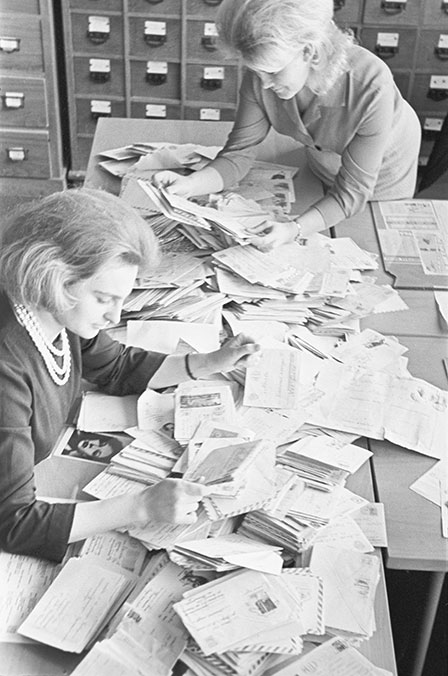
Figure 4.1 The Komsomol’skaia pravda newspaper editorial office. The staff of the Department of Letters work with incoming correspondence (S. Lidov/Sputnik Images)
Journalists’ concern with personal conduct and citizenship was carried over into a new rubric—one that tried to put flesh on the bones of the Communard philosophy. First printed in September 1963, the Scarlet Sail [Alyi parus] offered a dedicated space for young people’s private and public concerns. Each edition was numbered separately, as if it were a publication in itself, and contained around a dozen items, ranging from brief snippets of readers’ letters and poems to longer debates and discussions, as well as reflective essays from prominent authors. The feature’s title bore the hallmarks of the Thaw’s romanticism, taking its name from an adventure story of the 1920s by Aleksandr Grin, which had recently been made into a film.87 Grin’s faith in youthful exploration, independence, and play chimed with the rubric’s values and reflected the ideals of its shestidesiatniki founders, all born within two years of each other, between 1930 and 1932. Alongside Soloveichik worked his Department of Schools colleagues Ivan Ziuziukin, author of numerous articles on schools and pedagogy, and the legendary Inna Rudenko, the head of the Department and the driving force behind the paper’s turn towards ‘moral and ethical’ themes in the 1960s and 1970s. Between them, they succeeded in turning the Scarlet Sail into one of the paper’s most enduring features—one which would appear regularly until the fall of the Soviet Union.
The Scarlet Sail expressed the emotional dominants of the Thaw. Its editions were suffused with references to romantika, and its tone reflected the period’s atmosphere of inclusivity, manifested in glass-fronted architecture and the desire to find a common language across divides.88 Journalists did not simply direct orders at young people, but sought to address them in their own language, sometimes enlisting members of Club Iu.K. as contributors. Instead of a didactic article encouraging students to take more interest in their schoolwork, the Scarlet Sail (apparently) printed a conversation scribbled in the back of an exercise book, passed around by ‘Marina’ and ‘Natasha’ during class.89 The Scarlet Sail’s compliers also appealed to readers for advice. The first edition contained a request for feedback:
Comrade!
You can see we’re just getting started.
The Scarlet Sail:
Did we do it right or not?
How can we make it better?
Don’t curse, suggest!
Write! It’s your turn to speak!
Let’s go, Scarlet Sail! 90
The appearance of familiar rubrics like Club Iu.K. and the Scarlet Sail gave readers a sense that Komsomol’skaia pravda was a space that belonged to them. While some staff members were against this proliferation of familiar rubrics, believing that it granted individual journalists too much autonomy, the majority were in favour, including Soloveichik. In September 1962, he argued that the paper’s young readers ‘love to be entertained’ and that it was ‘more interesting for them when they’re dealing not with the Department of Student Youth but with the Young Communards’ Club. More interesting when they’re dealing not with the Department of Science but with the Knowledge-Lovers’ Club’.91 But unlike the Knowledge-Lovers’ Club [Klub liuboznatel’nykh], a popular science bulletin which seemed to confer member status simply by reading, the ‘Young Communards’ Club’ was unique in making membership contingent on meeting the Club’s ground rules and making a formal application. The Scarlet Sail and Club Iu.K. thus offered the frisson of excitement that came with being initiates of an exclusive society, something that made youth activity seem more exclusive in an age where Komsomol membership was becoming less selective.92
Club Iu.K. had been a powerful tool for advancing the pedagogical and organisational foundations of the Communard Movement, and the Scarlet Sail sought to do this too. In one edition, activities undertaken by two exemplary Komsomol brigades were listed, including such typical Communard activities as themed debates, the planting of trees on ‘Communard Avenue’, as well as the obligatory ‘Sincere Conversation’ to assess one’s work.93 The paper also set up a communications centre for the Eaglet camp, which would disseminate the newest innovations from the Pioneer organisation.94 In spring 1964, the paper happily discussed the growth of the movement, from two jamborees in 1963 to a planned five that summer, as well as meetings in Moscow and Leningrad.95 It also announced a new initiative, entitled ‘Operation Tarpaulin Roof’, in which young people would organise, finance, and run their own camp with minimal adult involvement.96 Subsequent editions contained letters from readers who had done exactly that, working in the fields from morning until lunchtime to finance the camp, and organising their own activities in the afternoon.97
Although the Scarlet Sail sought to further Club Iu.K.’s work, its main innovation was to flesh out the values of the Communard method on an individual level. Its articles were not solely focused on exemplary deeds in classrooms and brigades, but on the behaviour appropriate for life outside school. In doing this, the paper was continuing the reflections on personal behaviour that Adzhubei had popularised in the late 1950s and transferred to Izvestiia in the early 1960s.98 Unlike the publitsistika that became a staple of the late-Thaw press—a form of journalism in which journalists acted as the brain and conscience of the reader—Scarlet Sail articles tried to transfer those powers to readers through the discussion of personal problems. Questions of love and friendship, honour and duty, work and play, happiness and despair all appeared under the rubric’s banner. Though a dose of didacticism was inescapable, the paper’s journalists nevertheless provided a space for public discussion of personal problems otherwise lacking in Soviet public culture. Discussions took two forms: either readers would respond to a previously published letter, or their queries would be answered by journalists acting as agony aunts. One reader had been—unjustly in his view—punished for apparently reading an English textbook in a maths lesson, and had argued with his favourite teacher. He asked whether he was right to stand up for his opinion. The paper’s unsigned response supported the reader: ‘You’re right Lev: when someone is wrong and tries to prove that they’re right, you shouldn’t stay silent.’ But its response also sought to avoid unnecessary iconoclasm: ‘You say you respect [teacher] Abbas Nasreddinovich. But perhaps he was really offended to see you with an English textbook in an Maths lesson. Do you agree?’99 As with Club Iu.K.’s discussions, the paper upheld the importance of being outspoken while simultaneously upholding authority.
The Schools Department envisaged an older readership for the Scarlet Sail than for Club Iu.K.: teenagers. Journalists at the paper believed that they had to do more to appeal to adolescents, and some were convinced that social problems and criminality could be traced to a lack of media offerings for that age group.100 The rubric’s underlying aim was to mould ideal teenagers, and to do so through frank discussion of personal problems. Previous forays into readers’ personal lives had not always welcome. Journalists often seemed unhappy that readers had arguments, fell in love, made mistakes, and expressed doubts. They hoped that their readers were as they had imagined them: intelligent, bold, civic-minded, in control of their emotions. There was a marked sexism to these sentiments: journalists reserved special scorn for female readers who expressed naïve sentiments about the world around them (why do I have no friends? Why are people so rude?!) or who were tricked into bed by devious boys, treating them with mockery rather than sympathy. In editorial letuchki, journalists claimed that ‘only a housewife’ would be so foolish as to believe that people were ‘swine’ [svolochi] just because they swore. ‘If she’s got no friends’, concluded Zerchaninov, ‘that means that no-one wants to be friends with her.’101 The girl who was tricked into bed was described as a ‘vulgar, idiotic, little girl’ and as a ‘grey, vulgar person’ [poshliatina], while the journalist absolved the boy of blame.102 Even those who defended the girl admitted that ‘Of course, she’s not got two brain cells to rub together’.103 Readers were scarcely more sympathetic, with one letter including the memorable sentiment: ‘All women are offended by your thoughtlessness!’104
In Scarlet Sail, by contrast, love and relationships were celebrated. In 1964, the paper solicited letters from boys and girls who were asked to describe the characteristics that had made them fall in love and was not too shy to print the gushing replies it received.105 What was important was that young people were spoken to in their own voices, rather than patronised. A feuilleton penned by a reader in Kishinev related how a visitor came to their Komsomol club to talk about ‘Love and Friendship’ but was roundly mocked for arguing that pupils should only enter into relationships at the age of 21 and for arguing that kissing was dangerous and caused infections.106 The attendees began submitting absurd questions, such as asking whether one should fall in love with someone who had committed traffic violations. The unfortunate speaker was so out of touch, the writer related, that she took these ridiculous questions seriously.
While some journalists were sceptical of the Scarlet Sail, and criticised its authors’ lack of seriousness, most colleagues believed that frank discussions of young people’s inner lives were necessary to ensure their healthy transition to adulthood.107 Discussing the rubric in an editorial meeting, one journalist argued that the rubric was successful because it showed young people that being an adult was a state of mind: ‘it’s not about age, but about a person’s personal qualities, in the maturity of the self’.108 It was crucial for the Scarlet Sail’s readers to act as grown-ups and to take responsibility for their ideas and actions—after all, its readers were ‘not children any more’.109 Parents, from those who spoiled their children to those who were excessively protective, came in for criticism. A poem from Marina Kogan, an 11th grade student was addressed to her mother: ‘You lock me in my room, mum / You won’t let me leave childhood […] But you know: there’s no way / You can keep a person under lock and key’.110
To leave childhood meant to form one’s own views rather than relying on others’ opinions. Independent thinking was posited as the fundamental value of the Scarlet Sail, and of adulthood, with one article proclaiming that a person ‘not possessing their own opinion’ and who ‘parroted what they’ve heard and learned’ was ‘not a grown-up but a know-nothing’.111 The lead article in the very first edition of the Scarlet Sail was written by celebrated Kyrgyz writer Chingiz Aitmatov. He told the story of tenth grader Sergei who, prevented from dating his beloved, proclaimed his love by painting ‘Happy Birthday’ in red letters on the fence outside her home.112 For Aitmatov, Sergei’s actions should not be considered hooliganism or impetuousness, but proof that he had ‘unfurled his Scarlet Sail in life’ by asserting ‘his own understanding of justice, his right to independence’ and ‘his own relationship to life’. Aitmatov saw maturity, conviction, and childishness in his actions, and argued that this was the ‘charm’ and ‘uniqueness’ of being a teenager—a stage of development in which ‘a person’s will awakens and they develop the features of their character’.113 In this reading, the content of one’s soul was more important than academic merit: as another Scarlet Sail article argued, it was less important for an individual to be a good student than for them ‘to try hard, to have a good soul and honest dreams’.114
The feature celebrated independence of mind even when its expression breached norms of social propriety. A number of articles talked indulgently about eccentrics whose single-minded pursuit of their interests caused others to mock them.115 The conclusion readers were to draw from these articles was that it was more important to express one’s own individuality than to court approval from others. A 1965 debate about living virtuously came to the conclusion that true moral goodness necessitated opposing authority figures and the collective:
I don’t think that you should behave only the way your parents and teachers think you should. You feel virtuous only when nobody is forcing you to be ‘good’. That’s when I develop normally, simply, naturally. Hypocrisy, like other distortions, starts because of a constant fear: ‘but what do others think?’116
Another speaker in the debate gave the example of an unpopular girl whose only friend would not speak up for her. He suggested that a constant search for the ‘adulation’ of others sometimes led to a ‘sacrifice of virtue’ so that ‘others think well of you’. To ‘behave like everyone else’ often meant that the ‘majority’ trample the weak’.117
In both of these quotations, individual conscience served as a bulwark against the malign intentions of others—a view out of step with Soviet pedagogical traditions. For readers raised on Makarenko, for instance, this emphasis on the negative role of the collective must have seemed heretical. In the Gorky Commune, Makarenko’s famous pedagogical experiment, it was through horizontal forms of discipline and surveillance that the individual’s rough edges were rounded, and the individual adapted to the needs of Soviet society.118 But by the mid-1960s, pedagogical ideas were beginning to change. For Vasyl Sukhomlinsky, the collective was not nearly as positive as Makarenko had believed. He argued that it was unacceptable to make a child’s soul ‘the object of constant judgement’, and compared the subjugation of the individual to the collective to Stalin’s reduction of the individual to a ‘screw’ in the system.119 The main aim of pedagogy was not to reconcile the individual to the collective, then, but to ensure the ‘all-round development of the individual’ so they could become a valuable member of Soviet society.120 His view of pedagogy as individual flourishing can be seen clearly in the Scarlet Sail, which sought to rouse all facets of the reader’s personality: their capacity for love, friendship, and comradeship; their love of the outdoors, of bodily exertion, of music and the arts; of their ability to laugh and cry; and their aptitude for forming and defending a point of view. Only this type of well-rounded personality—elevated by its contemplation of humanity’s very highest ideas, sentiments and achievements—could become a true citizen.
This form of ‘holistic education’, in which empathy and compassion became as important as knowledge, stood at the heart of Sukhomlinsky’s work.121 And although the founders of the Communard movement were indebted to the work of Makarenko, the Scarlet Sail was far more inclined towards Sukhomlinsky’s ideas. It is telling that Soloveichik became one of his most vocal defenders, writing a glowing review of the final book Sukhomlinsky published during his lifetime, I Give My Heart to Children. The two struck up an epistolary friendship and Soloveichik travelled to Sukhomlinsky’s school in Pavlysh, Ukraine after his death, writing a ‘panegyric’ about his life’s work, and later editing the first anthology of his writings.122
Sukhomlinsky’s ideas can help us understand some of the peculiarities of civic culture after Stalin. The model for Soviet citizenship changed after 1953, as the predominant focus on legal protections and social welfare were augmented with a new emphasis on grass-roots organising and deliberation. The Communards, as a grass-roots initiative committed to action through discussion, provides a case in point. The image of a group of young people grouped around a camp fire and debating issues of public importance has a civic resonance that might put readers in mind of the Athenian agora or the Habermasian public sphere. But if in the Athenian case the connection between debate and decision-making was relatively clear, the Soviet case muddies the waters. Yes, the Communards’ ‘sincere conversations’ and ‘work councils’ created structures through which conversation could turn into action—but what were the political consequences? If we think of Soviet civic life as a building on two levels, we might say that the upper floors were accessible only for occasional visits, such as Supreme Soviet elections, while the ground floor—the floor where the talking and the thinking and the dreaming took place—was (within limits) open for business. This is where the Communard movement resided, alongside other grass-roots movements. Because of the inaccessibility of this upper level, discussions of civic virtue, which is how we might classify the many articles that made up the Scarlet Sail, were less concerned with grand reformist schemes than the question of serving society at the local level. A 1968 article with the title ‘Being a Citizen’ argued that the role of state organisations was ‘to get every young person into the habit of carrying out socially useful tasks’.123 Thaw citizenship, then, amounted to knowing what the right thing was, and doing it at the right time.
Writing of Sukhomlinsky’s conception of civic education, Alan Cockerill notes the absence of classic civic questions of politics, the constitution, or the legal process.124 Sukhomlinsky conceived citizenship not as a question of practical rights, broadly understood, but as a question of self-transformation. In Birth of a Citizen, Sukhomlinsky argued that ‘A civic view of the world means living morally to one’s very bones’.125 Civic activity was ethical activity residing in a feeling of responsibility—of duty—towards oneself, one’s family, one’s colleagues, to society, and to the nation:
A person starts to be a citizen when the sphere of his personal interests grows wider, to include the interests of many people. The moral relationships of an individual with others are reflected precisely in the fact that for the adolescent, the interests of other people have become their own.126
What is telling, however, is that these ‘moral relationships’ are for Sukhomlinsky forged outside the official political sphere: not in the Party, the Pioneers, or Komsomol, but rather in the home, the classroom, or in the workplace. The good society would come about not by changing political structures—those were off limits—but by changing the behaviour of the individuals living within it. This goes for the Communards as much as it applies to the adolescents educated by Sukhomlinsky. Change would come about by creating an army of individuals imbued with revolutionary zeal, who could oppose the hypocrisy of the surrounding world. But it also required individuals capable, to use Sukhomlinsky’s words, of ‘sensing the subtlest movements of another person’s heart, and responding to it with their own sincere movements’—that is, social transformation needed individuals imbued with the emotional and aesthetic intelligence to be with others.127 Hence the Scarlet Sail functioned as a space through which journalists could help to form the moral traits of the future communist subject. As the introduction to one edition of the Scarlet Sail stated:
Friends, our country is in great need of able, skilled, smart workers, well educated, energetic, and possessing a fresh view on things. In need of people who are just and honest, free of indifference to any evil, able to work in a collective. It needs people who are open to all arts, and truly intellectual. It needs people who are firm in their ideological convictions. All of you, of course, would like to be that person.128
The Communards and the Scarlet Sail offered a sentimental education—a training of the will, the emotions, the senses—that would enable young people to serve the interests of Soviet society. The enduring popularity of the Scarlet Sail—and of Sukhomlinsky’s teachings—beyond the end of the Thaw suggests that this programme would eventually become part of the pedagogical mainstream. The fate of the Communard philosophy, by contrast, suggests that effecting structural change to the country’s civic structures was far more challenging.
The Communards and the End of the Thaw
Komsomol’skaia pravda was a crucial mediator between the grass-roots and the public, as the rapid growth of the Communards and the popularity of the Scarlet Sail both illustrate. A study of the Khrushchev-era Komsomol concluded that the Komsomol’s goal of mainstreaming the grass-roots was unsuccessful—not because of official obstruction but because low-level officials were unaccustomed to thinking independently.129 The pages of Komsomol’skaia pravda provide ample examples of local officials’ unwillingness to deviate from type, much to the annoyance of young people and journalists. Yet the example of the Communards shows that this wasn’t always the case: dissatisfaction with the rigidity of official activity could lead to far-reaching innovations from below. While Pankin’s criticisms of the Kaluga obkom ended in failure, the burgeoning popularity of the Communard movement suggested that reform-minded pedagogues could see their ideas flourish nationally if they had the right connections. Benefiting from the loosening of restrictions, official media like Komsomol’skaia pravda were a crucial element in bringing new ideas to public attention. Rather than waiting for official approval, Thaw editors often assumed that an idea was acceptable unless proved otherwise. The Schools’ Department’s support for the Communards is one example: a chance encounter between Soloveichik and Ivanov turned into an article, the article turned into a Club, and the Club turned into a national movement.
The fact that the Communard movement appeared at all is significant. But how did its values fit into the basic contours of Thaw civic life? Some have seen the movement within the framework of dissidence, framing it as an ‘underground’ movement, an ‘all-union dissident organisation’ or a movement of ‘informals’ [neformaly].130 Leading Communard Richard Sokolov classed Igor’ Ivanov as a ‘dissident’ [inakomysliashchii], but also claimed that he was ‘more Catholic than the Pope in Rome’ when it came to communist ideas.131 And perhaps it is this latter claim that tells us more than the claim of dissidence for, as Daria Dimke has argued, it is this excess of identification with communist ideas that constitutes its most radical gesture. Communards’ insistence on the value of collectivism and comradeship, and their rejection of material comfort brought them into conflict with the more materialistic values of the Soviet sixties.132 This overidentification with communist ideas suggests that Commune-ism was not so much a ‘reterritorialisation’ of Soviet ideals (since its adherents had no intention of travelling outside the communist orbit) as an attempt to recapture a lost communist essence.133
This attempt to rescue an unblemished communism from the past was a quintessentially Thaw-like gesture. A decade later, the desire to extract a ‘pure’ communism from its imperfect applications would give way to appeals for human rights, the nativist suasions of Russian nationalism, or the retooling of communist discourse to one’s own advantage. For a brief moment, however, it was possible for marginal ideas to become mainstream, for things forgotten or distant from the centre to be rediscovered and adopted. Soviet socialism was not a book but a library, and its shelves housed a large archive of practices and ideas. The ‘Light Cavaliers’ drawn upon by the founders of the Kaluga Flame, or the amateur pursuits [samodeiatel’nost’] which did so much to animate local artistic activity, are both examples of practices decentred in time or space, but nevertheless available for appropriation. In drawing up their new pedagogy, Ivanov, Borisova, and Shapiro similarly drew on pedagogical ideas, some canonised and some forgotten, and did so in a bid to re-energise Soviet communism’s mainstream. This was not ‘underground’ activity: the founders of the movement expounded their new ideas at meetings of the Academy of Sciences, and were leaders of Komsomol and Pioneer brigades; the flagship Frunze Commune was run out of a district Pioneer headquarters. It was a matter of looking beyond Moscow to find new ideas whose application might stretch beyond their original locales if they found the right institutional niche—a role Komsomol’skaia pravda played for the Communards.
But the Thaw’s experiments, reliant as they were on indulgence from above, were destined not to last. The movement’s high point came in 1964, when an All-Union jamboree was held in Bratsk, a town iconic for the heroic construction of a new hydro-electric power station.134 Two hundred Pioneer and Komsomol supervisors were joined by thousands of young people who subsequently disseminated the movement’s ideas to the rest of the country.135 Branches emerged all over the Soviet Union, with local newspapers opening their own Young Communard Clubs with the support of local Komsomol organs. But the end of the Khrushchev era marked the movement’s high point. In late 1964, a meeting was convened with members of the Department of Schools and local Komsomol secretaries. The latter group complained that the paper was publishing more about Communards than ordinary Komsomol organisations, and that the paper favoured the Communards over rank-and-file Komsomol committees within schools.136 Officials’ annoyance was understandable: by showing how the Frunze Commune had real meaning for its participants, articles on the Communard method implied that official activities were going through the motions. Soloveichik’s first article on the Frunze commune expressed surprise that two individuals excluded from their Communard group were truly upset: ‘These two didn’t at all think that this was a game, some sort of childish entertainment. There was something in this Commune to make them take it seriously’.137 Similarly, in Ziuziukin and Soloveichik’s 1964 article, the authors mention a fashion for red neckties. Usually worn with extreme reluctance, children’s passion for the Communard method made them keen to get hold of a necktie from the camp so they could wear it in public.138 Given how many of the paper’s articles spoke of children’s high hopes upon joining the Pioneers being dashed, such enthusiasm was telling. One child, asked by Soloveichik what the movement had given him, replied that it had helped him to ‘understand what real Pioneer life is’.139 Real Pioneer life: only by imbuing official activities with individual meaning could the Pioneer and Komsomol organisations inspire young people, Soloveichik implied.
But youthful vitality sometimes overreached itself. Communards refused to treat their activities as a game or an experiment. In a world where communist ideas were supposed to be taken seriously only to a point, the desire to turn ideals into reality was subversive. Communards who saw this contradiction were sometimes enraged, turning them against classmates, parents, and teachers, whom they regarded as ‘philistines’.140 Shubin alleges that in 1966–1967, enraged Communards broke the windows of local Komsomol organisations in Leningrad and Salavat.141 Pankin had to defend the paper’s actions against attacks from local officials, but even he was forced to concede that clashes were caused by a clash between ‘youthful maximalism, fervour, and self-confidence’ with adults’ ‘caution, inflexibility and unjustified suspicion’.142
This friction worried Komsomol officials, who moved to take the movement under its control. In December 1965, a meeting was held at the Department of Working Youth at the Komsomol’s Central Committee with prominent Communards, including founding member Faina Shapiro, in attendance. According to Communard Richard Sokolov, who was also present, officials at the meeting demanded that the movement unify: ‘a single form, a single method’.143 The fate of the ‘Komsomol Searchlight’ movement, an initiative from below inspired by the Light Cavalry of the 1920s, suggests what might have happened to the Communard movement had they agreed.144 This grass-roots idea, which conducted inspections of factories and farms, institutions and enterprises, was supported by the Komsomol and received ample coverage in the youth press. But under the Brezhnev leadership’s centralising agenda, the Komsomol took control of the Searchlight and administered it as a department of the Central Committee, eliminating its grass-roots energy. The Komsomol Searchlight became a national phenomenon, but it lost its independence.
The Communards’ refusal to unite meant that they lost their institutional protection. Forced to make ad hoc arrangements with local Komsomol organisations, some individuals lost their jobs as vozhatye or their Komsomol positions.145 In July 1966, a Komsomol secretary, Boris Pastukhov (who would become the Komsomol’s First Secretary a decade later), issued a resolution decrying ‘serious shortcomings’ in the work of the Eaglet camp. He denounced the ‘disease’ of ‘experimentation’ [formotvorchestvo], and argued that educators had ‘become distracted by all sorts of aimless experiments, which do not correspond to children’s interests’. For Pastukhov, discussion had become dangerous, causing a ‘kerfuffle’ [azhiotazh], and ‘leading schoolchildren on a path of political equivocating and educating them in a spirit of nit-picking and nihilism’.146 In their place, Pastukhov foresaw a growth in activities which emphasised ‘education in citizenship and patriotism’, and well as ‘holidays, games, and mass activities’.147 Pastukhov and the Communards were not so dissimilar in their yoking of camp activities and citizenship, but they were worlds apart when it came to methods. For the Communards, patriotism and citizenship were cultivated through discussion and action; for Pastukhov, they were values to be taught and learnt. As a result of the resolution, many creative pedagogues were forced to leave the Eaglet camp, ostensibly because of their lack of pedagogical qualifications, but in reality because their ideas were considered excessively ‘humanist’—a term used to denounce humanitarian values of which the Party disapproved.148
The Communards didn’t immediately disappear from the pages of Komsomol’skaia pravda. In September 1966, Ivan Ziuziukin published a long and positive profile of Shapiro, while Shapiro co-authored an article which implied that the Communard methodology was the only way for the Komsomol to stay relevant.149 But this was the last salvo in a battle neither Ziuziukin nor Shapiro could win: these were the last articles to mention the Communards explicitly for two decades. In 1967, Simon Soloveichik, whose role at the paper had gradually shrunk to the role of classical music reviewer, was forced to leave the redaktsiia for the sin of ‘abstract humanism’; the same reproach was aimed at Vasyl Sukhomlinsky on the pages of the pedagogical press.150 Though the Scarlet Sail was hoisted through the 1970s and 1980s, there was no mention of the Communard method after 1966. Without the multiplying effect of the newspaper or an institutional foothold, Soloveichik’s dream of bringing kommunarstvo to a mass audience had vanished—and with it some of the idealism of the Thaw experiment.151 In curbing the influence of the movement, the conservatives and pragmatists who were beginning to take power firmly showed that under Brezhnev there was no longer room for the free-wheeling experiments—now ‘formotvorchestvo’—of the Khrushchev era.
News from Moscow: Soviet Journalism and the Limits of Postwar Reform. Simon Huxtable, Oxford University Press. © Simon Huxtable 2022. DOI: 10.1093/oso/9780192857699.003.0005
1 One iconic example being the treatment of Byvalov in Grigorii Aleksandrov’s Volga-Volga (1938).
2 Susan Reid, ‘Khrushchev in Wonderland: The Pioneer Palace in Moscow’s Lenin Hills, 1962’, Carl Beck Papers in Russian & East European Studies, 1606 (2002), 25–6.
3 Reid, ‘Khrushchev in Wonderland’; Iuliia Skubytska, ‘It Takes a Union to Raise a Soviet: Children’s Summer Camps as a Reflection of Late Soviet Society’, Unpublished PhD dissertation, University of Pennsylvania, 2018, 118–23.
4 Soo-Hoon Park, ‘Party Reform and “Volunteer Principle” under Khrushchev in Context’, Unpublished PhD dissertation, Columbia University, 1993; Kiyohiro Matsudo, ‘Obshchestvennost’ in the Struggle against Crimes: The Case of People’s Vigilante Brigades in the Late 1950s and 1960s’ and Kawamoto Kazuko ‘Public and Private Matters in Comrades’ Courts under Khrushchev’, in Obschestvennost’ and Civic Agency in Late Imperial and Soviet Russia, ed. by Yasuhiro Matsui (London: Palgrave MacMillan, 2015), 152–70, 171–98; Christine Varga-Harris, Stories of House and Home: Soviet Apartment Life During the Khrushchev Years (Ithaca: Cornell University Press, 2017), 106–35.
5 S. Soloveichik, ‘Frunzenskaia kommuna’, 10 Jan. 1962, 4. The language of ‘mastery’ was also present in Soloveichik’s articles on the Pioneer Palace: S. Soloveichik, ‘Eto Vam, schastlivye!’, 1 Jun. 1962; S. Soloveichik, E. Bruskova, ‘Kliuch ot strany romantikov’, 2 Jun. 1962.
6 For ease of reading, I will use the term ‘Komsomol’ to mean Komsomol and Pioneer organisations, since the latter was subordinated to the former.
7 The term comes from Gleb Tsipursky, Socialist Fun: Youth, Consumption, and State-Sponsored Popular Culture in the Soviet Union, 1945–1970 (Pittsburgh: Pittsburgh University Press, 2016).
8 N. Aleksandrova, S. Bol’shakova, ‘O tekh, kto nas trevozhit’, 10, 16, 17 Mar. 1954, 3; T. Solomatina, ‘U nikh doma’, 5 Jan. 1955, 3; M. Makliarskii, L. Sheinin, ‘O papakh i mamakh’, 14 Oct. 1955.
9 A. Kadege, ‘Pionerskii galstuk’, 4 Apr. 1954, 2.
10 ‘Zdes’ pioneram skuchno’, 17 Jul. 1948, 3; ‘Pochemu pioneram skuchno v otriade?’, 21 May 1948, 2. See also A. David’iants, ‘Pionerskie sbory po stsenariiu’, 6 Oct. 1951, 2.
11 ‘Kak sdelat’ zhizn’ Komsomol’skoi organizatsii interesnoi, soderzhatel’noi?’, 28 Mar. 1953, 2. Replies were printed on 8, 12, 15, 19, 29, Apr. 6 and 29 May, and 12 Jun.; E. Beman, ‘Protiv formalizma v Pionerskoi rabote’, 28 May 1953, 2; V. Bil’chinskii, ‘Dva vozhatykh, dva stiliia’, 21 Nov. 1953, 2; ‘Protiv shablona i formalizma v pionerskoi rabote’, 15 Apr. 1954, 2.
12 ‘Krasnorechie po shpargalkam’, 17 Aug. 1954, 2; I. Dukhovnyi, ‘Ne govorit’ gotovymi formulami’, 31 Oct. 1954, 2.
13 For more on these dynamics see Chapter 1.
14 ‘Vospityvat’ samostoiatel’nost’ u budushchikh rabochikh’, 24 Nov. 1955, 1.
15 Nikolai Mesiatev, Gorizonty i labirinty moei zhizni (Moscow: Vagrius, 2005), 307–8. See also D. Novoplianskii, ‘Dva pis’ma’, 12 Feb. 1954 for a similar argument.
16 Mesiatsev, Gorizonty, 310–11.
17 Tsipursky, Socialist Fun, 104 and passim. On the fate of one such club see Chapter 2.
18 V. Ganiushkin, ‘Vot chto takoe klub molodezhi!’, 9 Jul. 1957, 2. Many of these clubs were supported and promoted by local newspapers (Tsipursky, Socialist Fun, 104).
19 Ganiushkin, ‘Vot chto takoe klub molodezhi!’.
20 ‘Zapiska N.S. Khrushcheva o sisteme narodnogo obrazovaniia v SSSR’, 5 Jun. 1958, RGANI, f.3, op.14, d.219, l.1 in Prezidium TsK KPSS 1954–1964. Tom 2: Postanovleniia 1954–1958 (Moscow: Rosspen, 2006), 835–52 [839]; A. Konkhova, ‘“Ob ukreplenii sviazi vyshei shkoly s zhizn’iu” (reforma sistemy vyshego obrazovaniia SSSR v 1958 g.)’, Vestnik Leningradskogo gosudarstvennogo universiteta (2015), 127.
21 ‘Zapiska N.S. Khrushcheva’, 837; ‘U kazhdoi shkkoly dolzhno byt’ mnogo druzei’, 18 Sep. 1954, 1.
22 Laurent Coumel, ‘The Scientist, the Pedagogue and the Party Official: Interest Groups, Public Opinion and Decision-Making in the 1958 Education Reform’, in Soviet State and Society under Nikita Khrushchev, ed. by Melanie Ilič, Jeremy Smith (London: Routledge, 2009), 66–85.
23 On opposition see Laurent Coumel, ‘L’appareil du parti et la réforme scolaire de 1958: un cas d’opposition à Hruščev’, Cahiers du Monde russe, 47.1–2 (2006), 173–94. On connections with the 1920s see Konkhova, ‘Ob ukreplenii sviazi…’, 129. For articles on the new policy see, among many others, E. Tiazhel’nikov, ‘Uchiteliu nuzhna inaia podgotovka’, 2 Nov. 1958, 3; A. Rus’ko, ‘Rabochii so srednim obrazovaniem’, 19 Nov. 1958, 3; S. Bol’shakova, L. Ivanova, ‘Edinyi front’, 9 Dec. 1958, 2; R. Mertslin, I. Kamenogradskii, N. Eremin, ‘Spetsialist s universitetskim diplomom’, 10 Dec. 1958, 2.
24 Coumel, ‘L’appareil du parti’, 192–3. Sukhomlinsky’s letter is translated in Alan Cockerill, Each One Must Shine: The Educational Legacy of V.A. Sukhomlinsky (New York: Peter Lang, 1999), 157–9.
25 Sukhomlinsky quoted in Cockerill, Each One Must Shine, 86.
26 V. Sukhomlinskii, ‘Troika v attestate…Otchego?’, 10 Feb. 1961, 3.
27 Ibid.
28 V. Sukhomlinskii, ‘Rodina—v serdtse tvoem’, 18 Nov. 1964, 2.
29 Liudmila G. Borisova. ‘Puti sozdaniia obshchestvennogo mneniia pionerov i komsomol’tsev.’ Doklad na Pedagogicheskikh chteniakh APN RSFSR, Moscow, March 1957, http://kommunarstvo.ru/biblioteka/bibborput.html [Accessed: 2 Apr. 2019].
30 S. Bol’shakova, E. Shchatskaia, ‘Protiv serosti i skuki – za romantiku!’, 30 Mar. 1954, 3.
31 Mikhail Kordonskii, ‘Vvedenie v kommunarskoe dvizhenie’, http://www.altruism.ru/sengine.cgi/5/22/1 [Accessed: 11 Jul. 2019]; Roman Sinel’nikov, Ostavliaiu vam na pamiat’…(Pesni kommunarov) (Moscow: The Olympic Editorial, 1997).
32 Both terms are used in S. Soloveichik, ‘Bodry ritmy “Orlenka”’, 18 Aug. 1963, 1. This article contains the paper’s first mention of the term ‘Communard method’.
33 I. Ivanov, ‘Vospitatel’naia rabota pionerskoi organizatsii’, 8 Jan. 1958, Talk at ‘Znanie’ society, http://www.kommunarstvo.ru/biblioteka/bibivalek.html [Accessed: 22 May 2019]; Borisova, ‘Puti obshchestvennogo mneniia’; Shchatskaia, Bol’shakova, ‘Pedagogicheskaia nauka’.
34 Borisova, ‘Puti obshchestvennogo mneniia’.
35 Andy Willimott, Living the Revolution: Urban Communes and Soviet Socialism (Oxford: Oxford University Press, 2017).
36 Simon Soloveichik, Vospitanie tvorchestvom (Moscow: Znanie, 1978), 5; Richard Sokolov, ‘V poiskakh “nastoiashchei” sotsial’noi pedagogiki’, Na putiakh k novoi shkole, 3 (2004), 5–10, http://altruism.ru/sengine.cgi/5/7/8/17/8.html#5 [Accessed: 11 Jul. 2019].
37 Sokolov, ‘V poiskakh’.
38 ‘2-i letnii lagernyi sbor KIuF (iun’ 1960 goda)’, http://kommunarstvo.ru/istor/istkyulag2l.html [Accessed: 12 Jul. 2019].
39 Sokolov, ‘V poiskakh’.
40 Vladimir Shakhidzhanian, ‘Mne interesny vse liudi’, https://1001.ru/books/item/mne-interesny-vse-ludi-60/5316 [Accessed: 2 Apr. 2019].
41 S. Soloveichik, ‘Posovetuemsia, tovarishchi vozhatye’, Jul. 9 1955, 2; ‘Rasskaz ob odnom vozhatom’, 31 Aug. 1955, 3.
42 Shakhidzhanian, ‘Mne interesny’.
43 Soloveichik, ‘Frunzenskaia kommuna’.
44 Ibid.
45 Dar’ia Dimke, ‘Iunye kommunary, ili Krestovoi pokhod detei: mezhdu utopiei deklariruemoi i utopiei real’noi’, in Ostrova utopii. Pedagogicheskoe i sotsial’noe proektirovanie poslevoennoi shkoly (1940–1980-e), ed. by Il’ia Kukulin, Mariia Maiofis, Petr Safronov (Moscow: Novoe literaturnoe obozrenie, 2015), 360–97.
46 Soloveichik, ‘Frunzenskaia kommuna’.
47 Simon Soloveichik, ‘Bodrye ritmy Orlenka’, 18 Aug. 1963, 1.
48 Ibid.
49 Ibid.
50 Dimke, ‘Iunye kommunary’, 370; Kukulin, Maiofis, Safronov, Ostrova utopii, 657.
51 Dimke, ‘Iunye kommunary’, 370–1.
52 I. Ziuziukin, ‘Vse otdat’, vse vziat’’, 27 Sep. 1966, 2.
53 Ziuziukin, ‘Vse otdat’’, 2.
54 ‘Kommuna im. Makarenko (KiM)’, http://www.kommunarstvo.ru/kontsep/konslo.html#kim [Accessed: 17 Jun. 2019].
55 A. V. Shubin, Dissidenty, neformaly i svoboda v SSSR (Moscow: Veche, 2008), 316.
56 Soloveichik only listed Shapiro in his 1963 article on the Frunze Commune’s history (S. Soloveichik, ‘Kommuna, god piatyi’, 31 Jul. 1963, 2), and even articles which sought to tell the story of the commune—and Ivanov’s departure—never mentioned its founder’s name (e.g. Ziuziukin, ‘Vse otdat’’).
57 Soloveichik, ‘Posovetuemsia’, ‘Rasskaz ob odnom vozhatom’.
58 Kukulin, Maiofis, Safronov, Ostrova utopii, 658; Shubin, Dissidenty, 315–16; Tsipursky, Socialist Fun, 107.
59 I. Ziuziukin, S. Soloveichik, ‘Umnaia skazka orliat’, 11 Aug. 1964, 2.
60 Evelin Eichler, Pionierlager in der Sowjetunion (Berlin: epubli, 2015), 288–9.
61 Soloveichik, ‘Frunzenskaia kommuna’, ‘Kommuna—god piatyi’, ‘Bodry ritmy’.
62 Soloveichik, ‘Bodrye ritmy’.
63 Soloveichik later conceded that the Club’s main aim had been to ‘propagandis[e] the experience of the Frunze Commune’ (Vospitanie tvorchestvom, 19).
64 ‘Shkola, klass, druz’ia…Interesno li tebe s nimi?’, 24 Jan. 1962, 2–3.
65 ‘Slovo—kommunaram’, 24 Sep. 1963, 4.
66 Ibid.
67 Ibid.
68 ‘Shkola, klass, druz’ia…’
69 ‘Chto znachit byt’ bortsom?’, 7 Oct. 1962, 2.
70 On the practice of ‘sincere conversation’ see Dar’ia Dimke, ‘Zhizn’ po zakonam iskusstva: utopicheskie zrelishche I geroicheskoe soobshestvo (na primere Kommuna iunykh Frunzentsev)’, Sotsiologiia vlasti, 4–5.1 (2012), 111–38.
71 ‘Piat’ printsipov Alekseia Adzhubeia’, Izvestiia, 6 Jan. 2004, https://iz.ru/news/285551 [Accessed: 1 Oct. 2020].
72 Gleb Tsipursky, ‘Having Fun in the Thaw: Youth Initiative Clubs in the Post-Stalin Years’, Carl Beck Papers, 2201 (2012), 22. This was possibly a response to the Komsomol’s demand for newspapers to employ debates more widely.
73 Zapiska otdela kul’tury TsK KPSS: ‘O nekotorykh nezdorovykh iavleniakh v Moskovskom otdelenii Soiuza pisatelei’, no later than 30 May 1957 in Apparat TsK KPSS i kul’tura, 1953–1957. Dokumenty. ed. by V.Iu. Afiani (Moscow: Rosspen, 2001), 680.
74 ‘Klub otkryt, vkhodite!’, 24 Apr. 1957, 2–3.
75 Ibid., 2–3.
76 Ibid., 2.
77 ‘Predlozheniia po rabsel’korovskomu dvizheniiu’, undated 1958, RGASPI, f.98M, op.1, d.228, l.49; ‘Doklad redkollegii gazety KP’, undated 1958, RGASPI, f.1M, op.32, d.929, l.18.
78 6 May 1957, d.193, l.8.
79 Ibid., ll.8–9.
80 ‘Kak by ty khotel prozhit’ zhizn’?, 24 May 1962, 3.
81 Alyi parus, ed. by N. Sidneva (Moscow: Molodaia gvardiia, 1966), 4.
82 Ibid., 5.
83 Diana Georgescu, ‘Small Comrades as Historians and Ethnographers: Performativity, Agency, and the Socialist Pedagogy of Citizenship in Ceaușescu’s Romania, 1969–1989’, Slavic Review, 78.1 (2019), 78.
84 Willimott, Living the Revolution, 49–78.
85 Anna Krylova, ‘Soviet Modernity: Stephen Kotkin and the Bolshevik Predicament’, Contemporary European History 23.2 (2014), 167–92 and Anna Krylova, ‘Imagining Socialism in the Soviet Century’, Journal of Social History 42.3 (2017), 315–41.
86 Full list: ‘Predlozheniia po rabsel’korovskomu dvizheniiu’, undated 1958, f.98M, op.1, d.228, l.50.
87 Alye parusa (d. Aleksandr Ptushko, 1961).
88 On campfire singing see Petr Vail’, Aleksandr Genis, 60-e: Mir sovetskogo cheloveka (Moscow: Novoe literaturnoe obozrenie, 1998), 126. On spatial freedom see Lida Oukaderova, The Cinema of the Soviet Thaw: Space, Materiality, Movement (Bloomington: Indiana University Press, 2017); on common languages, see Eleonory Gilburd, To See Paris and Die: The Soviet Lives of Western Culture (Cambridge, MA: Belknap Press, 2019).
89 ‘Pora, moi drug!’, 26 May 1965, 4.
90 ‘Alyi parus’, 24 Sept. 1963, 4.
91 17 Sep. 1962, d.325, ll.57–8.
92 Steven L. Solnick, Stealing the State: Control and Collapse in Soviet Institutions (Cambridge, MA: Harvard University Press, 1998), 102–5.
93 ‘Sostiazanie krilatykh’, 4 Dec. 1964, 4.
94 ‘Otkryvaem PPO’, 2 Oct. 1964, 4.
95 ‘Klub Iu.K.’, 22 Mar. 1964, 2.
96 ‘Brezentovye goroda. Stroim?’, 22 Mar. 1964, 4.
97 ‘Nashei radosti “Ogonek”’, 26 Apr. 1964, 4.
98 Thomas Wolfe, Governing Soviet Journalism: The Press and the Soviet Person after Stalin (Bloomington: Indiana University Press, 2005), 16–19, 45–8.
99 ‘Otvechaem na vse voprosy’, 19 Feb. 1964, 4.
100 18 Jan. 1960, d.268, ll.115–22. On the youth ‘crisis’ see Kristin Roth-Ey, ‘Mass Media and the Remaking of Soviet Culture, 1950s–1960s’, Unpublished PhD Dissertation, Princeton University, 2003, 46–98.
101 18 Jan. 1960, d.268, l.86.
102 Ibid., l.12, 15.
103 Ibid., l.14.
104 ‘Pochemu tak sluchilos’?‘, 22 Feb. 1964, 2.
105 ‘Povest’ o pervoi liubvi’, Jul. 19 1964, 4; ‘Mal’chishka, kak on est’’, 1 Nov. 1964; ‘Portret otlichnogo mal’chishka’, 28 Mar. 1965.
106 N. Vieru, ‘Okh, uzh eto liubov’’, 26 May 1965, 4.
107 See Chikin’s criticisms: 30 Sep. 1963, d.349, ll.10–11.
108 9 Dec. 1963, d.50, l.31.
109 A. Rekemchuk, ‘Kogda ty stanovsish’sia vzroslym’, 4 Dec. 1963, 4.
110 M. Kogan, ‘Na poroge’, 24 Sep. 1963, 4.
111 Rekemchuk, ‘Kogda…’.
112 C. Aitmatov, ‘Druzhi s vetrom’, 24 Sep. 1963, 4.
113 Ibid.
114 ‘Fantazerom byt’ neplokho’, 6 Oct. 1963, 4.
115 E. Vorontsova, ‘Pro Alika i ego liniiu’, 4 Dec. 1963, 4; I. Ziuziukin, ‘Etot Vit’ka Novikov…’, 27 May 1964, 4; A. Ivkin, ‘Konfliktuiushchii Vit’iukha’, 2 Oct. 1964, 4; S. Sinitskaia, ‘Zelenoe iabloko’, 24 Jun. 1965, 4.
116 ‘Chto znachit—zhit’ s dostoinstvom?’ 21 Apr. 1965, 4.
117 Ibid.
118 On Makarenko see Oleg Kharkhordin, The Collective and the Individual in Russian Society: A Study of Practices (Berkeley: University of California Press, 1999), 75–122.
119 Sukhomlinsky quoted in Aleksandr Dmitriev, ‘Serdechnoe slovo i “respublikanskii uroven”: sovetskie i ukrainskie konteksty tvorchestva Vasiliia Sukhomlinskogo’, in Kukulin, Maiofis, Safronov, Ostrova utopii, 327. Catriona Kelly offers a different reading, claiming that Sukhomlinsky continued to demand ‘dutiful self-abnegation in the face of social demands’ (Children’s World: Growing Up in Russia, 1890–1991 (New Haven: Yale University Press, 2007), 134).
120 Dmitriev, ‘Serdechnoe slovo’, 333–5. See also Cockerill, Each One Must Shine, 165–6.
121 Cockerill, Each One.
122 This account draws on ibid., 176–7. S. Soloveichik, ‘Uchitel’ Sukhomlinskii i ego novaia kniga’, 18 Sep. 1969, 4; S. Sokoloveichik, ‘Rasskazyvaite o Sukhomlinskom’, Iunost’, 4 (1971), 78–85; S. Soloveichik, ‘Strast’ Sukhomlinskogo’, 4 Apr. 1976, 2–3.
123 A. Kapto, ‘Byt’ grazhdaninom’, 18 May 1968, 1.
124 Cockerill, Each One, 144.
125 V. Sukhomlinskii, Rozhdenie grazhdanina in V.A. Sukhomlinskii, Izbrannye proizvedeniia v piati tomakh. Tom 3, ed. by A.G. Dzeverin et al. (Kiev: Radians’ka shkola, 1980), 468.
126 Ibid., 536.
127 Ibid., 562.
128 ‘Okean znanii—vot ona, romantika!’, 1 Sep. 1964, 4.
129 Katharina Uhl, ‘Building Communism: The Young Communist League during the Soviet Thaw Period, 1953–1964’, Unpublished PhD Dissertation, Oxford University, 2013, 44–5, 50–7.
130 Valerii Khiltunen, ‘Perevod s prostogo na russkii’, http://soob.ru/n/2002/10/c/10 [Accessed: 1 April 2019]; Shubin, Dissidenty, 314–26.
131 Shubin, Dissidenty, 315.
132 Dimke, ‘Iunye kommunary’.
133 Aleksei Yurchak, Everything Was Forever until It Was No More: The Last Soviet Generation (Princeton: Princeton University Press, 2006), 126–57.
134 Although a participant in the meeting also recalls that excursions were impeded by barbed wire and signs warning them that guards would ‘shoot without warning’: they had strayed into the ‘Zone’ of the Gulag. See Valentin Sidak, ‘Uroki kommunarskogo dvizheniia’, Pravda, 13–16 May 2016, https://gazeta-pravda.ru/issue/50-30401-13-16-maya-2016-goda/uroki-kommunarskogo-dvizheniya/ [Accessed: 20 Dec. 2021].
135 Shubin, Dissidenty, 315–16.
136 B. Pankin to G.V. Buzin, undated 1967, RGASPI, f.98M, op.1, d.461, l.24. There is evidence of dissatisfaction even before this point: see the complaints listed in Soloveichik, ‘Kommuna, god piatyi’.
137 Soloveichik, ‘Frunzenskaia kommuna’.
138 Ziuziukin, Soloveichik, ‘Umnaia skazka orliat’.
139 Soloveichik, ‘Frunzenskaia kommuna’.
140 Dimke, ‘Iunye kommunary’, 394.
141 Shubin, Dissidenty, 317.
142 Pankin to Buzin, l.24.
143 Shubin, Dissidenty, 317.
144 Seth Bernstein, Raised Under Stalin: Young Communists and the Defence of Socialism (Ithaca: Cornell University Press, 2017), 22–3.
145 Sokolov, ‘V poiskakh’.
146 ‘O ser’eznykh nedostatkakh v rabote Vserossiiskogo pionerskogo lageria Orlenok’, 26 Jul. 1966, RGASPI, f.9, op.1, d.114, ll.32–5 [34]. My thanks to Evelin Eichler for this reference.
147 Ibid., l.34.
148 Eichler, Pionierlager, 319–21.
149 Ziuziukin, ‘Vse otdat’’; A. Zuev, M. Kazakina, F. Shapiro, ‘Otriad uzhe na doroge’, 6 May 1966, 2.
150 Inna Rudenko, ‘Nado pomnit’, chto est’ liudi, kotorye luchshe tebia’ in Zhurnalisty XX veka: Liudi i sud’by (Moscow: Olma-Press, 2003), 762; it seems that Soloveichik was allowed to resign rather than be fired, and he continued to write for the paper after his departure (Pankin to Buzin, l.26). For attacks on Sukhomlinsky see B.T. Likhachev, ‘Nuzhna bor’ba, a ne propoved’’, Uchitel’skaia gazeta, 18 May 1967.
151 Shubin, Dissidenty, 319–21.