
In public reports on “migration crises” in the Mediterranean and at the United States–Mexico border from 2015 to 2018, journalists and policy experts portrayed environmental changes as an underlying, hidden cause of mass migration. An article published in the UK newspaper the Guardian on October 30, 2018 is a case in point. Stating that “thousands of Central American migrants trudging through Mexico to the United States” have been affected by crop failures attributable to climate change, the article claims that the effects of environmental processes upon migration are “harder to grasp” than the more commonly reported bases of rapid displacement: “gang violence and extreme poverty.” Displaying a photograph of the 2018 migrant caravan that journeyed from San Pedro Sula, Honduras to Tijuana, Mexico from October 12 to November 15,1 the article proclaims, “The unseen driver behind the migrant caravan” is “climate change.” Punning on the image of the open truck, photographed from the rear and filled with passengers from the caravan, the headline personifies climate change as the agent of displacement and configures the Honduran and Guatemalan migrants seeking asylum in the United States as part of a larger expected wave of “millions more” migrants who will flee to the United States.2 In addition to quotations from two U.S.-based academics who argue that climate change exacerbates food insecurity in regions like western Honduras, which are experiencing large migrant outflows, the article includes the testimony of a single Mayan migrant from Honduras, Jesús Canan, who describes how drought “is forcing us to emigrate.”3
Such reporting often includes images and descriptions of the hardships faced by migrants, as well as of the devastation wrought by increased atmospheric carbon concentrations, which accelerates global warming. However, it tends to ignore the language people use to explain political contexts in their home countries and the complexity of migration decisions. Organized largely through the efforts of the transnational immigrant rights group Pueblo Sin Fronteras, the migrant caravans attempted to articulate critiques of U.S. immigration policies, border detention, and the physical and sexual violence to which migrants are routinely subjected—both in their home countries and on their northward journeys. Although they were viewed in the U.S. media as a sign of the large scale of mass migration (despite the fact that crossings at the southern border had actually dropped over the past two decades), the caravans were organized acts of political protest and mobilization to demonstrate the hypocrisy of U.S. asylum and immigration policies. Ignoring this performance context, the Guardian’s report suggests that asylum claims that migrants planned to submit at the U.S. border would exclude climate change as a deeper cause for their displacement: “Migrants don’t often specifically mention ‘climate change’ as a motivating factor for leaving because the concept is so abstract and long term.” By sidelining narratives of imminent danger, including targeted killings faced at home, stories emphasizing the climatic contributions to migration risk supplanting accounts of the political mobilization and legal strategies undertaken by migrants in relation to the different states they encounter on their journeys.
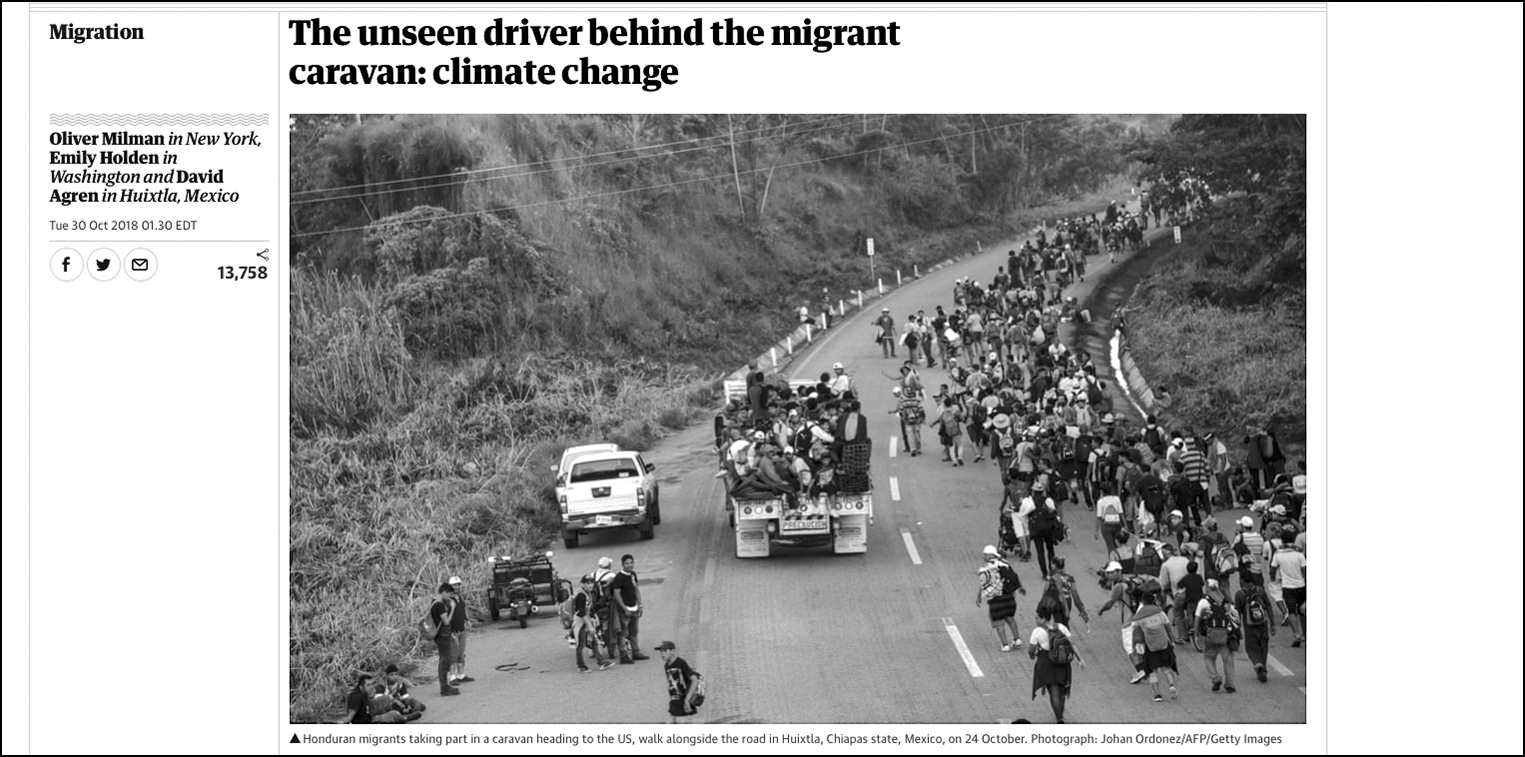
Oliver Milman, Emily Holden, and David Agren, “The Unseen Driver behind the Migrant Caravan: Climate Change,” Guardian, October 30, 2018, www.theguardian.com/world/2018/oct/30/migrant-caravan-causes-climate-change-central-america.
Rising atmospheric carbon concentrations are, indeed, intensifying ecological processes such as drought, desertification, extreme heat, sea level rise, coastal flooding, crop failure, and particulate pollution, which are destructive to human settlements and livelihoods. In 2017 alone, large flooding events displaced hundreds of thousands of people in locations ranging from Houston to Puerto Rico to Nigeria to India to Bangladesh, demonstrating that both environmental processes and failures of infrastructure to maintain dry land and to assist recovery are increasingly life-and-death matters.4 However, climate migration discourse as articulated by journalists, security experts, politicians, and nongovernmental organizations (NGOs) often uses the complexity and widely distributed geographic nature of environmental processes to suggest that migrants represent the unwitting blowback of the destructive combustion and release of carbon wastes. Selectively relating interviews with displaced farmers and other rural workers who describe their experiences with the weather, such reporting jumps scale from localized weather to globalized climate, suggesting that environmental change increasingly constitutes the unacknowledged “push” factor behind migration decisions. The specter of future mass migration due to planetary ecological change thus configures migrants as embodiments of environmental processes. The figures of climate migrant and climate refugee in turn configure the imagery of liberal humanitarian concern for migrants as an expression of the Global North’s overconsumption, evacuating the agency of migrants, removing focus from the proximate political and economic situations in their home contexts, and narrating their actions against the ghostly backdrop of the coming uninhabitability of their places of origin.
Critiquing Climate Migration Discourse
Planetary Specters: Race, Migration, and Climate Change in the Twenty-First Century presents a critique of the transnational discourse on climate migration. As the first book-length study in the humanities focusing on the intersection of race, migration, and climate change, it argues that the figures of the climate migrant and the climate refugee in public media and policy have, over the past decade, been constructed in a manner that obscures how the oil economy, economic inequalities generated by neoliberal economic and development policies, and forms of warfare and imperial intervention have been integrated into massive population movements that reflect capitalist regimes of racial disposability. Going beyond narrower legal and policy debates concerning proposed remedies for migrants affected by weather disasters, the book examines the invention and proliferation of climate migration discourse and imagery worldwide over the past three decades. The construction of multiple “migrant crises” in public media generates significant discussion of whether environmental factors related to the water cycle and food insecurity are driving migration. In the process, the questions of racism against refugees, changes in capitalist labor flows, and the imperial governance of northern borders are at times displaced in order to describe environmental forces as a sudden and severe generator of human mobility worldwide. In response to such crisis discourse, this book offers a focused study of changes in migration flows in Asia as a way to offer an alternative method for integrating economic, political, and environmental factors and analyzing their connections to forms of racial power. In the process, the book moves from a critique of planet-scale climate refugee discourse toward a more geographically focused study of how the systemic relationships between race and the oil economy have affected environmental destruction and migration flows originating in South and West Asia.
Discourses of climate migration highlight purported migration “hot spots” as sites of environmental degradation. Displaced groups and environments are in turn drawn into old-fashioned racial stereotyping about how the world’s poor mismanage resources and engage in resource conflicts, a phenomenon that increasingly overlaps with newer forms of speculative prediction about how vulnerable groups will face coming climate destruction. Working against these twin forms of racial representation of climate change, Planetary Specters offers an alternative method for making sense of the connections among neoliberal economic policies, race, and environmental destruction in contemporary migration flows. This requires telling the story of how, beginning in the 1970s, the transnationalization of labor and trade was significantly influenced by the emergence of oil as the energy and financial basis of the global economy. From this vantage, the book argues that environmentally destructive shifts to inter-Asian manufacturing and labor recruitment were integral to what Cedric Robinson terms “racial capitalism”—the systemic generation of racial differences and inequalities through forms of capitalist reproduction and expansion.5 From here, the book demonstrates how the stories of two of the key hot spots of purported climate migration—Bangladesh and Syria—can be retold by tracking how environmental processes relate to existing neoliberal labor migration pathways connecting agrarian peripheries to urban centers within these countries; transnational flows between West and South Asia; and transcontinental migrations from Asia to Europe and North America. Study of such migration pathways allows Planetary Specters to give an integrated account not only of how some of today’s large migration corridors took shape but also of how state-led development policies and post-9/11 forms of warfare that generate migration are intertwined with oil-fueled changes in the world economy. Even as environmental processes are racialized within journalism, security policy, and emerging forms of green governance, the book highlights how the geographic expansion of capitalist production, new oil wealth in the Persian Gulf region, and the rise of new supply chains across Asia have created circuits of environmental and economic vulnerability that generate displacement—processes that tend to be masked in planet-wide accounts of climate migration.
To the extent that emerging climate migration discourses centered on Asia provide a dystopic vision of future displacement and resource conflict, they represent a contrast to celebratory visions of a New Asian Century, which have touted the gains of neoliberal finance across the continent over the past three decades.6 This book examines how emerging visions of the underside of Asian development turn to some conventional scripts about the linkage between the agrarian poor and the border crisis. In the process, Planetary Specters works to challenge some racialized associations among rural peoples, disability, Islam, and war that emerge in journalism and security policy focusing on Syria, Bangladesh, and other sites of climate crisis discourse. Although climate migration discourse in these countries and worldwide has been propelled by liberal NGOs that claim a desire to reduce the injustices of either carbon emissions or immigration restrictions created by powerful states in the North, the humanitarian focus of such discourse recapitulates a history of racist colonial representations of Asia, Africa, and Latin America as zones of ecological degradation unable to achieve long-term development.
Meanwhile, the purported novelty of climate migration discourse in breeching divisions between nature and culture—the idea that it is a progressive arena of “posthuman” knowledge that integrates environmental and social analysis in new ways—is undercut by the ways it mobilizes racialized tropes of disability, Islamic insurgency, state collapse, and poverty. To the extent that the current increase in transnational migration is marked by the diversification of conditions of human mobility, it is also marked by a predictable retrenchment and militarization at the borders of many refugee-receiving countries. As such, the “migrant crisis” must be understood as “an unresolved racial crisis” that derives from neocolonial divisions in the international system.7 This book focuses on such inequalities as they take shape in the Asia-Pacific region, where a number of important processes are concentrated: the transnationalization of the bulk of the world’s manufacturing economy, the rise of unprecedented oil-funded development in the Persian Gulf states, the rapid changes in livelihoods due to rising waterways in the Pacific and Indian Ocean regions, the world’s largest migration flows from rural to urban areas and from poor states to the Gulf oil producers, and the militarized surveillance of ethnicity and religious affiliation across West and South Asia. If climate change discourse tends to abstract such geographic itineraries of carbon-fueled capitalism by emphasizing that “anthropogenic” or human-made emissions broadly cause environmental devastation, Planetary Specters attempts to analyze how unequal distribution of the benefits and costs of carbon pollution systematically produces racialized border crises. A critical analysis of migration and climate change requires attention to how the histories of race and capitalism intertwine to produce population movements, trade linkages, and forms of environmental destruction at large scales. By highlighting the interrelation among securitization, neoliberalism, oil production, and environmental change, this book presents interconnected geographies of displacement as an alternative to simplistic efforts to label particular migrants as climate refugees or particular migration routes as climate migration pathways.
Climate Change as a Border Crisis
One of the basic lessons we learn from reading scholarship in the field of critical refugee studies is that the view of migration as a problem or crisis for a nation-state in which migrants arrive tends to mask forces that displace people from their home countries. In much of the public journalism and policy discourse on migration in North America, Europe, Australia, New Zealand, and other high-income countries, it is the scale of migration and the purported problems of migrants’ economic needs, population pressures, legal status, racial or cultural differences, and assimilation processes that have historically preoccupied journalists and politicians focusing on migration. The economic demand that these receiving countries create for migrants to do low-wage labor to sustain their economies, and the forms of militarism and development they impose on parts of the world that send migrants, often take a back seat to crisis discourse about their arrival—that is, to narratives and images that suggest migrants are swarming the borders and threatening to change the economic and social bases of the nation-state. Whether sympathetic to or dismissive of migrants’ struggles, these crisis discourses figure the transnationally mobile body as a problem in itself rather than an effect of broader processes of economic inequality, war, and social change. As a field of study and writing informed by critical social theories, migrant narratives, and antiracist and immigrant rights movements, critical migration studies asks us to reframe the issue by focusing on the systemic nature of migration.
Public discourse on migration in the past decade has prominently figured global warming as a key factor driving people’s decision to flee their home countries. In the wake of a sustained political attack against international emissions mitigation agreements and climate science by fossil fuel interests and governments that back them, climate migration discourse appears to introduce a new avenue in mainstream journalism to politicize the impending effects of climate change. In the absence of a working international project to curb carbon emissions, the figures of the climate migrant and the climate refugee appear to help make appeals through national security apparatuses to create new climate policies. In this vein, news articles, policy papers, security think-tank reports, and documentaries focusing on the growing human costs of environmental change create a new avenue for politicians and advocacy groups to argue for individual countries or regional entities to take unilateral security action to minimize the costs of climate change. Does this represent a new and progressive change in the manner in which migrants are represented, especially in the wealthy countries that have the greatest share in the global contributions to atmospheric carbon emissions? Emerging environmental discourse on migration is especially notable in journalism in countries in the Global North—including the United States, the United Kingdom, and Germany—which have long been primary immigrant destinations and major polluters. In these locations, where there are active right-wing political movements that maintain xenophobic focus on immigration’s purported negative cultural and economic effects, climate change is configured as a security concern signaled by mass population movement.
Questioning emerging security discourses about the links between climate change and migration is necessary to reframe the manner in which militarized northern borders contribute to the current sense of a “migration crisis.” Rather than migrants themselves, the forces of capitalist enterprise and military intervention are the most prominent border-crossing agents today, forces that generate growing numbers of southern migrants as their unacknowledged supplement. As Harsha Walia of the Canadian immigration activist group No One Is Illegal succinctly puts it in Undoing Border Imperialism,
Capital, and the transnationalization of its production and consumption, is freely mobile across borders, while the people displaced as a consequence of the ravages of neoliberalism and imperialism are constructed as demographic threats and experience limited mobility. Less than five percent of the world’s migrants and refugees come to North America. When they do, they face armed border guards, indefinite detention in prisons, dangerous and low-wage working conditions, minimal access to social services, discrimination and dehumanization, and the constant threat of deportation. Western states therefore are undoubtedly implicated in displacement and migration: their policies dispossess people and force them to move, and subsequently deny any semblance of livelihood and dignity to those who can get through their borders.8
We need look no further than the recent crisis narratives about the migrant caravans at the United States–Mexico border and the Mediterranean crossings into Europe as evidence of this imbalance in the public discourse on migration. Honduran migrants are configured as security threats to the United States rather than as groups facing displacement in the wake of the U.S.-supported 2009 coup removing Manuel Zelaya from the presidency. The ensuing right-wing paramilitary violence that many migrants discuss as a reason to emigrate was emboldened by the National Party that took control subsequent to the coup.9 Similarly, Syrian refugees are portrayed as unassimilable in German media, sentinels of social ills of sexism and Islamism.10 In such crisis reporting, familiar rhetorics of external threat and post-9/11 fears of terrorism highlight how the migrant body is configured as the problem, rather than the systems of extractive capital, labor exploitation, decentralized warfare, and militarized borders that accelerate displacement and vulnerability.
Furthermore, the crisis discourse about climate migration emerges in a context in which environmental factors are increasingly viewed as accelerating border-crossing threats to international security. This requires that we consider some perhaps unexpected linkages among race, religion, and environment; the figure of the climate migrant as a security risk in public policy reports appears to link climate change to other security figures, including the figure of the terrorist. The launch of post-9/11 wars worked to entrench a model of militarized security that went beyond the ostensible goal of responding to the rise of Islamist insurgency. As scholars in critical security studies have argued, northern states in the wake of 9/11 invoked a broad systems-oriented approach to security that combined stereotyped views of Islam’s threat to the state system with broader attempts to surveil environmental and human networks, out of which threat potentials are understood to constantly emerge.11 Environmental phenomena may seem unrelated to the stereotyped construction of the terrorist, but from the vantage of security officials, they are parallel in their capacity to disrupt the smooth functioning of state and economic systems. At the same time, current ideas about security planning emerge within a longer context in which the supposed postsocialist transitions following the fall of the Berlin Wall and the dissolution of the Soviet Union rendered Islam and socialism as radicalized signs of threats to U.S. and European liberalism’s ways of conceptualizing human futurity.12 From here, the failures of development in the South—environmental degradation, population pressures, failures of social provision—appear as potential drivers of “extremism.” Since such security discourses disavow race’s central role in the unequal formation of the international system, they reify precepts that environmental change may be driving civilizational differences, suggested by a division between Islamist and secular views of governance. Put differently, the postracialism of transnational climate security discourse unites a posthumanist outlook on environmental risk with a postsecular conception of the international. In the process, the northern security state’s xenophobic views of Islam combine a complex set of environmental factors into visions of human vulnerability, ensuring that representations of individual migrants as well as entire nations remain linked to fears of Islam as a threat to democratic life.13
In emerging security thinking, integrating forms of surveillance for human and environmental phenomena generates a fantasy of “human security” from the multiple depredations of intentional or accidental vulnerability. In this context, racism involves not just a set of stereotypes attributed to the body, such as skin color, or cultural attributes, such as religious dress; it involves a dimension of time: “migrant crisis” emerges from the background of everyday life into the spectacle of sudden disaster. It is precisely the fact that environmental processes such as climate change appear to come from long-term, purportedly unintentional processes beyond human control that makes their capacity for racial spectacle salient. As environmental changes suddenly erupt into the lived experience of a population and threaten a sense of stability in time and space, their potential to virally unleash unpredictable social or behavioral responses configures a need for securitization against unfolding risks. If climate change undermines the normal social bonds, the story goes, an opening is made for Islamists, rogues, criminals, and other racially characterized figures of security risk to emerge. Climate change could be mitigated at the outset, but failing that, its effects will have to be policed. Islamophobic invocations of terrorist threat appear on the margins of climate migration discourse, as U.S. and European policy analysts and military advisors regularly note the fact that many places affected by desertification and sea level rise are located in Muslim-majority states like Syria and Bangladesh.
One could reasonably argue that the enhanced border controls that came with the coronavirus pandemic in 2020 might put on hold some emerging security discourses emphasizing climate change’s role in migration and conflict. However, current trends in both the acceleration of global warming and the continuation of human displacement point to the continuing significance of such ideas in the coming years. In the United States, President Joe Biden’s pre-inauguration climate plan drew on climate security discourse, emphasizing that climate change is a “threat multiplier” that requires addressing “water scarcity, increased risks of conflict, impacts on state fragility, and the security implications of resulting large-scale migrations.” Such implications include, according to the plan, “deteriorating economic conditions” which “could increase piracy and terrorist activity, requiring a US military response.”14 Although the COVID-19 control measures adopted in spring 2020 have slowed economic activity worldwide, at the time of this writing usage trends indicate that carbon emissions are not likely to see a long-term decline. The study that provides the most comprehensive data yet on the decline in energy use related to pandemic lockdowns does show a notable short-term dip in fossil fuel use and emissions, bringing current emissions closer to those of 2010. But the growth forecasts suggest a likely increase.15 There has not been a dramatic shift in the wealthy countries away from fossil fuel dependency; assuming that plans for nation-states to reopen economies without first transforming energy use stay in place, we can expect that the pandemic and the emerging economic recession or depression will slow the growth rate of fossil fuel use in the short term but not reduce total carbon emissions substantially enough to meet international emission reduction targets. The likely return to carbon emission growth is especially urgent, as according to prepandemic estimates, energy use—fueled mainly by surging oil and gas consumption—was projected to increase worldwide by 28 percent by 2040.16 Climate security measures will thus likely remain aimed at containing the aftereffects of emissions rather than addressing the problem through concerted efforts to rein in emissions. By all reputable accounts, rising global temperatures will increase the incidence of heat-related deaths, disease, food insecurity, and destructive weather, affecting poor countries most severely due to already overstressed infrastructures.17 Meanwhile, the international economic inequalities that may influence migration decisions have only intensified during the pandemic. The massive flows of people domestically in India and across borders in Latin America following the onset of COVID-19 lockdowns indicate that new controls on mobility have not simply led to a pause in migration but have in some cases exacerbated displacement and, indeed, made migrants more subject to forms of stigma, violence, economic desperation, and health risk.18
Critical Refugee Studies and the Environmental Migrant
Even though in this book I am critical of some invocations of “climate migration” by journalists and security experts, I don’t mean to dismiss discussions of how environmental processes constitute one important factor contributing to human mobility. Planetary Specters argues that environmental injustices must be understood as components of longer processes of colonialism and racial disposability generated by extractive capitalist development. The fossil fuel–based energy system that emerged from colonial histories of extraction is a critical facet of present-day environmental racism. Certainly the rise in flooding disasters in the early twenty-first century is a signal that temporary displacement after inundation is becoming normalized as a condition of human habitation across many coastal and island regions, as well as in places where poor infrastructure exacerbates the problems of growing rainfall or rising waterways.19 There are reasons that activists and politicians from small island states in the Pacific Ocean, Indian Ocean, and Caribbean—most prominently those from Kiribati, Tuvalu, the Marshall Islands, and Fiji in the Pacific and from the Maldives in the Indian Ocean—have been forceful in their proclamations that climate change will permanently displace Indigenous groups from their places of origin and thus from their cultural and ecological heritage.
Crisis discourse focusing on climate migration has emerged in tandem with a recent turn in migration studies to considering environmental causes of migration, particularly given the interest among development scholars in drought and famine. However, this turn to discussions of environmental migration in the field should not be understood as a new addition of environmental factors to a field that has historically focused on economic factors. In fact, the nineteenth-century origins of sociological investigation of migration included significant focus on environmental factors, which were subsequently critiqued in the post–World War II era because of their determinist views of social action. Reorienting the field around economic questions, several decades of migration studies literature in the late twentieth century considered ecological factors marginally if at all. The rise of refugee studies during this period, responding to the postwar elaboration of international asylum law, tended to confirm that “forced migration” was understood in political terms. States that targeted minorities with discriminatory laws and citizenship regimes were seen as the primary generator of the need for humanitarian refuge. Contextual considerations such as economic and environmental factors were excluded from the definitions of refugees. As the field has expanded with critical methods focused on race, empire, class, gender, and sexuality, the recent invocations of environmental migration among anthropologists, sociologists, and geographers have become controversial. Scholars have commonly noted the alarmist tone and speculative outlook of some of the extant studies on the topic, as I discuss throughout this book.20 Emerging work in critical refugee studies attempts to dislodge the normative legal associations with the category of the refugee, creating a new opening for research that breaches the boundaries between political, economic, and environmental categories as well as the binary division of migrants from refugees.21 Thus at present, there is an opening for critical refugee studies to chart a new path to analyze the complex environmental, economic, and political determinants of migration.
As I discuss in chapter 1, the idea that environmental crises are systematically driving accelerating numbers of migrants across borders has only been a significant topic of study among development, migration, security, and environmental experts over the past thirty years. Public awareness of concepts like climate refugees or environmental migration has had an even shorter shelf life of about one decade, as failure to reach international agreements on climate change coincided with the economic shocks, new military interventions, and regional wars that came after 2008. Since then, in the midst of a rapid uptick in transnational migration, a cottage industry of pundits, think tanks, and nonprofits has developed a growing literature on climate-influenced displacement and climate insecurity issues, focusing in large part on forms of international conflict that might emerge due to rapid environmental shifts or resource shortages. Despite the relative lack of academic research on links between migration and climate change, concern about global warming as a driving force in the current displacements is growing, and crisis thinking is quickly generating depictions of Black and Brown migrants from Africa and Asia fleeing shrinking zones of habitability. In much of this reporting, there is a familiar form of racialized humanitarian governmental imagination coming into focus, with the representation of mass displacement constituting purported climate refugees as objects of intervention assistance and management by first-world NGOs and international agencies.22
As such, critical migration and refugee studies have a role to play in rethinking standard accounts of climate migration and conflict. Even with public invocations of forced environmental migration as a violation of human rights and Indigenous sovereignty, the subjection of climate-affected peoples to state securitization and humanitarian intervention carries complex risks. On what bases do contemporary humanitarian or security discourses applied to ecologically transitional areas create racialized knowledge, technologies, and interventions that transform the lives of those affected by climate change? Do those discourses offer pathways for addressing the forces that generate displacement as a form of structural racism, reproducing what Ruth Gilmore defines as “state-sanctioned or extralegal group differentiated vulnerability to premature death”?23 Or are we witnessing how climate security discourse is helping to produce new forms of racialization in speculative constructions of at-risk groups whose homes and homelands are configured as uninhabitable (and thus disposable) in a warming world?
Early signs suggest that climate securitization only exacerbates racial divisions in life outcomes, which are, in part, expressed through the large increases in internal and transborder migration globally. Since U.S. imperial militarism, the collapse of the socialist states, and neoliberal transnationalization of industrial production and labor—the united forces of a purportedly postsocialist world order—have generated increased transborder migration over the past three decades, significant changes in the geographies of human mobility have emerged. Today, more and more migrants from the Global South seek safety in other parts of the south, a development that in itself generates alarm among northern security experts who see the potential for a spillover effect whereby the most vulnerable southern countries will undermine the state structures of stronger ones. This view is itself reinforced by the fact that south–south migrants regularly move on to the next step of building resources for the difficult and potentially deadly subsequent journeys they may take toward the militarized borders of Europe, the United States, or Australia. Such multiple migrations are a source of fear for security experts and right-wing politicians in the North. The Persian Gulf states today are the site of massive diasporas from South and Southeast Asia (especially from India, Pakistan, Bangladesh, Sri Lanka, and the Philippines), and major migrant flows depicted in the news media move large numbers of people from sub-Saharan Africa to the Mediterranean; from Central America to Mexico; and from many coastal, island, and rural locations to urban sites across Asia. The post-9/11 wars launched by the United States and increasingly prosecuted by a variety of state and non-state actors have displaced millions across the borders joining Iran, Iraq, Syria, Lebanon, Turkey, and the Kurdish-majority regions therein.
With these routes and others, current estimates of transnationally displaced people reach above sixty-five million. Environmental forces today are intersecting with unequal regimes of rights and citizenship that affect the daily lives of those who migrate. Taking note of how sea level rise is affecting small island states in the Pacific Ocean, Walia suggests its growing influence on transborder migration: “Tuvalu is one of dozens of low-lying Pacific Island nations threatened with total submersion as climate change and global warming cause ocean levels to rise drastically.… Over one-fifth of Tuvaluans have already been forced to flee their country, many to poor neighboring islands such as Fiji, and others to New Zealand. Despite having the world’s highest emission per capita at 19.6 tons of carbon dioxide per person, Tuvalu’s other neighbor, Australia, has so far refused to accept Tuvaluans as climate refugees. Border imperialism again denies justice to migrants who are its own casualties.”24 Walia’s focus on these small island states recognizes that they are on the front lines of some of the most sudden and intractable impacts of carbon pollution. Small islands that are losing landmass to sea level rise are sites of the most immediate displacements due to climate change. As the islands that are receding most quickly displace residents to larger nearby islands, those areas in turn are affected by a combination of population pressure, land degradation, and sea level rise. In response, climate justice activists from small islands in the Pacific have attempted to raise global awareness of how climate change threatens individuals’ lifeworlds through these processes of displacement, removing people from heritage lands and alienating them from communities. Taking note of the casual atmospheric violence meted out by large polluters against smaller, more climate-affected states, Walia situates climate change as one of the forces of displacement generated by the systematic inequalities of imperialism and capitalism that remain largely out of the purview of political debates on migration. Despite the undeniable pressures that these small countries face amidst loss of land base, the legal architecture of border exclusions prevents redress.
As I discuss further in chapter 1, the extant legal petitions by migrants for asylum based on climate change have failed to yield any individual redress, even as the scale of migration has swelled. One key challenge for critical studies of migration in this context is to develop methods of integrated geopolitical, social, and environmental analysis that can interrupt the crisis discourses that alternate between humanitarian concern for migrants and xenophobic invocations of economic chaos, terrorism, crime, and loss of purportedly secular national culture.
Racial Capitalism, Colonial Energy, and the Deep History of Migration
One strategy that scholars in critical race and ethnic studies, critical refugee studies, and postcolonial studies have deployed to challenge racialized spectacles of border crisis is to reframe the present crises within a longer time span. This helps us understand how the changes in land use and exchange generated by European franchise colonialism (the establishment by countries including England, France, Spain, Portugal, and the Netherlands of commercial empires, including formal colonial possessions in Asia, Africa, and the Americas), settler colonialism (the establishment of breakaway white-majority colonial states in the United States, Canada, New Zealand, Australia, South Africa, and elsewhere), and the related development of capitalist property systems have created widespread conditions for human displacement and racial disposability.25 Race historically emerged as an important regime of colonial statecraft because it managed human population demographics and land use in ways that reproduced a profitable mix of commoditizable land and labor; racial regimes of colonial states have thus exhibited some flexibility in order to manage human difference in ways required to make land, labor, or natural resources exploitable.26 Viewing present ecological disasters including climate change as an outgrowth of colonial forms of labor, production, and energy use helps us understand something about how race, as a flexible regime of colonial power and profit, and racism, as the structured management of group vulnerability to premature death, have shaped ecologies of migration. The moves by states with a history of white supremacy encoded in law to formally declare racial equality in the aftermath of World War II, decolonization struggles, and the antiracist movements of the 1960s have to date failed to stem the economic conditions that unequally render large swaths of the world’s agrarian poor subject to the depredations of the global economy’s financial, environmental, and political violences.
By the 1970s, fossil fuel development exacerbated global wealth inequalities and committed billions of Black and Brown people across Asia, Africa, and the Americas to dependencies on U.S.-led financial networks. The environmental and economic nexus of racial capitalism, which I discuss in detail in chapter 2, also breached the borders of the wealthier countries, with Indigenous lands devastated by oil extraction and sea level rise, and large, racially marginalized labor diasporas forming across the former colonial powers of Europe, the settler colonies spanning the Pacific Rim (the United States, Canada, New Zealand, Australia, and South Africa), and the newly rich, formerly colonized petrostates of the Persian Gulf. These neocolonial relations—which exacerbated some preexisting international wealth divides created by colonial labor and trade systems—emerged at the very moment that a series of economic crises suggested the possible decline of European and U.S. financial power. But the oil economy helped to float U.S. government debt (in part incurred through the massive expenditures of the Vietnam War) and to sustain the centrality of northern financial and corporate power in transnational capitalism. Thinking about oil-driven climate change as an outgrowth of the emergence of a planetary system of racial capitalism—which reshaped land use and based profit on the development of racially stratified labor systems—is necessary for a historical understanding of environmental disasters that appear as acute, contemporary displacement events. In this book, the critique of representations of migration as a climate change disaster is accompanied by a historical examination of how fossil fuels, especially oil, contributed to racially unequal conditions of displacement—even if large-scale extraction of fossil fuels never fully destroyed the diversity of human relationships to environments.27
Although there are different historical reference points for the processes that originated the current environmental crises—the formation of capitalism and the establishment of property in land in the sixteenth century, the expansion of slavery and the plantation economy in the eighteenth century, the rise of the coal economy during the height of nineteenth-century colonial land grabs, and the accelerated use of oil in the mid-twentieth century—scholarship in colonial environmental history, world systems analysis, and green Marxist thought contends that current environmental problems such as rising global temperatures, desertification, erosion, soil degradation, wildfires, and increased storm activity are products of longer developments in the extractive relationship between human societies and their environments. These forces have historically embedded the sustenance and reproduction of national economies in processes that deplete ecological capacities, displace people from traditional homes and lands, and render rural people dependent on long-distance markets.28 For Indigenous scholars focusing on the lengthy histories of settler colonialism in the Pacific and the Americas, European settlement produced massive ecological shifts. By reducing open common lands, introducing diseases, reducing cultivated forests and native grasslands, and introducing invasive species, direct colonial warfare was supplemented by massive forms of ecological change that accelerated colonial genocide.29
The imposition of a colonial land system and the violent depopulation of Indigenous societies by such settler states as the United States, South Africa, Brazil, and Australia emerged over several centuries. During the consolidation of the state structures of these settler colonies—each with racially differentiated citizenship hierarchies—the mixture of commoditized human labor with renewable and nonrenewable energies powered the growth of capitalist relations across geographies of dispossession and concomitant migration. Building on technologies of displacement emerging from the enclosure of the commons in England and western Europe, the rise of the Caribbean plantation complex and the Atlantic trade in enslaved peoples from the seventeenth through the nineteenth centuries ushered in a form of transcontinental interconnection that helped to geographically expand both the capitalist regimes of property in land and the fungibility of labor and life as the bases of colonial profit and demographic expansion of white settlement. As plantation expansion coincided with deforestation, which allowed for expanded shipbuilding in Europe as well as heating and cooking fuel in the colonies, European settlers developed forms of colonial land use that sustained the geographic expansion of capitalism across the Atlantic. This included the development of geological surveys to help map settler colonial expansion for both agricultural and mining capacities, a history that embeds contemporary geological theories about climate change in longer histories of colonial knowledge production and land reorganization.30 Plantation agriculture set in motion massive forms of human labor accumulation and migration, including the forced movement of over ten million enslaved people from West Africa to the U.S. South, the Caribbean, Brazil, and other slave states in the Americas, followed by the importation of several million Asian indentured workers in the nineteenth and early twentieth centuries. The centrality of anti-Black racism to this system of labor exploitation created the basis not only for other groups to be subjected to coercive labor regimes, but for the elaboration of mythologies that the sale of one’s labor provided a type of exercise in human freedom that moved one away from the condition of enslavement.31 For this reason, the system of slavery must be understood as part of the larger processes of generating myths of the universality and independence of the figure of the human, despite forms of racial sorting that emphasized the fungibility and affectability of large populations in Africa, Asia, and the Americas.32 Plantation expansion coincided with the concentration of small landholdings by the British in India, allowing a similar process of displacement and labor appropriation that advanced distance trades in key colonial agricultural commodities. The development of this transcontinental economy involved the alienation of large numbers of colonized peoples from small-scale agrarian production and their relocation into larger-scale plantations that, in turn, accelerated the rise of manufacturing and the rise of new trading linkages in the North Atlantic and across Europe. As such, the colonial concentration of labor in cities forms a key part of the process of developing racial capitalism’s capacities to conduct production and trade across expansive imperial geographies.33
The rise of racial capitalism out of systems of colonial extraction required the development of large-scale energy systems. The plantation complex involved the admixture of human and nonhuman animal labor with solar power (in the photosynthesis of crops) and wind power (in transoceanic shipping) for the distance trade of monoculture commodities like sugar, rice, tobacco, cotton, spices, and indigo. The twentieth-century rise of fossil fuels changed the relationship between geographies of migration and geographies of production and exchange. In locations in the United States and Europe, where the steam engine brought coal use beyond its traditional application for heating and cooking, manufacturing processes accelerated the rate at which basic agricultural commodities could be transformed into textiles and other finished goods for export.34 The expansion in carbon emissions due to coal use inaugurated the fast forms of global warming that we are witnessing today. Later, the rise of oil production competed for agricultural lands yet required fewer human laborers to extract profit.35 Coal and oil use increased the capacities for distance shipping and manufacturing, in turn redistributing the imperative for basic commodities to be grown or extracted in more dispersed locations worldwide. While the significance of migrant agrarian labor in maintaining both food economies and basic commodities for manufacturing grew throughout these transformations, some laborers were rendered surplus to production requirements as a result of increased mechanization and rapid transport. Meanwhile, control over land by extractive industries and large-scale farming, housing, and industrial operations remained geographically uneven, leading to growth in migration from peripheral small farms to both large rural landholdings and urban centers of trade and manufacture. If the plantation complex reinforced the reliance of a geographically expanding industrial economy system on transcontinental migration and shipping, the rise of fossil fuels allowed increased mechanization of extraction and production, sped the concentration of colonial land bases into large holdings, and grew divisions between agrarian and industrial workers worldwide. Thus, the connections between colonial geographic expansion, the change in the land base prompted by plantations and mining, the growth in manufacturing and distance trades created by fossil fuels, and the capitalist trades in both manufactured goods and laborers were part of a large-scale set of processes creating new migration and trade connections across continents and between rural and urban centers.
The systemic expansion of capital across the sixteenth through the twenty-first centuries thus yoked growth in fossil fuels to the privatization of land and the alienation of labor in ways that made migration central to the reproduction of capitalist systems. As national, religious, and ethnic markers continued to differentiate migrant labor forces within these systems, the racial character of capitalism remained crucial to the potential for managing dissent and preserving the dominance of oil-based transport and finance in maintaining the geographic reach of trade. As such, to the extent that an extractive capitalist influence on the environment increased over five centuries of colonial history, it also systematically generated human migration as a concomitant process to climate change, species extinction, and other forms of environmental destruction.
Inter-Asian Migration Ecologies
The planetary effects of this long-term colonial process of alienating people from heritage lands have been sped up by the combination of energy and trade transitions that are unique to the late twentieth and early twenty-first centuries. The capitalist processes that have given rise to anthropogenic changes in climate have specific geographic histories that are significant for understanding not only environmental change but also itineraries of racial power and struggles over labor and resources. I argue in Planetary Specters that the role of countries in Asia and the Pacific in the system of racial capitalism is significant to understanding the economic and environmental nexus of migration today. At the same time, the lessons we learn from migration routes in the Asia-Pacific offer larger lessons about how racial capitalism relates to environmental destruction, displacement, and governance worldwide.
Mass fossil fuel use has played a role in both industrial development in the North since the nineteenth century and the shift in the twentieth century from the United States and Europe to Asia as the manufacturing and logistics center of the world economy. Although the rise of coal and steam power first energized manufacturing in the United States and England in ways that allowed each of those countries to assume a central role in nineteenth- and early twentieth-century transnational trade (with its destructive carbon emissions), coal power eventually became the basis of national electric grids around the world and today still constitutes 38 percent of the world energy mix. At the same time, the expansion of the oil economy during the interwar period suddenly shifted the geographic basis of the fossil fuel economy to several key areas of extraction, including Texas, Nigeria, Venezuela, India, and, most centrally, the Persian Gulf states. This coincided with the end of the gold standard and the establishment of the role of the U.S. dollar in oil and arms trades, reconfiguring how national energy provision ended up requiring international exchange in dollars. In turn, a number of oil-rich former colonies attempted to establish more control over oil as a key economic resource for national development. The rise of the Organization of the Petroleum Exporting Countries, which I discuss further in chapter 2, is one notable aspect of this history.
Although the aspiration for economic independence from U.S. financial power in formerly colonized states was part of the history of geopolitical conflict over oil, the history of oil as a key energy commodity fueling new regimes of development and trade tended instead toward international economic dependencies on U.S. finance that made the international system increasingly unequal and unstable for the poorest formerly colonized regions and populations.36 Oil fueled the shipping regimes that allowed the rise of neoliberalism, an economic rationality in which states relied increasingly on dispersed, privatized economic activity to replace organized state systems for human provision and welfare. Even as some states—most notably Iran, Iraq, the United Arab Emirates, Kuwait, and Saudi Arabia—attained unprecedented GDP growth based on the new wealth from oil extraction, these states failed to widely distribute the economic gains across class divisions or to fund regional economic collaboration and stabilization among southern states. As organized challenges to U.S. and Soviet empire such as the third world movement floundered in this increasingly cutthroat international economic context, growing dependency on imported fuel and food in the poorer nations led to displacement of agrarian subsistence economies that provided local economic stability. People across the Global South became more subject to market instabilities. The spikes in oil and food prices that cyclically emerged during the era of neoliberalism energized circuits of national and transnational migration.
Yet the effects of these processes also helped to concentrate capital in a new set of manufacturing and financial centers across East and Southeast Asia, with much of the world’s textile, automotive, and electronics production chains now operating through Asian contractors and factories. To staff these new industries, large numbers of workers migrated internally, and in some countries, new low-tax, export-oriented economic zones were established to encourage multinationals to set up shop. Oil made this system of flexible labor and production possible, as transnational corporations took advantage of uneven national labor and environmental regulations to profit from surplus laboring populations in Asia. Although China remains central to this process in terms of its massive factories and huge rural-to-urban migration pathways coincident with its absorption of industrial capacity, smaller countries with cheaper operating costs (Bangladesh, Vietnam, the Philippines) have high-growth export sectors that feed into longer transcontinental commodity chains. As more people in these countries have been displaced from agrarian lands and local trades, they have been increasingly subject to transnational market forces that encourage them to migrate to cities or other countries and to remit a portion of their wages to their home economies.
These processes have been compounded by massive environmental changes wrought by the use of oil and coal for manufacturing and shipping, especially in the water system, which is so crucial to the livelihoods and settlements of the economies of rural and coastal areas. Although there are many environmental disasters that characterize the era of neoliberalism and track closely with expanded oil use, I focus in this book on interlinked climatic, economic, and geopolitical changes that have fueled migration in South and West Asia. The massive outmigration of agrarian workers from rural and coastal areas of South Asia has coincided with the expansion of the export-oriented manufacturing base in South Asian cities and the departure of a huge diaspora to the rapidly developing Persian Gulf states. The migrations in the eastern Mediterranean during the ongoing regional wars emerge as widespread violence compounding economic crisis has fueled new migration routes. In these locations generating significant twenty-first century migration from West and South Asia, we witness migration pathways where climate-driven changes to water systems (including drought, flooding, desertification, increased salinity, and loss of drinking water) overlap with major economic and geopolitical forces that conduct human resettlement. These interlocking forces include oil-fueled development in the rich Persian Gulf states, which seek South Asian migrant labor as a workforce that is alienated from regional political struggles; the expansion of Pacific shipping economies, which ensure the rapid delivery of oil from West Asia and finished goods from across the continent; and the expansion of arms trade and armed interventions in West Asia, which link imperial forms of securitization and militarization with ongoing transformations in agriculture in the region. Environmental changes to the water cycle contribute to pressures for migration in this context even as migration is increasingly managed by racialized forms of crisis governance.
A Posthuman Politics of Scale
The period of the rise of the oil economy since the 1970s, which witnessed intensified human displacement globally, coincided with several distinct currents of environmental thought through which environmentalists attempted to grasp the transitions at hand. As I discuss in detail in chapter 1, northern NGOs in the 1980s and 1990s developed a significant focus on southern overpopulation as a problem that appeared to drive transborder environmental crises; one of the main concerns at the time was how the growing population led poor people to destroy forests for agriculture and engage in forms of subsistence farming that degraded the soil and the water table. Drawing conceptually on the ideas regarding ecological carrying capacity developed by Thomas Malthus, such a focus tended to concentrate on high rates of women’s reproduction in the Global South rather than structural economic and political changes as a significant driver of environmental change. This type of gendered and racialized thinking about population was closely linked to sustainable development discourses that worked to entangle conservation in formerly colonized nation-states with economic development schemes such as ecotourism and, at times, with family planning initiatives to control reproduction rates. By 2000, amidst growing international concern about rising global temperatures, environmentalists and scholars also began to debate the concept of the “Anthropocene”—the phase of Earth history in which the human species purportedly determines the geophysical structure of the planet.37 Although the concept was initially generated in the context of attempts to formalize a new epoch in Earth’s history among geologists, the idea has gained wide attention beyond that discipline within academia and journalism.
How do climate migration narratives interact with these currents of environmental thought? Recent scholarship in the environmental humanities highlights how climate change challenges conventional understandings of history, literature, and politics, arguing that fossil fuel energy use has, since the industrial revolution, radically reshaped planetary life.38 In broader academic conversations beyond the humanities, debates among geologists, geographers, and social scientists over the concept have taken a strong ethical cast. Critics of the Anthropocene concept point to the outsize responsibility that the United States and Britain have for historical carbon emissions, which are unequally affecting the world’s poor and the Global South. In turn, scholars working on approaches to the environment in Black studies, postcolonial studies, and Indigenous studies, including Kathryn Yusoff, Amitav Ghosh, and Kyle Powys Whyte, have been critical of abstracting the “human” (anthropos) influence on climate; they argue convincingly that attention to the violences of racial slavery, class exploitation, colonial land use, unequal environmental pollution burdens, and the very field of geology as a colonial science have shaped the interests and actors that have made human impact on the climate a field of deep inequalities.39 In the process, a wide array of scholars of race, colonialism, and capitalism have invented a series of terms that propose to specify more clearly the responsible parties or processes: Capitalocene, Plantationocene, Eurocene.40 The resulting discussions of the Anthropocene counternarratives fit within a broader critical race and ethnic studies critique of the postracialism of recent posthumanist and new materialist trends in the humanities.41
For the purposes of this book, I articulate another way that we need to understand the relevance of critical race analysis to Anthropocene discourse. If we situate the rise of Anthropocene narratives and counternarratives within a recent history of environmental representation in which conservative, neo-Malthusian ideas about population in the Global South have been widespread in expert discourse on climate change, we can glimpse how the abstraction of human responsibility for environmental damage under the banner of the Anthropocene may have initially appeared as a progressive transcendence of earlier, stereotyped visions of poor, agrarian Black and Brown people overpopulating and destroying local ecologies. The Anthropocene story is a story that brought the North’s overconsumption into the narrative of degradation, even if it failed initially to substantively detail unequal pollution burdens and benefits. Critiques of the Anthropocene concept might benefit from specifying this immediate pre-history by combining three neocolonial dynamics: a massive increase in the destructive carbon emissions unleashed by northern countries, a development discourse originating in those same countries that blamed the agrarian poor in the Global South for environmental destruction, and a focus on outside intervention as the solution to degradation. To assert in response to the Anthropocene concept that Europe or capitalism is the responsible agent of environmental violence perhaps doesn’t go far enough on this point: it fails to hold northern environmental NGOs to account for the adoption of neo-Malthusian development precepts that extended a colonial history of blaming poor and minoritized populations for degradation, which compounded neoliberal assaults on their livelihoods. This occurred even though northern states were the main beneficiaries of the so-called great acceleration of carbon-based development in the late twentieth century. Given the significance of this recent pre-history of the Anthropocene concept, it is necessary to think in multiple historical frames—in terms of the deep histories of capitalism and climate change as well as the recent history of neoliberal environmental thought—in order to recognize how different processes of both accumulation and knowledge production are distorted by universalist thinking about climate change.
If the long time span, social and ecological complexity, and widely distributed impacts of climate change highlighted by Anthropocene discourse teach us anything, it is that the circuitous routes of environmental violence produce persistent crises of representation, creating the need for multiplying our knowledges and narratives of how humans and other species interact through the carbon economy. This includes narratives that operate at a more intimate scale than planetary accounts of environmental or political-economic change and that force us to consider the local and transregional circuits of environmental harm that frame contemporary environmental justice struggles. Replacing the abstract universal of the Anthropocene with a large-scale notion of capitalist or colonial responsibility may help us unveil biases and distortions in the universal invocations of human responsibility for environmental destruction, but it is less useful in helping environmental justice movements (1) develop a detailed critique of how the fossil fuel economy—specifically oil—develops particular ecological, social, and geopolitical harms and inequalities, and (2) promote grassroots efforts to restore interspecies relationships and ways of living that have been displaced by settler colonial processes of accumulation, extractive land use, and industrialism.
In parallel, it is necessary to take more seriously the complex relationships that southern publics have to the carbon economy. One response to critiques that center the responsibility of the rich northern countries is articulated repeatedly by U.S. and European climate negotiators: how can there be serious international action against climate change without addressing states like China and India, whose total fossil fuel emissions are surpassing or predicted to surpass those of the United States? Such criticisms have been posed disingenuously by U.S. representatives in order to influence and ultimately dismantle Kyoto framework treaty negotiations, and it is important to remember that countries that have large export-oriented manufacturing bases use a proportion of their carbon emissions to meet the demand of consumers elsewhere—most notably the United States. So it becomes difficult to measure what proportion of Chinese, Bangladeshi, or Vietnamese carbon emissions are actually produced to sustain the massive U.S. or European consumer markets or to meet the growing demand in large consumer markets like those in the Persian Gulf, or in high-consumption global cities like Singapore. Nonetheless, the roles of states in the Global South as producers and consumers in the carbon economy must be taken seriously in order to account for the integration of formerly colonized nations into current circuits of capitalist development and energy use. It would be a mistake to avoid addressing how states and publics in the Global South experience constrained yet real forms of carbon-fueled agency despite the fact that the United States and Britain bear most historical responsibility for anthropogenic carbon emissions, and despite the fact that Australia, the United States, and Canada remain the highest per capita consumers of fossil fuels. Focusing attention on the ecocides wrought by European colonialism, slavery, and mercantile empire over centuries makes sense as a response to simplistic notions of universally shared environmental risk and responsibility under the banner of the Anthropocene. But it does not by itself give us the tools to imagine how to challenge capitalist forms of social reproduction that stubbornly tie people across differences of race, class, and nation—including large populations in the South—to destructive fossil-fueled economic practices.
Oil: “Corpse Juice” of Planet Earth
Planetary Specters suggests that thinking carefully about the geographical shifts enabled by the oil economy is key to understanding how environmental inequalities are reproduced through international economic arrangements. How can we make sense of a situation in the twenty-first century in which we witness unprecedented levels of transborder mobility and communication at a moment when so many of the world’s poor and displaced people experience life as a shrinking horizon of habitation? This is not only a condition of people immediately affected by sudden weather disasters but also a broader problem of forces of infrastructural, housing-related, and ecological displacement and concentration worldwide. What explains the overlapping forces of what geographers used to call the “time-space compression” of globalization (cosmopolitan capacities allowing some people to cross borders and speed communication at ever-faster rates) and time-space expansion (containment of other people to shrinking horizons of movement, reproduction, and sociality) that attends carbon-fueled climate crisis?42 The mythic invocations of neoliberal speed in globalization discourse have their cognate in climate discourses about the “great acceleration” in human development that generated the Anthropocene. Great acceleration discourse suggests that the acceleration in human development came with the price of amplified levels of carbon and other forms of widely distributed environmental waste which increased in magnitude in the second half of the twentieth century.43 By any realistic measure, these forces of development are unequally shared, ensuring that agrarian populations most severely affected by climate change are also those least likely to have benefited from carbon-fueled regimes of capitalist accumulation. It is in this unequal share of the costs and benefits of neoliberalism, borne across the international division of labor, that we can begin to glimpse how neoliberal capitalism operates as a racialized economic system.
On this point, it is necessary to attend to how two particular nodes of the carbon economy—oil extraction and atmospheric carbon waste—configure migration processes. The twin mobilities of communications networking and carbon-fueled transit that allowed multinational corporations to transnationalize their manufacturing, labor, finance, and trade practices in the late decades of the twentieth century are at present largely dependent on coal- and oil-fueled infrastructures. These infrastructures enable rapid control of production and transoceanic shipping of goods along ever more complex transborder supply chains. Oil was particularly central in these transformations, as it allowed the proliferation of off-grid, transnationally mobile power sources that could help smooth transit and other logistics of highly decentralized production and trade.
Energizing growing scales of transborder trade even as its high price made it difficult for many countries to access, the political economy of oil led to enforced loans, which required poor countries to undertake policy transformations known as structural adjustment. In this process, pushed by U.S.-based conservative economists and dubbed “the Washington Consensus,” loan conditions imposed on poor countries by international finance agencies like the International Monetary Fund and the World Bank required states to open up to cheap imports from abroad and to make massive cuts to government social services for health, education, and the environment. This process, which moved poor countries away from their postcolonial state-controlled markets and toward private capitalist control of larger and larger parts of social life, trapped many poor countries that lacked an industrial base in unpayable national debts and undercut the potential of their largely poor, agrarian, and rural populations to compete in the increasingly international markets that took shape domestically. The effects of this corporate globalization process on agrarian and working populations in many states in the Global South were devastating, displacing traditional industries and subsistence lifestyles due to importation of basic goods. Large numbers of working and poor people were increasingly rendered as reserve surplus labor.44 As their countries were opened to greater volumes of international trade controlled by multinational corporations headquartered in the North, these populations were displaced from agrarian labor, which could no longer sustain livelihoods in the face of cheap agricultural imports, and were pressured to migrate to cities where they sought waged industrial work. Although the neoliberal revolution was uneven—it did not end complex strategies undertaken by postcolonial states attempting to navigate alliances and redirect decision-making authority and economic power to the South—forms of solidarity among African, Asian, and Latin American nations came under duress as the financial basis of U.S. empire encouraged competition for dollars and basic resources.45 This neoliberal transformation from the late 1970s to around 2000—enabled by oil as both a form of energy and a finance circuit sustaining a relatively high price for the North’s exported goods—caused large amounts of displacement. And this displacement was not mainly experienced as enhanced mobility in poor countries but as displacement from the rural agrarian base and concentration in urban peripheries, an alienation from land and kin. The resulting remittance economies—wherein displaced industrial workers become distance providers for rural family members who remain in the natal community—demonstrate that the demand to migrate is also often a profitable source of labor exploitation because it establishes dependencies on spatially alienated work for the reproduction of entire communities. All of this takes shape in a context in which migrants displaced to urban industrial zones are often viewed as racially, ethnically, or linguistically different, their labor configured as alternately exploitable and excludable as a condition of difference from those entitled to habitation, rights, and social welfare.
The extraction and waste effects of oil simultaneously produced large-scale forms of environmental destruction affecting racialized minorities and Indigenous nations during this period of neoliberal globalization. The violence orchestrated by Royal Dutch Shell in the Niger delta, including the repression of Ogoni activists and the assassination of Ken Saro-Wiwa, is one of the most violent episodes of extractive enclosure that arose during the expansion of oil-fueled neoliberalism.46 But it was not the only one. Oil production is often attended by transformation of the landscape, including displacement of local people; pollution of land, air, and water; and greater risk of destruction through transport spills. Such extraction risks have only increased in the first two decades of the twenty-first century as the Washington Consensus came under criticism from labor, environmental, farmer, and Indigenous movements worldwide. During the past two decades, the production of shale oil, tar sands oil, deep sea oil, and other “unconventional” hydrocarbons took on an increasing share of the global energy market. This enabled historical energy importers like the United States and Canada to proclaim independence from Gulf oil in the wake of the 9/11 attacks; when Athabasca oil sands in Alberta were reclassified as reserves by Canada in 2002, the country was defined overnight as the world’s second largest holder of oil reserves, a large proportion of its production destined for export to the United States. Meanwhile, the use of oil to fuel transnational shipping and growing small vehicle use was a key contributor to the increase in atmospheric carbon concentrations that exceeded four hundred parts per million in 2015. The widely publicized struggles of Indigenous nations in Canada and the United States against tar sands production and pipelines represent an attempt to connect the extractive infrastructure of oil to its networked effects in settler colonial environmental and economic systems.
Once categorized as an “unrenewable” resource, oil can now to an extent be “renewed” beyond earlier forecasts of available reserves. Deep sea drilling, which has been the prime conduit for the expansion of production in the United States (and also Brazil, Norway, and other countries), has produced a series of underwater oil spills, adding to the already significant risk of tanker spills as oil is shipped across oceans. These oceanic spills are responsible for destruction of coastal ecosystems, from the 1969 Union Oil spill in Santa Barbara, California, to the Exxon Valdez tanker spill off the Alaska coast in 1989, to British Petroleum’s Deepwater Horizon disaster in the Gulf of Mexico in 2010. Beyond spills, risks of a globalized oil economy are increasingly reflected in the mining of bitumen in the tar sands, which is significantly more destructive to land, water, and air than conventional oil production. For much of the twentieth century, the politics of oil were configured around the potential of its declining supply, apparent in the Nixon administration’s concern in the 1970s about the “fragile and finite” condition of “natural resources.”47 Although bitumen, as the most viscous layer of oil, has historically been used for tar production rather than for energy, oil companies discovered that it was possible to chemically transform it by taking over the geological processes that over millennia transform organic matter into crude oil. By using large amounts of water to filter the oil sands from the bitumen, oil companies are able to synthetically speed the process for producing oil, leaving behind large pools of wastewater that contain the toxic traces of the bitumen sand: nickel, vanadium, lead, chromium, mercury, and arsenic.48
By taking over the geological processes that produce hydrocarbons over the long span of geological time, unconventional oil and gas in the form of cracked shale oil, synthetic tar sands bitumen, and fracked natural gas represent an innovation on the temporal management that oil enables. Here is one way we might describe the energetic transformations enabled by conventional oil production: in layers of sedimentary rock, fossils of dead animals, plants, and microbial life are compressed and heated over millennia, transformed from solid to liquid deposits, the viscosity of which allows oil to seep across rock layers and pool in areas that may or may not lie close to the lithosphere, where humans can drill into them. Once discovered, collected, and refined, this sludgy carbon material is then distributed widely and combusted to power a number of high-energy-input human activities, from automobile and airplane transit to electricity generation for industrial machinery and heating. During this process, there is a transfer from the development of carbon capacities over the slow geological time of compression and heating of dead biological matter to the rapid acceleration of transportation and communication enabled by combustion, a time travel from the extinct bodies percolating in the deep time of geology to the viscous combustion of the phrenetic time of globalization’s time-space compression.
The innovations of cracked and fracked hydrocarbons, as well as of deep sea drilling, add complexity to this temporal process of conventional oil, creating a secondary feedback loop in the system. Drawing from the profits of conventional oil, oil firms transform the upper layers of the lithosphere into a kind of machine for filtering, compressing, and heating partially composed fossil fuels into synthetic carbon in shale oil and bitumen processing.49 By using highly carbon-intensive processes to generate new capacities for extraction, the time travel of long extinct bodies to contemporary fossil-fueled mobilities in turn shrinks the deep time of geology toward the industrial time of the global and allows a momentary capability to “renew” the nonrenewable resource: to exert the force of fossil-fueled racial capitalism back into the deep structures of the earth. This circuit seeks to bypass the geological limits to capitalist speed, displacing the supply crisis of peak oil and stretching the time of widely dispersible neoliberal supply chains toward an indefinite horizon. Meanwhile, the feedback loop that allows oil to reproduce itself, recruiting more and more bodies of the dead—human and nonhuman—into the enhancement of neoliberal mobilities in the present, massifies oil’s atmospheric waste: emissions continue to rapidly rise in concert with economic activity generally. There can be no transnational trade in its current form without it, and economic growth for any country today necessarily correlates with the more rapid and devastating effects of climate change.
These aspects of oil’s widely distributed infrastructural significance; its environmental feedback loops; its subsurface deposition; and its background capacities for enabling varieties of human representation, transit, and accumulation all help explain why energy humanities scholars who research petrocultures describe oil as a confounding material underpinning contemporary life. For Imre Szeman, the oil question is not an ontological or a historical question but an “epistemic” one, for human societies are “so saturated with the substance that we cannot imagine doing without it.” As such, oil forms “part of our knowing,” a material reality that shapes our representational lives and elaborates key categories of liberal interconnection, including freedom, mobility, growth, and futurity.50 For writers and artists including Stephanie LeMenager, Edward Burtynsky, and Amitav Ghosh, oil forms such a widely distributed part of the material conditions of culture but recedes into the energetic background in ways that make it difficult to represent.51 Such an argument parallels how environmental humanities scholars write about climate change as a crisis of representation: climate change seems to challenge the scales at which humans normally conceive of time and space, operating at the geological scale of Earth. And yet oil has been at the center of formal political struggle for a century, ranging from colonial prospecting to environmental justice campaigns against drilling to conflicts over access to underground stores among oil-producing states. Oil animates national energy economies and transnational commodity and labor chains, even as it is rendered in generic units for international trade and environmental surveillance.
Although it conventionally avoids focus on the extraction side of ecological violence and displacement, climate migration discourse focuses attention on widely distributed effects of climate change—the waste products of the extractive carbon economy. And in terms of aggregated effects on life systems, the impacts are being felt across the planet. Atmospheric carbon emissions are increasing the number of deaths due to particulate pollution worldwide, with an estimated 6.5 million premature deaths in 2015.52 Extreme heat events generate crop failure, with the likelihood that current rates of warming will reduce crop yields in Central America and the Caribbean by 50 percent by 2050. Freshwater availability and fish stocks are already on the decline due to ocean heating, loss of glacier volume, and desertification.53 The violent effects of such forces are undeniable, yet the ways in which they affect migration requires assessment of their correlation with other capacities for habitation, including infrastructure, industry, employment, and economic resources. But given the manner by which the geology of oil energizes such circuits of atmospheric waste toward existing extractive forms of inequality, violence, and disposability, Reza Negarestani characterizes oil as the “corpse juice” of capitalism, a material that connects neoliberalism’s cosmopolitan capacities for mobility and exchange to the death-dealing effects of war and ecological collapse.54
Planetary Specters
When considering the recent proliferation of climate refugee discourse, it is necessary to keep in mind that new rights of asylum emerge out of conflicted contexts of historical change. One element of climate migration discourse is a fear of blurred borders and rising “extremism” coincident with the failure of states to control population movement and implement successful development. On the other hand, a vision of climate migrants as fleeing shrinking zones of habitation configures a form of humanitarianism that operates to salvage peoples and lifeworlds viewed as inevitably dying, as doomed to the ravages of a carbon economy that cannot be brought under control. As such, climate migration discourse participates in broader discourses of Indigenous salvage that piggyback on a history of anthropological depictions of the agrarian poor’s vulnerability to environmental degradation. At times, these contradictory depictions of swarming threats and romantic depopulation converge in representations of the very same racialized groups, as in the representations of coastal farmers in Bangladesh explored in chapter 3.
To the extent that the migrating body can provide a racialized focal point to distill a variety of crises that reflect the destructive inequalities of neoliberalism, its incorporation into the law signals a fantasy of redress that seeks to redraw borders by offering climate-affected peoples the supposed gift of humanization by states that promulgate border imperialism. As such, the spectacle of inclusion that constitutes the ethical demand of climate migration discourse does not disrupt what Christian Parenti calls the “politics of the armed lifeboat”—policies aimed at creating privileged zones of safety against an outside world conceived as ever more chaotic, ungovernable, and unable to consistently support life.55 The metaphor of the armed lifeboat insists further that there is a relation between the safety of the boat and the violence outside. Through its militarized borders, it invests in a defensive posture that requires maintaining ever stricter separations between the securitized inside and the abandoned outside.
Such forms of racial securitization, evident in political contests over both climate change and immigration, demonstrate how the myths of humanitarian redress promulgated by the wealthy countries advance a geopolitics that reproduces neocolonial international divides; as a liberal project that forestalls the broader liberatory promises of decolonization, human rights law according to Randall Williams maintains violent neocolonial divisions of power in the world system.56 Jamaican philosopher and dramatist Sylvia Wynter argues further that twenty-first-century “struggles over the environment, global warming, severe climate change, the sharply unequal distribution of the earth’s resources … are all differing facets” of an “ethnoclass” struggle that lies at the heart of the colonial politics of the human, a struggle most spectacularly witnessed by the “new poor” who are defined “at the global level by refugee/economic migrants stranded outside the gates of rich countries.”57 Wynter configures climate change and the expansion of the new global poor as interrelated effects of colonial modes of thought and politics that separate human from nature, establish a racial geography of habitable ecological zones, and configure the African diaspora as the lowest rung of humanity against which northern states attempt to recruit migrants in reterritorializing hierarchies of the racial state. Thus viewing contemporary environmental crises as effects of a planetary racial and class order, Wynter challenges us to develop new accounts of human social and ecological relations that question assumptions of capitalist technological development and freedom.
The forms of violence produced by oil and other fossil fuels do not go without ideological and political contestation, as shown by the small island activists in Kiribati, the Oceti Sakowin and Wet’suwet’en pipeline resisters in North America, and other Indigenous environmental activists worldwide. Environmental justice organizations have focused significant effort on researching and transforming industrial practices that concentrate pollutants from petroleum production and other industrial production in minority communities. Such efforts are complemented by antiwar activists who have criticized the U.S. wars in the Persian Gulf region over the past two decades as cynical ploys using the 9/11 attacks as justification to control the geopolitics of the world’s largest oil-producing region. If public concerns are growing that climate-driven migration might produce instability or conflict, struggles over the control of fossil fuels have also helped generate discourse on the relationship between Global North and Global South and on the links between migration and oil. Oil’s role in forms of capitalist development and U.S. empire creates complex displacements and political struggles that have been key touchstones in debates over models of social transformation on the Left. While such debates have at times exhibited some of the limitations in activists’ ability to develop adequate accounts of the relationship among race, oil, and migration (philosopher Michel Foucault’s late writings are a case in point),58 Indigenous- and minority-led campaigns such as Idle No More signal that a new generation of activists are emboldened to challenge the global infrastructure that smooths the reproduction of oil-fueled racial capitalism.
In solidarity with such struggles, Planetary Specters develops an analysis of climate migration discourse with an eye to how changing configurations of political economy, geopolitics, and warfare helped to create contemporary pathways for environmentally affected migrants. Focusing on the ways that the rise of neoliberal forms of capitalism across Asia—including oil-based finance and militarization in the Persian Gulf, labor diasporas emerging in South and Southeast Asia, and growth in East Asian manufacturing—are central to understanding how environmental forces affect migration, the book argues that oil has provided a new basis for racial capitalism’s ability to recruit migrants as exploitable labor over the past half century, both as the nature of U.S. empire has shifted and as environmental processes have intensified pressures on the agrarian poor.
Chapter 1 argues that the figure of the climate refugee has become one of the central concerns of interdisciplinary climate research; this figure indexes shifts from mitigation to adaptation and from multilateral governance to state-centered security discourse in climate policy. Recounting the genesis of the figure of the environmental refugee in development studies and NGO research on environmental degradation, I suggest that a narrow state-centered view of climate migration as an international security crisis produces racialized geopolitical divisions, border militarization, and Malthusian precepts about rural overpopulation in the South. With the configuration of new security discourses around climate migration, the specter of Islam and the speculation of mass migration reconfigure how race is conceptualized through discourses that aggregate potential environmental and social differences arising from extreme weather events. Such trends are transforming some arenas of environmental thinking and activism—trends that environmental justice research should resist in order to develop a broader cartography of carbon’s human and ecosystemic costs.
Chapter 2 argues that theories of racial capitalism offer a productive method for moving beyond stereotyped and securitizing imageries of climate migration. Revisiting classic works on racial capitalism, including Cedric Robinson’s Black Marxism, the chapter analyzes race’s connection to the financial, geologic, and atmospheric formations of the carbon economy, with a special focus on West and South Asia. A theory of racial capitalism extended to considering how oil infrastructure generated neoliberal climate crisis allows integrated analysis of carbon-based neoliberal trade, the development of the South Asia–Persian Gulf migration corridor, and processes of atmospheric waste amplification that cause desertification, sea level rise, and intensified weather disasters. These processes intensify migration-driven forms of racial differentiation, as populations facing the violences of extraction, land displacement, labor exploitation, pollution concentration, crop failure, flooding, and debt experience the unequal effects of accumulation and unequal access to forms of state redress. The chapter concludes by examining how such racialized climate inequalities influence the recent emergence of concepts of natural capital, which attempt to extend capitalist forms of value to nature as a means of reconceptualizing wealth.
Chapter 3 focuses on how oil-driven development laid the groundwork for Bangladesh to become the world’s first “climate migration” hot spot. Critiquing visions of climate-driven mass migration, ethnic conflict, and Islamist terrorism narrated by Bangladeshi government officials, international security experts, development NGOs, and journalists, the chapter documents how the Bangladeshi state incorporated outmigration to the Gulf into its plans for neoliberal development beginning in the 1970s, which shaped the migration routes that are increasingly traveled by today’s flood-affected migrants. The chapter argues that weather-induced migration is currently moving along the same routes and networks created by the oil boom and the rise of neoliberal trade, with the largest flows moving internally from rural areas to the two major cities of Dhaka and Chittagong, and external flows heading to the Gulf. These dynamics challenge conventional thinking that ambivalently regards climate refugees from Bangladesh as either tragic victims of Western overconsumption or romantic figures of adaptation. Tracking how such representations of the climate refugee in Bangladesh are being mobilized by the state and NGOs to intensify racial capitalism’s processes of agrarian displacement, the chapter demonstrates that emergent climate adaptation schemes are configuring migrants as sites of human capital that can be cultivated by NGOs and southern states.
Chapter 4 examines how the ongoing civil war in Syria has been configured by security experts, climate scientists, and Western journalists as a “climate war,” particularly in the wake of a 2015 study claiming that drought was the trigger event for the Syrian uprisings.59 Detailing how narratives of racial disability are used to buttress claims that the Syrian uprisings were in essence climate conflicts requiring intervention, I argue that visions of climate-driven resource conflict attempt to skirt the complex political and economic underpinnings of Syrian resistance to the Assad government. By focusing on accounts of aerial bombing and infrastructure collapse during the war, it is possible to give an alternative account of environmental factors related to the Syrian and Arab uprisings and to witness other histories of environmental resistance in the conflict, including efforts to redistribute land and develop ecological collectives in Rojava. This reflects some potential alternatives to narratives of scarcity-driven climate migration, as forms of ecological thought can envision collective approaches to land, wealth, and interspecies relations.
Although it remains to be seen whether more changes in weather systems will establish new migration practices particular to the era of rapid climate change, this book argues that human movement builds on established networks of affiliation and knowledge about mobility. This makes it less likely that climate change will produce the widespread social breakdown envisioned by security analysts and right-wing, xenophobic critics of climate change. Resisting the racial stereotypes that are visited on climate migrants in such discourses, one of the lessons of weather disasters is that mutual aid and cooperation remain key outcomes when climate change challenges state-run infrastructure networks. This means that analysis of migration in climate-affected locations can become a key starting point for alternatives to the current carbon-fueled order of racial capitalism. The conclusion addresses this potential by analyzing recent migrant narratives that attempt to foreground the integration of geopolitical and environmental concerns. In so doing, these narratives help us see some pathways forward for critical studies of race, migration, and security—pathways that move away from statist forms of racialized crisis management and invoke practices of collectivity that transcend the armed lifeboat. In the process, they configure forms of habitation against the notion of a permanently sinking future.