
CHAPTER ONE
“Mobility is emerging as the human face of climate change,” write the authors of the 2018 World Bank Group report Groundswell, which predicts that the rise in average global temperatures will displace as many as 143 million people in Africa, South Asia, and Latin America by 2050.1 Building on research about environment-migration connections by climate activists and scholars, today international institutions (the World Bank, the International Monetary Fund, and the United Nations) and U.S. and European security agencies publicly discuss mass environmental displacement as a potential security crisis producing instability and conflict. Such public discussions have been accompanied by a series of court cases that explore whether there may be a basis for asylum among environmentally displaced people. Such pronouncements of planetary crisis help to propel interest in climate-driven migration across an increasing range of media as well as policy, legal, and academic writing. At the time this book was written, atmospheric carbon had reached a concentration of 409 parts per million—a three-million-year peak, exceeding levels that scientists have discussed as thresholds for rapid global warming and destructive sea level rise. The massive scales and rapid ecological shifts of climate change and related human-induced ecological processes are now being recorded in all regions of the planet, transforming areas of settlement in locations most vulnerable to storms, flooding, desertification, and other disasters. This undoubtedly makes displacement and migration two key areas in which climate change is likely to exacerbate social inequalities affecting poor, displaced, and minoritized populations.
Yet as the scale of climate change disasters propels public debates over the protection of ecosystems, species, and human communities, it is necessary to recall that the forms of social change that emerged with the fossil energy systems of coal and oil, and that were embedded in routes of globalizing trade and extraction, have long produced massive migration flows. Whether from rural to urban areas internal to nation-states or across national borders, migration—especially among people dependent on agriculture for survival—has long been one symptom of the unequal forms of human development. Such inequalities have marked the various phases of capitalist expansion since the sixteenth century but have emerged with particular planetary force during what environmental historians have recently named the “great acceleration” in human-induced ecological changes since World War II, during which industrial output, resource depletion, and carbon emissions have grown rapidly.2 From this vantage, it appears that the history of colonial energy use, which intimately entangled European and U.S. projects of industrialization and state formation with labor, resources, and social movements from the Global South, is a necessary backstory for understanding contemporary imaginaries of environmental crisis.3
Is there something particular about carbon-fueled climate change in the twenty-first century that makes the experience or effects of migration different from earlier eras? Why is mass migration increasingly understood as an inevitable risk of climate change and, in some contexts, one of the necessary adaptation strategies to it? And if climate change is, as security analysts and economic think tanks increasingly warn, propelling an increase in global migration, how can we understand how this current moment of disaster migration emerged out of larger systems of human settlement, state formation, energy use, and exchange? Noting the tendency of some journalists and security experts to depict climate change as a new and massive force propelling migration, this chapter tracks the invention of the figure of the climate migrant in environmental policy and journalism discourses of the last three decades. It argues that the figure of the climate migrant has emerged as a media icon not because the nature of the weather or of ecological destruction has fundamentally changed the nature of human mobility but because it offers a rhetoric about migration that appeals to a set of racialized presumptions about human conflict and population dynamics that fit into increasingly apocalyptic and conservative northern political imaginaries of climate change’s destructive social effects. By positioning displaced people in the Global South as disabled victims of geophysical processes rather than subjects responding to political and economic inequalities, climate migration narratives that have emerged in the publications of think tanks, development researchers, security agencies, and journalists often fall in line with neoconservative forms of risk prediction, securitization, and geopolitical mapping, which have become increasingly prominent state logics. Although these trends are most evident in the United States, Europe, and other wealthy countries, climate security discourses increasingly infuse journalism and policy discussions in the Global South as well. With little traction in courts for elaborating new rights for so-called climate migrants, recent climate migration discourses have been immersed in a new security thinking, which is oriented, on the one hand, by highly racialized speculations of Islamist militancy and, on the other, by posthuman social mapping techniques that transform the ways that vulnerable groups are conceptualized in emergent forms of surveillance and governance. From this vantage, it is possible to see how the turn toward security thinking in environmental politics recapitulates a longer history of racial governance that configures environmental degradation and population growth in the South as the causes of underdevelopment and conflict despite the fact that U.S. and European powers have been deeply involved in creating mass migration over the past half century.
By mapping this broader context, I reflect on how narratives of twenty-first-century climate migration as an exceptional and sudden form of migration build a racialized framing of environmental disaster. This framing obscures public understanding of the imperial force of carbon in the making of the current geopolitics and racial labor structures of transnational capitalism. Although later chapters will focus most closely on Syria and Bangladesh—two locations in which discourses of climate migration have had particular influence in international media—the history of the racialized discourse of climate migration (detailed in this chapter) as well as the colonial roots of oil’s international inequalities (detailed in chapter 2) have broad relevance in all places in which climate change affects livelihoods and habitation. Reckoning with the ways that climate migration discourse emerges out of longer histories of humanitarian and environmental politics, as well as the ways it is framed by emerging discourses of security, is necessary in order to formulate challenges to the current destructive order of carbon-fueled social reproduction and the inequalities it generates.
Figuring the Scale of Climate Insecurity
Today, the figure of the climate migrant or climate refugee has become one of the most visible public icons of climate change as an environmental injustice. Whether located among the growing masses of people migrating north from the Global South in Latin America, Africa, or Asia, or among vulnerable coastal populations at risk of internal displacement, the climate migrant appears amidst growing attention among journalists and international institutions to major weather disasters, as images of human settlements devastated by cyclones, floods, and rising seas circulate widely in digital media. Whether reporting on catastrophic infrastructure breakdown in Puerto Rico, hurricane flooding in Cuba, river flooding in Bangladesh, drought and crop failure in Syria and Somalia, sea level rise affecting coastal cities and small islands, or massive glacial and mountaintop melting in the Himalayas, media attention to the destructive impacts of climate change increasingly signals fear of infrastructure breakdown, famine, and the potential for internal and cross-border displacement.
As a matter of research, policy analysts have worked at length to quantify the scale of potential displacements. As climate migration discourse has moved from a niche arena of environmental policy analysis to broader discussions of economic and security policy, increasingly dire pictures of the global situation have been forecast. In the past decade, international policy analysts in the fields of development economics and international relations have produced a steady stream of reports on the displacement crisis generated by weather disasters and intensified by rising global temperatures. The Internal Displacement Monitoring Centre (IDMC), a key think tank based in Geneva that produces research on climate-driven migration, suggests higher degrees of human mobility generated by climate than does the World Bank’s Groundswell report. In 2018, the IDMC reported over 12.4 million new internal weather-disaster-related displacements in just the five countries with the largest displaced populations: the Philippines, China, India, the United States, and Indonesia.4 Set amidst a much larger world picture of mass migration, in which over sixty-five million cross-border migrants and many more internally displaced persons are on the move, images and narratives of climate-driven migration increasingly weave together evidence of vulnerability and desperation among the world’s poor with claims that displacement is caused by the widely dispersed effects of increased atmospheric carbon.
If much of the effort by climate scientists and policy experts to generate interest in climate change in the 1990s and 2000s focused on developing a public discourse around human responsibility for the destructive effects of carbon emissions, by the current decade the figure of the climate migrant or climate refugee has coalesced as a primary symbol of climate change’s threat to human life and social stability, particularly among the poor in the Global South. In the process, the icon of the climate migrant has moved from an obscure figure in development studies discourse to a primary object of state and NGO concern. When the Egyptian development scholar Essam el-Hinnawi first coined the term “environmental refugee” in a 1985 policy paper published by the United Nations Environment Programme, the problem of environmental migration emerged out of debates within development studies. At that time, UN development experts sought to prevent the world’s agrarian poor from degrading their resource bases, which, it was thought, would exacerbate development problems that made them subject to displacement: “Prevention is urgent, as the frequency and severity of disasters are increasing to the point of being unimaginable. In large parts of Asia, Africa, and Latin America, the ecological base for human existence is being damaged so badly that it can no longer support its growing populations. Most disaster problems in developing countries are unsolved development problems.… The question of averting natural hazards and halting the flood of environmental refugees is, therefore, a question of environmental management.”5 In this passage, el-Hinnawi configures problems affecting human capacity for settlement—poverty, infrastructure challenges, and environmental trigger events—as functions of the society-environment relation that express the ability of a natural “habitat” for humans to provide capacity for social reproduction. As such, el-Hinnawi follows trends in development and environmental literatures that express population as a determining factor of potential adaptation to environmental change.
From the early writings on environmental migration, questions of scale and widespread development problems were central to the discourse. Since such concerns were ripe for thinking in terms of crises that would cross borders, it is perhaps no surprise that environmental migration reporting moved in the direction of security thinking, even before the 9/11 attacks made this a central preoccupation of states. After el-Hinnawi, the British climate activist and scholar Norman Myers is often credited as the first author to put climate-induced migration on the international policy agenda. Myers’s series of papers and reports on the topic is notable in that the ostensible humanitarian focus on climate refugees beginning in the 1990s is supplanted by an emphasis on security by the 2000s. This change in emphasis indicates how liberal environmentalist thinking had at its roots assumptions about how population pressures on limited environmental resources could produce degraded land and cause resource scarcity resulting in social conflict. As such, climate migration thinking has always been a ripe arena for the development of securitizing discourses and technologies.6
Although discussion of the rights of migrants affected by climate change is ostensibly a liberal political project, the rise of climate migration discourse coincided with the end of binding emission reductions in the Kyoto framework negotiations and the concomitant rise of climate security discourse, especially in the United States and Europe. Climate migration discourse—like all expert discourse on climate change—is not simply produced and disseminated according to scientific rationales. Conflicts between states as well as negotiation among development, conservation, and carbon mitigation goals influence the rhetorical strategies used by state officials, NGOs, and scientific experts to speculate on climate change impacts. Since at least the 1992 United Nations Earth Summit, which invoked visions of a more sustainable, environmentally friendly capitalism as a solution for merging the UN’s conflicting conservation and development goals, governments in the Global South have had a role in articulating demands that poor countries be protected from short-term economic losses of reducing fossil fuel consumption and deforestation. Yet by the early 2000s, much of the international discourse on climate was dominated by large polluters, especially the United States, the European Union, China, and India. The role of U.S. negotiators in minimizing U.S. responsibility for carbon mitigation in Kyoto Protocol negotiations led to an emphasis on security discourses that appeared more palatable to unilateral defense agendas. Rather than mitigating carbon emissions, such schemes focused on adapting to rising global temperatures and establishing defenses against some of the major impacts of climate change that were increasingly viewed as inevitable.
Meanwhile, the Far Right has openly embraced discussion of climate adaptation precisely because of fears of “race suicide” and the potential for climate-driven migration to affect the demographics of U.S., Canadian, and Australian settler colonies and European states. To the extent that climate migration discourse increasingly makes the argument for environmental solutions on the traditional grounds of the Right—security, policing, military intervention—it has recently been taken up by the Far Right as one thread of a broader anti-immigrant discourse. The white nationalist journal American Renaissance recently published an alarmist article suggesting that climate change was contributing to so-called demographic threats against majority-white states.7 Mette Frederickson of Denmark’s far right People’s Party notes, in the context of the recent refugee streams to Europe, that “climate change will force more people to relocate,” a claim she combines with a warning that “the population of Africa is expected to double by about 2050.”8 Although such xenophobic arguments are emerging slowly out of parties that have historically been committed to denial of climate science, environmentalists in Europe are now noting that younger generations of activists are pushing “green nationalism” among far right, nationalist, and white supremacist political formations.9
Race, Gender, and Displacement
This xenophobic interest in environmental migration on the Right—anticipated by what el-Hinnawi’s UN report envisioned as the possible “flood” of environmental refugees—is one reason that we must attend to how the climate migrant as a media figure may obfuscate the complex relationships among race, capitalism, and ecological precarity. As a figure, the climate migrant stands as an icon of social vulnerability, tied deeply to public images of racial differentiation. Yet the racial and gendered spectacle of the climate migrant can mask the structural and historical forces that have produced systemic vulnerability for a variety of subaltern national, racial, and class groups, especially with the rise of the oil economy in the twentieth century. Using stories of personal tragedy linked to images of dark-skinned migrants—mainly women and children from the Global South—struggling to maintain adequate shelter and food in settings of ecological crisis, climate migration discourse works to homogenize different situations of social conflict and vulnerability into a narrative in which geological and atmospheric processes are positioned as the true roots of displacement.
Take, as an example, the National Geographic Society’s encyclopedia entry for “climate refugees” in its online resource library, published in March 2019.10 The entry, aimed at primary school students, fails to actually define the term, opting instead to explain that climate change affects different climatic regions. But it does include an image of an unidentified veiled woman, who serves as an emblem of the resulting displacements. Centering her face, the photographer focuses on the furrowed brow and sharp gaze of the woman, whose dark skin is illuminated in the bright sun, the desertscape behind her blurred. The caption reads, “a severe drought forced this woman and her clan to move over 240 kilometers (150 miles) in order to find water.” The entry does not provide a name or any details of the location of the image. But the reference to the “clan,” to desert and drought, and to long migration routes in search of water echoes much earlier writing that focuses on the purported environmental causes of conflict in the Sahara and the Sahel regions of northern Africa. For decades, colonial anthropology and development studies literatures created romantic and exoticizing narratives that focused on the disappearing pastoral practices of African herders and other nomadic peoples.11 Such narratives move between romantic visions of the tragic decline of African pastoralism to images of environmental and social degradation among rural peoples, marked by scarcity and social breakdown. As such, the National Geographic Society entry for “climate refugees” indexes the long-standing anti-Black racism of environmental degradation discourse, which is one source for contemporary climate migration narratives.
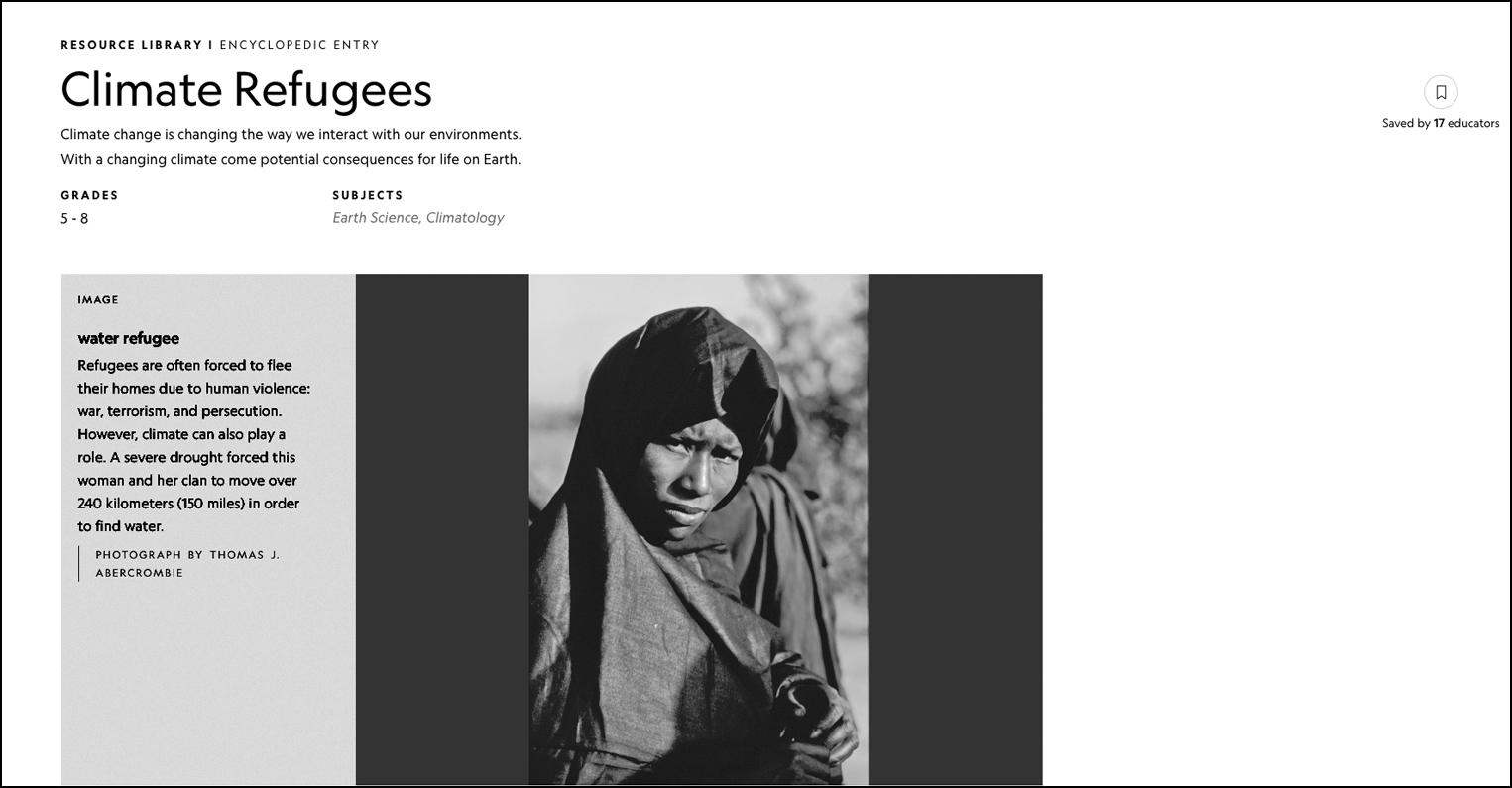
“Climate Refugees,” Resource Library, National Geographic Society, March 28, 2019, www.nationalgeographic.org/encyclopedia/climate-refugees. Photo by Thomas J. Abercrombie.
The fact that this “human face” appears without a name or a voice indicates the manner in which contemporary public representations of environmental change continue to build on generic tropes of colonial difference that render international crisis as gendered, raced, and classed, often located in rural geographic peripheries. The tragic images of farmers and other agrarian workers attempting to rebuild or maintain livelihoods following catastrophic weather disasters serve as potent symbols of planetary environmental destruction, as risks of social breakdown, and as icons for white rescue narratives invoking the vulnerability of women and children from the Global South.12 This is not only true of publications like National Geographic, which have long been criticized for racist depictions of Africa and of Indigenous peoples worldwide, but also of global think tanks and NGOs that attempt to focus on climate-driven migration in order to make a case for either launching international efforts to mitigate climate change impacts on the world’s poor or lowering barriers to migration in the Global North. IDMC’s report outlining a case for new research on “slow-onset” displacements is a case in point. Displaying on its cover the 2017 image of a woman photographed from behind—adorned with a bright yellow scarf, a green and white dress, and a bundle of sticks slung on her back—the blurred beige background displays a scene of drought that threatens habitation and life itself. The caption reads, “An internally displaced woman walked four hours with a heavy load to the village of Shisha in Somalia, crossing the mountains bordering the dry valley. From her 200 sheep, nothing is left. After building her tent, he [sic] intends to repeat the journey, bringing her children to the village.”13 In such narratives, environmental roots of migration are isolated from the complex networks of social, political, economic, and ecological relations that drive human mobility, in the process forging the icon of an economically and physically vulnerable dark-skinned third world woman as the embodiment of climate change’s human impacts.
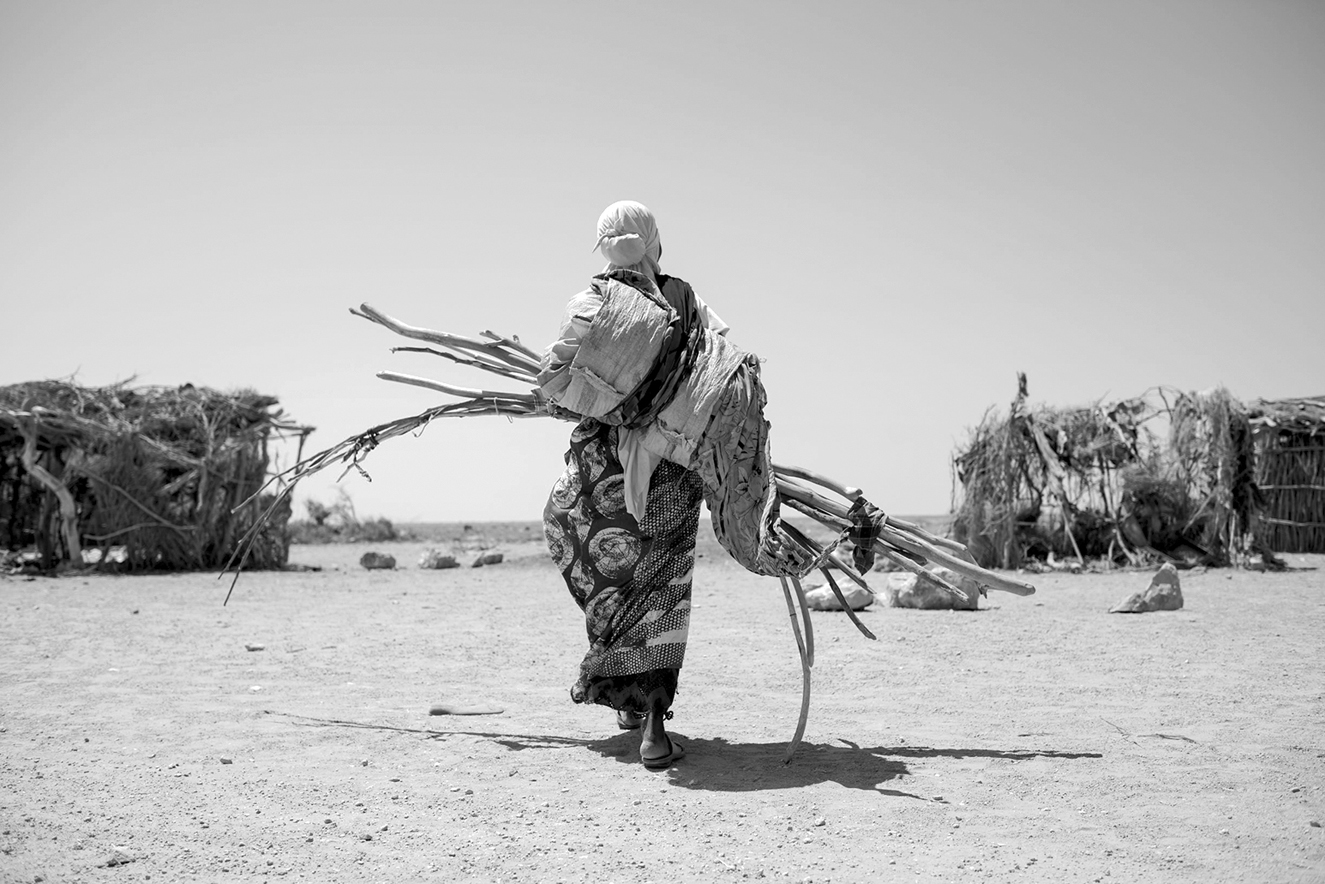
Bina Desai, Justin Ginnetti, and Chloe Sydney, No Matter of Choice: Displacement in a Changing Climate, Research Agenda and Call for Partners (Geneva: IDMC, December 2018), 1.
Parsing Environmental Causes of Migration
Images of individual migrants affected by environmental disasters often intend to communicate something of the human cost of climate change and to spur individuals and states into action to mitigate its worst impacts. So why should we be concerned about the racialized iconography of climate representation in media? The characterization of climate refugees institutes a form of racialization common to migration discourse more broadly, figuring migrants from the Global South as both vulnerable bodies and potential beneficiaries of humanitarian immigration policy within comparatively wealthy receiving states. Of course, the vast majority of these migrants never make it to the North; nations in the Global South become the host countries for four out of five refugees.14 The operation of racial differentiation in migration discourse thus rehearses a fictive colonial division of geographic space that is crucial for maintaining nationalist myths in northern countries about the purported humanitarianism of liberal law, despite the histories of militarism, environmental destruction, economic exploitation, and political interventionism in which the northern countries have persistently helped to generate migration. Critical refugee studies scholarship—including a growing body of work focusing on southeast Asian refugee flows—highlights how the dual concepts of refuge (indicating the sanctuary promised by the receiving state) and refugee (indicating the displaced subject who purportedly appeals for humanitarian redress from the receiving state) co-construct an imperial discourse that reifies settler and imperial logics of humanitarian rescue. Such discourse tends to mask the histories of militarized violence that produce refugees as a racialized supplement to the political orders of empire. In Body Counts, Yen Lê Espiritu argues that “the figure of the Vietnamese refugee … has been key to the (re)cuperation of American identities and the shoring up of US militarism in the post-Vietnam War era.… Having been deployed to ‘rescue’ the Vietnam War for Americans, Vietnamese refugees thus constitute a solution, rather than a problem, for the United States.”15 Mimi Thi Nguyen describes this solution as a type of national myth-making in the form of “the gift of freedom” purportedly conferred on Vietnamese refugees by the United States; such a narrative of state care “discloses for us liberalism’s innovations of empire, the frisson of freedom and violence that decisively collude for same purposes … because it may obscure those other powers that, through its giving, conceive and shape life.”16
Yet the purported gift of freedom that receiving states may offer to the figure of the climate migrant becomes more difficult to define when one inquires into how such a migrant might be characterized as a legal subject. One clue to the difficulties of the construction of the climate migrant lies in the term itself. Under what circumstances would a person’s mobility be labeled “climate migration”? Because of the complexity of migration decisions and the difficulty of isolating ecological influences on migration from others, the United Nations, the Intergovernmental Panel on Climate Change (IPCC), and other international institutions have not established accepted legal definitions of climate migration or climate refugees. Should all individuals who experience temporary or permanent loss of a home due to an extreme weather event in this era of accelerated climate change be designated as climate migrants? Such a definition would encounter the criticism that floods, hurricanes, and other weather disasters had been displacing human communities long before the era of anthropogenic climate change. As such, the IDMC uses “conflict” and “disaster” as the categories to identify root causes of internal displacement, with “weather-related disasters” (including extreme heat events, flooding, and drought) identified as the primary forms of disaster that produce displacement. According to the IDMC, 16.1 million out of 18.8 million people categorized as internally displaced in 2017 were affected by either floods or storms.17 IDMC’s work has been widely used to describe the growing threat of climate migration. Its annual Global Report on Internal Displacement website (https://www.internal-displacement.org/global-report/grid2020/) includes interactive maps displaying circles representing migration magnitude. These circles in most cases display a large blue section indicating disaster displacements, with a smaller section indicating conflict displacements. Data on disaster displacement of the sort visualized by the IDMC in its displacement map appear to suggest that weather-related displacement has outstripped displacement due to political factors, despite the fact that in the text of its reports, the IDMC gives contextual descriptions of how policies and social inequalities—including “poorly conceived urban planning” that affected people in flood-prone subsidized housing during Hurricane Harvey in Texas—affect the magnitude of displacement figures.18 Although the IDMC does not use the terminology of “climate migration” to describe displacements from what it categorizes as weather-related disasters, its figures or similar ones reported by the United Nations are at times subsequently reported as such.
The World Bank’s Groundswell report is also careful to distinguish environmentally induced migration from migration that can be directly linked to climate change (climate migration). But the need to parse differences between weather and climate in this distinction is also complicated by the need to address a number of other complexities in the categorization of migrants. The report includes a schematic representing the forms of environmental migration, emphasizing the gray areas between environmental displacement and migration as well as the interplay between the experience of mobility (as either forced displacement or voluntary adaptive migration) and that of immobility (which is described as a stage of the experience of displacement). The chart is organized around three columns representing the momentum of people affected by environmental processes, categorizing migrants based on mobility within borders, mobility across borders, and immobility. In turn, each column depicts a binary between voluntary and involuntary movement or stasis. When do environmental inducements to migration result in “voluntary” migration, and at what point do such inducements become so burdensome that migration is “forced”? The fact that the chart is organized around the dialectic between choice and coercion, and is framed by the thresholds crossed when migration becomes transnational, signals that the concept of environmental migration reflects a crisis for liberal ideas of free agency, citizenship, and property in the self. As Malini Ranganathan notes, such liberal concepts of property and agency have been significant in constraining the potential radical force of environmental justice discourse as they conceive of environmental racism as either individualized harm or incidental externalizations of market processes.19 Simultaneously, the particular scales and movements of environmental harm make it difficult to locate environmental racism in the normative time frames or human agencies of liberal politics. The subject of migration or stasis is potentially compromised by ecological forces beyond the subject’s control, and yet the potential slow onset of such forces may make environmental determinants of movement imperceptible. Such attempts to parse the condition of the climate migrant reveal the embedding of the migrant in broader biosocial and geophysical forces inextricable from the mythos of individuated human agency.
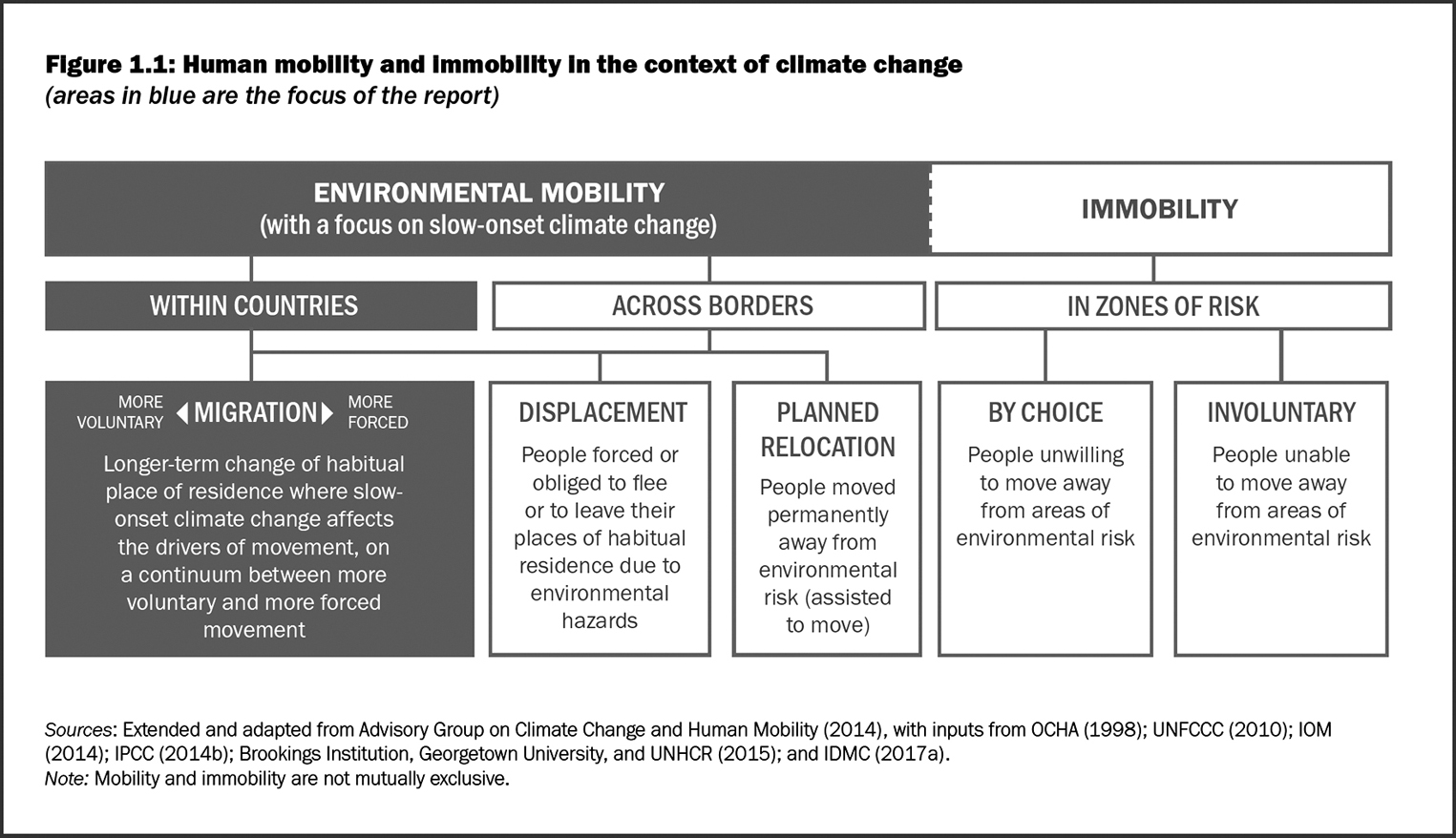
“Human Mobility and Immobility in the Context of Climate Change.” In Kanta Kumari Ringaud, Alex de Sherbinin, Bryan Jones, Jonas Bergmann, Viviane Clement, Kayly Ober, Jacob Schewe, et al., Groundswell: Preparing for Internal Climate Migration (Washington, DC: World Bank, 2018), 4. © World Bank. License: Creative Commons Attribution (CC BY 3.0 IGO).
Such problems of categorization reflect how the development discourse on climate migration recapitulates long-standing attempts by states to differentiate voluntary and involuntary migration as a political distinction. This issue is one currently faced by coastal Indigenous communities around the world. For example, the Biloxi-Chitimacha-Choctaw Indians of Isle de Jean Charles, Louisiana, are involved in a legal struggle over the U.S. federal government’s relocation of their community as the island recedes into the Gulf of Mexico with the rising seas. They have been labeled in numerous media outlets as the first U.S. climate refugees. But should the Biloxi-Chitimacha-Choctaw simply be designated as “climate migrants” or “climate refugees”? What about the history of colonialism that displaced the tribe to the coastal island during the 1830s, when genocidal settler militias and the Indian Removal Act displaced them and other Indigenous communities of the Gulf Coast?
These questions multiply in situations in which communities that have experienced displacement, segregation, and economic marginalization prior to the great acceleration have been concentrated in areas that are vulnerable to rapid environmental change. In such locations, structural factors ranging from zoning policies to insurance restrictions directly affect the potential for individuals and communities to stay in place and rebuild after disaster. The application of the word “climate” as an adjective that modifies “migrant” or “refugee” follows earlier attempts by the United States and other refugee-receiving states to parse differences between “political” refugees and “economic” migrants. During the Cold War, authorized in the programs of both major political parties, the U.S. government claimed to welcome refugees fleeing political persecution, but it dismissed migrants whom it viewed as fleeing economic hardship as ineligible for refugee status. U.S. immigration authorities relied on Cold War imperial mappings of capitalist versus communist states as the yardstick to measure which immigrants were deserving of refugee status and which were not. The U.S. Coast Guard carried out the refoulement, or forcible return, of migrants from Haiti fleeing the rule of both Duvalier in the 1980s and Cédras in the early 1990s. Haitians were dismissed as economic migrants despite clear evidence of the political targeting of dissidents, while the United States allowed and even aided the transport of Cuban migrants automatically designated as political refugees. Such decisions elsewhere also mirrored the capitalist ally versus communist enemy logic; Mexicans were rejected as economic migrants while Vietnamese were at times aided in relocation, designated as political refugees. According to this Cold War logic, it was inconceivable that people entering the United States from capitalist countries would be categorized as refugees.20
Population Bombs and Environmental Exodus
An attempt to synthesize environmental links to political and economic factors is apparent in the first in-depth study of climate migration by an international environmental NGO. In 1995, Norman Myers and Jennifer Kent, under the auspices of the Washington-based Climate Institute, published the 214-page report Environmental Exodus: An Emergent Crisis in the Global Arena. Arguing that “environmental refugees”—people involuntarily displaced by climate change, weather disasters, drought, crop failure, soil degradation, and other processes—had grown so quickly since the 1980s that they numbered higher than traditional political refugees, the text outlines a policy agenda to both prevent mass environmental migration and address the outcomes of what they describe as the “emergent crisis.” Environmental Exodus argues that climate changes and the collapse of agriculture risk displacing hundreds of millions of precarious, poor, and rural people in the Global South. Yet the text also vacillates between distinguishing environmental from economic migrants and intertwining economic and environmental causes of migration. Departing from el-Hannawi’s insistence on the interrelation of infrastructure, development, and environment, this tension is resolved in Environmental Exodus by situating economic influences as contributing factors in migration decisions while giving environmental factors primacy as a “necessary cause” of migration. Claiming without evidence that economic attraction is often overstated as a migration pull factor and that otherwise, “many more Mexicans would have made their way to the United States,” the authors assert that “neither environmental push nor economic pull need be a wholly sufficient cause of migration—though in the cases examined in this report we shall find that environmental factors are a necessary cause. It is not strictly relevant to consider whether in any specific instance they are prominent, pre-eminent, or predominant, though this report generally assumes that they are critical because they are fundamental.”21
This assumption that environmental causes play a critical role that often overshadows economic factors—embedded in the methodology of the report—appears again in a discussion of the Haitian migrations of the Duvalier and Cédras years. The report asserts not only that political repression, poverty, and environmental destruction intertwine but also that the environmental factors exist independently of the political economy:
There has been much repression from a series of authoritarian governments, and there is gross maldistribution of wealth and income.… It is difficult of course to separate out these political and economic factors from environmental problems, and hence to determine which is the more potent source of Haiti’s deprivation. The two sets of determinants are closely intertwined, and they probably exert a compounding impact on one another. All the same, recall that the great bulk of citizens rely on agriculture for their living, and that the agricultural resource base has been severely depleted by environmental problems.… The situation is exacerbated by population growth of 2.3 percent per year, the second highest rate in the Caribbean. Even were a democratic government to be permanently restored, were there to be a more egalitarian society and economy, and were agrarian reform to be widely implemented—all of these being policy purposes of the US intervention—there would still be environmental problems aplenty that would keep large numbers of Haitians in absolute poverty for the foreseeable future. To a substantial extent, people fleeing Haiti can be considered primarily environmental refugees, though often with political repression at work too.22
Again anticipating some contemporary discourses on climate refugees, this passage indicates the ways in which political and economic determinants of migration may be retrospectively interpreted as the result of environmental processes, displacing attention to the ideological grievances of activists challenging the authoritarian state and thus subject to political repression. The text configures the hundreds of thousands of Haitian migrants to the United States as significantly driven by lack of adequate arable land in Haiti, despite the fact that the political repression, economic collapse, and repeated European and U.S. interventions and economic warfare created short- and long-term bases for outmigration in the late 1980s. In the process, it subtly marks environmental refugees as agents—not just victims—of environmental destruction. The authors assert the mutually reinforcing nature of economic deprivation and environmental degradation, suggesting that as impoverished agrarian populations expand, the “population pressure” they exert on natural systems drives migration to marginal lands, where the new arrivals tend to strip the soil of productive capacity and further destroy the land base. Elsewhere, the report makes these connections explicit, figuring environmental refugees as “destitutes” who degrade the environment: “It is the most impoverished who do the most environmental damage, however unintentionally.”23
This foundational text unveiling the concept of the climate refugee to international policy audiences thus figures environmental refugees as both tragic victims and hapless agents in processes of environmental destruction. This builds on some of the long-standing contradictions within colonial and anti-Black depictions of peasants—especially rural peoples in Africa—connecting tropes of overpopulation with romantic invocations of environmental tragedy. In these ways, Environmental Exodus makes explicit its connection to the ideas of English cleric and demographer Thomas Malthus, whose deterministic arguments about the effects of overpopulation in the 1798 book An Essay on the Principle of Population suggest the propensity for the poor to overwhelm the so-called carrying capacity of land and resources in the society, a phenomenon euphemized in environmental discourse as “population pressure.” For Myers and Kent, “Environmental refugees can sometimes be viewed, in part at least, as ‘population pressure’ refugees.”24 Malthus’s ideas tend to portray the poor as the agents of their own misery due to excess reproduction. This is a line of argument that U.S.-based neo-Malthusian environmentalists in the 1970s and 1980s rearticulated in a global context in which the purported overpopulation of poor countries was viewed as the potential source of economic degradation, food crisis, and geopolitical emergency. Following publication of Paul and Anne Ehrlich’s The Population Bomb, this idea was also popularized by Lester Brown and his Worldwatch Institute, who configured environmental problems largely as third world population pressures. India and China were often the focus of such reporting as their populations neared one billion each.25 Building on this focus of international environmentalists, Myers and Kent’s ostensible humanitarian focus is coupled with a racially potent imaginary of southern population-driven environmental degradation. The ambivalence between these two poles of emphasis in the report is evident in the one photograph it contains, where the gendering of environmental degradation is explicit. Without any caption explaining the image, the cover of the report includes the portrait of a veiled Black woman holding a baby as they both stare directly into the camera. Echoing similar colonial portraiture of the colonized mother as an icon of the tragic social and environmental conditions of native societies in Africa and Asia—Katherine Mayo’s image of an Indian mother and child in the 1927 book Mother India being one widely circulated example—the cover of the report deploys dark-skinned mothers and children as the conventional objects of colonial humanitarian rescue, even as the invocation of the child suggests the incidental potential for the marginalized environmental refugee to reproduce the same conditions of displacement through the mother’s excess capacity for reproduction.26
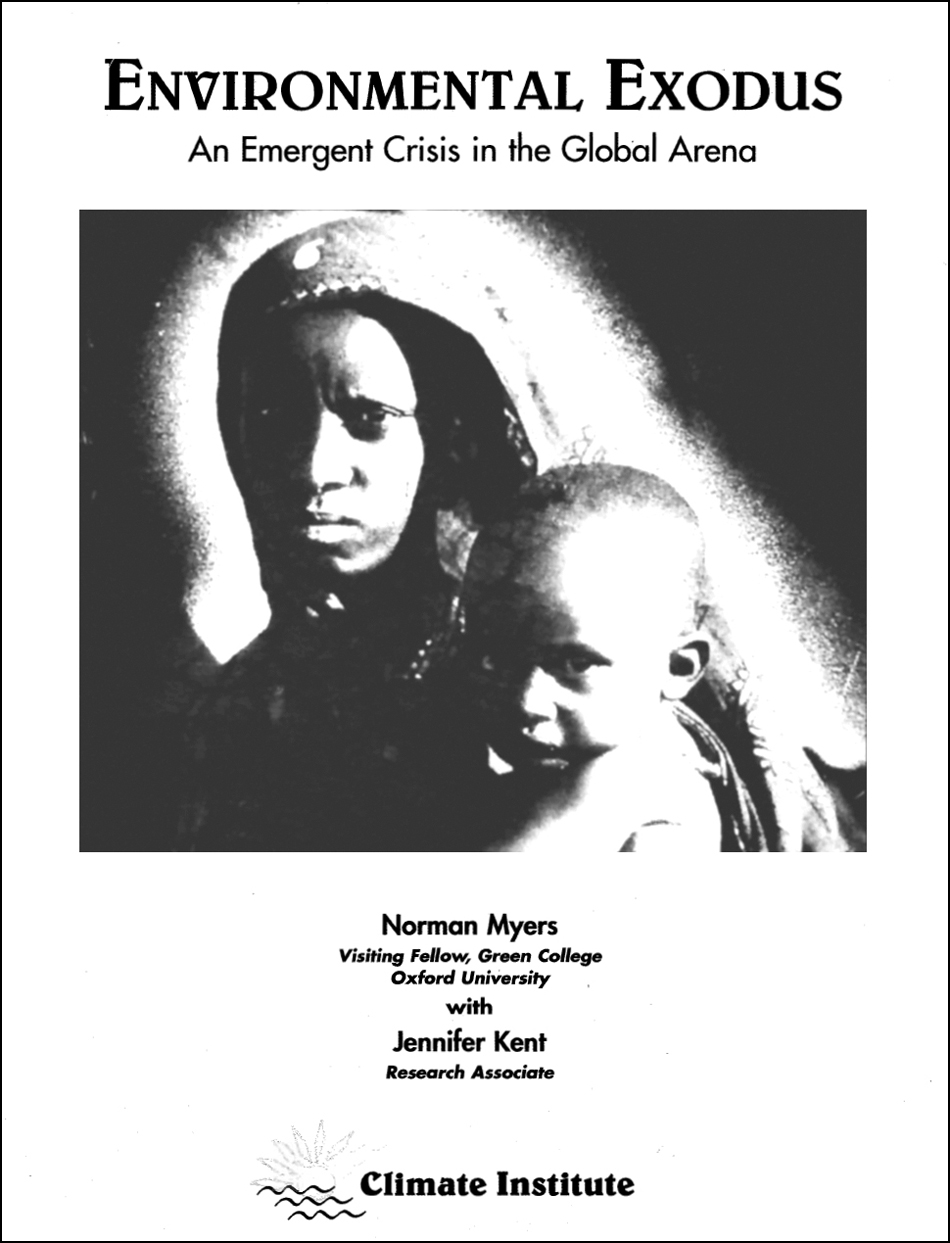
Norman Myers and Jennifer Kent, Environmental Exodus: An Emergent Crisis in the Global Arena (Washington, DC: Climate Institute, 1995).
Today, the legal and political context of the term “climate refugee” is different from the moment in which Myers and Kent published their report, especially as it emerges in two contexts that make migration an increasingly politicized crisis issue: (1) neoliberal economic policies, broadly dispersed armed conflict, and environmental disasters have generated massified flows of both internal and transborder migration, often fueled by demand for labor in the rich countries; and (2) the rise of neoconservative border militarization, coinciding with Islamophobic discourses on terrorism, has both limited the scope of formal migration pathways and grown the flows of officially unauthorized (though economically demanded) migration. As Nicholas De Genova argues, in the current moment “the criteria for granting asylum tend to be so stringent, so completely predicated on suspicion, that it is perfectly reasonable to contend that what asylum regimes really produce is a mass of purportedly ‘bogus’ asylum seekers.” For De Genova, this scene or spectacle of illegality is always accompanied by its “obscene supplement: the large-scale recruitment of illegalized migrants as legally vulnerable, precarious, and thus tractable labor.”27 For this reason, Harsha Walia suggests that we reframe thinking about “border control” to recognize the realities of “border imperialism”: “Border controls are most severely deployed by those Western regimes that create mass displacement, and are most severely deployed against those whose very recourse to migration results from the ravages of capital and military occupations.”28 As such, the widespread public media discourse that configured transnational migration to Europe as a “refugee crisis” in 2015 made the state itself the entity that experienced crisis rather than the people who were displaced.29
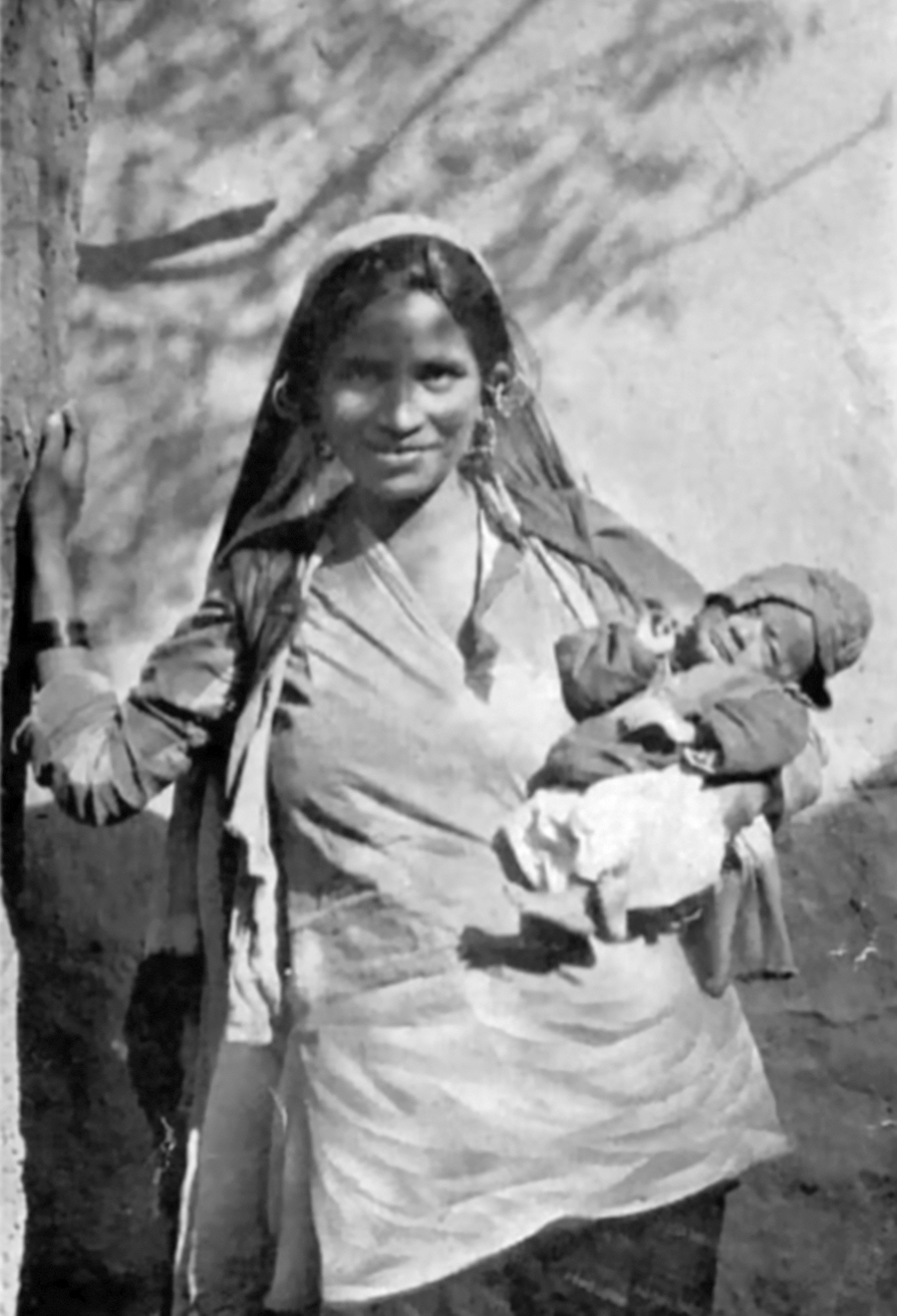
Katherine Mayo, Mother India (New York: Blue Ribbon, 1927).
Given the imbalance between demand for transnational labor migration and the declining willingness of receiving states to authorize continued migration flows, it should be no surprise that the articulation of climate migration as a new juridical category of international migration law has often been led by climate-affected states rather than receiving states. In cases when receiving states (particularly in the European Union) advocate for greater quotas of environmental migrants, the case is usually made by reference to the potential security crisis of mass unauthorized migration. These diplomatic dynamics were present in negotiations on the 2018 Global Compact for Migration, when a number of climate-affected states and international NGOs advocated for language recognizing climate change’s impact on migration. Despite the strategic goal of such advocacy in allowing larger numbers of legal entries, the calls for developing regular categories in international law for climate-affected migrants create a context in which states attempt to designate some migrants as deserving of relief over others because of the environmental roots of their mobility. One strategic reason climate-affected states might advocate for “climate refugee” as a new category within international law is precisely because it bypasses broader questions about the continuing inequalities in the international system, which are exacerbated by carbon extraction and the climate change processes it fuels.
If the originating accounts of environmental and climate refugees that came out of environmental NGO policy studies reproduce conservative narratives of degradation that blame victims of disaster for their own plight, other more recent environmental discourses about human-induced climate change tend to move toward apocalyptic predictions about the scale of such degradation. In the move from the degradation narratives of the 1990s to the apocalyptic visions of climate change in the twenty-first century, we glimpse how climate migration discourses enable a growing focus on the waste products of the system of racial capitalism.
Climate Migration as a Legal Concern
If in the 1990s climate migration discourse began to articulate an environmental source of global insecurity, by the 2000s and 2010s a variety of human rights, legal, and environmental justice discourses began to advocate for humanitarian responses to climate migration. This became clear in the legal case of Ioane Teitiota, a man from Kiribati who sought to be legally declared the world’s first climate refugee in a petition to the government of New Zealand. Teitiota migrated with his wife, Angua Erika, in 2007 from South Tarawa, Kiribati, to New Zealand, where he worked as a farm laborer. The couple had three children. After overstaying his visa, Teitiota applied for asylum under the 1951 Geneva Convention Relating to the Status of Refugees, which is incorporated into New Zealand’s 2009 Immigration Act. When the petition prepared by his pro bono lawyer, the Pentecostal minister Michael Kidd, was rejected by New Zealand’s Immigration and Refugee Tribunal on July 20, 2015, the court declared that its decision should not be taken as general precedent; the decision does “not mean that environmental degradation resulting from climate change or other natural disasters could never create a pathway into the Refugee Convention or protected person jurisdiction.”30 Although Teitiota’s deportation on September 23, 2015, and failure to win a final appeal hearing in the Supreme Court meant that he was permanently barred from New Zealand, he subsequently took the case to the United Nations. Again, the UN Human Rights Committee upheld New Zealand’s deportation decision. However, a variety of international media outlets immediately reported on the ruling, which determined, according to Amnesty International, “that governments must take into account the human rights violations caused by the climate crisis when considering deportation of asylum seekers.”31 Time magazine’s headline indicated further that “climate refugees cannot be forced home.”32
The involvement of the UN Human Rights Committee and the statements by Amnesty International reflect the increasing participation of human rights organizations in climate change as a legal and political matter. These organizations tend to foreground migration as a significant signal of human rights violations stemming from climate insecurity. In 2009, Amnesty International began calling for emissions reductions as an international human rights concern and indicated that if polluter states do not take action, they will “bear responsibility for loss of life and other human rights violations and abuses on an unprecedented scale.”33 Other major human rights NGOs including Human Rights Watch have moved into climate advocacy over the past decade. The 2019 report Climate Change and Poverty, released by Philip Alston, an international law scholar and United Nations special rapporteur on extreme poverty and human rights, criticizes the complacency of human rights bodies and NGOs, as well as the complicity of corporations and governments around the world, with fossil-fueled climate change. Noting that “forced migration,” or the choice “between starvation and migration,” is one of the likely large-scale outcomes of climate change, Alston argues that structural transformation of the world economy, litigation, and broad-based community solutions to climate change impacts are necessary to offset massive job losses and housing and food crises affecting the world’s poor.34
From Alston’s vantage within the human rights community, the aforementioned public reports about the UN tribunal ruling might appear irresponsibly celebratory. Time’s headline declaring that climate refugees cannot be returned does not address the complexity of the New Zealand tribunal and UN committee decisions, which both suggest at minimum an uncertain threshold for when settler states will accept asylum claims—or worse, that the threshold for being protected as a climate refugee is unlikely to apply to the displaced until their home countries are literally unable to support human life. Both decisions draw on a number of expert discourses on climate change. Because the convention guarantees a “right to life,” both legal bodies addressed expert testimony and research documents that examined the changing ecological situation generally among the thirty-three islands of Kiribati and specifically concerning Teitiota’s place of residence, Tarawa, which is home to nearly half of the I-Kiribati population. In Tarawa, displacements from other islands are concentrating the population; as Tarawa’s own land base and water table shrinks due to pollution and sea level rise, land disputes have become increasingly common and contentious. Researchers reported malnutrition, disease, crop failure, and water shortages, compounded by mass unemployment and widespread reliance on subsistence agriculture. These are indicators of a broader assessment attributed by the UN committee to the Intergovernmental Panel on Climate Change from its fifth assessment report, released in November 2014: “Kiribati … is losing land mass and can be expected to survive as a country for 10 to 15 more years.”35 And yet this period of national habitability is apparently enough in the eyes of the UN committee to ensure that Teitiota’s forced return to Kiribati remains legal at present; because Teitiota would not be immediately threatened with death, he could be returned by New Zealand authorities to a country configured by expert discourse on climate change as inhabiting a shrinking future.
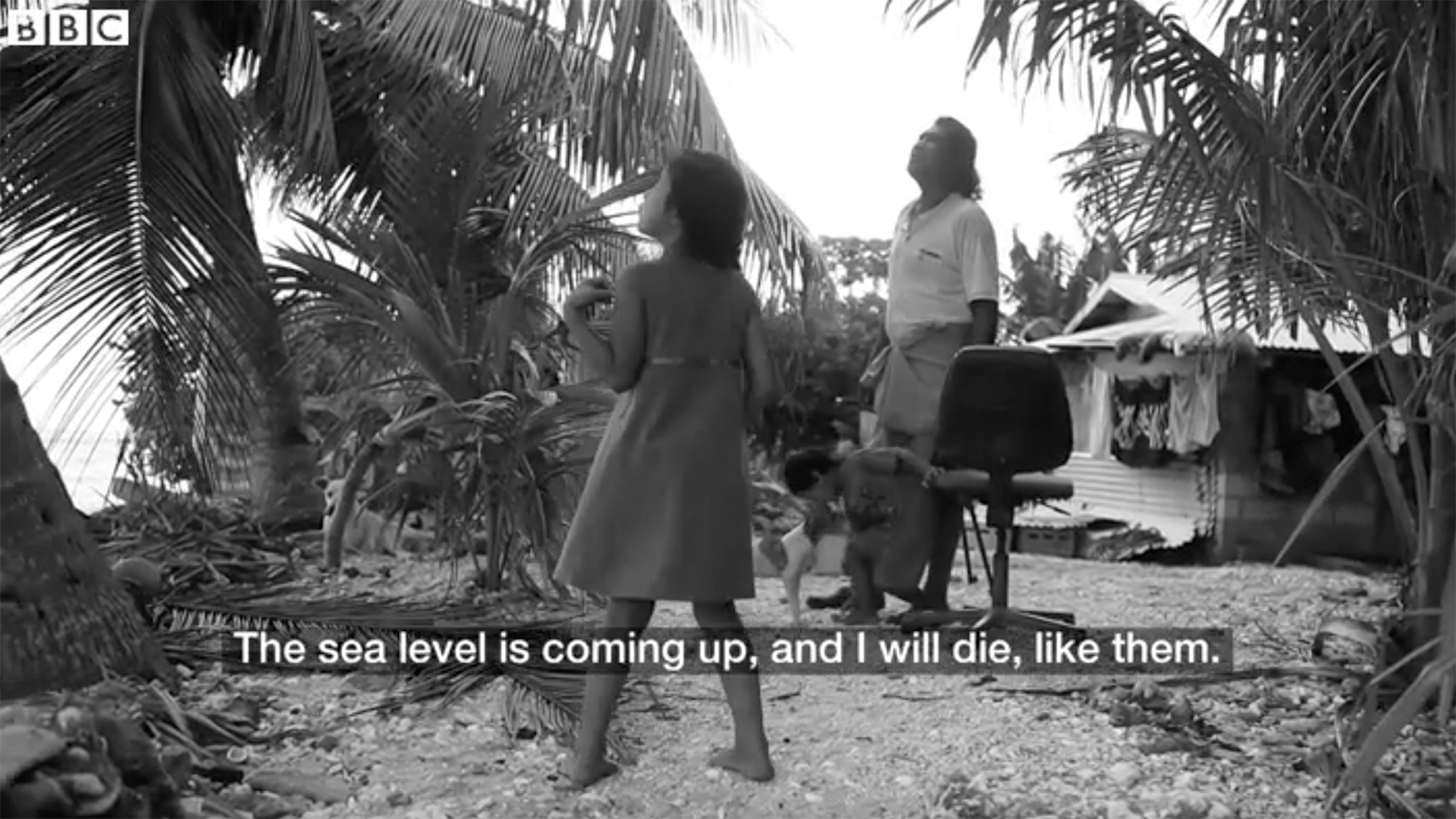
Tim McDonald, “The Man Who Would Be the First Climate Refugee,” BBC News, November 5, 2015, www.bbc.com/news/world-asia-34674374.
Kidd’s publicity for the case helped ensure that the New Zealand tribunal decision would be watched internationally, with televised coverage from Australia to France, as the site of a “test case” on the climate refugee; knowing that the law itself is unlikely to provide remedy, Kidd proclaims, “The law needs to be changed.”36 In this context, potential refugees like Teitiota have the ability to tell their stories to broader audiences, but the narrative frame of these stories is constrained in important ways. The context of refugee law requires that refugees strategically lay claim to stories that reify the receiving state as the last line of defense against impending death. These are thus narratives configured by national dependency; in the words of Epeli Hau‘ofa, “Is this not what neocolonialism is all about? To make people believe they have no choice but to depend?”37 Teitiota’s own interviews with Western journalists confirm this vision of Kiribati as a kind of “deathworld,” configured in order to underline a (now failed) humanitarian claim to refugee status.38 In an online video interview with the BBC, Teitiota is shown alongside his children at home in Tarawa after his deportation, indicating places where the flood wall has been damaged and the towering height that the tide reaches at its zenith. After displaying welts on his children’s skin to show that they have been affected by malnutrition and poor water access since their return from New Zealand, Teitiota indicates through a translator that his situation is “the same as people who are fleeing war. Those who are afraid of dying, it’s the same as me.” Bringing together a vision of climate-generated vulnerability uniting present disability and future death, Teitiota’s testimony underlines the failure of the potential receiving state of New Zealand to fulfill the promise of asylum and the certainty of extinction. Comparing himself and his family to refugees fleeing the direct violence of war, Teitiota states, “The sea level is coming up, and I will die, like them.”39
The Specter of National Extinction
The consequences that flow from the speculative declaration of the demise of an entire national population cannot be delimited to the arena of law, of strategic claims migrants might deploy to gain entry into a receiving state. Confirming long-standing stereotypes of the inevitability of Indigenous disappearance,40 the depiction of islands shrinking into rising seas looks somewhat different from public discourses concerning the threat of mass migrations from Syria, North Africa, or South Asia, where climate change mobilizes fears of swarming Islamist militancy amidst resource scarcity. As Renisa Mawani argues, the ocean has been configured by colonial powers as a free space for exploration, trade, and conquest even as it has simultaneously been rendered a site of repeated attempts to control population movement and enforced racialized laws separating colonial peripheries from European metropoles and white settler colonies.41 The colonial imaginary of the sea as a site of individual freedom buttresses visions of the island as prison, a historical situation that reinforces the reported I-Kiribati disdain for Teitiota’s representation of the national population as refugees who must flee a vanishing island. As Suvendrini Perera thus argues, renewed interest in the seafaring traditions in Indigenous Pacific literature and public culture often grapples with the complexity of violence, economic hardship, and environmental change that surround island refugee subjects.42
In the neocolonial vision of shrinking land under climate change, the predicted climate disaster that depopulates Kiribati recasts social time as shrinking at the individual, household, and national levels. The usual forms of time management that lend an imagined predictability to living—the life span of the individual, family time of reproduction, labor time based on industrial or crop cycles, and the indefinite opening of state time—all come under pressure with the stereotyped vision of climate change as a localized deathworld.43 Built on a history of colonial representations of islands that, as Elizabeth DeLoughrey argues, are presented as metonymic for a global condition, the shrinking island as a deathworld of climate change allows for the depiction of environmental determinism precisely because the assumption of a premodern past presages a deathly future.44
The change in the type of imaginable time for living inevitably bleeds into the experience of the everyday—a “descent into the ordinary”45—affecting the interpretation of life events along the slow-moving lines of environmental disaster. In snapshot moments, this bleeding of crisis feeling into the interpretation of social and ecological change may appear to transition a person, a family, a community, or an entire nation across the threshold separating the creeping motion of “slow violence” upon a lifeworld to the rapid undoing of life itself in “crisis.”46 What does the specter of mass displacement do to transform the feeling of inhabiting the present? How does it enable certain visions of what constitutes a livable life or the shrinking horizon of the future? To the extent that the specter of the climate migrant haunts transnational environmental discourse and immigration law, it configures the migrant’s lifeworld, generically conceived as an individual or a familial struggle rather than one at the scale of community, nation, or planet, as a compressed and constricted ecology requiring intervention. It is this potential for securitization—woven into the temporal unfolding of crisis from slow to rapid onset—that both views migrant bodies as inhabiting a space of living death and animates a kind of government of the climate migrant’s life along lines anticipated by discourses of asylum, adaptation, and development. Migration thus becomes not only an object to be contained by security but also a resource of adaptation to climate change.
In such a movement from a deathworld to a displaced migrant futurism, Aimee Bahng recognizes the speculative capture of migrant bodies as projections “that materialize the abstract, rendering it available for possession.”47 Herein is a specific and newly emergent process of race-making endemic to climate migration law as it attempts to move from individual claimants to narratives of group vulnerability using the markers of corporeal, biological, or geographic difference. This is evident in the manner by which courts distinguish differential risk to specific groups in the adjudication of the handful of extant climate-related asylum claims. Despite the fact that Teitiota’s case was widely reported as the first legal attempt to establish climate refugee status in law, the New Zealand decision against Teitiota cites a history of other similar petitioners—all originating from Tuvalu—dating to the year 2000. In the first of these cases, rejected upon appeal on August 10, 2000, an unnamed seventeen-year-old Tuvaluan man was denied asylum because all Tuvaluans were subject to displacement, and he was not considered by the court to be differentially affected as a member of a protected group within Tuvalu. The fact that refugee law generally and the Geneva Convention specifically are dependent on a narrative of minority persecution within a nation-state allows the court to dismiss Tuvaluan claims for asylum precisely because of their universal vulnerability to climate change:
None of the fears articulated by the appellant vis-à-vis his return to Tuvalu, can be said to be for reason of any one of the five Convention grounds in terms of the Refugee Convention, namely race, religion, nationality, membership of a particular group and political opinion. This is not a case where the appellant can be said to be differentially at risk of harm amounting to persecution due to any one of these five grounds. All Tuvalu citizens face the same environmental problems and economic difficulties living in Tuvalu. Rather, the appellant is an unfortunate victim, like all other Tuvaluan citizens, of the forces of nature leading to the erosion of coastland and the family home being partially submerged at high tide. As for the shortage of drinkable water and medicines, medical care, doctors and other associated services, these are also deficiencies in the social services of Tuvalu that apply indiscriminately to all citizens of Tuvalu and cannot be said to be forms of harm directed at the appellant for reason of his civil or political status.48
It is precisely in explaining the court’s denial that climate change conventionally discriminates based on race, nationality, or other protected group that a judgment is made that meets Ruth Wilson Gilmore’s definition of structural racism as “state-sanctioned or extralegal group differentiated vulnerability to premature death.”49 Here the court collects people into a group differentiated by their shared vulnerability to premature death. Race-making thus takes the form of collecting an entire national population subjected to escalating ecological violence and configuring their shrinking horizon of livability as an incidental process rather than targeted discrimination. Even though the implication is that a vulnerable national population would need to eventually be reconfigured as a vulnerable minority in diaspora, such a designation disallows the law from considering Tuvaluans as a targeted group. Put simply by the court, “all” Tuvaluans are “unfortunate victim[s].” This casual representation of the extinction of an entire national population as an unintentional tragedy cynically masks the combination of environmental, economic, and social pressures that render small islands especially vulnerable to climate change. Despite the fact that the category “Tuvaluan” is repeatedly used to identify the vulnerable population of which the petitioner is a part, the environmental racism of the wealthy polluter nations is not grounds to understand this as a threat of death emanating from protected-category discrimination. Instead, the abstract agent of climate destruction is “forces of nature.” As such, the petitioner cannot seek remedy of asylum from New Zealand, and because of Tuvalu’s very representation as an undifferentiated deathworld in law, the court condemns the petitioner to return to the place it views as having no future. In the logic of New Zealand’s adjudication of the Geneva Convention, if minoritization by ethnic cleansing supposedly entitles targeted migrants to the mythic “gift” of passage advertised by receiving states,50 universal vulnerability to the slow violence of climate change ensures their abandonment to enclosure, to a carceral logic of exclusion upon shrinking islands of life.
Migration, Human Security, and Environmental Racism
Although climate migration discourse has thus far resulted in little redress or relief for migrants, it has helped to advertise environmental inequalities. In turn, climate migration discourses have begun to appropriate the language of environmental justice movements, even as such language may sit uneasily beside the global crisis discourses and security logics that suffuse public reporting about migration. Environmental justice studies has thus occupied a complex position both inside and adjacent to climate migration discourses. Pioneered by grassroots environmental activists, environmental justice research in the tradition of sociologist Robert Bullard analyzed the siting of waste near Black communities in the United States beginning in the 1980s. This sociological research in the U.S. context worked to understand how the risks of toxicity emerged out of historical forms of segregation and were geographically concentrated in ways that unequally affect Black and poor communities. Environmental justice scholarship building on this tradition, including key writings by Laura Pulido, Julie Sze, David Pellow, and others, has since taken up a variety of themes, ranging from toxic air pollution, waste disposal and recycling, and the effects of industrial processes and pesticides on workers to environmental justice protest and questions of urban space and design.51 Such work offers important pathways for thinking about widely distributed environmental changes because it grapples with questions of responsibility and inequality. If corporate polluters mask the exact harms they unleash when they pollute environments, how can their culpability be proven? And how do invocations of environmental inequalities relate to recent efforts to incorporate migration and security discourses into environmental knowledge?
The appropriation of environmental justice concepts is evident in discussions among climate researchers and the IPCC of how migration itself may be one of the key acts of resilience by climate-affected peoples. In such claims, public assessments of climate change as racism often invoke retrospective empirical calculation of racialized groups’ vulnerability to environmental destruction—a configuration of racial power that may be incidental in intent but deadly in effect. In this context in which dominant environmental governance considers racism an incidental effect of climate disaster, academic research and policy proposals concerning climate change increasingly invoke paradigms of security that claim to address environmental racism and displacement.
Environmental racism is in turn posited as a problem for thinking about human security, as it may both signal the vulnerability that human groups experience due to environmental change and the capacities they exhibit for resilience. The term “human security” operates as a baseline to consider how climate-affected peoples interface with a broad range of social, political, economic, and environmental systems. Purportedly a counter to militarized security emerging from development studies in the 1990s, the concept represents a liberal approach to security that in the post-9/11 era integrates environmental, biological, and social systems into the surveillance, data gathering, and intervention processes of state and interstate institutions. Especially popular in the European Union context as well as among international NGOs, “human security” suggests that humans share universal needs and are subjected to various types of risks that can be the objects of prediction and intervention. Despite the apparent internationalism of human security, which claims to transcend narrow national security agendas, this concept has a wide arena of application and has recently been deployed as a form of governance integrating security and humanitarianism. Combining network analysis, surveillance, policing, military intervention, and the statistical management of populations, economies, and environments, human security activates a “posthuman” form of governance that is premised on creating ever more detailed data forms for predicting potential insecurity and devising counterstrategies. Although this characterization differs from some of the celebratory announcements of human security in the 1990s as either “freedom from fear” or “freedom from want,” the integration of surveillance, intervention, and network analysis renders some contemporary contexts of human security practice as extensions of existing foreign policy and national security agendas in a manner that reifies northern intervention as the site of the production of freedoms.52 This corresponds to shifts away from questions of territorial sovereignty in security discourse and toward the forms of informational control that have recently become significant to understanding digital governance and warfare.53 In this modality of control, bodies are targeted not primarily through techniques of inclusion and exclusion or through subjectivation but rather through the calculation of gradations of difference in population constructions.54 Invoking a network model relating social groups to technical, environmental, and geopolitical systems, human security engages in predictive forms of modeling that require aggregated social categories (including racial categories) in order to construct risk differentials.55 In this type of security thinking, environmental racism—represented in terms of unequal vulnerability to disaster—represents an increasingly useful tool for surveillance and modeling of large-scale social problems.
In the fifth assessment report of the Intergovernmental Panel on Climate Change, the chapter on “human security” notes differential economic and racial factors that influence the possibilities for the return or resettlement of environmental migrants. Even as risk is intensified by weather-driven crises, resources for resettlement create wide disparities in the IPCC’s rendering of human security:
Most displaced people attempt to return to their original residence and rebuild as soon as is practicable. The Pakistan floods of 2010, for example, caused primarily localized displacement for large numbers of people across a wide area, rather than longer-distance migration. Structural economic causes of social vulnerability may determine whether temporary displacement turns into permanent migration. In New Orleans, after Hurricane Katrina, for example, economically disadvantaged populations were displaced in the immediate aftermath and most have not returned.… Fourteen months after the event, African American residents returned more slowly, because they had suffered greater housing damage. Studies conclude that displacement affected human security through housing, economic, and health outcomes and that these have perpetuated the initial impact into a chronic syndrome of insecurity.56
The IPCC’s formulation of climate change as a threat to human security links the effects of displacement to racialized potentials for precaritization and rehabilitation. On the one hand, the figure of the climate refugee is marked by a racialized chain of waste effects, as carbon emissions render lands transitory and intermittently productive. At the same time, the climate refugee’s exercise of mobility is itself a resource against the potential catastrophe of spectacular climate disasters that happen at the shorelines of the desert and sea. Detached from the scene of disaster and returned to settled land elsewhere, the recapacitated climate refugee is rendered as a site of hope for the resilience of populations in the aftermath of disaster. The IPCC refers to historical scholarship on “the relationship between large-scale disruptions in climate and the collapse of past empires” as evidence of climate’s security threat (rather than emphasizing the reverse proposition that empire threatens life itself through climate change).57 Thus, even as such discourse positions the colonial state as the arbiter of security and conservation, the figure of the climate refugee ideologically functions as a supplement to the colonial geopolitical order, a positioning that allows for the valorization of the refugee’s purported knowledges about and practices of “climate adaptation.” Forms of knowledge produced in displacement are increasingly fetishized as Indigenous resources for climate resilience, although these processes vary regionally and are contested, for example, in the emergent Latin American “rights of nature” debates.58 In rendering racialized environmental capacities as “human security,” adaptive forms of flexible migratory living portend the future of capital after climate disaster. Such ideas often confer a kind of romanticism to the climate migrant, who is first a security risk but who may be rehabilitated in the service of universal human adaptation. In the process, references to human security in climate research and policy appropriate environmental justice discourse to suggest widely dispersed inequalities of disaster while suggesting that the Indigenous knowledges of migrants and other climate-affected peoples are resources that can be scaled up and redeployed across different geographies and scales of disaster.59 Race is thus a vital aspect of representation of the climate migrant, whose difference is mobilized in order to represent both the current harms of and the potential for future adaptations to climate change.
If the incorporation of environmental justice concepts into climate migration discourse has been a fraught exercise, revealing that the nexus of humanitarian and security thinking might lead to new forms of racialized population construction around weather-displaced migrants, how might environmental justice critiques be redirected to critically analyze the security discourses with which they have been entangled? The manner in which differences of race, class, and nation are calculated as vulnerabilities to unequal environmental harm is thus being used to invigorate new forms of climate migration governance. A turn toward the critical examination of key concepts within the field of environmental justice studies is necessary on this point, as scholars begin to expand the scope of what is considered environmental injustice and think critically about how social and geopolitical factors interrelate with phenomena seen as “environmental.” In the context of the dual pandemics of COVID-19 and police violence that activists are challenging at the present moment, such linkages remain critical.60 Although environmental justice scholarship has made vital contributions to understanding “the unequal distribution of environmental benefits and pollution burdens based on race,”61 the field’s historic and important focus on ex post facto determinations of unequal vulnerability to environmental harm may have had the unintended effect of narrowing the field of analysis of environmental racism on three fronts: it excludes the productive bases of racial capitalism, it repeatedly stages a debate over whether race or class is a greater contributor to toxicity risk, and it sidelines attention to processes of colonial settlement that displace alternatives to capitalist forms of development.62 So although it remains necessary to maintain focus on racially unequal distributions of environmental harm, invocations of those inequalities must be a starting point rather than an end point of the analysis. It has been critical to environmental justice research that pollution siting is not incidental, that injustices are structurally reproduced. Ex post facto evidence of environmental racism—such as discussions of how toxic waste siting unequally affects communities of color in the United States—thus benefits from being connected to an analysis of broader economic and political currents that invest in and reproduce inequality, including the logics of security that affect climate thinking today.
The turns to the incidental and the empirical in discussions of environmental racism invoke an ad hoc conception of racism. What would it mean to think, along the lines of Arun Saldanha, of climate change more broadly as a racial ecology of capitalism? Dismissing stereotypes of poor and Indigenous peoples as being the agents of degradation, for Saldanha, “the ecology of global capitalism has for some four centuries been intrinsically racist, making white populations live longer and better at the expense of the toil and suffering of others. Humanitarian campaigns after ‘natural’ disasters in the South (the 2010 Haiti earthquake), disasters which will become routine if capitalism goes on as it does, are the clearest example of the continuing racist hypocrisy underneath Western humanism.… As activists point out, places suffering most from climate change have contributed least to carbon emissions. The Anthropocene is in itself a racist biopolitical reality.”63 To challenge the empirical inequalities outlined in environmental justice research, then, requires attention to their mobilization in systems of racial control, to the ways that organizations like the IPCC can mobilize data points on climate injustice toward new models of governance.
Such an approach would follow important research on the relationship between race and capitalism. Ruth Wilson Gilmore’s study Golden Gulag explores how neoliberal prison expansion in California serves as a solution to crises of political economy, assembling racial categories by reproducing and redistributing social vulnerability. It is in this context—in which the criminalization of populations figured as surplus resolves contradictions in the state’s management of capital’s development potential—that Gilmore defines racism as an institutional social relation: “Racism, specifically, is the state-sanctioned or extralegal production and exploitation of group-differentiated vulnerability to premature death.”64 From the vantage of the neoconservative common sense about race, as well as from class-centered forms of leftist critique, this definition may seem idiosyncratic or simply inaccurate. Centering on the distribution of death rather than the differentiation of life (via phenotype or cultural essence), this definition suggests that race is the product of social relations rather than an a priori social categorization. The potential of such a redefinition of race lies in part in the ways it registers what Nikhil Singh describes as “the apparent contradiction between the ongoing normalization of racial liberalism and the intensification of racially inscribed domination.”65 Racism must be understood not simply in its rhetorical form as a set of moral infractions but rather as an effect of the material formation of social relations and their imbrication in more-than-human networks of settlement and ecological reproduction.
Thus, despite the fact that Gilmore’s focus on racism’s relation to death shares a certain conceptual ground with dehistoricized theories of race as social death or exception, her insistence that the social dynamics of this death-dealing relation are productive of race rather than its effect represents a significant break with these other methods. This is evident in Gilmore’s brief discussion of Islamophobia as at once a reproduction of racial hierarchy and a transition:
Sadly, even activists committed to antiracist organizing renovate commonsense divisions by objectifying certain kinds of people into a pre-given category that then automatically gets oppressed. What’s the alternative? To see how the very capacities we struggle to turn to other purposes make races by making some people, and their biological and fictive kin, vulnerable to forces that make premature death likely and in some ways distinctive. The racialization of Muslims in the current era does double duty in both establishing an enemy whose being can be projected through the allegation of unshakeable heritage (fundamentally, what the fiction of race is at best) and renewing the racial order of the US polity as normal, even as it changes.66
As one of the energizing forces driving security thinking, the post-9/11 racialization of Muslims as civilizational threats in the northern countries is one condition for the promulgation of a climate security discourse that configures migration as a threat to the state system—particularly given the number of Muslim-majority states that are depicted as climate migration hot spots. This dynamic will be discussed further in chapters 3 and 4. Racism, as it integrates migrants into security frameworks, is not the effect of race, dependent on its prior differentiation. Racism instead structures social forces that reconfigure populations and their racialized contours through embodied interactions and collective struggles. Drawing from Gilmore’s assessment of the relation between structural vulnerability and the reproduction of racism, critical scholarship on environmental racism can benefit from analyzing how the domain of empirical environmental inequalities feeds back into the productive forces of capitalism, a concern I explore at length in chapter 2. As the contemporary politics of both anti-Muslim racism and environmental racism demonstrate, retrospective figurations of racial disparity are persistently disavowed by actors who reframe race via discourses of security or development.
Conclusions
In sum, this chapter has argued that the public figure of the climate migrant helps to advertise both the widely distributed risks and the potentials for securitization that emerge in the post-Kyoto era of rapid climate change and state-led environmental adaptation. By advertising a racialized and gendered vulnerability of the climate migrant to ecological forces, climate security discourse imagines rural peoples in climate-affected areas as tragic victims of first world environmental processes, whose debilities require external intervention. At the same time, the climate migrant is configured as likely to accelerate the environmental degradation, risking a cascade of migration and potential violence that threatens to undo the normative powers of the nation-state to control movement and maintain infrastructure. As such, the climate migrant presages the racialized potential for climate change to undo the power of sovereignty, which recapitulates Malthusian narratives of resource conflict, energizes legal processes that continue to confirm the power of the state to exclude migrants, and activates liberal forms of racial control that appropriate environmental justice concepts to serve the banner of human security.
In contrast to this chain of risk speculations and security interventions, chapter 2 offers a theory of racial capitalism that explains the centrality of oil to the joint development of global crises (in war, environment, and economy) and the resulting labor transnationalization. Arguing that carbon-fueled development both radically increased global carbon emissions and set in motion new structures of capitalist resource use, the chapter contends that climatic factors in migration build on these existing processes of capitalist expansion, which have fueled transnational migration between Asian nations. I discuss in greater detail how the systems of finance that emerged after the 1970s oil boom created a racialized labor system that both divided southern states along intensifying economic inequalities and sustained new projects of United States empire through the end of the twentieth century. Highlighting how contemporary wars and the structure of U.S. economic power are dependent on oil, the chapter explains how racialized migration panics around terrorism and climate change have emerged from the intersection of oil and finance in the international economy, including in recent turns to “green finance.” As such, xenophobic fears of climate migration to the North are a symptom of a broader restructuring of the neoliberal economy that makes both migration and remittances into strategic development and accumulation strategies in the Global South. Although economic and political factors are central in the massification of migration flows under neoliberalism, environmental processes may contribute to such factors, requiring a theory of race that links structures of extraction, labor, and finance to broader ecologies of social reproduction.