
CHAPTER THREE
Emerging discourse on climate-induced migration in South Asia demonstrates certain limits of security thinking for adequately grasping the geopolitics and racialized public imagery of climate change. Bangladesh has become the epicenter of Western security thinking about migration for the region (and increasingly the world), as it is the country described as the most prone to climate-driven displacement. Eighty percent of Bangladesh’s landmass is floodplain, and the government has begun planning for more regular cyclones and river floods that threaten displacement and mass casualties. Major publications around the world regularly feature images of Bangladeshis displaced by flooding, cyclones, or sea level rise, alternately focusing on stories of personal tragedy and resilience. Resilience, it would appear, is in high demand, as the coming displacements portend regional or even global security crises. Bangladeshi Major General A. N. M. Muniruzzaman (Ret.) of the Global Military Advisory Council on Climate Change regularly speculates in the international press that tens of millions of Bangladeshis may soon be displaced due to climate change, arguing for changes in policies worldwide to admit larger numbers of environmentally affected migrants from South Asia. Speculations of security risk produced by displacement or resource scarcity go beyond the borders of Bangladesh. The apocalyptic climate-driven conflict and migration scenarios narrated by security experts include a potentially nuclear water war between India and Pakistan due to the melting of the Himalayan ice pack; the floodplain displacement of one-fifth or more of Bangladesh’s population, creating an international migration crisis; and a Hindu-Muslim conflict caused by a spillover of Muslim climate refugees from Bangladesh into the Indian states of Assam and West Bengal. Speculations of climate-driven conflict regularly invoke racialized geopolitical mappings of Muslim climate migrants as a threat to international order. At the same time, journalists and policy makers increasingly look to areas of environmental change like Bangladesh for lessons about how people might adapt to a warming world. In the process, the climate migrant can at once be configured as a racialized threat to the global order and as the solution, whose environmental knowledge may be appropriated by states looking for ways to manage climate change’s security crises.
Although mass flooding and other climate-induced disasters do indeed influence migration and access to resources throughout South Asia, the figure of the climate migrant or climate refugee in South Asia is often depicted as an exceptional and new disruptive force threatening to produce failed states. In the process, speculations of sudden climate-driven state collapse, ethnic conflict, mass migration, and adaptation contrast with some basic facts about the deeply ingrained forms of human mobility in the region: (1) flooding-induced migration is long established in the areas of India and Bangladesh that border the Bay of Bengal, as cyclical river flooding and cyclones have produced temporary displacement and permanent migration before climate change increased such risks; (2) new climate adaptation projects are encouraging migration by reorganizing agrarian production in advance of major coastal inundation; and (3) individuals migrating away from flood-prone areas of Bangladesh continue to follow migration routes established in the 1970s, when neoliberal transformations of the state made rural-to-urban migration to Dhaka and contract migration to the Persian Gulf states the primary paths for those facing displacement, debt, or unemployment. These factors point to one common difficulty in discussing how environment affects migration: it is often difficult to disentangle the environmental influences to migrate from political, economic, and social ones, including pressures to migrate produced by climate adaptation discourse itself. In South Asia today, it appears that environmental drivers of migration overlap in dynamic ways with longer histories of displacement and migration networking. Apocalyptic scenarios of resource wars and mass migration tend to sideline more specific investigation of how extant migration patterns have been incorporating those affected by or anticipating environmental disasters.
This chapter attempts to move away from the exceptionalism, crisis thinking, and geographic generalizations of security narratives on South Asian environmental migration to address the interlinked ways that the expansion of the Gulf oil economy, the U.S.-led transformations in neoliberal systems of finance and trade, climate adaptation schemes, and the waste effects generated by oil consumption are converging to produce contemporary circuits of transnational migration within and from contemporary Bangladesh. By focusing in particular on how the oil-producing Gulf states have played a role in Bangladesh’s postindependence development policy, I argue that the migration effects of the carbon economy must be understood not only in terms of the waste effects and systemic ecological changes wrought by carbon emissions but also through the extraction and production processes that have generated transnational growth and exchange, as well as by the shifting development economies that integrate visions of ecological collapse. In the process, it is possible to see how the neoliberal conditions of industrialization and development have generated particular configurations of Bangladeshi migration that are irreducible to the weather. Instead, the emergence of the figure of the climate migrant in Bangladesh may work to hide from view a longer history of neoliberalism as a phase of racial capitalism, wherein oil-fueled inter-Asian trade, manufacturing, development, and migration networks are fundamental to the reproduction of surplus labor in a warming world.
Bangladesh and the Gulf Labor Corridor
The oil boom and the resulting transformations of international finance and trade have resulted in significant shifts in the geographies of the South Asian diaspora. As India, Pakistan, and Bangladesh faced overlapping financial, political, agricultural, and labor pressures during the crises of the 1970s, they joined other Asian nations—including China, Indonesia, and the Philippines—in transforming human capital into a major export and source of foreign-dollar remittances. Much of this outmigration went to the Persian Gulf states, as labor migration became pivotal to completion of the massive infrastructure and development projects there, undertaken with oil revenues. Gulf states began to grow the number of temporary work visas granted to South Asian migrants immediately after the 1973–74 oil crisis. Echoing the colonial “coolie” migrations organized under the British indenture system,1 the kafala contract labor system established by the Gulf states relies on temporary labor contracts that attempt to prevent migrants from establishing wealth and rights in the destination country. Despite reports of widespread labor abuses and exploitation of migrants in this system, as well as restricted freedom of movement, as employers typically hold migrants’ passports, the number of migrants has swelled to such large numbers that immigrant laborers—mainly from countries in South and Southeast Asia—make up 50 to 90 percent of the workforce in Gulf countries.2 This reflects steady growth in South Asian migration to the region, with an estimated 9.5 million South Asians residing there today, a number higher than the combined estimated populations of those of South Asian origin in the United States, Canada, the UK, and Australia.3 By the early 1980s, there had already been a decisive shift in migration destination from the brain drain receiving states of the UK and its settler colonies (the United States, Canada, New Zealand, Australia) toward the Gulf.4
Three points of historical transition are important for witnessing the racialized character of this migration corridor from South Asia to the Gulf states. First, in the early years of the oil boom, majority-Arab countries remained important source countries for Gulf labor. However, as recruiting agencies formalized processes for importing labor, South Asian countries established laws regularizing contracts for outmigration, and as the private employment sector grew in the Gulf, South Asian laborers were increasingly seen as preferable to Arab ones for three reasons: (1) they could be employed with lower wages and workplace protections, (2) they migrated as individuals rather than in nuclear family units, and (3) they were viewed as less likely to politically threaten monarchal state systems by aligning with social movements.5 Second, some Gulf states decisively shifted from Arab to South Asian migration following the 1991 Second Gulf War, as Saudi Arabia and Kuwait viewed Iraqis, Jordanians, Palestinians, Yemenis, and Sudanese as untrustworthy, since their home states supported Saddam Hussein’s government against the Saudi-U.S. alliance. Over 1.5 million Arabs, including Palestinian refugees who had lived in the region for generations, were expelled from the Gulf, mainly from Saudi Arabia and Kuwait.6 Third, a second oil price spike in the early 2000s led to massive labor recruiting along the established corridor, bringing in millions of South Asians and an increasing proportion from the smaller nations, especially Bangladesh and Sri Lanka. From 2001 to 2012, the annual number of South Asian migrants entering the Gulf increased from 232,668 to 722,139.7 These trends reflect how South Asian labor was imported as a racially differentiated population whose status as temporary guest workers made them a solution to political disputes across the greater Persian Gulf region, exacerbated by U.S. intervention.
Bangladesh’s first comprehensive emigration law, the 1982 Emigration Ordinance, was aimed at formalizing the growing population of emigrants departing for the Persian Gulf states. Although India provided the majority of South Asian migrants to the Gulf in the 1970s, the establishment of diplomatic relations between Bangladesh and Gulf states in 1975 contributed to the international diversification of South Asian origin countries. By the early 1980s, recruiters were increasingly targeting smaller South Asian nations, including Bangladesh, Nepal, and Sri Lanka. In 1976, there were 6,087 Bangladeshi workers in the Gulf; but by 1979, there were 24,485. During these same years, annual remittances to Bangladesh from the region increased to over US$15 million.8 But it was largely after the year 2000 that Bangladeshi emigration to the Gulf came to rival Indian and Pakistani numbers. It was at this time that flows of emigrants from Bangladesh moved decisively away from India, the historic top destination country, toward the Gulf. Three-fourths of the outmigration from Bangladesh from 1976 to 2012 went to the Gulf, producing annual remittances of up to US$14 billion; 75 to 80 percent of these migrants went to Saudi Arabia or the United Arab Emirates.9
With the promulgation of the 1982 law, labor recruiters were able to bring larger numbers of Bangladeshis to Saudi Arabia, the United Arab Emirates, Oman, Qatar, Kuwait, and Libya as oil dollars rapidly expanded state development projects and expanded markets for unskilled migrant labor. This coincided with the privatization of many sectors of the Bangladesh economy; under both the Zia and Ershad governments in the 1980s, guided by conditions on foreign aid, Bangladeshi policy moved away from state-run economic activity to privatized markets. Despite the fact that the emigration law claimed to curtail abuses by recruiters, lax enforcement of labor standards and the difficulty of filing claims expanded the ability of Gulf firms to recruit under false promises about pay and working conditions.10
Outmigration and export-led development have been the twin strategies for gaining access to foreign capital, as the Bangladeshi state incorporated neoliberal structural adjustment. Although in the early years following independence, Bangladesh largely remained in line with the socialist policies of other South Asian states, the Zia (1975) and Ershad (1982) governments increasingly embraced Washington Consensus prescriptions for encouraging development through foreign investment, in the process shrinking the size of the state and expanding private market activity accessible to transnational capital. Both external pressures (foreign aid conditions imposed by the United States and international creditors) and internal pressures to form state coalitions with the military and industry led these governments to advance neoliberal policies, setting up Dhaka as a manufacturing center and expanding state dependence on remittances of emigrant workers. As Bangladesh became a hub for global textile production, migration to Dhaka from rural areas—including many coastal regions subject to flooding—skyrocketed.
In the midst of the largest wave of South Asian migration to the Gulf region, governments became nervous about concentrating demographically similar laboring groups and made a concerted effort to move some recruiting to Southeast Asia, with the Philippines providing the largest emerging labor source. By the early 2010s, the deep dependence on South Asian labor combined with a growing awareness and coordination among workers led to the first work stoppages and protests by South Asian workers contesting withheld wages and poor working conditions. Gulf states responded harshly, expelling workers and developing new policies to “localize” the labor force by recruiting more nationals into the private sector. In 2012, Kuwait expelled seven hundred thousand South Asian workers; Saudi Arabia established its Nitaqat labor law, which ranks corporations based on their proportion of citizen workers and requires that each business employ a minimum 20 percent Saudi workforce.11 Across the Gulf, states cracked down on the sale of visa sponsorships, deporting hundreds of thousands of South Asian workers. Finally, from 2017 to 2019, Saudi Arabia imposed additional restrictions and fees on migrants, leading to an exodus of approximately one million workers.12
Despite these emerging trends that work to shrink the Gulf Labor corridor, the establishment of large networks of family and peer recruitment in both sending and receiving states have helped to maintain and grow large flows of migrants. For Bangladesh, outmigration has continued despite the crackdowns, in that contractors are able to switch destination countries in response to conditions on the ground. With the attempt to clamp down on migration from South Asia to Saudi Arabia, it appears that Bangladeshi workers are shifting to other countries in the Gulf and the Maghreb. With a large labor recruitment network already in place, it is possible for more Bangladeshi workers to enter neighboring Gulf states or shift direction to other destinations through the corridor. During the so-called European migrant crisis, Bangladeshis became the top nationality represented among the incoming flows. In 2017, the first Bangladeshis (of approximately three thousand) arrived by boat in Italy from Libya, reporting after their arrival that they had been promised jobs by labor contractors who likely moved them through Tunisia to Libya and then across the Mediterranean on boats. Thus, even as the precarious status of contract labor in the Gulf shifts destinations of Bangladeshi emigrants, the existence of a mass migration corridor leaves in place networks that can be leveraged for large numbers of Bangladeshis leaving the country.
Insecurity and the Bangladeshi Climate Migrant
Because it is already prone to cycles of flooding along the Jamuna, Padma, and Meghna Rivers, Bangladesh is a key location of interest for international reporting on sea level rise and climate-driven migration, especially among U.S., European, and international reporters. Faced with rapid-onset flooding inundating homes and farmland, there are many accounts of individuals and communities facing direct displacement due to weather events. Journalists, policy makers, and climate scientists generally concur not only that Bangladesh is increasingly vulnerable to the effects of cyclones and flooding, but that sea level rise threatens its territory and population. The impacts of these changes are in progress, as hundreds of thousands face temporary or permanent displacement on an annual basis due to flooding. The Internal Displacement Monitoring Centre estimates that 946,000 people were displaced in Bangladesh in 2017 due to weather events. In 2007, the World Bank, citing Bangladesh government data, suggested that the capital Dhaka receives an estimated three hundred thousand to four hundred thousand migrants annually.13 More recent estimates put the inflows to Dhaka at about six hundred thousand annually. By all estimates, Dhaka is rapidly becoming one of the world’s megacities. According to sociologist Rita Afsar, internal migrants to Dhaka tend to be better educated, better off financially, and more likely to have significant kin obligations, while transnational migrants to the Gulf tend to have greater debts, have lower literacy rates, and be unmarried.14
When weather events precipitate environmentally influenced migration in Bangladesh, the options available for destinations remain substantially similar to those established in the 1980s. The concept of the “climate refugee” had not yet been invented when, in 1988, the first of three major flooding events of Bangladesh’s postindependence era brought the country to a standstill. A massive cyclone produced floods that killed over six thousand people and wiped out 70 percent of the country’s agricultural production. Large floods followed again in 1998 and 2004; these weather events resulted in an estimated 75 percent of the landmass being inundated with water. In the 1998 floods, thirty million Bangladeshis were displaced. Many people displaced by extreme flooding events may be able to return or to resettle locally, but when Bangladeshis seek to escape debt collectors or situations of persistent flooding, they often turn to Dhaka or to other large cities, like Chittagong. If climate change increases the frequency and number of Bangladeshi migrants, it is possible that the established domestic and international pathways will swell in numbers. Projections based on past Intergovernmental Panel on Climate Change (IPCC) estimates of Bay of Bengal sea level rise suggest significant future impacts. The more alarming predictions suggest that a three-foot rise in sea levels predicted by 2100 may swallow up to 20 percent of national territory, cause mass inland flooding and salinity-induced cropland losses, and displace large numbers of people (ranging from seventeen million to thirty-five million).
Given the dire predictions, Bangladesh has been an epicenter not only for reporting on purported climate refugees but also for speculation about mass migration, border conflict, ethnic violence, and Islamist terrorism, which, in the worst-case scenarios, appear explosive for all of South Asia. However, such speculation rarely involves close analysis of how environmental changes relate to the political economy of migration, which has been affected by an emphasis on export-oriented manufacturing located in the cities. In a widely cited report prepared for U.S. defense officials on climate change as a “threat multiplier,” CNA’s retired military consultants repeatedly mention Bangladesh as an epicenter of global climate migration.15 Since 2008, the nonprofit CNA has commissioned a series of reports on water, famine, and other potential causes of security crises in the country. In 2014, it held a scenario-based exercise simulating a regional water crisis attended by A. N. M. Muniruzzaman as well as former government officials and water experts from India, Pakistan, the United States, and China. CNA’s climate risk narratives suggest that Bangladesh is the most likely location of a future climate-driven U.S. military intervention. Categorizing Bangladesh as a high-risk and low-resiliency state, a recent report by CNA on climate-induced state instability identifies water system issues, famine, and weather events as reasons why Bangladesh may destabilize the entire region, making it a site of interest for U.S. military planners: “India’s relationship with Bangladesh is one important consideration for the U.S. Since neighboring Bangladesh is fragile and important strategically, it may be a candidate for future U.S. assistance. The U.S. might be motivated to intervene there because that nation could harbor Islamic extremists and also because of its potential for conflict with India.”16
Security analysts in both Europe and South Asia confirm similar threat assessments with their own apocalyptic speculations about climate-generated Bangladeshi displacement. Writing in Foreign Policy magazine, international relations professor Asma Khan Lone posits this argument:
With survival at stake, most Bangladeshis will have to make their way into other territories—Assam in northeast India being a traditional destination. The influx into the region has led to a greater scramble for its limited resources sparking frequent violence. This has led to recurrent communal tensions, which could be exploited by trans-national elements such as ISIS or al-Qaeda with the latter citing widespread violence against Muslim Bengali migrants in 2014 as one of the causes (along with Kashmir) for establishing its local off-shoot, AQIS (al-Qaeda in the Indian Sub-continent). All these matters could come to a head, providing for a lethal ignition in the region.17
With India reinforcing its border with Bangladesh using armed troops and a new fence, and with the genocide against the Rohingya that has increased migration pressures on Bangladesh, several media and policy discussions of mass climate migration suggest the risk for regional border crises if climate change increases the numbers of displaced people. Although there is little specific discussion of how flooding would affect the transborder dynamics of communal conflict, a number of security observers have raised the specter that climate change will drive religious nationalism and Islamism. The German Advisory Council on Global Change in 2008 published a fictional scenario-based exercise in which policy makers are asked to respond to migration driven by sea level rise in Bangladesh as people flood into neighboring countries. The scenario script assumes that resource scarcity will drive competition organized along ethnic lines. Here is a summary of the scenario published by the Bangladesh Institute of International and Strategic Studies and the NGO Saferworld:
Climate change will lead to a greater influx of migrants from Bangladesh into India, particularly the Indian states of Bihar, West Bengal and Assam, intensifying competition over resources between migrants and residents. This, in turn, could take the form of ethnic/religious conflict between Indian Hindus and Muslims from Bangladesh.… Local tensions could translate into diplomatic confrontation between the two countries if the Bangladeshi migrants are perceived as a security risk by the Indian government. At the end of this scenario, violent conflict is a real possibility.… The political conflict between the two states escalates; India threatens Bangladesh with “humanitarian intervention” on the pretext that the environmental migrants represent a terrorist threat.18
Religion operates as a shorthand for conflict in such speculative assessments, emerging as a vehicle of instability only when triggered by population-driven scarcity. In the process, Bangladesh is rendered as an emerging security threat because its designations as resource scarce, overpopulated, and poor intersect its potentials for religious violence and state collapse. Such thinking participates in a broader post-9/11 discourse that depicts Muslims as representatives of ingrained cultural differences that create a social tendency toward conflict and extremism.19 The racial character of such discourses is clear not only in the general security mapping of risks focusing on Muslim-majority states but also in stereotypes of overpopulation and transborder invasion by downtrodden migrants. As such, the Bangladeshi climate migrant becomes an icon of the interlinked political, social, and ecological risks of the present. The policy-maker summary of the German advisory council report explains the regional and global risks of South Asian climate pressure in terms of a chain of events leading from migration to conflict, as it increases “the likelihood of conflict in transit and target regions.” Loss of water and arable land, the report continues, increases the scale of environmental migration; although much of this will be South-South migration, “Europe and North America must also expect substantially increased migratory pressure from regions most at risk from climate change.” Focusing on how “the annual monsoon will affect agriculture, and sea-level rise and cyclones will threaten human settlements around the populous Bay of Bengal,” the summary concludes, “these dynamics will increase the social crisis potential in a region which is already characterized by cross-border conflicts (India/Pakistan), unstable governments (Bangladesh/Pakistan) and Islamism.”20
The more paranoid accounts of climate-generated conflict in Bangladesh signal the potential for outmigration to ignite a regional war. Public health researcher M. Sophia Newman claims that the border situation is already on the brink of ethnic conflict echoing Rwanda. Regardless of what one thinks of the accuracy of this historical reference point, the argument appears to depend on assumptions about scarcity fueling social violence. Newman follows evolutionary biologist Jared Diamond to make Malthusian resource conflict the trigger event for the coming South Asian genocide:
In rural areas, where environmental tensions can be most clearly felt, they arguably already are. For example, Bangladeshi Hindus were the targets of a two-month long spate of attacks in December 2013 to February 2014. The proximate causes were Islamic fundamentalists’ anger over a contested election and war crimes tribunal; the violence was widely decried by moderate Muslims. But the violence is part of a long-running persecution of Hindus, and victims noted that some attackers appeared mostly interested in grabbing Hindu land and property. While political losses were the spark, poverty and resource scarcity were the dry tinder for the attacks. The attacks looked much like the circumstances that preceded the Rwandan genocide of 1994—a conflict caused in part by resource scarcity, per scientist Jared Diamond’s seminal book Collapse. Ongoing climate change threatens to increase the potential for Muslim attacks on Hindus inside Bangladesh. As Nazmul Hussain, a Bangladesh Army staff officer deployed with a peacekeeping force to Rwanda during the 1994 genocide, says, “I can see a similarity about potential threats in Bangladesh like Rwanda.… There is an ominous sign of potential outbursts anytime.” If the threat is from Muslims to Hindus inside the country, though, the dynamic is reversed across the border. To speak of emigration to India is anathema to Bangladeshi tastes, despite ample evidence of long-standing Bengali Muslim migration into India’s West Bengali, Tripura and Assam states, motivated by a quest for arable farmland.… India’s newly elected prime minister, Narendra Modi, has publicly voiced his acceptance of migrants from Bangladesh— but only if they are Hindu. An outcry for inclusion from India’s leftist politicians notwithstanding, the stipulation reflects long-standing Indian discrimination against Muslims. It may, in the end, cause international difficulties impacting millions.21
Vulnerability and Recognition
If the mapping of Muslim-majority state collapse configures the racial specter of instability at the global level of security narratives, reporting on the quotidian effects of climate change on rural Bangladeshis fills in the picture of vulnerability attributed to poverty and resource scarcity in the coastal areas of the Bay of Bengal. Empirical accounts of environmental displacement in Bangladesh differ substantially from abstract risk scenarios narrated by northern governments and security think tanks, all of which anticipate mass international crossings. The reporting of Gardiner Harris in the New York Times, for example, gives a sense of why much of the migration remains internal, as displaced individuals and groups attempt to reconstruct livelihoods under conditions of spatial alienation. Nonetheless, Harris’s report, “Borrowed Time on Disappearing Land,” recycles familiar colonial tropes of child slavery and poverty that echo much older colonial rescue narratives. Harris gives a detailed story of one family displaced in Khulna district, just north of the Sundarbans—the biodiverse mangrove delta on the Bay of Bengal:
When a powerful storm destroyed her riverside home in 2009, Jahanara Khatun lost more than the modest roof over her head. In the aftermath, her husband died and she became so destitute that she sold her son and daughter into bonded servitude.… Ms. Khatun is trying to hold out at least for a while—one of millions living on borrowed time in this vast landscape of river islands, bamboo huts, heartbreaking choices and impossible hopes.… The poverty of people like Ms. Khatun makes them particularly vulnerable to storms. When [Cyclone] Aila hit, Ms. Khatun was home with her husband, parents and four children. A nearby berm collapsed, and their mud and bamboo hut washed away in minutes. Unable to save her belongings, Ms. Khatun put her youngest child on her back and, with her husband, fought through surging waters to a high road. Her parents were swept away.… The couple eventually shifted to the roof of a nearby hut. The family reunited on the road the next day after the children spent a harrowing night avoiding snakes that had sought higher ground, too. They drank rainwater until rescuers arrived a day or two later with bottled water, food and other supplies. The ordeal took a severe toll on Ms. Khatun’s husband, whose health soon deteriorated. To pay for his treatment and the cost of rebuilding their hut, the family borrowed money from a loan shark. In return, Ms. Khatun and her three older children, then 10, 12 and 15, promised to work for seven months in a nearby brickmaking factory. She later sold her 11- and 13-year-old children to the owner of another brick factory, this one in Dhaka, for $450 to pay more debts. Her husband died four years after the storm.22
Although this account dramatically highlights the sale of children as bonded laborers, it details a story that will be familiar more generally among accounts of economic hardship in South Asia. Following the death or disability of a male laborer, family members struggle to obtain resources and capital sufficient to cover debt; in the end, they make the difficult decision to relocate children out of the natal home in hopes that their urban remittance can sustain the family unit. If such decisions represent what Harris calls the “heartbreaking choices and impossible hopes” of environmental migrants, they must also represent broader problems of economic inequality, industrial and export-led development, and loan predation in South Asia (a problem that at times has been exacerbated by NGO resilience schemes, such as microcredit). Nonetheless, the story gives a useful spatial account of how floodplain-to-urban migration patterns enlarged by climate change are likely to stick to established routes. Bangladesh’s export-oriented development model make Chittagong and Dhaka more likely destinations of cash-seeking environmental migrants than India’s Assam border crossing, which remains a preoccupation of many security experts.
While news reporting on climate migration offers a mixed portrait of local, regional, and global processes that may influence migration, U.S. pundits writing in the same publications at times engage in gendered, colonial tropes of the Asian city, invoking Malthusian discourse on population as the main social pressure creating personal tragedies. Writing in the New York Times, Nicholas Kristof’s opinion column mentions the role of climate change in the Syria and Darfur wars and cites Christian aid groups to claim that climate change increases forced marriage of adolescent girls in Bangladesh. Kristof’s description of suffocating population concentration in Dhaka frames the tropicalizing narrative of urban congestion:
To stroll here in the mists of early morning is to navigate an obstacle course of makeshift beds and sleeping children. Later the city’s steamy roads and alleyways clog with the chaos of some 15 million people, most of them stuck in traffic. Amid this clatter and hubbub moves a small army of Bengali beggars, vegetable sellers, popcorn vendors, rickshaw drivers, and trinket salesmen, all surging through the city like particles in a flash flood. The countryside beyond is a vast watery floodplain with intermittent stretches of land that are lush, green, flat as a parking lot—and wall-to-wall with human beings. In places you might expect to find solitude, there is none. There are no lonesome highways in Bangladesh.23
Reversing colonial depictions of nature as a place of refuge from industrial modernity,24 the essay frames population concentration as the inevitable lot of the Bangladeshi poor who are vulnerable to climate change. Kristof figures the Bangladeshi internal migrant as a kind of natural force, moving across urban and rural space “like particles in a flash flood.” Tracking human mobility from Kristof’s tourist perspective—which reverses the rural-to-urban pathway of the migrants themselves—the essay turns from the romantic depiction of the urban intimacy of working-class entrepreneurs to the “wall” of human beings on the move in the rural, flood-affected areas.
This emphasis on unending population, recapitulating depictions of colonized hordes overwhelming colonial observers in their travel narratives, demonstrates no attention to the localized processes of decision making about migration. Even when weather events trigger sudden migration, such migration decisions are usually based on a complex calculus of social and economic factors and are clustered along migration routes and networks that are both internal and external to Bangladesh. As such, no migration is purely climate migration, and existing economic inequalities created by the carbon-fueled regimes of trade globalization have much to do with the high volume of migration in climate-affected regions. Kristof’s narrative nonetheless demonstrates how the histories of such regions are easy to write over with deterministic environmental narratives, suggesting that Earth system processes overwhelm the agency of those affected by their outcomes.
It is useful in the face of neocolonial narratives of environmental determinism to take note of another set of transformations affecting Khulna’s outmigration: moves by development agencies to promote climate adaptation schemes that in fact accelerate displacement. In her research on displacement in Khulna district, Kasia Paprocki details how, in the midst of land grabs by large landholders that displace coastal agrarian populations, development agencies have promoted shrimp aquaculture as an alternative to the coastal farming practices preferred by small agriculturalists. Describing a process of “anticipatory ruination,” Paprocki demonstrates how the vision of Khulna as a dying place affected by rising seas allows landholders and development agencies to promote aquaculture as an alternative to traditional rice cultivation, in the process detaching local residents from existing livelihoods and favoring large concentrated schemes for development.25 These schemes are based on an idea of the uninhabitability of the coastal region and a vision of development that requires coastal agrarian populations to develop new skills and to migrate for urban industrial work elsewhere. And yet they actually promote the degradation of the land base as aquaculture operations pump in salt water to the coastal plain, killing trees and other vegetation in the process. In a gothic reversal of John Locke’s vision of settler colonial plantation development, shrimp aquaculture in Khulna seeks to accumulate wealth based on accelerating the transformation of the landscape into wasteland in order to both hasten human outmigration and clear the land for large property owners to farm shellfish.
The Future of Adaptation: Climate Refugees as a Security Resource
Although some international journalism recycles long-standing racial depictions of South Asians, stereotypes about climate migration remain durable in part because they help to underscore specific diplomatic and policy appeals of the state. The Bangladeshi government is aware of the emerging discourse on climate migration and appears to find it useful in its policy strategies around migration and security. Like small island states, the Bangladeshi government has taken steps to reduce the impacts of climate change, including establishing an early warning system for flooding. Although significant inequalities keep over 40 percent of the population in poverty and many more economically vulnerable, state officials tend to stress resiliency, arguing that industrial development, climate adaptation schemes, and the expansion of health care have significantly reduced the mortality impacts of flooding over the past decade.
However, even though they have often attempted to counter stereotyped images of Bangladeshi poverty and instability, Bangladeshi government officials also overemphasize the potential that climate change will produce mass outmigration. This reflects a set of state agendas that favor the interests of middle-class Bangladeshis, particularly as they are viewed as a potentially greater source of foreign dollar remittances than are poor migrants. Two pressures appear to influence the strategic use of climate security discourse by Bangladeshi climate diplomats. First, GDP growth combined with a change in the definition of national wealth at the World Bank—driven in part by attempts to internalize natural resources into wealth estimates—has taken Bangladesh out of the group of extremely poor countries designated by the International Monetary Fund, placing more pressure on the Bangladeshi government to advocate for aid from international NGOs and emphasize its vulnerability to climate change. This change in status occurred despite the fact that Bangladesh continues to have the lowest income levels of any country in South Asia, meaning that some receiving countries in the Gulf boast average incomes of seventy times the average Bangladeshi income.26 Second, outmigration to the West is most likely to benefit educated middle-class Bangladeshis who seek professional employment abroad. The state has not prioritized aid to silt island dwellers and other informal settlements in flood risk areas, hoping to discourage settlement in areas subject to cyclical floods, yet it seeks expanded international resettlement to the rich countries in its negotiations of international migration agreements, such as the Global Compact for Migration. Conditions of unequal development and aid may help explain why Bangladeshi officials periodically raise dire warnings about outmigration, which may in fact benefit educated middle-class Bangladeshis who are not specifically environmental migrants rather than Bangladeshis who are fleeing flooding within the country or those who, affected by loss of land or crops, are seeking new employment in the Gulf.27
Sometimes, without specific rationale, government estimates trend significantly above scientists’ estimates. In 2014, Tariq Kalim, Bangladesh’s ambassador to India, estimated in the New York Times that as many as fifty million Bangladeshis could flee to neighboring countries by 2050—a figure (far beyond the usual claims of seventeen million displaced) that seems dubious given existing trends as well as the high proportion of migrants who are likely to remain internally displaced.28 Such statements may work against state efforts to advertise an image of growth and modernity for Bangladesh. But they are a key rhetorical strategy in the government’s push for resettlement commitments from the Global North. Bangladesh’s Climate Change Strategy and Action Plan of 2009 demonstrates how the state at times portrays such migrants as potentially useful laborers: “It has been estimated that there is the impending threat of displacement of more than 20 million people in the event of sea-level change and resulting increase in salinity coupled with impact of increases in cyclones and storm surges, in the near future. The settlement of these environmental refugees will pose a serious problem for the densely populated Bangladesh and migration must be considered as a valid option for the country. Preparations in the meantime will be made to convert this population into trained and useful citizens for any country.”29
Echoing development discourses that view agrarian peasants as in need of education and job training for the industrial economy located away from their present sites of habitation, such discourse on human capital development reflects the anticipatory clearing of the agrarian poor from the landscape that comes with climate adaptation planning. There is, however, no consensus in the literatures in geography or security studies that environmental scarcity produces conflict.30 Consider the rise of autonomous mutual aid societies in the Carolinas and Puerto Rico that have filled the gap in the wake of failures by state agencies to redress hurricane impacts. Such efforts align with arguments that environmental disasters may produce cooperation rather than conflict, a line of thinking that the Left has long used to critique social Darwinism and other environmental or biological determinist theories of social action.31 Taking account of this competing line of research, the IPCC’s fifth assessment report claims that “evidence on the effect of climate change and variability on violence is contested.” It even cites a growing body of scholarship detailing how climate adaptation and mitigation strategies are more likely to produce conflict. Furthermore, IPCC authors do not portray climate-influenced migration as a uniformly negative phenomenon. As discussed in chapter 1, the fifth assessment report’s chapter on human security makes two interrelated points: (1) “migration and mobility are adaptation strategies,” and (2) “indigenous, local, and traditional forms of knowledge are a major resource for adapting to climate change (robust evidence, high agreement).”32 These statements view climate migrants not as bearers of instability but as embodiments of and resources for adaptation. As such, emphasizing cooperation over conflict interfaces with emerging climate security discourses in a different way, seeking to accumulate the knowledge and labor of climate-affected Indigenous groups and climate migrants for state- and interstate projects of adaptation.
Such claims help to develop a related discourse on climate migration that moves from Malthusian speculations of instability to romantic invocations of human resilience and capacity for overcoming adversity. Although this breaks with some of the more pernicious, militarized depictions of climate insecurity, such depictions of climate adaptation dovetail with other equally distorting visions of individual transcendence of adversity. These may in turn buttress adaptation strategies that envision the removal of agrarian populations from coastal areas as new capitalist enterprises are put in place. Such moves from the fear of population bombs to romantic invocations of resilient adaptation include photography and journalism focusing on the char dwellers of Bangladesh’s Jamuna River. These river migrants have become famous for their ability to rapidly adapt farming, built structures, and social practices to a constantly shifting environment. The chars are small silt islands that flood and re-form with the ebbs and flows of water levels. Romantically depicting the heroic efforts of adaptation among the char dwellers, National Geographic describes life on the chars as such:
These islands, many covering less than a square mile, appear and vanish constantly, rising and falling with the tide, the season, the phase of the moon, the rainfall, and the flow of rivers upstream. Char dwellers will set out by boat to visit friends on another char, only to find that it’s completely disappeared. Later they will hear through the grapevine that their friends moved to a new char that had popped up a few miles downstream, built their house in a day, and planted a garden by nightfall. Making a life on the chars—growing crops, building a home, raising a family—is like winning an Olympic medal in adaptation. Char dwellers may be the most resilient people on Earth.33
The 2011 National Geographic article on the char dwellers, “The Coming Storm,” invokes the types of tragedy explored in Harris’s New York Times reporting but quickly turns to arguing that Bangladeshis’ protracted vulnerability leads to an unusual ability to adapt. It does so by configuring security officials’ speculations on the climate-driven disasters facing the country as part of a longer history of protracted tragedy afflicting the nation. Don Belt’s text for the article references the natural, constitutional resilience of the bodies and social formations of coastal migrants:
Such a catastrophe, even imaginary, fits right in with Bangladesh’s crisis-driven story line, which, since the country’s independence in 1971, has included war, famine, disease, killer cyclones, massive floods, military coups, political assassinations, and pitiable rates of poverty and deprivation—a list of woes that inspired some to label it an international basket case. Yet if despair is in order, plenty of people in Bangladesh didn’t read the script. In fact, many here are pitching another ending altogether, one in which the hardships of their past give rise to a powerful hope.… The one commodity that Bangladesh has in profusion … [is] human resilience. Before this century is over, the world, rather than pitying Bangladesh, may wind up learning from her example.
Jonas Bendiksen’s photos accompanying the National Geographic essay serve to illustrate the purported ability of the char dwellers to flexibly adapt to rising waters. This isn’t a generic claim, as the images literally depict people living in inundated houses. Rather than maintaining the tragic mode for representing flooding that must cause sustained difficulty in the household labor needed to reproduce the family unit, the image slideshow depicts the char dwellers as modeling efforts needed for climate adaptation—in this case displaced from any responsibility of polluters or the state as individuals develop makeshift water avoidance strategies. Several of the photos employ the convention of visually dividing the scene into two areas via an infrastructural cut through the landscape, such as a road or a waterway, depicting the movement of migrants through the landscape or creating a temporal dimension of transition through the contrast between the two sides of the frame. Such cues are aimed at a viewer presumed to be outside Bangladesh, whose vision of the images is framed by captions containing brief ethnographic descriptions of the people and the country, accompanied by algorithmically targeted hypertext ads for consumer goods and a lower banner connecting to other stories, such as an article concerning dinosaur fossils.
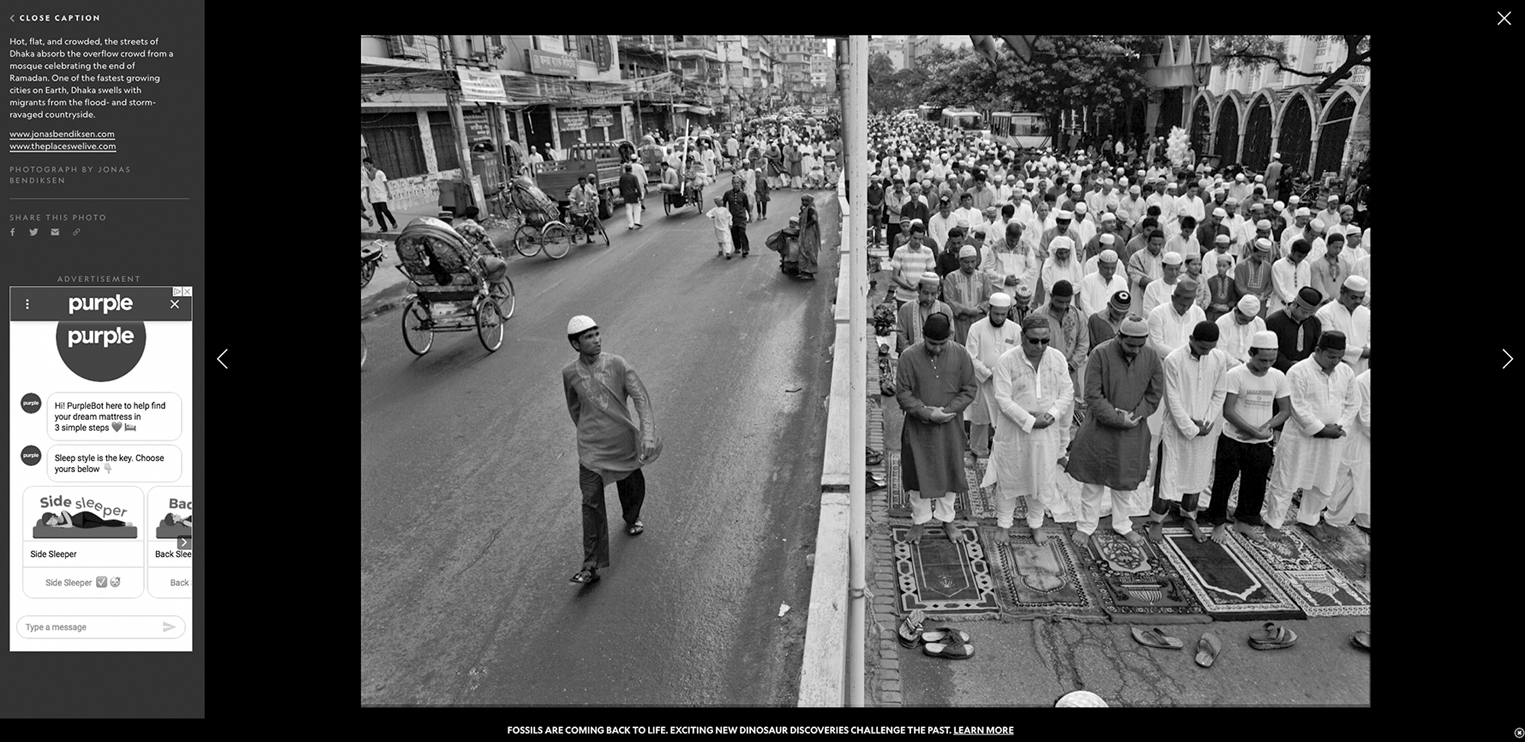
Hot, flat, and crowded streets of Dhaka, in Don Belt, “The Coming Storm,” National Geographic, May 2011, www.nationalgeographic.com/magazine/2011/05/bangladesh. Photo by Jonas Bendiksen.
Some images in the slideshow include views of overpopulation reminiscent of Kristof’s depictions of urban concentration and rural mass migration; one photo of riverboats at Dhaka’s main terminal is accompanied by the caption “Overflowing with People,” describing Dhaka as “one of the world’s most populated cities.” Another photo’s caption contends that “Dhaka swells with migrants from the flood- and storm-ravaged countryside,” as it visually contrasts the left side of a street, loosely populated by rickshaws, pedestrians, and shops, with the densely packed right side, full of barefoot men standing atop prayer mats, the street (and photo) divided by a median. Evoking the connection between Malthusian discourses of overpopulation and the view of Islam as a node of potential climate security risk, the caption claims, “The streets of Dhaka absorb the overflow crowd from a mosque celebrating the end of Ramadan.”
But more characteristically, the images retreat from sensationalizing population bombs and invoke self-uplift as the aftermath of disaster. Without always identifying the locations or individuals depicted, these images depict char dwellers and other Bangladeshis affected by rising waters—especially via images of the persistence of women and children—as evidence of the possibility of social reproduction after floods. The slideshow opens with a rain-soaked image of a child, titled “Resilient Spirits” (see cover). Clothed only in shorts, the youth walks barefoot down a drenched coastal road in the midst of a torrential downpour, trees blowing in the background. The image, taken during a heavy monsoon, configures the child as well as an adult villager in the distance as specters whose blurred moving outlines amidst the mud, rain, and fog suggest both the possible vulnerability to weather and the potential for transcendence. This image, arranged with the road bisecting the landscape, is echoed by another romantic image of displacement that similarly centers transit infrastructure in a changing landscape. Titled “City Bound,” this next photo depicts a number of men sleeping atop a moving train that transits lush green farmland toward the interior. The caption clarifies that these passengers are returning to Dhaka after visiting home villages, crossing rice paddies that are currently thriving but that are close to others threatened by salinization as the seas rise into the river delta. Concluding this journey from floodplain to city, the photo essay goes on to depict the crowded slums of Dhaka as “bursting with environmental refugees.”
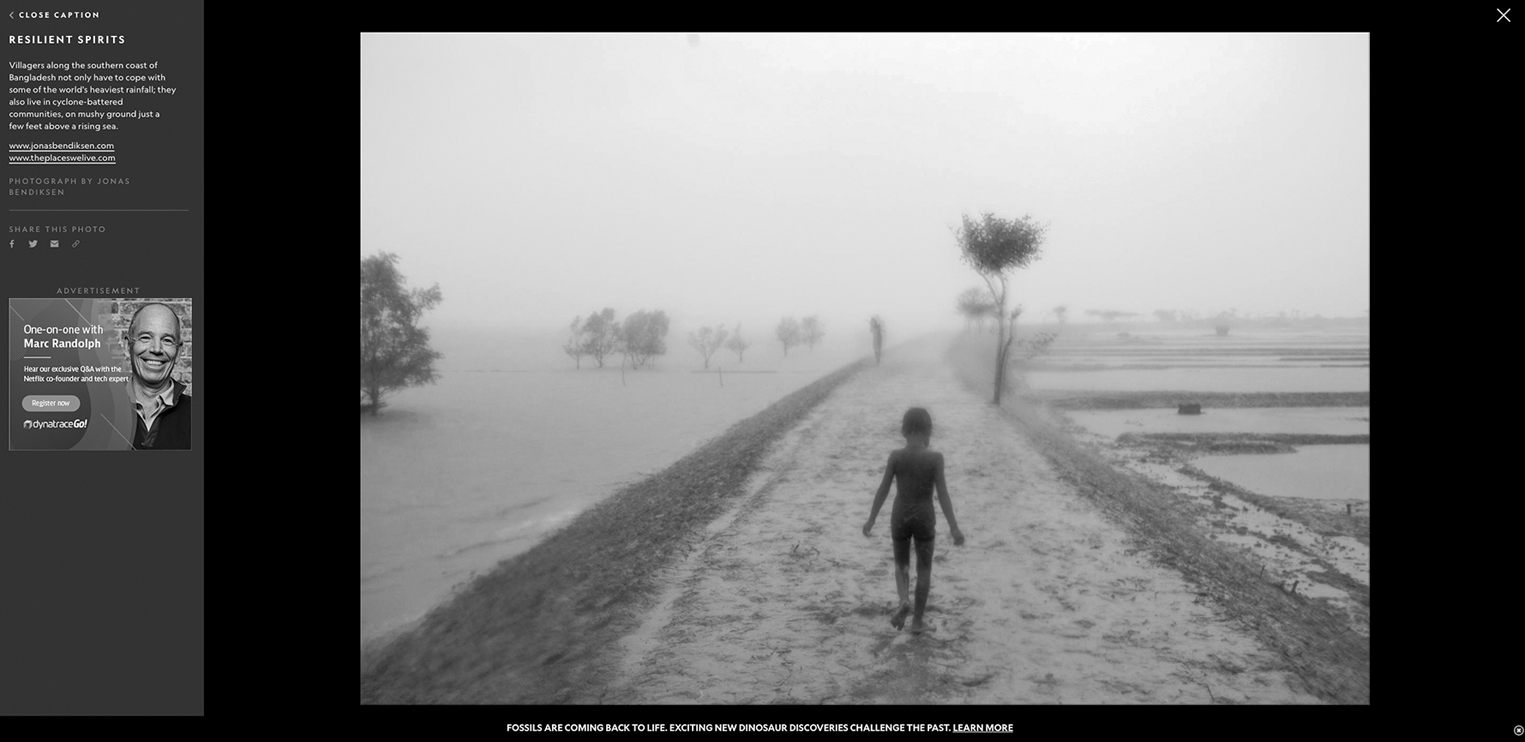
Resilient Spirits, in Don Belt, “The Coming Storm,” National Geographic, May 2011, www.nationalgeographic.com/magazine/2011/05/bangladesh. Photo by Jonas Bendiksen.
From here, Bendiksen’s images move from the tragedy of migration to the triumph of resilience, which is evoked in depictions of the changing spaces of work, home, and worship under flood conditions. In an image titled “Keeping a Country Afloat,” waterlogged rice paddies are revamped as salt ponds for shrimp and crab harvesting. Without describing the struggles between large enterprises and small farmers in the conversion to aquaculture described in Paprocki’s research, the image evacuates the agrarian poor from the scene of adaptation in order to emphasize the entrepreneurial success in sustaining food production amid rising waters. This image repeats the visual composition of a landscape divided by transit infrastructure—again a road—that swirls from front to back through the flooded farms. This reference to aquaculture suggests the influence of national and international nonprofit organizations promoting climate adaptation in the article’s construction of national resilience. Two images (not displayed here) focus on projects sponsored by two nongovernmental organizations, Practical Action and Friendship, depicting respectively a floating garden and a hospital ship financed by the Emirates Airline Foundation. This last example shows some of the connections of the oil-fueled Gulf labor economy that flow back into adaptation schemes, especially as several Gulf states have aid investments in Muslim-majority countries, including Bangladesh, through initiatives such as the Islamic Development Bank.
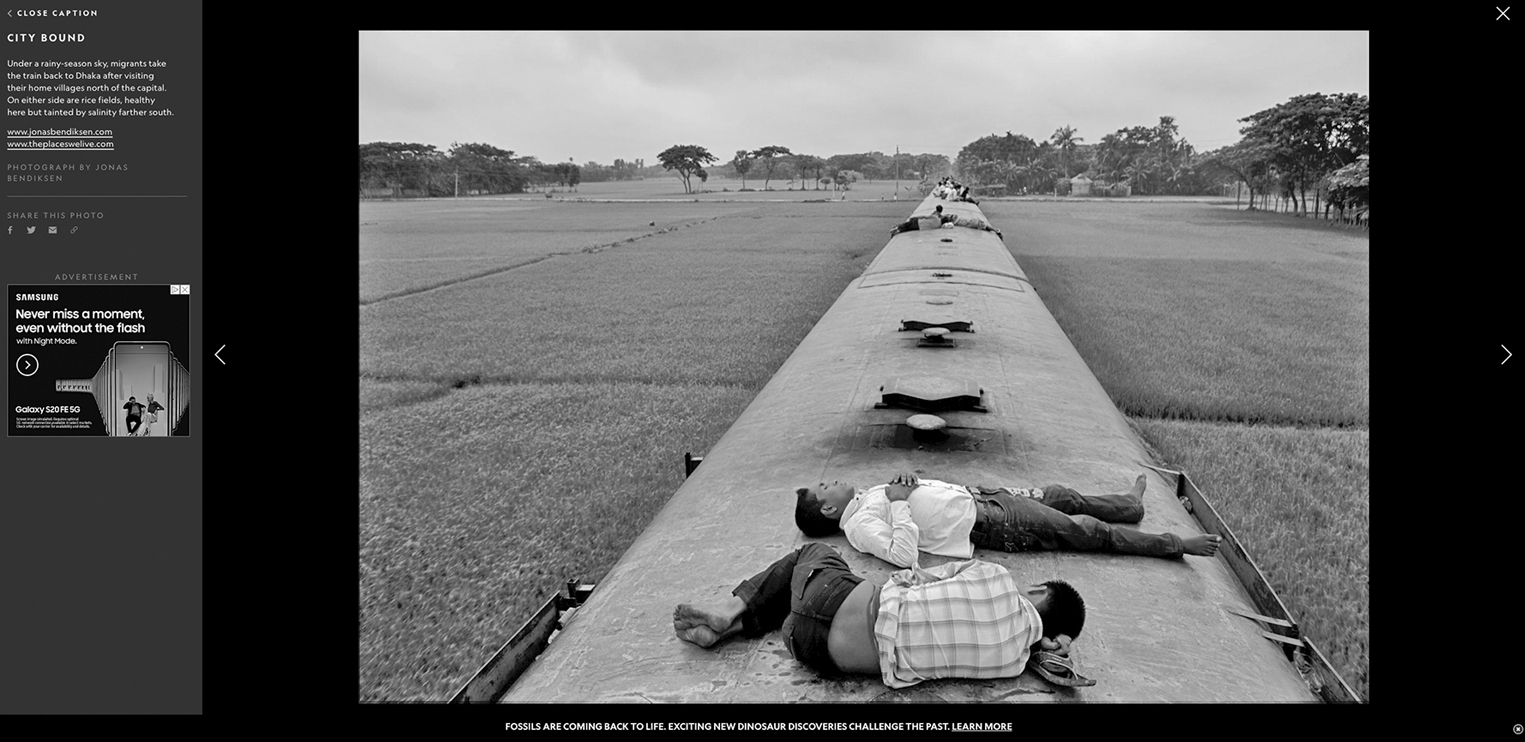
City Bound, in Don Belt, “The Coming Storm,” National Geographic, May 2011, www.nationalgeographic.com/magazine/2011/05/bangladesh. Photo by Jonas Bendiksen.
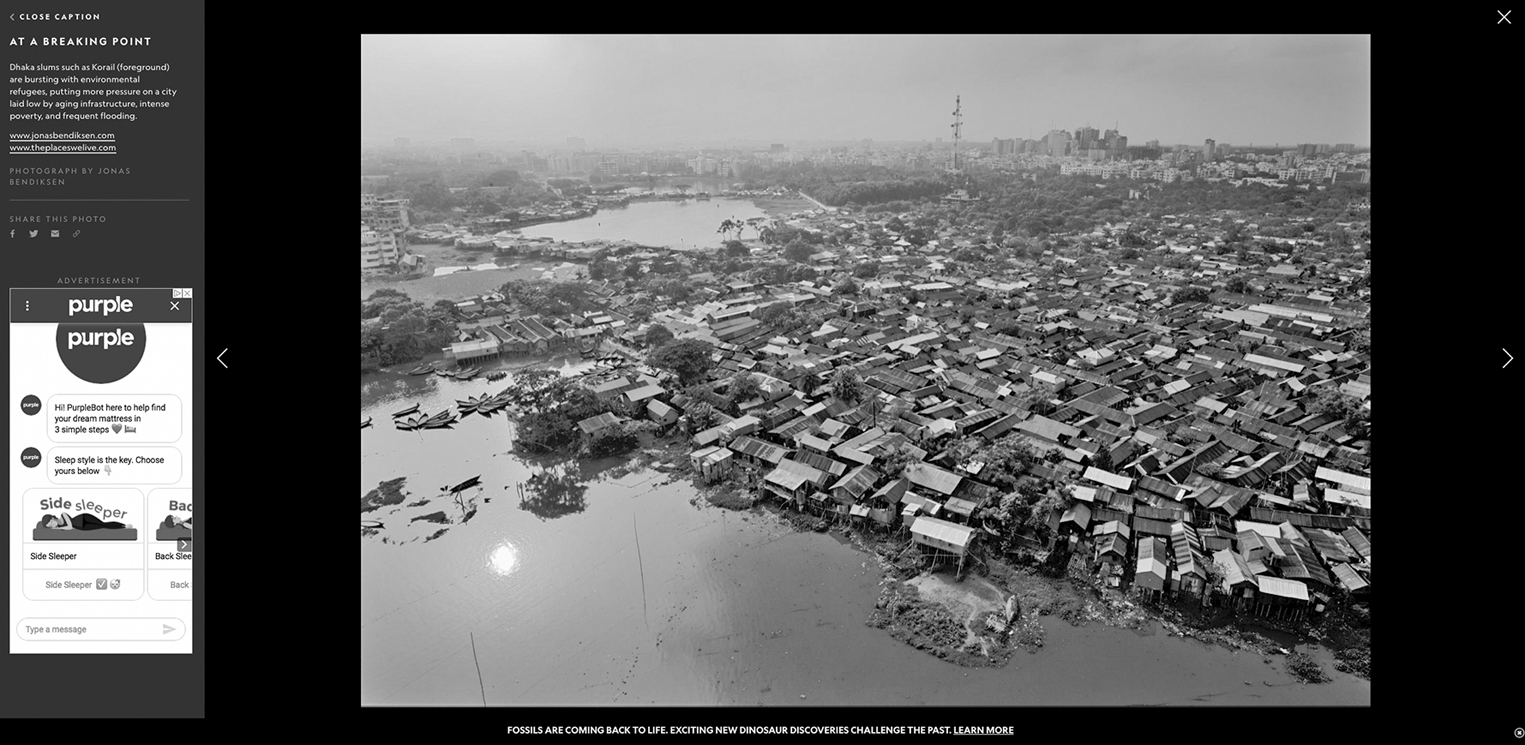
At a Breaking Point, in Don Belt, “The Coming Storm,” National Geographic, May 2011, www.nationalgeographic.com/magazine/2011/05/bangladesh. Photo by Jonas Bendiksen.
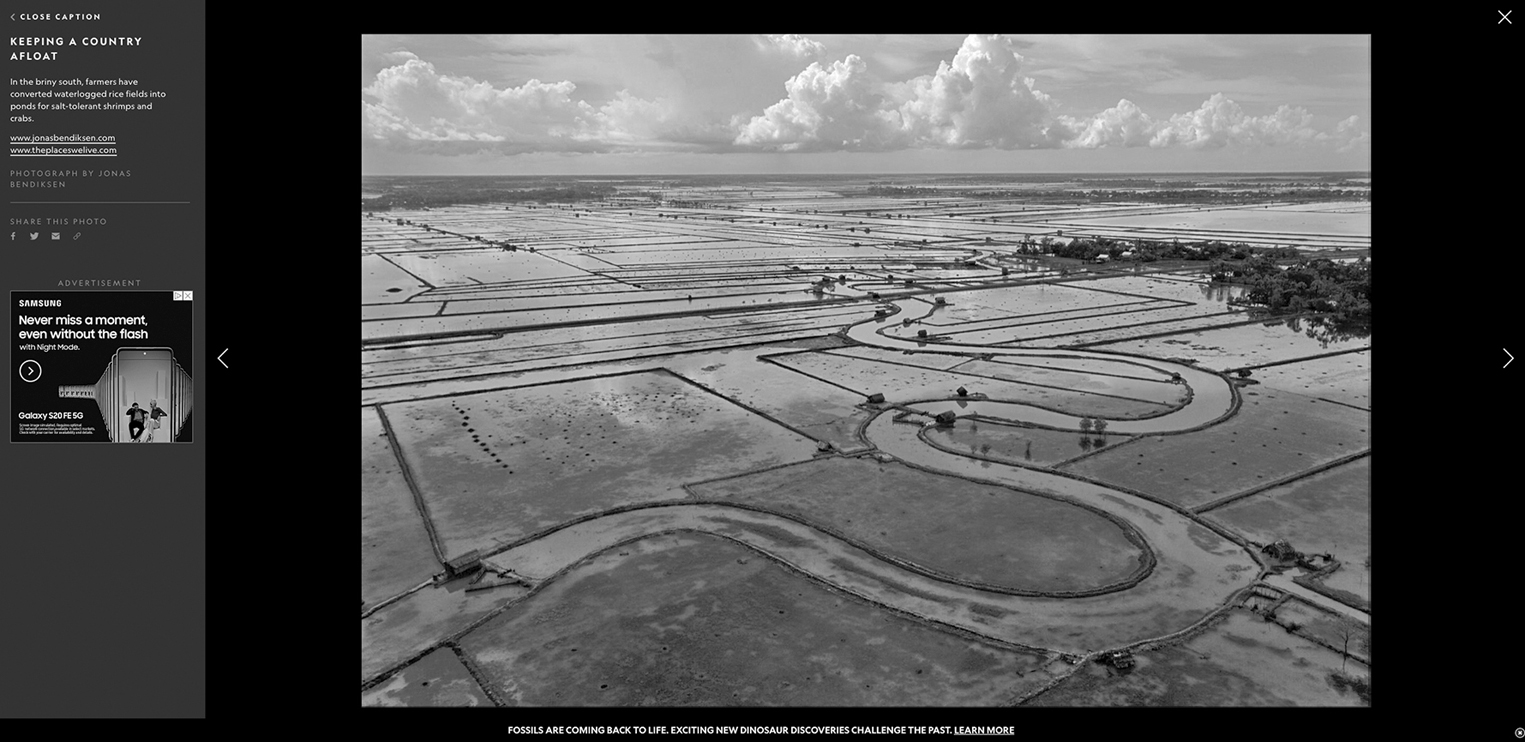
Keeping a Country Afloat, in Don Belt, “The Coming Storm,” National Geographic, May 2011, www.nationalgeographic.com/magazine/2011/05/bangladesh. Photo by Jonas Bendiksen.
Additional images show how adaptation strategies frame the experience of domesticity. One image, titled “Home for the Moment,” focuses on what is identified as the Uddin household in their home, where one foot of water is unable to prevent a woman from cooking the evening meal upon the family’s stone hearth. As the men of the household carry two babies above the waterlogged floor, several women are seated around the hearth, observing the cooking amidst large sacks of grain and an assortment of cooking pots. Explaining that the family had recently moved to escape flooding, the caption claims that they intend to dismantle and rebuild once again. In this invocation of reproductive labors involving the family’s efforts at provision and childrearing, the climate refugee’s resilience signals futurity in the face of threats to settlement. Whereas older development narratives tended to emphasize the potentially destructive aspects of children as avatars of overpopulation, this image suggests a hopeful survivalism and the potential for adaptation to aqueous habitation. Portraying two children who have climbed several feet up posts to stay elevated in a flood event, another image titled “High and Dry” suggests that adaptation can be reproduced as children integrate it into everyday life practices. The caption clarifies that “char dwellers … are used to such calamities, which are on the increase.” Another two images depict the process of mobile domiciling, showing a structure capable of disassembly and movement as the river path reorients the amount of available land among the chars. In this case, the images show a mosque being carried by a group of people crossing the char and then reconstructed, with one caption claiming that the afternoon move was fast enough to have the mosque operating by the time of evening prayers. These images directly invoke the Muslim-majority demographics of Bangladesh without resorting to security discourses about the potential for extremism; here, the efforts to maintain a mobile mosque are integrated into a broader set of representations that invoke the romantic potential for adaptation and the national capacity for resilience in the face of disaster.
Yet in Belt’s narrative for National Geographic, such small-scale portraits of human resilience blur into more established narratives of large-scale crisis. Toggling between a Malthusian nightmare and liberal adaptation fantasy, the article suggests that the hope offered by Bangladeshis’ constitutional capacity for adaptation is circumscribed by the potential for mass destruction. In his quotes for the article, Major General Muniruzzaman (Ret.) dubs climate migration “the largest mass migration in human history.” Despite the article’s emphasis on resilience, Muniruzzaman stresses two possible outcomes of mass migration due to climate change: (1) the sudden movement of people causes catastrophic security crises, or (2) rich countries establish migration policies that could act as a safety valve for such population pressures. In the second of these scenarios, Bangladeshi state officials and development experts appear to suggest the potential of mining the human capital of climate refugees:
If ten million climate refugees were ever to storm across the border into India, Maj. Gen. Muniruzzaman says, “those trigger-happy Indian border guards would soon run out of bullets.” He argues that developed countries—not just India—should be liberalizing immigration policies to head off such a chilling prospect. All around Bangladesh[,] bright, ambitious, well-educated young people are plotting their exit strategies. And that’s not such a bad idea, says Mohammed Mabud, a professor of public health at Dhaka’s North South University and president of the Organization for Population and Poverty Alleviation. Mabud believes that investing in educating Bangladeshis would not only help train professionals to work within the country but also make them desirable as immigrants to other countries—sort of a planned brain drain. Emigration could relieve some of the pressure that’s sure to slam down in the decades ahead. It’s also a way to bolster the country’s economy; remittances sent back by emigrants account for 11 percent of the country’s GDP. “If people can go abroad for employment, trade, or education and stay there for several years, many of them will stay,” he says. By the time climate change hits hardest, the population of Bangladesh could be reduced by 8 to 20 million people—if the government makes out-migration a more urgent priority.
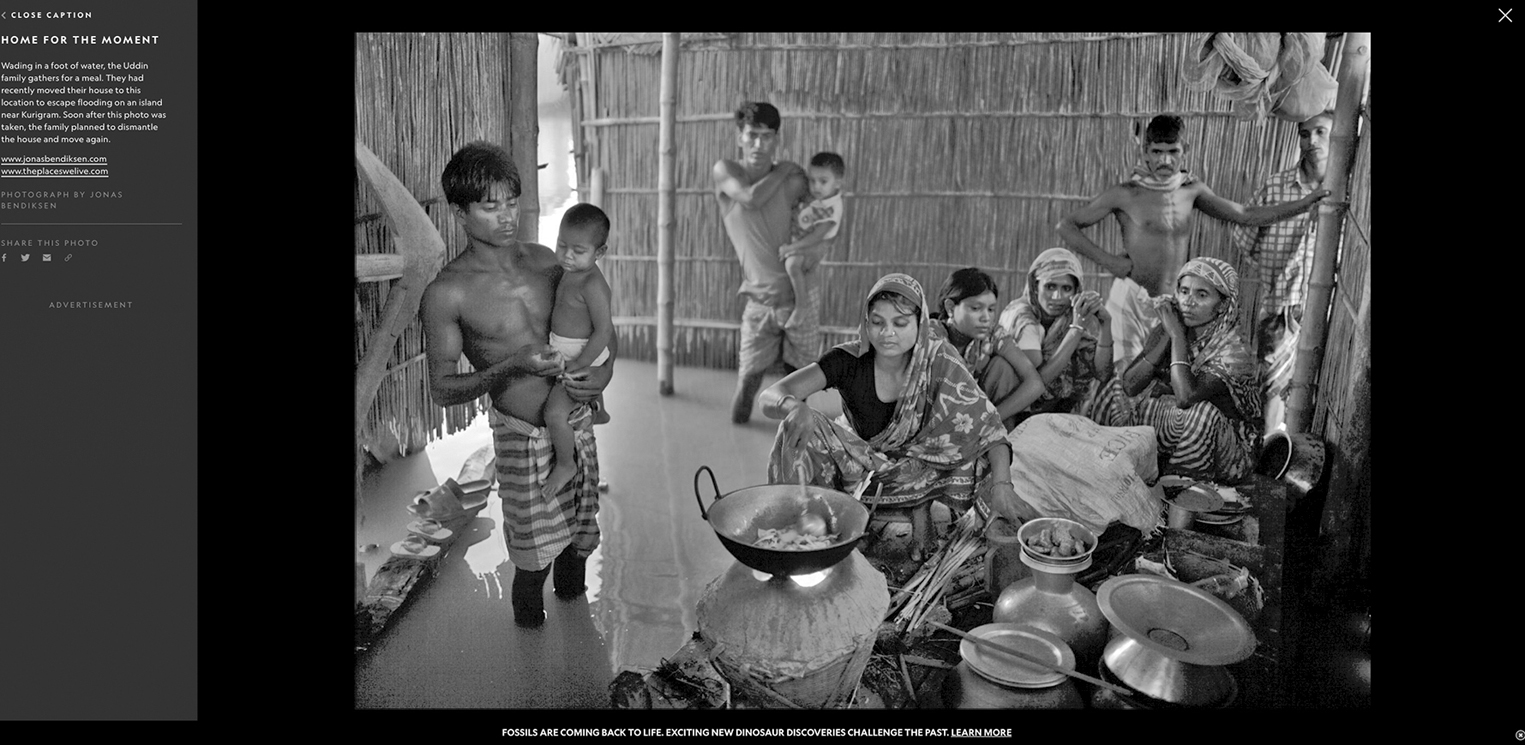
Home for the Moment, in Don Belt, “The Coming Storm,” National Geographic, May 2011, www.nationalgeographic.com/magazine/2011/05/bangladesh. Photo by Jonas Bendiksen.

High and Dry, in Don Belt, “The Coming Storm,” National Geographic, May 2011,www.nationalgeographic.com/magazine/2011/05/bangladesh. Photo by Jonas Bendiksen.
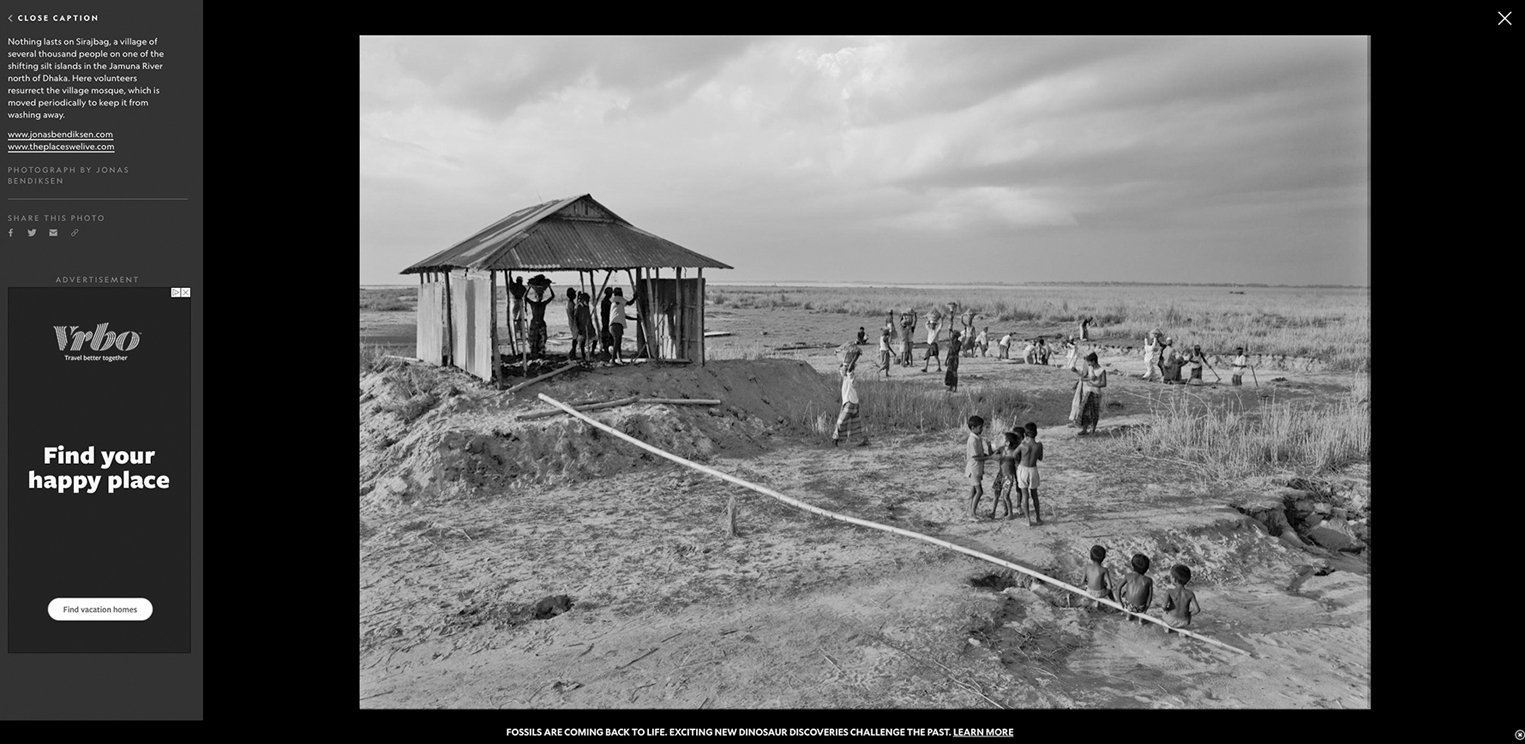
Nothing lasts on Sirajbag, in Don Belt, “The Coming Storm,” National Geographic, May 2011, www.nationalgeographic.com/magazine/2011/05/bangladesh. Photo by Jonas Bendiksen.
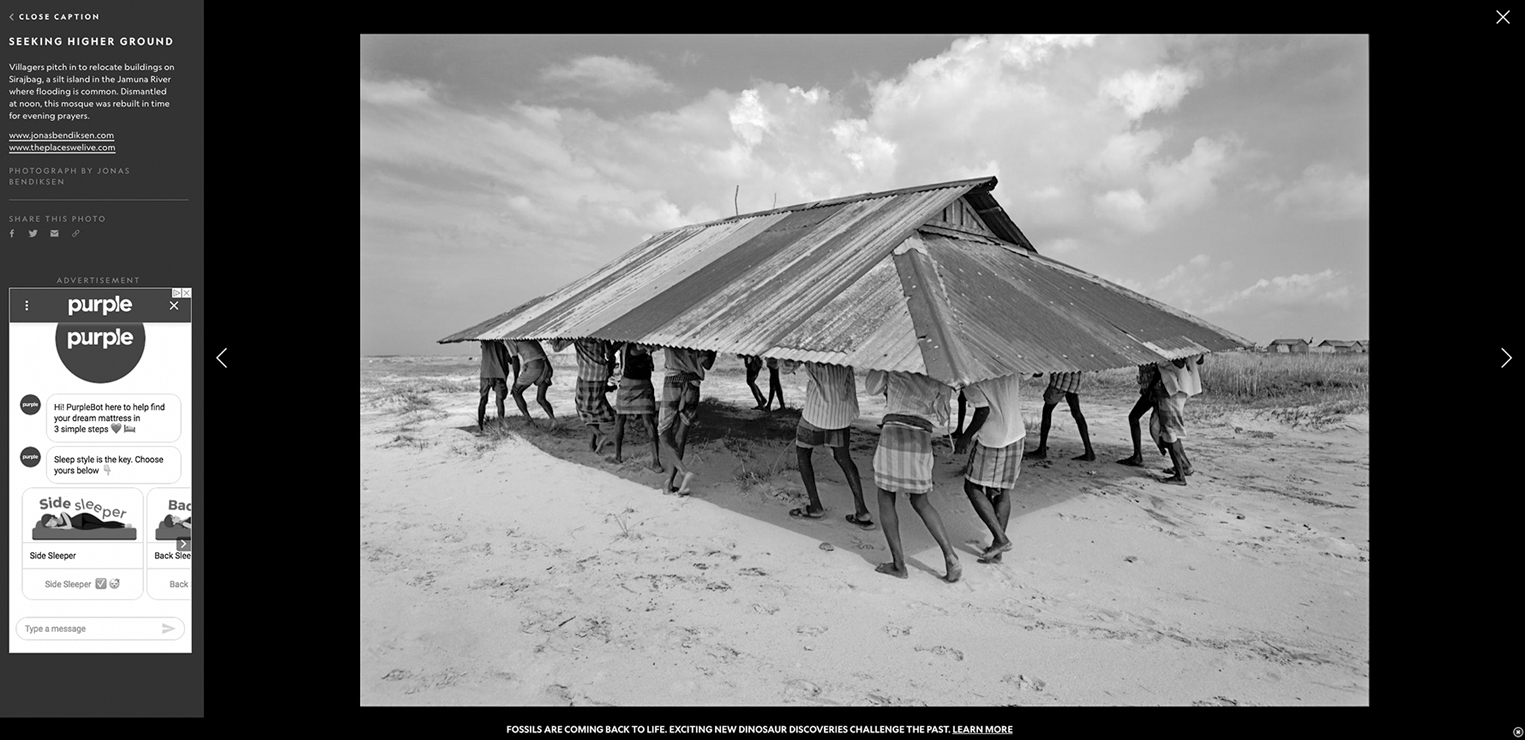
Seeking Higher Ground, in Don Belt, “The Coming Storm,” National Geographic, May 2011, www.nationalgeographic.com/magazine/2011/05/bangladesh. Photo by Jonas Bendiksen.
If the essay, following Muniruzzaman’s depiction of India as the aggressor country, avoids stereotyped security depictions of Islamic militancy, it nonetheless conjures the potential for scarcity-driven mass migration and conflict as the only imaginable outcomes of climate-driven flooding in Bangladesh. The article thus dovetails with the development plans of the state and NGOs to support outmigration. The imperative of the Bangladeshi government to transform peasant agriculturalists into a global laboring force in order to bolster a claim to environmental asylum presents a fascinating glimpse of how Malthusian views of conflict and sovereignty might be carried to their logical conclusions by climate-affected states. This vision of the planned depopulation of Bangladesh suggests that the true adaptation that must occur is to the regime of transnational capital and trade. The Bangladeshi peasant laborer is vulnerable to climate change if that laborer is localized—that is, dependent on the land. Climate displacement matters less if the peasant can abstract labor from land.
This last point is key, both for the fates of those affected by environmental change and for their relation to the state. Part of the agrarian vulnerability reproduced in places like the Bengal delta emerges from the intentional forgetting that occurs with colonial development of riverine environments. In important work on the ecological history of Bengal, Debjani Bhattacharya argues that the act of forgetting the river’s shaping of the city was central to the building of Calcutta as a colonial capital over a shifting deltaic environment. Hydrological control was central to filling in areas in which the river changed direction, allowing for the eastern side of the city to be built up and to drive its role in British commercial enterprise.34 Naveeda Khan, who is doing important ethnographic research on char dwellers along the Jamuna, notes that the community of itinerant farmers she studies dates to the 1930s, when the river shifted westward and displaced hundreds of thousands of villagers. This history of environmental change adds localized resolution to the specifics of human-environment interaction, demonstrating the long-standing imbrication of human bodies in the riverine environment in eras prior to what appears today to be the acceleration of flooding events. In the intervening decades since the 1930s, state efforts to build embankments have been ineffective or counterproductive, resulting in devastating floods such as those that took place in 1988. Following this, char dwellers were left out of government flood planning because shifting char lands were not seen as worthy of state protection. In the absence of state action to enforce flood protection or property laws on char lands—and in defiance of engineering decisions that mitigate flood risk to the mainland at the expense of the char islands—char-dwelling groups have developed unique cultural forms and have been able to maintain village identity autonomously. Exceptional representations of char dwellers as romantic figures of climate resilience foreclose the agency of the river and the complex set of embodied interactions through which societies have emerged on shifting silt islands.
Attempting methodologically to center not just the inhabitants of char islands but also the phenomenal world of the river itself, Khan notes the difficulty in discussing what aspects of riverine life are the result of climate change and what are longer-term aspects of the lifeworld:
While Bangladesh is undoubtedly affected by climate change … it is difficult to know for sure what comprises climate change within the river system. The usual fear related to rivers is that of flooding. With global warming, the increased precipitation from temperature rise is projected to produce more rainfall causing the Jamuna and other rivers to overflow more often and more unexpectedly. At present the standing rainfall data does not point definitively towards a rise in temperature within the country or even in the region and therefore to increased floodwaters. Yet there is still widely expressed concern about floods arising from global warming. I would argue that this concern is in part about the growing inability to anticipate floods … [whose] cyclicality does not seem to hold at present. Furthermore, this frequently articulated concern about floods arising from global warming is expressive of an anxiety among climate scientists in Bangladesh that regional processes and local variability underlying rainfall have not been sufficiently integrated … to be able to say anything definitively about climate change.35
By disentangling the lifeworld of the river and the char dwellers from the perspective of the Bangladeshi state, Khan distinguishes some of the elite prerogatives of climate security from the phenomenal complexities of inhabiting changing interspecies landscapes and ecologies. This involves setting aside an aesthetic of nature that is overdetermined by securitizing narratives of apocalyptic disaster. For Khan, “the enframement of one’s environment by the concept of disaster makes difficult the ability to see nature as anything other than pregnant with risks. Consequently, this powerful disaster-laden perspective on nature has ramifications for disinterring climate from weather.”36 Integrating discussion of the complexities and uncertainties of climate-affected water systems, shifting human habitation, and the complex movements of humans and other species requires us to attend both to the ways that oil-fueled capitalism has remade the international order and to the emerging ways that ecological processes map on to the existing geopolitical relations established by it.
Reframing the Mobilities of Climate
The figure of the climate refugee in Bangladesh thus reveals some significant changes in the politics and aesthetics of climate change in the aftermath of the collapse of international efforts to mitigate carbon emissions. First, it suggests that discourses about population, migration, and conflict signal the emerging shift from international to national efforts to remedy climate change, and from mitigation to adaptation and security frameworks. Second, it reflects how visions of both displacement and adaptation are emerging in ways that shift responsibility for displacement from capitalists and states to individuals who are most affected by weather disasters. Finally, it suggests that the hopeful focus on adaptation to climate change—a kind of overcoming of disability—configures migrant knowledge as a potential solution to crisis, even as states and analysts continue to invoke the Malthusian crisis scenarios of the mass migration frame.
This ambivalent move between large- and small-scale narratives of climate migration—from the mass migration scenarios of state conflict and collapse to the intimate portraits of individual effort and transcendence—reflects racialized dynamics in the politics of knowledge concerning climate change and conflict. This situation holds significant lessons for emerging discourses about time, space, scale, and agency in research on the Anthropocene and in environmental humanities research. Indeed, Bengal as a region encompassing Bangladesh and the Indian state of West Bengal has become an important location for recent theorizing of the Anthropocene in part because of the role diasporic scholars from the region have played in describing the relevance of climate change’s geophysical processes to politics, art, and history. Although climate migration discourse has not been at the center of these academic conversations, it is necessary to think about the interrelation between the idea of the Anthropocene and the icon of the climate migrant in order to understand how race, empire, and knowledge are being constructed.
The article that launched discussions of the Anthropocene among humanists in the United States, Dipesh Chakrabarty’s “The Climate of History: Four Theses,” was originally published in the journal Baromas in Kolkata before its translation for the English-language journal Critical Inquiry. Reflecting on this article and the experience of writing about climate change from India and more broadly from the Global South, Chakrabarty describes an international imbalance in access to information and debate about climate change:
Globalization—including questions about multinationals, money markets, derivatives and complex financial instruments, the net, the social media, and, of course, the global media—was a genuinely global topic that was discussed everywhere but global warming was not. And it also became clear who set the terms of the discourse. It was the scientists of nations that played a historical role in precipitating the problem of global warming through their emission of polluting greenhouse gases—for example, the United States, the United Kingdom, Australia and other developed countries—who played two critical roles: as scientists, they discovered and defined the phenomenon of anthropogenic climate change, and as public intellectuals they took care to disseminate their knowledge so that the matter could be debated in public life in an informed manner.… Global warming is a planetary phenomenon. But as a subject of discussion, it seemed to be distributed very unequally in the world. The situation has changed somewhat in the last ten years—thanks in part to the increasing frequency and fury of extreme weather events in different areas of the world—but not substantially. What are the implications of this disparity in the distribution of information? It surely skews the “global” debate on climate change in more than one way. When governments come to global forums to discuss and negotiate global agreements on climate change, they do not come equally resourced with informed public discussions in their respective nations, while some governments, admittedly, do not even desire informed publics. More importantly, it means that our debates remain anchored primarily in the experiences, values, and desires of developed nations, that is, in the West (bracketing Japan for the moment), even when we think we are arguing against what we construe to be the selfish interests of “the West.”37
Chakrabarty’s critique certainly applies to the discourse about climate migration, which appears to center on the interests of the poorest climate-affected peoples in the Global South but actually recapitulates a number of colonial stereotypes about the deterministic effects of resource scarcity, in the process reinforcing anti-Muslim security discourses that stress the potential for climate migrants to produce climate wars. Anchored by the writings of security experts in northern states and in security NGOs, such arguments rehash long-standing mappings of world risk focusing on Africa and Asia as sources of global instability. At the same time, the role of the state in articulating such discourses might give us pause as to whether the deep inequalities of wealth that drive insecurity map so easily on the inequalities between states.
Although Chakrabarty’s prior work had stressed the significance of considering postcolonial difference within accounts of the global,38 “The Climate of History” argues that it is necessary to retain the human as a universal category despite such critiques of capitalism’s notion of the human.39 In defending the Anthropocene theorists’ conception of the human as an environmental agent affecting planetary systems, Chakrabarty argues that it is necessary to focus on the human as a biological species and to consider how the deep histories of human social organization—including the transition to sedentary agriculture—unknowingly create massive changes in the geophysical form of the planet. This point about the unintentional violence of human environmental subsistence and settlement is the crux of Chakrabarty’s claim that it is necessary to tell a new history of the human, not as an identity but as a form of universality that “escapes our capacity to experience the world.”40 Chakrabarty here conceives of environmental harms as externalities of human activity and social organization that can only be retrospectively accounted for through empirical scientific observation. This echoes the arguments of some environmental justice advocates and climate scientists discussed in chapter 1, who engage in the retrospective accounting of environmental harm. Chakrabarty ends the essay by invoking the figure of a human species that unintentionally provokes a planetary crisis, allowing it to sense its own collective agency:
The anxiety global warming gives rise to is reminiscent of the days when many feared a global nuclear war. But there is a very important difference. A nuclear war would have been a conscious decision on the part of the powers that be. Climate change is an unintended consequence of human actions and shows, only through scientific analysis, the effects of our actions as a species. Species may indeed be the name of a placeholder for an emergent, new universal history of humans that flashes up in the moment of the danger that is climate change. But we can never understand this universal. It is not a Hegelian universal arising dialectically out of the movement of history, or a universal of capital brought forth by the present crisis.… Yet climate change poses for us a question of a human collectivity, an us, pointing to a figure of the universal that escapes our capacity to experience the world. It is more like a universal that arises from a shared sense of a catastrophe.41
Setting aside for the moment the equal possibilities that nuclear war could have been unintentional or that the extractive enterprises of the great acceleration were intentionally organized forms of accumulation, the role of the state in managing the development potential of the displaced climate migrant suggests that even if the figure of human universality may be useful for attending to large-scale planetary changes, it may have important distorting effects at the level of political economy, where generalizations about the effects of climatic processes mask how systemic inequalities create conditions in which the boundaries of livable and unlivable lives are drawn differently based on geographic, class, and national differences. The possibility that Bangladesh will use climate discourse in order to mobilize middle-class outmigration to the rich countries of the North must be understood within a longer context of its neoliberal approach to developing human capital as one of its export-oriented development strategies. So if, according to Chakrabarty’s argument, a universal history of the human as an environmentally destructive agent is necessary for understanding the large-scale processes of climate change, it is also pivotal to disaggregate the human subjected to the precarious futures of global warming in order to understand some of the smaller local- and regional-scale networks that are established through the carbon economy’s overlapping extractive and waste-generating processes. Put differently, planet-scale narratives of human agency are important in understanding certain processes of environmental change but may risk distorting how particular groups of people affected by floods and other disasters are likely to navigate the limited migration options generated by capitalist labor networks.
When attending to localized stories of environmental mobility caused by flooding, it becomes apparent that the deep time of environmental change is more complex and circuitous than the species-wide narratives of the human as geological agent. Amitav Ghosh, one of the most prominent climate change essayists today, foregrounds the agency and perspectives of subjects affected by environmental processes. Ghosh, the Bengali writer known for numerous novels, including The Hungry Tide, himself identifies as coming from a family of ecological refugees. The opening pages of his book The Great Derangement: Climate Change and the Unthinkable tell the story of his kin’s displacement:
My ancestors were ecological refugees long before the term was invented. They were from what is now Bangladesh, and their village was on the shore of the Padma river, one of the mightiest waterways in the land. The story, as my father told it, was this: one day in the mid-1850s the great river suddenly changed course, drowning the village; only a few of the inhabitants had managed to escape to higher ground.… It was this catastrophe that unmoored our forebears; in its wake they began to move westward, when they settled again on the banks of a river, the Ganges, in Bihar.42
Ghosh uses this accounting to describe a process of environmental recognition. Ghosh argues that environmental changes like the flooding of his family’s village are the sites at which people develop a new type of recognition of the nonhuman world, an awareness of the inseparability of the inside and outside of the body as well as the dependence on the environment as a background set of conditions enabling (or potentially destroying) a lifeworld. Drawing on this description of the experience of environmental harm, Ghosh argues that the process of recognition involves accessing a previously unacknowledged past. Echoing Anthropocene discourses focusing on the retrospective observation of species-scale agency, Ghosh rhetorically scales this down to the site of the subject and describes crisis as an opening to environmental awareness: “These too are moments of recognition, in which it dawns on us that the energy that surrounds us, flowing under our feet and through wires in our walls, animating our vehicles and illuminating our rooms, is an all-encompassing presence that may have its own purposes about which we know nothing. It was in this way that I too became aware of the urgent proximity of nonhuman presences, through instances of recognition that were forced on me by my surroundings.”43
Drawing on Ghosh’s invocation of intimacies with the landscape, the lesson for understanding migration in an era of climate change is not so much that a new universal vision of human history is necessary but that the types of mobility networks available to people who experience weather disasters have everything to do with the outcomes of how environmental violence grafts on to the existing violences of racism, colonialism, and capitalism. Many climate-affected people have already been living in worlds charged by struggles both to inhabit the land and to continue forms of subsistence disfavored not just by the changing landscape but by the interests of capital and institutions. In such contexts, recognition of nonhuman agencies in the surrounding environment may help people navigate uncertain futures, even though when imposed by the state and development agencies they can compound the variety of external influences that already participate in the destruction of livelihoods and lifeworlds. From here, what is needed is not just recognition of the sublime shifts in scale, space, and time created by environmental processes but also attention to the differential needs and capacities of people affected by both extractive enterprise and environmental change.