
CHAPTER FOUR
One of the most widely publicized climate change studies of recent years was a paper published in the Proceedings of the National Academy of Sciences (PNAS) in 2015.1 Colin Kelley, a climate scientist who was then a postdoctoral fellow at the University of California–Santa Barbara, cowrote the article with colleagues in the fields of international relations and earth sciences at Columbia University. Based on Kelley’s data surveying rainfall patterns in the Fertile Crescent region of North Africa and the eastern Mediterranean, the authors argue that the 2006–9 drought in the region contributed to the outbreak of the Syrian war of 2011. The authors frame drought as a trigger event for rural-to-urban migration, which they argue brought about the conditions for protest and conflict. Furthermore, the authors assert that the events of the beginning of the war were made more likely due to decades of Syrian agricultural policy that overused subsurface water resources and created unsustainable farm dependency on water importation.
Since the publication of the article, titled “Climate Change in the Fertile Crescent and Implications of the Recent Syrian Drought,” journalists, environmentalists, and security analysts worldwide picked up the story and began framing the Syrian uprisings, Syrian migration to Europe, and the Syrian war as evidence that Syria was experiencing one of the world’s first “climate wars.” The National Geographic article announcing the study reported that “a severe drought, worsened by a warming climate, drove Syrian farmers to abandon their crops and flock to cities, helping trigger a civil war that has killed hundreds of thousands of people.”2 Although there has been a mixed reception of the article among both climatologists and international relations scholars,3 reporting on the potential for climate change to cause transnational conflict accompanied by mass migration has only increased in the intervening years, with Syria remaining a key site representing the kind of social breakdown possible due to climate change. The story was picked up by major news outlets, including the BBC, NPR, and the Washington Post. It quickly became a topic of editorializing by military officials and security experts, who began to sound the alarm that climate change threatened globally distributed conflict in the twenty-first century. Although some environmental NGOs had suggested as early as the 1980s that growing water scarcity was the cause of resource conflicts,4 the PNAS article put climate-induced drought front and center in public debates over the effects of climate change, reaching an international audience of experts and laypeople.
The PNAS article inaugurated public circulation of the Syrian climate war thesis, a narrative that presents drought as a trigger of rural-to-urban migration that unleashed social and state breakdowns by creating an opening for Islamist groups to challenge the state. This thesis recapitulates long-standing orientalist narratives of rural and third world environmental degradation, moving between tragic or romantic depictions of climate-affected Syrians and tropes of unruly masses of migrants overwhelming the cities, radicalizing, and erupting into violence. In the process, the narrative sidelines discussion of the economic grievances and political critiques of the Assad government that led to the 2011 uprisings by broad sections of Syrian society in the midst of the broader Arab uprisings and the Rojava autonomy movement. Furthermore, it fails to place a central focus on the agrarian areas of the Hasakah governorate in northeast Syria, where the effects of the drought were most acute and the development of new experiments in collective land use and ecology challenge narratives suggesting that environmental precarity makes social conflict inevitable.
Reviewing journalism and environmental media that invoke the Syrian climate war thesis, this chapter explores how the framing of the Syrian war and Arab uprisings as being triggered by climate-induced drought helps sustain a neocolonial discourse on both environmental migration and “failed” postcolonial states. Arguing that an overemphasis on both scarcity and Malthusian theories of resource conflict in reporting on the Syrian conflict builds on older, racialized narratives of social breakdown caused by the inability of the colonized to properly manage resources, the Syrian climate war thesis reinforces neoliberal precepts about the purported dependency of rural populations and reproduces a geopolitical mapping of conflict that configures Muslim-majority states as particularly subject to mismanagement and insurgency. In such depictions, representation of Syrians disabled in war helps distill the human tragedy of the violence of climate change. As an icon, the disabled climate refugee evokes the embodied vulnerabilities produced by widely distributed climate changes, in the process masking the socioeconomic processes that contribute to interlinked mass mobility and debility. Although migration is a possible outcome of climate change in the region, an account of diverse narratives of the Syrian war demonstrates that aerial bombing and armed struggles among rebel groups and the state have been more proximate causes of displacement and vulnerability as well as more direct threats to agricultural production. Noting that the climate war thesis has been embraced by some leftist critics of climate change, the chapter argues that a broader accounting of geopolitical and economic relations of migration can help build a more contextual analysis of how environmental factors intersect with the social and political dynamics of war. Finally, the chapter concludes by arguing that climate migration discourses mask understanding of some of the possibilities for different social and ecological futures emerging from revolutionary critiques of state and colonialism in the region.
Environmental War and the Racial Map of Conflict
The growing attention to climate change as a security problem has been influenced by the collapse of the Kyoto regime of international carbon emission controls, which coincided with a shift in emphasis in climate policy circles from mitigation (reducing the use of fossil fuels) to adaptation (developing strategies to manage the effects of higher global temperatures) and from international to national frameworks for action. Such transitions—which echo older traditions of enclosure and Cold War isolationism—are evident in the U.S. approach to climate diplomacy, which has emphasized the potential for global warming to increase transnational armed conflict. In 2007, the U.S. defense think tank CNA famously identified climate change as a “threat multiplier.” In the absence of a binding emissions control regime, this phrase has since been adopted by both the Pentagon and the United Nations to suggest policies aimed at adapting to a hotter world rather than collaborating to mitigate anthropogenic warming. The military “threat multiplier” concept invokes neutrality on the politics of climate science, instead focusing on what it considers climate change’s undeniable emerging impact. General Chuck Jacoby (Ret.), former commander of U.S. Northern Command, emphasizes the catastrophic potential of resource conflicts in a warming world, which he considers an undeniable effect of climate change even though some Americans choose to deny the cause of those changes: “Many conflicts throughout our history have been based on resource competition. Increasingly in the future, we will be defining our national interest within those resource contests.… You can predict that that drives human activity in a way that can create conflict.… It can be considered a politicized issue.… I deal with the facts. Whatever the cause is less relevant to me than the effect.”5
Coincident with the rise of “new war” theories that blur traditional divisions of war and peace, civilian and soldier, human and nonhuman, the view of climate change as a threat multiplier reflects a broader attempt by states to bring social, economic, and environmental phenomena under the purview of state security. Yet there is some irony in the specific shift from climate change mitigation to adaptation schemes marked by the rise of environmental security discourse. While there is a scientific consensus on the destructive environmental and economic outcomes of current levels of carbon use, the idea that climate change leads to armed conflict remains one of the more dubious and contested claims among geographers and anthropologists who study environment-society interactions. Yet this idea has become one of the most widely discussed in terms of climate change impact, galvanized by the emergent attention of military planners and international relations scholars to planetary environmental questions. In this nexus of environmental and militarized security thinking, there is a resurgence of environmental determinist framings of human development that recapitulate racial mappings of risk. Projects of U.S. and European imperial intervention have long involved depictions of how heat, scarcity, and underdevelopment render colonized populations less modern. From the nineteenth century into the early twentieth century, climatic determinism focusing on the deleterious effects of heat guided a number of racial and colonial knowledge projects—ranging from behavioralist theories about crime to tropical medical theories of contagion to eugenic notions of race improvement.6 For Robert Vitalis, these traditions of imperial thought guided the rise of international relations as a field of academic research following World War I. In his book White World Order, Black Power Politics, Vitalis argues that the development of the field’s first major journal, Foreign Affairs, from its predecessor, Journal of Race Development, is instructive for understanding how the field’s conception of the international was informed by fears of the worldwide decline of white control in the face of anticolonial movements. Vitalis argues further that international relations has witnessed varied rearticulations of its eugenic roots over the decades, not the least in discussions of the geopolitics of oil as a “resource curse” that frames environmental degradation as an intractable problem of underdevelopment in the Global South.7 The mobilization of race as a mapping device to conceive of the “international” was especially important for the white settler colonies, where race provided a heuristic for evaluating the success of colonial projects in maintaining and extending a broader global project of white development.8 Racial mapping of threats to the geopolitical dominance of the United States and Europe thus grows out of longer colonial worldmaking projects and offers a naturalized common sense from which security experts worldwide narrate risks arising from purportedly intractable cultural and strategic difference. In representations of international conflict in journalism and policy arenas, it is commonplace for such risks to be written on Black and Brown bodies, returning theories of international conflict from a normative spatial understanding of the international to its racialized, developmental, and environmental-determinist roots.
In its post-9/11 articulation, the racialized geopolitical mapping of climate risk highlights majority-Muslim state collapse and the rise of Islamism as primary threats to the international system. Taking the anticipated environmental displacement of Muslims as a sign of potential radicalization, such invocations of climate-driven risk build on Islamophobic assumptions that have become conventional in post-9/11 writings of Western security experts. Several of the locations that have been designated as climate migration hot spots by climate security experts have been locations where migration is said to exacerbate the threats of Islamist insurgency. These crises are geographically configured within a tropicalizing discourse, where the hotter, wetter, already unstable climatic regions may eventually bring the blowback of anthropogenic warming to the Global North—the regions most historically responsible for anthropogenic carbon emissions that cause today’s rapid climate change. Emerging depictions of the figure of the climate refugee reify a racialized first world–third world division that grafts anthropogenic climate change onto a neocolonial racial map of economically dependent former colonial states. In such speculative risk scenarios, the worst-case outcome is articulated as state collapse followed by the rise of Islamist insurgency or an Islamic state. The concept of a “climate refugee” in turn purports to encompass the otherwise hidden ecological contributions to the migration calculus, which may inaugurate a chain of events that break down social defenses against conflict. As explained in chapter 1, climate security discourse makes the case for creating policies to address climate change on the traditional ideological ground of the Right. But such strategies have had little success in producing concerted changes in the energy economy and have instead resulted in the distortion of how environmental factors interrelate with longer-term neoliberal causes of inequality and migration. The only evidence that such strategies work comes from the Far Right, which seizes on any talk of migration to argue for xenophobic border militarization.
If climate security discourse appears as part of a larger Anthropocene discourse that promises that transgressions of the nature–culture binary are a sign of new posthuman politics, the speculative risk scenarios being constructed in climate security circles appear more like a mix of old-fashioned Malthusianism and orientalism. Since the late 1980s, a number of feminist and postcolonial geographers have analyzed how conservation discourses feminize the tropics and render southern environments sites of unruly reproduction, often drawing on earlier tropes of colonial natural history.9 The narratives of climate-driven impacts on small agriculturalists rehash colonial development narratives that historically highlighted population pressures and rural-to-urban migration as crises of the state, forgoing analysis of how drought and weather events fit into the political economies of capitalism. Feminist development scholar Betsy Hartmann puts it as follows:
For those familiar with … neo-Malthusian models of environmental conflict developed in the 1980s and 1990s, climate refugee and conflict narratives seem very much like old wine in a new bottle.… Drawing on old colonial stereotypes of destructive Third World peasants and herders, [these] degradation narratives go something like this: population-pressure induced poverty makes Third World peasants degrade their environments by over-farming or over-grazing marginal lands. The ensuing soil depletion and desertification then lead them to migrate elsewhere as “environmental refugees,” either to other ecologically vulnerable rural areas where the vicious cycle is once again set in motion or to cities where they strain scarce resources and become a primary source of political instability.10
Degradation narratives play a particular role in academic and nonprofit discourses on the relationship between southern environmental disaster and migration, as degradation is understood to be a deterministic outcome of poverty as well as a source and effect of displacement. In a key essay on the exhaustion of liberal paradigms for studying third world environmental problems, Raymond Bryant argues that degradation narratives make four interconnected interpretive errors: (1) a deterministic view of poverty as inherently leading to destructive environmental practices; (2) a failure to differentiate the global poor by subsistence practices, location, race, gender, or other factors; (3) an emphasis on first world environmental intervention as a presumed solution to degradation, without consideration of the role of first world economic policy in creating poverty; and (4) a naturalization of poverty geographically located in the third world, which subsumes those affected by poverty into developmentalist progress narratives. As such, degradation narratives view the participation of the poor in environmental destruction as inevitable, and the intervention of NGOs and northern states as natural solutions to the deterministic effects of poverty on the environment.11 Jan Selby and Clemens Hoffman suggest that scholars pay attention to the ways that such deterministic precepts about environmental causes of conflict have come to be embedded as common sense in some academic and policy sectors; narratives such as the Syria climate war thesis are troubling evidence that “most climate security discourse is … indebted to the Malthusian tradition for its core ontological and political premises,” as it “tends to interpret the global poor, and sub-Saharan Africans in particular, as the most likely subjects—and also sources—of climate related conflict.”12
The speculations of risk articulated in the Syrian climate war thesis reflect how stories of the tragic lives of climate refugees are coming to embody the hope for militarized environmentalist intervention as climate research and policy becomes suffused with the logics of state security. As the face of capitalism’s self-destructive consumption and waste practices, the climate refugee demonstrates how unchecked and rapid warming of the post-Kyoto era is considered by Western environmentalists to be a proximate cause of destabilizing challenges to the international order.
Drought and Disability: The Syrian Climate Refugee
Journalism and policy reports on environmental migration often make speculative causal claims about the relationship of climate change to migration. By focusing on the vulnerability of Syrian refugee bodies, including those of women, children, and the disabled, such reporting attempts to distill widely distributed geophysical changes in climate into icons of climate-driven suffering. In a classic essay on disability representation, David Mitchell and Sharon Snyder note that the disabled body itself becomes ideologically linked to social visions of crisis, as its purported vulnerability provides evidence of twinned problems of representation and sovereignty requiring repair: “The perception of a ‘crisis’ or a ‘special situation’ has made disabled people subject not only of governmental policies and social programs but also a primary object of literary representation.” The fact that the disabled body can at once operate as a “stock feature” of narrative and “an opportunistic metaphorical device” helps us glimpse the ideological vector of disability as social crisis, for it is in the disabled body that an icon of vulnerability signifies a broader ecology requiring intervention.13 Embedded within contemporary crisis representation, then, is the sentimental rhetoric of humanitarianism, which Rosemarie Garland-Thomson shows is prevalent in mass-mediated images of disability as tragic loss.14 This rhetoric was widely circulated in the social media sharing of photos of the dead body of three-year-old Alan Kurdi, who drowned in the Mediterranean on September 2, 2015, when his family attempted to cross from Turkey to the Greek island of Kos. Given the location of such images in war zones and at borders, it appears that disability signifies crises of state power that can be captured by neocolonial discourses of humanitarian rescue, reifying the state as the ultimate arbiter of security. The vulnerable body in war—whether conceived as disabled, childlike, or feminized—reflects a broader logic of colonial representation, justifying intervention of the state in the purportedly patriarchal or underdeveloped conditions that allow for the mass reproduction and exploitation of social vulnerability.15
Disability thus plays an important role in the public representation of the “migrant crisis” of the eastern Mediterranean. When attached to representations of national vulnerability, images of disability help to mask the manner in which national borders both create zones of privileged security and reproduce transborder violence. Much of the existing scholarship focusing on this as a media event has emphasized how language about refugees in Europe in 2015–16 shifted from initial humanitarian sympathy to increasingly xenophobic invocations of parasitism, threat, or social conflict.16 But this is only part of the story; as Black studies scholars focusing on race and sexuality in European contexts have noted, race is more often managed as a permanent crisis of social incompatibility that is used to restrict citizenship and disavow the colonial legacies evident in migration.17 Disability can furthermore be deployed to suggest that different countries exhibit developmental differences, masking the deeper structural roots of conflict and the specific geopolitical relationships established by militarized interventions of other state and non-state actors. To view the Syrian crisis in the longer context of racial capitalism, it is necessary to emphasize (1) that racial animus against migrants in Europe and white settler colonies recapitulates a history of violence and displacement under border imperialism, and (2) that transnational migration recruits spatial distinctions between nations toward the racialization of labor.18 Given this linkage of race and labor through transnational migration, disability allowed Syrian migrants to be branded initially as tragic victims despite the later attribution of criminality or terrorism.
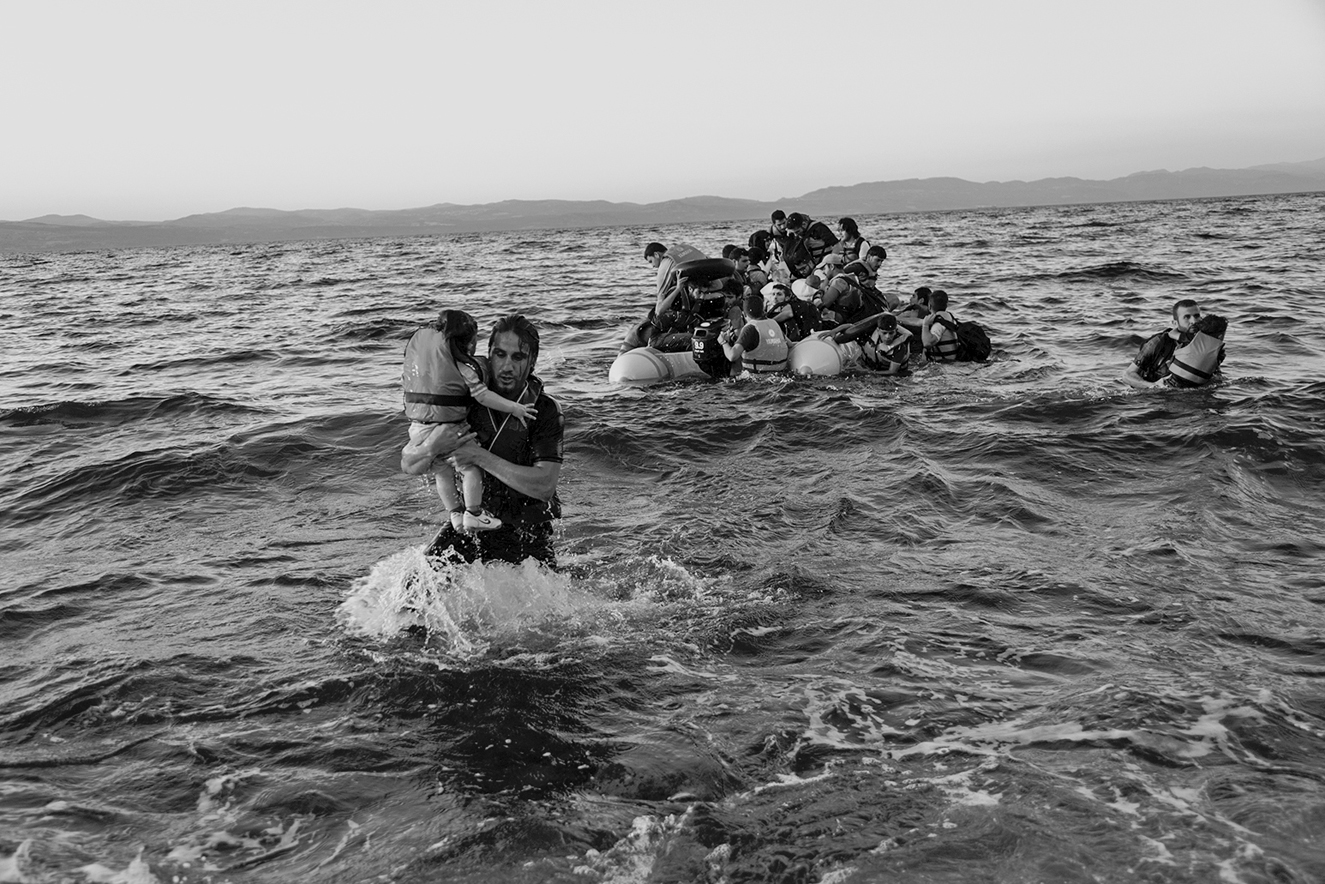
Syrian refugees arrive on Lesbos, in Jessica Corbett, “ ‘We Have to Get This Right’: Historic Bill in the US House Would Create Specific Protections for Climate Refugees,” Common Dreams, October 14, 2019, www.commondreams.org/news/2019/10/24/we-have-get-right-historic-bill-us-house-would-create-specific-protections-climate. Photo: © UNHCR/Andrew McConnell.
As such, visual depictions of Syrians entering Jordan, Lebanon, or southern Europe displace the geographic configuration of security discourse from Syria itself to other international borders. They provide a focal point for generic reporting on the worldwide potential for climate-driven displacement, resource conflict, and war. An article on the Common Dreams website uses a photo of a Syrian man emerging from the Mediterranean, carrying a child to the Greek island of Lesbos, as an illustration of the need to resettle climate refugees. In the background, a group of refugees climb off an inflatable craft, as another man carries a second child toward the island.19 Such images of the drenched bodies of Syrians disembarking from perilous Mediterranean journeys became stock features of northern reporting on the potential of the United States and Europe to serve as protectors of Syrians and other refugees. At the same time, such images were ambivalently configured as signs of risk, with precarious refugee bodies bringing with them the potential of terrorism or economic loss. In 2016, Newsweek published the article “Should Europe Be Concerned about Climate Refugees?” accompanied by a photo that depicted a large group of Syrian refugees crossing into Jordan at the Hadalat crossing east of Amman. Foregrounding a group of parents struggling to carry children and belongings, headscarves shielding their faces from wind and dust, the article cites the PNAS study to claim, “Drought linked to climate change devastated rural areas in Syria, driving people to overcrowded cities and fueling discontent in the urban centers where protests first erupted in 2011.” Reiterating stereotyped conflict geographies that separate North and South into zones of stability and violence, the article presents Europe as a “haven” despite the widespread xenophobic animus emerging during the so-called refugee crisis. In the process, authors Rob Bailey and Gemma Green figure war and climate change as the cause of a refugee crisis that European states could have predicted but did not:
Ongoing conflict in the Middle East and the unsustainable accumulation of refugees in neighboring countries should have been warning enough for Europe’s governments. Things are unlikely to improve any time soon. Europe is a haven of stability in a neighborhood of fragility. From North Africa to the Middle East and across the Sahel into the Horn of Africa, a great many of Europe’s neighbors are at risk of, or experiencing, conflict. Climate change will make a bad situation worse. As a recent report for the G7 argued, it will undermine livelihoods, increase local resource competition, aggravate pre-existing tensions and destabilize markets, ultimately increasing the risk of social upheaval. In extreme cases, climate change may leave people with little option but to move. One recent analysis found temperatures in the Middle East and North Africa could be so extreme by the end of the century that some areas may become uninhabitable.20
Reporting on Syrian migration need not engage with definitive claims about causality in order to use the disabled or vulnerable Syrian body as sensible evidence of climate-driven conflict threats. Uncertainty about the causes of war generates speculative associations. In the British newspaper the Independent, publication of a vegetation loss map of northern Syria spurred the question, “Did climate change help spark the Syrian war?”21 In an instance when a journalist takes account of scholars’ caveats about the weak evidence of causality between climate change and the Syria climate war thesis, Phil McKenna nonetheless uses images of a Syrian refugee as the face of the future climate migrant. In an interview published by the nonprofit website Inside Climate News, Dutch environmental policy professor Frank Biermann emphasizes that even though “many of these refugees come from countries affected by climate change … I would not make necessarily any causal link between climate change and the Syrian or Iraqi crises. Of course, there are many other reasons responsible for the war and civil strife in these countries.” Nonetheless, the article displays an image of a lone Syrian child in a refugee camp in Lebanon; the caption claims the child “might be foreshadowing bigger refugee crises ahead” due to climate change.22
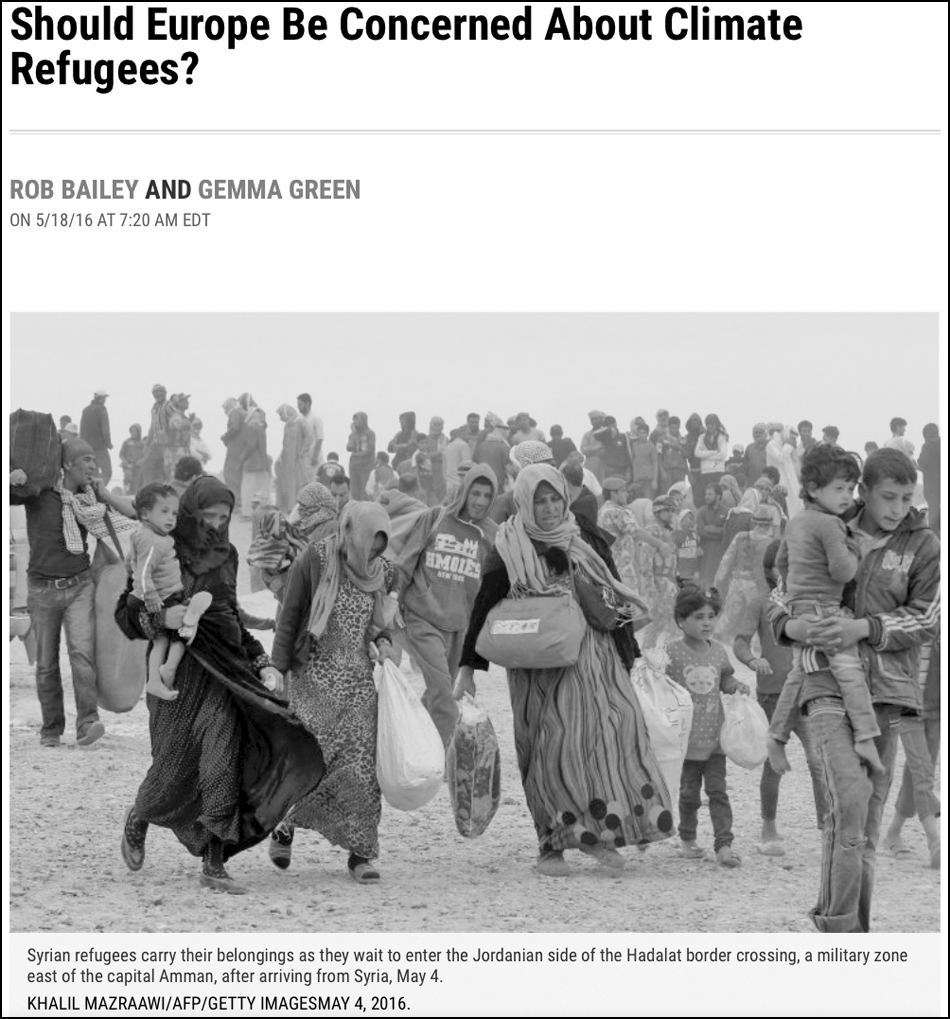
Rob Bailey and Gemma Green, “Should Europe Be Concerned about Climate Refugees?,” Newsweek, May 18, 2016, www.newsweek.com/should-europe-be-concerned-about-climate-refugees-460661.
The sources of vulnerability for Syrian refugees in such images and accounts tend to be drought, malnutrition, and the rapid breakdown of social safety. The result according to these articles is the mass debilitation of populations, which results in their increasing mobility. A key report by the British medical journal the Lancet makes the connection between climate change, migration, and the breakdown of physical and mental health. Syria becomes an example of such connections in a series of links between climate change, drought, malnutrition, displacement, and war. According to the 2018 edition of the journal’s annual report on climate change and public health, “In Syria, many attribute the initial and continued conflict to the rural-to-urban migration that resulted from a climate change-induced drought. However, the factors leading to the violence are wide-ranging and complex, with clear quantifiable attribution particularly challenging. Indeed, climate change, as a threat multiplier and an accelerant of instability, is often thought of as important in exacerbating the likelihood of conflict. Nonetheless, migration driven by climate change has potentially severe impacts on mental and physical health, both directly and by disrupting essential health and social services.”23 Here, after the caveat about uncertainty, the authors of the report connect widely distributed climate changes to the embodied vulnerabilities of migrants fleeing conflict. Such representations of disability as an indicator of climate change are increasingly prevalent in northern journalism on international conflicts.
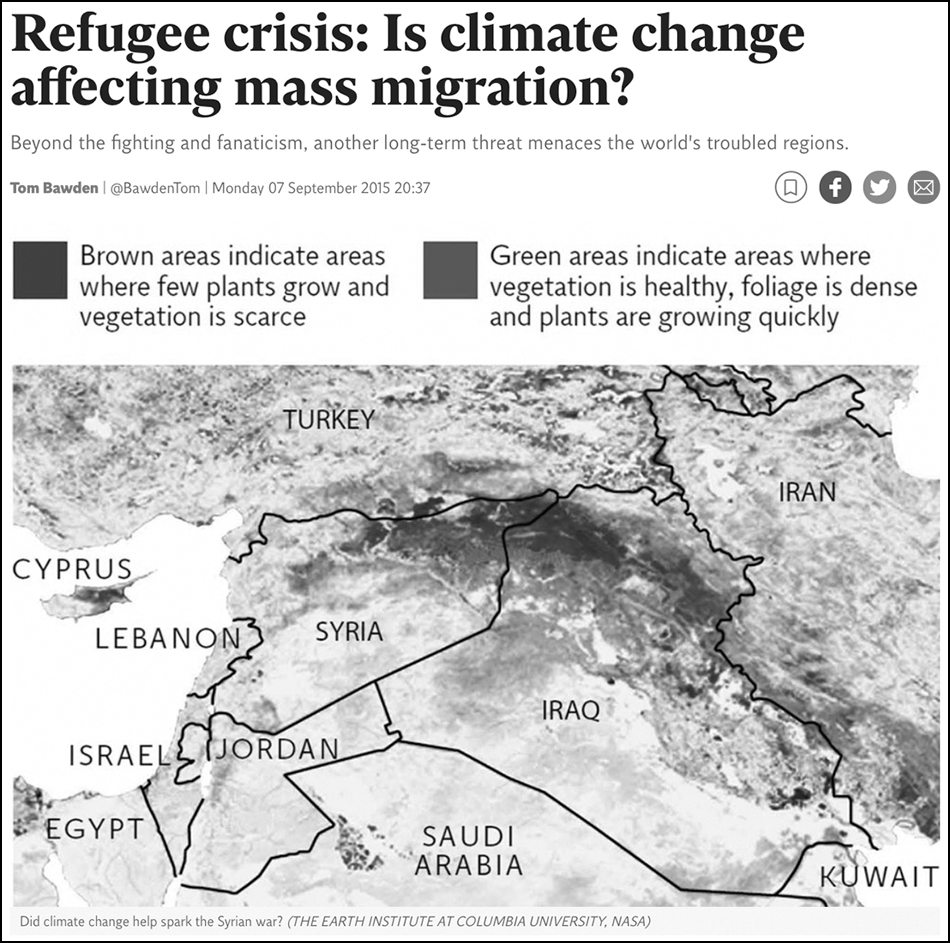
Tom Bawden, “Refugee Crisis: Is Climate Change Affecting Mass Migration?,” Independent, September 7, 2015, www.independent.co.uk/news/world/refugee-crisis-is-climate-change-affecting-mass-migration-10490434.html. Lighter gray areas indicate normal foliage, darker gray areas indicate scarce vegetation.
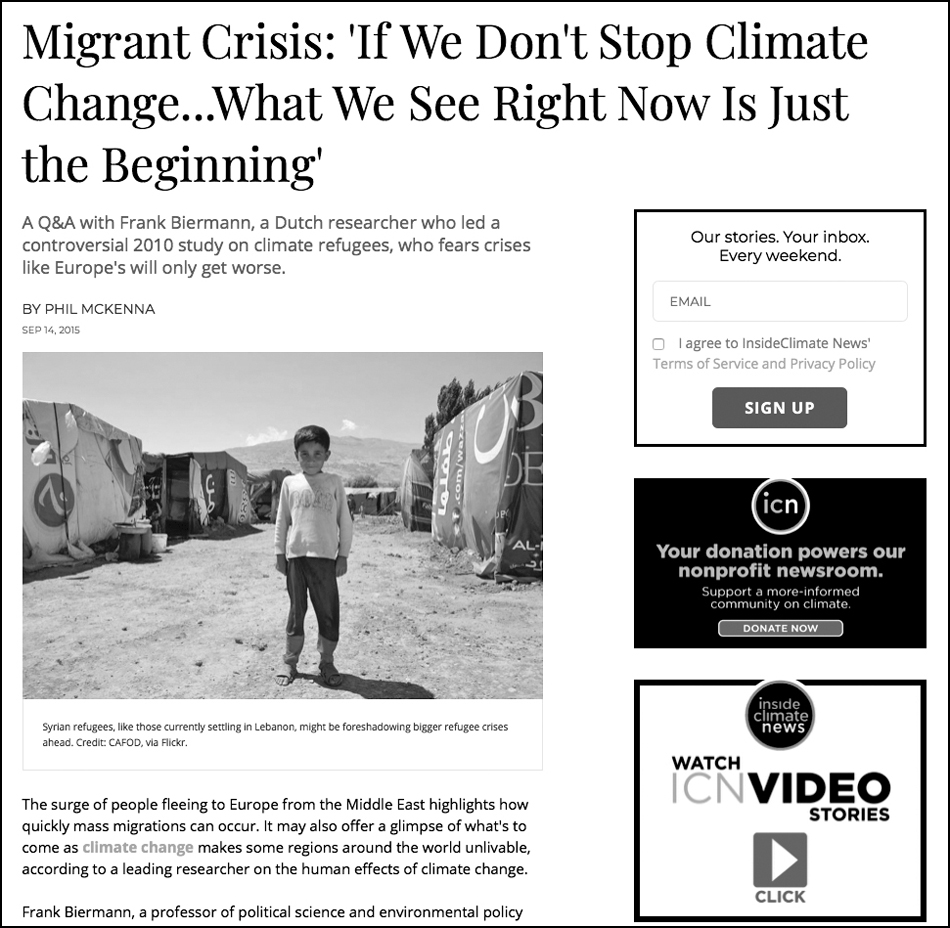
Frank Biermann, “Migrant Crisis: ‘If We Don’t Stop Climate Change … What We See Right Now Is Just the Beginning,’ ” interview by Phil McKenna, Inside Climate News, September 14, 2015, https://insideclimatenews.org/news/13092015/migrant-crisis-syria-europe-climate-change.
An article on Syrian migrants is an extended case in point. The cover story of the March 2016 issue of Scientific American announces that “fugitives from Syria’s devastated farmlands represent what threatens to become a worldwide crush of refugees from countries where unstable and repressive governments collapse under pressure from a toxic mix of climate change, unsustainable farming practices, and water mismanagement.”24 In the article, journalist John Wendle argues that “drought, which is being exacerbated by climate change and bad government policies, has forced more than a million Syrian farmers to move to overcrowded cities.”25 Despite the large numbers of farmers portrayed as climate refugees, the story and accompanying photo essay offer one story of a farmer fleeing Aleppo and another of a formerly successful well-digger who left the outskirts of Kobane. These stories are accompanied by a general series of photographs depicting the arrival and settlement of refugees on the Greek island of Lesbos, where Wendle conducted interviews.
For most of its text, the article relies on the research by Kelley and colleagues in PNAS. Notably, that study does not analyze the local hydrological effects of drought within Syria, instead making arguments about the broader Fertile Crescent region. The drought in Syria was most severe in the desert east of the country, and its epicenter was the northeastern Hasakah governorate, which falls in the Kurdish-majority Rojava autonomous region (and which at the time of this writing was being occupied by a combination of Turkish and Syrian Islamist forces). A detailed review of the PNAS article and broader claims of the Syrian war being driven by climate change was published in Political Geography in 2017 by Jan Selby, Omar Dahi, Christiane Fröhlich, and Mike Hulme, who highlight the significant effects that the Assad government’s neoliberal agricultural reforms had on small farmers in the lead-up to the drought. They argue that “inattention to Syria’s changing political economy” led proponents of the Syrian climate war thesis “to systematically overstate the impacts, both direct and indirect, of the 2006/7 to 2008/9 drought on migration.”26 Paying attention to the specific types of water use for the main agricultural sectors of different parts of the country, the authors conclude that the drought’s most lasting impacts on agriculture in the East were not ultimately coincident with the large-scale migration events described in the Syria climate war thesis. This conclusion is backed up by later research looking at the effects of the drought across Turkey, Iraq, and Syria, which stresses the relationship of the state to infrastructure as one of the key components affecting yield outcomes.27
Neoliberal policies in the later years of the Bashar al-Assad government are more likely reasons that the breadbasket of northeastern Syria transformed from an agricultural exporting region to a region in which farmers had persistent difficulty accessing infrastructure to maintain operations through the regular cycles of drought. Although divisions between opposition groups posed challenges for developing solidarities against the Assad regime, the emergent Syrian uprisings in many ways echoed grievances against Assad that were articulated following state attacks against Kurds in northeastern Syria in 2004. Nonetheless, it was only after the onset of the broader revolution in Syria that the Kurdish-led forces were able to more formally declare autonomy from the state. Analyzing a small number of interviews with refugees in Jordan, the Political Geography article is perhaps too quick to dismiss the idea that migrants from northeastern Syria may have been politically involved in the uprisings; although the Kurdish and Arab uprisings were conventionally depicted as separate political causes mapped onto a majority–minority divide, Hasakah city was the site of some of the first anti-regime protests of 2011, led by Kurds, and the retrospective interviews in refugee camps may be affected by the concern for retribution among migrants. Still, the broader points of the authors that political and economic grievances were deep drivers of the war and that there is insufficient evidence that climate change was a substantial trigger of migration in this area are sound.
It is beyond the scope of Wendle’s article in Scientific American to substantiate his claim, taken from the PNAS article and repeated widely in the news media, that “as many as 1.5 million Syrian farmers” were displaced by the drought. But Wendle configures Europe as a place of rescue in the face of this scale of mass migration. Displaying images of a man crying on the side of a road and a woman in a headscarf clutching a baby at Pikpa, the caption suggests that these experiences reflect the generalized feeling among migrants that they are “overwhelmed with relief upon reaching the Greek island of Lesbos.” Alongside this broader conception of Europe as a haven, Wendle employs a disability narrative in order to conceptualize the human cost of drought. He focuses on the individual story of fifty-four-year-old well-digger Kemal Ali to illustrate the association of climate change and migrant crisis. Describing how during the 2006–10 drought, the depth of wells Ali drilled grew from seventy to seven hundred meters, Wendle links a series of economic, social, and physical factors to the trigger event of a declining water table: “Ali’s business disappeared. He tried to find work but could not. Social uprisings in the country began to escalate. He was almost killed by crossfire. Now Ali sits in a wheelchair at a camp for wounded and ill refugees on the Greek island of Lesbos.”28 Representation of disability in the tragic mode helps Wendle account for the force of climate in unleashing a chain of disruptions in Ali’s social world, resulting in his family’s eventual passage to Turkey and then, by boat, to Greece:
Ali likewise tried to stick it out, but few of his former customers could afford to drill as deep as the water had sunk. And the war made ordinary activities practically impossible. His home village was only a short distance from the wreckage of Kobane on the Turkish border. That town was in ruins by the time the Kurds succeeded in recapturing it from ISIS, the militant group that has been terrorizing the region. Last July he headed for Syria’s capital, Damascus, hoping to find work and a place where his family could be safe. He was on his way there by bus when a rocket struck the vehicle. He awoke in a Damascus hospital, paralyzed from the waist down. The blast had peppered his spine with shrapnel. Somehow his family managed to get him back north, and together they made their way across Turkey to the shores of the Aegean.29
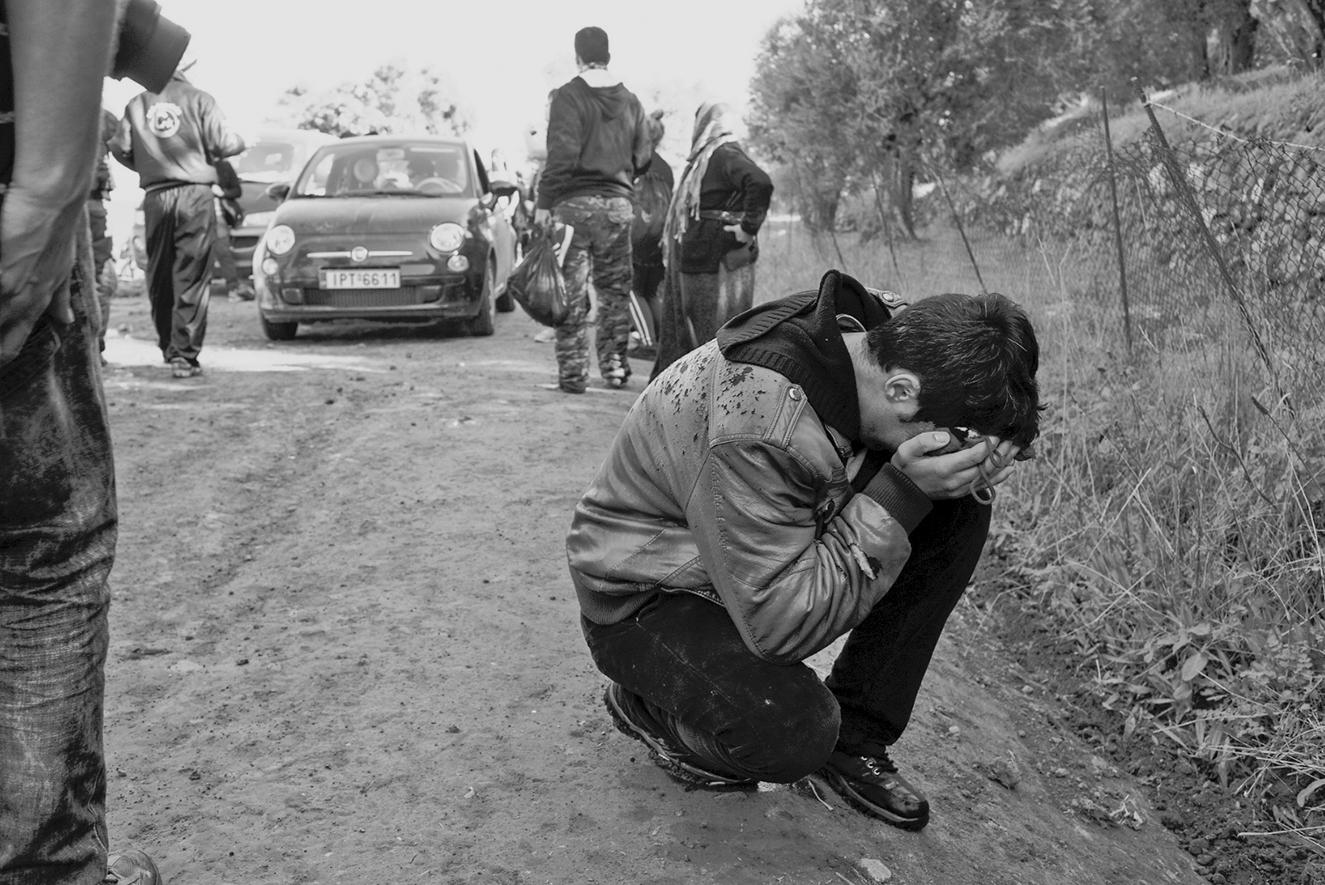
Photo of man kneeling, in John Wendle, “Syria’s Climate Refugees,” Scientific American, March 2016, 52.
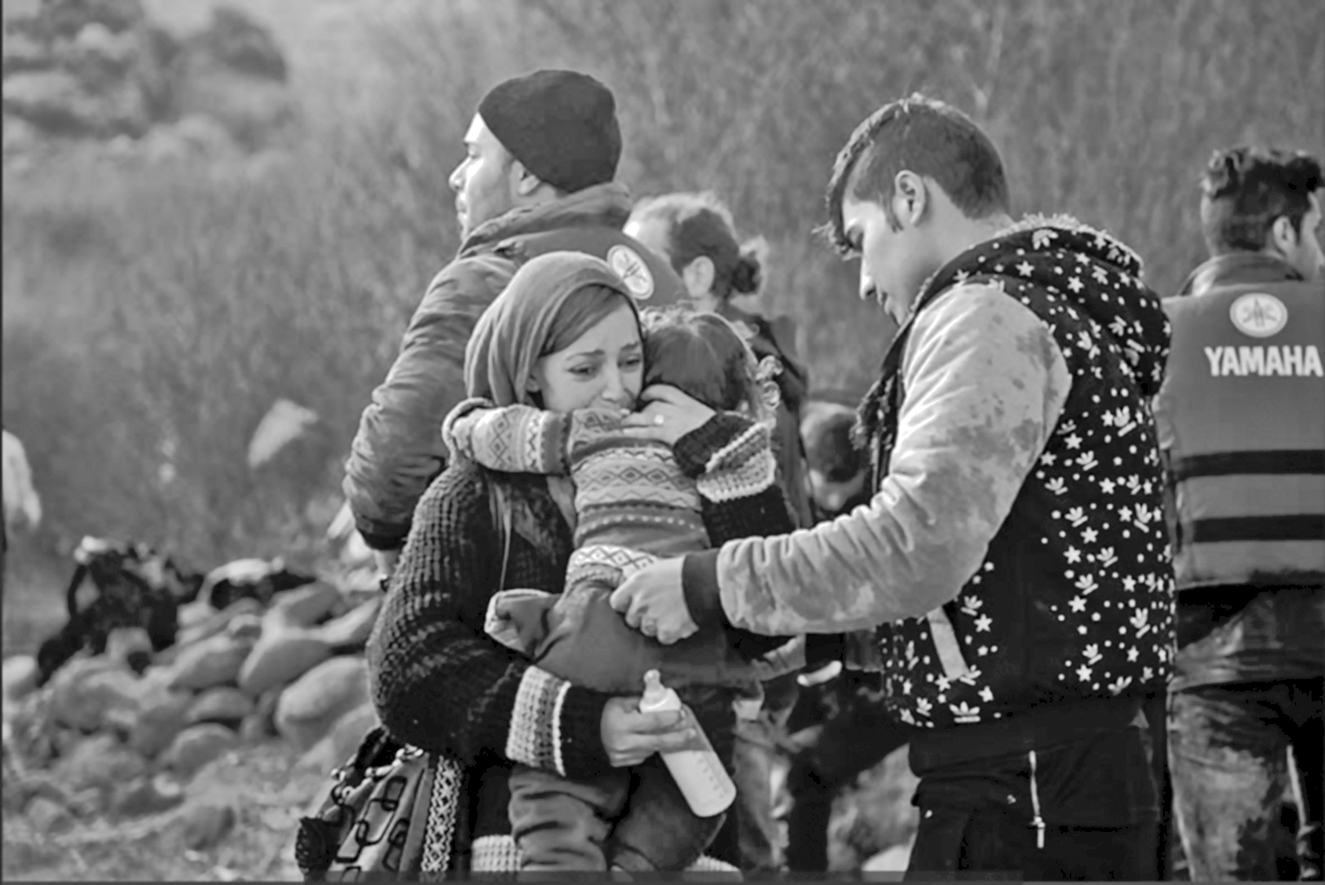
Photo of mother and child, in John Wendle, “Syria’s Climate Refugees,” Scientific American, March 2016, 52.
Ali’s paralysis is the culmination of a series of factors—economic hardship, the arrival of ISIS, and the dangerous urban-to-rural migration—purportedly triggered by drought. Disability here serves as a means of distilling the widely distributed effects of the climate system on affected migrants, as those fleeing war conjoin the specter of mass debilitation under climate change with the intensification of global mobilities wrought by ecosystemic collapse. Uniting disabled bodies with hypermobility under conditions of war, such narratives attempt to anthropomorphize the climate system in the bodies of vulnerable Syrian migrants—figures like Ali, the children emerging from the waters of the Mediterranean, and the women struggling to cross the Jordanian border.
Although the narrative of Ali’s transformation from successful laborer to paralyzed refugee begins with drought, it is notable that Ali’s actual decision to leave his home came not with the depletion of his business but later, in July 2015, following the nearly yearlong siege of Kobane and surrounding villages by ISIS and the June 2015 Kobane massacre, in which ISIS carried out a series of suicide attacks. Control was reestablished by the YPG/YPJ units of the Syrian Democratic Forces following a U.S.-led air bombardment that devastated the city. None of these events—which represent more sudden and severe forces of displacement—appear in Wendle’s article. Instead, Wendle emphasizes issues of water and agricultural collapse in producing disability. The article displays a blurry photograph (not reproduced here) of a resting Ali attended by his family members at the Pikpa camp on Lesbos alongside the following narrative:
Ali and his family are trying to somehow get him to Germany, where they hope surgeons will be able to restore his ability to walk. Outdoors in his chair to get a few minutes of sun, Ali is thinking of the friends he left behind in Syria. “The life of a farmer has always been hard,” he says. “Their biggest problem was water—period. Because water is life.” His son wheels him indoors for a rest. Weak winter sunlight partially illuminates a big room lined with a couple of dozen beds. Plastic sacks and cheap duffle bags are heaped everywhere, holding their owners’ few remaining possessions. As Ali’s children lift him into bed, his face crumples in pain and exhaustion. Fardous, his 19-year-old daughter, tucks his colostomy bag against his body and arranges the donated blankets to cover him. “It is written in the Quran,” Ali repeats. “Water is life.”30
Wendle ends the article here, invoking both the Quran and the phrase “water is life,” which has become an Indigenous rallying cry against oil pipelines since Standing Rock activists popularized its translation from the Lakota mni waconi. Although Ali remains paralyzed, hope for asylum is presented as a path forward for the family, configuring impairment as the tragedy that can be overcome in the act of resettlement. Whereas this overcoming of disability does not take place in the dramatic acts of adaptation attributed to the char island dwellers depicted in chapter 3, Wendle’s article situates the refugee journey as a passage away from the persistent threat of death and toward a new horizon of life.
Islam is obliquely referenced as the backdrop of the refugee passage. Inscribing a Quranic invocation of protest against the carbon economy, the end of the article plays on a contrast between an environmental ethic and the association of Syria with the rise of ISIS and Islamist insurgent groups. Although it is only implied in Ali’s story, international security discourse on the Syria war as a climate war draws on the specter of ISIS as climate change’s ultimate challenge to the liberal secular state system. Elsewhere in the climate security literature, the association is more explicit. In a study commissioned by the German government, the German think tank Adelphi contends that drought led directly to both the onset of war and the rise of ISIS and the al-Nusra Front. The report relies heavily on the listing of ethnic groups—ranging from Alawites to Kurds to Sunni Arabs—as a shorthand for conflicting interests already present in the region. In this already potent mix of social differences framed by poor state governance, Adelphi claims that climate change, “though far from being the only or the primary driver of conflict in Syria, … did play a catalytic role in accelerating the descent into fragility and facilitating the rise of NSAGs [non-state armed groups].” Emphasizing resource conflict, the report claims that ISIS was able to exploit water scarcity as a recruitment tool for migrant herders:
Farmers and herders in the northeast who were faced with crop failure and livestock death had little to no economic prospects and there were no adequate social safety nets in place for them under the Assad regime. As ISIS pays its fighters an estimated USD 400 per month, about five times as much as a normal wage in the region, it also provides economic incentives for young and unemployed people with few perspectives [sic]. Economic hardship is a primary driver for Syrians to join armed groups, as unemployment reaches up to 90 percent and most salaries of those who still have employment are insufficient for meeting basic needs.31
From Climate War to Climate Revolution
In her memoir The Crossing, journalist Samar Yazbek frames her memories of the Syrian war as a process of dismemberment occurring on parched earth: “In my mind, I hold a portrait of Syria, but it is no ordinary image. It shows a dismembered collection of body parts, the head missing and the right arm dangling precariously. Then you notice a few drops of blood slowly dripping from the frame, disappearing as they are absorbed by the dusty soil below. This is the catastrophe Syrians deal with every day.” Noting the persistent “signs of drought” that left “hardly any signs of life in the landscape,” Yazbek’s descriptions of a series of journeys across the western side of the border separating Syria and Turkey in 2012 and 2013 represent wartime Syria as a place where olive trees shrivel, villagers struggle to eke a living from tending starving sheep, and people shelter indoors, fearing the fate of those who lost limbs, life, and loved ones in the crossfire.32 Portraying her visit to a Turkish hospital at Reyhanli, where she describes “putrefying” bodies “laid out on white sheets, with mutilated feet, amputated limbs, hazy eyes,” Yazbek uses the images of bodily fragmentation to metaphorically portray the dissolution of the society, described as the “shattered heart” of Syria in the book’s subtitle.33 The only rain that appears in the narrative is the raining down of shells on the border region. Yazbek describes the aerial bombing and sniper shelling carried out by Syrian, U.S., and Turkish forces as an atmospheric violence, representing a “blazing sky,” a “sky that wouldn’t let us celebrate; no, the sky was on fire.”34
For Yazbek and some other memoirists of the Syrian uprisings and civil war, this atmospheric violence is not a violence primarily produced by the drought and other climate-driven processes. Aerial bombing and ground battles that intensified with the increased number of armed fighters and the growing number of regional parties to the conflict are depicted as generating both an intensive toll on the national body and a breakdown of social and ecological conditions for reproducing life. Although such depictions of dismemberment are common to war memoirs in a variety of historical and geographic contexts, the connection between the collapse of social reproduction, portrayals of aerial bombing, and visions of the bodily and architectural fragmentation in war have framed the context of narratives of war and migration in Syria. In Marwan Hisham’s Brothers of the Gun, the winter food shortages in Raqqa are depicted as an effect of the intensifying battles over infrastructure emerging as the disparate rebels—including the groups that would re-form as ISIS—took over the grain silos in the east. As he waits in a long line outside a bakery in December 2012, Hisham portrays his internal struggle to make sense of how the twin violences of the state and the rebels, “prison and anarchy,” intertwine to deprive people of food and energy in Raqqa, along with the neighboring breadbasket provinces of Deir ez-Zor and Hasakah: “Surely, this is temporary. It will end when the rebels come. It’s a siege situation. The rebels are going to break through fast and lift it. They care what we think about them. But do they? Aren’t they the reason I’m standing here? Aren’t they the reason those people are behaving like animals? Or not? Some say that the Department of Subsidies is making a profit from this situation and also that the government officials want us to hate the rebels in advance.”35 Whereas Yazbek’s literary prose abstracts Assad’s aerial bombing campaigns as fire in the sky, Hisham depicts the monstrosity of the planes—which shot “flames from the dragon’s mouth”—and emphasizes the personal agency of the pilots, who, disrupting the “calm” of Hisham’s “garden,” “killed everything beautiful in this country.”36 Although Hisham focuses less on sensational images of bodily trauma, his narrative of the war—from the blood of martyrs at Raqqa’s clock tower, to ISIS’s public executions, to the U.S. aerial bombing campaigns, to the moment of his exit across the Turkish border near Afrin—focuses on the moments when buildings collapse and bullets or shattering glass pierce the skin, leading masses of people to flee either to the hospital or away from the fighting. The images accompanying the narrative drawn by artist Molly Crabapple capture the connection between aerial bombing, infrastructural vulnerability, and bodily debility; in one image, the arrival of U.S. bombing campaigns in the east produces a landscape of dead bodies that must be extracted from the rubble. In such narratives and images, the vulnerability of bodies to war environments moves from longer time scales—witnessing the slow withering of the population broken down by war—to shorter ones, as sudden explosions generate transformation of the social landscape through sudden migrations.
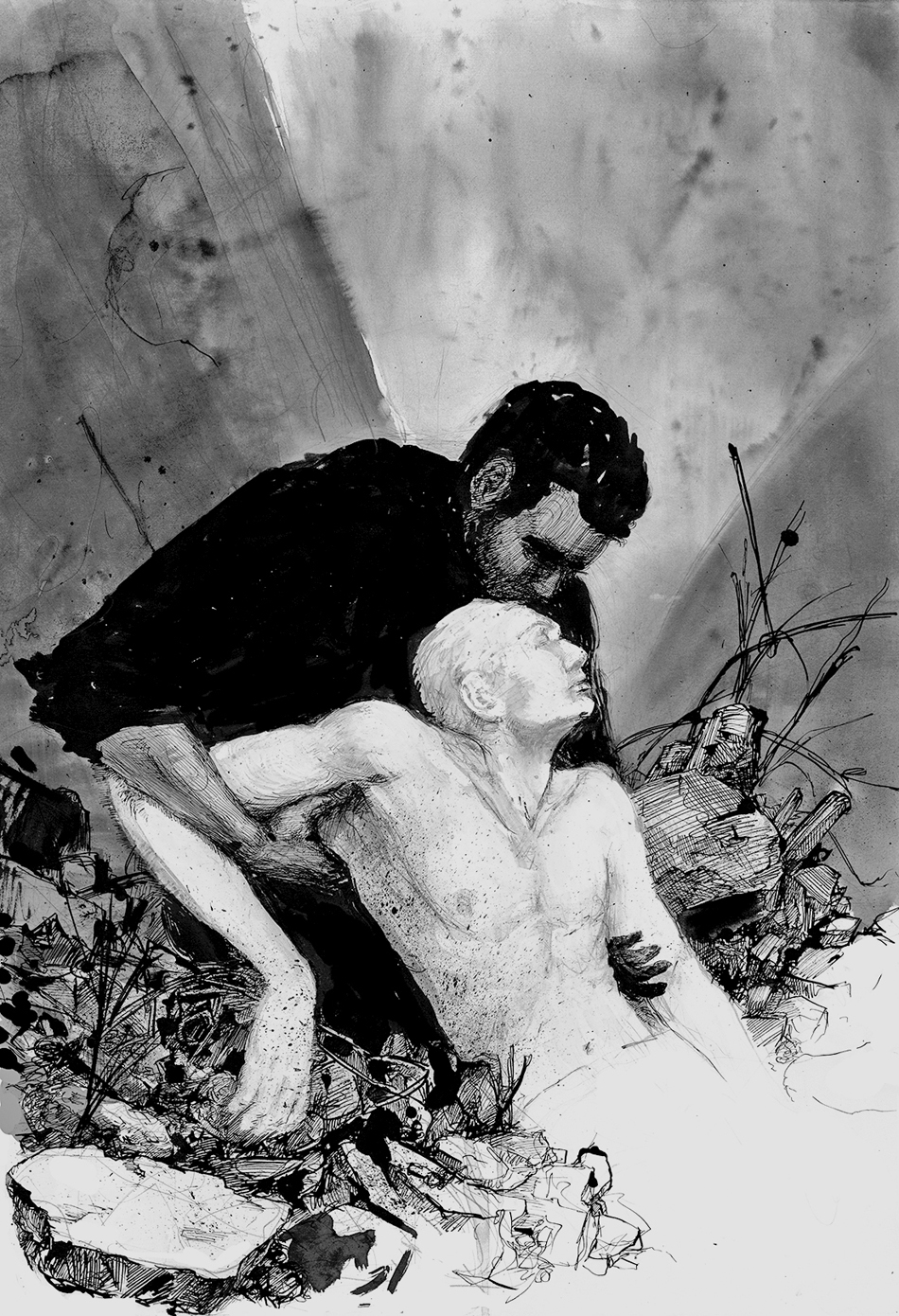
Marwan Hisham, Brothers of the Gun: A Memoir of the Syrian War, illus. Molly Crabapple (New York: One World, 2018), 182. Courtesy of Molly Crabapple.
Given this alternative vision of war as an embodied socio-ecological cataclysm, it is possible to critically analyze how some refugee and analyst narratives of the Syrian war have woven images of embodied and ecological precarity into the climate war thesis. As a primary example, videos in the Weather Channel’s Climate 25 project claim that drought led directly to the Syrian revolution. In one video, Thomas Friedman, the New York Times opinion columnist who elsewhere refers to himself as a “tourist with an attitude,” claims that “a million Syrians—farmers and herders, really conservative people—left their ranches and fields in the countryside and swamped all the major Syrian towns and cities as they were really driven off the land by the drought, putting huge pressure on the infrastructure. These farmers did not start the revolution, but with the first call of ‘Allahu Akbar’ by the revolutionaries, they were very eager to join to bring Assad down. There were many, many climate refugees among them.”37 The Climate 25 series includes related testimony from a Syrian informant emphasizing a chain of events leading from drought to migration to Islamic revolution. Syrian refugee and New America Foundation fellow Farah Nasif gives a short testimonial concluding that “everything changed” with the drought event, provoking public outrage at the government and the eventual rise of Islamism. In the video on the Climate 25 website, accompanied by links to media reports of the PNAS study, Nasif concludes that drought generated the individual feeling of anger that led many in the society to reject Assad. Displaying a framed photo of her family’s agricultural land, which shows fallow fields and a small group of sheep and goats grazing, Nasif testifies to the power of the drought to create hostility toward the Assad government:
We were OK.… Like any normal family. Everything changed when the drought [came].… Everyone suffered from those sandstorms. This is our land. All lands become like this—completely yellow desert. Nothing, no life, no chance to do anything.… Government doesn’t help us at that time in anything. The drought is one of the main reasons for the revolution. They have that, ugh, that angry, that annoying, that hate for the government, for the Assad government and what he do for them. They said oh the government doesn’t help me before and I don’t expect any future, so I will destroy it. Last year I leave Syria forever because the situation is become very horrible. The Islamists become more power, they targeted the women, they targeted the activists, they threaten me, threaten my family, so I was not even able to return back to that part of Syria.38
There is tension here in the framing of the revolution as both popular and determined by climate. Notably, although the drought arose in 2006, Nasif’s family, like Ali’s, actually migrates with the intensification of conflict, especially as ISIS gained ground in the east in 2013. Sources of violence, such as the actions of regional powers and the U.S. arming of Islamist militias, do not appear in the narrative. This video as such reflects some of the ironies and ambivalences of grafting Syrian opposition narratives onto the climate war thesis. Taken together, the videos of Friedman and Nasif suggest that climate change spurred instability and dissent in Syria, yet the ultimate lesson about whether a revolution in Syria could be positive remains unarticulated. The title of Nasif’s video—“How Can Climate Change Help Ignite a Revolution?”—could be interpreted to suggest that such a revolution against Assad’s dictatorship was necessary, but Friedman’s testimony invokes stereotyped visions of Islamist extremism that reinforce military security narratives of climate change as a trigger event for war.
Such stories about drought and revolution in Syria did not come out of thin air. They are the most common types of narrative that make claims for climate change as a trigger of war and political transformation. In 2007, a number of researchers, journalists, and policy makers, including UN Secretary General Ban Ki-moon, designated the war in Darfur as the world’s first drought-intensified climate conflict. Subsequent studies have questioned this designation, arguing that the timing of the drought was not coincident with the outbreak of armed violence in Sudan. However, even among some commentators who are skeptical of exaggerated narratives of climate war, rhetorical gestures toward the influence of climate change on revolution sometimes guide speculations about conflict triggers. Parenti’s book Tropic of Chaos begins with a theoretical model that discusses today’s “catastrophic convergence” of poverty, militarism, and environmental change but at times amplifies claims about the triggering force of climate change, particularly in the rendering of militant Islamism and ethnoreligious violence more broadly.39 Parenti depicts the history of recent wars in Afghanistan as such: “Yes, religious fanaticism, ethnic hatreds, and imperial ambitions are the larger moving pieces, but climate change also fuels the conflict in Afghanistan. First, the violence began as the result of a drought forty years ago. Second, climate stress creates poverty and desperation, which now feeds the insurgency against NATO occupation. Third, climate change causes interstate rivalries, which play out as covert operations inside Afghanistan. Finally, and very importantly, opium poppy is drought resistant to an extent alternative crops are not, and NATO attacks poppy while the Taliban defends it.”40 Despite the book’s lack of any discussion of how atmospheric carbon levels in 1970 might have affected drought in the Afghan-Pakistan borderlands, Parenti claims that climate-induced drought contributed to Mohammed Daud Khan’s coup against the Afghan monarchy, minimizing the importance of the ongoing set of Cold War political struggles between Communists and Islamists that were taking shape in Kabul.
The boldest set of claims about the relation of climate change to revolution comes from geographer Andreas Malm, who attributes the Egyptian uprising and the Syrian war to climate change. Malm depicts climate change as a potential trigger—though not an underlying cause—that ignites a larger social ecology of neoliberal crisis: “Global warming cannot be a sufficient cause for a revolution: but it can be one ingredient in a powder keg, and it can, at least potentially, light the fuse.”41 Malm’s contention about Egypt depends on a series of unsubstantiated inferences about the influence of climate change on world wheat markets, which experienced price spikes leading up to the Arab uprisings: “The bodily metabolism of the Egyptian population revolves around bread, accounting for a full third of daily caloric intake; subsidized bread made of imported wheat is the staple good of the nation. But due to the drought, Egypt received 40 percent less Russian wheat in the second half of 2010 over the equivalent period of 2009.… Expensive bread was an aggravating factor, one among several triggers unleashing oceans of dammed up discontent onto the streets, and in this respect, Tunisia and Egypt followed a script as old as revolution itself.” Malm goes on to quote Trotsky’s description of women textile workers striking for bread in Petrograd in February 1917, which he describes as being “the moment that set the whole train of 1917 in motion.”42 The same goes for Syria, according to Malm. In contrast to Hisham’s representation of the bread line as a direct effect of armed siege, Malm focuses on long-term environmental processes transitioning into rapid crisis. Citing the PNAS study about the drought, Malm claims, “Estimates range between one and two million displaced farmers and herders. Fleeing the wastelands, they hunkered down on the outskirts of Damascus, Aleppo, Homs, Hama, joining the ranks of proletarians seeking to find a living from construction work, taxi-driving, or any other, mostly unavailable, job. But they were not alone in feeling the heat. Due to the drought, the marketplaces of the country exhibited one of the central vectors of climatic influence on popular livelihoods: doubling, tripling, uncontrollably spiking food prices.”43 Emphasizing the rural roots of the Syrian uprising, Malm repeats some of the conventions of Malthusian development narratives, stressing the instability generated by rural-to-urban migration and land degradation. The fact that Malm reverses the moral opprobrium against impoverished rural migrants in order to idealize their purported revolutionary zeal does not mitigate the distorting effect of such claims about climate as a trigger of revolution.
Given that Parenti and Malm both attempt to synthesize critiques of neoliberal capitalism with accounts of climate change—in the process countering a species-level discourse about human transformation of the environment in the Anthropocene with accounts of class and national differences among humans—it is notable that they emerge as proponents of the language of trigger events, which frames the “threat multiplier” rhetoric of the military establishment’s emerging climate security discourse. Such speculative renderings of climate change as security crisis are intended, in Parenti’s and Malm’s works, to provide an intersection site for integrating political, economic, social, and ecological analysis. To be fair, they each provide caveats about the complex interrelation of social and ecological factors in conflict, and Parenti repeatedly raises problems in determining causality in the chain of events linking climatic to social processes. However, given the scale at which the accounts are framed, and the speculative cast of their conclusions about drought, such works reflect an embrace of climate change as a trigger of conflicts and displacements. Although they do not embrace the most destructive Malthusian precepts of the climate war thesis, their particular attempts to shift from an “old materialism” (one based on a notion of the human capacity to labor and transform nature) to a “new materialism” (one that stresses the agential power of nature itself) smuggles in elements of climate determinism.
Other emerging strands of materialist analysis—particularly among the works of geographers working in the tradition of political ecology—offer more promising pathways for understanding the interrelation between climatic processes and geopolitical economy. Jesse Ribot, a geographer who is studying the causes of migration for Senegalese farmers leaving for Europe, argues that exclusion from markets and political processes are the proximate causes of precarity in many climate-affected regions of the Sahel. For Ribot, writing on the abstractions of Anthropocene discourse, the underlying material bases of vulnerability cannot be understood by centering the peasant-environment relation as in Malthusian degradation narratives. Instead, it is necessary to highlight a chain of factors that affect peasant households’ capacities for resilience in the face of environmental change:
Grounded social-science research does not explain the precarity of the peasant household or its security and ability to withdraw into subsistence as a mere proximate relation between a household and the environment or hazard. Precarity and security are explained by locating the individual in the household, community, polity, market, nation and a differentiated global political economy. They are explained by people’s political leverage to shape these contexts. This applies to any social analysis of precarity—of the peasant, the young, the old, the disenfranchised—including climate-related vulnerability analysis. In the Anthropocene, some causal analysis must trace stressors to greenhouse gas effluents, explaining how these effluents are enabled and how their regulation and mitigation are products of a complex social and political-economic history. These are the causes of stressors in the sky. They are distinct from underlying vulnerability.44
Beyond Determinism
One issue that arises with international representations of Syrian migrants is that the linkage of embodied vulnerability to state power can configure the Assad government as the ultimate arbiter of security. However, when writing about the geopolitics of migration from Syria, northern journalists and policy experts generally avoid reflection on the relationship of the underlying statism of security discourse to critical discourse on Syrian sovereignty, setting aside discussion of the multiple histories of political opposition to Assad and the broader challenges such opposition offers to international systems of state and capital. Between the aerial bombing, urban sieges, and chemical attacks of the Assad government and the exclusionary violence of ISIS and other Islamist segments of the opposition, international journalists focusing on the Syrian war tend to postpone the ideological questions raised by activists in the revolution—questions that must be at the forefront of analysis of the ongoing war with Turkey’s latest incursion into Rojava, which at the time of this writing had added an additional three hundred thousand displaced people to the staggering eleven million who had already fled from homes within Syria’s prewar borders.45 This rhetorical outcome in which journalists skirt the political complexities of the revolution is one that has been persistently critiqued by Syrian leftists, who argue that northern silence in response to calls for solidarity with the Syrian opposition is an extension of the colonial formulation of a mandate to intervene, following French and British strategies for establishing authority through managed ethnic social stratification. Exiled communist dissident Yassin al-Haj Saleh explains:
The premise itself deems the Syrian revolution to be essentially majoritarian and anti-minority, without a clear explanation for why that is the case, and without showing sensitivity to time and historical changes in the course of the last eight years and for decades before. The roots of Western “neutrality” toward the Syrian revolution are based in this premise. Most Westerners are repelled by the Syrian regime, but they are equally or even more repelled by the Islamic core of our societies.… The emphasis placed on “the protection of minorities” is a vocal implication of this amoral neutrality, which is essentially apathy.46
For Saleh, the specter of Islamism, which has convinced outside observers to abandon the opposition, has been effectively cultivated by Assad and his allies in favor of a “culturalist” approach that emphasizes modernization and capitalist development along colonial lines. From this perspective, both narratives about the Islamic character of Syrian society and geopolitical narratives about Syria as an example of geopolitical insecurity performatively “depopulate” accounts of Syria’s civil war. Saleh explicitly rejects the Syrian climate war thesis as part and parcel of an erasure of Syrian knowledge and politics and a devaluation of Syrian lives:
The dominant discourses that share the act of producing knowledge about Syria, Palestine, Iraq, and the Middle East—the Geopolitical discourse and the culturalist one—are both depopulated, reductionist discourses that helped greatly in making local populations invisible, indeed nonexistent. These discourses have a dehumanizing effect that made our deaths something unimportant. The other face of this invisibility is the disproportionate visibility of factoids related to religion, sect, and ethnicity: every mediocre Middle Eastern “expert” knows that so-and-so is an Alawi, so-and-so is a Christian, or a Kurd. The “rest” are the “majority” Arabs and Muslims that the West should take great care to protect the minorities from its primordial threat. That is why the coverage of Syria and the attitudes of the right wing and left wing media in the West were really scandalous.… And there prospers in the United States a theory of explaining our struggle through drought! Four years of drought preceded the revolution and caused it. So it’s not a matter of politics, or of social demands or of a thuggish ruling junta. It’s not what those irrational Syrians think; science says it is … drought. But this science is full of politics as much as it suffers from ethical drought. This environmentalist approach could be fully embraced by neurotic thugs like Bashar Assad, the same way he embraced the culturalist theory that absolved him of the horrible crimes his regime committed.47
Narratives of climate migration and climate war in Syria avoid confronting the particular struggles within the opposition—which vary widely, for example, between the various factions fighting for control of the eastern oil fields near Raqqa and the ecofeminist anarchism of the Rojava autonomous region farther north. Leaving an ambivalent view of state power within Syria, such narratives treat disability as an icon of insecurity generalizable beyond Syria, threatening the ability of states elsewhere to contain emerging risks to international order.
Despite the persistence of the Syrian climate war thesis, actual attempts to respond to the conjoined situation of war and drought in northeastern Syria have invoked the potential for solidarity as the basis of a different relationship to land and subsistence. This follows the turn, in the last two decades, of Kurdistan Workers’ Party (PKK) political prisoner Abdullah Öcalan from the party’s original Marxist-Leninist ideology toward social ecology, inspired by the writings of anarchist theorist Murray Bookchin. With the movement’s success at establishing limited forms of autonomy, this strategy has been effective in developing local institutions that are able to challenge both capitalist development strategies and authoritarian forms of control coming from the central governments of the region. Although much of the international reporting on this aspect of the Rojava movement has focused on its articulation of a gender critique, evident in women’s prominent roles in both local collectives and YPJ armed units, the texts of the movement connect feminist critique with an autonomist vision of ecological resurgence. Given these dynamics within the movement, autonomous collectives in the region during the war have undertaken ecofeminist education projects, reforestation initiatives, and agricultural cooperatives based not on neo-Malthusian precepts of social collapse but on a vision of ecofeminist democracy grounded in anarchist traditions of mutual aid and critiques of social hierarchy. Öcalan directly connects anticapitalist critique to the “cause of women’s freedom and nature’s salvation,” which can be realized in the development of localized and autonomous democratic collectives based in municipalities, as well as rural cooperatives.48
Beginning in 2012, the development of over fifty autonomous agricultural cooperatives in Rojava’s eastern Cizîrê Canton, formerly in the Hasakah Governorate of northeast Syria, attempted to establish modes of ecologically sustainable social provision. Responding to the social ecologies of war—disruptions to basic provisions and infrastructure, theft of sheep, munitions pollution, toxic smoke from oil fires—participants in the Rojava campaign also developed a broader critique of capitalist agriculture. While much of the academic debate over whether rural-to-urban migration in Syria in the lead-up to the war was a result of drought-fueled agricultural collapse in the breadbasket region, the analysis of social ecology developed by the eastern Rojava activists questioned the capitalist logics of grain production, which during the last two decades of Assad’s rule has been both pesticide intensive and monoculture in nature, helping to intensify the problems of deforestation and desertification that threaten long-term food security. For this reason, the communes attempted to supplement livestock and grain production with reforestation efforts and the cultivation of olives and fruit.49 At the time of this writing, such efforts have been threatened by Turkey; on October 9, 2019, when Turkey launched an invasion, the international commune focused on ecology in the region published on its blog a drawing of a Turkish warplane unloading a bomb over the emerging green bloom of the cooperatives, framed by an explosion and a tank in the background. The image conveys the precarity of such efforts, which until now have suggested that even in the heart of the drought region that the Syrian climate war thesis views as the epicenter of social breakdown and outmigration, efforts to build new forms of social inclusion and ecological sustainability portend futures beyond any deterministic interpretation of how environment influences social relations.
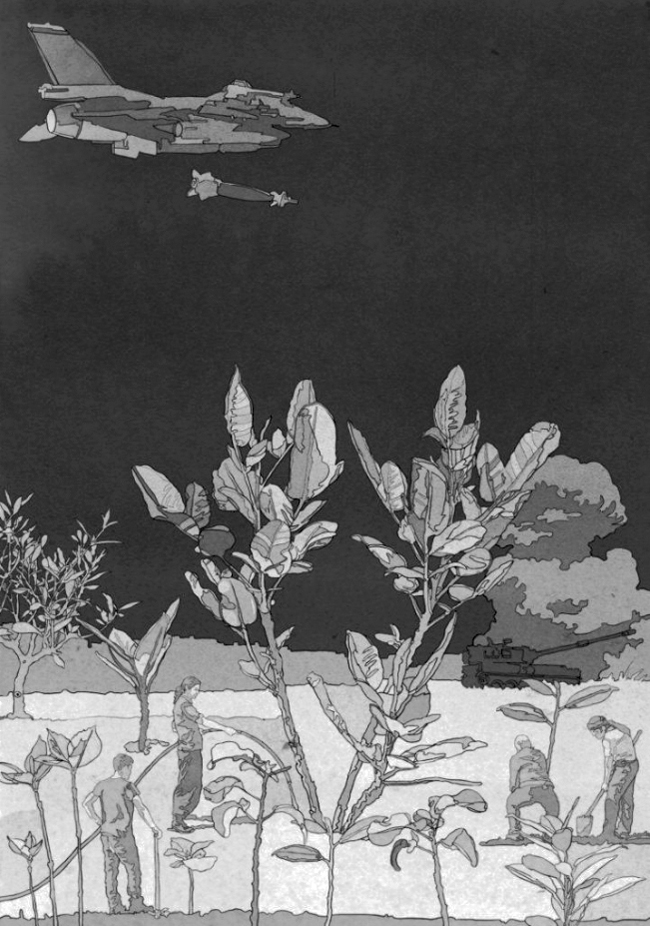
“Facing the War in Northern Syria: A Statement from Make Rojava Green Again,” October 9, 2019, https://makerojavagreenagain.org/2019/10/09/facing-the-war-in-northern-syria-a-statement-from-make-rojava-green-again.
Conclusions
The neo-Malthusian discourse of climate migration emerges at a time when the rise of right-wing political coalitions and border militarization already conceive of the world map as a place rife with racialized risk. For states that are settler colonies or former European colonial powers, the specter of increased migration appears to generate both representational strategies and governing technologies that aim to manage and contain climate disasters that are increasingly configured as inevitable in the post-Kyoto order. Rather than inaugurating a new materialism, a new dawn of understanding human imbrication in the geophysical forces of Earth, they rehearse the oldest form of materialism, which emphasizes how formal causes in the guise of nature structure social life. In the process, they dispense with close attention to how migration is embedded in the forces of racial capitalism’s oil-fueled militarization; the figure of the climate refugee and the specter of the climate war instead offer a tragic disabled icon of crisis that maps cartographies of risk in the Global South, particularly in Muslim-majority states. The Syrian climate war thesis reflects these developments in climate change discourse, signaling that migration will appear as the blowback of the climate system rather than a product of geopolitical struggles in the wake of U.S. wars, the subsequent rise of ISIS, and intervention by other regional and international powers. In response to this discourse, intellectuals and activists from the region—across different leftist segments of the uprisings—have rearticulated their critiques of the Assad government, other regional powers, and non-state militias, arguing for an understanding of how warfare and underlying political and economic grievances condition the forms of migration that have affected a full half of Syria’s population since the onset of the war. In the process, they have developed accounts of the war and experiments in collective agricultural management that move away from the spectacle of disability as a national tragedy and envision new social ecologies that depart from a framework of persistent competition and conflict.