
Section Four
10
Like the Southern football rivalry between the University of Georgia and Georgia Tech that has always hyped its annual games as “Clean, Old Fashioned Hate,” perhaps no political rivalry in American history could be characterized so aptly as the one that developed between President Woodrow Wilson and Massachusetts Senator Henry Cabot Lodge during the decade before 1920. From the landmark, four-nominee presidential campaign of 1912 that famously split the Republican Party and gave Wilson the victory, through World War I and the resulting Treaty of Versailles, theirs was a rivalry that got personal and left a lasting stain on U.S. international affairs and American foreign policy.1
Lodge, the great grandson of George Cabot—one of the wealthiest New England merchants and shippers of the 19th century—grew up a member of one of Boston’s most prominent families and in a home where our previously reviewed Charles Sumner was a frequent guest. Along with Sumner, in fact, Lodge would become one in a series of high-profile senators from the “Bay State” that started with Daniel Webster and would later include such recent political luminaries as Ted Kennedy, John Kerry, and Elizabeth Warren. Certainly a well-known group, it also included the first popularly elected African American senator, Edward Brooke, in the midst of the Civil Rights Movement of the 1960s—a fact that would have obviously made Senator Sumner very proud.2
Born in 1850, Lodge was old enough to remember the Sumner visits, the Civil War, and the assassination of Abraham Lincoln in 1865, and he would eventually aspire to become a reform-minded entrant into local politics over the objections of his entrepreneurial family, winning election to the Massachusetts House of Representatives at age 39 after graduating from Harvard and beginning his professional life as a history instructor at his alma mater. While in that role, he also established a long history of his own as an author, writing and editing numerous historical narratives and biographies, including one of the best on his own great-grandfather, The Life and Letters of George Cabot.3 By the 1880s, while serving as chairman of the Republican State Central Committee and as chief architect for the state’s party platform, his ever-expanding coterie of cultural and political friends would encourage his political aspirations. One of those would be lifelong friend and confidant Theodore Roosevelt. Already a New York assemblyman although eight years Lodge’s junior, the hyper-energetic “TR,” as he would come to be known throughout his meteoric rise to the U.S. presidency at age 43 (still the youngest ever), had actually been a student at Harvard while Lodge was an instructor, but they would not cement their long political relationship until working together at the 1884 Republican Convention in Chicago. There, with Lodge also running for the U.S. House, they were reluctantly forced to support the party’s nominee, James G. Blaine, the secretary of state for both the assassinated James Garfield (1881) and his vice presidential successor Chester Arthur (1882), but also a very polarizing figure during earlier years as the leader of one faction of the Republican Party while both Speaker of the House and a senator from Maine. Blaine would lose to New York reform Governor Grover Cleveland, the first Democratic president since before the Civil War, and Lodge would also lose in his initial bid for Congress.4
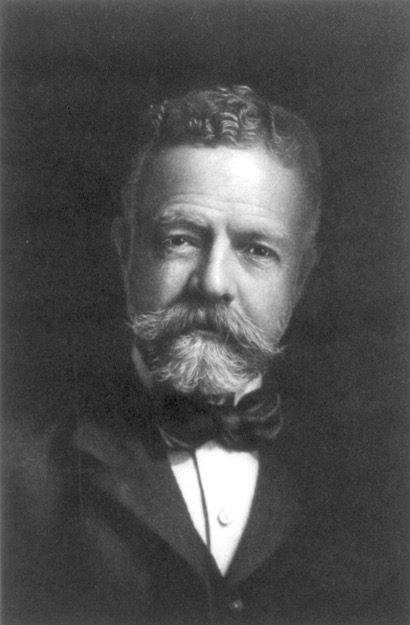
One of a long line of influential Massachusetts senators, Henry Cabot Lodge was a leading voice of the Republican Party for four decades. As the closest political friend of President Theodore Roosevelt, he was also the best-known political enemy of President Woodrow Wilson and is best remembered for his leadership of the Senate opposition to the League of Nations that Wilson conceived at the end of World War I (Library of Congress Prints and Photographs Division—Reproduction Number LC-USZ62-72073).
The election year of 1884 would prove one of reassessment for Republicans, as young party stalwarts like Lodge and Roosevelt sought to distance themselves from the political arena—TR in the wilds of North Dakota to try cattle ranching (while he also struggled to recover from the sudden, unrelated deaths of his wife and mother on the same day), and Lodge by returning to his editorial endeavors, including a book on the Works of Alexander Hamilton and as president of the Boston Daily Advertiser “in order,” in his own words, “to make it a strong Republican newspaper.”5 Both would return to politics in 1886, with Roosevelt the loser this time in the New York City mayoral race as the Republican nominee and decided underdog in a three-man race, while Lodge would also get another party nod and win in his second try for the U.S. House from Massachusetts’ heavily industrialized 6th District north of Boston.6
Theirs would be a political friendship forged by identical views on most issues and one able to stand the test of time by constant communication, discussion, and reinforcement. When TR first moved to Washington as an appointee of Republican President Benjamin Harrison on the federal Civil Service Commission for six years (1889–1895), he would begin his life in the nation’s capital by lodging at Congressman Lodge’s home. Very often, in fact, according to Roosevelt biographer H.W. Brands, Lodge was the only person outside TR’s immediate family circle “to whom he could entrust his feelings,” while Pulitzer Prize winning historian Doris Kearns Goodwin went a step further in her book The Bully Pulpit, when she pointed out that Lodge was TR’s “closet friend for more than a quarter century.” And Lodge biographer John Garraty obviously concurred, when he wrote: “The friendship of these two men was fascinating; it grew out of their early political adventures yet soon came to transcend politics completely.”7
All of that to say…. Henry Cabot Lodge and Theodore Roosevelt shared the same political opinion and attitude on just about anything or anyone they encountered in their nearly 30 years of partnership in the Republican Party, including how they both felt about Democrat Woodrow Wilson, the 28th president of the United States and the great antagonist they would criticize, challenge, and ultimately confront in the very public sphere of foreign policy before, during, and after the First World War. While Wilson would come to be regarded as one of our more successful presidents by most historians, to the two of them he was anathema and the wrongheaded villain at the head of American government at a most inopportune time.8 But who was this Democratic sorcerer, who suddenly rose from the ivy-covered walls of academia to national political prominence, and how did he come to inspire such political vitriol from the two Republicans most confounded by his presence and persona on the national stage?9
While Lodge was the product of an elite Northeastern entrepreneurial family and Roosevelt the scion of an old New York City family of Dutch heritage and community commitment, Wilson was the son of a preacher man, a Southern based Presbyterian minister, to be specific, who was born in Staunton, Virginia, and spent most of his formative years growing up in Augusta, Georgia, and Columbia, South Carolina. From there, he spent one year at Davidson College in North Carolina before transferring to Princeton University, the previous College of New Jersey from its founding in 1746 and the fourth oldest college or university in the nation, with the same kind of upper-crust, “Ivy League” education as what Lodge and Roosevelt had both enjoyed at Harvard, the nation’s oldest institution of higher learning (1636). In other words, while the lineages and childhoods of these future political antagonists were very different, their educational backgrounds were similar.10
One other marked difference was the sectional legacies from whence they came, with Wilson harboring the innate racial prejudices and attitudes of a Southern boy who was nine years old when the Civil War ended and who would return south after graduating from Princeton to study law and enlist in a law firm in the heart of the segregated “New South,” Downtown Atlanta, Georgia (1886). Although TR, whose mother hailed from Roswell, Georgia, heard family tales of heroic uncles serving in the Confederate Navy, his young allegiance was always to the Union, just as Lodge would grow up to the sound of Civil War fife and drum and never forget lessons about the North being right and the South wrong.11
While impossible to totally grasp the political esprit de corps that existed between Lodge and Roosevelt, it is instructive to see what the former had to say about the latter even when TR bolted the Republican Party in the election of 1912. Even then, although ever the party loyalist, Lodge would cheerily comment: “Theodore remains one of the most loveable as well as cleverest and most daring men I have ever known. The more I see of him, as the fellow says in the play, ‘the more I love him.’” Nonetheless, that election would come the closest to disrupting their friendship while also setting the stage for Lodge’s eventual Washington war with Wilson.12
In 1892, Lodge was elected to the U.S. Senate after three terms in the House. It was the start of a senatorial run that would last 32 years, ended only by his death in office in 1920. During the earliest years of that same span, TR would go from the Washington-based Civil Service Commission to a series of government positions that put him on a rapid trajectory towards the presidency, including his start as a news-making president of the New York City Board of Police Commissioners in 1895; his 1897 return to Washington as assistant secretary of the Navy; his recruitment and leadership of an all-volunteer cavalry regiment in the 1898 Spanish-American War (remembered famously as “Roosevelt’s Rough Riders”); his heroic fame from that venture, which catapulted him to the governorship of New York in 1899; and reluctantly, his party-mandated acceptance of the vice presidency under President William McKinley in 1901. He would only have the VP role for six months as a result of McKinley becoming the third of four American presidents to be assassinated when he was shot in Buffalo, New York, which suddenly elevated TR to the White House. Throughout that succession of jobs, Senator Lodge was always consulted and often aided each stop along Roosevelt’s way, especially in his assistant secretary appointment, his special military deployment, and even in convincing his acceptance of the VP role after “ulteriorly” promoting someone else first.13
Meanwhile, Wilson’s ascension to the top of Democratic politics was much more surprising and much less scripted. Despite the study of law on his own after dropping out of the University of Virginia Law School for health reasons, leading to his being admitted to the bar in 1882 and joining the previously mentioned Atlanta law firm, Wilson gave up being an attorney (a job he only wanted in hopes it might lead to a political career) and instead pursued what had become his more desired career as an educator. After he became the only future U.S. president to earn a PhD at Johns Hopkins University in Baltimore, Maryland (in political science), he authored a five volume History of the American People as well as a controversial treatise on Congressional Government before starting his teaching career in 1885 at Bryn Mawr College in Pennsylvania, a liberal arts school for women. He moved to Wesleyan University, an all-male school in Connecticut, to teach history in 1888. From there it was an easy choice to return to Princeton when the opportunity arrived to teach jurisprudence and political economy in 1890, a role he continued until becoming the 13th university president at age 46 in 1902. As such, he would transform Princeton from a venerable Ivy League college to a nationally recognized model of higher education by doing away with the big, impersonal lecture hall method of instruction in favor of smaller group settings; by redesigning the curriculum and reorganizing academic departments; and by attempting to abolish social cliques on campus, something that would, unfortunately, eventually prove his undoing at his alma mater. More importantly, it was during his eight-year tenure as university president that he actively embraced progressive politics.14

The son of a Presbyterian minister, Woodrow Wilson was raised in the South during the Civil War and rose to prominence as a transformational educator at New Jersey’s Princeton University. As the only U.S. president to obtain a PhD, he was also the first Democrat to earn consecutive terms since Andrew Jackson (Library of Congress Prints and Photographs Division—Reproduction Number LC-USZ62-13028).
As a result, he was well positioned when New Jersey’s Democratic Party hierarchy went looking for a gubernatorial candidate in 1911. New Jersey was in the midst of a run of five consecutive Republican governors when the state’s most powerful Democratic boss, James Smith, Jr., decided a new kind of statewide candidate was needed to break the Republican string. In his Wilson biography, Scott Berg, a Princeton grad himself, uses Smith’s terminology to reference his most famous fellow alum as “that Presbyterian priest” before also conceding that at a time when greedy business interests and corrupt political machines were under attack, “nobody” seemed more appropriate to articulate against such “special privilege than [Princeton’s] politically untarnished moralist.” Smith and his cronies also believed Wilson’s political inexperience would leave him beholden to them and their guidance, basically allowing them to run state government if he won. Ironically, at the same time Wilson was involved in the previously alluded to conflict at Princeton with his Board of Trustees, which made it all the more convenient, attractive, and not particularly difficult for him to decide to resign and enter the political arena he had always wanted to try. The timing could not have been better.15
Making it known from the start that any effort to draft him for the governor’s race would need to be unanimous, Wilson passed every test with the New Jersey Democratic Committee, while unbeknownst to him, he was also being sized up by influential Louisville Courier Journal Owner/Editor Henry Watterson and several other leading Democrats for a possible future presidential run. As amazing as that sounds, especially with the reminder Wilson had never held elected office, it was nonetheless true for a national Democratic Party just as desperate for a presidential winner, having had none since Cleveland’s second, nonconsecutive win in 1892, as it was the frustrated “Garden State” Dems. So, at the urging of Watterson and North American Review Editor George Harvey, the suddenly in-demand academic, progressive, reform-minded Woodrow Wilson became the 1910 New Jersey Democratic gubernatorial nominee—with the potential, strange as it seemed, of a U.S. presidential run only two years later (1912).16
With the support of the statewide Democratic machine, but much more the backing of the growing progressive movement (especially after he declared his independence from the surprised state party bosses), Wilson posted a relatively easy win over his Republican opponent en route to the governor’s mansion. And just over a year later, he scored the Democratic nomination for president, a shockingly quick political ascent made easier by the backing of William Jennings Bryan, a three-time presidential loser but still a beloved party icon and orator. John Milton Cooper, another Wilson biographer, actually listed that as one of a trio of things the relative political newcomer did to earn the nomination. In total those were: “First made himself known throughout the country; second convinced Bryan Democrats that he was one of them; and finally, burnished his credentials as a progressive.”17
An unexpected opponent would be Roosevelt. Back from African safari and a royal tour of Europe, the two of which absorbed his first 15 months away from the White House, TR had grown increasingly concerned and increasingly vocal about the lack of a progressive agenda being carried on by his hand-picked successor, William Howard Taft, another longtime friend who never really wanted the job of president but a Supreme Court judgeship instead. Taft, especially, would have rather not followed his charismatic and hugely popular predecessor. Nevertheless, he did so, accepting TR’s anointment as heir apparent and expectations to continue his progressive lean in 1909. But influenced by the Republican “Old Guard” in Congress, who had seen their power diminish during the Roosevelt years, Taft refused to be cowed by his forerunner’s increasingly public critiques of his administration and vowed to fight for his re-nomination rather than be pushed into one-term irrelevance by, in his own words, his “dangerous, egotistical, and demagogic” former friend.18
The 1912 Republican Convention, where this clash of wills would play out, was in Chicago and according to the two-part historical narrative of that event provided by James Chace:
There would be a total of 1,078 delegates at the convention, with 540 needed to win the nomination. Roosevelt entered having won 278 delegates, Taft 48, and [Senator Robert] La Follette [of Wisconsin, another progressive] 36. The rest of the delegates would be chosen by district conventions, caucuses, state conventions, or some combination of those that nonetheless did not permit voters to directly elect delegates. At the end of the primary season, 254 seats were contested with the disputes to be adjudicated by the Republican National Committee before the convention opened. Since the Civil War, the Republican Party had become a party of conservatism, but the primaries indicated that the great mass of voters had clearly moved into the progressive column. [Yet] of the 254 contested seats, the National Committee awarded 235 to Taft and [only] 19 to Roosevelt. There [was] no question TR was entitled to more delegates. Roosevelt’s own estimate was that he should have 80 or 90 more [and if he] had just won 70 of the contested seats, he would have had enough to obtain the nomination.19
Two days after the convention began and the Republican National Committee’s ruling on the contested delegates was endorsed by the credentials committee, every effort to rectify the obvious controversy was summarily rejected by the aforementioned Old Guard Republicans. As a result, the Roosevelt progressives walked out en masse and staged their own rump convention nearby, nominating TR under the banner of the new Progressive or “Bull Moose” Party. The Republican split was official, and Governor Wilson suddenly found himself not only the Democratic nominee, but the prohibitive favorite in a presidential race that would feature both Taft and Roosevelt. Also added to this four-way mix would be Eugene Debs, a political activist and trade unionist nominated by the Socialist Party of America, who one writer termed “the country’s most appealing radical politician” in an era of working class revolutionary change in other parts of the world (namely Russia), and Debs would win six percent of the popular vote, the largest share ever for a socialist candidate in America.20

Among the most popular Americans ever and still the youngest U.S. president, Theodore Roosevelt would fail in his bid for a third (nonconsecutive) term and famously split the Republican Party by running as a third-party candidate. Pictured here in his later years, he would remain a constant critic of Woodrow Wilson, the progressive Democrat he lost to in 1912 (Library of Congress Prints and Photographs Division—Reproduction Number LC-DIG-ggbain-21824).
At the same time, professing a brand of progressivism known as “New Freedom,” Wilson would capture 42 percent of the popular vote to easily best Roosevelt’s runner-up 27 percent, most of which was driven by his competing and equally progressive “New Nationalism.” The more conservative incumbent, Taft, got only 23 percent. Nonetheless, Taft’s total proved more than enough to deny Roosevelt a third, non-consecutive term. The vote for Taft would also be the worst ever for a presidential incumbent running for a second term, a clear sign of just how impactful TR’s entry had been and how damaging it was to the Republican Party. On the other hand, Wilson’s seemingly out-of-nowhere victory and his eventual re-election four years later (1916) would make him the first Democrat to win consecutive presidential terms since the party’s legendary progenitor, Andrew Jackson, in 1832.21
Amidst all the resulting Republican Party fallout was the most obvious disparagement ever between the Republicans’ foremost party allies, TR and Lodge. According to one Lodge biographer, “He was ‘reduced to gloomy desperation’” when he stated: “To the best of my ability, I have fought the battles of the Republican Party for the past 30 years. To the Republican Party I owe all that I have had in public life. With its policies and principles, I am in full accord and I believe in the policies set forth at Chicago.” And with that depressed admission, he had backed the party’s nominee and not his best friend. Regardless, another Lodge biographer noted that by refusing to consider Lodge’s opposition or even take it seriously, TR had placed a temporary strain on their relationship, but not one that couldn’t be overcome. Biographically speaking, “No hot words” would ever be exchanged between them and even during the heat of the 1912 campaign they continued to correspond.22
To the contrary, rather than cast stones at each other over TR’s decision to break with the party and Lodge’s decision to back the Republican incumbent over his closest friend, what might have been arrows of distrust or hurtful disloyalty were tactfully sheathed and laid aside in wait for the new administration. And just as “hell hath no fury like a woman scorned,” so too American history hath no fury like a Roosevelt wrongfully denied a return to the White House by his former party and the fellow progressive whose cunning entry by the Democrats had relegated him to only a share of the electorate’s progressive vote. Is there any doubt the majority of Republicans and additional progressives would have favored one of the most popular presidents ever if Taft had only stepped aside? Besides, the newcomer, Wilson, had essentially stolen his thunder by putting the Democrats on the same, progressive path that he (TR) had been first to advocate.
“Despite TR’s early doubts that he could win against an entrenched party system, defeat was bitter, above all because so many of his oldest political allies had turned their backs on him, but he was constitutionally incapable of lengthy depression.” So confirmed Chace in his synopsis of the 1912 campaign and election. At the same time, Wilson’s first term would witness a surge in domestic legislation in keeping with the new president’s political science background and congressional expertise. Among his first term accomplishments would be the lowering of tariff rates; the creation of the Federal Reserve System to make the U.S. money supply more adaptable to changing economic conditions; the establishment of a National Parks Service; and creation of the Federal Trade Commission to allow small businesses to better compete with big ones. Along with such domestic accomplishments, an insurrection in neighboring Mexico brought reactionary Victoriano Huerta to power in 1913, prompting Wilson to refuse Mexican recognition, which threatened relations between the two countries to the point of possible armed conflict and forced Huerta, under pressure, to resign in 1914. In his place, Wilson chose to back Venustiano Carranza, but he, too, failed to maintain order south of the border, as revolutionaries led by the bandit Pancho Villa took over the northern half of the country. This time, Wilson dispatched U.S. troops across the border to try and capture Villa, but throughout this Mexican entanglement, the President became the subject of repeated Republican attacks. While accepting of his domestic agenda for the most part, TR and Lodge became his most constant critics over foreign policy.23
In late February 1815, TR threatened: “Lord, I am feeling warlike with this administration,” while by that spring “Lodge had become convinced that with the possible exception of James Buchanan, Woodrow Wilson was the worst president in American history.” That warning and verdict were recounted by Berg and Garraty, respectively, in their biographies from a time of reunited and growing consternation by both Roosevelt and Lodge over the policies Wilson was undertaking. The latter of the two biographers also quoted Lodge with the following, very personal condemnation:
Woodrow Wilson is a self-seeking, unprincipled, egotistical, timid, and narrow-minded politician. He has a talent for felicitous expression and for mouthing high-sounding principles, but he has no policy other than his own aggrandizement. In domestic affairs, he is a demagogue, in foreign affairs a coward. He cannot get along with men who are his intellectual equals, consequently he surrounds himself with sycophants and second raters and drives them relentlessly to do his bidding. Essentially he is a man of words, not a man of action. He is stubborn, but when faced with a crisis of his own intransigence he collapses, disregarding the implications of his own acts.24
Those sentiments would precede Wilson’s decision to finally take the United States into the First World War. After earning re-election in 1916 when “He Kept Us Out of War” was both reality and his campaign slogan, the conflict that had embroiled Europe ever since the over-reactive summer of 1914 finally reached America, as U.S. shipping interests came under attack by German U-boats (aka submarines) in international waters as they tried to short-circuit trade with our principal European allies (and Germany’s principal enemies), Great Britain and France. Once American merchant ships came under attack on a regular basis, Wilson realized staying out was no longer an option. For Lodge and Roosevelt, it was about time. Both had been constant critics of the President’s lack of aggression, especially in his response to the sinking of the Lusitania in 1915, a British luxury liner with 120 Americans on board, and again with the 1917 interception of the infamous “Zimmerman Telegram,” an official German communiqué to the Mexican government proposing a military alliance between the two countries with the promised return of previously lost territory in the American Southwest should Mexico take the side of Germany in the ongoing international struggle. In both instances, TR failed to contain his martial spirit or harsh rhetoric, as he denounced Wilson’s reluctant policies (aka lack of backbone) in the face of German atrocities and provocation.25
Needless to say, upon America’s entry into the war and with all four of his sons headed to the front lines, TR would become the war effort’s biggest cheerleader with Lodge and the rest of the congressional Republicans in lockstep. On April 2, 1917, when Wilson went before a joint session of Congress to ask for a declaration of war, the cheers and applause were “deafening,” and Arthur Link in his book Woodrow Wilson and the Progressive Era wrote that even Lodge had to admit the President’s speech “epitomized his own thoughts.” It would be the beginning of America’s involvement in foreign wars and just as with World War II two decades later, there’s little doubt U.S. entry on the side of the Western Allies tipped the balance in bringing the so-called “War to End All Wars” to a final conclusion and armistice a year and a half later, November 11, 1918.26
To consummate a treaty and devise a lasting worldwide peace, Wilson felt no one could possibly be better suited to head the American delegation to Paris, France and the Palace of Versailles than himself. He would be one of the Big Four along with the victorious leaders of France, Great Britain, and Italy, and a world hero because of his proposed “Fourteen Points” for the treaty, including the formation of a League of Nations to arbitrate and deter any future conflicts between nations and as a means of avoiding another world war. As Berg emphasized, “The eyes of the world were on one man.”27

Shown here riding in an open carriage through the streets of Paris in 1919 with French Prime Minister Raymond Poincare, Woodrow Wilson (left) was viewed as something of a savior when he arrived in Europe to assume leadership of the peace conference that would officially end World War I. Having brought America into the war, he was expected to again lead in the new world order (Library of Congress Prints and Photographs Division—Reproduction Number LC-DIG-ggbain-27985).
Embraced by the other allied nations for his leadership in negotiating the Treaty of Versailles, including Germany’s acceptance of blame for the war and its required compensation to the winning Western Allies as a result, Wilson would win the Nobel Peace Prize a year later (1919), but fail to win approval from his own country for the League he had so determinedly conceived and built into the treaty. While the rest of the world looked to Wilson and America as the new Western colossus in defining a new world order rather than the crumbling monarchies and damaged democracies of Europe, the U.S. Senate of Henry Cabot Lodge did not. Rather than just following the lead of the man who had been the toast of Europe and the lead arbiter in the new international makeup, Republican leadership in the Senate would prove a lot more subjective in its approach to the treaty than the supposed Democratic “savior,” who had orchestrated its content and brought it home in glory to be rubber stamped. After all, they had really not been included among the U.S. commission that went “over there” with him to draw it up, with only one token Republican, a retired diplomat, among the official U.S. contingent, and they were wary of America committing to too much and what that might portend for its future. To Lodge and his Senate cabal, one foreign war was enough regardless of the President’s stringent blessing and what had been approved on his watch in France. Once again, political battle lines were drawn on Pennsylvania Avenue with an unsuspecting general public still celebrating the war’s end and the return of the American “Doughboys” of the American Expeditionary Force from Europe, while at the same time the U.S. government embarked on a very contested state of affairs.28
1. Bill Cromartie, Clean, Old-Fashioned Hate: The Game-By-Game Story of One of America’s Most Heated and Colorful Football Feuds, 1; John A. Garraty, Henry Cabot Lodge: A Biography, 297; A. Scott Berg, Wilson, 680, 695; Kurt Schriftgiesser, The Gentleman from Massachusetts: Henry Cabot Lodge, 265.
2. Kurt Schriftgiesser, The Gentleman from Massassachusetts, 5, 22; Ella Nilsen, “Why Isn’t Elizabeth Warren More Popular in Massachusetts?” vox.com, July 30, 2019; Douglas Martin, “Edward W. Brooke III, 95, Senate Pioneer Is Dead,” New York Times, January 3, 2015.
3. Kurt Schriftgiesser, The Gentleman from Massachusetts, 12, 23, 30, 38, 42, 52.
4. Ibid., 80; H.W. Brands, T.R.: The Last Romantic, 57; F. Martin Harmon, Presidents by Fate, 98–100; William DeGregorio, The Complete Book of U.S. Presidents, 217, 325–326; John A. Garraty, Henry Cabot Lodge, 68, 76–80, 86–87, 88.
5. John A. Garraty, Henry Cabot Lodge, 70, 88–90; Kurt Schriftgiesser, The Gentleman from Massachusetts, 93; F. Martin Harmon, The Roosevelts and Their Descendants: Portrait of an American Family, 7–8.
6. H.W. Brands, T.R., 191–192; John A. Garraty, Henry Cabot Lodge, 90–91.
7. H.W. Brands, T.R., 228, 546, 595; William DeGregorio, The Complete Book of U.S. Presidents, 379; Doris Kearns Goodwin, The Bully Pulpit: Theodore Roosevelt, William Howard Taft, and the Golden Age of Journalism, 7; John A. Garraty, Henry Cabot Lodge, 221.
8. John A. Garraty, Henry Cabot Lodge, 312, 348; Kurt Schriftgiesser, The Gentleman from Massachusetts, 296–298; 304–305; H.W. Brands, T.R., 735–736, 805; Richard A. Baker and Neil MacNeil, The American Senate, 183; Kenneth C. Davis, Don’t Know Much About the American Presidents, 391.
9. John Milton Cooper, Jr., Woodrow Wilson: A Biography, 8–10, 177–178; James Chace, 1912: Wilson, Roosevelt, Taft and Debs—The Election That Changed the Country, 268–269.
10. Kurt Schriftgiesser, The Gentleman from Massachusetts, 5, 25–29; H.W. Brands, T.R., 3, 55, 104; A. Scott Berg, Wilson, 29–41, 45–47, 51–73.
11. Kenneth C. Davis, Don’t Know Much About the American Presidents, 387–388, 391; John Milton Cooper, Jr., Woodrow Wilson, 18, 23–25, 33–40; Edward L. Ayers, The Promise of The New South, 20–21; Peter Collier with David Horowitz, The Roosevelts: An American Saga, 31–33; Kurt Schriftgiesser, The Gentleman from Massachusetts, 23.
12. John A. Garraty, Henry Cabot Lodge, 86–87; James Chace, 1912, 105, 112.
13. Karl Schriftgiesser, The Gentleman from Massachusetts, 118, 358–359, 361; “Henry Cabot Lodge,” American Experience, pbs.org; Edmund Morris, The Rise of Theodore Roosevelt, 477–478, 560–561, 614–615, 686, 725, 726–729.
14. Kenneth C. Davis, Don’t Know Much About the American Presidents, 388; William DeGregorio, The Complete Book of U.S. Presidents, 411–412, 414.
15. A. Scott Berg, Wilson, 181–186.
16. Ibid., 190–192; William DeGregorio, The Complete Book of U.S. Presidents, 414.
17. William DeGregorio, The Complete Book of U.S. Presidents, 415; John Milton Cooper, Jr., Woodrow Wilson, 142.
18. William DeGregorio, The Complete Book of U.S. Presidents, 416; Richard A. Baker and Neil MacNeil, The American Senate, 182; James Chace, 1912, 107–113.
19. James Chace, 1912, 113, 116.
20. Ibid., 7; Kenneth C. Davis, Don’t Know Much About the American Presidents, 388; William DeGregorio, The Complete Book of U.S. Presidents, 416–417.
21. William DeGregorio, The Complete Book of U.S. Presidents, 417; James Chace, 1912, 230–239.
22. Karl Schriftgiesser, The Gentleman from Massachusetts, 255–258; John A. Garraty, Henry Cabot Lodge, 292.
23. James Chace, 1912, 246; William DeGregorio, The Complete Book of U.S. Presidents, 422; Kenneth C. Davis, Don’t Know Much About the American Presidents, 392–393.
24. A. Scott Berg, Wilson, 410; John A. Garraty, Henry Cabot Lodge, 312.
25. Arthur S. Link, Woodrow Wilson and the Progressive Era: 1910–1917, 175–177, 178, 271–273, 274; William DeGregorio, The Complete Book of U.S. Presidents, 417; John Chace, 1912, 249, 256; H.W. Brands, T.R., 468, 750.
26. Arthur S. Link, Woodrow Wilson and the Progressive Era, 282.
27. William DeGregorio, The Complete Book of U.S. Presidents, 424; A Scott Berg, Wilson, 20.
28. William DeGregorio, The Complete Book of U.S. Presidents, 425; John Milton Cooper, Jr., Woodrow Wilson, 456–457, 462–463, 575–576; Margaret Macmillan, Paris 1919: Six Months That Changed the World, 15–16, 488; Barbara W. Tuchman, “The Case of Woodrow Wilson,” The Atlantic, September 29, 2014.