
9
Just as Charles Sumner can now be regarded as a visionary senator ahead of his time and perhaps the rightful father of African American civil rights, so too the Reconstruction period from which he departed in 1874 would have proven a real disappointment to him had he lived any longer. Eric Foner subtitled the period “America’s Unfinished Revolution,” but it might just as easily have been the era of what might have been or, as Philip Dray referenced in his Preface to Capitol Men, a “glorious failure.” With America on the verge of achieving at least a semblance of racial equality as Sumner dreamed, it was all gone in less than a decade, as the same old White supremacy and racism exhibited by the administration of Andrew Johnson, Sumner’s political opposite and eternal rival, would resurface almost immediately, ending whatever chance Radical Republican hopes of equality had in the South. After all, if it had been up to Sumner, Lincoln would have emancipated America’s Southern slaves much earlier than September 22, 1862, as from the war’s beginning the outspoken Massachusetts senator was urging exactly that as a “military necessity.”1
Indeed, the deceased Sumner may have turned over in his grave in late 1876, only two and a half years after his passing and just over a year since his Civil Rights Act of 1875 had passed, when Republican Rutherford B. Hayes followed Grant to the White House only because of another controversial political bargain being struck after another U.S. presidential election was thrown into the House of Representatives. Unlike what had become known as the Corrupt Bargain in 1824, when none of four presidential candidates, including our previously reviewed rivals Andrew Jackson and Henry Clay, received an Electoral College majority, this one came about when votes from four states, South Carolina, Louisiana, Florida, and Oregon, were contested and an electoral majority unable to be decided as a result. The real controversy would occur, however, when a combined and supposedly equally divided Electoral Commission of 10 congressmen and five Supreme Court justices (seven Democrats, seven Republicans, and allegedly one Independent) established by Congress to decide things turned out not so bipartisan as portrayed. The one supposedly Independent member, Justice Joseph Bradley, was later exposed as a Republican after maliciously proclaiming his “nonpartisanship.” Thus did what Foner term the “maddeningly ambiguous” Constitution become the underlying reason for one of the most disputed elections in American history. Hayes would go into the history books as the winner by one electoral vote, 185–184, after the Commission tally was 8–7 along strict party lines. The narrow popular vote winner, however, had been Democrat Samuel Tilden, the former governor of New York, with a 51 percent majority, setting the stage for what could have become the worst possible constitutional crisis had not Tilden “restrained his supporters” and Hayes “mollified them,” using Foner’s words, with a compromise ending Reconstruction’s military occupation of the South, something Southerners and most Democrats actually preferred over winning the White House. It would be the second of five American presidential elections in which the popular vote winner would not become president—ironically, all Democrats.2
To the country at large it was obvious—the Republicans had cut a deal with the Democrats. But for African Americans living in the South this deal meant the end of the Reconstruction on which they had based all their hopes. Gone overnight was the military safeguard put in place by Sumner, Stevens, and the other Radical Republicans to federally protect African American rights over Johnson’s strenuous objections and vetoes. The South would become less and less Republican with the evaporation of Black votes through White intimidation and voter suppression. As presidential historian Kenneth Davis re-quoted Republican chronicler Lewis Gould: “After a generation of trying to build a freer and more open society for all its citizens, the United States lapsed back into the customs and prejudices of old.” And over the next quarter century, as a result of this abandonment by the “Party of Lincoln,” the “Solid South” would become more Democratic and segregated.3
Though given enormous credit by the comments of Foner and other historians for his “tireless advocacy” and the civil rights bill passed after his death, Sumner’s last contribution to Black equality was also criticized for what it did not include. Along with the previously mentioned lack of school desegregation, it also lacked enforcement mandates and has usually been considered an anomaly in the history of race relations after the Supreme Court ruled it unconstitutional in 1883 … and because so few Southern Blacks of the time were willing to use it when discriminated against, rendered it a “dead-letter law” in the Court’s opinion.4
On the other hand, current diversity experts referenced by historian Barry Goldenberg, such as Penn State University Professor Kirt Wilson, have maintained the 1875 act had “extreme importance” as a symbolic presence within the African American community, especially through all the decades of “Jim Crow” segregation in the South leading to LBJ’s previously mentioned landmark civil rights legislation in the 1960s. As a result, regardless of any deficiencies of the age in which it was enacted, Goldenberg emphasized it should always be recognized as a “milestone” in the evolution of America’s civil rights history. He properly eulogized Sumner when he concluded:
Charles Sumner was not a prototypical politician concerned only with his political career. Nor was he a man who succumbed to the prejudiced restraints of his era. Instead, Sumner was a visionary; he was a man who wholeheartedly believed that until the nation offered complete equal rights to Blacks in every possible arena, the country would continue to be an inhumane society that slandered its own claim of universal equality. Political shortcomings aside, he should be remembered for his vision; his unique accomplishments; and a life dedicated to civil rights in an unprecedented era.5
Unfortunately, as established, Sumner’s grand vision would only be enforced and maintained for a short amount of time, and the man who managed to do it even that long was another of Goldenberg’s “unknown architects,” the before mentioned, two-term president, Ulysses Grant. While always better recognized for his commanding generalship during the Civil War and especially the single-minded, win-at-all-cost mentality so necessary to bringing the nation’s greatest conflict to a final resolution, Grant’s presidency has generally been best remembered for some noteworthy scandals, particularly the so-called “Whisky Ring,” whereby distillers and federal officials were diverting liquor taxes into their own pockets, and Credit Mobilier, the name of a railroad construction company founded upon a scheme to defraud the U.S. Treasury during the linking of the East and West Coasts by rail. In addition, his oversight of the financial Panic of 1873 has always been questioned. All three served to tarnish his presidential legacy and compromise his overall standing among U.S. chief executives, but none of those ever reduced his fame, leaving him one of the most revered and popular Americans ever.
Having played such a leading role in the war and its resolution, Grant came to office believing African Americans’ right to vote would be essential to successful Reconstruction and that Black political support would be equally essential to keeping the Republican Party in power. For both of those reasons, Goldenberg contended that Grant’s influence on Negro suffrage provided lasting benefit in the nation’s rehabilitation and struggle for civil rights despite almost immediate indications of voter discrimination in the South.6
Despite having been part of the Johnson administration, “the new president felt an overwhelming responsibility to protect the results of the costly war” that he as much as anyone had propagated. Also, according to Goldenberg, he understood that reuniting the country with the emancipated slaves was a “very fragile proposition” and felt duty bound by the war, an attitude that not only made but kept him a veritable symbol for African Americans anxious about their civil rights. As to his dedication to the Negro race, he once stated: “I hope sincerely that the colored people of the nation may receive protection, which the laws have given them. They shall have all my efforts to secure such protection and they should prove by their acts their advancement, prosperity, and obedience to the laws worthy of all privileges the government has bestowed [and] by their future conduct prove themselves deserving of all they now claim.”7
Grant also called “the sacred heart” of Reconstruction “protecting the Negro in his new freedom,” and to do that he continued to align himself with the Republican Party to ensure that Union victory in the war would translate into establishing and protecting the rights of Southern Blacks. Again according to Goldenberg, he “fought” to ensure military protection for African Americans in the South by enforcing the Reconstruction Acts and “pushed” for ratification of the Fifteenth Amendment, which guaranteed continuation of the five Southern military districts in order to contain lynchings and other forms of assault on the South’s new Black citizenry. To his way of thinking, ratification was a necessary component of each Southern state’s reunification process and when the Fifteenth Amendment was finally sufficiently ratified and added to the U.S. Constitution on February 3, 1870, he called its prevention of a citizen’s “race, color, or previous solitude” from affecting his right to vote anywhere in the United States, “the most important event since the nation came to life.” Without question, his personal popularity played a major role in its passage, helping to ensure 28 of 37 states voted for ratification.8
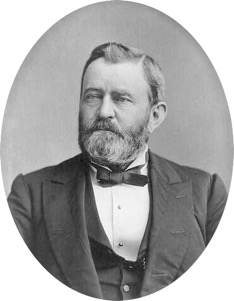
Although often cast as a scandal-marred president following his glorious military career as overall commander of the winning Union armies in the Civil War, Ulysses Grant does deserve credit for the role he played in African American civil rights during his eight years in the White House. Under Grant’s determined oversight, Black citizenship was allowed to gain a foothold in the South (Library of Congress Prints and Photographs Division—Reproduction Number LC-USZ62-79351).
With what Goldenberg termed a “methodical approach” throughout his first term, Grant was responsible for the “relative stability” of this “unprecedented time in American history.” While striving to maintain “sectional peace,” he had to do so without enacting policies that would put the Republican Party in political jeopardy. Nonetheless, under his watch, the Enforcement Acts of 1870 and 1871 and the Ku Klux Klan Act of 1871 granted the federal government “unprecedented power to protect Black Americans.”9
Standing in stark contrast to the administration of Johnson, Grant’s embrace of Black America ushered in a time of change, at least temporarily, and nothing exemplified that change more than the presence of African American officeholders populating courthouses and statehouses throughout the South and even the national capitol. Philip Dray’s book Capitol Men memorializes this unique group of Black officeholders, who filled local positions like county tax assessor and sheriff, all the way up to two Black Southern senators, Mississippi’s Hiram Revels and Blanche Bruce (when state legislatures still decided U.S. senators), as well as seven Southern Black congressmen between 1870 and 1877. Dray even related how South Carolina, the birthplace of Southern secession, would hold its convention to write a new, post-war state constitution with 77 of its 124 total delegates being Black, and how it would become one of three Deep South states, along with Mississippi and Louisiana, to send mostly African Americans to Congress during the Reconstruction years.10
Along with the Freedmen’s Bureau, which had been set up to assist the newly freed slaves with their transition to emancipation, another private organization begun in the North during the war, the Union League, also came to the aid of the freedmen in their conversion to citizenship, helping them with land and labor issues. Aligned with the Republican Party, it was a springboard for identifying capable Southern Blacks for government service, mostly charismatic men who largely came from the African American clergy … ministers like South Carolina’s Richard “Daddy” Cain, who would serve one term in the State Senate and two in the U.S. House between 1868 and 1879. Despite real strides in universal education for Southern Whites as well as Blacks during Reconstruction, including the first public schools in the South and the first historically Black colleges, as well as “the forging of Black political know-how and leadership,” according to Dray, the brief, approximately eight-year run of African American officeholders would end when federal intervention in local politics became too much for Northern voters to stomach or stay involved with once national attention became diverted by things like the Panic of 1873.11
Meanwhile, in addition to the triumph of Radical Republicanism in the Reconstruction process of the mid– to late 1860s, the popular, eight-year presidency of Grant with his pro–African American support system, and the brief surge of Black officeholders in the South during his administration, there were a number of other Southern developments resulting from the aftermath of the Sumner-Johnson, congressional-presidential political warfare. Among those with lasting significance was the very necessary economic offshoot of slavery—sharecropping—as a new labor arrangement was needed to accommodate both post-war Southern landowners and the newly emancipated slaves in their sudden need for personal income and a means of family sustenance. Another was growing Southern White resistance to what had been deemed Negro rule, which could be any situation that reminded Whites of the suddenly equal standing of African Americans in their midst. Also, the influx of Northern businessmen, speculators, and opportunists in the South, the so-named “Carpetbaggers,” who were initially welcomed because of the much-needed, post-war financial capital they contributed, before becoming demonized for their unexpected influence in local politics and economies. There were the previously mentioned Black Codes, colluded restrictions by Southern Whites designed to keep African Americans economically dependent and later to curtail political or judicial participation, as well as secret societies like the Ku Klux Klan and others that introduced organized terror to the Southern landscape in an effort to intimidate Black citizenship through group violence under the cover of darkness and disguise. And ultimately, out of the tragedy of Reconstruction lasting such a short time, there was the emergence of the so-called “Lost Cause” mentality, the South’s mythical attachment to the defeated Confederacy and its heroes despite its connection to slavery. Memorialized and past down from generation to generation of White Southerners, it relentlessly re-enforced institutional segregation of the races as the accepted (and preferred) Southern way of life for decades.12
According to H.W. Brands in American Colossus, following the presidential election (and bargain) of 1876, the former White ruling classes of the South almost immediately regained political power in a takeover and backlash proudly referred to as “Redemption.” The White North basically stood aside to better consolidate the country and restart economic prosperity in the coming age of industrialization and technological advancement. That would be priority numero uno for both the Republicans and Democrats in the last quarter of the 19th century. Of that same time, Jon Meacham would acknowledge: “The post 1877 period was bleak” for Southern Blacks. He would also quote a former slave, who said, “The whole South—every state in the South—had got into the hands of the very men who held us as slaves” and that’s how it would remain until another Washington war to be covered later in this book—one involving another President Johnson, but that one on the side of civil rights.13
1. Eric Foner, Reconstruction, 532–533; Philip Dray, Capitol Men, xiii; F. Martin Harmon, Presidents by Fate, 183; David Herbert Donald, Lincoln, 314; Barry M. Goldenberg, The Unknown Architects of Civil Rights, 4, 91.
2. Barry M. Goldenberg, The Unknown Architects of Civil Rights, 89, 91; William DeGregorio, The Complete Book of U.S. Presidents, 97–98, 271–272, 284–286; Eric Foner, Reconstruction, 576; Martin Kelly, “Presidents Elected Without Winning the Popular Vote,” thoughtco.com, August 5, 2019; Kenneth C. Davis, Don’t Know Much About the American Presidents, 297–298.
3. Kenneth C. Davis, Don’t Know Much About the American Presidents, 298; Eric Foner, Reconstruction, 582.
4. Barry M. Goldenberg, The Unknown Architects of Civil Rights, 89.
5. Ibid., 89, 95.
6. Ibid., 54, 56, 60.
7. Ibid., 49, 51, 53.
8. Ibid., 45, 49, 57–59.
9. Ibid., 61–62.
10. Philip Dray, Capitol Men, 57, 64, 65, 188; Eric Foner, Reconstruction, 39, 40.
11. Eric Foner, Reconstruction, 145; Philip Dray, Capitol Men, xi, 36, 40, 64; Elwood Watson, “Richard H. Cain,” blackpast.org., January 18, 2007.
12. Eric Foner, Reconstruction, 106–108, 137–138, 199–201, 342–343; “Reconstruction: The Second Civil War,” PBS-American Experience video, 2004.
13. H.W. Brands, American Colossus, 390, 432, 436; Jon Meacham, The Soul of America, 68.