
Section Five
13
On November 2, 1948, one of the biggest upsets in American political history took place. Missouri’s Harry Truman, the “stand-in” president who had followed the four-time elected and hugely popular Franklin Delano Roosevelt into the White House only because he had been vice president at the time of FDR’s death (April 12, 1945), was re-elected in a presidential campaign for the ages—one in which he was given no chance. Truman’s come-from-behind victory over New York’s Republican Governor Thomas Dewey was unlikely for a number of reasons. In the first place, the plain-spoken Truman was an improbable successor to the polished, Harvard-educated FDR, whose hopeful, progressive agenda during the Great Depression and World War II had rallied the country in ways not duplicated before or sense. But the need to balance the Democratic ticket of 1944 with a moderate from Middle America like Truman rather than the liberal Henry Wallace, FDR’s incumbent vice president and preferred running mate, elevated the “Show-Me State” senator at the last minute to the VP position—a job he really did not want and repeatedly tried to decline. Only FDR’s direct appeal in the face of party dissension over retaining Wallace finally convinced Truman to get on board, even as rumors of the President’s increasingly fragile health began to surface.1
So, when Roosevelt, generally considered one of the top three presidents of all-time, did indeed suffer a fatal cerebral hemorrhage only a month into his fourth term, his new and little-known vice president became the last of our presidents to ascend to the White House without benefit of a college education. As summed up in the book The American Senate: “Truman seemed a sorry substitute for Franklin Roosevelt. He had none of FDR’s debonair nonchalance, his persuasive eloquence, or grand manner. He had none of Roosevelt’s arrogance either or his political guile.” What Truman did have, however, was a great deal of common sense and plain-spoken honesty. The late, great journalist and author David Halberstam once described him as a “decisive man” and “easy to underestimate.”2

Taking over for the hugely successful Franklin Delano Roosevelt as president in 1945, Harry Truman seemed an unlikely replacement. Already a more moderate vice-presidential replacement when he was made FDR’s fourth term running mate in place of the liberal incumbent, Truman had to learn on the job as World War II wound to a close and the Cold War against the Soviet Union heated up (Library of Congress Prints and Photographs Division—Reproduction Number LC-USZ62-98170).
Such qualities allowed him to pick up the gauntlet left by FDR without overcompensating in an attempt to measure up by bringing World War II to a successful close. In so doing, he made a world-changing decision to drop the first atomic bombs on Japan as a means of ending the war sooner with less American lives lost; he completed FDR’s vision of a United Nations organization to try and limit future international conflict, avoiding the American tendency towards isolationism following overseas involvement that had been obvious in the Senate denial of Wilson’s League of Nations; and he was proactive in his approach to the Cold War with the Soviet Union (formerly Russia) by rebuilding European democracies and seeking to contain the spread of communism in devastated or developing countries through establishment of his Truman Doctrine and the European Recovery Act that became known as the “Marshall Plan.”3
All of these early, first term achievements are made even more impressive by considering what his primary biographer, David McCullough, claimed in his 1992 Pulitzer-winning masterwork, Truman, when he wrote: “In just [his first] three months [in office], Harry Truman had been faced with a greater degree of history, with larger, more far-reaching decisions than any president before him”—a bold claim to be sure made even bolder as McCullough included both Abraham Lincoln, with the impending Civil War starring him in the face, and FDR in the midst of the nation’s worst economic disaster. “Forthright to the point of bluntness,” was how Walter Isaacson and Evan Thomas characterized Truman in their book The Wise Men about the six U.S. diplomats primarily responsible for America’s Cold War diplomacy. According to them, following the “haughty air” and self-assuredness of Roosevelt, it took Americans some time to get used to the “righteous indignation of President Truman.” Far more reliant on his advisers when it came to foreign policy than FDR, Truman was a surprisingly steady, resolute leader early on, including his participation as Roosevelt’s replacement at the Potsdam Conference, which was held in a suburb of the defeated German capital (Berlin), where he had every intention of continuing to negotiate in good faith with the Soviet Union, treating it as the ally it had been during the war. In addition, his decisive use of the atomic warheads at Hiroshima and Nagasaki to end the war in the Pacific and spare American lives that otherwise would have been lost in an invasion of the Japanese homeland, set the U.S. apart as the world’s lone superpower (at least for the time being). At Potsdam, British Prime Minister Winston Churchill, FDR’s famous partner in Allied leadership during World War II, judged Truman “a man of immense determination.” In addition, after the new president made known his Truman Doctrine and the Marshall Plan in response to attempted communist intrusion in Greece and Turkey, and as war debts forced Britain to abandon more than four decades of leadership in the Eastern Mediterranean, Churchill would write to him to say how much he appreciated what had been done “for peace and freedom,” and how his presidency had become “the one cause of hope in the [post-war] world.”4
Relying on the grasp of world affairs of General George C. Marshall, one of FDR’s most trusted confidants as Army chief of staff during World War II, Truman would first bring the general out of retirement as a special envoy to the nationalist government in China during its battle to avert communist takeover and later make him secretary of state, ultimately confirming his Cold War importance by virtue of his namesake Marshall Plan. Also central to Truman’s expanding strategy of challenging the spread of communism with economic aid to European countries decimated or in jeopardy of succumbing to socialism was Dean Acheson, one of the six “architects of the American Century” featured in the previously mentioned book by Isaacson and Thomas. A product and prodigy of the Eastern elite, including Yale University and Harvard Law School, he may have been more responsible for the Truman Doctrine than the President himself and as responsible for the Marshall Plan as the secretary of state he previously served under before Truman elevated him to head of the State Department. Marshall, Time magazine’s two-time Man of the Year (1943 and 1947), had actually retired a second time and been called back again by the President to be secretary of defense, when a controversial predecessor in that role had to be replaced over an unprecedented “Revolt of the Admirals.” That so-named uprising among naval leadership was prompted by the National Security Act of 1947, which reorganized the U.S. military in lieu of the tremendous debt incurred during World War II, leading the Navy’s leadership to assert its funding should not be cut in order to offset development of the Air Force as a separate service instead of its wartime status as the Army Air Corps.5
Although regarded by the President as irreplaceable members of his administration as the Cold War heated up and other foreign developments took place (for instance U.S. recognition of the new Jewish nation of Israel in the Muslim dominated and formerly British mandated area of Palestine), both Marshall and Acheson would become targets of criticism in Truman’s second term. In Republican circles, Marshall was already being blamed for China becoming the world’s second major communist country due to his perceived lack of oversight as World War II drew to a close, and Acheson was among the most disliked officials in post-war Washington, where his often aloof demeanor and what Isaacson and Thomas described as his equal “contempt for ignorance and congressmen” made him a logical GOP target.6
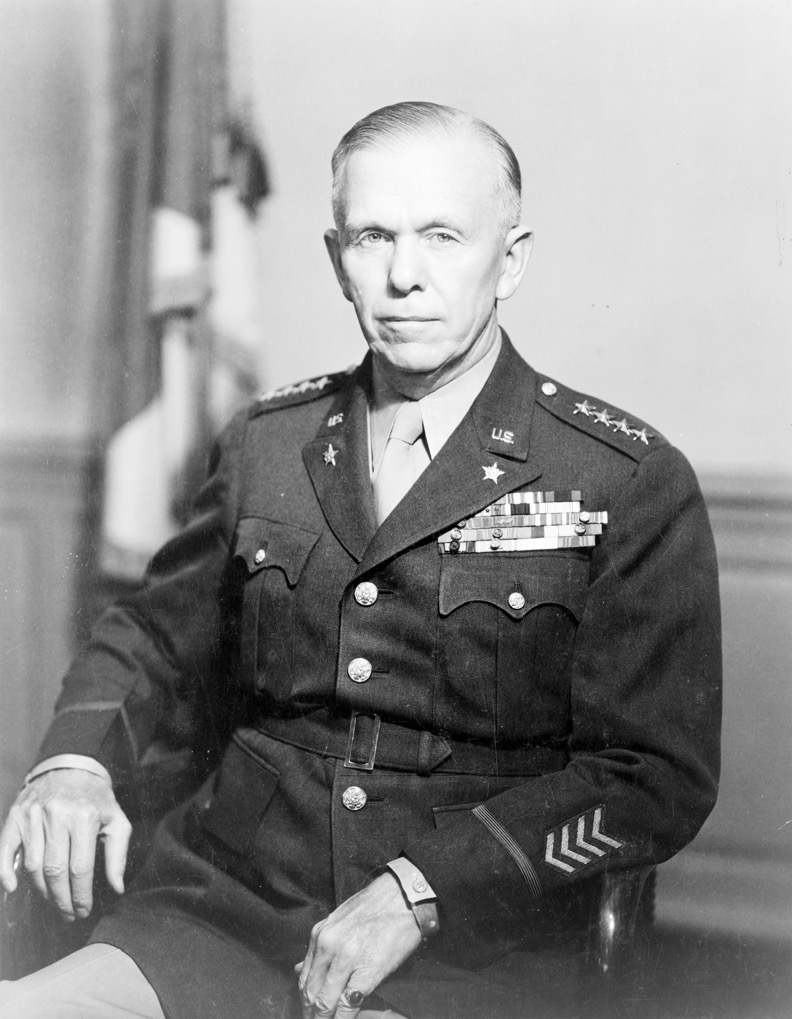
A mainstay of the Allied effort during World War II, General George Marshall would become just as important as a statesman after the war, serving Truman as both secretary of state and later secretary of defense. Despite his five-star military service and post-war achievements, including the European Recovery Act also known as the Marshall Plan, he would become a target for Republican criticism (Library of Congress Prints and Photographs Division—Reproduction Number LC-USZ62-119186).
At the same time, Truman’s own stock had begun to drop since being the common, every-man successor the country had rallied around when he manfully assumed the great responsibility that FDR’s death had cast upon him. Since bringing another world war to a close with his decisive decision to decimate America’s reviled attacker, Japan, and positioning the U.S. as the world’s democratic leader, the soldiers were coming home and the country was ready to enjoy the fruits it felt were warranted by having been the “Arsenal of Democracy” for four years. With the Great Depression and war finally over, the desire to live in the “Land of Opportunity” was again on American minds and no one was under more pressure from those expectations than the President. By 1946, less than a year after Japan’s surrender, work stoppages consumed the country as U.S. workers decried their sacrifices of the previous four years and anticipated a bigger slice of the American pie. Labor support remained key to the Democratic Party, but as coal miners and railway workers instigated simultaneous strikes, Truman threatened to use the Army to seize the railroads and the mines, and to draft strikers back into the armed services in peacetime. This time, however, such decisive action was deemed a bit too far in the land of the free, as the Christian Science Monitor plaintively asked the question, “is this Russia or Germany?” with both Democrats and Republicans combining to crush the President’s dramatic proposal in the Senate by a vote of 70–13.7
“Unlike FDR and so many FDR mourners,” according to David Pietrusza in what would be his book on the presidential election of 1948, “Truman did not wear his liberalism on his sleeve.” Already he had replaced the liberals’ “sainted” Wallace in 1944 and with FDR gone and the war completely over, many of those FDR loyalists now began to turn on the President so much, in fact, that talk of replacing him with Wallace in ’48 became prevalent following his failed attempt to control labor.8
Also, as the grandson of slaveholders and son of Southern sympathizers living in rural Western Missouri from whence the pro-slavery Border Ruffians of Bleeding Kansas days had come, “the White South felt confidant,” Truman, as president, “would be sympathetic to its racial code,” when he replaced the obviously more liberal Roosevelt. William Leuchtenburg authored a book about such White Southern concerns and the three mid–20th century Democratic presidents who tried to move past them in The White House Looks South. Southern Blacks were just the opposite. Although Truman’s voting record during his Senate days had been surprisingly pro-civil rights, African Americans found his sudden ascension “unsettling” and most believed him “a Negro hater,” based on where he came from, according to Leuchtenburg. Both Southern groups had to be equally surprised when Truman asked Congress to again fund the Fair Employment Protection Committee (FEPC) and when he announced he would be creating a President’s Committee on Civil Rights (PCCR). Their collective surprise was then turned to shock when he desegregated the U.S. military and all federal employment by executive order.9
Once again according to Pietrusza, the political “timing” in both circumstances “revealed remarkable calculation” on his part when the Democratic Party became a party in revolt. As the 1948 Democratic National Convention neared, left-leaning party regulars, including FDR’s sons, had sought to enlist popular General Dwight Eisenhower, World War II’s overall Allied commander in Europe, as a replacement candidate for Truman, while Southern Dems, angry over the President’s recent actions in support of civil rights jumped on the conservative candidacy of powerful Georgia Senator Richard Russell. Both efforts failed, however, with Eisenhower declining (only to run as a Republican four years later) and Russell failing to gain any traction outside the South and losing on the first ballot to Truman, who rallied delegates with what one historian termed “a two-fisted attack” on the Republicans now holding a majority in Congress (what he termed the “Do-Nothing Congress”), while also threatening to call a special congressional session to address a series of progressive bills, including slum clearance, low-cost housing, and the extension of FDR’s popular Social Security Act. From lackluster, care-taker candidate, “Give ’em Hell Harry” was suddenly born and the convention hall in Philadelphia, by all reports, was “electrified.”10
Truman would go on to stage a determined 30,000-mile “whistle-stop” campaign by train in which he delivered more than 300 outspoken speeches to an estimated six million people, but he remained a decided underdog. Not only was he going against a young, polished Republican opponent in Governor Dewey, who was running for a second time after losing to the FDR-Truman ticket four years earlier, but Wallace also filled a void for the most liberal Democrats by getting his own name on the ballot in 45 of the then 48 states, while Southern Democrats or “Dixiecrats,” as they were called, coalesced around Strom Thurmond, the segregationist governor of South Carolina. Indeed, with three Democrats in the running, potentially splitting the party three ways, it was very reminiscent of the 1860 election of Abraham Lincoln. Truman’s fate seemed all but sealed. Dewey was supremely confident and campaigned on a vague theme of national unity and an end to what he called the “waste and inefficiency” of Democratic rule the previous 16 years.11
Amazingly it was not to be. Truman’s aggressive fighting style in the face of extremely long odds convinced enough of the country that he should be re-elected. He garnered 49 percent of the vote to Dewey’s 45 percent, while the insurgent campaigns of Wallace and Thurmond managed just two percent each. As mentioned before, it was a stunning upset. Despite the pre-election polls and pundits giving him no chance, Truman continued to believe he could and would win, and in the end not only won himself, but also carried the Senate and House races with him, flipping both from Republican majorities to Democratic control. Even most of the governors’ mansions were left in decidedly Democratic hands.12
As a result, to say Harry Truman entered his second term on a high note would be an understatement. McCullough, his chief biographer, would write:
The country was flabbergasted. It was called a “startling victory,” “astonishing,” “a major miracle.” He had won it against the greatest odds in the annals of presidential politics. Not one polling organization had been correct in its forecast. Not a single radio commentator or newspaper columnist, or any of the hundreds of reporters who covered the campaign had called it right. Every expert had been proven wrong and, as was said, “a great roar of laughter arose from the land.” The people had made fools of those supposedly in the know. Of all amazing things Harry Truman had turned out to be (he was) the only one who knew what he was talking about.13
His victory had come against the backdrop of the aptly named “Berlin Airlift,” which he began along with the British as a means of not allowing Soviet held East Germany to cut off supplies from the Allied western sector of Germany’s capital city once the fighting stopped—what McCullough described as “one of the most brilliant American achievements of the post-war era and one of Truman’s proudest decisions, strongly affecting the morale of Western, non-communist Europe, the whole course of the Cold War, and his drive for re-election.” In keeping with the Truman Doctrine and Marshall Plan, his decision to fly supplies into West Berlin, rendering the surrounding Soviet blockade irrelevant, was yet another example of his desire to contain communism without confronting it militarily, giving the world and particularly Europe a chance to recover from the carnage and devastation of World War II. And with FDR’s visionary United Nations still in its diplomatic infancy, he would continue to utilize deterrence in the hope of avoiding future conflict in April 1949. That’s when 12 nations under the leadership of his administration created the North Atlantic Treaty Organization (NATO) as a bulwark against further expansionist aims of the Soviet Union on the European continent (as most of Eastern Europe was already under Soviet control by war’s end). With Marshall, by then between stints as secretary of state and secretary of defense, Acheson deserved most of the credit for negotiating the NATO defense pact, whereby an attack, Soviet or otherwise, on any of the 12 member nations would be treated as an attack on all—a deterrent that at this writing had lasted over 70 years.14
The Truman Doctrine; the Marshall Plan; the Berlin Airlift; the North American Treaty Organization; a history-making come-from-behind re-election victory that included majorities in both Houses of Congress; and sole possession of the world’s most powerful weapon. Obviously, President Truman and his administration had enjoyed a glorious run of achievements by the summer of 1949, but their string of accomplishment was on the verge of an abrupt end.15
Along with the previously mentioned communist takeover of China, that fall would bring proof of the Soviet Union’s detonation of their own atomic weapon, stunning America’s sense of security with the realization that suddenly there was another superpower. And as the calendar changed to a new decade, 1950 dawned with new accusations—charges of communist infiltration in the Truman administration by congressional Republicans, an attention-getting mechanism that provided front page headlines for weeks and one that continued even when overshadowed by other news four months later. That’s when a surprise attack—equally surprising to the Japanese attack on Pearl Harbor nine years earlier that ushered America into the Second World War—occurred on the Korean Peninsula. North Korea, the communist controlled half of that East Asian appendage invaded its southern neighbor, South Korea, on June 25, 1950, initiating the kind of ideological military confrontation Truman had hoped to avoid. Some 90,000 soldiers—more than seven infantry divisions and one armored brigade of the North Korean People’s Army—crossed the 38th parallel and drove south in “an extremely well-planned, multi-pronged attack.” That’s the very simple way Halberstam described the start of the Korean War in his 2007 book The Coldest Winter. Following a United Nations mandate to expel the North Koreans engineered by Truman the “Korean Conflict,” as it became known, would last three years (1950–1953) and eventually involve China, which also surprised U.S. military leadership by entering the war when American troops got too close to its border with North Korea, yet another massive headache for Truman as he sought to minimize the chances of a third world war and especially the threat of an atomic war between superpowers. As a result, Korea would be termed a “police action,” not a war at all in the official administration lexicon of the day, but until the North Koreans and later the Chinese were pushed back within their original borders, it would cost the lives of over 33,000 Americans before ending in stalemate—thankfully without the use of any more atomic bombs.16
In the meantime, despite all its efforts to avoid military conflict at any Cold War flashpoints left over from World War II, the Truman administration was finally forced to deal with an armed invasion of localized origin that threatened global consequences, while back on the home front another equally insidious attack was underway on the President and his government. To address this other, domestic threat as early as 1946, Truman had established a Temporary Commission on Employee Loyalty to facilitate the removal of security risks from sensitive federal jobs. With communism making inroads around the world, however, Republicans in Congress had “criticized him [even then] for not going far enough.” That implication, acknowledged by presidential historian William DeGregorio, presaged the coming storm that would be called the “Red Menace” or, more appropriately, the “Red Scare.”17
The fear of communism had indeed come home to roost and not just on the battlefields of a little known or previously considered peninsula on the other side of the world, where localized ideological warfare had evolved into American soldiers suddenly being confronted by Communist Chinese. In 1949, in fact, a year before North Korea attacked its more democratic southern neighbor, a former member of the Communist Party in America and a former editor at Time magazine, Whitaker Chambers, alleged that one of the original Justice Department attorneys from FDR’s first term, Alger Hiss, who had gone on to work at the State Department as director of the Office of Special Political Affairs and as secretary-general of the United Nations Conference on International Organization, was, in all probability, a Soviet spy. Into the vortex created by this very public allegation by an admitted former communist stepped the first of several political opportunists, relatively new California Congressman Richard Nixon, who, as a member of the House Un-American Activities Committee, knew an attention-grabbing issue when he saw one and pounced, understanding the lofty political aspirations that could be realized by pursuing (and perhaps proving) such a case. Later, as Nixon biographer Rick Perlstein would poignantly write in regard to hidden evidence that Chambers produced and Nixon revealed, leading to Hiss’s conviction for perjury despite unwavering support and testimony from his superior at State, Secretary Acheson:
The very next day, in the most stem-winding speech of his congressional career, Richard Nixon said that Dean Acheson’s words [had been] sacrilege. Nixon called his oration “The Hiss Case—A Lesson for the American People.” The lesson was that Alger Hiss’s conviction [was an indictment] of Harry Truman himself. The Secretary of State had thrown the power and prestige of his office [and the Truman administration] behind Hiss after he had been convicted. In Nixon’s words, that was just how liberals were. They coddled traitors. They [wrongly] invoked the Holy Name to do so. They traduced Americans’ moral values.18
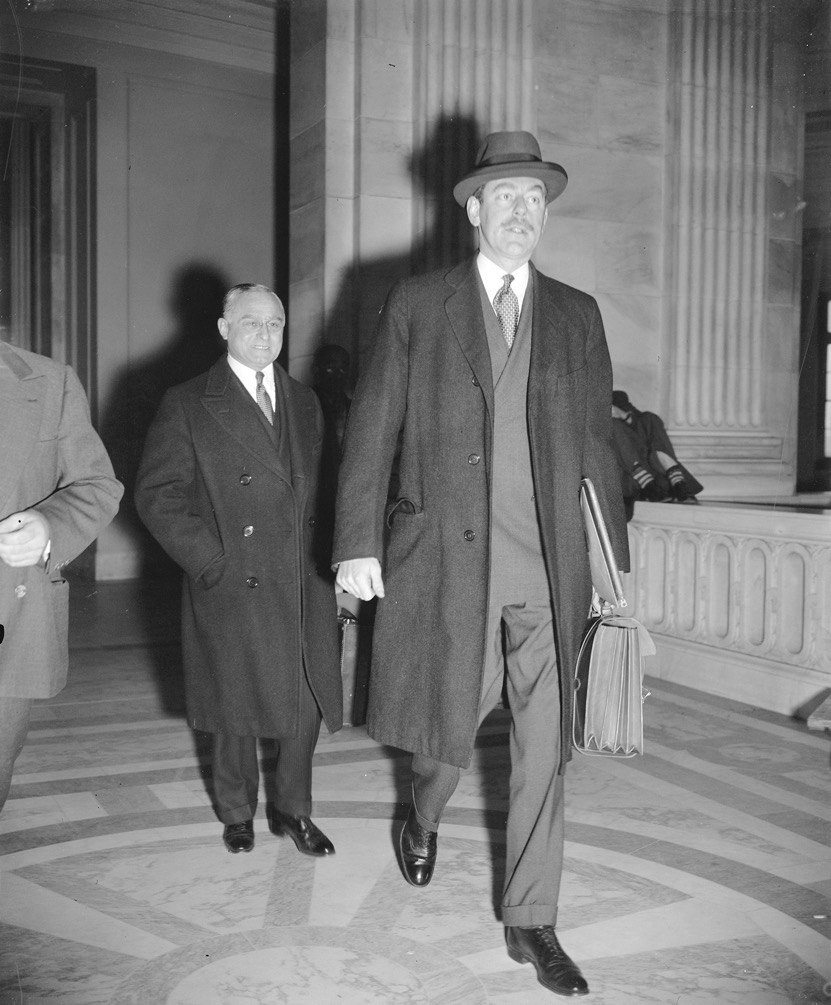
The successor to George Marshall as secretary of state, Dean Acheson emerged during the Truman years from a coalition of young American diplomats who had played roles during the Cold War aftermath of World War II. Considered arrogant by the political right, his testimony in the Alger Hiss perjury trial would be held against him as claims of communist infiltration in his State Department intensified (Library of Congress Prints and Photographs Division—Reproduction Number LC-DIG-hec-25820).
It would be the opening salvo in a concerted Republican effort to uncover more communists in the Truman administration and it set the stage for the launch of a senatorial witch hunt like no other in American history. Unwittingly, in making a name for himself within the Republican ranks (which he obviously did by becoming Dwight Eisenhower’s vice-presidential running mate in 1952), Nixon illuminated a potential pathway to prominence that appealed to one Joseph R. McCarthy, the junior senator from Wisconsin. On February 9, 1950, just two weeks after Hiss was sentenced to five years in prison, the third year U.S. senator borrowed large tracts of Nixon’s congressional address in a speech he would give in Wheeling, West Virginia. With midterm elections already on the minds of the Republican minority and Nixon’s use of what noted historian Jon Meacham termed “domestic fears of communist influence” in his Soul of America, McCarthy delivered what the Wheeling Intelligencer called a “homey” address to 275 people at the McClure Hotel as part of a Lincoln Day celebration. Seemingly out of nowhere at this intimate small town gathering, McCarthy suddenly injected, “While I cannot take time to name all the men in the State Department who have been named as active members of the Communist Party and members of a spy ring, I have in my hand a list of 205 that were made known to the secretary of state as being members of the Communist Party and who, nevertheless, are still working and shaping policy in the State Department.”19 Suddenly, that same Wheeling Intelligencer had gone from covering a feel-good, local story to a block-busting national exclusive.
Of that same moment in another of his exceptional books before he was killed in a tragic 2007 automobile accident, Halberstam would write:
The McCarthy era was about to begin. Joseph R. McCarthy, Republican senator from Wisconsin, stepped forward to lend his name to a phenomenon that, in fact, already existed. He was the accidental demagogue. Almost casually, he claimed that there were communists in the State Department and that they controlled American foreign policy. As one of the reporters who knew him well noted later, McCarthy himself had no idea his speech would prove so explosive. Otherwise, he would have taken along at least one of the handful of right-wing reporters who tutored him. Also, he would have picked a bigger town than Wheeling and a more prominent group than the Ohio County Women’s Republican Club. His line about communists in the State Department was [actually] a throw away, but that began it. Later that night, Noman Yost, who worked as a stringer for Associated Press, phoned in a few paragraphs to the AP office in [West Virginia’s capital] Charleston. The story moved over the AP wire on a Thursday night and made the Friday papers. The circus had begun.20
For President Truman, new Secretary of State Acheson, and former Secretary of State Marshall, a new and bitter nemesis was created with that AP story, a nemesis who would rise to so much prominence on the notion of communist infiltration of our federal government and what he called “20 years of treason” in the last two Democratic presidential regimes that a derivative of his name “McCarthyism,” would become synonymous with the Red Scare. Not the first Republican to profit politically from such propositions (as future President Nixon’s meteoric rise attested), Senator McCarthy would nonetheless make a name for himself without ever producing a shred of evidence and become one of the earliest right-wing heroes. Anthony Summers, a biographer of controversial FBI Director J. Edgar Hoover attested to as much despite the “bogus” nature of the accusations McCarthy would make over the next four years in a disgustingly profound way, when he quoted a reputedly inebriated McCarthy boasting to a gathered group of reporters shortly after his West Virginia speech: “Listen you bastards, I just want you to know I’ve got a pail full of this shit and I’m gonna use it where it does me the most good.” And after he had flushed it “on an America [already] awash with [the] fear of communism,” U.S. politics would never be the same.21
1. David McCullough, Truman, 292, 298–299; Robert H. Ferrell, The Dying President: Franklin D. Roosevelt, 1944–45, 27, 76–78; William DeGregorio, The Complete Book of U.S. Presidents, 495, 512, 513, 514–515.
2. William DeGregorio, The Complete Book of U.S. Presidents, 503; Richard A. Baker and Neil MacNeil, The American Senate, 115–116; Kenneth C. Davis, Don’t Know Much About the American Presidents, 458; Tom Murse, “Presidents Without College Degrees,” thoughtco.com, June 26, 2019; David Halberstam, The Coldest Winter: America and the Korean War, 202–203.
3. William DeGregorio, The Complete Book of U.S. Presidents, 518–519.
4. David McCullough, Truman, 741–742; F. Martin Harmon, Presidents by Fate, 137; Walter Isaacson and Evan Thomas, The Wise Men: Six Friends and the World They Made, 256.
5. David McCullough, Truman, 741–742, 798; Jeffery Barlow, Revolt of The Admirals: The Fight for Naval Aviation, Kindle; John T. Correll, “The Revolt of The Admirals,” Air Force Magazine, May 29, 2018.
6. Forest C. Pogue, George C. Marshall, Statesman, 422; Walter Isaacson and Evan Thomas, The Wise Men, 465–466.
7. David Pietrusza, 1948: Harry Truman’s Improbable Victory and the Year that Transformed America, 53, 55.
8. Ibid., 55, 288.
9. David McCullough, Truman, 27–28, 53; William E. Leuchtenburg, The White House Looks South: Franklin D. Roosevelt, Harry S. Truman, Lyndon B. Johnson, 147–156, 161, 162, 163, 165, 178.
10. David Pietrusza, 1948, 288; William DeGregorio, The Complete Book of U.S. Presidents, 513–514; Richard A. Baker and Neil MacNeil, The American Senate, 115.
11. Richard A. Baker and Neil MacNeil, The American Senate, 493, 513, 514.
12. Ibid., 515; David Pietrusza, 1948, 362–364, 393, 397, 399.
13. David McCullough, Truman, 710.
14. Ibid., 630–631, 734–735; Kenneth C. Davis, Don’t Know Much About the American Presidents, 460.
15. Kenneth C. Davis, Don’t Know Much About the American Presidents, 461.
16. Ibid., 456–457; David Halberstam, The Coldest Winter: America and the Korean War, 4, 47; William DeGregorio, The Complete Book of U.S. Presidents, 520.
17. William DeGregorio, The Complete Book of U.S. Presidents, 520.
18. Walter Isaacson and Evan Thomas, The Wise Men, 466–467; Rick Perlstein, Nixonland: The Rise of a President and the Fracturing of America, 33.
19. Rick Perlstein, Nixonland, 33; William DeGregorio, The Complete Book of U.S. Presidents, 537, 586–587; Robert Halberstam, The Fifties, 49; Jon Meacham, The Soul of America, 186.
20. Robert Halberstam, The Fifties, 49.
21. William DeGregorio, The Complete Book of U.S. Presidents, 520; Anthony Summers, Official and Confidential: The Secret Life of J. Edgar Hoover, 178.