
14
“National bonfire” was the way Lyndon Johnson’s award-winning biographer Robert Caro described what Joe McCarthy ignited in early 1950. In his book, Master of the Senate, Caro described “a bonfire that was to consume or sear the reputations of thousands of innocent Americans, blazing for four years and 10 months, a period longer than America’s participation in the Second World War.” But who was the rogue senator that started this blaze? And how did he maintain membership in the nation’s loftiest legislative body while making destructive accusations that would sully the nation’s leadership without proof? Robert Sherrill, one of the leading investigative journalists of that era, called him “the most influential demagogue the United States has ever produced,” and although that is no longer true, it certainly was in 1950.1
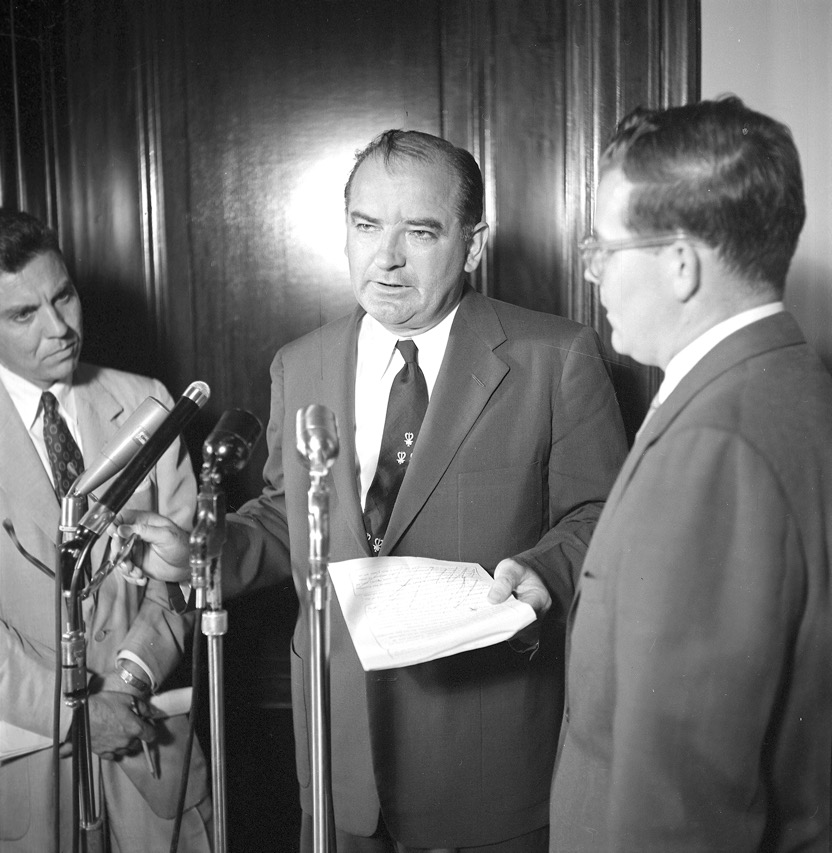
A relative unknown his first few years in Washington, Wisconsin Senator Joseph McCarthy would become a household name in American politics when he began making claims of communist infiltration of the U.S. State Department. Along with President Truman, George Marshall and Dean Acheson would become primary targets of the McCarthy accusations (Library of Congress Prints and Photographs Division—Reproduction Number LC-DIG-ds-07186).
“Shrewd, insecure, and defensive,” as David Halberstam described him in his book The Fifties, McCarthy was of “poor, Irish stock from the wrong side of the tracks” in Appleton, Wisconsin. He put himself through college in-state, attending Catholic, Marquette University in Milwaukee and finishing with a Law degree in five years. After working for a year at a small law firm in Shawano, Wisconsin, he ran for district attorney as a Democrat in 1936 and lost. In 1939, he ran again for an elected judgeship in his home state’s 10th Circuit and defeated the incumbent, who had held the position for 24 years, by reputedly exaggerating his opponent’s age. As controversial on the bench as he would later be in the Senate, he was censured in 1941 for misplacing evidence. Less than a year later he entered the Marine Corps as a first lieutenant, thanks to his college work qualifying him for a direct commission, and he would serve in World War II as an intelligence briefing officer for a dive bomber squadron based in the South Pacific for 30 months, exiting with the rank of captain in April 1945. A volunteer for 12 combat missions during the war as a gunner-observer, he would acquire what many believed the self-conferred nickname “Tail-Gunner Joe” by the time he left the service, and somehow receive a Distinguished Service Cross by falsely claiming 32 aerial missions on his wartime resume.2
Putting such personal propaganda to use even before the war was over, he campaigned unsuccessfully for a Republican nomination to the U.S. Senate while still on active duty in 1944 but was simultaneously re-elected unopposed to his old seat on the circuit court. Almost immediately after those results were in, he set his sights on Wisconsin’s other Senate seat in 1946 and through the support of the state’s Republican boss, Thomas Coleman, he achieved that primary victory by unseating Robert M. La Follette, Jr., the three-term Republican incumbent and son of Robert M. LaFollette, Sr., one of the most renowned politicians in state history.3 With Coleman’s backing, McCarthy attacked the younger La Follette for not enlisting in the wartime military, even though he was 46 years old at the time, and for war profiteering through the stock market. McCarthy’s campaign funds, most of which came from out-of-state, were also 10 times those of La Follette and contributed to his upset victory by just over 5,000 votes. Then, in the general election, McCarthy hammered his Democratic opponent with a convincing 62 percent of the vote to 37.3 percent.4
Rapid recovery, stunning rise, or just plain lucky … actually all three applied to Joe McCarthy as he entered the Senate in January 1947. Most pundits would say his credentials did not warrant the position, but regardless, once in the Senate, he, like all politicians, needed to be productive to stay there and as McCullough pointed out in Truman:
Until January [of 1950], Wisconsin’s 41-year-old junior senator had been casting about for an issue that might lift him from obscurity [including his stunning concern for Nazi war prisoners convicted of the infamous massacre of unarmed American soldiers at Malmedy, Belgium in WWII due to the profusion of voters of Germanic ancestry in the “Badger State”]. All but friendless in the Senate and recently voted the worst member of the Senate in a poll of Washington correspondents, McCarthy appeared a hopeless failure [by his third year on the job]. [Then] over dinner one evening, Father Edmund A. Walsh of Georgetown, a Catholic priest from one Washington’s most historic neighborhoods, suggested he might sound the alarm over communist infiltration of the government, and McCarthy, who had already made some loud, if unnotable, charges about communist subversion, seemed to have realized all at once he had found what he needed.
Suddenly he was making headlines throughout the country, claiming to have revealed “Truman’s iron curtain of secrecy.”5
Wild and unsupported though his claims were, he was making the kind of noise in the Senate that had not been seen since the days of Louisiana’s Huey Long, another so-called demagogue, but without Long’s flamboyance and charisma. Although initially a supporter of then President-elect Roosevelt when he first arrived in the Senate in 1932, the flamboyant former governor of the “Bayou State,” who was known there as the “Kingfish,” quickly unfurled his true colors in the Democratic ranks as he sought to at first influence and later usurp the New Deal policies of FDR, who once labeled Long one of the two most dangerous men in America. According to Long’s biographer, T. Harry Williams, after one showdown meeting with FDR over administration policy moving forward, Long supposedly remarked, “What the hell is the use of coming down to see this fellow? I can’t win any decision over him.” And along those same lines, he would later state: “The trouble is Roosevelt hasn’t taken all of my ideas; just part of them. I’m about one hundred yards ahead of him.”6
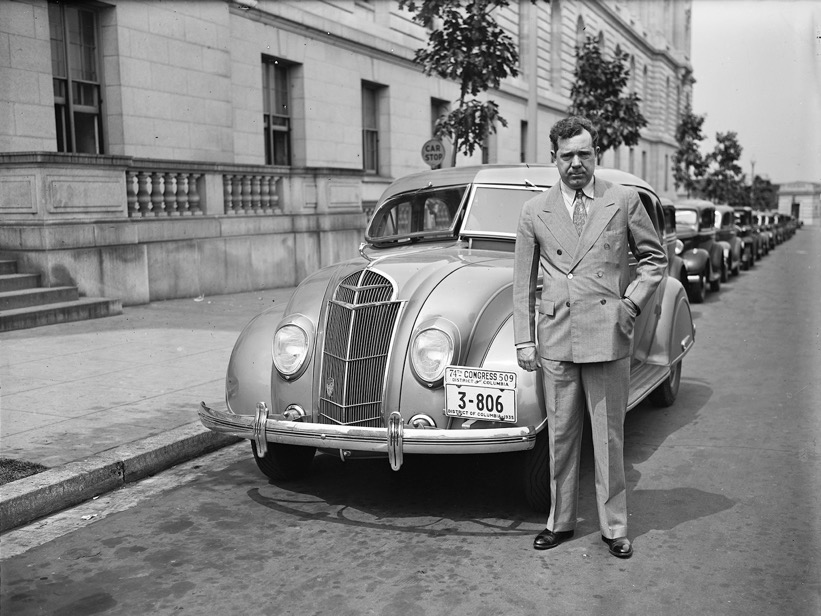
Before Joe McCarthy, the closest thing to a political demagogue in the U.S. Senate had to be Huey Long, the flamboyant former governor of Louisiana who attracted attention from the moment he arrived in Washington in 1932. An early supporter of FDR, he quickly became a potential rival for the new Democratic president, who once termed him one of the most dangerous men in America (Library of Congress Prints and Photographs Division—Reproduction Number LC-DIG-hec-38950).
While totally different, they were of the same party and Long’s initial intent was to push the President and the Democratic Party to become even more progressive in the Depression. But his true intention of stepping into presidential power himself should Roosevelt falter was clear to FDR from the get-go. As a result, FDR managed to control him politically behind the scenes and keep him in his place, rendering Long impotent on the national stage.7 On the other hand, Harry Truman would have no such power to control the Senate demagogue he and his administration would be confronted with. Instead, because they were of opposing parties, he had to hope the Republican leadership would rein in the irrational and unsubstantiated claims McCarthy was making and while at first that might have been the wishes of some GOP leaders, others, including Styles Bridges of New Hampshire, Owen Brewster of Maine, Homer Capehart of Indiana, Karl Mundt of South Dakota, and Kenneth Wherry of Nebraska began actively “egging him on.” Eventually, even Ohio’s Robert Taft, the ultra-conservative senator known as “Mr. Republican,” offered McCarthy encouragement to “keep talking.” Taft, in fact, coined the phrase “soft on communism” that became the mantra for an opposition party still angry over Truman’s surprising second term. At the same time, Democrats in Congress would press for a “complete investigation of McCarthy’s charges,” resulting in a special subcommittee under the leadership of Maryland’s Millard Tydings. The Tydings committee began hearings in March.8
The bright light of public exposure, however, only made McCarthy more magnified. When asked what evidence he had to substantiate his claims of rampant communist infiltration in the State Department, he would simply say that Acheson’s staff at State had all the evidence under wraps, basing his accusations on the existence of FBI information, even though J. Edgar Hoover, whose biographer termed McCarthy “Edgar’s protégé,” would never own up to it. Hoover, in fact, would scold the senator—not over what he had said, but the specific way he said it. Subsequently, when President Truman ordered the State Department files opened, Hoover declared them intact, prompting McCarthy to assert they had been tampered with before the FBI gained access.9
In other words, it did not matter that the Tydings subcommittee findings found that McCarthy had perpetrated a “fraud and hoax” on the Senate, the senator from Wisconsin remained unrepentant in his ongoing claims. “Basking in his new visibility,” according to Baker and MacNeil in The American Senate, he “learned the rhythms of the press, not only the daily deadlines, but the restraints of the ‘objectivity’ [the reporters] imposed on themselves.” George Reedy of United Press International observed at the time, “We had to take what McCarthy said at face value. Joe couldn’t find a communist in Red Square—he didn’t know Karl Marx from Groucho [Marx]—but he was a United States senator.” In The Fifties, Halberstam also mentioned how he became adept at making his communist claims in small towns, knowing full well the nearest Associated Press office would pick up the local story and run it without further scrutiny. And even though they knew better, as Halberstam also indicated, they were guilty of “chronicling each charge” in “his travelling road show, instead of bothering to follow up. It was news and he was news” and apparently “that was all that mattered.”10
Amid McCarthy’s litany of accusations and the Tydings hearings, Truman found time to hold a press conference on March 30 while enjoying a spring getaway at his Florida Little White House in Key West, during which he addressed the McCarthy saga. “I think the greatest asset the Kremlin has is Senator McCarthy,” he asserted. It was an accusation of aiding communism in reverse and a pre-planned strategy that the gathered scribes jumped on to report, with one exclaiming, “Brother will that hit page one tomorrow.” According to Jon Meacham in The Soul of America, the President also reminded them of the 1946 loyalty commission he had instituted as the Cold War gathered steam to identify potential subversives—a proactive policy that obviously looked good in light of McCarthy’s radioactive rhetoric.11 Making it seem nothing but politics, Truman continued:
For political purposes, the Republicans have been trying vainly to find an issue on which to make a bid for control of the Congress next year. They tried “statism.” They tried “welfare state.” They tried “socialism.” And there are a certain number of the Republican Party who are trying to dig up that old malodorous dead horse called “isolationism.” And in order to do that, they are perfectly willing to sabotage the bipartisan foreign policy of the United States. Now if anybody really felt that there were disloyal people in the employ of the government, the proper and the honorable way to handle the situation would be to come to the President and say, “This man is a disloyal person. He is in such and such department.” We would investigate him immediately and if he were a disloyal person, he would be immediately fired. [But] that is not what they want. They are trying to create an issue.12
Just over two months later, North Korea’s communist regime unleashed its surprise attack and the Korean conflict would take precedence in Truman’s presidency for the remainder of his two plus years in office. In that vein, he would repeatedly downplay the constant irritation that was McCarthy. According to McCullough, the President considered him a temporary aberration—“a ballyhoo artist who has to cover up his [own] shortcomings by wild charges.” Even before the Tydings subcommittee findings were announced, with no evidence of further communist subversion (other than the earlier Hiss case), Truman remained calm amid his staff’s worry and repeatedly voiced the expectation that McCarthy was a “liar” who would ultimately “destroy himself.” Writing to the sister of Owen Lattimore, a former State Department employee whom McCarthy had implicated as the potential “top Russian espionage agent” in the U.S. and Hiss’s one-time boss, the President wrote:
I think our friend McCarthy will eventually get all that is coming to him. He has no decency or honor. You can understand, I imagine, what [a] president has to stand [when] every day in the week he’s under a constant barrage of people who have no respect for the truth and whose objective is to belittle and discredit him. While they are not successful in these attacks, they are never pleasant, so I know just how you feel about the attack on your brother. The best thing to do is to face it and the truth will come out.13
At the same time, nothing Truman or anyone else said seemed to quell the incessant abuse and drumbeat of McCarthy’s accusations, and the resulting fear it spread through the federal government. The closest anyone in his own party came to admonishing the Wisconsin senator was a female colleague—Senator Margaret Chase Smith of Maine. Publicly acknowledging her as one of his personal heroes, historian Jon Meacham recounted an exchange between McCarthy and Chase on June 1, 1950, just 24 days before the Korean War began. At that time, Chase issued what she termed a “Declaration of Conscience,” attacking McCarthy’s methods. Confiding to another author, she stated that “Joe began to get publicity crazy and the other senators were now afraid to speak their minds [and] take issue with him, obviously for fear his communist claims might even include them—the next time. It had gotten to the point where senators were afraid to even be seen with certain people in Washington previously implicated or suspected. Smith had been on good terms with McCarthy before his communist accusations began, having even lauded her as a possible vice presidential candidate in 1952, so it was with no trepidation that he approached her before knowing what her Declaration was about and said, ‘Margaret you look very serious; are you going to make a speech today?’”—to which she replied, “Yes and you will not like it.” “Is it about me?” he inquired. “Yes,” she continued, “but I am not going to mention your name.” Frowning at this point, according to Meacham, McCarthy then reminded the first woman to serve in both Houses of Congress that he controlled 27 convention votes from the Wisconsin delegation—a warning that obviously did not faze Smith, who pushed by McCarthy and onto the Senate floor, where she famously rose and offered the following:
I would like to speak briefly and simply about a serious national condition. It is a national feeling of fear and frustration that could result in national suicide and the end of everything that we Americans hold dear. I speak as a Republican. I speak as a woman. I speak as a United States senator. I speak as an American. I think it is high time we remembered that we have sworn to uphold and defend the Constitution. I think it is high time that we remembered the Constitution speaks not only of freedom of speech, but also trial by jury instead of trial by accusation. Those of us who shout the loudest about Americanism in making character assassinations are all too frequently those who, by their own words or acts, ignore some of the basic principles of Americanism—the right to criticize; the right to hold unpopular beliefs; the right to protest; the right of independent thought.14
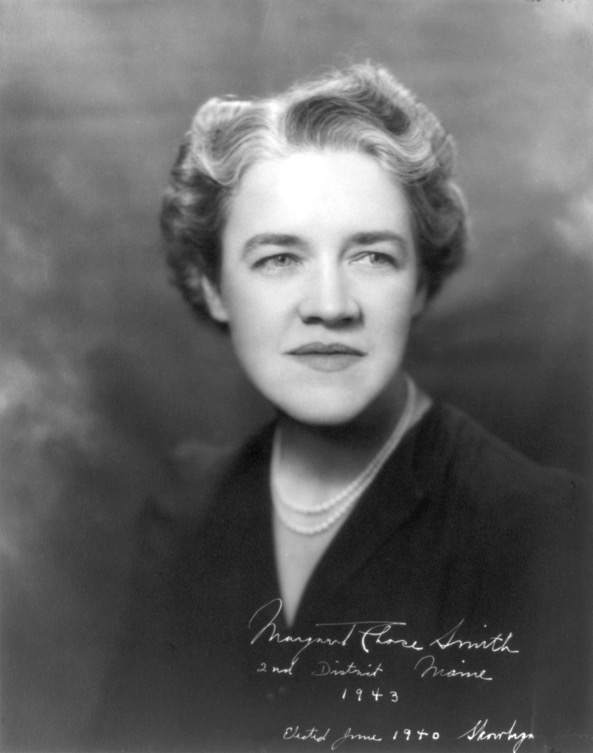
The only GOP senator to rebuke the dirty tactics of fellow Republican Joe McCarthy was also the first woman who would serve in both Houses of Congress, Maine’s Margaret Chase Smith. In June 1950, Smith famously admonished the Wisconsin senator on the Senate floor for his rejection of basic American principles (Library of Congress Prints and Photographs Division—Reproduction Number LC-USZ62-42661).
Everyone in the Senate that day knew the intended target of Smith’s rebuke, what Meacham termed being “four years ahead of most of her colleagues.” But alas, only six other senators joined her in their condemnation of the tactics being utilized by Congress’ badgering antagonist from the Badger State, and McCarthy was quick to defiantly label them “Snow White and the Six Dwarfs.” Unfortunately, other Republicans were only too willing to see where “McCarthy’s act” might take them. One, John Bricker of Ohio, supposedly even said, “Joe, you’re a real SOB, but sometimes it’s useful to have SOBs around to do the dirty work.” As for McCarthy’s in-state approval among his Wisconsin constituents at that time, Milwaukee Mayor Frank Zeidler attested, “He’s unbeatable right now. He’s a Northern Huey Long.”15
Most of McCarthy’s attacks continued to be aimed at Truman’s State Department and in particular Acheson, whose friends rallied to the Secretary’s defense. After vowing not to turn his back on the convicted Hiss, he at first felt good about his statement that day and his support for his discredited former staffer. He labeled McCarthy and his Republican backers “primitives” and “beneath contempt.” But along with Truman, he underestimated their staying power. Later he would acknowledge that his initial loyalty to Hiss had hurt the State Department and much later his wife would confide that the “attack of the primitives” had taken 10 years off his life. Meanwhile, “McCarthy’s witch-hunt,” as Walter Isaacson and Evan Thomas would term it in The Wise Men, resulted in the immediate firing of 91 employees and over the next three years the Loyalty Boards established by Truman to pre-empt right-wing attacks would end up dismissing hundreds more as security risks. Most, however, were “innocents.” Acheson manfully tried to defend his subordinates whenever possible, but as the co-authors added, “He could not afford to take a high profile and make a crusade out of protecting his underlings,” as “he was damaged goods” in the eyes of a Cold War wary public convinced that communists were lurking everywhere. By being “true to himself” and coming to Hiss’ defense, “he had exhausted his moral capital,” especially as Korea heated up and U.S. containment policy shifted from diplomacy back to the military.16
Among the more surprising supporters of Joe McCarthy was Joseph Kennedy, the wealthy former wartime ambassador to Great Britain and the father of a future Democratic president. Having himself experienced rebuke and recall for criticizing the British decision to stand alone against Germany at the start of World War II while representing the Roosevelt administration at the Court of St. James, the elder Kennedy “enjoyed McCarthy’s company” and “admired his big mouth, his outspoken confrontation with the government establishment (especially the State Department), his take no prisoners attacks on the Truman administration, and his contempt for diplomacy and decorum.” That’s according to Kennedy biographer David Nasaw, who authored The Patriarch: The Remarkable Life and Turbulent Times of Joseph P. Kennedy. Like Kennedy an Irish Catholic, McCarthy would also benefit from Kennedy money in his re-election campaign, briefly date two of Kennedy’s daughters, and even employ Robert Kennedy, the future president’s younger brother (and recent University of Virginia Law graduate) as legal counsel for his Subcommittee on Investigations. As an assistant attorney under Roy Cohn, the subcommittee’s soon-to-be infamous chief counsel, “Bobby” Kennedy would eventually have a falling out over the aggressive tactics witnesses were being subjected to in the Senate hearings and resign. He was convinced Cohn “was going to get McCarthy and everyone who worked for him in trouble.” Ironically, four years later, when the Senate finally voted to censure McCarthy by a 67–22 vote, the only Democrat absent that day who did not cast a vote against the Wisconsin senator would be Senator John F. Kennedy of Massachusetts, conveniently absent due to illness.17
Long before that vote, however, the war in Korea was front and center on a daily basis for the Truman administration. After initially doing nothing but retreat in the face of the surprise North Korean onslaught pushing south, the United Nations forces, anchored primarily by American soldiers, rallied at the southeasternmost part of the peninsula, establishing what became known as the “Pusan Perimeter.” By August 5, 1950, the retreating Americans had stopped their retreating and solidified their defenses on two sides, facing north and east with the Sea of Japan at their backs to the west and the Straight of Korea and seacoast city of Pusan behind them to the south. From there, the U.N. forces steadied themselves, repulsing repeated North Korean charges at different points along the perimeter as the enemy probed for a weak spot in the defensive line. Based in Tokyo as supreme commander of the Pacific Theater ever since accepting the surrender of Japan at the end of World War II, and overseeing that former enemy’s occupied return to unmilitarized global acceptance, General Douglas MacArthur, one of five legendary U.S. Army generals to attain five-star ranking from their leadership in World War II (the others being Marshall, Eisenhower, Omar Bradley, and Hap Arnold), had been slow to react to the North Korean assault. By then 70 years of age, MacArthur had ignored warning signs emanating from the ideologically divided peninsula ever since 1945, focusing instead on Japan’s conversion from ancient monarchy that somehow achieved what Halberstam termed “economic and military modernity” despite “social and political feudalism” to a more “egalitarian, democratic society,” and by 1950 the job he was doing there was being lauded both in Japan and Stateside. He rather obviously cared little for Korea, South or North, an attitude developed more from the primacy given Japanese and Chinese cultures in Western historical thought. Again, as Halberstam stated in The Coldest Winter: “Korea was a small, proud country that had the misfortune to lie in the historical path of three infinitely larger, stronger, more ambitious powers—China, Japan, and Russia.” Speaking for MacArthur, Halberstam clearly felt Korea meant little to the U.S. without the threat of global communism.18
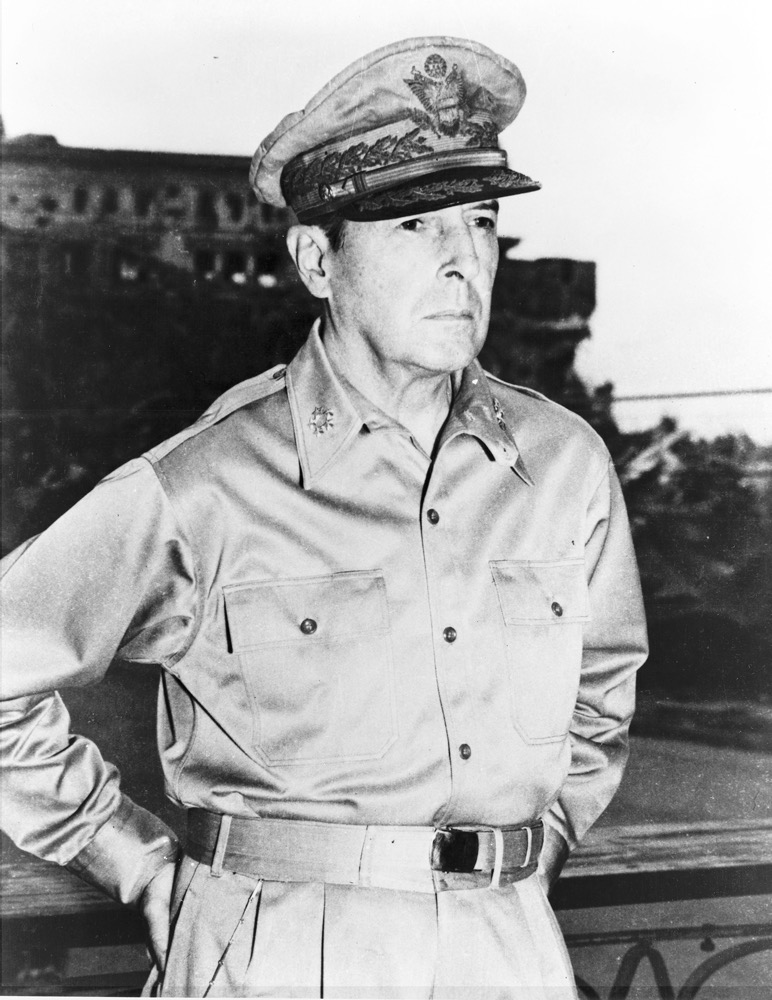
One of five five-star American generals in World War II, Douglas MacArthur was the commanding officer in the Pacific when North Korea initiated the Korean War by invading the South in 1950. Initially taken by surprise, MacArthur would reverse the course of the conflict with some daring strategy before controversy marred his command (Library of Congress Prints and Photographs Division—Reproduction Number LC-USZ62-21027).
But as of summertime 1950 that was the threat and America’s top general in that part of the world was suddenly on the clock to deal with it. Although fighting under a United Nations flag rather than American, thanks to the Truman administration’s “police-action” approach, the commanding general in the Pacific was not one of the most decorated U.S. soldiers ever without good reason and after his forces retreated in the best order possible, he went to work devising an ingenious plan to get them relief and turn the tide of a conflict that was even entertaining talk of evacuation (a la the British at Dunkirk in World War II) if something dramatic wasn’t forthcoming. That drama would take place at another Korean seacoast town, the Port of Inchon on the opposite, west coast and well behind the frontlines. Halberstam said, “It reflected the supreme self-confidence [of MacArthur] and the Tokyo command about what American troops could accomplish,” but it would involve an amphibious landing, which was always “fraught with danger” and in a place the Navy felt must have been “created by some evil genius” without “beaches, only seawalls and piers,” and with a heavily guarded island “smack in the middle of the harbor.”19
Out of necessity, the landing and offensive would come at high tide and with the threat of mines throughout the harbor on September 15, 1950. A total of 13,000 U.S. Marines reached the seawalls and piers, and breached the North Korean defenses, including the heavily fortified island, immediately turning the American led U.N. war effort from defense to offense, as it recaptured Seoul, the South Korean capital, and erased North Korea’s supply lines. After originally underestimating North Korea’s fighting capacity, MacArthur had pulled off the totally unexpected against a now overconfident opponent. Inchon would forever be memorialized as the war’s turning point. Unfortunately, it should have also been the reason for its conclusion. Soon enough the North Korean forces were in full retreat, back above the 38th parallel they had surged across less than three months earlier to begin the conflict. It’s the boundary that still divides North and South Korea. Suing for peace in that moment and renewing the peninsula stalemate left over from World War II to avoid further aggression and bloodshed would have been a wise choice without the threat of another global confrontation. MacArthur, however, had other ideas.20
As far back as 1948, the General had made known through American media outlets his belief that the loss of China to communism would “imperil the United States” and along with the pro–China, right wing press, which included Time, Life, and Fortune magazines’ magnate Henry Luce, the son of missionaries to China and leader of the China-first Republican lobby in Congress, MacArthur had stateside support. At about the same time, McCarthy and a sidekick, William Knowland of California, began to question whether the administration was doing enough in support of the besieged Nationalist Chinese government of General Chiang Kai-Shek, which would ultimately be forced to abandon the huge Chinese mainland to the Mao Zedong–led communists, setting up shop on the island of Formosa (now Taiwan). With China in communist hands, in fact, Acheson’s State Department would be compelled to produce a China White Paper once General Marshall’s previously mentioned mission to the “Middle Kingdom” proved “fruitless,” as the Nationalist Chinese were unable to shore up allegiances and their resources insufficient to forestall the Communist Chinese takeover or, at the very least, work out a compromise regime. The report covered the years 1944–1949 and was designed to head off Republican criticism of China policy during the Truman years, including acknowledgment of the suddenly wasted $2 billion expenditure in support of China’s exiled government. In Truman, McCullough recounted Acheson’s lament that this huge investment “had not been enough” and “the fault was in the internal decay of Chiang Kai-Shek’s regime, its rampant corruption, lack of leadership, [and its] indifference to the aspirations of the Chinese people.” The Secretary of State added: “The unfortunate but inescapable fact is that the ominous result of the civil war in China was beyond the control of the United States. It was the product of internal Chinese forces; forces which this country tried to influence but could not.” Nevertheless, it remained a prime Republican talking point and it still was when MacArthur, a Republican presidential wannabe himself, reversed the Korean conflict and had, in his estimation, the communists on the run.21
“The specific issue being used against Truman was China,” Halberstam emphasized. “Both Truman and Acheson were aware of the political game being played and they were contemptuous of the men who were leading the gathering force.” The Republicans had their issue and were plotting a “political barbecue” in the lead-up to the 1950 midterms. To combat this anticipated attack over China and Korea, Truman reverted to what had worked so well for him during his 1948 presidential campaign—a cross country train tour during which he would make more than 50 speeches in 15 states. It was arranged in conjunction with the President’s previous commitment to dedicate the massive Grand Coulee Dam in Washington State. According to McCullough, never once in all those speeches, however, did he mention McCarthy or “sound a call to arms” as he had so often done in his come-from-behind, whistle-stop crusade two years earlier. “Instead,” his biographer wrote that “he seemed to glow with patience and optimism,” while maintaining that although the Cold War figured to be around a while, it would produce no problems that could not be effectively resolved.22
Meanwhile, the Republicans were calling for Acheson’s resignation, prompting Truman’s assurance that his secretary of state wasn’t going anywhere—“period.” And when Time magazine speculated there was “suspicion” within Congress that the State Department had indeed “played footsie” with the communists “over China,” McCarthy labeled the ongoing Asian conflict “the Korean death trap” and charged the whole thing could be laid “at the doors of the Kremlin [Russia’s seat of power] and those who sabotaged rearming China [at the end of World War II], including Acheson and the President.” McCarthy even attempted to frame Millard Tydings, the Democrat whose Senate subcommittee had found no evidence to support his claims of State Department malfeasance, by forging a fake photo of the Maryland senator in the company of Earl Browder, head of the American Communist Party. Obviously, such wanton accusations severely tested Truman’s resolve to ignore the Wisconsin sensationalist. Even the First Lady, fed up with McCarthy’s dirty politics, chastised the President for not using his “presidential bully-pulpit” to pressure his over-reaching Senate rival. Through it all, however, Truman remained, in McCullough’s words, “calm and steady.”23
About that time, speaking of over-reaching, MacArthur on his own would make a military and ultimately political evaluation that would change everything. Never one to interpret civilian authority and leadership as superior to his own (symptomatic of an old, family grudge left over from his father’s bitter experience as a celebrated but stymied military lieutenant general), MacArthur believed North Korea, as the perpetrator of the conflict, could and should be made to collapse once its defeated army retreated back across the 38th parallel, so he sent his own forces across that boundary as well, seizing the initiative and taking advantage of what Halberstam called some “surprisingly ambiguous” orders coming out of Washington. Regardless of the North Korean response or ability to repulse the U.N. force, which had effectively turned the tables as far as potential reunification of the peninsula was concerned, the American commander was to “avoid any act that would engage the United States and the United Nations in a larger war with either the Russians or Chinese.” But to that possibility, MacArthur was convinced the still fledgling Chinese Army would never come into the war—even as American troops drew closer and closer to North Korea’s border with China at the Yalu River. With the wind of victory at his back after Inchon and the communists in full retreat, the old General’s blood was up and his goal of a reunited, non-communist Korea was suddenly of paramount importance to him, without regard to signals emanating from across the Yalu. MacArthur was obviously fixated on putting an end to the first communist country history had sent against him and not particularly worried about the potential (and much more dangerous) enemy on the other side of the river.24
More than any other American military miscalculation of the 20th century, Halberstam believed MacArthur’s decision to advance all the way to the Chinese border ranks as the worst, because by October 15, 1950, with the acknowledgment and approval of both the Soviet Union and the now desperate North Koreans, troops of the Red Chinese Army had begun crossing the Yalu relatively undetected at first, but soon in overwhelming numbers. But combined with the fact the Chinese had virtually no air force yet, giving the U.N. forces total air superiority, “the China that existed in MacArthur’s mind was one that had actually not been touched by revolution [the way Russia had in 1917],” Halberstam revealed. As would become painfully obvious, however, had been and Mao’s mastery of that country through his “Long March” and the massive manpower at his disposal should have never been underestimated, as it was by MacArthur.25
Ironically, the Chinese offensive would secretly be planned the same day as the first ever, face-to-face meeting between Truman and his commanding general in the Pacific at Wake Island. MacArthur thought it a waste of time and a violation of his sense of hierarchy and deference due him at that time. According to a young officer on MacArthur’s staff, Vernon Walters, the General did not believe anyone from Washington outranked him and that was especially true of the titular leader of the rival party. Needless to say, the meeting began in what Halberstam described as “an atmosphere of mutual suspicion” and did not go well. MacArthur remained dismissive of the signals coming out of the Chinese capital (Beijing) and, according to H.W. Brands in his 2016 book The General vs. The President, assured the President that “victory in Korea was [already] won.” Upon departing at the Wake Airfield, MacArthur impetuously asked the President if he would run for re-election in 1952, to which Truman responded noncommittally with the same question of the General. “No,” MacArthur reportedly answered before adding, “If you have any general running against you, his name will be Eisenhower, not MacArthur,” a statement obviously predicting Republican intentions two years later. And by the time MacArthur had returned to Tokyo to oversee his highly anticipated wrap-up and reunification of Korea remotely, his “misread of Red China,” as another historian labeled it, had come home to roost—regardless of air superiority or any other advantage.26
DeGregorio very concisely summarized what happened next, when he wrote:
Hundreds of thousands of Chinese poured across the border in January 1951 and drove the Americans back south. MacArthur then called for all-out war against China. When Truman refused to extend the conflict for fear of touching off World War III and a possible nuclear exchange with the Soviet Union, MacArthur publicly criticized U.S. policy. Unwilling to tolerate such insubordination, Truman relieved the popular general of his command four months later—a decision that drew a firestorm of criticism from the political opposition.
And fellow presidential historian Kenneth Davis would take that description further, when he wrote:
At home, “hawks” supported total commitment to the war effort and were led by MacArthur and the powerful China Lobby of Republican senators and media moguls [like the before mentioned Henry Luce], who all wanted all-out war against communism, including an assault on China. In one of the most dramatic moments of the Korean War, Truman fired General MacArthur, a World War II hero, a presidential aspirant, and one of the most popular men in America, for insubordination. MacArthur wanted Truman to drop 30 to 50 atomic bombs on mainland China. A great general and icon in most Americans’ eyes, MacArthur publicly rebuked Truman’s decision not to commit U.S. air power to attacking China and the President’s war strategy in general. He came home to a hero’s welcome and Truman’s approval ratings plummeted.27
Basically, everyone in the administration agreed with Truman’s decision to relieve MacArthur, including his military peers and superiors on the Joint Chiefs; the Department of Defense with former General Marshall at the helm; as well as Acheson’s State Department. Marshall biographer Forest Pogue pointed out that McCarthy had by now re-directed his attacks by focusing on the former general and secretary of state. “Defeats in Korea and the removal of MacArthur had aroused ancient hostilities against Marshall and particularly his ongoing defense of Acheson,” his successor at State. McCarthy called Marshall “completely unfit,” “completely incompetent,” and demanded his dismissal from Truman’s Cabinet, especially after he supported the decision to remove his fellow five-star general from command in Korea. On June 4, 1951, McCarthy rose in the Senate to castigate one American military icon, Marshall, in support of another, MacArthur. Given advance notice via the Washington press corps of what was coming, the galleries were packed to overflowing for his speech, which he had even titled “America’s Retreat from Victory: The Story of George Catlett Marshall.” The Congressional Record reported his speech lasted nearly three hours, “twisted quotes, drew unwarranted conclusions from the facts he did get right, and accused the revered Marshall of having made common cause with Stalin [the Soviet despot] in 1943.” Although he later denied he had actually accused Marshall of treason, it “was not unreasonable to conclude that McCarthy was accusing Marshall of nothing less than being pro-communism.” Again, in Truman, McCullough concluded: “The scourge of Joe McCarthy that Truman had thought would go away was by then still poisoning the entire political atmosphere.” He accused both Marshall and Acheson of being part of a “mysterious” communist conspiracy “so immense” that it surpassed any “such venture” in history. He chided Marshall for the “disastrous” China policy after World War II and for a military strategy that was making the war in Korea “a pointless slaughter,” and he insinuated Truman was “no longer master of his house” and of being guided by a world-wide conspiracy that had been hatched “in Moscow,” the Soviet capital. Needless to say, the President was furious and finally sought advice on what he should do about McCarthy.28
An unofficial committee of four Democratic senators, the attorney general, solicitor general, Democratic Party chairman, veteran Kentucky Congressman Brent Spencer, and White House Council Clark Clifford was convened to consider what McCullough termed McCarthy’s “hectoring and innuendo, his horrors and dirty tricks, his delight in the ruin of innocents,” as well as the most effective “antidote” for such “poison.” Mentioned was a “devastating dossier” that was being compiled on the Wisconsin senator, including “details on his bedmates” through the years—enough to blow up the whole “McCarthy show.” There were suggestions that this material could be leaked to the press, but speaking in the third person, Truman emphatically put an end to “such talk” by emphasizing: “You must not ask the President of the United States to get down in the gutter with a guttersnipe. Nobody, not even the President, can approach too close to a skunk in skunk territory and expect to get anything out of it but a bad smell. If you think somebody is telling lies about you, the only way to answer is with the whole truth.”29
From that point on at press conferences whenever asked for his views on McCarthy, Truman, “though plainly seething,” according to his biographer, would simply answer “no comment.” And taking the President’s lead, Marshall also refused to respond, stating privately that if at this point in his long and distinguished service “he had to explain that he was not a traitor, then it was hardly worth the effort.”30 The furor over Truman’s firing of MacArthur would eventually subside and the President would actually be exonerated by testimony given by the Joint Chiefs and others McCarthy had treated with contempt during additional Senate hearings in May 1951, with influential Georgia Democrat Richard Russell presiding. Throughout the inquiry, both Truman and MacArthur were treated fairly, for which Russell received acclaim for “defusing” what a biographer of his would term “a highly inflammatory situation.” Once General Omar Bradley, Marshall, and Acheson all laid out the series of insubordinate actions MacArthur had committed while prosecuting the Korean Conflict, it became clear the President had no choice but to remove him in favor of a much younger and more efficient General Matthew Ridgway, who would lead the way until the war concluded in stalemate under President Eisenhower in 1953. Nonetheless, with the Senate still failing to rein in McCarthy’s charges, Truman would have to continue his “no comment” posture for the remainder of his White House days.31
McCarthy, in fact, would carry over his anti-communist agenda into the early Eisenhower years, even though the presidency had finally been flipped to the Republicans after 20 years of Democratic rule. By then, his was a tired act and his own party really didn’t need him mounting attacks or raising suspicions of Democrats anymore. Halberstam touches on that sudden non-partisan transformation by the Republicans in The Fifties, when he wrote:
For McCarthy, Eisenhower’s election was the beginning of the end. Now that the Republicans had the White House, they wouldn’t need McCarthy any longer. What would take place, of course, was the denouement. McCarthy did not understand, of course, that his real value was not in uncovering spy rings, which he almost certainly had not been doing, but as a partisan ploy, allowing worthier men to keep their hands clean.32
1. Robert A. Caro, Master of the Senate: The Years of Lyndon Johnson, 542.
2. David Halberstam, The Fifties, 53; David M. Oshinsky, A Conspiracy So Immense: The World of Joe McCarthy, 2, 11, 18–19, 22–23, 24, 26, 29–32.
3. David M. Oshinsky, A Conspiracy So Immense, 34–35, 36.
4. Ibid., 39–49, 52.
5. Richard A. Baker and Neil MacNeil, The American Senate, 247–248; Larry Tye, “Senator McCarthy’s Nazi Problem,” Smithsonian magazine, July-August 2020; David M. Oshinsky, A Conspiracy So Immense, 74–80; David McCullough, Truman, 765.
6. David McCullough, Truman, 765; T. Harry Williams, Huey Long, 572–573, 619–620, 636–637, 640.
7. T. Harry Williams, Huey Long, 794–795.
8. Ibid., 766; Richard A. Baker and Neil MacNeil, The American Senate, 248.
9. Richard A. Baker and Neil MacNeil, The American Senate, 248; David McCullough, Truman, 766; Robert A. Caro, Master of the Senate, 543–544.
10. Richard A Baker and Neil MacNeil, The American Senate, 248; David Halberstam, The Fifties, 55.
11. Jon Meacham, The Soul of America, 188.
12. Ibid., 188–189.
13. David McCullough, Truman, 766, 768–769, 770.
14. Jon Meacham, “The Soul of America Conversation and Audience Q&A,” Atlanta, Georgia (Carter Center), May 21, 2018; Jon Meacham, The Soul of America, 190.
15. Jon Meacham, The Soul of America, 191.
16. Walter Isaacson and Evan Thomas, The Wise Men, 493–495.
17. David Nasaw, The Patriarch: The Remarkable Life and Turbulent Times of Joseph P. Kennedy, 667–668, 671–672.
18. David Halberstam, The Coldest Winter, 60–63, 165.
19. Ibid., 140, 295; William Manchester, American Caesar, 683–684.
20. William Manchester, American Caesar, 684, 688; David Halberstam, The Coldest Winter, 12, 295, 306–308, 335; Forest C. Pogue, George C. Marshall, 453–454; Tim Marshall, “Korea: A History of The North-South Split,” news.sky.com, April 4, 2013.
21. David Halberstam, The Coldest Winter, 215, 238–239; Robert E. Herzstein, “Henry Luce: Political Portrait of the Man Who Created the American Century,” foreignaffairs.com, May 1, 1994; Forest C. Pogue, George C. Marshall, 73–143; David McCullough, Truman, 743.
22. David Halberstam, The Coldest Winter, 247–248; David McCullough, Truman, 772–773.
23. David McCullough, Truman, 813–814.
24. H.W. Brands, The General Vs. The President: MacArthur and Truman at the Brink of Nuclear War, 193; William DeGregorio, The Complete Book of U.S. Presidents, 520; David Halberstam, The Coldest Winter, 331, 332, 334.
25. David Halberstam, The Coldest Winter, 355, 364, 369, 370; H.W. Brands, The General Vs. The President, 200.
26. H.W. Brands, The General Vs. The President, 179, 183; David Halberstam, The Coldest Winter, 365–368; William DeGregorio, The Complete Book of U.S. Presidents, 520.
27. William DeGregorio, The Complete Book of U.S. Presidents, 520; Kenneth C. Davis, Don’t Know Much About the American Presidents, 457.
28. Forest C. Pogue, George C. Marshall, 488–489; David McCullough, Truman, 860–861.
29. David McCullough, Truman, 861.
30. Ibid., 861–862.
31. Ibid., 852; Sally Russell, Richard Brevard Russell: A Life of Consequence, 186–188; David Halberstam, The Coldest Winter, 605, 613; Kenneth C. Davis, Don’t Know Much About the American Presidents, 456.
32. David Halberstam, The Fifties, 250.