
15
Harry Truman’s successor in the White House wasn’t so much elected president as preordained. For General Dwight D. Eisenhower—much like Generals George Washington and Ulysses Grant before him—the job was his whenever he wanted it. As with the American Revolution and Civil War, a grateful nation was more than happy to inaugurate its pre-eminent general of World War II, despite no prior political experience, in 1952. Chances are it would have done the same thing in 1948 if he had wanted the job then, but at that time, no one even knew which political party he would call his own. As a result, playing the partisan waiting game made sense (although several leading Democrats, including a couple of FDR’s sons, did try to recruit him as a replacement for Truman in ’48).
Once he made up his mind, World War II’s victorious supreme Allied commander in Europe, “Ike,” as Eisenhower was affectionately known, would win the 1952 GOP presidential nomination on the Republican Convention’s first ballot after not entering the race until early June—just five months before the election. Senator Robert Taft, the favorite of the conservative wing of the Republican Party and the pre-convention favorite, was overwhelmed by a draft Eisenhower movement that began with the chant “Taft can’t win” and ended in a rout, 845 delegate votes to only 280 for Taft, including a midnight switch of votes by the Minnesota delegation that ultimately put Ike over the top.1
In 2007, Mark Perry, a critically acclaimed author and journalist, wrote a book about the unique partnership that existed during World War II between Eisenhower and his immediate superior, General Marshall. As the story goes, Marshall had actually been in line to command the Allied armies in Europe, but because President Roosevelt wanted to keep Marshall close at hand in Washington, modern history’s choicest military assignment, the liberation of Western Europe from Nazi Germany, including the now famous D-Day invasion (June 6, 1944), fell to Eisenhower, Marshall’s hand-picked choice. As a result, with that sort of mutual trust and admiration in their past, the most eye-opening episode of the 1952 Eisenhower presidential campaign and landslide victory over his Democratic opponent, urbane and intellectual Adlai Stevenson, the governor of Illinois, involved none other than the already infamous Joe McCarthy. Perry recounted the episode thusly:
In the midst of his campaign … Eisenhower was asked whether he would endorse the bid of Senator Joseph McCarthy for another term [in the Senate]. Eisenhower maintained his silence on the subject, but in private he hated McCarthy, resented his mindless criticisms of [Marshall], and refused to forgive him. When the time came, he vowed, he would denounce him. Eisenhower had even written a speech defending Marshall, to be delivered in Milwaukee, when McCarthy [would be] seated on the platform behind him. But the Republican gang, as well as leaders of the Republican Party and Wisconsin’s governor, flew to Peoria, Illinois (where Eisenhower was campaigning), to urge Eisenhower to appear with McCarthy and say nothing. His criticism of McCarthy would do nothing to help Marshall now, they said, and it could hurt his majority in the state. Eisenhower reluctantly deleted the offending paragraphs, and one week later, in Milwaukee, he stood on the same stage as the senator. He remained silent. The next morning, the nation’s papers commented on Eisenhower’s apparent endorsement of McCarthy’s views. That is what his silence meant, they said. Serving out his last months in the White House, Harry Truman was enraged. He denounced Eisenhower then and throughout the [remainder of] the campaign. Eisenhower was surprised by Truman’s vitriol; he had made his views on Marshall clear in public. “There is nothing of disloyalty in General Marshall’s soul,” he told one audience. While never mentioning McCarthy’s name, he told another audience that he had “no patience with anyone who can find in [Marshall’s] record of service for this country anything to criticize.” … Even so, there it is: Eisenhower’s silence remains a stain on the Eisenhower legacy.2
On that same affair, Jon Meacham would write of the Milwaukee omission:
Eisenhower was slated to defend Marshall in no uncertain terms. “I know that charges of his disloyalty have in the past been leveled against General George C. Marshall,” Eisenhower was to have said. “I have been privileged for 35 years to know General Marshall personally. I know him as a man and as a soldier to be dedicated with singular selflessness and the profoundest patriotism to the service of America. And this episode is a sobering lesson in the way freedom must not defend itself.” Ike never uttered the words. Talked out of it by political advisers who thought it unwise to antagonize McCarthy and his supporters. Eisenhower always regretted his failure to say what he thought, and he hated that the world knew what had happened [after] word of the dropped paragraph leaked to the New York Times. “It turned my stomach,” General Omar Bradley would later [say] of the Eisenhower-Marshall-McCarthy episode.3
Thus, for the sake of political expediency and party loyalty did the professed non-political Eisenhower side with the mudslinging McCarthy at the expense of his longtime friend and colleague in arms, Marshall. Distasteful as that was for Truman, Bradley, and others in the administration and military establishment, it also gave notice that the Wisconsin senator was not going away just because a fellow Republican was about to enter the White House. “To Truman, with his devotion to George Marshall, Eisenhower had committed an act of unpardonable betrayal,” McCullough would acknowledge. McCarthy would retain his Senate seat and resume his ceaseless diatribes and warnings. By then it was the only political game he knew, and Eisenhower would just have to put up with it—much like Truman. “Although documents reveal Eisenhower working behind the scenes to blunt McCarthy, Ike never publicly challenged the Wisconsin senator as he continued his vitriolic and dangerous campaign against communist subversion in America,” Kenneth Davis stated in 2014.4 At the same time, the eight-year Eisenhower administration would become more impactful behind the scenes than out in front of them.
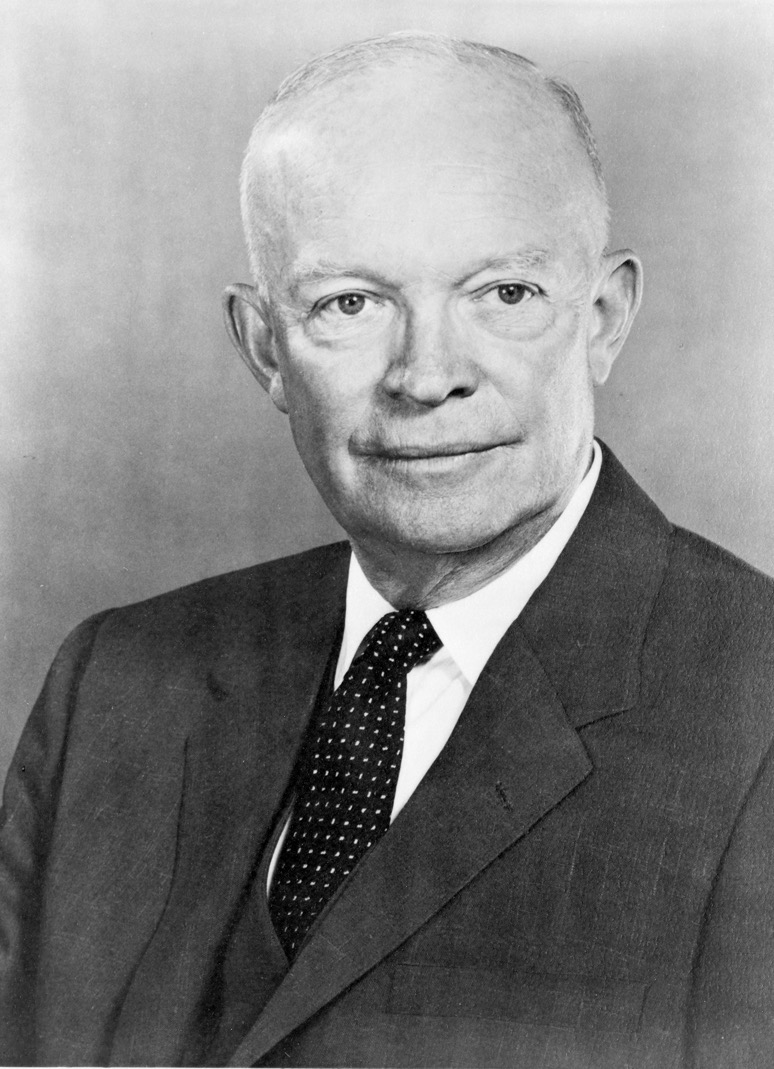
President Dwight Eisenhower. With his ascension in 1952 as the first Republican president in 20 years, most political pundits felt Joseph McCarthy’s scurrilous accusations of communist infiltration into the previously Democratic federal government would finally end. But they were sadly mistaken, as the junior senator from Wisconsin continued his fearmongering and guilt by association (Library of Congress Prints and Photographs Division—Reproduction Number LC-DIG-ppmsca-38556).
After being re-elected in 1952, Senator McCarthy not only continued his anti-communist crusade, but expanded it even with a Republican at 1600 Pennsylvania Avenue. One historian of the era worded it this way: “For several years he captivated the nation by charging that communists had launched ‘a conspiracy so immense and an infamy so black as to dwarf any previous venture in the history of man.’” Among the agencies he (again) singled out as having been infiltrated by communists were the State Department and the (increasingly influential Central Intelligence Agency or) CIA, which had come into existence just five years earlier under Truman as a clearinghouse for foreign intelligence and was becoming a huge contributor in the containment of communist expansion. In addition to its primary purpose to collect, analyze, evaluate, and disseminate foreign intelligence, it also became the only agency under the National Security Council authorized to conduct covert overseas operations. Exactly what that had entailed up to that time other than the gathering of foreign surveillance is hard to equate (although MacArthur would blame the CIA rather than his own military intelligence sources for his lack of advance knowledge of Communist China’s entry into the Korean Conflict), but McCullough makes clear Truman “never intended the CIA to become what it did.” On the other hand, what it became was evident almost immediately under his successor.5
Perhaps Eisenhower, given all his years in Europe as head of the Supreme Headquarters Expeditionary Force (SHAEF), with all the intricate, international give-and-take and behind the scenes maneuverings he must have experienced in that role, was more amenable to under-the-table overseas operations than his presidential predecessor had been. Or perhaps as a political novice he wasn’t wary of using American power and influence to cut some diplomatic corners as long as he could maintain plausible deniability, but whatever the excuse, there’s no denying the CIA became a much more aggressive foreign undercover operation during the Eisenhower years. Of that development, Davis would write: “Under Eisenhower, the CIA was allowed to run roughshod with covert operations.” Eisenhower’s new secretary of state, John Foster Dulles, was U.S. legal counsel at the First World War’s Versailles Peace Conference more than three decades before and more recently a U.S. senator from New York. And his younger brother Allen Dulles, a veteran State Department diplomat, had become the first civilian head of the CIA. According to Stephen Kinzer, an award-winning foreign correspondent, in a 2013 book he authored on the Dulles brothers, Foster had made a convert of Eisenhower while he was still overseeing post-war Europe but already the presumptive Republican presidential nominee. As a private attorney at the prestigious New York law firm of Sullivan & Cromwell, the elder Dulles had “arranged to be invited to give a speech in Paris, where Eisenhower was serving. They had two long conversations, and Foster left the General with the manuscript of an article called, ‘A Policy of Boldness’ that he had just written for Life magazine. It charged the Democrats with following a cowardly policy, seeking only containment of communism, while Republicans would take the offensive. They would secure the ‘liberation’ of ‘captive nations’ and crush ‘communist stooges’ around the world.”6
This openly defiant and aggressive approach was John Foster Dulles’ introduction to the next president of the United States, and it must have made an impression because gradually some of the sentiments in that article began to find their way into Ike’s campaign speeches. Although exaggerated because of established knowledge that Truman had come to the aid of the Greek government in 1947; that he had met the Soviet challenge at Berlin and instituted the Marshall Plan in 1948; that he had entered NATO in 1949; and that he had stopped the communist takeover of Korea in 1950, all of which were evidence of the Truman Doctrine, Dulles’ influence nonetheless must have resonated with the new president and his get-even-tougher message on communism obviously appealed to the voters, who gave Eisenhower a resounding victory in 1952.7
The Dulles worldview resonated with Eisenhower so much, in fact, that he named Foster secretary of state over the objections of several prominent foreign statesmen, including British Foreign Secretary Anthony Eden as well as, somewhat surprisingly, previously noted conservative mainstay Henry Luce, who recommended Dewey while privately hoping for the job himself. At his Senate confirmation, Dulles would assert that not only was the influence and spread of Soviet communism the “gravest threat ever faced by the United States, but the gravest threat ever faced by what we call Western civilization or indeed any civilization which was dominated by a spiritual faith,” according to Kinzer.8
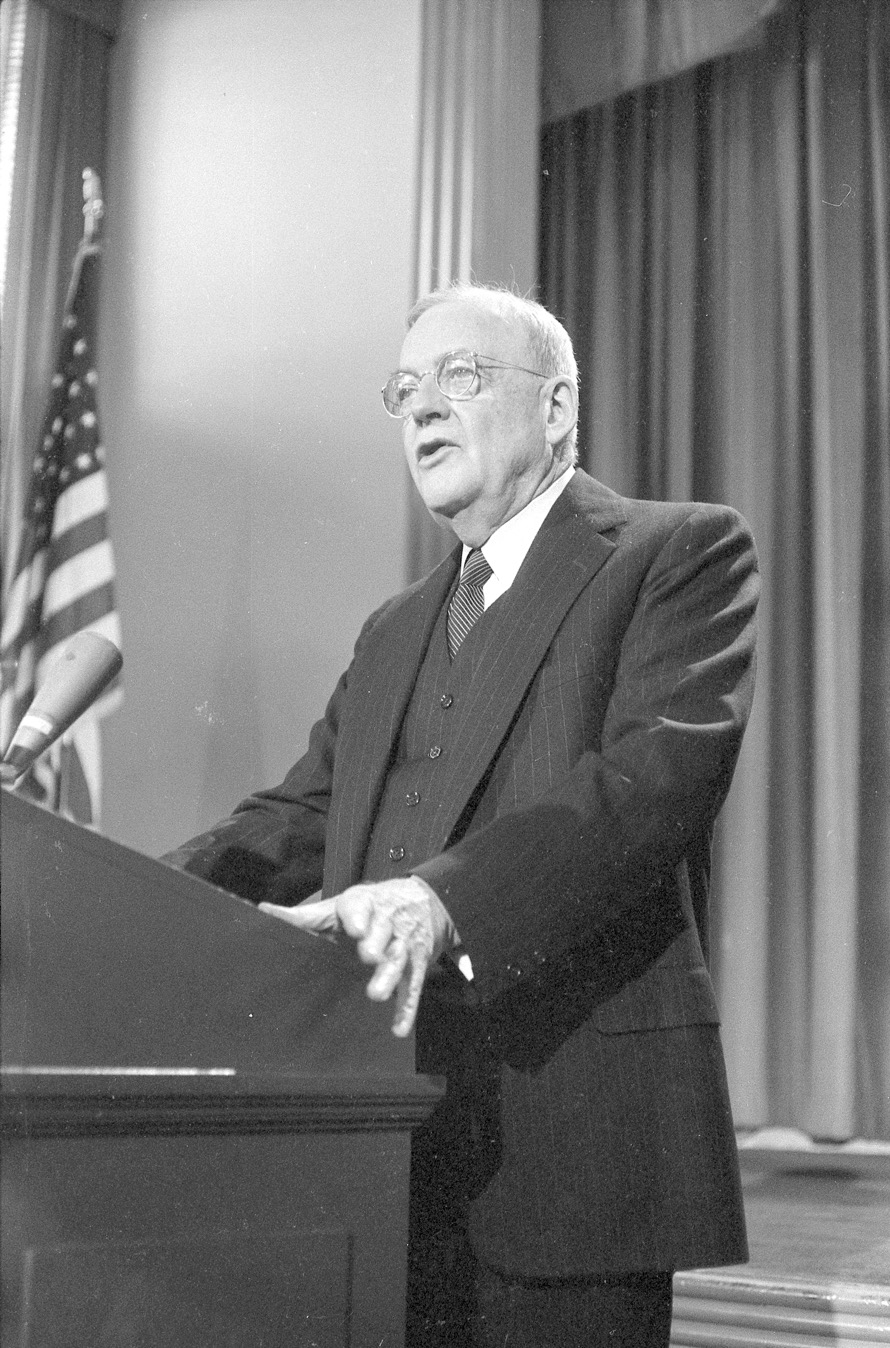
As President Eisenhower’s secretary of state, John Foster Dulles would oversee the United States’ turn to covert action against foreign governments and individual leaders during the remainder of the Cold War. Assisting in this change of approach from the Truman years would be Dulles’s brother, Allen, as the first civilian head of the still new Central Intelligence Agency (CIA) (Library of Congress Prints and Photographs Division—Reproduction Number LC-DIG-ds-01102).
At the same time Allen Dulles was ascending from deputy director of the CIA to the intelligence agency’s top spot, Eisenhower nominated his trusted World War II chief of staff, Walter “Beetle” Smith, to be undersecretary of state, even though Smith, again according to Kinzer’s The Brothers: John Foster Dulles, Allen Dulles and Their Secret World War, “made no secret of his concern over Allen’s enthusiasm for extravagant covert actions.” Others also warned the President of the younger Dulles’s unorthodox mind, which, they said, would make it problematic for him to run such a large, worldwide operation. But just as with Foster, Ike fell under the Dulles spell and Allen would be confirmed by the Senate on February 26, 1953, setting up a team of brothers in the nation’s two most influential foreign policy posts, a unique collaboration that would facilitate an American transition to covert conspiracy on the international stage.9
As Walter Isaacson and Evan Thomas would concisely document in The Wise Men, with Foster orchestrating foreign policy in the State Department, the agency managed by his brother was “in its freebooting heyday.” It organized the overthrow of a government deemed to be pro-communist in Iran in 1953 and Guatemala in 1954; helped install pro–Western governments in Egypt in 1954 and Laos in 1959; tried and failed to overthrow the government of Indonesia in 1958; infiltrated refugees to disrupt Soviet-bloc governments in Eastern Europe; ran sabotage operations against Communist China from nearby Laos and Burma; and plotted assassination attempts against China’s Chou Enlai, Prince Lumumba of the Congo, Cuba’s Fidel Castro, and Rafael Trujillo of the Dominican Republic.10 Needless to say, while McCarthy continued to warn of communist subversives in the U.S. government, his Red Menace rumors had nothing on the Dulles brothers when it came to America’s actual foreign subversion.
Meanwhile, “isolationism was [also] back on Capitol Hill and it was back strong.” That was the judgment of Robert Caro as he authored Master of the Senate, covering the life and times of Democratic Minority and later Majority Leader Lyndon Baines Johnson during the Eisenhower years. With a Republican administration in charge, in fact, LBJ proved much more amenable to working with the new moderate in the White House than did many of his more conservative Republican colleagues. As previously referenced, Eisenhower would have been an immensely popular choice for president regardless of which party banner he ran under in 1952 and working with the World War II hero became a prerequisite of Johnson’s ability to stay in office and get things done. As Caro worded it: “Since Eisenhower was popular, Johnson explained, whoever was supporting him would be on the popular side. The Democrats, he said, could be on the popular side—particularly if they were supporting Eisenhower and the Republicans weren’t.” And as a product himself of the more conservative Southern faction of the Democratic Party, LBJ was prepared to make that happen, especially in the foreign policy realm, where the prospective return of Republican isolationism had the potential to drive a wedge between the former Allied commander, a globalist, and his party. Of course, Johnson had to convince his Democratic caucus that such bipartisan agreement made sense. Once he did, it paid huge dividends for both his and Eisenhower’s legacy.11
For instance, the most conservative Republicans in Congress sought to impugn the legacy of Democratic icon FDR, especially in regard to Roosevelt’s final “Big Three” conference with British Prime Minister Winston Churchill and Stalin, the Russian premier, at Yalta, a resort city on the Black Sea, shortly before FDR’s death in 1945. Once Stalin also died in March of 1953, the resurgent GOP conservatives felt empowered to question what the Roosevelt administration had actually acquiesced to by signing a war-ending pact. “Yalta gave these throwbacks a focus for their rage, for it symbolized so much of what they detested and feared: the usurpation of the sacred constitutional powers of Congress by the hated Roosevelt; the ‘softness’ on communism that had left Eastern European nations under Stalin’s heel; not to mention the treachery implicit in those ‘secret’ agreements that they were certain existed.” Such was Caro’s spin on that time of Republican majorities in both the House and Senate.12
There was one problem with that, however: Eisenhower, as supreme Allied commander in Europe, had been the “implementer” of Roosevelt’s agreements, and as president he was not disposed to seeing the agreements he had overseen suddenly scrutinized for purely political purposes, especially if their repudiation could open the door to similar scrutiny and repudiation by Russia (aka the Soviet Union). Instead, again according to Caro, Ike rejected “interpretation of the accords that ‘have been perverted to bring subjugation of free peoples’” with the knowledge that Dulles as secretary of state had already investigated and found nothing to substantiate any “secret” agreements. The same Republican congressional contingent, upon realizing that President Eisenhower would not repudiate the Yalta accords and only accuse the Soviets of subverting them, began plotting harsher amendments of their own until a new voice was heard in the person of the Senate minority leader, LBJ, who conveniently sided with the President—the Republican President.13
It was the start of America’s most cooperative and peaceful bipartisan relationships even after LBJ went from minority to majority leader in 1955 and one that would resist the same kind of isolationist tendencies that had cloistered American interests after World War I (and even in the earlier era before Theodore Roosevelt at the turn of the 20th century). Johnson, in fact, would draw criticism from some Democrats “for failing to square off more often against the popular Republican president,” as presidential historian DeGregorio recounted LBJ’s mastery on Capitol Hill, but their unusual symbiotic political relationship would contribute to a 1950s decade that seemed, according to Halberstam, “slower, almost languid,” an “orderly era, one with a minimum of social dissent” and one of “general goodwill and expanding affluence.” Unfortunately, this political era of truces and understanding at the highest levels of the federal government would not silence the cacophony of discordant accusations that continued, at least early on, from the mouth of Senator McCarthy. Davis, as a presidential historian, would confirm that “Ike never publicly challenged McCarthy” and the “great fear” that he continued to cultivate “would ruin lives and careers with ‘guilt by association.’” For example, at least 300 people were “blacklisted” in Hollywood (as communists), as the Senator’s accusations continued to fly “with little regard for due process or constitutional rights.” With Truman comfortably enjoying retirement in Independence, Missouri, as of 1953, Johnson, as the highest-ranking Democrat, continued the waiting game—waiting on the Wisconsin senator’s own, personal demise—waiting for him to take a step too far that would effectively silence him forever.14
That moment finally came in 1954, the fifth and final year of the McCarthy era, when he made the mistake of picking on the worst possible, most unassailable target—the United States Army. For a nation steeped in political wars and name-calling political campaigns, that would prove a bridge too far and the breaking point of public patience. Ultimately embarrassed by a documentary on national television by the famous broadcaster Edward R. Murrow, McCarthy followed that up with a fatal mistake by agreeing to his Senate subcommittee hearings being shown on live TV—investigative hearings pitting McCarthy vs. the U.S. Army—a dual development that exposed the shamefully fabricated nature of his accusations. Exposed as never before, his popularity plummeted right along with his credibility, allowing Johnson to bring charges that Republicans had to accept, which led to his censure by the Senate and showcased LBJ’s legislative skill. Three years later, still in the midst of his second term in the Senate, Joe McCarthy would die of complications brought on by alcoholism at Bethesda Naval Hospital. Humbled and again an inconsequential (and by then unelectable) senator, he was just 49 years old.15
Meanwhile, Truman, who was already 69 when he left the White House, would live two more decades, dying in December 1972. Although at lower than low approval rankings when he left office, his legacy and presidential ranking would enjoy an amazing recovery in the years ahead. And with the collapse of Russia’s Soviet government in 1991, in fact, his visionary policy during the Cold War, which always included avoiding all-out confrontation with the major communist nations if possible, was “vindicated.” Speaking of that, historian Robert Dallek assessed Truman this way: “His contribution to victory in the Cold War without a devastating nuclear conflict elevated him to the stature of a great or near-great president.”16
1. Mark Perry, Partners in Command: George Marshall and Dwight Eisenhower in War and Peace, 403; David McCullough, Truman, 612, 633; William DeGregorio, The Complete Book of U.S. Presidents, 532–533.
2. William DeGregorio, The Complete Book of U.S. Presidents, 533–534; Mark Perry, Partners in Command, 404.
3. Jon Meacham, The Soul of America, 197.
4. David McCullough, Truman, 911; Kenneth C. Davis, Don’t Know Much About the American Presidents, 472; Stephen Kinzer, The Brothers: John Foster Dulles, Allen Dulles, and The Secret World War, 3.
5. Stephen Kinzer, The Brothers, 143; Rhodri Jeffreys-Jones, “Why Was the CIA Established in 1947?” tandfonline.com, January 2, 2008; David McCullough, Truman, 604, 990.
6. D. J. Hancock, Eisenhower and The Art of War: A Critical Approach, 69; Kenneth C. Davis, Don’t Know Much About the American Presidents, 472; Stephen Kinzer, The Brothers, 103–105.
7. Stephen Kinzer, The Brothers, 104–105.
8. Ibid., 106.
9. Ibid., 107–108.
10. Walter Isaacson and Evan Thomas, The Wise Men, 574.
11. Robert A. Caro, Master of the Senate, 521, 523, 524.
12. Ibid., 524.
13. Ibid., 524–525.
14. William DeGregorio, The Complete Book of U.S. Presidents, 568; David Halberstam, The Fifties, ix, x, xi; Kenneth C. Davis, Don’t Know Much About the American Presidents, 472; Robert A. Caro, Master of the Senate, 547–550.
15. Robert A. Caro, Master of the Senate, 551; Kenneth C. Davis, Don’t Know Much About the American Presidents, 472.
16. Kenneth C. Davis, Don’t Know Much About the American Presidents, 458–459.