
17
Long the domain of long-winded speakers and speeches, the U.S. Senate’s most time-honored function has always been policy discourse and debate. Since its inception as supposedly the more rational (or sensible) and thus more consistent (or reliable) Upper House in America’s bicameral system of legislative democracy, the Senate idea probably came from the British House of Lords in Great Britain’s Parliament, which had always been based on heredity or appointment. Usually composed of more established (or secure) representatives as a result, it theoretically provided an alternative to the more idealistic type of mass-driven representation to be found in the House of Commons—the British equivalent of the House of Representatives. From the get-go, America’s Founding Fathers, while understanding the democratic need for a legislative branch with local representation based on the general populations of the individual states, also perceived possible danger if this large and potentially undisciplined House of the common man wasn’t offset by older, wiser, more established decision-makers—men like themselves—to avoid the pitfalls of rash decisions that could result from more emotional, less experienced leadership.1
As a result, their elected House of Representatives would choose two senators from each state for what was expected to be a much steadier, more level-headed Senate. And in keeping with this concept of a wiser Senate being able to mitigate a more impulsive House was born the necessity of debate—of being able to hash out the various issues from all sides and constituencies in order to make the best, majority-based decisions on any legislation before becoming law. And ably fulfilling this crucial function after the original founders would be a progression of outstanding debaters, some of whom have been covered in these pages, senators like Henry Clay, Stephen Douglas, Charles Sumner, and yes, Richard Russell and Lyndon Johnson, two Southern Democrats whose careers intersected at a moment of great national debate. Upon the death in office of President John F. Kennedy and the ascension of Johnson to the White House in late 1963, their successful Senate partnership would come to an end, but their revised relationship would still command center stage as the country finally faced its inevitable question of civil rights.2
Perhaps the first great Senate debater, as credited in The American Senate by Richard Baker and Neil MacNeil, and the first to hold court on the Senate floor for hours at a time was John Randolph of Roanoke, Virginia. He apparently loved to lecture his fellow senators, holding them captive in the mid–1820s until they asked for something called a “corrective” or began the practice of walking out on his most excessive harangues. His fellow Virginian, the Revolutionary orator Patrick Henry, once even drew up “articles” against Randolph’s “most flagrant indecencies of vilification,” calling on the sitting vice president to restrain Randolph’s abuse of debate from his presiding chair—a request the VP steadfastly refused, citing his intended role as impartial overseer. While fellow senators could call another senator to order for excessive speech-making—this established the vice president should not.3
Although not considered a filibuster at that time, ultimately debate would become a regional or partisan tactic designed to delay, obstruct, and hopefully stop legislation through a succession of long, drawn-out speeches—an early American hint of what was to come by 1837, when it became accepted minority strategy. That’s when the previously referenced Thomas Hart Benton moved to “expunge” the Senate’s earlier censure of President Andrew Jackson over the extended, all-night speeches of Clay and other Whigs seeking to preserve the previous reprimand. Fast forward from there to the post–Civil War period, when partisanship achieved new identity levels by 1879; when reinstated Southerners suddenly created a Democratic majority in the Senate; and when Republicans resorted to filibuster to slow the prohibiting of Army regulars from guarding Southern polling places in light of the South’s emerging segregationist tendencies. Then again in 1891, a new kind of one-man filibuster emerged when West Virginia’s Charles Faulkner held court on the Senate floor for eleven and a half straight hours, a situation that unnerved congressional observers and portended the threat of other individuals purposely tying up Senate business until their colleagues conceded to their wishes. Some filibusters would last for weeks, as one did in 1908 when progressives from the Midwest spoke out against emergency currency legislation they considered nothing more than a scheme to benefit the wealthy. For Senate historians like Baker and MacNeil, the bottom line was: “When Republicans were in the minority, they filibustered Democratic bills. When the Democrats were in the minority, they filibustered Republican bills.” And at other times, “the filibusters came from regional blocs like farmers or ideological blocs like isolationists.”4
Needless to say, it became a practice that brought criticism to the Senate to the point of some senators proposing a stronger majority cloture rule, which is the only procedure the Senate has to place a time limit on the debate of a bill and thereby overcome protracted filibuster—Senate Rule XXII. With 60 votes this time limit could be applied to any issue under debate, effectively containing a filibuster if a three-fifths majority could be cobbled together.5 George Norris, the great senator from Nebraska spotlighted in this book’s Prologue, offered another, at least partial filibuster solution in 1923, which was ultimately approved by both Houses of Congress and ratified in 1934. In order to preserve the sanctity of debate and yet end the practice of a filibuster and its primary intended obstruction in the final days of a congressional session, Norris proposed leaving each session’s final day of adjournment “open-ended.” To his nuanced way of thinking, “No limitation of a session would exist and no filibuster would [then] be attempted.” Unfortunately, Norris’ claim that such an open-ended congressional schedule would prevent blatant filibusters was not the easy fix he prophesied and senators’ use (and abuse) of the filibuster continued.6
Perhaps the worst abuser of the filibuster was the previously mentioned Huey Long of Louisiana, whose flamboyant, self-promoting use of the tactic captured national attention during his short Senate career in the mid–1930s. One day in 1935, Long held the Senate floor for 15 hours and 35 minutes, an extraordinary feat that was both irrelevant and offensive to Senate norms, but also instructive to other Southerners, who were soon using well-timed filibusters to waylay votes on basic civil rights in fear that giving an inch to federal intervention might lead to having to accept a mile on other, integration measures. In 1922, the House of Representatives passed just such a measure, a bill that would have made lynching (aka, mob murder of African Americans), which had been happening in the racially unrepentant Deep South ever since Reconstruction, a federal crime. Amazingly, when that most virtuous of bills reached the Senate, it was immediately filibustered to death by Southern senators, the first of many such victories of delay and disruption that would lead to Alabama’s Oscar Underwood, the minority leader at the time, snidely remarking, “Under the rules of the Senate, when 15 or 20 or 25 say you cannot pass a bill, it cannot be passed.” In the words of The American Senate:
That was the beginning of the calculated obstruction by filibustering Southern senators of all civil rights measures, a systematic campaign that would torment the Senate’s deliberations for the next half-century and more. And in that vein, Southern senators flaunted what they were doing, sure of enthusiastic support from voters back home. They argued that these bills were unconstitutional and by opposing them they were defending “the Southern way of life” by which they meant the subjugation of Blacks to legally enforced racial segregation. In this struggle, the Senate’s filibuster became for them a positive good, the means of protecting their cherished principles, such as they were, from outside intrusion.7
This then was the backdrop in which Senate Majority Leader Lyndon Johnson got Richard Russell and the Southern Bloc to go along with, or at least acquiesce to, his ice-breaking civil rights bills in 1957 and 1960, the latter of which authorized federal inspection of local voter registration polls and was only passed via some of Johnson’s parliamentary sleight-of-hand. That was still the backdrop three years later when John Kennedy was assassinated with his own expanded civil rights legislation languishing in Congress. It was also the legislative backdrop when the modern Civil Rights Movement came into determined, full-throated prominence like never before.8
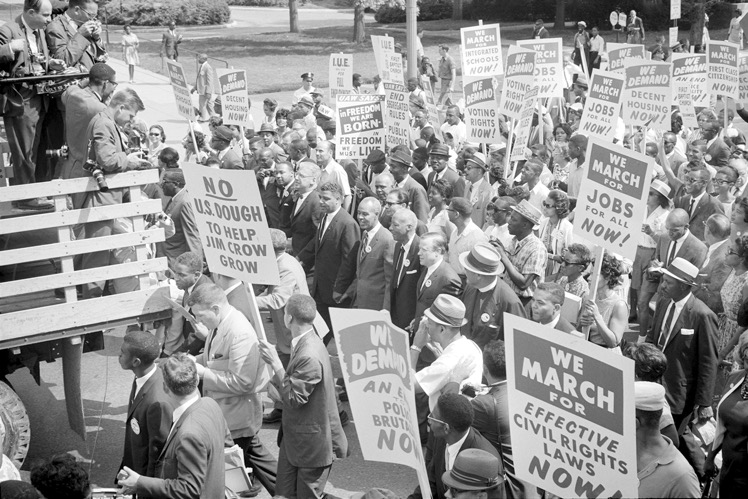
During the 1950s and early ’60s, the nonviolent Civil Rights Movement would reach its zenith in America, as demonstrations and marches took place throughout the South, prompting President John F. Kennedy to seek a landmark civil rights bill and his successor, President Lyndon Johnson, to utilize the JFK legacy and his own mastery of the Senate to finally get it passed (Library of Congress Prints and Photographs Division—Reproduction Number LC-DIG-ppmsca-04297).
That’s not to say it had not been building in the late 1950s and early ’60s through protests and the resulting media exposure of such things as a Southern city bus boycott by African Americans over racially segregated seating; through National Guard enforced integration in a Southern state capital in the wake of the Brown versus Board of Education Supreme Court decision; through multi-city sit-ins by young Blacks at several White-only lunch counters in the South; through the premeditated travel of Negroes called “Freedom Riders” on interstate buses throughout the Deep South and the numerous physical attacks they encountered along the way; through the heinous murders of civil rights workers seeking to register Black voters in the Deep South; through the police use of water hoses and snarling dogs to disperse urban protest marches in the South; and through a Sunday morning church bombing by the notoriously racist Ku Klux Klan that left four African American girls dead in a major Southern city. Indeed, by the time JFK was gunned down in the streets of Dallas and LBJ was sworn in as president, the rest of the nation had been made painfully aware of the ongoing racial discrimination and violence occurring in the American South. So, with momentum building for a more determined response, including action on Kennedy’s pending civil rights bill, the threat of filibuster became the accepted legislative tactic of choice for the Senate’s Southern Bloc.9
In the 12 months preceding his assassination, according to presidential historian William DeGregorio, Kennedy had “ordered an end to racial discrimination in housing owned, operated, or financed by the federal government; had established [a] Presidents Committee on Equal Employment Opportunity; had appointed numerous African Americans to prominent federal positions; and had exerted moral leadership on the race issue in a televised address. Nonetheless, his domestic civil rights agenda as a whole remained under wraps along with a new, recession-proof tax bill [overseen by previously mentioned Southern stalwart Harry Byrd] in the Senate despite what Johnson biographer Robert Caro labeled ‘demonstrations throughout the South rising in intensity’ and despite the fact 200,000 demonstrators had descended on the national capital in a so-called ‘Freedom March’ that August. In other words, the country was already inundated with civil rights talk and tension when its young president was killed. That’s when a clear majority came to the realization there had to be change.”10
So too had Lyndon Johnson. Because he had been excluded from much of the Kennedy administration’s day-to-day deliberations, as Caro confirmed repeatedly in his fourth volume of the Johnson life story, The Passage of Power, “he did not know what he needed to know” about the exact status of the deceased president’s domestic agenda—the tax stalemate and civil rights paralysis. So, once the solemnity of three days of Kennedy remembrance, homage, and burial in the nation’s capital had taken place, he set about learning the updated lay of the congressional landscape he had mastered the previous decade. For instance, he learned that Senator Byrd’s Senate Finance Committee was holding up the tax bill until the overall Kennedy budget became apparent in January. If it amounted to more than $100 billion as he expected it would, Byrd was determined to stop the tax cuts. LBJ was advised to give up the idea of lowering the tax rate because so much ill will against the Kennedy measures had been built up in Congress before his tragic demise. “No, no,” Johnson is reputed to have replied. “I can’t do that [without] destroying the Democratic Party. We can’t abandon that fella’s program because he’s a national hero now and his people [the Kennedy Cabinet] want his program passed. We’ve got to keep the Kennedy aura around through the election [1964],” which was less than a year away.11
Those comments, made to Senate “Whip” George Smathers, a Floridian whom LBJ had relied on as a vote counter during his majority leader days, were apparently the first admission by the new president of the legacy of the previous one that he would endorse and rely on to get things done in time for his own 1964 presidential re-election campaign. In recent months, the Civil Rights Movement had been encouraged by the Kennedy administration’s apparent commitment to their cause after so many decades of false hope and incremental accommodation designed to placate rather than truly solve the inequality of ongoing segregation in a third of the country. And a Southerner suddenly in the White House in Kennedy’s place had to send the fear of another aborted Reconstruction through the Movement’s leadership, just as the first President Johnson had done nearly a century before following the assassination of Abraham Lincoln. Jon Meacham addressed what had to be the mindset of Martin Luther King and other Movement leaders in The Soul of America when he speculated: “Now we may never get our freedom,” as the logical reaction of MLK and other Civil Rights officials all too familiar with the disappointments of previous administrations, especially those of the more liberal Democrats, hamstrung politically as they were by their Southern brethren/senators of the previously Solid South. To turn its back on Dixie always threatened electoral division and doom for the Democratic Party, a national tightrope that Franklin Roosevelt, Harry Truman, and JFK had all had to master. But the Dems’ high stakes balancing act would be different this time. Ever the master politician, LBJ sensed it had to be.12
In her 2018 book, Leadership in Turbulent Times, Doris Kearns Goodwin established Johnson’s vision at the time, when she wrote:
Everyone agreed that Lyndon Johnson was a master mechanic of the legislative process. What became apparent from the first hours of his presidency, however, was that he meant to use those unparalleled skills in the service of a full-blown vision of the role government should play in the lives of the people. From the outset, he knew exactly where he wanted to take the country in domestic affairs [including civil rights] and he had a working idea of how to get there. In his mind’s eye, he could already envision a future in which all of Kennedy’s progressive legislation, then deadlocked in Congress, had become law. “I’m going to get Kennedy’s tax cut out of the Senate Finance Committee and we’re going to get [the] economy humming. Then I’m going to pass Kennedy’s civil rights bill. And I’m going to pass it without changing a single comma or word.”13
In that same vein, Meacham’s 2018 The Soul of America summarized LBJ’s transformation this way:
Johnson had hardly been a progressive in his pre–White House years. As a Texan with an acute sense of politics and a consuming ambition, he [had previously] erred on the side of appeasing his segregationist constituents. [As a result], his commitment to the cause after Dallas would form one of the great chapters of personal transformation and political courage in the history of the presidency—one akin to Lincoln’s move from tolerance of slavery in 1861 to emancipation in 1862–63. In the story of Johnson and civil rights, we [were to] see the difference a singular president can make when the circumstances are right.14
Caro acknowledged that “in confrontations with the former president during the [previous] three years, Congress, and in particular the Senate, had won so often [and] blocked so many Kennedy legislative proposals, that Congress felt power rested on Capitol Hill, not in the White House.” In other words, Congress, and more specifically the Senate, was emboldened and confident in such a fight. But that was with the former chief executive, as Senator Byrd and his Senate Finance Committee would soon find out, as well as the previously impervious Southern Bloc.15
On November 27, 1963, just four dramatic days after becoming the fourth accidental U.S. president to assume office via an assassination and the first since Theodore Roosevelt in 1904, LBJ spoke to the combined Houses of Congress and the nation. “All I have I would have gladly given not to be standing here today,” he began. “Eloquent and sorrowful,” is how Caro described his tone, as he continued: “The greatest leader of our time has been struck down by the foulest deed of our time. Today, John Fitzgerald Kennedy lives on in the immortal words and works he left behind.” A few sentences later, he would add: “No words are strong enough to express our determination to continue the forward thrust of America he began.” Never considered a great speaker, Johnson, nevertheless, hit a responsive chord from that point on in the way Caro said he spoke. So slowly, with a deep, grave dignity that seemed to reverberate across the rows of listeners. It was the determined LBJ his former Senate colleagues had known so well and with each carefully crafted phrase, he added to the Kennedy legacy of progressive ideals and charismatic leadership.16
For members of the Kennedy administration in attendance that day, Johnson’s effusive eulogizing of their boss had to be gratifying and somewhat surprising, especially given the way the vice president had been shunned from most policy decisions the previous three years, but it proved another example of LBJ’s well-timed political instincts when it came to getting things done. In death, Johnson knew President Kennedy’s hopes and wishes had a better chance than they enjoyed while he was alive—and as his successor, he was determined to take advantage.
In the run-up to his speech, Johnson received advice from a number of people, including his party’s foremost progressive voice, Senator Humphrey; respected economist and diplomat John Kenneth Galbraith; Associate Supreme Court Justice Abe Fortas; National Urban League Executive Director Whitney Young; and several administration insiders such as Ted Sorenson, a longtime JFK adviser and speech consultant. However, he already knew what he wanted to say. At some point, in fact, someone advised him “not to press for civil rights,” to which Johnson supposedly replied, “Well what the hell’s the presidency for [then]?” Meacham even headlined one of his Soul of America chapters with that query—an obvious, spur-of-the-moment retort by LBJ and a clear indication of his intent and determination to be the president who finally got meaningful civil rights done. As Meacham concluded: “Fate had given him ultimate power and he intended to use it.”17
And as his speech that day reached its climax, LBJ famously stated: “No memorial oration or eulogy could more eloquently honor President Kennedy’s memory than the earliest possible passage of the civil rights bill for which he fought so long. We have talked long enough in this country about equal rights. We have talked 100 years or more. It is now time to write the next chapter and to write it in the book of law.”18
Caro’s recounting of that historic moment, the moment the whole country, North and South, East and West, knew there was a new sheriff in town, so to speak, a new Southern president who was going to go to greater lengths than his Democratic predecessors, FDR, Truman, and JFK, had ever felt able to go. In that moment, with the moral outrage of a nation still in mourning over an assassin’s bullet, Lyndon Johnson was truly going for it, shaking down the echoes of Lincoln and Sumner from so long ago. There was no turning back, the gauntlet had been cast, and as applause rained down from almost every corner of the House Chamber, LBJ spoke directly to the gathered legislators when he said: “I urge you, as I did in 1957 and 1960, to enact a civil rights law [that will] eliminate from this nation every trace of discrimination and oppression that is based upon race or color.”19
But not everyone in the House Chamber was applauding, as Caro took time to emphasize. Seated directly behind the Cabinet were “two rows of Southern senators,” mostly veterans of the Southern Bloc—Byrd, Eastland, Talmadge, Thurmond, Russell, and others—men who had lifted LBJ to power in the Senate, who had swallowed hard on his limited 1957 and 1960 civil rights bills in order that he might become a national candidate. They were not applauding. According to Caro, they were “islands of silence in a sea of cheers.”20
Johnson’s commitment to civil rights that day constituted a decisive departure from his past, as Leuchtenburg confirmed in The White House Looks South, but Russell may have already known, or at lease sensed, what was coming. Immediately after his speech, the new president called on his old mentor from Georgia, asking him to serve on a commission he was putting together to be led by Supreme Court Chief Justice Earl Warren for the purpose of investigating the Kennedy assassination, with the hope of putting to rest countless conspiracy theories running rampant throughout the country. Russell, however, was adamant that he could not serve. He knew that defeating the impending civil rights legislation would require his guidance, so he declined LBJ’s assignment, claiming no time in the midst of the current legislative schedule. Besides, he had “no affection for Earl Warren,” according to his niece, “feeling as he did that the Warren Court had brought about too much judicial law”—the rightful realm of Congress. Not taking no for an answer, however (as was often the case), Johnson purposely included Russell’s name among the committee members when the Warren Commission was announced in the press. Upon being informed by LBJ that his name was still on the list and that he “would just have to deal with it,” Russell angrily compared it to being “conscripted” into the military.21
Although there was no suggestion that Johnson wanted Russell on the Warren Commission to potentially weaken his impact in the upcoming civil rights fight, the President was undoubtedly cognizant of the fact his old ally might serve as a useful confidant, if need be, or as a counterweight to the chief justice, whom LBJ knew he did not get along with. Plus, knowing that Russell had become a trusted congressional committeeman, as evidenced by his heralded chairmanship of the previously mentioned Truman-MacArthur hearings, his name added to what would ultimately become the “Warren Report,” was intended to lend credibility to the findings. Nonetheless, the timing of his commission assignment simultaneous to the pending civil rights bill was too suspicious to ignore, especially given Johnson’s penchant for political advantage.22
And it’s not like Russell didn’t know what (or whom) he was up against. His biographer pointed out how “early in the fight,” during one of his frequent visits to the White House, Johnson had told him outright: “Dick, I love you. I owe you. But I am going to run over you if you challenge me or get in my way. I aim to pass the civil rights bill, only this time Dick, there will be no caviling, no compromise, no falling back. This bill is going to pass.” For Russell it was the realization of a long-anticipated inevitability, the fact that sooner or later a civil rights champion was going to emerge with the political skills to overcome Southern obstruction tactics in the Senate. That inevitability, however, did not mean he would go down without a fight. According to Caro, he knew “the new odds against the South were long, but that did not stop him from famously rallying the Southern Bloc with the classical retort: ‘It’s clear that the only thing we can do now is gird our loins and shout the cry of centuries—The enemy comes to our tents, O Israel.’”23
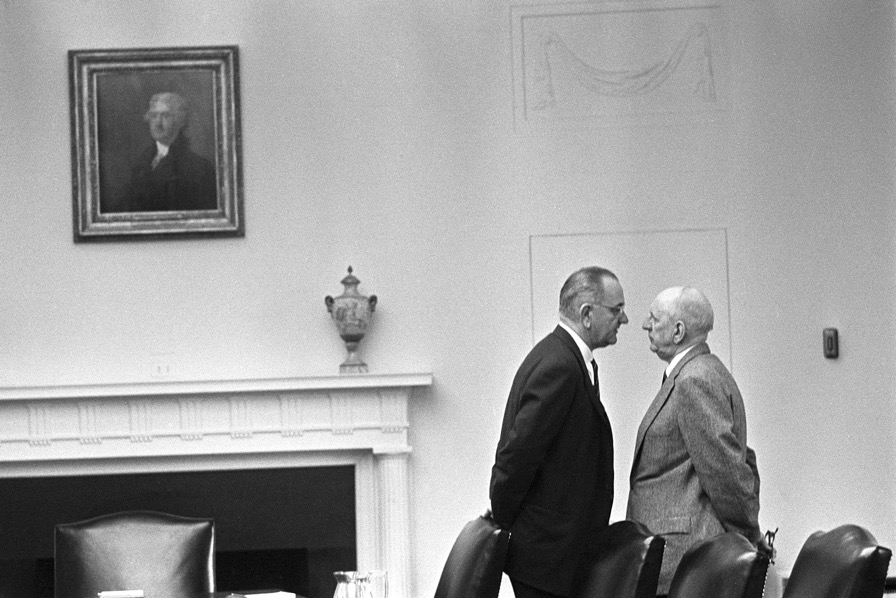
Known for his confrontational style of politics, Lyndon Johnson could even resort to the same tactics with allies, as was the case after becoming president when he met with old friend and mentor, Georgia Senator Richard Russell, to let him know in no uncertain terms that he intended to pass meaningful civil rights legislation over the objections and obstruction of Russell’s Southern Bloc in the Senate (courtesy LBJ Presidential Library, W98-30).
By early 1963, it had become clear that the entire Kennedy domestic agenda was being intentionally bottled up in the Senate. Along with tax cuts and civil rights, this legislation included Medicare (the eventual federal health insurance program for America’s senior citizens) and federal aid for education. The media termed it just another congressional “logjam,” but LBJ recognized it as more than that. With the “public outcry for civil rights” and “an end to Jim Crow” growing stronger by the day, Johnson realized it was more than that—that, in fact, it was a strategy and probably the only one available to his former associates in the Southern Bloc. The President knew a Southern strategy when he saw one and how, behind the scenes, his old friend and new rival, Russell, was indeed laying it all out; drawing up a list of all federal laws set to expire and explaining to his Southern co-conspirators how they would build a blockade around the civil rights bill in the committees chaired by senators from the South. And if and when that logjam was broken, the Southerners would need to be prepared to filibuster, Caro advised—“not on the civil rights bill itself, but on the motion to bring the civil rights bill to the floor.” Only should cloture be imposed to end the filibuster on that motion would the South have to fall back on its last line of defense, another filibuster of the bill itself, which by that point in the proceedings would probably signal the doom of debate and overwhelming civil rights momentum.24
Cloture, a seldom heard word even in the world of legislative assembly, was the procedure for ending debate in the Senate and forcing a vote. Caro pointed out early on in The Passage of Power that there were, after all, only two ways to end a Senate filibuster—by a vote of cloture or by abandoning the bill being filibustered altogether, effectively withdrawing it from Senate consideration. The latter way had actually played out in the South’s favor 11 times before between 1929 and 1962. Whenever the South decided to fight civil rights with the filibuster for as long as necessary by not allowing the Senate to move on to other bills—in effect rendering those other bills hostages of civil rights—that was the very effective Southern strategy LBJ knew only too well. To defeat the strategy first required getting any other important bills off the table, so to speak. Only by eliminating the pressure of other key legislation did the 1964 Civil Rights Act, which outlawed discrimination based on race, color, religion, sex, or national origin in the workplace, schools, or public accommodations, get passed into much needed law.25
The day Johnson issued his challenge to Russell, nose-to-nose, in the White House, saying he fully intended to pass the civil rights bill, the very careful, deliberate senator from Georgia supposedly replied: “Well Suh, you may very well do that, but if you do … you will lose the South forever.” That would remain the prevailing political fallout Johnson had to come to terms with, not only for himself in what would be his re-election campaign later that year, but also for the future of the Democratic Party. Leuchtenburg, in The White House Looks South, even indicated LBJ went so far as to lecture the Southern Bloc in advance of the upcoming showdown, remarking: “Boys, you’ve got a Southern president and if you want to blow him out of the water go right ahead, but [if you do] you will never see another one.”26
As had happened before, including his first year in the Senate (when as one of the youngest members of the Southern Bloc he had witnessed the Southern strategy work to stop the hoped for civil rights legislation of newly re-elected Harry Truman), LBJ knew it could happen again if he didn’t do something to counteract it. And as Caro acknowledged, Russell would first try to make time the ally of the South. If the Southerners could keep debate in the Senate going long enough, proponents of the civil rights legislation were expected to again tire and seek to move on to other bills with a better chance of consensus passage. Almost as imperative, if not as contentious as the civil rights bill was sure to be, was the tax bill, then in its 11th month before Congress and, as previously noted, under the control of Senate Finance Committee Chairman Harry Byrd, an unflinching, 31-year member of the Southern Bloc and someone with personal strings attached to both bills.27
Debate on the civil rights bill began in early March and led by Russell, the well drilled Southerners filibustered from the start. Seeking to derail such tactics, Johnson pressured his successor as Senate majority leader, Mike Mansfield of Montana, to hold around-the-clock sessions, which would have forced Russell and his Southern colleagues to keep debate going into the wee hours. Mansfield, however, refused, citing the fact that tactic had failed to crack Southern resolve before and with the rebuke: “This is not going to be a circus or a sideshow. We are not operating in a pit with spectators late at night to see senators of the republic come out in (their) bedroom slippers. There will be no pajama sessions of the Senate.” According to Baker and MacNeil’s history of the Senate, Mansfield did relent some by starting sessions “early each morning” and letting them run “well into each night,” but his refusal to use harsher methods made it easy for Russell and company as they filibustered the motion for three full weeks. Only then, fearing to stall any longer might prompt a successful motion for cloture did the Southerners back off, allowing debate on the bill itself to begin.28
Taking the lead in arguments for the civil rights bill was Humphrey, the Democratic majority whip, who coordinated cogent arguments among his more liberal colleagues in a procession of speakers on both sides. Mansfield and Humphrey were relying on the prospect of an eventual settlement through cloture, but as so often before, with the Southern Bloc of Democrats as their opposition, they knew they could never muster enough party-line votes to achieve the two-thirds needed to end debate. What they needed were Republicans, who as conservatives themselves had often sided with the Southern Dems, especially whenever they could safely trade their votes on civil rights for similar favors on their own minority legislation.29
At the same time, LBJ was behind the scenes maneuvering what became the Tax Reduction Act of 1964, which cut federal income taxes by approximately 20 percent across the board, out of the tight-fisted clutches of Harry Byrd by getting the federal budget below the $100 billion mark, the Virginia senator’s deal or no-deal cutoff as far as negotiations were concerned. Once Johnson had managed the necessary reductions, a feat of fiscal responsibility rarely equaled in such a short amount of time by a sitting U.S. chief executive, and proven his handiwork to “Old Harry,” who was growing tired of hearing how he was the hold-up on reducing taxes, the bill was finally moved out of committee and onto the floor, where it became law on February 26, 1964. It would be a precursor of the administration’s final push on civil rights legislation just over four months later.30
Meanwhile, Johnson’s floor generals in the Senate, Mansfield and Humphrey, had gone out of their way to make an unlikely ally on civil rights in the person of the Republican minority leader, Everett Dirksen of Illinois. Mansfield, a modest man to the point of “self-abnegation” (again according to The American Senate’s co-authors), had no trouble deferring to the droll, spotlight-seeking Dirksen. LBJ had urged them both to flatter Dirksen by offering him the role of statesman in a history-making undertaking. As a result, Humphrey reported: “[We] began a public massage of [Dirksen’s] ego and appealed to his vanity.”31
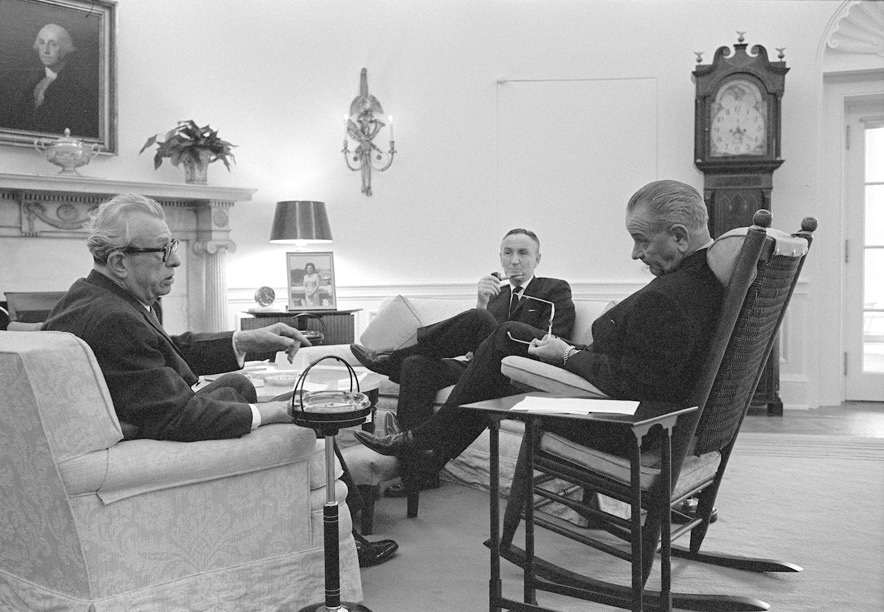
Photographed at the White House with Senate Republican Leader Everett Dirksen (left) and Democratic Majority Leader Mike Mansfield (center), Lyndon Johnson as president took advantage of his vast parliamentary experience, honed during his own years of Senate leadership, to break through the Southern strategy of filibuster that had previously limited meaningful civil rights legislation. Dirksen’s influence was key to bipartisan passage of the 1964 Civil Rights Act (courtesy LBJ Presidential Library, A2550–3a).
Nearly identical versions of this courtship appear in the previously referenced historic narratives of Doris Kearns Goodwin and Jon Meacham, while the biography of Russell provided the opposition take. In Goodwin’s text she wrote:
A legendary nose-counter, Lyndon Johnson was certain that without Republican support [given the sectional split in the Democratic Party] “we’d have absolutely no chance of securing the two-thirds vote to defeat the filibuster. And I knew there was but one man who could secure us that support—the senator from Illinois, Everett Dirksen.” Just as he had identified Senate Finance Chair Harry Byrd as the key to success in the tax struggle, so now he saw that the Republican minority leader was the one man able to corral the 25 or so Republicans needed to invoke cloture. “The bill can’t pass unless you get Dirksen,” Johnson [told] Humphrey. “You and I are going to get him. You make up your mind now that you’ve got to spend time with [him]. You’ve got to let him have a piece of the action. He’s got to look good [in this] all the time.”
Both versions would conclude with the following exhortations: “You get in there to see Dirksen! You drink with Dirksen! You talk to Dirksen! You listen to Dirksen!”32 On the other hand, Russell’s biographer would simply note:
As the civil rights fight of 1964 heated up, the President sent Hubert Humphrey to court and win over Republican giant Everett Dirksen. Although the Southern Bloc mounted a formidable filibuster campaign, Humphrey took pages from Russell’s book and kept his people on hand with [speaking] schedules that allowed everyone rest time. Including the debate on the motion, this became the longest filibuster in the history of the U.S. Senate, lasting 74 working days.33
Dirksen had issues to deal with if he was to support the civil rights bill. During his last re-election campaign in 1962, Illinois’ African American leadership had come out against him and that still annoyed him. At first, he pronounced the bill unsatisfactory, but as the filibuster continued week after week, he eventually put aside personal issues while entering into what Baker and MacNeil described as:
A complex series of backroom negotiations with senators sponsoring the legislation, staff experts, and officials of the Justice Department led by Attorney General Robert Kennedy. A gifted legislator able to compose law, unlike many of his colleagues, Dirksen began to propose changes in the pending bill, which had already been passed in the House [of Representatives]. Resentful [of] Dirksen’s sudden prominence in the [process], Robert Kennedy tried to block [the changes], but Dirksen had his way. He had a telling argument, [as] without the changes he could not hope to deliver the votes of his Republicans for cloture. Dirksen offered 70 amendments in all and he insisted on them as his price for supporting the bill. He so altered the bill that it became known as “the Dirksen package.”34
In the middle of these negotiations, Russell made one last effort to woo Dirksen away from the bill’s sponsors, but the Johnson-inspired and Humphrey-implemented recruitment of the Republican leader had been too deferential and empowering for him to ignore. In addition, Dirksen had taken his party’s prospects for the coming presidential election into account and with his good friend, fellow Senator Barry Goldwater of Arizona, as the presumptive Republican nominee, he wanted to position the GOP and its candidate in as favorable a light as possible. But even with his own amendments added, he still faced a daunting task getting at least 25 of 33 Republican senators to vote for cloture.35
Nonetheless, with Republicans numbering less than one third of the Senate’s membership, he had achieved remarkable influence for the party, far in excess of its numerical strength, and through his remarkable talents of persuasion he was going to decide not only whether the bill passed, but also its substance. During the debate, making the most of his theatrical style of oratory, he urged his fellow senators to endorse a cause long overdue, when he uttered the phrase: “Stronger than all the armies whose time had come, this is an idea whose time has come. It will not be stayed. It will not be denied.”36
And it was not. As Russell’s niece, Sally Russell, recorded: “On 10 June, the Senate voted 71 to 29 [with four more ‘ayes’ than actually needed], to close off debate” on what would become the landmark Civil Rights Act of 1964. Clearly the Senate had changed since Russell repeatedly blocked civil rights legislation via the filibuster, as well as two attempts to amend the filibuster rule. Realizing he could no longer stop what he termed “the resulting stampede of amendments,” the Georgian ironically complained that “a lynch mob” had been loosed on the Senate floor. In a last-ditch try to preserve Southern segregation, he proposed that certain provisions of the bill be submitted to a national referendum, but that proposal was easily turned back by a 73–27 vote two days later, the same tally by which the legislation itself would ultimately pass on June 19. And on July 2, LBJ, a Southerner, triumphantly signed a bill officially putting an end to 90 years of segregation in the South.37
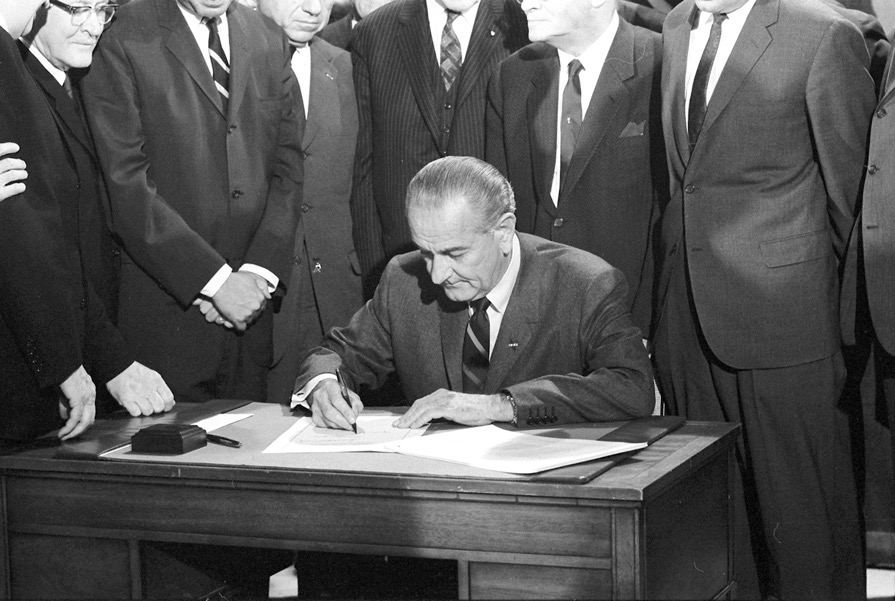
Upon assuming the presidency in the wake of the Kennedy assassination, Lyndon Johnson would invoke the memory of JFK and the honor that would be afforded him by passage of the 1964 Civil Rights Act, which he would doggedly pursue to this historic signing on July 2, 1964 (Library of Congress Prints and Photographs Division—Reproduction Number LC-DIG-ppmsca-03196).
Having maneuvered his former Southern colleagues turned foes into submission, Johnson had proven he was still “master of the Senate.” Former Atlanta mayor and U.S. ambassador to the United Nations under President Jimmy Carter, Andrew Young, who along with Martin Luther King, Jr., John Lewis, and others became icons of the Civil Rights Movement, would later write: “It was a powerful symbol … that a president born and raised in a [former] Confederate state was the one to [finally] sign the [1964] Civil Rights Act into law.” However, as Johnson would later reflect, “The decision to press for the civil rights bill in 1964 was not without penalties for me. It was destined to set me apart forever from the South.”38
Richard Russell would serve one more term in the Senate, dying while still in office on January 21, 1971. Always admired by former constituents and colleagues, though viewed disparagingly by the rest of the country for his decades-long defense of segregation, he would remain cordial with LBJ even in defeat of what he had termed the “Southern way of life.” Although he never again addressed Johnson as “Lyndon”—only “Mr. President”—he would mostly support the remainder of his presidency and take pride in the fact their friendship had played a big part in elevating him to the Oval Office. Later their relationship did “cool,” according to Sally Russell, near the end of her uncle’s life as the result of a disagreement over the appointment of a federal judge from Georgia. Russell again felt betrayed and this time would go to his grave having lost all trust in Johnson, his former Southern protégé.39
1. David McCullough, John Adams, 374–379; Andrew Burstein and Nancy Isenberg, Madison and Jefferson, 152–157.
2. Richard A. Baker and Neil MacNeil, The American Senate, 276, 278, 280, 284–286.
3. Ibid., 305–306.
4. Ibid., 306–307, 311, 313, 315–316; Molly F. Reynolds, “What Is the Senate Filibuster and What Would It Take to Eliminate It?” brookings.edu, October 15, 2009.
5. Richard A. Baker and Neil MacNeil, The American Senate, 317.
6. Ibid., 318.
7. Ibid., 319–320.
8. William E. Leuchtenburg, The White House Looks South, 263, 269–270; Sally Russell, Richard Brevard Russell, 219; Doris Kearns Goodwin, Leadership in Turbulent Times, 308; Jon Meacham, The Soul of America, 211–212; John Lewis with Michael D’Orso, Walking with the Wind: A Memoir of the Movement, 46–48.
9. John Lewis with Michael D’Orso, Walking with the Wind, 46–48, 128, 175–176, 199, 276; David Halberstam, The Children, 11, 92–94, 102–105; David J. Garrow, Bearing the Cross: Martin Luther King and the Southern Christian Leadership Conference, 11–82, 154–161, 239, 248–250, 291; Robert A. Caro, The Passage of Power, xiii–xv, 347, 444.
10. Robert A. Caro, The Passage of Power, 346; William DeGregorio, The Complete Book of U.S. Presidents, 557.
11. Robert A. Caro, The Passage of Power, 393–395.
12. Jon Meacham, The Soul of America, 212.
13. Doris Kearns Goodwin, Leadership in Turbulent Times, 308.
14. Jon Meacham, The Soul of America, 212–213.
15. Robert A. Caro, The Passage of Power, 398.
16. Ibid., 429–430; F. Martin Harmon, Presidents by Fate, 36.
17. Jon Meacham, The Soul of America, 209, 212, 213; Robert A. Caro, The Passage of Power, 427–428.
18. Robert A. Caro, The Passage of Power, 430.
19. Ibid., 431.
20. Ibid., 431–432; F. Martin Harmon, Presidents by Fate, 152.
21. Sally Russell, Richard Brevard Russell, 231.
22. Ibid., 232; Robert A. Caro, The Passage of Power, 443, 446–449.
23. Robert A. Caro, The Passage of Power, 457; Sally Russell, Richard Brevard Russell, 232.
24. Robert A. Caro, The Passage of Power, 455, 457–458.
25. Ibid., 258–259; Sam Berger and Alex Tausanovitch, “The Impact of the Filibuster on Federal Policymaking,” americanprogress.org, December 5, 2019; William DeGregorio, The Complete Book of U.S. Presidents, 574.
26. William E. Leuchtenburg, The White House Looks South, 303.
27. Robert A. Caro, The Passage of Power, 458–459, 462.
28. Richard A. Baker and Neil MacNeil, The American Senate, 330.
29. Ibid., 330–331.
30. Martin Fridson, “Why the Kennedy Tax Cut Never Really Happened,” forbes.com, December 11, 2017; Robert A. Caro, The Passage of Power, 471–475, 482–483.
31. Richard A. Baker and Neil MacNeil, The American Senate, 331.
32. Doris Kearns Goodwin, Leadership in Turbulent Times, 323; Jon Meacham, The Soul of America, 230.
33. Sally Russell, Richard Brevard Russell, 235.
34. Richard A. Baker and Neil MacNeil, The American Senate, 331.
35. Ibid.
36. Ibid., 332.
37. Sally Russell, Richard Brevard Russell, 235.
38. William E. Leuchtenburg, The White House Looks South, 308–309; Robert A. Caro, The Passage of Power, 9.
39. Robert A. Caro, The Passage of Power, 431–432; Brian O’Shea, “Who Is the Russell Building Named For?” ajc.com, August 27, 2018; Sally Russell, Richard Brevard Russell, 257.