
18
In the first volume of his voluminous, multi-volume biography of Lyndon Baines Johnson, The Path to Power, Robert Caro laid out the political strategy of a very young, 28-year-old LBJ, seeking to become the representative of Texas’ 10th Congressional District in just three words—Franklin Delano Roosevelt. Indeed, the most popular and generally recognized most successful president of the 20th century, the always engaging and politically astute FDR was Johnson’s hero and role model even before he became a freshman congressman in 1937. While virtually all down-ballot Democrats would profess allegiance to the undisputed titular head of their party in the mid–1930s, Johnson, in Caro’s words, had to be “more pro–Roosevelt” than the rest. And in his own words, especially as a largely unknown first-time candidate, Johnson was a “Roosevelt man” all the way when it came to addressing Texas voters in the all-important 1936 Democratic primary and general election that followed.1
LBJ had actually jumped on the Roosevelt bandwagon in 1931 as a young congressional aide for then–Texas Congressman Richard Kleberg, “one of the wealthiest men in Texas” and the grandson of Richard King, founder of the world-famous King Ranch. With his new boss a typical, conservative Southern Democrat, in fact, it was Johnson who first impressed on Kleberg the absolute necessity of casting his lot with FDR’s New Deal as a means of political survival, since most of the Great Depression masses had embraced their new president’s progressive, government-induced strategy for economic recovery upon his arrival in the White House in 1933. As a young congressman himself four years later, Johnson would take full advantage of a Roosevelt fishing excursion along the Texas coast that ended at the Port of Galveston. He arranged to meet FDR at the conclusion of the President’s 11-day cruise with Texas Governor James Allred there to facilitate introductions. It would be the first of many well-timed ploys by Johnson and a valuable photo op as he ascended the political ladder. So well timed, in fact, that he was invited to ride in the President’s open touring car (along with Allred and Galveston’s mayor) amidst a tremendous turnout for FDR by the citizens of Galveston all along the way from the port to the city train depot, where Johnson also got to accompany Roosevelt aboard his private railroad car, first to review 3,000 ROTC cadets at Texas A&M University and then on to Fort Worth before de-training and bidding the President adieu, having spent an entire day in his company, a rare opportunity indeed for any young Democratic congressman.2
Later in Means of Ascent, his second volume in the Johnson series, Caro reported on the instant rapport of Johnson and Roosevelt from that first meeting, which would enable LBJ to gain access to a small circle of FDR associates in the nation’s capital that assisted his political rise. At the same time, no one could have predicted how the fates aligned that day in Galveston—the coming together of two U.S. presidents, both of whom ascended to the White House nearly three decades apart. Johnson, however, was always of the mindset to seek to control fate, especially his own, and his desire to emulate Roosevelt as his career moved forward would often resurface, especially after he became an accidental president through a totally unexpected historic twist—the death in office of the second youngest U.S. president ever. And in that tragic moment, when LBJ sought to use the passing of John Fitzgerald Kennedy to inspire Congress to finally adopt meaningful civil rights, it should have come as no surprise that Johnson would also adopt the legacy of FDR—tackling the depths of the Great Depression with his New Deal—by announcing a “War on Poverty” in 1964. Doris Kearns Goodwin illuminated this connection to FDR when she acknowledged Johnson’s hope to “surpass” the New Deal with his own, so-called “Great Society,” a series of programs by which Johnson could model himself after the president he admired most, carrying “the people though a dark hour in their national life,” and “exhorting them to action.”3
In The Soul of America, Jon Meacham echoed this connection, when he wrote: “Both [FDR and LBJ] believed in the transformative power of the presidency and sought to marshal federal power in the service of government.” But an even more personal illustration of FDR’s influence on his fellow, future president was confirmed in a 2012 online article that deciphered the simultaneous use of three initials, à la FDR, by aspiring young Democrats of the next generation like LBJ and JFK. Its conclusion: “The most enthusiastic and calculating adopter of the [three initial] convention was LBJ. As a congressman, long before he was vice president, he had instructed his assistants to always refer to him by his initials in the FDR mode.” Johnson would even name his two daughters using the same three initials (Luci Baines and Lynda Byrd), a political ploy and subliminal connection with the preeminent Democrat of the 20th century.4
And perhaps nothing illustrated how much Johnson measured himself and greatness by the legacy of Roosevelt than his immediate reaction to FDR’s death in 1945, explicitly described in Caro’s The Path to Power as the depiction of a reporter friend who spied LBJ by himself in “a gloomy capitol corridor” after news of the President’s passing had just been announced. That eye-witness account follows:
“With tears in his eyes” and “a white cigarette holder”—similar to Roosevelt’s—clamped in “a shaking jaw,” he told the reporter that when the news came, “I was just looking up at a cartoon on the wall—a cartoon showing the President with that cigarette holder and his jaw stuck out like it always was. He had his head cocked back; you know. And then I thought of all the little folks and what they had lost. He was just like a Daddy to me; he talked to me that way…. God! God! How he could take it for all of us!”5
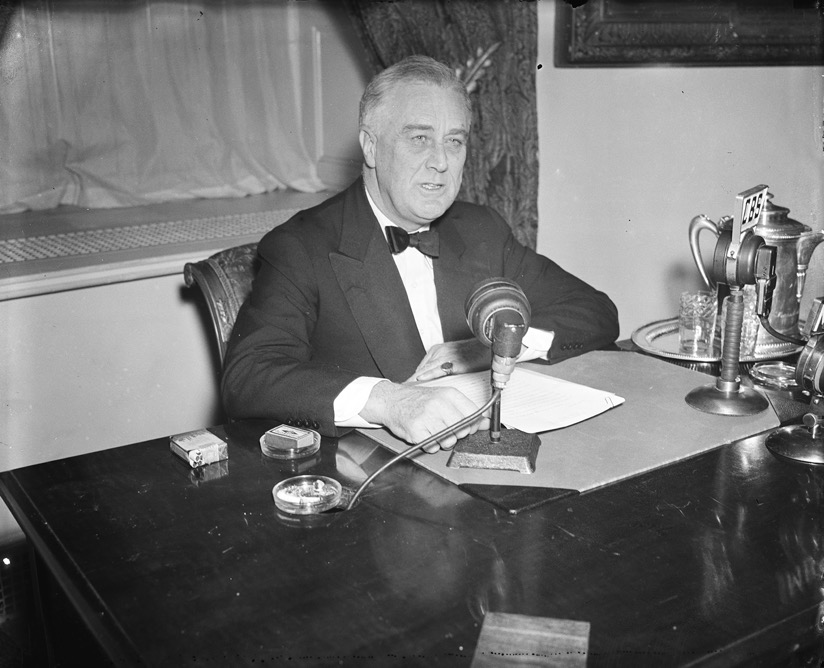
There’s no doubt Franklin Delano Roosevelt, shown here addressing the nation via radio in the 1930s, was Lyndon Baines Johnson’s political hero and role model as president. Following his re-election in 1964, in fact, LBJ’s series of legislative programs aimed at lifting people out of poverty were intended to emulate FDR’s New Deal in the midst of the Great Depression (Library of Congress Prints and Photographs Division—Reproduction Number LC-DIG-hec-47601).
All of that to say … even with the nation in mourning as he ascended to the presidency due to an assassin’s bullet; and even with his embrace of Kennedy’s legislative program, including the divisive specter of civil rights, Lyndon Johnson was still going to seek to make history the way Franklin Roosevelt made history three decades before no matter how he got to the White House or what else confronted him once he was there. He just thought that was what all presidents were supposed to do, so in 1964 he went for it all—not only the Kennedy agenda, but also what Caro described as “a vast, revolutionary transformation of America.” His War on Poverty would be the start of a transformation of American society as a whole into the Great Society. In his 1964 State of the Union address, Johnson said, “Many Americans live on the outskirts of hope, some because of their poverty and some because of color, and all too many because of both. Our task is to help replace their despair with unconditional war on poverty in America.” And with that announcement, he introduced legislation that led to the Economic Opportunity Act and the funding of such programs as the Job Corps, which provided vocational training to disadvantaged youth; Volunteers in Service to America (VISTA), which enlisted volunteers to work and teach in urban ghettos; the Work-Study Program, which provided jobs to enable students of low income families to work their way through college; the Work Experience Program, which provided child care for poor households; and the Community Action Program, providing instruction for disadvantaged preschoolers under Head Start, tutoring for disadvantaged high school students under Upward Bound, and elderly volunteers to befriend institutionalized children and legal aid for the poor under a Foster Grandparents Program.6
If all that sounded similar to the massive “alphabet soup” of federal programs or agencies started by FDR: programs like the CCC (Civilian Conservative Care), WPA (Works Progress Administration), NRA (National Recovery Act), AAA (Agricultural Adjustment Act), PWA (Public Works Administration), and TVA (Tennessee Valley Authority), it’s because they came from the same presidential playbook. Some worked better than others, but for the second time in U.S. history, there was a reliance on government to accomplish tasks, ease the burdens of a crisis, and generally make life better for Americans regardless of their station in life in ways the private sector was unwilling or unable to do.7
Just a few months later in May of 1964, Johnson gave another speech at the University of Michigan in which he “laid out a course toward not only the ‘rich society and the powerful society but upwards to the Great Society,’” according to presidential historian Kenneth Davis. That day, LBJ said that America could be the society to “end poverty and racial injustice,” with his speechwriter’s coining of “the phrase Great Society” setting the stage for an ambitious legislative agenda that addressed education (Elementary and Secondary Education Act), health (Medicare for seniors and Medicaid for welfare recipients), and the environment (Wilderness Act and National Historic Preservation Act), in addition to his better remembered civil rights and poverty bills. In all, more than 200 significant pieces of legislation were passed while Johnson was president—what Davis also termed his “Great Society rush.”8
As already established, Johnson felt those were “what-the-hell-the-presidency-was-for,” but alas, his desire to do as much good for as many Americans as possible and to actually outdo FDR, if possible, was irrevocably set back by the tragedy of the Vietnam War. Like Korea in the 1950s, it was a containment conflict, but one that would last 20 years, 1955 through 1975, and involve the administrations of five presidents, none of whose legacies would be more damaged than LBJ’s by that second and much longer U.S. police action on the Asian continent. Its escalation, in fact, much of which would come under his watch, would be the reason Johnson would relinquish what early on had seemed his inevitable re-election in 1968. Instead, after his controversial Gulf of Tonkin Resolution in August of ’64 further escalated the conflict via sleight-of-hand policy, LBJ’s hopes of seeing his War on Poverty and Great Society through to fruition were dashed by the Viet Cong’s determination to outlast South Vietnam and reunite their nation under Communist North Vietnam and its determined leader Ho Chi Minh.9
Johnson’s shocking announcement that he would not seek re-election in ’68 followed four years of increasing protests and demonstrations against the Vietnam War, especially on college campuses. This was exactly what LBJ must have had in mind when, after his landslide re-election in 1964 with 61.1 percent of the vote, he had an introspective moment, supposedly telling his staff:
I’ve just been elected and right now we’ll have a honeymoon with Congress. But after I make my recommendations, I’m going to start to lose the power and authority I have…. Every day that I’m in office and every day I push my [legislative] program, I’ll be losing part of my ability to be influential, because that’s the nature of what [a] president does. He uses up capital. Something is going to come up … something like the Vietnam War or something else, where I will begin to lose all I have now. So, I want you guys to get off your asses and do everything possible to get everything in my program passed asap, before the aura and the halo that surround me disappear.
Needless to say, it was an intuitive reality check by a great politician who understood the tenuous nature of presidential approval, even at the moment of his greatest popularity.10
And Johnson’s intuition would surely seem prophetic to his staff four years later. But before reaching that point in the LBJ legacy and heading into an ignominious retirement, the Civil Rights Movement that he had embraced would provide one more milestone on the Johnson presidential resume, thanks to another seminal event in the Deep South. That one would occur in Selma, Alabama, on March 7, 1965, and forever become ingrained in American history as “Bloody Sunday”—the day approximately 600 marchers set out on foot from that sleepy Southern town for the state capital, Montgomery, a 54-mile trek designed to bring attention to the one thing the 1964 Civil Rights Act had not fulfilled for African American equality—voting rights—for without voting rights there could be no Black equality regardless of what other desegregation (or integration) occurred.11
On the now famous Edmund Pettus Bridge, which sits where the highway exits Selma’s downtown over the Alabama River, the marchers were met by state troopers, some mounted, and brutally beaten when they did not disperse and call off their march. Under the direction of Alabama’s segregationist governor, George Wallace, the troopers’ actions that day were captured by network television, to the horror and revulsion of the entire nation. And when the march triumphantly resumed a few days and federal-state-Movement negotiations later, this time under National Guard protection, it would lead directly to President Johnson finishing what he had started the previous year with his 1965 Voting Rights Act, which once-and-for-all prohibited any kind of racial discrimination in voting when it was passed by both Houses of Congress six months later.12
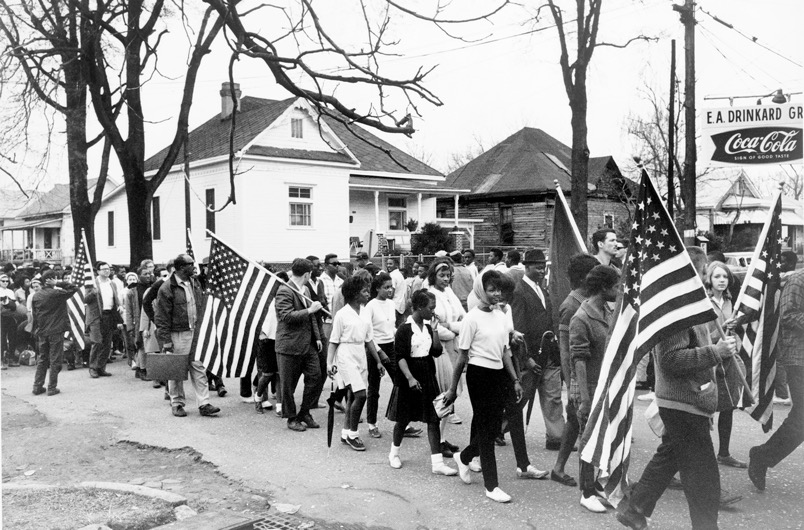
After the national disgrace that was Bloody Sunday in March of 1965, the Civil Rights Movement’s planned march from Selma, Alabama, to the state capitol in Montgomery to demonstrate for African American voting rights was allowed to proceed as the result of intervention by the Johnson administration two weeks later with over three thousand taking part under National Guard protection (Library of Congress Prints and Photographs Division—Reproduction Number LC-USZ62-133090).
How Selma and Bloody Sunday led to that historic follow-up legislation on August 6, 1965, has been retold in numerous narratives of the Civil Rights Movement. A young newspaper reporter at the time, David Halberstam was there representing the Nashville Tennessean during the Southern sit-ins and went on to cover that period in detail, including Vietnam while working for the New York Times, where he earned a Pulitzer Prize in 1964. His 1998 book, The Children, made the young Black adults who were the Movement’s leaders better known and understood. Twelve years earlier, David Garrow, a professor at Emory University in Atlanta, Georgia, conceptualized the whole era in greater detail with his Pulitzer Prize-winning book, Bearing the Cross, about Martin Luther King (MLK) and the Southern Christian Leadership Conference (SCLC), which evolved into the Movement’s most influential leadership organization. And in 1998, John Lewis, one of the young titans Halberstam had prominently profiled in his book, authored his own bestselling memoir of the Movement, Walking with the Wind, including his first person participation and near death experience on Bloody Sunday. All three books, in fact, would lend credence to the far-reaching impact of the Selma confrontation and the transformative, concluding legislation it directly produced.
Taking Lewis’ recounting first, his thoughts on the aftermath of Bloody Sunday, during which the future and longtime Georgia congressman (33 years) sustained a fractured skull were as follows:
The American public had already seen so much of this sort of thing, countless images of beatings and dogs and cursing and hoses. But something about that day in Selma touched a nerve deeper than anything that had come before. Maybe it was the concentrated focus of the scene, the mass movement of those troopers on foot and on horseback, rolling into and over two long lines of stoic, unarmed people. This was a faceoff in the most vivid terms between a dignified, completely nonviolent multitude of silent protesters and the truly malevolent force of a heavily armed, hateful battalion of troopers. The sight of them rolling over us like human tanks was something that had never been seen before. People just couldn’t believe this was happening, not in America.13
Halberstam, meanwhile, described the aftermath from the role of the perpetrators when he wrote:
It had been nothing less than state-sponsored mayhem that day, the State of Alabama using its full force to beat and intimidate its poorest citizens and thereby keep them from being able to participate in the political process. Yet, it was the most short-lived of segregationist victories, for yes, they had succeeded momentarily in stopping the march … but they called national attention to Black grievances in Alabama. It had been America at its ugliest.14
Meanwhile, the following excerpt from Bearing the Cross touched on how media reports began to permeate and influence the country, as Garrow documented:
It was early evening by the time that news reports of the bloody attack began to spread across the country. Many television viewers were astounded by the graphic film of the troopers’ assault on peaceful marchers. ABC interrupted a movie, Judgement at Nuremberg, to present footage that depicted how racial hatred could generate awful violence in America, not just Nazi Germany.15
As a result of the optics of Selma, which had been set up by ongoing African American demonstrations over Southern voting rights, it was relatively easy for Johnson to go back to Congress the following year for what the 1964 Civil Rights Act had obviously lacked—federal voting guarantees for minorities. In describing the 1965 legislative process that dealt with voting rights, co–Senate historians Richard Baker and Neil MacNeil kept it simple as they explained: “The debate began in mid–April and the Southerners filibustered. Once again, Dirksen conceded that they were having the usual difficulty persuading senators to vote for cloture despite some promised conversions. The day before the scheduled vote, Senator Russell said in resignation, ‘If there is anything I could do, I’d do it, but I assume the die is cast.’ The vote for cloture was 70 to 30 and the next day the Senate approved the [1965 Voting Rights Act], 77 to 19. Larry O’Brien, Johnson’s chief liaison to Congress, gave the credit to Dirksen. ‘You can’t get cloture in the Senate,’ O’Brien said, ‘without Dirksen working like hell for it!’” But even with Johnson’s and Dirksen’s passage of the 1964 and 1965 bills, their passage still did not remove one more racially charged problem, prompting Johnson and Dirksen to join together yet again to pass a Fair Housing Act in 1968. When completed, it signaled the enactment of all the “long-pending civil rights measures,” according to Baker and MacNeil. “Only dimly understood at the time, the three bills of 1964, 1965, and 1968 would dramatically change the nation politically,” not only ending the Democrats hold on the South, but in their estimation “radically altering the way voters chose presidents and members of Congress. In this new form, the filibuster would fundamentally change the Senate. Within the Senate, the filibuster became an entirely different mechanism, freed at last from the onus of racial discrimination, but caught up in its revised use as an instrument of even more frequent legislative gridlock.”16
1. Robert A. Caro, The Path to Power, 219, 271–272, 395; F. Martin Harmon, Presidents by Fate, 150.
2. Robert A. Caro, The Path to Power, 446–448; David M. Kennedy, “FDR and LBJ,” American Heritage, December 1984.
3. Robert A. Caro, Means of Ascent, 10–11; Robert A. Caro, The Passage of Power, 550; Doris Kearns Goodwin, Leadership in Turbulent Times, xv–xvi, 312, 328.
4. Jon Meacham, The Soul of America, 46; Will Oremus, “RFK, DSK, OBL, WTF: When did we start referring to famous people by three initials,” slate.com, June 11, 2012.
5. Robert A. Caro, The Path to Power, 766.
6. Robert A. Caro, The Passage of Power, 601; William DeGregorio, The Complete Book of U.S. Presidents, 574.
7. Jonathan Alter, The Defining Moment: FDR’s Hundred Days and the Triumph of Hope, 280–304; Michael Hiltzik, The New Deal: A Modern History, 66–69, 72–78, 106, 162, 164, 168; Kenneth C. Davis, Don’t Know Much About the American Presidents, 431–433.
8. Kenneth C. Davis, Don’t Know Much About the American Presidents, 500–502.
9. Jon Meacham, The Soul of America, 212; William DeGregorio, The Complete Book of U.S. Presidents, 575–576; Kenneth C. Davis, Don’t Know Much About the American Presidents, 502–503.
10. Kenneth C. Davis, Don’t Know Much About the American Presidents, 508; F. Martin Harmon, Presidents by Fate, 153–154; Jon Meacham, The Soul of America, 235.
11. Christopher Klein, “How Selma’s Bloody Sunday Became a Turning Point in the Civil Rights Movement,” history.com, March 6, 2015.
12. Ibid.; Mary Schons, “The Selma-to-Montgomery Marches,” nationalgeographic.org, January 21, 2011.
13. John Lewis, Walking with the Wind, 344.
14. David Halberstam, The Children, 513–514.
15. David J. Garrow, Bearing the Cross: Martin Luther King, Jr., and the Southern Christian Leadership Conference, 399.
16. Richard A. Baker and Neil MacNeil, The American Senate, 333–334.