
Section Seven
19
As secretary of state under both Presidents Richard Nixon and Gerald Ford, Henry Kissinger, a naturalized, German-born U.S. citizen and former Harvard University professor, became perhaps the best-known diplomat on the world stage during the 1970s and later authored a book with the rather simple title, Diplomacy. More specifically, it’s a book about the history of Western diplomacy, basically from the time of Cardinal Richelieu in France through the likes of French Emperor Napoleon and the unifier of Germany, Otto von Bismarck, with the gist prefacing leadership of the United States in the 20th century and what he termed “The Hinge”—the “watershed,” internationalist presidencies of Theodore Roosevelt (1901–1909) and Woodrow Wilson (1913–1921) that European history helped initiate. Included in Kissinger’s text would be many of his own contributions on the back side of the century, but, ironically, nothing of his most direct link to the legacy of the irrepressible TR—the transformative Panama Canal, the 51-mile long lifeline of maritime trade that crosses the Central American Isthmus at its narrowest point, connecting the Atlantic and Pacific Oceans and significantly lessening the distance and costs of global commerce.1
Or to be more specific, the role Kissinger played in the ultimate transfer of the Panama Canal, Roosevelt’s vision, acquisition, and creation, and truly one of America’s greatest contributions to the world. Instead, the Canal is mentioned only once in the 912-page Kissinger text published in 1994, 17 years after the Ford administration gave way to the presidential election of Georgia Governor Jimmy Carter in 1976. On page 39, Kissinger merely stated: “With American help, the local population wrested independence from Colombia, but not before the Roosevelt administration had established the Canal Zone under United States sovereignty on both sides of what was to become the Panama Canal.”2
It was mentioned in the context of TR’s more assertive, “muscular diplomacy” in the Western Hemisphere and America’s “new global role,” but it failed to assert the diplomatic liberties and foreign policy short cuts our first President Roosevelt would take in 1903 to make it happen and keep it American for “perpetuity.” For more on the whole dramatic story of America’s incredible Canal achievements, read David McCullough’s The Path Between the Seas: The Creation of the Panama Canal—1870–1914, but for the purposes of this book, suffice it to say that TR tried to deal with Colombia before Panama seceded from that South American nation, but when the asking price got too unrealistically high he was more than happy to support and deal with the suddenly independent nation of Panama instead. That’s another story of diplomatic intrigue for another day that obviously did not make Kissinger’s book. Flash forward seven decades and what’s equally surprising is how Kissinger’s diplomatic efforts with Panama in early 1974 also didn’t make it—what became known as the “Kissinger-Tack Principles,” the agreement the then U.S. secretary of state would reach with Juan Antonio Tack, Panama’s foreign minister, promising to replace the 1903 Hay-Bunau-Varilla Treaty “with one providing a prompt end to U.S. control of the [Panama] Canal Zone, a greater share of Canal profits for Panama, and a promise that Panama would join in the administration and defense of the Canal.” This according to another book that does deal specifically with the Canal issue, a 2018 narrative by Adam Clymer titled Drawing the Line at the Big Ditch: The Panama Canal Treaties and the Rise of the Right.3
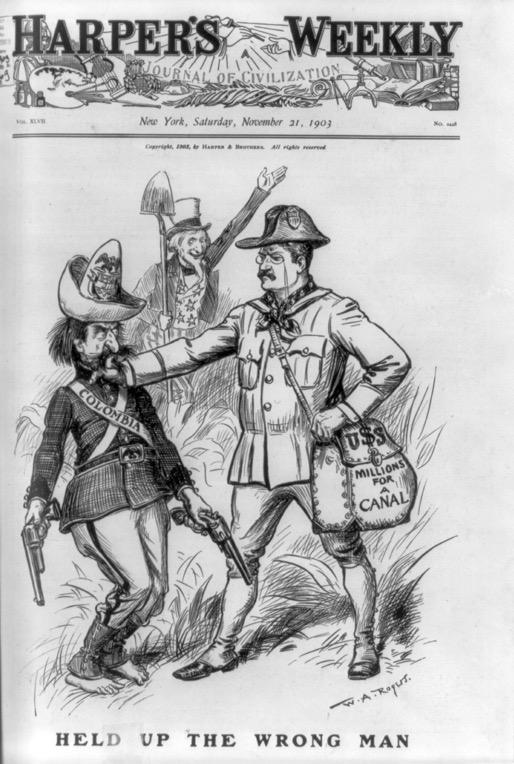
Taking advantage of a planned Panamanian revolution and separation from the nation of Colombia, President Theodore Roosevelt first rejected the extortionist demands of the Colombian government, as this 1903 Harper’s Weekly cartoon illustrated, supporting Panama’s independence instead in order to secure for America the best deal and chance to begin construction of the Panama Canal in 1904 (Library of Congress Prints and Photographs—Reproduction Number LC-DIG-ppmsca-50509).
Perhaps Kissinger’s omission of his Panama negotiations under Nixon and Ford was just a sign of the times, as Clymer made note of the fact only one major newspaper, the Los Angeles Times, considered the Kissinger-Tack announcement front page news. Coming out of the Johnson and Nixon presidencies, which were ultimately consumed by the specter of Vietnam and Watergate, respectively, the move towards relinquishing seven decades of control of the Panama Canal did not seem so important and as Clymer noted, “they spent no political capital trying to prepare the American people to accept their belief that this national treasure would be best preserved not by a continuation of colonial rule, but by cooperation on terms modern Panama could accept.” The limited media coverage was enough, however, to stir reaction that blurred party lines. Strom Thurmond, by then a converted Southern Republican, having abandoned the Democratic Party in 1964 after Democratic President Johnson’s assumption of civil rights leadership, said the Panama agreement would “invite disaster,” while Democrats like John Murphy of New York stated: “Kissinger was undertaking ‘a course of action which borders on insanity.’” Yet another Democratic congressman, Daniel Flood of Pennsylvania, who had been inspired as a child by the building of the Panama Canal after actually meeting then ex–President Theodore Roosevelt, even warned of his fear of communist takeover and the problem of the U.S. “yielding ‘to politically and communistically motivated demands of Panama [that] at times featured mob violence.’”4
With all of Latin America looking to the United States for good faith in its mentorship of the Western Hemisphere, including the relinquishing of what increasingly seemed seven decades of imperialistic control of the Canal Zone, the United Nations Security Council convened a meeting in Panama in the spring of 1973. Its purpose was to consider a resolution demanding, “without delay” a new “just and fair” treaty that would fulfill Panama’s legitimate aspirations and guarantee full respect for Panama’s sovereignty over all its territory, with the authoring and signing of a new treaty to replace the old, 1903 version. The U.S. had promptly vetoed that resolution and no other Security Council nation had voted with the Americans, not even the British, who abstained.5
That was the moment, however, that prompted Kissinger to act and to convince Nixon that serious problems could result from turning away from the Panamanian, and indeed, the entire Latin American aspirations of the late 20th century. As a result, that winter Kissinger and Tack developed their agreement, which promised a replacement for the 1903 treaty that would end U.S. control of the Canal Zone; provide a greater share of Canal profits to Panama; and affirm partnership between the two countries in the administration and defense of the Canal. The United States would still retain the use of land, water, and airspace necessary to defend the Canal and priority access to Canal passage for its shipping over every other nation in the future. “Most important,” according to Clymer, “the document (also) promised to abrogate the 1903 treaty and replace it with one having a fixed termination date” and elimination of the concept of “perpetuity.”6
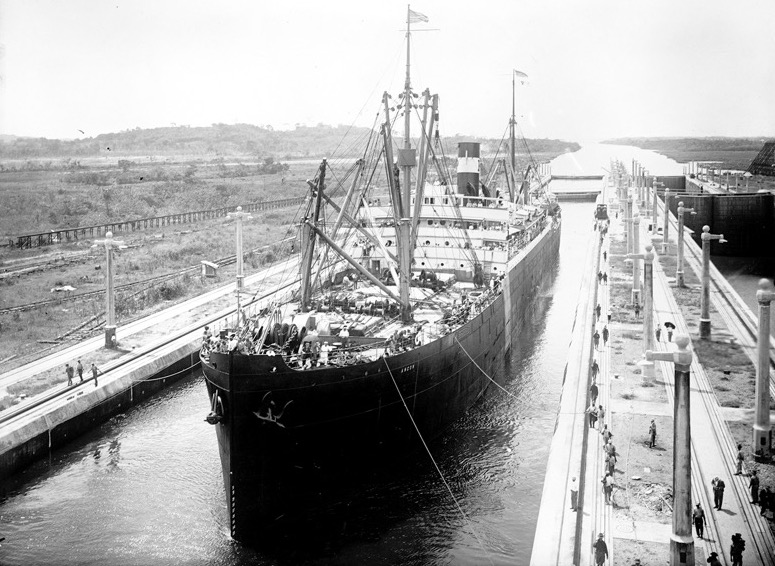
Still one of mankind’s greatest engineering achievements over 100 years after its completion, the Panama Canal made the global transport of goods much easier by connecting the Atlantic and Pacific Oceans with a manmade, 51-mile waterway that eliminated the necessity of sailing around South America (Library of Congress Prints and Photographs Division—Reproduction Number LC-DIG-npcc-19345).
At the time, Kissinger stated, “The world we live in today is not the world of Teddy Roosevelt,” but it was the world Gerald Ford inherited when he became an accidental president as surely as any, following Nixon’s historic resignation from office over the Watergate scandal (or maybe more so than any other considering he was also an accidental vice president after his appointment a year earlier under the new Twenty-Fifth Amendment following VP Spiro Agnew’s disgraced resignation over tax evasion). Despite their acknowledgment of the congressional opposition to be faced from the likes of Senator Thurmond and Congressman Flood, Ford instructed Kissinger to move ahead on the agreement for a new treaty. The threat of Panamanian unrest or insurrection, already evident in past instances of violence in 1958 and 1964, or even possible sabotage of the Canal locks, presented the new president with a Latin American situation that he would just as soon negotiate away as he dealt with the last vestiges of the Vietnam War, which did not come until 1975, and Watergate, which would include his controversial pardon of Nixon issued later that year, September 8, 1974.7
Many conservatives, including Alabama’s segregationist governor, George Wallace, felt that because of America’s abdication from Vietnam and the resulting communist takeover of that entire country, many Americans believed it was more than strategic, diplomatic, or geopolitical issues that were tied into giving away the Canal. Indeed, it was, as Floyd Haskell, a Republican turned Democratic senator from Colorado, uttered regarding the agreement and planned giveaway, when he said, “We were giving away a piece of American folklore.” That was the essence of the Panama Canal controversy that became front and center fodder for the 1976 presidential campaign. While most Americans were focused on the breakdown of trust in the American government brought on by Vietnam and Watergate, and the choice between a Washington outsider in Democrat Jimmy Carter and the replacement Republican incumbent Gerald Ford, another name surfaced bringing conservative values into the national discussion, Ronald Reagan, a former movie star and the governor of California. Normally, an incumbent president has the complete support of his party when seeking re-election. But exceptions to that rule had occurred: for instance, President Franklin Pierce, who was replaced on the 1856 Democratic ticket by James Buchanan, and three other accidental presidents, Millard Fillmore, Andrew Johnson, and Chester Arthur, none of whom ever enjoyed the overall support of the parties that put them in position as vice presidents to ascend to the White House in place of deceased predecessors. Likewise, Ford, as the most accidental of accidental presidents, felt he had earned another term, but unlike fellow 20th century accidentals Theodore Roosevelt (1904), Harry Truman (1948), and Lyndon Johnson (1964), he would not get one in ’76—not because of Reagan’s candidacy, but because of the tainted Nixon legacy and his pardon, which set him far behind what Carter biographer Stuart Eizenstat described as “an outsider’s nonideological appeal to restore trust and confidence in the presidency.” That outsider appeal produced an insurmountable 30-plus point deficit in the polls early on and eventual defeat despite a ferocious comeback that made the final 1976 presidential election results much closer than expected—297 electoral votes for Carter to 240 for Ford.8
But Reagan’s conservative infusion into the Republican primary had not helped Ford’s chances either and the esteemed, longtime Michigan congressman and Speaker of the House wanna-be (before he was literally drafted by the GOP for his brief VP role), would go to his grave believing he deserved better after coming to the rescue of the Nixon administration. As a result, he would always harbor a grudge against Reagan, who entered the race on November 20, 1975, and generally made life miserable for the incumbent through the primaries. “Decades later,” according to Ford biographer David Brinkley, “[he] still bristled about Reagan’s decision to challenge him in 1976. To Ford, that rendered an earlier Reagan pronouncement: ‘A Republican should never criticize another Republican’” totally hypocritical.9
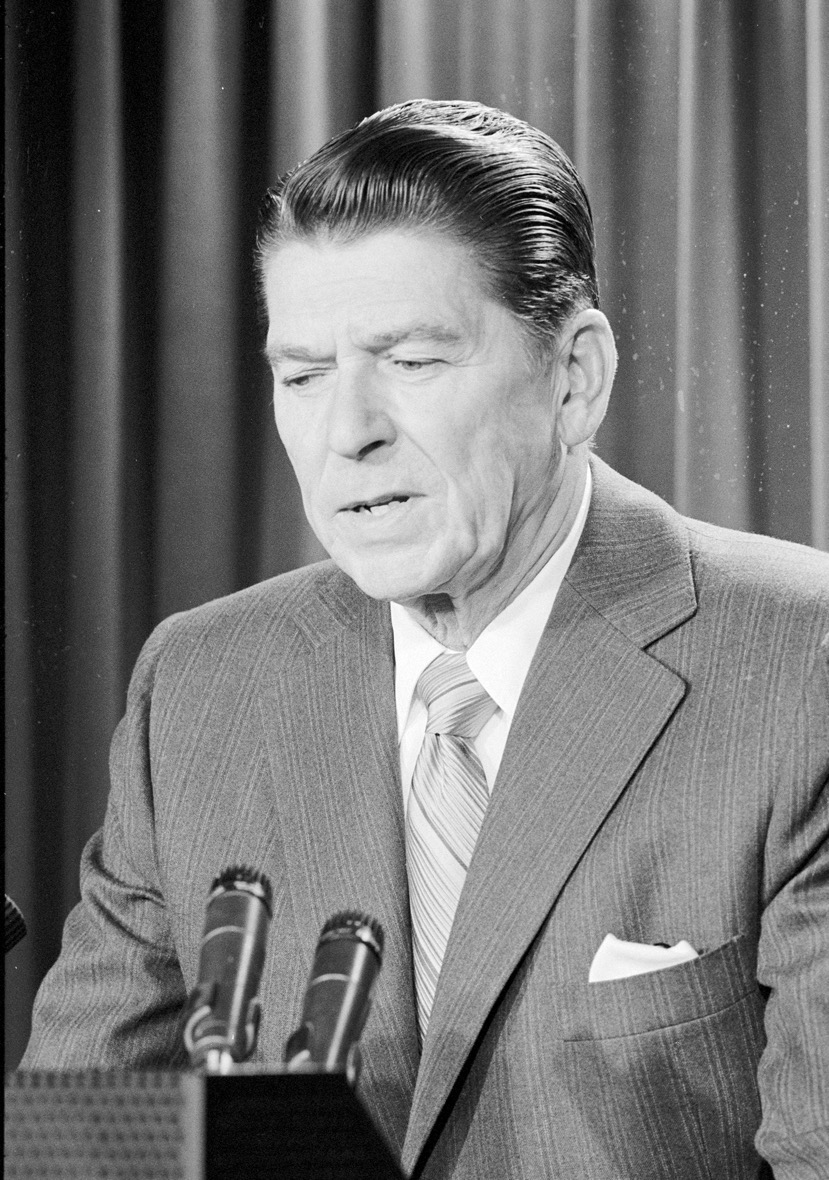
The 1970s congressional battle over the Panama Canal was actually a proxy war brought about by the leading conservative of that era, Ronald Reagan, California’s governor and a first-time presidential candidate in 1976. Reagan identified American intentions to turn the Canal over to Panama as a major campaign issue and the battle was continued for him during the administration of President Jimmy Carter (Library of Congress Prints and Photographs Division—Reproduction Number LC-DIG-ppmsca-50509).
Nonetheless, challenge him Reagan did and one of the best ways he found to carry out that challenge was by casting Ford’s decision to continue negotiating away the Panama Canal as un–American. At speaking engagements, Reagan discovered that one of the best avenues for rallying the crowd to his candidacy was the phrase “we built it, we paid for it, it’s ours and we are going to keep it,” forcing President Ford to address what Brinkley referred to as “The dull nuances behind the official U.S. position in the complex negotiations over the inevitable eventual transfer of control of the Canal to Panama.” Clymer, again in Drawing the Line at the Big Ditch, would make Reagan’s stance on the issue the subject of two early chapters leading up to the 1976 general election. He confirmed that in mid–July the year before, Regan had asked his good friend and Nevada Senator Paul Laxalt to establish an exploratory Reagan for President Committee. That allowed their conservative backers to raise money and begin a drumbeat over the impending Canal transfer, including the demand that Congress stand up to the State Department’s intention to surrender the Canal, and comments by Reagan like: “I think we’d be damn fools to turn over the Panama Canal. The Panamanians seceded from Colombia in 1903 because they wanted to participate in the benefits the Canal would bring to their part of the world and they identified their future success with the United States, having watched the French fail in their attempts.” As well as: “Panama has the highest standard of living in Central America”—as if to say (according to Clymer), why would Panamanians want to “kill the goose that laid the golden egg?”10
The Reagan campaign continued to draw applause whenever the issue came up. Meanwhile, the Carter campaign, according to Eizenstat, “declared [it] was ready to negotiate with Panama on physical improvements, tolls, and practical matters,” but “would not relinquish practical control of the Panama Canal Zone anytime in the foreseeable future.” It was a convenient abdication by the Democratic nominee of an issue that was roiling the Republican Party, but it was an issue that would not be going away and one that President Ford would soon turn over to his successor. That would set up a rare proxy war in the Halls of Congress and particularly the Senate, a proxy war that would ensure, once and for all, the rise of Reagan and the right wing of the Republican Party.11
1. Henry Kissinger, Diplomacy, 17, 29, 58, 65, 74, outside cover bio.
2. Ibid., 39.
3. David McCullough, The Path Between the Seas: The Creation of the Panama Canal, 1870–1914; Adam Clymer, Drawing the Line at the Big Ditch: The Panama Canal Treaties and the Rise of the Right, 8–9.
4. Adam Clymer, Drawing the Line at the Big Ditch, 9.
5. Ibid., 8.
6. Ibid., 8–9.
7. Ibid., 5, 13, 15; F. Martin Harmon, Presidents by Fate, 38, 159; David Brinkley, Gerald R. Ford, 67, 99–100.
8. F. Martin Harmon, Presidents by Fate, 75–76, 89–90, 108; Jean H. Baker, James Buchanan, 69–70; Stuart E. Eizenstat, President Carter: The White House Years, 6–7, 54, 64.
9. David Brinkley, Gerald R. Ford, 133–139; F. Martin Harmon, Presidents by Fate, 160; Adam Clymer, Drawing the Line at the Big Ditch, 23.
10. Adam Clymer, Drawing the Line at the Big Ditch, 20, 22, 23; David Brinkley, Gerald R. Ford, 136.
11. David Brinkley, Gerald R. Ford, 23; Stuart E. Eizenstat, President Carter, 556.