
In 1955, a young Massachusetts senator, John Fitzgerald Kennedy, authored a book that would win a Pulitzer Prize, Profiles in Courage. It featured the inspiring stories of previous United States senators who, despite intense political pressure from constituents, powerful colleagues, or even their party as a whole, exemplified courage in the choices they made and the votes they cast during some of the nation’s most dramatic moments. A year later, while seeking to further elevate the history of Congress’ “Upper House,” Senate Majority Leader Lyndon Johnson asked JFK to head a five-man committee charged with selecting what in essence was a Senate Hall of Fame, a task that resulted in the naming of five all-time greats on May 1, 1957—the original, so-called “Famous Five.”
After initially struggling over the attributes that should define senatorial greatness, Kennedy’s committee settled on statesmanship transcending party or state lines, and national leadership on legislation. Sixty-five candidates were recommended for consideration by a prestigious scholars’ committee for the five all-time slots, an obviously daunting task that resulted in the “Great Triumvirate” of the early 1800s—Kentucky’s Henry Clay, South Carolina’s John C. Calhoun, and Massachusetts’ Daniel Webster—all having their greatness confirmed along with progressive icon Robert La Follette of Wisconsin and staunch conservative Robert Taft of Ohio, two influential Senate fixtures of the early and mid–1900s, respectively.
Surprisingly left off of the Senate committee’s top quintet—to the consternation of the 160 nominating scholars who voted for him unanimously—was Nebraska Republican George Norris, perhaps the most independent, nationally focused senator ever. His legacy between the world wars as “Father of the TVA”; as the primary advocate for the Rural Electrification Act; and as the first outspoken opponent of the Electoral College in presidential politics remains unmistakable, proving that progressive ideas and bipartisan accomplishment do not necessarily rate with congressional colleagues (or rivals) the way they do with more objective observers. Indeed, nearly a half century later in 2004, when this so-called Senate HOF was updated with the addition of two more all-time greats, Norris, maybe the last truly progressive Republican, was again left out in favor of Michigan’s Arthur Vandenberg and New York’s Robert Wagner, one a Republican and the other a Democrat (respectively) from roughly the same chronological era as Norris.
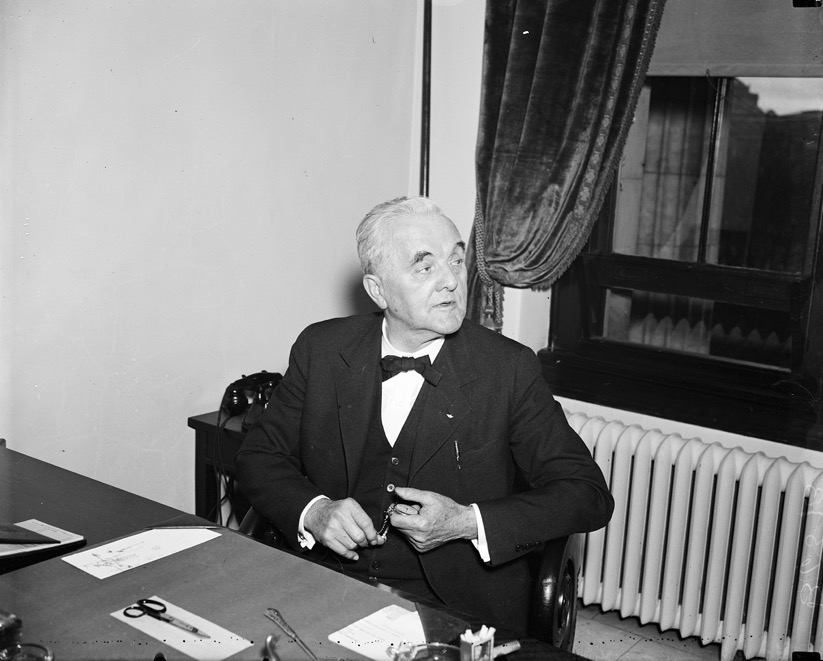
Despite being a unanimous choice of 160 nominating scholars charged with helping select the top U.S. senators of all-time in 1956, Nebraska’s George Norris was not among the five inaugural honorees and has continued to be mysteriously omitted even after four have since been added to what amounts to a Senate Hall of Fame (Library of Congress Prints and Photographs Division—Reproduction Number LC-DIG-hec-37934).
In September of 2018, in an article titled “The Senate’s Incomplete Hall of Fame,” the History News Network termed the omission of Norris a “historical wrong” that should be righted, while also recommending the addition of more recent Senate greats, John McCain of Arizona and Ted Kennedy of Massachusetts (again, a Republican and a Democrat). Like Norris, both were well known for working across the proverbial aisle with the opposition party to get things done.
After all, two senators from America’s previously ignored founding generation, Roger Sherman and Oliver Ellsworth (ironically, both from Connecticut), were added in 2006 and portraits of what has now been termed the “Famous Nine” are displayed in lasting recognition in the Senate Reception Room at the Capitol. So why not at least three more for what would truly be the “Deserving Dozen”?
Initially, these and other giants of our Upper Chamber were to be the focus of this book, but gradually the rivalries and battles waged by certain senators against sitting presidents warranted more attention and precedence. Once termed a “Millionaires Club” and later the world’s “Most Exclusive Club,” senators actually were the winners in several of these wars, but certainly not all.
Indeed, except for the legendary Clay, it’s surprising (but no less revealing) that none of the other Senate combatants examined in this book came close to the Kennedy committee’s final honorees. Not Stephen Douglas, Charles Sumner, Henry Cabot Lodge, Joseph McCarthy, Richard Russell, or Paul Laxalt, all among the most influential (or infamous) senators of their individual eras, but also-rans when Hall of Fame status was being conferred. Unlike Norris and Taft, none were worthy of Kennedy’s award-winning Profiles either.
And in no way is this an attempt to elevate them “senatorially,” either. Instead, this book’s purpose is to simply reveal in detail these career-defining confrontations as congressional titans took on the “Bully Pulpit” and often overreaching power of the presidency. These were Washington wars pure and simple, and as with most conflicts, to the victors went the spoils, politically shaping U.S. history over some of our most contentious landmark issues.
Prologue sourcing: John F. Kennedy, Profiles in Courage, New York: Harper & Row, 1955; “The Famous Five,” senate.gov (March 12, 1959); Andrew Glass, “Senate Creates Members ‘Hall of Fame,’” politico.com (March 11, 2017); Gene A. Budig and Don Walton, George Norris, Going Home, Lincoln: University of Nebraska Press, 2013; Ronald Feinman, “The Senate’s Incomplete Hall of Fame,” (September 9, 2018); “United States Senate Reception Room,” en.wikipedia.org.