
Section One
1
Orphaned by the age of 14; unbeaten as an American military hero in wars against the Seminoles, Spanish, Creeks, and British; and our first truly populist president, Andrew Jackson felt vindicated when he was elected to the White House over John Quincy Adams in 1828, having been denied the presidency four years earlier by Adams’ and Henry Clay’s so-called “Corrupt Bargain.” Despite receiving the most popular votes of four major candidates in the 1824 election, Jackson ultimately lost when no candidate received a majority in the Electoral College, thus casting the top three into a runoff election in the House of Representatives. That’s when Speaker of the House Clay, the frustrated fourth place finisher, threw his extensive congressional support to Adams, the runner-up and eventual winner, reportedly in exchange for the supposed next-in-line position of secretary of state. It would prove the opening salvo in a political rivalry that some historians actually termed hatred that has echoed in American history ever since, a Washington war pitting trans–Appalachia stars from Tennessee (Jackson) and neighboring Kentucky (Clay) in a multi-decades confrontation epitomized by their brazen battle over the Second National Bank of the United States as a prelude to President Jackson’s second term.1
Why Clay would back Adams over Jackson, a New England mainstay over a fellow Westerner, was the question most people could not fathom in 1824 unless the nefarious quid-pro-quo was actually in play, but there are reasons other than political deal-making that historians in the know have pointed to as a basis for the Kentuckian’s obvious lack of regional loyalty. Foremost among those was Clay’s apparent disdain for the very idea of a “military chieftain,” as he termed it, being installed as the head of state. To a judge of the time he wrote, “As a friend of liberty, and to the permanence of our institutions, I cannot consent, in this early stage of their existence, by contributing to the elevation of a military chieftain to give the strongest guarantee that this republic will march in the fatal road which has conducted every other republic to ruin.” And as fate would have it with much of the high-profile correspondence of that era, Clay’s letter found its way into the Washington National Intelligencer. “From that moment [forward] Jackson conceived a hatred for Clay he would carry to the end of his life,” H.W. Brands confirmed as recently as 2019 in Heirs of the Founders.2
Also, there was the sudden rise of a regional rival and proverbial political outsider. As any nationally ambitious politician understands, serious consideration for high office usually requires unmitigated support from one’s home community and region, the kind of support the veteran Clay suddenly saw eroded by this military marvel—this “Hero”—the kind of Western support he did not wish to share.3
Eight years and two presidential terms later, by the time of Jackson’s re-election bid in 1832, Clay was still a congressional force to be reckoned with; by then returned to the Senate, where he had served twice before, and well on his way to becoming one of three legendary senators of that era, a renowned trio that included Daniel Webster of Massachusetts and John C. Calhoun of South Carolina.4 All three would oppose Jackson at some point in his presidency, but it was towards Clay that he would always muster the most animosity, referring to him as “Judas of the West” and “a profligate demagogue.” Undoubtedly, those sentiments were mutual. Clay, in fact, would sarcastically label Jackson “Caesar” or “King Andrew,” while leading Upper Chamber efforts to censure the rather autocratic president when impeachment proceedings proved too much to ask.5
Having risen to national prominence and mass popularity by sheer audacity and the notoriety of his military exploits, Jackson and his advisers were the first to take advantage of a growing electorate, where the abolishment of property qualifications had opened voting rights to virtually all adult White males. The Jacksonian managers were the first political organizers to fully mobilize the common man, especially in the new Western states where the frontier had only recently been conquered.6 After all, “Andy” Jackson was a man’s man who had survived several duels and other notorious confrontations, and was known to his soldiers as “Old Hickory” because of his toughness. Although his leadership style could be brash and irreverent, it was offset by a natural charisma that had always elevated Jackson in the company of other men, even before his military achievements. Jon Meacham noted as much in his Pulitzer-winning American Lion, when he mentioned Jackson’s “sense of adventure” and “infectious fearlessness” that contributed to an undeniable “raw ability to lead” and (in turn) “be followed.”7 Later, when Jackson was an incoming U.S. senator himself in 1823, Robert Remini wrote of his early days in Washington as “nothing less than brilliant. No sooner did he take his seat in the Senate than he set off a dazzling display of Jacksonian charisma and presence. The figure he cut! The commanding style he revealed! He came like a thunderclap and left observers overwhelmed.”8
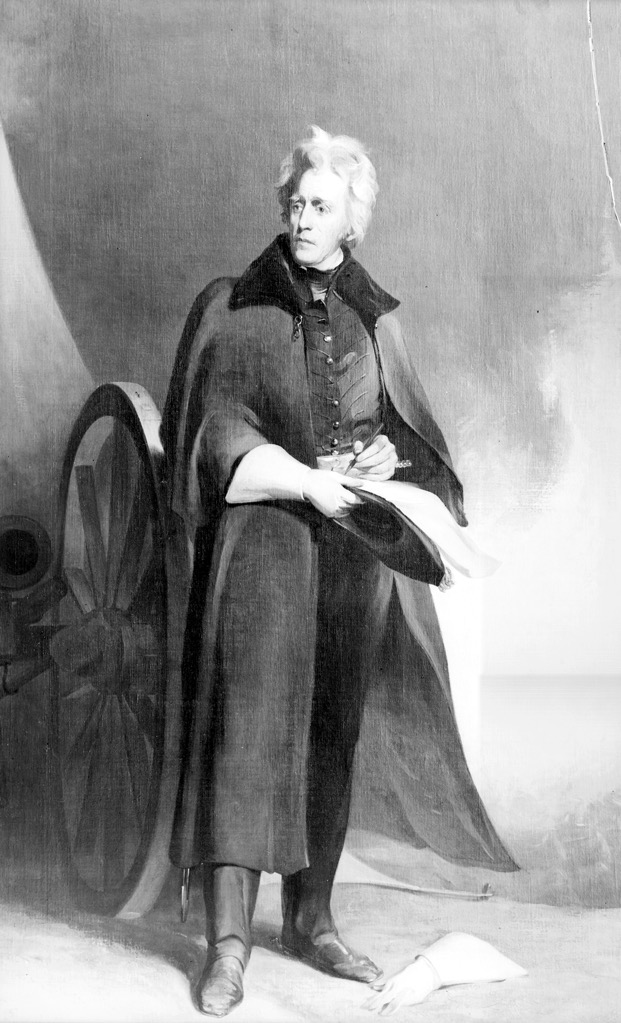
America’s first national hero since George Washington, General Andrew Jackson was a dashing, charismatic, and very willful character on the national stage by the time he reached the White House in 1828. After being denied the presidency in 1824, when the election had to be decided by the House of Representatives, his immense popularity offered him the chance to expand presidential power (Library of Congress Prints and Photographs Division—Reproduction Number LC-DIG-det-4a26552).
Equally charismatic, if not as intimidatingly so, the same biographer recognized similar attributes in Clay, one of the most renowned legislators of his or any other American era. Unlike Jackson, the product of a very large family, with eight siblings and seven half siblings (once his mother remarried following his father’s death), Clay also displayed early leadership capabilities. But instead of illustrating those at the head of a militia, his powers of persuasion and ability to lead became rapidly apparent once he attained elected office at just 26 years of age.9 On that topic, Neil MacNeil and Richard A. Baker wrote in their history of the U.S. Senate: “Henry Clay was elegant in debate, haughty and imperious at times, gracious and chivalric at others, he commanded a fiery eloquence that won him national popularity. As an orator, he could be witty and clever, dignified and high-toned, bold and impetuous—whatever posture seemed appropriate—and he was especially genial and winning.”10 Offering equal praise of Clay, Remini confirmed: “Over the years he had developed the extraordinary skill of drawing people to him. This magnetic quality to his personality attracted followers and admirers, both male and female. His amiability, his love of conversation, his ready smile, his delightful manners, his devastating wit, his remarkable intellect, and his profound understanding of the issues facing the nation all combined to produce a dynamic and charismatic personality that most Washingtonians found irresistible.”11
Such adulation by a group in Congress known as the “War Hawks” (advocates for further national expansion) propelled Clay at 34 to become the second youngest House Speaker ever and the youngest before 1939. There followed 11 years of House leadership and four more as secretary of state before three separate stretches in the Senate, including an 11-year run from 1831 until 1842 during which most of his run-ins with Jackson would occur.12
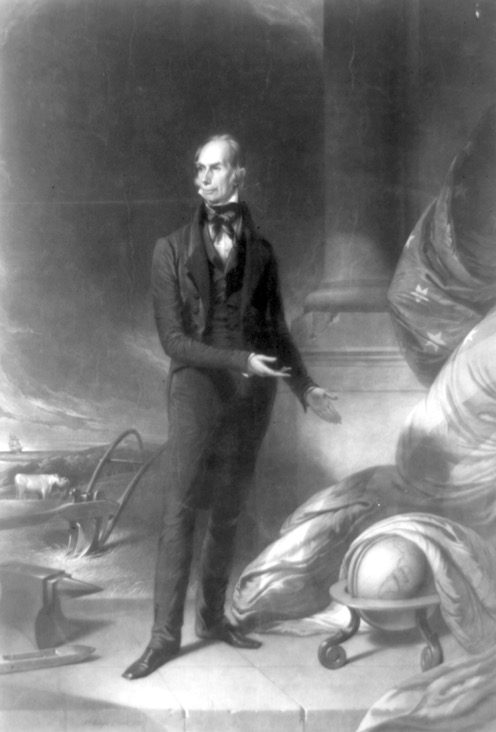
Perhaps the most renowned legislator in American history, Henry Clay was a wily, gifted, and audacious participant on the national stage for more than four decades, beginning with his elevation to Speaker of the House at age 34 and three separate stints as a dominant voice in the United States Senate. Ambitious to a fault, however, he would become one of only two three-time U.S. presidential losers (Library of Congress Prints and Photographs Division—Reproduction Number LC-USZ62-71603).
These would lead to weeks (even months) of bitter political struggle. For starters, Western farmers were interested in cheap land; New England industrialists were demanding protective tariffs; Southern planters wanted those tariffs kept low; and internal improvements were on the minds of most as the country moved west. Both Clay and Jackson had to remain attuned to those trends, and the economic and social ramifications they inspired as they developed competing party programs. And by the 1830s, it was indeed competing parties. Jackson’s mass following bore the Democratic Republican mantle of the agrarian/states’ rights philosophy first espoused by two of our founders and former presidents, Thomas Jefferson and James Madison, while Clay’s so-called “American System” would become the basis of a new party, the Whigs, an offshoot of the earlier Federalists of the first secretary of the treasury, Alexander Hamilton, and his belief in a powerful central (aka federal) government.13
Clay’s new twist on a more assertive federal government was all about financing internal improvements, including those involving more than one state, in order to spark more rapid development of the nation as a whole. Meanwhile, the Jacksonians would shorten and keep only the name Democrats, a designation that has been in place ever since, while Clay’s Whigs, who wouldn’t be officially called that until two years later (1834), stuck with National Republicans for the time being. That moniker would also be shortened and recalled 22 years later, when the new/current Republicans replaced the short-lived Whigs in 1856.14
In keeping with his “every-man” approach to democracy, Jackson sought to weed out over-governance by and for the country’s elite. To his way of thinking, it was the same principle that had inspired America’s Revolutionary generation to break away from British monarchy and he capitalized on angry voters bent on venting their discontent. No sooner had he avenged his presidential loss of 1824 than he began to target what he considered federal over-reach, especially anything he regarded as in direct competition with his own, executive agenda. Such a malignant force, at least in Jackson’s mind, was the Second Bank of the United States. According to one presidential scholar: “When Andrew Jackson didn’t like something, there were few half measures. He built his military career by attacking his enemies with little restraint [and] his political enemies were no different. In 1829, he made clear his hatred of the National Bank.”15
As the centerpiece of the United States’ original federal economic system, Jackson felt the National Bank “exerted too much control over the nation’s economy.” He viewed it as a political adversary that made loans to influence elections and re-elections, and paid retainers to favored lawmakers. And with the Bank’s 20-year charter set to expire during what would be his second term, Jackson made known he had no intention of it seeing it renewed.16
Seizing upon such avowed opposition, Clay, the unanimous National Republican nominee, slyly sought to make the Bank a campaign issue in 1832. Although there were many other issues on which they disagreed, including Jackson’s forced removal of Native American tribes, pushing them west to what was then “Indian Territory” in present day Oklahoma, as well as the President’s opposition to federal funding of interstate or “national roads,” an example of the kind of internal improvements he felt should be funded solely by the states, Clay saw in the Second Bank an issue where the destruction of a trusted financial institution might lead to the electoral repudiation of a popular incumbent. While Jackson had thoroughly avenged his controversial 1824 loss to Adams in 1828, his foremost Western rival, Clay, was angling for a way to mount a more formidable challenge in 1832.17
Despite the fact Jackson had recently ignored a Supreme Court ruling, which upheld existing treaty rights and the sovereignty of the most progressive of Southern tribes, the Cherokees, who along with the Creeks, Choctaws, and Seminoles were nonetheless compelled to leave their homelands and move west on their infamous “Trail of Tears,” Clay chose the National Bank issue over all others for the coming campaign.18 And despite the fact Jackson had previously vetoed federal funding for the “Maysville Road,” which would have linked Clay’s hometown, Lexington, to the Ohio River, the Kentucky senator chose to make that direct affront to him and his constituency secondary to the Bank in his plan of attack on the incumbent.19 Not only as a sitting president had Jackson openly defied the Supreme Court, he also had the pleasure of curtailing a popular pet project of his personal rival and presidential opponent. Nevertheless, Clay’s campaign focus would remain on the Bank.20
The Second National Bank had come into existence in 1816, a full five years after expiration of the First. As already noted, the brainchild of Alexander Hamilton, the original version had been signed into law in 1791 by then President George Washington. Federal Reserve historian Andrew Hill called it a “grand experiment” designed to assist the post–Revolutionary War economy. Hamilton’s concept of a central bank was to help re-establish commerce and industry, repay war debts, and restore value to the currency by lowering inflation. All this was to be accomplished by the Bank issuing banknotes (paper money); to provide a safe place for public funds and commercial transactions; and to act as the government’s designated fiscal agent in the collection of tax revenue and payment of debts. Its design was based on the Bank of England.21
Not all of America’s “Founding Fathers” agreed with the concept, however, including Hamilton’s chief rival, then Secretary of State Jefferson, who felt the federal government was creating a financial monopoly that would undermine smaller, state banks and cater to merchants and financiers at the expense of its agrarian based citizens and economies. Basically, it was the same argument Jackson would use 40 years later (with Jeffersonian-Jacksonian ideology usually referenced as a key part of Democratic Party heritage).22
When the First Bank’s charter expired 20 years later in 1811, then Vice President George Clinton, a Jeffersonian disciple, broke a tie vote in the Senate by which it was not renewed. Five years later, however, it was brought back (as the Second Bank) as a result of financial issues left over from the War of 1812. It was re-chartered, surprisingly, with another Jeffersonian, President Madison, still in charge. Many historians have even interpreted that as Madison abandoning the principles of his mentor, but regardless of the reason for “Little Jemmy’s” change of heart in the White House (as Madison was called due to his five foot, four-inch stature), the Bank was back in business by 1817.23
Over the next decade and a half, the Second Bank would gain in power and influence, especially under the leadership of Nicholas Biddle, its third and final president. In 1822, then President James Monroe, the third consecutive Virginia-born president (following Jefferson and Madison), heeded the advocacy of Biddle—one of the Bank’s most active proponents as a wealthy three-term Pennsylvania congressman—by naming him to head the expanding institution, which was located in his hometown, Philadelphia. It would prove a great or toxic match, depending on one’s status or station in life, for Biddle was, in the words of business historian Steve Fraser, “an unapologetic patrician … politically tactless enough to advertise his disdain for the popular will.” Nevertheless, what’s not debatable is that the Bank prospered under his leadership, serving as a useful market source for government bonds and commercial operations throughout the young country.24
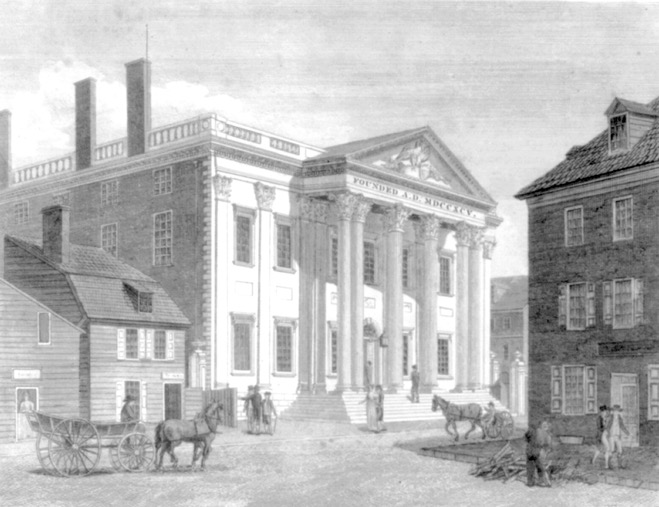
The Second Bank of the United States, as it appeared in the early 1800s in Philadelphia, Pennsylvania. After the First National Bank was dissolved in 1811, America’s involvement in the War of 1812 led to a desire for a rebirth of the federal repository and lending institution, leading to its creation by 1816 (Library of Congress Prints and Photographs Division—Reproduction Number LC-USZ62-56349).
Although not certifiably a monopoly, it exerted a large amount of control over foreign and domestic exchange, and if an asset in many ways, it could also be viewed as a liability, especially by not being subject to any kind of government constraint. That’s what would become irritatingly obvious to President Jackson when the Bank doled out favors to influential people, including up-and-coming opposition voices like New York State Senator William Seward, newspaper editors like the New York Courier and Enquirer’s James Watson Webb, and even powerful opposition senators like Webster and Clay, both of whom borrowed from it extensively. Already suspicious of all banks and banking in general, it was easy for Jackson to reach the conclusion that Biddle’s Bank was, in his words, “a hydra of corruption—dangerous to our liberties by its corrupting influence everywhere”—“a monster,” no less, that should not be re-chartered.25
With such intense opinions made manifest, imagine the Jackson administration’s surprise when Biddle opted not to wait to seek the Bank’s re-charter (not due until 1836), but to instead inject such a request into national politics four years early. Prodded by Clay, who obviously sought to back Jackson into a corner and a fight he felt had the potential to render him a one-term president, Biddle tossed a political grenade, the Bank re-charter legislation, onto the campaign landscape a full four years early in the winter of 1832.26
Needing a unifying issue to rally around versus the Jackson incumbency, Clay and his supporters enthusiastically endorsed the early re-charter idea, basically daring the President to veto a major (and by then accepted) component of the U.S. financial system during an election year. They were anticipating an equally major backlash at the ballot box. What they got instead was a divisive, wedge issue that enabled Jackson to inflate his presidential prerogatives and force systematic changes whether the country was ready for them or not. It was presidential autocracy on steroids, an all-powerful approach not seen before and utilized by only a few presidents since. It was first standardized during the reign … err, administration of Andrew Jackson.27
As confirmed by two separate but related entries in The American Senate, An Insider’s History: “Jackson expanded the president’s power and prestige beyond anything seen before. He saw no reason to defer to Congress—especially the Senate—and his defiance of the Senate changed the very nature of the presidency, of the Senate, and of the relationship between them.” “Such a polarizing figure, fiercely intent on subordinating the Senate to his purposes, he also summoned [or disparaged] into existence an identifiable class of visible and eloquent Senate leaders”28—chief among them, Henry Clay.
1. William DeGregorio, The Complete Book of U.S. Presidents, 98, 107, 111–112; Jon Meacham, American Lion: Andrew Jackson in the White House, 44; Glyndon G. VanDeusen, The Jacksonian Era: 1828–1848, 61–67.
2. H.W. Brands, Heirs of the Founders: Henry Clay, John Calhoun, and Daniel Webster—The Second Generation of American Giants, 117–118.
3. Robert V. Remini, Henry Clay: Statesman for the Union, 212–213, 218–219; Jon Meacham, American Lion, 37; Glyndon G. VanDeusen, The Jacksonian Era, 31.
4. Robert Remini, Henry Clay, 373; Richard A. Baker and Neil MacNeil, The American Senate: An Insider’s History, 62.
5. Robert Remini, Henry Clay, 1; William DeGregorio, The Complete Book of U.S. Presidents, 112; Kenneth C. Davis, Don’t Know Much About the American Presidents, 165.
6. William DeGregorio, The Complete Book of U.S. Presidents, 109–110; Michael F. Holt, The Rise and Fall of the American Whig Party: Jacksonian Politics and the Onset of the Civil War, 8.
7. Kenneth C. Davis, Don’t Know Much About the American Presidents, 156; Jon Meacham, American Lion, 20–21.
8. Robert Remini, Andrew Jackson: The Course of American Freedom—1822–1832, 59–60.
9. Robert Remini, Henry Clay, 2–5, 34–35.
10. Richard A. Baker and Neil MacNeil, The American Senate, 280.
11. Robert Remini, Henry Clay, 77.
12. Robert Remini, Henry Clay, 77; “Henry Clay,” en.wikipedia.com; Glyndon G. VanDeusen, The Jacksonian Era, 47.
13. Glyndon VanDeusen, The Jacksonian Era, 47; Robert Remini, Henry Clay, 225.
14. Glyndon G. VanDeusen, The Jacksonian Era, 51; Michael F. Holt, The Rise and Fall of the American Whig Party, 10–20, 841–842.
15. Glyndon G. VanDeusen, The Jacksonian Era, 1; Michael F. Holt, The Rise and Fall of the American Whig Party, 6; Kenneth C. Davis, Don’t Know Much About the American Presidents, 164–166.
16. Kenneth C. Davis, Don’t Know Much About the American Presidents, 164-166; H.W. Brands, American Lion, 120–122.
17. H.W. Brands, Heirs of the Founders, 186–190; Glyndon G. VanDeusen, The Jacksonian Era, 48–52; Robert Remini, Henry Clay, 376; H.W. Brands, American Lion, 273–274.
18. Glyndon G. VanDeusen, The Jacksonian Era, 48–50; William DeGregorio, The Complete Book of U.S. Presidents, 116; H.W. Brands, Heirs of the Founders, 186.
19. H.W. Brands, Heirs of the Founders, 185.
20. H.W. Brands, American Lion, 139–140, 201, 203–205.
21. Andrew T. Hill, “The First Bank of the United States,” federalreservehistory.org, December 4, 2015.
22. Robert Remini, Andrew Jackson, 36; H.W. Brands, American Lion, 48; Kenneth C. Davis, Don’t Know Much About the American Presidents, 48–51.
23. Kenneth C. Davis, Don’t Know Much About the American Presidents, 117, 119, 121; William DeGregorio, The Complete Book of U.S. Presidents, 63, 66; William Safire, “Essay; ‘Little Jemmy,’” New York Times, March 19, 2001; Andrew Burstein and Nancy Isenberg, Madison and Jefferson, 544–545.
24. Kenneth C. Davis, Don’t Know Much About the American Presidents, 164; Glyndon G. VanDeusen, The Jacksonian Era, 62.
25. Glyndon G. VanDeusen, The Jacksonian Era, 63–64; Robert Remini, Daniel Webster: The Man and His Time, 261–262; Robert Remini, Henry Clay, 195, 198–199, 569; H.W. Brands, Heirs of the Founders, 190.
26. H.W. Brands, Heirs of the Founders, 189–190; Robert Remini, Henry Clay, 379–380.
27. Michael F. Holt, The Rise and Fall of the American Whig Party, 15–17; H.W. Brands, American Lion, 208–212; Kenneth C. Davis, Don’t Know Much About the American Presidents, 165–166.
28. Richard A. Baker and Neil MacNeil, The American Senate, 61, 169, 281.