
Section Two
4
Not every Washington war has originated as a purely partisan squabble. Occasionally, intra-party conflicts have also influenced national policies, reshaping politics and constituencies for decades and maybe none more so than the battle that beset the Democratic Party before the Civil War. “Popular sovereignty,” a concept so democratic in its premise that it seemed to sneak up on the nation when it narrowly became law with passage of the Kansas-Nebraska Act of 1854, brought about this breakdown through a clash of executive overreach and legislative leadership that led to party dysfunction, division, and ultimately disunion.1
At the same time, rarely, if ever, in American political history has a phenom so dramatically risen in the hearts and minds of his countrymen, or at least his party, when it came to Senator Stephen A. Douglas—the “Little Giant” of Illinois at only five feet, four inches tall—in the decade leading up to the war. And just as rarely, if ever, has a sitting U.S. president so abused and abdicated presidential leadership as Pennsylvania’s only chief executive, James Buchanan, during the years overlapping Douglas’ prominence between 1856 and 1860.2
Both were Jacksonian Democrats when the party of Jackson was still supreme and worthy of national leadership at a time of real need in America, as the country continued to careen towards sectional animosity and division. Douglas was a certified political wunderkind by the time he rescued Henry Clay’s Compromise of 1850 from the scrapheap of sectional discord in his mid–30s, securing its passage through the separate passage of its individual parts with legislative slight of hand that endeared him for the moment to wishful peacemakers nationwide. Buchanan, still America’s only bachelor president (as a rumored though never proven homosexual) and its oldest up that time at age 65, had held about every governmental pay grade by the time his party turned to him and put him in the White House almost by default, including state assemblyman, congressman, senator, secretary of state, and ambassador to both Russia and Great Britain.3
Ironically, both Buchanan and Douglas would become focused on rendering American debate over slavery in the mid–1800s as mute as possible, but they would veer to completely divergent paths in trying to make that wish reality. Although both were Northerners, Buchanan, as president, would display Southern empathy and preferences, apparently cultivated during his earlier Washington years of socializing and boarding with legislators from the Southern states, while Douglas would attempt to toe middle ground in the slavery debate designed to keep his future at the forefront of Democratic politics.
With consideration of slavery’s expansion into new territories at the forefront of national discussion, this irony would be exacerbated despite both seeking ways to lessen (or even diffuse) the slavery debate. Both hoped the nation’s attention could be refocused on transcontinental or even hemispheric development without the brewing sectional divide. For Douglas it was a logical and constitutional solution that he championed as a cure-all for the North’s abolitionist motivation and the South’s mounting sense of disrespect and potential isolation. Buchanan, on the other hand, sought a quick resolution to the territorial slavery issue in order that his presidency could move on to other, more acclaim-worthy accomplishments. And from his lofty new White House platform, he saw no reason that a man of his vast experience should not expect his party and his nation to follow his lead.4
Each of their respective outlooks on the North-South conflict had been shaped by Clay’s two earlier compromises, his initial Compromise of 1820, which allowed Missouri’s entrance to the Union as a slave-condoning state only because of Maine’s simultaneous entry as a new slave-prohibiting state. This maintained what was deemed the all-important balance of free and slave states in the U.S. Senate. In addition, what came to be known as the “Missouri Compromise” also established an imaginary, horizontal line of 36 degrees 30 minutes north latitude along Missouri’s southern border and extending westward through the unorganized remainder of the 1803 Louisiana Purchase; in theory all the way to the Pacific Ocean should that vast, adjacent area ever belong to the U.S. instead of Mexico.5 As a permanent solution to the slavery question, most Northerners had never accepted the Missouri Compromise and they were urging Congress to reject it and prohibit any further extension of the nation’s “original sin” into the Western territories.6
Nonetheless, for three decades this Missouri Compromise line of demarcation survived the increasing controversy of what to do about slavery and its potential expansion into the West as an accepted part of “Manifest Destiny,” the long-running American impulse to extend the nation’s borders in that direction regardless of roadblocks. This became especially so before, during, and after the U.S. war with Mexico from the mid– to late 1840s. It began with the annexation of the Republic of Texas (1845), formerly the northeasternmost Mexican state, and was followed by the war and Treaty of Guadalupe Hidalgo (February 1848) by which Mexico relinquished the future states of New Mexico, Arizona, California, Nevada, and Utah to the U.S., as well as parts of Oklahoma, Colorado, and Wyoming.7
Many Northerners of the time considered this so-called “Mexican Cession” nothing more than a “land-grab” (many Mexicans still do). Suddenly, as of February 1848, the United States had over 500,000 additional square miles to fill at a cost of $15 million. It was the second largest American land acquisition up to that time—second only to the previously mentioned 1803 Louisiana Purchase (from France)—and would remain so until Alaska (from Russia) proved slightly larger less than two decades later in 1867.8 Along with the Oregon Territory, annexed away from British claims by a previous 1846 treaty establishing the 49th parallel as the U.S. border with Canada, America truly stretched from “sea to shining sea” and such things as the Santa Fe Trail, California Gold Rush, Mormon Migration, and Oregon Trail all figured prominently in White America’s populating of the westernmost parts of the country.9
Two years after the Mexican Cession and with Oregon already a territory, the nation reached another landmark moment made necessary by the surge of people into its other, would-be Western territories. Settlers were pouring into these newly accessible lands from both North and South, while “politically, slavery infected the nation like a virus” as “slave-owning Southerners supported territorial expansion as a strategy for their survival.” So stated Fergus Bordewich in America’s Great Debate: Henry Clay, Stephen A. Douglas, and the Compromise that Preserved the Union, his excellent retelling of the Compromise of 1850.10
Foremost among the issues in need of compromise at that time was California’s readiness for statehood. Since General Stephen W. Kearney, John Sutter, John C. Frémont, and Kit Carson had all had a hand in the tearing away of Mexican influence on the West Coast, and the discovery of gold at Sutter’s Mill in January 1848 had ensured a surge in population growth—the soon-to-be “Golden State” had become prime real estate in a relatively short amount of time with its entry into the Union inevitable. As early as September 1849, delegates were meeting to decide the territory’s immediate future, including one of their earliest priorities—making sure slavery did not gain a foothold in California. In other words, admittance as a free state despite pressure “back East” to open California to slave-owners. President Zachary Taylor, a general and hero of the Mexican War (and president as a result), was a leading proponent for admitting California as a free state before his untimely death in July 1850 put a far more amenable personality into the White House. Vice President Millard Fillmore, in fact, was a Northerner who leaned South (much as Buchanan would, too) and in contrast to Taylor’s view, California’s statehood without slavery wasn’t the only part of the compromise being put forward by Clay that he endorsed. Fillmore understood that while admitting California with its economic boost as a free state was what the majority of its settlers desired, such a move could spark disunion without something to satisfy Southern interests in return. Thus did New Mexico and Utah gain acceptance as new territories with no restrictions on slavery; thus did Texas receive $10 million to pay off debts incurred while an independent republic following its disputed severance of ties with Mexico in 1836 and before entering the Union as a slave state in 1845; and thus (and most accommodating of all) did a new Fugitive Slave Act become enacted to provide tougher federal oversight in assisting slave owners with their recovery of runaway slaves escaping north. Along with California, Northerners, in return, could take solace in the ending of the slave trade in the District of Columbia, what had been a lingering embarrassment in the nation’s capital, but distaste for the tougher fugitive slave law would increasingly inflame sensibilities above the “Mason-Dixon Line.”11
Ultimately (as previously indicated) it would take addressing Clay’s compromise as individual parts by Douglas to win passage in Congress of all that was in the original omnibus bill, the acceptance of which has traditionally been credited with “staving off the [eventual] fracturing of the nation [via the Civil War] for a few years.” Bordewich also confirmed “the nation rejoiced, most of it anyway,” and in that moment, President Fillmore asserted: “We have been rescued from the wide agitation that surrounded us.” A more recent interpretation put it this way: “Most of the country enjoyed the fruits of the compromise and strived to persuade itself that it would endure. Most people earnestly desired to believe the slavery question settled forever.”12
Still, the controversy of the new territories and their future with or without slavery would not go away. While California was a long way from the gathering storm in the East, the land just west and/or north of the newer tier of states that included Missouri (1821), Arkansas (1836), Texas (1845), Iowa (1846), Wisconsin (1848), and also Indian Territory (originally set aside for the so-called “Five Civilized Tribes” pushed west by President Andrew Jackson in the 1830s that would eventually become Oklahoma in 1907) remained ripe for settlement and yet to be spoken for in the ongoing slavery debate.13
Unlike previous territorial bills for the still expanding country, the Compromise of 1850 (as already implied) did not specify free or slave holding status for the new territories of New Mexico and Utah despite the fact no slaves had been allowed there previously under Mexican rule. In addition, the drier climate of the West and Southwest was obviously not conducive to agrarian, slave-based labor. Instead, Congress agreed it would let the residents of those territories, old and new, decide for themselves via elections and make that decision part of their constitution when they applied for statehood. This became an idea known as popular sovereignty (or derisively as “squatters’ sovereignty”) first espoused by Lewis Cass of Michigan, the Democratic nominee for president in 1848, and later co-opted by Douglas. Cass had warned against federal interference in the territorial slavery question, stating at the time: “If the relation of master and servant may be regulated or annihilated [by the federal government], so may the relation of husband and wife or parent and child, and of any other conditions which our institutions and the habits of society recognize.”14
Although already aspiring to the presidency, when Douglas adopted the popular sovereignty concept it was “less a product of political calculation than a reflex conditioned by an intimate relationship that he enjoyed with voters,” according to Martin H. Quitt in his 2012 Douglas biography. But when he spoke of democracy and political sovereignty, they were “exclusionary.” Douglas never intended to empower people of anything but European descent and his indifference to the bondage of African Americans would eventually become “notorious,” again according to Quitt.15
Nevertheless, by the time he put the concept forward as the basis for organizing another of the new territories, he was at the height of his prestige and legislative power. West of Iowa and Missouri were vast stretches of unorganized land, the northern remnants of the Louisiana Purchase. The settlers already there were frustrated. Initial territorial status had been rejected by Congress in March 1853 and by December of that same year, Senator Augustus Dodge of Iowa had introduced another bill calling for a new territory to be named Nebraska, a word taken from the Oto Native American language meaning “flat water” for the placid Platte River that flows the length of what is now that state (and already a guiding landmark for settlers moving west along the Oregon Trail).16

Because he stood only five feet, four inches tall, Illinois Senator Stephen A. Douglas was known as the Little Giant in the decade before the Civil War after a meteoric rise through the Democratic Party that culminated in his guidance of the Compromise of 1850 through Congress; his advocacy for the concept of popular sovereignty as chairman of the powerful Senate Committee on Territories; and his passage of the controversial Kansas-Nebraska Act in 1854 (Library of Congress Prints and Photographs Division—Reproduction Number LC-BH82-2460A).
As chairman of the Committee on Territories in the Senate, Douglas was integral to the new bill’s passage the second time around, but he was also advised of a lingering problem early on when Missouri Senator David Atchison, an in-state rival of venerated, Manifest Destiny architect Thomas Hart Benton, let him know that as long as the Missouri Compromise line remained on the books, the Southern members of Congress would never support additional territories north of parallel 36°30.’ Obviously, anyone possessing slaves would not be eligible to move there unless the demarcation line was rescinded. As political leaders of the only slave state west of the Mississippi River and north of the Missouri Compromise line, the Benton and Atchison factions were on opposite sides of the issue, creating pressure for Chairman Douglas.17 At the same time, then President Franklin Pierce, the current leader of the Democratic Party of which Atchison, Benton, and Douglas were all part, hoped to avoid language that risked making repeal of the 30-plus-year-old compromise line an issue, while Douglas, knowing Atchison was right, understood that Southern support would be strictly contingent on repeal. To not go along, he convinced Pierce, would be to risk the administration’s Senate support on other issues. So, with the President’s backing, Douglas astutely offered a substitute bill that would create two territories instead of one, thus splitting the Dodge legislation into a southern territory and a northern territory, the Kansas-Nebraska Bill of January 23, 1854.18
Douglas’ revised bill was based on the popular sovereignty premise “that all questions pertaining to slavery in the territories and in the new states to be formed are to be left to the decision of the people residing therein through their appropriate representatives,” as defined in Nicole Etcheson’s book Bleeding Kansas: Contested Liberty in the Civil War Era. And although faced with some criticism for dividing the original territory into two territories and what skeptics surmised to be the increasing chances that one would be open to slavery, both of the existing neighboring states, free state Iowa and slave state Missouri, endorsed the division, which would prove of minor consequence compared to elimination of the Missouri Compromise line. Regardless, Douglas continued to preach that popular sovereignty was all about local self-government and remained the most basic of democratic principles.19
In the North, however, Douglas’ democratic approach to the remaining territories was not well received, both during and after four-month long debate and final passage of Kansas-Nebraska. President Pierce did not sign the act into law until May 30, 1854, and the New York Times was typical of Northern reaction, when it called the Kansas-Nebraska Act’s repeal of the Missouri Compromise line “a gross violation of a sacred pledge” before predicting its passage would turn the new area “into a dreary region of despotism inhabited by masters and slaves.”20 Southerners, on the other hand, found the act easy to accept. It opened them and their property to territory formerly closed. Georgia Senator Robert Toombs argued that repeal of the Missouri Compromise line was proper because it had already been violated by Northern refusal to apply it to the Mexican Cession, and other Southerners renewed the argument of their patron spokesman from a generation before, John C. Calhoun, who had maintained that Congress had no right to interfere with slavery in the territories as slaves were “common property” in all states. For them, Douglas’ formula merely confirmed Calhoun’s doctrine.21
Final voting on the Act further illuminated the differing sectional (if not partisan) views. In the House of Representatives, Northern Democrats, presumably Douglas’ most connected colleagues, were split evenly, 44 in support and 44 opposed, while Southern Dems overwhelmingly supported his bill with only two exceptions. At the same time, no Northern Whigs supported it, while their Southern counterparts were split with two-thirds in favor, 14–7.22
The Senate exhibited even more sectional division with 15 Northern Democrats for it and only five opposed, while all but one Southern Dem, Texas’ legend Sam Houston, voted in support. As for the Senate Whigs, no Northern members of that party supported it, while 11 of 13 Southern Whigs voted yea. Obviously, popular sovereignty provided the South more chance of bringing slavery into the territories and a better chance of retaining power in a divided Senate. As Etcheson succinctly concluded: “While less certain a guarantee to protect property in slaves, a chance was nevertheless preferable [for the South] to the Missouri Compromise’s exclusion.”23
Douglas, meanwhile, was suspected of ulterior motives in his passionate advocacy. While he championed popular sovereignty as his bill’s “contribution to freedom,” and defended it by pre-empting opposition amendments with some of his own, he was accused of possible conflict of interest motives, such as remuneration from his home state hopes that a transcontinental railroad would begin in Chicago and proceed across Illinois before continuing west through at least one of the new territories, as well as potential political gain. In that regard, an unsigned editorial in the New York Daily Times said Douglas would “sacrifice any public principle, however valuable, and plunge the country into foreign war or internal dissention, however fatal they might prove, if he could thereby advance himself a single step towards the presidential chair.”24
If political profit was what Illinois’ up-and-coming senator was all about, however, the Kansas-Nebraska Act did not seem to offer much in the way of national laurels. Missouri’s Benton, speaking rather immoderately off the record to another congressional colleague, surmised as much when he supposedly stated: “Douglas, Sir, is politically dead, Sir. If he fails to carry his bill the South will kick him in the rear, Sir; and if he does carry it, the North will beat his brains out, Sir.”25
But while sectional loyalty seemed uppermost in the Kansas-Nebraska Act vote, the other political issue at play was party loyalty—or the perceived lack of any. The Democrats held the majority in both Houses, while the gradually disappearing Whigs still managed 33 percent in the Senate and 30 percent in the House, and a third party of the time known as “Free Soilers” enjoyed a grand total of six seats, two in the Senate and four in the House of Representatives. Any political party sectionally split over slavery seemed certain to lose congressional seats in the 1856 election, not to mention the problems that could present for any presidential candidate. There were those, like Senator Houston and by then Congressman Benton, who felt that because the Missouri Compromise had been adopted as a settlement for divisive questions of the era, it should never be disturbed. And indeed, once it was, contentious rejoinders were issued on the Senate floor by the likes of New York’s William Seward, a leading abolitionist and Northern presidential hopeful, who famously said: “Come on then gentlemen of the slave states. Since there is no escaping your challenge, I accept it on behalf of the cause of freedom. We will engage in competition for the virgin soil of Kansas, and God give the victory to the side which is stronger in numbers as it is in right.”26
Those would prove fighting words and Kansas, the more southerly of the two new territories, would become the battlefield. While Nebraska Territory—the original name given the entire area before Douglas’ split was introduced for passage purposes—would escape the controversy and conflict of its southern neighbor, Kansas would be subjected to probably the most dysfunctional and contested entry of any state (or territory) into the Union. After all, did any of our other 50 states ever suffer a more disturbing moniker than “Bleeding Kansas”?27
Essentially in repealing both the Missouri Compromise and Northwest Ordinance of 1787 (whereby the federal government was first established as sovereign over territorial expansion rather than existing states), Douglas knew the Kansas-Nebraska Act would “raise a hell of a storm,” but even he underestimated the sectional, political, and confrontational blowback it would provoke. On August 1, 1854, a large party of New England emigrants sponsored by the Massachusetts Emigrant Aid Company arrived in Kansas and began establishing the new town of Lawrence, which was named for their largest benefactor, New England merchant and philanthropist Amos Lawrence. It was located just 30 miles inside the territory’s eastern border and with the expressed goal of setting up homesteads and initiating the process by which a free state would eventually be voted into existence.28
In neighboring slave-state Missouri, meanwhile, the arrival of the free-state settlers did not go unnoticed and given their close proximity, vast numbers of Missourians began to infiltrate Eastern Kansas as well, establishing their own settlements—towns such as Lecompton and Leavenworth. It would be the start of what Etcheson labeled “the race for Kansas,” the challenge Senator Seward had foreseen and accepted after passage of the Kansas-Nebraska bill. Majority rule was now uppermost on the minds of both abolitionists and slave-owners, as they recruited settlers (or squatters as they were also known) to make their way west to what would become the center of the country and become a voting resident of Kansas as soon as possible.29
Unfortunately, in addition to a race for settlers, Kansas also became an arms race … and a corrupt race. “Border Ruffians,” so-named backcountry residents of Missouri who wanted neighboring Kansas to also be open to slavery, made their presence felt by burning, looting, and in a few instances even taking lives in free-stater enclaves like Lawrence. In return, free state emigrants learned to give as good as they got, inflicting retribution on pro-slavery settlers, including violent acts like the radical abolitionist John Brown’s brutal massacre of six pro-slave settlers along Pottawatomie Creek on the night of May 24, 1856. It was, as Etcheson again described, “revenge heaped upon revenge,” with the ultimate goal of both sides being to drive enough of the other away to ensure the territory’s upcoming decision at the polls would produce a majority in their favor. In other words, popular sovereignty gone mad.
Adding to this mess of territorial democracy would be some corrupt elections and voter fraud aimed at elevating one side and one philosophy on slavery over the other; a series of failed governors appointed by the President; and competing legislatures in Lecompton (pro-slavery) and Topeka (anti-slavery), with each holding constitutional conventions and supposed territory-wide elections, the results of which were then submitted to Congress for approval in order to gain Kansas statehood—their way. One of those votes (Lecompton), however, was subject to a boycott by the other side, rendering it entirely suspect from the start with only one third of eligible voters taking part. As a result, one thing was certain—the majority of the people of Kansas were not in favor of the Lecompton constitution.30
Ironically, one very important person who did favor the Lecompton document was President Franklin Pierce. The New Hampshire–born Pierce was still in the White House when Douglas introduced popular sovereignty as a means of circumventing the intensifying debate over slavery in the territories, and his unequivocal support of the Kansas-Nebraska Act inflamed New England abolitionists, whom he actually blamed for much of the agitation and violence occurring in Kansas. Along with favoring the pro-slavery, Lecompton version of Kansas’ constitutional efforts, Pierce also denounced the Topeka, free state constitution. Thus was the Pierce administration’s stance on Kansas ripe for criticism and second guessing (especially in the North) by the time the Democratic Convention of 1856 rolled around, creating a desire by many Democrats to replace their incumbent, who was not even favored in his own home state (actually, it would be 50 years after Pierce’s death before New Hampshire would honor him with a statue).31
To take Pierce’s place, the most likely candidate seemed Douglas based on his lofty senatorial standing and national notoriety, but there was another who had been out of the country for three years and missed the long and acrimonious Kansas-Nebraska debate, keeping James Buchanan free of the sectional taint that plagued both Pierce and Douglas. “Old Buck,” in fact, suddenly seemed immensely qualified and electable following his many years in Congress; as secretary of state; and most recently in the diplomatic corps. Gradually, the remaining Pierce supporters disappeared amidst the mounting criticism of his administration and shifted their allegiance to Douglas. On the convention’s 18th ballot, however, with Illinois’ Dems steadfast in their desire to retain him as their senator, the relatively young Douglas (age 43) forsook his presidential ambitions, at least for the time being, by suddenly withdrawing his name to unify the party behind the 65-year-old Buchanan. John Breckinridge, a popular young congressman from slave state Kentucky, was then quickly added as Buchanan’s vice-presidential running mate.32
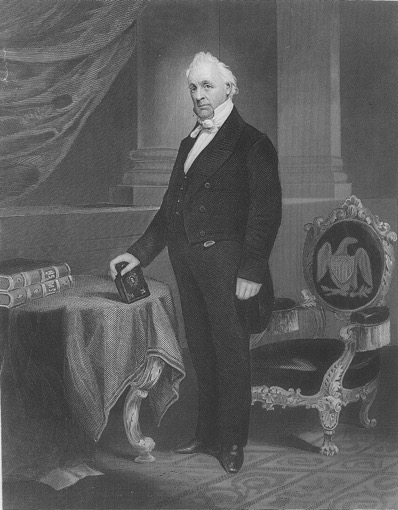
The only bachelor president in American history and the oldest president when he took office in 1856 at the age of 65, James Buchanan of Pennsylvania had a vast array of congressional and diplomatic experience when he ascended to the White House, but also the misfortune of preceding Abraham Lincoln, the president generally regarded as America’s greatest chief executive (Library of Congress Prints and Photographs Division—Reproduction Number LC-USZ62-96357).
Douglas, meanwhile, would enter perhaps the most famous Senate race in American history versus a little known former congressman, Abraham Lincoln, seven years removed from his Illinois congressional seat. As one historian phrased it, “Douglas had let the genie out of the bottle” with his Kansas-Nebraska Act and Lincoln would represent the anti-slavery frenzy its passage unleashed. Their series of debates throughout Illinois would become famous for the compelling focus they brought to the slavery issue nationwide, and although Douglas would be re-elected by the state legislature and retain his Senate seat, the exposure Lincoln received and the name recognition he gained through such things as his now famous “house divided” speech (“A house divided against itself cannot stand…”), regarding slavery and union, would propel him to the presidential nomination and election four years later as the first Republican president.33
At the same time, Buchanan would go on to win the presidency in 1856 in a three-way race, defeating the first Republican presidential nominee, John C. Frémont, the celebrated California explorer and former military governor mentioned earlier, who by then was known as “The Pathfinder,” and former President Fillmore, the last Whig chief executive who ran as a candidate of the nativist anti–Catholic, anti-immigrant American Party (also as the "Know-Nothings"). Previously, while minister to England, Buchanan had been the primary author of the Ostend Manifesto, an American diplomatic report justifying U.S. interest in the nearby island nation of Cuba. It proposed a $100 million purchase of Cuba from Spain “on the grounds it was a natural geographic appendage of the United States” and its “location commanding the mouth of the Mississippi” River. If, after offering Spain “a fair price,” the sale of the island was refused, that same manifesto also justified the use of force by the U.S. to “wrest” it from Spain. Such an acquisition had long been the dream of Southern statesmen hoping to extend their dominion to Cuba and, perhaps, other Latin American areas where an agrarian, slave-based economy like theirs could flourish. Indeed, the fact Buchanan would renew this unfulfilled proposal three years later while still in the White House serves to illustrate the Southern aspirations that made this Pennsylvania native such an enigma as leader of the Democratic Party and nation right before the Civil War.34
1. Richard A. Baker and Neil McNeil, The American Senate, 285.
2. Debra McArthur, The Kansas-Nebraska Act and “Bleeding Kansas,” 39–40.
3. Martin H. Quitt, Stephen A. Douglas and Antebellum Democracy, 66–86; William Gardner, The Life of Stephen A. Douglas, 25–30; Jean H. Baker, James Buchanan, 23–29, 32–34, 38–43, 57–67; Garry Boulard, The Worst President, 16–23.
4. Garry Boulard, The Worst President, 36; William Gardner, The Life of Stephen A. Douglas, 43–47; Martin H. Quitt, Stephen A. Douglas and Antebellum Democracy, 107–114; Jean H. Baker, James Buchanan, 77–78, 79, 81.
5. William DeGregorio, The Complete Book of U.S. Presidents, 82; Debra McArthur, The Kansas-Nebraska Act and “Bleeding Kansas,” 17–18; Kenneth C. Davis, Don’t Know Much About the American Presidents, 133.
6. Kenneth C. Davis, Don’t Know Much About the American Presidents, 133; Walter Stahr, Seward: Lincoln’s Indispensable Man, 51.
7. Fergus M. Bordewich, America’s Great Debate, 9, 11; William DeGregorio, The Complete Book of U.S. Presidents, 157, 170–171.
8. William DeGregorio, The Complete Book of U.S. Presidents, 171; Walter Stahr, Seward, 486.
9. Fergus M. Bordewich, America’s Great Debate, 8; Walter R. Borneman, Polk, 224; Kenneth C. Davis, Don’t Know Much About the American Presidents, 202, 204; Robert Utley, The Indian Frontier of the American West: 1846–1890, 340.
10. Debra McArthur, The Kansas-Nebraska Act and “Bleeding Kansas,” 18–19; Fergus M. Bordewich, America’s Great Debate, 11–12.
11. Fergus M. Bordewich, America’s Great Debate, 11-12; Kenneth C. Davis, Don’t Know Much About the U.S. Presidents, 217, 218; “Mason-Dixon Line,” en.wikipedia.org.; William DeGregorio, The Complete Book of U.S. Presidents, 192.
12. Williiam DeGregorio, The Complete Book of U.S. Presidents, 192; Richard A. Baker and Neil MacNeil, The American Senate, 64–65; Fergus M. Bordewich, America’s Great Debate, 358; William Gardner, The Life of Stephen A. Douglas, 33.
13. “Arkansas,” “Iowa,” “Missouri,” “Oklahoma,” “Texas,” “Wisconsin,” The States, History Channel Video, 2007; Glyndon G. VanDeusen, The Jacksonian Era, 48–50.
14. Debra McArthur, The Kansas-Nebraska Act and “Bleeding Kansas,” 21, William DeGregorio, The Complete Book of U.S. Presidents, 180–181; Scott Farris, Almost President, 57.
15. William Gardner, The Life of Stephen A. Douglas, 35; Martin H. Quitt, Stephen A. Douglas and Antebellum Democracy, 6, 89, 184.
16. Nicole Etcheson, Bleeding Kansas, 9–11; David Dury, The Oregon Trail: An American Saga, 59, 81.
17. Nicole Etcheson, Bleeding Kansas, 11, 14.
18. Ibid.
19. Nicole Etcheson, Bleeding Kansas, 14–15; Scott Farris, Almost President, 57.
20. Debra McArthur, The Kansas-Nebraska Act and “Bleeding Kansas,” 27–40.
21. Nicole Etcheson, Bleeding Kansas, 15.
22. Ibid., 20.
23. Ibid.
24. Scott Farris, Almost President, 56; Kenneth C. Davis, Don’t Know Much About the American Presidents, 226; Debra McArthur, The Kansas-Nebraska Act and “Bleeding Kansas,” 27–28.
25. Debra McArthur, The Kansas-Nebraska Act and “Bleeding Kansas,” 28–29.
26. Ibid., 40.
27. Mark Stein, How the States Got Their Shapes, 102, 169; William DeGregorio, The Complete Book of U.S. Presidents, 205; Scott Farris, Almost President, 59.
28. Scott Farris, Almost President, 58, 59; Debra McArthur, The Kansas-Nebraska Act and “Bleeding Kansas,” 41–43.
29. Debra McArthur, The Kansas-Nebraska Act and “Bleeding Kansas,” 41–45; Kenneth C. Davis, Don’t Know Much About the American Presidents, 228; Nicole Etcheson, Bleeding Kansas, 69–78.
30. Nicole Etcheson, Bleeding Kansas, 59, 77–82.
31. Kenneth C. Davis, Don’t Know Much About the American Presidents, 227–228, 229; William DeGregorio, The Complete Book of U.S. Presidents, 215.
32. Jean H. Barker, James Buchanan, 62, 67–68, 70.
33. William DeGregorio, The Complete Book of U.S. Presidents, 231–232.
34. Walter Stahr, Seward, 177.