
3
Most historians now agree: Jackson’s veto of the Second Bank of the United States ushered in the climactic final chapter of the 1832 presidential campaign.1 Despite optimistic reports almost daily from friends and supporters around the country, and his own delusional expectations that destiny had chosen him to deliver the nation from a finally-exposed autocratic despot, Clay’s unrealistic interpretations of the campaign were obviously impaired by his failure to realize the Bank issue was being spun to Jackson’s benefit more than his own.2
A normally astute and shrewd politician, Clay’s gamble on the Bank issue was nonetheless one in a series of political long shots he employed for personal advancement throughout his career, while seeming to always lag behind his immediate rivals organizationally.3 Other examples included his misguided 1824 strategy whereby not having a majority Electoral College winner among the four presidential contenders would give the final decision to the House of Representatives where he was speaker. He anticipated that would ensure his chances of victory if only he could make the top three—a gamble proven wrong when he missed the cut by finishing fourth. Also, his gamble in the 1844 presidential election that opposition to Texas annexation, its expansion of slavery, and what figured to be a resulting war with Mexico would earn him more Northern votes than what it would ever cost him in the South and West—an error in judgment confirmed by his narrow loss to the nation’s first “dark horse” candidate, James K. Polk.4 Although Clay would always recognize the value of well-placed campaign propaganda, Jackson’s Democrats proved infinitely more adept at it in 1832.5 The only states Clay carried were Delaware, Connecticut, Rhode Island, Massachusetts, and his own—Kentucky.6
The most obvious, first result of the election (and lack of a backlash to Jackson’s Bank veto) was the demise of the National Republicans as a national party. The electoral outcome seemed to confirm that National Republicans were “out-of-touch advocates of the Northeastern elite” and a party “unfit to make converts.” Also illustrated by period historian Michael Holt’s extensive research, “Competing on even terms with the Jacksonians [Democrats] would mean abandoning the National Republican Party” for a more enticing partisan model—what would become the Whig Party—which, ironically, would also come and go from the American political scene by the 1850s.7
Another immediate result of the 1832 Clay-Jackson political conflict was the re-elected president’s re-configuring of American finances. Only months after his battle over the Bank was electorally resolved, Jackson ordered all federal deposits in the National Bank to be withdrawn and deposited in state banks. When Treasury Department officials refused to comply with his wishes, he simply replaced them with those he could trust to conform, including Attorney General Taney, who suddenly went from heading the Justice Department to serving as acting secretary of the treasury. And despite the Senate’s refusal to confirm Taney at Treasury on a permanent basis, he was there long enough to carry out Jackson’s wishes. As a result, by October 1, 1833, all surplus federal funds were no longer in the Second Bank of the United States, having been deposited instead in smaller “Pet Banks,” effectively sounding the death knell of the Philly-based, Biddle-led National Bank, which would re-charter as the United States Bank of Pennsylvania in 1836 before going bankrupt and gone entirely by 1841.8
Although his authority to remove the deposits at the time was questioned, even by his own Cabinet, Jackson had no doubt he had the right to do it and was determined to make sure the issue did not outlast his administration. In response to the President’s devastating action, Biddle attempted to survive by recalling all of the Bank’s outstanding loans, thus starving the U.S. economy of cash flow and attempting to prove to the country it indeed needed a National Bank. Jackson’s abrupt actions and stubborn resolve following the veto, as well as Biddle’s understandable response, would lead to investment limbo throughout the country and set in motion what ultimately became the “Panic of 1837,” a national recession that lasted well into the 1840s. Focusing on the administration’s seemingly high-handed removal of the deposits and the resulting contraction of credit, businessmen throughout the country flooded Washington with petitions asking for relief and prompting Jackson to angrily remark, “Come not to me! Go to the monster! Go see Nicholas Biddle. It is folly, sir, to talk to Andrew Jackson. The government will not bow to the monster.”9
Meanwhile, the President’s detractors in the Senate were equally appalled at the economic hardship he had so flagrantly instigated and led by Clay they moved to censure him for “the exercise of power over the Treasury not granted by the Constitution and dangerous to the liberties of the [American] people.” Clay even felt it was a revolution of sorts, “tending,” as Brands wrote in Heirs to the Founders, “towards a total change of the pure republican character of the government to concentration of all power in the hands of one man.” Clay basically accused Jackson of seizing the nation’s financial assets and “scattering them to the winds.”10 While under Whig control the censure would be upheld, specifically because of Jackson’s failure to turn over documents related to his Bank actions, but once Democrats were back in control of the Senate before Jackson’s second term ended, they wasted no time having that official rebuke expunged from the congressional record.11
All the while, Jackson blamed Biddle for implementation of the financial distress and held Clay responsible for continuing to put ideas in the Bank executive’s head. The President also took obvious delight in what Brands framed as Clay’s “personal impotence” on the banking question. Most Americans did not understand the arguments, pro and con, but generally took Jackson’s side (as had the majority during the election), believing the President was waging a battle for them against the financial aristocracy.12 At the same time, despite the nation’s economic anxiety and ongoing political debate, Jackson felt empowered enough to issue an executive order known as the “Specie Circular.” It required that all land purchased from the federal government be paid for in gold or silver (specie) instead of paper money, furthering the financial depression Biddle’s loan recall had initiated and leaving the worst of the resulting economic woes to the next administration—Van Buren’s.13
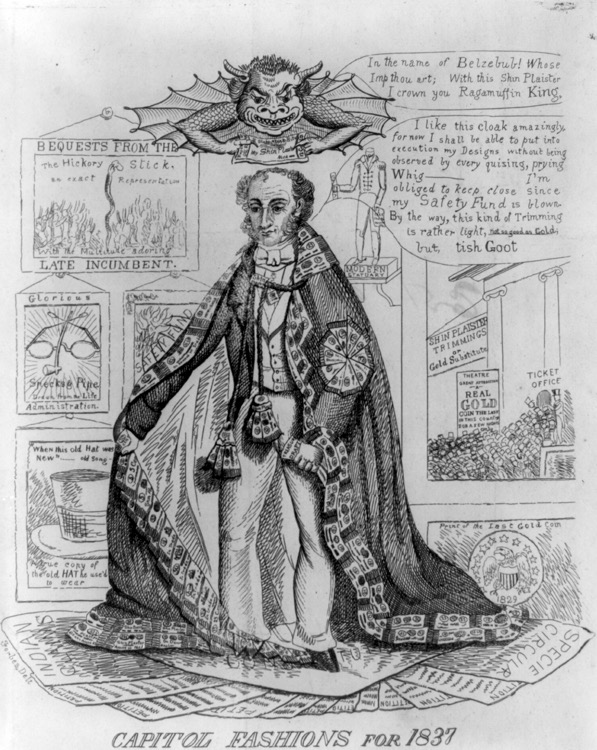
As the designated successor to President Andrew Jackson, Martin Van Buren inherited his hard money policies, including the 1836 Specie Circular, which contributed to the Panic of 1837, the subject of this political cartoon of the time. Notice the devil hovering over the well adorned new White House resident (Library of Congress Prints and Photographs Division—Reproduction Number LC-USZ62-26455).
Among those heavily involved in land speculation, both before and after the Specie Circular, was none other than Daniel Webster, and to the Massachusetts senator and others in Congress this was yet another example of Jackson unjustly increasing the powers of the executive branch. It was one more result of the failure of the Bank battle to derail an incumbent bent on expanding presidential power to never before seen constitutional limits. Along with the Specie Circular, Webster and Clay also decried a “spoils system” of unchecked patronage that Jackson was employing to excess, affirming the argument that the President alone, as Remini confirmed in his book Daniel Webster (yet another of his massive biographical texts), was the sole “representative of the whole American people.”14 Pressure for repeal of the Specie Circular mounted under Van Buren and it would eventually be rescinded, but there can be no denying the American chief executive’s influence over national finances and patronage was irrevocably increased during Jackson’s leadership.15
In addition, Jackson’s victory over the Bank and Clay had been preceded by his veto of federal funding for the Maysville Road from Lexington, Kentucky, Clay’s hometown, to the Ohio River, one of the internal improvements nearest and dearest to Clay’s heart and his beloved American System. Along with the National Bank, which unlike Jackson Clay had fully embraced after the War of 1812 and resulting national debt, the Kentuckian advocated federal dollars for internal, multi-state improvements, believing those to be in the best interests of the entire nation. Jackson, on the other hand, was decidedly of the opinion that funding for internal improvements should be the sole responsibility of the individual states (example: the Erie Canal, built solely by the state of New York between 1817 and 1825). Obviously, his re-election and the administrations of his Jacksonian Era successors—Van Buren (1837), the Democratic defector and accidental president John Tyler (1841, having ascended as vice president when William Henry Harrison died in office), and Polk, America’s great Western expansionist (1845)—would set back the concept of federally funded internal improvements for decades.16
Another legislative pillar of the formula for Clay’s American System was the tariff—what amounted to taxes (or duties) levied on imports from other countries that in that age made up the largest share of U.S. revenue. Before the election in 1832, according to presidential historian William DeGregorio, a new, more “moderate” tariff was enacted, but one only slightly “less exacting” than the so-called “Tariff of Abominations” of 1828, so-named by its Southern detractors in Congress because of the debilitating effect it would supposedly have on their section’s economy.17 Unlike their Northern counterparts, where manufacturing and industry were beginning to proliferate, the Southern state economies remained agrarian based, so that while high duties on incoming imports were obviously beneficial to Northern manufacturers striving to compete with European makers of the same products, they were not so in the South, where the price of all goods went up without the accompanying product protections being reaped by the North. As a result, many Southern legislators continued to feel the tariff was “unconstitutional, unequal, and oppressive” (even the modified 1832 version), making their constituents what Glyndon VanDeusen called the “serfs of the system.” Needless to say, they looked for a way to rescind it.18
With Jackson securely back in the White House and wielding presidential power in extraordinarily new and more assertive ways, this sectional disagreement over the tariff exploded shortly after the election in early 1833, when Calhoun-led South Carolina, in an act of Southern brinksmanship (as occurred often before the Civil War), drafted its “Ordinance of Nullification” that ruled collecting the tariff null and void in the “Palmetto State.” It was an act of states’ rights defiance that Jackson would not tolerate, leading to passage of his Force Bill the following month, which gave him the authority, as president, to use the U.S. military to enforce the tariff in states where its collection might be obstructed and to overpower and jail anyone, if necessary, involved in obvious obstruction of this or any other federal law. Defiantly Jacksonian in its aggressive, out-front approach, its passage quelled the budding Southern resistance of the moment, but it was a precursor of the looming sectional conflict that would not go away until civil war and the emancipation of Southern slavery in the 1860s.19
At the same time, despite his crushing defeat in the presidential race the year before, Henry Clay remained integral to actually solving the “Nullification Crisis” in 1833, as debate and animosity between the sections continued to escalate. Just as with the “Missouri Compromise” of the 1820s, when Missouri could not be admitted as a slave state until Maine was also added as a balancing, non-slave, free state, Clay led the way to yet another tariff, the lesser known “Compromise Tariff.” To do so, he had to secretly consult with the increasingly radicalized Calhoun to concoct a gradual, decade-long lessening of import duties to pre–1820 levels that a reluctant South and disgruntled North could both accept—at least for the time being (through 1842).20 While never able to fulfill his lifelong ambitions for the White House, his service to the nation would continue as the “Great Compromiser,” repeatedly staving off what always seemed America’s inevitable march to civil war. His last introduction of such legislation would happen in 1850, what became known as the “Compromise of 1850,” but it would be for a younger and equally appeasement-conscious senator, Stephen A. Douglas, to push that one across the finish line by breaking the initially large omnibus bill into more acceptable parts for the 72-year-old and ready-to-retire Clay, probably America’s greatest legislator and most battle-scarred politician of all time (and the first deceased American to be honored by having his body lie in state at the Capitol, 1852). Nine years after his death when Abraham Lincoln became president, he remembered Clay’s influence over 40-plus years of federal government service and how he had always been his “beau ideal as a statesman.” Even more revealing, Lincoln called Clay “the man in a crisis.”21 Along with Democratic firebrand William Jennings Bryan—whose populist message and thunderous oratory made him a political star in the late 19th and early 20th century—Clay remains one of America’s only two three-time, major party presidential losers.22
Politically the Jacksonian Democrats obviously benefited from the Bank confrontation, as they were able to characterize their opponents as “lackeys of a ‘mammoth corporation.’” In other words, according to VanDeusen, “friends of the wealthy and powerful” and “exploiters of the masses.” Vice President Van Buren would also write, “The opposition labor[s] hard to shake off the Bank, but we are determined to hold them to it,” and for the foreseeable future that’s exactly what they did, returning to the issue again and again throughout Jackson’s second term and again during his VP’s successful succeeding campaign in 1836.23 Van Buren, in fact, would be the last vice president to ascend to the White House on the coattails of his preceding presidential running mate until George H.W. Bush succeeded Ronald Reagan in 1989. Paraphrasing historian Kenneth C. Davis in that regard, he wrote: “Like his long ago predecessor Martin Van Buren, Bush would be a one-term president—and one who was measured against [the] presidential giant [who preceded him].”24
That sort of “giant” status among American presidents has rarely been unanimous, however, and the major expansion of presidential power that occurred under Andrew Jackson has always had its share of detractors. One such historian, Brian McClanahan, even labeled the Jackson administration “the first imperial presidency” for the way it “arrogated enormous power not authorized by the Constitution.” In other words, executive overreach—examples of which McClanahan pointed to in Jackson’s handling of both the Bank and Nullification controversies. As to the first of those, he called Jackson’s Bank veto mostly a “personal vendetta” against Clay and his administration’s removal of federal deposits patently unlawful in light of the fact Congress was not notified first. On Jackson’s aggressive approach to Nullification via the Force Bill, McClanahan took the side of Calhoun, the primary author of South Carolina’s ordinance, arguing that his presidential power play was not only aimed at an individual state’s authority, “but also at the expense of the entire federal system and Constitution itself,” permitting the executive branch to eventually “consume” powers of the other federal branches as well as the states.25
Also, Jackson’s expansion of presidential authority clearly coincided with the push for equality and economic opportunity by the middle and lower classes of the White population throughout the country.26 This was especially true in the Deep South and early West, where his Indian Removal Act of 1830 proved a major operation with no precedents that callously pushed Native Americans westward, opening their homelands to Caucasian settlement and increased Democratic voter rolls.27 No longer would such ironies as a “Virginia Dynasty,” where four of our first five presidents all hailed from the same state, be conceivable, or the financial influence of one or two regions of the country, such as New England and the Middle Atlantic, hold sway over national decision-making.28 Instead, Jacksonian-style democracy had effectively ushered in populist appeal and massed partisan support.
After feeling burned by insider politics in his first national run in 1824, the general that was Jackson made sure to marshal his forces the second and third times around, and he did so, in part, by exemplifying and enhancing presidential control while in the White House. Among the ways he did so was by the presidential veto, blocking more congressional bills (12) than all his predecessors combined; by doubling the size of the federal government and rewarding his supporters with government jobs (what we now term patronage) in our original spoils system; and by asserting the supremacy of the federal government over state governments more than any of his predecessors.29 Although other presidents, most notably Theodore Roosevelt at the turn of the 20th century and his fifth cousin, Franklin Roosevelt, in the 1930s, could rightly be credited with greatly extending the powers of the presidency, Jackson clearly set the early standard for presidential empowerment or overreach, depending on one’s point of view. Either way, he’s been called the “founder of the modern presidency” as a result.30
1. Robert Remini, Henry Clay, 394–410; Glyndon G. VanDeusen, The Jacksonian Era, 67; H.W. Brands, Heirs of the Founders, 195–196; Kenneth C. Davis, Don’t Know Much About the American Presidents, 164; William DeGregorio, The Complete Book of U.S. Presidents, 112; Michael F. Holt, The Rise and Fall of the American Whig Party, 17.
2. Robert Remini, Henry Clay, 403–404.
3. Ibid., 1–2.
4. Robert Remini, Henry Clay, 239, 249, 658, 662–663.
5. H.W. Brands, American Lion, 218–219; Robert Remini, Henry Clay, 404; Michael F. Holt, The Rise and Fall of the American Whig Party, 17.
6. William DeGregorio, The Complete Book of U.S. Presidents, 112.
7. Michael F. Holt, The Rise and Fall of the American Whig Party, 17, 18, 957, 983; F. Martin Harmon, Presidents by Fate: Nine Who Ascended through Death or Resignation, 72.
8. Kenneth C. Davis, Don’t Known Much About the American Presidents, 164–165.
9. H.W. Brands, Heirs of the Founders, 229–230, 234–236.
10. Ibid., 230–231.
11. H.W. Brands, American Lion, 278–279, 335.
12. H.W. Brands, Heirs of the Founders, 235.
13. Kenneth C. Davis, Don’t Know Much About the American Presidents, 165; Glyndon G. VanDeusen, The Jacksonian Era, 104–106, 113, 116.
14. Robert Remini, Daniel Webster, 445, 452, 464–465.
15. Glyndon G. VanDeusen, The Jacksonian Era, 119–120, 128.
16. Glyndon G. VanDeusen, The Jacksonian Era, 52, 69; H.W. Brands, Heirs of the Founders, 185; William DeGregorio, The Complete Book of U.S. Presidents, 82–83; Glyndon G. VanDeusen, The Jacksonian Era, 113–114, 167, 206–207.
17. William DeGregorio, The Complete Book of U.S. Presidents, 115.
18. Glyndon G. VanDeusen, The Jacksonian Era, 39.
19. Glyndon G. VanDeusen, The Jacksonian Era, 71–80; H.W. Brands, Heirs of the Founders, 197–201; Kenneth C. Davis, Don’t Know Much About the American Presidents, 168.
20. H.W. Brands, Heirs of the Founders, 202–205; William DeGregorio, The Complete Book of U.S. Presidents, 82, 115; Margaret Coit, John C. Calhoun: American Portrait, 255.
21. Fergus M. Bordewich, America’s Great Debate: Henry Clay, Stephen A. Douglas, and the Compromise That Preserved the Union, 1; Scott Farris, Almost President: The Men Who Lost the Race But Changed the Nation, 20–21, 45, 55; Richard A. Baker and Neil MacNeil, The American Senate, 171, Martin H. Quitt, Stephen A. Douglas and Antebellum Democracy, 117; Robert Remini, Henry Clay, 786.
22. Michael Kazin, A Godly Hero: The Life of William Jennings Bryan, xiii–xiv, 10, 40, 47–49, 122–123; Phillip Bump, “What’s The Optimal Number of Times to Run For President?” Washington Post, September 12, 2014.
23. Glyndon G. VanDeusen, The Jacksonian Era, 86.
24. Kenneth C. Davis, Don’t Know Much About the American Presidents, 568–569; Scott Farris, Almost President, 32–33.
25. Brian McClanahan, Nine Presidents Who Screwed Up America, 15–16, 22–23.
26. Kenneth C. Davis, Don’t Know Much About the American Presidents, 166.
27. Glyndon G. VanDeusen, The Jacksonian Era, 49; “Indian Removal Act,” en.wikipedia.org.
28. Kenneth C. Davis, Don’t Know Much About the American Presidents, 124; H.W. Brands, Heirs of the Founders, 140–141.
29. Glyndon G. VanDeusen, The Jacksonian Era, 28–30; Kenneth C. Davis, Don’t Know Much About the American Presidents, 157, 159–160, 166; William DeGregorio, The Complete Book of U.S. Presidents, 114.
30. William DeGregorio, The Complete Book of U.S. Presidents, 114, 384–387; 498–501.