
6
The presidential election of 1860 was a watershed moment for America made all the more likely by a dysfunctional Democratic Party, four major candidates instead of the usual two, and the rise of a Republican Party that would rule the political landscape for most of the next five decades. With the divisive election of President Abraham Lincoln confirming for Southerners what had been forecast for years—that the North’s true intention was to subdue the Southern way of life and end slavery—the last vestiges of Unionist sentiment in “Dixie” were overruled, leading to the secession of eleven Southern states and the nation’s greatest disaster—the Civil War. Afterwards, following the unprecedented carnage caused by four years of brutal conflict, “Waving the Bloody Shirt” became the modus operandi for Republicans whenever they wished to remind voters of past failures of the Democratic Party, upon whose tenure they repeatedly placed blame for disunion and the war.1
The Buchanan-Douglas feud over Kansas had staggered the Democrats. Douglas, in fact, “had reached the brink of the abyss,” as biographer William Gardner put it, desiring, if possible, to “conciliate the South without alienating the North.” At the same time, Republicans had looked on as “pleased spectators.” Advising the son of a friend at the time, the Illinois senator evidenced his frustration when he said, “Never go into politics. If you do, no matter how sincere and earnest you may be, you will be misinterpreted, vilified, traduced, and finally sacrificed to some local interest or unreasoning passion.”2
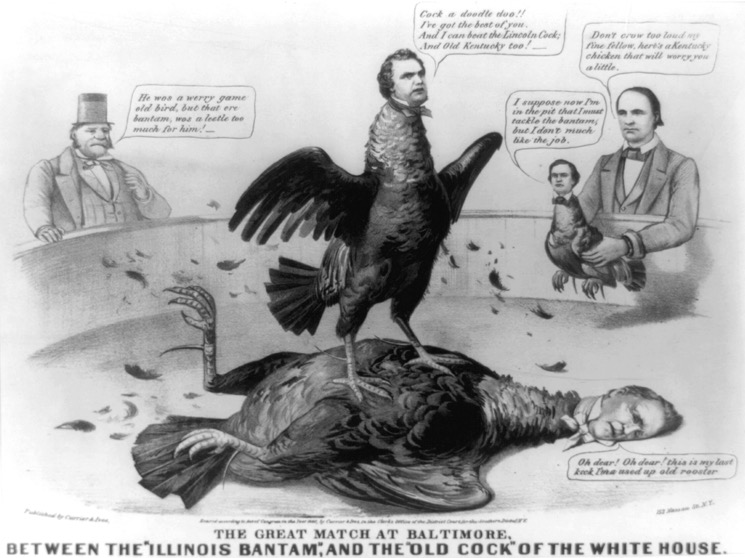
Portrayed as a staged “cock fight,” something that was common in early rural America, Senator Stephen A. Douglas of Illinois emerges victorious in this political cartoon from the mid 1800s over a prostrate President James Buchanan. Illustrating the intra-party conflict that emerged between these two leading figures of the Democratic Party, the cartoon makes reference to Baltimore, site of the 1860 Democratic National Convention where Douglas was named the official party nominee to replace the outgoing Buchanan, while Vice President John Breckinridge, candidate of the breakaway Southern Democrats, is also seen entering the ring (Library of Congress Prints and Photographs Division—Reproduction Number LC-USZ62-10365).
Douglas, after all, was a pragmatist, who like Henry Clay was famous for seeking compromise. He openly despaired at what secession and war between the sections could mean for American democracy, but his selection in 1860 as the Democratic presidential nominee had as much to do with bringing on the colossal conflict as the Lincoln nomination on the Republican side—the event normally attributed as the last straw leading to war—or at least that’s the verdict assessed by Scott Farris in Almost President: The Men Who Lost the Race but Changed the Nation. Farris also cited the Southern “Fire-Eaters,” radical secessionists like Alabama’s William Lowndes Yancey, South Carolina’s Robert Rhett, Texas’ Louis Wigfall, and Mississippi’s William Barksdale, as being those who conspired to bring about a split in the Democratic Party at the 1860 national convention in Charleston, South Carolina, a hotbed of Southern secessionist sentiment. Indeed, once it was determined that Douglas would be the party’s official nominee, eight Southern state delegations walked out, forcing the convention to adjourn for lack of a two-thirds majority and to reconvene in Baltimore, Maryland, six weeks later.3
In the interim, Douglas offered to withdraw his name if a compromise candidate could be agreed upon, but his Northern supporters would not allow it and refused to even let his offer be made public. “Unless he is nominated, our party is gone for all time to come,” one leading Northern Democrat was heard to say and “Douglas or nobody” seemed to be the prevailing sentiment when the Democrats tried to regroup in Baltimore still minus the Southern delegations, who had resolved to meet on their own in another part of town and to hold a “rump convention.” They would nominate John Breckinridge, Buchanan’s outgoing vice president as the Dems’ Southern nominee in the newly formed National Democratic Party, and, as if the presidential field wasn’t large enough, it got even more crowded when Tennessee Senator John Bell, an aging, former anti–Jackson Whig, was nominated by the Constitutional Union Party, a coalition of Southern conservatives.4
By entering the race, both Breckinridge and Bell hoped the election could be thrown into the House of Representatives via a deadlocked Electoral College, leaving no clear majority winner, as had happened two previous times (1800 and 1824). That way a Southern compromise candidate might emerge. In his anger over the Democratic breakup, however, Douglas indicated he would rather “throw the election to Lincoln” than see either of his other opponents elected by the House.5 And that’s what he did by staying in the four-way race, even when it was clear Democratic and Southern voters would be split, allowing Lincoln and the Republicans to be first time winners of the White House with only 40 percent of the vote. Douglas came in second with 29 percent, Breckinridge third at 18 percent, and Bell fourth with 13 percent.6
Despite his campaigning throughout the country (the only candidate who did) and warning of the inevitability of secession should Lincoln win, Douglas’ fate and that of the country were all but sealed by the crowded field, as Lincoln took all 18 Northern states as well as California. It would be the start of a Republican dominated North for a long time to come. Thus the practice of “waving the bloody shirt” would come into political play in the decades immediately after the Civil War—even for Ulysses S. Grant, who as the Union’s greatest general would be the most obvious two-term “waver” from 1869 through 1877. After Grant, Rutherford B. Hayes waved it again during his extremely contested election versus Democrat Samuel Tilden in 1876 and James Garfield, another Union general, would wave it yet again in 1880 and win despite being matched against an even more famous Union war hero, Gettysburg frontline commander Winfield Scott Hancock.7
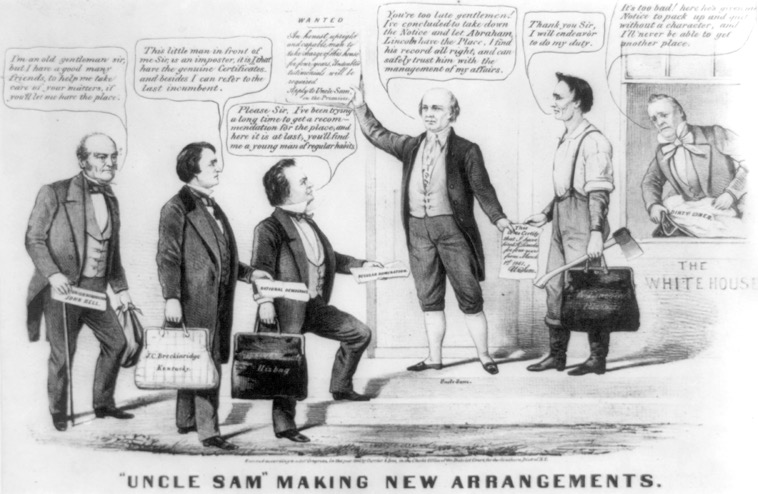
With outgoing President James Buchanan shown packing his bags in the White House (far right) after only four years, this political cartoon shows U.S. symbol Uncle Sam (early version) welcoming Abraham Lincoln, the President-elect from Illinois who was known as the “Rail Splitter,” while former Tennessee Senator John Bell, Vice President John Breckinridge of Kentucky, and Illinois Senator Stephen Douglas are advised they are too late in their hope of ascending to the executive mansion (Library of Congress Prints and Photographs Division—Reproduction Number LC-USZ62-12424).
Except for the two non-consecutive terms of Democrat Grover Cleveland, in fact, the Republican Party would control the White House from Lincoln in 1860 through William Howard Taft in 1913, and thanks to its influence in the “dynamically growing, industrializing, immigrant-attracting North, the party that dominated the nation’s manufacturing districts—which is to say the Republican Party” (as H.W. Brands said in American Colossus: The Triumph of Capitalism, 1865–1900)—would enjoy a decided advantage in national elections throughout the second half of the 19th century. But American elections do have consequences and no election ever had more consequence than the one in 1860. Presidential historian Kenneth Davis acknowledged as much when he called it, “without question the most momentous in American history,” while according to Walter Stahr, who authored a biography of William Seward, Lincoln’s secretary of state: “The Republicans generally saw themselves as the party of clean government” and a necessary answer to the “corruptible” Buchanan years.8
Actually, the last two years of the Buchanan administration were also about the President’s unfulfilled ambitions and/or overreach when it came to foreign policy. As established by the Ostend Manifesto he co-authored before becoming president, Buchanan always hoped to purchase and annex Cuba as the nation’s 16th slave state and those desires only intensified once he was in the White House. He argued that his so-called “Pearl of the Antilles” remained essential to American security, less than 100 miles off the coast of Florida and within easy reach of both Mobile Bay and the mouth of the Mississippi River. He also issued a dramatic proposal involving Mexico, asking Congress for authority to establish military outposts across the Arizona border in Mexican territory, and also permission to raise a military force to police that area. Legislators who remembered only too well the political discord that accompanied the Mexican War a decade earlier absorbed both requests with understandable disbelief, but such were the kind of ideas Buchanan hatched—foreign policy suggestions that led biographer Jean Baker to label him “one of the most aggressive and hawkish of our chief executives,” but also one Congress routinely “avoided or opposed.”9
Suspected corruption by his administration was also the subject of a congressional investigation once the Republicans gained control of the House of Representatives in 1858. John Covode, a Pennsylvania Republican, headed the probe of his home state president. Known as “Honest John,” Covode was convinced Buchanan had benefited from illicit campaign funds in 1856 and was fairly certain the President had tried to bribe individual members of Congress during the Lecompton debate. When created, the Covode Commission drew praise from the New York Times, which reported “a general conviction throughout the country that the administration of Mr. Buchanan has been profligate and corrupt beyond all precedent.” Once testimony began, there were accusations by Democratic insiders and Buchanan appointees, but the findings were inconclusive and served only to illustrate the great disparity of opinion when it came to the President by those who disliked him and his loyalists, who felt he had done nothing wrong. Afterwards, Buchanan ridiculed his accusers, when he said, “I defy all investigations. Nothing but the basest perjury can sully my good name.”10
Just one week before Lincoln’s election, Buchanan encountered probably the most disturbing moment of his presidency. According to biographer Garry Boulard, that was the moment he received a message from Winfield Scott, the commanding general of the United States Army, advising him of “imminent danger of disruption of the Union by the secession of one or more of the Southern states.” In the same communiqué, Scott indicated that federal forts along the Mississippi and Atlantic coast “were at risk of invasion” and recommended garrisoning those immediately in order to deter any thought of surprise attacks, while also predicting, “The danger of secession may be made to pass away without one conflict of arms, one execution, or one arrest for treason.” Famous last words—no message could have been more annoying to Buchanan, who felt that by even hinting at such alarm, Scott had only made matters worse.11
In Lincoln: A Life of Purpose and Power, Richard Carwardine, a British biographer of America’s most revered president, used the word “hapless” to describe Lincoln’s predecessor in the White House, particularly in the four months between the 1860 election and Inauguration Day. With the states of the Deep South following South Carolina’s lead and seceding in near unison, Buchanan was being derided nationally for his “feeble argument that it was beyond his power to stop.” Despite disunion and the seceding states seizing federal arsenals and forts within their boundaries, Buchanan could only urge caution and conciliation, and a call for a convention at which compromise proposals could be submitted by Congress, including a hopeful scheme by Senator John Crittenden of Kentucky, a would-be political heir to his in-state predecessor Henry Clay, that attracted the most attention. It called for a series of constitutional amendments that would remove slavery from the reach of the federal government for all time, with the Missouri Compromise line restored and a guarantee of slavery’s permanence south of that line, literally binding future generations to its provisions. Of course, the key to the Crittenden proposal was getting enough Republicans to support it, the majority of whom were opposed to slavery, but also deeply concerned about the financial chaos disunion promised.12
Lincoln, however, was not open to any such compromise. Like FDR’s previously discussed decision not to work with Hoover before taking office in 1932, the President-elect in 1860 let it be known that he wanted no part of compromise on the question of extending slavery before taking the oath. He was not about to relinquish the platform he and his new party had run on, and won on, before assuming the reins of power (and his heroic moment), even in the face of the Southern states breaking away and the awful, overwhelming sense of responsibility that by then filled his every waking hour.13
Basically, the U.S. government had no policy to deal with the crisis. Buchanan vacillated between believing secession unconstitutional while at the same time concluding he was powerless to do anything about it. In the first three months following his election victory, Lincoln made no public statements or formal addresses. When he did speak, he offered what biographer David Herbert Donald called “bland observations” designed to reassure the citizens of the North who had voted him into office, feeling there was no way Southerners would actually dissolve the Union despite their threats, the same kind they had issued so many times before—before the Missouri Compromise of 1820; during the Nullification Crisis of 1832; throughout debate over the Compromise of 1850; and while deciding the ongoing fate of the territories acquired by the Mexican Cession of 1848—all of which had extracted some sort of Northern concessions. Buchanan sincerely believed that was all Southerners really wanted: that once again it was “the trick by which the South breaks down every Northern man.” But should he agree to it, he also felt, would render him “as powerless as a block of buckeye wood.”14
Regardless, the chances of Lincoln and the Deep South ever achieving compromise were slim and mostly none. Once again according to Donald, whose 1995 biography of Lincoln followed two earlier Pulitzer Prizes, “The President-elect’s commitment to maintaining the Union was absolute.” Although pressed to accept concessions that might give a measure of support to Southern Unionists, he was immovable on one thing: stopping the extension of slavery into the new territories, the thing that had gained him so much national exposure during his 1856 Senate race with Douglas. On that point alone he told Republican congressmen: “Stand firm. The tug has to come and better now than at any time hereafter.”15
On March 4, 1861, James Buchanan and Abraham Lincoln began the ride down Pennsylvania Avenue to the Capitol together. Their inauguration journey followed the President-elect literally being snuck into Washington in order to foil a rumored assassination plot uncovered by the Pinkerton National Detective Agency during Lincoln’s victorious, 12-day train trip from his home in Springfield, Illinois, to the District of Columbia on a circuitous route that took him through as many Northern cities as possible. Knowing that to complete the last leg of the trip, travelling through slave state Maryland and particularly Confederate-sympathizing Baltimore, Lincoln would be required to change not only trains but stations, a secret train and sleeping car were arranged to transport the President-elect from Philadelphia to Washington under the cover of darkness, a ploy that would be exposed and derided by the New York Times and New York Tribune upon his arrival. Nine days later, as soon as Lincoln had finished his inaugural address, which included his famous appeal to “the better angels of our nature,” he was faced with the dilemma of re-supplying the federal garrison at Fort Sumter in Charleston Harbor, the place where the Confederate forces of General P.G.T. Beauregard would initiate the Civil War with their historic bombardment 39 days later.16
At least one author of more recent vintage has suggested Lincoln was not all that taken aback by the South’s headlong rush to secession and, in fact, was actually “all in” on a Republican plot to initiate the confrontation all along in the hope the new party would gain complete control and power of the central government. Talk about re-writing history; Robert Broadwater set out to at least threaten “Honest Abe’s” saintly reputation in his Did Lincoln and the Republican Party Create the Civil War?: An Argument, written in 2008. In the book’s Introduction Broadwater wrote:
The true cause of the war is one as old as civilization itself: the power to rule. The Republican Party, a relative newcomer to national politics, had, by a twist of fate, secured the election of Abraham Lincoln to the presidency in only its second presidential election. The Democratic Party had become split, divided into three factions [with] each nominating its own candidate. Lincoln won with a decided minority of the popular vote and his presidency promised to be of limited power and influence. It became apparent to the Republicans from the beginning that even with the presidency they could exert no great influence over national politics unless the hold of the Democrats was broken [and] the most expeditious manner to accomplish that was to eliminate the solid Democratic [voting] bloc that was the South. The sectional crisis that erupted with the election of Lincoln could have been avoided through mediation and diplomacy, but the [Lincoln] administration opted against such a course. Vowing to save the Union, the Republicans [instead] did everything in their power to dissolve the confederation [Union of states] and split the nation.
Totally revisionist in theory to say the least, Broadwater’s controversial premise seems even more ironic when one considers how Stephen Douglas, Lincoln’s most formidable opponent, was actively striving to preserve the Union to the bitter end of his 1860 presidential campaign, even when Lincoln’s victory had become inevitable. Douglas’ biographers agree he was working on keeping the country together more than ever, specifically because of the new, soon-to-be resident of the White House—an assumption that makes a lot of sense if Broadwater’s argument is to be believed. “During the entire last month of his presidential campaign, when Douglas recognized the probability of Lincoln’s victory, he focused on the need to preserve the Union by explaining why the South should remain wedded to the established constitutional order. [And] immediately after the election, he continued to articulate the same message”—at least that’s how one of his biographers put it while emphasizing economic arguments and Lincoln’s repeated promise to leave Southern slavery alone. Another Douglas biographer confirmed: “He was sincerely alarmed for the safety of the Union in case of Lincoln’s election, which he believed probable. [And] he urged upon the South the duty of submitting to the result, whatever it might be.”17
Easily the most recognized Democratic spokesman, with Buchanan having faded from relevancy by the time of the 1860 presidential election, Douglas was also instrumental in the previously mentioned Crittenden compromise, the last gasp of those trying to again compromise their way out of disunion. Reflectively, he would also revise his previous career-long political approach by claiming to regret having had to vote for compromise so often, an example of his tendency to reconstruct the past to accommodate more immediate goals. Of necessity, he would end his political days vigorously supporting Lincoln before dying of typhoid fever at the even-then young age of 48, while on a grueling speaking tour on behalf of (you guessed it) saving the Union, less than two months after the fall of Fort Sumter.18
Buchanan, by contrast, would simply retire to his Wheatland estate in Lancaster, Pennsylvania, and live out the remaining seven years of his life in relative anonymity, seeking only to defend his administration by authoring Mr. Buchanan’s Administration on the Eve of Rebellion, a memoir of his one-term presidency with more positive spin than what most pundits remembered from that four-year drift to disunion that he had not only failed to resolve, but accelerated. To the end of his life at age 77, he would seek to justify and draw similarities between his policies and those of his successor, especially once Lincoln was lionized in death by an assassin’s bullet that made him a national saint.19
Yet, although Lincoln has nearly always been regarded as our greatest president, such levels of adulation have not left him immune to detractors—one of whom, Brion McClanahan, in his Nine Presidents Who Screwed Up America, even had the temerity to include Lincoln as one of those nine. In so doing, he admitted that in “presiding over the most traumatic and defining moment in American history,” a war between states, there may have been need for a “careless disregard [of] executive restraint” and the “wholesale transformation from federal republic to consolidated nation,” but Lincoln, “more than any other president before him,” including the often executively autocratic Andrew Jackson, “created the blueprint for the modern presidency.”20
To support this argument, McClanahan expressed Lincoln’s own understanding of the national situation he assumed leadership of in 1861 as a state of “anarchy,” while at the same time classifying the Union of that nation as “perpetual” and “indissoluble.” These two rarely used words, which mean “never ending” and “unable to be destroyed,” obviously meant a lot to Abraham Lincoln because in upholding their meaning in regard to the nation, he was forced to play what McClanahan cited as “a dangerous balancing act with the Constitution and his oath of office.” Examples would be his initial call for 75,000 troops to put down the Southern “rebellion,” since the secession of individual states by state governments was an illegal act without law on which to base the so-called Confederate States of America. And his unilateral suspension of habeas corpus by arresting secessionist-leaning office holders in Maryland in April 1861 that was ruled unconstitutional by the Taney Supreme Court. That was a ruling he would ignore two more times during the Civil War by sanctioning the detainment of perceived foes through his war powers and finally his January 1863 Emancipation Proclamation, which has always been hailed as a seminal act in American history for freeing the slaves, but also questioned by legal scholars for its invalidating of state laws and property rights via presidential decree.21
In other words, the conflict between Senator Douglas and President Buchanan and the overall breakdown of the Democratic Party between 1856 and 1860 undoubtedly resulted in political control by the Republican Party for the foreseeable future; actually escalated the sectional divide over slavery that had long threatened the nation’s unity; and eventually paved the way for the election of a little known former congressman to be president, who rightly (as has always been taught) or wrongly (as constitutional law might indicate), expanded presidential power to never before seen levels. Ultimately this personal, intra-party, Washington war helped precipitate the Civil War, the worst catastrophe in American history and one that planted the seeds of so many things that still confront and divide us.
1. William C. Davis, Look Away: A History of the Confederate States of America, 428; William E. Leuchtenburg, The White House Looks South, 22; Pedro Hernandez, “The United States’ History of Third Party Candidates,” fairvote.org, May 19, 2020; H.W. Brands, American Colossus: The Triumph of Capitalism, 1865–1900, 438.
2. William Gardner, The Life of Stephen A. Douglas, 141; Scott Farris, Almost President, 64.
3. Scott Farris, Almost President, 64–65.
4. Ibid., 65.
5. Ibid., 65–66.
6. William DeGregorio, The Complete Book of U.S. Presidents, 234.
7. Ibid., 271, 285; Kenneth C. Davis, Don’t Know Much About the American Presidents, 306, 308.
8. Kenneth C. Davis, Don’t Know Much About the American Presidents, 253; H.W. Brands, American Colossus, 537; Walter Stahr, Seward, 186.
9. Jean H. Baker, James Buchanan, 107–110.
10. Garry Boulard, The Worst President, 68–70.
11. Ibid., 87.
12. Richard Carwardine, Lincoln: A Life of Purpose and Power, 137, 141.
13. Ibid., 135, 141.
14. David Herbert Donald, Lincoln, 257, 259–260.
15. Ibid., 268–270.
16. Ibid., 277–279, 282, 284–285, 291–292.
17. Robert P. Broadwater, Did Lincoln and the Republican Party Create the Civil War? An Argument, 7–8; Martin H. Quitt, Stephen A. Douglas and Antebellum Democracy, 170; William Gardner, The Life of Stephen A. Douglas, 150.
18. William Gardner, The Life of Stephen A. Douglas, 170–171; William DeGregorio, The Complete Book of U.S. Presidents, 221, 233.
19. Jean H. Baker, James Buchanan, 6, 159.
20. Brion McClanahan, Nine Presidents Who Screwed Up America, 25–26.
21. Ibid., 26, 28–31; Kenneth C. Davis, Don’t Know Much About the American Presidents, 257–258.