
Section Three
7
Boston-bred, Harvard-educated, and European-experienced, with an impressive array of mentors and friends that included Supreme Court Justice Joseph Story and esteemed poet Henry Wadsworth Longfellow, Charles Sumner was a polished lawyer, teacher, and United States senator ahead of his time in the 1850s. Indeed, how many American politicians have been elected to their first office—a major, statewide office—by an unlikely coalition of two separate parties joining forces to oust the state’s prevailing “money power”? Such was the case in Massachusetts in 1851 when Sumner’s short-lived Free-Soil Party coalesced in a controversial alliance with the state’s traditionally second place Democrats to capture the Senate seat long held by the iconic Daniel Webster and his Whigs.
By all accounts, it was a radical changing of the guard in the “Bay State” that took 26 ballots to consummate in the Massachusetts House of Representatives, but that’s not why Sumner was ahead of his time. Instead, that status would be earned by the leading role he played in the nation’s first African American civil rights movement—both the anti-slavery agitation he brought and personified in the U.S. Senate before and during the Civil War, and the Radical Republicanism he would eventually subscribe to and lead during the nation’s “Reconstruction” after the war. Barry M. Goldenberg confirmed as much in his 2011 book The Unknown Architects of Civil Rights, when he wrote: “Sumner lived his life as a means to fight for Black equality, his source of passion as a U.S. senator.” Also quoting the leading Sumner biographer, David Herbert Donald, who actually authored two books on the Massachusetts senator, Goldenberg agreed that he was “‘a man inflexibly committed to a set of basic ideas as moral principles.’ Those principles that defined Sumner were grounded in equality, social justice, and civil rights.”1
But if Sumner was a senator ahead of his time in 1851, Andrew Johnson would prove a president terribly behind the times upon his sudden elevation from vice president to the White House following the shocking assassination of Abraham Lincoln just six days after the end of the Civil War in 1865. Unlike Sumner, Johnson, who had aspired to higher office for decades, was a battle-tested career politician by the time he became the nation’s chief executive, having risen steadily through Tennessee’s Democratic Party. In a period history he authored in 1988, in fact, Eric Foner argued that in terms of sheer political experience, few men could have appeared more qualified for the presidency than Andrew Johnson did by the 1860s.2
And yet, Johnson had been fatherless, unschooled, and apprenticed at an early age, when he and his brother escaped dire financial straits in Raleigh, North Carolina, crossing the Appalachian Mountains in order to start anew as tailors (their acquired profession) in the still young “Volunteer State.” There Johnson would settle in the lovely East Tennessee village of Greeneville, within sight of the Great Smoky Mountains, where he established a successful tailor’s shop, acquired a self-taught education, raised a thriving family, and jumped into local and state politics, winning early and often as a disciple of Andrew Jackson.3 In 1843, representing Tennessee’s 1st Congressional District, he reached the U.S. House, where he thrived before becoming governor in 1854, senator in 1858, military governor in 1862 after Tennessee seceded and was partially re-conquered by Union forces early in the war, and vice president as a Unionist “War Democrat” on Lincoln’s revised re-election ticket of 1864 (replacing Lincoln’s highly regarded first term VP, Maine’s Hannibal Hamlin).4
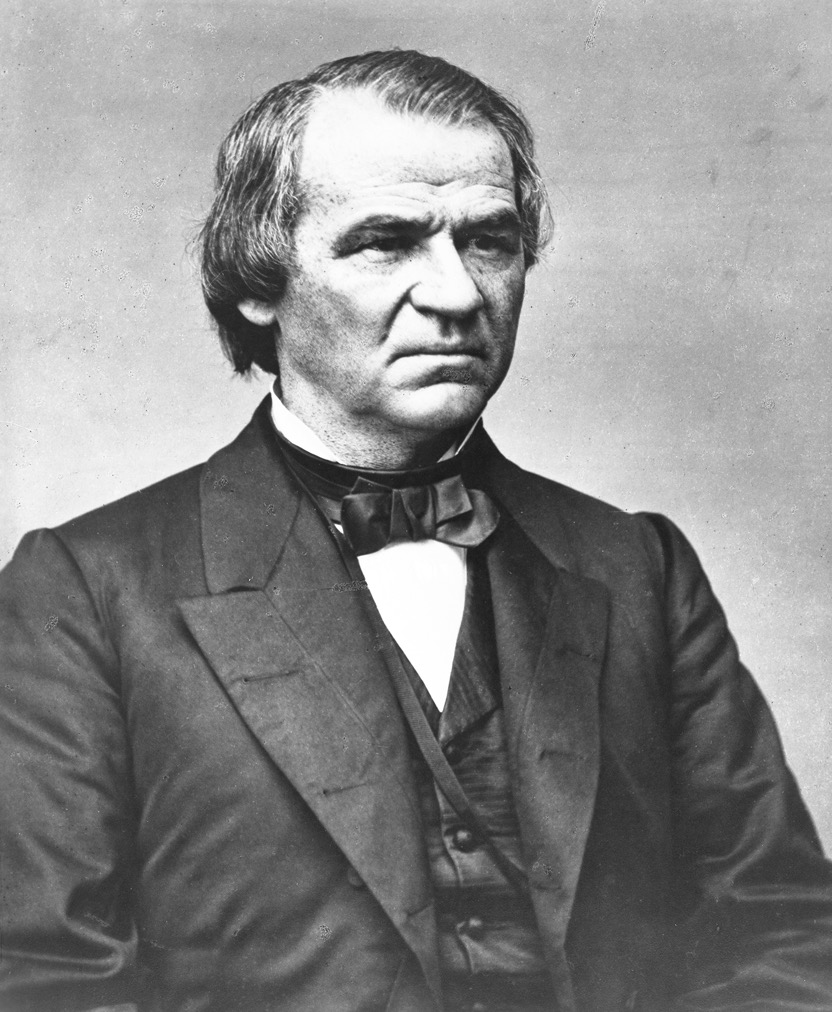
As the first American president whose ascent to the White House was due to an assassination, Andrew Johnson was thrust into national leadership at the most troubling of times—the bitter end of the Civil War with its ongoing sectional hostility, and the death of the man (Abraham Lincoln) who had seemingly willed the country back together. Despite a long political career, Johnson would prove ill-equipped to deal with the enormous challenges still facing the nation (Library of Congress Prints and Photographs Division—Reproduction Number LC-USZ62-13017).
Johnson’s move to the Republicans as military governor and vice president was a matter of political necessity, as well as a reflection of the strict constitutional beliefs that kept him in his Senate seat in Washington when all other Southern senators were abandoning theirs in early 1861, returning to their respective seceded states before the war’s inevitable start. He truly believed secession illegal and caused by a treasonous “slaveocracy” in the South, the wealthy, plantation-owning minority who were determined to take the rest of the White population to war with them in order to protect their influence and property. As a result, he subscribed to the belief the Southern states had never actually left the Union and were in a state of rebellion only because the vast majority of people in the South had been duped into believing their way of life was threatened. Eventually Johnson had to accept political reality and his lack of a home state constituency, as well as Lincoln’s Emancipation Proclamation ending slavery in January of 1863. What he would never surrender, however, were his roots and belief in White supremacy. “Everyone must admit that the White race is superior to the Black,” Johnson was recently credited with saying by a current, national media outlet.5
At the same time, an ironic bit of commonality in their connected saga was the fact both Sumner and Johnson had been elevated to hero status in the North by the time the Civil War began. Sumner would ascend the Mount Olympus of anti-slavery and abolitionist sentiment following a speech he gave in May 1854 during debate over the Kansas-Nebraska Act. It became known as his “Crime Against Kansas” speech and in it he attacked “the one idea that Kansas, at all hazards, must be made a slave state.” Castigating repeal of the Missouri Compromise line as a pro-slavery conspiracy and “swindle” by Stephen Douglas, the Pierce administration, and their legion of Southern adherents in Congress, who, he said, “shamelessly acquiesced around the concept of popular sovereignty as a means of expanding slavery into the territories,” he also personally chastised other members of the South’s Senate delegation, including James Mason of Virginia, “where human beings are bred as cattle,” and South Carolina’s Andrew Butler, whom he branded the “Don Quixote of slavery” with “a mistress [slavery], who though lovely to him is polluted in the sight of the world.” Unbeknownst to Sumner, the aging Butler had a younger, more radicalized second cousin representing South Carolina in the House at the same time, who took it upon himself to defend family honor and that of the South by attacking Massachusetts’ anti-slavery spokesman in broad daylight as he sat at his desk in the Senate chamber. Congressman Preston Brooks, in fact, would use a walking cane to repeatedly strike Sumner about the head and shoulders, rendering him bleeding and unconscious before the few other senators in attendance that day could restrain the assailant and get the victim medical attention.
Although expelled from the House and convicted of assault, Brooks would never be incarcerated and was fined only $300. On the other hand, Sumner faced a three-year rehabilitation from his injuries and resulting infection, a period in which he was absent from the Senate though retaining his seat, and a time during which he would become a heroic symbol for the North’s growing anti-slavery fervor. Not surprisingly, he would be re-elected to the Senate in 1859 despite never fully recovering from what has come to be diagnosed as post-traumatic stress disorder, obviously the neurological result of Brooks’ attack.6
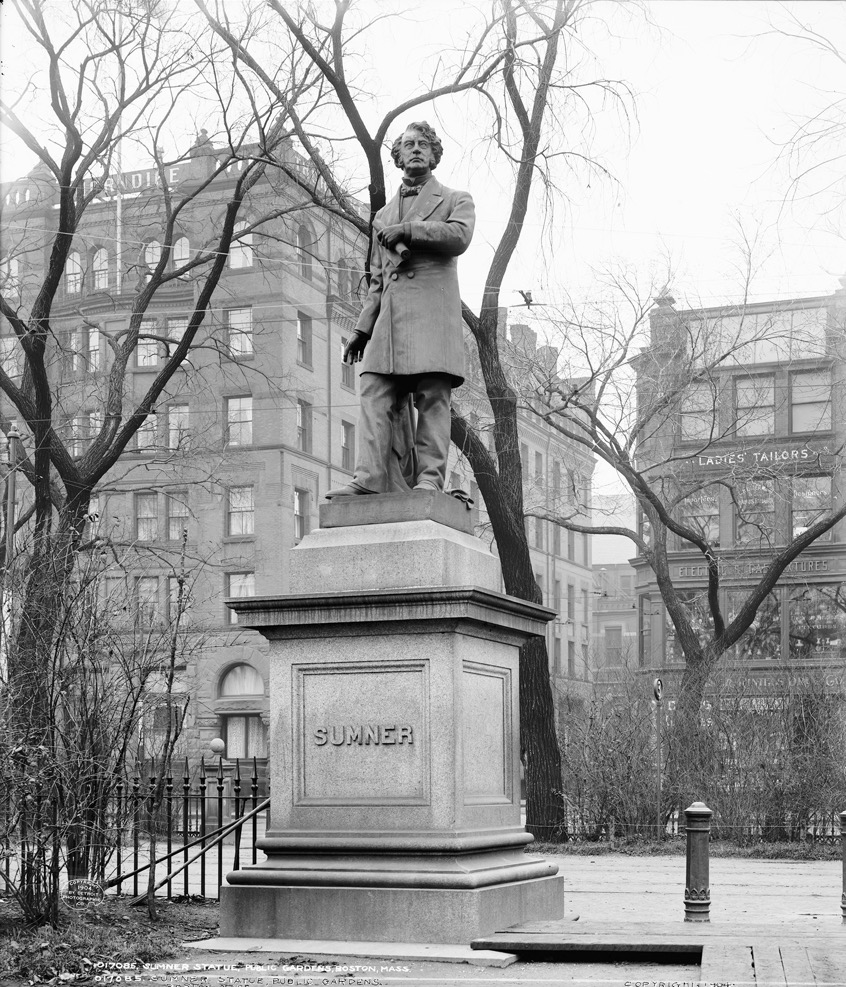
This impressive 1878 statue of Massachusetts Senator Charles Sumner still stands in Boston’s Public Garden. A Boston native and graduate of Harvard College, Sumner was regarded as one of the most important members of Congress for more than two decades. Ahead of his time in terms of civil rights, he was also the victim of the worst assault ever inflicted in the Halls of Congress by an opposition congressman, but recovered from his injuries to lead the Republican Senate during Reconstruction (Library of Congress Prints and Photographs Division—Reproduction Number LC-DIG-def-4111405).
Following Lincoln’s election in the fall of 1860, Johnson would also attain Northern hero status, when his urgent pleas in support of the Union and decision to remain at his post in the U.S. Senate, regardless of Southern secession, made him the target of abuse in his home state and throughout the South to the point of having his likeness burned in effigy and being threatened by mob violence in Virginia while en route to his home in East Tennessee. That visit, in fact, had to be cut short to allow him to slip out of Tennessee by another, more circuitous route through neutral Kentucky to avoid becoming a political hostage. Needless to say, he was treated to a hero’s welcome upon his return to Washington, becoming a much sought after Unionist spokesperson as the nation continued its plunge to war over the next several months.7
Both were good speakers, with Johnson an effective backwoods debater and Sumner an eloquent orator, especially whenever the slavery issue was addressed. Otherwise, while Johnson was already a very experienced politician by the time he rose to the U.S. House at age 35, Sumner needed coercion to get over his political reluctance at age 40 before being swept along by his Free Soil colleagues to their coalition nomination with the Democrats and the opportunity to end Webster’s two decades of Whig influence in the Senate.8 Like Johnson, Sumner would eventually change parties for political expediency, finding a more appropriate and lasting home in what he considered the new, “fusion” party (aka the Republicans) before that party’s first presidential nomination in 1856.9
Although Sumner would find a useful role in the pre-war and wartime Republican ranks, Johnson’s days of party influence were numbered once he reached the post-war White House and crossed paths (and purposes) with Sumner and the other, so-called “Radical Republicans.” It was there that the new President’s plans for Reconstruction and those of congressional leadership diverged, setting up one of the most intense Washington wars ever—a confrontation that would lead to the first presidential impeachment in the House of Representatives and the first of our four presidential acquittals by the Senate, with this one closer to conviction (a single vote) than the other three. What’s interesting in hindsight is that no one in leadership at the federal level saw such drama coming, even in the anger that followed the Lincoln assassination. Once the overwhelming shock of that tragedy had subsided, Congress prepared to embrace Johnson as someone it could work with; maybe even more so than would have been possible with the re-elected Lincoln, who was expected to take total ownership of what he was calling his “restoration” policy had he not been assassinated. After all, Lincoln’s intentions were well known by that time in terms of the more moderate olive branch he planned to extend to the defeated South. Perhaps “Honest Abe’s” more lenient Reconstruction would have been accepted verbatim—it would seem he had earned that right by his leadership through the country’s worst-ever, four-year nightmare—and it is doubtful anyone in the House or Senate would have been brazen enough to challenge his designs on national reconciliation.10
Instead, his successor was generally regarded by congressional leaders as more amenable to their own desires to treat the traitorous Southerners a lot more stringently than what Lincoln had prescribed; thereby forcing them to show the proper contrition in order to re-enter the Union as reconstituted states. This was an understandable conclusion on their part given Johnson’s early and total rejection of secession; his oversight of his re-conquered home state as Tennessee’s military governor during the war; his acceptance of emancipation before becoming Lincoln’s running mate; and, most of all, comments he made on April 15, 1865, during his first meeting as president with congressional Republicans. According to his principal biographer, Hans Trefousse, his message that day opened with: “I am very much obliged to you gentlemen and I can only say you can judge my policy by the past. I hold to this: robbery is a crime; rape is a crime; treason is a crime; and crime must be punished. The law provides for it; the courts are open [to it]. Treason must be made infamous and traitors punished.” After applause for those words from his congressional visitors, they departed, apparently satisfied and confident in his viewpoints. Their confidence was even more assured a few days later when he agreed with bombastic Radical Senator Ben Wade of Ohio that even hanging might become necessary for “a number of the rebel leaders” to drive home the essential requirement of Southern submission to the Reconstruction process.11
According to co-Senate historians Richard Baker and Neil MacNeil, the “Radicals believed they now had one of their own as president” and along with other, conservative Republicans, they had been reassured by President Johnson’s initial pronouncements. At the same time, Trefousse emphasized how the President “was taking particular care not to commit himself to any specific program,” while going out of his way to reassure the general public, including “holding over” Lincoln’s entire cabinet.12 His response to the Radicals was obviously contrived and those same Senate historians confirmed, “In less than a month, Johnson began to slip from their grasp.” After initially speaking about “harsh, punitive measures towards the Confederates,” Johnson’s actual Reconstruction approach softened to resemble that of his deceased predecessor. In The Complete Book of U.S. Presidents, William DeGregorio summed it up this way:
Taking the position that, technically, the rebel states had never left the Union because constitutionally it is in dissoluble, Johnson set out to restore their legal status swiftly, without recrimination, and with the least possible disruption in the lives of his fellow Southerners. His plan was to appoint a local provisional governor, who was to call a state constitutional convention, which, in turn, would draft a new constitution repudiating secession, slavery, and Confederate war debts. Full rights of citizenship were to be restored to Southerners on swearing a simple oath of allegiance to the federal government. Once these objectives were accomplished, the people of the Southern states were to be free to govern themselves and send men of their own choosing to Congress. As for the emancipated slaves, it was Johnson’s hope that the South would recognize the value of giving the vote to literate, responsible Blacks.13
No sooner had Johnson started implementing this Reconstruction policy, however, than what would become irrevocable disagreements between the President and Congress began to surface. Writing about the impending conflict, Seward biographer Walter Stahr noted: “Radicals were in no hurry to welcome the Southern states back.” Previously, when Louisiana, already under federal control, had attempted to form a state government before the war’s end and sent representatives to Washington, the Radicals had prevented them from taking seats. The Radicals argued that unless Southern Blacks were given the vote, Southern states could not have “republican governments” as required by the Constitution, even though many of their own Northern states also prohibited or limited Black suffrage. They also wanted not just a temporary Freedmen’s Bureau, which had been initiated by Lincoln to ensure provisions to the newly freed slaves, but a permanent independent federal agency charged with helping and protecting the Southern Blacks.14 Such demands by the Radical Republicans even before Johnson instigated Reconstruction—his way—undoubtedly made clear their expectations to the new president, but he chose to ignore their input anyway. DeGregorio, again, simplified the brewing divide when he wrote: “The South had no intention of sharing political power with former slaves; Radical Republicans, led by Charles Sumner in the Senate and Thaddeus Stevens in the House, were determined to punish the South and prevent a resurgence of Southern Democratic power”15; and Johnson had finally revealed his commitment to re-admitting his fellow Southerners “under his own authority” in the quickest, most accommodating manner possible.16 It was a recipe for political mayhem—or, at the very least, a Washington war that would pit one of the most stubborn, outmoded presidents against a senator having to reinvent himself, but still very much ahead of the game.
Perhaps their individual biographers said it best when each took time to summarize their subjects. In the case of Johnson, Trefousse ended his Epilogue with the admission our 17th president’s “refusal to adjust his racial views” rendered him “a child of his time, who [unfortunately] had failed to grow with it,” while Donald’s second Preface made manifest “what was unique about Sumner [was] the way he implemented his principles—[for] between the age of Thomas Jefferson and that of Woodrow Wilson, [he] was the one American who had equal claim for distinction in the world of intellect and the world of politics.”17 How’s that for critical judgment of one and high praise for the other?
1. David Herbert Donald, Charles Sumner and The Coming of The Civil War, 27–28, 33–35, 39–40, 189, 191, 199, 202–203, 267; Barry M. Goldenberg, The Unknown Architects of Civil Rights, 75.
2. Hans L. Trefousse, Andrew Johnson: A Biography, 51–83, 84–127; Eric Foner, Reconstruction: America’s Unfinished Revolution, 1863–1877, 176.
3. Hans L. Trefousse, Andrew Johnson, 26–27, 28–34, 35–50.
4. Ibid., 53, 88, 107, 150–152, 177–179.
5. F. Martin Harmon, Presidents by Fate, 84–85; Hans L. Trefousse, Andrew Johnson, 130–131, 144–145; Kenneth C. Davis, Don’t Know Much About the American Presidents, 268, 271, 272; “The Impeachment of Andrew Johnson,” The Week, October 25, 2019.
6. David Herbert Donald, Charles Sumner and The Coming of The Civil War, 281, 282–286, 289–296, 297–304, 336.
7. Hans L. Trefousse, Andrew Johnson, 132, 137, 139, 140, 142–143.
8. William DeGregorio, The Complete Book of U.S. Presidents, 250; Barry M. Goldenberg, The Unknown Architects of Civil Rights, 78; Robert Remini, Daniel Webster: The Man and His Time, 281; David Herbert Donald, Charles Sumner and The Coming of The Civil War, 181, 186–187, 194–195.
9. David Herbert Donald, Charles Sumner and The Coming of The Civil War, 213–219, 274–275; Hans L. Trefousse, Andrew Johnson, 42, 44, 50.
10. Kenneth C. Davis, Don’t Know Much About the American Presidents, 273, 275; William DeGregorio, The Complete Book of U.S. Presidents, 253, 254; Hans L. Trefousse, Andrew Johnson, 197–198.
11. Hans L. Trefousse, Andrew Johnson, 197-198; William DeGregorio, The Complete Book of U.S. Presidents, 251.
12. Richard A. Baker and Neil MacNeil, The American Senate, 69; Hans Trefousse, Andrew Johnson, 197, 198, 207.
13. Kenneth C. Davis, Don’t Know Much About the American Presidents, 273; William DeGregorio, The Complete Book of U.S. Presidents, 253.
14. Walter Stahr, William Seward, 417.
15. William DeGregorio, The Complete Book of U.S. Presidents, 253.
16. Hans L. Trefousse, Andrew Johnson, 216.
17. Ibid., 379; David Herbert Donald, Charles Sumner and The Rights of Man, iv.