
The pioneer pattern of agriculture is impressed upon the Wyoming land.
—FRANK TRELEASE, WYOMING LAW PROFESSOR, 19661
Places: Horse Creek, southeast Wyoming; Laramie River, southeast Wyoming.
Time: 1915–1975.
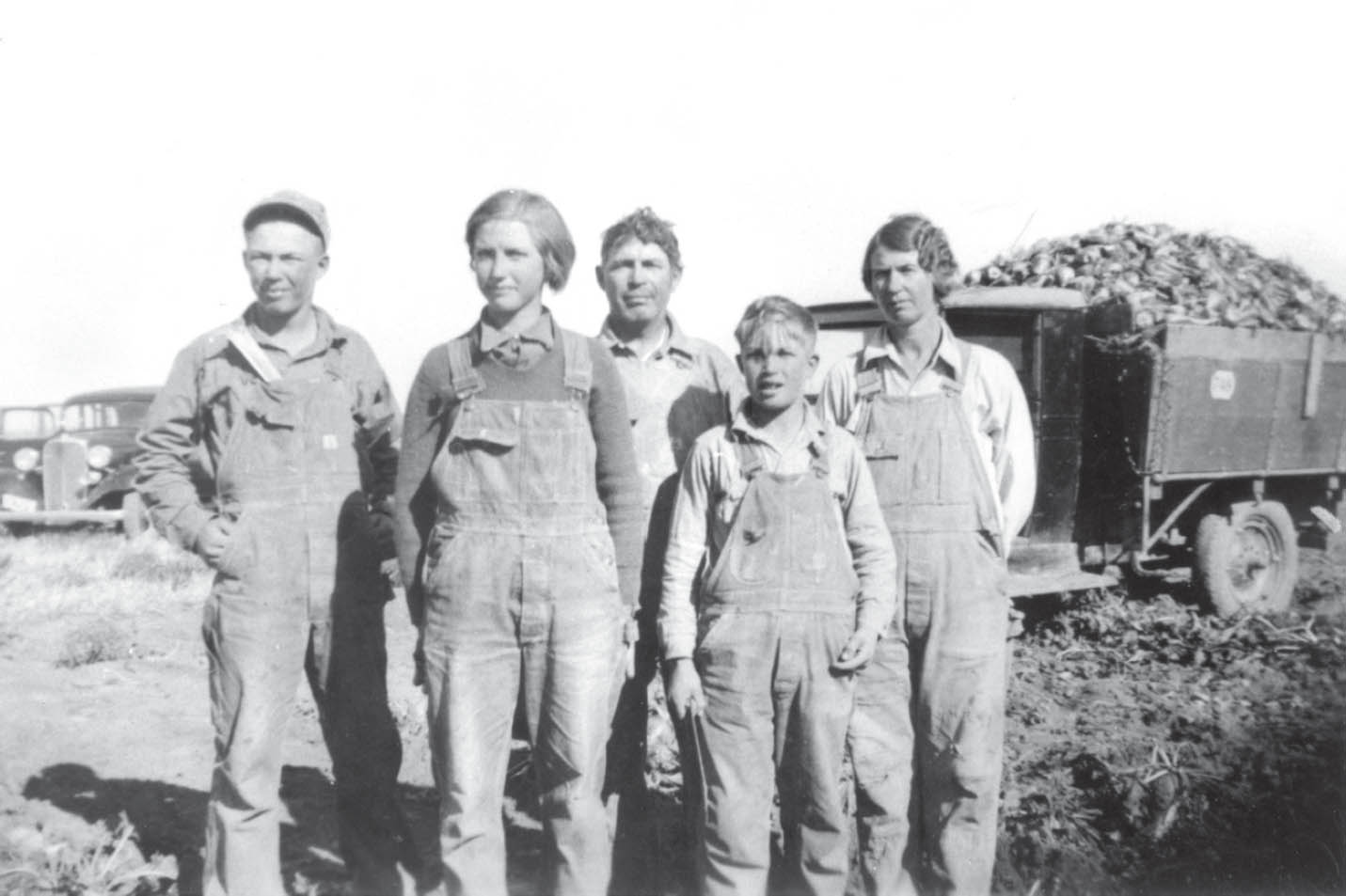
Ersanch family, 1930s Hawk Springs, harvesting sugar beets. Courtesy of Wyoming State Archives.
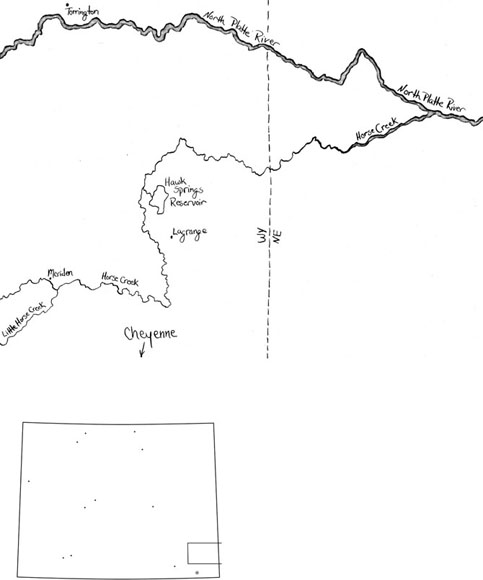
LITTLE HORSE CREEK, WHERE Johnnie Gordon had his Springvale Ranch, soon joins larger Horse Creek running northeast another twenty miles or so, to where the landscape of rolling plains begins to host some isolated big bluffs with striking rock formations.
In 1884, the Sherard family came out from Kansas and Missouri in two covered wagons and stopped near those bluffs. Nelson Sherard, “Nels,” age fourteen, was driving one of the wagons. The ranches on Little Horse owned by Gordon and the Johnston family were two of only four settlers’ ranches the Sherards had passed as they drove their wagons some sixty miles up from Cheyenne. More settlement was yet to come on Little Horse.2
But along Horse Creek itself, in sight of the big bluffs, there were already a few more settlers. A Nebraska-based townsite company even had people at work staking land and water right claims—anticipating profit if a rail line came through someday. Horse Creek was fed not by snowpack on high mountains but by local storms—it could run all year, off and on. Big cattle herds from Texas were driven north through the valley a couple of years after the Sherards arrived. A store became the core of a little settlers’ town named LaGrange.3
At age fifteen, Nels started riding for cattle roundups and big ranches. He witnessed the drought and bad winter of 1886–1887 on the open range and eventually tried cowboying hundreds of miles away, near the head of the Gray Bull River in the Big Horn basin. He was a crack roper, lassoing even a gray wolf. He came back to marry a LaGrange girl; the Johnstons on Little Horse hosted the wedding. By 1902, Nels had moved his young family to a place near LaGrange, where he ranched for the next forty years.4
In 1902, the communities on the creeks north of Cheyenne were on edge over a murder the previous summer. The young son of a sheep rancher forty miles west up the creeks by LaGrange had been shot from ambush and killed. Tom Horn, known to be a hired killer for big cattle ranchers, was arrested and tried for the boy’s murder. LaGrange-area men were on the jury. Nels Sherard went all the way to Cheyenne to hear every bit of the trial. “He was a nester,” Sherard’s son Don said of Nels, years later. “He was a small rancher. He wasn’t in the class of the big boys that had the big ranches. He wanted to hear it all. That was a big deal in those days.” Horn was convicted and hung.5
The next year, Nels Sherard took out a ditch to irrigate 190 acres on his new place, and Johnnie Gordon, now removed to Cheyenne, came and surveyed it for him. Nels and his wife put together a ranching and dairy operation. It was a satisfying life, but not an easy one. They had four boys but lost four others in infancy; their only daughter died at age eight after an appendicitis operation performed, too late, on the kitchen table.6
In 1916, when he was forty-six, Sherard himself sparked a “big deal” that caused a ruckus in Cheyenne. He complained that the townsite investment company, which owned a ranch and a big ditch dug in the 1880s that hadn’t carried water for years, had lately started taking water through that ditch for its ranch. As Sherard understood the Wyoming water system, the old water right had been abandoned and should be gone. As a boy, just after reaching Horse Creek in 1884, he and his brother and father had helped dig the big ditch in question, he said. But by the early 1900s, it was “growed up with grass.” There had been breaks in the ditch early on, making it hard to use, and it hadn’t been running water for years.7
Others in the neighborhood said the same. There was a man who as a boy rode horseback to town for school (then held in summer and fall). There was the longtime rural mail carrier. There was a man who drove freight teams back and forth to Nebraska. They all said they had no trouble crossing the small swale that once had been a ditch. It wasn’t a ditch anymore. It was full of dirt and grass, never water. That was, they said, until about the summer of 1909. The freighter, who grew up in the east and had never seen an irrigation ditch, remembered asking people in 1909, “It didn’t rain, how did that water get there?” His wagon and team got stuck in mud and water where for years past there had been dry ground.8
These Horse Creek neighbors joining Sherard to describe what they’d seen were a solid bunch. One who was born in Prussia, taken on board ship with his parents at age five to make their way to Ohio in the late 1850s, had gone West in the 1870s. He worked as a freighter and a cowboy and finally made his own ranch near Horse Creek, where his son eventually also ran the ranch and went on the school board and the boards of various statewide associations. Another man had come from Nebraska in 1903 to manage his brother-in-law’s ranch but then homesteaded his own place, helped build the church and the cemetery, and became a county commissioner. Another who came in 1901 to work for his uncles on a ranch and then got his own place was later deputy sheriff and a state legislator. Several of these men had joined Sherard in helping build a big new hall for the LaGrange store after it burned down.9
Horse Creek by 1916 was a busy place, with a lot of farmers and ranchers wanting water, so the state water office had a water commissioner working there, named Clint Donahue. When water was in demand and users would affirmatively “call” for getting water under their water rights, water commissioners would go by the official list of water rights and close headgates in priority order as necessary to get water to early right holders. Like other part-time water commissioners, Donahue was a farmer and rancher. He had come to the area in 1904, got a place on Little Horse Creek, and added the job of water commissioner to his work in 1916. He held that post for forty-five years. Donahue later testified that water started running through that old ditch in 1909 only because in fall 1908, the townsite company had acquired a new water right for its old ranch. That water right allowed the company to use the old ditch to transport water from Horse Creek to a new “reservoir” on the ranch—a small bowl of a pasture bounded by a little ridge plus some dirt berms. That meant, as Donahue put it, that the water suddenly flowing through the old ditch was “1908 water.” The original line of the ditch was dug in the 1880s, but after years of non-use, it was now just a conduit for water with a 1908 priority to get to the new reservoir. Sherard and his neighbors agreed with Donahue. Sherard’s own most recent water rights were dated 1904. Donahue’s opinion meant Sherard should receive water before the ranch reservoir did.10
The townsite company’s view was different. The company said that the water now running through in that big old ditch was “1884 water,” because the ditch was built in 1884, for a water right dated 1884. The difference between 1884 and 1908 was of course significant. The 1884 right was big enough to take much of the water in the creek, water that otherwise would go to smaller farmers like Sherard that had settled and gotten their water rights after 1884.11
Sherard and one of his neighbors went straight to the state engineer to complain that the 1884 right had been long out of use and therefore should be considered abandoned and forfeited under Wyoming water law. The state engineer took the question seriously and launched a major investigation of water rights and usage on Horse Creek. The resulting report showed how little use there had been, over the past twenty-five years, of many big old water claims on Horse Creek and neighboring streams.12
Failure to use water could bring severe consequences—in Wyoming and across the West. Mead’s laws had adopted the custom developed under prior appropriation that fit in with his view of water. If a water right is defined by water use, then users should lose their right if they don’t use the water for years at a time. A water right could be declared “abandoned” because of non-use, and the water right itself, with its valuable priority date, would disappear. That makes room for someone else who came along later to get a new right to water and use it. “Use it or lose it” remains many people’s shorthand version of the prior appropriation system, along with “first in time, first in right.”13 In Wyoming as elsewhere, whether and how a water right should be declared abandoned has, not surprisingly, been a question much debated, contested, and documented in state records. Nelson Sherard’s complaint to the state engineer about Horse Creek started a chain of contests that significantly affected what happened to unused water rights in Wyoming.14
For Mead, abandonment was part of the mix of certainty and flexibility, a tool for allocating water for ultimate public benefit that he sought for the new system. People who failed in their attempts to put water to use should get out of the way and leave that water to be used by those who came after with perhaps a better idea. Just as no person should be able to transfer a priority water right to another place, so no one should be able to keep a right that is not used. The early priority date should vanish with the failed use, so that new priorities could replace it.
Mead’s ideal of quick turnover after failure, however, suffered the same fate in abandonment policy as it did in permit deadline enforcement, as seen on the Shoshone. The ideal disappeared when theory was overcome by practice.
Wyoming’s abandonment rule under Mead was strict, repeating what the territorial laws said: water users who failed to use water for only two years running could lose their right. Then in 1905, just after Nelson Sherard took out new water rights for his small ranch, some users got the legislature to change the law in Wyoming so that only water rights left unused for five years or more could be declared abandoned. That rule was more typical in the rest of the West. Meanwhile, Van Orsdel, the Wyoming attorney general, who tended to view water rights as property rights like land, said in 1904 that only the courts could declare a water right abandoned. It took until 1913 for the State Engineer’s Office to get the legislature to modify the statutes so the Board of Control could declare abandonment after investigating formal complaints about unused rights.15
Nelson Sherard soon prompted the Board of Control to consider the possibility of widespread abandonment of water rights north of Cheyenne. Sherard complained that the townsite investment company ranch had not used its 1884 water right for many more than five years. That old right, like many water rights claimed in the 1880s, had been ambitious. It anticipated irrigating 4,500 acres of ranch lands from the 1884 ditch. Records in the county courthouse show that the townsite company, through its subsidiary, acquired the ranch lands in the 1880s through the typical pattern for major companies of the day, hiring dummy entry-men to take advantage of federal land laws. One part of the ranch to be served by the ditch, for instance, was acquired via a “desert land” patent issued to a New Yorker who had to pay a small amount and assert that he had brought water to otherwise “desert” land. In 1886, he handed over the property to an agent of the railroad’s irrigation company who officially deeded it to the company the next year. In 1889, the water right for the ditch had been officially confirmed by a district court judge settling a priorities dispute on Horse Creek, just before statehood. That was one of the notorious territorial decrees Mead found so troublesome because it awarded wildly varying volumes of water with little attention to actual ditch size or acres irrigated.16
The state engineer who received Sherard’s complaint in 1916 was James True, the man who just the year before had reluctantly extended the permit for the Shoshone project. As he considered Sherard’s grievance, True began to wonder how much acreage along Horse Creek and nearby streams really was being irrigated by the water rights that ranches had acquired decades earlier, including rights confirmed by old court decrees. He got major funding from the legislature for a wider investigation on Horse Creek and Crow Creek (Crow Creek is a stream much nearer the capital that also had water rights set by territorial decree). True put a surveyor to work, and the results of that detailed field survey showed that on many ranches, as the owners had begun to use the water, the actual acreage they found it feasible to irrigate was much smaller than the acreage they had claimed or been awarded.17
True therefore launched a wholesale abandonment action against portions of nearly fifty water rights on Horse Creek and Crow Creek. He proposed that portions of most water rights be declared abandoned, to the point that most rights would shrink by well over 50 percent. The legal water right would then reflect the actual use of the water. A look at the topography on Horse Creek even today makes it clear that what True proposed made sense—the reduced water rights he outlined covered essentially all the land practical to irrigate in the area.18
True’s eminently sensible idea led to turmoil. His massive abandonment action was an assault on overstated water rights held by wealthy individuals and companies that had considerable influence in state and even national politics. Owners of the land on Horse Creek and especially on Crow Creek included leading politicians. Warren, in his prime in the US Senate, was one landholder whose water rights on Horse Creek were affected. Former territorial governor George Baxter, prominent in the water sales contract on Little Horse Creek, had rights on Crow Creek that would be cut. When the Board of Control held a hearing on True’s abandonment proposal for Horse and Crow Creeks in 1917, crowds of landowners, lawyers, and onlookers turned out. Their numbers were so great that the Board of Control had to relocate the hearing to the House chambers in the state capitol building.19
The Board of Control proceeded, heard the evidence and agreed with True. They declared as officially abandoned major parts of the big old claims, including the railroad land company’s 1884 right that Sherard had targeted.20
That decision did not last long. The major landowners in the case hired the most influential lawyers in the state—including the firm founded by Warren’s former lawyer Willis Van Devanter (by that time a sitting US Supreme Court justice). The lawyers did not argue the facts. They cited no details of water use or non-use. Instead, they simply challenged the procedure. They said the abandonment declaration was void because the state engineer and the other administrators could not launch a wholesale abandonment procedure. Each single abandonment charge, they said, had to be brought by an individual water right holder. They won with that argument; the district court ruled in favor of the landowners. At True’s request, the attorney general appealed to the Wyoming Supreme Court. The appeal was withdrawn, however, with no explanation on record. Judge Carey’s son Robert had been elected governor. He managed extensive family ranches, including lands on Horse Creek. None of their water rights had appeared to be unused, so they were not affected by True’s abandonment action. But perhaps Carey sympathized with those influential neighbors who did not want to see their water rights abandoned. The entire Horse and Crow Creek abandonment effort died.21
Abandonment was, in a water supervisor’s eye, a natural cleanup tool—a way to put failed, sleeping, or simply excessive water use claims out of the Wyoming water rights system and make room for the work of potentially more successful, active users with feasible plans. Horse and Crow Creeks, however, had proved to be hazardous cleanup targets. The buzzing of the crowds in the state House chambers echoed in the district court decision the next year. The owners of the big water claims on those creeks wanted to hold on to them, considering them a property right like a right to land. A water right gave land its value, and they wanted to hold on to rights covering as much water as possible. Their lawyers, arguing for a process limiting the scope of the abandonment searchlight, essentially argued that water rights, like land titles, deserved protection as property.
Users had begun to think water rights should become private property, but courts had the power to harden that growing idea into law. When a water dispute went to court, it was an opportunity for courts to import concepts problematic for water management. That was what had happened initially with the fight over water sales on Little Horse Creek.
“The law abhors a forfeiture” is a standard tenet of the Anglo-American common law of property in land. Starting with the 1918 district court ruling blocking the cleanup of Horse and Crow Creeks, that concept from land law pushed its way steadily into judicial decisions in Wyoming on water. As a result, “the law abhors abandonment” could almost be said of Wyoming water law today, even though abandonment remains on the statutes.22
Yet if “the law abhors a forfeiture,” Wyoming water supervisors do not. Water users may not either, depending on how they sit. The decades after 1918 were hard. People seeking a self-sufficient way of life kept coming and homesteading, creating more farms and small ranches, mostly irrigated and a few dry-farmed. Yet a combination of mechanization and market prices that dropped quickly from highs reached in World War I meant a struggle to survive, particularly for irrigators who had been tempted into single-crop agriculture dependent on bank loans and market sales. Bouts of drought in the 1920s followed by severe drought in the 1930s made survival still harder. Through those years, water users would sometimes charge neighbors with abandonment, bringing individual abandonment cases (just as the lawyers in Cheyenne had conceded they could). The Board of Control, in turn, sometimes declared abandonment and sometimes did not. It was not that either the users or the water supervisors were avid for abandonment—it was simply a tool that had to be available. In the Horse Creek case, it could have protected the small farmers like Sherard against the opportunism of the railroad company. But whenever courts were invoked in the years ahead, they steadily restricted the conditions under which a water right could be forfeited for failure to use the water.23

In the end, the 1918 district court in Cheyenne helped to allow the big 1884 right on Horse Creek—impractical at the time, and under-used—to stay on the books for over half a century more, available to its owners to try to use as convenient. That created considerable tension and conflict in the neighborhood.
In the Great Depression Horse Creek questions came back, this time in the form of a single abandonment claim brought specifically against the townsite investment company’s ranch. This time, an irrigators’ association filed the claim, to protect the water supply for a reservoir they had built. The association had an interesting history. Their reservoir was built by a group of local ranchers on Horse Creek and nearby Bear Creek led by Frank Yoder. They had seen a chance to develop some upland prairie to the north into irrigated fields they could promote for new settlers.
Frank Yoder and his brother Jess, like Nels Sherard, had come to Horse Creek as teenagers with their families in the 1880s. The two started various ventures in the area, including the store in LaGrange and their own ranches. Twenty years later, in the early 1900s, water storage was an important topic of discussion everywhere for Wyoming—finding a way to beat the uneven pulses of nature that sent water by in torrents one month and left creeks and rivers nearly dry in the next. Catch the water in winter and spring and release a nice steady stream of it when and if you needed it. That was the idea. The Reclamation Service was building big reservoirs—on the Shoshone, far to the northwest, and on the North Platte. There they broke ground in 1904 for the Pathfinder Reservoir, which would provide water to a lot of land in Nebraska and some in Wyoming—lands a little to the north of Horse Creek.24
Groups of irrigators launched plans for smaller reservoirs. In spring 1908, Frank Yoder signed the application for water rights for a reservoir to be built on top of Hawk Springs, storing water from Horse Creek, to irrigate prairie to the north. His group well knew that their fledgling irrigation project could never get water from Horse Creek in summer, given all the active water rights in the area with early, higher priority dates. But Horse Creek often flowed in the winter, fed by occasional storms. The reservoir was intended to take advantage of that—to take water in the non-growing season, in the winter, and store all the water the new farmers would need in summer to irrigate the prairie lands north.25
Yoder applied for rights for the reservoir in May 1908 (with the help of Johnnie Gordon, acting as surveyor). Meanwhile, though, the townsite investment company had made plans for its “pasture reservoir,” meant to be a shallow pond, from which water could seep out to the lands nearby. The company filed for water rights for that pasture reservoir—also in 1908, but in October. The water for the reservoir would be conveyed from Horse Creek through that old ditch built in 1884, plus an extension. Frank Yoder was well acquainted with the townsite company—it had a variety of ranch holdings around the Horse Creek area, and he leased some of them. His development group and the railroad company knew of each other’s reservoir plans and negotiated exchanges of money and water to serve their different ventures. In 1908, Clarence Johnston, as state engineer, put a warning stamp on both ventures’ water right applications as he approved them; the stamp provided notice that Horse Creek was “largely appropriated” and that they would only be acquiring rights to surplus or waste waters and could not injure earlier appropriators.26
That 1908-right water for the townsite company’s pasture reservoir was the priority date to which Nelson Sherard, and the state engineer, had tried to limit the company in the failed abandonment effort of 1916–1917. The Hawk Springs reservoir typically could only fill in winter and get the water it needed if the railroad company’s winter diversions through the old ditch were limited to its 1908 right. The railroad company’s right of October 1908 was later in priority than the May 1908 rights of the Hawk Springs project. If the company could instead claim use of its larger 1884 right, through that old ditch, the Hawk Springs reservoir and its farmers would not get the water they counted on.
The Hawk Springs reservoir was built, and in due course, new farmers on the former prairie lands it served formed themselves into a water users’ association, took over the Hawk Springs reservoir and ditch operation, and reorganized themselves as the Horse Creek Conservation District.27
Skip forward to the 1930s. The New Deal administration in Washington brought new policies to the West, intended as “relief” to improve the economy and the productivity of the land. A major initiative closed remaining public lands to new settlement and put the land under federal grazing leases managed in conjunction with nearby ranchers (as Mead and Warren had proposed years before). Federal programs also put in some irrigation and stock-watering improvements statewide. Other programs bought out subsistence dry farms labelled as unprofitable, and put those lands, too, under federal grazing leases.28
In the worst drought they had ever seen, people who had struggled to get a good water supply to their lands were determined to protect their water rights as best they could to keep their farms going. Horse Creek Conservation District farmers relying on the Hawk Springs reservoir felt that way. Water stored in Hawk Springs reservoir was low, and the farmers blamed the townsite company ranch. The company in turn declared that it could and did take Horse Creek water in winter by virtue of the company’s big old 1884 right, easily predating Hawk Springs reservoir. The farmers’ district filed an abandonment claim against the 1884 right, saying all the company had used and could use was its 1908 pasture reservoir right.29
Once again, the crowds who came to watch the case were so large that the Board of Control hearing moved to the House chambers in the state capitol building. Nelson Sherard, now in his sixties, did not use Hawk Springs reservoir water. But he was a longtime neighbor to the farmers who did, and he could testify about the old ditch to the townsite company’s ranch. He was joined by the other witnesses who had seen that ditch left dry in the 1890s and early 1900s. Clint Donahue, the water commissioner, said he had allowed water to go down the ditch of the railroad ranch only under the priority of October 1908. It was not until 1932, a bad drought year, the commissioner said, that the ranch manager had proposed that the water go into that ditch with a much higher priority—1884.30
The townsite company and the people to whom it had leased its various ranch lands testified to a different set of facts. Those people included Frank Yoder himself, who had over the past twenty-five years become mayor and then legislator for a larger town just north, built alongside the federal Bureau of Reclamation’s North Platte project. By the time of the lawsuit, Yoder was living in Cheyenne while continuing his ranch operations near Horse Creek. He and other witnesses for the townsite company all said that since 1909, the company’s ranch had used the big 1880s ditch, always relying on the water right priority date of 1884—the right that would trump the farmers in the conservation district.31
After hearing all the testimony, the Board of Control ruled much as it had in the earlier attempted Horse Creek cleanup: the board declared the 1884 right had been abandoned.32
The courts, at both the district and Wyoming Supreme Court level, again reversed the board’s decision. The court opinions made it clear that the judges never grasped the significance of the October 1908 priority date. They never discussed that right, which the company had applied for and gotten for its ranch reservoir. The Wyoming Supreme Court justices simply noted that water had run through an old ditch built in the 1880s; the ditch had been used initially and then sat unused for years, but it started carrying water again in the winter of 1908–1909. The top court ruled that if anyone had wanted to claim that the 1884 right had been abandoned and the ditch left dry for years, they would have had to say so before any water started running through the ditch again in late 1908. No one had done that. So, failing what the court considered a timely objection, the unused 1884 right could be, and was, essentially revived by its owner in the winter of 1908–1909, the court said. Ruling that the 1884 right was still good, the Wyoming Supreme Court cited precedent that explicitly relied on the old land law idea that “the law abhors a forfeiture.”33
With this new rule on abandonment, the Wyoming high court joined other western courts that had come to the same conclusion. The rule meant, in practice, that a water right, however long left unused, could be revived and come roaring back to life. Once revived, an old long-unused water right could completely disrupt the pattern of water use that neighbors had built up over the intervening years. Neighbors who wanted to prevent that had to act, filing an abandonment complaint in a “timely” manner—and that meant, before the water right started being used again. In the absence of that kind of initiative among their neighbors, landowners with unused water rights could rest easy and not put water to work until they had money, time, inclination, or new technology.34
The hitch, of course, as the courts in Wyoming and throughout the West may well have known, is that few abandonment claims are likely to be filed “timely” under that rule. In the small world of Wyoming irrigation, as the twentieth century wore on, the slim margins did not tend to attract many newcomers. Neighbors expected to work lifelong alongside each other and each other’s children and grandchildren. It was therefore a major decision to make an enemy of such neighbors via an abandonment claim and its bitter contest of opposing witnesses. It was also a major expense, involving lawyers, engineers, hearings, and sworn testimony. Better to let sleeping water rights lie if they stay asleep and unused. If, however, it becomes clear that someone—perhaps a new owner—is planning to start using water covered by a dormant right, then it can be worth going to the State Engineer’s Office to complain of abandonment. But then the complainers must act fast. The Wyoming courts have insisted, since 1939, that the complaint be filed before water is used again under the old right. Sometimes, neighbors rush to the engineer’s office in a race against the backhoe next door that is laying new pipe to carry water anew under an old water right.35
The court-sanctioned revival of the old 1884 water right on Horse Creek has created tensions that continue to haunt that creek valley. The scarce water in Horse Creek is used enough all year long that the creek is typically managed (“regulated”) all year by a water commissioner according to priority date. But since the 1960s, a new factor has been added to Horse Creek: use of groundwater. Post–World War II technology made pumping up groundwater a practical way to irrigate. In response to increasing pumping of groundwater, the State Engineer’s Office successfully pushed the state legislature in 1957 to require groundwater wells to have permits from the state engineer and to provide that he could regulate them, like surface water, according to priority. The 1957 law officially acknowledged the potential that different groundwater sources, or groundwater sources and surface water streams, could be “so interconnected as to constitute in fact one source of supply,” and approved state engineer authority to regulate interconnected sources as one, according to priority date.36
The Horse Creek Conservation District pumped groundwater steadily from the 1960s into the 1980s to help supply its Hawk Springs Reservoir. Meanwhile a family that had ranched along Horse Creek above the reservoir since the 1940s bought the old townsite company ranch with its small pasture reservoir in the early 1960s. Proudly considering themselves to be the first in Wyoming to use sprinkler irrigation instead of the old flood method, they too used groundwater, for their sprinklers.37
Tapping groundwater on Horse Creek only added to the tension and complexity of water management there. Pumping groundwater to help fill Hawk Springs reservoir prompted plenty of complaints from neighbors and a pumping limitation order from the state engineer in the 1970s. In 1979, the Hawk Spring reservoir users once again brought an abandonment case against the old 1884 water right. The Board of Control ruled that the 1884 right covered only the ranch acreage held by the new owners and declared that therefore, about half the old 1884 right had been abandoned (much as True had decided in 1916). This time, the board’s decision was affirmed by the district court.38
Then in 2009, the Hawk Springs reservoir users demanded that groundwater and surface water use be regulated in priority together. That would mean that the groundwater wells, all of late date, could not be pumped in irrigation season until most surface rights were satisfied. Even though the need for such regulation had been foreseen in the 1950s statutes, that kind of joint priority regulation was not undertaken anywhere in the state until State Engineer Pat Tyrrell did so in the early 2000s on a creek in central Wyoming. In 2009, the Hawk Springs users’ target was, once again, the old 1884 right—what remained of it—on the former townsite company ranch. The ranch typically diverted water from the creek under that 1884 right in winter (because in summer, still older rights took the water available). The ranch irrigated land with the 1884 right—irrigated it in winter. Hawk Springs people argued that the real purpose of running water from that old right on the land was to recharge, in winter, the groundwater wells that the ranch used in summer. And taking the water from the creek for that purpose in winter meant that Hawk Springs reservoir couldn’t get the water it relied on taking from the creek in winter.39
As the dispute wore on, once again influential people became involved. The owner of the old townsite ranch was a state senator, Curt Meier, who was elected state treasurer in 2018. His lawyer, Harriet Hageman, ran unsuccessfully for governor that year. Meanwhile, Meier was skeptical of fair treatment in his water case because while it was still before the state engineer, the sitting governor, Matt Mead (no relation to Elwood Mead), had a ranch with a little irrigated land served by the Hawk Springs Reservoir. State Engineer Tyrrell had authorized a groundwater-surface water study, held hearings on it, and in 2013 and 2017 issued orders for controls. He did not require regulation of groundwater and surface water on Horse Creek together by priority, concluding that the connections between the two water sources in this valley were complex and the impacts of one on the other might take years to occur. But his orders aimed at finding a workable limit on both winter irrigation use of surface water and summer irrigation use of groundwater. With the help of some wet years, a version of equilibrium apparently was reached. By 2017, groundwater use declined. Upstream uses of pre-1884 water rights shifted so that the 1884 right became more useful in irrigation season. Meier retooled his system on the old townsite ranch so that his sprinklers could tap into ditches carrying 1884 Horse Creek surface water in summer. Still, more friction is likely in future dry years.40
In other decisions, from the 1930s on, the Wyoming Supreme Court has thrown up more barriers against declaring any water right abandoned. That made it harder for water to be available for new, perhaps more successful uses. The court repeatedly overturned abandonment orders—overruling the Board of Control no matter what the board had decided, either for or against abandonment. Through its opinions, Wyoming’s high court has set rules for examining abandonment challenges—including an examination of whether failure to use water was “voluntary”—that can be hard to follow as a practical matter.41
In only one case, nearly fifty years after the 1939 decision allowing revivals of Wyoming water rights, a prominent member of the Wyoming Supreme Court wrote a majority opinion that refused to apply “the law abhors a forfeiture” to water law. He declared, with considerable judicial vigor (unleashing not one exclamation point, but two), “We cannot call up the abhorrence-of-forfeiture rule in order to rescue [an irrigation company] from an abandonment of a water right in lieu of requiring that the applicable statute pertaining to abandonment be applied and given its plain English-language meaning. We are not the legislature. Indeed, we do abhor forfeitures, but it is the legislature that has established this rule for forfeiting water rights—not the court!!”42 But that lone pronouncement, never repeated by the court, is the exception that proves the rule. It is very hard to get a water right declared abandoned in Wyoming.
Members of the Board of Control have watched successive court decisions on abandonment with both exasperation and consternation. In the 1960s, the state engineer described the abandonment process dictated by the courts as “so cumbersome and expensive for anyone wishing to force an abandonment that it is seldom utilized.” He declared that the result was “many thousands of acres of water rights on the records in Wyoming which have not been utilized over a long period of years, and in some instances have never been used.” Though they were rights only on paper, they were nonetheless a cloud on the rights of anyone who came in later, a discouragement of new ideas, because of the ever-present threat of revival. Fifty years later, in 2012, State Engineer Tyrell voiced the same complaint.43
The court’s reluctance to allow abandonment reveals, to the water supervisors’ minds, a profound misunderstanding of water and water management principles. In water, there must be an opportunity to recognize failure and make room for an orderly change to new players with new ideas. Early-date water rights allowed to sit unused on a stream awaiting revival are, by contrast, like time bombs. They may be useful for new people and ideas, as in the case of the senator’s recharge plans on Horse Creek, but only by disrupting the local water use patterns, on which all the other water users on a stream have come to depend. Far better, the supervisors believed, to replace a failed old idea with a new idea via a new priority date that might not supply as much water but would not trump the existing users. The new idea would receive water while the people already using water on the stream received water with their earlier-date rights. That approach would recognize the interdependence of water users—the product of idiosyncratic stream hydrology and water user habits—and retain the distinction between rights to water and rights to land that had been vindicated after the struggle over the Little Horse Creek water rights sale decades earlier. The legislation that overturned Justice Potter’s decision in that case had highlighted the special nature and the limits of a water right. But as the court began to disfavor abandonment and allow unused rights to persist and be revived, the decisions described a Wyoming water right as a private property right, like a title to land.44
Wyoming water users acquiesced, in the 1930s and the decades after. Perhaps they welcomed the court’s rejection of a distinction between water rights and land rights when it came to abandonment. Those crowded hearings in the state capitol about Horse Creek in both 1917 and 1934 showed how the idea of abandonment could alarm water users. Small owners as well as wealthy ones were uneasy with it. Many who had come to Wyoming and tried to irrigate, whether on small or big ranches, hoped to make their valleys into blooming Edens, but by the 1930s, the number of people who could stay on the land was getting winnowed down.45
Drought and economic stress could make people more desperate to challenge others’ rights, but lean times also meant everyone knew the problems of irrigating and raising a crop and how hard it could be to find the cash to fix a damaged reservoir or ditch headgate. Left unrepaired, faulty structures could cut back use of a water right for years. The court rulings making it hard to prove abandonment were to the advantage and possibly the relief of many water users who wanted to see their water rights as their property. The concept of “private property” gives a water right some sanctity, in legal and political parlance. In an irrigator’s view, that could be an appropriate return for the blood, sweat, and tears that a family puts into digging ditches and creating irrigated fields in Wyoming’s landscape.
Anti-abandonment rulings from the top court gave Wyoming water users the power to stay in the water community, waiting for a better day to put their water to use. But limits to that opportunity remained. Public ownership of water was still represented by the state engineer, the superintendents, and the local commissioners. Their view of good water management, recognizing both user interdependence and the need to replace failure with new ideas, asserted itself with remarkable effect in a different context: water right transfers.
Transfers of a water right to a different location—watering different lands or serving some other completely new use—had been banned in 1909. But the 1909 statute included an exception: a water right could be moved without loss of priority to certain “preferred” uses, like water supply for towns, cities, and important industries like railroads.46 As Wyoming grew and changed, slowly, after 1909, its towns, cities, and railroads did find they needed larger water supplies. They found room to do so under that exception to the transfer ban. They wanted a secure supply, and of course that came through a water right with an early priority date. The town or railroad would typically want to get an old irrigation right and change it to a new use, often in a new place.
To do that, there were details to be resolved—how much water could be transferred, for use at what times? The Board of Control slowly worked out its own way of answering those questions. Reservoir construction was continuing, and the state engineer in 1920 (Frank Emerson, who extended federal project permits and negotiated the Colorado River Compact), argued that reservoir water should be freely transferable. Building a reservoir, he said, meant creating an asset that its owners should be able to use as needed. But he underlined the unwavering concern in the engineer’s office over the very different proposition of transferring rights to water that was not stored in a reservoir but simply diverted as it naturally flowed down a stream. Echoing Mead, he wrote that such a transfer “would make a speculative commodity of the water of the State. The equilibrium of conditions on our streams would be continually changed.” Rights to a stream’s natural flows that had not been stored—called “direct flow” water rights—had to be governed by the limits imposed by the engineer’s office, including strict controls on transfers, to recognize the interdependence of those who use such waters.47
For Wyoming towns, acquiring existing rights to naturally flowing water and transferring the rights to municipal use was often their best option. Reservoirs were expensive to build and maintain—and would have a priority tied to the date they were planned and approved, junior to existing users. As towns grew, early-date water rights from the ranches around them seemed the best sources of water supply, particularly as residential areas expanded onto ranchlands that had water rights. In response to town proposals, the Board of Control began to work out ways to allow those transfers in ways that would consider and protect “the equilibrium of conditions on our streams.”
A family from near Douglas became prominent in that process. Spencer Bishop, age twenty-two, had come to Wyoming in 1874 from upstate New York to find his fortune, and soon was managing the army hay fields serving Fort Fetterman and hauling freight near what became Judge Carey’s ranch. Bishop went back home to New York to get married after he homesteaded a place on LaPrele Creek eight miles from the fort. He began a ranch and freighting operation with the homesteader next door. More and more people came to settle nearby. Spencer’s oldest son Loren Clark Bishop (known as L. C.) was born on LaPrele. L. C. dropped out of school in eighth grade to earn money and help the family, and in 1908, he managed to get a job with a survey crew for a LaPrele Creek irrigation project. The crew was run by Emerson, the future state engineer. The LaPrele irrigation project was, like Wiley’s project in the Big Horn basin, launched under the Carey Act, with federal land allocated to it under state supervision. It was the brainchild of a doctor who arrived in Douglas when it was a tent camp in 1886 (and ten years later switched from doctoring to managing a big sheep ranching company). He partnered with a preacher and another sheep rancher-turned-developer to launch the project to water about twelve thousand acres of large ranches and small homesteads. The project took water directly from LaPrele Creek south of town and supplemented it with a reservoir to store high flows of the creek. L. C. became the project engineer and got construction going. There were plenty of financial and water supply troubles, but people settled and irrigated under the LaPrele project, and the settlers organized into an association that took over operations in the 1920s. The LaPrele settlers became quite a community—irrigators’ association and women’s club meetings, as well as school and church events, were family social occasions.48
In 1919, when Emerson became the state engineer, L. C. became superintendent of Water Division I, which encompassed the North Platte River and the southeast section of the state. He had spent some years in the army, including during World War I, and was a crack shot. Family lore had it that the skill sometimes helped him on the job, as when cantankerous irrigators, after seeing his marksmanship, decided not to challenge his closing of their headgates in priority. When a new federal reservoir on the North Platte above Casper was proposed and built in the 1930s, primarily as a jobs project in the 1930s, L. C. opposed the idea floated by the state engineer to give the new dam a 1904 priority date because it had shown up sketched in on government maps of that era. Such a date for a new federal reservoir would upend accustomed water use for rights dated after 1904. Bishop’s stalwart stance paid off. He became state engineer in 1939 and held that job till 1956. In 1963, his own son Floyd became state engineer in turn, putting a stamp on Wyoming water management into the 1970s.49
L. C. Bishop presided as state engineer in 1940 when the Board of Control considered the proposal for a water rights transfer to the town of Greybull. The town wanted to take over for its supply an 1893 irrigation right to water flowing in a nearby creek. Greybull had been growing as a small industrial center, supported by refineries handling oil from production wells in the Big Horn basin. The town was located where the river, by then called the Greybull, flowing in from the west, joined the much bigger Big Horn River. There were, however, a lot of demands and early water rights on the Greybull River, like those of the Wiley project and the Farmer’s Canal. The town, therefore, had turned to the rights of a ranch on Shell Creek, flowing from the Big Horn mountains to the east, in order to add to its water supply. There were also water users on Shell Creek, of course, and the creek is still known today for its feisty water fights. In 1940, Shell water users argued that the town of Greybull should not get a right to more water under the ranch’s 1893 water right than the ranch fields had consumed. The town wanted a larger amount of water—the total that the ranch had diverted from the creek to take to the ranch fields. The Shell Creek people argued that the town should be able to get not the amount of water diverted in the past, but only the amount consumed.50
The reasoning behind that distinction is this: to get the water to the fields through dirt ditches and to flood entire fields, ranchers typically must divert more water than their hay crop can consume. Some share of that water comes back to the stream, seeping through the ditches and running off the fields. That water is called “return flow.” Return flow can, depending on geology and topography, support healthy riparian areas and wildlife. It can also resupply a stream with water that the next users can divert in turn—water they rely upon. Return flow is one of the factors making for interdependence among water users. The people on Shell Creek were worried about seeing all the water that the ranch formerly diverted put into the pipeline planned by the town of Greybull—with no prospect of any water returning to the stream.51
The Board of Control headed by L. C. Bishop agreed to focus on past consumptive use. The board determined that the ranch crops had only consumed about 60 percent of the water when the ranch made use of that 1893 right. The board therefore allowed the town of Greybull to put only 60 percent of the original 1893 water right into its pipeline. The local district court upheld that decision, and there was no further legal challenge.52
In years that followed, the Board of Control tended to exercise the same caution in other transfers to towns or railroads. The board carefully eyed the hydrology and uses on the stream involved and allowed transfers of sometimes all the water diverted under the original right, and sometimes, a reduced volume equal only to the past consumptive use, depending on the local conditions.53
L. C. Bishop’s son Floyd became state engineer in the 1960s. He’d been a construction engineer on the Alcan Highway and a bomber pilot over Japan in World War II. He came home to settle into civil engineering for the next dozen years or so, focusing on water as his father had done.54
The postwar years stand out as a time of massive economic growth in the United States—particularly, in Wyoming eyes, in downstream states whose growth made them ever thirstier. Federal dam construction enthusiasm in the 1930s had supported growth in those states. Bureau of Reclamation dam building continued in the 1950s, but the big projects affecting Wyoming typically only made existing uses more secure or supplied power and irrigation water for downstream states. Some smaller federal projects supplied new irrigation water. The Bureau’s momentum came from Floyd Dominy, a Nebraska farm boy and University of Wyoming graduate who got his start helping put in tiny earth dams to catch the rare rain on the northeast Wyoming plains in the 1930s but whose real talent was in marshaling congressional support for big projects. He shepherded the 1950s’ Colorado River Storage Project, with new dams built from Utah to northern Arizona, including a new reservoir crossing the Wyoming border—and encouraging more growth downstream of Wyoming. Meanwhile, Wyoming legislators put some state money into small local reservoirs for irrigators and towns. There was some new demand for water for a few new plants in Wyoming burning Wyoming coal from nearby mines, and the plants required water to make electric power. And in the mid- and late-1950s, major drought struck.55
The combination of modest growth and major drought meant competing demands and changing uses for Wyoming water. Water rights transfer proposals multiplied. The State Engineer’s Office got the legislature to add steam power plants and industry to the list of the favored few exempted from the water rights transfer ban. Provision for temporary change in the use of water rights for two years, for short-term uses like highway or railroad construction, also made it into the law books. In 1956, the Pacific Power and Light Company, based in Oregon, was granted Board of Control approval to move an 1890s irrigation right on the North Platte River downstream to its new coal-fired power plant between Casper and Douglas. The board allowed the plant to take in its new diversion all the water covered by the old right—not just the water that ranch crops had consumed—and divert it from the river year-round rather than only during the traditional irrigation season.56
That changed after Floyd Bishop became state engineer in 1964. He’d had private clients perplexed by the difficulty of putting water to new uses. To handle the pressures for change, he wanted Wyoming water rights cleaned up and put in order. It was he who, soon after coming into office, decried the court-imposed abandonment hurdles as “cumbersome” and “expensive.” Barriers to abandonment, in his view, jeopardized newer rights and new development by leaving state water records littered with unused rights that could be revived.57
In the case of water for the power plant, Bishop and the rest of the Board of Control got the power company to backtrack, cutting the 1890s right it had moved and some of its other water rights by nearly 30 percent to keep more flows in the North Platte for other users. That mimicked what the board had done in the town water cases. A few years later, when the power company needed more water, Bishop and the board allowed it only summer use and only half the water of the former irrigation water right that the company transferred to its plant.58
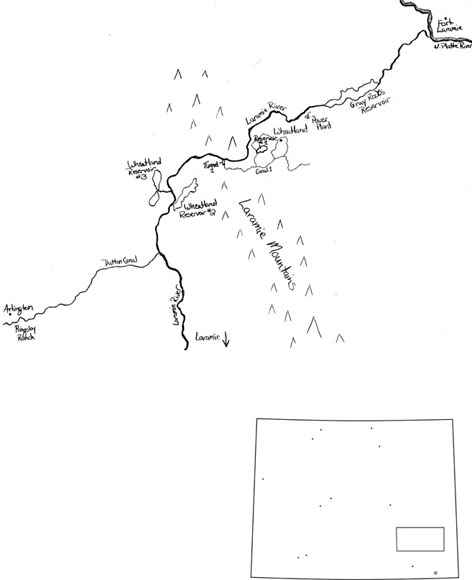
The biggest challenge, however, came not from industry but from irrigators looking for more water. The droughts of the 1950s were still more severe than the previous ones, and the Wheatland irrigation project, one of the biggest in the state, was desperate for water. Wheatland’s lands were some seventy miles north of Cheyenne, on the spot on the Laramie River that John Gordon had pointed out to Judge Carey in the early 1880s as a good cropland site for the company Carey and other stockmen formed to claim and sell land and water to settlers. Early on, there had been a major contest over water right dates between the company and Laramie River irrigators on the west side of the mountains. The Wheatland project in its search for a reliable water supply had built an ambitious reservoir and tunnel system; in the 1950s drought, the project, now owned by its farmers, was looking for more water.59
The governor asked all major users on the Laramie River to investigate new water supplies, and eventually, the Wheatland project found a big old ranch to the west across low mountains, known as the Ringsby Ranch, with rolling irrigated hayfields, all possibly for sale. The attraction was the ranch water rights. But could they be transferred to Wheatland? Moving irrigation water from one set of fields to another was clearly prohibited by the transfers ban of 1909. Irrigation was not a preferred use exempted from the ban. But some of the key water rights on the ranch predated the 1909 ban. So the district hoped that water under those rights could be moved, and lawyers indeed persuaded the Board of Control that it had to allow such a transfer.60
Bishop and the rest of the Board of Control accordingly allowed the transfer for those pre-1909 rights. Not wholesale, however; they applied the tests the board had developed over the years for transfers to towns and to industry. They required the Wheatland farmers who wanted the water to show exactly what the old ranch had diverted, what its hay crops had consumed, and what return flows had come back to the creek from the hayfields. In the end, the board, as it had done in other cases, limited much of the water the Wheatland project could get to what the old ranch had actually used under its water rights, rather than allowing Wheatland to have the larger amount the ranch had diverted from the creek.61
The board’s approach had a prominent local critic. University of Wyoming law professor Frank Trelease, nationally known as a water law and policy expert, advocated a more liberal water rights transfer policy. In 1960, he asserted in a report to the legislature that “in general there is no essential difference between the property aspects of land and water.” He expanded on that idea in 1966, zeroing in on the impact of the transfers ban a year after the board decision limiting Wheatland’s transfer. For over fifty years, Trelease argued, that ban had unfairly and unequally deprived water users of the ability to move their valuable resource to a different use and get paid for it. Within the limits of the transfer ban, there were some who could sell their water rights—if their buyer happened to plan a “preferred use.” But those unlucky enough to attract only agricultural buyers or others not covered by the exemption to the transfer ban were stuck and could not sell their water rights without selling the land it served.62 The result, Trelease wrote, was that agricultural innovation was stifled. The transfers ban, tied to the priority system, meant that
Wyoming agriculture still lies in the mortmain grip of the pioneer. The pioneer pattern of agriculture is impressed upon the Wyoming land. For the most part, the irrigated land is near the rivers, watered by gravity flow from ditches that follow the contour lines. Much good land lies above the ditches. Today, pumps can put water on those lands and lands can be watered with pipes and sprinkler systems.
The post-1909 rights on Ringsby Ranch that Wheatland could not transfer continued to water only hay land and pasture instead of Wheatland’s more valuable crops like sugar beets, dry beans, or barley, Trelease argued. That exemplified the mortmain—“dead hand”—grip on land and water that he deplored. The problem might have been avoided by Mead’s old idea of a system of state water leases, regularly reviewed for renewal. Mead had never seriously proposed water leases for Wyoming, though, probably because he knew his audience too well.
Now in 1966, Trelease pushed the legislature to focus on water rights transfers. He endorsed a transfer process much more generous than the Board of Control had adopted, one that would generally allow transfers of water rights, prohibiting only the aspects of a proposed transfer that clearly injured other users.63
New transfer legislation was enacted a few years later. But the legislature enshrined in law the board’s approach to transfers, not Trelease’s. In the early 1970s, the legislature enacted a law officially allowing the permanent transfer of water rights for all purposes—not just for a preferred use—and adopting for all permanent transfers the screening process the board had developed. The temporary water right transfers, initially for such uses as highway construction, that had been allowed by a 1959 statute, included a simple rule of thumb calculation for how much water could be temporarily moved.64
The new law for permanent water right transfers explicitly stated a series of more complex restrictions: no amount of water could be transferred that exceeded the amount or the timing of historic diversions, or that increased the amount consumed historically, or that resulted in reduced return flows, or that in any way injured the rights of other water users. The focus on consumption and the patterns it creates has tended to mean that only the previously consumed amount can be transferred. The new statute also said that the board had to weigh any economic loss to the county from which the right was being transferred. Since the early 1970s, the Board of Control has regularly enforced its own transfer restrictions that had thus been put into statute, and its actions have been backed by the state Supreme Court.65
As the transfer statute has been applied since 1973, however, there has been a curious result, one that Trelease would likely still deplore. A Wyoming water right is hard to lose, due to the Wyoming Supreme Court. If, however, you try to transfer it to a new use, you are likely to lose time, money, and water. Given the court’s opposition to abandonment and indulgence of water right revivals, a water right holder can often revive an old, unused water right in its original place and use. Other users on a creek may suffer, but they have no recourse.
As the board now applies its transfer rules embodied in statute, however, anyone who wants to put an old right to a new use or on a new location has significant hurdles to overcome. The water right holder must show whether the water right has been used well and recently. The answer to that question, yes or no, leads to a complex tree of yes-no questions that will produce different results. The sequence is easiest for nearby moves to the same kind of use; those proposals may not have to produce a lot of evidence on past use. If a water right is to be moved to a new use or to a distant location for the same use, however, the board sometimes requires detailed evidence on the old right on such issues as consumptive use, return flow, or other impact on fellow water users. The board may end up advising the owner of an old water right that has not been used to invest in putting that water right steadily to the original use, however uneconomical, for three to five years. Even after that investment, the amount of water that can be moved will almost inevitably be less than could be diverted from the stream under the old right. Instead of “Use it or lose it,” a new axiom for Wyoming water law could be “A Wyoming water right is hard to lose until you try to move it.”66
To some degree, that result is in response to the state high court’s opposition to abandonment and sanction of revivals. Given the court’s stance on abandonment, the supervisors seem to have injected into their transfer reviews a scrutiny of water rights much stricter than they or the court impose in abandonment cases. Further, they sometimes recommend revivals since those have court approval. Notably the board requires—and recommends in revival—consistent use of a water right, if water has been available, for three to five years before a water right transfer can occur. Five, of course, is the number from the abandonment standard, imported into transfer law. All that is required to avoid losing a water right in an abandonment case, however, is using water at some point within the last five years. That is quite different from having to use water consistently, over an irrigation season for instance, every year for three to five years in order to transfer a water right. The scrutiny applied to a water right being transferred is therefore a lot tougher than the scrutiny the courts allow on non-use of a water right that a neighbor claims has been abandoned. Overruled by the courts when it comes to abandonment, the water supervisors have been able to follow their view of the nature of water rights and water user interdependence when it comes to the transfer arena, and they have stood their ground there. There can be considerable impact on other users from moving and giving new life to a water right that has not been steadily used in past years. The board therefore requires that evidence of considerable regular use. The water supervisors have sought to allow change but have continued to impose major restrictions on how much water can move under a water right transfer.67
With current technology, board members now scrutinize satellite photographs to verify, quantify, or defeat claims of consistent use. The examination of the evidence is painstaking and often requires further research, testimony, and an inspection of the site by the superintendent, in addition to the photographs. The extent to which the detail required is left to board member discretion, and the resulting length of the process, can frustrate users. A few complaints have surfaced in recent years.68
Economists, and many lawyers from Trelease on, do not think much of this Wyoming water transfer process. In the allocation of water, they argue, the goal should be putting the resource to its “highest and best” use, and markets are the way to do that. Restrictions on transferring water to new uses only hobble any markets in water. Markets in land or minerals are far more effective in moving those resources to their “highest and best use.” Changing the use of land can be subject to some restrictions, like zoning laws, but real estate markets nonetheless function well. By contrast, the extensive restrictions on changing the use of water in Wyoming, economists have said, mean that the market is unduly limited. Since the ability to transfer property is often regarded as a key feature of ownership, the critics note, restrictions on water right transfers in Wyoming mean that holding a water right doesn’t mean owning the water, as a person could own land.69
That verdict would, of course, not disturb Elwood Mead or his successors in the Wyoming State Engineer’s Office over a century and more. For them, water has always been different, and they have not believed water rights should include all the rights that come with land ownership.
One leading economist in this topic today argues forcefully that Mead took the wrong approach, and as a result, western water law today requires major recasting. Terry Anderson, a senior fellow at the Property and Environment Research Center in Montana and at Stanford University, has explained why. The prerequisite for a market that can put water to its best use is private rights to water, rights that are both well defined and well enforced, Anderson writes. Mead’s system, with its concept of state ownership and issuance of state permits, has cast a cloud on private water rights, Anderson argues. Those aspects of Mead’s system, even as selectively adopted by other states, have unnecessarily and sadly impeded markets in water in the West, he concludes. He argues that it did not have to happen this way, claiming that in the late-nineteenth century, the prior appropriation system was evolving on its own into a private rights system that could support a smoothly running market. Fears of monopoly in water were largely unfounded, he believes, and when people proposed changing the use of water, nineteenth-century courts made decisions that ensured enough consideration of the impacts that transfers could have on other users. Private rights and the early court decisions could have been the foundation for effective markets for water and the flexible allocation of water for the best economic results, with no need for some broader consideration of general public welfare, Anderson contends. Mead and state administration systems interfered and have long hampered much-needed water markets, he concludes. Adding to the problem, the federal construction of big, often uneconomic irrigation projects only made things worse by ensuring that politics rather than economics have dictated who uses project water where, he argues.70
Much of that argument leaves out common nineteenth-century realities and twentieth-century experience, both well demonstrated in Wyoming. Across vast and little-populated terrain, water rights in the nineteenth century were not well defined or enforced. Money and people to do that were scarce. Fear of monopoly had reasonable grounds; the expansive 1880s Wyoming water and land claims, intended by stockmen to keep small settlers out, demonstrate that. Further, the Wyoming court clearly showed itself, on Little Horse Creek, unable to consider third-party impacts of a water-rights transfer. The courts simply did not understand how water worked on the ground. It was because the Wyoming high court demonstrated ignorance of water realities on Little Horse Creek that the state agency and Wyoming water right holders together got the severe “no-transfer” provision put into state law. Leaving water transfer decisions to the courts would have meant no real consideration of the water use needs of anyone or any place other than the interests of two people at either end of a transfer, as Mead had argued. A system of purely private rights, whose nineteenth-century emergence Anderson sees as promising, meant to Mead a riot of “organized selfishness . . . more potent than unorganized consideration for the public interests.”71
In 1929, an observer looking back from only forty years’ distance saw the early years differently than Anderson. Moses Lasky believed that inequities and uncertainty prevalent in the late-nineteenth century were ample reason to adopt administrative systems like Wyoming’s. It was appropriate to make a water right “only a grant of a privilege of user by the state” based on a variety of considerations including diligent water use and have such systems displace the private property rights of prior appropriation, Lasky wrote in 1929. The state administration systems should be celebrated as the key step in a welcome trend toward “economic distribution of water,” with state agencies in the lead, he wrote. On the verge of his career as a nationally acclaimed trial lawyer, Lasky also chided Wyoming’s courts and legislature for “timidity” in failing to champion the power of the Board of Control to declare water rights abandoned.72
As the twentieth century wore on, the Board of Control kept tight supervision over water rights transfers, but experience led the water supervisors to soften and finally eliminated the transfer ban in Wyoming. They had it replaced with a set of restrictions that grew out of agency and water user examination and intimate understanding of the impacts of transfers. The board’s process ends up defining and enforcing some Wyoming water rights—those rights that come to it to review—as never before, much as economists like Anderson have said is needed for a functioning market. Meanwhile, Wyoming’s 1959 temporary transfers law is in regular use, though it can be used only to transfer water rights temporarily to certain new purposes. Anderson and other modern economists are welcoming the idea of temporary water use transfers rather than permanent water rights transfers, as promising steps to a workable water market. They see temporary transfers as the best way to avoid the destruction of agricultural communities that has accompanied some permanent water rights transfers in other states.73
Wyoming water users appear to have been reasonably happy with the way both abandonment and transfer laws have progressed. The court’s dislike of abandonment makes it hard for the board to clear non-users off the water right records. As a result, the users have considerable control over their water rights and over their own ability to stay in or rejoin the game on their stream. That in turn means that having a right to use water becomes more like owning private property, and users tend to like that. As for the transfer laws, only in very recent years since 2015 or so has the detailed level of scrutiny required in moving water from one field to another seemed to chafe some users, because of the time and expense involved.
With those changes, Mead’s concept of a state system morphed over the decades into a system of community management that distributes rights in water among key players. By the 1970s, the state agency and the water users had different sets of rights to water. The state agency represented the public. Once the state agency granted permission, individuals had rights to access, use, and manage water within limits defined by the extent and nature of the use. The state retained significant rights, however. The state could include or exclude individuals from the right to use water; the state could decide when and whether and how much of those rights can be transferred to other places or purposes. Factors such as the politics of federal water projects, aptly criticized by economists, shifted more rights to users as big projects like that on the Shoshone River shredded the state’s ability to require user diligence in order to keep a right to water. Court resistance to abandonment did the same. The state nonetheless retained its rights in water, including the power to approve or deny transfers. The understanding that the issue is public waters, rather than purely private rights, is fundamental to the community management system that emerged. Despite the critics, agency and users to this day suspect that a market in private water rights that lacks the restrictions they have created would fail to support the welfare of the people in the state.
Wyoming’s longstanding hostility to permanent transfers as a means of speculation in water rights that could disrupt communities was only reaffirmed, in the eyes of both water users and the board, by a highly publicized case from the late 1970s. In that case, an irrigation project that had failed years before tried to sell its never-used water permits, under a plan to move those permits over one hundred miles down the Green River to provide water for a new power plant. The state engineer approved the change, but on appeal, the Board of Control voted against him and disapproved the transfer. The Wyoming Supreme Court joined them, upholding the flat denial of that transfer.74 The facts of the case clearly alarmed the board and shocked the Supreme Court, as its opinion made plain. Though the case involved old unused water permits, not unused adjudicated water rights, it demonstrated what could have happened in Wyoming if the court-sanctioned power of users to revive old unused rights had not been restrained by the longstanding Wyoming suspicion of water transfers and speculation, embodied in the Board of Control’s cautious process that had been put into statute in 1973.
Wyoming water records remain littered with old rights that might be revived in their old uses and inaccurate information on where and how some water is used. Further, there are major obstacles to taking an old right and doing much new with it with any speed. All that hobbles the ability of a society to use its water resources to respond to new needs. Much of the trouble comes from the court’s intervention against abandonment, in disregard of the nature of water, water rights, and water user communities—in disregard of the testimony and arguments of a Nelson Sherard. Blocked by the growing court taboo on abandonment, the Board of Control exercised its expert judgment elsewhere. The water supervisors learned from the needs of power plants, towns, small irrigators, and longstanding and large irrigation projects like Wheatland.
As a board, the supervisors recognized what needed to be done to allow change. They formulated a policy built upon their and the users’ understanding of the peculiar nature of water, water rights, and water user communities, and the responsibilities for public welfare entailed in water decisions—in recognition that they dealt with public waters. Court resistance to abandonment, however, has meant the water supervisors have been barred from applying their expertise to the entire arena of what happens to water rights that have lost their usefulness. Economic stagnancy, for lack of turnover, has sometimes resulted. That means ineffective water allocation. The dead hand of the pioneer, the demon that Trelease identified in the 1960s, managed for many years to play a role in Wyoming water rights and Wyoming water use.