
But the principal defect of the system, the one capable of working the greatest injustice, is inherent in the very theory itself, in its fundamental conception. The prior appropriator, in order to carry out a purpose regarded by the law as beneficial . . . may divert and consume, without returning to its natural channel, the entire water of a public stream, no matter what may be its size or length, or the natural wants of the country through which it flows.
—JOHN NORTON POMEROY, LEGAL COMMENTATOR, 1893 (ITALICS IN ORIGINAL)1
Places: Green River, southwest Wyoming; Salt River, southwest Wyoming; Wind River, west-central Wyoming.
Time: 1965–1990.
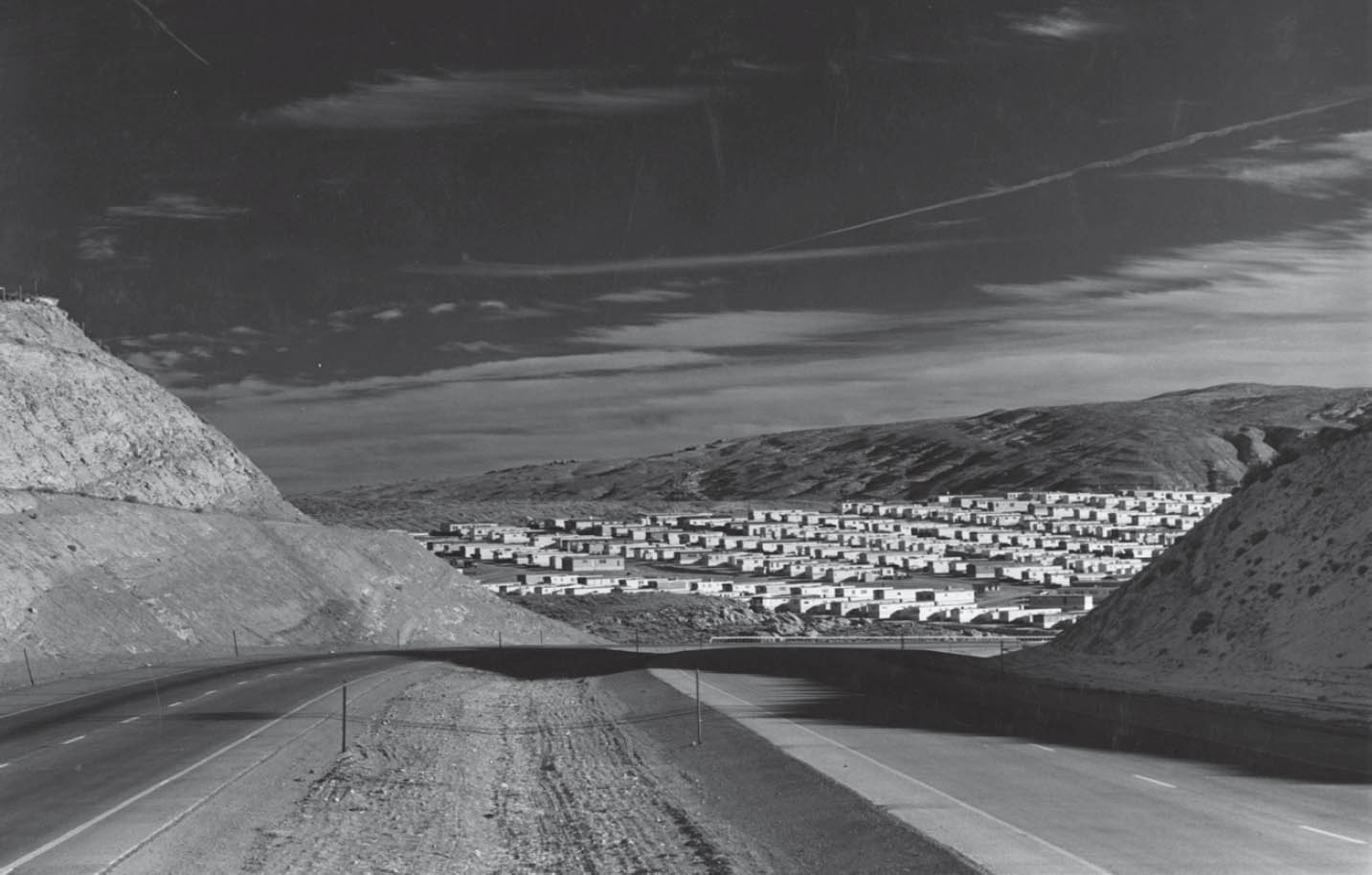
Energy production man camp. Michael McClure Collection, American Heritage Center, University of Wyoming.
WHEN THE SUPERINTENDENT OF a Wyoming water division envisions the surrounding landscape, what appears is not a mental map of roads, but a web of creeks, ditches and water rights, stretched from the hillsides through the valleys and onto the bench lands nearby.
In this big landscape with its few people, by 1970—over three-quarters of a century since the water management system started—the weave of that web varied across the state. Active “regulation” of a stream by state officials, allocating water to users by water right date, did not occur unless and until some user on that stream formally called for her water. Users often tried to avoid bringing in state staff. Nevertheless, in some places users typically called for water, and active regulation happened regularly, so the web was tightly woven. In those places, users might be many, or the water scarce, or the hydrology complex. Some combination of those factors could prevail, or there might be regular conflicts between neighbors that erupted as water disputes even though the real issues were not about water. So the superintendent, his staff, and the water rights on the books were almost always present. In other places, the web was loosely woven—where users were few, water abundant, hydrology simple, users self-organized into well-run irrigation districts, or some combination of all those elements ruled. There, superintendent and staff rarely appeared, and users managed for themselves, with water rights dates faded into the background, sometimes to the point that no one knew what they were. The web with its spots of loose weave and tight weave reflected the community water management system that had emerged over the decades. The state had greater or lesser presence on the streambank, depending on the location. Water users’ ability to manage the water by themselves waned or waxed in response.2
That did not mean that a place of loose weave or tight weave was necessarily peaceful. “I carry a rifle, not a shovel, when I go irrigating,” said one young rancher in southwest Wyoming in 2020. “I hear you, it’s definitely a blood sport,” replied an older man who ranched over one hundred miles away. Some fifteen years earlier, in a low-water year for the plains of eastern Wyoming, the water superintendent there commented wryly, “It’s going to get very western around here.”3
Users on any stream could sometimes enjoy access to a “free river,” as the state engineer and superintendents call it. Users could take as much water as they needed, well above the amount set in their water rights. That could go on as long as in anyone else’s eyes (including the water commissioner’s), the water taken wasn’t literally wasted and all the users on that river were satisfied enough not to call on the superintendent to restrict everyone to their formal rights. In late spring, when most Wyoming streams, fed by mountain snows, are at their highest, a “free river” and loose weave of water rights could prevail in a good water year in many places across the state.4
In the early 1970s, however, a pamphlet called The River is Free was distributed by the League of Women Voters of Wyoming. Their idea of a free river was completely different. They were talking about a river free from much human interference, a river whose water was not taken to work in irrigated fields or power plants or city pipes but left to run on its own. They were talking about keeping water flowing for the sake of rivers themselves—on rivers Wyoming people would choose to protect as wild, scenic, or recreational. That had begun to happen nationally.5 But could the needs of a river be woven into that web of water rights governing Wyoming water management? In prior appropriation and in Mead’s system for water use to help create a new society, nothing required that any water be left in a river. Leading nineteenth-century legal commentator John Norton Pomeroy of California highlighted that as a major defect in prior appropriation West-wide—allowing users to dry up a stream, with no concern for “the natural wants of the country through which it flows.”6
The “wants” of fish had always gotten some attention in Wyoming’s water system. Superintendents worried about fish winding up in ditches. As early as the 1920s, the US Reclamation Service built Diversion Dam on the Wind River, serving the Midvale district, with a fish ladder, one of the first in the country, to help fish navigate past the obstruction. Reservoirs could create new, cold flows on the river below—making life there difficult for native fish but attractive for introduced game fish. The reservoirs themselves provided good fishing, and in the 1950s and 1960s, the Bureau of Reclamation finished the last of its big dams and reservoirs (most justified by the power they would create, but also creating good lake fishing), including Flaming Gorge crossing the Wyoming-Utah border on the Green River, Fontenelle further north on the Green River, and Boysen and Yellowtail on the Wind and Big Horn Rivers. Eventually, proposals for new dams began to include in their list of benefits the idea of ensuring some river flows below for fish. But it was not clear, within the bounds of the water rights system, whether rivers might be treated as anything other than conduits to the headgates and pipes people needed for farms and industry.7
In the 1960s and ’70s, however, there were people in Wyoming who were thinking about water differently than in the past. Several of them came from western Wyoming. That part of the state, traversed by the Rocky Mountain chain heading northwest, is home to river valleys among high mountains, a place where the beauty of the rivers makes people think about rivers’ needs. Eastern Wyoming, where the railroad gave birth to the capital city in the 1860s and where grasslands merge into sagebrush steppe that then runs up against the mountains, had hosted many of the early water management debates that went with settlement and so had provided the context for many of the early water management decisions. Western Wyoming had seen somewhat slower settlement, but in the second half of the twentieth century, it was becoming less isolated, playing more of a role in statewide dialogue and water policy.8
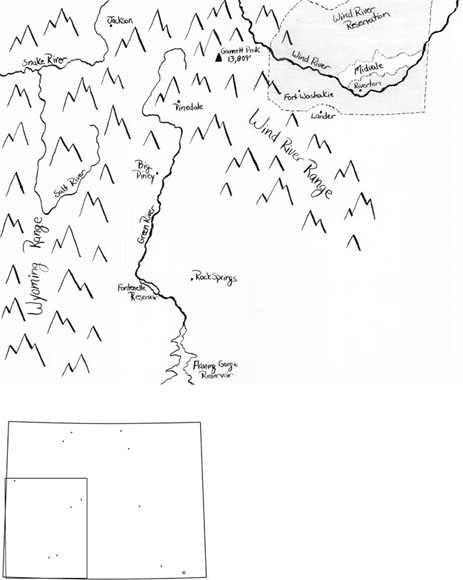
Western Wyoming hosts the state’s highest peak, sitting astride the Continental Divide in the Wind River Mountains at 13,810 feet, while the snowpack on that range feeds both the Green River and the Wind River—sources, respectively, for the Colorado and Missouri-Mississippi river systems. The heights of Yellowstone National Park, in the far northwest corner, feed not only the Missouri-Mississippi system (partly through the Shoshone River running east through the top of the Big Horn basin to join the Big Horn River heading north), but also the Snake River, the largest tributary of the Columbia River. The Snake runs down through high country with long winters and the valley of Jackson Hole, where the Teton range and land fronting it in 1950 were (after decades of local debate and rancor) combined into the Grand Teton National Park, first started in 1929. Skiing and tourism there were only in their infancy in the 1950s—but thirty years later, they gave Teton County residents the highest per-capita income in the state. The Salt River, running north to meet the Snake just as it heads into Idaho, comes through the Star Valley settled by Mormon irrigators in the 1880s who managed to make it into dairy country despite the long winters. On the Green River to the south of Wind River Mountains, fur traders met in rendezvous with Shoshone and other native people in the 1820s–1840s. Early cattlemen came up the river for winter shelter on native hayfields in the foothills and stayed. Further south, running through the Red Desert, the river passes railroad and mining towns, built for the Union Pacific line heading to Utah, that hosted much of the early population of the area.9 In the drought and depression of the 1930s, when some ranches in the area were reported abandoned, a young man from the mining town of Rock Springs found a way to make a living by planting trout in the streams on the south faces of the Wind River Mountains and taking vacationers up there to fish in the summers. On the north side of those mountains, the Wind River runs through the wide valley where the Eastern Shoshone and then the Northern Arapaho people were forced after the Civil War onto the reservation that was eaten away under settler and government pressure, which in turn spawned two towns, a ranching and mining town in Lander and the irrigation project town in Riverton. 10
Tom Bell grew up in Lander, the son of a coal miner. A contemporary of Floyd Bishop, he too flew on bombing missions in World War II, losing his right eye, and nearly his life, to shrapnel. After the war, he went into the Red Desert to recover: “It was important to see the beautiful earth,” he said. He went on to get a master’s degree in wildlife management at the University of Wyoming (he studied pronghorn migration, and started the rodeo club), to work for the Wyoming Game and Fish Department, and then to ranch and teach science and to spur a pioneer museum in Lander.11 In the 1960s, Bell saw threats to the landscape and wildlife he loved—Wyoming was increasingly being looked on as a potential center for producing energy for the country—a “national sacrifice area,” some said, expected soon to host dozens of power plants burning Wyoming coal. There was even a proposal for underground nuclear explosions at the edge of the Red Desert to boost natural gas production. A series of major coal-fired power plants were discussed for the Powder River basin in Wyoming and Montana, and Wyoming US senator Cliff Hansen, a former governor, proposed federal legislation to build an aqueduct to serve industrial development there. Bell created the Wyoming Outdoor Coordinating Council in 1967 to organize and advocate against the developments he considered destructive; in 1969, he created a newsletter that became High Country News to get the word out. Both organizations are still thriving fifty years later.12
Bell and the council soon turned their attention to the upper stretch of the Green River—undammed for some fifty miles as it flowed south out of the Wind River range and, in the 1960s, one of the first six rivers nationwide considered for designation by Congress as a “wild and scenic river.” When the national act of that name establishing protection for rivers was passed in 1968, the Upper Green River in Wyoming was left out. Wyoming’s three-man congressional delegation, supported by a turnout of local residents in the Rock Springs-Green River area, said the state needed to keep open opportunities to develop the river for other uses—and, they said, the state wanted to do its own river planning.13 At the state level, therefore, Bell took up the cause of the Upper Green. He gathered some people from Upper Green communities and from Casper, the central Wyoming town-turned-oil-industry-hub since the 1920s. They believed, they said, that Wyoming leaders who had opposed federal protection for the Upper Green nonetheless appreciated its value as a free-flowing river. Bell’s group argued that there was a growing new industry using Wyoming water—the recreation industry. The group cited 1960s economic studies to show how for recreation, the value of the Upper Green River—its fish and wildlife and its natural setting—would only increase as Americans had more leisure time and better transportation to places once considered remote. Subsidies for water used by agriculture and other industries, however, were likely to shrink the supply of water for recreation despite its increasing value. So government or citizen groups had to take steps to secure and protect key waters for recreational use, Bell’s group argued:14
Much is said in Wyoming about bringing “industry” to the State. Few seem to realize that we have a built-in industry which relies only on the God-given assets available to us. However, the value of those assets are dependent on the wise use and management by resource managers and the public. They need only be recognized and protected.
The tourist and recreation industry is recognized as such by our leaders, but often gets no more than lip service in the immediacy of living here and now. Because the industry is so new, it suffers from a time lag in a state still oriented to a rural, early-American West.15
Those opening paragraphs of the group’s formal brief sound like they came directly from Tom Bell. He was a fan of Wyoming history and rodeos, but in the here and now, he believed in fighting for the beautiful earth. In early 1969, he and his colleagues asked State Engineer Floyd Bishop to grant them a water right to protect some flows in the Upper Green River for fish and wildlife. They filed that brief arguing that this water right would be for an industrial use, with recreation as the industry. The right they asked for would be within the first fifty-one miles of the Green River, as it left the Green River Lakes in the Wind River Range.16
Meanwhile, in 1969, Paul Stauffer, a member of the next generation after Bishop’s and Bell’s, had just come home to the Star Valley in far western Wyoming. Stauffer’s father had a drugstore in the Star Valley, and Paul had gone off to get a pharmacy degree. A bright student, he was urged by his professors to become a professor himself, but he realized that if he committed to academia, “I wouldn’t be able to live where I wanted to live.” Stauffer was an avid fly-fisherman (he titled his recent memoir “Did I Fish Too Much?” The answer, clearly, is “No.”). When Stauffer came home to the Star Valley with his wife and baby son, he found that the Salt River had changed. Years of US Department of Agriculture aid to ranchers to switch from flood irrigation to sprinklers and to denude their riverbanks of water-thirsty willows had resulted in lower quality fishing in a wider, shallower river. Some traditional flood irrigators had warned as much but to no avail.
In 1971, a couple of years after Stauffer’s return, the river flooded disastrously for the first time in local memory, cutting new channels and eating into irrigated fields. Some landowners responded by charging into the river with bulldozers to straighten the channel and send the river flows barreling downstream. Fish habitat and spawning grounds, as well as downstream landowners, suffered. Stauffer responded by pulling together a group of landowners, fishermen, and government agencies aiming first to get willows back on the banks: the Save the Salt River Committee.17
A contemporary of Stauffer’s from the Wind River valley, Dick Baldes, was graduating with a master’s degree in fisheries. He had grown up in Riverton, the town right by the big bend that the Wind River takes as it heads north. As a boy, Baldes fished, played, and swam in that river as his back yard. But when he came back from the university and his first jobs in wildlife conservation in other states, he found the river devoid of everything but carp and suckers and unsafe to swim in. He took a job with the US Fish and Wildlife Service to work in its office on the Wind River Indian Reservation. His goals included enhancing wildlife on the reservation, which after all the land cessions still encompassed some two million acres stretching up to the crest of the Wind River Mountains, including a vast wilderness that reservation leaders had protected starting in 1934. Another of Baldes’s aims was to bring the river back to life.18
Baldes was an enrolled member of the Eastern Shoshone tribe. People in Riverton, where early business high hopes had been dashed by the slow development of irrigation, tried a lot of different ventures over succeeding years to keep going—oil drilling, uranium mining, hog or beet processing. Uranium mill tailings were dumped by the side of the river in the 1950s. As the irrigation districts on the north side of the river did manage to grow, however slowly, their diversions left less and less water in the river during summer. Midvale was looking for still more water, and so was the city of Riverton.19 In the 1970s, as Baldes returned home to work for the US Fish and Wildlife Service and was dismayed by a depleted river, Riverton started eyeing groundwater as a water supply for its small airport and an industrial park. When the city announced plans to drill wells for those sites in 1975, tribal authorities objected, because it appeared that use of that groundwater could affect tribal members’ irrigation. The tribal councils cited the original 1868 treaty setting up the reservation to cover much of the Wind River valley “for the absolute and undisturbed use [of the tribes]. . . as their permanent home.”20 Those lands, as the tribes pointed out, were made habitable by their waters, so the groundwater and surface water in the Wind River valley belonged not to Riverton, and not to the state of Wyoming, but to the tribes.21
Both the Eastern Shoshone and the Northern Arapaho tribes had been taking strategic steps since at least the 1930s, as entities, to make reservation resources benefit their people. They had achieved a turning point in reservation agriculture, shifting away from the irrigated-farming model imposed by Congress and instead taking on ranching, grazing cattle on tribal uplands while irrigating bottomland hayfields for winter feed, in the pattern that worked best in most of Wyoming. The Shoshone, via a lawsuit against the federal government in the 1930s, got funding to buy back some outsiders’ ranch properties in the ceded northern section of the reservation, and the federal government returned all the unclaimed ceded land to the reservation. The Arapaho, at about the same time, got a federal loan to buy a big ranch northwest of Wind River Canyon and start a successful tribal cattle ranch. Both tribes successfully fought off “termination,” under the federal policy of the 1940s–1950s that eliminated federal services and obligations to protect tribal lands and sought to relocate native people away from reservations and into cities. By the 1960s, ranching and related irrigated hay lands supported only about 14 percent of reservation population full time. Underemployment and unemployment were significant and apparently growing. Oil companies did develop oil and gas reserves on the reservation and paid royalties to the tribes, which (with ups and downs in revenue) provided per capita payments supporting individuals and revenues for tribal government investment in public infrastructure. The Bureau of Indian Affairs had managed tribal resources, including water and oil and gas, since the 1880s. Federal antipoverty programs of the 1960s, however, encouraged participation by tribal governments independent of the BIA. A 1968 US Senate report concluded that the dominant US policy toward tribes and their governments had been “coercive assimilation,” resulting in destruction of Indian communities and individuals, and in the growth of an ineffective bureaucracy at BIA that helped perpetuate tribal poverty. The roots of destructive federal policy were “a continuous desire to exploit, and expropriate, Indian land and physical resources” and intolerance of tribal communities and culture, the Senate report acknowledged. At Wind River, the tribes kept working toward creating economically viable communities and sought to keep their culture intact. A major step for that was the creation in the late 1970s of Wyoming Indian High School, run by the tribes, which was achieved after a ten-year effort by parents who as children had left home for boarding school or suffered disdain and ridicule in white-run local schools that got federal money for enrolling tribal students. As adults, they were determined to give their children “respect, accomplishment, and dignity” instead, and to use the federal funds for their own schools.22
By the late 1980s, however, unemployment at Wind River reached nearly 80 percent, and the tribes’ lawyer told the US Supreme Court that it appeared that agribusiness, dependent on abundant water, was the tribes’ “only certain hope” for a reliable economic future. Since the early 1960s, tribes around the West had begun asserting rights to water resources. They had successes in claiming high priority rights from nineteenth-century treaties, under the rule of the 1908 Winters case. When in 1975 the Shoshone and Arapaho tribes cited the 1868 Shoshone treaty to object to Riverton’s groundwater drilling plan, Wyoming state government ultimately responded with a lawsuit. In 1977, the legislature endorsed, with nearly unanimous support, a bill to start a “general adjudication” of the Wind-Big Horn River system. Congress had enacted a law twenty-five years earlier providing for such general adjudications. It meant that if a general adjudication were undertaken in a river basin, then a state court rather than a federal court could decide a controversy over what water rights the tribes and the federal government held there. On the Wind River, the state’s lawyers saw state court as a significant advantage in their effort to defeat the tribes’ claims. The elaborate state court adjudication process formally began two days after the legislature endorsed it in 1977, inaugurating a review of all water rights in the basin, a herculean task that ultimately took three and a half decades.23
Bishop’s successor in the State Engineer’s Office believed, as the lawsuit got underway, that it would eventually “end years of uncertainty and speculation” about how much water the tribes could claim in the Wind-Big Horn system and therefore how much water other users could develop. Baldes, on the other hand, saw the lawsuit as “good for the river.” The research and attention that the litigation would bring could, he believed and hoped, make more people learn about the river, care about it, and ultimately take action to let it keep more of its water.24

Wyoming’s state engineers in the 1960s and 1970s, meanwhile, faced pressure from added, conflicting directions. The major drought of the 1950s had left traditional Wyoming agriculture eager for more water, as demonstrated by Wheatland’s search for more supplies. Scattered towns around the state, like Casper in central Wyoming, had long been supported by oil and gas production and servicing. Now, increasing electricity demand nationwide, plus a combination of pollution concerns and the dependence on foreign oil eventually highlighted by the “energy crisis” of 1973, led to what galvanized Tom Bell in Lander: demand for Wyoming’s little-tapped but massive low-sulfur coal reserves. John Wold, a prominent geologist in Casper who became the state’s lone congressman, had successfully invested in federal coal leases in the 1960s in anticipation of a boom in coal that soon materialized. A major power plant tapping Green River water was built in the 1970s near Rock Springs. By the end of the 1970s, Wheatland itself—because of easy access to water on the Laramie River—was the home of a new coal-fired plant that shored up the town’s economy. There began to be talk of people speculating in water rights for energy projects.25
At the same time, downstream states were continuing to develop at a pace ever faster than Wyoming’s. They had their own water ambitions, particularly on the Colorado River, which made people on headwaters in Wyoming’s Green River worry about water for their future development, despite the protections of the Colorado River Compact. In 1948, to flesh out those protections and obligations, Wyoming and the other states in the upper reaches of the river had agreed on the Upper Colorado River Compact. That agreement allocated a specific percentage of available water to each upper basin state (Wyoming, Colorado, Utah, and New Mexico), while also putting in place a procedure for ensuring that the upper basin states could meet the 1922 compact requirement that water use in the upper basin not deplete flows below a certain level. Post—World War II population growth and federal investments in dams and infrastructure tapping the Colorado River for water and power, serving both agriculture and cities, soon made for steady economic growth in Arizona and Colorado. Meanwhile, Wyoming couldn’t generate much new demand—or corresponding federal investment—for all of its share of the river under the 1948 compact. The poor economics for agriculture in the high desert meant that even a modest federal reservoir built in the 1960s on the middle stretch of the Green couldn’t generate the new irrigated agriculture it had been designed to create. Instead, it has served a wildlife refuge, and its projected mine and power company customers use the reservoir only for back-up “insurance” water supplies they have never used. Full Wyoming use of its compact portion of Green River water was much dreamed of but not realized.26
Bishop, state engineer from 1963–1974, worried that “economists and federal-type planners” were likely to give priority to downstream, low-elevation states with more attractive climates when they eyed water investments. By the early 1970s, he was frustrated that not only were federal funds going to “social programs of various kinds” instead of water development, but “the trend of environmental opposition to all water development projects is increasingly difficult to counteract.” Writing in 1972, after the political upheavals, riots, and assassinations of the 1960s and early ’70s, he subscribed to a 1900-era view of farm settlement as a pressure relief valve for US cities. He bemoaned national lack of interest in that idea: “Even though the expenditure of federal funds for water development projects in Wyoming would help to solve some of the social problems of the overpopulated areas of the nation, there seems to be little sympathy for this viewpoint at the federal level.”27
Bishop argued that Wyoming must pay more attention to Wyoming water matters and invest in the State Engineer’s Office, which in 1961 had so few staff and such an outdated filing system that if Elwood Mead had walked in, one staffer wrote, “he would have felt right at home.” Bishop felt that the state’s water users could not remain comfortably wrapped in isolation. The federal government, he warned, was increasingly activist, not just in water projects to serve downstream economies, but in issues like water pollution and the impact of reduced river flows on native fish, birds, animals, and plants. Since those issues cut across state lines, he could foresee federal intervention in state water management, possibly changing Wyoming’s system.28 As soon as he came into office in 1964, Bishop began warning:
Too little emphasis has been placed on the administration of water in Wyoming for many years, and if this trend continues the ultimate result can only be federal control of our water, which has historically been a state responsibility. This would be a tragic thing in the eyes of most Wyoming water users.29
Wyoming water users, however, were suspicious of change, at any level. They were fearful that new people and new industry would somehow take their water rights away. The water superintendent of the Powder River basin, meanwhile, expected change to take the form of industrial demand for large volumes of water there. Power plants were projected to accompany Wyoming coal production there, and power plants would need water. The water superintendent reported with dismay, however, that almost all irrigators disliked the idea of industrial development. He thought it was because they didn’t understand how Wyoming water law would work to allow new industrial users of water to get senior rights on streams only if they paid irrigators for them, and only if existing stream use patterns were protected.30
Law professor Trelease, as he argued for a new law to make water rights transfers easier, saw a similar problem. “The mortmain grip of the pioneer” imposed on the Wyoming landscape by the ban on water rights transfers enacted in 1909 had, he believed, stifled innovation and the use of new technology in agriculture and other industry. Further, the transfers ban had left successive generations of Wyoming water right holders with what he called an “heirloom attitude.” They feared letting water rights move or change in any way—and that became a factor in the state’s poor economy. The Wyoming water user, Trelease wrote,
feels that water is his most precious asset, his heritage, his birthright. To sell it would be sinful. Laws against sin are much in favor. In part this attitude may come from a misunderstanding, a fear that stability of water rights is at stake, that water will be “taken” from irrigators without compensation, as may be done in some eastern states. In part it seems to stem from desires to preserve the status quo of rural Wyoming, to prevent neighbors from selling out, to prevent the loss of tax revenues for counties and school districts in areas subconsciously feared to be marginal.31
Wyoming water users fundamentally did not want to see their familiar system upset. They had reached a comfortable position by the 1960s, sharing power over water management with the state engineer staff. That was particularly the case, of course, on the streams where the web of water rights management was loosely woven, because water right regulation rarely occurred there.
Bishop was not content to sit tight and hope that the national changes he saw coming would bypass Wyoming. At the end of the 1960s, he had his office start drafting a complete recodification of Wyoming water laws to address problems he saw. The rewrite included modernizations, setting new numbers for fees and salaries, and adding oil and gas drilling to the purposes for which temporary transfers of water would be allowed. He wanted to limit time extensions for putting water to use under a permit (the familiar issue that had long dogged the State Engineer’s Office). Further addressing “paper,” or unused rights lingering on the books, Bishop launched a proposal to give the state engineer authority to initiate abandonment proceedings—just as True had done on Horse Creek in 1916. Bishop regarded the lack of that authority as the most serious gap in water law, and in the water law rewrite, his proposals to get that authority aroused the most opposition from water users.32
Eventually, as part of a reordering of Wyoming water laws passed by the legislature in 1973, Bishop got the authority to initiate abandonment actions—but in vain. User hostility to that kind of initiative by state engineers has remained so strong that the authority has only been used once (and unsuccessfully) in the forty-five years since. Instead, the Board of Control has turned to forceful persuasion; when users ask for help in getting their water or moving/changing their water use and superintendents find a mire of overlapping or unused rights, or rights not accurately recorded, they convince users to clean up those problems. Sometime that means persuading users to “voluntarily abandon” their right or some portion of it. In that way, some unused rights have been eliminated, though many still litter the state’s records. And the superintendents themselves prefer to preserve water rights, particularly old ones that may predate the interstate compacts made on many rivers, to keep water in use in Wyoming. In such situations, they tend toward encouraging revival of use under a water right and then transfer to other lands, instead of voluntary abandonment.33
The final 1973 reorganization of the water laws also included the new procedures for transferring a water right to a new place or a new use, enshrining the board’s exhaustive look at transfer impacts on water use patterns rather than the relatively permissive process Trelease had once recommended. Putting the board’s process into black and white made sure existing water users, and prospective new ones brought in by the energy crisis, would know that water rights transfers in Wyoming were possible but only with scrutiny.34
Wyoming water user resistance to change is still demonstrated, however, in an interesting way. Today, coming up on fifty years since the new transfer law went into effect, it is not widely known. Water users who have never been involved in the transfer process still insist that in Wyoming, water cannot be moved away from the land it irrigates. They believe that the 1909 ban still applies. Mead’s original goal of blocking speculation plus the “heirloom attitude” Trelease identified militate against water right sales. People welcome the idea that they and their neighbors lack the power to sell off their water right easily to the highest bidder. They cite it as one of the best features of Wyoming water law.35
Soon after the reworked water laws were approved in the early 1970s, change arrived. Big coal mines did open, primarily in the Powder River basin, and some new power plants were built, though not nearly as many as had been forecast a few years earlier. One major power plant built on the Green River, plus a new coal mine to serve it, brought in so many new workers they had to live in tent camps. The legislature enacted a new law requiring that companies proposing big new industrial projects must work with towns and counties to ensure housing and all kinds of services would be beefed up to handle the new development. Soon, “man camps” of trailers to house project construction workers were familiar sights on once quiet roads. Wyoming became by far the biggest coal producing state in the country, and for a time the biggest in the world. Rather than becoming home to legions of power plants, the state shipped off hundred-car trains of coal to many US states.36
Wyoming was suddenly a wealthy state. The energy industry—particularly coal, but also oil, gas, and uranium—became the big economic driver for a state whose government one day in 1968 had only eighty dollars in the bank. Having taken a major (and controversial) step in 1969 by imposing a “severance” tax on the extraction of minerals and hiking that tax in subsequent years, the state government began to see big revenues. Legislators long used to thinking small began to dream that someday Wyoming government—if its services remained minimal—could be funded simply by income from a savings account of stockpiled mineral revenue. Provision for a portion of severance taxes to be dedicated to a “permanent mineral trust fund”—earning interest revenue that helped fund state operations—became part of the state constitution in 1975.37
For the new power plant on the Green River, some enterprising families had proposed to sell some of their old, unused water permits downriver for the plant—the plan defeated by the Board of Control backed by the Supreme Court. For water users who paid attention, that case confirmed the competence of the Board of Control as a water transfers watchdog. Meanwhile, new proposals for using Wyoming water for energy kept cropping up—including schemes to use water to help turn coal into synthetic fuels or to transport coal to market via pipelines. Those plans in turn spawned a new batch of “temporary filings” cluttering up state engineer records with papers that were not yet even applications for water rights permits, but just sketched ideas for water diversions and reservoirs for industry.38
Considerable portions of the new state government wealth went into investment in major water infrastructure, much as Bishop had hoped. At the federal level, there was discouraging talk of cutting federal largesse for water projects. In Wyoming, the state’s leadership was determined to step in with their new revenues to build the dams and reservoirs the federal government had not provided.39
Ed Herschler started his unprecedented three terms in 1975 as a popular governor, whose slogan was “Growth on Our Terms.” He was a World War II decorated Marine sergeant, railroad company lawyer, and legislator from a longstanding ranch family near the coal town of Kemmerer in southwest Wyoming on Fontenelle Creek, which joined the Green River just where the federal dam intended to spur irrigation had ended up creating a wildlife refuge. One of Herschler’s flagship projects was creation of a new set of funds for water development fed by state tax revenue from coal, oil, and gas. Towns wanted new water infrastructure for growing populations, and irrigators needed to extend the life of facilities that were often sixty years old or more. Nearly all the population, therefore, could unite behind the idea of using a chunk of the new mineral revenue for water facilities.40
The Wyoming Water Development Office, independent of the State Engineer’s Office, was created and well funded. The new agency inherited files on all kinds of water projects that had been proposed over the decades and began to accept proposals for both new and rehabilitated water supply projects for irrigated agriculture and for towns. About two-thirds of the costs of each project could be covered by outright grants from state funds and one-third by low-interest state loans. State legislators were soon awash in water development proposals, as well as energy money, and they created a special committee to oversee water development. The Wyoming Water Development Office, envisioned as Wyoming’s own Bureau of Reclamation, developed political relationships in Cheyenne much like those in Washington that had kept bureau water projects steadily funded for decades. Mutually beneficial ties between the development agency, its legislative oversight committee, and water using entities ensured that a significant chunk of the new mineral revenues would go solely to water projects dotted around the state to give credit to legislators for bringing state money home. Over the next thirty-five years, some $1.4 billion in mineral revenues went to planning and construction of water infrastructure.41
Accordingly, a good number of agricultural water users were shored up rather than undermined by the economic changes they had so feared. Some people transferred some water rights—profitably—to growing towns or industry, but there was no wholesale transformation of Wyoming water use. Rather, longstanding irrigation projects, along with some new reservoirs and groundwater wellfields for cities and towns, got infusions of state mineral tax money. Wyoming was able to update infrastructure and provide new water supply facilities in a way it never could have done without the mineral revenues. The portion of the mineral tax revenues earmarked for water development was soon considered money sacred to water projects.
To get the money for a water project, irrigators had to be in or create some form of public entity that could legally hold title, receive state money, incur debt, and raise revenues to repay a state loan. For those who could meet that requirement, the cost-share funded all kinds of improvements: rehabilitation for private projects built long before, like Wheatland, or Hawk Springs on Horse Creek, or LaPrele near Douglas; new irrigation reservoirs in places like the Greybull River in the Big Horn basin, where additional storage made it possible for the Wiley project and the Farmer’s Canal to work in far greater harmony; and upgrades like canal lining, piping, and automation for Bureau of Reclamation irrigators such as those on the Wind River, on the Shoshone east of Cody, and on the North Platte near the Nebraska line. The state of Wyoming proudly helped fund an expansion of the big Bureau of Reclamation Buffalo Bill Dam on the Shoshone, and a major pipeline to give towns along the Shoshone an easy-access water supply for homes and businesses. Cities and towns, which have little fundraising ability under Wyoming law, were able to get state funds for water supply projects. Wyoming was king of coal, exported by rail, and in the eyes of East Coast media, the state was profiting from it as “blue-eyed Arabs.” But major new industrial water guzzlers, like synthetic fuels plants or coal slurry pipelines, were not built, and power plants remained few.42
Faith in “water development” held sway, a “build it and they will come” spirit reminiscent of the early twentieth century beliefs of Wyoming settlers. The water development agency was tasked to “emphasize projects developing unappropriated water” and “give preference wherever possible to projects developing new storage capacity.” In the occasional busts that inevitably accompanied the new energy-minerals-dependent economy, even the need to fund schools could not overcome legislative determination to dedicate and protect money for water projects. While university economists and some legislators questioned water development economic analyses, a legislative majority steadily supported investing revenue from “non-renewable resources” (minerals) into “renewable resources” (water supply).43
Rehabilitation projects and some new projects were built. But big water project dreams ran into some limits, imposed by out-of-state reality: downstream states watching supplies for their own thirsty farms and cities, and national legislation aimed at protecting the life and health of rivers and the species dependent on them. When the Wyoming legislature committed coal revenues to a new dam on a creek feeding the North Platte in the mid-1980s, the state of Nebraska went to court to kill the project and get a reexamination of all the Wyoming water use arguably affecting farms in Nebraska near the North Platte. The new coal-fired power plant at Wheatland planned to use water from the Laramie River, tributary to the North Platte. It was constructed—but only after the utility provided for lands and research to support endangered whooping cranes who used the river downstream in Nebraska. It was people nationwide, like Bell, Stauffer, and Baldes, whose concerns led to federal environmental legislation, including the 1973 Endangered Species Act. That act was the legal hammer that local and national opponents used to force settlement terms on the rural power cooperative that built the new Wheatland power plant.44
National interest in environmental protection persistently imposed more limits. The federal government began to take on a very different role in water projects than it had played for the first three-quarters of the twentieth century. The federal Bureau of Reclamation went through a personality change, from charge-ahead dam builder to self-described river steward. The bureau required that the expansion to the Buffalo Bill Dam on the Shoshone, nearly half of it paid for with Wyoming’s mineral money, provide a set amount of water to keep flowing in the river below rather than be diverted. The bureau had become the manager (either officially or de facto) of big rivers, including the Colorado, the Shoshone, and the North Platte, by virtue of its big dams. It had built a pair of new reservoirs on the North Platte in the 1950s and ’60s, a big one in eastern Wyoming on the North Platte, and a smaller one above Casper for flood control and irrigation. Those dams allowed more shifting of water while storing it for a new irrigation season, and a minimum flow downstream through Casper. That flow in turn helped dilute the notorious (and smelly) pollution of the river in central Wyoming, which Wyoming governor Milward Simpson in the mid-1950s had highlighted by pushing to reduce the dumping of untreated sewage and refinery waste into the river. In the 1990s, the bureau’s Wyoming manager was able to set a new pattern of shifting stored water around in order to benefit fish, while still providing promised power and irrigation water. In the late 1980s, the bureau realized that under the Endangered Species Act, it had to review the operation of all the dams on the North Platte to determine their impact on endangered species, even if changed operations could mean less water for irrigators. The federal Clean Water Act of the 1970s, meanwhile, meant that Wyoming had to prove “purpose and need” (rather than relying on “build it and they will come”) for any proposal to disturb the natural flows of a river and its wetlands. That applied to every dam dreamed of by Wyoming irrigators and legislators.45
Wyoming political leaders in the late 1980s and early 1990s displayed dogged determination to build dams despite obstacles like the Clean Water Act. In 1988, the legislature began committing water development funds from coal taxes to a dam proposal in south-central Wyoming, on a tributary of the Little Snake River, that some locals had dreamed of for decades. Two University of Wyoming economists questioned the water development agency’s economic analysis. Their critique was immediately disavowed by the university’s president. The economists had dared to suggest that the state would do better by just investing the money, rather than building the dam. But as Pat O’Toole, a legislator from the Little Snake area put the prevailing counterargument: “People know that water development is an investment in the future, a safe, secure, investment, much more than Wall Street is ever going to be, because that water is going to flow.” The legislature authorized pursuit of the dam project.46
That project, however, lost its bid for a Clean Water Act permit for lack of “purpose and need.” Federal reviewers noted there were no definite buyers for the nearly two-thirds of the project water yield that the Wyoming water development agency said would go to “industry.” Only a much smaller dam managed to get a permit. That dam yielded barely more than a third of the water of the original proposal and served only irrigation, yet the irrigators could not pay even a minimum share of the costs of the severely downsized dam. Legislators again demonstrated their unflagging dedication to the water development dream, in 1992, by authorizing state water funds to pay the entire cost of the downsized dam—totaling some $30 million—and take it on as a state-owned and run project. It was built, and irrigators in the area eventually came back asking for another dam. They included O’Toole, no longer in the legislature but now the president of the Family Farm Alliance, a group with the motto of “Protecting Water for Western Irrigated Agriculture.” The new dam was estimated in 2018 to cost $80 million. Legislative commitment to water development had dimmed a little by 2018, but it persisted. State government was in tight budget times because coal was no longer in its heyday. But after quite a fight, legislators committed nearly $5 million to keep plans for that dam going, while cutting $27 million from public schools.47
In the end, purely agricultural projects got less than half the money that small Wyoming cities and towns received from the state mineral revenues pouring into water projects. A large majority of the money for city and town water projects went to new infrastructure—reservoirs (that won federal permits, for towns that could prove they were growing), well fields, major water pipelines, or storage tanks. By contrast, half the money for irrigators who had managed to organize into public entities went to extending the life of old systems, while the other half of the funds gave irrigators new structures, often improving the water-delivery capacity of their existing systems by means that included a few new small dams. Irrigators, organized as an entity or not, continued to use by far the most water in Wyoming. They were a major force in the water policy battles within Wyoming that people like Bell, and Stauffer, and Baldes sparked as they sought more water for live rivers.48
Tom Bell and his group had asked Floyd Bishop to grant them the right to protect flows in the upper reaches of Wyoming’s Green River in 1969, just before the new energy development and new money came into the state. Bishop consulted his agency’s lawyer—an assistant attorney general and a popular past governor’s son who soon speculated in water rights at likely reservoir sites. Bishop and the lawyer both saw the Green River flow-protection proposal as an interesting idea that, if approved, raised all kinds of questions about how to create and manage a new kind of water right. Water rights, as managed in Wyoming since Mead’s time, all had familiar features: they authorized diversion of water out of rivers, their use and non-use could be measured, and they could be abandoned. How would the engineer’s office apply its expertise to a right to leave water untouched in a stream? Was there expert evidence on how much water fish needed? How to know if it was “used” or “unused”? Those problems should be thought through before any actions are taken, they concluded. The lawyer suggested that Bishop ask the state Game and Fish Department for draft legislation laying out new rules for a new kind of water right. Bishop instead told Bell’s Outdoor Coordinating Council that they should draft such a bill.49
At bottom, Bishop wrote to Bell, “the proposed water right is of such potential value to all the people of Wyoming that if it could be granted, it should be vested in the State for the people of Wyoming rather than vesting such a right in a limited group such as you have proposed.” Well acquainted with Bell, Bishop signed the letter “with best personal regards.” He did not deny the permit, but rather planned to keep it on hold till the legislature might act.50
Bishop probably could have acted on his own to approve some version of Bell’s application. He and the Board of Control prided themselves on their long history as the experts expected to make judgment calls about water, and they had considerable discretionary authority that, over the years, had been used to recognize new water uses. There was and is no official list in Wyoming statutes of authorized “beneficial uses” of water to which new ideas can be added only by the legislature (though some legislators have sought that power). The State Engineer’s Office could simply recognize new uses and had regularly done so. Bishop could have decided to recognize water kept in a stream for fish as a “beneficial use” of water, approved a water right permit, and worked with the Board of Control to figure out how to administer it. But at the core of Bell’s proposal was a political question, as Bishop’s letter to Bell clearly demonstrated: Would the state government decide to protect water flowing in a river because of the great “potential value to all the people of Wyoming”?51
For the next few decades, that question of “instream flow” marked the fault line between Wyoming’s water rights traditions and Wyoming traditional users, on the one hand, and people in the state who believed water had an important new role to play.
There were a significant number of such people, eager for the challenge of thinking anew about water, as their state changed almost daily around them. Wyoming’s members of congress had emphasized the value of Wyoming’s making its own river plans, when the delegation kept the Upper Green River out of the national Wild and Scenic Rivers Act. The statewide League of Women Voters, an active group and a serious force in civic dialogue in Wyoming at the time, took those political leaders at their word. After the publication of The River is Free leaflet, League members focused their early 1970s work on pushing for a Wyoming wild and scenic river program. Their effort climaxed in a public seminar held in Casper, the state’s oil and energy town. The 1973 legislature responded by creating a Stream Preservation Feasibility Study Committee, which included Bishop, other agency heads, legislators, and two “public” members.52
Paul Stauffer, in the Star Valley, was surprised to find himself named to the new committee as one of the two public members. He was more surprised to be elected chairman. He and his committee eventually proposed a bill to require review of any proposed river channelization and a bill setting up a new process for the legislature to designate scenic rivers and recreational rivers, case by case, acting upon recommendations from a proposed new state River Protection Council.53
The committee also went further. They had been told that it was not possible to create a water right to protect flows. They nonetheless commissioned an independent report from Trelease, the water law professor, and his report convinced them otherwise. Stauffer saw that as “a signal accomplishment.”54 In line with Trelease’s report, the committee proposed that key natural flows of water, in selected rivers to be designated by the legislature, be protected by water rights—rights for “instream flows,” to be held by the proposed new River Protection Council “in trust” for the people of Wyoming. Further, they proposed that the governor could act unilaterally to appropriate such rights in any river in the state, to be held in trust. The goal would be to protect or enhance all kinds of values, ranging from geological and historical to fish and wildlife. The state engineer in turn would take on some new roles, studying what features of rivers deserved protection and controlling activities that channelized rivers to the detriment of natural habitat.55
“With the advent of the new era of industrial development thrust upon Wyoming by the demands of the energy crisis, the ripeness of this controversy is seldom questioned,” the entire Stream Preservation Feasibility Committee observed in its final report.56 Enclosing the report, Stauffer himself as chairman wrote to the governor:
The committee is not taking a posture against dams, energy development, or future agricultural needs. We are recommending that the future needs of the people be carefully considered in these areas. The people should also, we believe, have the option to insure that certain streams or portions of streams will remain a part of the Wyoming way of life for the values such streams can provide in their natural state.57
The idea of stream preservation, however, alarmed many irrigators, for a variety of reasons. The only instream water flows they might feel easy about protecting would have to be flows released by reservoirs. Protecting natural flows might mean no new water rights in certain streams; it might mean water would be required to keep flowing in a Wyoming river that crossed the border and benefited diversions in downstream states. Fundamentally, the idea of a new kind of water right becoming a phenomenon on Wyoming streams—recognized like any other right by the state engineer’s office—meant introducing a new player who might have very different ideas for water into streams where for years primarily agriculture had held water rights and had jointly managed what happened to the water. It meant a new player in statewide community water management. If an energy industry looking for water rights was sometimes unwelcome, a new state committee seeking instream flow rights was always so. (And in fact, energy industry people, from the geologists to the miners and rig hands, were often fishermen, and in turn became advocates for protecting river flows. Access to Wyoming rivers and mountains was a quality-of-life bonus that kept many of them from leaving the state to find higher pay elsewhere.) To irrigators, the potential creation of a state-owned instream flow right could mean a new voice demanding state staff to come regulate, on streams and in communities that had settled into comfortable patterns of use that rarely or never required invoking regulation. It could also mean that a stream might not be a “free river,” in a water-user view of those words, for as many days or weeks as it had been in the past—or perhaps never. The prospect of losing the opportunity in “free river” spring runoff to take many times more water than was covered by a water right could be a major concern. At times, it sparked opposition not only to instream flows but also, on occasion, to new reservoirs serving other irrigators.58
Stauffer’s committee in 1974 optimistically anticipated legislative action on its proposal the next year. But in committee hearings held around the state, Stauffer had seen how polarizing the issues were. “At Pinedale [by the Green River] we received some pretty stern chewing on by some of the hard-nosed ranchers,” he remembered years later. “Then when we got to Cody [on the Shoshone], the environmentalists who showed up there insisted that our committee’s recommendations were not strong enough.” One of Stauffer’s Salt River neighbors, who had bulldozed the river and whose job was to represent the Wyoming Farm Bureau, publicly accused Stauffer of trespassing on his ranch—by floating by, down the Salt River in a fishing raft. This despite a hotly contested state Supreme Court ruling over ten years earlier, upholding public rights to float on Wyoming streams through private land. The Wyoming Farm Bureau Federation officially commented on the committee proposal: “When the nation’s and world’s demands are increasing for red meat, Farm Bureau would not favor any stream preservation concept which might hamper present or future agricultural production or its expansion.” Bell’s Wyoming Outdoor Council, addressing “You good people who care about rivers,” by contrast, supported “strong protection” for Wyoming rivers. Laramie resident Ruth Rudolph, an active League of Women Voters member whose husband was law school dean, argued to protect at least “some small portion of our streams,” writing, “Assessing the economic worth of such elusive values as quietude, a natural setting, and an undisturbed life cycle is impossible. Yet, the existence of small geographic areas in their original state is essential to the mental and spiritual health of all men.”59
State Engineer Bishop had told the league’s seminar that detailed studies should be done of every possible scenic river, to catalogue possible development uses, before “locking them up by designation as wild rivers.” A few weeks after shelving Bell’s instream flow application back in 1969, Bishop had touted the development potential on the Green in advice to the governor. Stauffer recalled that when the committee toured streams, Bishop “would immediately try to figure out where the best place to put a dam might be.”60
In fact, the final report from Stauffer’s committee turned out to be the opening of a twelve-year battle over the idea of preserving water flows in Wyoming streams. It became clear that the legislature, which had long followed rather than led in water law, was incapable of endorsing the idea on its own. People working directly in agriculture were only about 10 percent of the state’s population, but they were responsible for most of the water use in Wyoming, and they had strong influence in the legislature. About 25–30 percent of legislators came from agricultural backgrounds or had business connections with agriculture, as did the 1970s governors. However, the legislature and the voters had approved in the late 1960s a constitutional amendment giving voters the power to create law themselves by the initiative process (Judge Carey had first proposed such a provision more than fifty years earlier, when states other than Wyoming first adopted the initiative process, but he had failed). Now, in the face of legislative inaction on instream flows, the people who wanted to see new ideas about water enshrined in law turned to the initiative process and launched a massive public campaign for the idea of protecting flows in streams.61
The constitutional requirements set for a successful initiative in Wyoming were steep, but after ten years, the statewide effort led by the Wyoming Wildlife Federation (with a former Democratic congressional candidate at its head) succeeded in getting the signatures of some thirty thousand people—just over 15 percent of the registered Wyoming voters who had voted in the last general election. The petition they signed would put a detailed citizens’ proposal for an instream flow law on the ballot. For agricultural people and their allies in the 1986 legislature, the prospect for a popular vote on the issue meant disaster. They rallied to prevent it. They enacted a law they liked better that could, nonetheless, be determined under the constitution to be “substantially similar” to the citizens’ instream flow proposal and thus legally forestall a popular vote on instream flow. As Cynthia Lummis, the leader of the legislative counter maneuver (herself a member of a family with irrigated ranches, and a future Republican congresswoman and US senator) told her colleagues, the legislature’s version had features that protected agricultural interests from what most disturbed them about instream flow rights.62
Thus, in 1986, the Wyoming legislature finally passed an instream flow law, recognizing protection of instream flows as a beneficial use—but for certain purposes only. Further, water rights for those purposes could be held only by the state government. The approved purposes were very limited, and the law imposed an elaborate process for creation of such a water right. Legal protection of the flow of water in-stream, not created by a reservoir, was limited to the minimum flow necessary to keep or improve existing “fisheries,” not any flow to upgrade rivers and establish new fisheries. There was no other basis for claiming “beneficial use” for a water right protecting natural flows in a stream. Recreational and aesthetic goals for protecting natural rivers were left out. The state Water Development Commission was required to study the feasibility of a dam on any river where protection of natural flows for fish was proposed by the state Game and Fish Commission; the idea was to see if a dam could be the best way to provide flows, and new storage for water users, on any stream proposed for protection. The state engineer had to hold public hearings before approving a water right permit for instream natural flows in stream segments and was required to deny the permit if exercise of it would reduce Wyoming’s potential to develop water under interstate compacts or court decrees. The engineer also had to deny any application for a right to protect flows within a mile of state borders. Other water users couldn’t be regulated by the state engineer’s office for the sake of an instream flow right unless there was a current or future injury to the fishery. Water users could give or sell their rights to the state to become instream flow rights, after all the usual considerations for a transfer were applied. But the law included a new transfer restriction, since water users couldn’t change their right to this new use and still own it. Only the state of Wyoming, no one else, could hold an instream flow right.63
The attorney general ruled that that statute was enough like the initiative bill to keep the issue off the ballot, and the legislature’s version became law in the summer of 1986. The state Game and Fish Department professionals had been conducting instream flow studies on over one hundred streams since the late 1970s and had computer models of likely fish habitat conditions tied to different flow levels. By 1986, the department had an internal list of sixty-two stream segments as candidates for instream flow protection. Given the proven incendiary nature of the issue, however, the department took a cautious approach to proposing instream flow rights under the new law. Tom Annear, educated in wildlife management and aquatic ecology and later a founder of the international Instream Flow Council, led the department’s effort, nominating in the first few years only the stream segments least likely to stoke the political fires further. High-quality streams in canyons with few water users around or expected were among the first candidates for instream flow rights. “Proceed carefully and slowly with first streams to get a feel for the new process and insure first filings are successful,” a 1986 internal department memo read. By 1992, only seven instream flow proposals had successfully gotten permits from the state engineer, after traversing what one legal observer called “the administrative quagmire” created by the Wyoming instream flow law. One of the new instream flow rights protected flows for a little under ten miles of the fifty-one-mile stretch of the Green River that Tom Bell’s group had proposed for protection in 1969.64
Paul Stauffer had withdrawn from the statewide fray in the late 1970s after he was called to local Mormon church leadership (though his brother Alan was in the Wyoming House and voted for the final instream flow bill in 1986). Paul had been disappointed to see the committee’s proposed bill to control river channelization die in the 1975 legislature, along with scenic river protection. But federal legislation soon giving the Corps of Engineers power over channelization nationwide “essentially solved regulation of river channelization in Wyoming with a few renegade exceptions, some of which occurred in Star Valley,” he said. The State Engineer’s Office implemented a process to review and disallow channel changes around irrigation diversions. By 1991, Paul Stauffer’s church duties had lessened, and he led the local Trout Unlimited chapter and the Star Valley Conservation District (primarily representing agriculture) in restoring the Salt River, with initiatives including willow planting, to restore prime fishing areas.65
In 1991, and in 1990, Dick Baldes went through heights of excitement and despair. The instream flow law was no help to the Wind River. There were certainly no fisheries to protect on the Wind River as it nears Riverton. Fish populations there suffer insult and injury, from both silt and irrigation diversions, and Baldes had been irate about it for years. The state’s lawsuit against the tribes, which he had hoped would bring people to learn and care about the river and then bring it back to life, almost made a big difference in 1990–1991—and then didn’t.
When the Shoshone people visited the Wind River valley seasonally in the mid-nineteenth century, the river’s flows had naturally varied greatly through the year. Its source in mountain snowmelt meant that the river carried a surge of water in late spring or early summer and dwindled down after that. Fish (and likewise, people) were adapted to that. The earliest gauge data is from 1912, and it shows that in its low months, the Wind River, measured where it turned north (at Riverton) could run as little as 5 percent of the water it had carried at peak. But by the 1970s, the lows in the Wind River measured at that point could often be as tiny as 1 percent of the high flows. Even in good water years, that wasn’t much; in bad water years, it was very, very little. The change was primarily a result of development of irrigation from the river on the lands above Riverton, from the three irrigation projects that shared the 1906 permit priority date. Most of that permit went for watering lands intended for the federally built, slow-growing Midvale project. As with most federal irrigation efforts, the bureau has subsidized the project throughout its life. But farmers on the project still had to struggle to make the lands provide a living. Even the Bureau of Reclamation’s official history concluded the project was “more notable for its failed ambitions than its triumphs.” Wyoming state engineers, following the precedent on the Shoshone, kept extending the 1906 permit. In 1970, Wyoming’s congressional delegation, citing the “high level” and “soundness” of the Midvale project, arranged for hydropower revenues across the Missouri River basin to help pay project debt, and that helped the farmers. As settlement grew on the project, so could the amount of water the project diverted. The permit extensions slowly shrank the flows left in the Wind River. That happened in a way that wasn’t noticeable with the permit extensions on the Shoshone River—because the Shoshone had massive flows and a big reservoir on the main stem of the river to store and release those flows all summer that the Wind River didn’t have.66
The originally healthy fish population of the river was recognized by federal engineers when in 1923 they built the fish ladder into Wind River Diversion Dam, that diverted water into Midvale’s main canal about thirty miles above Riverton. Bull Lake, feeding the river via Bull Lake Creek above the diversion dam, had been commonly fished by Shoshone people. The water in lake and creek was controlled by the Bureau of Reclamation for the benefit of Midvale however, starting in the 1930s. Along with another small storage reservoir on the Midvale lands, Bull Lake Dam and Diversion Dam can manage a portion of Wind River water as if in a plumbing system, shifting water between handy storage sites and timing releases to the needs of Midvale’s irrigated crops.67
As the plumbing system was completed, the needs of the river and its fish got less attention. To supply the Midvale fields in late summer, water stored in Bull Lake is released and the creek leading down to Wind River sees a sudden rush of water in late summer months, a pattern unnatural in stream systems fed by mountain snows. As one of the studies Baldes worked on shows, winter spawning habitat for much prized burbot, in the shallows of Bull Lake, can be dried up by these releases from the lake. Trout in the creek heading down from the lake can in turn have their spawning habitat decimated by the high late-season flows. Fish in the lake, the creek, and the river are isolated by dams both above and below them. Decades after the model Diversion Dam fish ladder was installed, fish could no longer use it. The river below Diversion Dam became less and less of a flowing river as the two smaller irrigation districts near Riverton took water for their fields. Those districts had emerged first from the failed ambitions on Wind River of the early twentieth century. They have first dibs ahead of Midvale on the natural flow of Wind River under the 1906 right, and they have no storage upstream. As the result of another Bureau of Reclamation project, however, they can take more water from the river than their 1906 right provides. As part of its dam-building boom era post–World War II, the bureau condemned reservation land to create a major reservoir, known as Boysen. The dam is located at the head of the Wind River canyon thirty miles downstream and north of Riverton and accommodates a railroad and highway through the canyon to the Big Horn basin, as Wyoming state engineers had envisioned decades earlier. The two small irrigation districts near Riverton can take more water from the Wind River upstream of Riverton via contracts with the Bureau regarding Boysen Reservoir. Under the contracts, the districts pay to store high-runoff water in Boysen during spring in exchange for taking water out of the river upstream in summer. The state engineer can and has approved such water right exchanges around the state and got authority in statutes to do so in the late 1940s.68
Diversion Dam and the federal project for Midvale plus the two smaller districts took diversions from the Wind River, and the cumulative effect drastically cut river flows nearing Riverton, nearly dewatering it in summer in dry years. Electroshock counts showed that rainbow and brown trout populations in the river managed to survive below Diversion Dam but were reduced by 90 percent or much more after the diversions for the next two irrigation districts. The quality of what river remained also suffered. Temperatures in the shallow water went up. Further, as Diversion Dam directed river water into Midvale’s ditch system all summer, the dam accumulated behind it tons of silt that the river had brought down from the mountains. The irrigation district, to ensure its diversion structure kept functioning, regularly had to flush that silt down the river, often many times in one summer—each flush in just a few minutes multiplying by 1,200 times what environmental engineers call “suspended solids” levels in the river below. The result is brown, muddy flows that are hard on whatever fish and tiny macroinvertebrates try to inhabit the dwindling stretches of river below. Memories of river conditions before mid-century vary; but good fishing and swimming has not been common on the Wind River at Riverton for at least the last forty years.69
But 1989 brought a surprise, and the potential for real change. In the early 1980s, young tribal leaders had been able to document oil company theft of oil from leases on the reservation, and the tribes recovered millions of dollars in unpaid royalties that went to two key expenses: tribal member per capita payments, and lawyers to argue the Wind River water case. In 1989, the tribes won a significant part of that case. Wyoming’s effort to minimize tribal water rights had backfired. The district court and then the Wyoming Supreme Court confirmed that rights to most of the water in the Wind River belonged to the Eastern Shoshone and Northern Arapaho tribes. The US Supreme Court, split down the middle as Justice Sandra Day O’Connor recused herself, left the award standing.70
The Wyoming courts had jurisdiction in the “general adjudication” of basin water rights, but they were required to follow federal law on tribal water rights. Considerable federal law on Indian water claims had developed since the 1908 Winters decision in which former Wyoming attorney general Van Orsdel had played a role. As tribes across the West began to assert their water rights in the 1960s and 1970s, the Winters case had led to court opinions outlining federal law that tribes have a right to the water necessary for the purpose of the reservation established by the government. The amount of water could be determined by the courts to include future as well as present needs, based on the reservation purpose. It was not a right limited to how much water was used by a certain date or a right that could be lost for non-use. Rather, it was reserved in perpetuity for use for the reservation.71
Accordingly, the Shoshone and Arapaho tribes wound up with a confirmed right to five hundred thousand acre-feet of water in the Wind River, nearly all the average annual flow of the river. That water right had the priority date of 1868, the date of the treaty establishing the reservation. That meant the tribes’ right to the water was recognized legally, for the first time, 120 years after the treaty, and all the water uses and their water rights established on the river by other people after that time suddenly would have to acknowledge a higher-priority right on the Wind River system. The air was vibrant with the sense of potential transformation of relationships along the river.72
The Wyoming high court had allocated the water right to the tribes based partly on their current uses, and partly (as the federal courts had dictated) on elaborate calculations of how much water they might reasonably use in the future—for, very specifically, new irrigation projects. Something over half the right was for current uses, and the remainder was for potential future projects. If the tribes could put that “futures” water right to use, non-Indian irrigators could foresee competing with each other for an amount of water currently not covered by tribal rights but likely to dwindle increasingly as tribal uses grew. Ironically, their risks and rivalry now were more intense because of the precedent the State Engineer’s Office had reluctantly set in 1915 on the Shoshone for leniency on state water permit deadlines for big federal irrigation projects. That policy had allowed Midvale’s actual water use to grow over the years toward its original permit total.
The picture on the ground, however, was complex. The nineteenth-century policy that required individual members of the tribes to take ownership of lands allotted for farms, followed by more than a century of land sales and irrigation, had made everything complicated. Non-Indians were irrigating lands on the reservation water project, and tribal members were irrigating lands under the non-Indian projects. Some non-Indians on former allotments might claim treaty-based rights themselves (a tempting prospect for some, though requiring considerable litigation time to confirm).73
Fremont County was not known for treating tribal members with respect, as a federal court found years later in a voting rights case.74 The new water ruling made it seem that might have to change. Within a couple of years, though, that prospect began to fade. There were rapid new developments. From the start, it was clear that the early-date rights for irrigation on tribal members’ lands meant that in a dry year, water would have to go to all those fields first—quite a different sequence from the usual. The year 1989 was a dry year. Tensions exploded within months of the state court decision, before the US Supreme court upheld it. Tribal officials lost patience with early water diversions by non-tribal irrigators under the reservation irrigation project and with fish decimation by federal management of Bull Lake for Midvale. They shut selected irrigation headgates and blocked access to Bull Lake. Allegations of peremptory actions multiplied and raised tempers. The state and the tribes worked out a temporary settlement, which included sharing shortages between the tribes and the non-Indian districts and providing state financial support to the tribes via a cash payment and foregone state taxes on reservation oil and gas production. The US Senate held a hearing where Baldes’s issues on the health of the river and the fish were heard, and a leading senator blasted the federal Bureau of Reclamation for favoring non-Indian irrigators at the expense of the fish in Wind River and its tributaries. Tribal-state negotiations continued, aimed at a longer-term settlement on how the river would be managed.75
Court decisions rarely answer all the practical questions people encounter after the decisions are issued, so there was much yet to be settled, and each side saw its own promising future in the Wind River rulings. The Wyoming Supreme Court had ruled that the 1868 treaty created the reservation for a “sole agricultural purpose.” This was distinct from, and much narrower than, the broad purpose of a reservation to create a “homeland”—which the special master in the Wind River case had found and which the top court in Arizona later endorsed for some tribes there. The Wyoming high court’s denial of a “homeland” finding for the reservation on the Wind River was a victory from the state’s point of view, and it had meant an award of water rights smaller than the tribes sought. It meant the amount of water that the Wyoming Supreme Court allocated for the tribes’ water rights did not include water supplies for fish, wildlife, aesthetics, mineral development, or new groundwater development. The amount of water the Wyoming Supreme Court confirmed for the tribes was based solely on reservation irrigation—existing irrigated lands and reservation acreage considered “practicable” to irrigate in the future.76
Further, the court’s economic calculation of what was “practicable” to irrigate on the reservation was parsimonious compared to the actual history of irrigation in the West. The calculation used included no allowance for subsidy. It would have rejected affirming water for a project like Midvale. In this the state high court again followed the law federal courts had established on reserved water rights. Those courts, more than one hundred years after some of the treaties, had imposed limits on tribal water awards that had not been imposed on water claimed and used by non-native people. The federal courts seem to have absorbed something of Congress’s longtime attitude: generosity with Reclamation projects and parsimony with water for tribes. So Wind River tribal irrigation projects that would have had to be subsidized were not considered “practicable,” and water rights were not awarded for them.77
On the other hand, the federal courts had also said that water rights quantified by what could be used for irrigation did not actually have to be used for irrigation. The Wyoming Supreme Court, meanwhile, had not specifically addressed how the futures water rights could be used. So after the 1989 US Supreme Court decision affirming their award, the Shoshone and Arapaho tribes considered other ways to use their futures water rights. They created a water code as the law governing water management on the reservation. The code listed a wide variety of beneficial uses, including aesthetic, spiritual, recreational, and instream flow. Under the code, the tribes saw an opportunity to dedicate some of their futures rights to reviving the Wind River by creating instream flows on the Wind River through Riverton.78
The measurements made pre–World War I by the State Engineer’s Office showed that the natural low flows of the Wind River just above Riverton in mid-July were about 250 cfs. The tribes proposed to use their water rights partly to reestablish flows at about that level: 250 cfs. The tribes’ water office had reviewed an economic study showing that the highest and best use of the water was for instream flow and restoration of fisheries on the river. To achieve the 250 cfs in mid-summer, the tribes dedicated to instream flow in the Wind River somewhat under half of the 1868 water rights allocated to them for “future use.” Experts advising the tribal water office calculated that keeping that amount of water in the river would not mean major injury to anyone—it would not force non-Indian districts and ditches on the river to make serious cutbacks in their water diversions. The year 1990, unlike 1989, was a good water year. That year, the tribes arranged to put trout in the river. Originally, some were put there with the help of the US Fish and Wildlife Service, which had Baldes in its Lander office. When Wyoming’s US senators quietly scotched that, the National Wildlife Society (with a staffer who had also helped lead the fight for Wyoming’s instream flow law) funded fish planting from a private hatchery.79
That set the stage for a clear demonstration of the differing aspirations and experience of the peoples on the Wind River, starkly displayed in the gulf that soon revealed itself between Wyoming water law and tribal water law. Under the court decisions, the state engineer oversaw the river. In the summer of 1990, official gauges showed the tribes that the final stretch of the Wind River before it reached Riverton was carrying less water than their 250-cfs instream flow called for. The two irrigation districts near the town were making diversions of water that lowered the flows in that stretch. The tribes asked the state engineer to stop those diversions, to protect their instream flow right with its 1868 date. The state engineer was now Jeff Fassett. Having first been a consultant for the state on the Wind River lawsuit and then deputy state engineer, Fassett was familiar with all the details of the river and the uncomfortable twists and turns of thirteen years of litigation. He favored, generally, making it possible to keep water flowing in rivers. Having now become the state’s chief negotiator with the tribes, he hoped for a long-term solution—maybe the launch of multiyear planning and investment for a dam upstream to supply water summer-long for farmers and for fish. In the summer of 1990, he worked with non-Indian irrigators along the Wind River, persuading them to cooperate voluntarily to keep more water in the river. The gauge readings showed that the amount of water the tribes had dedicated to instream flow was there for some stretches, including past Midvale’s Diversion Dam. But the tribes were concerned about the river more than ten miles downstream from that dam, and then on toward Riverton, where they estimated that the diversions of the other two irrigation districts were dropping the water levels to sometimes only 80 percent of the tribes’ instream flow target.80
The State Engineer’s Office had no experience regulating water use to keep water flowing in a certain stretch of a heavily used river. Wyoming water law was built around the practice of diverting water, for use away from a stream. The very words instream flow sparked strong feelings. The state instream flow law adopted after years of controversy envisioned designation of stretches where flows existed and could be protected; on a hard-working river like the Wind, that might conceivably be done under the state law only by someone handing over old water rights to the state. The state instream flow program was just four years old, and thus far had involved primarily new and very junior instream flow rights that could raise few enforcement issues. Further, in State Engineer’s Office tradition, enforcement of even ordinary water rights could be a complicated matter, not undertaken unless a senior water right holder formally requested it. If a request was made, enforcement would then mean closing the diversions of all the junior appropriators (in reverse order, most junior first)—but only if shutting them down would mean water would then be available to fill the senior’s right. Fassett said he had followed that procedure—with no formal request—to ensure that water got to the tribes’ diversions for irrigation on the reservation. But when the tribal water engineer asked the state engineer to specifically shut down the key diversions just above Riverton for the sake of instream flows in the stretch that concerned the tribes, Fassett saw that as a request for “selective” enforcement, which he said the State Engineer’s Office had never done and that he would not do. When the tribes complained to the court in the hot days of mid-summer, the state’s lawyers went further, arguing that the tribes’ water rights were only for diverting water and belittling the tribes’ dedication of their water rights to instream flow under the tribal water code as a “self-awarded,” “unilateral” action. A change to a different use like instream flow had to be done under state law, the state’s lawyers argued.81
The Wyoming Supreme Court had said that questions of interpretation and enforcement on the ground of its 1988 award to the tribes should go to the district court. The tribes went to that court to get an order requiring enforcement of their instream flow and removing the Wyoming state engineer from oversight of the river—asking, in fact, that he be cited for contempt of the earlier court decrees. The district judge ruled that the tribes could use their water rights as they chose, including for instream flow, without regard to Wyoming water law. The district judge also found that the state engineer “has had difficulty assuming a neutral role in the administration” of the tribes’ rights, and therefore the tribes should take over management of the major stretch of the river within the boundaries of the reservation. Because of the interdependence of water users, the judge did require that the amount the tribes could dedicate to instream flow from a futures water right be limited by the amount of water that would have been consumed by crops (not the larger amount that would be diverted for that purpose) if the water had been used for a futures agricultural project on tribal land. That restriction was one the tribes’ 1990 dedication to instream flow had apparently met.82
The Wyoming Supreme Court rejected the district judge’s ruling. In a tortured decision that displayed five different opinions from its five justices, the Wyoming Supreme Court ultimately ruled that the tribes could not put their futures water right into instream flow. The tribes, the court said, must follow state law if they wanted to put those futures rights to a non-agricultural use. And, of course, the state’s limited instream flow law would not allow allocation of a previously unused senior-date water right to instream flow. Further, the split court ruled that the state engineer alone must have charge of the river.83
The tribes, uncertain of the likely stance of the US Supreme Court and arguing internally after weary years of litigation, did not appeal. Instream flow for the Wind River died very quickly. Former state engineer Fassett, looking back almost twenty years later, said, “We got off on the wrong foot and found it almost impossible to stop the litigation chain. Clearly the hard-fought litigation left ill will among the parties. It damaged relationships. And it damaged the neighborhood.”84
The tribes’ wariness of a US Supreme Court decision, which would affect tribal water rights nationwide, had some foundation. When the US Supreme Court discussed the Wind River case in 1989, reports from the oral argument showed that the high court might be interested in limiting the tribes’ water rights and their use. Perhaps reports of the oral arguments also influenced the Wyoming Supreme Court opinions on the instream flow case in 1992. United States Supreme Court justices often play devil’s advocate in questioning lawyers, and in the end, the high court issued no written opinion. Several US Supreme Court justices, however, during the hearing in 1989 had questioned the legitimacy of the basic water award, largely in consideration of the other water users who had come to Wind River since the treaty. Those justices, in the oral argument, asked whether the tribes really needed so much water or might just hold other users hostage as part of a plan to sell them water.85
In the Wyoming Supreme Court decision in 1992, Justice Richard Macy pronounced, in one opinion among three that prevailed:
The Tribes do not have the unfettered right to use their quantified amount of future project water for any purpose they desire . . . . The Tribes, like any other appropriator, must comply with Wyoming water law to change the use of their reserved future project water from agricultural purposes to any other beneficial use . . . . Our decision today recognizes only that which has been the traditional wisdom relating to Wyoming water: Water is simply too precious to the well-being of society to permit water right holders unfettered control over its use.86
Wyoming Supreme Court Justice Mike Golden wrote the most eloquent dissent. He compared the recognition and implementation of tribal water rights in Wyoming with its series of court reviews to courts’ implementation over several decades of the US Supreme Court’s 1954 Brown v. Board of Education school desegregation decision, which overturned longtime customs in recognition of the fundamental rights of the people involved.87
Regarding the original 1908 US Supreme Court Winters decision, Golden said that decision’s “broad language does not allow a crabbed interpretation of the proper uses of the reserved water by the Tribes.”88 “The Tribes may call for their water for any use to which water may be beneficially put . . . if the only injury to other users comes about because the Tribes are actually using their water for instream flow, and that same injury would exist if the water was used to irrigate corn, then there is no injury” for the law to remedy, Golden wrote, concluding, “The state engineer is bound to make that water available as requested.”89 “I reject the argument that the reserved water is the property of the state and the state engineer thus must have control. The reserved water rights of the Tribes are not within the boundaries of the state but are within the boundaries of the reservation.”90
The 1989 decision had put the state engineer in an impossible position, Golden said, requiring him to be an impartial “water master” monitoring water use under the court decision while he was also the state’s chief negotiator with the tribes over water issues, and was required by the Wyoming Constitution to protect the waters of the state. It made sense for the district court to remove him as water master. That job should go to the tribes, who would carry the burden of monitoring activity under the 1989 decision and turn to the courts if they perceive a violation.91
Harking back to 1905, when the federal government cut back the Wind River reservation to make lands available to non-Indian settlers, Golden concluded:
If one may mark the turn of the twentieth century by the massive expropriation of Indian lands, then the turn of the twenty-first century is the era when the Indian tribes risk the same fate for their water resources.
Today some members of the court sound a warning to the Tribes that they are determined to complete the agenda initiated over one hundred years ago and are willing to pervert prior decisions to advance that aim. I cannot be a party to deliberate and transparent efforts to eliminate the political and economic base of the Indian peoples under the distorted guise of state water law superiority.92
Golden was very much in the minority.
So—as of the early 1990s, Wyoming water law and management had seen much controversy but proved itself largely resistant to major change. Despite challenges focusing on the value of flowing rivers and the water needs of the tribes, most Wyoming water users’ resolute opposition to change had been successful. The state’s community water management system persisted without having either to allow many new players into the community or to recognize an independent separate community on the Wind River reservation. There was some shifting of power among the customary players, the state agency, and the long-time water users. The State Engineer’s Office was taking on new significance as a lead agency handling instream flow applications and responding to tribal water uses. That pointed toward an increasing exercise of the state’s rights in water, which carried a responsibility for public benefit. In years soon to come, state engineers could act in new ways, from accepting new instream uses in creeks with long-set water use patterns to influencing how private water rights could be managed to accommodate new out-of-state demands, including the requirements of federal environmental law. Yet the most significant statewide change since the 1970s—the major mineral development that transformed Wyoming’s economy and government budget—had not brought water users the troubles they feared. Rather, it brought water users a dream-come-true cache of money to improve and repair infrastructure. The dead pioneer hand could still be seen in the landscape. Users could hope to protect their heirloom rights and use water the way they always had.