
3
Hippies hated technology for roughly the same reason Luddites did in the early nineteenth century: they believed it to be disempowering. To refuse technology was to show that you were free, while the rest of us were trapped in a vast exoskeleton of mechanical systems, technology, engineering, and artifice. It was a grand (and sincere) gesture, to be sure, but it left them at odds with the world.
And eventually, it left them tragically out of step with it. What began as a statement ended up a self-imposed curse: eventually you had no choice but to drive your truck into a tree. Before long, commune kids were returning from city visits all agog at how the cities hummed and bristled with machinery. (Elevators? Really?) Hippies renounced the world, only to discover that the world was quite happy to move on without them.
STEWART BRAND
Who would save them from their self-imposed exile? Stewart Brand would. Brand was the one who taught hippies to love technology—or at least to get out of the way.
First, he had the credentials. He was a hippie, at least for a time. Tom Wolfe found a shirtless Brand driving a Merry Prankster vehicle, wearing a shining piece of jewelry on his forehead and an Indian bead tie.1 He wasn’t a Prankster for long, Fred Turner tells us in his 2006 book, From Counterculture to Cyberculture.2 Brand was like a comet. He entered worlds and then passed through them.
Before he was a hippie, Brand was a soldier (a parachutist, no less), and he believes that gave him a gift for organization that allowed him to help construct the counterculture taking shape in San Francisco in the late ’60s. Brand organized the Trips Festival, a three-day event regarded by some as the movement’s starter pistol.3
Brand was also a Stanford-trained biologist, which helped him understand big pictures and natural systems. He knew something about how events that begin in one part of the world could end up animating events elsewhere. (He was that animator.) As Turner deftly shows, Brand fashioned a connection between the counterculture and cyberculture.4 (The rise of a cyberculture was inevitable. The form it took was not.)
Brand understood that NASA could take a photo of the entire Earth from space. And he could see what the photo might mean to a species that had spent most of its 6 million years on the planet captive of a vicious tribalism that made cooperation difficult, when not impossible. Brand felt certain that one glimpse of the Earth from outer space would change all this. “[N]o one would ever perceive things the same way.”5
In January of 1966, Brand began selling buttons that read: “Why haven’t we seen a photograph of the whole Earth yet?” He sold them at Sather Gate in Berkeley, wearing a top hat, white jumpsuit, and sandwich board. He was thrown off campus and spent the rest of the year selling the buttons everywhere he could.
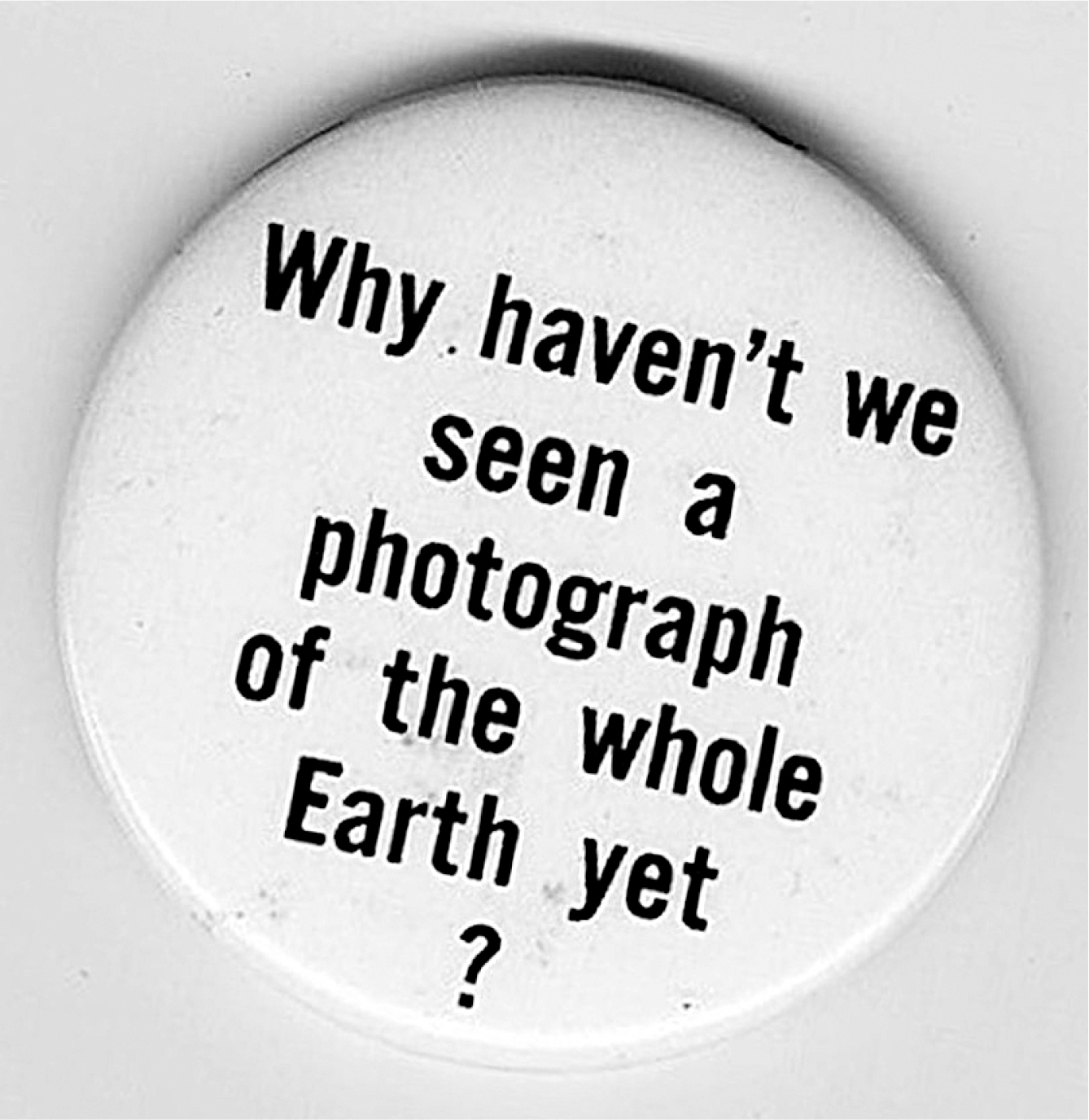
Stewart Brand issues a challenge.
Brand was using the cheapest, tiniest form factor (a button?) to penetrate an air space filled with TV shows, ad campaigns, cereal boxes, billboards, coffee table magazines, and all that mass marketing on mass media. The nerve of the guy! Persuading a government bureaucracy to do something really hard and a little odd with a button that was badly edited, crudely made, and sold by hand in batches of one for a quarter. Yeah, right.
NASA finally took the photo in January of 1967. Brand used it as the cover for his next project, the Whole Earth Catalog. The Catalog was published several times between 1968 and 1972 and occasionally thereafter until 1998. It was a collection of practical things: diagrams, agricultural devices, tools, machines, seeds. In the words of New Yorker scribe Anna Wiener, it expressed “pioneer rhetoric, the celebration of individualism, the disdain for government and social institutions, the elision of power structures, the hubris of youth.”6 It was meant to encourage the reader in a liberal self-definition, a libertarian self-sufficiency, and a DIY presumption that the world wasn’t really all that hard. (I mean, if you could use a button to get NASA to take a picture from outer space…)
This work was designed in part to soothe the hippie beast. As Walter Isaacson noted in his book The Innovators:
The underlying premise was that a love of the earth and a love of technology could coexist, that hippies should make common cause with engineers, and that the future should be a festival where a.c. outlets would be provided.7
But if the Whole Earth Catalog looked back to hippies who were now in danger of losing touch with the wagon train of contemporary culture, it also looked forward to the personal computer revolutionaries who were well out ahead of it. (The Catalog wowed Steve Jobs and the founders of Airbnb, Stripe, and Facebook, to name a few.8) Brand was nothing if not fluid and multidimensional. He was various, not in that child-of-the-universe “look I’m a tree, now I’m a sunset” fashion of the moment, but as a creature of real multiplicity.
In fact, it’s hard to find evidence of Brand ever repudiating anything. And this at a time when repudiating something was precisely the way you joined the counterculture and fashioned your identity. No, Brand kept everything—the Stanford training, the Army learning, the Merry Prankster bus rides, the rooftop visions—and kept going. In the late ’60s and ’70s, this meant he was visiting the emerging centers of computer research. His breadth of vision allowed him to see a possibility others missed: that what the communes were failing “to accomplish, the computers would complete.”9 That heady optimism is now hard to summon, but Brand in the 1960s could see it clearly before others could see at all.
The Whole Earth Catalog, that “way out” for hippies, became a “way in” for the computer geeks of Menlo Park. In the words of David Brooks, Brand “helped give tech a moral ethos, a group identity, a sense of itself as a transformational force for good.”10
Today, Brand is occasionally criticized as a friend of capitalism and, gasp, individualism. (This is an odd charge to bring against someone who might as well be the poster child for individualism.) To quote more fully from the New Yorker piece:
Certain elements of the “Whole Earth Catalog” haven’t aged particularly well: the pioneer rhetoric, the celebration of individualism, the disdain for government and social institutions, the elision of power structures, the hubris of youth.11
Surely, this is ingratitude when directed against someone who gave us not just the Whole Earth Catalog but also the Trips Festivals, the CoEvolution Quarterly, the Hackers Conference, The WELL, Global Business Network, and the Long Now Foundation. Oh, and saved hippies. Ms. Wiener, please. (Talk about the hubris of youth.)
This is what Brand gives the artisan: a demonstration of what can happen once we step out of our endless cycle of self-reproach and forgetting. This is a deep piece of the evolutionary grammar of American culture. It’s almost as if we can’t move forward without scorning our past. (This is indeed precisely what Wiener was doing for the New Yorker.) Too often, this leaves us forgetting what we know, willing a naïveté, and insisting on a clean slate when there remains a lot of wisdom on the existing one. Multiplicity is a Brandian gift and an artisan endowment. Why not use every bit of who you are, and what you know, in your work and art?
MARK FRAUENFELDER
Mark Frauenfelder can be seen as a lineal descendant of Stewart Brand. He’s the editor-in-chief of a magazine (called Make), the co-owner of a blog (called Boing Boing), the founder of an event series (called Maker Faire), and he now works in an organization that resembles the Long Now (called the Institute for the Future). Publication in print, publication online, events, institutions cantilevered out into the future, and a feverish engagement with the world, it’s all so very Brandian.
If Stewart Brand was proof of concept, Mark Frauenfelder is proof of practical possibility. And he is utterly and unapologetically post-hippie. The DIY ethos matters to him because it helps us “become more mindful of our daily activities, more appreciative of what we have, and more engaged with the systems and things that keep us alive and well.”12 Hippies wanted to see beneath surfaces in search of truth. Frauenfelder wanted to see beneath them in a search of a system. It’s a difference that makes a difference. One looks away from the world, the other into it.
The Frauenfelder vision is anti-hippie in a second way. He describes a visit with friends Julian Darley and Celine Rich, founders of the Post Carbon Institute:
They weren’t blindly optimistic about going back to the land. Instead, they approached the problem as amateur scientists, using their garden and workshop as a laboratory to test tools and technologies that might help people live in a world without cheap energy.13
Unlike hippies, the Mark Frauenfelder crew accept that the world has been shaped by the industrial revolution. Indeed, it is precisely this revolution that gives the DIY crew a puzzle to investigate and a method with which to work. The puzzle: the systems that keep us “alive and well.” What are they? How can we use them? Could we do them ourselves? The method: mastering technologies and teaching the old dog new tricks. There is absolutely no “crash the truck” reflex here.
By the advent of DIY revolution, the industrial revolution was four or five centuries old. Machines were fully installed in the domestic world and our personal lives. They were now responsible for producing and preparing more and more of our diet. They were in our kitchens, garages, and living rooms. We were as gods, equipped with a push button.
Strangely, almost inexplicably, this marked a hiatus in our enthusiasm for the industrial regime. It was as if Baby Boomers said of tech, “Too close for comfort!” And when the hippie trickster bus drove past, they said, “Perfect. We can go back to the land. We can escape our technological nirvana. We can turn the clock back and pretend our industrial perfection never happened.”
The gleam of that industrial perfection was already fading. At the very moment it was being celebrated by the people of the barbecue, their children were saying, “Absolutely not. We want to go back to nature. We want to go back to tribalism. Let’s get out of here.”
So Mark Frauenfelder and company had their work cut out for them. They wanted to revive the industrial after its hippie repudiation, even as they found a way to diminish, control, and reform it. They did this by splicing DNA from homo faber with that of homo ludens, in a laboratory accomplishment that would do much to shape the artisan.
Homo faber (forgive the sexist formula, please) is “man the maker.” This creature knows the world by manipulating the world, by working with materials, seeking out combinations, creating mechanics in the production of outcomes. In the DIY version, this is a very manual way to know the world that wore its mechanisms on the outside, there for view, inspection, manipulation.
This homo faber learns by doing. This is often my experience of something new. It’s only when I begin to use it that I begin to understand it. Or, better, I have to grasp it to grasp it. The DIY crew expect to see the mechanics of the thing and to work with those manually.
The DIY crew think of the world as a lab bench or the bricoleur’s backyard. What’s here? What can I do with what’s here? What can I make happen? I remember reading about women who figured out a way to feed the dog in her apartment when she was going to be late getting home. The idea, and the tech, is now available to everyone at Maker Pro.14
One of earliest hacks was the Trojan room coffeepot created at the University of Cambridge in 1993.15 This took a picture of the coffeepot and put it on the web, where it could be seen by Cambridge coders too lazy to walk to the end of the hall to have a look for themselves. The BBC gives us a more noble account: “[The Trojan room coffeepot] removed the need for any physical effort to check the coffee pot, and avoided the emotional distress of turning up to find it empty.”
The Trojan room coffeepot charmed us because it was so completely pointless. Surely, it would be simpler to walk to the end of the hall and check, no? Plus, the coffeepot photo was so monstrously inefficient, insisting as it did on taking the long way around. A signal had to leap from a web camera onto the internet and find its way back again to computers just feet away. Who could keep from smiling at this combination of the breathtakingly possible and the completely unnecessary?
This is where homo faber begins to elide into homo ludens, “man the player.” The bible here for anthropologists is Johan Huizinga’s Homo Ludens: A Study of the Play-Element in Culture. Huizinga wanted us to see how much of human activity exists not for a practical purpose, but entirely for the heck of it. Released from necessity and practicality, most people (except, it turns out, Canadian bureaucrats) begin to make stuff up, easily and continuously and very, very happily. I was once in a brainstorm and sitting, it turned out, next to a banker. Oh dear God, I thought, this is going to be a long day. I was wrong. Within minutes she had entered Huizinga’s state of play and was producing one brilliant idea after another.
Usually, there is a contest between these two creatures. Homo faber, on the one hand, tends to prize efficiency, precision, and rationality. She looks for the shortest distance between two points. She scorns things that do not cut to the chase and go straight to the problem.
Homo ludens, on the other hand, are interested in the imaginatively and intellectually possible. Is this shimmering thought a good idea? Can it survive in the world without the oxygen supplied by the brainstorm? Homo ludens don’t care. It’s enough that the idea exists, animating the world with possibilities, pushing people out of the proverbial box, releasing us from what the American anthropologist Clifford Geertz called the dead hand of competence and the recitation of the indubitable.16
They look mutually exclusive, but in fact, as Mark Frauenfelder shows, homo faber and homo ludens can coexist. In fact, there is no Trojan room coffeepot without the two of them working together.
The ultimate combination of the two came in the form of Rube Goldberg. Mr. Goldberg (1883–1970) was an engineer and a cartoonist.17 He enjoyed enormous popularity in the first half of the twentieth century for the depiction of his fantastically complicated devices.18
By the 1950s, Goldberg and his cartoon creations were scorned as old-fashioned and just plain weird.19 In a world of push buttons and brand-new kitchen appliances, Rube’s technology looked gauche and pointless.
Then came the 1990s. Rube was back. His machines were everywhere—in dorm rooms, engineering competitions, music videos (OK GO), ads (Honda), and TV shows (MythBusters and Elementary).20 Suddenly we were smitten by machines that threw unlikely parts into implausible combinations in a near-miss universe threatened constantly by pandemonium. We were in love with Rube again. Rube somehow “got us.”
But, dude, like, why? We are well past hippie repudiation. We accept that tech must matter. Perhaps it’s that we now suspect that tech matters too much. Thanks to the digital revolution, technology has gone from more or less dependable to almost always faultless. (FedEx delivers 6 million packages a day. When was the last time it lost one of yours?) We have only to think of something we need and, fourteen keystrokes later, it’s on order at Amazon and, two days later, sitting on our doorstep. Digitally augmented, the machine is magnificent.21
That’s why we love Rube Goldberg machines. They are so improbable in design, so tempting of failure. Our love of his machines reflects ingratitude born of anxiety. Something perfect in them is at odds with something in us. Years ago, I walked into a record store in Toronto. They were playing Bach on one of the first digital compact discs. “Listen to that,” I said. “It’s perfect.” My friend paused and frowned. “Too perfect.”
Right, I thought. Too perfect. Poor us.
Imperfection is now all the rage. That’s why we love Rube’s machines, tempting disorder at every handoff. And as the machines get ever more perfect, imperfection has become our difference, our signature. Or, well, it has to be. We will never again be as efficient as the machines. We might as well make imperfection our difference. It’s how we do. We muddle through. We bumble on. C’est nous.
As the world is increasingly managed by digital perfection, the more we come to look like the odd ones out. Increasingly it looks like our world is actually the machine’s world.
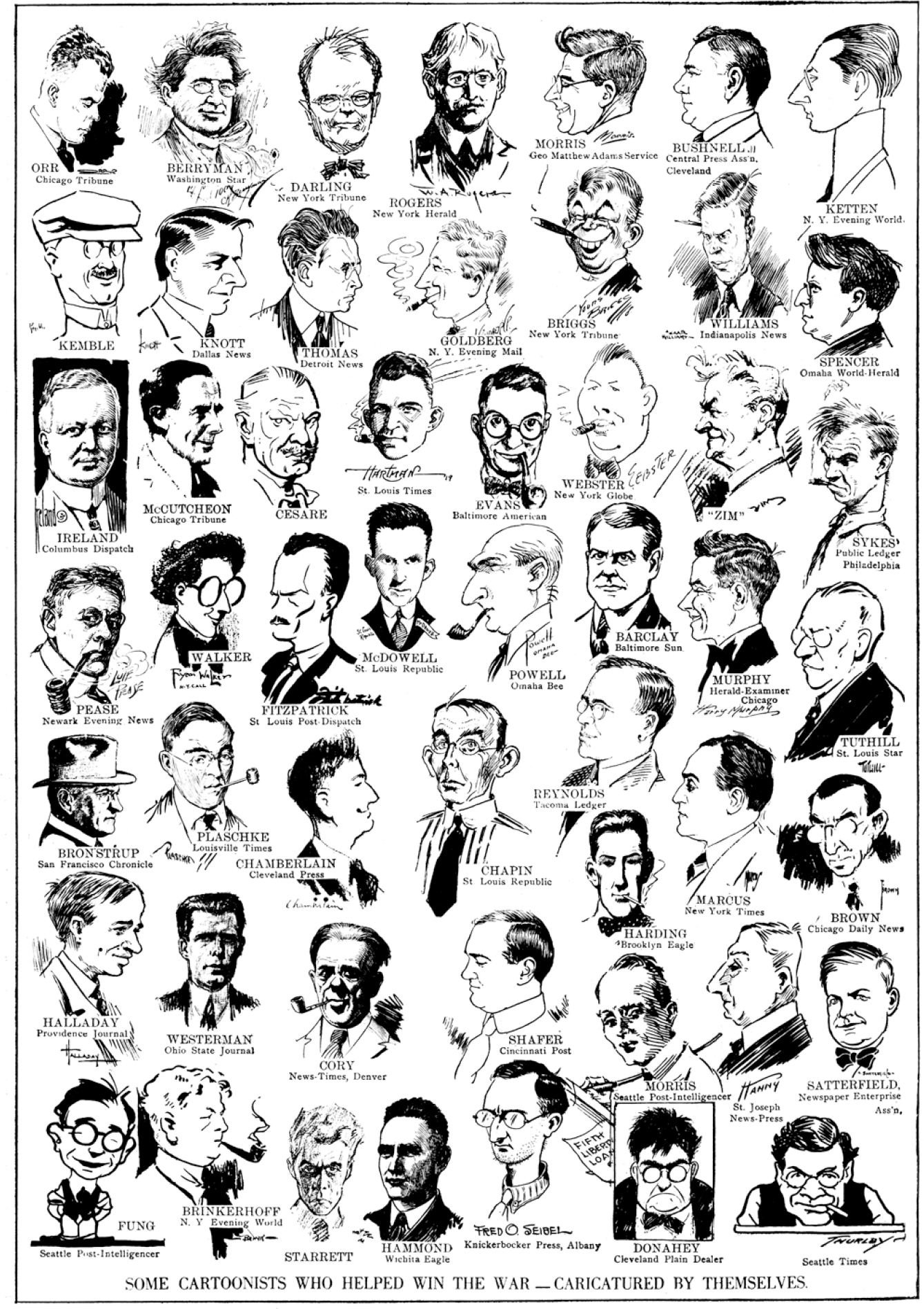
Rube Goldberg shows himself inking the air with a smoking pen.
Imperfection is back in fashion. Even, God save us, for engineers. Jordan Vallejo of the Purdue Society of Professional Engineers was asked to identify her biggest challenge when making Rube Goldberg machines. She said:
It’s becoming harder to make these machines humorous and playful, but it’s important to try. A lot of people think of engineering as a very serious career. Which it is! But it’s important to take things lightly, to laugh, to learn from mistakes.22
That sound you hear is generations of engineers turning in their graves. Mistakes? Engineers don’t make mistakes or, as Jack Nicholson says in A Few Good Men, people die. The idea that even engineers must show how lighthearted and playful they are tells us something about the world we live in now. Homo faber used to prevail. Now she must share the stage with creatures kooky and charming who help us learn from their mistakes.
So Mark Frauenfelder is riding a wave. DIY matters because it is an excellent way to embrace things that are defined by their imperfection, their near misses, their “OMG, I can’t believe this thing actually works.” But most of all, what matters about DIY tech is that we think with it, we tinker with it, we put it together, we do it ourselves. And this puts humans back in the driver’s seat. Whew.
ALICE WATERS
Alice Waters opened her restaurant Chez Panisse in Berkeley in 1971. Inevitably, it became associated with the hippie moment. But it was also going to be an experiment within the experiment. Having studied French culture at UC Berkeley and lived in France, Waters could see culinary possibilities beyond tofu, tempeh, and avocados.
The first order of business was to redefine food:
[An] ideal was coming to fruition—French techniques pepped up with jazzy improvisation, bright-flavored and utterly fresh California ingredients, purity of flavor, simplicity of presentation, seasonality. This was the birth of what came to be called California cuisine.23
Beneath the cuisine were new principles: local ingredients, grown organically, harvested in season, taken straight to market, unadulterated by preservatives or industrial intervention. In a perfect world, the supply chain was a partnership, farmers working with chefs working with patrons, all committed not just to better dining but a new vision of food and society.
The restaurant was not an inevitable success. As Thomas McNamee puts it in his Alice Waters and Chez Panisse,
How the slapdash, make-it-up-as-we-go-along little hangout and its harried mistress became such icons is a story of adventure, misadventure, unintended consequences, steel will, pure chance, and utterly unrealistic visions. The characters who thread through its history range from hedonists to Machiavellian careerists, from the crazy to the coolly rationalist; nearly all have been driven by passion, passion sometimes so fierce as to be blind. The road Chez Panisse has traveled from there to here is neither straight nor smooth. It is potholed, booby-trapped, cliff-hanging, devil-daring, sometimes not quite a road at all.24
The rise to greatness can be seen in the press coverage. The first plaudits appeared in the late 1970s. By the middle 1980s the New York Times was prepared to celebrate Alice Waters for “revolutionizing American cooking.” In 2001, Gourmet magazine declared Chez Panisse the “best restaurant in the US.” Pretty good for a “slapdash, make-it-up-as-we-go-along little hangout.”25
The hippie revolution was a groundswell. News traveled not so much by word of mouth as line of sight. Sometime in the middle ’60s you could see new eddies forming everywhere in the fashion pond. Fabrics, colors, and styles of clothing were changing. Everyone seemed to be growing their hair long or at least “out.” The hippie thing came up through the aquifer. Suddenly it was there.
Adopting the new look was easy. All we really needed to do was devolve, to repudiate fashion, propriety, status aspiration. The trick was to stop acting like the barbecue people and forsake those brush cuts and A-line dresses.
But the Chez Panisse revolution was different. It had to reach us by stages. It had to find its way out of Berkeley, a secret message traveling as if a sacred message, passing from one person to the next.
The Chez Panisse conversion called for knowledge and cultivation. It demanded that neophytes learn before attempting to teach. The restaurant might look like a funky old house on Shattuck Avenue embraced by a bunya pine. But it was also a seminary, sending waves of zealots into the world.
In fact, getting the message out of Berkeley was actually going to take an ecosystem of collaborators, what Paul Freeman calls a “network of chefs, activists, investors, and food enthusiasts.”26
At the creative core of the network were Alice and her several collaborators and competitors, including: Danny Meyer, Ruth Reichl, Thomas Keller, Jeremiah Tower, James Beard, Mark Miller, Wolfgang Puck, David Bouley, Michael Pollan, Mark Bittman, and Jamie Oliver, among others.
There followed ten waves.