
6
ARTISANS BEFORE COVID
In August of 2008, Epson introduced a new line of printers.1 They claimed it set “new standards in image customization and quality.” They called it their “Artisan line.” The response was overwhelming. One could hear the nation saying, “Artisan printers? Oh, please, that is so dumb.”
But even boneheaded marketing can signal something. Apparently, the artisan idea was now so far above the novelty horizon that it was visible even to the people who made printers, and so resonant in our culture that it was useful even to those who sold them.
Alice Waters ignited her part of the revolution with the founding of Chez Panisse in 1971. Her diaspora of chefs then spilled across America, all those charismatic men and women, dropping by tables at their restaurants to press the flesh and baptize the novitiate. Lo! Patrons were now foodies, and these foodies made a second, larger diaspora, leaving restaurants to create new diets for their kids. For over thirty years, the artisan idea was the little engine that could, making its way out of the wilds of Northern California into an ever-larger world.
So it ends up on a line of printers. Worse things have happened to noble missions. And if this is any consolation, the trend had just discovered yet another diasporic partner. The oldest boomer was sixty-two and now at war with aging, which meant getting serious about health, which meant getting serious about diet. Increasingly, boomers were all about it when it came to wellness eating. They could be relied upon to turn up at a barbecue and say things like, “Have you ever noticed how much sugar you drink?”
There are 93 million boomers in America. Even if only 30 percent of them underwent an “artisan redemption,” this would be very good for the artisan. Plus, they are busybody know-it-alls and therefore effective diffusion agents. Indeed, by this time they were hounding their own children to feed their grandchildren better. Chances were Gens X, Y, and Z had already gotten the message. The younger you were, the more likely you were to think that eating vegan was not a fringe activity but a sensible idea. The artisan message was storming the nation. In 2011, Dana Steinberg was prepared to offer this deeply optimistic view:
The food system in the United States is undergoing a remarkable shift. The revival of small farms and artisanal producers has generated new partnerships with restaurants, institutional food services, and retail outlets to make locally sourced, sustainably produced food more widely available. This shift has stimulated, and is now responding to, a growing demand from health-conscious consumers in ways that are affecting America’s economy as well as its eating habits and well-being.2
But we shouldn’t go too far. In 2009, there were only thirty-five hundred CSA initiatives.3 This figure tells us that CSAs had yet to capture a significant place in the imagination of American consumers or a place of any significance in the economy. (This despite the fact that it was a very useful way of sustaining organic farms, an important staging area of the movement.) This key piece of the artisanal idea was active but not well distributed.
The artisan movement had transformed places like Brooklyn and Boulder. It had changed certain restaurants and bars. But had it touched the lives of people in the mainstream? Insisting on kale in 2008 didn’t prove anything. American lives are constantly touched by the fads and fashions born in someone else’s cultural galaxy. We embrace them merely to remain au courant, to “go with the flow.”
Still, the artisanal revolution was conspicuous enough to draw the attention of industry. In 2010, an anonymous observer said:
This year, big business continued to follow the foodie dollar, co-opting and transforming the language of the culinary crowd. A few years ago they swarmed the once-crunchy cottage organic industry. Then everyone from Whole Foods to Wal-Mart latched on to the “local” label. When the Big Foods of the world made Frito-Lay’s Tostitos from “Artisan Recipes” and Sargento shredded cheeses from “Artisan Blends” (all trademarked, of course), you know the term lost its credibility.4
The artisanal movement had attracted the attention of marketers keen to get in on the trend. This is a bad place for a trend to be: merely acknowledged by consumers and now more and more fully exploited by marketers.
A couple of years later, the novelist and essayist Jen Doll took a look at the artisan trend transforming the worlds she knew in Brooklyn and upstate New York. Her first reaction was to suggest that the artisanal trend was overexposed. She wrote an obit in The Atlantic. It begins:
Artisanal, a word that fought early in his career to ensure recognition of craftsmen for their important contributions to society before later being drafted into the creation of a worldwide gourmet branding glut, died Wednesday.5
Every long-form journalist has a hunting license. All of them want to be the first to bag a new trend, the first to see it coming into or going out of fashion. There are bragging rights and book deals for those who get it right and almost no penalty for those who get it wrong. So Jen Doll may have been reaching, but as we have seen, she wasn’t far off. The artisanal trend was both undersubscribed and overexposed. Life was hard. Doll’s proposition: surely, it must also be short.
A year later, Jen Doll herself supplied an answer. She declared that the artisanal trend was not exhausted, not exploited, not in fact dead. Tongue still firmly in cheek, Doll was now prepared to rescind the obit she had written the year before:
Artisanal has a radioactive half-life so powerful that it could for years sustain full-fledged underground communities of humans making bread from hand-picked cornhusks and locally sifted flour. Artisanal is not dead, it’s undead, a whole food zombie running around feasting on artisanal brains. Artisanal, regardless of an organic beefsteak tomato through the heart or a hand-hewn bamboo stick to the brain, is eternal. Eternally damned, maybe, but sticking around and torturing us nonetheless.6
Well, this is perhaps not a complete recantation. The artisanal thing was not dead, but undead. This clever recovery hints at a larger development. By 2013, the artisanal trend had managed to install itself as an enduring part of our culture.
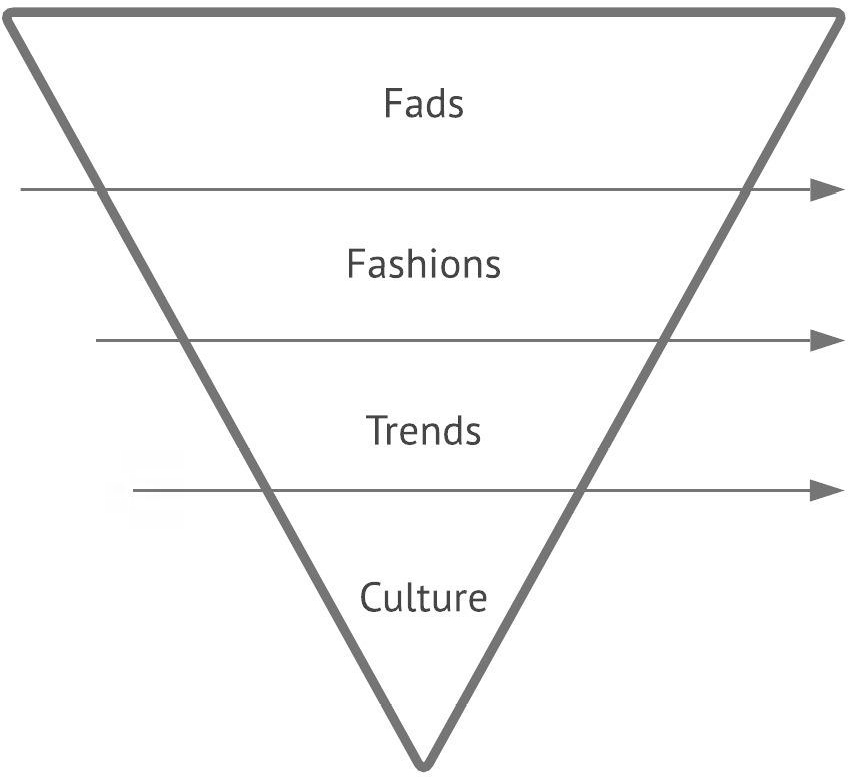
How some innovations settle into culture.
And that culture teems with change. A river runs through us. At the top, there is a flood of fads. They come whistling out of the worlds of music, design, dance, architecture, movies, TV. And most of them just keep going. They pour through. A few prove to be keepers, and they settle. Indeed, we could think of our culture as a settling tank. Most fads keep going, but a few stick around. They have weight. They capture interest. Some of these fads settle to become fashions; some of these fashions settle to become trends; some of these trends settle to become cultural realities. A year after her obit, Jenn could see that settling tank at work. The artisanal trend was increasingly a feature of our culture, here for the longer term, but not, of course, forever. (Because in our culture especially, nothing is forever.)
This was good news for several reasons. The Harvard economist Larry Katz could see the artisanal movement might be one answer to the employment crisis now upon us. He figures that “good” middle-class jobs might come from the reemergence of artisans. PBS’s Paul Solman asked whether Brooklyn hipsters could help save the middle class. Ward picked up the refrain.7 It was also true that people are beginning to question traditional career arcs, the ones that took you out of college into a city to pursue a glorious professional career.8 For many in Gens Y and Z, it was beginning to look like these traditional careers would not be forthcoming. In an article called “The (Not So) Simple Life” a woman called Alissa Morris is quoted as saying:
“People are starting to realize that they are detached from their food, priced out of real estate, and can’t obtain any sort of American dream unless they make a major move.”9
Here two problems, food and career, combine to inspire a move out of the city to the countryside. But of course this made sense. Who would want to suffer underemployment in the city when an artisanal life in the small town or the countryside held out the promise of new careers and styles of life?
It was no easy task liberating a diet that had been taken captive by Mad Men marketing and every “taste breakthrough” of which the food industry was capable. But the word was out. The revolution was in play. Things were beginning to change. And by the second decade of the century, the changes were marked:
On average, American adults now eat more whole grains, nuts, and seeds, and they drink less soda…. But we’re not eating any more fruits and vegetables than we used to, nor less salt, saturated fat, or processed meats, such as hot dogs and bologna. Plus, while Americans of various races and income levels improved their diets over the last 15 years, richer, better-educated, white Americans improved the most, widening the gap between the country’s privileged and underserved.10
By 2019, virtually all of the artisanal food indicators were up. Livestock and poultry products stood at $2.5 billion, up 12 percent. Vegetables at $2 billion, up 27 percent. Fruits at $2 billion, up 44 percent. Livestock and poultry at $1.6 billion, up 44 percent. Field crops $1.2 billion, up 70 percent. Some $2.04 billion in organic products were sold to retail. Another $300 million were sold directly at farmer’s markets, on-farm stores and stands, roadside stands or stores, u-pick, community supported agriculture farms, and online markets. The conventional retail channel was carrying more organic products and less conventional channels were growing too. This made for fatter margins for the farmer. And by most accounts this was still critical as farms struggled to survive.11
So much for the organic artisanal. The growth and new stability of handmade artisanal is even more remarkable. We can use Etsy as our rough measure, and the stats there are striking. After Etsy was founded in 2005, the early days were rocky. But the second decade of the century shows tremendous growth.
The number of active buyers rises from 10 million in 2012 to 40 million in 2018. The number of sellers doubles (roughly from 1 million to 2 million). By 2019, there were 60 million products listed for sale. The percentage of sales from outside the United States now stood at 34 percent, which means artisans now had access to large international markets. And perhaps most important, 92 percent of Etsy buyers felt they couldn’t find Etsy products anywhere else.12
Several trends were responsible for Etsy’s astonishing growth, but one was perhaps key. Personalized, customized, individualized goods mattered more and more as the kind of thing people wanted to own, and they really mattered as the kind of thing people wanted to give as gifts. Artisans were the obvious beneficiary of this trend. After all, it was they who had helped create the idea and launch the reality. The movement was beginning to harvest the world it helped create.
THE COVID MOMENT
The arrival of COVID-19 in 2020 transformed the American economy and culture in many ways. It was manifestly bad for hotels, airlines, restaurants, anyone who supplied restaurants, performing arts, live music, gyms, and country fairs. It was (mostly) good for people who were selling online or could seize new opportunities there. (Etsy-based artisans were quick to bring face masks to market; at their height, masks made up a tenth of all Etsy sales.)13 To say COVID was a mixed blessing would be an understatement.
But in one way COVID was unambiguously good news for the artisanal movement. People began to flee the city for suburbs, exurbs, small towns, and the countryside. By some estimates, three hundred thousand people left New York City, heading to upstate New York and the far end of Long Island. Sometimes this meant merely activating summer homes. Sometimes it meant renting. Sometimes it meant purchase. For all, it meant giving up their treasured city, at least for a while.
Most of these people were not migrants. They had no intention of staying. After all, a real New Yorker scorned the idea of the “bridge and tunnel” world beyond the city. This was the world God created for suburbanites, “breeders,” the weak of head and heart, people without real cultural currency, those who choose to wallow in the wasteland of popular culture.
Bridge and tunnel is the world so heartlessly captured by Christopher Guest in Waiting for Guffman. In this “mockumentary,” Guest gives us a town called Blaine, Missouri, a place were everyone is a clueless hick except for one man, Corky St. Clair. Corky is in fact a total dunce. Corky has failed to make it on Broadway and returned to Blaine to start again. Poor Corky. When he realizes that Blaine too must betray him, he lashes out.
“And I’ll tell you why I can’t put up with you people: because you’re bastard people! That’s what you are! You’re just bastard people!”14
In a culture where expressions of outrage are crafted for us by the best writers in Hollywood, “bastard people” seems a little ineffectual. This was Guest’s point exactly. In bridge and tunnel world, people aren’t really very good at anything. They can’t even manage convincing indignation.
The bridge and tunnel stereotype had long kept New Yorkers in place, in check, at home. Things could get very bad in the city—you could lose your job. You could fail to complete that novel or win that contract. But until you actually left the city, you were still a New Yorker, an insider. You were not yet Corky St. Clair.
The artisanal movement managed to shift this stereotype. It helped us see small towns and the countryside as a virtuous choice, instead of a Corky-scale failure. With the artisanal lens in place, the world outside of New York City became a more attractive place. Human scale, handmade, historical, authentic, kinder, gentler, less competitive. Quite suddenly, bridges and tunnels were less a source of shame than a method of escape.
But it wasn’t just COVID, of course. Thanks to broadband and apps like Zoom, it was of course possible to live anywhere. And for the many New Yorkers confined to tiny apartments, the city was the last place they wanted to be. Besides which, the city was growing more violent. Over the July Fourth weekend of 2020, sixty-four people were shot and eleven killed. August was even worse. By September, financial firms and big Midtown companies were pleading with Mayor Bill de Blasio to do something.15 Eventually, he did. He cut funding to the police.16
Some people began to hear echoes of the 1970s and early ’80s, when the city suffered from so much unemployment and lawlessness that people began to leave, taking their taxes with them and pushing the city into a downward spiral. Fifty years later, New York City appeared poised for yet another fall. Three hundred thousand people left. Fewer people threatened a small tax base, fewer services, and more chaos. This would mean diminished police and fire support. This would mean more crime and chaos. This would mean more flight. A self-renewing cycle had been set in train.17
New Yorkers are perpetual motion machines. And now that New York City was pushing (thanks to COVID and crime) and places like upstate New York were pulling (thanks to the artisanal revolution), departure felt like a compelling option.18
What a gift for the revolution! Every small town got an infusion of people. In the early part of 2020, Litchfield, Connecticut, got two thousand newcomers in a period that would normally bring them sixty.19 Most came bearing the big salaries that can be made in a big city. And virtually all these people had been inducted into the artisanal movement while still living in the city, by the diasporic chefs doing Waters’s work there. They were newcomers, but not entirely unwitting when it came to local culture.
This is what every social movement dreams of. New recruits who are sophisticated and well-heeled. For people living in a subsistence economy, barely eking out an artisanal existence, this was water in the desert, manna from heaven. Restaurants flourished. CSAs finally passed their break-even point. Farmer’s markets filled to overflowing. Life was good, or at least better.
But, of course, there is always a tension. The newcomers might grasp the general idea of the artisanal mission, but some of the realities escaped them. They could be rude and clueless. In Winhall, Vermont, the locals were feeling a bit overwhelmed:
The post office ran out of available P.O. boxes in mid-June. Electricians and plumbers are booked until Christmas. Complaints about bears have quadrupled. And as far as the [town] dump is concerned, as [one town resident] put it, “the closest word I can tell you is sheer pandemonium.”20
In the worst cases, the newcomers were driving real estate prices up and old-timers out. The irony was palpable. Writing from the small town of Kingston, New York, Sara B. Franklin warned of the “potential loss of people who’ve kept our community vibrantly diverse, not to mention alive and functioning.”21
Still. The COVID moment brought together people with taste, money, and commitment with locals who had been making small towns and artisanal economies work for generations. Sometimes it worked; sometimes it didn’t. But generally speaking, the artisanal movement was massively augmented.
The key question was whether the newcomers would stay. And this depended on a series of smaller questions. Would they put down roots? Would they “take” to life outside the big city? Would their employers let them stay, or would they call everyone back to headquarters the moment it was safe to do so?
I did a research project on American families in the COVID era.22 Mothers were clear on whether they wanted to go back to work outside the home. For most, the answer was a resounding “no.” These women now had proof that they could work from home. And now that they were working from home, they looked back at the pre-COVID era with a sense of puzzlement.
“Why was it,” one of them asked me, “that we had to spend all that time commuting, all that time on our clothing and hair, all that time in the office with lots of empty engagements and pointless meetings? For what?” In the ensuing conversation, some women were prepared to entertain the suspicion that work had been a kind of “theater.” This had nothing to do with functionality or practicality. My respondents thought something else was going on. One of them said:
I think it must be men. Women can do lots of things at the same time. We can work at home. We can manage a family. It’s men who need to have a separate time and place to work. They need a box to work in. It’s also a question of ego. Men like to see cars in the parking lots. Why do women go into the office? They do it to satisfy male egos in the C suite.
But it was not just women who took this point of view. The New York Times talked to a guy who gave up his home in LA and bought a place in Vermont. Apparently, Jonny Hawton “finds it hard to conceive of returning to his old commuter lifestyle, which allowed him only an hour a day with his 1-year-old daughter.”
If someone told me I had to go back to do that tomorrow, I don’t know what I would do,” he said. “It’s almost like we were in a trance that everyone went along with. I used to see Millie for an hour a day. This whole crisis has kind of hit the reset button for a lot of people, made them question the things they sacrificed for work.23
These folks will want to stay outside the city, and they are prepared to make extraordinary sacrifices to do so. The research told me that these women had used the time saved in the COVID era to change their families, to get to know their kids better, to build new relationships with their daughters, to restructure mealtime, and to give the family new centrality. At one point I thought I was looking at the possibility of the emergence of a more fully, more emphatically matrifocal family.24
The economist Jed Kolko is right to call for caution: “How people behave in a pandemic is probably not a great guide to how they want to live their lives in normal times. We are living in the middle of a grand forced experiment, but we really don’t know how the experiment is going to play out.”25
But there are plenty of reasons people might want to remain out of the city. For some, living in the country completes their artisanal redemption. Others were anchored in the fundamental changes in family wrought by the COVID disruption. It’s worth pointing out that these changes are almost always invisible to the economist and the C-suite. This means they will be invisible to corporate America, at least for a while.
We can say this much with relative confidence: the artisanal revolution started by Alice Waters in the late ’60s was brought to maturity by the COVID migration. For many artisans, there was now enough wealth and scale to promote the experiment beyond subsistence and at least suggest the possibility that the artisanal approach was now thoroughly installed in American life. More to the point, the migrants brought with them pools of talent, wealth, know-how, and network connections that could only enrich the artisanal hinterland. For the artisan who needed legal, strategic marketing, or innovation help, it was now just down the street, and possibly even free.
ARTISANS AFTER COVID
Much of what we do, and who we are, will be changed by COVID. As Kolko says, it is hard to know what awaits us. But what I want to do in this section is discuss one tempting scenario: that artisans could be our future.
Of course, caution is called for. It’s very possible that the new normal will look very like the old normal. We will go back to work. Cities will return to form. It will take a Studio 54–level blowout to get the COVID period out of our system, but then we will get over it. It will take months, perhaps years, to restore our economy, but this, too, will happen. Even our institutions of higher education will return to something like normal.
I grant this possibility, but I want to at least entertain an alternative future. This one says change is coming, from an artisanal direction. Consider the following scenario. (I offer it not as a perfect prediction, but so that we prepare ourselves for a situation that, should it arrive, will be less painful and more manageable for our opportunity to think it through.)26
RECRUITING MILLENNIALS
Millennials and Gen Z (hereafter “millennials” for short) have on the whole been refused a berth on the industrial economy. This was a trend long before COVID, but it has been greatly accelerated. We will see millennials acting as both a cause and an effect of our artisanal future.
Millennials made extraordinary efforts to get into college. Some of them set aside completely the “youth culture” available to (some in) previous generations. They came out of their undergraduate experience burdened by enormous debt. They competed once more for places in graduate schools, law schools, and business schools, amassing even more debt, only to discover that these did not guarantee them jobs. The digital revolution was shrinking the accounting, financial, and legal professions. Houses were expensive. Children were expensive. This generation felt the effects of the 9/11 attacks and then a succession of recessions, one of them so bad it was called the Great Recession. All this misfortune piled up. The Washington Post wondered if millennials might be “the unluckiest generation in U.S. history.”27
Then came COVID. The Wall Street Journal put the bad news in a headline: “Millennials Slammed by Second Financial Crisis Fall Even Further Behind”:
The economic fallout of the Covid pandemic has been harder on millennials, who are already indebted and a step behind on the career ladder from the last financial crisis. This second pummeling could keep them from accruing the wealth of older generations.28
Who wanted a conventional career path when it now looked like pushing a boulder up a very high hill? How tempting to find a craft or a creative process that might set you free. The artisan does this beautifully. All of the definitions we noted in chapter 5 can be read as an opportunity to walk away from the middle-class existence. I am not suggesting that the artisan movement was crafted for this purpose, just that it can work this way.
HELP FROM A DECENTRALIZING AMERICA
American cities were already losing their allure before COVID. Sabrina Tavernise and Sarah Mervosh found that New York, Los Angeles, and Chicago had all lost population over the last few years. Even before COVID, millennials were choosing places like Tucson, Raleigh, and Columbus, as well as exurbs and newer suburbs outside large cities.29 With COVID, New Yorkers were particularly keen to get out of the city in what Forbes called “droves.”30
In the end, COVID would injure all parts of the American experiment, but it would affect the city first and foremost:
Now, as local leaders contemplate how to reopen, the future of life in America’s biggest, most dense cities is unclear. Mayors are already warning of precipitous drops in tax revenue from joblessness. Public spaces like parks and buses, the central arteries of urban life, have become danger zones. And with vast numbers of professionals now working remotely, some may reconsider whether they need to live in the middle of a big city after all.31
The exodus was being driven by two much larger trends: the career crisis experienced by young people and the deteriorating state of the cities themselves.
HELP FROM A DECLINE OF CONSUMPTION
But this was just for starters. There were other trends at work. We can see the decline of traditional standards of consumption. I see this in my ethnographic interviews. People tell me that conspicuous consumption is too, well, conspicuous and therefore to be avoided. Showing off, once that great American pastime, is now frowned upon. Or to use a new phrase, if you must brag, do it humbly.32
This comes through especially in the new trend known as “normcore.” The term was created by a trend-forecasting collective called K-HOLE. Fiona Duncan describes normcore fashion as
“ardently ordinary clothes. Mall clothes. Blank clothes. The kind of dad-brand non-style you might have once associated with Jerry Seinfeld, but transposed onto a Cooper Union student with William Gibson glasses.”33
This was a wild act of repudiation. So much of American culture and the American economy had centered on declaring one’s specialness. To dress in a manner “ardently ordinary” really was to tip things over. Fashion was about claiming some membership, some difference, and the possession of wealth, taste, and discernment. To wear ordinary clothing was simply to step out of American culture. It was also to withhold your dollars from the American economy. But most of all, it signaled a willingness to take your leave of the usual patterns of sociality. What took you away from these drew you closer to the artisanal, if indeed it did not deposit you there.
HELP FROM A DECLINE OF COOL
Perhaps still more radically, we have witnessed, in recent years, the decline of cool. Cool was a withholding of enthusiasm. It was the enemy of sincerity. It was especially keen to distance itself from the mainstream and middle class, anything earnest, eager, or conformist. Cool was the particular possession of youth and a way to scorn creatures of age. Cool kept its distance.
And then quietly, over the last couple of decades, cool began to cease to matter. If it pleases the court, let the record show two quite different social creatures, both of them prepared to betray cool.
Let’s start with Chance the Rapper, an artist at the heart of surely the coolest part of contemporary culture, hip-hop. There may not be anyone cooler than Chance the Rapper. I’m just saying. This guy is massively talented, famous, and loved. And what did he do at the height of his greatness? He wrote a love song to his grandmother. Rock and roll does not normally acknowledge the elderly. In fact, I am certain that the words “grandma” and “grandpa” do not appear anywhere in the hip-hop lexicon or anywhere else, for that matter, in the history of rock and roll.
In a song called “Sunday Candy,” Chance the Rapper writes:
…your grandma ain’t my grandma,
mine’s handmade, pan-fried, sun-dried…34
In “Familiar,” Chance the Rapper heaps scorn upon women who are trying for cool, the ones who turn up in the latest fashion. The key lyric is “forgive me but you look familiar,” and Chance turns the pickup line into criticism. Women grasping for cool are excoriated for their efforts. (Language alert: some of what follows will offend some readers as misogynistic.)
She the latest model but these hoes retros
One in a million, but these bitches special…
But you just so usual, you just look used…35
Cool is scorned. Grandmothers are cherished. Fashionistas are predictable.
Chance the Rapper criticizes his own pursuit of cool. In “Wanna Be Cool,” the lyric runs:
All the confidence I was tryin’ to buy myself
If you don’t like me, fuck it, I’ll be by myself 36
And it’s not just there. We also see the disavowal of cool in the pages of the Times Literary Supplement (TLS) and on its accompanying podcast. Until recently, the editor of both was a man called Stig Abell.
You don’t have to listen to this guy for very long to understand that he is a prodigious talent, that he has read the entire canon, and that he can field virtually any literary topic with gusto and ease. He is, in short, just the kind of guy you would expect to occupy this position. He is a particularly fine token of a distinguished British type.
But the next thing you notice about Abell is that he is no creature of orthodoxy. He openly admits to reading books that are scorned by virtually everybody with literary pretensions. Abell says he reads Lee Child’s Jack Reacher books and, gasp, that he likes them.37
This is really wild. Cheeky even. Most serious people don’t usually read Jack Reacher novels, and if they do they often have the decency to register embarrassment and regret. Most criticism, of any art form, engages in this kind of virtue signaling, meant to show how deeply considered and fine is the critic’s sensibility. After all, membership in the tribe always matters more than the task at hand.
Apparently, Abell can manage without this public performance of the self. He even reads historical fiction, much of which is middlebrow stuff and, well, just not done. (I know you understand this, right? You and I, we’re good?) What we get from Abell, in place of fineness, is boldness. This is not boldness of the competitive kind, the one that stakes a claim to more than its share of a conversation. It’s boldness in aid of clarity, as an act of emphasis.38 (Or put it this way: this is not bold as in personality, but bold as in typeface.) Abell spends no time on identity signaling. Every author, genre, topic, and title is on the table. Curiosity is all, and the starter’s gun has sounded.
What we see in Chance the Rapper and Stig Abell is a repudiation of cool. They do not care that their enthusiasms define them as enthusiasts. They don’t care to signal distance. They are untroubled by the possibility that we might think them suckers for middlebrow fiction or the worship of elders. These guys are earnest in earnest. This makes them perfect fellow travelers for the artisanal movement.
The best symptom of the decline of cool may be the state of cool hunters, a community that once helped organizations find their way in a confusing, chaotic culture. The trouble is that the sky is falling. Where once there were tens of trends, now there are hundreds of them. This is too many for one person, even a sensationally hip person, to keep track of. Now cool hunters can be found running around on airport runways dodging jumbo jetliners with the rest of us.
The three Cs—cities, consumption, and cool—used to keep people out of the artisanal world. It just seemed so folky and clueless. Surely, red-check flannel could only take you so far in the world. Surely, all that manual labor obscured the real opportunity of a contemporary culture, the digital revolution that opened creativity to millions of people. Surely, when so many of us now have the training, the inspiration, and the permission to make our own culture, the artisanal version of DIY, all hammers and tool belts, just seems a little too literal.
Yet, as I will argue in the next chapter, artisans retain a Promethean aura. It does feel like they are doing something extraordinary for contemporary culture. If creativity is now for everyone, the artisans are the ones fashioning a place for this creativity to take up residence. And especially as people stream out of the industrial economy and the big cities, artisans are the ones welcoming them across.
The future has gotten faster, meaner, and less intuitive. And it’s not like we weren’t warned. Joseph A. Schumpeter told us that capitalism inclined naturally toward creative destruction. Alvin Toffler diagnosed our “future shock.” Peter Schwartz pitied organizations trapped in a state of “perpetual surprise.” Clayton Christensen warned of “disruption” of an essential feature of the contemporary world. Nassim Nicholas Taleb told us we must fear “black swans,” changes that so departed from our expectations we could not imagine them. We were warned.39
Taleb is right. There is something out there coming, even for the artisan. It’s hard to imagine, because they are the darlings of the moment. We’re the ones who invented the world, so of course, we perfectly match the world. But this, too, shall pass. The world will move on. The danger here is smugness, which has proven the downfall of every fashion trend, political party, and mighty corporation. Smugness is the beginning of the end.
What is our black swan? It will be a shift in sensibility, a new worldview, a new aesthetic. And it may already have arrived. It might be sitting right under our noses. And we can’t see it, because again we define the moment. Anything that doesn’t look like us must be wrong or, in Taleb’s point of view, invisible.
Ask the celebrity starlet, athlete, or talk show host, the one who just rose to prominence. They are exalted because they don’t just reflect the moment; they define it. But their celebrity must eventually slip away. It will happen by gradual stages. A fickle public will move on. New stars will emerge. These will look like pretenders and the existing stars will dismiss them. But the public will not, and one or two will flourish.
This fall must eventually happen to the artisan. More and more people will cease to care about the artisanal approach. Eventually, even the loyalists drift away. We will end up standing in the parking lot of the Beverly Hilton during the Golden Globe Awards, hoping for an interview. Someone like the TV show TMZ will indulge us, if only to ridicule us: “Hey, Harvey, you’ll never guess who showed up at the Golden Globes!” And everyone will have a good laugh at our expense.
Is there a contender out there now? Almost certainly. My wife and I went to a restaurant in London called Pollen Street Social. It was my birthday. My wife is a foodie. She chose. The meal was a revelation for me. It was like a tabletop laboratory. Our meal came to the table throwing flames and belching smoke. A tiny, controlled disaster. (What better way to celebrate the birthday of an aging anthropologist?) More important, it was miles away from the usual pieties of the artisanal restaurant.
Is this it? Will we be supplanted by the molecular gastronomy movement? Could this be what Chez Panisse was in 1971? Probably not. But this is proof that some black swans are assembling, a change that entirely contradicts our point of view.
It’s hard to see the other challengers, but we can easily see the take-down artists. Virtually the whole of Portlandia, for starters. And Brooklyn has come in for its share of scorn.40 The artisanal feeling for the exquisitely careful choice in coffee and beer is now a target.41 Cultural trends, at the top of their game, present themselves as inevitable. The comics are now giving us a chance to see that the artisan is arbitrary.
So the future is coming, and it won’t have a place for us unless we prepare. Certainly, we should emphasize our strengths. Take, for instance, our gift for making the world homey and cozy. This is one of the ways we show we are anti-industrial. It’s what happens when we commit to the imperfect and the handmade. Cozy has certain values wired into its very scale. It’s hard to treat someone badly when you know you are going to see them again tomorrow at the diner. Finally, cozy is also an excellent way to welcome migrants from the mainstream. It signals that we are a place of sharing and caring, that we exist for the relationship, not the transaction; for the community, not the competition.
But cozy has a danger. It can make us provincial, un-cosmopolitan, narrow, and self-congratulatory. At its base, the artisanal has a world-renouncing impulse, a refusal of what’s happening “out there.” Many of us come to the artisan community not just to avoid alternatives, but to repudiate them.42
And in some ways, this is fair. Every social movement works to make members feel like a group, to make them feel what Goffman called a “we.”43 But it’s a bad thing if it yanks us out of the stream of contemporary life. Recall the hippies in chapter 2 stopping the commune truck by driving it into a tree. Repudiation mustn’t become self-sequestering. We must trade with the world, if only to keep our antibodies up.
Social media is built for this task. YouTube is the raw feed of contemporary culture. It’s an observation platform from which we can engage in a range of social experiments. So is Facebook. For all its relentless missteps, it also helps us see all the new species of social life taking shape in the world, and to build an audience for our own galaxy. And once we have a connection, Twitter helps us stay in touch with friends and fans telegraphically. Instagram is the stage on which we perform, the place we show our latest wares. And when we see the work of someone else in the artisanal community, someone who wows us with their imagination and creativity, social media makes it easy to reach out and make contact. Social media wires us into the world out there and enables to recruit those who might join us.
But there is a second way to preserve a place in the world. And that’s to keep ourselves and our communities porous. We want to emphasize the moral clarity that is our signature, of course we do, but we don’t want to harden our boundaries. The inclination for some artisans is to construct an identity that is monolithic and well armored. This may feel like the path to authenticity, but it is also a surefire way to lock ourselves into a fixed adaptation.
What we want is selfhood and a community that’s porous. This lets things in. It’s almost respiratory. Things come in. Things go out. Freed from single-mindedness and fixity, we can flow with alternatives. We are mobile.
“Multiple selves” turns out to be one of the secrets here. This is a somewhat grand term for the sensation that we are more than one person. The best illustration of this is that thing that happens when you are having lunch with someone who thinks you are one person and are joined at the table by someone who knows you as another person. Awkward!
Or take the case of Stewart Brand, as I discussed in chapter 3. Brand was a great accumulation of selves sourced from his Stanford learning, Army training, Merry Prankster bus rides, rooftop visions, the things he published, the organizations he organized.
Multiple selves are very useful to the artisan. You may actually experience several different artisan selves as you find yourself responding to different parts of the world. There may also be future artisan selves that you glimpse from time to time, when you see something interesting and think, Hmmm, I wonder what it would be like to do X?
And then there are the things I am going to talk about now, all the acts of creativity and innovation and world building that it takes to keep our galaxies alive. These also serve to pull us out of ourselves, to cultivate new points of view. Here a well-stocked portfolio of selves gives us a distinct adaptive advantage.44
Here’s where I make an argument that might seem anti-artisanal. I want to argue that for all of our historical continuity and groundedness, we are obliged to stay current with all the things that are happening in and around our culture.
Fashion, even fashion. It’s easy to scorn fashion. Isn’t this, we ask, one of the symptoms of a consumer society and convincing proof that this is a world that cannot separate what is serious from what is frivolous? Well, that is the fashionable thing to say about fashion. Indeed, in the senior(s) common room at our great universities, it is the necessary thing to say. But some people see a deeper significance to fashion. The great French geographer Fernand Braudel (1902-1985) thought fashion might actually be essential to the Western gift for self-transformation. He asked,
Can it have been merely by coincidence that the future was to belong to the societies fickle enough to care about changing the colours, materials and shapes of costume, as well as the social order and the map of the world societies, that is, which were ready to break with their traditions? There is a connection.45
The notion here is that we can see in the colors, materials, and shapes of the fashion world a glimpse of the worlds that are in the works. And this I would argue is essential for those who would pilot an artisan community. As I note above, we are the darlings of fashion at the moment, but this will not last forever.
We want to monitor the world. There is a steady stream of innovation taking place everywhere, the world of social media, gaming, storytelling, design thinking. You name it and someone is tinkering with it.
Now that the future comes at us like a gale from the North Sea, prior acquaintance is a very good thing. It’s easy to be complacent. It’s easy to imagine ourselves as deep and thoughtful creatures with weightier concerns than passing fashions. But we need to be listening more carefully than ever. Imagine yourself a mezzo-soprano, humming while washing dishes at the sink. This is likely the least interesting sound you will make this week, but that doesn’t mean it’s not an opportunity for illumination. Every so often something will surface. A stray refrain will activate your gift. “Oh, what’s that?” you ask as a particularly fetching melody sambas by. “How interesting.” Entire worlds have come from less.