
5
1. IMPERFECTION
Artisans like the imperfect. We get a glimpse of why in a conversation between Mark Frauenfelder and his friends Eric Thomason and Julia Posey. Eric and Julia run an urban homesteading adventure called Ramshackle Solid, which experiments with gardening, crafting, beekeeping, and slow food, to name a few.
Eric said to Mark:
There’s an aspect of imperfection in the stuff we’re doing—that’s part of [our] name, Ramshackle Solid. I like imperfection. I like something that’s been reworked or modified in an unintended direction and the way that that shapes the outcome of the project…. It seems more real. It seems more like it’s a living thing or has a history at that point. If everything’s perfect, it’s kind of boring.1
For artisans, the imperfect has life. Perfection, on the other hand, is easy, and that makes it untrustworthy. Perfection is uniform, and that makes it a little tedious.
This concept also plays out in the world of the audiovisual. The objective of recording and reproduction used to be “high fidelity.” Our standards rose steadily until we made it all the way to absolute fidelity. Then suddenly this wasn’t enough. Now we were “Okay, then. That game is over. What can we learn from low fidelity?” Hence the return of vinyl.2
You may recall a moment in the 1990s when the Fisher-Price PXL PixelVision (aka the Kiddie Corder) became a celebrity object. A Canadian anthropologist was moved to remark:
Now that we can capture a perfect image, the PixelVision seems to promise a larger, poetic truth. In a world of post mechanical perfection, we love the actual, the manual and the mechanical. It grounds us. It lets us back in. Most important, it flatters us…. Digital products are silent and slightly accusatory. They give nothing away about their internal operation, because frankly, they seem to say, you wouldn’t understand it anyhow.3
Sara Winge was working in a technology firm in the Bay Area in the year 2000 when she noticed that a lot of her colleagues, people who made their living in the digital world, were now looking for recreation in almost anti-digital activities. These herders of perfectly orderly 1 and 0s were now keeping bees, raising chickens, working wood, smoking meats, and making kombucha. There was something rich and tasty about imperfection.
Imperfection is a theme in popular culture. We like the new TV because it is constantly breaking out of genre and doing messy things we can’t anticipate. Trends in fashion and decor now favor the complex and unpredictable. Perfection is ordinary. Precedent is tedious. “Just so” is just so boring.
So artisans are in good and elegant company when it comes to imperfect. But I suspect they do not embrace it to be fashionable, but because they want to move toward what seems to them more real and authentic.
2. HUMAN SCALE
It’s shiny. It’s vast. It takes up many acres and contains thousands of people. It is the headquarters of the Procter & Gamble corporation in Cincinnati, Ohio. It seems to say, Behold, we are magnificent. We are formidable.4
There was a time when some people wanted all corporations to look like this. Size and scale were guarantors of seriousness, professionalism, and trustworthiness. We could depend on P&G. Look at that building, we said to ourselves. They can’t be doing this just for the fun of it.
Compare P&G to Mary Lou Rankin, a ninety-two-year-old who makes fried apple pies in her kitchen and until 2019 sold them out of her son’s store in Millersburg, Kentucky. Mary Lou started selling her pies forty-five years ago to benefit the local fire department. Until her retirement, she was selling around two hundred pies a week. Some people drive hundreds of miles to buy them.5
P&G headquarters and Mary Lou’s home in Kentucky are the two extremes of the American economy. And not so long ago, P&G was the undisputed winner of the comparison. We wanted our corporation to be large and, yes, formidable. It meant we could trust them. It meant we should admire them.
By the P&G standard, Mary Lou was a hopeless amateur, a DIY embarrassment, a business so small it managed to be risible (when not invisible). I mean, really, making pies in your own kitchen? Selling them out of someone’s storefront? Is this a business or amateur theater? Now we are charmed by the prospect of pie by Mary Lou. And, yes, some of us would happily drive a long way to get one.

Just landed.
The P&G building now looks like something out of Independence Day, the beginning of an alien occupation. And the metaphor gets more and more apt. These days it seems like P&G is so thoroughly out of touch with American culture it might as well be an alien occupation.
Somehow, the tables turned. The building that said, You can trust us, now seems to say, We can barely conceal our contempt for you. Human scale is a terrible thing to lose.
The artisan truth usually now sits somewhere in between Mary Lou and P&G. But it always prefers the former. The artisan enterprise will usually scale up to something bigger than a kitchen of a ninety-two-year-old woman. But this will always be its spiritual home: a single person working in a modest place, without the aid of any of the abbreviations that so adorn contemporary business: PR, HR, CEO, MBA, CIO, CMO, CCO….
American capitalism has a tradition. People start companies with a view to scaling up and selling off. But many artisans establish an enterprise that aims to stay small. Here’s the story of Paul Arney, the man who founded the Ale Apothecary:
Disillusioned with his brewing job at Deschutes, Paul Arney quit his job there. With his wife, Staci, he then opened a brewery that would produce the antithesis of what he refers to as “factory beer.” As much as their brewery outside Bend, Oregon, was meant to be an embrace of their ideals—freedom, craftsmanship, a sense of place—it was equally a rejection. It was built in purposeful opposition to the trappings of most modern American breweries. When the Ale Apothecary brewed its first beer in 2011, it had no stainless steel, no tasting room, and no staff besides Paul. He intended to keep it that way.6
As Paul found out, it’s hard to stay small. Every artisan is running the ridge between not big enough to survive and too big to remain personal. What helps them find the balance is a sense of human scale.
For some people, it’s a tension. Homa Dashtaki created White Moustache yogurt. She would like to scale… but she can’t:
For me, I just embrace that I have a cap. This is going to be a handmade product, and putting it in glass jars is super inefficient. Our label is super inefficient. I’ve just come to accept it, and now sort of take a sick sense of pride in it in a business sense.7
Capitalism prefers mass production, mass marketing, mass media, designed to speak to mass audiences. It wants to work at scale. Growth is regarded as manifestly good. By necessity and preference, the artisan often prefers a different approach. Happily, millions of consumers have also grown tired of mass and now routinely go shopping for small.8
As Steve King puts it, “small businesses define success idiosyncratically.”9 And that means there is no simple measure for the artisan, no easy way to say, We’re there. Stop growing! Each artisan has to make their own decision on when this should happen, and it’s a decision that will have to be returned to over and over. The irony is clear: The challenge of business used to be how to get big. Now, for some, it’s how to stay small.
3. MAKING A HANDMADE PRODUCT
I have a piece of stone sitting on my desk. It’s a Clovis end scraper. Many thousands of years ago, it was used to separate meat from hide.
It has a perfect weight to it. It’s heavy enough to put some momentum into your swing, but not so heavy that cleaning a hide would wear you out.
I found it on a beach on the Long Island Sound. Just sitting there. Someone dropped it and it banged around in the sand and the surf for centuries. It could be very old. Scrapers emerged forty thousand years ago at the start of the Upper Paleolithic.10 (I’m guessing this means the warranty has expired.)
To make this scraper, someone had to take a small rectangle of granite and give it seven new planes. Tricky. A work of very precise sculpture, without any of the tools now available to the sculptor. The maker was making something by hand that would help the scraper make two things by hand: dinner and clothing. Teaching the hand new tricks, that was the way we made a place for ourselves on the planet.
For a stretch of time so long it dwarfs our sense of scale, we made things by hand. It was only in the last several hundred years that we turned machines into an external self and asked them to take over. And, boy, did they take over. “Satanic mills” ran all day and night, turning the factory into a place with air you couldn’t breathe and noise you couldn’t stand. Increasingly, handmade goods were a reminder of “the world we have lost,” as Peter Laslett called it, the world as it was before the machines came.11
The artisan works by hand. This is a guarantor of imperfection. This is true because most human hands can’t make things without making them a little bit crooked. Hand work is charmingly crooked. It is also a guarantor of scale. Working by hand obliges us to keep it small.
Making things by hand is an almost eccentric thing to do when so much of our world is abstract and immaterial. Thomas Stewart introduced us to the idea of “intellectual capital.” And we have been encouraged to think of our work as “digital content” created for an “attention economy” and a “creative class” in the formation of an “information society” and the age of the “Infovore.”12 All of this happens without hand work. (Well, except for the tapping of fingers on keyboards.) This work happens in the head, not the hand.
Handmade objects are material. They come from a hand. They come to rest in a hand. They act on the world through the hand. Much of the rest of the day we bathe in 1s and 0s streaming from computers, entertainment centers, and smart speakers. There is something more actual about the artisanal.
Matthew B. Crawford is worth reading on this and other artisanal matters. Here’s what he says in Shop Class as Soulcraft:
The satisfactions of manifesting oneself concretely in the world through manual competence have been known to make a man quiet and easy. They seem to relieve him of the need to offer chattering interpretations of himself to vindicate his worth.13
Crawford detects in hand work what psychologist Mihaly Csikszentmihalyi calls “flow.”14 This is the moment when we are so completely absorbed by what we are doing that we lose track of where we are in time and space. We can only stop the flow experience by falling out of the embrace of the moment. “Oh,” we say. “Sorry. I was miles away.” From a creative point of view, this is deep space, the place we are able to bring the best of our problem solving to bear on the problem at hand (“Should I cut it this way or that way?”) and the larger issues of life (“How do I make myself make sense to a fifteen-year-old?”).
As Crawford points out, we were inclined to scorn hand making in the later twentieth century. We got rid of shop class in favor of computer science and coding. We encouraged kids to give up trades for a berth on the global economy. Only lonely figures like Mike Rowe and his show Dirty Jobs were prepared to stand for manual labor. Otherwise, it was assumed to be beneath the dignity of anyone who aspired to the professional class.
Handmade things are material. But working by hand is an intensely cerebral exercise. We learn to make the hand sentient. Artisans “listen” with their hands. They “see” with their hands. For some, hands are the way to discover. We follow them to knowledge. They lead us to understanding.
There is a “conversation” between the hand and the material being worked. The craftsperson proposes a shape for the wood. The wood disagrees and makes a counter-offer. The two of them work out a compromise. This will sometimes rise to the level of inspiration. Neither party knew what would come of their interaction until, magically, something remarkable did.
But discovery and conversation don’t stop when the artisan is finished. They carry over to the people who buy the object. They, too, now listen, see, and discover with it. They say the object is alive. They can hear it “speak.” (Certainly, that Clovis scraper speaks to me. Mostly by saying, Man, you have it so easy.) We can hear the object chatter, murmur, declaim, according to the instructions of the artisan.
We admired how perfect things were when made by machines. Recall little Jerry Seinfeld’s love of the perfect rectangularity of the Pop-Tart. Recall those toiletry kits that people used to bring home from trans-Atlantic flights for their kids. All sleekly designed with zippers and compartments and things inside. A dream for any eight-year-old, an immaculate creation, and now gloriously theirs, a promissory note from adulthood of the glamour to come.
But now we love things that are immaculate because they are untouched by machines. Once scorned, the manual is back. The handmade object can assume extraordinary powers. I wrote about these powers in an essay called “Uncle Meyer’s Wallet,” which is included in this book as the appendix. Decide for yourself.15
But even as we embrace it, we see the term “handmade” being called into question. Tito’s Vodka is pitched as Tito’s “handmade vodka.”16 Here someone sings the praises of salt that is hand panned: “The production of premium sea salt takes time and attention to detail. Each small batch of Balinese Sea Salt requires two weeks of hand panning and grading to produce.”17 Can the average person detect the difference when vodka or salt is handmade? There’s no mystery here. Just marketing.
Anyone who wants a beautiful tour of the pleasures of the artisanal world should have a look at Handmade Nation. It comes both in a documentary (on Amazon Prime) and in the form of a book. It is absolutely chockablock full of illumination.18
4. CRAFTSMANSHIP
When the artisan crafts something in the world, inevitably she also crafts the personal self. She gives the self qualities. We have talked a lot about “externalities” in this book; let’s call these qualities internalities.
When I think of an artisan, the picture that comes to mind is of someone working with her hands, head down, full concentration. This fashions the self wonderfully. It’s a conversation not just between head and hand, but between some of who the person is, what she cares about aesthetically, and socially, and even commercially, and the object in her hand, the tradition in which she works, the way she is changing that tradition as she goes. There’s a lot going on.
Often, the purpose of this process is to allow the artisan to resist mass culture. These objects are unique. They are made by someone as an expression of their uniqueness. And they enter the buyer’s life as an exploration and augmentation of their uniqueness. Picture the moment of sale at the fair. A buyer swoops in and says, “I love this!” Connection made. Confirmation received. It also shows how the artisan resists mass manufacture. The triumph of the machine, the ability to make every object perfect and identical, for some part of the twentieth century this was a triumph. But by the twenty-first century we were wearying of it. Perfect. Schmerfect. Give us something with character, wit, and soul. The Renegade Craft Fair was established in Chicago in 2003 with the express purpose of encouraging a DIY aesthetic.19 No to the machine made; yes to the handmade.
In the industrial era, when assembly lines were king, the producer wanted to be as machine-like as possible. The idea was to join the machine, embrace its discipline, efface our individuality, and create an object that looked like every object with this brand. In the post-industrial era, we embrace individuality and accident. Any given craft fair is a whirlwind of variety. There is no “quality control” in evidence here. The more individual, the better. The more ingenuity, the better. The more accident and variation, the better. Artisans harvest accident as if it were a blessing from the gods.
And for some, the artisanal process is a way to slow down their lives, to make a visceral, tactile relationship with materials and time. They are dispensing with the “hate my job, love my life” formula so common to office and factory work and instead aiming for something close to “love my job, love my life.”
There is independence here of thought and action. I don’t depend upon some larger organization, a creature that deigns to decide if I am worthy of employment, when and how I should be engaged, when and how I should be disposed of. In the words of Faythe Levine, craft is about “having control over my life… making my own destiny with what I create.”20
Crafty lives are crafted lives.
5. RAWNESS
Years ago, I stumbled upon the opportunity to talk to chefs and find out how they were thinking about food. One of the people I talked to was Tyler Florence.21 To be honest, I had never heard of him. But the moment I mentioned him to my wife, she looked at me with new regard. “Tyler Florence?” she asked, and then, just to make sure, “Tyler Florence?”
Tyler Florence it was indeed. We had a great conversation. He was generous and interesting. He talked a lot about his farm, the place from which he got most of the food he served at his San Francisco restaurant, Bar Florence.
“The important thing,” he said, “is to get the farm right. I need to talk to my farmer. I need to make sure he’s happy.”
I wasn’t sure what to ask next. I had always thought that a restaurant was really about the restaurateur. Or the chef. Not the suppliers. Not the farm. Not the farmer.
“And then my job is clear,” Tyler continued.
I waited, hoping Mr. Florence would tell me what this meant.
“My job is to get out of the way.”
This took me aback, captive as I was to an old-fashioned idea of the chef. I pictured someone large and, like, French, with a billowing white hat. I pictured someone who was kind of like an emperor—domineering, charismatic, and very grand. I pictured someone who did miraculous things with sauces and condiments. A guy who actually liked getting in the way, who actually believed that this was his job.
Clearly, this was not the Tyler Florence approach to things. For Florence, less is more. Adulteration is the enemy. Intervention, processing, preservatives, these are all bad. Raw is sometimes better than cooked. Sauces and condiments are disguises. A good chef lets the food speak.
Of course, the idea of unadulterated food can be taken to extremes. I had a friend in the 1970s who kept everything in the fridge in a brown paper bag. She did this because guru Adelle Davis had persuaded her that even exposure to light could damage the nutritional content of food. I didn’t have the heart to tell her the light went off when the fridge door closed. But you could hear the philosophy at work. Untouched, unprocessed, unlit: “uns” were better.
In a way, “getting out of the way” might as well be a slogan for the entire artisanal movement.
6. LOCALISM
Artisans embed themselves in specific localities, which often puts them at odds with commerce, capitalism, profit, and growth. For an artisan, it matters where you are. It’s the place from which you draw inspiration. Local communities are a big piece of why you do what you do.
But of course localities matter for another reason, as we learned from Alice Waters. It was Waters who declared war on the food industry and its love of vast quantities. This meant big factories. This meant central locations. This meant shelf stability. And it meant trucking things across the continent. All of which equaled the death of fresh.
Alice thought fresh was the way to make a meal. Don’t go see what’s in the fridge or the pantry. Don’t go looking for a recipe. Go to a market and see what’s fresh. Then eat that. Occam never had a razor like it! Eating fresh slays the dragons of industry in a single stroke, especially the trucking and the chemicals. Rarely had such a small idea made such a big change in the world.
Most of all, eating fresh gave the local guy a fighting chance. You had destroyed the advantages of big, centrality, and scale. The local guy could now compete. You would never get prices as low as what the industry could charge. But then, Alice suspected you didn’t really want to eat what they were selling so cheaply. As she put it:
If you wanted a peach that tasted like a peach, you pretty much had to grow it yourself.22
What happened to food also happened to beer.
Here, too, the magic year was 1971. As Alice Waters was establishing Chez Panisse in California, CAMRA (Campaign for Real Ale) was founded in Ireland by people who opposed the mass production of beer and the homogenization of the industry.
On the US side, 1971 was the year Frederick Louis “Fritz” Maytag III produced the first batches of bottled Anchor Steam from his newly reconstructed brewery, making it the first craft brewery since Prohibition to bottle its beer for sale.23 Anchor Steam was an old American brand, founded in San Francisco in 1896, but it had struggled until Fritz’s rescue. By the 1980s, the brand had become a national and industry influence, inspiring micro and craft imitators everywhere.
The growth in the American industry was remarkable. In 1979, there were 89 breweries in the United States. By 2013, there were 2,416. By 2019, there were 8,386.24 It’s among the purest instances of the triumph of the local.
Localism takes on another significance when artisans help build neighborhoods. Take the case of Olives & Grace, a tiny shop on Boston’s south side. Sofi Madison created this store in order to bring artisans’ goods to market. She moved here because rents were reasonable. The trouble is that Sofi’s store and others like it have helped to gentrify the neighborhood, which has pushed rents up. And now Sofi may have to move on.
Sofi has a plan. With the help of other shop owners, she is trying to tell the artisanal story in a way that makes it clear to people who live in the neighborhood how much value comes from shops like hers, how these shops transform the local style and spirit of life there, and what happens when the big-box brands come in. (Reebok has just set up shop down the street, and while it is calling itself a collective, and trying its hardest, people are nervous.)
Sofi Madison is, in a sense, building the locality. Her store makes the neighborhood a better place to live. But, of course, she then has to sell the locality. She has to plead with people to understand why her things cost more. Effectively, she is asking people, Where do you want to live? Her argument, roughly, is you moved here because you found the neighborhood charming. But this charm doesn’t happen by accident. If you want this place to remain charming, you know what to do. Patronize local shops. And not “patronize” in the diminishing sense, as in dropping by every month or so. No, make Olives & Grace the place you get your olives. Routinely.25
Artisans build localities. And these localities create many kinds of value, financial, emotional, social. It would be great if we could take a page from Sofi’s world and find a way to talk about these at once. This is a job for a team of economists, anthropologists, and storytellers.
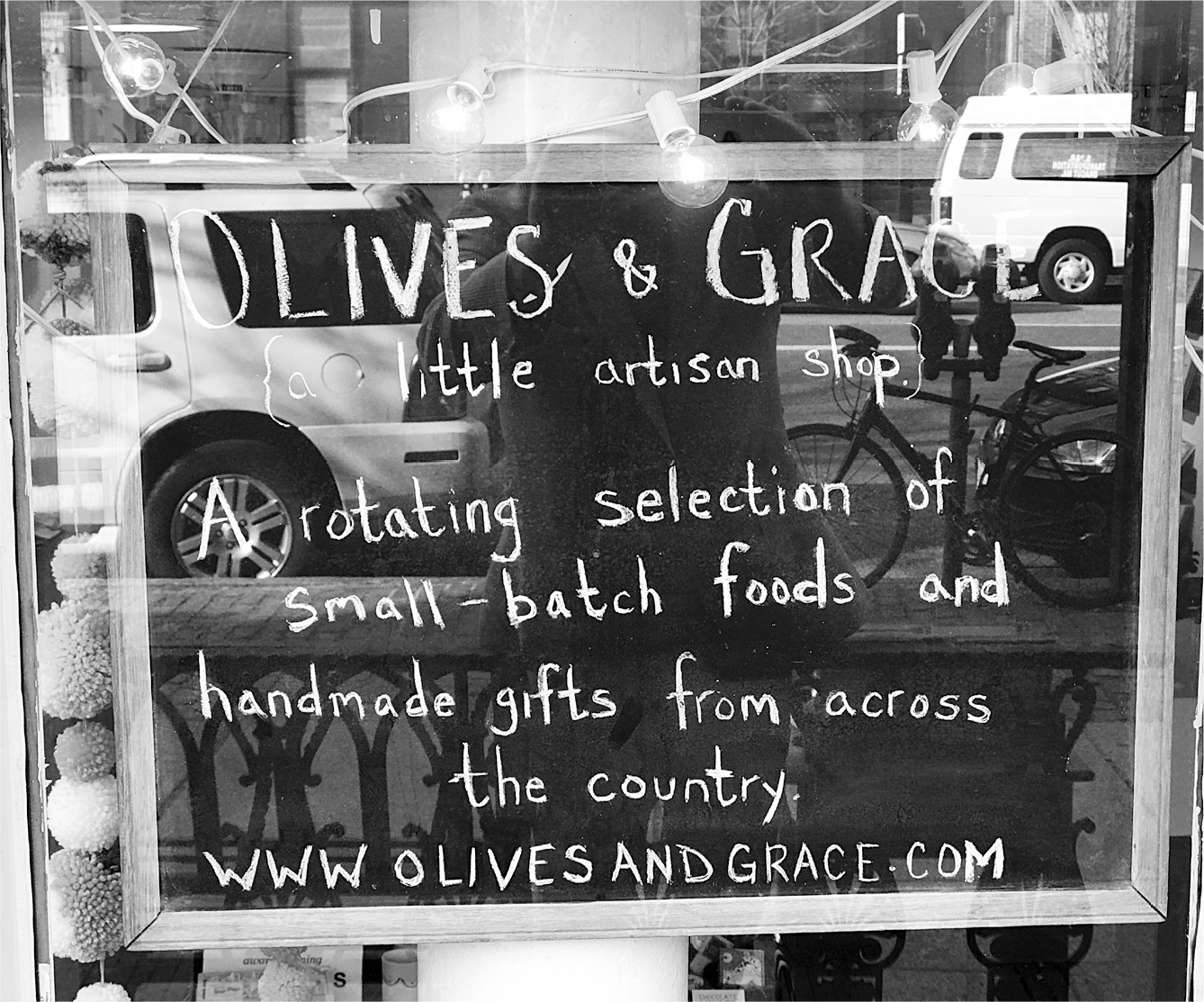
Marketing, the artisanal approach.
7. HAPPINESS
There’s a guy in my community who’s much happier than me. He is adored as a person, admired as an expert, respected as a teacher. He’s a pillar of our community. He’s an artisan.
His world is magnificently actual. At the moment, I am writing a sentence. No one will read it until agents, publishers, editors, designers, printers, bookstores, critics, and my wife have done their work. And that’s going to take at least a year. Then the book will go out into the world and you will read it, if you read it, months or years later. Finally, unless you send me an email (and remember, you promised, the address is grant27@gmail.com) I will never know you read the book.
Ken’s world is a whole lot clearer. He gets to meet his “readers,” (i.e., “eaters”) as often as once a week. And they come in and say things like “I loved that Stilton you sold me. And that Arethusa cheese, wow!” Ken’s satisfactions are a whole lot more tangible than mine.
Ken’s world is also structurally straightforward. Thanks to the “creative destruction” of capitalism, as accelerated by a new order of innovation, competition, and disruption, many people in the bigger business world live a life of confusion and anxiety.26 The possibility of having the world ripped out from under them is a distinct possibility. Most of the natural barriers to entry have fallen. And many managers spend their time wondering where the next hit is coming from. They know the target may not be their company but their job. Job security is gone.
Ken’s world is clear. Yes, there can be problems in the supply chain. Yes, labor can prove hard to find or manage. But this is not an inscrutable world filled with big surprises or “black swans.”27 Compared to the sheer complexity of most middle managers, Ken’s life is virtually contemplative. It is calm. It is composed. Most of all, it’s transparent. Yes, it’s true that some of Ken’s clients make more money than he does. But it’s also true that they pay enormous “transaction costs” to get this income and might well envy Ken. They might even someday even emulate him. (Some will join the artisanal disruption not out of necessity, but by choice.)
There’s a last reason the artisan is happier than you or me. In the nineteenth century the relationship between Ken and me would have been a status relationship. The consumer was the superordinate. Ken was the subordinate. (Sorry for the sociological lingo.) The buyer ranked higher. The seller had to defer. That has changed beyond all recognition. Ken is a god in my community. I am but an ink-stained wretch. I make a point of letting people know that I know Ken. I would be very surprised if he ever tells anyone he knows me.
8. BEING FUNNIER (AND CHARMINGER)
Artisans are good at many things, but ingenuity is especially prized. Consider the case of the Postcard Machine (Possibly from the Future), which was invented by Michele Ott in 2006 and has since been installed at a variety of craft fairs and art shows.
The Postcard Machine is a “free-standing human-powered postcard vending machine.” It is made from marine canvas and stands around six feet high, four feet wide, and three feet deep. (These measurements are guesswork.) The front of the machine shows a slot into which dollars can be fed. And it shows a slot through which, apparently, a postcard will eventually come. Even I could tell that this wasn’t really a machine. After some reflection, it occurred to me that there must be someone inside the machine, taking money and giving cards.
The Postcard Machine is a parody of a vending machine. The vending machine came late in the industrial revolution. By the time of its appearance, machines had learned to do most everything: build, hoe, pick, dig, assemble, paint, finish, and distribute. What they couldn’t quite manage to do was replace retail. They did not yet have a place in the general store, department store, or restaurant. They did not yet have a role to play at the moment of choice and purchase. And this made them very angry.
Then someone said, “Why not make a machine that can do what a Macy’s salesperson does at the counter? Or what waitstaff do in a restaurant?
And someone did. They invented the “Automat.”28 The first one in the United States was installed in Philadelphia in 1902. Patrons walked up to a wall of small compartments, inserted coins in a slot, lifted a window, and removed food. The machine was happy.
Did anyone ever protest this accomplishment? Did anyone ridicule the machine? Okay, sure, Charlie Chaplin in Modern Times, but who else? Michelle Ott, that’s who. She de-mechanized the machine. Her machine was soft canvas and loving imprecision.
Having successfully ridiculed machine overreach, she took on what the corporation calls the value proposition. (This is the statement that captures what a corporation brings to the world, what they do for the world.)
Here’s how Ott defines her consumer:
You love to receive tangible, wonderful surprises in the mail. You like to send notes to other people via the USPS. You write “thank you” cards to people. You put postcards on your refrigerator when you get them. You are kind to people. You are delighted to have a stack of blank postcards ready to write and send when the inspiration strikes. You love to support artists and are committed to helping them continue to make new work. You laugh at jokes. You appreciate astute observations of the world. You are my hero!28
The conventional response to this sort of thing is to call it quirky. But that always seems to me a little patronizing and diminishing. Let’s give Ott her due. Her postcards help us see things that capitalism can’t see and, if left to its own devices, would render invisible.29
9. BEING HISTORICAL
I once met a Scottish stonemason wandering around a small town in Canada. He was staring at a local church. Closely, and for a long time.
“Hey,” I said. An anthropologist is like a journalist: always on the lookout for a story.
“Hey,” he said back in a rich Glaswegian brogue.
And that was all he had for me.
He kept looking at the church, his nose almost pressed up against it.
“Whatcha doin’?” I asked. This is the international call sign for Whatcha doing?
It worked.
“I’m having a look.” He stepped back and stared up.
Then he said, “How old is this church, would you say?”
We scanned the front. No date.
“Nineteenth century?” I ventured.
“Obviously.” He looked at me like I might be a little soft in the head.
Another long Scottish pause filled the space between us.
Then a burst of speech: “I think I can tell you that the masons who made this church were from Scotland.”
“Really!” I exclaimed.
“Yes, really.” You could hear an unspoken chatterbox here.
He continued, “I can tell you that they came from Scotland. I think I can tell you where they came from in Scotland. I think I can even tell you which part of Edinburgh they came from.”
This is artisans talking to one another across 150 years and 3,000 miles.
An artisanal world stretches in two directions. One is the community of artisans in the present day. This is made up of all that sharing, comparing, competing, and learning. (Most of all learning.)
The other is the community over time, which stretches across centuries and continents. How long have humans been making beer? Probably 12,000 years.30 When did we start making cheese? Artisans are time travelers. They can claim fellowship with communities and creativities that go back ages. By this standard, the blandishments of the mid-century modern, so sleek and abstract, so eager to claim the newest and the latest, all looks like slightly hysterical chatter.
For much of the twentieth century, we were particularly enamored of the new. In a wonderful book called New, Winifred Gallagher suggests we suffered “neophilia,” novelty seeking and a craving for change.31 This reached its peak sometime around 1960, when we were exhorted to throw off old things and buy new ones. There was actually something shameful about clothes that were “out of date.” Out of date? This is not a concept that matters unduly in the artisan’s world. But in the twentieth century, obsolescence seemed dangerous. We wanted to be “with it,” whatever “it” was.
An artisan finds this weird. Historical is better, if only because it allows you to claim fellowship with all those artisans in Edinburgh who went before you. But also because history is a kind of ballast. It helps you steer a course. It helps identify what matters for moral purposes and what works for practical purposes. History is the artisan’s laboratory. It’s where she does her “time testing.”
10. STAYING UNBRANDED
In the world of consumer-packaged goods (CPGs for short), brands were the way corporations let us know how good, nutritious, and downright miraculous their products were. Brands were beacons in the supermarket, shining from the shelf, charismatically colored, brilliantly boxed, irresistibly, er, irresistible! Now some brands are objects of suspicion, an act of trickery. We know too much about how the proverbial sausage is made; there is too little truth in its packaging.
Things in the farmer’s market are trustworthier, because they are not branded. So much for Madison Avenue. All those millions of dollars poured into the brand as a marker of reliability, and we turn up our noses. We’ve come full circle; after all, in the eighteenth and nineteenth centuries, consumers were buying from barrels.
It turns out that Marx was right. (Finally.) The meaning of the object comes from the act of manufacture, not the act of marketing. It’s as and when the artisan makes an object that she brings it to life.
Jocelyn Gayle Krodman doesn’t have a brand. She doesn’t need one:
Jocelyn is an artist living and working in Kingston, NY. She created her brand, PetitFelts, in 2011 and since then she has made it her goal to create high quality, unique needle felted pieces. She strives to make animals that spring to life through their expressions and whimsical humor. She puts lots of love into her work and above all else, she hopes that people can sense that when they come across her creations.32
Jocelyn says she has a brand. But what she means is, she has a name. There’s no real brand here, no logo, no packaging, no advertising, and no design thinking in a conventional marketing sense of the term. No attempt to mesmerize us with the Glenda the Fox brand. The idea of conventional branding of Glenda the Fox in a conventional way would seem as odd as branding a real fox. Everything that matters is the “love Jocelyn puts into her… creations.” Glenda is the message and the medium. She doesn’t need a brand.
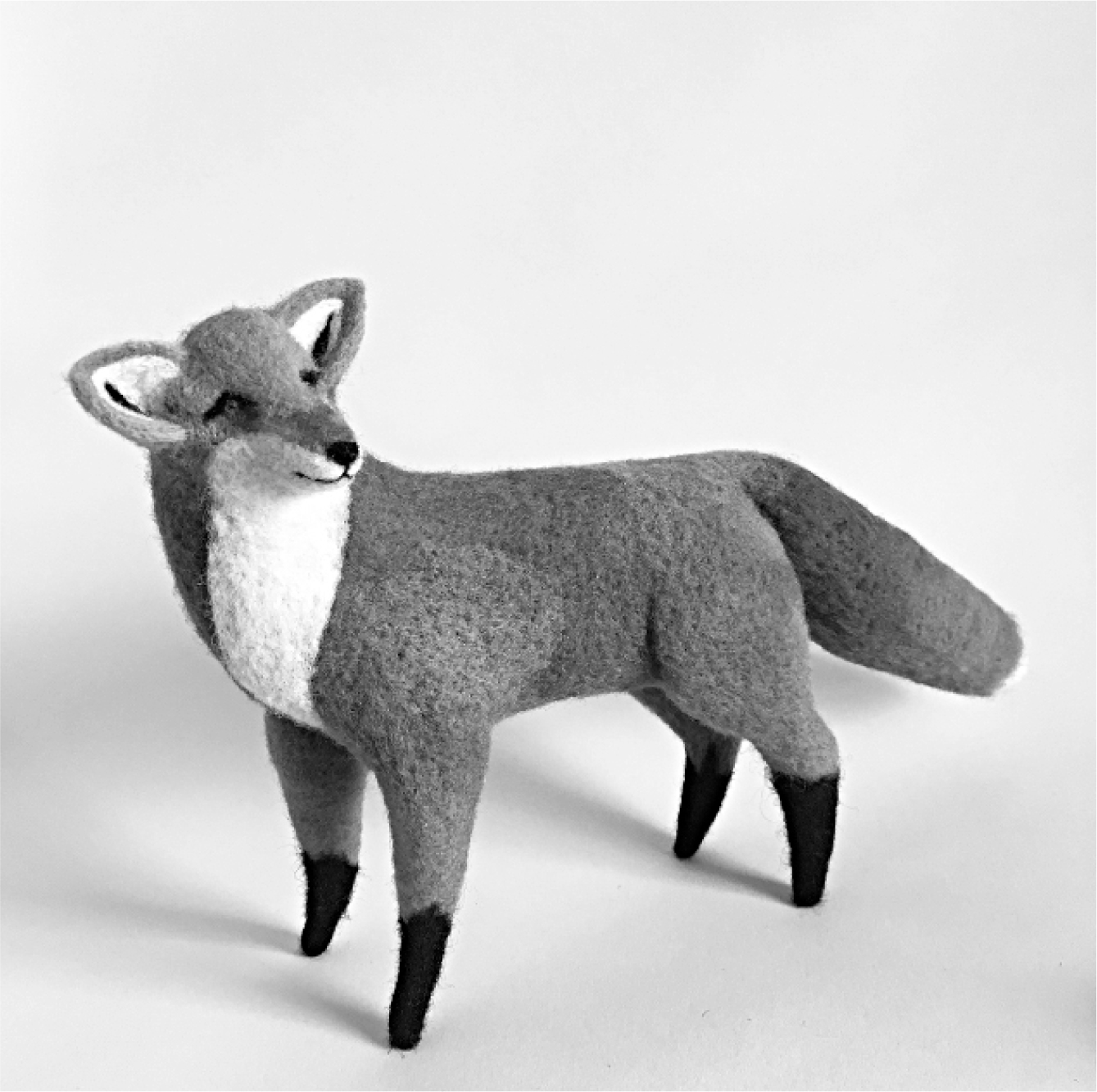
A fox summoned out of felt.
Certainly, most artisan enterprises come with a story. In fact, this is getting a little tedious. It always seems to be about two guys who were sitting around one night and, what do you know, one guy says to the other… This is the origin myth of a cheese store (Beekman), razor blade (Harry’s), bow tie (Two Guys Bow Ties), farm (Arethusa), and brewery (TwoGuys Brewing). Not that this is a bad thing. Everyone needs a story. But wouldn’t it be good if it weren’t always the same story?
11. STORIES
What artisans have instead of brands are stories. And yes, these can be clichéd, as in the case of the “two guys who had an idea.” Every artisan surely has more to draw on than the origin myth. What about all that trial and error? Triumph and heartbreak? Being agile, nimble, adaptive, and responsive? All those buzzwords from the corporate handbook, so much talked about and often so little practiced, are alive and well in the world of the artisan. Let’s tell those stories more.
Plus, there is almost no artisanal knowledge that does not come wrapped in a story. I don’t remember “the way to shear a Leicester longwool sheep.” I remember the guy, Kaelin Vernon, who told me how he does that, the farm he and his wife live on in Plano County, even perhaps the weather on the day I talked to him (wet and muddy). Artisanal knowledge is personal knowledge.
Artisanal knowledge is embedded knowledge. That tool on someone’s workbench comes from a great-grandfather and memorializes how he started a family tradition. The bridge that stands in the center of town evokes how this community pitches in and works together. No plaque. No opening ceremony. No yearly ritual. You see the bridge, you think of the meetings and the work and how much better life got when the bridge went in.
Stories also prove to be an alternative to brand marketing. Where the typical consumer product will build a brand and beat the marketing drum, the artisan must resort to other options. Happily, these aren’t just cheaper; they are distinctly better.
Take the case of Lacey, the Media Wonder Dog. Lacey lives on the farm of James Beckner and Robin Harden. This is James’s family farm, and it is a miracle of initiative. Rock’n B Farm offers carriage rides, Christmas gatherings, “fire-pit to pan” dinners, Fall Festivals, Valentine’s Day celebrations, outdoor weddings, and any other social event that looks like it might draw an audience. James and Robin, ever resourceful and ingenious, also built Mammaws Kitchen on the back of their farmhouse. I dropped in for lunch a couple of years ago and we were greeted almost immediately by Lacey.
Lacey looks like a standard sheepdog, but she is in fact a marketing genius, a story that cannot wait to be told. James is occasionally asked to do a spot on local TV. He takes Lacey along because, well, Lacey is the star. Everyone at the studio drops by to welcome her. She gets her own chair on camera and most of the close-ups. When people come to the farm, they all want to see Lacey. As a gifted sales creature, she likes to jump up and establish full eye contact.33
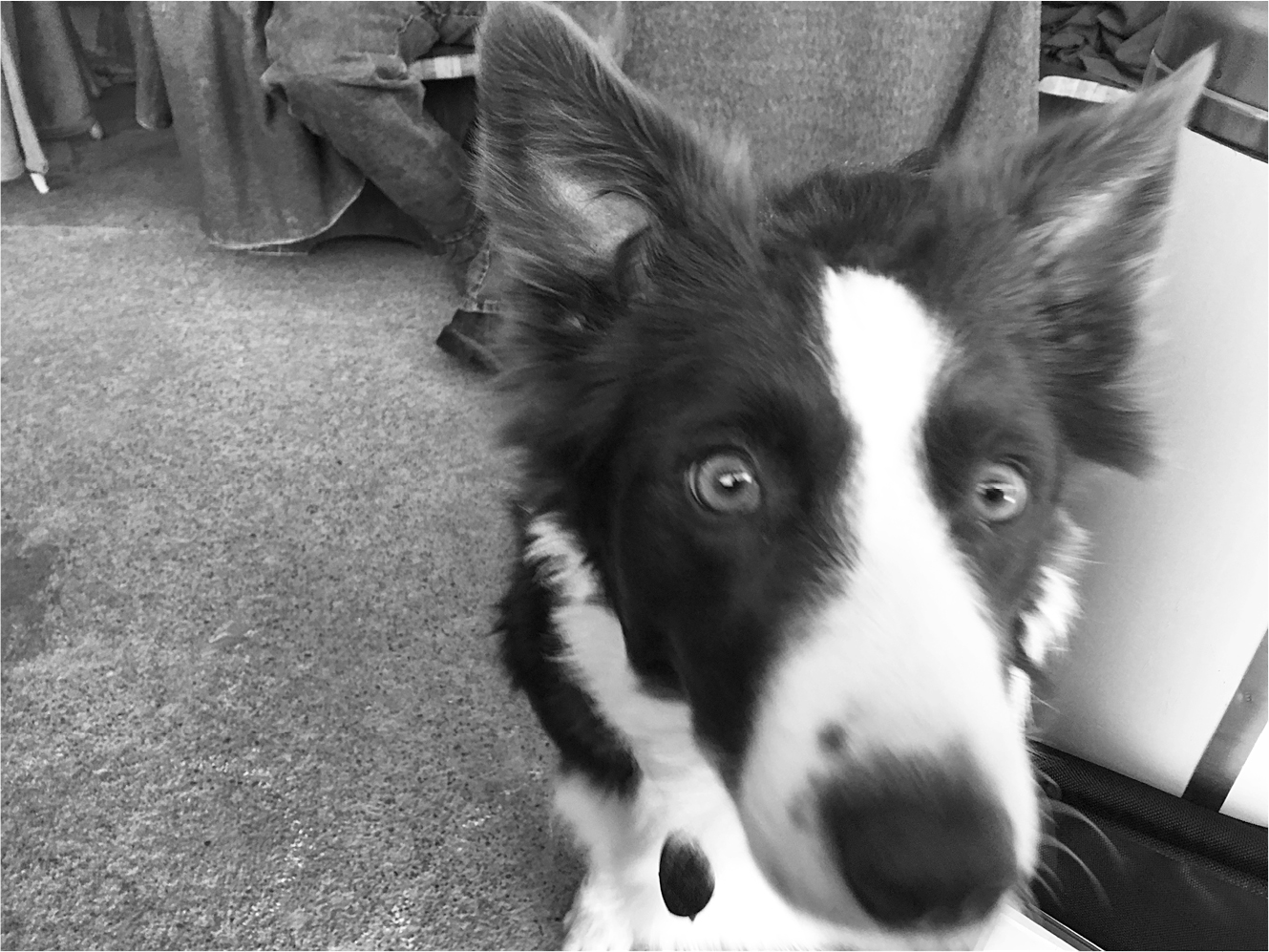
There are many alternatives to conventional marketing. Lacey is merely a very cute one. The trick is to turn the stories that define that artisan’s life and communities into stories the rest of the world wants to share.
12. BEING UNDERFUNDED
Artisans rarely make a bundle. Many struggle even to make a subsistence wage. As Bren Smith pointed out in an op-ed for the New York Times:
The dirty secret of the food movement is that the much-celebrated small-scale farmer isn’t making a living. After the tools are put away, we head out to second and third jobs to keep our farms afloat. Ninety-one percent of all farm households rely on multiple sources of income. Health care, paying for our kids’ college, preparing for retirement? Not happening.34
Eric Glasgow, who runs Grey Barn and Farm, told me that he could not run his farm without external resources. “It’s very hard work,” he said, “for what amounts to minimum wage.”35
Glasgow says that Americans are “addicted to cheap food.” There are two ways to address this. One is to persuade Americans that cheap food is often bad food. It is processed, adulterated, preserved, and otherwise diminished as a source of nutrition, health, and wellness. Here, at least, we are making real progress. Americans care about wellness. They identify food as a critical part of their pursuit of wellness. They are prepared, some of them, to pay the premiums that attach to good food. Increasingly, those who can buy good food are buying good food.
The other way to address the problem of cheap food is to show that when we pay a premium for good food we are sustaining farms, farmers, farmer’s markets, and entire communities.
It turns out that coffeehouses, that other staple of entrepreneurial artisanship, can be problematic in a different way. In an essay for Slate titled “Bitter Brew: I Opened a Charming Neighborhood Coffee Shop. Then It Destroyed My Life,” Michael Idov gives us an account of the café he opened in New York City:
The small cafe connects to the fantasy of throwing a perpetual dinner party, and it cuts deeper… than any other capitalist urge. To a couple in the throes of the cafe dream, money is almost an afterthought. Which is good, because they’re going to lose a lot of it.36
The hours can be long and the margins small. And the costs are not just economic but also emotional. Idov says:
Guess what, dear dreamers? The psychological gap between working in a cafe because it’s fun and romantic and doing the exact same thing because you have to is enormous. Within weeks, Lily and I—previously ensconced in an enviably stress-free marriage—were at each other’s throats.
This, too, is a question to be addressed through education. Consumers need to understand that when they refuse to buy or, as in this case, refuse to pay, they put at risk the very café that matters so much to their community and their style of life. You can withhold your support from the local café, but this is surely a false economy. You save money but cost yourself the style of life you cherish.
I have written a book on this topic, arguing that various companies and technologies create a “dark value” that does not get reflected in the price of the good or in the mind of the consumer.37 The artisanal community has a job to do here. Engage in a public education that will help people see what they are getting and what they are supporting when they pay the artisanal premium.
This might be a job for Gwyneth Paltrow, who has turned her brand and TV show into a platform for public education. And she has coconspirators, including Elise Loehnen:
Loehnen wasn’t just interested in wellness; she was obsessed with it. Wellness, she argued, isn’t just about a spa you’re going to or a cleanse you’ve started or a diet you’re on. It’s how local your food is. It’s how the chickens you eat all went to the right schools. It’s the water you drink. It’s the cures you never thought possible. It’s the level of well-being you didn’t even know to ask for.38
Paltrow and her friends take the broad view. They can see how prices in the market can make (or kill) farms in the countryside. If there is a group capable of communicating the big picture, it’s Paltrow and company.
13. STAYING PERSONAL
The artisan undertaking is deeply personal. Mateo Kehler of Jasper Hill Farm puts it this way: “We work on something we love, with people we love, in a place we love.”39
How different from the person who moves to Los Angeles to work for a record label he doesn’t really respect, filled with people he doesn’t really like, in a city he loathes… but, hey, the money’s good and his husband happens to love the city. This sort of thing won’t work for the artisan. It’s hard to make something matter to the world if it doesn’t matter to you.
I remember visiting an IBM office in Armonk, New York. They led me upstairs into the warren of cubicles where the engineers sat. At first I thought I was suffering sudden-onset color blindness. The place was white, from side to side and top to bottom. There wasn’t a single thing that differentiated one cubicle from another. Not a single image, memento, personal gesture. No pictures of the family. No drawings from the kids. Just a great, yawning whiteness.
It reminded me a little of the way they used to label offices at Harvard Business School. On your door there was a metal holder. It was designed to hold your business card. You just slide it in. Of course this meant someone (the dean?) could just slide it out. They could erase all evidence of you with the swipe of a wrist.
This sends a message. It says, You are replaceable. Don’t get comfortable. You are a cog in a machine.
It also says, Don’t take a risk. Don’t engage in high-stakes creativity. Don’t see if you can reimagine the institution. We are way ahead of you. We can forget you in a second. When I left HBS, I think a second was actually much more time than they needed.
The artisan, on the other hand, lives in a world that resonates. There’s the neighborhood coffee shop where they have your favorite macchiato waiting first thing in the morning. There’s the customers who come in first to chat and only then to buy. There are those retailers “who went deep for us” after COVID hit.
But artisans are also in the business of making the world resonate. The conversations over the counter make the world a kinder place for consumers. This is the value add. And this is where the artisan kills P&G, which can make things gleam and work but cannot make them mean, not like this. And this brings us to the next section.
14. PERSONALIZATION
I’m torn. Sometimes I think personalization is pointless. I mean, really, how many differences do we actually need? At one point, Starbucks was claiming that there were eighty-seven thousand combinations at their counter.40 Surely, that’s too many. I’ll just have a coffee of the day. (Okay, make it a grande.)
On the other hand, I know people for whom there is only one drink they want from Starbucks, and it’s a venti nonfat extra-dry cappuccino. Not somewhat dry. Extra dry, okay?
That’s where we are now. We are so accustomed to having things just the way we like them that it feels like the optional is now the necessary. Human beings are noticing machines. We are fantastically good at detecting differences and then coming to rely on them.
Barry Schwartz, professor of social theory and social action at Swarthmore College, thinks this is empty choice. He thinks having so many options is bad for us.41 But this is what intellectuals always say. Somehow they came to believe that their job is to tell us how bad we have it.42 (Well, everyone except Steven Pinker.43) But the fact of the matter is that choice is gratuitous until we can’t imagine the world without it. And if choice was truly a matter that didn’t matter, there would be Amazon but no Etsy, Kroger but no farmer’s market, Illinois but no Vermont.
Artisanal personalizing creates a lot of value. In the case of Jocelyn Gayle Krodman’s Glenda the Fox, it helps me acknowledge, honor, adore my wife. It touches her in a way that no object of mass manufacture could hope to do. I am sure a new car would make a bigger impression. But price is no reflection of value. Glenda the Fox speaks much more powerfully.
Artisans also personalize the point of sale and moment of purchase. When you walk into Darien Cheese, Ken or his wife or another expert behind the counter immediately offers you a piece of cheese. And immediately the “retail encounter” becomes more social and therefore more personal. And this makes the cheese more meaningful. Plus, it’s vastly more human.
Consider my usual experience at my local big-box grocery store. I wander around for a while, blinking under the klieg lights. I ask directions from some guy with a badge. He says “far wall” in a way that suggests that he’s not completely sure, but that I should understand that he is busy with stuff far more pressing than my need for cheese. Sure enough, it is the far wall. Not the one I thought he meant, of course. But really, there were only four choices and I got lucky on the third try. I cart my plastic packet of Kraft cheese to the checkout and in an outburst of fellow feeling, I say, “Wow, this is a really big store.” The woman behind the counter looks at me as if to say, So go someplace else. Artisans: 400. Big Box: 0.
Max Weber talked about our efforts to re-enchant the world after science and rationality had managed to make it cold, heartless, and grim.44 We went back to folklore. We restored magic. We discovered benign forces. We entertained ideas not vouchsafed by science. It wasn’t that we wanted to give ourselves over to superstition. But who could live in a world so utterly without warmth, a world so careless of our existence? Almost no one.
Capitalism suffered the same problem, roughly. Big brands were so big, the corporation so heartless, the headquarters, as in the case of P&G, so like an alien spaceship, that they seemed cruel and unreasonable, a punishment. Did they care about us? Care about us? Living way up there in the C-suite, they couldn’t even see us. Naturally, they liked to say they cared. Usually in very carefully crafted ads. Every time we turn around some company is saying they’re “there for us.” Yeah, right, we think. No re-enchantment here.
I give you the artisanal revolution. It re-enchanted the world beautifully. All the things we’ve seen so far, the imperfection, human scale, historical outlook, handmade, raw, all of these helped make the world a kinder, gentler, more intelligible, more habitable place.
I think it’s probably fair to say that P&G found this completely bizarre. As nearly as it could tell, the artisan world was bound to fill the world with too many little brands. All that variation and variety. All the barter and swapping. I mean, really, what would Adam Smith say? Well, forget Adam Smith. The real question was for Max Weber, and he would have said, “Good on ya, Tanya,” or more deeply learned German words to that effect. For P&G, we could surmise, the artisanal world might as well have been Mars. There wasn’t enough water or oxygen to make it profitable or even habitable. For the rest of us, it was just where we wanted to be.
The artisanal revolution helped recover the world we had lost. Yes, thank you, we wanted to see the face of the man who grew our food and shake his hand. It was fun to take the kids out to our CSA farm and introduce them to the patch that would grow their vegetables. On the whole, it was better to deal with someone who knew our names. And, look, knew our tastes so well, he set things aside for our arrival on Saturday morning. Artisans: 600. Big Box: 0.
There’s a convention at work in the artisanal world. We always want to trade a few words with our artisan. We’re looking for a combination of a little information, emotion, solicitude, and humor. And we always want to end with a laugh. This may be formulaic, but it’s a very well-intentioned formula. It’s our conventionalized way of saying, I like you. I admire you. I appreciate you. And I hope that’s mutual!
Mass manufacture delivers the impersonal. Artisans guarantee the personal. The latter is winning. There is something charming about knowing that the Glenda the Fox I may buy for my wife for Christmas is not quite like anything else on the market or even in Jocelyn’s studio. It’s one of a kind. So, you see, is Pamela. I guess that settles it.45
15. PRIVILEGE
Early readers of the manuscript let me have it on the topic of privilege. One of them said:
That busboy working at a restaurant in Midtown Manhattan, the one recently arrived from Nicaragua, he doesn’t have any hope of moving out to Hudson, New York, and starting his own start-up. He’s hoping to find a way to supplement his minimum-wage salary. And now that he’s got a kid on the way, he is staring at the prospect of food insecurity right here in the city.
This is fair. It takes all kinds of capital to be an artisan: intellectual, cultural, economic. We have to have education, a breadth of knowledge and experience, and, most of all, enough money to get started and survive the lean years. So, yes, artisans are creatures of privilege.
On the other hand, most people working as artisans are just scraping by. Many survive with side gigs, second jobs, and living at their parents’ home. Compared to some people, they do have advantages. But compared to virtually anyone working in the professional or the creative economy, they are underpaid, overworked, insecure, working without health insurance, and otherwise challenged.
It may have taken privilege to get them here, but it is hard to see them as creatures of privilege now. Indeed, it is probably more sensible and true to see them as people building a way of life a busboy from Nicaragua would welcome. Because this is a diverse community, most artisans are working to reform our culture and our economy. The costs are high, the dangers are high, and the insecurities are high. If this is privilege… well, it’s not.
And this first community of innovators is helping to create a world that is growing so sufficiently it might someday be able to lower its price points like a drawbridge and admit those who cannot now afford entry. It is probably thanks to the early artisans that so many Americans are prepared to call themselves foodies, and that Walmart and PepsiCo now care about “organic.” It is thanks to people like Alice Waters and organizations like Big Green that there are now “learning gardens” where before there were none.
But this pool of enthusiasm isn’t quite as broadly distributed as it should be. The artisanal world remains largely the domain of the white and middle-class.
16. INTERSECTIONALITY
There is more to privilege than being white and middle-class. Contemporary culture now acknowledges a profusion of identities, as defined by gender, sex, race, class, age, sexuality, religion, disability, physical appearance. And where these are grounds for prejudice and exclusion (as there often are), we now struggle to take down our prejudices and dismantle exclusion’s architecture.
Let’s take racism as a case in point. Change here doesn’t come merely from, say, persuading colleges to change their admission policies. It doesn’t come from people saying they will try to be more sensitive.
The trouble is that racism is a liquid. It finds its way deep into every nook and cranny of our culture. It seeps into our assumptions and our behavior. This means we can’t wish it away or will it away. What we need is an exacting study of how racism enters, sometimes invisibly, into the way we think, talk, and act. Only a very concentrated study will help us run this racism to ground. Only exerted effort will allow us to root it out.46
This sounds hard, and of course it is. Or, more accurately, it’s really uncomfortable. But the good news is that this labor has a reward. As we put old thinking behind us, we can see parts of the world that have been concealed from us, parts of the African-American experience that are astonishing.47
Still more illuminating is what happens to American culture when it is more inclusive of African-Americans. As I write this, I know that at the end of the day my wife and I will sit down to watch a TV show called Bridgerton. This dramatic series from Netflix makes Georgian England come alive with dramatic and imaginative possibilities that might have impressed even the magnificently gifted Jane Austen. How did this happen? Shonda Rhimes is the show runner. You could argue that Rhimes is one of our modern Jane Austens. She has given us Grey’s Anatomy, How to Get Away with Murder, and Scandal. What Rhimes has created is popular culture, to be sure, interesting and accessible to all. But it is also different, richer and more arresting—perhaps due to the fact that Rhimes is African-American. Let’s make the artisanal community one of the portals through which African-Americans can fully participate and contribute. It’s our job to put down the drawbridge. Worlds will open up: new kinds of culture, new horizons, new partnerships.
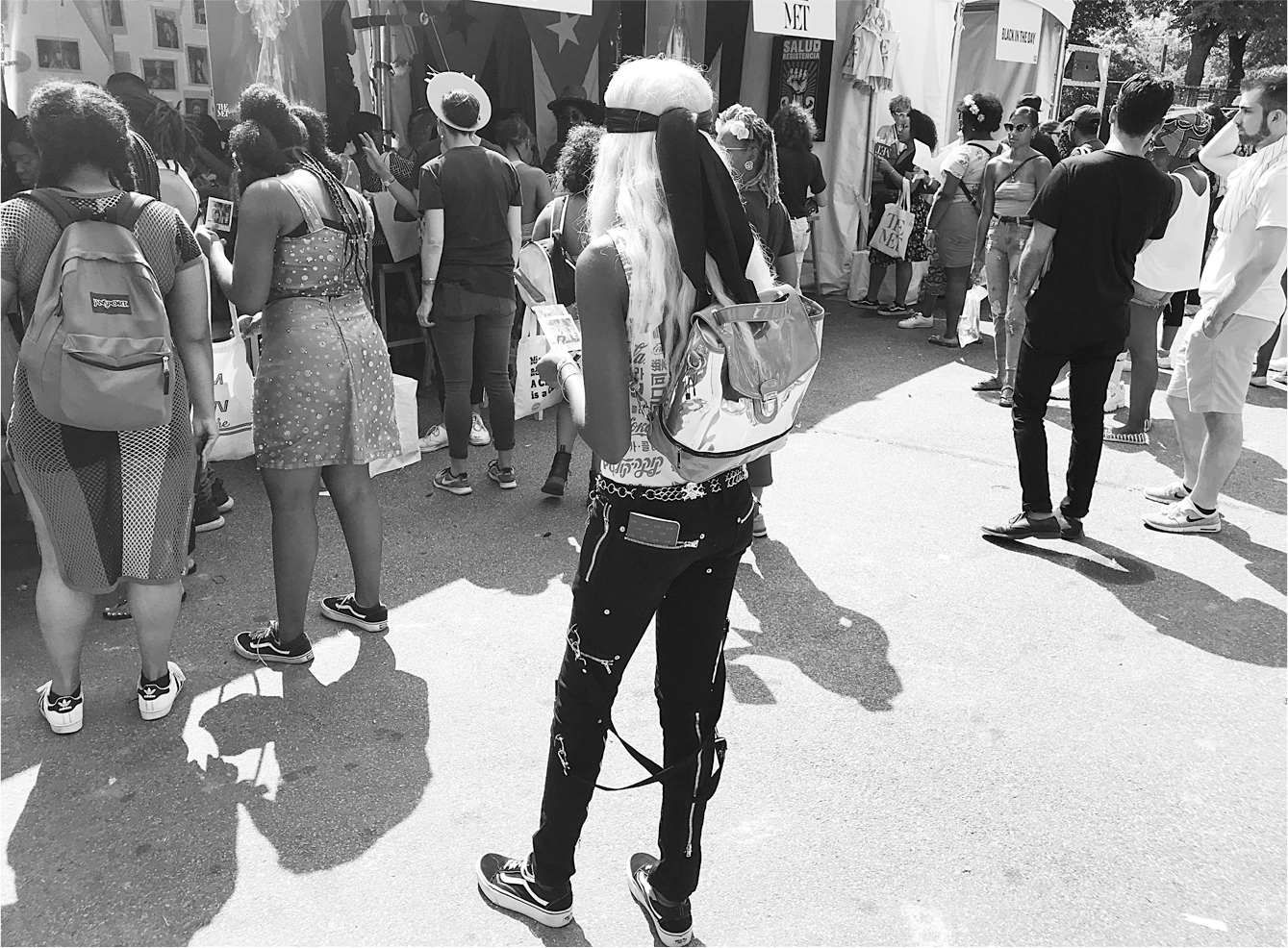
Exploring the possibilities.
17. SOCIAL GIFTS, SOCIAL GOODS
Giving is exploding in America. In 2018, people volunteered around 6.9 billion hours of time. As individuals or organizations, Americans gave $410 billion to charity.48 Even the world of branding and marketing is suddenly all about “purpose.” Where once the objective was, frankly, to make as much money as possible, now American corporations want us to know they are committed to creating social good.
Captains of industry and rock stars have been newly generous. Bill Gates, Warren Buffett, and Mark Zuckerberg have all signed a Giving Pledge, committing millions of their personal wealth to philanthropy. But artisanal giving is a finer, more particular affair. When my little town locked down for COVID, suddenly there were little packages everywhere, gifts from one household to another. Eggs, honey, bread, jam: gifts without much monetary value. The point was sentimental. Giving a gift says, I’m thinking of you. I care about you. I hope you’re okay. Connecticut mothers knew that we were in for a long and difficult time. They figured it might take a village after all, and being social felt like an excellent way to get started.
Artisans make gifting easy. Their creations are perfectly gift proportioned: authentic, human scale, handmade, they are exactly the right size and shape, plus particular and personal in just the way a gift should be. They are Goldilocks valuable: not too precious, not too mere.
In some artisanal communities, artisanal gifting makes up a big chunk of the gift economy. My respondent in western Massachusetts described the astonishing number of things in motion in her world. One person makes herbal medicine. Someone makes jam. Someone is good with motors. Someone builds websites. And there is so much in motion, people don’t need cash. They don’t even need markets. Stuff just arrives. Suddenly there’s a jar of jam on your doorstep. You don’t even have to choose. Your neighbor has raspberry bushes, so you’re getting raspberry jam.
This gift exchange is not perfect. Inevitably, someone is giving more than they are getting. Or, much worse, some people are deliberately exploiting the generosity of others. I am thinking of those people who come to a neighborhood café and sit all day, enjoying the free Wi-Fi. They order one cup of coffee. One cup of coffee. (You know who you are. Cut it out.)
All gifting is good, but some of it is expensive. When we give everything, or most everything, away, it is not clear how we sustain ourselves. The intellectuals and academics love these acts of generosity. They see a “gift economy” flourishing. Finally, they say, we have escaped the rigors and asymmetries of capitalism. Now things flow from those who have to those who need.

Moms giving gifts in the COVID era.
I love that idea, of course. I grew up hoping it would be the future. But now that I am a little more worldly, a little more realistic, I take another view. The “gift economy argument” always seems to come from academics who do not actually work for free. In point of fact, they have tenure, fat salaries, job security, and a guaranteed livelihood, no matter how little they work. These are the people who praise others’ generosity. I have done ethnographic interviews with teens who make magnificent fan fiction and fan art, all of it for free. “What’s that like?” I ask them. The answer is something like, “Hey, I will have to work at McDonald’s this summer, because no one is prepared to pay me.” And I can’t help feeling these artisans have a point. The gift economy works best when people get paid.49
18. ARTISANAL ECOSYSTEMS
Some artisans go beyond their own work to create things that help other artisans get in the game and grow. Let’s call them ecosystems.
Take the case of Blackberry Farm, a resort hotel and restaurant:
Blackberry Farm is a well-oiled machine when it comes to gathering the requisite ingredients for a full-on foodie experience: teams of gardeners, foragers, brewers, preservationists, and livestock handlers partner with local farmers to generate the decadent final products found in their haute-comfort menus. What’s more, they’re thrilled to walk you through their meticulous process. There’s truly no way to better consume the unpretentious cuisine of the Tennessee Smoky Mountain foothills.50
Blackberry Farm is an ecosystem. It encourages local artisans by giving them a place to show their work. It also draws in foodies from national and international communities. Foodies bring in wealth. They take away knowledge.
Raeisha Williams creates an ecosystem too. When Jamar Clark was shot in Minneapolis on November 15, 2015, Williams helped lead a protest. She occupied a police precinct for eighteen days. It was exhausting and absorbing, and afterwards Raeisha wasn’t sure what she wanted to do. She had worked on a number of things—helping to run the Minneapolis NAACP, standing for city council, making public service advertising. What was she going to do now?
Williams decided to open the Heritage Tea House in St. Paul. I interviewed her there in early 2019. Heritage is not only a teahouse but also a wine bar and African Heritage boutique. It’s styled like a living room. There are photos on the wall that give a glimpse of the history of the local African-American community. One shows a debutante ball from deep in the twentieth century. That woman there in a row of debutantes? The one on the far left? That’s Raeisha’s grandmother, looking a little unimpressed by the occasion but holding the red ribbon.
We did our interview in the Tea House. There were people coming and going, eager for Raeisha’s attention. It’s hard not to be. She is, apparently, lit from within. Raeisha told me Heritage was designed to welcome everyone: activists, foodies, anthropologists. She means to empower people and create community. It’s a kind of “come for the tea, stay for the revolution” thing. The mayor drops by. Politicians and community leaders turn up.
Raeisha has curatorial abilities. She is using her teahouse and her natural incandescence to collect people and combine them.51
Heritage reminded me of Rao’s, an Italian restaurant in Spanish Harlem. This, too, is a place where people network. You can tell by the way they’re dressed. At one table there is a woman who looks like she might be a politician. Her outfit is expensive, fashionable. She is eating with someone who looks like he might be a Teamster. His outfit is expensive but not fashionable. At another table, there’s a guy in a suit eating with a guy in a tracksuit (and wearing a really expensive Rolex). These are people from different parts of New York City. Rao’s is one of the places they can “find” one another.
Minneapolis has always been a diverse community too. Heritage can help bring some of its various parties together. But the city is struggling to manage its diversity. And then there’s the sense, recently, that this is a city on the precipice of civic disorder, since the killing of George Floyd launched a nationwide flood of protests. Now it’s really essential for someone to stage a space where people can find one another. Heritage can help there too. As a curator and connector, Raeisha has a role to play.52
Consider Mateo Kehler and his brother Andy, who together founded and run Jasper Hill Farm in Greensboro, a town of 706 people in northern Vermont. I spent an hour on the phone with Mateo and I was wowed. It’s hard to tell whether Jasper Hill is an economic enterprise embedded in a social objective or the other way around. Business and culture intertwine seamlessly.
Mateo is interested in the transfer of wealth. He believes that economic practice and government policy have hollowed out rural communities, moving money from rural America to big cities, from agriculture and industry into financial services. Mateo’s idea is to use Jasper Hill Farm to make wealth run in the other direction. Urban dwellers with plenty of disposable income happen to love his cheese, and they are prepared to pay handsomely for it. And when they do, capital flows back to rural Vermont. This is Jasper Hill as a force for good. This is artisanal economy as a way to address a pressing social need.
Jasper Hill is so well known in the foodie world that it draws many visitors each year for tours… or just to stand in awe of what the Kehler brothers have accomplished. If Jasper Hill were a conventional moneymaking operation, it would have a company store to capture revenue from all those visitors.
But Mateo and his brother decided against this. Instead, they reached out to Willey’s, the general store in Greensboro, and made it their unofficial “company store.” This gives the general store an extra $100,000 a year in revenue, no small thing in a town of fewer than a thousand people. Mateo says it felt like the right thing to do, because Willey’s is a venerated local institution, family owned and operated for five generations. If Jasper Hill could help Willey’s, the Kehler brothers felt they had to try. As Mateo put it, “We don’t want to compete with them. They are such an important part of life here.” Imagine how much could change if Walmart thought like this.
Sarah Lagrotteria and Tricia Wheeler have created Flowers & Bread, which they describe as “a multi-dimensional space that houses an elegant café, a recreational learning space, and is a place to engage your hands in the old-world traditions of bread baking, floral arranging, and cooking from a wood-fired oven.”53 As ecosystems go, this may be the most beautiful of all.
Frank Giustra is the publisher of Modern Farmer. He launched the Million Gardens Movement to respond to the effects of the COVID crisis, including “social isolation, disrupted supply chains and economic hardship.” As he said, “simply growing a tomato can be an act of hope and resilience that unites us.”54 The Million Gardens Movement website gives instruction on how to create herb spirals, dwarf fruit trees, worm composting, and other acts of pandemic gardening. The idea is to help gardens bloom in backyards, in community plots, on balconies and fire escapes, then help distribute this bounty from those who have to those who need. The hope is that if we can make gardens bloom, we can make food deserts bloom. If we make food deserts and diverse gardens bloom, we have literally made a common ground for a varied America.55
Tyson Gersh, co-founder and executive director of the Michigan Urban Farming Initiative, has recovered tracts in a once intensely urban Detroit, returning it to farmable land. In the process he has hosted over 10,000 volunteers in over 100,000 hours of volunteer service, grown over 80,000 pounds of over 300 varieties of produce, which has been distributed to over 2,500 households within two square miles of MUFI’s headquartered space, formed numerous partnerships with global brands (i.e., BASF, the Scotts-MiracleGro Company, General Motors, et cetera), and orchestrated over 3.5 million dollars’ worth of residential investment.56
When artisans build ecosystems, they must contend with political issues that wouldn’t necessarily come up had they stuck to a freestanding enterprise. Thus, Tyson Gersh is sometimes accused of “neocolonialism,” because some perceive him as more interested in developing neighborhoods than supplying cheaper (or free) produce for food deserts. The larger the ecosystem, the bigger the systemic effects, and the more likely it is that political differences of some kind will emerge.57
Some ecosystems are designed to enable other artisans or even civilians. In the first case, we craft a space in which would-be or early-stage artisans assemble to think about what they might want to do in a full-blown artisanal enterprise. We could think of this as a lab, a place of exploration and experimentation, where people can look for options and see what speaks to them most powerfully.
In the second case, the civilian case, what we are doing is setting up a place where people can throw their own pots or even make their own bubble gum. A recent experiment from London: “Artisan is the world’s first gum micro-factory, where Joe Public can hand make tiny batches of oral fixation in any flavour he likes—the three-year dream of jellymongers Bompas & Parr.”58
One of the ecosystems that matters most is the one created by the archivists, curators, chroniclers, and documentarians. So much of the artisan world springs up unexpectedly. It is an act of ingenuity that is not anticipated by the artisanal “handbook.” (Naturally, there isn’t a handbook.) And so much of what happens is evanescent. It’s there at one fair and gone the next.
So the artisanal movement needs chroniclers, both to look backwards and to give the movement the chance to see forward. Perhaps the most remarkable example here is the work of Faythe Levine, who, with her partner Cortney Heimerl, has created a book and a documentary called Handmade Nation.59 These give us a window on artisanal ideas and practice. Research began for Levine in 2006, and it would take her nineteen thousand miles and trips to fifteen cities to complete. The anthropologist in me tips its hat to the artisan in her.
What Levine has constructed is an ecosystem of knowledge and understanding. Here’s how she sees it:
We are celebrating a generation of makers. We are reshaping how people consume and interpret the handmade. I want to remind people that craft is what you make it. Handmade Nation attempts to capture what is happening in this amazing community, of which I consider myself a part. It is a labor of love, appreciation, and respect. Our community is just beginning to grow into our roles of knitter, book binder, shoemaker, painter, seamstress, potter, etc. We appreciate the generations of makers who came before us and from whom we draw inspiration and support. In turn, we are setting the groundwork for future generations, leading by example and showing the creative paths you can take.60
Perfect.
Perhaps the most powerful ecosystem in the artisanal world is the craft fair. Not so long ago, as Susan Beal notes, people gathered at local church bazaars. From those modest beginnings, any event can attract hundreds of vendors and thousands of attendees.61 The Bazaar Bizarre started in Boston in 2001. The first Renegade Craft Fair started in Chicago in 2003. Stitch Austin was founded in 2003. Faythe Levine started the Art vs. Craft fair in Milwaukee in 2004.
The Renegade Craft Fair was organized by Sue Blatt and Kathleen Habbley, who, in the fearless spirit of DIY, noticed that there wasn’t yet a national fair for the new crafting scene.”62 Christy Petterson met with Shannon Mulkey and Susan Voelker to consider what they could do in Atlanta. They came up with the name Indie Craft Experience and a mission: “a summertime event that would include a craft market, fashion show, live music, charity raffle, art show and a guaranteed good time.”63
These events are hothouses for the artisanal movement. Each one demonstrates a new set of possibilities. The displays instantaneously inspire attendees, who return the following year with creative proposals of their own. And there is a relentless recruitment going on. People come one year as observers, the next year as consumers, and the year after that as artisans. All of this creativity and community begins to generate more and more proceeds. Thus does this ecosystem help supply the precious profits on which the larger ecosystem eventually depends.
19. BEING ANTI–ADAM (SMITH)
Almost all the things we’ve seen that define the artisan, the imperfection, human scale, handmade products, rawness, localism, being historical, staying unbranded, personal, and personalized, and social gifts and goods and ecosystems, put the artisan more or less at odds with the capitalism of contemporary culture.
The chief cause of this opposition is that artisans prefer to see and to put their economic activity in a larger context. This can be a social, cultural, ethical, ecological, artistic context. But one way or another, the artisanal economy is embedded in a larger world, from which it draws and to which it gives. How the artisan embeds her enterprise is up to her.64
There are a bundle of additional differences we should touch on briefly.
19.1: The artisan world is more about the producer than the consumer. In the old-fashioned, twentieth-century scheme of things, the point of the enterprising enterprise was to know the consumer. In the words of Charles Coolidge Parlin in 1912, the consumer was king.65 This meant putting the consumer at the center of things.
Artisan consumers aren’t kings. They aren’t even courtiers. Sure, they are consulted. They are treated as collaborators. But they are no longer kings.
This reversal of fortune is due to several things and especially the influence of Steve Jobs, who believed that consumers couldn’t know what they wanted until he made it for them. Alice Waters also made a contribution here. In the words of Thomas McNamee: “She alone would dictate how every dish was to be prepared, down to the finest touch of technique: how brown a particular sauté should be, how many shallots to sweeten a sauce, how finely chopped. She knew exactly how she wanted everything to taste, to look, to smell, to feel.”66
Artisanal producers tend to know more and better than consumers. We could send a dish back at Chez Panisse… well, no, on second thought, we probably wouldn’t. We take for granted that Alice Waters knows more and better than we do.
Artisans are revered in their local communities and even on the national stage. (This is true, as we have seen of Ken and Drew. And this can be a problem for the artisan. Erin told me she feared being seen as someone special.)67 The downside here is the artisan who comes to think too well of himself.
19.2: Capitalism lives to optimize. Making the most broadly appealing product for the largest audience in the cheapest way, this was the path to profit. The artisan is inclined to make the product she thinks is most compelling, for a small audience, not with the cheapest method, but the most crafted one. This is the artisanal difference.
19.3: Capitalism is prepared to create what it calls externalities. These are the unintended consequences: smokestacks throwing off pollution, effluent piped into nearby streams. Once it’s off the grounds of the corporation, well, it’s someone else’s problem.
But artisans take responsibility for things that come from them. They mop up after themselves. Conventional businesses are happy to throw things “away.” Artisans believe (correctly) that there is no “away” on spaceship Earth.
19.4: Artisans prefer intrinsic benefits over extrinsic ones. This distinguishes them from most people who “work for a living.” Those people work for a paycheck. They are paid whatever someone prefers to pay them.
Artisans hope to “make a living” from their craft. But they are also paid richly in intrinsic benefits. There is the joy, the pleasure, the satisfaction, of doing something difficult well. Relatively few run a dry-cleaning operation for the satisfaction. They do it to make a wage and support their family. Everyone who is making chocolate, baking bread, or running a coffee shop has higher aspirations. They have committed to a craft and this craft pays them in pleasure however much (or little) it pays them in cash. The dry cleaner is “in it for the money,” we say. Why else would he do something like this? Artisans have an additional set of rewards.
19.5: Artisans are sensitive to a bigger picture that captures not just natural externalities, but a broader range of things. The earliest expression of this was perhaps the button created by Stuart Brand, the one that read: “Why haven’t we seen a photograph of the whole Earth yet?” Artisans take for granted that beyond their immediate concern are entire domains that need discovery and examination. They are more inclined to ask, about their own enterprises and others, “What does this coffee shop have to do with the community in which we find ourselves?” It’s a sense of diligence, and mindfulness. It is precisely this kind of question that leads to the creation of slam poetry evenings and community events. Tyler Florence started to think about the farm from which his food came. Artisans spend a lot of time casting the net wide.
19.6: Artisans like transparency. They believe that they should be able to see the full supply chain, and so should the consumer. If there are people laboring in the kitchen or on the assembly line, we should be able to glimpse the conditions that govern their labor. There is no backstage or behind the scenes. It is, or ought to be, visible to all.
In a sense, transparency is what the artisan has in lieu of a brand: Look into us and judge what you see there. See into our hearts; detect what you can there. This is who we are.
19.7: The artisanal world was an obscure enthusiasm for a relatively tiny world for most of the twentieth century, and it is now growing sufficiently to make a substantial place for itself in the world. As it grows it is in a position to recruit more widely.
The artisanal approach stands as a way to solve some of the problems created by the new economic realities of the twenty-first century. It can be a source of employment for the millions of people who can no longer realistically hope for industrial jobs. Too often people respond to their loss of permanent industrial employment with desperate measures. Social pathologies blossom. The artisanal economy is a source of employment but also community and stability. Politicians and policy makers can harness the artisanal disruption for policy purposes and social good.
Besides which, there are 92 million boomers now undergoing, or contemplating, a shift from their working lives into something called retirement. Thanks to research I did for the Canadian Heart and Stroke Foundation, I know that plenty of boomers are healthy and wealthy enough to take a new approach. They refuse the traditional strategy of “scaling down” as timid and defeatist. What they want is a qualitative change to how they live. For this group, “going artisanal” is a plausible next step.
Recruiting should happen most surely among millennials and Gen Zers, for whom the artisanal movement can be a source of inspiration as well as a new economic narrative. These generations believe in social purpose and social entrepreneurship. On the whole, boomers ask capitalism to create economic value. Younger generations demand that it also creates social value. Nothing produces social values more surely than the artisanal economy. (Not even all those big brands newly touting purpose.)
Recruitment for the artisan movement comes from robots. At first we thought robots would simply take over manual and menial labor. Now we see they can take over white-collar and creative work as well. The financial advice community is being hollowed out as I write this. The economist Tyler Cowen thinks we might be able to see a future that contains “a permanent class of long-term unemployed, who probably can’t be helped much by monetary and fiscal policy.”68
Americans will not tolerate a set of values that finds them wanting. They simply make a virtue of their necessity. In the present case, this means that Americans will find a way of living that forgives them their unemployment and that suggests a better way of living in the world. The handiest, most compelling narrative for them to employ is the artisanal one. We might see large numbers of people living in rural, barter communities—stepping out of, and happily away from, the mainstream.
If robots recruit for the artisanal revolution, it may prove COVID does too. As I write this, we find ourselves living in the remains of a once-robust economy. The need to protect ourselves from COVID infection has forced the closure of restaurants, theaters, and businesses of all kinds. It is possible that this economy will be slow to return to vibrancy. The real fear is that it might prove to be caught in a downward cycle, from which recovery is painfully slow. As it stands, people are wondering if New York City will ever recover its former prosperity. A diminished New York City would represent a terrible wound for the rest of the nation.
A national economic downturn would create vast unemployment. And this unemployment would inflict on an entire nation the kind of hardships we have seen in the deindustrialized Midwest. In some communities there, meth production was one of the few vital parts of the economy. And meth consumption was a temptation many found impossible to resist.69 When unemployment and addiction are your alternatives, the artisanal economy may well prove to be the most appealing “life alternative” for many.
19.8: And the money is sometimes a problem.
We know from the story of Portland’s Stumptown Coffee that things can get rocky when the artisan sells out. Stumptown sold a piece of the company to private equity firm TSG Consumer Partners. There was what Ryan Tate calls a “massive blowback from indie coffee fans,” with criticism from Todd Carmichael at Esquire (which asked readers to “vote with your dollar and avoid Wall Street–owned roasters”) and Ruth Brown at Willamette Week.70
So there is capital, and capital. When the financial support comes from friends, and relatives, that’s one thing. When it comes from local investors, that, too, is “okay.” But when it comes from “Wall Street,” there is a feeling, apparently, that a fox has been invited into the henhouse. The artisan needs to think hard about where her financial support comes from and whether she wishes to pay the hidden costs attached.71
19.9: For the artisan, it’s rarely about the image. While some artisans have celebrity thrust upon them, most are prepared to work in relative, if not outright, obscurity. This is noble. It may also be unwise. Yes, we are a celebrity culture. Yes, American capitalism is preoccupied with selling images sometimes more than reality. But it may be wrong for artisans to be so camera shy, so humble. (You are hearing this from a Canadian, so take note.)
Currently, we have a continuum—on one end, the artisan as a self-adoring celebrity, and at the other, the artisan as too modest for his own good. The reader must choose. Personally, I think this calls for a trade-off. I think the artisan wants enough celebrity to aid with sales, marketing, and fundraising, but not so much that a cult of personality threatens to interfere with ego or business.
19.10: There are mysteries at work in the world of the artisan. They remind me of a famous conversation previously mentioned between two transcendentalists living in Concord, Massachusetts, in the nineteenth century. One says to the other that he’s seen a young man sitting on a path examining a frog. The second man says, “Surely, that’s not very odd.” The first man replies, approvingly, “Yes, but he was still there when I walked past him five hours later.”72
There is an interest in the thingness and treating this thingness as a portal to ways of thinking and feeling. Working with our hands, in a material, on an object, this can prompt us to leave the here and now and squeeze into other ways of thinking. I touched on this when I talked about flow.
Mind you, some things in the artisanal gift are mysterious for not very mysterious reasons. Bees, for instance. One of my respondents installed beehives in her backyard during COVID. She loved them: “It’s like having an ancient court in your garden.” This court has inspired a literature and a scholarship: “You can read everything that’s interesting about chickens in one night…. But you can read about bees every night for the rest of your life.”73
19.11: The artisan world has a certain ambivalence for design and fashion. Some feel these are wrong for the artisan. Surely, they are too exuberant, playful, governed by change. Artisans are about verities that endure. Fashion is too artificial, and governed by wizards in Paris and Rome. Shouldn’t everything artisanal be more grounded, more sincere, less given to artifice?
But the owners of Arethusa Farm in Litchfield, Connecticut, George Malkemus and Tony Yurgaitis were, until last year, president and vice president of the shoe company Manolo Blahnik USA. Their dairy is widely praised, and they make an organic, artisanal, hand-packed ice cream that is prized across the U.S.
Yurgaitis feels no ambivalence:
People sometimes think there are two totally separate things that we do—our shoe business and the farm—but we approach everything the same way. We have a certain style of making it what we want it to be.74
For Yurgaitis, fashion wins the tug-of-war. But for many artisans, anything that looks even vaguely fashionable feels a bit iffy. Fashion feels like something at odds with the artisan’s sincerity, her authenticity. After all, fashion changes often and eagerly. For the artisan, this feels wrong. Surely, the things that matter are grounded in tradition and enduring over time.
But every artisan will find the useful compromise and his own place on the continuum.
19.12: Trends are a mixed blessing for the artisan. On the one hand, it was as a trend that the artisanal revolution came up to displace industrial food. It was as a trend that the artisanal revolution ran through American food, recruiting millions of supporters and participants.
But what trends bring in they can also take away. The artisan lives in a culture transformed by a series of cultural disruptions, one hot on the heels of the next. Whether we like it or not, the artisan lives within fashion’s sphere of influence. At the moment, the artisanal is fashionable. That could change. This much is inescapable: the artisanal came up as a trend. It, too, may pass. No trend is forever.
Indeed, there could be evidence that a counterreformation has been underway for some time. The engines of satire and ridicule are loud. Ten years ago, David Rees presented himself in a pious video as the “artisanal pencil sharpener.” Sitting in a white shirt and a black apron, Rees gives a completely humorless account of sharpening pencils. The advice is practical and philosophical: “It is possible to sharpen a pencil without a pencil sharpener, but it is impossible to sharpen a pencil without a pencil.”75 This point has troubled deep thinkers for centuries. Now we know.
Paul Riccio gives us a mockumentary treatment of the Timmy brothers, two guys who make “bespoke, artisanal water.” Riccio’s inspiration is Christopher Guest’s mockumentary This Is Spinal Tap. His execution is excellent. Terry Timmy intones, “I know what wetness is for me, but what is that for you? It could be something completely different.”76
McDonald’s UK has done an ad ridiculing the shortcomings of artisanal coffee: the prices are too high, the hours too short, the menu too complicated, the wait too long, and the barista is so much cooler than we are.77
Lewis Black used an appearance on The Daily Show to ridicule the very notion of the artisanal: “Snapper, tilapia, who gives a shit? That’s what the ketchup’s for.”78 Somewhat less shouty treatment comes from Fred Armisen and Carrie Brownstein, who in a Portlandia skit give us a couple who cannot proceed with their restaurant meal unless they have all the necessary artisanal reassurances. Carrie wants to know if the chicken is USDA organic, Oregon organic, or just Portland organic? Fred asks whether the chicken is local. He then asks if the chicken’s food was local. Just who was the chicken, anyhow? Fred and Carrie learn the chicken’s name was Colin.79
All of this is good fun until someone forces a change in our culture. And that could happen. Wave after wave of satire and ridicule could make us tire of the artisanal movement. What if it dropped into the trough where all popular things go when they suddenly lose their first glow of celebrity? And, as we have seen, there is enough here to work with, when the repudiating mood comes upon us. The artisanal thing can be pretentious, humorless, silly, and self-indulgent. Some of the people who work the counter of the artisan world appear to pay themselves in self-regard. They punish any consumer who’s unworthy of the good they are buying. Artisans live in a glass house.
All things come in on a trend. Most of them are eventually swept away by the next new thing. A few lucky ones get to stay on. Actually, they build in. They become a fixed and standard part of our world, relatively safe from removal. It’s too early to say which kind of trend the artisanal is, passing or permanent. Chances are it’s the latter, but the artisan must remain alert to the possibility that the earth is moving beneath their feet. Watch for the new.
19.13: The last piece of our anti–Adam Smith character is authenticity. The trouble is it’s often easier to detect the authentic than define it. We have noted the things that signal the authentic, that help build it up, the imperfect, a human scale, being handmade, rawness, localism, happiness, being historical, unbranded, underfunded, personal, personalized, committed to social gifts and social goods, constructive of (or at least participating in) ecosystems, and other anti-Smith properties. But some of these can be missing and we still say that something is entirely authentic.
At a minimum, the artisan is not “in it for the money.” She is more interested in the relationship than the transaction. She is driven by a larger purpose. She aims to create something useful in the world, valuable for the community, and sustainable for the planet. Perhaps the key is no fakery, no fronting, no manufacturing impressions. (These, too, should be made by hand.) What you see ought to be what you get.
20. SIMPLIFYING
One virtue of an artisan approach to life is that it’s radically simplifying. It looks at the great profusion of contemporary life, the multitude of ways of being, acting, dressing, living, and opts for a reduced set: the artisanal option.
I found this out the hard way when attending the Basilica Farm & Flea Market in Hudson, New York, a couple of years ago. I was there with my friend Peter Spear, and we were surveying the crowd, hundreds of people crammed into a small space: talking, selling, shopping.
Peter asked, “How are you feeling about your coat?”
I looked at him with surprise and said, “Er, fine, I guess. Why, what’s wrong with it?”
He said, “Look around.”
What I saw were people dressed in autumnal colors, flat greens, dull blues, dark reds, lots of subtly different browns. Me, I was wearing a bright yellow jacket. I think I got it from L.L.Bean or someplace. They call it a squall jacket, I think. You see a lot of them in New England. I wear mine in the hope that I will not get run over while out walking at night. But here in Hudson, what it said was, I own a boat. You, probably, do not. I was conspicuous. I was showy.
Artisans are not showy. They do not make a spectacle of their wealth or their social standing. In fact, generally speaking, they care little for wealth or social standing. Artisans live modestly. They don’t own a car if they can manage without one. When they do own a car, it’s more likely to be a Subaru than a luxury sedan. Their clothing isn’t fashionable. Artisans don’t buy multiples. They don’t build walk-in closets. They don’t renovate their homes for show. Their American dream is not sumptuous. Their idea of the “good life” is “simpler is better.”80
This is all good. But it’s not without a problem. With simplification, we run the risk of making the palette too small and too rigid. Sometimes you want a yellow jacket in the midst of all those autumnal colors. Not nautical yellow. No, I just looked like an idiot. But a non-autumnal yellow, just to mix things up. We need noise in the signal. We need things that are slightly off course and out of step. Otherwise, we end up looking like Canada, a place where conformity rules some people so completely it extinguishes the very creativity that makes a country live.
Variety is our fellow traveler. Well before the artisanal trend beat its way in from the margin, variety was putting itself at the center of things. We were a mass culture, with mass marketing, mass media, and mass consumption. Variety was unusual, exotic even. Then it took over popular culture, exploding especially in the 1990s. There it was in poetry collections, street fashion, music.81
This is when a culture loses its centers. When elites lose their grip. When hierarchies collapse. When distinctions get muddled (in a good way). This is when variety becomes diversity. There are just so many people inventing so much culture from so many diverse points of view that we can no longer police our culture—including some, excluding others. We have broken down the hegemony that says, Here’s how you must make a poem, a TV show, or an argument. Now everyone is welcome to the party. There are bright jackets everywhere.
That leaves us with a tension. The artisanal community is a respite precisely in that it allows us to take refuge from the blooming, buzzing world out there. It speaks to us precisely because it is not distracted and complicated by a hundred points of view. The artisanal world has a certain constancy, clarity, and simplicity.
All good. But we mustn’t allow ourselves to be terrorized by this constancy. We need to let things in. We can’t shut ourselves off from what contemporary culture has managed to open up. Or, to put this somewhat more grandly, we can’t allow our repudiation of the city to alienate us from the vigors and virtues of city life.
Aristotle praised the city for its ability to bring together people who are dissimilar.82 The great English critic Isaiah Berlin picked up the theme:
It is hardly possible to overrate the value… of placing human beings in contact with persons dissimilar to themselves, and with modes of thought and action unlike those with which they are familiar.83
We can’t let our simplicity shut us out of this.
21. CREATIVITY
Creativity is a terrible houseguest. It doesn’t care that you have a routine, that you have made this place “just the way you like it.” Creativity likes to do things its way. It prefers to turn things upside down. It doesn’t do anything as grand (or fashionable) as “resist” and “disrupt.” It’s not deeply unhappy with the existing order of things. It just doesn’t care. It always has another idea, even if it’s a minor one. Creativity is always waving its hand, demanding our attention. It’s always asking, Okay, sure, I know you do it that way, but what about this?
Creativity is a wellspring of the novelty that is increasingly our best method of adaptation. The world moves quickly. The Heraclitean stream is now a torrent. And nothing is exempt from change. Heraclitus had a phrase for it: “panta rhei” (everything flows).84 Surely, one of the best ways to stay in touch with this change is to give our creativity free rein. It is capable of running out ahead of what we are thinking now, consorting and cavorting with new ideas and impulses. Then it returns to us, bearing gifts and provocations.
This is good for the artisan. She loves creativity. But it’s also bad. After all, the artisan is committed to the historical, the continuous, the conventional. She embraces continuities that run back hundreds of years. The movement is to some extent a bulwark against the raging torrent of change that now consumes us. The artisan says, in effect, What if we posit these few things, devote ourselves to them, perfect them, and return to them? What if we stand for continuity?
This is good and a powerful position to take, but it puts us at a disadvantage. Anyone who wants to participate in American culture needs to know that culture. It is one thing to refuse that constant, mindless fizz of this culture. It is another to lose touch with its center of gravity, which moves inexorably, stranding those who don’t move too.
We need a creativity that makes us uncomfortable, that moves away from what we know, that leads us toward something new. The fact that it makes us uncomfortable is a good thing. That’s the sound of our boundaries being stretched, our options being multiplied. Artisans can’t be all convention and tradition. That way lies stasis and orthodoxy.
22. UNEMPLOYMENT KILLING
The scourge of unemployment is upon us. It was once assumed that hard work and an education guaranteed a good job and the ability to make enough money to raise a family and make a place for ourselves in the world. This American dream is now fading for millions of Americans as they see jobs being shipped off to China, Canada, Mexico, and across the Third World even as they are preempted by the rise of the robotization of work.
For many Americans, this means the job they have just lost in the industrial economy may be the last such job they will ever hold. Bad things happen when people are pushed out of the industrial economy. Despair grows. Drugs beckon. Families suffer. Communities descend into chaos. Lives fall apart.85
And that’s where the artisanal economy can help. It has several excellent properties as a substitute for industrial work. It is compact enough that it can be staged in our own home, and if we are lucky enough to have our own house now we have something really useful to do in that backyard.
It doesn’t take a lot of money. It doesn’t take a lot of learning. We can start small and bootstrap our way to something larger. Plus, we can eat (or wear or share) our surplus.
But this is where I think it can really serve us. To engage in artisanal labor is to regain control of some part of your own destiny. You don’t have to wait for a factory to move back into town.
I did an interview with a guy who keeps bees in the backyard of his home in suburban New Jersey.86 He had 6 hives. He estimates that he produces 45 pounds of honey a year and at $8 a pound that’s around $3,000. To be sure, hives, equipment, and bees are not inexpensive. But even relatively small amounts can make a big difference.
In addition to the financial benefits, there are other values. The beekeeper has something to trade with neighbors, a way to fight the damage done by colony collapse disorder. And as we noted earlier, there are poetic benefits: those bees in the garden are an ancient court with their own rituals and mysteries.
Perhaps the best thing about an artisanal approach is that it gives the individual and his community a chance to build something that is more fulfilling, humane, connected, and connecting than the jobs it seeks to replace. And it doesn’t take a project flown in from Washington, dreamed up by a contingent from MIT, or a reparative grant pried away from the Sackler family.87 A community can make its own way.
23. ARKISHNESS
I met a guy driving for Uber. We got talking. (The anthropologist wants to hear anything you want to tell him. Okay, almost anything.)
He was talking about the business he used to have. He had been making iPad stands out of wood. And it went pretty well, he said. The stands were beautiful to look at. People liked them. Then our conversation petered out.
“What happened?” I asked.
He said, “I could never get the marketing right. I just didn’t get it.”
Wow, I thought, of all the things to be bad at! Marketing! It’s not rocket science. This guy had done the artisanal thing with the hand, head, and heart. He had mastered human scale, the imperfect, the local, the historical, and the personal. But to stumble on marketing, what should be the easy stuff—what a shame.
I talked to another artisan who failed because he just couldn’t get the hang of social media. And I guess I can see that Twitter and Facebook can be a little intimidating. Wait, no, I can’t. They are harder than marketing, especially if you come from a pre-digital generation. On the other hand, you only need sustain the discomfort of not knowing for a little while and then you’ve got it. There are no mysteries in social media that can’t be extinguished by a short course on YouTube. And it’s not optional. For an artisan not to use social media inflicts a mortal wound.
The artisan must be an ark. The challenge is to master not only your craft but all the other things required to run a business. How to work a spreadsheet. How to do marketing. How to do social media. How to do sales. How to manage customers. How to chat people up at a farmer’s market. How to do supply chain marketing. How to do PR, HR, and stakeholder management. Happily, cultivating range of this kind is the latest thing.88
And most of this will be self-taught. There are programs emerging. Under the guidance of Namita Wiggers, Warren Wilson College has developed a Master of Arts in Critical Craft Studies.89 This is “the first program of its kind to integrate American studies, anthropology, art history, decorative art history, design history, social history, and material and visual culture studies.” There are many practical courses of study online. I looked for a network that allows artisans to exchange knowledge. This is the traditional means of artisan education. But I couldn’t find anything particularly robust. Please, will someone build one of these, a LinkedIn for artisans?
It’s also possible to buy marketing, bookkeeping, and design services and advice online from the likes of Upwork and Fiverr.
For better or worse, the artisan is obliged to be freestanding and self-directing. There is no company to confine her. But this also means there is no company to sustain her.
24. A DOME ABOVE, A GRID BELOW
I sit pondering. I have two cats on my desk. This leaves me one short of my minimum. I can’t really manage without the entire crew: Molly, Vivienne, and Zsa Zsa. (That’s Zsa Zsa on the right. She’s asleep on her feet. Vivienne is about to follow suit. I don’t know where Molly is. TikTok keeps her pretty busy.)
I was thinking about Kentucky, where people were giving generously without being able to say why or to whom the gift was going. Pressed, they would say “oh, Kentucky,” “the church,” “the neighborhood,” “my family,” “the planet,” “young men struggling,” or “old guys lying.” There were lots of beneficiaries, but no real plan.
The author and his sleepy assistants.
Clearly, Kentuckians weren’t keeping careful track. They were throwing off good, and they were doing it recklessly, generously. I could see the same thing happening everywhere we did research, Connecticut, Iowa, New York State, Washington State, New Jersey, Michigan, and California. Domes up there in the air. Filling with generosity. Drawn upon by everyone and especially those in need.
But there is another way to think about the artisan. And that’s someone who also lives in a grid. Kaelin and Heather Vernon raising Leicester longwool sheep at Peacefield Farms in Kentucky are constantly sharing with and caring for their neighbors. But ultimately, they are freestanding. They are individuated. They are separate. There’s a group of flower farmers in Northern California. Originally, they hoped to create a collective, but for a variety of reasons that didn’t quite work out. Yes, they still cooperate and collaborate, but at the end of the day they, too, are freestanding.
And this is when a picture began to form in my head. There’s a dome above and a grid below. The dome fills with goodness. The grid defines difference. The two work together. Acts of generosity rise to fill the dome. Much of what is actual and practical, that helps make the grid.
There is a tension between dome and grid. The dome is beguiling. A community can feel itself creating good and giving it away. People don’t keep track. They don’t claim credit. No one knows how much there is or what its overall effect must be. Surely, some say, we are a collective. We have built a common good.
The temptation is to say, All right, then. That dome is our collective. But the moment we try to keep track, or apportion credit, things get tricky. Some people seem to give so much more than others. And there are so many kinds of goods in circulation, the act of measurement is impossible. Rules emerge. And fail. Schemes are crafted. And fail. Figuring out what each of us owes to others and then extracting and distributing it… we struggle. We fail.
We would very much like to relocate the whole of the artisanal world in the dome. This is, we want to say, our accomplishment, where we share our abilities and take for our needs. Surely, someone somewhere has made this work. But not us. Failing is the easy part. We have spent entire decades refining and perfecting our failure. It’s now indubitable.
And that leaves us inclined to return to a grid. This is the world where everyone assumes responsibility for their own enterprise. Then they don’t need to rely on others. And now they can give freely without worrying about whether the Kombucha brothers are more or less generous than the Top Crops family. Everyone just gives. We’ll be fine. Exacting and tracking, that’s so very joyless. Just give. Our generosity is reckless for a reason.
Most artisans have both dome and grid “in their blood.” Take the case of Thomas Massie. He went off to MIT and could have just kept going. But he returned to serve Kentucky. Why? Well, dome. That’s why. People feel tattooed from the inside. And most of them come home. But when Massie came back to Kentucky, he built himself a self-sufficient farm on a distant hillside well away from other Kentuckians. Lots of artisans seem to share this distinction. They are both freestanding and part of something larger.
Dome above and grid below is one of the organizing principles of the artisan’s world. It means everyone is called upon to make a simple distinction. What do they owe the “dome”? What must they do for the “grid”? It also helps as a warning to the newcomer. Don’t join the artisanal world if you expect only to “dome.” Don’t join the artisanal world, if you expect only to “grid.” We need you to be both generous and responsible.
We are a culture that is rethinking its individualism. We used to encourage individuals to individuate, to define themselves as separate, to mark themselves as different, to show themselves as special. Now we are searching for a way to acknowledge and reinforce our connectedness.
Competition is diminished. Status matters less. Conspicuous consumption begins to look merely odd. Luxury goods look vulgar and overweening. The status hierarchy becomes the preoccupation of a few. In the unflinching gaze of the social scientist, we have always been embedded in a whole, less freestanding than we wanted to think. But now Americans are catching up to the scientist. We see ourselves as embedded too.90
So the artisanal movement, by combining dome and grid, manages to capture both faces of America: our emerging collectivity, our enduring individualism. This is good news. When cultural movements capture diverse trends within American culture, they flourish.