
{223} SECTION IX
Early interactions between the Portuguese, who landed in the country in 1543, and the Japanese were fraught. The gap in understanding between the Portuguese and the Japanese is amply evident in this section’s first document, in which Ōuchi Yoshinaga (?–1557) sets aside land for the construction of a Portuguese church. The Japanese text of this commendation reveals that the Ōuchi perceived these newcomers as being reformist Buddhist monks, while the Portuguese believed they were receiving a permanent land grant for their church. But the church was destroyed in 1557 when the Ōuchi fell from power.
The Portuguese brought cannons and gunpowder to Japan. Ōtomo Sōrin (1530–87), a daimyō who converted to Christianity, received both cannons and gunpowder recipes from the Portuguese; the latter were quickly disseminated through Japan.
1. Ōuchi Yoshinaga’s Commendation1
Ōuchi Yoshinaga permitted Cosme de Torres (1510–70) to establish a Christian church in Yamaguchi. Yoshinaga saw the early Portuguese as Buddhist monks from the west, a mix-up possibly caused by the fact that the Portuguese had traveled to Japan from Goa, India. Comparison of the two texts here reveals the gulf in understanding between the Japanese and the Portuguese regarding their diplomatic documents.
Monks from the western regions who came to Japan2 desiring to revitalize the Buddhist Law wish to build the Temple of the Great Way (Daidōji) in Yamaguchi {224} county (agata) Yoshiki district of Suō Province. In accordance with their request, permission is granted thus.
Twenty-eighth day of the eighth month of the twenty-first year of Tenbun (1552)
Suō no suke (gohan)3
To: The Head of This Temple
2. Portuguese Translation of Ōuchi Yoshinaga’s Commendation
This document, translated from Portuguese, was published in a collection of letters printed in Coimbra in 1570. In addition to the translation, a facsimile of the Japanese document was reproduced as well. The editors are under the impression that the donor of the Yamaguchi lands was Ōtomo Sōrin, who later converted to Christianity and adopted the name Francisco. That introduction states:
“Other than the [land] rent and fields of which the above letters tell—which the King of Bungo gave to the priests in order that they might make churches in the Hakata and Bungo—he gave them another sixty leagues of Bungo in the city of [Y]amaguchi. The donation is put here so that their writings, permits, and script may be seen. And each of these figures means what comes above it.” In addition to confusing Ōuchi Yoshinaga with Ōtomo Sōrin, this document claims that the Ōtomo (Ōuchi) exercised authority over all of Japan.
Donation which the Duke of Bungo andJapan made of a field to the Priests of the Company of Bu [Ya]maguchi
The Duke of the Kingdom of Suō, of the Kingdom of Nagato, of the Kingdom of Buzen, of the Kingdom of Chikuzen and Aki, of the Kingdom of Iwami, of the Kingdom of Bingo, [and] of the Kingdom of Bitchū, concedes Daidōjio4 (i.e., Great Way of Heaven) to the Priests of the Occident, who have come to preach a law for making Saints, according to his will, until the end of the world, which is {225} a plain which is behind [Y]amaguchi, a great city,5 with privileges, which no one may be killed nor captured in it, and in order that it may be clear to my successors I give them this patent so that at no time may they be able to take them out of this [temple].
The King who now governs the reign of Tembun, year 21, in the eighth month, the twenty-eighth day.
the name sign
The Duke Daidiki Bosatsu [J. seal]
of the monastery, the Priest who resides in it.6
3. Letter by Ōtomo Sōrin7
Ōtomo Sōrin wrote and cosigned (along with his heir Yoshimune) this document in 1580, following the rebellion of Tabaru Chikatsura, the head of a different branch of the family. Tabaru Chikatsura revolted after the disastrous battle of Mimigawa, where his forces were devastated by those of the Shimazu. Following Chikatsura’s rebellion, Sōrin named one of his sons, Chikaie, at the request of the Tabaru family. Although Sōrin initials this document “FRCO”—for “Francisco”—he signs it using Ensai, his Buddhist name. Sōrin’s FRCO seal, rarely used on documents, appears on a saddle and a cannon constructed for his use.
Tabaru uma no kami Chikatsura’s treachery (gyakushin), planned at this time, is unheard of. Words fail me. Nevertheless, the retainers of the Tabaru (kachū) were {226} united with appropriate judgments (junro no kakugo) and defeated Chikatsura’s evil bands (akutō) and the Nyohōji rebels.8
Concerning the head (katoku) of the house of Tabaru: they9 petitioned (konmō) us that it will be most appropriate (kan’yō) to name [Sōrin’s second son] Chikaie as my successor. Therefore, we10 accept (ryōsho) and order Chikaie to become the Tabaru heir in the district. If Uma no kami’s evil bands happen to flee to your region, coordinate with people of the district to ensure the bandits will be killed so that they cannot flee anymore. The performance of such service is most important right now. The Shibata jiuemon novice (nyūdō) shall explain to you the particulars of what we have discussed with Chikaie. Respectfully.
The twelfth day of the second month (Tenshō 8/1580)
[Ōtomo] Yoshimune [monogram]
Ensai (Ōtomo Sōrin) FRCO monogram
To: The Honorable Kōshita kamon no suke
4. Photo of Ōtomo Francisco (Sōrin) Saddle with FRCO Monogram
The Japanese warlord Ōtomo Sōrin converted to Christianity in 1578 and took the name Ōtomo Francisco. From the years 1578 through 1580 he used the initials FRCO in his documents (they represented his new name FRansiCO) and had it prominently added to his saddle and cannon. From the cannon it is impossible to distinguish the F, which is superimposed on the letter R, but the seal on his saddle shows the distinct F and R (see below). The diamond shape in the middle of the letter may be the F, as an R would not normally have this shape in the middle of the letter. Ōtomo Francisco’s FRCO monogram prominently appears on two artifacts, a saddle and a cannon. His saddle was made of lacquered wood, with his name inlaid in gold.
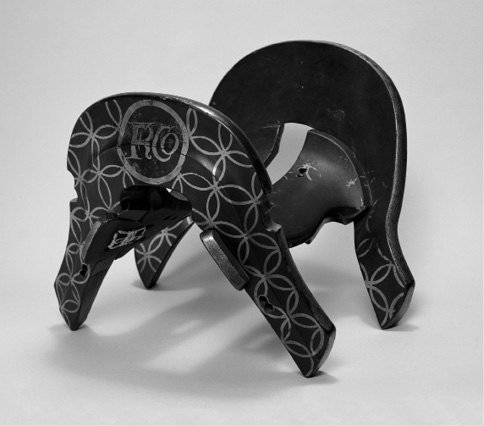
An image of Ōtomo Sōrin’s saddle. The monogram on the saddle—FRCO—represents “Francisco,” the Christian name that Sōrin adopted following his conversion.
{227} 5. Photos of Ōtomo Francisco Cannon with FRCO Monogram
This breech-loading cannon, a rare surviving example, dates from the latter half of the sixteenth century. It was created in the Portuguese colonies in the late sixteenth century. It is a three-pound (79 mm) cannon, with a total length of 268 cm. This cannon was cast by the Portuguese for their Japanese ally Francisco (Sōrin), who died of illness in 1587. His heir Yoshimune (d. 1610) sided with Hideyoshi’s supporters against those of Tokugawa Ieyasu. The Ōtomo were divested of most of their lands, and it seems likely that sometime, either after the battle of Sekigahara in 1600, or the destruction of Hideyoshi’s castle in 1615, the Tokugawa seized their cannon.
We know that the Tokugawa moved this cannon to defend the Kurile Islands against Russian incursions. Lt. Nikolai Aleksandrovich Khvostov (1776–1809) commanded the Juno for an expedition led by N. P. Rezanov (1764–1807). In retaliation for the Japanese refusal to establish relations with Russia, Khvostov landed at Shana on Iturup (Etorofu) (Syano) and captured several pieces of ordinance. This cannon was donated to the St. Petersburg Military-Historical Museum by the Russian-American Company, founded by Rezanov, in 1822.11
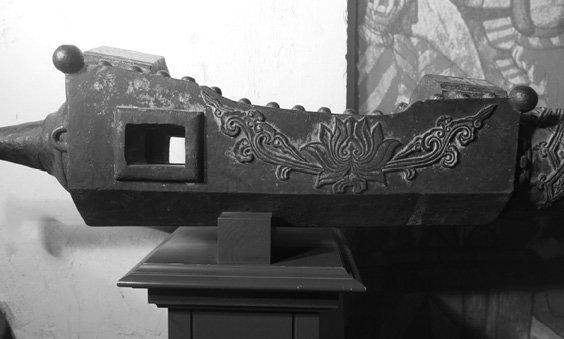
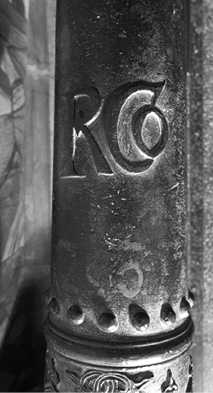
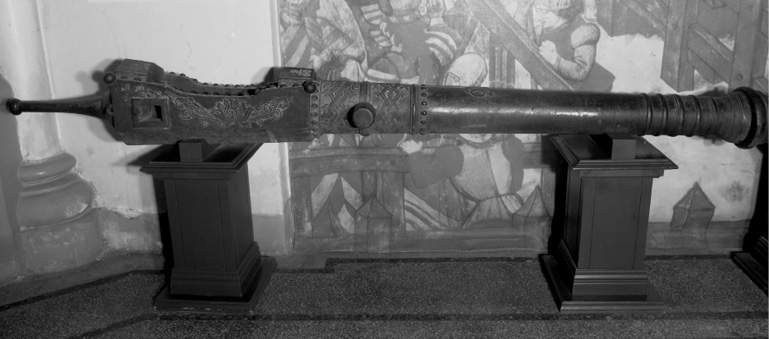
{228} Images of Ōtomo Sōrin’s cannon, featuring his FRCO monograph. The Portuguese, who manufactured this cannon, gave it to Sōrin after he lost his first cannon in battle.
{229} 6. The Dissemination of Guns: The Example of the Takeda
The following two documents are Takeda mobilization rosters dating from 1562 (Eiroku 5). They are called “vermillion seal” documents, a specific genre, because the document was stamped with the seal of the daimyō but not signed by him. Of the warriors mentioned here, two-thirds (60 out of 90) have pikes; 4 others have spears. Only 10 bows and 2 marksmen are requested—even though the 5 horse riders most likely relied on bows as well. Still, the impact of guns remained quite limited. The Takeda had more bannermen than arquebusiers.
Vermillion Seal Document of the Takeda House 112
[Seal] Regulation
The accoutrements of forty-five people.
Pikes (yari): 30.13 Nevertheless, of this number, five are present in the headquarters and are hereby exempt.
Bows: 5.
Short pikes (mochi-yari): 2.14
Gun (teppō): 1.
Helmet bearer (kabuto mochi): 1.
Bannerman (kohata mochi): 1.
Battle flag holder (sashimono mochi): 1.
Without anything: 4.
In total, forty-five people.
The aforementioned people are to be mobilized thus and shall perform military service. Thus.
The tenth day of the tenth month (mizunoeinu) [(1562/Eiroku 5)]
To: The Honorable Ōi sama no jō
{230} Vermillion Seal Document of the Takeda House 215
[Seal] Regulation
Forty-five people, with accoutrements for forty.
Regarding the latter:
Short pikes (mochi-dōgu): 2.
Bows: 5.
Gun (teppō): 1.
Bannerman (kohata mochi): 1.
Horse riders: 5.
Long-handled weapons [pikes] (nagae): 31.16 Nevertheless, of this number, five are in service at the Provincial Headquarters and are hereby exempt.
Thus.
The aforementioned people are to be mobilized thus and shall perform military service. Thus.
The nineteenth day of the tenth month (mizunoeinu) [(1562/Eiroku 5)]
To: The Honorable Ōi sama no jō
Excerpts from the Vermillion Seal Document from Takeda Katsuyori17
Excerpts from a document sent by Takeda Katsuyori (1546–82) to one of his followers, Koizumi Masamune, revealing a change in military organization after the debacle of the Battle of Nagashino. The document dates from 12.16.1575 (Tenshō 3)
Item (10). Since guns (teppō) are currently most important, we will start to limit the number of warriors mobilized with long-handled weapons (nagae). Bringing guns to a battle will be considered outstanding military service. We will determine the {231} number of guns required after we have investigated the number of pikemen requisitioned in mobilization rosters.18
Item (11). No one should bring bows and guns unless they have been trained to use them. In the future, we will be checking within the camps to see who has been trained to use bows and guns and who has not. If we find untrained warriors with bows and guns, their commanders shall be punished.
Item (12). The handles for nagae and handheld spears shall be made of wood or rattan (uchie). Currently the shafts of these long-handled weapons are of extremely poor quality. From now on, pay attention and prepare only high-quality shafts.
Item (13). Please be consistent in your preparation and use of battle flags so it will be obvious which units are brave or cowardly on the battlefield. It is up to you to decide which crest you use on these battle flags or banners.
Item (15). Battle flags and banners should be made anew.
Item (16). Regardless of rank, those men who prepare a surplus of bullets and gunpowder will be providing great military service.
7. Portuguese Recipe for Gunpowder, Given by Ashikaga Yoshiteru to the Daimyō Uesugi Kenshin in 155919
After receiving a gunpowder recipe from Ōtomo Sōrin, Ashikaga Yoshiteru (1536–65) transmitted it to allies such as Nagao Kenshin (1530–78) (who later adopted the name of Uesugi to become Uesugi Kenshin). Strangely, the document from Yoshiteru was carefully sealed, though the gunpowder recipe was visible to all. This recipe reveals that creating a proper gunpowder slurry mattered as much, if not more, than the guns themselves.
{232} An Official Letter (gonaisho) from Ashikaga Yoshiteru
You have been at Sakamoto for quite some time. How has your boil been?
I am concerned, and thus have dispatched Saemon no suke Harumitsu. He shall speak to you in further detail.
The twenty-ninth day of the sixth month [(1559/Eiroku 2)]
[Monogram of Ashikaga Yoshiteru]
To: The Honorable Censor (danjō shōhitsu) Nagao
A Letter (shojō) from Ōdachi Harumitsu
Saemon no suke has been dispatched to inquire about the state of your boil.
Recently Ōtomo Shintarō [Sōrin] presented [Ashikaga Yoshiteru] with a scroll on gunpowder.
Please deign to have a look at it; this is a great honor.
As for further thoughts from the Shōgun, Teruuji shall speak to you in detail.
Respectfully yours,
The twenty-ninth day of the sixth month [(1559/Eiroku 2)]
[Monogram of Ashikaga Yoshiteru]
To: The Honorable Censor (danjō shōhitsu) Nagao
A Gunpowder Recipe (Teppō yaku no kata narabini chōgō shidai)
This sophisticated gunpowder recipe was transmitted by the Portuguese to Ōtomo Sōrin, who in turn informed Ashikaga Yoshiteru, who then passed it along to Uesugi Kenshin. In contrast to the previous documents, which were secret in that they could only be opened by Kenshin, this recipe was not protected.
The composition of gunpowder determined the power of an explosion and the distance a bullet could be fired. Potassium nitrate, or saltpeter, provided the explosive potential, while sulfur lowered the ignition temperature, and carbon bound the other two ingredients. The ideal ratio of gunpowder was ultimately determined by the German general staff in the nineteenth century to be a ratio of 74 parts saltpeter (potassium nitrate), 12 parts sulfur, and 13 parts coal. The following recipe approaches that ratio. It contains two options: either {233} 80 parts saltpeter, 12 parts sulfur, and 8 parts coal, or 77 parts saltpeter, 13 parts sulfur, and 10 parts coal—the latter of which closely approximates the ideal ratio. It also describes how to heat and mix the ingredients into a slurry which, when dried, was more effective than a simple mixture of ground sulfur, coal, and potassium nitrate powders. After receiving this recipe, Kenshin engaged in a series of attacks on his rivals. He occupied Kamakura in 1560–61 and used guns effectively at the battle of Kawanakajima in 1562.
Gunpower recipe
Potassium nitrate 2 ryō, 2 bu (93.75 g)
Charcoal 1 bu, 2 shu (12.5 g)
Sulfur 1 bu (9.37 g)
Or
Potassium nitrate 1 ryō, 2 bu (56.25 g)
Charcoal 1 bu (9.375 g)
Sulfur 3 shu (4.6875 g)
All of the highest quality
Among the Evergreens (hainoki) used for making charcoal, the Kawara yellow catalpa [kisasage, Catalpa ovata] or the Japanese Sumac (katsuki, Rhus javanica) are suitable. It is not good for the wood to be too dried out. Forty to fifty days of drying is about right. Longer than that will result in the wood splitting apart. Old trees are not good. However, if the tree is a new sprout from an old stump, even an old tree is no problem. Cut the wood for charcoal at about 30 cm. Make sure you remove the bark. Remove the inner core, then dry the wood for a day. Since the summer sun is strong, the wood should be well dried in 10, 14, or 15 days. However, if you dry the wood in excess of 20 days, you should dry it in the shade. Next is the roasting of the wood. Dig a hole about two feet deep and cover the bottom with about five inches of cut straw. Pack the wood on top of the straw and light it from below. When the wood starts to burn, keep putting straw on top of the wood to keep the fire from dying down. Smoke should not rise from the bottom if the wood is burning well. When the smoke stops rising, flip over a bucket and, using it as a lid, steam the pieces of wood. When they turn to charcoal, pour hot water on them and let them boil a good amount. Then take them out and roast them. When they dry, they are ready for concoction. This is how to make the charcoal for the best powder. But not all charcoal needs to be done this way. You can abbreviate steps to make a lower grade of powder.
{234} To cook the potassium nitrate, add 9 tenmoku [1.8 l] of water to 1 kin [about 600 g] of potassium nitrate. Remove an appropriate amount of wood from the fire commensurate with the amount of water added so that it will not overflow. Reduce the slurry down to a third of the original amount. Then put it in a bucket one foot [30 cm] in diameter and store it away. Do not check it for one whole day. Check the mixture the following day, then put the top layer of liquid into a separate bucket. For about a day, dry the potassium nitrate that has congealed on the bottom and then scrape it with a spatula, dry it thoroughly again, and reduce the liquid content to half its original volume. When it cooks down, add one tenmoku of water and let it come to a rolling boil again. Then as before, let it cool in a separate bucket. Repeat the process as before: remove the top liquids, dry the bottom solids, repeat. Use a bright yellow sulfur. Green sulfur is not good. If sand and other impurities are mixed with the slurry, scrape them off with a small blade. For a good mixture, it is not a problem to have crumbly, clumpy sulfur so long as the color is good. But firm sulfur is even better. Grind the charcoal, the potassium nitrate, and the sulfur on a mortar. If ash starts to fly up, whisk in some water without soaking the gunpowder. Mix it until you cannot see the sulfur. Then put a bit of the powder on a table and ignite it. If there is no trace of powder remaining after the reaction, then wrap the powder in paper. Additionally, wrap it in three layers of cloth. Seal it up well, place it on a board, and use your feet to pack it together so it becomes firm. Then cut it up finely. Under no circumstances should you light any fires or have open flames at the site producing the powder. If a fire breaks out, it will cause a catastrophe. Even when lighting the powder to test it, be sure there is no other powder nearby. Extra powder should be stored separately. Fire can ignite powder even at a distance of 2 to 3 yards [3.6 m to 4.4 m]. You must be careful. Though these instructions might lead you to believe the process of making powder takes a long time, it actually takes no time at all once you get used to it. Even when you need to make about 5 or 6 kin, use the ratios as stated above. Roughly grind the three ingredients together in the mortar [yagen]; then blend them together in a stone mortar like a medicine mortar [yakuusu]. When the ingredients have been ground to a fine grain powder, pack it into bamboo cylinders and, once the mixture has hardened, split open the bamboo and cut the powder. All the details not recorded here will be transmitted orally by Kashii.
Respectfully
Twenty-ninth day of the sixth month of the second year of Eiroku (1559)
1. Nihon kankei kaigai shiryō Iezusukai Nihon shokanshū yakubun hen 2.2, 207–8 for the 8.28.1552 (Tenbun 21), Ōuchi Haruhide saikyōjō. For the original and a facsimile, see Nihon kankei kaigai shiryō Iezusukai Nihon shokanshū genbun hen 2 (1996), “Appendix 2” pp. 329–30. This document was originally published in a collection of letters in Coimbra in 1570, although the editors thought that the document came from Ōtomo Sōrin. For these insights I am indebted to Patrick Schwemmer. The Japanese was translated by Thomas Conlan, while the Portuguese version was translated and analyzed by Patrick Schwemmer.
2. Literally, “came to the court” (raichō), an alternate way to describe Japan.
3. Ōuchi Yoshinaga, who took over for Ōuchi Yoshitaka after the coup of the previous year.
4. The manuscript seems to have a capital letter O written and then crossed out. Coimbra 1570 transcribes this as a small e, yielding Daydogie (f. 161v), and Évora 1598 apparently corrupts this further to Daydoige and scrambles it in with the translation of the name (vol. 1, f. 61r). Translated and analyzed by Patrick Schwemmer.
5. A mark made between grande and çidade and then crossed out, together with the corrections Bu Manguchi and Daydogi O above, suggests that this is the original manuscript written from dictation in Yamaguchi, presumably on a copy of the document with the seal impression (go-in).
6. In the scribe’s apparent zeal to preserve the word order of the original, the grammar has become convoluted, but the priest of the monastery is presumably being listed as the party to whom the donation of “Duke Daidiki” is addressed.
7. Ōita ken kyōiku bunka ka, comp., Ōtomo Sōrin shiryōshū, vol. 5 (Ōita kyōiku iinkai, 1994), doc. 1744, 2.12 [(Tenshō 8/1579)] Ōtomo Yoshimune Ensai renshojō, 99–100. Translated by Thomas Conlan with Horikawa Yasufumi.
8. Nyohōji was another name for the Irie, a collateral line of the Tabaru.
9. The retainers of the Tabaru.
10. Sōrin and his son Yoshimune.
11. Explanation courtesy Dr. Sergei Efimov, the deputy director of the Military-Historical Museum of Artillery, Engineering, and Communications Forces.
12. Sengoku ibun Takeda hen, vol. 1, doc. 803, 10.10 Takeda ke shuinjō utsushi, 286–87. Translated by Thomas Conlan with Horikawa Yasufumi.
13. These were 18 feet (3 ken in length).
14. These were 12 feet (2 ken in length).
15. Sengoku ibun Takeda hen, vol. 1, doc. 804, 10.19 Takeda ke shuinjō utsushi, 287. Translated by Thomas Conlan with Horikawa Yasufumi.
16. Nagae. Weapons with long handles. Pikes. In Takeda Katsuyori’s 1575 document, the two are translated interchangeably.
17. Sengoku ibun Takeda hen, vol. 4, doc. 2555, 12.16.1575 (Tenshō 3), Takeda ke shuinjō utsushi, 45–46. Translated by Thomas Conlan with Horikawa Yasufumi.
18. Mobilization rosters, such as the first two documents in “The Dissemination of Guns,” translated above. Katsuyori suggests that guns should be levied in proportion to the number of pikes mobilized.
19. These documents were translated by the students in Sources in Ancient and Medieval Japanese History with Thomas Conlan. Claire Cooper translated the three documents under “Portuguese Recipe for Gunpowder,” while Kyle Bond translated the gunpowder recipe itself. For the documents, see http://komonjo.princeton.edu/uesugi/. Accessed August 27, 2021.