
{193} SECTION VIII
In the fifteenth and sixteenth centuries, some regional hegemons, or daimyō, attempted to restore order in their domains. The Ōuchi wall codes depict a stable and ordered society; one of the prohibitions mentions that uninvited guests would sometimes wander into the lord’s garden and peek into his house. By contrast, the Date family codes show that northern Japan was a much poorer and more chaotic place. A series of Mōri family oaths demonstrates how Japan’s warriors tried to create durable organizations without instituting a law code.
1. Ōuchi Laws Regarding Violence1
The Ōuchi were among the most powerful warlords of western Japan. The Ōuchi law codes, of greater antiquity than most daimyō laws, reveal much about warrior life in the fifteenth and early sixteenth centuries. The earliest of these laws were designed to establish order in the newly founded town of Yamaguchi. Since they were apparently written on the walls surrounding the mansion of the Ōuchi lord—where they could be seen and known by all—the laws became known as sekisho, or “wall writings.” It seems likely, however, judging from their length, that only the newest regulations would appear on the walls, with administrators keeping track of the previous regulations. These wall writings also reveal how the town of Yamaguchi was ordered and purified. Finally, regulations concerning adultery and violence reveal that the Ōuchi relied on some elements of Kamakura law, which by this time had become customary practice.
Ōuchi regulations for Yamaguchi. 5.22.1459 (Chōroku 3).
Monogram2
{194} Prohibited:
Item (2). Wandering along major roads at night.
Item (3). Sumō wresting at the crossroads.
Item (4). Taking women on the roadside (rotō).3
Item (5). Entering the Yuta hot springs at night. However, this does not apply for visitors to Yuta,4 women, and cultivators (nōnin).
Item (6). People fleeing from other provinces, and those whose reason for coming here is not known. They should not be taken into service.
Item (7). Wearing strange clothes, claiming that it is the style of the capital.
Item (8). Use care in taking people from different provinces into your service.
The aforementioned seven clauses were decided on this past twentieth day in Council meeting. The high, middle, and low people of our lands should abide by these clauses. This Wall Writing (hekisho) is thus.
Twenty-second day of the fifth month of the third year of Chōroku (1459).
[Sugi] Saemon no jō Hideaki Received.
[Sugi] Saemon no taifu Masayasu Received.
2. Ōuchi Regulations for Yamaguchi, 4.29.14865
The 1459 regulations, some of which had become widely accepted, were revised.
Item (89). Walking along major roads at night. This prohibition became well known during the previous rule [of Ōuchi Norihiro]. Different, suspicious people should be banned. Nevertheless, travelers should be exempted (from this prohibition) after their lodgings have been investigated.
{195} Item (90). Wandering monks, itinerant musicians, and monkey trainers should be expelled from here and nearby villages.
Item (91). People from other provinces who are not craftsmen (shokunin) or retainers (hikan) of various people (shonin) should not lodge here.
Item (92). Evening chanting of the nenbutsu at the roadside (rotō) is prohibited.
Item (93). Pilgrims (junreisha) can stay here for five days. Stays lasting more than five days will not be permitted.
The aforementioned five clauses were decided on this past nineteenth day in Council meeting. The lord has thus ordered that these clauses should be strictly followed. This judgment is thus.
The ninth day of the fourth month of the eighteenth year of Bunmei (1486)
Handa Ōi no suke (Hiro-oki)
Toida Kamon no kami (Hirotsuna)
3. Ōuchi Regulations for Yamaguchi, 4.20.14876
Further revisions of the previous year’s clauses.
Prohibitions Regarding walking along major roads at night.
Item (117). Long weapons,7 bows, and quivers. However, travelers and those greeting or seeing off travelers are exempt. All others will be rigorously inspected.
Item (118). Those with hats (kasa), haori,8 or jutoku or other strange clothes. Even if they are seen during the day, such people will be punished (seibai seraru beki nari).
Item (119). People who claim to be worshipping [at shrines and temples].
Item (120). People who cover their faces (hōkaburi) or show their underclothes [without wearing jackets (jutoku)].
{196} Item (121). Those with flutes, shakuhachi, or other instruments. However, they are exempt within 100 to 200 yards of their lodgings.
The aforementioned people are strictly prohibited. If someone disobeys these orders, or if they are a suspicious person wearing strange clothes, they should be held in their lodgings and investigated. If their [identity] is not clear, then in pursuance to the law, the lord will be notified and the person will be punished. Arsonists, rock throwers, and thieves shall be bound and reported without notifying the lord. Next, as for householders (gokenin) and retainers (hikan) of various people: their work is never done, so such people, whether male or female, may go back and forth even in the depths of the night. These people should not be investigated. These clauses should be known to night watchmen, who should be prepared to enforce them. The lord has ordered thus. This Wall Writing (sekisho) is thus.
The twentieth day of the fourth month of the nineteenth year of Bunmei (1487)
{197} 4. Further Prohibitions Regarding Killing9
Having established regulations concerning the control of people, Ōuchi Masahiro then issued prohibitions regarding the killing of animals and tried to make Yamaguchi a purified area.
Item (106). Concerning the cleaning of Tsukiyama.10
Cleaning, from the Tsukiyama Shrine to the small gate of Matsubara, shall take place on the last day of every month. The cleaning and construction crew (fushinshū) shall be conscripted [from a pool of retainers] at a ratio of one person per one hundred koku of revenue. The administrators in charge, and the allocation of the number of the crew, shall be determined beforehand [by the Ōuchi lord]. If, however, there is inclement weather, [the crew] shall wait for the weather to clear. The lord has thus ordered this process. This Wall Writing is thus.
The last day (misoka) of the third month of the nineteenth year of Bunmei (1487).
Item (124). The killing of soft-shelled turtles (tochigame) for use as hawk bait is prohibited.
Soft-shelled turtles and snakes shall not be used as hawk bait. That is because they are the manifest messengers of the [North Star God] Hikamisan. Those who do not fear the God, and kill turtles and snakes, shall not escape divine punishment. Henceforth, that practice shall be strictly prohibited. Falconers should only use wild animals as bait. Anyone who cannot secure adequate bait should not possess falcons. If any samurai disobey this prohibition and seek soft-shelled turtles, they shall have their benefice lands confiscated. Violators who don’t own land shall be banished. As for the common rabble (bonge no tomogara): if they are seen, or rumored to be, killing turtles, they shall be arrested or cut down at the place where it happened, according to the situation. The lord has ordered thus. This Wall Writing is thus.
The fourth day of the ninth month of the first year of Chōkyō (1487)
5. Prohibitions of Loitering11
Even during the “Warring States” era, the Ōuchi experienced problems with people leering into their mansions. They never did fortify their dwelling.
Item (138). People shall not sightsee at the lord’s mansion
Gawking at the lord’s mansion is strictly prohibited. Some people get their friends to sneak them into [the lord]’s living quarters; this is most surprising. Henceforth, sightseers shall not be allowed to enter the mansion, even to see the gardens. Autonomous warriors (tozamashū)12—even those who serve at the mansion—shall not be allowed into the inner chambers. The lord has ordered that anyone disobeying these orders should be punished. This Wall Writing is thus.
The nineteenth day of the twelfth month of the first year of Entoku (1489)
{198} Item (146). The prohibition of people sightseeing from atop the earthen walls of Tsukiyama
People spontaneously (shizen) climb atop the earthen walls of Tsukiyama to view the Gion Festival or to see other various things—this is strictly prohibited. In particular, people tend to congregate near the main hall (gohōden) or other shrines (chinju). Some climb the stone walls and set up seats to view events (saijiki). This is strictly prohibited. From now on, when [the Lord Masahiro’s sister, and head of the subtemple] Shinhō-in13 wants to sightsee from the walls, she must first make a request, through the temple administrators, to the person in charge of temple affairs. The lord has ordered that anyone disobeying these orders should be punished. This Wall Writing is thus.
The sixth month of the fourth year of Entoku (1492)
6. Ōuchi Reverence for Kamakura Law14
Ōuchi Norihiro upheld the legal tradition of the Kamakura Bakufu (1185–1333) and used principles espoused in its laws as the basis for common law in his domains. In 1462, Ishikawa Sukegorō was killed by a commoner (heimin) named Saburō, who had discovered his wife and Sukegorō in flagrante delicto; Saburō killed Sukegorō but not his wife. Norihiro adjudicated the case, banishing Saburō, his wife, and their child to Mishima Island. He justified this decision through an appeal to the principles of the 1232 Goseibai shikimoku (The Jōei Code) (see The Formulary of Adjudication, p. 42). Norihiro issued the law to the deputy shugo of Nagato Province, who was entrusted with enforcing the decision.
Concerning the Crime of Killing People in Revenge.15 The last day of the eighth month of the third year of Kanshō (1462).
{199} Item (14). Laws concerning those who rely on some pretext to kill people for revenge.
On the night of the past seventeenth day [of August], Ishikawa Sukegorō, a retainer (rōjū) of Iida Ōinosuke Sadaie, was killed by the commoner (heimin) Saemon Saburō of Misumi estate, in Nagato Province.
Concerning the aforementioned, Sukegorō had an affair with the wife of Saemon Saburō. She is known as the mother of [the child] Saimatsu. Saemon Saburō cannot avoid punishment for his crime of killing Sukegorō for revenge. In the domains governed by this house, the commoners (domin) should either notify their lords or state the particulars of a dispute in our courts and receive a judgment. The Ōuchi will judge cases concerning matters of our domain, based on the right or wrong of the matter. Anyone who seeks vengeance for a grudge are liable to lose their judgment. Their actions are disloyal and unfilial, and similar to those who come to ruin over prostitutes (keisei).16 What indiscreet people they are! It follows that henceforth we shall uphold this judgment and establish a law that should not be violated. If anyone happens to disobey this law—even if they are completely different types of people (iruishin), or devoted retainers who have served a house for generations—they, their children, and their grandchildren shall all be punished.
In order for this regulation to be widely known, it has been decided that, in accordance with the laws of the Jōei Code, Saemon Saburō and [his wife] the mother of Saimatsu, shall be banished. Quickly dispatch both of these people to Mishima Island, Nagato Province.17 Thus.
The last day of the eighth month of the third year of Kanshō (1462)
The Tsukiyama Lord [copy of monogram]
To: The Honorable Naitō Shimotsuke no kami [This is Moriyo].
{200} 7. More Laws Concerning Violence18
The following law was written shortly before Ōuchi Masahiro’s death, and shows that his son decided to adopt a more hands-on approach in dealing with quarrels, which were given great latitude during the turmoil of the Ōnin War and its aftermath.
Item (155). Laws concerning quarrels.
Quarrels should be decided by the participants. They should not become a source of public or private concern. It is Lord Ōuchi Masahiro’s belief, held since the time of the Bunmei era [1469–77], when he resided in the capital,19 that he would not intervene in such disputes and this has become established law. Later, he naturally heard examples of quarrels breaking out, but they were not adjudicated. From now on, quarrels should be settled by participants themselves. Yet it is rumored that other people are getting involved, providing military aid to one or another of the sides in a quarrel, or otherwise acting selfishly and loudly, and causing disturbances. Such behavior will cause problems for many and lead to a disregard for [our] laws. Thus we are now changing the recent law: from now on, if the lord hears of such quarrels, he will adjudicate them. He and he alone will determine the rightness or wrongness of a given case and in all matters. Should someone violate this law, they should be prepared for their own destruction. From now on, no one will give any help to either side in a quarrel, regardless of whether the quarrel involves parents and children, older and younger brothers, retainers within a house, or people with some other bond; instead, the will of the lord must be followed. This law is established, once again, thus. Let the people know this. This Wall Writing is thus.
[Sagara] Shami Masatō received
[Sugi] Saemon no jō Takeaki received
The eighth month of the fourth year of Meiō (1495)
Item (173). Regulations concerning quarrels in military encampments.
Quarrels arising within military encampments should be settled in a peaceful manner, regardless of the rights or wrongs of the matter. If one of the aggrieved parties has something to say, they should say it to the lord after the campaign has {201} ended. Conversely, anyone who acts selfishly and violates this law shall be punished, even if they are in the right.20
The thirteenth day of the first month of the second year of Dai’ei (1521)
8. Regulations Concerning Shipping21
The Ōuchi were a major maritime power, and they twice led armadas to the capital. The first such voyage, undertaken by Ōuchi Masahiro in 1467, allowed him to maintain a presence there until 1477. Masahiro’s son Yoshioki also led an army to Kyoto in 1508, which he occupied until 1518. The first regulation below concerns the crossing of the Straits of Shimonoseki in order to quell a rival of the Ōuchi, the Shōni.
Item (58). Regulations concerning levies of war boats crossing the Straits of Shimonoseki
When the [Ōuchi] lord was at Akamagaseki in order to conquer Kyushu, it was decided at the Council that the residents of Akamagaseki should, as their military duty, outfit war boats to cross the Straits of Shimonoseki. This law has been established in accordance with precedent. [Today] it has been decided at the Council that this law shall continue to be followed.22 This [was added] to the daily record for the Council. This Wall Writing is thus.
The first day of the eighth month of the fifteenth year of Bunmei (1483)
Item (105). Concerning waivers of tax levies for various merchant ships: although some want these taxes waived, henceforth [retainers] shall not entertain requests [as intermediaries from others to the lord]. Such exemptions are granted solely at the lord’s discretion. This Wall Writing is thus.
The twenty-ninth day of the third month of the nineteenth year of Bunmei (1487)
Saemon no jō Takeaki
{202} Ōi no suke Hiro [missing]
Tolls for Akamagaseki
Stipulated Articles
For the crossing between Akamagaseki, Kokura, Moji, and Akasaka.23
Item (108). Akamagaseki to Kokura: three mon.24
Item (109). Akamagaseki to Moji: one mon.
Item (110). Akamagaseki to Akasaka: two mon.
Item (111). Chests for armor:25 fifteen mon.
Item (112). Long chests (karabitsu): same as above.
Item (113). One horse: same as above.
Item (114). One palanquin: same as above.
Item (115). One dog: ten mon.
Regarding those eight clauses about tolls: though these laws were established previously, it has been reported that ferrymen (funagata) are not honest in their pricing, and that this has become a nuisance for people traveling back and forth. Starting now, ships from Akamagaseki to Kokura shall not charge an additional two mon per person; neither shall ships returning from Kokura to Akamagaseki charge an additional mon per person. When [the Ōuchi] discussed tolls [with the ferrymen] last year, they never mentioned these additional tolls (agesen). Tarō saemon, Jirōsaburō, and Jirō uemon of the Amidaji lands (ryō), both from Akamagaseki, requested this ruling for the first time this year. Laws regulating the tolls have been firmly established. Yet when the wind and waves are strong, the ferrymen have been taking [extra] tolls as they wish and thus disobeying the laws.
These regulations should be followed even when the wind and waves are strong. Whoever disobeys these laws, and harasses the people crossing back and forth, will be imprisoned by the representatives (daikan) of Akamagaseki or Kokura. From there [the situation] will be reported to officials in Yamaguchi, where the matter will be investigated carefully, and the criminals executed. Hence, this order is thus.
{203} The twentieth day of the fourth month of the nineteenth year of Bunmei (1487)
From the administrators at that time
[Handa] Ōi no suke Hiro[oki]
[Yasutomi] Ōmi no kami Fusayuki
[Sugi] shami [Shūsai]
[Naitō] Danjō no chū Hironori
[Toida] Ōkura no shōyū Hirotane
Item (116). Contracts (ōsho) with Locals Concerning the Established Law about the Ferries at Akamagaseki
Concerning the ferries at Akamagaseki: if we hear about someone failing to obey the posted prohibitions, we will investigate them and report back to you. Should we fail to keep you informed, we should be immediately punished. Respectfully.
The twentieth day of the fourth month of the nineteenth year of Bunmei (1487)
Tarō saemon (han)26
Jirōsaburō (han)
Jirō uemon (han)
Item (128). Concerning the Boats Commandeered for War
When we provide our retainers with commandeered boats for the advance to the capital (and a variety of other purposes), we also supply a daily ration of rice. Because we pay for these provisions, we do not pay retainers for boat fees or wages for sailors. This has long been the arrangement. Nevertheless, last year, when war boats were allotted to retainers,27 some of them improperly requested boat fees. Acting as if they were merchant ships or ferries (kaisen), our retainers willfully requested rice as well as boat fees and wages for sailors. When the forces advancing to the capital boarded the boats, they insisted on making this selfish request (watakushi no kojitsu), which is most surprising. In the end, if this law is disobeyed, or if someone disputes this or hides boat gear, that boat shall be confiscated from those who were allotted the said boat [such as the Ōuchi, or the Sue]28 and will be {204} used however the leader of the campaign pleases. The Council is in accord. This order shall be made known. The order is thus. This is so conveyed.
Twentieth day of the first month of the second year of Chōkyō (1488)
Handa Ōi no suke Hiro[oki]
Sugi Saemon no jō Takeaki
Sugi Saemon no jō Takemichi
Yasutomi Ōmi no kami Fusayuki
Naitō Higo no kami Hironori
To: The Honorable Sue Nakanotsukasa no shōyū
9. Portrait of Hosokawa Sumimoto
The following portrait of Hosokawa Sumimoto (1489–1520) was completed sometime before 1518, as the monk Keijo Shūrin commented that Sumimoto had this portrait commissioned as a sign of his victory in a familial dispute. He did so after seeing a portrait of Ashikaga Takauji in armor, showing the enduring influence of the Ashikaga leader.29 Sumimoto is wearing a style of simplified armor, known as haramaki, which was tied under his right shoulder. The shoulder boards (sode) are flexible and are more for decoration than the inflexible sode of earlier times. The helmet is of a style favored in his time, known as akoda-bachi, and it is decorated with horns, called maidate, attached at the front. Sumimoto holds a long sword with a wrapped handle that covered three feet of the blade. This style of sword, known as nagamaki, was popular in his day, but later fell from favor. Equally notable, inserted in his belt one can see a short sword with katana-style fittings. This portrait is one of the oldest showing swords with these fittings. Finally, partially visible on his left is a sword hanging from his belt in the earlier tachi style. The leg armor is also notable, as it completely covers the lower leg, including the knee, and the rear of the leg. Finally, the haunch of his horse is branded with a three diamond (mitsumeiyui) crest.
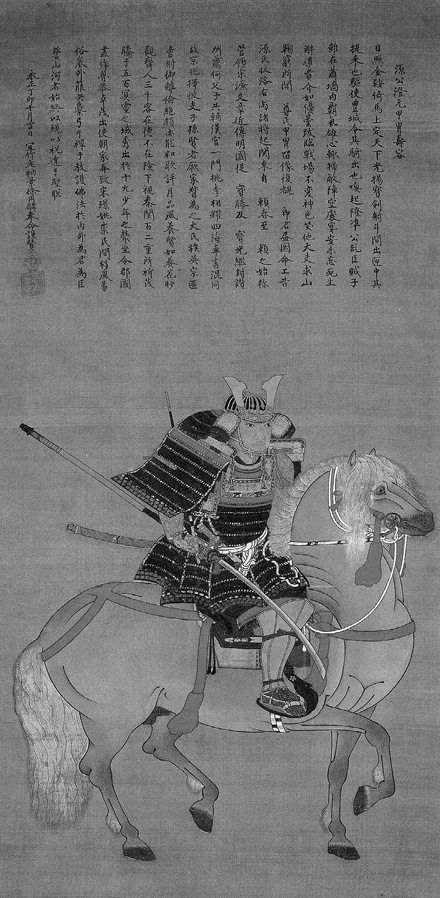
{205} A portrait of Hosokawa Sumimoto. This painting accurately depicts sixteenth-century Japanese armor and is unusual in offering one of the earliest-known images of a sword (tucked in Sumimoto’s belt) with katana-style fittings.
{206} 10. The Jinkaishū, Laws of the Date30
In 1536 (Tenbun 5), Date Tanemune (1488–1565), a lord of Mutsu, in northern Japan, wrote a set of laws that he called the Jinkaishū. The phrase means “dust and dirt,” and was used to describe worldly (as opposed to Buddhist) affairs. Unlike the Ōuchi laws, Tanemune’s regulations were not apparently publicly displayed as “wall writings.”
Tanemune felt the need to codify local practice by writing laws but struggled greatly in crafting them. Tanemune was a very poor writer. He wrote the codes in the local dialect. Although people in his domains most likely understood the laws, later scholars struggle to decipher them. Tanemune ended his new code with the 1232 Jōei Formulary’s final oath (see The Formulary of Adjudication, p. 42), thereby revealing the esteem with which he held the earlier laws. Passages lifted directly from that code are reproduced here in bold type.
Tanemune’s world was one where local warrior authority remained strong. Warriors were still referred to with the title of jitō, a holdover from Kamakura times. Their houses were autonomous legal spheres, and Tanemune freely admitted that his writ did not apply there. Here, he exercised far less authority than the Ōuchi, who could interfere in house affairs. He also recognized their right to feud with other houses. These local warriors (jitō) also began to assert greater authority over the region’s commoners. Indeed, the old term for commoners, hyakushō, was increasingly used to refer to peasants instead of people who could serve as military retainers.
Though evidence was still required in the processing of legal matters, the use of torture to generate confessions was becoming ever more common in judicial affairs. Still, older practices, such as allowing women to inherit lands, remained.
Tanemune’s code contains 171 clauses; 52 of them are translated here. The clauses reproduced below mostly refer to criminal cases, which illuminate the lives and judicial ideals and practices of warriors and their followers in the north. Laws that refer to financial matters, loans, or religious institutions are omitted.
Item (13). People who have renounced the world should not carry (sasu) swords.
Item (16). The punishment of murder.
For those who aid murderers: if they have unsheathed their swords, they shall be punished for the same crime as the murderer. But accessories to murder who want {207} to avoid this punishment will be pardoned if they kill the perpetrator before turning themselves in. Any abettors (toritabane) who have not used their own swords but have been involved with the perpetrator are to be convicted of the same crime and punished in the same way.31
Item (17). In violent contest (kakemukai), there are cases where one party claims that they were ambushed and suffered fatalities but in fact they were the ambusher; or in other cases they claimed that through skill they killed ambushers when in fact they ambushed their rival in a surprise attack. In such cases, officials should search for proof. If there is no proof, it shall be judged that the killed party was in the right.
Item (18). If a retainer or a low-ranked person kills someone and then flees, their lord should not be punished. But if the lord harbors a known killer, that lord should receive the same punishment as the murderer. Furthermore, in such cases, if someone associated with the victim claims that a lord aided or protected the killer during the murder, then the lord’s residence (zaisho) should be searched.32 If the aggrieved party claims that the lord aided and abetted the killer after the murder took place—and if these claims are proven to be true—then the lord shall be punished in the same way as mentioned above. If no clear proof is produced to support these claims, then the lord shall not be blamed. If a retainer, in an attempt to placate a lord’s anger, killed someone without the lord’s knowledge and then fled, it will be difficult for the lord to escape punishment. In such cases the lord shall be pardoned if he kills the murdering retainer and then turns himself in.
Item (19). If a criminal attempts to escape execution by seeking sanctuary in another lord’s lands, the lord of those lands should quickly expel the criminal. If the lord does not expel the criminal, his holdings should be searched. The same holds for criminals seeking sanctuary on temple lands; these temples shall not protect them.
Item (20). If a quarrelsome and combative person willfully (watakushi ni) attacks another’s place without first asking the Date to rule on the right and wrong of the matter, then that person shall be found guilty even if he is completely in the right in terms of the legal case.
Item (21). When crazed drunkards kill people, they often use their inebriation as an excuse, but they should be punished. Drunks who slash or beat people should suffer the same punishment they would receive if they were sober.
{208} Item (22). The slander of drunkards shall be evaluated on a case-by-case basis, even if the drunks are women or those who have renounced the world.
Item (23). When criminals are killed, they are still at fault regardless of how many of their confederates were killed in the process of their capture.33 But if the criminals’ confederates are men of worth, you should let them escape, notify the Date, and wait for the Date’s judgment.
Item (24). Enemies of one’s family should not be killed impulsively.34 Nevertheless, if such an enemy, after his punishment has ended, is loitering in rival lands and runs into someone who then proclaims that they are an enemy of their parent or child and kills them, the avengers are not at fault.35
Item (25). Punishments of parents and children in affairs that may or may not bind them.
Concerning the aforementioned: in cases where people impulsively quarreled, or were crazed at a banquet, and unpremeditatedly killed someone, they shall be punished, and their lands confiscated. However, if their father or son was not involved, they should not be punished. The same is true in the case of crimes where someone cuts down another person. Next, when sons or grandsons are convicted of having killed their parents’ or grandparents’ enemies (ada), the parents or grandparents shall suffer the same punishment even if they were unaware of their sons’ or grandsons’ plans. This is because such murders are plotted and carried out in order to seek revenge on a parent’s or grandparent’s behalf. If, in the course of committing a crime, a son kills the person from whom he is stealing land or possessions, his father shall not be punished so long as his ignorance of his son’s plans can be proven beyond a doubt. The same principle shall apply in cases involving crimes committed by brothers.
Item (26). When criminals from different domains are killed, people from those domains should not interfere.
Item (27). In cases where a retainer abandons his original lord and takes a new lord, the original lord should inform the new lord of these existing bonds of lordship. If the new lord keeps the retainer and does not return him to the original lord, the original lord should inform the new lord that he will kill the retainer. The original {209} lord can kill the retainer wherever he finds him. Furthermore, if the new lord does not respond to the original lord’s letter, the details of the case shall be made known to the Date. Depending on the facts, the aforementioned retainer, or those who permitted him to switch lords, shall be punished.
Item (28). When a guest is killed, the master of the house shall be punished. In cases where the perpetrator can be clearly identified beyond any doubt, the master shall not be punished, depending on the circumstances.
Item (29). In cases where two guests get in a fight, and one is killed by the other, the master of the house should apprehend the murderer and notify the authorities. In cases where the murderer is not apprehended, the master of the house should consider the circumstances and explain36 the particulars.
Item (30). In cases where people are called out from their residence (zaisho) only to go missing and then be found assassinated (yamiuchi): in such cases, the person who called out the victim shall be punished. But he shall not be punished if there is unmistakable proof of his innocence.
Item (31). In cases where someone is called out, then assassinated (yamiuchi) on their way home, the person who called out the victim shall be responsible to investigate this murder.37
Item (37). It is prohibited to kill a criminal without first notifying the lord of the residence (zaisho) where the criminal is being harbored. If the lord is notified but ignores this notification and continues to protect the criminal, then this case will be made known to the Date and that lord’s residence will be searched.
Item (38). In quarrels or disputes where people have been cut down on both sides, the judgment will be made in favor of the party that suffered the greatest number of casualties. But if they attacked first (kakarite), they will be at fault and will be punished even if they suffered the greater number of dead and wounded.
Item (39). When people are apprehended for the crime of cutting down others, report the case to the Date and wait for their ruling. No one should willfully (watakushi ni) strike back without waiting for the Date’s judgment. Those that do, even if they have ample right on their side, are disobeying the law and will be punished.
Item (40). As for those who assault others: if samurai, they shall have their lands confiscated. Those with no lands will be banished to other provinces. Victims who seek {210} revenge without waiting for our judgment will lose their land holdings. Any landless victims found guilty of seeking revenge will be banished to another province.
Item (41). Stealing, banditry, robbery, and piracy.38 If evidence is lacking in the case of the aforementioned crimes, suspects shall be apprehended and questioned (ikeguchi). Accomplices named in a suspect’s confession shall also be apprehended. If such named accomplices claim innocence of the crime, they can name their own suspects, and both groups will be taken to the court (satasho) where they will be questioned for fifty days. The guilty party will be punished.
Item (47). If someone discovers people who ran away from their master, he should return the fugitives to the original master. If, after the fugitives have been captured and the master notified, the lowly people (genin) flee again, then the person who found, then lost, them is liable. In such cases, the discoverer will have to pay three hundred hiki in compensation for the loss of male fugitives and five hundred hiki in compensation for the loss of females.
Item (48). If someone discovers people who ran away from their master and notifies the master, he should receive, as a show of gratitude, thirty hiki for each person he returns. But if the capturer has to return the escapees from far away, miscellaneous expenses and tolls should be paid by the original master. All items used by the escapee should be returned.39 If the discoverer decides to keep these items, he will be charged with the same crime as the fugitive. In some cases, a fugitive will sell or lose such items (idakimono) during his escape. If someone finds them40 later and does not know the circumstances of how the items came to be lost or sold, the fugitive’s (genin) testimony shall not serve as the basis for determining the proper course of action.41
Item (49). When suspects (ikeguchi) are inadvertently killed during their capture, the apprehender (torite) shall be at fault (oto taru beshi). Nevertheless, if the confession of another suspect includes the name of the killed suspect (hakujō ni nosuru ni tsuki), then the apprehender’s position is confirmed.42
Item (50). If a captured suspect (ikeguchi) does not confess, his captor is at fault. But if one of the captured criminal’s compatriots is later apprehended and confesses, while being tortured during the investigation, that he was the previously captured {211} criminal’s accomplice and that both they and the captured criminal are guilty, then the captor shall be judged in the right.
Item (51). If a captured criminal disembowels themselves or bites their tongue and dies while being interrogated by the Date’s representative (daikan),43 the case shall not be investigated further (zehi ni oyobu bekarazu). But such cases can still be adjudicated depending on the particulars.
Item (52). If a captured suspect (ikeguchi) being transported along the road is seized by villagers, their lord, relations, or a mob of accomplices, this act will be considered to be theft. But if the suspect shows up in court claiming to have done nothing wrong, they will be questioned and tortured. The truth shall be determined in this matter.
Item (53). Poor planning—such as failure to bring rope—can result in suspects (ikeguchi) evading capture. When this happens, the suspects will accuse their captors of being bandits and highwaymen (hikihagi); the suspects will claim to be the captors, and both sides will dispute the truth. If neither side can prove their claims, thereby making it difficult to reach a just verdict in the matter, both sides should apprehend further suspects (ikeguchi) for interrogation to plead their case in appeal. Then it can be decided which side is in the wrong, and those judged to be in the wrong will be classified as brigands (akutō).
Item (54). Anyone who personally punishes a thief shall himself be punished, even if evidence is provided to prove the thief’s guilt.44 But if the thief’s captor instead notifies the thief’s lord, who then punishes that person, then the right and wrong of the matter should be clear, and no punishment is required.
Item (57). Regarding the blame that falls to the parents and children of thieves: if the parent is guilty, so, too, is the child. But if a thief’s children live in a distant area, from which it would be impossible for them to have participated in a crime, they shall not be punished. In similar situations, parents should not be blamed if their children commit crimes. If, however, both parents and children are living under the same roof, they should all be punished in the same manner. Decisions will be made based on the circumstances.
Item (63). Concerning robbers and similar criminals: any accomplices who receive a share of a criminal’s stolen booty, even if they did not participate in the crime themselves, shall be punished as thieves. In addition, any accomplices who plotted with criminals but, due to a sudden change of heart, did not show up when the crime was committed, should be considered criminals if their names appear in the thieves’ confessions. That is because they aided robbers.
{212} Item (66). Trespassing—climbing over a fence and entering someone’s residences (zaisho)—shall be punished just as if it were robbery.
Item (74). When a suspect’s confession names a deceased person as an accomplice, the time at which the crime was committed must be determined. If the deceased accomplice’s children were under ten years old when the crime was committed, they shall not be punished for their parent’s crime. If, however, they were ten years or older at the time, they shall be punished for the same crime as the deceased parent. In addition, the accomplice’s son-in-law shall be punished for the same crime if he succeeds to the headship of the family.
Item (75). Arsonists shall be treated as thieves and executed.
Item (76). On the relationship between jitō lords and hyakushō commoners:45 if the latter have been retainers to jitō for a long time, they should still pay their share of agricultural taxes in full. If they owe back taxes, they will suffer confiscation of their lands. Nevertheless, if the hyakushō, claiming historical rights, rely on the authority of central proprietors (kenmon)46 to interfere with tax collection (zaike) by the jitō, they shall be punished.47
Item (83). The opinion of the jitō lords shall be followed in settling questions regarding the historical rights of the hyakushō. In cases where hyakushō, relying on their lord, or based on their ties with central proprietors (kenmon), cultivate, harvest, or otherwise interfere with disputed rights, they, along with all other hyakushō who support them against the jitō shall be punished.
Item (104). A parent’s wishes, as expressed in their will, shall be followed in settling a daughter’s inheritance.
Item (125). The possessions of craftsmen shall not be sold without good reason (midari ni). Both seller and purchaser shall be punished.
{213} Item (130). Concerning revenge for assault and murder: if, in an act of revenge, a resident of our domains is captured or killed in a different domain in an act of vengeance, then anyone living in our domains who is associated with that crime shall be investigated and punished.
Item (131). All the facts of the matter should be considered before revenge is taken on another province’s resident who slashed or murdered one of our own. In such cases, a person from the assailant’s province should be held hostage, and the office of the protector of that province (shugosho) should be notified.48 But if the assailant has already been punished in another domain, then the hostage shall be immediately released and returned to that province.
Item (132). A warrior killed accidentally on the battlefield by his allies will still be considered to have been “killed in battle” (uchiji), and the deceased warrior’s relations must not seek revenge in such cases.49
Item (151). Concerning the homesteads (zaisho)50 of people punished for their crimes: a suspect’s guilt shall be firmly established before our agents (daikan) confiscate any of the assets attached to his lands and residences (tatō),51 including such wealth and treasures as cows, horses, and hereditary followers. If a convict flees with the aid of his former lords or anyone else, his assets shall be returned to the previous jitō. The province’s agents (daikanshū) should not squabble over confiscated produce; any agricultural products belong to the jitō.
Item (152). The areas surrounding the houses (zaike) of convicted criminals should not be burned down as part of their punishment. Anyone who commits such outrages—including the cutting down of trees and bamboo around a criminal’s residence or the destruction of the outer walls of the house—shall be punished for their crimes. The guilty parties may have been acting against convicted criminals, but they will have disobeyed the law in their own way, and their punishment shall not be light.
Item (154). If you find a hawk and do not return it, you will be punished as a thief.
Item (156). If a horse or cow runs away and starts eating your produce, you should hold it and fine the owner over the losses you incurred. There is no reason for you to kill or shoot livestock with arrows. If you injure a horse or cow, you should pay {214} compensation. If you kill the animal, you should pay the price of its worth. Those who ignore this law shall have their dwellings confiscated.
Item (157). No one should be punished for killing a dog if they use it for hawk bait. Still, no one should chase a dog onto other’s property and kill it.
Item (159). On messengers’ lies: if a lying messenger is a samurai, their holdings can be confiscated; if they have no holdings, they will be banished to another province. If the lying messenger is of a lower status, they will be summoned and physically punished.
Item (162). A man who secretly has an affair52 with another’s wife will be killed as punishment. This applies to both adulterous men and women.
Item (163). Regarding illicit affairs (mikkai): whether forced or gentle encounters, they must occur in a place of assignation (nakadachiyado).53 Those who offer a place of assignation to adulterers will be punished identically to those committing adultery.
Item (164). Regarding adulterers killed by the wronged husband: the laws say nothing about saving the wife. If the husband caught and killed the other man in the bedroom54 but failed to also kill his wife, he shall not be at fault for not killing her (oto taru bekarazaru nari).
Item (168). Attendants should not carry long pikes or quivers when accompanying their retainers. But they can carry quivers or other military accoutrements for falconry, or while accompanying a superior to a different location. These regulations (sadame) should be followed henceforth.
Oath: Questions of right or wrong shall be decided at Council meetings.55
An individual is liable to make mistakes through defect of judgment, even when the mind is unbiased. They can also, out of prejudice or partiality, reach an erroneous decision while believing they are right. Furthermore, they can claim that proof {215} exists, even in cases where there are no facts to be found. Or, even when being cognizant of the facts, they might be unwilling to expose another’s shortcomings and therefore refrain from reporting the truth of the matter. When intention and fact are not aligned, catastrophe ensues. Therefore, at meetings of Council, whenever questions of right or wrong arise there shall be no regard for ties of relationship. None shall give in to likes or dislikes, but rather all shall speak out in whatever direction reason pushes and the inmost thought of the mind leads, without regard for companions or fear of powerful houses (kenmon). Even when a decision given in a case is perfectly just, it shall be agreed upon by the whole Council in session. The entire Council shall be held accountable for misguided actions taken on the basis of faulty information. Council members will never say to litigants and their supporters, “Although I personally had the right understanding of the matter, so-and-so among my colleagues of the Council dissented, and caused confusion.” Should such things be said, the solidarity of the Council would be fractured, and we would be ridiculed. Were an individual Council member to agree to support the appeal of a plaintiff who, because they do not have a legal leg to stand on, was denied a trial by the full Council, such an act would be tantamount to the single Council member declaring that all the others are wrong. Were the Council to agree to hear a direct appeal while burying the appeals of the less worthy (fushō no tomogara), they would, in effect, be breaking the law (hōrei) themselves. At those times, no one should accept the claims of those in the wrong or agree with them. Likewise, defendants should not rely on clever stratagems to intimidate the thoughtless or inexperienced (mutenin); nor should ignorant families (mōsai) who have justice (dōri) on their side be unable to properly plead [their case in court]. We would be wrong and in violation of the principles of this Constitution (kenpō) if we did not carefully distinguish (ryōken) between the injustice of the intelligent and the justice of the ignorant.
Such are the reasons for these articles. If in even a single instance we deviate from, or bend or break, them, may the gods Bonten, Taishaku, the four great Kings of the Sky, and all the gods—great and little, celestial and terrestrial of the sixty odd provinces of Japan (Nihon), and especially the Shiogama Daimyōjin56 this [Nishiyama] Hachiman Daibosatsu, Marishisonten, and Temman Daijizai Tenjin—divinely punish us. So may it be, accordingly, we swear a solemn oath as above.
The fourteenth day of the fourth month of Tenbun 5 (1536)
[Names omitted]
{216} 11. Mōri Motonari Oaths
As the tumultuous sixteenth century progressed, warriors resorted to extreme measures to shore up their authority. The following sequence of documents illustrates how Mōri Motonari (1497–1571)—who, at the time, was serving Ōuchi Yoshitaka (1507–51)—ousted and killed the Inoue, a family he believed was preparing to usurp his house. He alludes to similar turmoil among the Yamana and the Akamatsu, with their retainers the Kakiya and Urakami, and provides a comprehensive list of the Inoue crimes—for which they were killed. An oath solidified this organization in 1550 and was reiterated in 1557 after a similar rebellion led to the destruction of the Ōuchi and paved the way for the Mōri becoming a daimyō in their own right.
In the first document, Mōri Motonari writes to Lady Ozaki, wife of his son Mōri Takamoto (1523–63). Lady Ozaki (1527–72) was the daughter of Naitō Okimori (1495–1554), a crucial retainer of the Ōuchi. In this document the term comrades refers to Mōri Motonari’s retainers.
Mōri Motonari’s List of the Inoue Group’s Crimes (Mōri Motonari Inoue shū zaijōsho)57
This document provides an excellent overview of what came to be perceived as being intolerable insubordinate behavior to lords.
To: The Honorable Lady Ozaki, respectfully
[From:] Motonari
For thirty years, since the death of Okimoto, the older brother of Motonari, Inoue Kawachi no kami (Motokane) has served our house in the following manner:
During councils or times when consultation was required, he did not attend, even when summoned.
He never served for New Year’s ceremonies or other established rites.
Without Motonari’s permission, he claimed to be retired and refused to respond to our demands of setting up encampments or dispatching messengers on our behalf. Furthermore, he did not pass his benefice lands (kyūchi) to his sons but instead continued to control them. He refused to serve the lord (kōgi), claiming he was retired.
{217} Concerning tansen, tanbetsu and other taxes.58 In spite of orders, he refused to survey and assess taxes on all the lands to be dispatched to Motonari. In addition, comrades (bōhai) and others never serve as Mōri messengers. These comrades never urge the Inoue to pay taxes to the Mōri; nor, because of their fear of the Inoue, do they cross the boundaries into their lands.
When asked to construct a castle or ordered to provide various levies (fushin), Motokane never served at all.
Although appointed as a representative (daikan) to Motonari’s lands, Motokane refused to collect taxes on these lands. Instead, he occupied them.
Motokane occupied the lands of our comrades (bōhai).
He occupied the fields and paddies of temples and shrines.
Regarding seating arrangements, although Watanabe occupied a higher-ranked seat than Inoue Motokane, Motokane unjustly demanded a higher-ranked seat than Watanabe and, in recent years, forcibly occupied it.
Motokane has his retainers (uchinomono) engage in unjustified and unwarranted brawls, and allows them to win with no regard for the merits of the case.
Additional violations of recent years:
A man called Yoshirō, the son of Inoue Yozō uemon no jō, pummeled the face of Hikoshichirō, son of Mitsunaga Shirō uemon no jō, of our same name.59 Because Yoshirō beat Hikoshichirō, who wears our Mōri crest, Yōzō uemon no jō and his son (Yoshirō) were told to disembowel themselves (harakiri).60 [Mitsunaga] Shirō uemon no jō, and his son [Hikoshichirō] were also told to disembowel themselves. This was because in the eyes of Motonari they failed to maintain their honor and retaliate against the Inoue as they were expected to do after taking such a beating. But without considering the merits of the case, all with the same Inoue surname objected to this punishment. So to prevent the fracture of my house, I suspended this punishment. Nevertheless, the Inoue killed Mitsunaga Shirō uemon no jō.
A man called Kashiwamura Saburō hyōe no jō, stabbed his wife to death and killed a person called Inoue Shin uemon no jō, whom he declared to be her lover (megataki).61 But the Inoue said they would retaliate against Kashiwamura since he had not caught the lovers in the act before he killed Shin uemon no jō and that, furthermore, Inoue Shin uemon no jō had not been the lover of Kashiwamura’s wife for {218} several years.62 I, Motonari, had no choice but to banish Kashiwamura Saburō hyōe no jō from the Mōri domains so as to maintain peace. Already a certain Zen saemon no jō63 had killed the mother of one of Saburō hyōe no jō’s children. The right and wrong of this matter should be clear (zehi ni oyobazu): the Inoue are evil.64
At a market, a merchant affiliated with Inoue Gengorō quarreled with a lowly river person from another area and was killed. At that time, a different river person lived in Inokoda, a place in [Mōri] Takamoto’s holdings. This other river person had lived on Takamoto’s lands for a long time. Saying that this different river person was allied with beggars from elsewhere,65 the Inoue gathered in great numbers and killed him66 without even consulting Takamoto. Even if a merchant affiliated with Inoue Gengorō had in fact quarreled with and been killed by a river person from Takamoto’s holdings, Takamoto should have been notified first, before the Inoue retaliated. Even worse, the beggar,67 who actually fought with and killed Gengorō’s merchant, came from somewhere completely different. Claiming that the river person from Inokoda was allied with beggars from elsewhere, the Inoue cut him down just below Takamoto’s castle without even a word of consultation. It is a great outrage. The right and wrong of this matter should be clear: the Inoue are evil.
Other general issues:
In recent years, the Inoue attitude has been: because they are allied with the Mōri, Motonari and Takamoto can maintain their houses. At the bottom of their hearts, all those named Inoue, whether young or old, harbor the arrogant thought that it’s up to them whether to harm the Mōri or not. It is unbearable that they sometimes say such a thing in public. Much as I hate to make the comparison, these statements are similar to those made by the Kakiya, followers (miuchi) of the {219} Yamana and the Urakami of the Akamatsu.68 The right and wrong of this matter should be clear: the Inoue are evil.
The Inoue make it hard for anyone—even commoners (tami hyakushō) and village merchants in the markets—to serve our house without first consulting them.
Within our house, our relatives and others with different names favor those who have connections with the Inoue. Those without such connections are harassed by the Inoue on a variety of pretexts. Hence, among the retainers of the highest status (bunsai), only three to five do not have such connections with the Inoue. These facts will be of the greatest consequence in the future.
We are forced to make this statement as a result of the countless unprincipled misdeeds done by the Inoue against us, our relatives, and retainers (hikan). Because of all this, we asked our lord (Ōuchi Yoshitaka), through the intermediary Hironaka Takakane, that the Inoue should be wiped out with his help. But our request was not granted because the Hiraga—father and son—took up arms against each other at Kashirazaki. As our enemy, the Amako, was strong in Izumo Province, we first needed to complete these difficult campaigns before again asking our lord to strike the Inoue. Yet again, our request went unfulfilled. So this is not the first time we have asked. Please convey this report to your father Naitō Okimori who will notify the Ōuchi.69
The fourth day of the eighth month
Kohara Takanobu Letter70
A letter from Kohara Takanobu to his lord, Mōri Takamoto, the eldest son of Motonari. Kohara recounts the death of the Inoue, showing how, having justified this course of action in the previous enumeration of the Inoue crimes, Motonari still had to receive the permission of his lord, Ōuchi Yoshitaka, before killing them.
To: The Honorable Mōri Bitchū no kami
Kohara Aki no kami Takamoto
The other day I presented your report to our lord Ōuchi Yoshitaka and notified him that the Inoue had all been killed. He said he had no problem with you managing {220} your lands and followers as you see fit. Accordingly, he dispatched Sugi Shinano no kami Takemasa as a messenger to you. Since this messenger was sent to you most suddenly, you must arrange all matters in your domain so that all will settle down soon. Sugi Shinano no kami shall inform you of the details, so they are omitted here. Respectfully
Twenty-fifth day of the seventh month (Tenbun 19/1550) Takanobu (monogram)
To: The Honorable Mōri Bitchū no kami
Fukuhara Sadatoshi Oath71
An oath signed by Fukuhara Sadatoshi and other retainers.In the aftermath of the Inoue killing, Motonari relied on oaths to solidify ties within his organization.
Clauses stated [to those above]
The Inoue have repeatedly belittled Mōri Motonari and in major and minor affairs acted as they wished. Hence, they were ultimately destroyed. We acknowledge this and hence each of us shall not harbor any traitorous intentions.
From now on, all affairs of the house shall be conducted in accordance with the judgment of the lord. We all fervently believe this. Therefore, in all affairs, we shall do as we are ordered to do. In no way shall we be negligent.
Concerning disputes among comrades (bōhai): no one shall say or do anything that violates the judgment or orders of the lord (tonosama). As for those who ignore who started a quarrel and aid one of the aggrieved parties, all shall follow the commands of the lord.72 Relatives of the culprits and those who possess familial or other connections shall not intervene in the dispute or say anything about it. In addition, it is henceforth prohibited for retainers to congregate with weapons and armor at the scene of disputes among retainers.
Concerning warfare (literally, yumiya or “bow and arrow”), all shall perform outstanding service (chūsetsu) as before.
Regardless of which party is in the right, those who engage in disputes with their comrades shall be admonished by both the lord and their comrades.
{221} Even when unexpected issues arise among comrades, they shall behave appropriately73 when discussing matters in front of their lord (the kōgi) or at times where guests are present.
Concerning fights: once they erupt, the particulars shall be reported. Those mixed up in them should show restraint and obey the commands of the lord.
Concerning the return (sata) of people [who have fled]: it applies for both men and women.74
Concerning cows and horses that wander onto the lands of others: even if they eat the harvest of others’ holdings, they should be returned to the original owner. If they eat such produce without permission three times, the said horses and cows shall be confiscated.
Mountains shall be shared in common as they have before.
Boundaries shall be established in accordance with the flow of rivers.
Concerning deer. Those that come down into villages from the mountains belong to villages and not people from the mountains. Deer that have been shot but crossed boundaries into other jurisdictions shall be taken by those who shot them.
Wells and irrigation ditches belong to the lord (uesama).
Clauses ordered from the lord concerning times of war (literally, “bow and arrow”).
Military accouterments. Those who are not wearing them in times of war shall have their holdings confiscated.
Arrows.
Additional clauses concerning rewards.
Concerning those who should be rewarded: if the lord has not praised [e.g., rewarded] them, then an appeal shall be launched by the Council of Elders (toshiyorishū).
Be prepared for war [literally, times of movement] at all times and respond to orders of mobilization immediately.
Regarding messengers, the same as above.
From now on, those who disobey the above clauses shall be punished [by the lord]. It is fitting then that if we state a lie, the heavenly punishment of Bonten, Taishaku, the Four Heavenly Kings, all of the Great, Middling, and Small Gods throughout the sixty-six provinces of Japan—particularly both Gods (Daimyōjin) of Itsukushima, the Ox head Heavenly King of Gion, Hachiman Daibōsatsu, the {222} gods of Daiji Zaiten, and various attached gods—shall fall on the bodies of each of us. This oath is such.
The twentieth day of the seventh month of the nineteenth year of Tenbun (1550)
Fukuhara sakon no suke Sadatoshi (monogram)
[The following 237 names are omitted.]
Oath by Fukuhara Sadatoshi et al.75
An oath signed by Fukuhara Sadatoshi and other retainers, written in the aftermath of the destruction of the Ōuchi. In the ensuing chaos, still more oaths were required to keep the Mōri organization intact and ensure compliance to their orders. The strengthening of command authority represents one of the most notable transformations of this time.
The lord’s order shall be known by all and spoken by each.
Military forces of this house have continued, unceasingly, to commit outrages, in spite of their prohibition. Therefore, henceforth, those who commit outrages, regardless of their identity or connections, shall be cut down immediately.
From now on, it is unlikely that the lord will order military encampments to be destroyed.76 The lord shall punish those who ignore this order in the same manner as those mentioned above; they shall be cut down.77 Orders are most important. Hence, from now all shall sign their names and take this oath. Hachiman Daibosatsu and the Itsukushima Daimyōjin shall view these words. Thus, this oath is such.
The second day of the twelfth month of the third year of Kōji (1557)
Fukuhara sakon no suke (monogram)
The following 240 names omitted
1. Chūsei hōsei shiryōshū vol. 3, Bukehō 1, 5.22.1459 (Chōroku 3) Ōuchi shi sekisho, clauses 2–8, 36. Translated by Thomas Conlan with Horikawa Yasufumi.
2. The Tsukiyama lord, Ōuchi Norihiro.
3. Although the laws only refer to “taking” women, the context suggests prostitution rather than abducting women.
4. The Yuta springs were thought to have medicinal value.
5. Chūsei hōsei shiryōshū, vol. 3, Bukehō 1, 4.29.1486 (Bunmei 18), Ōuchi shi sekisho, clauses 89–93, 69–70. Translated by Thomas Conlan with Horikawa Yasufumi.
6. Chūsei hōsei shiryōshū vol. 3, Bukehō 1, 4.20.1487 (Bunmei 19) Ōuchi shi sekisho, clauses, clauses 117–21, 77–80. Translated by Thomas Conlan with Horikawa Yasufumi.
7. Nagagusoku. Refers to glaives (naginata), long swords (ōdachi), or pikes (yari).
8. This presumably refers to a formal jacket, but why it would be prohibited is not clear. The term clothing is referred to as a hōri.
9. Chūsei hōsei shiryōshū vol. 3, Bukehō 1, 3.30.1487 (Bunmei 19), Ōuchi shi sekisho, clause 106, 76, and ninth month 1487 (Chōkyō 1), Ōuchi shi sekisho, clause 124, 82. Translated by Thomas Conlan with Horikawa Yasufumi.
10. This, the former dwelling of Ōuchi Norihiro, is the area where he was enshrined as a deity.
11. Chūsei hōsei shiryōshū vol. 3, Bukehō 1, 12.19.1489 (Entoku 1), Ōuchi shi sekisho, clause 138, 89–90, and 6.1492 (Entoku 4) Ōuchi shi sekisho, clause 146, 96. Translated by Thomas Conlan with Horikawa Yasufumi.
12. Not direct retainers of the lord but still, in this case, having some ties and obligations to the Ōuchi with at the same time maintaining a modicum of independence. For more on the distinction of tozama and miuchi, see Conlan, “Largesse and the Limits of Loyalty in the Fourteenth Century,” 39-64. By contrast, followers with greater obligation, known in earlier times as miuchi, would be described by terms such as nainai, or “interior” followers.
13. This identity of Masahiro’s sister is known from the sixteenth-century account known as Towazu monogatari. See Hagihara Daisuke, “Ashikaga Yoshitada seiken kō,” 90.
14. Chūsei hōsei shiryōshū vol. 3, Bukehō 1, 8.30.1462 (Kanshō 3), Ōuchi shi sekisho, clause 14, 43. Translated by Thomas Conlan with Horikawa Yasufumi. This proved to be a much stronger authority over house law than evidence in other regions, such as by the Jinkaishū, which dates from the sixteenth century and is translated below.
15. Violence for self-redress of wrongs.
16. This phrase literally means “became prostitutes and came to their ruin.” Originally the text must have said “for the sake of prostitutes” (keisei no tame ni), but at some point this code was misread or miscopied as keisei to shite, or “as prostitutes,” which makes less sense here.
17. This island is located approximately an hour north of Hagi by boat.
18. Chūsei hōsei shiryōshū vol. 3, Bukehō 1, 8.1495 (Meiō 4), Ōuchi shi sekisho, clause 155, 99, and 1.13.1521 (Dai’ei 2), Ōuchi shi sekisho, clause 173, 110. Translated by Thomas Conlan with Horikawa Yasufumi.
19. This passage refers to the latter states of the Ōnin War. Masahiro was in fact in the capital from 1467 through 1477.
20. The term seibai here refers to punishment.
21. Chūsei hōsei shiryōshū vol. 3, Bukehō 1, 8.1.1483 (Bunmei 15), Ōuchi shi sekisho, clause 58, 56, 3.29.1487 (Bunmei 19), Ōuchi shi sekisho, clause 105, 75, and 4.20.1487 (Bunmei 19), Ōuchi shi sekisho, clauses 108–16, 77–79, and 1.20.1488 (Chōkyō 2), Ōuchi shi sekisho, clause 128, 84–85. Translated by Thomas Conlan with Horikawa Yasufumi.
22. Here, the term denchū refers to the place where the Council was held.
23. All separate ports on the straits of Shimonoseki, with Moji, Kokura, and Akasaka all being harbors in Kyushu, and Akamagaseki the only port involved at the tip of western Honshu.
24. A copper coin, a small unit of currency. In current purchasing power, equivalent to one dollar. Akamagaseki is referred to in these classes in an abbreviated fashion as “Seki,” but to avoid confusion it will be referred to as Akamagaseki.
25. Karabitsu, or literally “Chinese chests.”
26. Copy of monogram. This oath was copied, dispatched to the representatives at Akamagaseki, and then transmitted to Yamaguchi.
27. This was during the twelfth month of 1487, when Toida Hirotane led an expeditionary force to aid Ashikaga Yoshitane.
28. That is because the Sue received this law and were presumably responsible for this allotment to retainers.
29. For this explanation, see http://www.eiseibunko.com/collection/hosokawa1.html. Accessed August 27, 2021.
30. Ishii Susumu, et al., eds., Chūsei seiji shakai shisō, vol. 1, 210–43. Translated by Thomas Conlan with Horikawa Yasufumi.
31. The word used to describe abettors is toritabane. It refers not to plotters but to people who captured or held down the victim so that he or she could be killed.
32. With the assumption that the lord was harboring the criminal. If the criminal was discovered in such cases, he would be apprehended.
33. This means that the people who killed the criminal should not be responsible for any collateral deaths.
34. This clause states literally “enemies of parents, children, or siblings.” In other words, enemies of a family could be killed after they were first punished by the Date and then were proclaimed as being enemies by their rivals.
35. This is tacit recognition of feuding, in that a warrior could kill an enemy of any of their close relatives even if they did not have a personal grudge or conflict with them. Date Tanemune only prohibits hasty attacks, but he otherwise permits these feuds to take place in due course.
36. Mōshiwaku, to explain or make an excuse.
37. The implication is that if the person who called someone out does not find proof that another murdered the victim, then he would be punished as an accessory to murder as outlined in Item 30.
38. These terms mirror clauses 3 and 33 of the 1232 Jōei Formulary and suggest how much this code was indebted to those earlier regulations.
39. These items were thought to belong, by right, to the master.
40. This could either refer to the escapees or their items (idakimono), which belonged to their master.
41. As to who shall receive the belongings of the escapee.
42. And will not be punished.
43. A euphemism for committing suicide.
44. Only lords could punish their retainers in the Date domains.
45. The terms here are somewhat anachronistic. Jitō, the signature office of the Kamakura era, continued to remain as a name for local lordship in the far north, where a powerful magnate did not arise, and even the Date continued to delegate important judicial and policing authority to locals. Hyakushō, which through the fourteenth century referred to commoners, maintains that residual meaning, as these commoners are described as retainers of military lords, although their cultivator activities are emphasized. By the late sixteenth century onward, this term best describes peasants, but the ambiguity should be evident here.
46. The term kenmon traditionally refers to central proprietors, or noble or monastic institutions capable of governing territory through an administrative office called a mandokoro. This term is used as such in the 1232 Jōei Code.
47. The term zaike literally means a dwelling, but in this context refers to the taxing authority for a specific area within an estate.
48. This is a term for the protector of provinces, the shugo, which dates from Kamakura times.
49. The clause is ambiguous and could also mean that the person killed in battle will still be rewarded as if he or she were killed in battle. In other words, this code could refer to rewards for death in battle or limiting of vendettas. As the thrust of the law codes is with the latter, this law has been interpreted thus.
50. This includes lands and residences.
51. In other words, Date representatives could confiscate those properties mentioned above.
52. The verb used, however, is totsugu, for marriage, which does not, however, make sense in English.
53. For example, whether forcible rape or a consensual encounter. The verb used here is, however, the same as “marriage.” As marriage was ill-defined at the time, so determining adultery would have proved difficult. Affairs taking place in a house could merit capital punishment. Hence, the Date tried to limit violence by encouraging affairs to occur in places of assignation.
54. For example, in flagrante delicto.
55. The oath at the end of this document is copied directly from Kamakura’s 1232 Jōei Code, save for one additional clause and some variations with the names of gods and the language concerning divine punishment. Passages copied from the earlier code appear in bold while those unique to this code are reproduced in regular print, and the omissions of gods located near Kamakura are duly noted.
56. The reference to the “two avatars (gongen) of Izu and Hakone, and the Mishima Daimyōjin” found in the 1232 code is omitted.
57. Dainihon komonjo iewake 8 Mōri ke monjo, vol. 2, doc. 398, 8.4 Mōri Motonari Inoue shū zaijōsho, 13–18. Translated by Thomas Conlan with Horikawa Yasufumi.
58. Tansen were provisional taxes levied on lands, in units of tan, while tanbetsu taxes were based on the size of cultivated areas (tanbetsu).
59. They were a branch family of the Mōri.
60. Motonari uses the phrase harakiri to describe the act which, in later centuries, would be described as seppuku.
61. The literal terms for this was “wife enemy” (megataki).
62. In other words, a husband could kill his wife’s lover only if he found the lovers in the act. That was not the case here. The Inoue claim that this murder was unjustified had merit, as a husband only had the right to kill a megataki if he caught him in the act. Hence, they demanded retribution against Kashiwamura.
63. A retainer of Inoue Motokane.
64. This document justifying the slaughter of the Inoue ends particular outrages with the phrase zehi ni oyobazu, which generally means “nothing could be done,” but in this case, the original meaning that there should be no need to distinguish right and wrong—e.g., the merits of the case should be obvious—seems in order. The same phrase connotes two diametrically opposed meanings, which has led to much confusion. For example, the warlord Oda Nobunaga used this very phrase just before his death, leading some to think that he was resigned to his end, while others (correctly in the author’s view) saw him as aggressively asserting that he was in the right. By implication, he is meaning that the Inoue are in the wrong.
65. In other words, the beggar who had killed the Inoue merchant.
66. In retaliation.
67. A synonym for “river person.”
68. The Kakiya rebelled against the Yamana as did the Urakami against their Akamatsu lords.
69. Ōuchi Yoshitaka was the lord of the Mōri. One of his retainers was Naitō Okimori. Okimori’s daughter, the Lady Ozaki, was married to Motonari’s son Takamoto. She is the intermediary for this communication.
70. Dainihon komonjo iewake 8 Mōri ke monjo vol. 2, doc. 400, 7.25 Kohara Takanobu shojō, 19–20. Translated by Thomas Conlan with Horikawa Yasufumi.
71. Dainihon komonjo iewake 8 Mōri ke monjo vol. 2, doc. 401, 7.20.1550 (Tenbun 19), Fukuhara Sadatoshi ika kashin rensho kishōmon, 20–43. Translated by Thomas Conlan with Horikawa Yasufumi.
72. Retainers should not aid a party who started a quarrel without the permission of their lord. Those who initiated violence, in other words, were judged to be invariably in the wrong and should not be supported.
73. And not show their rancor or anger.
74. Often the return of these people, or the dispensation of their abandoned belongings became a source of conflict. This passage is written quite tersely, as the fact that people fled is not mentioned directly. The clause literally reads: “Concerning the distribution of people: both men and women.” Most of the later clauses are similarly laconic.
75. Dainihon komonjo iewake 8 Mōri ke monjo vol. 2, doc. 402, 12.2.1557 (Kōji 3), Fukuhara Sadatoshi ika kashin rensho kishōmon, 43–62. Translated by Thomas Conlan with Horikawa Yasufumi.
76. The exact meaning of this is not clear. Often this term refers to abandoning encampments. It is clearly something negative, but whether it refers to the abandonment or destruction of a military encampment, or some other outrage of depredation committed in camp, is not clear.
77. Killed.