
{149} SECTION VI
The documents of the fourteenth century are unusually rich, as they provide a detailed record of warriors’ actions and tribulations. Many families relied on oaths to shore up their internal support; others complained about insufficient rewards or compensation. The burdens of waging war are most evident in a series of letters written by a warrior, Yamanouchi Tsuneyuki, who perished in 1340. Ultimately, after 1350, the Ashikaga would allow shugo to use half of a province’s revenue for military provisions: this allowed them to better supply warriors, establish standing armies over time, and become incipient provincial magnates.
The letters written by Yamanouchi Tsuneyuki to his family tell of the great burdens imposed upon Japan’s warriors by the civil war. These records, which were only discovered in the 1990s, make clear the precarious position of these warriors, many of whom did not survive the conflict. These sources show that both warriors and commoners (hyakushō) could ride horses and fight in battle. They also illustrate warriors’ efforts to equip their families and followers for campaigns—a crushing financial burden.
Most translations have focused on the drama of the earlier years of the conflict, but an entertaining passage from the latter half of Taiheiki, a lengthy and famous text that serves as one of the most influential tales of the age, recounts the tedium of besieging castles, warrior knowledge of Chinese military manuals, and the enduring competition by warriors for recognition. This section ends with a passage from The Chronicle of Meitoku.
{150} 1. An Oath by Members of the Nejime Family1
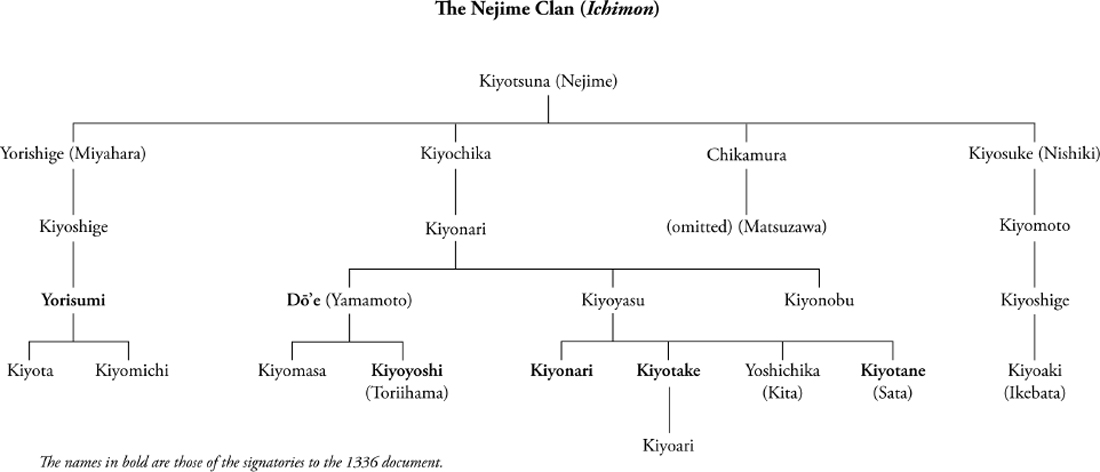
When confronted with the renewed outbreak of warfare late in 1335, some families took steps to shore up their bonds and refrain from discord. When they heard of Takauji’s rebellion against Go-Daigo early in 1336, warriors in southern Kyushu relied on oaths to bolster their familial ties in an attempt to ensure their survival during the civil war.
As the world is in turmoil, this clan (ichimon) agrees to be unified, [as if of] one body and one mind (ichimi dōshin).
Concerning the above, we shall act of one mind in thought in action (ichimi dōshin) concerning various things. There should not be the least difference of opinion (igi). Everything shall be discussed in council (shūgi). Those who disobey this oath shall suffer the otherworldly (myōdō) punishment of all of the small, middling, and great gods of the country of Japan. This document is stated thus.
The eleventh day of the first month of the third year of Kemmu (1336)
Kiyoyoshi (Copy of Monogram)
Kiyotane (Copy of Monogram)
Kiyotake
Yorisumi (Copy of Monogram)
Dō’e
Kiyonari (Copy of Monogram)
2. A Petition for Reward (gunchūjō) by Hatano Kageuji2
In a petition, Hatano Kageuji recounted his remarkable experiences. He joined Takauji shortly after his rebellion. But when Takauji was defeated and fled to the west early in 1336, Kageuji was trapped and left behind. He somehow {151} {152} managed to escape. In the following excerpt from his petition, he argues that because he thought about dying in battle—which, to him, is the same as actually dying in battle—he made the ultimate sacrifice, which was, among these autonomous warriors, rather rare.
Hatano Hikohachirō Kageuji states: On the past twelfth day of the first month, I joined the forces that entered the capital and, on the thirteenth, followed them as they forded the river. On the sixteenth, the mountain monks [of Mt. Hiei] and other rebels descended to the lower wards of the capital and tried to encircle our encampment. I traveled to Hosshōji where I performed great service before the temple, pursuing defeated enemy forces up the mountain [Mt. Hiei]. On both days of the seventeenth and the eighteenth, we went to Nishi Sakamoto [to the east of Mt. Hiei] and on the nineteenth we defended Yawata castle [to the south of Kyoto].
My military service continued through the seventh day of the second month. While we were fighting in battle, the Shōgun [Ashikaga Takauji] departed for Hyōgo Island, and the victorious enemy surrounded my castle. I wanted to join the Shōgun’s forces but could not. I thought I would die where I stood. I had all but resolved to kill myself in the garden any number of times, but, somehow, I managed to preserve my unworthy life. If one were to carefully consider the extent of my service (chūkin), then it would be the equivalent of dying in battle. Regardless, many have abandoned the general, and most of our army has fled. In order to prove the veracity of my claim, I desire to receive a commander’s monogram. Respectfully.
Second month, twenty-fifth day of the third year of Kenmu (1336)
To: The administrators
Received (monogram) [Takeda Nobutaka]
{153} 3. Takeda Nobutaka Document of Praise (kanjō)3
In the following extant copy (utsushi) of a document, Takeda Nobutaka recognizes the service, and praises the accomplishments of Hatano Kageuji.
A document viewed by the Honorable Takeda Hyōgo no suke
During the battle for Yawata, several thousand horsemen of our army—the vast majority—fled. Those who remained performed splendid battle service. As for rewards, let [your] receipt [of them] not be a matter of dispute. This report (chūshin) is thus.
The second month, twenty-fifth day of the third year of Kenmu (1336)
Hyōgo no suke (copy of monogram)
To: The Honorable Hatano Hikohachirō
4. A Cosigned Document (rensho shojō)4
In the following document, warriors from the Gotō islands of northern Kyushu complain about the lack of compensation for their military service and emphasize their unified resolve in pressing their claims. Such complaints were not invariably successful, but they reveal that no notion of loyal obligation existed. To the contrary, military service required compensation.
Our rewards are insufficient, and we were told to speak of this publicly (oyake). This family (ichizoku) is in agreement (ikki tokoro sōrō nari) that there should not be any problems [with our claims]. Respectfully.
The fifth day of the eleventh month of the second year of Ryakuō (1339)
Tomo (Monogram)
Tsumu (Monogram)
[To:] The Honorable Madarajima Genji
{154} 5. The Letters of the Yamanouchi5
One of the most remarkable sources for the study of the wars of the fourteenth century is a cache of letters later discovered inside a Buddhist statue (Takahata Fudō). Cut into small pieces and stamped with images, it is possible these letters were considered magical talismans, and that they were given to the temple by Tsuneyuki’s surviving wife and son in his memory and to aid his salvation. Piecing the letters back together proved to be painstaking work. These letters recount the actions of one warrior, Yamanouchi Tsuneyuki, who participated in the early battles fought in Hitachi Province. Tsuneyuki’s letters reveal the great costs of the war in Hitachi, which lasted from 1339 through 1344, as well as the intensity of the battles. Yamanouchi Tsuneyuki fought under the command of Kō no Morofuyu (?–1351) and traveled to Kamakura during the eighth month of 1339. In the early years of the war, Morofuyu’s forces were at a disadvantage as he tried to conquer the Southern Court strongholds of Seki and Taihō castles, located in Hitachi Province.
Kitabatake Chikafusa (1293–1354), whose son Akiie (1318–38) died in battles in 1338, was the able opposing commander. He described Morofuyu’s forces as being “unusually weak” early in 1340.6 It was probably around this time that Tsuneyuki died. Other Yamanouchi would survive this conflict and prosper, but nothing more is known of Tsuneyuki, his wife, or his son.
Tsuneyuki’s records show the great burden placed on families by the waging of warfare. Notable, too, is that hyakushō—a term commonly translated as “peasants”—had horses and weapons. The term is translated here as “commoners” to reveal their relatively elite status in provincial society. Tsuneyuki also relied on several figures, such as the Arai and Takahata, for support, but of them, little is known.
Though the Kō were valued followers of the Ashikaga, and though Morofuyu ultimately triumphed, they would be almost completely annihilated in the political disturbances of Kannō. Two of Morofuyu’s documents, which were preserved by some of Tsuneyuki’s surviving relatives, are reproduced here as well.
{155} Part One: Preparations for War
Organizing and dispatching an army required months of efforts. The following letters reveal the length of time required before an army embarked on an offensive.
Yamanouchi Tsuneyuki Letter, Unknown Date, to Matakesa (1)7
This letter confirms that Tsuneyuki was in Kamakura and involved in some unspecified court case in 1339. Officials required that Tsuneyuki buy them sake before they would hear his case. In later letters, he mentions (28) how he received a dwelling, which suggests he was successful in this case.
[Beginning of letter missing/fragmentary]. As for my judicial dispute, after the initial court (honbugyō) [proceedings] I dispatched a messenger. I was well-known there [in Kamakura] and, when my case was transferred to another court,8 they decided to hear my case. Unfortunately, right now, I don’t have any sake [for the administrators] but need to buy five gallons (one to)9 before I can do anything in the matter. At this stage, there are many people [waiting for their day in court] and so I want to be able, somehow, to buy sake. . . .
Yamanouchi Tsuneyuki Letter, Unknown Date, to Matakesa (4)10
Here Tsuneyuki discusses the need to get funds from the commoners of his estate. The provisional levies are undoubtedly to be used to pay for his provisions. He relied upon someone named Hachirōshirō to help his son collect these funds.
Even though we levied a provisional tax (tenyaku) on the commoners (hyakushō), I have heard they [these funds] have not been distributed. Speak to Hachirōshirō {156} and the Tarōjirō novice (nyūdō) and have them attach a notice (fuda) on the agricultural produce [designating it for these taxes]. If anyone has a problem with this (igi), please inform me. . . . Show them a document explaining why this is the case. If you do not do this, they will not be at ease (ando dekinai).
Yamanouchi Tsuneyuki Letter, Unknown Date, to his Son Matakesa (5)11
This letter indicates that while Tsuneyuki was away, he had continuing problems collecting taxes and dispatched either Hikosaburō or Kosaburō to help Matakesa, his young son, govern these lands.
The commoners (hyakushō) are not paying their taxes (tokubun) at all, but there is nothing that I can do about it. They will not listen to me. I find this most surprising (kokoro yori hoka ni zonji sōrō). As [most of my followers] are away, I will dispatch [name missing] Saburō there. . . .
Letter, of Unknown Date, from Yamanouchi Tsuneyuki to Shōshin, a Monk at Takahata Fudō (22)12
Tsuneyuki expresses his regrets for not being able to return but asks that the Arai help his family secure revenue from the commoners of his lands.
I am delighted to have the chance to speak with you. At this time, I would once again like to worship at your temple, but because of preparations, I am acting most improperly,13 and contrary to my wishes, there is no way that I can return. . . . In all affairs. . . . The Honorable Arai has requested that Tōken, a servant of the monastery, should visit and speak with him. As for the commoners (hyakushō) and their affairs, speak to the Honorable Arai and gain a real understanding of the true situation at the temple so that we can prepare. Explain this to the people there in detail and report this directly to the Honorable Arai, regarding all things. . . .
{157} Yamanouchi Tsuneyuki Letter, Eighth Month (23)14
The following letters recount delays in Morofuyu’s force departing for Hitachi.
Because I can easily dispatch [something to you], I am writing this letter. Our departure to Hitachi is delayed again for who knows how long. Everyone is lamenting how long they must stay here. I thought that we would leave on the thirteenth, but that has not happened. . . .
Yamanouchi Tsuneyuki Letter Fragment to a Monk from Sekidō Kannon (24)15
I would like one or two da of commissariat rice.16 I entrust everything to you.
Yamanouchi Tsuneyuki Letter to a Monk from Sekidō Kannon (25)17
I read your letter carefully. They say that we will set off for Hitachi either today or tomorrow, but I am not sure exactly when this will be. I feel bad about this, but can you borrow money from the Honorable Arai, and please send it me? There are reports that we will depart on the sixteenth . . . .
Yamanouchi Tsuneyuki Letter to Matakesa, Eighth Month 1339 (26)18
Here Tsuneyuki continues to wait for the army to depart. He requests more funds for provisions.
[First part of letter missing] . . . In addition, today. . . Shichirōjirō [text missing]. I really want to hear all about this. As for your letter, I have been told it will arrive {158} soon. Even if it does not make it on the seventh or eighth, it will arrive eventually. The Honorable Mikawa [governor Morofuyu] will depart around the twentieth. I hope your letter arrives before then. I will need two kanmon in expenses before I depart.19 You must get these funds somehow, even if you have to sell a house (zaike). . . [text missing] . . . Shirōjirō . . .
Yamanouchi Tsuneyuki Letter to Wife, Eighth Month (27) 20
. . . The Mikawa Governor (Kō no Morofuyu) has decided the army will set off on the twentieth. I will be with those forces through their arrival at the Musashi Provincial Headquarters. . . . I will have to sell one house (zaike ikken). I would some tea, and also two or three dyed robes. It finally looks like we will be setting off soon. Every day, [regardless of] whatever happens, I will write.21
Yamanouchi Tsuneyuki Letter to his Son Matakesa (28)22
Thank you for sending a messenger with a letter. The Mikawa [Governor Morofuyu] will soon be departing and I will go with him to Musashi Province. I hoped that you would come to Kamakura, but you said that you are from the countryside, you would not look good there, so it is best that you remain, although I worry as it is difficult to remain there. Gorō is also exhausted. . . I was given a dwelling (zaike) as a result of a successful court case, and some cash remains. Please take it and buy a bow and send it my way. I am sending them to you. Give your mother my very best regards. . . .
Eighth month, sixteenth day . . .
{159} Part Two: The Campaign Commences
The following letters reveal the frantic activity and stress of Tsuneyuki as Morofuyu’s armies prepared to besiege the enemy castles in Hitachi, located near Shimokōbe estate.
Yamanouchi Tsuneyuki Letter, Early Ninth Month (31)23
From various messengers on fast horses, I know that we are now going to Shimokōbe estate, where eventually a battle will most likely be waged, although I cannot confirm this. We will reach Shimokōbe estate on the fourteenth or fifteenth, or perhaps later, on the sixteenth or seventeenth. . . .
Yamanouchi Tsuneyuki Letter to Yamanouchi Rokurō, a Retainer (34)24
I am happy to receive your letter. You have sent many, even before waiting for my replies. We are setting off for Shimokōbe estate. According to rumors, it has been ordered that all who remain behind will have [some of] their holdings confiscated. In addition, anyone who mentions this [policy] in a petition25 will lose [all] their homelands (honryō). . . . By all means [secure] two to three kan [of cash], which I really need. Speak to Daishinbō26 and borrow five kanmon. . . .
Yamanouchi Tsuneyuki Letter to Matakesa (35)27
This fragmentary letter reveals Tsuneyuki’s impatience to receive military accoutrements before battles commenced.
[First part missing] . . . borrow. . . messenger. I need to receive this most quickly, for on the ninth day of this month, I am convinced that battles will begin. [text missing] day would be most welcome, as forces are approaching the castle [at Koma]. . . speak to the military council. . .
Tenth month
{160} Yamanouchi Tsuneyuki Letter to His Wife (36)28
I am delighted to receive your letter. . . . We expect to arrive at Shimokōbe estate on the twelfth. Tomorrow they will decide exactly when we will arrive. Don’t worry about the battle. As a number of people have gathered, we may leave by noon today. If not—even if we are delayed—we will definitely leave tomorrow. I am waiting for our departure. I miss you so much already!
Yamanouchi Tsuneyuki Letter to His Son Matakesa (37)29
[First part missing]. Bring two [containers]. If it is not too difficult to do so, speak with the temple, and get old [powdered?] tea for the first. In the other, buy some tea. In addition, get dried persimmons and dried peeled “victory” chestnuts (kachikuri).30 Buy them and bring them to me. Respectfully,
Thirteenth day of the tenth month.
[Yamanouchi] Tsune[yuki]
Ink mark of a cut seal31
Letter, Sent by Yamanouchi Tsuneyuki in the Yamakawa Region, to His Son Matakesa (38)32
This would have been written while Tsuneyuki was part of Morofuyu’s army. His request to borrow horses and armaments from the commoners (hyakushō) of his lands indicates he suffered from a lack of adequate supplies.
[First part missing] borrow horse . . . notify the commoners (hyakushō) and make this happen. Borrow a saddle and accoutrements (gusoku) and put them on the {161} horses. If they do not have saddles or accoutrements, please have them lead a horse on foot. In everything, consult with your mother. As you are not so young, please plan this all out. Respectfully.
Sixteenth day of the tenth month. Tsuneyuki (monogram)
Ink mark of a cut seal
From Yamakawa. To Matakesa. A response from Tsuneyuki
Letter, Dated 10.28, from Yamanouchi Tsuneyuki to His Son Matakesa Regarding the Desertion of Many of His Followers after Their First Battle (39)33
Whether you call it a battle, or guard duty, one should not be discouraged. I will write down the number [and names] of our retainers (matadomo) who fled.34 You should make sure that every single one of them is returned without fail. If you do not do this, I will no longer consider you to be my son. Etchū Hachirō, Yatsu, Kiheiji. . . if those people do not come, then send their parents here. Tell Okubō’s Yasaburō that he should have those who have not yet arrived bring up the rear.
Twenty-eighth day of the tenth month
Take this and speak [of its contents] Ink remains of cut seal
To: The Honorable Matakesa From: Yamakawa Tsuneyuki (monogram)
Reply from Shikime . . . no Hi[ko]saburō
Letter from Hikoshirō to Aoyanagi Saburō (53)35
Hikoshirō commiserates with Aoyanagi Saburō on the death of the “wet nurse mother” who raised Saburō. Hikoshirō also comments on comrades performing guard duty.
Now it is the eleventh month . . . final turn of guard duty. People from Chisagata district [of Shinano Province] are performing [this guard service]. They are doing {162} this adequately, as one would expect. Consult with the Honorable Nyū about everything. The current world is one where everything is unsettled. I am happy to hear that you are passing the time without having to collect anything [e.g., taxes, revenue, supplies of people]. I am really sorry to hear about your wet nurse mother (menoto) and am thinking of how deep your laments must be. I will discuss all things and convey them to [my retainer] Aoyanagi.
Eighth day of the eleventh month
Hikoshirō (monogram)
To: The Honorable Aoyanagi Saburō
Letter from Yamanouchi Tsuneyuki to His Son Matakesa (40)36
We are having Satō Saburō’s son sent here. Make sure he is prepared and have him gallop here. Please inform Oku (the Governor of Michinoku?). As I previously requested, Matamera, who has already fled and returned, should be arrested without fail, [along with his people]. As you are taking care of affairs at home, you must have much to worry about. I will write further regarding everything.
Second day of the eleventh month Tsuneyuki (Monogram)
Reply to The Honorable Yamanouchi Matakesa
[P.S.] I did not mention it in my letter to your mother, but people should continue to live at the temple houses (zaike). In addition Yatsu . . . respond to . . . emon Tarō Hachirō
Ink mark of cut seal
To: The Honorable Yamanouchi Matakesa
{163} Part 3: The Tribulations of Battle and Death
The following, final letters of Tsuneyuki, reveal the intensity of battle, and in the end, the hopelessness of Tsuneyuki, who did not expect to return from the campaign alive.
Letter from Yamanouchi Tsuneyuki to His Son Matakesa (42)37
I need a horse. As some of our reinforcements have brought horses, I asked for and received one from Lord Ebina’s herd. I was also able to borrow a helmet from someone. War has arrived here [at Koma castle]. I have not yet been injured, but many have been killed or wounded. You must wonder what battle is like. Don’t think that it is no big deal. As for this battle, a variety of important people have been wounded . . . or dead. . . will speak with . . .
Eleventh month
Letter from Yamanouchi Tsuneyuki to His Son Matakesa (43)38
Tsuneyuki wrote to his son during the twelfth month of 1339, at the start of the battle for Koma castle. Since the castle was not likely to be conquered, Tsuneyuki wanted to return home.
I read with care the letter from Kosaburō. I have no particular response regarding what he said. This castle will not fall within the year. I am thinking that I might take my leave and return. From now it will just be getting colder. . . . I am worried about [your finances for] at the end of the year,. . . if not there, Okubō’s Ya[saburō]
Ink mark of cut seal
Reply to the Honorable Matakesa Tsuneyuki (monogram)
{164} Letter from Yamanuchi Tsuneyuki to a Monk (44)39
This letter reveals the difficulties caused by the military campaign—such as the fact he was running low on provisions and his need to borrow money from Daishinbō again.
Thank you for your letter. When the retainer (wakatō) of the Honorable Takeda came here, I said that I would like to receive a letter at Kawamata.40 I hope to hear about the Kiheiji affair. My military provisions (hyōrōmai) are exhausted. . . . From Nuta, send a messenger to Daishinbō and say . . . [text missing]
Letter from Yamanuchi Tsuneyuki to His Son Matakesa (45)41
I carefully read your last letter. As you said in your letter, things [back home] are difficult as no one is there to help you. I have, however, explained everything, and as recently you seem to be in good spirits, there is nothing more for me to say. By the way, the Governor of Mikawa (Kō no Morofuyu) is quite pleased about my actions in this battle. . . . Even if I end up dying, as long as the general or members of this unit (ikki) survive I am at ease [as they will help to take care of you].
Letter from Matakesa to the Honorable Arai, or a Takahata Monk (58)42
My father fought in many battles but has not been killed; it gives me great joy. We received a document . . . [of praise] that had been sent by the General (taishō) [Morofuyu].
{165} Letter by Yamanouchi Tsuneyuki (46)43
In his letters, Tsuneyuki would often complain of the difficulties of guard duty and the counterattacks being launched by the enemy.
[First half missing.] This leaves me ill at ease (kokoromoto naku). Regarding guard duty (tono-i),44 you should have the commoners (hyakushō) do it. Keep them appeased until I return, but please ensure that they perform guard duty. . . . I received a letter. I want to reply to it, but we are fighting battles every day . . . attack . . . [text missing or fragmentary]
Ink mark of cut seal
[To: The Honorable Mata] ke[sa]
Letter from Yamanuchi Tsuneyuki to His Son Matakesa (47)45
Tsuneyuki complained to his son about the lack of reliable followers at home and the difficulty of extracting revenue from commoners. Tsuneyuki’s letter to his wife is most likely his last letter. He apparently died in this campaign shortly after it was written.
I saw the letter from Yasunobu. As he says, no words can describe the hardships here. Nevertheless, I am reconciled with things. To the contrary, I am most worried that there is no one to help protect you as you remain behind. You, as a responsible adult (ichinin mae no hito to shite) are to consult with your mother in all matters. Ensure that the commoners (hyakushō) pay their taxes and are not remiss. . . . [latter half missing]
{166} Letter from Yamanouchi Tsuneyuki (48)46
I am delighted with your letter. . . . In addition, Shiomoto is setting off, and although it will be to the same battle[field], it will be most difficult [for him] as he [commands] only limited forces. . . . Regarding what has happened until now, I wanted to send a letter to the Honorable Arai, but there was nothing in particular to report. In addition, last night we had reports that enemy forces would attack our castle. I decided to be careful [and not write a letter]. . . . Please do not worry regarding anything, as I have now sent a messenger with a letter to the Honorable Arai.
Letter from Yamanouchi Tsuneyuki to Matakesa (50)47
Everything is so confused here—I think that I cannot send you even a trifle. Nevertheless, the battles continue, and I think that I cannot get the time to return. The enemy castle is located nearby so taking leave is impossible. I don’t think I will be able to survive this battle and I am most worried that there is no one there to take good care of you. . . . Talk to Hachiroshirō about guard duty [of our house and temple]
[Latter half of letter missing]
Letter from Yamanouchi Tsuneyuki to His Wife (21)48
. . . As for everything, I will entrust affairs to the Honorable Arai. You should speak to him regarding all things; he will listen to you regarding anything. I know my abilities (mi no hodo). I thought that I would have Hikosaburō remain in Hitachi before returning, but Gorō states that he really wants to come back. . . so he will bring this. I am repeating myself, but as for our holdings (shitaji),49 you should rely on the Honorable Arai for everything. Do not unburden yourself with others. In {167} everything, the Honorable Arai . . . [text missing] and even regarding yourself all is the same. It is no big deal regarding me. People come into the world and leave it. . . .
6. A Document by Kō no Morofuyu (hōsho)50
This document, written by the general Kō no Morofuyu, recounts the battles for Koma castle and suggests the difficulty his army had during the campaign. Tsuneyuki’s letters ceased around this time.51 It survives in a documentary collection of the Yamanouchi Sudō house. They were relatives of Tsuneyuki who survived the campaign.
Concerning our attack on the rebels of Hitachi and Shimōsa provinces. We are in the midst of battles at the Castle of Koma Mansion. Most of our military forces have returned to their provinces. Your current service (chūsetsu) is outstanding. Henceforth, you should exhibit outstanding military service (gunchū). This order is thus conveyed.
Thirteenth day of the twelfth month of Ryakuō 2 [1339]
Mikawa no kami (monogram Kō no Morofuyu)
To: The Honorable Yamanouchi Sudō Saburō
{168} 7. Yamanouchi Tokimichi Report of Arrival (chakutōjō)52
The following report of arrival, monogrammed by Kō no Morofuyu, marks the end of the campaign against the forces of Kitabatake Chikafusa, and the fall of his castles. Tsuneyuki did not survive the campaign, but Yamanouchi Tokimichi, one of his relatives, did.
11.13.1343 (Kōei 2) Yamanouchi Tokimichi report of arrival (chakutōjō)
Arrived: Yamanouchi Sudō Saburō Tokimichi
The aforementioned Tokimichi performed military service from the beginning at Shidariyanagi until the fall of the Seki and Taihō castles.53 His arrival is thus.
The thirteenth day of the eleventh month of the second year of Kōei (1343) (Monogram)54
8. Oaths and the Kannō Disturbance55
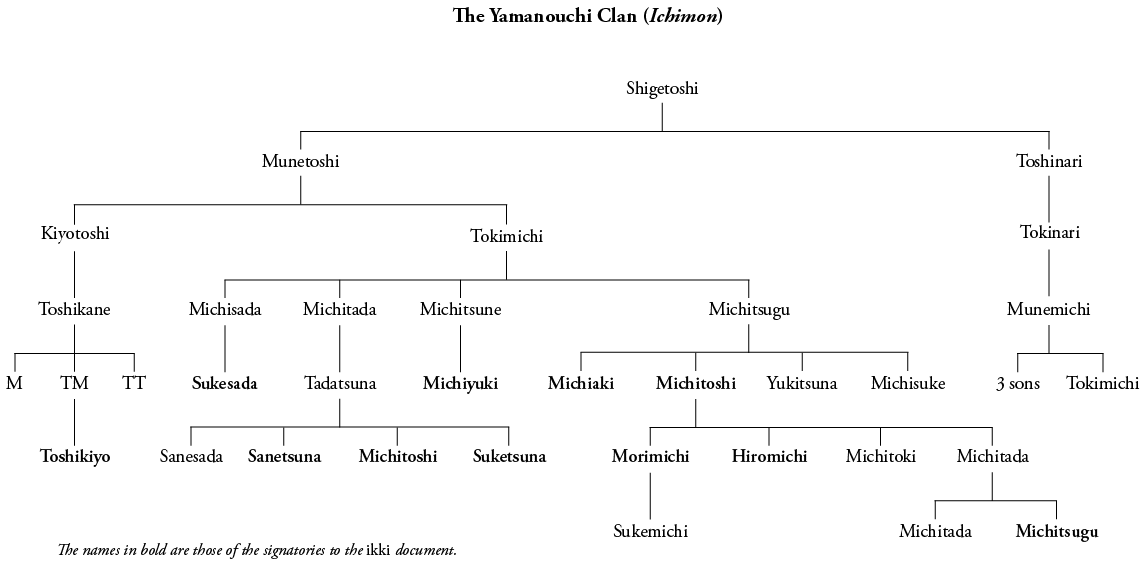
The Kannō Disturbance of 1350 pitted Ashikaga Takauji against his brother Ashikaga Tadayoshi. Warriors of the provinces (kokujin) had to decide whether to ally with one of the Ashikaga brothers or with the forces of the Southern Court. This period marks the ultimate division of higher authority during the fourteenth century. In this case, numerous members of the Yamanouchi decided to side with Ashikaga Tadayoshi. Many Yamanouchi did not agree, preferring instead to fight for Ashikaga Takauji.
Agreed (keiyaku su): The particulars of this family in accord (ichizoku ikki)
Concerning the above: since the Genkō era [1331–34], this family has been of one mind (dōshin) and has received rewards from the Shōgun’s house. There have been no disturbances regarding our possessions (chigyō). Nevertheless, since {169} autumn of the last year, due to the conflict between both [Ashikaga] lords, peace and stability have not returned. Claiming to support the [Southern] Court side, or the Shōgun’s house, or the Nishiki-kōji Lord [Tadayoshi],56 the opinions of the people of the province (kokujin) are divided, and yet this family (ichizoku), basks in the rewards (go-on) of military houses (buke onshō).57 How can we forget such rewards? Thus, we shall fight for our allies58 and hope to display our prowess and honor in war through our final generations. Of the above, there must be no duplicity. In the future, if someone violates these provisions, it shall be discussed within the council (shūchū) and opinions should be unanimous. If anyone utters even the slightest lie, may they endure, first, the punishments of Bonten, Taishaku, the four Heavenly Kings, and the otherworldly (myōdō) punishment of the small, middling, and great gods of the nation of Japan, and in particular Suwa, Hachiman Daibosatsu, and the Kibi-tsu Daimyōin of this province shall be inflicted upon each. Thus, this vow (ichimi keiyaku kishōmon) is stated as such.
The second day of the tenth month of the seventh year of Jōwa (1351)
Fujiwara Toshikiyo Monogram
“ ” Morimichi Monogram
“ ” Sanetsuna Monogram
“ ” Michihiro Monogram
“ ” Michitoshi Monogram
“ ” Sukesada Monogram
“ ” Michiaki Monogram
“ ” Suketsuna Monogram
“ ” Michiyuki Monogram
Shami Jōkaku Monogram
Kumajūmaru [Michitsugu] representative (dai) Dōen Monogram
{170} {171} 9. Petition for Reward (gunchūjō) by Aso Koresumi59
Aso Koresumi fought for the Southern Court. He experienced difficulties similar to those encountered by Yamanouchi Tsuneyuki.Though this document is not dated, it most likely dates from late 1350. Although written from the perspective of Koresumi, he refers to himself in third person and this document is translated accordingly.
Aso Chikugo no kami Koresumi, of Higo Province, respectfully states:
Having accrued merit in more than a hundred battles since the Genkō era [1331–34]—and in order to continue to excel in my service—I wish to be granted land holdings (ryōsho).
Since the Genkō era, Koresumi, of no great renown, has fought several hundred battles and submitted battle reports (chūshin); he has even received imperial edicts. Since the beginning of this conflict, Koresumi has performed military service, unceasingly aiding members of both his and other lineages. Other men—even those who have surrendered or are simply members of families that have performed military service for our forces—have all received land holdings (ryōsho). It’s easy to [speak of] honor, but Koresumi has not received a single land holding even though he is exhausted and struggles to perform unceasing service. [Koresumi’s inability to continue serving] would render worthless his previous efforts. In addition, Koresumi’s homelands and new rewards (honryō shin’on) were not confirmed when [his rival Aso] Koretoki allied [with the Southern Court].60 Furthermore, tax-exempt paddies within these holdings were taken from us and restored to the Aso Shrine this past autumn. Our exhaustion increases. We wish to be granted to land (ryōsho) in this or some other province. Such a grant would support our military forces, depleted after many years, and allow us to perform increasingly noteworthy military service (chūkin) from now on.
Item: Concerning Moritomi estate. Koresumi, allied [with Southern Court forces] and in accord with the Council, has received imperial edicts [from Emperor Go-Murakami] and princely edicts [from Prince Kaneyoshi]. Nevertheless, because Kawajiri Shichirō surrendered, these lands have yet to be confirmed. The holdings {172} of Kawajiri Shichirō were actually grants from Takauji, the enemy of the court (chōteki). Koresumi has fought according to the wishes of his commanders and received [praise] from emperors and princes. Koresumi wishes . . . [text missing] to receive a just settlement so as to perform noteworthy military service. Spoken roughly, thus. . . [rest of document missing].
10. A Document of Loss (funshitsujō) by Tannowa Nagashige61
A statement from Tannowa Nagashige, penned in the third year of the Ōei era (1396), regarding the loss of documents concerning managerial (gesu) rights. That Nagashige’s compatriots signed this document suggests they supported the veracity of his claims. But the fact they felt they had to sign indicates that the protector (shugo) of the province did not support Nagashige.
Concerning the loss of documents pertaining to the managerial (gesu) rights in and to the homelands of Tannowa Inaba no kami Nagashige of Izumi Province.
As for the aforementioned, two Rokuhara orders (gechijjō),62 one letter of appointment from the proprietor (ryōke), and a house genealogy were entrusted to Nagao Munehide of Kii Province. During the disturbance (sekiran) of the Ōan era (1368–75) these documents were burned and lost. The jitō and gokenin of this province collectively sign this document of loss. Thus.
Twenty-second day of the eighth month of the third year of Ōei (1396)
Tottori
Kadeno saemon no jō Masakatsu (monogram)
Imai
{173} Saburō saemon no jō Munesada (monogram)
Sakō
Shirō saemon no jō Yoritada (monogram)
Tottori
Tōtōmi no kami Tadatsugu (monogram)
Tadokoro
Shūri no suke Motoie (monogram)
Sōkan
Shirō saemon no jō Kagetoshi (monogram)
Kashii
Iwami no kami Sadaaki (monogram)
Sano
Hayato no suke Tomokage (monogram)
Sukematsu
Saburō saemon no jō Masakatsu (monogram)
Sueki
Mimasaka no kami Masatomo (monogram)
Tashiro
Buzen no kami Suetsuna (monogram)
11. Excerpts from “The Battle of Ryūsenji,” Taiheiki 63
The Taiheiki, an epic tale of the fourteenth century, comprising over forty volumes, contains in its final third detailed accounts of battles which are, at times, humorous. The following passage recounts the valor of Hosokawa Kiyouji (?–1362), a prominent supporter of the Ashikaga shogunate. This section recounts events which occurred in 1359–60, shortly after the death of Ashikaga Takauji, against the Southern Court forces in their central Japan {174} heartlands. This account also shows that some Chinese military manuals (but not the famous Sunzi Art of War) were known to Japanese warriors and writers.
The Kusunoki and Mikita generals stationed a thousand warriors from nearby Yamato and Kawachi Provinces at Ryūsenji castle.64 The enemy would not attack them, and the soldiers complained. “Why in the world are we here? Let us attack the plains and scatter our enemies!” They left one hundred skirmishers (nobushi) of no great skill behind as decoys, disguised treetops as archers’ blinds and attached banners, making it look as if a great army remained.
The besieging forces of Tsuzuyama looked at the castle and exclaimed in fear: “How terrible! A mighty enemy army occupies this looming castle, perched high on a mountain. There is no way we can take it.” Not a single warrior dared to attack. Pointlessly, 150-odd days passed with the men merely looking up at the enemy’s banners.
At a certain time, a resourceful old warrior who belonged to the Toki family’s Bellflower unit (Kikiyo ikki) intently observed the Ryūsen castle. Speaking to his comrades, he said: “Taigong (Jiang Ziya) wrote in the ‘empty fortifications’ volume of his military manual that ‘When looking above enemy castles, if you do not see flying birds startle then certainly you shall know your enemies have created false figures of deception.’65 I have been closely observing the Ryūsen castle for the last three or four days: the kites flying in the sky and the crows returning to forest have not been disturbed. Our enemy must have made it look as if a large force was holed-up by planting some banners over there. Without mingling with other troops this ikki alone should advance and take Ryūsen—it will make us famous throughout the realm.”
Upon saying this, the five hundred-odd horsemen of the Toki Bellflower ikki, realizing that the old man’s advice was excellent, agreed and decided to attack immediately. At the break of dawn on the twenty-ninth of the fourth intercalary month, the five hundred-odd horsemen of the Bellflower unit crept away from Tsuzuyama. Then, under the cover of the morning fog, before the eastern sky began {175} to brighten, they swept toward one gate of the Ryūsen and in unison screamed their battle cries.
Hosokawa Sagami no kami Kiyouji and Akamatsu Hikogorō Norizane both were in the headquarters at Tsuzuyama, but when they heard the war cries from Ryūsen, Kiyouji cried out: “Already others are charging ahead of us! We must cut our way into the fort first. That is what is known as the real vanguard! Saddle the horses! Bannermen, come quick!” Just as he said this Kiyouji and Hikogorō grabbed their armor and threw it on their shoulders, tightened their shoulder straps,66 and galloped toward Ryūsen’s western gate, located under a tall wooden turret. There they jumped off their horses. Glancing behind, they saw three horsemen—Tamiya danjō no chū, Kidokoro no Hikogorō, and Takami Hikoshirō, all Akamatsu men—following. Behind them, Kiyouji’s retainers (rōjū) were coming, strung along in no particular formation, each vying to be first.
Hosokawa Kiyouji’s bannerman crashed his horse headfirst into a steep embankment. Seeing that he could not easily rise, Kiyouji himself ran over and snatched the flag. Plunging it into the front of the embankment, he cried out in a thunderous voice: “Kiyouji is first in the van!” Then Akamatsu Hikogorō entered the fort and yelled repeatedly: “The first one in the van is Norizane. Those who saw me, come forth as witnesses!” He then clambered over the castle walls.
Seeing this, Hiyoshi shuri no suke, Fujita Hyōgo no suke and Utsumi shuri no suke Mitsunori of the Toki Bellflower ikki wrenched open the gate and plunged inside. The soldiers inside the castle continued fighting for a while but, aware of their enemy’s great strength and their own utter weakness, must have felt that there was nothing that they could have done and retreated toward Akasaka under a calm and deliberate cover fire of arrows.67
After a while, the great multitude of besieging warriors, huddled together in many encampments, realized that the Toki Bellflower ikki had advanced and attacked Ryūsen. Surely, they thought, the ikki could not take that fort easily. “Put up the shields! Archers to the fore!” Calmly they mobilized for battle, their army consisting of over a hundred thousand horsemen, and set off for the base of Ryūsen mountain. By that time, the castle had already been taken and its turrets and wooden palisades were torched. The advancing force’s tens of thousands scratched their heads and lamented their misfortune. Without knowing how puny enemy forces were—and to their everlasting regret—they did nothing while Toki and Hosokawa achieved great names for valor. They all gritted their teeth in disappointment.
{176} 12. Excerpts from The Chronicle of Meitoku68
The following excerpt recounts one of the last major uprisings of the fourteenth century, when members of the Yamana rose against the forces of Ashikaga Yoshimitsu, who appears in the narrative as “the Shōgun.” Note the long swords favored at this time, and how adequate preparation for death, and prayer to Amida Buddha for rebirth, elicit great praise by the chroniclers of this tale.
The deaths of Kakiya and Namera
The two charged into the thick of the mass. Kakiya with his five-foot, three-inch long sword69 and Namera with his five-foot, two-inch glaive slew six. “Look!” Ujikiyo cried when he saw them. “A mere two of the enemy have killed many of our men. You should be ashamed of yourselves! Level your blades, charge them, engage with them, kill them!” Yamaguchi Danjō, Fukutomi Bitchū and other mighty warriors, fourteen or fifteen of them, promptly dismounted, ranged their spear and glaive points in a serried row, and attacked.
“There’s no escape, Namera.” Kakiya said. “Dismount! We’re going to die.” Armed as he was with a long sword, Kakiya moved to slash vertically at men and horses, meanwhile avoiding the foe’s daggers; but his blade, entangled in cut strips of armor sleeves, stabbed deep into the soil. He was striving to extract it when, in the struggle, a lance and a glaive penetrated his armor. He certainly knew he was finished. “You there, Namera?” he shouted. “I’ll go on ahead!” He called the Amida’s Name four or five times, and a blade thrust killed him.
Namera heard him. “Right!” he replied. In battle frenzy he charged into the enemy and fought to the death. “That must be Namera Hyōgo,” Ujikiyo said to himself, “famed throughout the nine provinces of Tsukushi. And he continued aloud, “Get him, men! Use your long weapons [nagagusoku]! Move your sword-bearer around behind him and cut his armor skirts!”
Five men, already in place with thrusting spears and glaives, sent their sword-bearers dashing around behind Namera. These cut the back plate [okubyō-gane] of the shin guard on each leg. Badly wounded, Namera collapsed to a sitting position, braced upright by his arms. When a new thrust slipped past his skirts, he dropped his glaive, drew a three-foot sword, and with it kept the attackers at bay.
He then looked up at them. “I am exhausted,” he said. “Please just let me lie down. Gentlemen, see me welcomed by Amida and go to rebirth in his Pure Land.” {177} He faced west and died seated, braced by his arms. Every witness, friend or foe, was deeply moved.
At that very moment Tokihiro raced to join the Ōuchi force stationed by the Jingikan. He had barely escaped death. Once the fight was over he rushed to the Shōgun, reported briefly on the battle, and described the deportment of friend and foe.
The Shōgun looked pleased. “Is Kakiya really dead?” he asked.
“Yes, my lord, he is. With fourteen or fifteen enemy warriors around me I thought I was finished, but then Kakiya and Namera rushed to me.” He wept until he could no longer speak, and his tears moistened his armor sleeves.
“I understand how you feel,” the Shōgun said with emotion. “Those two will stand as models for every man of bow and arrow. They are a great loss.”
Every witness envied Tokihiro. “Not only did he stay alive thanks to Kakiya and Namera,” they said to themselves, “but now the Shōgun also heaps praise on him!”
1. Seno Seiichirō, Nanbokuchō ibun Kyushu hen, vol. 1, doc. 383, 1.11.1336 (Kenmu 3) Torihama Kiyoyoshi rensho keijō utsushi, 132. Translated by Thomas Conlan.
2. Matsuoka Hisato, comp., Nanbokuchō ibun Chūgoku shikoku hen, vol. 1, doc. 259, 2.25.1336 (Kenmu 3) Hatano Kageuji gunchūjō utsushi, 125. Translated by Thomas Conlan.
3. Matsuoka Hisato, comp., Nanbokuchō ibun Chūgoku shikoku hen, vol. 1, doc. 260, Takeda Nobutake ikenjō utsushi, 125. The copyist mistakenly copied the character for year as the number three. Translated by Thomas Conlan.
4. Seno Seiichirō, Nanbokuchō ibun Kyushu hen, vol. 2, doc. 1418, 11.5 Terada Tomo Tsumo rensho shojō, 36. Translated by Thomas Conlan.
5. Documents drawn from Hino shi shi shiryōshū Takahata Fudō tainai monjo hen. All were translated by Thomas Conlan.
6. Sekijō chōshi, shiryōhen III, chūsei kankei shiryō, 1.22 Shirakawa Yūki Chikatomo ate Kitabatake Chikafusa mikyōjo utsushi, 346–47. This weakness continued, according to Chikafusa, through 4.3.1340, with no signs of enemy reinforcement arriving. See Ibid., 4.3 Shirakawa Yūki Chikatomo ate Kitabatake Chikafusa mikyōjo utsushi, 348–49.
7. Hino shi shi shiryōshū Takahata Fudō tainai monjo hen (Hino, 1993), doc. 1, Yamanouchi Tsuneyuki shojō, 14–15.
8. In Muromachi court cases, the honbugyō was responsible for the initial hearing of the case, while another court, the ai-bugyō, was responsible for the supplementary function of interrogating the plaintiff. Tsuneyuki, in referring to the change in court, is referring to the ai-bugyō.
9. One to equals just under 5 gallons (1.05 to constitute 5 gallons, or 18 liters).
10. Hino shi shi shiryōshū Takahata Fudō tainai monjo hen, doc. 4, Yamanouchi Tsuneyuki shojō, 20–21.
11. Hino shi shi shiryōshū Takahata Fudō tainai monjo hen, doc. 5, Yamanouchi Tsuneyuki shojō, 22–23.
12. Hino shi shi shiryōshū Takahata Fudō tainai monjo hen, doc. 22, Yamanouchi Tsuneyuki shojō, 60–61.
13. Literally, the way of the left hand (sadō).
14. Hino shi shi shiryōshū Takahata Fudō tainai monjo hen, doc. 23, Yamanouchi Tsuneyuki shojō, 62–63.
15. Hino shi shi shiryōshū Takahata Fudō tainai monjo hen, doc. 24, Yamanouchi Tsuneyuki shojō, 64–65.
16. One da weighs approximately 240 lbs. (110 kg).
17. Hino shi shi shiryōshū Takahata Fudō tainai monjo hen, doc. 25, Yamanouchi Tsuneyuki shojō, 66–67.
18. Hino shi shi shiryōshū Takahata Fudō tainai monjo hen, doc. 26, Yamanouchi Tsuneyuki shojō, 68–69.
19. This is roughly the equivalent of two thousand dollars.
20. Hino shi shi shiryōshū Takahata Fudō tainai monjo hen, doc. 27, Yamanouchi Tsuneyuki shojō, 70–71.
21. He states, literally, I will speak to you.
22. Hino shi shi shiryōshū Takahata Fudō tainai monjo hen, doc. 28, Yamanouchi Tsuneyuki shojō, 72–73.
23. Hino shi shi shiryōshū Takahata Fudō tainai monjo hen, doc. 31, Yamanouchi Tsuneyuki shojō, 80–81.
24. Hino shi shi shiryōshū Takahata Fudō tainai monjo hen, doc. 34, Yamanouchi Tsuneyuki shojō, 86–87.
25. In other words, those who complain about this policy.
26. Unknown, but most likely some sort of money lender affiliated with a monastary.
27. Hino shi shi shiryōshū Takahata Fudō tainai monjo hen, doc. 35, Yamanouchi Tsuneyuki shojō, 88–89.
28. Hino shi shi shiryōshū Takahata Fudō tainai monjo hen, doc. 36, Yamanouchi Tsuneyuki shojō, 90–91.
29. Hino shi shi shiryōshū Takahata Fudō tainai monjo hen, doc. 37, Yamanouchi Tsuneyuki shojō, 92–93.
30. These chestnuts had been dried and shelled. Their name represented a homonym for victory (kachi); hence, they were favored in battle. See Hino shi shi shiryōshū Takahata Fudō tainai monjo hen, doc. 37, Yamanouchi Tsuneyuki shojō, 92–93.
31. A “cut seal” (kirifu) was where the end of the document was cut vertically and used to wrap the document and seal it with an ink marking, which is evident here. For more on kirifu, see https://komonjo.princeton.edu/uesugi-01/. Accessed August 29, 2021.
32. Hino shi shi shiryōshū Takahata Fudō tainai monjo hen, doc. 38, Yamanouchi Tsuneyuki shojō, 94–95.
33. Hino shi shi shiryōshū Takahata Fudō tainai monjo hen, doc. 39, Yamanouchi Tsuneyuki shojō, 96–97.
34. The meaning of the term matadomo is unclear. It seems to be a colloquial term for Tsuneyuki’s core retainers.
35. Hino shi shi shiryōshū Takahata Fudō tainai monjo hen, doc. 53, Aoyanagi Saburō shojō, 124–25.
36. Hino shi shi shiryōshū Takahata Fudō tainai monjo hen, doc. 40, Yamanouchi Tsuneyuki shojō, 98–99.
37. Hino shi shi shiryōshū Takahata Fudō tainai monjo hen, doc. 42, Yamanouchi Tsuneyuki shojō, 102–3.
38. Hino shi shi shiryōshū Takahata Fudō tainai monjo hen, see doc. 43, Yamanouchi Tsuneyuki shojō, 104–5, for people leaving his forces, presumably during the twelfth month of 1339.
39. Hino shi shi shiryōshū Takahata Fudō tainai monjo hen, doc. 44, Yamanouchi Tsuneyuki shojō, 106–7.
40. Located in Saitama district of Musashi Province. It is not clear whose opinion he wanted regarding Kiheiji, but the language suggests a social superior.
41. Hino shi shi shiryōshū Takahata Fudō tainai monjo hen, doc. 45, Yamanouchi Tsuneyuki shojō, 108–9.
42. Hino shi shi shiryōshū Takahata Fudō tainai monjo hen, doc. 58, Bō shojō, 134–35.
43. Hino shi shi shiryōshū Takahata Fudō tainai monjo hen, doc. 46, Yamanouchi Tsuneyuki shojō, 110–11.
44. In this case at Yamanouchi Tsuneyuki’s home or temple.
45. Hino shi shi shiryōshū Takahata Fudō tainai monjo hen, doc. 47, Yamanouchi Tsuneyuki shojō, 112–13.
46. Hino shi shi shiryōshū Takahata Fudō tainai monjo hen, doc. 48, Yamanouchi Tsuneyuki shojō, 114–15.
47. Hino shi shi shiryōshū Takahata Fudō tainai monjo hen, doc. 50, Yamanouchi Tsuneyuki shojō, 118–19.
48. Hino shi shi shiryōshū Takahata Fudō tainai monjo hen, doc. 21, Yamanouchi Tsuneyuki shojō A B, 56–59.
49. This refers to a lord’s paddies, forested lands, tax revenues, and public duties.
50. Dainihon komonjo iewake 15 Yamanouchi Sudō ke monjo (Tokyo teikoku daigaku, 1940), 12.13.1339 (Ryakuō 2), Kō no Morofuyu hōsho, 46–47. Translated by Thomas Conlan.
51. Hino shi shi shiryōshū Takahata Fudō tainai monjo hen, 195, 197–205, particularly 205.
52. Dainihon komonjo iewake 15 Yamanouchi Sudō ke monjo, doc. 46, 11.13.1342 (Kōei 2) Yamanouchi Tokimichi chakutōjō, 48–49. Translated by Thomas Conlan.
53. These castles were the headquarters of Kitabatake Chikafusa. Their fall marked the end of Southern Court resistance in Hitachi and the ultimate triumph of Kō no Morofuyu’s campaign.
54. Kō no Morofuyu.
55. Yamanouchi Sudō ke monjo, doc. 25, 10.2.1351 (Jōwa 7) Yamanouchi ichizoku ikki keiyaku rensho kishōmon, 30–31. Translated by Thomas Conlan.
56. The three references are to the Southern Court forces, and those of Ashikaga Takauji and his younger brother Tadayoshi, respectively. This period marks the ultimate division of higher authority during the Nanbokuchō period.
57. The Ashikaga.
58. This evidently refers to Ashikaga Tadayoshi’s forces. See Satō Shin’ichi, Nanbokuchō no dōran, 358.
59. Seno Seiichirō, Nanbokuchō ibun Kyushu hen, vol. 3, doc. 2835, Era Koresumi mōshijō an, 125–26. Translated by Thomas Conlan.
60. Warriors’ core lands were known as “original holdings,” and they, as well as more recent land grants, were typically confirmed when warriors fought. In this case, Koresumi lost his lands when a rival relative joined his army. Presumably the more powerful Koretoki received Koresumi’s holdings.
61. https://komonjo.princeton.edu/tannowa/view.html?t=4-0. 8.22.1396 (Ōei 3) Tannowa Nagashige funshitsujō. Accessed August 26, 2021. Translated by the students of Sources in Ancient and Medieval Japanese History with Thomas Conlan.
62. Documents issued by the Rokuhara tandai, which was destroyed in 1333.
63. This version was drawn from Hyōdo Hiromi, Taiheiki, vol. 5 (Iwanami shoten, 2016), maki 34, 319–23. Translated by Thomas Conlan.
64. Kusunoki Masanori and Mikita Masatake were two prominent Southern Court generals. Yamato and Kawachi Provinces now constitute modern Nara and Ōsaka, respectively. The castle was located in Izumi Province, which is now part of Ōsaka as well.
65. Taigong (T’ai Kung)’s Six Secret Teachings (Liù Tāo) has been translated by Ralph Sawyer, The Seven Military Classics of Ancient China, 40–106. For the relevant passage about empty fortifications, see p. 88, which states: “The T’ai Kung said: ‘Listen to see if his drums are silent, if his bells make no sound. Look to see whether there are many birds flying above the fortifications, if they were not startled [into flight]. If there are no vapors overhead, you will certainly know the enemy has tricked you with dummies.’”
66. Takahimo, the straps which helped attach armor to a warrior’s torso.
67. Akasaka Castle was a Southern Court stronghold held by Kusunoki Masanori.
68. Tyler, Iwashimizu Hachiman in War and Cult, 55–56.
69. Ōdachi, a weapon carried across the back or over the shoulder.