
{118} SECTION V
This section focuses on Ashikaga Takauji’s rebellion, which in 1333 brought down the Kamakura regime. Takauji perceived his victory and the triumph of his Minamoto lineage as both predetermined (as a result of his ancestors’ prayers), and inevitable (because of a perceived Minamoto right to rule).
A series of records recounts Takauji’s revolt and his prayers. One chronicle, Baishōron, written by a strong supporter from Munakata Shrine, describes an experience with Takauji during the tumultuous 1330s; the chronicle also describes how Takauji destroyed Kamakura and later rebelled against Go-Daigo, the triumphant emperor of 1333. This firsthand narrative varies from most fictional accounts in that it does not rely on extended dialogues and carefully distinguishes what the warrior himself would have seen on the battlefield.
1. Excerpt from Imagawa Ryōshun’s Nantaiheiki1
Ideas of Minamoto warrior identity coalesced over the course of the thirteenth and fourteenth centuries. The wars of the Jishō (1177–81) and Jūei (1182–84) eras were originally conflicts against the center, with alliances not based upon family ties; the idea that the Minamoto were a cohesive identity became stronger, promoted by figures such as the Ashikaga, who used this myth as a justification to defeat their Hōjō (Taira) rivals. Retrospectively, the wars of the 1180s, between the Taira and the Minamoto, became known as the Genpei War even though they were not thought of in this way at the time. Ashikaga Takauji and Tadayoshi (1306–52) believed that their ancestors had written an oath to seize the realm in seven generations. Evidence for this comes from the retrospective account of Imagawa Ryōshun (1326–1420), who recounts a testament by Yoshiie stating he would accomplish this feat. Ashikaga Ietoki, Takauji’s {119} {120} grandfather, who perished when Adachi Yasumori was killed in 1285, purportedly wrote a testament stating that his grandson Takauji would defeat the Hōjō and achieve a position of head of the warriors of Japan. Takauji and his brother Tadayoshi believed this to be true, as is revealed in a document from Tadayoshi (Ashikaga Tadayoshi Directive, p. 121) discussing Ietoki’s testament—found in the Daigoji temple archives.
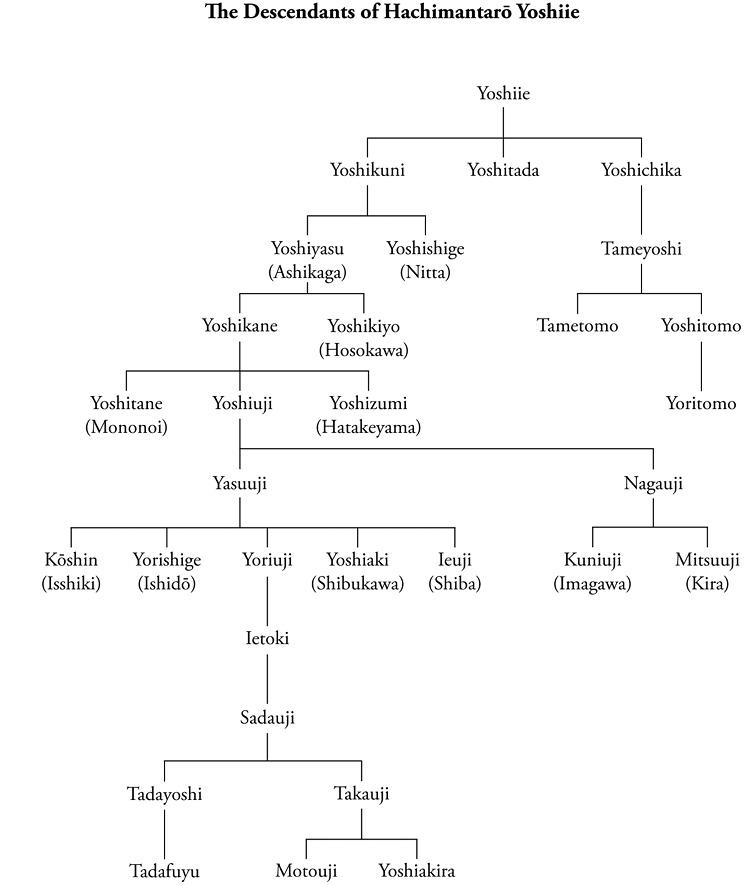
“Hachiman-dono” m eans Lord [Minamoto] Yoshiie, Governor of Mutsu and Chinjufu Shōgun. His son, Yoshikuni, was followed by Yoshiyasu, Yoshikane, Yoshiuji, Yasuuji, and so on. Yasuuji was known as Hiraishi-dono; his son, Yoriuji, as Jibu-no-Taifu-dono; and Yoriuji’s son, Ietoki, as Iyo-no-kami. Ietoki’s son, Sadauji, was referred to as Sanuki-no-nyūdō-dono. His sons were Takauji and Tadayoshi. Despite being Yasuuji’s third son, Yoriuji followed his father as head of the house.2 The men of Owari, the Shibukawa, and so on, his elder brothers, all became his juniors (soshi).3 The Hosokawa and Hatakeyama lines seem to have parted after Yoshikane.
Yoshikane was over eight feet tall and supremely powerful. He was said really to be a son of Tametomo,4 although Yoshiyasu had brought him up from infancy. Yoshikane kept this quiet, however, so that no one knew. He became particularly close to Yoritomo but feigned madness in order to avoid further attention, and he lived his life without incident. He is reported to have declared, “My spirit will possess my descendants for a time and madden them.” For that matter, Yoshiie wrote in his testament (okibumi): “I shall be reborn seven generations hence and seize the realm.” That generation was Ietoki’s, who, no doubt realizing that the time was not yet ripe, prayed as follows to Hachiman: “Cut my life short, I beg, and have us seize the realm within three generations.” He then slit his belly.5 The testament written in his own hand gives further details. My late father and I read it in the presence of both Takauji and Tadayoshi. They said that they owed their conquest of the realm to this prayer. Ambition working over generations had made them masters of the world.
{121} 2. Ashikaga Tadayoshi Directive (mikyōjo)6
Ashikaga Ietoki’s testament is not extant. But the record of it below, created by Ashikaga Tadayoshi, predates 1350, and was written at a time when Tadayoshi wielded great power within the regime.
I viewed the document from the time of [Ashikaga] Ietoki’s passing, which he gave to his retainer Kō no Morouji. Reading it brings tears to my eyes; I will not forget it. I am thus taking this document and will send you a copy. Thus
Fourth day, fifth month
Monogram (Tadayoshi)
To Kō Tosa no kami [Moroaki]
3. Ashikaga Takauji Prayer (gammon), Shinomura Shrine7
Though they were not trusted to hold major offices, the Ashikaga held an unusually high status within the Kamakura regime. Lady Nijō, for example, singles only them out among all the non-Hōjō in the record she kept of her 1289 visit to Kamakura (see The Confessions of Lady Nijō, p. 99). The Ashikaga married into the Hōjō line; Takauji’s wife was a member of their family. Nevertheless, as The Clear Mirror account (see “The Dayflower,” p. 109) reveals, the Hōjō did not fully trust them, and forced Takauji to sign an oath of loyalty. He later ignored this oath, most likely because he was aware of the prophecy that he was destined to seize the realm. The best source for his perspective is a prayer written at Shinomura Shrine, to the northwest of Kyoto. An alternate version of this oath appears in Taiheiki, but it was derivative of an oath written by Minamoto Yoshinaka appearing in the Tale of Heike and so will not be translated here.
Respectfully offered in prayer. The Hachiman Bodhisattva is the protector of the kingly realm [of Japan] and the ancestor of our [Minamoto] lineage. As Takauji is {122} the lingering trace of this God, and head of the lineage,8 how can one be superior to him in the way of the bow and horse? Having destroyed, through the ages, enemies of the court, and having chastised rebels for generations, I now have received an imperial edict (rinji) from the enlightened lord of the current era (genkō no meikun [Go-Daigo]) who desires to revitalize the worship of the deities, to help the people of the realm prosper, and to save the world. Following this imperial command, I wish to raise a righteous army. While at the Shinomura station in Tanba province, I spied a white flag9 at the base of a willow tree, and at the base of that tree there is a shrine altar (shatan). In response to our questions, the village residents explained this was a shrine for the Hachiman Bodhisattva. Our generals swiftly congregated at this holy spot, a sign of the future success of our righteous forces. Relying on faith in the Buddha to respond to our requests, and moved to tears, this prayer will meet with success, and the fortunes of our house will flourish again. Thus, we have respectfully commended paddy lands to this shrine altar. Our prayer is thus.
Reverently presented by the Former Jibu no taifu Minamoto no ason Takauji on the twenty-ninth day of the fourth month of the third year of Genkō (1333) (monogram on reverse)
4. Excerpts from Baishōron10
Among written accounts of medieval Japanese warfare, the Baishōron remains relatively obscure. Taiheiki, the more popular chronicle of the age, overshadowed it for centuries. While Taiheiki recounts a generation of warfare in forty chapters (and over a thousand pages), Baishōron, just over a tenth as long, covers six years in detail.
Baishōron’s survival is remarkable since the work was ideologically obsolescent when it was written. It recounts the glory of the Ashikaga brothers: Takauji, the first Ashikaga Sei-i-tai shōgun, and Tadayoshi. These two founded a warrior-based government and worked together until 1350, when they became embroiled in a mortal struggle known as the Kannō no jōran (the Kannō Anarchy, 1350–52). This conflict resulted in Tadayoshi’s death and the near destruction of the Ashikaga regime. By presenting an early justification {123} of Ashikaga rule, Baishōron is critical to understanding why Takauji and Tadayoshi were so successful from 1333 until 1350. The only comparable surviving monument of their authority consists of two remarkable portraits, one of Takauji and one Tadayoshi, likewise executed before 1350.
Though the Baishōron author has remained anonymous, analysis of the text provides ample clues to his identity. The text was completed between the eighth and tenth months of 1351.11 Its author was a warrior from Kyushu who fought at the battles of Tatarahama and Minatogawa in 1336 and was somehow linked to Munakata Shrine. Unlike the formulaic description of battles in most literary accounts of warfare, the Baishōron author’s accounts of these battles describe the coloring of armor or horses in a way consistent with how an actual observer would have noted them.12 Details like the sunlight on the eve of battle, a sudden dust storm impacting the battle, or for that matter, the fact that the billowing cape (horo) of one warrior prevented his armor from being recognized suggests a careful narrator who recounted what he actually saw. This is a rare account of medieval Japanese warfare by a participant.13
The next notable element of the text is its accuracy with respect to place and chronology. In comparison with Taiheiki, Baishōron provides remarkably precise dates for major events, as well as a chronology consistent with actual geographical movement. For example, Baishōron correctly states that Takauji first rebelled on 4.27.1333 (Genkō 3) at Shinomura.14 Taiheiki, by contrast, contains significant errors, most notably the notion that he switched sides on 5.7.1333.15 Likewise, the Baishōron narrative lines up with that in other documents and is geographically and temporally possible. An example of this narrative accuracy is found in the Baishōron’s account of Takauji’s advance from Kamakura late in 1335. The chronology it provides for the battle of Minatogawa can also be verified.16 Finally, Baishōron correctly states that the {124} Protector Priest Kenshun brought an edict from the Jimyōin emperor (Kōgon) legitimating Takauji’s rebellion midway through the second month of 1336. This is confirmed by a letter written by Takauji on 2.15.1336 and a mobilization order dating from two days later.17 Taiheiki claims that this edict was not issued until nearly ten weeks later, on 5.1.1336.
Taiheiki exaggerates the size of armies and provides no consistency at all with respect to numbers.18 Baishōron, too, mentions impossibly large numbers, but these are invariably reported as hearsay, not as fact.19 It describes actual encounters in far more limited, plausible fashion. For example, Baishōron mentions fifty troops dying in one encounter during the battle of Minatogawa, and it describes the destruction of the Kusunoki army as resulting in seven hundred deaths. Such numbers are consistent with the number of casualties in an overwhelming defeat.20
Takauji Raises an Army
When Go-Daigo set off in the spring of the previous year, even those deeply indebted to the Bakufu grieved to see him leave on his long journey, and the most uncouth among peasant men and women joined those of more cultivated understanding in moistening the sleeves of their hempen garments with tears of sorrow. People everywhere prayed for the safety of the throne. It was therefore no mere coincidence that Akamatsu Nyūdō Enshin [Norimura]21 of Harima, and all the other forces in the Kinai and neighboring province had rallied to his support.
They awaited Go-Daigo’s return, then on 3.12.1333 (Genkō 3) made a twopronged attack on the capital from Toba and Takeda. Rokuhara forces quickly rode to meet them, fought them, and drove them back. A messenger rode from the capital to the Kantō with news of this attack. Ashikaga Takauji, now the Shōgun, therefore came up to the capital for the second time as one of the commanders of a punitive force. He entered the city late in the fourth month of the same year.
{125} Back in Genkō 1 [1331], too, he had been a commander of the force that attacked the stronghold on Mount Kasagi. This time, however, he received the order to go within a few days of his father’s death.22 He had not yet held the memorial service and was still overwhelmed with grief, but the lay priest [zenmon] Takatoki23 nonetheless ordered him to start for the capital. He could only obey. No doubt his quality as a commander made him the Bakufu’s best choice, but the order on this occasion was unreasonable, and Takauji apparently conceived a deep grudge. The other commander was Nagoe Takaie, the governor of Owari and a descendant of Tomotoki, of the Ministry of Ceremonial, who commanded the Hokurikudō force in the Jōkyū conflict. Both commanders reached the capital at the same time and also left at the same time, on the twenty-seventh of the fourth month. Takauji was to proceed to Hōki via the San’indō provinces of Tanba and Tango. Takaie moved to Hōki via the San’yōdō Harima and Bizen. Their goal was to attack Mount Funanoe, but in their first skirmish on the way there, at Koga Nawate,24 Nagoe Takaie was killed. His men returned to the capital without fighting.
Takauji camped that same day at Shinomura, a holding of his in Tanba.25
His family had actually been harboring for generations the idea of destroying the Bakufu. Moreover, when he was at the Kagami post station in Ōmi, on his way to the capital, Hosokawa Kazuuji (Awa-no-kami) and Uesugi Shigeyoshi (Izu-no-kami) had conveyed to him the secret command that Go-Daigo had given them earlier. They had urged him repeatedly to take a stand for Go-Daigo, arguing that their receiving this command meant that the time had come to act.
Before the Hachiman Shrine in Shinomura, Takauji therefore flew his banner from the top of a huge willow. The spring sun rises in the east, and the willow is the tree of the east. By ruling the east the sun becomes the master of the realm. It is {126} also said that a great commander comes from the east, and that when spring turns to summer he will move west and destroy the enemies of the court. Accordingly, a great many of the troops that had crowded into the capital hastened to rally to Go-Daigo.
Takauji then moved his camp from Shinomura to Saga, and it was rumored that he would attack the capital in a few days. In the capital, the Bakufu forces, which had lost more than ten battles since the twelfth of the third month, fortified Rokuhara and established an imperial dwelling there.26 Tens of thousands of men entrenched themselves inside.
Meanwhile the large Bakufu army that had surrounded Kusunoki Masashige’s stronghold on Mount Kongō since the previous spring had not won a single encounter and had been losing ground. They were very frightened when they heard that Takauji, acting on Go-Daigo’s orders, would soon invade the capital. Nonetheless, many residents of the city, as well as Shikoku and Kyushu warriors, continued to give the Bakufu impressive service.27
Takauji Attacks Rokuhara
On the seventh of the fifth month, at the hour of the hare [6 a.m.], Takauji’s forces proceeded from Saga and occupied Uchino. The front ranks took up position in front of the Office of Shrines [Jingikan], facing east. The Rokuhara forces went up through Shirakawa and positioned themselves beyond the Nijō-Ōmiya crossing, facing west.
At the hour of the dragon [8 a.m.] the two sides advanced. The din of humming arrows resounded, war cries went up, and a battle to the death began. The thunder of hooves and the whistling of arrows filled the sky and shook the earth. The two sides charged again and again. The dead and wounded were beyond counting. Among them, on Takauji’s side, was Shidara Gorō (Saemon-no-jō), whose loyal death in the vanguard of Takauji’s forces was especially moving.
At the hour of the sheep [10 a.m.] the Rokuhara forces were defeated at Ōmiya and retreated. A loyalist force attacking from the south entered the capital via the Toba Road and Takeda, and occupied positions in several places around Kujō, while other forces attacking from various directions broke into the capital. The Rokuhara men therefore retreated into their fortress. Some braves among them, {127} keen to win honor for their family and themselves, attempted sorties, and the battle continued for seven days.
Meanwhile, many on Go-Daigo’s side favored using their great strength to surround the fortress immediately and kill all of the enemy. However, Hosokawa Kazuuji (Awa-no-kami) said, “If we do that, the enemy will fight desperately, and our casualties will be high. If instead we open one side of our siege and allow them to flee, they will be in retreat, and we will wipe them out easily.” This suggestion was carried out.
Many in the fortress changed their minds and came over to Takauji. The two Rokuhara administrators (tandai), Hōjō Nakatoki (Echigo-no-kami) of the north Rokuhara compound and Hōjō Tokimasu of the south—discussed the situation and concluded: “If we are to die, we would prefer to fall in battle here in the capital, but this would give us only personal fulfillment. We have His Majesty with us, and it would not help him or the Retired Emperors28 for us to die fighting or to kill ourselves. We must first escort them out of the capital and await reinforcements from the Kantō, or send word to the forces besieging Mount Kongō, and only then join battle. Then we can quickly re-enter the capital.”
They reported their position to the Emperor, who replied that the warriors should do as they saw fit. Accordingly, they left Rokuhara at midnight on the seventh day, proceeded east along the Kuzume road, crossed the Seta bridge, and came to a path across a field. It was now light. As the attending courtiers made their way through the thick, dew-laden summer grass that lined this unfamiliar mountain path, their tears seemed to vie with the dew, for their sleeves were still wetter than the grass.
From roughly Moriyama on, skirmishers (nobushi) raced over hill and dale to attack the retreating force, of whom it is impossible to say how many were killed or wounded. That night the Emperor lodged at Kannonji in Ōmi.
The next day, the ninth of the fifth month [of Genkō 3, 1333], they were fleeing eastward when, at Banba in Ōmi, they were attacked by bandits [akutō] from Ōmi, Mino, Iga, and Ise. Claiming to be Go-Daigo partisans, the attackers raised their banner and blocked the road with their shields.29
Having fought in Kyoto on the seventh and survived the attacks of the roving warriors on the eighth, the previous day, the Rokuhara men and horses were too exhausted and could not go on. Nonetheless, some who valued their reputations {128} fought all that day. However, there was no way out. The men agreed that they must perform the terrible act of killing the retired emperors, then all die in battle or by their own hand.
The commander, Nakatoki, said, “It would be disgraceful to survive and let His Majesty be captured, but what happens afterwards will not matter if we die first.” At the hour of the bird [6 p.m.] he therefore killed himself, followed by several hundred fellow warriors. Tokimasu had been struck by a stray arrow on the night of the seventh at Shinomiya-gawara. After his death, one of his retainers took his head and brought it to Banba, where Nakatoki viewed it before he committed suicide. The names of those who slit their bellies on this occasion were recorded then in the temple at Banba and therefore are still known.30
After this battle was lost, Emperor Kōgon and the Retired Emperors learned that Former Emperor Go-Daigo had entered the capital. When the same news reached Mount Kongō, the great force attacking Masashige’s fortress lifted their siege and withdrew to Nara. They did not know what to do next. However, once Takauji had destroyed Rokuhara and become Shōgun in the capital, on Go-Daigo’s instructions he issued an order to all the warriors in the land to destroy the Bakufu, and the troops in Nara hastened to join him. Thereupon the commanders of the force attacking Masashige—Aso Tokiharu, Osaragi Takanao, and Nagasaki Shirōzaemon—surrendered in Nara and took holy orders in Nara. They were imprisoned nonetheless.31
The next passages of this account describe Takauji’s flight to Kyushu after rebelling against Go-Daigo late in 1335. After briefly occupying the capital but then suffering defeat, Takauji fled to Kyushu, where he triumphed at the battle of Tatarahama and then returned to defeat Go-Daigo’s forces at Minatogawa.
Akamatsu Advises Takauji to Withdraw to the Western Provinces and to Obtain a Decree from the Cloistered Emperor
Late that night, Akamatsu Enshin went in secret to see Takauji. He said, “Even if we were to defeat the enemy and invade the capital, we would be too tired to {129} accomplish anything worthwhile. Would it not be better to move your army to the western provinces for a while, let the troops recover their morale, rest the horses, and ready the weapons, and then only then proceed to the capital?
“In any battle,” he continued, “the banners are fundamental. The Emperor’s army follows the imperial banner. Our side has no comparable banner, and we therefore appear to be enemies of the throne. The Jimyōin Cloistered Emperor [Go-Fushimi] is, after all, of a legitimate imperial line (shōtō), and I doubt very much that the destruction of Hōjō Takatoki pleased him.32 We should quickly obtain a retired emperor’s decree (inzen) from him and fly the imperial banner before us.
“Our side was worsted in every battle last year,” he went on, “because when we set out from the Kantō you were in the west, and we were therefore at a disadvantage. Nonetheless, you were fortunate enough after all to enter the capital. This time, when you attack from the western provinces the enemy in the capital will have to face you, you will accomplish your purpose.
“First, the Hosokawa should go to Shikoku. I myself will take control of Settsu and Harima. In Kyushu, the two sons of Myōe of Chikugo,33 Saburō and Shōgen, will soon join you. Myōe recently received your summons, and they will certainly give you service.
“Ōtomo Sadanori was killed by Yūki Chikamitsu in Kyoto in the first month of this year, and his successor, Chiyomatsumaru, is still a child; but several hundred of his family’s retainers are serving in your army. Can there be any doubt that you will return to the capital next month with forces from Chūgoku, Shikoku, and Kyushu? First, though, you should return to the foot of Mount Maya.”
Akamatsu gave Takauji this advice repeatedly. Takauji therefore withdrew from his position at Segawa around midnight and entered Hyōgo on the twelfth day at the hour of the hare [6 a.m.].
Takauji’s Army Moves from Hyōgo to Muro-no-tsu
When Tadayoshi returned to the foot of Mount Maya, he meant to go on to the capital without regard for his own life. Takauji therefore argued forcefully with him and persuaded him to return to Hyōgo. They boarded the ships at about the hour of {130} the bird [6 p.m.] on the same day, without deciding who would board first, and the men’s eagerness to do so showed how keen they were to get away.
Long ago, however, in Jishō [Jishō 4, 1180], when he first took up arms, Yoritomo was defeated in the battle of Ishibashi, and when he boarded a boat at Cape Manazuru there were only six men with him, including Doi Jirō Sanehira and Okazaki Shirō Yoshizane. Miura Kotarō Yoshimori joined him at sea, on the way to Awa or Kazusa. Miura seemed truly loyal, and Yoritomo trusted him.34 The warriors of the eight eastern provinces joined him as soon as the boat reached Karishima, in Awa, and he accomplished his purpose. Also, when Yoriyoshi and Yoshiie went on a punitive expedition to the far north, their force was once reduced to only seven men. Therefore many said that with these initial reverses Takauji was following in his family’s fine tradition.
Meanwhile, seven or eight35 of those who had served Takauji with forces under their own command left for the capital. They were said to have surrendered. All had rendered Takauji distinguished service since the previous year, when they were fighting in the Kantō, but because of Takauji’s defeats they quickly furled their banners, removed their helmets, and altered their crests.36 It is sad to ponder their feelings. When those brave warriors who attached more importance to loyalty than to their own lives learned what they had done, they expressed their determination to render Takauji every possible service.
Takauji’s ship set sail at about the hour of the dog [8 p.m.]. Suddenly, a wind blew up from the east: a following wind known as “the dragon.”37 The ship therefore reached Muro-no-tsu at about the hour of the tiger [4 a.m.]. Many who had been too late to board the ships the previous evening rode to Muro-no-tsu by land. Their service was admirable. Over three hundred ships accompanied Takauji’s. The sea in the area where they made their passage is called Harimanada.38 The passage is difficult and no one makes it without a favorable wind. Takauji’s fortunes had depended on the wind. Tadayoshi attributed it entirely to divine protection. He dropped relics39 and a sword into the sea during the passage as an offering to the Dragon God.
{131} The Ashikaga Army Splits Up Among Several Provinces. It Receives the Cloistered Emperor’s Decree
The army stayed at Muro-no-tsu for a day or two, and a council of war was held there. Various opinions were expressed. One man said, “The imperial army will undoubtedly pursue us. Should we not station a commander in each province in order to protect Takauji’s rear, until he reaches Shikoku and Kyushu?”
Takauji agreed. He immediately assigned these nine commanders to Shikoku: the three brothers Hosokawa Kazuuji, Yoriharu, and Morouji; and their cousins, the six brothers Hosokawa Akiuji, Jōzen, Kōkai, Tadatoshi, Masauji, and Shigeuji. He put Kazuuji and Akiuji in charge of rewarding warriors in Shikoku according to their services.
Akamatsu was assigned to Harima. Ishibashi Kazuyoshi of Owari was assigned to Bizen and stationed in Mitsuishi Castle, together with the Matsuda family. The Imagawa brothers Saburō and Shirō were assigned to Bingo, and took up positions at the ports of Tomo and Onomichi. Nunokawa Shosaku, of the Momonoi, and the Kobayakawa family were assigned to the province of Aki. Ōshima Yoshimasa of the Nitta was appointed commander and Ōuchi Nagahiro protector of Suō. Shiba Takatsune was appointed commander and Kotō Tarō Takezane protector of Nagato.
After making these assignments, Takauji proceeded to Tomo in Bingo, where Sanbōin Kenshun, acting as imperial messenger, presented him with Kōgon’s decree.40
This was a cheering development. Takauji was no longer an enemy of the throne, and it was a joyful occasion when he sent instructions to his commanders in the provinces to raise the imperial banner.
The Ashikaga Army Sails the Inland Sea and Reaches Tsukushi (Kyushu)
Making a long, unforeseen journey was bad enough, but the sea route was unfamiliar to Takauji and many of his warriors. Afloat on the sea at high tide, the ships, numbering in the hundreds, seemed to be rising to the clouds and hanging in midair. Uncertainty filled the men, far from home and unsure of their destination. The clouds closed behind them. The noise of the wind forever blowing through the pine trees on the shore interrupted their sleep. Unable even to doze off, they could not stop thinking about their native lands. Words cannot express how discouraged they were in their desperate situation. Wretched and forlorn, they did not know whether {132} they would live to return. The weather was favorable, however, and Takauji’s ship reached Akama-no-seki41 in Nagato on Kenmu 3.2.20 [1336].
On the twenty-fifth of that month, Yorinao, the eldest son of Dazaifu Assistant (Dazai no shōni) Myōe, came to greet Takauji accompanied by over five hundred members of his family. He presented Takauji and Tadayoshi with brocade hitatare. The occasion seemed to foreshadow Takauji’s future success.
On the twenty-ninth, Takauji and his army left Akama-no-seki by ship and after a day’s journey on the Inland Sea reached the port of Ashiya in Chikuzen, in Kyushu.
Takauji’s Army Leaves for Munakata and Yorinao Joins in a Council of War
The following day, the first of the third month, Yorinao was assigned to the advance guard. Takauji’s army left the port of Ashiya and, at the hour of the bird [6 p.m.], reached the residence of Munakata Ujinori, the chief priest of the Munakata Shrine.42 Ujinori presented Takauji and Tadayoshi with suits of armor and horses. Takauji learned there that Myōe had indeed committed suicide. He seemed to mourn him deeply.
Meanwhile, news came that the enemy had already taken up position at Hakata. That night Yorinao therefore did the same at Minoo Beach, some three miles ahead of Takauji’s camp. He alone was summoned to Takauji’s camp at Munakata, where they discussed the coming battle. Yorinao said, “My father was defeated in the recent fight at the Dazaifu Headquarters because I had taken my men to meet you and he therefore had too few. He knows that area well, however, and I am sure that he himself is safe. No doubt some of the local warriors will join you at tomorrow’s battle. As for that Kikuchi Taketoshi, I will easily dispatch him with a single blow.” He tossed off this speech casually, leaving the impression that one could fully rely on him.
One man said to Takauji: “The men who followed you from the Kantō are willing to die for you. However they are on foot, since they left their horses at Hyōgo, and it is uncertain whether they will arrive here tonight. I suggest that you stay here tomorrow, just one more day, and place them in the vanguard for the battle. It would be a pity to leave here without them.”
{133} There was no agreement, but about midnight there were reports from various quarters that Kikuchi had already left Dazaifu to attack Takauji. The question of the force left behind was therefore no longer relevant.
A Good Omen at the Kashii Shrine
At the hour of the dragon [8 a.m.] on 3.2.1336 (Kenmu 3), Takauji and his army left the camp at Munakata to meet the enemy. After some fifteen miles they passed at about the hour of the sheep [2 p.m.] before the Kashii Shrine, where priests brought Takauji cedar branches and said, “The enemy are all wearing as their emblem leaves of bamboo grass. Yours should be cedar.” They attached cedar sprigs to the sleeves of Takauji, Tadayoshi, and the other warriors. This seemed truly auspicious. This shrine is named Kashii43 because when Empress Jingū was here, at the time of her expedition against Silla, she touched a chestnut tree, and it gave off a sweet fragrance. The chestnut was therefore designated the shrine’s sacred presence [shintai], while the cedar was made its particular treasure.
At any rate, an old man in white personally attached a cedar sprig to the sleeve of Takauji’s armor. Takauji gave him a sword in a plain wooden scabbard. Later, when Takauji asked for the old man, the priests said that they had no idea who he was. Takauji took this as a sign of divine protection, the old man being a god in human form. He grew even more confident, and his army displayed heightened morale.
The Ashikaga Army Confronts the Kikuchi Army at Tatarahama
Takauji’s army left Kashii and advanced to a place called Akasaka. Takauji sent out scouts. They discovered a dry beach known as Tatarahama, three and a half miles long and with a brook at its southern end. The Hakozaki Hachiman Shrine was there, surrounded by a hundred-acre pine wood. To the south was Hakata; there was a hill about a mile to the east; and to the west the sea stretched away to China. The place reminded one of the sad story of Lady Matsura, who pined away, waving her scarf.44
Between Akasaka, where Takauji took up position, and the pine wood, the sand sparkled like jewels. The enemy crossed the brook and drew up facing north, with the pine wood at their rear. They were reported to number over sixty thousand {134} mounted men.45 In the vanguard of Takauji’s army were Kō no Moroyasu, as well as those who had followed Takauji from the capital: Ōtomo, Shimazu, Chiba, Utsunomiya, and over three hundred mounted warriors. These drew up facing the main enemy force. Takauji’s advance guard to the east was Shōni Yorinao and his force of over five hundred mounted warriors; these dismounted and took up position. In all, Takauji’s force numbered fewer than a thousand men.
Yorinao wore a yellow-braided breast protector and arm protectors bound at the edge with cord of the same color. This was the famous armor that his ancestor, Mutō Kojirō Sukeyori, had received from Yoritomo at the time of the Ōshū expedition in Bunji 5 [1189]46 and that had been in his family for generations. Wearing this armor and his helmet, a drawn short halberd in hand, and riding a piebald horse, Yorinao went by himself to see Takauji and Tadayoshi. He said: “The enemy are many, but they may come over to your side. Kikuchi’s own force cannot number over three hundred. If I sacrifice my life fighting at the forefront of your army, the enemy will be like dust before the wind. I suggest that we should advance under our banner.” He seemed fully reliable. Naturally, everyone present agreed that Takauji and Tadayoshi should advance.
Takauji’s Appearance, and His Orders
Takauji wore that day the red brocade hitatare that Myōe had presented to him through Yorinao; a suit of armor braided with Chinese twill; and two swords, one named Crunchbone,47 which had been in his family for generations. He carried a rattan-wrapped bow and kabura arrows. His horse, a dark grey, was one that the chief priest of the Munakata Shrine had presented to him the previous day.
On that day Takauji had Atsutadaigūji Takanori48 of Noda wear the suit of armor Kosode (“Short Sleeves”), which had been in the Ashikaga family for generations.49 In general, that family has many secret traditions regarding battle dress. Long ago, when Minamoto Yoriyoshi went on his punitive expedition against Abe no Sadatō, he struggled hard for twelve years. Since they fought on dark nights and {135} in the snow, it was feared that in a melee Yoriyoshi might be mistaken for an enemy. Kiyohara Takenori got the idea of having him wear seven emblems, the so-called Seven Signs, all of them being items of military equipment, that would not allow the enemy easily to pick him out. It is said that Takauji gave some thought to his dress on this day, in accordance with this example, although he did not go as far as seven emblems.
Takauji said: “I never meant to come so far from the capital, but war involves both advance and retreat. If we meet this renowned enemy and for lack of a strategy lose our last battle, will our family not also lose its long-standing reputation for military skill, and will we not leave a bad name behind us? I have an excellent plan. If Tadayoshi and I were to advance together and find the going hard, who would be left to accomplish our purpose? If I stay in the rear, however, even by myself, the forces in the front will fight with some confidence. Even if the odds are against us, I would be able to take over with my guardsmen and defeat the enemy. Therefore Tadayoshi should advance first.” Everyone praised this idea, saying that no one else could have thought of it. They also said that Takauji’s tactics had won the battle at Ashigara the year before, after leaving Hakone, and they advanced under his banner.
Tadayoshi wore the red brocade hitatare given him by Myōe and armor braided with purple leather. His sword fittings were decorated with a bamboo grass leaf pattern, and he carried and a bow and arrows. He rode a chestnut horse that had been given him the day before by the chief priest of the Munakata Shrine.
The Battle Begins; Soga and Niki’s Hard Fight
The warriors who had come with Takauji from the Kantō were all on foot, but all vied as they advanced to be first. Among them was Soga Morosuke, wearing a red-braided suit of armor, cut off below its cross-patterned borders, over a padded garment of shot silk. He carried two swords over four feet long; a large, unlacquered bow; and, on his back, a quiver with twenty or thirty arrows. With his helmet on, he cut a strange figure as he stood before Tadayoshi’s mount.
Under the banner stood Niki Yoshinaga in a yellow-braided suit of armor. Tadayoshi had received this armor from the chief priest of the Munakata Shrine and then presented it to Niki, thus greatly honoring him.
When Niki rode his chestnut horse to the front, what seemed at least twenty or thirty thousand of the enemy charged out from the east wing, which faced the Shōni force, brandishing their swords and shouting battle cries. They were so powerful that it seemed not even demons could resist them.
{136} However, Tadayoshi’s force remained calm. First the foot soldiers shot arrows, and when the enemy hesitated for a moment, the mounted warriors seized the opportunity and charged. Just then, a north wind blew up clouds of sand, making things difficult for the enemy and causing them to falter. At the sight, Tadayoshi’s center, too, fought fiercely.
Meanwhile, Soga Morosuke killed an enemy officer and cut off his head, and soon came before Tadayoshi riding on the officer’s large red-tinged grey horse. When he showed Tadayoshi his prize, Tadayoshi was highly pleased. “Morosuke,” he said, “you have gotten yourself a good horse. Now you can take on a thousand or even ten thousand of the enemy.” Morosuke charged the enemy again, every inch a matchless warrior.
Niki Yoshinaga charged the enemy and fought without regard for his life, killing many, and rejoined the ranks with blood on his horse and armor.
Taking advantage of victory, Tadayoshi’s force pursued the enemy past the Hakozaki pine wood and all the way to the Hakata beach.
Takauji’s Offering at the Hakozaki Shrine
Tadayoshi quickly started with Yorinao in pursuit of the defeated enemy, even though it was the hour of the bird [6 p.m.]. They reached the Dazaifu that night at about the hour of the boar [10 p.m.]. Tadayoshi first inspected the remains of Myōe’s residence, which had been reduced to ashes, and he seemed deeply grieved. The troops, however, had more confidence in Takauji than ever, for they believed that that his strategy had won the day.
Takauji camped at the Hakozaki temple.50 The shrine priests welcomed him. He refrained from making a formal offering because he had been defiled by battle, but he bathed and saluted the Hachiman Shrine51 from before the gallery. He then donated to the shrine a sword in a plain wooden scabbard, with a cord tied in a latticework pattern, given him by Kira Mitsuyoshi. Wishing also to donate land to the shrine, he asked to see the shrine documents in order to obtain a model for his letter of endowment. Among these he found a letter of endowment written long before by Chinzei Hachirō Tametomo.52 Feeling truly grateful to his family’s tutelary deity, he turned toward the shrine’s main hall and pressed his palms together in veneration. His reverence seemed profound.
{137} Takauji and Tadayoshi Reunited
The next day, the third of the third month, Tadayoshi sent a messenger named Mutō Buzen Jirō, a Shōni kinsman, to Takauji to say, “Our victory in yesterday’s battle was by no means due to our human prowess. I believe that we owe it to divine protection. Our triumph was auspicious. When we climbed the mountain near Dazaifu yesterday, at about the hour of the bird [6 p.m.], enemy warriors surrendered and joined us. Yorinao interceded with me on their behalf. We are expecting you here, but I am sending you this message in the meantime.”
The distance from Hakozaki to Dazaifu is said to be about twelve miles. At the hour of the horse [11 a.m.] Takauji reached the monks’ lodge on the mountain. While he and Tadayoshi met there, the warriors who had surrendered the previous day were assigned to guard the gate. This was a noble act indeed.
The victory had been due to Takauji’s strategy, but it was said that the quick destruction of the enemy had been due to Shōni Yorinao’s deeds.
Good Omens for the Ashikaga Army
Takauji reached Kojima in Bizen on the fifteenth of the fifth month. This area was held by the Sasaki family. Kaji Akinobu, therefore built him a temporary residence near the beach and prepared a bath and so on for him. Takauji rested there.
That night, two black lines of cloud were observed stretching for some time across the full moon. Takauji’s troops joined their hands in worship. It was a very good omen.53
While Takauji was in Kyushu countless strange phenomena occurred at various shrines, and there were other good omens as well. A particularly auspicious one occurred while he was at Dazaifu in Kyushu. Speaking through a maidservant at the Sumiyoshi Shrine, the deity of the Kushida Shrine in Hakata said to Takauji, “I will be keeping watch over you and Tadayoshi all the way to the capital. You will arrive safely, but you will have to fight. Offer a white banner, a suit of armor, a sword, a bow, some arrows, and some humming arrows (kabura).” This oracle was so miraculous that Takauji had these things prepared. The woman who had received the oracle strung the bow and fitted a kabura to it in the presence of Takauji’s messenger. She said: “Many doubt me, but here is the proof. If Takauji is to establish his rule over the realm, not one of these arrows will miss its mark.” She then shot three arrows at a slender bead tree branch and never missed. No woman of humble birth could have done this.
{138} Also, the spirit of Tenjin’s messenger appeared, shining, in each battle, inspiring great confidence in Takauji’s men.54 Finally, Takauji had a sacred dream on his way down to Kyushu, as a result of which an old, pale grey horse was stationed to one side of his ship.55
Takauji Examines the Abandoned Enemy Banners
Meanwhile, the land force pitched camp at Kakogawa in Harima. The sea force reached the harbor of Muro in the same province. The next day, Akamatsu came to see Takauji at his ship and gave him a register of the warriors who had joined him in his castle, as well as over a hundred banners that the enemy had abandoned at their points of attack when they withdrew. Takauji examined each, and each family crest was identified. “Seeing these,” he said, “I have nothing to say about those who were on the enemy side from the beginning. However, I also see here the banners of a few warriors who once rendered me distinguished service in war. It is sad to imagine the inmost thoughts of those who joined Yoshisada in order to avoid our temporary hardships. They will eventually rejoin us.” Takauji looked very pleased, and people felt that his sentiment had been truly generous.
Takauji entrusted the banners to Akamatsu and told him to make a note of how many there were, saying that he would decide later what was to be done with them.
The Positioning of the Two Armies on Land and at Sea
At the hour of the hare [6 a.m.] on the twenty-fifth the Hosokawa commanders, whose more than five hundred ships from Shikoku made up the main naval force, spread their sails as on the previous day, since the following wind was still blowing, and sped along within sight, to port, of the Minato River, where the enemy had taken up position, and Hyōgo Island.56 Their purpose was to block the enemy’s line of retreat.
The imperial banner on Takauji’s ship bore a gold sun disk and the names of the Sun Goddess and Hachiman in gold characters. It glittered in the sun. The banner was unfurled and fluttered in the breeze, and they beat the drum, as was the custom when Takauji’s ship set sail. The thousands of ships spread their sails at the same {139} time, jostling one another so that even the three-mile-wide strait of Awaji seemed to be too narrow. As they rowed along in formation, one could not see the water.
The land forces likewise began to move. They seemed to fly through Ichinotani. Late in the hour of the dragon [9 a.m.] they came within sight of the island at Hyōgo. The enemy had taken up position from the mountains behind the Minato River down to the village, with their banners flying and their shields in lined. This was Kusunoki Masashige’s force.
Also, a large force57 proceeded to the Suma junction on the Harima Road and took up position there. At the beach front, an enemy force apparently over ten thousand strong stood with its back to a young pine grove on Wada Point, flying nakaguro banners.58 Actually, it was divided into three.59 The vanguard appeared to be about five hundred strong and the next force about two thousand. The third stood at the pine grove.
The Shōni Force Advances to the Van of the Ashikaga Army
Time passed. At the hour of the serpent [10 a.m.] Takauji’s three forces—mountain, Suma junction, and beach—all began to advance at the same time. Perhaps because they were faster, Shōni’s beach force of over two thousand mounted warriors took the lead under his banner.
Over five hundred of these warriors got some one hundred yards ahead of the rest, and over fifty of these were even further in front, when two of them raced about thirty yards ahead of all the others. One rode a black horse and wore a pink horo.60 The color of his armor braiding was not clearly visible. The other rode a tan horse with a black mane and tail (“buckskin”) and wore yellow-braided armor. Both were relatives of Shōni Yorinao.61
The one with the horo was Mutō Buzen Jirō, and the one with the yellow-braided armor was Mutō Tsushima Kojirō. Both were very young. The ships were only about a hundred yards from the shore, and those aboard could watch as though watching a performance from stands.
{140} Yoshisada’s Defeat at the Battle of Hyōgo
When rapid drumbeats sounded from Takauji’s ship, the men in the naval force raised their battle cry. The great land force responded three times, and the kabura arrows began to sound. The six earthquakes’ roar could not have been louder.
Before this spectacle the enemy vanguard pulled back without shooting a single arrow. The two warriors in the lead changed direction and charged into the enemy’s second rank.
Fearing that the two would be killed, the rest of the great force followed. As a result, the enemy was defeated. In this battle at Wada Point, while smoke rose from farmhouses at the edge of Hyōgo, the enemy force on the Harima road could not hold. The same was true for the mountain force.
Meanwhile, the Shikoku force was landing near at Ikuta Wood, to prevent the enemy at Hyōgo from retreating, when they encountered Yoshisada and some three thousand warriors, who were withdrawing in defeat from the battle at Hyōgo. The men on the ships hesitated to land, since the enemy being mounted. However, the Hosokawa brothers and cousins advanced, each vying to be first.62 Among them were Jōzen, his younger brother Tatewaki Senjō, Furuyama Yūzō, Sugita, Usami, and Ōba. These disembarked their horses and mounted, and eight of them charged into the great force.
However, the enemy were too many. They were forced back into the water and returned to their ships. Then one Niinomi Kodayū, from Sanuki, declared that he would sacrifice his life for his commander. He dismounted and he remained alone on the shore to fight. At the sight, Jōzen and fifteen other mounted warriors rushed ashore again and fought. The rest of the force then disembarked and went up on the shore. As a result, Yoshisada was defeated and fled towards the capital.
Masashige’s Death in the Battle at Minatogawa
Jōzen heard that Kusunoki Masashige was still at the Minato River and fighting fiercely against the center force. Ignoring Yoshisada, he rushed to join Tadayoshi in the fight. Late in the hour of the monkey [5 p.m.], Masashige, his younger brother Shichirō Masasue, and some fifty other warriors committed suicide together. Over three hundred others had died in action. It was said that, altogether, over seven hundred had died on the beach, at Hyōgo, and at the Minato River. In such a battle, there were naturally many killed and wounded on Takauji’s side as well.
{141} The Most Reverend Musō’s Praise of Takauji’s Virtues
In the course of a sermon, the Most Reverend Musō63 once praised Takauji’s and Tadayoshi’s virtues. Of Takauji he said, “A man born to become a king, a minister, or a leader of men is so destined by the power generated by his good deeds in previous lives; it is not a matter merely of what he does in this life. The Shōgun, especially, occupies a very important position, since it is his duty to assist the Emperor and suppress rebellion.
“I have heard only at second hand about affairs in China. In our own country, Sakanoue no Tamuramaro, Fujiwara no Toshihito, Minamoto no Yorimitsu, and Fujiwara no Yasumasa all suppressed rebels, but their authority did not extend over the whole country. From Jishō [1177–81] on, Yoritomo also held the office of shōgun and took affairs of state entirely into his own hands. He did not let his personal feelings affect his administration of justice, but the punishments he meted out were nonetheless too harsh, and he therefore appeared to lack humanity.
“Takauji, the present Shōgun, possesses not only benevolence, but also still greater virtues. First, he is courageous. Often, in his battles, his life seemed in danger, but he kept smiling and his face betrayed no fear. Second, he was born with charity and hates no one. He has forgiven many sworn enemies, treating each as if he were his only son. Third, he is generous; there is nothing stingy about him. To him gold and silver are like earth and stones, and when he gives weapons, horses, and so on away, he does not match the gift to the man but distributes them at random. I have heard that he has received gifts beyond counting on occasions like the first day of the eighth month, but that he has given them all away, so that by evening no one could remember what they had been. Truly, a Shōgun with these three virtues is rare in this latter age.” Musō talked this way whenever he preached a sermon.
Takauji’s and Tadayoshi’s Deep Devotion to Buddhism
Prince Shōtoku built forty-nine temples and instructed the nation to observe the fast days. Emperor Shōmu built Tōdaiji and the Kokubunji, and Fujiwara no Fuhito built Kōfukuji. These things occurred in ancient times and were all a result of divine incarnation.
Likewise Takauji and Tadayoshi, in our own time, should not be regarded as ordinary men. They devote themselves to Buddhism above all, and they built Tenryūji, founded by Musō. Takauji offered a prayer in which he vowed to copy out {142} the Tripitaka,64 and he personally painted a Buddhist image, wrote an inscription on it, and signed it. Even after a heavy bout of drinking he always holds a meditation session with everyone present.65
Takauji’s and Tadayoshi’s Good Government, and Their Respect for Musō
Tadayoshi built a temple named Ankokuji in each of the sixty-six provinces, and he similarly erected a stupa in each province. In this way he fulfilled his desire. His behavior shows him to be an upright, sincere man untainted by dishonesty. For this reason Takauji entrusted the government of the realm to him. Tadayoshi declined resolutely more than once, but he finally agreed after Takauji begged him to accept. Thereafter Takauji never interfered in government affairs, even in the most trivial matter.
Once, when they were together, Takauji said to Tadayoshi, “Since you rule the realm, please behave responsibly and never go sightseeing or waste your time. There is nothing wrong with viewing cherry blossoms or autumn leaves, but sightseeing and so on should be limited to special occasions. The reason I ask you to be prudent because I think that I myself will be mingling casually with retainers, eliciting their support, and guarding the imperial court.” Tadayoshi appreciated this advice, which, he thought, an ordinary man would never have given him.
This is how Takauji and Tadayoshi came to accept Musō as their master. Before Genkō, when Hosokawa Akiuji was on his way through the northern provinces to Awa, to recruit troops for the imperial cause, he had an audience with Musō at Erinji Kai and received his teaching. Later, Musō gave spiritual guidance to Takauji and Tadayoshi. Thanks to the urging of the priest Musō and the layman Akiuji, Takauji and all those below achieved everlasting glory. This was wonderful and auspicious indeed.
Takauji’s Magnanimous Rule and the People’s Willing Submission
Takauji and Tadayoshi once came together, summoned Kō no Moronao and many members of the former Bakufu’s Council of State, and enacted a number of government regulations. Takauji said, “According to what I have heard of ancient times, the Heike were wicked and tyrannical during the twenty years when Yoritomo suffered in exile in Izu and devised his farsighted plan of raising an army. In order to put an end to the inexpressible grief of the people, Yoritomo raised his army in {143} Jishō 4 [1180] and suppressed the rebels in Genryaku 1 [1184]. The war lasted for five years.
“What I have heard about his rule suggests that rewards and punishments were made clear, which is something that the ancient sages did well. However, there were still many harsh punishments and this gave rise to suspicion within the Minamoto family, and between it and others. As a result, many were executed for no particular misdeed. This was most unfortunate.
“The intention of this government is to rule without causing suffering. We should therefore placate even those who were our sworn enemies, assure continued tenure of their ancestral estates, and bestow especially generous rewards on those who perform military deeds. I trust that everyone will assist the government with this aim in mind.”
Tadayoshi was particularly pleased. Moronao and all the members of the old Council of State appreciated Takauji’s generous feelings. None among them did not wipe the tears from his eyes.
There is no need here to discuss Yao and Shun, since they lived in China. Here in Japan, however, those who were born under such a Shōgun as Takauji, even in this Latter Age, have had the good fortune to enjoy prosperous and peaceful lives.
5. Copy of a Letter (shojō an) by Ashikaga Takauji66
The following document was sent by Takauji after he first received legitimation from Kōgon—the Emperor who fled to Banba with Rokuhara in 1333—and was then abolished before being recognized by Takauji again.
By the pleasure of the New Retired Emperor (Kōgon), I am departing for Chinzei [Kyushu]. For your military service (chūsetsu) to be undivided, older and younger brothers should act as if they are adopted father and son. Respectfully.
Second month, fifteenth day of the third year of Kenmu (1336) Takauji (copy of seal)
[To]: The Honorable Ōtomo Chiyomatsu
{144} 6. Mobilization Order (gunzei saisokujō), Ashikaga Takauji67
Takauji, having received an edict from the Retired Emperor Kogon, used it to attract support from warriors to attack Go-Daigo’s general Nitta Yoshisada. He deferred to Go-Daigo and did not openly call for his removal.
I have received a Retired Emperor’s edict (inzen) ordering me to immediately chastise Nitta Yoshisada and his supporters. Quickly, lead your family and ride for Akamaseki. As for rewards: if you perform military service, we will personally distribute them.
The seventeenth day of the second month of the third year of Kenmu (1336)
To: The Honorable Aki Daiku no suke
7. Ashikaga Takauji Prayer (ganmon)68
Ashikaga Takauji issued the following prayer at Kiyomizu temple on 8.17.1336. He had just installed Kōmyō, Kōgon’s son, as Emperor two days before and was well on his way to establishing the Muromachi shogunate. This document gives no sense of the fact that he had attained victory. Ironically, although Takauji would delegate authority to his brother Tadayoshi, the two brothers would, in the end, wage war against each other, resulting in Tadayoshi’s death in 1352.
This world is nothing but a dream. I, Takauji, feel compelled to enter religious orders. Please let my later incarnations achieve enlightenment. Now, as I wish to take the tonsure, please let me have the peace of mind (dōshin) to do so. As for the karma of this world, please transfer it to later incarnations. As for the karma of my life, please transfer it to [my brother] Tadayoshi. Protect him in all ways.
{145} 8. Document (kakikudashi) by Ashikaga Tadayoshi69
In fact, Takauji did not enter religious orders. He tended to entrust most affairs to his brother Tadayoshi. The rift that developed between the two brothers resulted in the splitting of the Ashikaga regime. Here Tadayoshi issues an edict to attack the Kō brothers Moronao, Takauji’s trusted chief of staff, and Moronao’s brother Moroyasu in 1350.
Chastise Moronao and Moroyasu.
You shall quickly perform military service.
Thus.
Eleventh month, twenty-first day of the first year of Kannō (1350) (monogram)70
To: The Honorable Tannowa Hikotarō
9. Reminiscences by Aiba Ujinao71
Takauji later dreamed his brother tried to kill him. Tadayoshi’s supporters killed Kō Moronao and Moroyasu, and in the ensuing conflict Takauji attacked and defeated Tadayoshi, resulting in Tadayoshi’s ultimate death. Here, thirty-three years after Takauji’s death his confidant Aiba Ujinao explained why Takauji often drew images of Jizō (Sanskrit Ks.itigarbha), revealing that Takauji was as devout as Baishōron suggests, and that he perceived himself as directly communicating to bodhisattvas through dreams.
Takauji had a dream in which he was pressed by enemy forces. He fled to the mountains. At the peak, the road came to an end and he was in danger of falling. He looked back and was grabbed by Tadayoshi, who exerted all his strength in trying to throw Takauji into the abyss. Then, suddenly, Takauji saw a single priest (bikuni sō) in the form of Jizō bodhisattva who took him by the hand and led him {146} to the safety of the plains where the Kō brothers and an army of thousands greeted him. Later, when reaching Kyushu, he encamped at just such a plain, proof of his dream. Thereupon, Takauji drew a picture of the Jizō in which he celebrated his ability to sense [Jizō] through his dreams.
10. Letter (shojō) by the Protector Priest (gojisō) Kenshun72
Early in 1351, when the defeat of his patron seemed inescapable, Sanbō’in Kenshun (1299–1357), a Protector Priest (gojisō) for the Northern Court Emperors and Ashikaga Takauji, wrote the following remarkable letter to his nephew and disciple Kōzei (1326–79). The letter shows that gojisō like Kenshun were Takauji’s most trusted and most loyal supporters—even more loyal and trusted than his own warriors. Although Takauji was defeated and the Kō brothers killed, Tadayoshi’s young son died at the moment of Takauji’s surrender. This death allowed Takauji to reward his followers and undermine his brother. Some allies of the Kō brothers eventually poisoned Tadayoshi. Kenshun, who was a Protector Priest devoted to Takauji, died in 1357, but not before offering to exchange his life so as to extend Takauji’s (see Prayer by the Protector Priest Kenshun, p. 147). Takauji himself died in 1358.
Last winter, at the time when I thought about how best to convey my ritual knowledge (hōryū), I transmitted to you our sect’s (shū) most important practices. Nevertheless, you have again offered to help at this difficult time. I have spoken to the monk (hōin) Jōchō. Last year when we worshipped at the shrine (jingū), I spoke with him, and you should be assured. You should question him most closely. I have written out a testament concerning the transmission of the monzeki and other rights.73 There should be no disturbances. Everyone should follow this document and there should be no disturbances.
As my future is intertwined with his life, I am now traveling on the same path as the Shōgun [Takauji]. To follow the Shōgun into battle goes against the way of the Buddha (shakamon) and is a source of shame for my lineage (ichiryū) and a deep cause for concern in both this world and the unseen world known only to the gods and Buddhas (myōken). Nevertheless, please understand that I have no other choice. {147} If I perish in the course of my travels, wait until peace returns and then restore these teachings. During the time of the 1333 disturbance, I received the transmissions of my master [Kenjo], and during later difficult moments, I briefly lost honor (menboku). But, after the realm returned to peace, my earlier decision was ultimately one of wisdom and not shame and all was restored. As a sign of otherworldly help (myōjo), I have come to exceed all others. Pray fervently so as to receive the support of the otherworld. Respectfully.
The fourteenth day of the first month [of 1351]
Kenshun
[To:] Hōchi-in hōin gobō [Kōzei]
11. Prayer (ganmon) by the Protector Priest (gojisō) Kenshun74
Kenshun was Takauji’s most trusted Protector Priest and adviser. Knowing the general was ill, Kenshun prayed to the gods that he might die first so as to trade his life for Takauji’s. No warriors were willing to die for Takauji but not so Kenshun! Kenshun’s prayer inspired his later successor, the powerful Protector Priest Manzei (1378–1435). Such devotion to lords would later become expected of higher-ranked warriors in later centuries.
Respectfully Submitted Before the Treasure Hall of the Iwashimizu Hachiman Shrine, a Prayer:
This prayer is as follows: The Minamoto Grand Minister (Ashō) Lord Takauji is in a dangerous year [of his life]. The general is grateful to the gods and Buddhas; may his years in the world be extended. The general and I, Kenshun, disciple of the Buddha,75 have for many years been blessed with a bond (hōkei) that is deep, and for the last few years, our obligation has become even deeper. His kindness is manifest; and in order to pay back his benefice (on mukuimugatame), I pray that I can substitute my life for the Shōgun (daiju). May the majesty of the gods descend, and may my prayer not be in vain; so to the three gods of Hachiman (Ōjin, Jingū, and Himegami), and the Wakamiya and Takeuchi Shrines and [all of the shrines] {148} affiliated with this mountain [complex] (manzan) receive the protection of the Buddhist law, and through the expedient means of great compassion, may the power of the Buddhas and the power of the Buddhist law be added. Thus, my request is such. Respectfully.
Second month, tenth day of the second year of Enbun (1357)
The Kongō busshi Kenshun, respectfully,
(copy of monogram)
A copy of this prayer was written by my grandfather, master Kenshun, in his own hand. The original is to be found at the treasure hall of the Treasure Hall. His request was fulfilled because of his fervent prayer. I am incredibly moved. So that others know this, I have recorded this year.
Manzei (Monogram)
12. Sutra Colophon Written by Ashikaga Takauji76
Ashikaga Takauji copied out the Perfection of Wisdom Sutra (Japanese Rishukyō Sanskrit Prajñāpāramitā-naya-śatapañcaśatikā), a foundational Buddhist sutra, for Kenshun’s Shingon sect. In his copy he praised Kenshun’s sacrifice of his life in order to give more years to Takauji. Kenshun died on the sixteenth day of the seventh intercalary month of 1357 (Enbun 2). On the forty-ninth day after Kenshun’s death, Takauji wrote the following postscript. Takauji himself would die during the fourth month of 1358 (Enbun 3).
On the day that corresponds to the Buddhist services held on the forty-ninth day (after the death of) Sanbō’in Primary Prelate (daisōjō), I have copied one volume of the Hannya Rishukyō.
Twenty-eighth day of the eighth month of Enbun 2 (1357)
The Minamoto ason of the Second Rank Takauji (monogram)
1. Tyler, Fourteenth-Century Voices II, 236–38.
2. Ryōshun is suggesting that (as he states plainly below) his line is senior to the Ashikaga (Yoriuji’s).
3. Yasuuji’s first son, Ieuji, founded the Shiba line and Yoriaki, the Shibukawa. Both were elder brothers of Yoriuji.
4. Whose exploits are narrated in Hōgen monogatari.
5. This happened when Adachi Yasumori was killed in 1285.
6. Dainihon komonjo iewake 19 Daigoji monjo, vol. 1, doc. 160, 4.5 Ashikaga Tadayoshi mikyōjo, 117. Translated by Thomas Conlan.
7. Kamakura ibun, vol. 41, doc. 32120, 4.29.1333 (Genkō 3) Ashikaga Takauji ganmon, 245–46. Translated by Thomas Conlan.
8. Uji, often translated as clan.
9. Sign of the Minamoto and completely unrelated to the modern symbol of surrender.
10. Uyenaka and Tyler, Fourteenth-Century Voices II, 47–52, 79–83, 85–90, 92–93, 97–98, 99–100, 102–5, 116–19.
11. Koakimoto, Taiheiki Baishōron no kenkyū, Kyūko shoin, 2005, 352–61, 394–95. Koakimoto also showed that the work does not recognize Southern Court promotions and therefore betrays a Northern Court bias.
12. Fujimoto, ibid., 181–83.
13. The only comparable work would be the Mongol Invasion Scrolls (Mōko shūrai ekotoba), which consists of Takezaki Suenaga’s narrative of battle.
14. Kamakura ibun, vol. 41, docs. 32109–14, 4.27.1333 (Genkō 3) Ashikaga Takauji gunzei saisokujō (an), 243–44.
15. Washio Junkei, ed. Taiheiki (Seigen’in bon) (Tōkō shoin, 1936), maki 9, “Gogatsu nanoka kassen no koto onajiku Rokuhara ochiru koto,” particularly, 212–18. Similar variation appears in the Kandabon version. See Taiheiki (Kandabon), maki 9, “Gogatsu nanoka miyako kassen no koto,” 90–110.
16. Compare the narrative with Seno Seiichirō, comp., Nanbokuchō ibun Kyushu hen, vol. 1, doc. 616, 5.25.1336 (Kenmu 3) Ashikaga Takauji kakikudashi an, 193.
17. Nanbokuchō ibun Kyushu hen vol. 1, doc. 417, 2.15 Ashikaga Takauji shojō an, 144 and doc. 418, 2.17.1336 (Kenmu 3) Ashikaga Takauji gunzei saisokujō, 145.
18. See Conlan, State of War, p. 9 for one example of how Taiheiki exaggerates numbers.
19. The Kandabon Taiheiki states that 300 Ashikaga warriors fought 30,000 Kikuchi enemies. See maki 15, “Tatarahama kassen [no] koto,” 221. The Seigen’in version has the same numbers. See maki 15, “Tatarahama kassen [no] koto,” 424.
20. The battle, which resulted in the death of Kitabatake Akiie, resulted in seven hundred dead. See Nanbokuchō ibun Kyushu hen, vol. 1, docs. 1215–17, urū 7.6.1338 (Kenmu 5). Isshiki Dōyū shigyōjō, 367, and vol. 7, docs. 6995-8, urū 7.6.1338 Isshiki Dōyū shigyōjō utsushi, 15–16. [TDC]
21. The Akamatsu turned against Kamakura quite early in the conflict of 1331 and throughout the fourteenth century were staunch Ashikaga supporters.
22. According to Sonpi Bunmyaku, Takauji’s father Sadauji (referred to in the original as Jōmyōji, his posthumous Buddhist name) died on 9.5.1331. This error appears also in the oldest (Kanda-bon) text of Taiheiki (Book 9, “Ashikaga dono jōraku no koto”) but was corrected in the later Jingū chōkokanbon. See Hasegawa, Taiheiki, maki 9, “Ashikaga dono onjōraku no koto,” 215–16. For analysis, see Koakimoto Dan, Taiheiki Baishōron no kenkyū, 397–99.
23. Hōjō Takatoki (1303–33), the fourteenth Kamakura Bakufu adjutant.
24. In present Fushimi-ku, Kyoto.
25. Takauji’s mother, Uesugi Kiyoko, was born in the nearby Uesugi region and apparently gave birth to Takauji there as well, since much lore concerning Takauji’s birth, as well as his grave and that of his wife and mother, can be found in nearby Ankokuji. In moments of crisis Takauji returned to Shinomura, and he made the shrine there an essential cultic site for the Ashikaga regime. Crucially, Takauji’s earliest documents confirm that his rebellion dates from the twenty-seventh of the fourth month, showing that the Baishōron narrative is correct. The Taiheiki and other texts date his rebellion to approximately a week later. See Kamakura ibun, vol. 41, for Takauji’s documents of 4.27 (1333).
26. See Takemuki-ga-ki 30, Kōgon, Go-Fushimi, and Hanazono moved to Rokuhara on 3.12.1333 (Genkō 3) (Takemuki has 3.16).
27. For example, the army of Aso Harutoki, who besieged Kusunoki Masashige in 1333. His army survived, long after other Kamakura institutions had been destroyed. For Harutoki’s final document see “The Kamakura Age,” doc. 31, Document of Praise (kanjō), Aso Harutoki. [TDC]
28. Emperors Go-Fushimi and Hanazono.
29. According to Masukagami, the fifth son of Emperor Kameyama, the Itsunomiya Prince Moriyoshi, led a “waiting imperial force.” Documents issued by him, describing the destruction of Rokuhara, appear in Kamakura ibun, vol. 41, doc. 32160, 5.14.1333 (Genkō 3) Itsunomiiya ryōji. See Command of the Fifth Prince (p. 116). This Moriyoshi is not to be confused with another, the more famous son of Go-Daigo (e.g., Command of Prince Moriyoshi [p. 112]). [TDC]
30. This document, the Ōmi Banba no shuku Rengeji kakochō, survives (Kamakura ibun, vol., 41, pp. 252–58, doc. 32137) and shows that 430 perished. The days correspond to those in the narrative. Of this list, 189 have their names recorded. Almost all were close Kamakura confederates. Only one was an administrator (bugyōnin) of Rokuhara; another was a member of the Council. The rest, whose sympathies lay with the court, abandoned Kamakura with alacrity.
31. Documents from the Mikita collection reveal a document of praise written by Aso Harutoki (Doc. 31, Document of Praise [kanjō], Aso Harutoki). These men were killed by Go-Daigo in 1335, when Kamakura partisans launched a rebellion. [TDC]
32. Kōgon had retreated with most of the Hōjō-related officials associated with the Rokuhara, although not their lower ranking administrators. In the end, over four hundred of these men were defeated and committed suicide. Although some courtiers were wounded, they did not die here like the Kamakura warriors. Some renounced the world but Go-Daigo refused to recognize this. Kōgon was then treated by Go-Daigo as if he had never reigned. This emphasis on Jimyōin legitimacy contrasts with the earlier narrative. As for the inzen, Go-Fushimi, the senior member of the Jimyōin line, fell ill at this time, so that the edict was ultimately issued by Kōgon, then styled Shin’in (Junior Retired Emperor).
33. Shōni Sadatsune, the deputy governor at Dazaifu in Kyushu.
34. The Kyōdai, Kanshō, and other early copies of this text lack this sentence.
35. The oldest texts say eight or nine.
36. Warriors attached the family crest of the Ashikaga, printed on a piece of cloth, to their helmets or sleeves as an identifying badge (kasajirushi). Those who went over from Takauji to Yoshisada are said to have modified their Ashikaga crests to make them look like Nitta crests, since both families were of Minamoto descent and the crests were similar.
37. The dragon stands approximately southeast by east in the Chinese zodiac.
38. A nada is an area of ocean with strong winds and high waves.
39. Shari, in theory the bones of a Buddha or saint.
40. Kenshun was a crucial Ashikaga and Jimyōin supporter.
41. The Shimonoseki strait that separates Honshu from Kyushu.
42. The Munakata, hereditary chief priests of the Munakata Shrine, were also administrators for Kamakura. Some lived in Kyoto, but many more fought for Takauji. They could well be the source of the Baishōron narrative.
43. Literally, “fragrant chestnut tree.”
44. According to a legend recorded in the Man’yōshū, the Hizen Fudoki, and elsewhere, she climbed the hill mentioned and in vain waved her scarf to call back her departing lover, Ōtomo Sadehiko, who had been sent to lead an expedition to Mimana.
45. Needless to say, a gross exaggeration.
46. Yoritomo’s punitive expedition to Mutsu against the Fujiwara family in 1189.
47. Ōbami, according to Genpei Jōsuiki 16 the sword with which Minamoto no Yorimasa (1104–80) killed the nue (a monstrous creature with the head of a monkey, the body of a tiger, and the tail of a serpent) at the imperial palace. Heike monogatari 4 only mentions Yorimasa receiving a sword named Lion King (Shishi-ō) as a reward for his deed.
48. Originally Atsuta Daigūji (“chief priest of the Atsuta Shrine”). However, the title came to be used as the name of the Owari family, which held the office.
49. Perhaps Atsuta daigūji had been designated Takauji’s double, a common practice.
50. Presumably the temple (jingūji) associated with the shrine.
51. The Hakozaki Shrine proper.
52. Minamoto Tameyoshi’s eighth son, who subdued most of Kyushu in the late Heian Period. Heiji monogatari tells his story.
53. The Ashikaga crest consisted of two dark horizontal bars in a circle.
54. “Tenjin” is probably Tenman Tenjin, the deified Sugawara no Michizane enshrined at Dazaifu. Uesugi Kiyoko mentioned a comparable divine manifestation in the passage quoted as an epigraph to this volume.
55. The meaning of the original sentence is unclear.
56. Hyōgo-no-shima, a crucial port west of Sakai.
57. Tadayoshi’s.
58. The Nitta family crest.
59. According to Taiheiki, these three were commanded by Nitta Yoshisada, his younger brother Wakiya Yoshisuke, and Ōdate Ujiaki.
60. A sort of cape that protected against enemy arrows. A crimson-dyed horo was thought to reflect a warrior’s resolve to fight to the death in battle. A horo could also serve as a fallen warrior’s funeral shroud.
61. Unusually, this passage does not describe a warrior’s armor fully, but instead limits its description to what the narrator presumably observed.
62. This sentence is missing from the Tenri text, one of the oldest variants.
63. Musō Soseki, 1276–1351.
64. The Gen’ishū account of the battle of Tōji in 1355 describes Takauji’s fulfillment of this vow.
65. The oldest Kyōdai text lacks these two paragraphs, although the 1466 (Kanshō 7) copy of the latter half of Baishōron contains them.
66. Seno Seiichirō, comp., Nanbokuchō ibun Kyushu hen, vol. 1, doc. 417, 2.15 Ashikaga Takauji shojō an, 144. Translated by Thomas Conlan.
67. Nanbokuchō ibun Kyushu hen, vol. 1, doc. 418, 2.17.1336 (Kenmu 3) Ashikaga Takauji gunzei saisokujō, 145. Translated by Thomas Conlan.
68. Dainihon shiryō series 6, vol. 3 (1903), hoi, 3. 8.17.1336 (Kenmu 3) Ashikaga Takauji ganmon. Translated by Thomas Conlan.
69. 11.21.1350 (Kannō 1) Ashikaga Tadayoshi kakikudashi. https://komonjo.princeton.edu/tannowa/view.html?t=2-1. Accessed August 27, 2021. Translated by the students of Sources in Ancient and Medieval Japanese History with Thomas Conlan.
70. Ashikaga Tadayoshi.
71. Gidō Shūshin, Kūge nichiyō kufū ryakushū (10.1.1382 (Eitoku 2), 175–76. Translated by Thomas Conlan.
72. Dainihon komonjo iewake 19 Daigoji monjo vol. 6, doc. 1258, 1.14 [(1351/Kannō 2)], Zen daisōjō Kenshun shojō, 253–54. Translated by Thomas Conlan.
73. Buddhist priests of an aristocratic or imperial lineage and their offices.
74. Dainihon shiryō series 6, vol. 21 (1924), 206–7. Manzei was a powerful monk who mastered Kenshun’s ritual knowledge. Translated by Thomas Conlan.
75. A Shingon monk.
76. For a good illustration of this sutra, see Ashikaga Takauji: Sono shōgai to yukari no meihō, 48. Translated by Thomas Conlan.