
12
Alexandra Hill
The decline of witch-hunting was a complex phenomenon. Indeed, it has been called ‘the most baffling aspect of this difficult subject’.1 The intricate nature of the gradual demise and eventual end of witch-hunting in Scotland proves to be no exception to this. Christina Larner, in her seminal work, articulated the then-orthodox view that the decline of witch-hunting correlated to the decline of belief of the educated elites after the Scientific Revolution, though in another passage she seemed to argue for judicial, rather than philosophical, scepticism.2 Brian Levack, who has examined the decline of Scottish witch-hunting at greater length, has argued strongly that it was dictated by judicial scepticism and that new intellectual views were not influential.3 This argument has become something of an orthodoxy, though the relevance of the Scientific Revolution has recently been argued by Michael Wasser.4
While such interpretations offer useful starting points, they reveal the absence of a comprehensive and detailed study of the late cases in Scotland. Lizanne Henderson has paved the way with her detailed investigation into the survival of witch belief and accusations in the southwest, while Stuart Macdonald’s study of Fife sheds light on late cases there.5 The dramatic possession cases of 1697–1700 in Renfrewshire and 1704 in Fife have attracted welcome attention.6 The purpose of this investigation, therefore, is to build upon these studies and attempt to conduct a comprehensive analysis of the accusations that surfaced in the final decades of Scottish witch-hunting.
I
The decline of witch-hunting in Scotland is generally thought to have begun after the 1661–1662 panic, after which, apart from brief panics in 1678 and the late 1690s, accusations descended into a series of small-scale and individual cases.7 Yet, there can be little doubt that conditions existed for witch-hunting to continue to fruit in the eighteenth century. Even after the so-called Glorious Revolution of 1689, when presbyterian orthodoxy was re-established, religious tensions were far from eased. As P. G. Maxwell-Stuart observes, the early eighteenth century witnessed ‘a variety of – isms which rose to bestrew the religious landscape, like mushrooms in the night’.8 Witchcraft became one of a number of crimes targeted in a climate of moral cleansing in the aftermath of the episcopalian era.
Scotland also witnessed an unprecedented stream of literature defending the supernatural world in these years. George Sinclair combated the threat of fashionable atheism by relating tales of witchcraft and apparitions in Satan’s Invisible World Discovered (1685). The ministers Robert Kirk and John Fraser were similarly motivated, writing on the legitimacy of the fairy world and the phenomenon of second sight.9 The intellectual framework existed for witchcraft accusations to seed and bud well into the eighteenth century.
For the purposes of this investigation, the accusations that surfaced between 1701 and 1727 have been classified according to group size in order to explore the pattern of decline.10 See Figure 12.1 for a breakdown of these cases by date and group size. Some relevant cases from the period 1697–1700 are also discussed in order to place these other cases in context. Firstly, witches accused individually are discussed. It is perhaps not surprising that individual accusations continued to appear throughout the period, gradually becoming less frequent over time. The second part of this investigation explores small group cases, where between two and five witches were accused together. Such group cases continued well into the eighteenth century, as often as individual cases and even beyond them. The last recorded accusation, in Dornoch in 1727, involved two women. Lastly, larger group cases involving six or more witches are considered. One of these cases occurred as late as 1719. The decline of witch-hunting followed an erratic path, rather than a linear one. Even in its last gasps it remained a multiple affair.
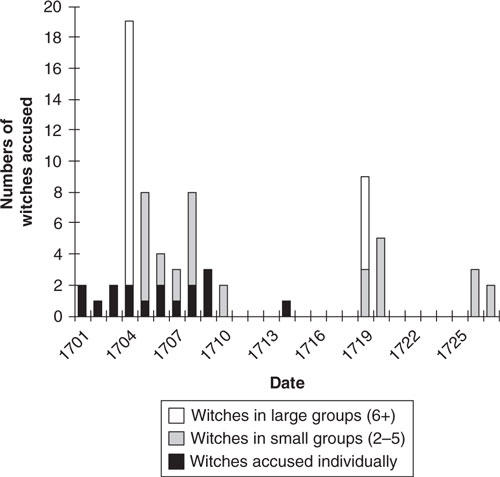
Figure 12.1 Witches by group size, 1701–1727
II
Individual witchcraft cases in the early eighteenth century were similar to their earlier counterparts in a number of ways. Neighbourhood tensions resulting in acts of malefice remained a common cause of accusations. Some instances involving refusal of charity adhere precisely to the ‘Thomas-Macfarlane’ model, in which accusations of witchcraft stemmed from the feeling of guilt a wealthier member of society had after they had refused charity to a beggar.11 In 1701, Elizabeth Dick, from Anstruther Easter, was summoned to the kirk session for turning grain in the local mill from white to red after she had been refused charity.12 Janet McRobert, in Kirkcudbright in 1701, was arraigned for supposedly causing Robert Crighton’s wife’s breast to ‘swell to a great height’ after she had been given only a small quantity of chaff for her cow. McRobert had quite a reputation, with floating candles, piercing screeches and a spinning wheel going ‘without the help of any person’ possessing her house.13 Two years later, in 1703, another Dumfriesshire witch, Janet McMurray from Twynholm, sought revenge on those who refused her charity, killing horses, inflicting ‘great pain’ and making milk ‘useless’.14 In 1704 in Bo’ness, Anna Wood was accused of witchcraft by Robert Nimmo after he had refused to give her a commission to travel to Holland aboard one of his ships. He claimed that whilst walking home one evening ‘he met with six cats’, one of which, whom he knew to be Wood, ‘did bid kill him’.15
The practice of charming continued to give rise to witchcraft accusations. Even during the height of witch-hunting, most cases of charming had remained separate from cases of witchcraft, but from time to time, a few charmers crossed the line and were converted into witches, either by appearing to commit serious malefice or by appearing to make a pact with the Devil.16 Mary Stewart was summoned before the Kilbride kirk session in 1705, accused of witchcraft ‘in regard that she frequently used charms for the healing of diseases’. She was punished merely as a charmer.17 Katherine Taylor, from Stromness in Orkney in 1708, was clearly a sorceress of repute, although a crippled beggar woman. She visited the house of Katherine Brown in Southside in order to cure Brown’s bedridden husband, William Stensgar. Several witnesses claimed that before sunrise the next morning, Brown had emptied a ‘large stoup’ containing the water in which her husband had been washed ‘in a common slap [i.e. drain]’. One witness claimed that in passing by, he ‘was overtaken by bodily indisposition’ and became afflicted with Stensgar’s illness.18
Thus, most individual witch accusations in the latter decades of the Scottish witch-hunt very much reflected earlier accusations, with the continued prominence of charming and vengeful malefice. A demonic element continued, although it was perhaps less prominent than it had been during panic years. In 1701, one girl alleged that whilst in Janet McRobert’s house ‘the devil appeared to her in the likeness of a man, and did bid deliver herself over to him, from the crown of her head to the sole of her foot’.19 As Edward J. Cowan and Lizanne Henderson point out, ‘the Devil had, by this time, been replicating precisely these demands, in exactly the same language, and eliciting identical responses from his intended victims, for over a century’.20
The case of Bessie Wanton, in Cupar in 1699, gives an insight into the prominence of the Devil in these late years. James Tarbot, an 18-year-old boy, claimed that Bessie was tormenting him; she had predicted his imminent death and appeared to him on a number of occasions, sometimes in his bed, pricking him with pins and nipping him. According to his mother’s testimony, James had fallen into fits rendering him deaf and dumb for eighteen days and able to see invisible sights. James claimed that he had seen a man in Bessie’s house who had pressed him to ‘go away with him’ and had ‘promised him bonnie things’.21
Certain features of this case, such as financial gain in exchange for compact with the Devil, are reminiscent of those of an earlier era. Yet this was quite like a possession case – a phenomenon that now acquired a new prominence in Scottish witchcraft.22 It occurred in the same year as the 1699–1700 possession cases of Margaret Laird and Margaret Murdoch in Paisley, and in the aftermath of the famous Christian Shaw case in Renfrewshire. James Tarbot’s symptoms seem to have followed the script of the Renfrewshire cases, though they should be distinguished from demonic possession to the extent that it was the witch herself who was carrying out the tormenting (while demonic possession involved a demon entering into the possessed person). However, Tarbot’s accusations against Bessie Wanton were not given the same credibility as those in Renfrewshire. The presbytery ‘found nothing made appear that could fix guilt upon her’. Tarbot was repeatedly asked by the sceptical presbytery if he was sleeping or dreaming, or if what he was relating ‘were not his fancies’. The fact that Tarbot’s allegations were dismissed, when the case of Christian Shaw only two years previously had created such a stir, suggests that local elites and zealous ministers were fundamental in fomenting any large-scale panic.
Another individual case with some new features was that of Robert Bainzie. His case of ‘charming or withchcraft [sic]’ was heard by the kirk session of Oyne in 1703. At ‘flitting’ (moving out of his house), he carried out a magical ritual including killing his dog and burying a cat beneath his hearth. Although this was not recorded explicitly as being an act of malefice, it could well have been intended to harm the next tenant. What is interesting, though, is that even though the session thought of his act as ‘witchcraft’, they equated this with ‘charming’ and do not seem to have been interested in a criminal prosecution. Bainzie was merely ‘rebuked’.23
Jean Brown, in Penninghame in 1706, was one of the remarkable visionaries of Scottish witchcraft.24 She came to the attention of the kirk session when she arrived in the parish ‘under ane ill fame of devilish practices’, and soon affirmed that she ‘converses ordinarily with spirits’ who ‘ly with her carnally as men and women do when they beget children’.25 The presbytery elicited some even more remarkable details. The spirits were the Father, Son and Holy Ghost, to whom she was married; they had shown her a vision of the day of judgement, when the heavens were as thunder and fire. A trial commission was requested, but Brown escaped from prison and disappears from the records.26
Brown was unique in several ways and was not part of a group. However, the session investigated her case concurrently with that of two charmers, Mary McNairn and John McNairn, illustrating the extent of moral and behavioural cleansing in Penninghame in 1705–1706. The fact that men such as Thomas McGill were rebuked and forced to repent publicly for drinking and cursing suggests that witchcraft was just one of the many crimes against God in the eyes of the presbyterian ministers.27
Some other individual cases, about which less is known, can be mentioned more briefly: Janet Dowlach (Kirkmichael, 1704);28 Alexander Deuart (Dumfries, 1707);29 Christian Wilkieson (Greenlaw, 1708), declared fugitive for witchcraft and charming;30 Margaret Clark (Cranston, 1709), to be tried before a circuit court;31 Isobel Anderson (Dunnet, 1714), ‘relapse in fornication … and under great presumptions of witchcraft’, who was apparently banished with the aid of the sheriff;32 and Margaret Watson (Walls, Shetland, 1725), investigated for a second time.33
Thus, with the exception of Bessie Wanton and Robert Bainzie, there remained a formulaic pattern to these witchcraft accusations in the late seventeenth and early eighteenth century. The main difference was that the central authorities, and in some instances the local authorities, appear to have been adopting a more moderate stance. The rise of noncapital penalties, especially banishment, is one example. Janet McRobert was banished to Ireland;34 Elspeth Rule, from Dumfries in 1709, the last witch to be tried before the court of justiciary in Edinburgh, was condemned to be branded on the cheek with a hot iron; according to local lore, smoke was seen issuing out of her mouth.35
This case also illustrates another point: those who were punished, perhaps especially those who were condemned to death, seem to have obtained an almost legendary status, perhaps because they were less common than before. Again according to local lore, Margaret Myles refused to say the Lord’s Prayer on her way to execution in Edinburgh in 1702.36 The circumstances surrounding Meg Lawson’s indictment in 1700 were ‘handed down by tradition’, so that even her grandchildren continued to suffer from her reputation.37 A snuff mill belonging to Margaret Laing, one of the Bargarran witches of 1697, became an antiquarian relic and ended up in the National Museum of Scotland.38
The case of Helen Kirkpatrick, in Kirkbride in 1706, provides a contrast, illustrating some changing attitudes. Peter Rae, the parish minister, issued a petition against Helen claiming that she had ‘grievously abused, slandered and defamed him’ by calling him a ‘soul-murderer’. In retaliation, Helen issued a petition against him, asserting that he had called her a witch and ‘bled her forehead with a lance’. After much contemplation, both parties were called before the congregation on the next Sabbath and rebuked, with Mr Rae declaring that he was ‘very sorry to have offended any of the meanest of Christ’s members’.39 Had such a case occurred a century before, it is less likely that Mr Rae would have been punished, and Helen’s claims against him might not have received such credit.
Thus, there remained some traditional patterns to individual witchcraft accusations in the eighteenth century. In some areas, however, those accused were met by newly tolerant attitudes among local elites. Witches were less likely to find themselves on trial, and those who were tried were less likely to be condemned to the flames. Of the eighteen witches accused individually in these years, only one (Margaret Myles) is known to have been executed. Nevertheless, nine are known to have suffered non-capital punishment; witchcraft very much remained a punishable crime.
III
Remarkably, small group cases involving two to five witches budded almost as often as individual cases in the years 1701–1727. These group accusations shared many of the characteristics of those accused individually. However, on closer inspection, it is clear that those caught up in a multiple indictment were linked by family ties, by association or by being victims of an individual’s zeal.
The parish of Caerlaverock, in Dumfriesshire, produced one small group of witches in 1705 – a group which may have been linked to others through the zeal of one or more ministers. The most obvious minister was Robert Paton, the former minister of Caerlaverock who in 1695 had been transferred to nearby Dumfries. He had been involved in earlier Caerlaverock cases in 1692 and 1697–1699. John Somerville, minister of Caerlaverock, Robert Blair, minister of Holywood, and John Reid, minister of Lochrutton, were all involved with two of the four cases. There were as many as nine ministers involved with the main case.40 It was a case of demonic possession, and the ministers ‘prayed with the familie molested, and after discoursed with all the persons suspected to be the instruments of their disturbance, except Bessie Heslope, whom they could not find’. Heslope was the only person named; the total number of suspects is unknown but was evidently at least four. The original idea was to get ‘the Magistrat’ (presumably the sheriff-depute) to arrest the suspects, but this did not happen – perhaps he refused? The ministers reported that ‘they find several very odd presumptions of witchcraft, yet they can see nothing to fix the same upon any of the persons suspected’. They sent an ‘information’ to the queen’s advocate, but a reply came back that ‘no criminal process can be raised’, whereupon the presbytery ‘thought fit to let it fall and leave the matter to Providence’.41
The Caerlaverock group may have been linked to another case counted here as an individual case: that of Janet Hairstains, a vagrant who had been in periodic trouble for suspected witchcraft for some time. In 1709 she was reported as a witch in the parish of Kirkbean, separated from Caerlaverock by the estuary of the Nith, and had also been reported in the neighbouring parish of Torthorwald. Paton, Blair and Reid were all involved in Hairstains’ case.42 Hairstains may not have been involved directly in the Caerlaverock possession case, but she was connected to it by the same ministers’ fanaticism.
An explanation for this apparent concern of these Dumfriesshire ministers may be found in a letter of 1704 from the commission of the general assembly to the presbytery of Wigtown, lamenting the ‘distressed state of diverse of the reformed church’ and the need for ministers to address in their sermons ‘the pernicious heresies, idolaters and superstitions of the Romish Church’.43 Clearly there was a wider climate of presbyterian panic in the southwest, and it was not merely witchcraft that was the object of moral cleansing. On the same day as Bessie Heslope’s case was being investigated, Richard Harries came before the presbytery for his ‘drunkenness and scandalous behaviour’. A month later, Janet Harper was fined after she had been in ‘company of loose and debauched men’.44
However, the central authorities did not share the anxieties of these ministers. The king’s advocate had written in 1699 that the case of Janet Wharrie, one of the earlier Caerlaverock witches who had been incarcerated for two years for performing various acts of malefice, was ‘not so momentous as to require a commission’.45 Janet Hairstains was treated more and more leniently. In 1700 she was banished for the use of charming, only to return three weeks later!46 In her eventual trial before the circuit court in 1709 she was acquitted.47 Thus, it is clear that although large-scale witch-hunting still surfaced in these late years, the central authorities – and even some of the local authorities – were beginning to treat them with less severity.
Throughout the period of Scottish witch-hunting, it was common for a witchcraft suspicion to stem from family ties. The case of George and Lachlan Rattray, in Inverness in 1706, was an example of this. They were ‘alleged guilty of the horrid crimes of mischievous charms, by witchcraft and malefice, sorcery or necromancy’. The privy council issued a commission to try the offenders locally, but the judges did not allow an execution to take place without a warrant from the council.48 Such strict guidelines suggest that the privy council was reluctant to let the fate of these two men lie entirely with the Inverness authorities. Only a decade before, the privy council had issued a commission to the Inverness authorities to try two women, named McRorie and McQuicken, which lacked these guidelines and gave them authority to execute them if found guilty.49 As it turned out, despite the precautions, the Rattrays were still ordained to the flames, but their case was the last execution authorised by the privy council. After the abolition of the Scottish privy council in 1708 (the year after the union of the Scottish and English parliaments), its role in authorising witchcraft trials was taken over by the queen’s advocate.
Sadly, little documentation survives of the Rattrays’ case. However, the example of the Ratter family, in Shetland in 1708, sheds light on how a family could be caught up in a joint accusation. The Ratters, two sisters and a brother, were seen as being ‘great deluders and abusers of the people’, their neighbours being ‘greatly terrified with their horrid cursing and imprecations’. The family were unpopular in Calvister and were deemed responsible for a number of deaths and misfortunes, often after they had received insufficient alms. In one instance, Elizabeth Ratter threatened Hugh Thompson with crop failure, saying that last year he had refused her a plate of corn and had consequently suffered a poor harvest, whilst his neighbour, who had been generous towards her, had had a better harvest. Her sister Katherine was apparently held responsible for several deaths. She was heard cursing Christopher Thompson ‘several tymes’ before his untimely death.
The accusations against Andrew Ratter were more extensive than those against his sisters, which is perhaps a reflection of some beliefs surrounding male witches. Male witches were sometimes believed to possess greater powers than their female counterparts and to be on more equal terms with the Devil. George Burroughs was seen as being ‘the ring leader of them all’ in Salem in 1692.50 Andrew was reported to have ‘leaned on his staff’ when performing a certain act of malefice. A staff, or something similar, has been argued to be a symbol of authority for some male witches; Alexander Hamilton in 1630 was said to have been given a ‘battoun of fir’ by the Devil.51 Like his sisters, Andrew was accused of harming livestock and hindering their production, causing illness and even killing a child.52
It was not merely through family ties, but also as accomplices more generally, that witches were accused together. A fourth suspect, Margaret Watson, was investigated with the Ratters.53 Another northern group, in Risegill, Caithness, consisted of two suspects: Henry Christian and Ann Sutherland. They were sent for trial at a circuit court in 1710.54
What began as an individual case in Kirkcudbright soon began to turn into a serial accusation. There is little documentation, but Janet McKeoner was recorded in November 1707 as having been ‘burnt for witchcraft at Kirkcudbright lately’.55 This was recorded by the Penninghame kirk session in their investigation of William Drew for witchcraft; he had allegedly been named as a witch by McKeoner. However, Drew’s case was dropped.56
In 1720, an unknown number of witches, at least five in total, were accused of tormenting Patrick Sandilands, the 12–13-year-old third son of Lord Torphichen. It was reported that he ‘fell down in trances, from which no horse whipping could rouse him’. Whilst in such fits he supposedly pronounced prophecies, made urine the colour of ink and was lifted up into the air by invisible hands. Eventually Lord Torphichen gave credit to his son’s claims and had the tormentors seized, while the minister of the parish proclaimed a fast. Yet, despite showing similar symptoms to the earlier possession cases in 1697–1700 and 1704, the case was nipped in the bud. Patrick was ‘sent off’ to join the fleet and little more was heard of the affair.57
There were several contemporary interpretations of this case. The eccentric William Mitchell, the ‘Mad Tinklerian Doctor’, used it to prove the existence of witchcraft.58 Robert Wodrow, minister of Eastwood, seems to have been more sceptical: ‘but what to make upon the whole I know not’.59 These differing accounts perhaps reflect the varying degrees of doubt concerning witchcraft in this period. The fact that Patrick’s claims were not given the same credibility as other earlier cases suggests that such cases, whilst providing a means to demonstrate the reality of demonic power for some, were no longer considered convincing evidence to others.
In the parish of Spott, East Lothian, in October 1705, there is a brief reference to ‘Many witches burnt on the top of Spott loan’.60 Following the convention of the Survey of Scottish Witchcraft, this group of ‘many’ can be counted as containing at least three witches.
Two small groups of witches, also with their precise numbers obscure, were mentioned later in Ross-shire. The minister of Tarbat, David Ross, reported to the presbytery in November 1719 ‘a great noise in that parish of witches and witchcraft’. An investigatory committee was established, a report was to be made to the ‘procurator and agent for the church’, and in February 1720 Ross was ‘to send south the next week the abstract of the process anent those alleadged guilty of witchcraft’. The case then disappears from the presbytery records.61 Also in Ross-shire, with no place noted but under the date May 1726, Wodrow noted ‘odd accounts of witchcraft there of late, some of them prosecute’.62 This was certainly a small group, and possibly a large one. The results of the prosecutions are unknown, but Wodrow’s wording is ominous.
This was not long before Scotland’s final known witchcraft prosecution, itself another small group case in the far north: two women in Dornoch, Sutherland, a mother and daughter. The mother was executed, while the daughter escaped. The name ‘Janet Horne’ was assigned to the mother in the early twentieth century, though with dubious authenticity. Even the date is unclear, several references assigning it to 1722, but the date of 1727 was preferred by Cowan and Henderson, who studied the case in as much detail as the fragmentary records allowed.63
Therefore, it appears that multiple indictments continued to blossom in the eighteenth century; the decline of witch-hunting was not as sharp as is sometimes assumed. Yet, unlike their earlier counterparts, there appears to be evidence of increased judicial scepticism that prevented these cases from mushrooming out of control. In only four of the eleven groups do we have evidence that one or more of the witches in these small groups was executed.
IV
Turning to the cases of large groups of witches, there were three instances after 1701 when groups of six or more witches were accused together in these final decades. This period followed a burst of witch-hunting in the late 1690s, especially the famous Christian Shaw case of 1697, which fused into the possession of two other young girls, Margaret Murdoch and Margaret Laird. These cases have been discussed elsewhere; here it is important to note the witch-hunting zeal of the local elites, clerical and non-clerical. There were at least twenty-seven ministers involved in the cases of Shaw, Murdoch and Laird, including James Brisbane and Neil Gillies, whilst laymen such as Sir Francis Grant of Cullen and Sir John Maxwell of Pollok also played an active role.64 However, only seven of the twenty-five witches named in the commission to the privy council in 1697 were executed, and all of the 1699–1700 witches were released without trial. Whilst all the fundamental ingredients for a large-scale hunt were in the mix, systematic doubts emerged from the central authorities. Michael Wasser argues that 1697–1700 marks the ‘last major witch-hunt’ in Scotland.65
However, the events of 1697–1700 did not mark the end of serial witch-hunting in the localities. Despite central scepticism, local fervour remained and gave birth to some large-scale accusations in the eighteenth century.
The scale of witch-hunting in the late 1690s should be emphasised, with 107 recorded cases altogether in the period 1697–1700.66 One less-studied serial accusation, occurring in the same years as the Renfrewshire cases, should perhaps be mentioned here: a series of accusations that surfaced in Easter Ross. The surviving records show two groups, one of three and one of twelve, but the cases were evidently connected since they occurred in the same locality at the same time. Three women, deemed responsible for a number of misfortunes, were the subjects of precognitions taken at Fortrose in October 1699. Following an altercation with Mary Nicinnarich, Alexander Maclay fell ill, recovering only after drinking a glass of her milk. Margaret Provost’s reputation was such that a local laird took matters into his own hands and ‘pulled down the house about her ears’. The laird’s gardener, who had assisted in the demolition, subsequently ‘swelled as big as two men’ and ‘got such a voracious stomach that he would eat as much as six’.67 Meanwhile twelve other people were ‘alleged guilty of the diabolical crimes and charms of witchcraft’. A commission of local lairds was appointed by the privy council to put them to trial by an assize, but then to report back with recommendations. Margaret Monro and Agnes Wrath confessed, and were convicted with eight others in the local court. The other two, John Glass and Mary Keill, had nothing found proven against them, but were still sentenced to be fined and banished. All this shows local belief in the criminality of these witches and extrajudicial action by the authorities. However, the privy council took a more moderate attitude. Those who had been convicted were ordered to receive an arbitrary but non-capital punishment, while Glass and Keill were ordered to be freed from Fortrose jail.68
Turning to the large groups after 1700, the first was the 1704 possession case of Patrick Morton in Pittenweem. This reinforces the idea that local fervour was crucial. The barbarous lynching of Janet Cornfoot unequivocally establishes the extent of popular belief. Brian Levack suggests that the war against France provided a suitable climate for witchcraft accusations: soldiers quartered in the town undermined godly discipline, raping women and encouraging villagers to drink during Sunday sermons.69 It comes as no surprise that the presbyterian minister, Patrick Cowper, was at the forefront of the accusations. The author of a pamphlet against the affair asserted that the minister orchestrated it and ‘exercised more civil authority than any of the Baillies’. He claimed that Cowper read an account of the Christian Shaw case to Morton and encouraged him to implicate Beatrix Laing.70 Another pamphlet alleged that Cowper was so determined to force a confession from these women that he beat Janet Cornfoot with his staff and turned a blind eye to her brutal murder.71 Eight in total were named: Isobel Adam, Thomas Brown, Janet Cornfoot, Janet Horseburgh, Margaret Jack, Beatrix Laing, Nicolas Lawson and Lilias Wallace. Yet all were released (except Brown who died in prison), with Cornfoot’s lynching occurring when she returned to the town. Laing and Lawson were prosecuted again in 1708–1709 (counted here as a small group), but again were released.72 The central authorities were not convinced by the zeal of local elites. In the recriminations afterwards, one of the bailies, William Bell, was forced to apologise in 1710 for maltreating Janet Horseburgh. Brian Levack writes that this ‘may have dealt a final blow to intense witch-hunting in Scotland, as there were no attempts to prosecute entire groups of witches, only individuals, after that date’.73 Yet we have already seen that there were some small groups after 1710 – and we shall see shortly that there was also one more large group.
Meanwhile, in the neighbouring parish of Torryburn, local elites were aiding witchcraft activity. The events of 1703–1704 unfolded following a rumour that Jean Bizet had been ‘molested by Satan’ and had arisen from her sleep shouting, ‘by God he is going to take me! O Lilly (Adie) with her blew doublet! O Mary, Mary Wilson! Christ keep me!’ Following these allegations, Jean Neilson claimed that she too was ‘dreadfully tormented’ by Lilias Adie. After her arrest, Adie confessed to being in a compact with the Devil and named Agnes Currie and Elspeth Williamson as witches she had recognised at meetings with the Devil. Thus the chain of denunciation had been set in motion; seven were named in 1704 (Adie, Currie and Williamson, plus Bessie Callendar, Mary Carmichael, Janet White and Mary Wilson), plus two who had been executed recently (Grissel Anderson and Euphemia Stirt, apparently in 1703), making a total of nine. The Devil played a prominent part in these confessions, being described by Adie as having a cloven foot and appearing as ‘a shadow’, and by Williamson as having a silent step on the stubble. Adie’s account of her renouncing her baptism correlates exactly to those that had been related for over a century.74 After the two executions of 1703, and Adie’s death in prison, nothing appears to have come of the accusation of 1704. There is no evidence of the central authorities becoming involved; perhaps the case was simply dropped. Nevertheless, the meticulously stereotypical nature of the confessions, and the apparent encouragement to name accomplices, suggest that there were members of the local elite at the heart of the investigation.
Even as late as 1718, large-scale witch-hunting continued to bud. According to Robert Dundas, the king’s advocate, there were ‘very extraordinary, if not fabulous’ discoveries of witchcraft in Caithness. In December 1718, William Montgomery petitioned the sheriff-depute of Caithness that his house had become infested with cats, and one evening he had used his sword to fend off the intruders, killing two of them. He claimed that ‘not one drop of blood’ came from the injured cats, and no bodies could be found in the morning. The sheriff-depute was not stirred until February 1719, when it was reported that Margaret Nin-Gilbert’s leg had fallen off. In a letter to Robert Wodrow, James Frazer reported that Margaret Olson, a tenant of his uncle, had been removed from her lodging on account of ‘the wickedness of her behaviour’ and replaced by Montgomery. Olson then solicited Nin-Gilbert to ‘do mischief’ in revenge.75 In June 1719, the synod of Caithness and Orkney noted a recent ‘noise of witchcraft and socerie’ in the presbytery of Caithness. The diligence of the presbytery and sheriff was approved, and further action encouraged.76
As in the cases previously discussed, it is clear that the local elites played a crucial role. The sheriff-depute appears to have intended to take the case into his own hands and was only checked when the king’s advocate intervened and reproached him for not having referred the case to the ‘proper method and court’.77 The minister of Thurso, William Innes, likewise played a vital role. Under his examination Nin-Gilbert confessed to being in league with the Devil, claiming that he appeared to her ‘in the likeness of a great black horse … a black cloud, and sometimes like a black man’. She further admitted to having been ‘bodily present’ in Montgomery’s house in the form of a ‘feltered [i.e. shaggy] cat’ and was encouraged to name her accomplices. Olson was even pricked for the witch’s mark – a practice that had been forbidden by the privy council in 1678.78 This case contained all the ingredients of a panic; had the king’s advocate not intervened, the six women would probably have suffered an unpleasant fate.
It thus becomes clear that local elites were most important in the surfacing and maturing of multiple accusations. In almost all of these cases there is evidence of local elites, more often than not zealous ministers, determined to force a confession and to obtain names of accomplices. It is of particular interest that three of these cases featured possession. According to Brian Levack, the emergence of possession cases in 1690s was part of the ‘late seventeenth-century Calvinist religious culture’.79 In a time of philosophical scepticism, possession offered proof of the existence of evil spirits. It could be argued that Levack’s theory could be applied to the non-possession cases in this group as well. The tale related in Thurso and the emphasis on the role of the Devil in Torryburn both suggest that local elites were reaching for sensationalist extremes in order to prove the existence of the supernatural world. Meanwhile, one cannot overlook the fact that the central authorities took an increasingly moderate stance. As Levack points out, possession cases were a double-edged sword. On the one hand they stoked belief, whilst on the other they encouraged scepticism.80
V
Overall, the early eighteenth century witnessed a distinct increase of systematic doubts about witchcraft. Central authorities adopted an increasingly moderate attitude to prosecutions. Commissions for trials were often refused and, even if a commission was granted, it was issued with greater caution and supervision than before. Those witches who were put on trial were more likely to be given a non-capital punishment, or even acquitted, rather than being condemned to the flames. The increasing incidence of non-capital punishment was a significant development of the period; for most of the period of Scottish witch-hunting, there had been a single crime – witchcraft – with a single punishment – death. Now, both central and local courts were giving themselves a wider range of options, reducing the seriousness of the death toll.
Nevertheless, belief endured and allegations of witchcraft continued to be made. Even with the emergence of the new philosophies that were attacking belief in the supernatural world, presbyterian fervour and anti-Sadducism seem to have provided the intellectual framework for witch-hunting to survive. At the grass roots level, magic remained very much an integral part of everyday life, and even among educated elites there was a ‘mixed bag of beliefs’.81 As Michael Wasser remarks, ‘what was occurring was not a contest between true believers and complete sceptics, but between people with different degrees of doubt, who chose to emphasise different things’.82 There was, certainly, a falling-off of individual cases after 1709, with only one further individual case (in 1714); but between 1710 and 1727, at least twenty-one witches were accused in groups. Thus, driven by the resilient beliefs of local elites, witch-hunting continued to seed and bud in these decades with the same flavour as it had done in earlier years, and subsequently declined less sharply than is generally assumed. In some localities at least, it was quite remarkably a story of survival.
Notes
1. Keith Thomas, Religion and the Decline of Magic (Harmondsworth, 1971), 570.
2. Christina Larner, Enemies of God: The Witch-Hunt in Scotland (London, 1981), 78–9, 189–91.
3. Brian P. Levack, ‘The decline and end of Scottish witch-hunting’, in his Witch-Hunting in Scotland: Law, Politics and Religion (London, 2008), 131–44.
4. Michael Wasser, ‘The mechanical world view and the decline of witch-beliefs in Scotland’, in Julian Goodare, Lauren Martin and Joyce Miller (eds.), Witchcraft and Belief in Early Modern Scotland (Basingstoke, 2008), 206–26, at pp. 208–10.
5. Lizanne Henderson, ‘The survival of witchcraft prosecutions and witch belief in south-west Scotland’, SHR, 85 (2006), 52–74; Stuart Macdonald, The Witches of Fife: Witch-Hunting in a Scottish Shire, 1560–1710 (East Linton, 2002). See also Edward J. Cowan and Lizanne Henderson, ‘The last of the witches? The survival of Scottish witch belief’, in Julian Goodare (ed.), The Scottish Witch-Hunt in Context (Manchester, 2002), 198–217.
6. Hugh McLachlan and Kim Swales, ‘The bewitchment of Christian Shaw: a reassessment of the famous Paisley witchcraft case of 1697’, in Yvonne G. Brown and Rona Ferguson (eds.), Twisted Sisters: Women, Crime and Deviance in Scotland since 1400 (East Linton, 2002), 54–83; Michael Wasser, ‘The western witch-hunt of 1697–1700: the last major witch-hunt in Scotland’, in Goodare (ed.), The Scottish Witch-Hunt in Context, 146–65; Brian P. Levack, ‘Demonic possession and witch-hunting in Scotland’ and ‘Witch-hunting and witch-murder in early eighteenth-century Scotland’, in his Witch-Hunting in Scotland, 115–30, 145–61.
7. Levack, ‘Decline and end’.
8. P. G. Maxwell-Stuart, ‘Witchcraft and magic in eighteenth-century Scotland’, in Owen Davies and Willem de Blécourt (eds.), Beyond the Witch Trials: Witchcraft and Magic in Enlightenment Europe (Manchester, 2004), 81–99, at p. 92.
9. Hunter (ed.), Occult Laboratory, 77–117, 187–204. For some other works, see Christina Larner, ‘Two late Scottish witchcraft tracts: Witch-Craft Proven and The Tryal of Witchcraft’, in Sydney Anglo (ed.), The Damned Art: Essays in the Literature of Witchcraft (London, 1977), 227–45, and Hugh McLachlan (ed.), The Kirk, Satan and Salem: A History of the Witches of Renfrewshire (Glasgow, 2006).
10. There are several groups of unknown size, where sources refer to ‘several’ or ‘many’ witches. Following the practice of the Survey of Scottish Witchcraft, such groups are counted as comprising three witches. The figures are for cases, not individual people; three individuals had more than one case. Cases are defined as formal accusations of witchcraft that might have led (and in some cases did lead) to trial and execution.
11. Thomas, Religion and the Decline of Magic, 652–69; Alan Macfarlane, Witchcraft in Tudor and Stuart England (London, 1970), chs. 15–16.
12. Macdonald, Witches of Fife, 144.
13. Extract from the Minute Book of the Kirk Session of Kirkcudbright (6 February–10 April 1701), in J. M. Wood, Witchcraft in South West Scotland (Dumfries, 1911), 82–7. Cf. Henderson, ‘Survival of witchcraft prosecutions’, 61.
14. Extract from the Session Book of Twynholm (18 April–9 May 1703), in Wood, Witchcraft, 87–91.
15. Thomas J. Salmon, Borrowstounness and District: Being Historical Sketches of Kinneil, Carriden, and Bo’ness, c.1550–1850 (London, 1913), 119–21.
16. On charming, see Joyce Miller, ‘Devices and directions: folk healing aspects of witchcraft practice in seventeenth-century Scotland’, in Goodare (ed.), The Scottish Witch-Hunt in Context, 90–105, and Owen Davies, ‘A comparative perspective on Scottish cunning-folk and charmers’, in Goodare, Martin and Miller (eds.), Witchcraft and Belief, 185–205.
17. Extract from the Session Records of Kilbride (3 June 1705), in J. M. Balfour and W. M. Mackenzie (eds.), The Book of Arran, 2 vols. (Glasgow, 1910–14), ii, 294–5.
18. Extract from a Process contained in a Session Register (July 1708–5 September 1708), in G. Low, The Islands of Orkney as Traversed in Summer 1774 (Kirkwall, 1834), 201–3.
19. Extract from the Minute Book of the Kirk Session of Kirkcudbright (6 February–10 April 1701), in Wood, Witchcraft, 83.
20. Cowan and Henderson, ‘The last of the witches?’, 204.
21. NRS, Cupar presbytery records, CH2/82/2, pp. 344–7.
22. Levack, ‘Demonic possession’.
23. James Logan, ‘Ecclesiastical collections for Aberdeenshire’, Archaeologia Scotica: Transactions of the Society of Antiquaries of Scotland, 3 (1831), 4–19, at p. 13.
24. For another case involving a well-known visionary, see Emma Wilby, ‘ “We mey shoot them dead at our pleasur”: Isobel Gowdie, elf arrows and dark shamanism’, Chapter 8 in this volume.
25. The Session Book of Penninghame, 1696–1724, ed. Henry Paton (Edinburgh, 1933), 164.
26. SSW; Henderson, ‘Survival of witchcraft prosecutions’, 62–3.
27. Session Book of Penninghame, 161–9.
28. John Hunter, The Diocese and Presbytery of Dunkeld, 1660–1689, 2 vols. (London, n.d. [1918]), ii, 60.
29. Christina Larner, Christopher H. Lee and Hugh V. McLachlan, A Source-Book of Scottish Witchcraft (Glasgow, 1977), no. 3009.
30. SSW.
31. Ibid.
32. Alfred W. Johnston and Amy Johnston (eds.), Old-Lore Miscellany of Orkney, Shetland, Caithness and Sutherland, vol. iii (Coventry: Viking Club, 1910), 48.
33. SSW. The first investigation, discussed below, was as part of a group with the Ratter family.
34. Extract from the Minute Book of the Kirk Session of Kirkcudbright (10 April 1701), in Wood, Witchcraft, 87.
35. Cowan and Henderson, ‘The last of the witches’, 205.
36. Quoted in Chambers, Domestic Annals, iii, 217.
37. Thomas Craig-Brown, The History of Selkirkshire, 2 vols. (Edinburgh, 1886), ii, 100–1.
38. Hugh Cheape, ‘ “Charms against witchcraft”: magic and mischief in museum collections’, in Goodare, Martin and Miller (eds.), Witchcraft and Belief, 227–48, at p. 244.
39. NRS, Penpont presbytery records, CH2/298/1, pp. 287–301.
40. SSW; Hew Scott (ed.), Fasti Ecclesiae Scoticanae, 7 vols. (2nd edn., Edinburgh, 1915-), ii, 259.
41. NRS, Dumfries presbytery records, 1701–10, CH2/1284/4, pp. 174, 181, 183, 195.
42. SSW; Henderson, ‘Survival of witchcraft prosecutions’, 66.
43. Quoted in Henderson, ‘Survival of witchcraft prosecutions’, 61–2.
44. NRS, Dumfries presbytery records, 1701–10, CH2/1284/4, pp. 181, 185.
45. Henderson, ‘Survival of witchcraft prosecutions’, 64.
46. Ibid., 66.
47. SSW.
48. Chambers, Domestic Annals, iii, 302.
49. Ibid., 136.
50. Paul Boyer and Stephen Nissenbaum (eds.), Salem-Village Witchcraft (Belmont, Calif., 1972), chs. 5, 14.
51. Julian Goodare, ‘Women and the witch-hunt in Scotland’, Social History, 23 (1998), 288–308, at p. 305; cf. Julian Goodare, ‘Men and the witch-hunt in Scotland’, in Alison Rowlands (ed.), Witchcraft and Masculinities in Early Modern Europe (Basingstoke, 2009), 148–70.
52. NRS, Shetland presbytery records, CH2/1071/1, pp. 152–8. I am grateful to Mrs Diane Baptie for permission to quote from her transcript of this document and to Professor Liv Helene Willumsen for obtaining a copy of it for me. The Ratters’ fate is unknown.
53. SSW.
54. Ibid.
55. Session Book of Penninghame, 205.
56. Henderson, ‘Survival of witchcraft prosecutions’, 71.
57. Charles K. Sharpe, A Historical Account of the Belief in Witchcraft in Scotland (London, 1884), 194–5.
58. Ibid., 196–7.
59. Robert Wodrow, Analecta: Materials for a History of Remarkable Providences, 4 vols., ed. Mathew Leishman (Maitland Club, 1842–1843), ii, 339.
60. Statistical Account of Scotland, 1791–99, vol. v, p. 454 (Spott, County of Haddington), online at http://stat-acc-scot.edina.ac.uk/link/1791–99/Haddington/Spott/5/454/.
61. NRS, Tain presbytery records, 1718–23, CH2/384/4, pp. 59, 61, 63, 68.
62. Wodrow, Analecta, iii, 302.
63. Cowan and Henderson, ‘The last of the witches?’, 205–9.
64. Wasser, ‘Western witch-hunt’, 153.
65. Ibid., 146–7, 154.
66. SSW.
67. Extract from miscellaneous papers of the Boyds of Trochrigg, quoted in Larner, Lee and McLachlan, Source-Book, 275–7.
68. Chambers, Domestic Annals, iii, 216–17; Larner, Lee and McLachlan, Source-Book, 280.
69. Levack, ‘Witch-hunting and witch-murder’, 148.
70. ‘An Answer of a Letter from a Gentleman in Fife’, in David Webster (ed.), A Collection of Rare and Curious Tracts on Witchcraft and the Second Sight (Edinburgh, 1820), 72.
71. ‘An Account of an Horrid and Barbarous Murder’, in Webster (ed.), Collection, 73.
72. Levack, ‘Witch-hunting and witch-murder’, 159–60.
73. Ibid., 159.
74. Minutes and Proceedings of the Kirk-Session of Torryburn (30 June-3 September 1704), in Webster (ed.), Collection, 127–43; Macdonald, Witches of Fife, 112–13. For statistical purposes all nine are assigned to the same group dated 1704, although two of the cases were slightly earlier.
75. Sharpe, Historical Account, 180–90. For more on witches’ transformation into cats, see Robert Darnton, The Great Cat Massacre (London, 1984), 91–4.
76. Alfred W. Johnston and Amy Johnston (eds.), Old-Lore Miscellany of Orkney, Shetland, Caithness and Sutherland, vol. ii (London: Viking Club, 1909), 172.
77. Sharpe, Historical Account, 184–6.
78. Ibid., 188–90.
79. Levack, ‘Witch-hunting and witch-murder’, 146.
80. Levack, ‘Demonic possession’, 129.
81. Roy Porter, ‘Witchcraft and magic in Enlightenment, Romantic and liberal thought’, in Marijke Gijswijt-Hofstra, Brian P. Levack and Roy Porter, Witchcraft and Magic in Europe: The Eighteenth and Nineteenth Centuries (London, 1999), 191–282, at p. 237.
82. Wasser, ‘Western witch-hunt’, 161.