
5
Paula Hughes
The dramatic political events in Scotland during the 1640s may seem to give an air of inevitability to the witch-hunting that broke out in 1649–1650. Supporters of the revolutionary National Covenant, and later the Solemn League and Covenant, had gained firm control of Scottish political and ecclesiastical institutions. The National Covenant of 1638 was a contract between the Scottish people and God, in which those who subscribed to it promised to behave in a godly manner. The Solemn League and Covenant of 1643 further cemented this and laid foundations for exporting the ‘perfect’ model of presbyterian church government to England. In the autumn of 1648, after the collapse of the moderate covenanters’ Engagement with Charles I, the radical wing of the covenanting movement seized power. By 1649, protection of the sanctity of the covenants was at the top of the agenda for the regime.
I
Throughout the 1640s the kirk became increasingly concerned about sinful behaviour. It was a regular topic of discussion for the kirk’s central bodies – the general assembly and the commission of the kirk – and, in the localities, kirk sessions and presbyteries. Witchcraft and superstition were among the most serious of these concerns. Charming was the practice of using magical objects, spells or prayers to cure ailments or for personal gain; this had been treated hitherto as an ecclesiastical offence but never as a criminal offence.1
During 1643–1644, presbyteries dealt with an increased number of charmers.2 In 1646, the commission of the kirk petitioned parliament to criminalise the practice of charming and consulting of witches and charmers.3 This became linked with a debate about ‘consulters’ with charmers and witches. The original 1563 witchcraft act included a directive against consulters with witches, but even by 1567 it had been recognised that this provision was a dead letter. Witches, in the usual official sense of maleficent magical practitioners who made a pact with the Devil, did not really have ‘consulters’ anyway.4 Nevertheless, parliament eventually responded, and on 1 February 1649 issued a new act against witches:
The estats of parlement &c, understanding that there are some persons who consult with devills and familiar spirits who, notwithstanding of the 73 act of Queene Marie [i.e. the 1563 act] quhairby it is ordained that all witches sorcerers necromancers and consulters with them are to be punished by death, doe yet dreame to themselffis impunity becaus consulters are not expresslie mentionat in the said act: doe thairfor for further clearing theirof declare and ordaine that whatsoever persone or persons shall consult with devillis or familiar spirits are lyable to the paines contained in the said act and shall be punished by death; and the saids estats ratifies and approves all former acts made aganst witches, sorcerers necromancers and consulters with thame in the haill heads, articles and claussis thairof.5
This thus ratified the act of 1563 and sought to clarify the position of ‘consulters’, but instead of criminalising consulters with charmers, or even consulters with witches, it condemned ‘persons who consult with devills and familiar spirits’ – a phrase that would normally have been understood to mean necromancers. The act’s statement that ‘consulters are not expresslie mentionat’ in the 1563 act sits oddly with the mention, a few words earlier, of the fact that consulters had indeed been mentioned in it. Indeed necromancy had also been mentioned in the 1563 act. Thus, the new act did not go as far as the general assembly and the commission of the kirk had expected. On the surface it looked as though it clarified the position of ‘consulters’, but it did not really do so. Perhaps as a result, there is no evidence of any charmers, or consulters with witches or charmers, being prosecuted under the new act in 1649–1650. Nor for that matter were ‘familiar spirits’ mentioned in the prosecutions, though the Devil was certainly prominent. All cases that went through to the central authorities to request a commission for trial involved the straightforward crime of witchcraft.
The radical regime believed that Scotland was experiencing a second Reformation in 1649. The regime demonstrated its godliness in a number of ways, especially the removal of the ungodly from government and the army. But to demonstrate its godliness, the new regime also undertook a broader campaign of moral reform. In the early months of 1649 parliament passed twelve acts concerning morality, including acts against fornication, adultery, incest, blasphemy, drunkenness, swearing and profanity and witchcraft.6 Betrayal of the covenants came in many forms, from the mass betrayal of the covenants through the Engagement in 1647 to personal acts of betrayal by those acting in an ungodly manner. Suspected witches fell into the latter category. The act of becoming a witch involved renouncing baptism and entering into a pact with the Devil, which was the ultimate betrayal of the Scottish people’s covenants with God.
What happened in 1649–1650 was a culmination of ten years of dominance of political and religious life by presbyterian radicals with apocalyptic visions and an impending sense that the nation’s troubles resulted from the scourge of the ungodly threatening to subvert a covenanted and godly nation.7 In 1649–1650 many charges of witchcraft noted that the suspected witch had entered into a ‘covenant’ with the Devil as opposed to the more conventional ‘pact’. The main features of the pact, for example renouncing of baptism, receiving the Devil’s mark and a new name, and consummation of the pact, remained key features in confessions. However, the substitution of the term ‘covenant’ for ‘pact’ is not to be taken lightly.
II
The evidence for witch-hunting comes from several different stages of the process. In the early, pre-trial stage, local church courts – kirk sessions or presbyteries – were often involved. The kirk session was often the first official body to hear of an accusation of witchcraft, when a parishioner or group of parishioners complained to it about a suspected witch. Stuart Macdonald has argued that the kirk sessions were instrumental in bringing suspected witches to the notice of the authorities.8 This is true to the extent that kirk sessions, and presbyteries, carried out a key function in the pre-trial stage by helping to gather evidence against suspects and putting that evidence forward to apply for a trial. However, the initial accusation or report of witchcraft in a chain of accusations came from the local community.
In rare cases a minister might write to a neighbouring kirk session to inform them that a suspect had named a parishioner in a confession, or a presbytery would write to a neighbouring presbytery upon hearing of a case of witchcraft to enquire whether any of their own residents had been named.9 These interactions could be important when chain-reaction witch-hunting was occurring. By that time, most suspects were generated not by neighbourhood accusations but by confessing witches. However, before that stage, the vast majority of initial accusations were brought to kirk sessions’ attention either by ordinary folk complaining of an act of witchcraft or by a counter accusation of slander if someone had been called a witch.
Macdonald’s interpretation thus sees the kirk sessions as being proactive in hunting for witches. However, in 1649–1650 the local authorities reacted to reports of witchcraft from the community and from other parishes. Once a report had reached a session it would appeal for witnesses and evidence. Macdonald appears to have interpreted this as the first step in searching for witches in the community, placing the initiative in the hands of the kirk session.10 However, the kirk session was reliant on residents to inform and bring information about their neighbours to the kirk session. Occasionally, even the accused would bring the case to the session by complaining of slander. In any such case, the session would appeal for witnesses, examine evidence and inform the presbytery.
Once evidence was compiled, the presbytery evaluated and ‘attested’ the evidence as to whether it was sufficient for ‘suiting’ or requesting a commission for a trial from the central institutions. In 1649–1650, presbyteries acted as important intermediaries between the local investigation and the official trial. Almost all of the commissions granted by the committee of estates in 1649 referred to the suspects as belonging to presbyteries as opposed to parishes, counties or burghs.
Evidence found in local church court records includes measures taken to imprison and interrogate suspected witches, confessions of accused witches, witness testimonies and accounts of previous behaviour of witchcraft suspects.11 In some cases, kirk sessions or presbyteries would bring in a witch-pricker to gather evidence of the witch’s mark. This locally-compiled material was then taken to the central authorities in Edinburgh. If the evidence was satisfactory, the authorities would grant a commission of justiciary to a group of local men, authorising them to conduct a criminal trial in the locality.12 In some periods of Scottish witch-hunting, trials could also be held in the central justiciary court in Edinburgh, but there appear to have been no instances of this in 1649–1650.
Most of the surviving evidence for the 1649–1650 witch-hunt comes from central records of the granting of these commissions. Most commissions were for trying of several witches, which is symptomatic of ‘chain-reaction’ witch-hunting – searching for suspects and apprehending them if named by a confessing witch. Commissions were granted to a small group of commissioners, usually between five and nine, usually with a quorum of three or four. Some commissioners were named repeatedly. Of the eleven commissions granted for the presbytery of Haddington, James Skirving, Richard Skirving and Alexander Borthwick were each named on five.13 Each commission empowered the commissioners to convene a court and hold a trial for the named witchcraft suspects. Evidence of the outcome of the trial rarely survives, but there are strong indications that the acquittal rate was low.14
Witch-hunting was thus co-ordinated centrally. The covenanting revolution made significant changes to the political framework in Scotland. Parliament was placed firmly at the head of political life and was in session much more often than before. During parliamentary recesses the executive government was headed, not by a privy council appointed by the king, but by a committee of estates appointed by parliament.15 The privy council would normally have been responsible for granting commissions to try witches, but in 1649–1650 the council had been reduced to a nominal institution and did not grant any commissions.16 Instead, the committee of estates acted as the co-ordinating body when parliament was not in session.
Like parliament, the general assembly of the church became more institutionalised and met more frequently. The general assembly consisted of representative ministers and lay elders. Although the church was no longer represented in parliament, the general assembly influenced political life through the commission of the kirk. This governed the church when the assembly was not in session, just as the committee of estates governed the country when parliament was not in session.
The wordings of trial commissions indicate that each commission was issued on its own merit. For example, of the five commissions issued on 4 December 1649, only one commission contained the order to take an inventory of the accused’s belongings.17 Such an order may indicate that some of the witches to be tried may have been known to possess property worth confiscating. Forty-seven of the commissions noted that the depositions against and confessions of the witches were either subscribed, attested or revised by the presbytery – a further indication of presbyteries’ significant role in the pre-trial stage of the prosecution of witches in 1649–1650.
An unusual general commission was granted on 4 December for the trial of people in the presbytery of Biggar, who had been accused of witchcraft by Janet Coutts from Peebles.18 This offered the local authorities carte blanche to try any suspects named by Coutts. The commission included some procedural guidance, instructing that she was to be confronted with those she had accused of witchcraft and that those whom she then confirmed as witches were to be tried. It was the only general commission granted in 1649–1650; all others were restricted to named individuals. The central authorities were usually cautious in their proceedings. Requests for commissions were carefully considered before they were granted by the committee of estates, and clear instructions were given to the commissioners on how to proceed. Less information was recorded about commissions granted by parliament, but given parliament’s concern at the potential use of torture to extract confessions and the clear remit it gave to the May 1650 committee (to be discussed below), it is likely that parliament gave the same level of consideration and instruction in each case that the committee of estates did.
Parliament and the committee of estates were sometimes appealed to in cases of mistreatment of suspected witches. Bessie Masterton and Marjory Durie petitioned the committee of estates, complaining against the treatment they received at the hands of the presbytery of Dunfermline during their incarceration. There is no evidence that their petition was successful, but there are no further references to them in the official records.19 The nature of their mistreatment was not specified, but it most likely refers to the common practice of sleep deprivation and ‘watching’, where suspects were watched by ministers or elders to extract confessions.
Handling requests to try suspected witches could be a lengthy process. Margaret Finlayson’s confession and the depositions against her were dated February and March 1650. The application for a commission to try her was addressed to the ‘rycht honorabill committee of estates of parliament or the Lords of the Secret Counsall’ on 21 March 1650. Her case was passed to the sub-committee set up by parliament to consider papers concerning witches in May 1650. The committee did not hear her case until 29 June 1650, when it recommended the justice depute to consider the case and report back.20
Finlayson’s case also indicates local uncertainty about the changing nature of central government: Which body was responsible for granting commissions to try witches? Another such case had occurred in September 1649 when the presbytery of Glasgow sent witness testimonies and a supplication to ‘the rycht honorable Comite of Estaites or Lords of His majesties Priwie Counsil’ requesting a commission to try Maud Galt.21 There is no evidence that a commission was granted for her trial.
III
Defining an exact number of witches who were accused is problematic due to the nature of record-keeping and the survival and condition of records.22 The Survey of Scottish Witchcraft can produce a figure for exactly 800 people accused of witchcraft in 1649 and 1650. This figure is made up of 557 named individuals and additional entries for 243 unnamed persons. The latter figure is imprecise, since most of these unnamed persons come in groups of unknown size, where the Survey had to make an estimate of their numbers. This often occurred with the commissions granted by parliament, which contain little detail. They give the name of the parish or presbytery in which the suspected witch was to be tried but no names of suspects or names of commissioners to try them. This commission granted on 5 July 1649 is typical:
THE QUHILK DAY Comissioun wes grantit be the Parliament to certaine persouns for administrating Justice vpon some persons guiltie of the cryme of witchcraft within Aberdour and Innerkeithin Haymouth and Dirltoun.23
In such cases, when parliament issued a commission for the trial of ‘some persons’ or ‘certain persons’ in a given parish or presbytery, the Witchcraft Survey treated that as being 3 persons. If the ‘certain persons’ were stated to be from more than one parish, that was treated as 3 from each parish. This method of counting is imprecise and there is a danger of double counting if (for instance) named witches found in presbytery minutes are the same ones for whom parliament later issued a commission naming no names. The Survey adjusted for all known instances of this, but there may be others. On the other hand, some of the groups of unknown size were probably larger than 3, sometimes much larger. In one case in the presbytery of Biggar, the names are unknown but the presbytery record states that Janet Coutts had named 48 witches.24 Commissions too could encompass sizeable numbers. One commission to interrogate suspects in Peebles, dated 6 November 1649, named 39 suspects;25 if this had been a parliamentary commission, this number would not have been mentioned and the Survey would have treated it as a group of 3. Finally, some reports of extensive witch-hunting are almost impossible to quantify. The unnamed Scottish witch-pricker, who extended his activities to northern England in 1649, claimed that he had been responsible for two hundred executions in Scotland and England – probably mostly in Scotland.26 It was claimed that Janet Coutts named approximately 88 suspected witches across the borders region, encouraged by the deal she had struck with the witch-pricker George Cathie. These figures possibly include the 39 suspects to be tried in Peebles by the commission granted by the committee of estates on 6 November 1649, but the remaining names are difficult to trace. Some of them may appear in the Survey’s statistics, but probably not all of them do.
Figure 5.1 shows a chronological distribution of the 557 individuals named as accused witches in 1649–1650. Lauren Martin has recently warned against the pitfalls of ‘suspect counting’ using disparate evidence from different dates.27 These figures are of witches who were named on supplications for commissions, and they are listed at the date of the commission granted for their trial, a standard record (usually the last) of official involvement. In the case of individuals whose accusations were not pursued, the date of their appearance is used. This chart is based on records of accused witches compiled from the Witchcraft Survey, and cross-referenced with accused witches named on commissions granted by the committee of estates and accused witches named in the records of kirk sessions and presbyteries within the synod of Lothian and Tweeddale.
As can be seen from Figure 5.1, there was a large wave of prosecutions in the second half of 1649, with two distinct peaks in July and October–November. Prosecutions continued at a lower level for the first few months of 1650 before rising to a third, smaller peak in June. Significant prosecutions continued into August 1650 but then dropped suddenly in September to almost nothing. The overall high point of accusations was in November 1649, when 87 people were accused.
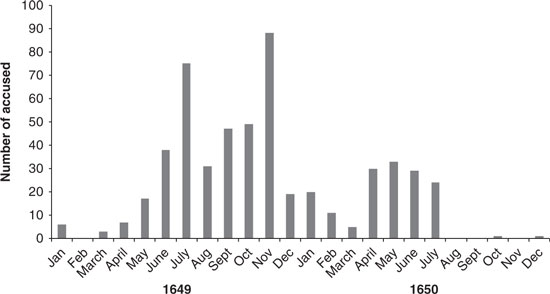
Figure 5.1 Accused witches in Scotland by month, 1649–1650
The first recorded witchcraft accusations in 1649–1650 occurred in January 1649 in the presbyteries of Cupar and Dunfermline in Fife.28 In January 1649, there were six recorded cases: two in Cupar, three in Dunfermline and one in Haddington. Despite these initial cases, the witch-hunt did not gather momentum until May 1649. Accusations then continued throughout December, into January, February and March, with a slight dip in April, culminating in another peak in accusations from May until July. Witch-hunting in 1649–1650 comprised a series of local hunts that spread into one another as accusations crossed parish, town and county borders. Macdonald describes a ‘massive hunt’ in the presbytery of Dunfermline in 1649–1650 and tells of how the presbytery ‘fought … to maintain control of both the process and the incarcerated suspects’, a situation which was to be repeated throughout the areas most affected by witch-hunting in 1649–1650.29
Witch-pricking fuelled the process, as local authorities sought to supplement the usual evidence against witches (confessions and neighbours’ statements) with evidence of the Devil’s mark. Several professional prickers operated during the 1649–1650 witch-hunt.30 The most interesting was George Cathie, from Tranent, who travelled between many parishes in central and eastern areas of the country during the course of the 1649–1650 witch-hunt. He was called upon by the presbytery of Peebles in September 1649 to search Janet Coutts.31 Coutts had attempted to flee after she had been apprehended, and those involved in her interrogation had trouble in bringing her to a confession. After Cathie had found the mark on Coutts, her interrogators reported to the presbytery that she had confessed and named around 80 other witches in Peebles, Lanark, Biggar and Jedburgh. She was transported to Biggar and Jedburgh to be further examined about the individuals that she had named in those areas.
However, on 4 January 1650 the presbytery of Biggar wrote to the presbytery of Peebles informing them about Coutts’s ‘inconstancie in delateing and passing from her delateiouns’ against individuals she had previously named when confronted with them. The brethren at Peebles responded by ‘exhorting’ the commissioners who had been appointed to try Coutts ‘to tak speedie course for execution of justice upon her, as one desperatlie sent to the devil’. Further correspondence between the presbyteries led to scrutiny of Cathie’s role in bringing Coutts to a confession and naming of other witches.32 The brethren at Jedburgh passed this information on to Cathie’s home presbytery of Haddington, and he was called to appear before them on 17 April. He did not appear, and the presbytery sent one of the ministers to Tranent ‘to deall with the civil magistrate’ to ensure his attendance. He eventually appeared before the presbytery on 1 May and denied that he had struck a deal with Coutts that she would name other witches ‘so that he might get his implyment’.33 The presbytery ordained that James Smith, one of the elders at Tranent, was to deal with the bailies of Tranent to bring Cathie to appear before the presbytery of Peebles. There is no further record of Cathie, but it would be a fair assumption that this incident put a stop to his career. Those whom Coutts had falsely accused were exonerated, but she was still sent to the stake.
By the spring of 1650 the committee of estates was concerned with the more pressing matters of negotiating with the exiled Charles II, a royalist rising led by the earl of Montrose and a breakdown in relations with the English government led by Oliver Cromwell. On 12 April 1650, it created a sub-committee to deal with granting commissions to try witches until parliament reconvened and came up with a more permanent solution.34 Parliament then, on 18 May, created another committee to consider witchcraft cases and to devise a more permanent method for dealing with witches.35 Unfortunately no records of either the subcommittee of the committee of estates or the parliamentary committee survive. The loss of these records may mean that there were further witches about whom no evidence survives. Some evidence does survive, however, in local records, of cases that would have gone to the committees. Finally, a new committee of estates was appointed to rule from 5 July until 26 November 1650, granting only two further commissions to try witches.
IV
Witch-hunting was unevenly spread across the country. The following statistical analysis uses the method developed by Lauren Martin to analyse the regional intensity of Scottish witchcraft panics.36 She divided Scotland’s thirty-four counties into ten regional groups and worked out how many witchcraft suspects were recorded for each one in the Witchcraft Survey. This exercise can be carried out for 1649–1650, and the results are shown in Table 5.1. There were 555 suspects whose county of residence was recorded and these counties are arranged in the table by region, with the regions listed in descending order of number of suspects. The locations of these counties are shown on the map on p. xiii above. As will be seen from the table, the largest numbers of suspects were recorded in the regions of Lothian, East Borders and Strathclyde.
Table 5.1 Numbers of suspects by region and county, 1649–1650
|
Lothian |
264 |
|
|
Edinburgh |
79 |
|
|
Haddington |
160 |
|
|
Linlithgow |
25 |
|
|
East Borders |
98 |
|
|
Berwick |
19 |
|
|
Peebles |
44 |
|
|
Roxburgh |
29 |
|
|
Selkirk |
6 |
|
|
Strathclyde |
79 |
|
|
Argyll |
0 |
|
|
Ayr |
38 |
|
|
Bute |
5 |
|
|
Dunbarton |
10 |
|
|
Lanark |
14 |
|
|
Renfrew |
12 |
|
|
Fife |
71 |
|
|
Fife |
71 |
|
|
Kinross |
0 |
|
|
Tayside |
17 |
|
|
Forfar |
16 |
|
|
Perth |
1 |
|
|
Dumfries and Galloway |
16 |
|
|
Dumfries |
9 |
|
|
Kirkcudbright |
0 |
|
|
Wigtown |
7 |
|
|
Grampian |
5 |
|
|
Aberdeen |
4 |
|
|
Banff |
1 |
|
|
Elgin |
0 |
|
|
Kincardine |
0 |
|
|
Central |
3 |
|
|
Clackmannan |
0 |
|
|
Stirling |
3 |
|
|
Highland |
1 |
|
|
Cromarty |
0 |
|
|
Inverness |
0 |
|
|
Nairn |
0 |
|
|
Ross |
1 |
|
|
Sutherland |
0 |
|
|
Far North |
1 |
|
|
Caithness |
0 |
|
|
Orkney |
1 |
|
|
Shetland |
0 |
|
|
TOTAL |
555 |
Source: SSW.
Martin’s method then asks how these crude figures might be translated into accusations per capita of population. A pioneering census was conducted in Scotland in 1755. The population probably increased somewhat between 1650 and 1755, but the regional distribution of the population probably changed little (unlike in the following century when the distribution was affected by industrialisation and emigration). The proportion of suspects in a given region can thus be related to the proportion of the population in that region. The results of such a calculation are shown in Table 5.2. The crucial figures are in the column ‘Suspect: population intensity 1649–1650’: the larger the figure, the more intense the prosecution in that region. A figure of 1.0 in that column would indicate that prosecutions in that region were at an average intensity for 1649–1650. The right-hand column, ‘Suspect: population intensity 1563–1736’, shows Martin’s figures for the Scottish witch-hunt overall. These allow comparisons to be drawn with 1649–1650.
Table 5.2 shows that the area categorised by Martin as Lothian, which included the presbytery of Haddington, produced 48 per cent of the suspects in 1649–1650. This is staggering considering that the area represented only 11 per cent of the overall population at the time. The region which produced the next highest proportion of suspects was the East Borders; this included the presbytery of Peebles, which produced many suspects due to the activities of George Cathie and Janet Coutts.
Table 5.2 Intensity of prosecution by region, 1649–1650
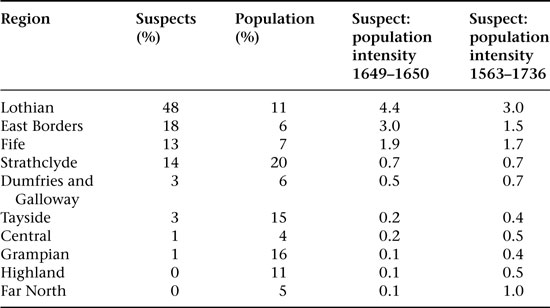
Source: Table 5.1 above, combined with data from Martin, ‘Scottish witchcraft panics re-examined’, 125. Some figures are affected by rounding.
Administratively, these regions were covered by the synod of Lothian and Tweeddale. The synod acted as a regional assembly, covering seven presbyteries: Biggar, Dalkeith, Dunbar, Edinburgh, Haddington, Linlithgow and Peebles. These were close to Edinburgh where local witch-hunters had easy access to the parliament and committee of estates.37 The concentration of cases in Haddington in 1649–1650 is also not surprising given that this area experienced intense witch-hunting in the previous witch-hunts of 1590–1591, 1597 and 1628–1631; the 1660–1661 hunt would also be concentrated there.38 Table 5.2 shows, however, that 1649–1650 was Haddington’s most intense period of witch-hunting overall.
There were also other areas with intense witch-hunting in 1649–1650. The Strathclyde region produced 14 per cent and Fife produced 13 per cent of suspects. For Strathclyde, its large population reduces the per capita intensity to below the average for 1649–1650, but Fife was well above the average per capita intensity. Stuart Macdonald has recently written that the 1649–1650 witch-hunt was concentrated in Fife and the Lothians. Macdonald claims that the cases that occurred outside this area after the main outbreak of witch-hunting occurred in Fife and the Lothians were ‘aftershocks’.39 A clearer conclusion, however, would be that the witch-hunt was concentrated in the Lothians.
V
The 1649–1650 witch-hunt came to an abrupt end due to the souring relations between Cromwell and the Scottish parliament. Negotiations with Charles II and another royalist rising led by Montrose diverted the regime’s attention away from the pursuit of witches. This is evident in the lack of quantitative evidence of commissions being granted. However, it is apparent that witch-hunting was still going on because there are references to commissions being granted. A warrant was issued in March 1650 to send Alexander Colville of Blair, one of the justice deputes, to Galloway to try suspects there.40 As we have seen, two committees were created in April and May to consider evidence against witches and grant commissions for the trial of witches. By June, the regime was concerned with purging the army and preparing for an anticipated invasion by Cromwell’s forces after the latter’s conquest of Ireland.
By July 1650, Cromwell’s forces had crossed the border and passed into the Borders and Lothian regions where witch-hunting had been intense. The presence of enemy troops in these localities provided the ordinary folk with a more tangible and immediately dangerous enemy than witches. Moreover, some presbyteries had to abandon their meetings, removing the most important local administrative unit in combating witchcraft. Up to 17 July the presbytery book for Haddington recorded dealings with suspected witches alongside the organisation of supplies and the arrival of troops ready to defend against Cromwell’s forces. After that date, the presbytery did not meet again until 13 August 1651 ‘in respect of the present troubles and violence of war’. Once normal business was restored, no more witchcraft accusations were recorded.41
Occasional cases still reached the central authorities. The committee of estates granted two further commissions to try witches, on 8 August and 12 November 1650.42 Christine Clerk petitioned the committee of estates in November; she had been imprisoned for witchcraft but had not confessed, nor had any witnesses testified that she was a witch. The committee ordered her to be liberated upon caution.43 When parliament reconvened on 26 November it ordered the committee for bills to consider outstanding requests for commissions to try witches. The last commission to be granted in 1650 was granted by parliament on 2 December for the trial of John McWilliam, Margaret McInlay and Margaret McMurich in Dumbarton.44 This was far from the heartland of the witch-hunt, but it was an area that the Scottish government still controlled.
VI
This chapter has discussed the 1649–1650 witch-hunt from a top-down perspective. The church pressured the central authorities throughout the 1640s for action to be taken on the threat of witchcraft in the country. The 1649–1650 witch-hunt has been described ‘from above’, examining the way in which commissions to try witches were granted and the role of the presbytery as an intermediary in the processing of suspected witches, bridging together the local experience of apprehending and interrogating a witch and co-ordinating requests for trials to the central authorities. The 1649–1650 hunt was not a continuous nationwide hunt; rather it was a series of localised hunts mainly concentrated in the Lothians and Tweeddale, which spread to neighbouring areas.
When the witch-hunt broke out in the spring of 1649 it did not turn into the free-for-all that one might have expected, given the pressure exerted by the church. This was largely due to the orderly response of the central institutions in making sure procedures were followed, issuing timely reminders that ‘mistreatment’ was not to be used in extracting confessions, and hearing petitions from those who claimed mistreatment. Unofficial torture, usually in the form of sleep deprivation, was regularly used in extracting confessions of witchcraft. Pricking was supposed to find the Devil’s mark, but it could also be connected with pressure to confess. In April 1650, the chancellor, the earl of Loudoun, asked that suspects renew their confessions in front of trial commissioners, indicating concern over how confessions were being obtained.45 This letter was sent just as the hunt was escalating in its final peak before it was cut short by the arrival of Cromwell’s forces.
The way the central authorities attempted to deal with the outbreak of witch-hunting in 1649–1650 reflects a more long-term trend of dealing with large-scale witch-hunts and a more deep-rooted concern over existing procedure, which extended further back than 1649. This indicates that the central authorities’ ‘readiness to panic’46 over witchcraft could result in an inability to cope with the demand for witchcraft commissions. The central authorities had to deal with the influx of applications for commissions from the localities and had to manage the demand by trying to find ways to organise their response. This in turn led to temporary measures to deal with the problems, especially in times when more general political or diplomatic crises occurred. I believe that the prosecutions of 1649–1650 can be categorised as a panic rather than a hunt in the initial stages, as the term ‘hunt’ implies proactive seeking of witches. On the surface it looks like a hunt with its co-ordination and discussions taking place at high level, but it was all reactive measures, both by the local and central authorities. The commission of the kirk and general assembly had pushed for a witch-hunt by pressing parliament for legislation, but even these steps were reactions to news that reached them from the localities.
It may be argued that the 1649–1650 witch-hunt was inevitable because of the church’s campaign throughout the 1640s for action to be taken on witchcraft. This chapter has discussed how attempts were made in 1649 to change both the legislation against witchcraft and the procedure for dealing with witches. The witch-hunt can be divided into two phases. The first phase was from May to December 1649, when responding to the outbreak of witchcraft accusations was a pressing concern for the radical regime, as is evident by the stringent record-keeping and intensity of demand for commissions to try witches. The second phase was from January to July 1650 when the breakdown in relations with Cromwell, negotiations with Charles II and Montrose’s rising diverted the regime’s attention away from the pursuit of witches. This is evident in the lack of quantitative evidence of commissions being granted – though these conclusions are rendered tentative by the scarcity of evidence of the activities of the central sub-committees of April and May. By June 1650, the regime was distracted by war. However, this only tells one side of the story. The steps taken to control the number of witches being prosecuted and the strict guidelines given to commissioners named to carry out trials indicate that the central authorities were moving towards taking measures to bring the witch-hunt to a conclusion. If Cromwell’s forces had not crossed the border in 1650 the witch-hunt might have continued in the localities, but it is possible that it would have run out of steam, given that the central authorities were already showing concern that it was getting out of hand.
Notes
1. Joyce Miller, ‘Devices and directions: folk healing aspects of witchcraft practice in seventeenth-century Scotland’, in Julian Goodare (ed.), The Scottish Witch-Hunt in Context (Manchester, 2002), 90–105; Owen Davies, ‘A comparative perspective on Scottish cunning-folk and charmers’, in Julian Goodare, Lauren Martin and Joyce Miller (eds.), Witchcraft and Belief in Early Modern Scotland (Basingstoke, 2008), 185–205.
2. Records of the Kirk of Scotland, Containing the Acts and Proceedings of the General Assemblies, 1638–1649, ed. Alexander Peterkin (Edinburgh, 1843), 354.
3. Records of the Commissioners of the General Assemblies of the Church of Scotland, 3 vols., eds. Alexander F. Mitchell and James Christie (SHS, 1892–1909), i, 44, 64; cf. Miller, ‘Devices and directions’, 91.
4. Julian Goodare, ‘The Scottish witchcraft act’, Church History, 74 (2005), 39–67, at p. 65.
5. APS, vi, II, 152, c. 44 (RPS, 1649/1/62).
6. RPS, 1649/1/118, 119. See also Paula Hughes, ‘The 1649–50 Scottish Witch-Hunt, with Particular Reference to the Synod of Lothian and Tweeddale’ (University of Strathclyde PhD thesis, 2008), 28.
7. For the context of godly discipline and witchcraft in Scotland during the 1640s, see John R. Young, ‘The covenanters and the Scottish parliament, 1639–51: the rule of the godly and the “Second Scottish Reformation”’, in Elizabethanne Boran and Crawford Gribben (eds.), Enforcing Reformation in Ireland and Scotland, 1550–1700 (Aldershot, 2006), 131–58; John R. Young, ‘The Scottish parliament and witch-hunting in Scotland under the covenanters’, Parliaments, Estates and Representation, 26 (2006), 53–65.
8. Stuart Macdonald, The Witches of Fife: Witch-Hunting in a Scottish Shire, 1560–1710 (East Linton, 2002), 169–78.
9. For example, upon hearing of the arrest of Jean Craig in Tranent, the presbytery of Peebles wrote to the interrogating minister Robert Balcanquall on 31 May 1649 to find out whether Craig had named residents of Peebles as fellow witches. NRS, Presbytery of Peebles, 1644–1649, CH2/295/3, p. 114.
10. Macdonald, Witches of Fife, 175–8.
11. For a detailed study of such material, see Anna Cordey, ‘Reputation and witch-hunting in seventeenth-century Dalkeith’, Chapter 6 in this volume.
12. Julian Goodare, ‘Witch-hunting and the Scottish state’, in Goodare (ed.), The Scottish Witch-Hunt in Context, 122–45.
13. NRS, PA11/8, fos. 101, 115, 144; PA11/9, fo. 5.
14. Liv Helene Willumsen, Witches of the North: Scotland and Finnmark (Leiden, 2013), ch. 3.
15. During this period, parliament was in session during the following dates: 4 January 1649 to 16 March 1649, 23 May 1649 to 7 August 1649, 7 March 1650 to 8 March 1650, 15 May 1650 to 5 July 1650. The committee of estates was in session: 14 March 1649 to 23 May 1649, 7 August 1649 to 7 March 1650, 7 March 1650 to 15 May 1650 and 5 July 1650 to 26 November 1650.
16. The modern editors of the privy council records printed several commissions in their edition of privy council papers, but in fact these were mostly commissions that were granted by parliament in June and July 1649. For instance, the confessions of Isobel Brown and Helen Taylor, both from Eyemouth and who were accused alongside Elspeth Smith, are dated 2 July and 8 July 1649 respectively, but a note was added to Brown’s confession dated 5 July saying that the estates ‘grant commission’ to try her: RPC, 2nd ser., viii, 195.
17. NRS, PA11/9, fos. 3r.-6r.
18. Ibid., fo. 3r.
19. See NRS, PA11/8, fos. 135, 185; PA12/4, September warrants; and PA7/6, paper 148. It is possible that Durie and Masterton were included in the commission granted by parliament on 31 July 1649 for the apprehension of some of the wives of some of the magistrates and others in Inverkeithing. See APS, vi, II, 510 (RPS, 1649/5/309). For more on this case, see Louise Yeoman, ‘Hunting the rich witch in Scotland: high-status witchcraft suspects and their persecutors, 1590–1650’, in Goodare (ed.), The Scottish Witch-Hunt in Context, 106–21, at pp. 118–19.
20. RPC, 2nd ser., viii, 211–35.
21. Ibid., 198–204. For the intersection of witchcraft and lesbianism in this case, see Julian Goodare, ‘Maud Galt (fl. 1648–1649)’, in Elizabeth Ewan et al. (eds.), The Biographical Dictionary of Scottish Women (Edinburgh, 2006), 131.
22. Lauren Martin and Joyce Miller, ‘Some findings from the Survey of Scottish Witchcraft’, in Goodare, Martin and Miller (eds.), Witchcraft and Belief, 51–70, at pp. 55–8.
23. APS, vi, II, 463 (RPS, 1649/5/198).
24. SSW, case reference C/JO/2860. These 48 were counted, because the numbers were known. The Survey of Scottish Witchcraft estimated that Coutts named about 88 people altogether in early 1650; the remainder were allowed for elsewhere in the Survey’s figures.
25. Hughes, ‘The 1649–50 Scottish Witch-Hunt’, 189–90.
26. Brian P. Levack, ‘Witch-hunting in revolutionary Britain’, in his Witch-Hunting in Scotland: Law, Politics and Religion (London, 2008), 55–80, at p. 74.
27. Lauren Martin, ‘Scottish witchcraft panics re-examined’, in Goodare, Martin and Miller (eds.), Witchcraft and Belief, 119–43, at p. 123.
28. SSW.
29. Macdonald, Witches of Fife, 108, 113.
30. See in general W. N. Neill, ‘The professional pricker and his test for witchcraft’, SHR, 19 (1922), 205–13.
31. NRS, CH2/295/3, p. 121a.
32. Ibid., pp. 114–15.
33. NRS, CH2/185/6, pp. 114–15.
34. NRS, PA12/5.
35. APS, vi, II, 564–6 (RPS, M1650/5/6).
36. Martin, ‘Scottish witchcraft panics re-examined’, 123–5.
37. Larner cited this as a reason why the witch-hunt as a whole was concentrated in this area: Christina Larner, Enemies of God: The Witch-Hunt in Scotland (London, 1981), 80.
38. Martin, ‘Scottish witchcraft panics re-examined’, 124–5.
39. Macdonald, Witches of Fife, 25; cf. Larner, Enemies of God, 80–8.
40. NRS, PA12/5, March minutes.
41. NRS, CH2/185/6, p. 124.
42. NRS, PA12/5, November warrants.
43. Ibid.
44. APS, vi, II, 614 (RPS, M1650/11/18).
45. Goodare, ‘Witch-hunting and the Scottish state’, 122.
46. Ibid., 136.