
6
Anna Cordey
The witch’s reputation in the community is a well-established theme, but still capable of further development with the aid of detailed studies. Many studies of ‘reputation’ have focused on the question of how people came to be suspected of witchcraft by their neighbours – a vital question, but nevertheless one that tends to focus on certain types of witches. Such witches certainly existed in Scotland. It is not always clear how a decision was taken to prosecute a neighbourhood witch, but records of Scottish prosecutions often show neighbours contributing to the process, testifying to quarrels, curses, bewitchments, enmities and reconciliations – sometimes going back for several decades. It is easy to see these witches’ reputations as the mainspring that drove their prosecution. However, in Scotland as in many other places, a reputation for witchcraft among neighbours was not the only driving force for prosecutions; people could also be named by another confessing witch. It has not always been clear whether such people had reputations or not.
This chapter conducts an in-depth examination of the nature and functions of reputations for witchcraft in Scotland. It is based on a case-study of the presbytery of Dalkeith, a group of sixteen parishes near Edinburgh, in the period 1649–1662 when there were two significant witchcraft panics (1649–1650 and 1661–1662). As will be seen, the study embraces witches who had reputations among their neighbours and witches who did not. It makes suggestions on how to prove that a given witch did not have a prior reputation. It also argues that a few of the ‘reputations’ that appear to emerge from the records can be seen, on closer inspection, to be illusory.
I
Witches usually acquired reputations by being seen to cause misfortunes. Misfortunes, however, were not randomly attributed to the nearest witch, merely because they were inexplicable to the people of the seventeenth century. Robin Briggs has shown that peasants did not believe witches to be randomly cruel: they chose their targets.1 Alan Macfarlane was the first to show in detail that the association of a misfortune with witchcraft would tend to follow a quarrel where the suspected witch had been treated badly. The person who had abused the witch, violating the duties of good neighbourhood, would feel a sense of guilt. This guilt, combined with fear if the woman (and it was usually a woman) already had a reputation for witchcraft and had cursed them, could lead to the desire to blame them for any misfortunes. The feeling of guilt was transferred and the victim–bully roles reversed.2 David Sabean saw this model at work in Germany and wrote about it in terms of power relations, with the weak being feared by the strong.3
Women’s tongues often got them into trouble. Curses and threats uttered in the heat of anger at an injustice could backfire if the person they were aimed at suffered in some way afterwards. There is rarely a sense in the trial records of which cases caused a reputation to begin, which cases were remembered differently once a reputation had grown and which cases added to this reputation. Clive Holmes has commented that many charges presented in court in England were for crimes which had supposedly taken place many years before, but had not been reported at the time.4 The most we can expect from trial records is an idea of the general circumstances surrounding the growth of reputation. However, parish records can sometimes give us an idea of how a suspected witch had behaved in the years leading up to an official accusation.
Where future witches appeared in kirk session records before their official accusation, it was almost always in cases involving words. They were either being punished for scolding or cursing, or they were pursuing a slander case against another member of the community. The fact that witches were often women with short tempers and sharp tongues has been noted in many studies. Christina Larner wrote that having a ‘ready, sharp and angry tongue’ was a major characteristic of the witch: ‘No cursing: no malefice: no witch.’5 John Harrison’s work on the use of branks as a punishment for scolding women is also useful. He shows that the social profile of the ‘scold’ in Stirling was similar to the profile of the Scottish witch. She was an established member of the community, yet was generally poor and she scolded others of around the same social status. Harrison comments that the branks were used most often at the times of greatest concern with witchcraft in Scotland. These women, he concludes, could have become witches, but were not suspected of witchcraft because their curses and threats did not appear to come true.6
Several women in Dalkeith were charged with serious cursing during this period, but were never accused of witchcraft. Marion Leach, in Newbattle, was charged with ‘bid[d]ing the devill rugg [i.e. tear] the heart out of Elspeth Sympsoun’. Marion Wilson, in Dalkeith, got into trouble for saying that she would give herself to the Devil to have amends of Alexander Calderwood and Alexander Dickson.7 These women were all felt deserving of punishment and correction, but despite their entreaties to the Devil, they were not suspected of witchcraft. Their threats were not believed to have taken effect.
The family feud between Isobel Ferguson and her son, which ended with his death in 1661, began similarly, but then took a more sinister turn. Ferguson first got into trouble with the session in September 1658. She was charged with swearing, ‘saying to her daughter in law god put her sonne and her together but shoe should mak the devill separat them’. The shocked session warned her that they would ‘see what her cariag sall be hearafter’.8 This was recalled in 1661, when it was further alleged that she had threatened her son. He had gone on a trip, ‘and hee not taken leave of his mother’. Ferguson went to his house and told her daughter-in-law that, because of his slight, there would be no joy in his homecoming – ‘and [it] was well known that fell so out, for he came home that night exceeding sick and continued grievouslie tormented till he died’.9 Ferguson’s first appearance in front of the kirk session aroused attention, but was not followed by a misfortune. The second threat seemed to predict the death of her son, which did occur; this pointed to witchcraft.
Curses by suspected witches could take a variety of forms. There were specific predictions that precise things would happen, such as death or paralysis or loss of wealth. Often, threats were generalised, such as a promise that a person would regret saying or doing something that had hurt the witch. Isobel Ferguson’s threat against her son was like this. In some cases, the witch would shout, perhaps clapping her hands. In others, she would walk away muttering.
Yet there are several cases which cannot be explained by the reversal of guilt. Occasionally there is no record of a quarrel, but an indication that victims believed the witch to be acting out of malice or jealousy. Ferguson’s neighbours commented that they had been poorer since they had lived next to her. She said that they would get even poorer before they grew richer and, over the next two years, five of their horses died. In another example, Margaret Erskine commented on Bessie Bell’s good health. Bell immediately began to experience chest pains, her body swelled up and she collapsed.10
II
Cursing was not the only suspicious activity by which a person could acquire a reputation for witchcraft. Attempting to flee when accused, or even beforehand, as in the cases of Christian Wilson and Janet Watson, were signs of a guilty conscience.11 Several other causes for suspicion can be mentioned more briefly, such as a victim dreaming of the witch, seeing her at a sickbed or deathbed, or as they died, calling on surviving relatives to bring to justice the witch responsible. Jean Forrest fell out with Janet Cock, and Jean’s child died that night. Forrest cried, ‘Alace that ever I had to doe with that witch Janet Cock, for she has bein at my bed syd all this night standing and I could not be rid of her and behold the [illegible] of it my child is dead.’12 William Richardson, who killed Christian Wilson’s hen, saw Wilson by his bedside ‘in the likenes of ane Gray Catt’.13 These nocturnal visions look like cases of sleep paralysis.14 James Douglas was so certain that Janet Cock was the cause of his death that he was even reported to have said, ‘Lord forgive my friends if they doe not garre [i.e. cause] burne her, for under god said he schoe is the cause of my death and I leave it upone her.’15 The importance of the spoken word in early modern society gave these words real potency.16
Other kinds of reputation-creating behaviour could occur after the death of a possible victim. Christian Wilson was suspected for causing the death of her brother because she had frequently argued with him, showed no grief at his death and refused to visit the body. When she was eventually forced to do so by the bailie and minister, she went reluctantly and reportedly shook all the way. She was compelled to touch the body in a ritual known as bierricht. When she did so, blood rushed out of his wounds, though there had been no ‘apeirance of a spot of blood either upone his bodie or nigh to it’ before.17
Similar to suspicion aroused by a lack of grief was a refusal to be reconciled with a neighbour after a quarrel. Reconciliation rituals were important. Janet Cock refused an offer ‘to make agriement’ as follows: ‘Malitiouslie and bitterlie giurning and gnashing your teith, and beating your hands upon your knees said O! them that called me a witch.’18 If Cock had agreed to a reconciliation, this would have formed part of a pattern that often led to the victim of witchcraft being cured of their illness. When a woman agreed to cure somebody believed to be bewitched, it was often assumed that she was either taking responsibility for the bewitchment or she was confirming that she had the power to remove such maladies. This could assist the growth of a reputation in the long term, even though it defused the immediate quarrel.
III
This leads on to the issue of ‘charmers’ in the sense of people who offered their services as healers and diviners. Charmers were distinct from witches; they were self-professed, whereas witches were labelled by others. For most people, the local healer or charmer offered the only medical attention they could ever hope to receive. Nevertheless, a charmer could sometimes acquire a reputation for witchcraft. Space precludes a full discussion of this topic, which has been covered by others from other angles.19 Here it seems more appropriate to focus on one particular type of healer: the midwife.
David Harley has stressed that midwives were vital members of the community and would normally have been respected, rather than feared as witches.20 Harley’s arguments have effectively undermined the idea that charmers and midwives were systematically targeted during witch-hunts. Yet, it is possible to move too far towards the other extreme. In Dalkeith, it is clear that the authorities saw charming as suspicious: scratch the surface and it was likely that something more damning was going on. And charming and midwifery seem to have been linked.
This can be illustrated from the cases of two witches. In the first, Agnes Johnstone was accused of two counts of charming. When Agnes Alexander was having trouble giving birth, Johnstone put salt in her mouth and said, ‘Our Ladie said, and sooth she said, that after birth salt never hade’. Johnstone was also accused of curing Thomas Thompson’s bad eye with a stone.21 Questioned, both of Johnstone’s clients refused to take any responsibility. Alexander claimed that she was in so much pain that she did not know what she was doing. Thompson said that he did not know whether it was the stone that had healed his eye, but that he would have nothing to do with Johnstone ever again. The session eventually passed on her details to the ‘civill magistrate’ who they hoped ‘wold lay hands on hir for witchcraft’.22 The attitude of Johnstone’s clients hardly points to a loyal regard for their local midwife and healer. In the second case, Beatrix Leslie was also suspected of using charming in the birthing chamber. William Young and Agnes Acheson were terrified of her after their friendship with her broke down; both had nightmares that she was devouring them. The fact that Leslie had been Acheson’s midwife did not make them trust and respect her once the relationship had failed; rather, it caused further unease because they were aware of her abilities.23 Again, sleep paralysis seems to have been involved.
The last major factor which could lead to the creation of a reputation was being known to be associated with an existing witch. There are several cases, particularly in the kirk session records, which demonstrate how dangerous it was to be a witch’s friend or relative. Larner saw the accusation of ‘witch’s get’ as a common first stage in the labelling process.24 However, there were only two instances in Dalkeith where association with known witches led to a formal accusation by a neighbour. The first was that of Margaret Walker and her daughter Janet Currie.25 The other was that of Agnes Hill, accused because of her friendship with the witch Agnes Lawson; she visited Lawson in prison.26 The inhabitants of Dalkeith presbytery probably did believe in this kind of guilt by association, but they had few opportunities to articulate it. Usually, kirk sessions treated such accusations as slanders. In both Newton and Inveresk, sessions issued warnings to their parishioners that people labelled ‘witch’s get’ would be protected by the church and that those doing the labelling would be harshly dealt with.27
IV
Women who were called witches by their neighbours, even in a fit of passion, were frequently not content to let the matter lie. To allow such a slur to pass would be to acquiesce in the name of witch. In London, Laura Gowing has found that an individual would be assumed guilty until they had publicly proven their integrity. A case of slander was not a private affair. A woman who had been accused of being a whore or a witch wanted her accuser to be rebuked publicly, so that the whole community could take note and gossip accordingly. To bring a slander case was to change the dynamics of the quarrel.28
There were several different types of slander case in Dalkeith. The first was the isolated incident, when, during a quarrel or when drunk, one member of the community called another a witch. When that person complained to the session, these incidents usually ended with the guilty person apologising. One such case occurred in Newton in 1661, when Margaret Adams complained that John Wilson had called her a witch and had also uttered ‘abominable oaths’. When he appeared before the session, he expressed his sorrow, explaining that he was drunk at the time.29 Such isolated cases, where the complainer never appeared in the records again and where the slanderer meekly faced the music, ended perfectly for those whose good names had been restored.
The second type of slander case was where the litigant appeared several times. It seems that when a person was often called a witch and complained to the session, mud was eventually bound to stick. This was probably what happened to Janet Cock. She complained in 1645, 1655 and 1659 that neighbours had called her a witch, and the session found in her favour each time, but she was still ultimately tried for witchcraft in 1661. There seems to have been a shift in the session’s attitude. In 1655, they dealt harshly with Walter Lithgow, who was made to acknowledge ‘that he had scandalized Jonet Cocks good name’ and gave ‘signes of his sorrow for the same’. By 1659, however, Helen Wilson confessed that she had called Cock a witch, but there is no record of any ‘good name’ or any particular outrage at what she had done.30 It is possible that Cock’s reputation had grown by this stage and that the session were becoming uneasy.
Bringing a case to the kirk session was to announce publicly that you had been called a witch, and this could attract unwelcome attention. Geillis Chartes pursued a slander case against John Lawrie, but unfortunately for her, Isobel Ferguson was questioned before the same meeting for witchcraft. Ferguson named Chartes as a co-conspirator, probably because her name was fresh in her mind in association with the word ‘witch’. Chartes was arrested, pricked for the mark and imprisoned, the clerk noting perhaps redundantly that she had lost her case against Lawrie.31 Meg Shanks chastised her daughter, Margaret Erskine, for going to the session as she was just drawing attention to herself.32 There was a fine line between upholding a good reputation and undermining an already shaky one.
None of the witnesses in Erskine’s case actually acknowledged that they had called her or thought her a witch. They were, however, willing to cast suspicion upon her in a roundabout way by relating strange tales about sinister events which had occurred around her. This is the third type of slander case, where witnesses essentially said, ‘no, but’ to the session when asked if they had called a person a witch. Both Bessie Bell and Isobel Watt related tales of sudden illnesses which passed only when Erskine touched them. Aware that her case was going badly, Erskine attempted to deflect suspicion of witchcraft onto another woman, Elspeth Scott, who, Erskine said, had made her ill for two weeks.33 Another example took place in Penicuik in 1661. Three women, Christian Purdie, Agnes Elphinstone and Marion Tweedie complained to the kirk session that John Louvine had been calling them witches. He denied the charge, but he did recount a suspicious story, telling of how he had arrived home late one night on his horse. He claimed to have gone to investigate a fire in a field and to have seen the women dancing around the fire, waving handkerchiefs. He added that he was ill that night and that his horse died two days later.34 Why were these people casting suspicion without being prepared to go the whole way and accuse a suspected witch in front of the session?
V
It seems clear that in these cases, the witnesses did believe that the women were guilty. There are several possible reasons why they refused to voice their suspicions. Robin Briggs found that peasants might not be willing to go to the authorities because they mistrusted central courts and felt cheated if a witch was found innocent.35 This is possible, but no Dalkeith evidence supports it directly. David Sabean suggests that in some cases, peasants would not call someone a witch before the authorities because the witch was too powerful within the community. Only when she had lost some power or position would others be prepared to attack.36 This could be applied to Janet Cock, who appears to have had some standing in Dalkeith as a healer and petty trader. She was called a witch informally by neighbours at least seven times over the years. Yet until 1661, there was no official investigation of her. What, if this was the case, could have caused the sudden shift in power relations? A possible explanation is the involvement of a central figure of authority who altered the dynamics of power at work in the community.
A reluctance to accuse a neighbour at the kirk session may seem like a denial of the legitimacy of the court. Were the peasants making the point that they did not want these people burnt at the stake – that it was just going too far? Stuart Macdonald notes that people in Fife were willing to testify in a trial, but would not initiate proceedings.37 This seems to have been the attitude in Dalkeith too. Where there were specific accusations for witchcraft or charming to a kirk session, they almost always came from session elders rather than ordinary villagers, even though there was no shortage of witnesses once a trial got under way. It is possible that a shift in the balance of power was caused by the involvement of the elder.
It seems that peasants had their own ways of dealing with witches and that they generally felt no real need for official punishment. Robin Briggs suggests that some people were reluctant to admit their suspicions because they still hoped for reconciliation within the community.38 The methods used to manage neighbourhood witches in Dalkeith tend to match those used across Scotland and elsewhere.39 There are examples of attempting to avoid her, appeasing her with gifts of food, confronting her aggressively and demanding that she or another witch remove an illness. Added to this was the insidious power of gossip and rumour to undermine the position of a suspected witch. As Briggs writes, witches were a part of everyday life in the early modern period: they were just another hazard which people had to deal with. Trial records show only a small part of this.40 After all, peasants did not believe in witches only during the panics – they lived with them day in, day out. There were probably witches in many parishes who never came to trial at all, but lived out their lives with a reputation. The local people would realise the danger and deal with it in their own way.
In general, the people of Dalkeith needed to be galvanised into action, and there were plenty of men in positions of power who were willing to take on this role. The active witch-hunters of Dalkeith are beyond the scope of this chapter, but it is clear that the region cannot fit Briggs’s model in which, once a panic was under way, almost all cases were initiated by the peasantry.41 Both Christina Larner and Julian Goodare have opted for a more complex interpretation, essentially focusing on the co-operation between central and local elites and emphasising the involvement of all levels of society.42 While central authorities provided the system with which to prosecute witches, local authorities initiated proceedings, and the peasantry provided evidence and the base belief in witches which fuelled the whole process. However, without pressure from their social superiors, the peasantry would not take their grievances about witches to the kirk session. In general, as in Margaret Erskine’s case, they would even be slow to admit suspecting witchcraft in a neighbour.
VI
This suggests that the importance of reputation may have been overemphasised. Returning to the question of the evidence on which ‘reputation’ is based, further reasons may be suggested to question its importance. Those suspects who had long-term reputations attract more attention because they generated the most paperwork. It is clear, however, that many witches in Dalkeith had no prior reputation, but were swept up in the panics of the time, their convictions based on confessions of demonic pacts. Moreover, the concept of ‘reputation’ itself is not a simple one; it requires careful scrutiny.
There are three main types of evidence for the existence of a reputation. Firstly, and best known, there are witness statements, in pre-trial or trial records, where neighbours testify to past events. Secondly, there are previous slander cases. These are particularly useful in not being coloured by hindsight, but need to be treated carefully as evidence for community attitudes. If the record shows a kirk session decreeing that someone should not have been called a witch, this evidence does not usually tell us whether the wider community agreed or not, though indications can be gleaned from repeated slander cases. Thirdly, witches’ confessions frequently recorded how long ago she or he had made the demonic pact. A suspect who was known to have a reputation would probably have been encouraged by an interrogator to name a date which took this reputation into account. By contrast, if a suspect had no known reputation, this would imply that the pact was likely to have been recent and a date a few months earlier would be given. Janet Cock, Isobel Ferguson, Christian Wilson, Beatrix Leslie and Janet Peaston, who can all be seen to have had reputations, admitted to pacts lasting twenty-four, forty, thirty, seven and four years, respectively.43 Such women tended to be accused and investigated first in a hunt. It was then that chain accusation began to become an issue.
Confessing witches often named others who already had reputations, but not always. Figure 6.1 shows a chain of accusations in diagram form. The accusations begin with Isobel Ferguson; she names three others, two who seem to have had reputations – Geillis Chartes and Beatrix Leslie – and one who probably did not – Christian Paterson. Paterson confessed only to having been the Devil’s servant for a few months.44 However, in her confession she did name other witches, including Chartes and indeed Ferguson; such mutual accusations seem to have been thought to add weight to the case against all those involved. Reputation and ‘ill fame’ were helpful in securing a conviction at trial, but it was not vital. This was, after all, a secret crime and lack of reputation was no proof of innocence. The confession, on the other hand, was extremely important in the trial process. Brian Levack has found that a trial commission was almost impossible to gain if the suspected witch had not confessed beforehand.45 Where there was no reputation, the confession was even more significant.
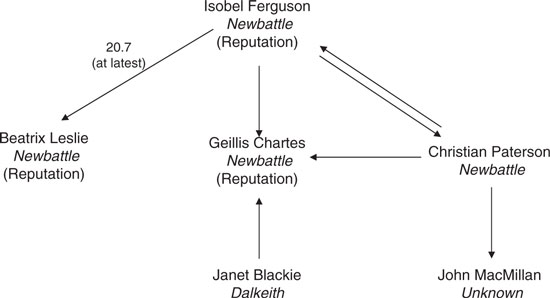
Figure 6.1 Chain of accusations, Newbattle, 1661
Of the twenty-four people for whom investigation and confession documents exist from 1661, only four appear not to have been taken to trial. Eight certainly had reputations, three may have done and thirteen almost certainly did not. Only one of these thirteen, William King, never confessed – and he was never tried. Two others withdrew their confessions, Agnes Thomson stating that she had been lying and Margaret Stevenson claiming to have been tortured; they too were not tried.46 This leaves nine people who seem to have had no reputations who still confessed and were tried. Many of them had been named by other confessing witches, and they in turn named several others.
A different story is told by a more wide-ranging chain, shown in Figure 6.2. Accusations frequently cross parish boundaries; here there are witches from two adjacent parishes, Newton and Inveresk. Moreover, the web is not self-contained. Janet Dail, David Johnstone, William King, Agnes Johnstone, Janet Lyle and Elspeth Haliburton are its main constituents, but the panic spreads more widely when Margaret Ramage begins to name further witches.
This web is also interesting as it spreads widely over time as well as space, giving insight into how social memory worked. In her confession in 1661 Janet Dail mentioned that she had been in a house with Margaret Barbour and Agnes Anderson when she made the pact. These two women had been tried by commission in 1649.47 Dail may have made this claim either because it made her story appear more realistic or because she had a reputation based on her association with these two known witches.48 Margaret Bannatyne (not a member of this group) illustrates another aspect of social memory. She was from Crichton and was mentioned as Agnes Williamson’s accomplice in 1662. Williamson was from Haddington, and there is no record of any proceedings against Bannatyne during the 1661–1662 hunt. However, she appeared again in 1678 as an accomplice to various witches from Crichton and Haddington, and was made to confront several of them.49 This shows how easy it was for reputations to be created and to stick, even for seventeen years.
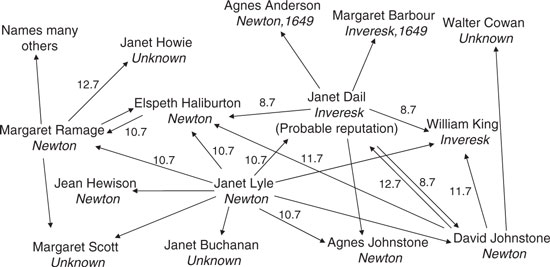
Figure 6.2 Chain of accusations, Newton and Inveresk, 1661
Several conclusions suggest themselves in the light of these examples of chain accusation. The first is that merely to be accused by a confessing witch was extremely dangerous. The witch at the start of a chain or web frequently had a reputation. Being named could lead to arrest, interrogation, confrontation, pricking and confession. The practice of making witches confront each other was certainly important here. This took place on many occasions in Dalkeith. The action of making the accused face the confessing witch and being challenged forcefully in front of witnesses must have been dramatic and compelling. The confrontation would often be followed by pricking, and these two events together would be enough to convince witnesses of her guilt. Even if the case was dropped later, the local population would always think of her as a witch. Sir George Mackenzie highlighted the dread that seized one accused woman, who said that she would rather die than go back into society now that she had been imprisoned for witchcraft. She told him that
she had not confest because she was guilty, but being a poor creature, who wrought for her meat and being defam’d for a Witch she knew she would starve, for no person thereafter would either give her meat or lodging, and that all men would beat her, and hound Dogs at her, and that therefore she desired to be out of the World.50
Mackenzie was active in the Dalkeith and Musselburgh areas in 1661 and the manuscripts show that he interviewed several accused witches in the Musselburgh tolbooth. The woman whom he described was probably Janet Dail. She mentioned that she was terrified, though not of the justices. She said that she had refused to confess at first, ‘for fear of shame of the world’.51
The second point about chain accusation was that, as several people were all naming each other, this gave added weight to the case against each of them. Janet Watson named three other people. After pricking, they in turn named her.52 This would seem to be a far more compelling case in court or in a request for a commission. Thirdly, accusation chains undoubtedly added to fears of the witchcraft conspiracy. Julian Goodare has also come to this conclusion, seeing the naming of accomplices as promoting the belief that there was an underground movement of witches.53 Lastly, the phenomenon meant that the role of the peasant was practically removed from the equation. They were not involved in interrogation and the demand for more names from accused witches. The responsibility for this must lie with the local elites – the men who were also primarily responsible for producing suspects.
VII
Much has been said about witches with long reputations. Robin Briggs has written: ‘Alleged lengths of reputation are more accurate than not, although it is hard to see how this could be proven.’54 It would certainly be desirable to find a way of evaluating the long reputations which appear, retrospectively, in the trial records. The Dalkeith evidence cannot answer this question conclusively, but some questions can be posed and answers suggested.
After a person with no reputation had been named by a witch, been interrogated and had confessed, was it possible that an ‘instant reputation’ could build up around her with the aid of hindsight? Could ‘ill fame’ be created at will? This question is extremely difficult and, in relation to Dalkeith, impossible to answer definitively. However, some clues are suggestive. One is the way in which the words ‘ill fame’ or ‘notorious witch’ were used. These words would seem to indicate a long-standing reputation, but in fact they could be used to describe individuals who had simply been named by one or more confessing witches and had then confessed themselves. This process made them into ‘notorious witches’ overnight. Bessie Moffat, who confessed that she had made the pact only a couple of months before, was mentioned in a list of ‘notorious witches’ in Elspeth Graham’s indictment. William King was listed as one of a number of ‘notorious witches’ in the Musselburgh meeting of the justiciary court on 28 July 1661, even though he had refused to confess and was never actually tried. It is likely that once this had happened, the community would then begin to remember misfortunes and interpret them with hindsight into instances of bewitchment. The accused witch could then be fed more directly into the flow-chart of reputation and accusation. Janet Dail’s fearful attitude certainly suggests that people would now consider her a confirmed witch.
Another way in which ‘instant reputation’ may have occurred was through the intervention of local figures of authority. Mary and Janet Colden, Janet Cock’s daughters, wrote to the justice general and his deputes, begging for justice for their mother, who they claimed was being framed for witchcraft by William Scott, the bailie of Dalkeith. He was single-handedly turning everybody against their mother and dragging up old arguments; people were complying because they were frightened of him. He had apparently taken all her money and property, and was going round town to all Cock’s former friends and getting them to tell stories about her. They said that the whole town was ‘afraide of him because he is heids man in the town’. Furthermore, they suggested that his determination was down to a personal grudge as he blamed Cock for the death of one of his children, although Mary and Janet pointed out that five of his other children had died too.55
If there is any truth in this letter, and we must allow for exaggeration, the implications are extremely interesting. There can be no doubt that Janet Cock had a long-standing reputation. However, if Scott was visiting people with whom Cock had solved her differences and getting them to testify against her by remembering quarrels and misfortunes in new ways, it is possible that this aggravated her reputation as it ultimately appeared. There are in fact some inconsistencies between the indictments and witness statements, suggesting that whoever provided information for the indictment – in which Scott had a role – had seriously exaggerated some of the evidence. In court, witnesses were unwilling to testify to these embellished accounts. The dittay (indictment) for Cock’s second trial said that James Ritchie was ill for six months after a dispute with her. In court, he said that he did not become ill at all, he only lost some money. Robert Hardie said that William Hardie, who it was claimed had become ill straight away and then died, had only become ill two to three weeks after the dispute and had lived for six years afterwards.56
Janet Cock’s case is unusual in that there is so much paperwork surviving and that the prosecutors had so much personal enmity towards her. How often this sort of behaviour occurred cannot be estimated. However, the fact that it happened at all means that it may have done so again. To be a woman with a reputation was undoubtedly dangerous, but it is also clear that many of those formally accused did not have a reputation and that a damning case could be built around almost anybody.
VIII
This study has allowed a detailed view of the conflicts and exchanges which occurred in day-to-day village life. The development of reputation was a complex business, of which the documents can show us only a small part. However, a local study has meant that individual people have been examined, along with their relationships and activities in order to gain a fuller picture. Here, general ideas about witch-hunting may be put to the test. The situation in Dalkeith has particularly high-lighted the fact that the peasantry were specific in whom they believed to be a witch. Witches were rarely, if ever, randomly cruel, and misfortunes tended to follow quarrels, where a specific curse or threat had been uttered.
Dalkeith people did not fear witches because they were allied with the Devil, but because they were able to cause misery and distress. The witch of Dalkeith, although powerful and able to cause disease, death and the disruption of household activities, did not have the huge and devastating ability of some other Scottish and European witches. If she damaged crops, it was only a small area or amount, rather than the food for an entire settlement. Dalkeith witches did not control the weather, as many European witches were believed to do. Other forms of witchcraft, such as the evil eye and demonic possession, occurred rarely, if ever.
Neighbours certainly recognised particular individuals as witches and engaged in familiar strategies of conciliation and avoidance. They rarely initiated prosecutions, however, preferring to leave this to the church elders. They were often willing to testify against known witches once prosecutions had begun, but in some cases they can be seen attempting to avoid doing this. Moreover, it can be argued that the witches with reputations were only a minority of those accused. Most witches were caught up in chain-reaction hunts in which a confessing witch named accomplices. In these, accusations by other witchcraft suspects did not usually rest on a prior reputation among the community. Some ‘reputations’ appear to have been created by the process of accusation, since some of those accused escaped prosecution during one panic, only to be arrested again during another, without any indication of neighbours’ testimony against them. And when neighbours were invited to reinterpret earlier events, as in Janet Cock’s case, we can see how an ‘instant reputation’ could be created.
There was, therefore, a link between reputation and witch-hunting – but only an indirect one. Witches were often assumed to possess ‘ill fame’. Some people who had existing reputations for witchcraft were prosecuted for it. Quite possibly, however, some people with reputations for witchcraft escaped prosecution; this is inherently hard to prove, and the Dalkeith records are no more than suggestive. What the records do show more clearly is that during the panics, when chain-reaction hunts occurred, numerous people without reputations were dragged in, being named by another confessing witch. It was this, rather than existing reputations, that drove the panics.
Notes
1. Robin Briggs, Communities of Belief: Cultural and Social Tension in Early Modern France (Oxford, 1989), 74.
2. Alan Macfarlane, Witchcraft in Tudor and Stuart England (London, 1970), 196.
3. David W. Sabean, Power in the Blood: Popular Culture and Village Discourse in Early Modern Germany (Cambridge, 1984), 148, 153. Cf. Briggs, Communities of Belief, 108.
4. Clive Holmes, ‘Women: witnesses and witches’, Past and Present, 140 (August 1993), 45–78, at p. 55. Briggs has also identified difficulties with evidence given in retrospect: Robin Briggs, Witches and Neighbours: The Social and Cultural Context of European Witchcraft (2nd edn., Oxford, 2002), 17.
5. Christina Larner, Enemies of God: The Witch-Hunt in Scotland (London, 1981), 97. Cf. D. E. Underdown, ‘The taming of the scold: the enforcement of patriarchal authority in early modern England’, in Anthony Fletcher and John Stevenson (eds.), Order and Disorder in Early Modern England (Cambridge, 1985), 116–36, at p. 120; Macfarlane, Witchcraft, 158–9; Briggs, Witches and Neighbours, 23.
6. John G. Harrison, ‘Women and the branks in Stirling, c.1600 to c.1730’, Scottish Economic and Social History, 18 (1998), 114–31.
7. NRS, Newbattle kirk session minutes, CH2/276/4, 27 November to 29 December 1661; Dalkeith kirk session minutes, CH2/84/3, 16 July to 13 August 1661.
8. NRS, Newbattle kirk session minutes, CH2/276/4, 26 September 1658, 10 October 1658.
9. NRS, Newbattle kirk session minutes, CH2/276/4, 3 July 1661.
10. NRS, HCP, JC26/27/9, item 18; Newbattle kirk session minutes, CH/276/4, 1 November 1654.
11. NRS, HCP, JC26/27/9, items 2, 5.
12. NRS, books of adjournal, JC2/11, fos. 46v., 43r.
13. NRS, HCP, JC26/27/9, item 2.
14. See Margaret Dudley and Julian Goodare, ‘Outside in or inside out: sleep paralysis and Scottish witchcraft’, Chapter 7 in this volume.
15. NRS, HCP, JC26/27/3, item 12.
16. Cf. Larner, Enemies of God, 143.
17. Another incident occurred with Beatrix Leslie. Two girls who had angered her were killed by a falling roof in a coal pit. Neither body bled until Beatrix was brought to their bodies. See NRS, HCP, JC26/27/9, items 2, 7, 19.
18. NRS, books of adjournal, JC2/11, fo. 43r.
19. Joyce Miller, ‘Devices and directions: folk healing aspects of witchcraft practice in seventeenth-century Scotland’, in Julian Goodare (ed.), The Scottish Witch-Hunt in Context (Manchester, 2002), 90–105; Owen Davies, ‘A comparative perspective on Scottish cunning-folk and charmers’, in Julian Goodare, Lauren Martin and Joyce Miller (eds.), Witchcraft and Belief in Early Modern Scotland (Basingstoke, 2008), 185–205.
20. David Harley, ‘Historians as demonologists: the myth of the midwife-witch’, Social History of Medicine, 3 (1990), 1–26.
21. NRS, Newton kirk session minutes, CH2/283/2, 11–18 August 1661. For magical use of stones, see Joyce Miller, Myth and Magic: Scotland’s Ancient Beliefs and Sacred Places (Musselburgh, 2000), 109.
22. NRS, Newton kirk session minutes, CH2/283/2, 15 September 1661.
23. NRS, HCP, JC26/27/9, item 19.
24. Larner, Enemies of God, 99.
25. RPC, 3rd ser., i, 74. Little more is known of them as their trial was by commission.
26. NRS, Dalkeith kirk session minutes, CH2/84/3, 30 July 1661. Hill was eventually tried by commission: APS, vii, 283.
27. In Carrington, the minister and elders attempted to make peace between two couples who had fallen out after one man had called another ‘witch’s get’ and refused to withdraw his claim: NRS, Carrington kirk session minutes, CH2/62/1, 15 September to 24 November 1661.
28. Laura Gowing, Domestic Dangers: Women, Words and Sex in Early Modern London (Oxford, 1996), 135.
29. NRS, Newton kirk session minutes, CH2/283/2, 25 August to 20 October 1661.
30. NRS, Dalkeith kirk session minutes, CH2/84/2, 5–17 July 1655, 6 March to 2 May 1659.
31. NRS, Newbattle kirk session minutes, CH2/276/4, 23 June to 10 July 1661.
32. Ibid., 1–22 November 1654.
33. Ibid., 1–29 November 1654.
34. NRS, Penicuik kirk session minutes, CH2/297/1, 29 December 1661 to 12 January 1662.
35. Briggs, Communities of Belief, 43.
36. Sabean, Power in the Blood, 109.
37. Stuart Macdonald, The Witches of Fife: Witch-Hunting in a Scottish Shire, 1560–1710 (East Linton, 2002), 177.
38. Briggs, Witches and Neighbours, 67–8.
39. Julian Goodare, ‘Women and the witch-hunt in Scotland’, Social History, 23 (1998), 288–308, at p. 298; Macfarlane, Witchcraft, 103–10; Briggs, Communities of Belief, 26.
40. Briggs, Communities of Belief, 28, 63.
41. Ibid., 63.
42. Larner, Enemies of God, 83–5; Julian Goodare, ‘Witch-hunting and the Scottish state’, in Goodare (ed.), The Scottish Witch-Hunt in Context, 122–45, at pp. 138–9. There has been debate over the respective roles of central and local elites, but that is a separate issue. See Brian P. Levack, ‘Absolutism, state-building, and witchcraft’, in his Witch-Hunting in Scotland: Law, Politics and Religion (London, 2008), 98–114.
43. NRS, books of adjournal, JC2/11, fo. 35v.; HCP, JC26/27/9, items 17, 2, 9, 5.
44. NRS, HCP, JC26/27/9, item 13.
45. Brian P. Levack, ‘Judicial torture in Scotland during the age of Mackenzie’, Miscellany of the Stair Society, iv (2002), 185–98, at p. 195. Cf. Macdonald, Witches of Fife, 134–6.
46. NRS, HCP, JC26/27/2, item 6.
47. Ibid., item 5; NRS, register of the committee of estates, PA11/8, 16 October to 20 November 1649.
48. NRS, HCP, JC26/27/9, item 13. Christian Paterson (Chain 1) mentioned John MacMillan in her confessions as having been at meetings with her, although he had been executed over four years before she made the pact at Martinmas 1660.
49. SSW.
50. Sir George Mackenzie, Laws and Customes of Scotland in Matters Criminal (Edinburgh, 1678), 87. This passage has been much quoted ever since Sir Walter Scott drew attention to it in Letters on Demonology and Witchcraft (London, 1884; first published 1830), 237–8.
51. NRS, HCP, JC26/27/2, item 6.
52. NRS, HCP, JC26/27/9, items 5, 8, 10, 13; NRS, papers of the Society of Antiquaries of Scotland, depositions against witches, GD103/2/3/11, 21–26 July 1661.
53. Goodare, ‘Witch-hunting and the Scottish state’, 137.
54. Briggs, Witches and Neighbours, 17.
55. NRS, HCP, JC26/27/9, item 20.
56. NRS, books of adjournal, JC2/11, fos. 45v., 46r.