
10
‘Awake the Present!’ is the repeated refrain of a verse prologue that Dickens wrote in 1842 to help promote The Patrician’s Daughter, a play which had caught his imagination because it was set in contemporary times and performed in modern dress.1 It was, as Dickens versified, ‘[n]o tale of streaming plumes and harness bright…[of] distant ages out of human view’, rather it will ‘[a]wake the Present!’ so that we can ‘[l]earn from the lesson of the present day’.2 Throughout the 1840s, Dickens struggled to ‘awake the present’ during a decade of dangerous political turbulence in Britain and abroad. At the start of the 1840s, he wrote in the Morning Chronicle about ‘these times, [when] so wide a gulf has opened between the rich and poor’.3 This social deficit would engulf much of Europe in revolution by the end of the decade. Dickens’s keen awareness of the politics of the social was already manifest in his early writings, such as Sketches by Boz.4 But in the 1840s his work shifted into a different scale, and he recalibrated his style in response to this unprecedented upheaval.
After 1848, Dickens became more public and more vocal in his support of European nationalisms. In August 1849, on hearing that Mazzini had escaped safely after the French had retaken Rome, Dickens drafted an ‘Appeal to the English People on Behalf of the Italian Refugees’, which was published in various newspapers.5 ‘I have seen something of these men’, he explained to a journalist unsympathetic to the Italian cause; ‘I have known Mazzini and Gallenga; Manin was tutor to my daughters in Paris…I have gone back to Italy after ten years, and found the best men I knew there exiled or in jail.”6 From 1850, he would use his journals, Household Words and then All the Year Round, to report the struggle for Italian unification in numerous articles.7 In 1866, he wrote to Tom Trollope: ‘I feel for Italy almost as if I were an Italian born’.8 But according to the war correspondent William Howard Russell, the Dickens he met in 1846 ‘was ignorant and indifferent to what are called “Foreign Affairs”, indeed he told me himself that he never thought about them until the Revolution of 1848’.9 As editor of the Daily News in 1846, diplomatic and military intelligence may not have much interested Dickens, but ‘abroad’ certainly did.
By 1846, Dickens had already seen enough of ‘abroad’ to make him question all his liberal assumptions about progress. His frustration with the iniquities and political inertia of the England of the 1840s had driven him away repeatedly: to America, to France, to Italy, and to Switzerland. The difficulties he found in working out his relationship to the ‘New World’ (America) and the ‘Old World’ (Europe, and particularly Italy) and his bewilderment when confronted by unexpected juxtapositions of the old and the new in both places, and indeed his failure to make sense of much of what he saw, forced Dickens to develop new literary strategies. While America seemed to him to be dangerously backward in many ways, parts of Europe were democratic and progressive. In Geneva in 1846, for example, Dickens wrote about the recent revolution: ‘I believe there is no country on earth but Switzerland in which a violent change could have been effected…in the same proud, independent, gallant style.’10 Dickens worked through his confused travel experiences in literary comparisons, analogies, metaphors, superimposition, and experiments with the counterfactual. The writing he produced after 1842 was a departure: it was new, angry, vertiginous. It reaches out precariously beyond known social relationships into an unmapped future of the imagination.11 Understanding Dickens’s itinerary in the mid-1840s is vital to understanding why Dombey and Son (1846–7) is such a different book to Barnaby Rudge (1841).
Writing to his friend John Forster just after the February Revolution and the establishment of the Second French Republic in 1848, and signing himself ‘CITOYEN CHARLES DICKENS’, Dickens broke enthusiastically into French: ‘MON AMI, je trouve que j’aime tant la République, qu’il me faut renoncer ma langue et écrire seulement le langage de la République de France—langage des Dieux et des Anges—langage, et [sic] un mot, des Français!’ [My friend, I find that I love the French Republic so much that I will have to give up my native tongue and write only in the language of the Republic of France—the language of gods and angels—the language, in [a] word, of the French!]12 The European revolutions of February and March had ‘appear[ed] synchronized’ to those who lived through the exciting first months of 1848, and this synchronicity helped Dickens to imagine an expanded human fellowship, a newly politicized generation that could connect beyond national boundaries to create a universal human history.13 He continued to see the revolutions as part of an unfinished and ongoing process of social change into the 1850s. He was right. François Furet describes the establishment of the Third French Republic in 1870, the year of Dickens’s death, as ‘the French Revolution coming into port’, nearly a hundred years after its first eruption.14 Dickens’s newly Frenchified political spirit was noted with disapproval at the time by some readers of Dombey and Son: one reviewer complained about ‘[t]his levelling principle, frequently peeping out in Dickens’s works,…imported from France, where that spirit is so rife’.15 The revolutions caused a shift not only in Dickens’s literary style, but in his political thinking too. He was used to publishing in serial form: now he began to think in serial form.
Dickens’s Historic Present
All is going on as it was wont. The waves are hoarse with repetition of their mystery; the dust lies piled upon the shore; the sea-birds soar and hover; the winds and clouds go forth upon their trackless flight; the white arms beckon, in the moonlight, to the invisible country far away. Dombey and Son (Chapter 41)16
Dickens’s extraordinary use of the historic present tense throughout five entire chapters of Dombey and Son, and in parts of several other of its chapters, is surely one reason why this novel of 1846–8 reads so very differently to its predecessors, Barnaby Rudge (1841) and Martin Chuzzlewit (1843–4).17 It was a stylistic shift that was noticed, although not universally welcomed, at the time. One contemporary critic described Dombey and Son as ‘a sad falling off’, regretting that Dickens ‘seemed…to have had the misfortune to strike into a vein of fine writing, yielding whole pages which might have been read off into rather bombastic blank verse’.18 Another critic, while enjoying the story, agreed in bewilderment that ‘[t]he book is…full to overflowing of waves whispering and wandering; of dark rivers rolling to the sea; of winds, and golden ripples, and such like matters’.19 Others were more sympathetic to Dickens’s new ‘poetic expression’, and his ‘more ideal tendencies’ in Dombey, through which ‘particular thoughts and phrases… run…like the leading colour through a painting, or the predominant phrase in a piece of music’.20
The historic present tense in nineteenth-century literature ‘typically experiment[s] with presentification and descriptive close-ups. They may be considered as forerunners of later more extensive types of tense alternation’, according to the teleology of conventional narratology.21 Linguists propose that the historic present is generally an ‘internal evaluation device’ which functions in alternation with other tenses to create breaks and emphases within the narrative.22 While these observations are undoubtedly broadly correct, when applied to Dickens’s narrative experiments in the 1840s they create a curiously a-historic reading of his style. Rather than a ‘forerunner’ of something later and more ‘extensive’ in—presumably—the twentieth century, this chapter argues that Dickens’s new style is already a direct and complete response to the abjection and confusion of the 1840s. This chapter ends with a reading of Dickens’s 1859 novel A Tale of Two Cities. Ostensibly a ‘historical’ novel, A Tale of Two Cities is much more interested in time than in history. Dickens’s use of the historic present tense in this novel reveals the long-lasting effects of the 1848 revolutions on his writing. Of course, all Victorian novels are ‘historical’, and there is much to say about Dickens’s use of the historic present in David Copperfield (1849–50) and in Bleak House (1852–3), but A Tale of Two Cities is so self-consciously concerned with revolution and the making of ‘history’ that it is singled out for discussion here.23
For most readers encountering Dombey and Son in 1847, generic boundaries were far more impervious than they were later to become. They were trained to hear the present tense as the ‘lyric present’ of poetry.24 And they were troubled by quite what such ‘poetry’ might be doing intruding in the middle of Dickens’s new novel. What scholars of linguistics have described as a ‘non-temporal use of tense…[when]…what is usually a grammatical sign for a time relation may sometimes be used for other notional purposes’ is rare in English narrative writing, but I suggest that Dickens, encouraged by the powerful example of Carlyle, was experimenting with a present tense that was not in fact lyric in intention.25 In 1847, it seems that Dickens was reaching for a tense with which to exercise a temporary withdrawal from linear time in order to contemplate the place of individual experience in a universal ‘history’. The tense he uses to do this is the historic present tense.26 Dickens’s use of the historic present in the 1840s introduces a careful and precise rearrangement of historical narrative from a fundamentally and radically presentist viewpoint. By the time he came to write his 1859 historical novel A Tale of Two Cities, Dickens had ceased to use the historic present tense so much because by then he had found a presentist structure for the narrative itself. A Christmas Carol (1843), The Chimes (1844), and Dombey and Son (1846–8), although none of these were ‘historical’ fictions, were in fact the pivotal texts in which Dickens worked out his own idea of ‘history’.
The newly historically universalized perspective of Dombey and Son, corroborated by metonymic profusion (all those waves and rivers), which we might now assume to be part of a distinctively ‘Dickensian’ style, was in fact forged by Dickens as a response to a very specific experience of the dislocation of history in the 1840s. In this politically turbulent period, he not only starts to experiment with the historic present tense, but also to explore the possibility of making the present historical. His journalism and his Christmas books need to be placed alongside similarly politically motivated rhetorical experiments by, for example, Augustus Welby Pugin in Contrasts (1836), and Thomas Carlyle in the The History of the French Revolution (1837) and Past and Present (1843).27 All are texts which cast around for a new grammar, lexical or visual, which is capable of dramatizing the present with reference to the past (and crucially not the other way around). Carlyle famously found himself grammatically embattled in this period. Replying to John Stuart Mill’s criticism of his style and his ‘quarrel with the Nominative-and-verb’ in The French Revolution, Carlyle explained:
the common English mode of writing has to do with what I call hearsays of things; and the great business for me, in which alone I feel any comfort, is recording the presence, bodily concrete coloured presence of things;—for which the Nominative-and-verb, as I find it Here and Now, refuses to stand me in due stead.28
In reaching for the historic present, both Carlyle and Dickens reached for a tense which works better in French than in English. This Frenchification of their respective prose represents a significant turn outwards from the local and the vernacular at a moment of intense and urgent internationalism.
Between 1842 and 1847 Dickens covered immense distances. He travelled to America, and several times to Italy, to France, and to Switzerland. He experienced these as not only journeys across space, but also journeys through time. The Italy he visited in 1845 was already preparing for the Risorgimento: ‘Signore Mazzini and the fiery cross were traversing Italy from end to end’, as he later recalled.29 When he arrived in Rome he was delighted by ‘so many fresh traces of remote antiquity’.30 The freshness of antiquity in a period which saw not only more actual travel, but also a proliferation of printed information and visual representations and reconstructions of the distant past, posed a new challenge to the imagination of what it meant to be contemporary. Dickens suffered a kind of crisis of temporal calibration as he travelled around in an uncertain and politically unstable present time which seemed to occupy more space and to drag behind it more ‘historical’ time than ever before. The texts which respond most directly to this crisis are American Notes (1842), the first two of Dickens’s Christmas books, A Christmas Carol (1843) and The Chimes (1844), and Pictures from Italy which first appeared as a series of letters in his own newspaper, the Daily News (1845–6).
But in 1841, before he set out on his peregrinations, Dickens had written his first ‘historical’ novel, Barnaby Rudge; a book so closely mapped onto London that Steven Connor suggests the narrative suffers from a ‘perspectival difficulty…[because]…for Dickens to see with and through the body of the city is to surrender the possibility of determinate perspective’.31 Barnaby Rudge is indeed a curiously claustrophobic narrative, and we spend a lot of it locked inside its bounded spaces, from the ‘snug corner’ (32) of the Maypole to the ‘small room[s]’ (118) and ‘dark winding flights of stairs’ (41) in Gabriel Varden’s house in Clerkenwell, and Widow Rudge’s house in a ‘narrow…extremely dark’ street in Southwark (139).32 The plot finally works itself out under lock and key in a series of dungeons and prison cells. It seems that even Dickens felt he could never quite escape his small party of main characters, although he tried to cut loose from them in the ‘fire and smoke’ of the riot scenes, which he explained that he wanted to present as ‘a great mass…all mixed up together’ and ‘even to lose my own dramatis personae in the throng, or only see them dimly’.33 One of the ways he tries to ‘mix up’ his description of the rampaging mob is by using a particular image cluster: ‘the crowd [r]oar[s] and chaf[es] like an angry sea’ (501), and it is through the image of the sea, too, that Dickens tries to introduce some uncertainty into his ‘historical’ narrative, breaking into the present tense to rupture what Michael Wood has called ‘the unimpeachable authority of the past tense’:34
A mob is usually a creature of very mysterious existence, particularly in a large city. Where it comes from or whither it goes, few men can tell. Assembling and dispersing with equal suddenness, it is as difficult to follow to its various sources as the sea itself; nor does the parallel stop here, for the ocean is not more fickle and uncertain, more terrible when roused, more unreasonable, or more cruel.
(413–14)
This is a perspectival shift in the narrative, which perhaps suggests a connection between Dickens’s account of the Gordon riots of 1780 and the Chartist unrest that he was witnessing in London in the late 1830s. But this present tense is the ‘gnomic’ present of commonplaces, generalizations and proverbial truths, and not the historic present with which Dickens will later attempt to forge a dynamic link between past and present.35 Dickens is here introducing an image of uncertainty (the sea) rather than creating uncertainty in the fabric of his text.36 Barnaby Rudge never breaks historiographically, or philosophically, with the past perfect tense, the tense that Roland Barthes called ‘le temps factice des cosmogonies, des mythes, des Histories et des Romans’ [the unreal time of cosmogonies, myths, histories, and novels] and which scholars of linguistics recognize as the normative ‘unmarked tense form’.37 That the images of the rioting crowd provide the only mentions of the sea in what is an otherwise landlocked story is also significant. ‘Chroniclers are privileged to enter where they list’, Dickens famously asserts at the beginning of Chapter 9, ‘to come and go through keyholes, to ride upon the wind, to overcome, in their soarings up and down, all obstacles of distance, time, and place’ (79). But there is very little riding on the wind or soaring in this novel, hampered as it is by its ‘perspectival difficulties’. Dickens only really seems to have learnt how to make his narrative fly and soar after he himself put out to sea in 1842 and put some serious distance between himself and his London home. And even then, he did not immediately strike upon his new style.
Dickens in the Old World and the New: American Notes and Pictures from Italy
‘His mind is American—his soul is republican—His heart is democratic’, announced the New York Herald on 1 February 1842, shortly after Dickens’s arrival in America.38 Of course, after Dickens’s famous and repeated denunciations of American piracy of British books, the publication of his American Notes for General Circulation in October, and the American sections of Martin Chuzzlewit the following Spring, the Herald, like most of the American press, was to take an altogether different line—excoriating him for his ‘lies and blackguardism’.39 So what happened to this Dickens (the republican, democratic, ‘American’ Dickens)—the Dickens who set off from Liverpool ‘in a small steamer, to board the “Merrikin” ’ on 3 January 1842 already disgusted with Peel’s Tory administration in Britain—a government which later that year was to use increasingly authoritarian methods to put down the industrial unrest and riots which spread across the North of England and into Wales.40 Dickens left for America with every expectation of proving to himself his theory that good institutions and an active and democratically mandated state machinery would inevitably produce a good and happy populace. His disappointment with much—although not all—of what he found in America greatly influenced his responses to Italy where he went two years later and where he and his family spent the best part of a year.41 The Chapman & Hall 1866 Library Edition of Dickens’s works followed Dickens’s own instructions in publishing American Notes and Pictures from Italy together in one volume, and Dickens’s responses to the New World and the Old in these two travelogues are best understood as a kind of pair, and a pair that owes much to the politically fraught context of British and international politics between 1842 and 1846.
Dickens approached the New World as ‘a Lover of Freedom’ with high expectations of its newness, fully expecting to find the Americans ‘applying themselves in a new world to correct some of the falsehoods and vices of the old’.42 But almost as soon as he disembarked, he started to perceive a shallowness about this spanking newness. American scenes seemed to him to have ‘no more perspective than a Chinese bridge on a tea-cup’ (81); Boston was ‘slight and unsubstantial in appearance’ (34) and the houses did not seem ‘to have any root at all in the ground’ (34). In Worcester ‘[a]ll the buildings looked as if they had been built and painted that morning and could be taken down on Monday with very little trouble’ (81). America’s brightness quickly became glaring and rebarbative. The light ‘so intensely clear, and dry, and bright’; the ‘gaudy colours; the gilded letters were so very golden; the bricks were so very red, the stone was so very white, the blinds and area railings were so very green, the knobs and plates upon the street doors so marvellously bright and twinkling; and all so slight and unsubstantial in appearance’ (34). The chapels were ‘so prim, and bright, and highly varnished’ and ‘[t]he white wooden houses [were] (so white that it makes one wink to look at them)’. It is striking in these descriptions that Dickens makes uncharacteristically little use of analogy or metaphor: the bricks are just ‘very red’, and the blinds just ‘very green’. Dickens’s enthusiasm for political transparency was, in fact, rather dampened by this unremitting visibility. America seemed a country of surfaces.43 Inalienable freedoms and the rhetoric of Liberty, for example, allowed some people to make slaves of others, ‘to the music of clanking chains and bloody stripes’ (133). As he wrote to his friend, the actor Macready, ‘I am a Lover of Freedom, disappointed.—That’s all.’44
Just as he had looked forward to newness in America, in approaching Rome, Dickens is eagerly anticipating oldness, and he writes that the Tiber had ‘a promising aspect of desolation and ruin’ (116) (my emphasis); but on entering Rome he was disappointed: ‘There were no great ruins, no solemn tokens of antiquity, to be seen;—they all lie on the other side of the city. There seemed to be long streets of commonplace shops and houses, such as are to be found in any European town.’ (116) Even when he did finally get to the ruins next morning, he found that ‘obelisks, or columns: ancient temples, theatres, houses, porticos, or forums…every fragment, whenever it is possible, has been blended into some modern structure’ (151). The old “blended” indistinguishably with the new, and refused to fall into a satisfactorily sequential narrative. Dickens’s inability to bring the past and the present into a meaningful relationship on his travels is manifest in his travel writing. In American Notes he did occasionally try using the present tense, but Blackwood’s complained that he had fallen ‘into the error of attempting to describe events in the present tense and first person—abruptly passing into it—moreover, from the ordinary style of the narrative in the past tense’. It did not judge the experiment, which it assumed was an imitation of the Homeric epic present, to be a success.45
The imagery of photography, skiagraphy, dissolving views, dioramas, and panoramas informs and even structures the text of Pictures from Italy.46 What is most striking, however, about the relentless vocabulary of shows and pictures in this text, is the way in which Dickens places himself—most uncharacteristically—as the passive consumer of images. He never represents himself as being in control of imagining, making, or interpreting. The technologies he references are perhaps less important than the passivity of his response. There is a limit—one might even go so far as to say a bankruptcy—of his imagination in these two travelogues, which Macaulay recognized when, declining to review American Notes for the Edinburgh Review, he pronounced the book ‘at once frivolous and dull’.47 Dickens seems to have suffered, on his travels, from the tourist’s incapacity to bring past and present time into a truly historical perspective.48 Horrified that he was able ‘briefly [to] summarise…Genoa, that city of splendid history and most poetic and romantic fame, as “a city of pink jails” ’, one reviewer of Pictures from Italy pronounced Dickens ‘impertinent’ and ‘ignorant’.49
In America, Dickens complained that the ‘very flatness and extent’ of the Looking-Glass Prairie ‘left nothing to the imagination’ (201), and he often seems to have had a sense of imaginative blankness, not only in shallow and flimsy new America, but also—and perhaps more surprisingly—in the deep shadows of the ruins of the Old World. In Rome, for example, although he was fascinated by the Coliseum, and tells us that ‘I could never get through a day without going back to it’(161), his literary response to this iconic ruin is oddly platitudinous for this most inventive of writers. He does no better with the amphitheatre at Verona, which he describes as like ‘the inside of a prodigious hat of plaited straw’, immediately apologizing for this ‘homely and fantastic’ image, but claiming it is all he could come up with at the time (88).50 Dickens is right in calling his ‘pictures’ from Italy ‘faint reflections’ (5) and ‘shadows in the water’ ”(5)—there is something curiously second-order, recycled, and pre-mediated about his experience of the ‘great scenes’ he set out to see, compared, for example, to the vivacity and freshness of Margaret Fuller’s Tribune dispatches from Rome.51 One of his problems was that there was no lining up of past, future, and present in the right order: Rome had reminded him more of contemporary London than New York had, and he had found some areas of America primitive in the extreme. He needed to find another way of thinking about history. His aim in November 1843 when he had planned his trip to Italy was to ‘enlarge [his] stock of description and observation’.52 He returned with largely second-hand stock, and what he described as a ‘tired memory’ (140).
The ‘clanking chains and bloody stripes’ that Dickens uses as a synecdoche for slavery in American Notes seem curiously disjunct from the bodies of real slaves. When he does make occasional comparisons, they bring little with them: when he tells us of Boston for example, that ‘every thoroughfare in the city looked exactly like a scene in a pantomime’ (34) he is telling us it looks flat. But he is telling us flatly—the comparison does not offer us—as Aristotle tells us all good comparisons should—‘surprise, in conjunction with hiddenness’.53 Dickens was a predictable tourist: he always tended to follow the beaten track—visiting the places in both countries that he had already heard or read about—Looking Glass Prairie, Niagara Falls, Juliet’s house in Verona, the Coliseum by night, and so on. Indeed, before setting off on his European trip in 1844 he had confided to his friend John Forster ‘I see very little pleasure in it, beyond the natural desire to have been in those great scenes; I anticipate no enjoyment at the time.’54 It was ‘great scenes’ he was after. Undoubtedly, he was fascinated by the ‘newness’ of America looking as if ‘it started in business yesterday’ and the ‘oldness’ of Italy with its ‘so many fresh traces of remote antiquity’. Yet the obvious contrast between the ‘brown, decayed, old’ towns of Italy in ‘these degenerate days’ and the ‘bright and gay and fresh’ (29) and ‘cheerful, thriving, and industrious’ communities of North America proved to be nowhere near as straightforward as he had expected. Dickens himself was feeling flat in the 1840s. When he arrived in Italy in 1844, he struggled to start writing and seemed to have temporarily mislaid his usual inventive fluency. As he began composing The Chimes that October, he wrote to Forster: ‘[n]ever did I stagger so much upon a threshold…I seem as if I had plucked myself out of my proper soil when I left Devonshire-terrace; and could take root no more until I return to it’.55 It is a revealing image of being unable to enter, to take up residence and inhabit his fiction. Displaced and imaginatively exhausted, he had to build his new story from unfamiliar materials, to use what was around him: not in London, but in his Italian villa where, as he wrote to a friend, ‘every inch of the walls is painted in fresco’.56
In Italy Dickens did discover one style that fascinated him. Whenever he encountered the ‘voluptuous designs’ of the high baroque style, his writing intensified.57 The ‘intolerable abortions’ sculpted by Bernini that he saw in Rome he describes as ‘breezy maniacs; whose every fold of drapery is blown inside-out; whose smallest vein, or artery, is as big as an ordinary forefinger; whose hair is like a nest of lively snakes’ (146–7). Of St Peter’s, ‘after many visits’ he concluded ‘[i]t is an immense edifice with no one point for the mind to rest upon; and it tires itself with wandering round and round’ (119). In Mantua in the Palazzo Tè, ‘as singular a place as I ever saw’ (92), he was astonished and disturbed by the frescoed giants ‘staggering under the weight of falling buildings, and being overwhelmed in the ruins; upheaving masses of rock, and burying themselves beneath’ (93) [Fig. 10.1]. The writing is swept up and fascinated as well as repelled by the movement, the hybridity, and all the knotted and entangled activities of baroque style, its figures ‘wandering round and round’ (119) and ‘flying upward, and downward’ (40). Walter Benjamin described the vitality of the international baroque style as residing in its ‘transposition of the originally temporal data into a figurative spatial simultaneity’.58 While he was obviously struck by the vertiginous perspectives, Dickens may or may not have noticed such ‘spatial simultaneities’. He was certainly fascinated and half-appalled by the baroque as a ‘style’ of foreignness—a powerful and international representational code which he repeatedly encountered across Europe. And he may have claimed to object to all this breezy billowing, but it blows into his own writing after 1844. These passages surely prefigure not only the description, but also the move towards a new style inspired by his exposure to the baroque in ‘the host of shifting and extraordinary figures’ who appear in the bell tower in The Chimes, with their ‘restless and untiring motion’ and their deliberate collapsing of different categories of time.59
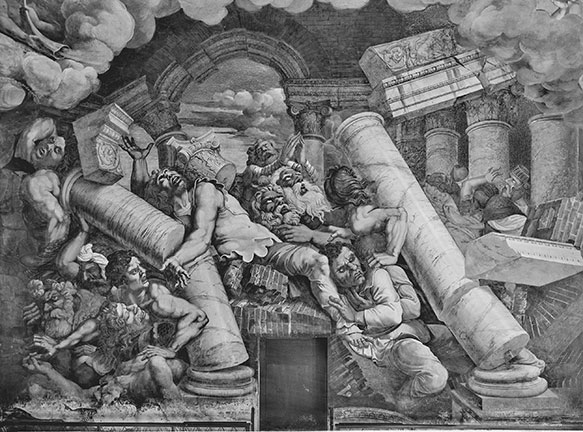
Fig. 10.1 Giulio Romano, Frescoed Chamber of Giants: Side Wall, Palazzo Tè, Mantua (1532–35).
[Alinari Archives, Florence]
The Chimes: The Making of a Historical Present
Despite his avowed renunciation of fiction writing, Forster describes how Dickens was inspired by the bells of the Duomo in Genoa, and ‘the clang and clash of all its steeples’ during a high wind. The Chimes: or A Goblin Story of Some Bells That Rang An Old Year Out and A New Year In (1844) was written at the Palazzo Peschiere where he and Catherine were sleeping in a bed positioned under the tumbling figure of a frescoed Phaeton [Fig. 10.2].60 As has been noticed before, in the story Dickens transforms the pealing of the bells of Genoa into a wake-up call to the condition of England, and a clamorous attack on Malthusian political economy.61
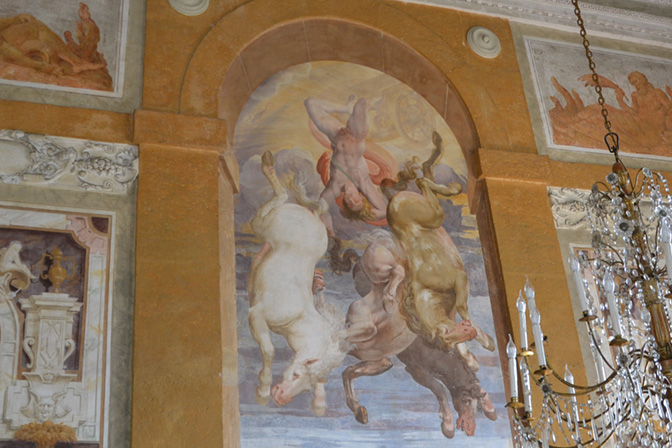
Fig. 10.2 Giovanni Battista Castello detto il Bergamasco, La caduta di Fetonte (1560), Villa di Tobia Pallavicino detta delle Peschiere, Genova, Italy.
[Photograph credit: Carlo Dell’Orto]
The Chimes was of far more importance to Dickens than it has ever been to Dickensians. ‘All my affections and passions got twined and knotted up in it’, he wrote, confessing that when he had finished the story he had had ‘what women call “a real good cry”’, and then left for Venice ‘to recover the composure I had disturbed’.62 So urgent was his desire to show the story to Carlyle in particular that he took the extraordinary decision to make the arduous journey back from Italy to London in wintertime across the Simplon Pass in order to do just that. He read it out loud at Forster’s rooms in Lincoln’s Inn Fields on 2 December 1844 to a small group which consisted of Carlyle, Blanchard, Jerrold, Forster, Frederick Dickens, Maclise, Stanfield, Harness, Dyce, and Fox.63 Maclise reported that ‘there was not a dry eye in the house’ and that there were ‘floods of tears’.64 Dickens was ecstatic—even gleeful—about his friends’ reaction: ‘If you had seen Macready last night—undisguisedly sobbing, and crying on the sofa, as I read—you would have felt (as I did) what a thing it is to have Power.’65 To the modern reader, this is puzzling as the story seems sentimental and somewhat insubstantial. So, in what did the original power of The Chimes subsist?
Like the better-known A Christmas Carol, written the Christmas before, The Chimes uses time-travel to effect a reawakening to fuller consciousness. The main character, Trotty Veck, is a street-worker, a poor ticket-porter (one of Marx’s slum proletariat), who is bullied by the authorities into believing that he and his fellow poor are ‘people who were bad at heart, born bad’ (133). On New Year’s Eve the bells of the church seem to call him out of bed, and he finds the tower door unlocked and climbs to the bell-chamber, where he discovers a ‘Goblin Sight’: ‘He saw the tower, wither his charmed footsteps had brought him, swarming with dwarf phantoms, spirits, elfin creatures of the Bells. He saw them leaping, flying, dropping, pouring from the Bells without a pause’ (138). The Spirits of the Bells reprimand him for losing faith in Man’s destiny to improve and progress, then tell him shocking news—he fell from the tower that New Year’s Eve and has been dead for nine years, and since then his family has sunk into alcoholism and prostitution. The spirits whizz Trotty around, showing him harrowing scenes, the last of which is his daughter Meg, destitute, contemplating drowning herself and her child. Seeing this, Trotty accepts the lesson of the Chimes that the poor are not inherently bad, but rather are oppressed and neglected. With this the vision ends and Trotty finds himself awakening at home as if from a dream as the bells ring in the New Year, and the book ends with celebrations for Meg’s wedding day.
The vision of the goblins in the bell tower is the centrepiece of the story:
He saw them riding downward, soaring upward, sailing off afar, perching near at hand, all restless and all violently active…He saw some putting the hands of clocks forward, some putting the hands of clocks backward, some endeavouring to stop the clock entirely. (125–6)
The goblins in The Chimes, with their “shifting and extraordinary figures”, literally enact Dickens’s stylistic struggle to find a position from which to bring the past and present into a meaningful relation. While their actions are frenzied and energetic, there is also an attempt to ‘stop the clock’. Similarly, despite the vertiginous air travel of A Christmas Carol, Scrooge notices that ‘the Christmas Holidays appeared to be condensed into the space of time they [he and the Spirit] passed together’.66 In both A Christmas Carol and The Chimes, the spectral removes us into other time and then delivers us back into the uninterrupted succession of serial time as if nothing has happened. Although of course something has happened: a transformation has taken place in Scrooge, and in Trotty Veck. Anachronism and anatopism are the rhetorical figures of revolution when time is wrested out of joint and spaces are occupied by disorder in an attempt to re-begin the world differently. Frustrated by the ‘neglect, oppression, and misrule’ (Pictures 187) of Italy, which mirrored that in England, and by the shallow, heedless newness of America, Dickens strains towards a history that does not look backwards, but rather forwards. Rather than writing ‘a cry of lamentation for days which have had their trial and their failure’ (Chimes 128), he wants to look forward into the future through the past, and thus to ‘awaken’ the present. Trotty pleads with the spirits as they show him his daughter Meg heading towards the river to drown herself and her baby, ‘[f]or any gentle image of the Past, to rise before her!’ (155)—he wants the past before her, not behind her, so that she can escape the nightmarish causality that is driving her inexorably towards infanticide. Dickens here seems to want to counter a linear, diachronic, and causal historical view with a spatialized view which makes available all times and tenses, a point of view which recalls the perspective of the baroque. Indeed, the illustrations to the first edition of The Chimes by Daniel Maclise and Richard Doyle seem deliberately to invoke the baroque [Figs 10.3, 10.4, and 10.5]. Dickens attempts to create a fully ‘historical’ present in which the past can alter the possibilities of the present. ‘I will live in the Past, the Present, and the Future!’ cries Scrooge at the end of A Christmas Carol; ‘The Spirits of all Three shall strive within me.’ (77)
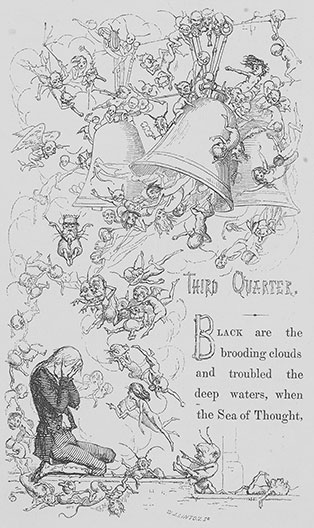
Fig. 10.3 Richard Doyle, ‘Trotty Veck among the Bells’ (1844) Full-page wood engraving for The Chimes: Third Quarter.
[© Bodleian Libraries, Oxford]

Fig. 10.4 Richard Doyle, ‘Margaret and her Child’ (1844) Full-page wood engraving for The Chimes: Fourth Quarter.
[© Bodleian Libraries, Oxford]
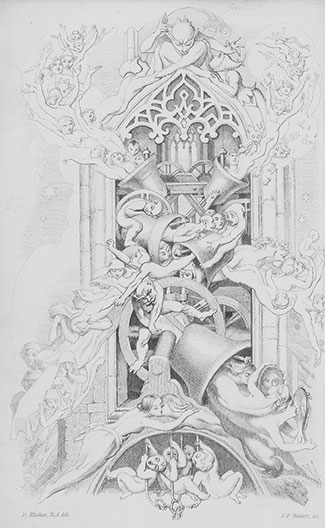
Fig. 10.5 Daniel Maclise, ‘The Tower of the Chimes’ (1844) Full-page wood engraving for The Chimes.
[© Bodleian Libraries, Oxford]
Hannah Arendt has defined the struggle of making, imagining or creating a present thus:
Seen from the viewpoint of man, who always lives in the interval between past and future, time is not a continuum, a flow of uninterrupted succession; it is broken in the middle, at the point where ‘he’ stands; and ‘his’ standpoint is not the present as we usually understand it but rather a gap in time which ‘his’ constant fighting, ‘his’ making a stand against past and future, keeps in existence. Only because man is inserted into time and only to the extent that he stands his ground does the flow of indifferent time break up into tenses.67
In his Christmas stories of the 1840s, Dickens is not trying to dispense with tenses altogether, so much as to break the grammar of oppression by their temporary confusion. Industrial modernity, in Dickens’s imagination, is a heartlessly linear and sequential system on which the individual can get no purchase, and which allows no pause.68 These short volumes, which punctuated his uncharacteristically long break from serial fiction writing before he returned to monthly parts in Dombey and Son, must be read as experiments in this fundamental re-figuring of time. They are explicitly dramatizing the new possibilities of metonymy in his work.
When Dickens was actually moving himself—travelling into regions unknown to him, his analogical imagination rather tended to fail—or at least it was sorely tested when he reached places he did not know what to do with. But nevertheless it was Dickens’s own restless movement in this period of the 1840s that renewed, as he put it the ‘old relations between myself and my readers’ (Pictures, p. 6). Peter Fritzsche has noted that ‘[t]he sense of itinerancy in the nineteenth century was strongly related to the historicization of the world’.69 Fritzsche argues that increased mobility in the nineteenth century made it easier for people to build sequential models, and to understand time and history through these paradigms. But Dickens’s itinerancy initially disturbed him, confusing sequences and upsetting his sense of history and progress, until he worked out how to transform this confusion into an imaginative tool which he could use to disrupt historic sequence in his own work. Certainly, Dickens’s experiences of ‘abroad’ in this period were to lead to a profound change in his sense of historical narrative. The goblins in The Chimes are effectively placeholders for the new style towards which Dickens was straining in his itinerant years.
Alderman Cute may well wonder in The Chimes if ‘some motion of a capsizing nature was going on in things, which affected the general economy of the social fabric’ (148). ‘A motion of a capsizing nature’ is exactly what Dickens is trying to achieve in the story, and through The Chimes he moved closer to the metaphorical imagination of his later work. Metaphor is always an event. It is not a small epiphenomenon in a larger text, nor mere ornament: a twiddle, a small side-order of virtuosity. Metaphor is in fact the generator of all literary energy and imaginative meaning and—like the baroque to which Dickens responded so energetically—it is a lively and sometimes even nightmarish animator of the inanimate. In a metaphor, things are being pulled apart, substituted and transferred—meanings are in motion, shuffling around, with ‘restless and untiring motion’ like the goblins, creating a ‘host of shifting and extraordinary figures’. Political taxonomy, which Dickens targets in The Chimes through Alderman Cute and Mr. Filer, cannot survive the attack of metaphor. Through metaphor categories are shifted, meanings are redirected: metaphor, in fact, relies on deviation, but a deviation which can remake the entire meaning—metaphor is, in Paul Ricoeur’s words, ‘the omnipresent principle of all [the] free action of [language]’.70 On a visit to Correggio’s frescoes in Parma cathedral [Fig. 10.6] Dickens had been overwhelmed by ‘such a labyrinth of arms and legs: such heaps of foreshortened limbs, entangled and involved and jumbled together: [such as] no operative surgeon, gone mad, could imagine in his wildest delirium’, and in his imagination the frescoes immediately became confused with the live bodies of the beggars who come creeping out of the subterranean chapel of the cathedral, displaying ‘a more confounding display of arms and legs’ (67). For Dickens, the tangled bodies of Correggio’s fresco resonated immediately into the present and ragged bodies of Italian beggars. When Dickens calls The Chimes ‘a blow for the Poor’ the blow is of course a metaphorical one, and as Paul Ricoeur puts it, metaphor is—at bottom—a violent principle of realignment: ‘this ontological vehemence cuts meaning from its initial anchor, frees it as the form of movement and transposes it to a new field’.71 This is just what we see the goblins in The Chimes doing. In stopping time and creating a moment where all things subsist at once, they are able to issue an unsettling challenge to the received order. The goblins perform the work of metaphor that Dickens himself found it so hard to achieve in Italy.

Fig. 10.6 Antonio da Correggio, Assunzione della Vergine [The Assumption of the Virgin] (c.1522–1530) Fresco decorating the dome of the Cathedral of Parma, Italy.
[Alinari Archives, Florence]
It is in The Chimes that we first hear the churning of the sea as a figure of universalized time, a trope which Dickens will go on to use to powerful effect in Dombey and Son and in David Copperfield. Trotty Veck declares at the end of the story, ‘I know that our inheritance is held in store for us by Time. I know there is a sea of Time to rise one day, before which all who wrong us or oppress us will be swept away like leaves. I see it, on the flow!’ (157). But when Dickens crossed the sea back to London in July 1845, it was not to fiction, but to a newspaper that he returned.
Breaking News and the Present Tense
Dickens had always noticed newspapers on his travels in both America and Italy. In Italy he watches ‘grave men with sticks, sit[ting] down in the shade for hours together, passing a meagre Genoa paper from hand to hand, and talking…about the News’ (44). He was frustrated by the heavy censorship of print in Italy in the mid-1840s. But conversely, in America he was horrified by the ‘fifty newspapers, which…precocious urchins are hawking down the streets’ of New York (98), adding that it would be impossible ‘to convey an adequate idea of this frightful engine [the Press] in America’ (270). In Martin Chuzzlewit, Dickens was mischievously to name American newspapers the Sewer, the Stabber, the Family Spy, the Private Listener, the Peeper, the Keyhole Reporter, and the Rowdy Journal. The meagre (i.e. heavily censored) newspaper in Genoa is no model, but then neither was the fast and furiously vulgar press of the United States which pandered to the lowest forms of public opinion. In Britain, he saw only stagnation and an aristocratic neglect of the people. It was, therefore, to the rapidly expanding newspaper press that Dickens resorted in his attempt to galvanize British democracy upon his return. In the prospectus that he wrote for the Daily News, he undertook to demonstrate the right balance of authority and liberalism, to promote ‘the happiness and welfare of society’.72 He agreed, with some reluctance, to be the launch-editor for the paper. Later, Dickens would shrug off his editorship as a ‘brief mistake’.73 But in the early months of 1846 he was feverishly busy engaging writers and working on his own editorials and articles on such subjects as ‘Crime and Education’ and ‘Capital Punishment’ alongside preparing his Italian Travelling Letters for the press.
The new paper was to take a robustly pro-Reform and anti-Corn Law position on domestic matters and Dickens declared that ‘besides being what a first-rate daily newspaper now is, [the Daily News also] will be something that it is not. Great attention will be paid to foreign matters.’74 As his Rome correspondent he signed up Francis Mahoney, a seemingly ubiquitous Irish Catholic priest living in Rome known as ‘Father Prout’, whom Dickens had met during his stay there.75 Barrett Browning’s acquaintance Margherita Albana Mignaty was invited to write political letters from Florence for the paper. Dickens’s friend, the “heartiest of Greek Professors!” Harvard Professor of Greek, Cornelius Felton, with whom he had consumed gigantic quantities of oysters in Boston, became one of the American correspondents, and was asked by Dickens to provide ‘[a] general view (such as you would naturally take if you were writing to a friend) of Politics and news’.76 By March 1846, the paper had so many American correspondents and agents that Dickens felt he had to discourage Edgar Allan Poe who wrote and offered himself in the role.77 The paper does indeed stand out against its main competitors, The Times, the Morning Herald, the Morning Chronicle, and the Sun, in the fullness of its international coverage, reprinting at length, for example, the proceedings of the French Chamber of Deputies regularly several times a week. Dudley Costello was Foreign Editor, and he managed correspondents in more than ten cities in Europe, the Middle East, and India. Dickens also tried to hire William Howard Russell, but Russell went to the Morning Chronicle instead.78 Every country was held to the same exacting measure of ‘progress’. America did not come out well. In February 1846, the paper commented:
The recent annexation of Texas to the United States, for the avowed purpose of sustaining slavery…would seem, at first sight, to prove the singular fact, that while the principles of freedom and Christianity are making a steady advance in other parts of the world, they are as steadily retrograding in America.79
Three weeks later—on 16 February 1846—Peel addressed the House of Commons on the uncertainty of economic cycles. It was as yet unclear whether the general economic trend in Britain was moving up or down. As he said, ‘[g]loomy winters, like those of 1841 and 1842, may again set in…These sad times may recur. “The years of plenteousness may have ended” and “the years of dearth may have come”’.80 Peel also said ‘[i]t seems to be incident to great prosperity that there shall be a reverse—that the time of depression shall follow the season of excitement and success’.81 The fear was that the current reverse would fail to correct itself, even after the repeal of the Corn Laws and other anti-protectionist measures were put in place. In Italy’s case, the ‘[b]roken aqueducts…[and] broken temples’ of Rome were the last remaining evidence of a cycle that had long ago degenerated into a tailspin. But in the slums of New York, Dickens had also remarked that ‘[d]ebauchery has made the very houses prematurely old’ (99): evidence, too, of a cycle accelerating in the wrong direction. When Dickens tried to arrange the Old and the New World in a diachronic line of progression with Britain at the centre, he found it did not work at all. There was no lining up of past, future, and present in the right order: he needed to find another way of thinking about the world, a way that was capable of holding multiple terms in tension and resisted diachronic taxonomies with their over-tidy categories. His editorship of a newspaper was important in helping him to do this: from the fertile juxtapositions of the newspaper page emerged a miscellaneous structure that was fundamentally comparative and metaphoric. As a journalist and an editor, Dickens saw that it was in the spaces between, in the juxtapositions, that social relations became visible, and enacted themselves. From these spaces and gaps emerged the forms of the future.
In his Editorial leader in the first issue of the Daily News on 21 January 1846, Dickens figured the abolition of the Corn Laws as inevitable—like the unstoppable chime of a clock: ‘[t]he wheels have revolved; the hands point to the hour, and the clock must strike’, he wrote.82 The repeal of the Corn Laws is about to become history, but it is not yet history, here it is still held in suspense as breaking news, like the whirring of a clock before it chimes. During his brief but exceedingly enthusiastic editorship, Dickens immersed himself in the evergreen present tense of the daily news in the Daily News. Musing on the restlessness and disorder of the contents of any page of newsprint, Richard Terdiman has suggested that in the newspaper, ‘form denies form’, and Kevis Goodman agrees that ‘[t]he [news]paper…testified obliquely to the contradictions and complexities of ongoing events not by mapping them faithfully but by miming them with its own incoherences or dissociations’.83 The newspaper mimes that aspect of presentness that resists known historical categories because the terms that will describe them are not yet fully formed or known; social relations remain inchoate and in the act of becoming on its pages.
Like A Christmas Carol (1843) and The Chimes (1844) the daily newspaper also enacts the paradox of unstoppable time temporarily stopped. The formless onrush of eventful time achieves a form in the newspaper, albeit an ephemeral one like those of the goblins of The Chimes, who exist only for the duration of the clock’s striking and then ‘in the act of falling died and melted into air’ (126). Kathleen Tillotson noticed long ago that the importance of the Christmas books to the novels ‘lies…in their treatment of time’.84 The Chimes is harshly divided, like the clock, into four ‘quarters’, and the bells chime on the hour. The narrative is full of images of remorseless time. The ‘[new year]’s life was parcelled out in almanacks and pocket-books, the coming of its moons, and stars, and tides, was known beforehand to the moment’ (108). A Christmas Carol is divided into five ‘staves’ because it is, of course, a carol, and Scrooge is visited with business-like punctuality by the series of three ghosts. The newspaper is the record of a day, ruled into columns and divided into sections. But at the same time the contents of the page of news and the spirits and visions of the stories spill over, exceed and defy these artificial boundaries. The newspaper and the Christmas stories share the construction of a represented or mimed present through the production of spatial simultaneity. This can be better illustrated by the close examination of a page of the Daily News for Wednesday 11 March 1846, in which the last of Dickens’s series of Travelling Letters ‘Written on the Road’ appears. His letter is printed alongside news just arrived from France, Poland, and Madrid. There is an article about a poor woman in London who drowned a child she could not feed (as Meg contemplated doing in The Chimes); there are letters from Dublin opposing the new Coercion Bill for Ireland; and, under the heading ‘Advances of Famine’, details of the kinds of seaweed that starving Irish people are now eating along the coasts in their utter desperation. Next to this, Charles Mackay’s poem ‘An Emigrant’s Blessing’ is spoken in the dramatic present tense by a starving English emigrant on the eve of his departure for a ‘new nation’.
Dickens’s last Travelling Letter ends with a scene in which he is being shown around a churchyard in Bologna by a cicerone:
Seeing this little man (a good-humoured little man he was, who seemed to have nothing in his face but shining teeth and eyes) looking wistfully at a certain plot of grass, I asked him who was buried there. ‘The poor people, Signore,’ he said, with a shrug and a smile, and stopping to look back at me—for he always went on a little before, and took off his hat to introduce every new monument. ‘Only the poor, Signore! It’s very cheerful. It’s very lively. How green it is, how cool! It’s like a meadow! There are five,’—holding up all the fingers of his right hand to express the number, which an Italian peasant will always do, if it be within the compass of his ten fingers,—‘there are five of my little children buried there, Signore; just there; a little to the right. Well! Thanks to God! It’s very cheerful. How green it is, how cool it is! It’s quite a meadow!’ (70)85
Dickens makes no comment but he ends both the newspaper article and the chapter in the volume edition with this affecting scene. But its affect was qualitatively different in the two different print forms. When these ‘letters’ were reissued in volume form they were collected into longer chapters, so that they ceased to be ‘letters’ sent by a correspondent on the hoof. The volume text was embellished with polite engravings of picturesque ruins by Dickens’s friend Samuel Palmer, figuring precisely those ‘great scenes’ such as the Coliseum that had in fact rendered Dickens imaginatively blank, as we have seen. The two-volume work would have been instantly recognizable as a conventional travel memoir of Italy, a genre that was pouring off the press by the mid-1840s. As a character in an 1838 novel by Walter Savage Landor exclaims, ‘[a] man to leave Italy and not to write a book about it! Was ever such a thing heard of?’86
Under the sign of the ‘picturesque memoir’, the ‘little man’ in the Bologna churchyard recedes into the distance like Will Fern’s derelict and unhealthy cottage in The Chimes which ‘the ladies draw…in their books’ and which ‘looks well in a picter’ (137).87 But how differently the original ‘Letter’ read when it was still travelling around restlessly in the newspaper. Date-stamped with that newspaper’s date, Dickens’s ‘Letter’ acquires a kind of immediacy and topicality, as if it were really being written ‘on the road’ and up to the moment, contemporaneous with its readers. Jostling on the page in the shared space of the present with reports of the desperation of the starving Irish and the suffering English, the ‘little man’ in Bologna is reflected in a non-Anglocentric, non-triumphalist light. Dickens’s Travelling Letter ends with the present-tense narrative of the Bolognese guide. The page of news that surrounds the Bolognese guide generates a powerfully affective field and creates for its readers on that particular Wednesday morning in March a strong feeling of involvement in the ‘news’ which makes the Bologna peasant fully contemporary in a way that he no longer is between the covers of Pictures from Italy. The jumble of news stories on the page also fragments a linear model of narrative. The reader cannot follow one thread but must pass quickly and often from one to another, relativizing each one against the next. Significantly, it is reading a newspaper that prompts Trotty’s despair in the first few pages of The Chimes: ‘I like to know the news as well as any man [but] … [i]t frightens me’ (93).88 The perspective of ‘history’ offered by the newspaper is an uncertain, fragmented, present-tense one. Causalities and consequences are often as yet unclear. When the Saturday Review remarked somewhat unkindly in 1858 that ‘Mr. Dickens’s writings are the apotheosis of what has been called newspaper English’, it was, in a sense, absolutely right.89
Despite his own intense desire for historical and political participation through the Daily News, Dickens left the editorship after only three weeks, on 9 February 1846, declaring himself ‘tired to death and “quite worn out”’, and passing the role to John Forster.90 A couple of months after Dickens had stepped down, his erstwhile collaborator on the paper and radical anti-corn law campaigner William J. Fox wrote to a friend that ‘[y]es, it was very stupid both of Dickens and Jerrold not to be at Exeter Hall’. They had missed a large public meeting at 5 p.m. on 29 April to discuss the abolition of capital punishment. Fox continued: ‘but these literary people have no public work in them after all’.91 In fact, Dickens had plenty of public work in him, but he had by now realized that his best political work was literary. On 31 May, he ‘sent himself abroad’ once more, both physically, across the Channel to France, and artistically, obeying Marley’s ghost’s injunction to Scrooge that ‘the spirit within him should walk abroad among his fellowmen, and travel far and wide’ (22). This time he headed for Lausanne in Switzerland, where he started to write Dombey and Son.
Arriving in the Present with Dombey and Son
Under immense political pressure to find new analogies and a new grammar capable of impressing the urgency of the present political crisis upon his readers, Dickens reached for a narrative tense which could reconnect the past to the present in ways which radically undermine the temporal distances and perspectives of conventional ‘past-historic’ narrative. In Dombey and Son, a novel with an unusually contemporary setting, Dickens attempts a new generalization and mobility of meaning. The historic present tense displays past and present in a single moment, while also suggesting an irreducible repetition that underpins, and to some extent undermines, all human agency. In Dombey the historic present is linked to the anxious metonymic qualities of that novel: ‘[a] few days have elapsed, and a stately ship is out at sea, spreading its white wings to the favouring wind’ (772). Walter and Florence’s honeymoon journey floats down the metonymic stream already established by a novel in which ships, streams, rivers, and waves stand in for the deeper structuring concepts of the ‘story’: risk, time, and death.92 The novel first switches into the present tense in Chapter 18, when Paul Dombey has just died and the household is in suspension so that ‘it seems like Sunday’ (238) in a ‘prolonged mortuary present’;93 it returns briefly in the railway train ‘roaring, rattling, tearing on’, another repeated motif in this text of the unstoppability of time, where the train is like ‘the remorseless monster, Death!’ (276), and more substantially in Chapter 31 on the day of Dombey’s marriage to Edith, as the ‘steeple-clock [is]…emerging from beneath another of the countless ripples in the tide of time that regularly roll and break on the eternal shore’ (420). The household await the happy couple’s return in the present tense at the start of Chapter 35, and in Chapter 41 Florence returns to Brighton where ‘the requiem of little Dombey on the waters’ (554) is played in the present tense while ‘all goes on, as it was wont’ (563). In Chapter 51 the humiliated Dombey, after Edith’s elopement, imagines the opinion of the ‘World’ in a nightmarish and continuous present: ‘it is in his house, outside it, audible in footsteps on the pavement, visible in print upon the table, steaming to and fro on railroads and in ships; restless and busy everywhere’ (682). In Chapter 57, when Walter and Florence put out to sea on their honeymoon, the waves continue ‘their ceaseless murmuring, of love—of love, eternal and illimitable, not bounded by the confines of this world, or by the end of time, but ranging still, beyond the sea, beyond the sky, to the invisible country far away!’ (773). Chapter 59, ‘Retribution’, starts in the present with the ruin of Dombey’s firm and the sale of his possessions. And the final chapter returns to the present where on a beach a ‘white-haired gentleman walks with the little boy’ (833).
As Steven Connor says of the resolution of the metonymic and metaphorical narrative and counter-narrative at the end of Dombey and Son: ‘[t]he growth in structural awareness marks the move into a metaphorical/paradigmatic dimension, replacing the purely serial, metonymic relationship of events coming one after another. The story which has been experienced temporally can now be experienced spatially, with all its elements imaginatively present at once.’94 The experiments dramatized in the Carol and the Chimes are now incorporated into the patterning of the narrative. Instead of ghosts and goblins, Dickens displays a renovated rhetorical apparatus of narrative tense alternation, metaphors, and metonymic chains of associative imagery. Instead of a fairy-goblin, he uses the present tense in Dombey to stop time, and deliver his readers to a place ‘not bounded by the confines of this world, or by the end of time’ (773).
The present-tense chapters in Dombey mark the crises of the action. They host a marriage, a funeral, a breakdown, and another marriage, and yet their focus tends to be on a chorus of peripheral characters. The anticipatory activities of Mrs. Miff the pew-opener in Chapter 31, or of Dombey’s cook and the servants in Chapter 35, for example, seem deliberately to move the reader away from the main characters. By writing in the present tense and by opening up a contiguous action contemporary to the main narrative, Dickens finds a way to suggest the difficulty of ascribing value to events in the here and now, before they have been committed to the organizing narrative of history. Indeed, he even suggests, through his use of language and tense forms in these chapters, his scepticism about the possibility of ever being able to incorporate the events and periods of individual human lives into a meaningful perspective of ‘history’. This is symptomatic of the pervasive political confusion of the 1840s. Bewilderingly, the ‘monstrous system’ of papal government in the centre of Italy, for example, could be replaced by the Roman Republic, which in turn was attacked and brought down by the ‘stupendous baseness’ of the very nation which, as Dickens saw it, had started the revolutionary process in the first place: France.95
At the opening of Chapter 31 of Dombey, the ‘dawn moans and weeps for its short reign’ (420) and night ‘sits upon the coffins’ (421): while Dickens directs us to the single day which is Dombey’s wedding day, his imagery also invokes the longer timescales of religion and politics. The historic present is a tense which returns foreboding and suspense to completed events, unravelling them, and leaving them once again unfinished. The fearfulness and foreboding that permeates Dombey, particularly in these present-tense chapters, extends well beyond the confines of this largely domestic story, into a grander, global perspective. It is through this tense that Dickens finds the way to launch an urgent historiographical enquiry into a pan-European state of unfinishedness. The uneven and scattered upheavals and revolutions of the 1840s represented for Dickens not completed events, but the forebodings and risks of something as yet incomplete and inchoate. And a decade later, in the late 1850s, he continues to feel that the events of 1848 are not complete, as is clear in A Tale of Two Cities.
A Tale of Two Cities: History Just About to Happen
Twelve years after Dombey, in the only other explicitly ‘historical novel’ he wrote after Barnaby Rudge, Dickens returned to his preoccupations with ‘abroad’ and with the revolutions which had marked his experience of the 1840s. A Tale of Two Cities (1859) never becomes a historical novel in the ‘full immersion’ sense of a Scott novel. Instead, it further develops the metonymic patterning of Dombey and Son to create a novel which rests on analogical affinities between here and there, and now and then. Although it travels back to 1789, this is also Dickens’s belated response to the revolutions of 1848.
Mark Philp has commented about A Tale of Two Cities that Dickens’s ‘portrayal of France is not innocent of his portrayal of England, and neither is untouched by the implicit counterfactual of American liberty’.96 Certainly, by 1859 Dickens had crossed ‘salt water’ (31) many times, and, unlike the doggedly patriotic Miss Pross, he can no longer imagine Britain as an island isolated from the rest of the world. But even Philp understates the way in which A Tale of Two Cities is structured around the ‘travelling backwards and forwards betwixt London and Paris’ (20) rather than around a binary division between the ‘two cities’. At the beginning of the novel, on the brink of one of its many cross-Channel journeys, Mr. Lorry waits in Dover for a sailing packet to Calais, noticing that the ‘air…[was] at intervals clear enough to allow the French coast to be seen’ (21). The distance between Paris and London in this novel is slight, and the true centre of the narrative is the Channel.97 Dickens reinforces this proximity and connection by opening the novel with the international Mail Coach (la malle-poste) ‘mash[ing…its] way through the thick mud’ (5) to keep to its timetabled schedule to meet the mailboat.
The Mail Coach connects the two countries by letter and they are further connected by diasporic families: Lucy Manette is an Anglo-French hybrid who speaks English ‘a little foreign in its accent’ (23); Charles Darnay is a French ‘emigrant’ to England; and Miss Pross’s brother Solomon is discovered under the name Barsad in Paris. Business and fiscal connections are strong too: Tellson’s bank has branches both in London and in ‘the Saint Germaine Quarter of Paris’ (316). Indeed, all of the main characters in the novel cross the salt water at least once, and Dickens’s chapters move restlessly between the two cities. Dickens’s insistence on the geographical proximity of the two countries is metonymically linked to his insistence on the proximity of the present to the past. If France is so close, so perhaps is its Revolution. The very first paragraph of the book enforces this temporal analogy, telling us that ‘in short, the period was so far like the present period’ (1) (emphasis added). From the outset in this ‘historical novel’, neither France, nor its revolutionary energy, is very far away at all.
Ian Duncan has suggested that ‘[h]istory does not appear as a category of dynamic process in [Dickens’s] narratives’ because for Dickens, history ‘signifies not even lives passing, but a dark, blind, dead past’.98 Certainly Dickens’s disdain for any kind of nostalgia for the ‘olden days’ is blatant in some of the deleted passages on ‘Young England’ he originally wrote in The Chimes, in his poem ‘The Fine Old English Gentleman. New Version’ that he published in the Examiner in 1841, in the A Child’s History of England that he was writing in the early 1840s, and in the joke-titles of his set of mock books at Gad’s Hill, ‘The Wisdom of our Ancestors’.99 But this is a political disdain for a Tory version of ‘History’, not an irreverence for the power of the past itself, of which he was intensely, almost superstitiously, aware.
As was also true for Carlyle, thinking ‘historically’ for Dickens never meant merely thinking about the past. Dickens’s millenarian hope for the imminent arrival of a new time in the 1840s has often been read simply as his debt to Carlyle’s prophetic style. But as Gareth Stedman Jones has pointed out, even in the grim 1840s Dickens had retained far more political faith than the gloomy Carlyle, who consistently ‘degraded’ the possibilities of political agency and change.100 Carlyle’s French Revolution, as seen from his vantage point in 1834 to 1836, was a unique and apocalyptic eruption. Carlyle himself explains in Book II of Part III of his gigantic French Revolution why he abjures the past tense in favour of the present:
For indeed, it is a most lying thing, that same Past Tense always: so beautiful, so sad…For observe, always one most important element is surreptitiously (we not noticing it) withdrawn from the Past Time: the haggard element of Fear! Not there does Fear dwell, nor Uncertainty, nor Anxiety; but it dwells here; haunting us, tracking us; running like an accursed ground-discord through all the music-tones of our Existence;—making the Tense a mere Present one!101
Carlyle’s frequent recourse to the present tense throughout his French Revolution represents the attempt of a historian to restore chaos, uncertainty, fear, and complexity to completed past events, even if The French Revolution is in fact ‘nearly a third’ interpretation in the form of commentary and reflection by the narrator.102 Carlyle continues to privilege the interpretative perspective of the past over the confusion of the ‘mere Present’, using the present tense as a device to re-open the affect and multivalency of the past, whilst simultaneously retaining the control of the ‘historian’ looking back over the narrative. The energy generated by the collision of these two opposing narrative positions is what powers Carlyle’s remarkable prose: his writing sets out deliberately to enact precisely the contradiction between event and interpretation that produces ‘History’.
Vernon Lee, astonished and impressed by Carlyle’s achievement of the ‘lyric of prophecy’ through his use of the historic present tense, claimed that, by contrast, in Dickens it becomes only ‘a vulgar dodge for realization’.103 This seems a misreading or misunderstanding of Dickens’s style. It is true that Dickens’s use of the present tense is different from Carlyle’s in its motivation. Dickens does not represent the French Revolution as an epochal event which rents the fabric of time and creates a shockingly new sense of ‘history’, so much as part of a causal series of linked events. The obstinately insistent political determinism of A Tale of Two Cities suggests that Dickens in 1859 now saw the events of 1848 as part of a continuum of the long revolutionary process which was still unspooling across Europe after its dramatic initiation in the first French Revolution. If the circumstances of neglect, poverty, and iniquity were in place, as Dickens believed they were in Britain in the mid-1850s, then the people would know what to do: ‘[s]ow the seeds of rapacious license and oppression over again, and it will surely yield the same fruit according to its kind’ (459) he warns in the final chapter of his ‘historical’ novel. Dickens’s historiography is less fully Hegelian than Carlyle’s in that he retains a stubborn belief in individual agency and is unwilling to abandon all his political faith to the blind and inevitable processes of Hegel’s philosophy of world history.104
A Tale of Two Cities only twice moves into extended present-tense passages: at the point of Darnay’s near arrest when being smuggled out of revolutionary France (III, xiii), and at the climactic execution scene (III, xv) when Sidney Carton is the twenty-third prisoner to be guillotined on one December day in Revolutionary Paris:
The murmuring of many voices, the upturning of many faces, the pressing on of many footsteps in the outskirts of the crowd, so that it swells forward in a mass, like one great heave of water, all flashes away. Twenty-Three. (III, xv)105
Carton is described as he stands on the guillotine in the Place de la Révolution awaiting his execution as looking ‘sublime and prophetic’ (464) . But despite the repetition of ‘I see’ in the final three paragraphs of the novel, what we are given at the end of A Tale of Two Cities is not a prophecy. Dickens takes us not into the present tense of prophecy, but into the conditional perfect: ‘if he had given any utterance to his [thoughts], and they were prophetic, they would have been these’ (464). What follows is therefore not a prophecy, but an imagination of what a prophecy might have been from the secure position of hindsight. Dickens knew Second Empire Paris well, and he had resided there between October 1855 and May 1856. He often walked in the Place de la Concorde, formerly the Place de la Révolution, and beheld it ‘fair to look upon, with not a trace of this day’s [the Revolution’s] disfigurement’ (465). This is the scene that Lucy Manette’s grandson is shown at the end of the novel. So, the novel ends not in the future of prophecy, but in the present in Dickens’s own lifetime. Indeed, Lucy Manette’s grandson is probably born around the same time as Charles Dickens himself in the second decade of the nineteenth century, so that Dickens himself stands in the place of the grandchild of the Revolution. It was both the distance and the proximity of the bloody days of France’s Terror that fascinated Dickens as he strolled in the comfortable and elegant boulevards of Paris in the mid-1850s just as the Haussmannization of the city was getting underway. The guillotine was only two generations behind him, the February revolution of 1848 and the June Days were less than a decade away. A Tale of Two Cities is never a fully ‘historical’ novel because Dickens’s narrative never fully inhabits the past: instead, it is told self-consciously and deliberately from the perspective of the uncertain present of 1859. Vernon Lee was right that Dickens does not use the present tense of prophecy, but she does not see that this is because he has no desire to foresee an inevitable future. Instead, Dickens uses the present tense as a tense of possibility: a tense which deliberately delivers us into the parblind, inchoate, and risky contemporary moment, and no further. It is important to Dickens that the future is impossible of vision, as Paul Saint-Amour says, in order ‘to reawaken us to the ramifications of our timeliness—of our not being too late’.106
The political disaffection and difficulty of imagining a future in the 1840s produced a peculiarly modern form of presentism, a ‘regime of historicity’, in François Hartog’s terms, in which ‘light is produced by the present itself, and by it alone’.107 Dickens reminds us that he ‘began [Dombey and Son]…by the lake of Geneva, and went on with it for some months in France’.108 The trajectory of Dickens’s style in the 1840s, like his own travels across oceans and seas, is marked by a slow journey out—as the landlocked eighteenth-century London of Barnaby Rudge gives way to the expansive world historical present of Dombey and Son, a novel which delivers us, on its final page, into ‘Autumn days [on] the sea-beach’ (833) and back into the ‘shining’, momentous, and crucially unfinished present (833).
Conclusion: A Tale of Three Cities
‘The wine cask, shattered like a walnut shell, [in A Tale of Two Cities] shattered every Saturday night on the corner of our street, and, yes, Dickens was right, the gutters turned a bright and then a rusty red.’109 In twentieth-century New York City, a twelve-year-old James Baldwin was taken downtown by his teacher to see the 1936 Metro-Goldwyn-Mayer film version of Dickens’s A Tale of Two Cities at the Lincoln Theater.110 The film proved uncannily familiar to Baldwin, particularly the scene in which ‘the carriage of the Marquis races headlong through a provincial village. We are confronted by the speeding wheels of the carriage, the relentless hooves of the horses. And a small, running, ragged boy, trying to get out of the way. He is knocked down, he is run over, he is killed; and I knew something about that.’111 In Harlem in 1936, ragged boys died violent deaths due to state neglect, just as they had in France in 1789. The voraciously literary twelve-year-old Baldwin had already read Dickens’s novel when he saw the film: ‘I read A Tale of Two Cities—over and over and over again.’112 But ‘the first book I can remember having read’ was Harriet Beecher Stowe’s Uncle Tom’s Cabin (1852) which ‘I had read…compulsively’ and which ‘had a tremendous impact on me’.113 He got so obsessed with Uncle Tom’s Cabin that his worried mother took to hiding the book on ‘the highest shelf above the bath tub’.114 In his mind, perhaps he collapsed the two novels together. The film of A Tale of Two Cities was powerful because
I understood…something of revolution—understood, that is, something of the universal and inevitable human ferment which explodes into what is called revolution. Revolution: the word had a solemn, dreadful ring: what was going on in Spain was a revolution. Revolution was the only hope of the American working class—the proletariat: and world-wide revolution was the only hope of the world. I could understand (or, rather, accept) all this, as it were, negatively. I could not see where I fit into this formulation, and I did not see where blacks fit.115
Growing up black, poor, and gay in 1930s Harlem, Baldwin knew that Dickens’s A Tale of Two Cities was a ‘historical’ novel, but he also understood very well that it was not really about the past. Likewise, he devoured Harriet Beecher Stowe’s novel ‘sensing something in the book of some immense import for me: which, however, I knew I did not really understand’.116 While he recognized their limitations (where did blacks fit?), he also appreciated their power and their anger, and he understood their pledge to a universal humanity. Later, he would repudiate Stowe. But back in the day, A Tale of Two Cities and Uncle Tom’s Cabin perhaps helped the schoolboy Baldwin think about what kind of revolution might fit him fully into the social fabric of America.117 He was at middle-school at this time, at the Frederick Douglass Junior High, his school named for another nineteenth-century believer in the bonds of a common humanity. Through the universalist rhetoric of progress, rights, and human dignity generated by the revolutions of 1848, and promulgated by Douglass, Dickens, and Beecher Stowe, the spirit of 1848 continued to rage on into the Civil Rights Movement of 1950s and 1960s America.118
1 Charles Dickens, ‘Prologue’, J. Westland Marston, The Patrician’s Daughter (1842), quoted in John Camden Hotten, Charles Dickens, the story of his life, by the author of ‘The life of Thackeray’ (London: John Camden Hotten, 1870), p. 337. The Prologue was delivered by the actor Macready on the stage of Drury Lane on the opening night on 10 December 1842 and was printed for the first time in the Sunday Times (11 December 1842). The Patrician’s Daughter was a five-act blank-verse tragedy.
2 ‘No tale of streaming plumes and harness bright | Dwells on the poet’s maiden theme tonight. |…| That solemn music he does not pursue, | To distant ages out of human view. |…|Awake the Present! Shall no scene display | The tragic passion of the passing day? |…| Learn from the lesson of the present day.’ Charles Dickens, ‘Prologue’, J. Westland Marston, The Patrician’s Daughter (1842), quoted in Hotten, Charles Dickens, pp. 336–7.
3 CD to the Editor of the Morning Chronicle (25 July 1842). The letter concerns the Mines and Collieries Bill: The Letters of Charles Dickens, ed. Graham Storey et al., 12 vols (Oxford: Clarendon Press, 1966–2002), vol. 3: 1843–1847, ed. Madeline House, Graham Storey, and Kathleen Tillotson (1974), pp. 278–85, p. 285 (hereafter CD Letters 3).
4 See Pettitt, Serial Forms, pp.199–212.
5 CD wrote this pamphlet for the National Italian Appeal Committee and it was published in The Examiner (8 September 1849) and other newspapers. See B.W. M[atz], ‘Charles Dickens and the Italian refugees of 1849’, The Dickensian 10 (December 1914): 319–22.
6 CD to Henry F. Chorley (3 February 1860), The Letters of Charles Dickens, vol. 9: 1859–1861, ed. Graham Storey (1997), pp. 205–8, p. 207. The Dickens family was resident in Paris from October 1855 to May 1856 and Dickens became very friendly with the artist Ary Scheffer: ‘I have had long talks about scores of them [the Italian nationalist exiles] with poor Ary Scheffer, who was their best friend.’ It was Scheffer who introduced Daniele Manin to Dickens. Daniele Manin, one of the most important leaders of the Risorgimento and erstwhile President of the Republic of St Mark in Venice, was now exiled in Paris, his wife and daughter both dead. Manin was reduced to tutoring in the Italian language and took on Mamey and Katey Dickens as pupils in Paris in 1855 to1856.
7 For more on Dickens’s engagement with, and public support for, the Italian uprisings, see Michael Hollington, ‘Dickens and Italy’, Journal of Anglo-Italian Studies 1 (1991): 126–36; M. Gabriella Caponi-Doherty, ‘Charles Dickens and the Italian Risorgimento’, Dickens Quarterly 13 (September 1996): 151–63; and Massimo Verzella, ‘Dickens, Gallenga and the Topography of Decay’ in Michael Hollington and Francesca Orestano (eds), Dickens and Italy: Little Dorrit and Pictures from Italy (Newcastle upon Tyne: Cambridge Scholars Publishing, 2009), pp.134–43.
8 CD to Thomas Adolphus Trollope, The Letters of Charles Dickens, vol. 11: 1865–1867, ed. Graham Storey (1999), pp. 225–7, p. 226.
9 John Black Atkins, The Life of Sir William Howard Russell, 2 vols (London: John Murray, 1911) vol. 1, p. 58, quoted in Philip Collins (ed.), Dickens: Interviews and Recollections (London: Macmillan Press, 1981), vol. 1, p. 76.
10 CD to Macready, The Letters of Charles Dickens, vol. 4: 1844–1846, ed. Kathleen Tillotson, pp. 645–7, p. 646 (hereafter, CD Letters 4).
11 Raymond Williams made a similar point when, speaking of Dombey and Son, he remarked, ‘one…can talk of an element of Dickens’ writing which is subjunctive, which is clearly ‘what if’ or ‘would that’ or ‘let us suppose that’. In other words, he introduces a perspective which is actually not socially or politically available. Raymond Williams, ‘Forms of English Fiction in 1848’, in Francis Barker et al., 1848: The Sociology of Literature, pp. 277–90, p. 286 (underlining original).
12 CD to John Forster (29 February 1848), The Letters of Charles Dickens, vol. 5: 1847–1849, ed. Graham Storey and Kathleen Tillotson (1995), pp.256–7, p. 256.
13 Hartmut Pogge von Strandmann, ‘1848–1849: A European Revolution?’, in Evans and von Strandmann (eds), The Revolutions in Europe, pp. 1–8, p. 5.
14 François Furet, Revolutionary France 1770–1880 (Oxford: Blackwell, 1992), p. 537.
15 ‘Dombey and Son’, Home and Foreign Review 1:4 (22 January 1848): 64–6, p. 65.
16 Charles Dickens, Dombey and Son, ed. Alan Horsman (Oxford: Clarendon Press, 1974), p. 554. All subsequent references are to this edition.
17 The chapters in the present tense are 31, 41, 51, 57, and 62.
18 [Anon.], ‘David Copperfield and Pendennis’, Prospective Review 7 (July 1851): 157–91; reprinted in Charles Dickens: The Critical Heritage, ed. Philip Collins (London: Routledge, [1971] 1995), pp. 264–6, p. 265.
19 [Anon.], Sharpe’s London Magazine (March 1848): 200–3. p. 201.
20 [Anon.], Examiner (28 October 1848): 692–3. p. 692.
21 Monika Fludernik, Towards a Natural Narratology (London: Routledge, 1996), p. 196.
22 Michael Toolan, Narrative: A Critical Linguistic Introduction (London: Routledge, 1988), p. 162.
23 Elizabeth Ermarth also argues that all Victorian novels are, in fact ‘historical’ novels, because ‘[t]he historical novel…has everything to do with a particular construction of time, and nothing to do with antiquarian subject matter: Elizabeth Deeds Ermarth, The English Novel in History 1840–1895 (London: Routledge, 1997), p. 82.
24 Ibid., p. 692.
25 Otto Jespersen, The Philosophy of Grammar (London: Allen & Unwin, 1924), pp. 265ff.
26 The historic present is often confused in English with the dramatic present, and the two terms are often used synonymously. Raymond Williams makes a helpful distinction between the two. The dramatic present is used when things are still happening, e.g. ‘Whence is that knocking | How is’t with me, when every noise appals me?’ (Macbeth). The historic present narrates completed events in the present. See Raymond Williams, Writing in Society (London: Verso 1983), p. 54. Simon John De Vries introduces a third type of present, the ‘gnomic present’ which ‘is the present to which wisdom sayings pertain, hence it is repeated and repeatable as long as the sayings are true. The cultic present is very similar: it is the ongoing present to which every sort of ritual and cult legislation pertains. These two kinds of present are, together, ideologically opposite to the historical present. The essential difference is that the historical present is always unique—an experience unto itself—whereas the gnomic and cultic present is anything but unique. If the historical present is disjunctive, even irruptive, the gnomic/cultic present is repetitive, cyclical, and institutional.’ Simon J. De Vries, Yesterday, Today, and Tomorrow: Time and History in the Old Testament (Grand Rapids, MI: Eerdmans, 1975), p. 45.
27 See my discussion of Thomas Carlyle, Past and Present and Augustus Welby Pugin, Contrasts in Pettitt, Serial Forms, pp. 177–99. Michael Slater has called The Chimes ‘fiercely political’: Michael Slater, ‘Introduction’, in A Christmas Carol and Other Christmas Writings (London: Penguin, 2003), p. xxi. When he was trying to plan his Christmas Book for 1846, while also beginning Dombey, Dickens felt ‘an odd shadowy undefined idea is at work within me, that I could connect a great battle-field somehow with my little Christmas story. Shapeless visions of the repose and peace pervading it in after-time; with the corn and grass growing over the slain, and people singing at the plough; are so perpetually floating before me.’ John Forster, The Life of Charles Dickens 1842–1852, 3 vols (London: Chapman & Hall, 1873), vol. 2, p. 204. The folding together of two historically contrasting times joins the projects of Pugin and Carlyle in exploring historical sequence. Dickens’s published Christmas book for 1846 was The Battle of Life: A Love Story. It is set in an English village that stands on the site of a historic battle.
28 Carlyle to J. S. Mill (22 July 1836), The Carlyle Letters Online, see https://carlyleletters.dukeupress.edu/home.
29 Only later did Dickens confess that he had carried a bottle and a message secretly to a political prisoner in Italy. ‘The Italian Prisoner’ first appeared in All The Year Round (13 October 1860) and was then reprinted in The Uncommercial Traveller and Other Papers 1859–70, ed. Michael Slater and John Drew (London: Dent 2000): 190–9, p. 198. See CD to Lord Dudley Coutts Stuart (24 July 1845): ‘My Dear Lord Dudley. Behold Sanvanero’s little Bottle of Wine! His whole heart is in it, I am certain.” CD Letters 4, p. 335 and n. Lord Dudley Coutts Stuart (1803–1854) MP was married to Christine Bonaparte who had grown up in the papal principate of Canino. The couple therefore had extensive connections in Italy. Little is known about Savanero, but his story generally resembles that of Carlo Poerio (1803–67), another political prisoner helped to freedom in 1859 through Gladstone’s intercession: https://www.djo.org.uk/indexes/articles.html (consulted 3 May 2020).
30 Charles Dickens, Pictures from Italy, ed. Kate Flint (London: Penguin, 1998), p. 116. All subsequent references are to this edition.
31 Steven Connor, ‘Space, Place and the Body of Riot in Barnaby Rudge’, in Steven Connor (ed.), Charles Dickens: Longman Critical Readers (London: Longman 1996), pp. 211–29, p. 228.
32 Charles Dickens, Barnaby Rudge. A Tale of the Riots of ‘Eighty, ed. Clive Hurst, Oxford World’s Classics (Oxford: Oxford University Press, 2008). All references are to this edition.
33 CD to John Landseer (5 November 1841), The Letters of Charles Dickens, vol. 2: 1840–1841, ed. Madeline House and Graham Storey (1969), pp. 417–18, p. 418.
34 Michael Wood, ‘Afterword’, in Colin Jones, Josephine McDonagh, and John Mee (eds), Charles Dickens, A Tale of Two Cities and the French Revolution (Basingstoke: Palgrave Macmillan, 2009), pp. 188–94. p. 189.
35 See n. 26 above.
36 See Thomas Jackson Rice, ‘The End of Dickens’s Apprenticeship: Variable Focus in Barnaby Rudge’, Nineteenth-Century Fiction 30:2 (September 1975): 172–84.
37 Barthes, Writing Degree Zero, p. 30. Monika Fludernik, The Fictions of Language and the Languages of Fiction: The Linguistic Representation of Speech and Consciousness (London: Routledge, 1993), p. 201.
38 Madeleine House, Graham Storey, and Kathleen Tillotson, ‘Preface’, CD Letters 3, p. xii.
39 Ibid., p. xvi n. 7.
40 CD to Daniel Maclise, from Adelphi Hotel Liverpool ([3] January 1842), CD Letters 3, pp. 8–9, p. 9.
41 Dickens stayed in Italy from 2 July 1844 to 3 July 1845.
42 CD to Macready (1 April 1842), in CD Letters 3, pp. 173–6, p. 176; Charles Dickens, American Notes for General Circulation, ed. Patricia Ingham (London: Penguin, 2000), p. 133. All subsequent references are to this edition.
43 Sally Ledger argues that Dickens always rejected nostalgia and Tory paternalism: Sally Ledger, Dickens and the Popular Radical Imagination (Cambridge: Cambridge University Press, 2007). Miles Taylor claims that political radicalism at this time ‘was placed at the confluence of Benthamism, socialism, Mazzinian nationalism, anti-clericalism and Whiggery’ within an essentially pre-democratic system without party alliances: Miles Taylor, Decline of British Radicalism, p. 13.
44 CD to Macready (12 April 1842), in CD Letters 3, pp. 173–6, p. 176.
45 [Anon.], ‘Dickens’s American Notes for General Circulation’, Blackwood’s Edinburgh Magazine 52:326 (December 1842): 783–801, p. 794.
46 This aspect of Pictures from Italy has been much discussed. See, for example, Stephen Bann, ‘Visuality Codes the Text: Charles Dickens’s Pictures from Italy’, in Bullen (ed.), Writing and Victorianism, pp. 202–12; John Plunkett, ‘Optical Recreations and Victorian Literature’, in David Seed (ed.), Literature and the Visual Media, Essays and Studies for the English Association, Woodbridge: Boydell & Brewer, 2005), pp. 1–28; Kate Flint, ‘Introduction’ to Charles Dickens, Pictures from Italy, pp. vii–xxx.
47 (MSS BM) quoted in CD Letters 3, p. 289 n. 2.
48 In his critique of les guides bleus in Mythologies, Roland Barthes suggested that these guides can answer ‘none of the questions which a modern traveller can ask himself while crossing a countryside which is real and which exists in time’, because the guide books ‘account…for nothing of the present, that is, nothing historical, and as a consequence, the monuments themselves become indecipherable, therefore senseless’: Roland Barthes, ‘The Blue Guide’, in Mythologies, trans. Annette Lavers (New York: Hill & Wang, 1981), pp. 75–6. James Buzard discusses E. M. Forster’s attempt to resynthesize history and the present through the genre of the guide book in James Buzard, The Beaten Track: European Tourism, Literature, and the Ways to Culture 1800–1918 (Oxford: Oxford University Press, 1993), pp. 330–1.
49 [Anon.], ‘Two English Novelists: Dickens and Thackeray’, Dublin Review 17:32 (April 1871): 315–50, p. 339.
50 Dickens’s literary response to the iconic ruin of the Coliseum is predictable and disappointing: ‘Never, in its bloodiest prime, can the sight of the gigantic Coliseum, full and running over with the lustiest life, have moved one’s heart, as it must move all who look upon it now, a ruin. GOD be thanked: a ruin!’ CD, Pictures from Italy, p. 118. This stock liberal progressivist point about the ruins of the Coliseum seems oddly platitudinous. At least Dickens manages to forebear from quoting Byron’s ‘butchered to make a Roman holiday’, as Mark Twain was later to congratulate himself on not quoting—while of course in fact quoting—when confronted by the Coliseum: ‘[s]o far, good. If any man has a right to feel proud of himself, and satisfied, surely it is I. For I have written about the Coliseum, and the gladiators, the martyrs, and the lions, and yet have never once used the phrase “butchered to make a Roman holyday.” I am the only free white man of mature age, who has accomplished this since Byron first originated the expression.’ Mark Twain, The Innocents Abroad, or The New Pilgrim’s Progress (New York: Oxford University Press, 1996), p. 284.
51 CD to Forster (2 November 1843), CD Letters 3, pp. 590–1, p. 591. See Brian H. Murray, ‘ “Mere Shadows in the Water”: Travel Writing, Fresco, and Form in Pictures from Italy’, English: Journal of the English Association 61:235 (Winter 2012): 341–53.
52 CD to Forster (1 November 1843), CD Letters 3, pp. 587–8, p. 587.
53 Paul Ricoeur, The Rule of Metaphor: Multi-Disciplinary Studies of the Creation of Meaning in Language, trans. Robert Czerny with Kathleen McLaughlin and John Costello SJ (London: Routledge & Kegan Paul, 1978), p. 34.
54 CD to John Forster (2 November 1843), CD Letters 3, pp. 590–1, p. 591.
55 CD to John Forster (?6 October 1844), CD Letters 4, pp. 197–9, p. 199.
56 CD to Count D’Orsay (7 August 1844), CD Letters 4, pp. 166–71, p. 167. This is a description of the Dickens family’s first summer villa (Villa di Bagnerello). In the autumn they repaired to the more splendid Peschiere, whose frescoes are described by Dickens to Forster in CD to Forster (?30 September 1844), CD Letters 4, pp. 195–7, p. 195.
57 Here I part ways with Stephen Bann, who sees Dickens as falling neatly into line with the ‘good replicas’ of Northern Europe and ‘bad replicas’ of the Catholic south: Bann, ‘Visuality Codes the Text’, pp. 206–7.
58 Walter Benjamin, The Origin of German Tragic Drama, trans. John Osborne (London: Verso, 2003), p. 81.
59 The Chimes, in Charles Dickens, A Christmas Carol and Other Christmas Books, ed. Robert Douglas-Fairhurst (Oxford: Oxford University Press, 2006), pp. 85–161, both quotations p. 126. All subsequent references are to this edition.
60 See Philip V. Allingham, ‘Charles Dickens, the Villa Pallavicino della Peschiere in Genoa, and its Frescoes (1556)’, http://www.victorianweb.org/authors/dickens/gallery/peschiere2.html (24 July 2005).
61 For a discussion of the anti-Malthusian charge of Dickens’s story, see Josephine McDonagh, Child Murder and British Culture, 1720–1900 (Cambridge: Cambridge University Press, 2003), pp. 116–22. For further political contexts to The Chimes, see Michael Shelden, ‘Dickens, “The Chimes” and the Anti-Corn Law League’, Victorian Studies 25:3 (Spring 1982): 329–53 and Michael Slater, ‘Carlyle and Jerrold into Dickens: A Study of The Chimes’, Nineteenth-Century Fiction 24:4 (March 1970): 506–26.
62 CD to Countess of Blessington (20 November 1844), CD Letters 4, pp. 224–8, pp. 224, 224–5. CD to John Forster (3 and [4] November 1844), CD Letters 4, pp. 210–11, p. 210.
63 Dickens read The Chimes to Macready on 1 December 1844 in London. There was a second reading on 5 December after dinner at Forster’s. And this, with Fox, was the first. The journalist Albany Fonblanque, of the radical weekly the Examiner, was at the second reading. Shelden, ‘Dickens, “The Chimes” and the Anti-Corn Law League’, p. 337.
64 To Mrs Dickens from Maclise (8 December 1844), quoted in CD Letters 4, p. 235 n. See also K. J. Fielding, ‘Two Sketches by Maclise’, Dickens Studies 2 [1966], 13.
65 To Mrs Charles Dickens (2 December 1844), CD Letters 4, pp. 234–5. Dickens read The Chimes to Macready in Paris on his way back to London from Italy.
66 Charles Dickens, A Christmas Carol, in A Christmas Carol and Other Christmas Books, ed. Douglas-Fairhurst, pp. 5–83, p. 61. All subsequent references are to this edition.
67 Hannah Arendt, Between Past and Future: Eight Exercises in Political Thought [1954] (New York: Viking Press, 1968), p. 11.
68 Dickens was to become more interested in the potential of industrial modernity, which he portrays very differently, for example in his 1854 novel Hard Times. Tamara Ketabgian makes a good case for a more fully imagined industrialism in this novel. Tamara Ketabgian, The Lives of Machines: The Industrial Imaginary in Victorian Literature and Culture (Ann Arbor, MI: University of Michigan Press, 2011).
69 Peter Fritzsche, Stranded in the Present: Modern Time and the Melancholy of History (Cambridge, MA: Harvard University Press, 2004), p. 181.
70 Ricoeur, The Rule of Metaphor, p. 80.
71 Ibid., p. 300.
72 Forster, Life of Dickens, vol. 2, p. 192.
73 According to Robert Patten, Dickens’s editorship of the Daily News was a ‘fiasco’: Robert L. Patten, ‘The Fight at the Top of the Tree: Vanity Fair versus Dombey and Son’, Studies in English Literature, 1500–1900 10:4 (Autumn 1970): 759–73, p. 766.
74 To J. H. Stocqueler [?1–4 December 1845], CD Letters 4, p. 446.
75 The Brownings met ‘the famous “Father Prout”’ (Mr Mahoney) in Leghorn while he was the Daily News correspondent. EBB writes to her sister how ‘Robert told me about a year ago that always he was meeting that Lion in strange out of the way places roaring wildly…Robert had seen him whenever the sight was least expected’: EBB to Henrietta Moulton-Barrett ([Florence] May 16 [1847]), The Brownings’ Correspondence, 14, pp. 203–11 (Ellipsis original). Mahoney’s first report from Rome, entitled ‘Italy’, had appeared in the Daily News on 16 February 1846.
76 CD to Professor Felton, 1 January 1846, CD Letters 4, pp. 463–4, p. 464.
77 CD to Edgar Allan Poe, 19 March 1846, CD Letters 4, p. 523.
78 Information from KC [Kathryn Chittick], ‘The Daily News’, in Paul Schlicke (ed.), The Oxford Companion to Charles Dickens: Anniversary Edition (Oxford: Oxford University Press, 2011), p. 149. Dudley Costello was author of Piedmont and Italy: from the Alps to the Tiber. Illustrated in a Series of Views Taken on the Spot. With a Descriptive and Historical Narrative, 2 vols (London: James S. Virtue, 1859–61). The Daily News was largely financed with railway money and therefore it could exploit particularly fast information channels through the railway network.
79 Daily News (2 February 1846).
80 ‘And the seven years of plenteousness, that was in the land of Egypt, were ended. And the seven years of dearth began to come, according as Joseph had said: and the dearth was in all lands; but in all the land of Egypt there was bread.’ Genesis 41:53–4.
81 Hansard Parliamentary Debates (Commons) lxxxiii c1042, quoted in Hilton, A Mad, Bad, and Dangerous People?, p. 557. Peel was speaking in Parliament on 16 February 1846.
82 Leader, Daily News (21 January 1846).
83 Richard Terdiman, Discourse/Counter Discourse: The Theory and Practice of Symbolic Resistance in Nineteenth-Century France (Ithaca, NY: Cornell University Press, 1985), p. 122; Kevis Goodman, Georgic Modernity and British Romanticism: Poetry and the Mediation of History (Cambridge: Cambridge University Press, 2004), p. 77.
84 Kathleen Tillotson, ‘The Middle Years: From the Carol to Copperfield’ in Dickens Memorial Lectures 1970. Supplement to The Dickensian (September 1970): 14.
85 First published as ‘Travelling Letters Written on the Road, By Charles Dickens’, Daily News (Wednesday 11 March 1846): 5–6.
86 Walter Savage Landor, High and Low Life in Italy (1837–8) in The Complete Works of Walter Savage Landor, ed. T. Earle Welby, 16 vols (London: Chapman & Hall, 1927–36), vol. 11 (1930). The novel was serialized in the Monthly Repository, 1837–8.
87 Will adds, ‘but there an’t weather in picters, and maybe ’tis fitter for that, than for a place to live in’: Dickens, The Chimes, p. 137.
88 When Trotty reads a story of infanticide in his newspaper, ‘with an earnest and sad attention’, Dickens’s first readers would have recognized the case of Mary Furley, which had been widely reported in the press in April 1844. Furley threw herself and her baby in the Thames after being refused poor relief. She was rescued, but her baby drowned, and Dickens joined in the protest to commute her death sentence to transportation. See The Christmas Books, ed. Michael Slater, vol. 1, p. 264.
89 [Anon.], Saturday Review of Politics, Science, and Art 5:132 (8 May 1858): 474–5, p. 475.
90 John Forster remembers this as the content of Dickens’s note to him on the night of 9 February 1846, telling him of his resignation of the editorship. Forster hints that here had been some disagreement and ‘interruption’ that might have hastened Dickens’s decision, and that Dickens himself may have been somewhat to blame for this, but he does not give details. Forster, Life of Dickens, vol. 2, p. 192.
91 W. J. Fox to Eliza Flower (R. Garnett, Life of W. J. Fox, p.283), quoted in CD Letters 4, p. 542 n. The meeting was reported at length on 30 April in the Daily News.
92 See Steven Connor, ‘Metaphor and Metonymy in Dombey and Son’, in Charles Dickens (Oxford: Blackwell, 1985), pp. 44–55; Stephen Marcus, From Pickwick to Dombey (London: Chatto & Windus, 1965); and Janice Carlisle, ‘Dombey and Son: The Reader and the Present Tense’, Journal of Narrative Technique 1:3 (September 1971): 146–58.
93 The phrase is Garrett Stewart’s: Garrett Stewart, ‘Dickens, Eisenstein, Film’ in John Glavin (ed.), Dickens on Screen (Cambridge: Cambridge University Press, 2003), pp. 122–44, p. 132.
94 Connor, Charles Dickens, p. 54.
95 Charles Dickens, ‘Appeal for Funds for the Italian Refugees’, Examiner (8 September 1849).
96 Mark Philp, ‘The New Philosophy: The Substance and the Shadow in A Tale of Two Cities’, in Jones, McDonagh, and Mee (eds), A Tale of Two Cities, pp. 24–40, p. 26. Philp maintains that the politics of Dickens’s French Revolution are more Painite than Carlylean.
97 György Lukács discusses the separation of private and public, and ‘modern privateness in regard to history’, in ‘A Tale of Two Cities’ in The Historical Novel, pp. 243–4, p. 244. Gregory Vargo adds, ‘[l]ess commonly remarked is how the trope of home as sanctuary is bound up with broader notions of England as asylum’. Vargo argues that Dickens combines memories of Chartism with the controversies surrounding European refugees from the 1848–9 crisis in England to create a sense of transnational radicalism: Gregory Vargo, ‘Two Nations Revisited: The Refugee Question in the People’s Paper, Household Words, and Charles Dickens’s A Tale of Two Cities’, in An Underground History, pp. 206–28, p. 218. For more on the refugees from 1848, see Finn, After Chartism; Bernard Porter, The Refugee Question in Mid-Victorian Politics (Cambridge: Cambridge University Press, 1979); Marcell Pellegrino Sutcliffe, Victorian Radicals and Italian Democrats (Woodbridge: Boydell Press, 2014); Felice Orsini, Memoirs and Adventures of Felice Orsini (Edinburgh: Constable, 1857).
98 Ian Duncan, Modern Romance and Transformations of the Novel (Cambridge: Cambridge University Press, 1992), p. 16.
99 CD, ‘The Fine Old English Gentleman. New Version’, Examiner (7 August 1841). For a discussion of the deleted passages of The Chimes, see Shelden, ‘Dickens, ‘The Chimes’ and the Anti-Corn Law League’. Dickens’s series of dummy books comprised Volume 1, Ignorance; Volume 2, Superstition; Volume 3, The Block; Volume 4, The Stake; Volume 5, The Rack; and Volume 6, Dirt. Paul Schlicke discusses the dummy books in Dickens and Popular Entertainment (London: Routledge, 1988), pp. 195–6. For a discussion of the Child’s History and the dummy books, see Slater, ‘Carlyle and Jerrold into Dickens’; also [Anon.], ‘Dummy Books at Gad’s Hill Place’, Dickensian 54 (1958): 46–7.
100 Gareth Stedman Jones, ‘The Redemptive Powers of Violence? Carlyle, Marx and Dickens’ in Jones, McDonagh, and Mee, A Tale of Two Cities, pp. 41–63, p. 48.
101 Thomas Carlyle, The French Revolution: A History, ed. K. J. Fielding and David Sorensen (Oxford: Oxford University Press, 1989), p. 204.
102 Malcolm Hardman, Six Victorian Thinkers (Manchester: Manchester University Press, 1991), p. 30. On Carlyle’s use of the present tense, see Barton Friedman, Fabricating History: English Writers on the French Revolution (Princeton, NJ: Princeton University Press, 1988), p. 114 and Elliot L. Gilbert’s essay ‘A Wondrous Contiguity: Anachronism in Carlyle’s Prophecy and Art,’ PMLA 87 (1972): 432–42.
103 Vernon Lee, The Handling of Words and Other Studies in Literary Psychology (London: John Lane, 1927), p. 186.
104 As Michael Wood has noticed, this leads to the ‘paradox’ at the heart of A Tale of Two Cities, which is ‘if we fail to prevent it, the inevitable will indeed have happened’: Wood, ‘Afterword’, p. 193.
105 Charles Dickens, A Tale of Two Cities, ed. Andrew Sanders (Oxford: Oxford University Press, 1988), p. 464. All subsequent references are to this edition.
106 Paul K. Saint-Amour, ‘“Christmas Yet to Come”: Hospitality, Futurity, the Carol, and “The Dead”’, Representations 98:1 (Spring 2007): 93–117, p. 100.
107 François Hartog, Régimes d’historicité: Présentisme et expériences du temps (Paris: Seuil, 2003). I argue that the political disaffection of the 1840s produced a similar, although not identical, form of presentism. The translations from Hartog are Patrick Wright’s from his 2009 Preface to On Living in an Old Country (Oxford: Oxford University Press, 2009), p. xviii.
108 CD, ‘Preface to the Cheap Edition of Dombey and Son (1858)’, reprinted as Appendix A in CD, Dombey and Son, p. 927.
109 James Baldwin, The Devil Finds Work: An Essay [1976] (New York: Vintage International, 2011), p. 12 (emphasis original).
110 Orilla (‘Brill’) Miller was the white grade-school teacher who became Baldwin’s lifelong friend.
111 Baldwin, The Devil Finds Work, p. 13.
112 Ibid., p. 9.
113 Ibid., pp. 14, 9.
114 Ibid., p. 14. Summing up his ‘[f]ormative influences’ in 1970, Baldwin said, ‘my father, the Church, and Charles Dickens’, quoted in John Hall, ‘James Baldwin Interviewed’, Transatlantic Review 37–8 (Autumn/Winter 1970–1): 5–14, p. 9. In the same interview, Baldwin said that his own work is always about ‘human justice’ and ‘[i]t’s not different from Dickens’s indignation about children pulling carts through mines, and any society has its injustices…I was talking about the way people treat each other, and especially about the way they treat their children’: p. 12. He remained less faithful to Beecher Stowe’s Uncle Tom’s Cabin, calling out her sentimentalism and bad faith in his essay ‘Everybody’s Protest Novel’ in Notes of a Native Son [1955] (London: Penguin Classics, 2017), pp. 13–24.
115 Baldwin, The Devil Finds Work, p. 15.
116 Ibid., p. 14.
117 Baldwin was never in favour of a ‘black revolution’ as such. He argued that ‘[n]one of this has anything to do with colour, that’s true. Colour is a great American myth.’ Quoted in Hall, ‘James Baldwin Interviewed’, p. 9. Baldwin was anti-separatist and with the rise of the Black Panther Party his work fell out of favour. Of white separatism, he said, ‘we cannot separate…[y]ou can’t deny your brothers without paying a terrible price for it. And even then they are still your brothers.’ Quoted in Hall, ‘James Baldwin Interviewed’, p. 7.
118 James Baldwin does however disagree with what he reads as Dickens’s Malthusian solutions to the problems of the ragged in A Tale of Two Cities, arguing that ‘[t]he wretched of the earth do not decide to become extinct, they resolve, on the contrary, to multiply: life is their only weapon against life, life is all that they have’: Baldwin, The Devil Finds Work, p. 16. As Emily Steinlight points out, Edwin Chadwick showed Malthus’s calculations to be flawed, agreeing with Baldwin that high mortality tends to increase rather than decrease the birth rate: Emily Steinlight, ‘Dickens’s “Supernumeraries” and the Biopolitical Imagination of Victorian Fiction’, NOVEL: A Forum on Fiction 43:2 (Summer 2010): 227–50, p. 230 n. 4.