
9
She is by far the most European of all the English poets of that age; all of them, even her own much greater husband, look local beside her.1
The full effects of the revolutions of 1848–9 on social, political, and artistic practice would gradually become clear in the 1850s. This chapter stays in Florence and shows how the collapse of the Republic and the ongoing struggle for Italian unification to 1860 began to call new aesthetic strategies into being. The first part of the chapter considers the way in which the domestic interior becomes a space of waiting in the work produced in Tuscany by artists and writers whose hopes had been disappointed by the retaking of the city by Austrian troops. The domestic interior comes to suggest the time of revolutionary interruption, and its windows and portals are used to scope out a future in which the coming generation will complete the unfinished political work. Domestic, family, and biological time were politically deployed by Elizabeth Barrett Browning in the second part of Casa Guidi Windows, and also by the Tuscan artists known collectively as the Macchiaioli, many of whom had fought in the 1848 revolution. More generally, the chapter suggests that, alongside the realism of the Italian Macchiaioli and the work of the Barbizon painters in France, including Gustave Courbet and Jean-François Millet, the literary realism of the nineteenth century is another consequence of the international series of 1848, and its emergence can be more fully understood both in relation to this social crisis and in a European and transatlantic context. Coming out of the same crisis, Elizabeth Barrett Browning’s poetry moves away from idealism and towards a more pared-down ethical utility. Surprisingly—she had once haughtily dismissed Margaret Fuller’s work as ‘mere newspaper writing’—by the late 1850s she also started to publish her verse in newspapers, and to write in a new, direct journalistic style, stressing the mobility and urgency of her message.
Margaret Fuller’s stay in Florence profoundly changed Barrett Browning’s artistic practice, radicalizing her politics and boosting her confidence as a writer and as a mother. The American Fuller changed Barrett Browning’s understanding of the predicament of Italians, showing it to be part of a sequence of oppression that linked directly to American slavery. This realization—of what we might call the seriality of a global struggle—helped Barrett Browning to find a new voice, one that resembled Fuller’s in its political commitment and deliberate unrootedness. As Barrett Browning wrote to the publisher of her Poems Before Congress in 1860, insisting on her strict adherence to ‘the facts of things’: ‘I don’t dream and make a poem of it. Art is not either all beauty or all use, it is essential truth which makes its way through beauty into use.’2 Through her later work, she wanted to put words to direct and searing use in the world.
After the birth of their son, the Brownings had renamed their residence at Palazzo Guidi Casa Guidi: a homelier, less pretentious name that suited their republican sympathies. They had furnished the place themselves, redecorating the drawing room in the colours of the forbidden Italian Risorgimento flag—red, white, and green.3 This was significant. The Brownings were committed supporters of the Italian cause and invested much of their money into the revolutionary movement’s Tuscan Funds; but their resistance took the form of radical home décor and protest poems, not bandages and war correspondence.4 During the siege of Rome, as we have seen, Fuller was out on the streets, walking all over the city, nursing the wounded, and running a busy hospital. But, for all her support of ‘the people’, Barrett Browning rarely wrote from street-level, or ventured out at all, ‘at the best, only seeing so much of things as may be beheld from a carriage or in few and rare visits’.5 Unlike Fuller, she was known to be a married woman, and her husband was not fighting with Republican soldiers. Her situation, although mildly bohemian, was much less socially precarious. Fuller was a committed activist and a socialist, one of the ‘out and out Reds’, in Barrett Browning’s words. Her influence rings through the second part of Casa Guidi Windows, which Barrett Browning wrote after her friend’s departure for America in 1850.6
In Part Two of Casa Guidi Windows, babies and children are no longer ‘noises off’ like the little child whose singing wafts through the window at the beginning of Part One. Now a baby actively interrupts the narrative but will also grow to be the means of its completion. In the 1850s, Barrett Browning, awaiting the next revolution, brings together all her concerns for justice and for human rights. She fashions a universal protest against American slavery; against the continued oppression of Italy; against the abuse of child factory workers in England. At the second crisis of the Italian struggle for emancipation in 1859–60, she threw herself into publishing poems in American newspapers. In this decision, too, she was possibly emboldened by the memory of Fuller’s work as a journalist, and Fuller’s deliberate conflation of the wrongs of American slavery and the wrongs against Italy. In her last published collection, Poems Before Congress (1860), which she called ‘a little “brochure” of political poems’, she warned darkly of the dangers of insular nationalisms, reminding the world that Italy’s nationhood had been the result of an international and cooperative endeavour.7 In ‘Italy and the World’, she looked forward to
no more England nor France!
But one confederate brotherhood planting
One flag only, to mark the advance,
Onward and upward, of all humanity.
(Stanza X: 47–50)
Frederick Douglass and Emerson had taken the same universalist message from 1848, Clough had imagined a transatlantic isopolity, and Fuller had believed that ‘mankind is one and beats with one great heart’.8 It was an idealist moment that would soon be swept away by the rising tide of imperialist nationalisms; but it was nevertheless a moment of global possibility. Rather than the outcomes of the various and particular revolutions themselves, history’s ‘failure’ to turn in 1848 was a failure to realize the possibilities of this universalism.
Maternity and Serial Revolution
After her marriage to Robert on 12 September 1846, Barrett Browning had become pregnant several times but suffered repeated miscarriages, the last in February 1848.9 But she carried her next pregnancy to full term and gave birth to a baby boy on 9 March 1849: ‘Oh—when I heard his first cry, the unspeakable rapture of it!’, she wrote.10 After some ‘domestic émeutes’ over name choices, the child was called Robert Weideman Barrett Browning, but he dispensed early with such a long and unpronounceable name, calling himself simply ‘Pen’, a pet-name that stuck.11 Pen appears in Casa Guidi Windows as ‘a little Florentine’, and it is tempting to think of Barrett Browning’s miscarriages and her surviving child as straightforwardly symbolic of the birth struggles of ‘Young Italy’, as many critics have suggested.12 But the gestational and generational time of the poem is more complicated than such a reading would suggest. Richard Bonfiglio has claimed that ‘Barrett Browning invokes the tradition of republican motherhood dating back to the French Revolution and places the Victorian home at the center of her reflections on Italian politics’.13 But in the poem, the child and the home resist such meanings. The home becomes a conflicted, dark and imprisoning place when it is cut off from civic meaning, and the child is emphatically not a symbol, but merely (and marvellously) a child.
Margaret Fuller and Barrett Browning did not meet until October 1849, when Fuller was on her way back to the United States. Travelling from Rome to the port at Livorno, she stopped off for a few months in Florence and introduced herself to the Brownings with ‘a live husband and child’.14 This ‘astounded’ Barrett Browning: ‘[n]obody had even suspected a word of this underplot’ of Fuller’s secret marriage to Count Ossoli and the birth of a child.15 Naturally, the women knew of each other’s published work and they had very nearly met before. In 1846, when Elizabeth Barrett was still a semi-invalid in London, her publisher sent her Margaret Fuller’s important feminist manifesto, Woman in the Nineteenth Century. ‘I have this moment a parcel of books’, wrote Elizabeth Barrett to Robert, a parcel that included ‘“Woman in the Nineteenth Century” from America from a Mrs. or a Miss Fuller—how I hate those “Women of England,” “Women and their Mission” and the rest. As if any possible good were to be done by such expositions of rights and wrongs.’16 And if Barrett was positioning herself emphatically away from what she characterizes as Fuller’s do-gooding and earnest feminism, Fuller had the year before reviewed Barrett’s poems in the American Tribune with some ambivalence. She welcomed the poems’ lack of ‘morbid sentimentalism’, which she saw as a fault lamentably common in women poets; but generally she found the poet ‘singularly deficient in the power of compression’, and ‘overstrained’ in ‘thought and expression’.17 Nevertheless, when Fuller arrived in Europe in August 1846 she was hoping to meet the celebrated British poet, but by the time she got to London she was too late—the Brownings had married and left for Italy. Fuller also headed to Italy in the Spring of 1847, but she settled in Rome, where, as we have seen, she found herself trapped in the French siege of 1849. Both she and Barrett Browning were, then, expatriate writers in Italy caught up in the revolutions, and both felt an urgent political commitment to write about those revolutions and to inform their readers in Britain and America about Italy’s nationalist struggle. By the time they met, both were deeply saddened by the failure of their recent political hopes, and both were angry about international reactions to the Italian defeat. Of Casa Guidi Windows, Barrett Browning had written ‘[i]t is bold, you will admit, in any case, & very sincere—& I found it pleasant to tell some truths once in a way, being angry’.18 The two writers discovered that boldness, sincerity, and anger were attributes that they shared.
The Brownings’ experience of the revolutions of 1848 was markedly different from Fuller’s. They saw themselves as permanent residents of Florence, whereas Fuller was a journalist temporarily posted to Rome. What is more, there was in Florence nothing like the scale and brutality of fighting that Fuller saw in Rome, nor was Barrett Browning ever called upon to dirty her hands in the hospitals.19 While one regretted that the Florentines had not taken up arms against their oppressors, the other had seen the hideous human cost of battle: ‘I forget the great ideas, to sympathize with the poor mothers, who had nursed their precious forms, only to see them all lopped and gashed’, said Fuller.20 And Barrett Browning was a famous poet and not a jobbing journalist. Despite being an avid reader of newspapers, when she was asked to write a piece for Sharpe’s Magazine in 1848 she had written to her sister, ‘Robert does’nt [sic] like my writing for magazines…He is very proud, I tell him—but he maintains that it is taking a wrong position with the public, a thing which he himself never did,…As to a third rate publication like Sharpe’s, he does’nt like it at all—.’21 Fuller could afford no such scruples, and the Brownings’ snobbery about newspapers meant they failed at first to understand the transnational importance of her work, Barrett Browning dismissing it as ‘—mere newspaper writing, &, that, quite inferior to what might have been expected from so masculine an intellect’ and ‘very inferior to her conversation which is of a high order’.22
When Fuller first presented herself at Casa Guidi, Barrett Browning described her ‘one of the very plainest women I ever saw in my life, & talking fluent Italian with a pure Boston accent’, with her husband ‘sitting by in meek silence’.23 But, somewhat to their mutual surprise, when they started to spend time together they found they very much liked and respected one another. After all, they had a great deal in common as writers, intellectuals, and furious supporters of the Italian cause. Perhaps equally important, at the late ages of 38 and 43 they had both given birth to their first babies—both boys—in the midst of the turbulence and upheaval of the European 1848 revolutions.24 ‘I see Mr. and Mrs. Browning often’, Fuller wrote from Florence; ‘their baby is surpassingly pretty’.25 But the Brownings worried about little Angelo Ossoli, whom they thought ‘not a healthy child’ and possibly ‘lymphatic’.26 Barrett Browning sent the pattern of one of Pen’s baby caps to Fuller to be made up for Angelo and advised her where in Florence to buy good ‘Baby-linen’ and toys.27 Fuller’s shy suggestion in December 1849 that baby Angelo should meet Pen, ‘that he may exchange a few looks with mine. I think babies seem amazed at one another’, led to a growing intimacy, so that by the late spring of 1850 the two writers were enjoying long confidential conservations together: ‘while I was writing, in came, Madme [sic] Ossoli—stayed dinner . . stayed coffee . . hours upon hours, the rain helping. I like her much.’28 While she was in Florence, Fuller declared that ‘I have become an enthusiastic Socialist’ and, as a recent convert, she was perhaps a little over-enthusiastic: Barrett Browning disliked Fuller’s ‘red’ politics, feeling that ‘I disagree with her perhaps on every serious point—and have avoided two or three different subjects, in talking to her, because I felt there was a gulf betwixt us, even while our hands leant over to clasp’.29 Nevertheless, ‘I like her atmosphere .. if you know what I mean by that’.30 ‘We loved her’, concurred Robert, ‘and she loved Ba, coming here oftener as the time for departure approached.’31 It is a measure of how close the two women had become that Barrett Browning, who rarely went out in the evenings, allowed Robert to carry her up ‘six flights of stairs’ to the Ossolis’ third-storey apartment in Casa Libri on Piazza S. Maria Novella for a going-away party on what was expected to be the Ossolis’ last night in Florence.32 At the end of the party, Barrett Browning ‘was much surprised & touched by her giving to my child, as a gift from her child, a bible, before she went to America’.33
In the late summer of 1850, Barrett Browning, who was again three months’ pregnant, suffered another very serious miscarriage.34 She was still ill a fortnight later when news reached Casa Guidi of the wreck of the Elizabeth and Fuller’s drowning off Fire Island, along with her baby son and her husband.35 The news affected her deeply, and she could not rid herself of the unbearable sadness of little Angelo’s death: ‘[t]hey buried the poor darling baby in the sand. He was two years old. I keep foolishly thinking of his little velvet shoes which were made to be like Wiedeman’s.’36 Fuller’s son had been only six months older than Pen. Her own lost hope of a sibling for Pen (who had been vocal in demanding one), the loss of her dear friend, and the death of the little Angelo: all were added to her grief for Italy’s plight.37 As soon as she was able, she started work in earnest on the second part of her Risorgimento poem.
Generation and Revolution
Throughout Part One of Casa Guidi Windows, the poet’s gender was kept deliberately ambivalent; but in Part Two she fully becomes a ‘she’ and repeatedly invokes her female self. This second part was written after Barrett Browning’s winter of intimate friendship with Fuller and their long political talks. In it, the poet excuses herself by way of her pregnancy for her credulity when she saw the Grand Duke kiss his children at the palace window:38
And I, because I am a woman, I,
Who felt my own child’s coming life before
The prescience of my soul, and held faith high,—
I could not bear to think, whoever bore,
That lips, so warmed, could shape so cold a lie.
(II: 95–9, p. 42)
This description rhymes with another in the poem: that of another pregnant expatriate caught up in Italy’s tortured struggles for self-determination:
—who, at her husband’s side, in scorn,
Outfaced the whistling shot and hissing waves,
Until she felt her little babe unborn
Recoil, within her, from the violent staves
And bloodhounds of the world,—at which, her life
Dropt inwards from her eyes and followed it
Beyond the hunters. Garibaldi’s wife
And child died so.
(II: 678–85, p. 60)
Garibaldi’s Brazilian wife and fellow revolutionary Anita died on 4 August 1849 as Garibaldi and his troops fled Rome, pursued by the Austrian army, after the unsuccessful Roman revolution of 1848–9 [Fig. 9.1]. She was at least six months pregnant at the time of her death. Garibaldi described his wife as ‘the Amazon…superior to her sex in the discomforts and dangers of war’ and just as ‘admirable in domestic life.’ He liked to describe how stoically she had endured a terrible winter retreat on horseback across the Sierra Mountains with their little son Menotti on the front of her saddle.39
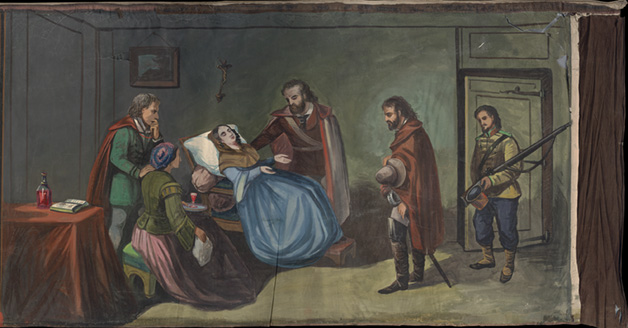
Fig. 9.1 ‘The death of Anita Garibaldi at Guiccioli Farm in Mandriole, near Ravenna, Italy’, The Heroic Life & Career of Garibaldi. A panel from a moving panorama exhibited in Britain in 1861.
[Anne S.K. Brown Military Collection, Brown University Library]
Garibaldi had to leave his wife’s body to be hastily buried by friends on the beach near Ravenna, as the Austrian troops were fast catching up with him and his remaining men.40 Her sandy grave was reputedly so shallow that the corpse was dug up by dogs and found by children. Refusing this gruesome and disturbing scene, Barrett Browning instead folds a beautiful ‘murmurous’ meditation on Anita’s death into her poem:
And now, the sea-weeds fit
Her body, like a proper shroud and coif,
And murmurously the ebbing waters grit
The little pebbles while she lies interred
In the sea-sand.
(II: 685–9, p. 60)
This epitaph for Anita Garibaldi has a secret sharer, perhaps: Barrett Browning wrote these words while she was still ‘dreadfully shocked & affected’ by the news of Fuller’s death.41 Her friend’s body was never recovered from the sea and the second part of Casa Guidi Windows is haunted by Fuller. Barrett Browning seems to have drawn strength and determination from the friendship, and her feminism in this second part of the poem is more marked and confident. Her explicit references to her own pregnancy and to that of Anita Garibaldi both choose the word ‘child’ over ‘baby’, subtly suggesting the succession and growth of a new generation, although in Garibaldi’s case that had been cruelly interrupted. More generally, the second part of Casa Guidi Windows suggests a move towards a more radical inclusion of the biological processes of a woman’s life into the patriarchal political narrative.
In her last letter to the Tribune Margaret Fuller had done something similar. She had addressed a fierce prophecy to the English Times, the Austrian officers and the Catholic Cardinals, all of whom she felt were ‘laughing’ at the fall of the Roman Republic.42 ‘The next revolution, here and elsewhere, will be radical’, she had said; ‘[t]he New Era is no longer an embryo; it is born; it begins to walk—this very year sees its first giant steps, and can no longer mistake its features’.43 She insisted on the ongoing revolution, and that the current pause will only allow for the gestation of a more ‘radical’ and ‘uncompromising’ revolution.44 She used the language of speeded-up developmental biology: this is a child whose rapid growth poses a threat to the counter-revolution. Children never become sentimental or compensatory in the work of Fuller (or, indeed, of Barrett Browning). On hearing of her marriage and child, a friend wrote to Fuller from America, ‘it is still better to give the world this living soul…than a printed book’. But Fuller did not like this sentiment, replying, ‘[i]t is true; and yet of my book I could know whether it would be of some worth or not, of my child, I must wait to see what his worth will be’.45 In the same manner, although Pen Browning, her ‘own young Florentine’, is described at the end of Casa Guidi Windows as the ‘blue-eyed prophet’ (II: 757, p. 62) who brings her hope, Barrett Browning is ultimately unwilling to make her two-year-old into a symbol of anything but himself. First, she creates a weight of religious and mystical symbolism borne by the child with his nimbus or halo of hair lit up by the sun streaming through the windows:
The sun strikes, through the windows, up the floor;
Stand out in it, my own young Florentine,
Not two years old, and let me see thee more!
It grows along thy amber curls, to shine
Brighter than elsewhere.
(II: 742–6, p. 62)
…
Now shake the glittering nimbus of thy hair.
(II: 760, p. 62)
And then she retracts the image, insisting on its merely being an optical occurrence, a trick of the light. A child only needs to represent hope. Not an angel or a cherub or a prophet. Italy—present, real-time Italy—needs to represent nothing but itself, and to remain firm in its faith in itself. Images, symbols, and spectres of revolution or democracy are useless, or worse than useless. ‘But we sit murmuring for the future though | Posterity is smiling on our knees | Convicting us of folly’ (II: 773–5, p. 63). The poet looks down at the lively child wriggling on her lap and decides that ‘[t]he future of Italy shall not be disinherited’.46 She insists that the series of Italy’s great men has not ended with ‘Virgil, Cicero, Catullus, Cæsar…| Boccaccio, Dante, Petrarca |…| Angelo, Raffael, Pergolese’ (I: 176–81, p. 6). These are not the ‘chaplet’s last beads’ (I: 185, p. 6), she assures us, using a characteristically material image. She evokes the long connected human series of generations so that: ‘Your last rhythm will need | Your earliest key-note. | Could I sing this song, | If my dead masters had not taken heed | To help the heavens and earth to make me strong’ (I: 431–34, p. 14). When Barrett Browning had mingled with the celebratory crowds down by the Arno, she had noticed ‘the children of two years old, several of whom I heard lisping . . “Vivas” ’.47 The paralyzed gaze of the Florentine citizens who waved their handkerchiefs and held their children at the windows is contrasted to the child’s gaze, a gaze of pious wonder which ‘fronts the future’: ‘And from thy soul, which fronts the future so, | With unabashed and unabated gaze, |Teach me to hope for, what the Angels know | When they smile clear as thou dost.’ (II: 748–51, p. 62)
Both Barrett Browning and Fuller turn their political writing away from the individual child and towards the idea of biological generation to open up the future for Italy. This is not the sentimentalization of children, but an unleashing of biopower. Barrett Browning’s Christianized serial is stadial:
Children use the fist
Until they are of age to use the brain;
And so we needed Cæsars to assist
Man’s justice, and Napoleons to explain
God’s counsel, when a point was nearly missed,
Until our generations should attain
Christ’s stature nearer. Not that we, alas,
Attain already; but a single inch
Will raise.
(I: 685–693, p. 22)
The ‘single inch’ of ground gained by each generation is critical. In Casa Guidi Windows, historicism can spring the cage of History: the dead weight of Italy’s past can be organized into an unfinished succession and can then be set in motion towards the future. For Fuller, similarly, each generation is a herald of the next, ‘their work unfinished…happy in the thought that there come after them greater than themselves, who may at last string the harp of the world to full concord’.48 Barrett Browning calls on her readers to prepare themselves by their deeds, ‘to be invoked | By future generations, as their Dead.’(I: 248–9, p. 8) There is a collision in the second part of Casa Guidi Windows between a gradualist, Christianized, liberal model of progress and the revolutionary serial: ‘How one clear word would draw an avalanche | Of living sons around her [Italy], to succeed | The vanished generations.’ (I: 197–9, p. 7) The ‘avalanche’ outstrips history as a revolutionary event that breaks through the steady flow, while Christian eschatology promises an eternal end. Barrett Browning collapses together not two but three timeframes in Part Two, the eternal time of Protestant eschatological theology, the revolutionary recalibration of time, and a progressive stadial time. This reflects the contradictions of her own liberal position as, as we have seen, a supporter of Cavour and not of Mazzini, whom she considered ‘a man without conscience’.49 Margaret Fuller’s Christianity was differently diffused through her Boston Transcendentalism. She wrote in her last dispatch from Italy, ‘EMMANUEL begins to be understood, and shall no more so foully be blasphemed. Men shall now be represented as souls, not hands and feet, and governed accordingly.’50 Fuller, like Emerson, was comfortable in a dematerialized prophetic mode, while Barrett Browning tended to harness her abstractions to the material world. While she adopted some of Fuller’s ‘atmosphere’, as she called it, in Part Two of Casa Guidi Windows, Barrett Browning continues to build solid houses, tabernacles, and dwelling places for her verse. As we saw in the last chapter, the poem ends with prophecy materialized in the unfinished ‘fane’, or temple, which she prays will be one day be completed with ‘pillared marbles rare’ and ‘generous arches’ (II: 778–9, p. 63). After the publication of Casa Guidi Windows, Barrett Browning’s politics continued to radicalize through the 1850s. This shift in her thinking was partly a result of her entry into the community of republican patriot artists and writers in Florence, many of whom had fought in the battles of 1848, and would fight again in the Second War of Italian Independence in 1859.
Barrett Browning was delighted to be invited into Italian artistic circles, and her understanding of the political situation in Italy deepened as a result of this new exposure. ‘[T]he Florentine review (Italian) has been praising my last book in an unwise manner, I fancy . . lifting to the skies my “politics & poetry,” Henrietta,!! as a “poema stupenda” [sic].’51 Barrett Browning’s ‘wonderful poem’, Casa Guidi Windows, was published in London by Chapman & Hall on 21 May 1851 and Le finestre di Casa Guidi was immediately reviewed in Italian and welcomed enthusiastically in Florentine intellectual, artistic, and political circles.52 By 1858, the Brownings appear to be thoroughly integrated into the progressive social scene in Florence: ‘We go on most saturdays [sic] to Madame Peruzzi’s receptions’, writes Barrett Browning, for example.53 This social world of Florence was far from small or provincial; on the contrary, it was internationally networked. Emilia Peruzzi had lived in Paris and had been a close friend of Chopin’s. Another of the salonnières close to the Brownings, Margherita Albana Mignaty, was the Italian political correspondent for Dickens’s paper, the London Daily News. Mignaty was also a close friend of the Italian historian and positivist philosopher, Pasquale Villari, who became a friend of the Brownings too. When they first encountered him in the late 1850s, he was researching his important book on Savonarola. Villari published a lot of his work in the Rivista Britannica di Firenze where Casa Guidi Windows was first noticed in Italy.54 Barrett Browning recalls an evening in the summer of 1853 that she spent in Villari’s company: ‘Mr Lytton invited us to a bachelor’s party at his villa, to have tea on the terrace. It’s a villa perched high up at Bellosguardo…Our friends were there . . Mr Tennyson, Mr Powers, & Signor Villeri [sic], a Sicilian, one of the most accomplished men in Florence. It was quite cool & enjoyable, & as we consumed floods of strawberries & cream, & the stars pressed out over us to meet the fireflies underneath, we were very sociable & had quantities of interesting & harmonious talk. Nobody struck a discord.’55 The following November, she found herself to be one of the bachelors: ‘fancy my passing the evening before last with Mr. Lytton, Signor Villeri, & Mr Wood,.. Robert being out…in came my male visitors. We have tea & cigars—we talk literature & spiritualism– “A delightful evening”, said Mr. Lytton at eleven o’clock when we broke up. I think I shall send Robert out another time.’56 The tone of these evenings is casually bohemian and the talk is loose but serious, of literature, politics, and art. Another historian, busy translating Thomas Babington Macaulay’s History of England into Italian when the Brownings first met him, was ‘Signor Paulo Emilio Guidicci [sic], a literary man, who comes at coffee time very often & exercises our Italian’.57 He may have been a ‘literary man’ but like many of the Italian writers and artists in this circle, Giudici had also fought against the Austrians in 1848.
The Macchiaoli Painters in Florence
Casa Guidi Windows and Macchiaioli paintings employ architectural and interior space to model the problematics of entering into a new social state. Both literary and visual artists seem to be reaching for new idioms for the interruption of historical time by revolutionary time, and for the blurring of the vanquished past and the possible future from the vantage point of a domestic present which represents a temporary exile rather than a retreat. The Brownings were far more interested in contemporary artistic practice and the discussions of aesthetics among Italian painters than has previously been noticed. An Anglophone focus on their friendships with Hiram Powers, Horatio Greenough, and Harriet Hosmer has homed in on Barrett Browning’s interest in neoclassical sculpture, and, for example, on her ekphrastic sonnet on Hiram Powers’s The Greek Slave (1850).58 But the Brownings spent time with Italian artists too. Margherita Mignaty’s Greek husband, Giorgio, became Robert Browning’s drawing tutor, and Barrett Browning told her sister they worked on life drawing together: ‘[Robert] is drawing a hand beautifully– He goes twice a week to M. Mignaty, to see him draw from a nude model,—a man,—& the advantage is great, Robert says.’59 The relationship seems to have been both professional and personal, as Mignaty is often mentioned visiting Casa Guidi in the evenings along with Hiram Powers and others of the American artist set in Florence.60 It was, of course, Mignaty who painted Casa Guidi’s drawing-room as a memento for Robert when he was about to ‘go away, break up everything; go to England’ after his wife’s death in 1861.61 Mignaty knew the art critic Diego Martelli and the Macchiaioli painters, including Michele Gordigiani. In 1858, Barrett Browning reported that ‘Gordigiani is repainting my picture & this time it will be like, they say. When I say repainting, I mean on the same canvass [sic], but not a line or colour is left the same.’62 Gordigiani is one of the artists who appears in a famous 1860s caricature by Adriano Cecioni of The Caffè Michelangiolo. Another prominent Macchiaiolo, and the group’s principal historian, Telemaco Signorini records that by the spring of 1849, the Caffè Michelangiolo in Via Larga ‘gathered almost all of the painters who had participated in the campaign of Lombardy in 1848 and in the defense of Venice, Bologna, and Rome in 1849’.63 The Macchiaioli were officially founded by the artists Silvestro Lega and Giovanni Fattori in 1861, the year in which Barrett Browning died, but they had already been active as a group throughout the 1850s.64 And throughout the 1850s, the Macchiaioli painters and Barrett Browning were engaged in a similar or even a shared project of finding an aesthetic for new political experience in Italy.65
Barrett Browning’s portraitist Michele Gordigiani had studied in Florence and in Paris with Silvestro Lega, one of the most important of the Macchiaioli artists. While the group was influenced by the French neoclassical political painters of the Revolution, David and Ingres, they also took their Florentine heritage very seriously and the mature Macchiaiolo style owed much to the study of Quattrocento painting in Florence and elsewhere in Tuscany, especially to the peculiar quality of time-suspense they found in the frescoes of Giotto and Piero della Francesca and the paintings of Paolo Uccello. The Macchiaioli were staunch republicans, much more so than the Barrett Browning of the early 1850s, who—as mentioned earlier—was suspicious of Mazzini’s uncompromising brand of nationalism, calling him ‘Mazzini the unscrupulous, who would crush the world inclusive of his friends & his enemies, under the chariot wheels of his One Idea, rather than it should swerve an inch . . ready to use the assassin’s knife at any moment’.66 Lega would remain faithful to Mazzini to the end and painted the eulogistic Giuseppe Mazzini on his Deathbed in 1873. The Italian revolutionary attempt continued through the 1850s in a spluttering and painful series of efforts. After Garibaldi’s expedition in 1860, when Italian unity was made against Mazzini’s and Garibaldi’s Jacobin and republican ideas, the Macchiaioli retreated to a small village just outside Florence’s city walls, Piagentina.67 Here they produced mainly paintings of domestic interiors. But these are not the traditional genre paintings that they might first appear to be.
Macchiaioli Windows
A striking feature common to much artistic work in Europe which attempts to represent the events of 1848 is the placing of women in interiors by windows, doors, and gates, or on balconies. In novels in German written about the revolutions of 1848, for example by Louise Otto and Fanny Lewald, the ‘women view what little of the events they can see from windows, doorways, or gates; likewise, the novels’ narrators stay with them and do not progress on to the field of action’.68 The women in Macchiaioli pictures of the early 1860s similarly are depicted ‘torn between confinement and new, innovative activity, frustrated on the one hand and exalted on the other’.69 Neoclassicism and history painting were no longer sufficient to give form to the urgent and very modern affect of contemporary political experience. Discussing Jean-François Millet’s painting Les Botteleurs de Foin (Men and Women Trussing Hay, c.1850) as an example of Millet’s move from classicism to realism in the context of 1848, T. J. Clark brilliantly suggests that ‘[i]t imposes the sublime upon the ordinary without finding it there’.70 This effect of doubleness is there in the Macchiaioli paintings, too. Just as Barrett Browning refused to make Pen symbolic of anything but himself in Casa Guidi Windows, but nevertheless insisted on the historical and political importance of coming generations, these paintings refuse any conventional sentimentalization of their subjects: indeed they even insist on their ‘banalizzazione’ [banalization].71 Nevertheless, they suggest that these ‘banal’ domestic scenes have historical meaning, just as Barrett Browning did in her poem. Telemaco Signorini could be speaking of Casa Guidi Windows, and the poet’s refusal to ‘croon the dead or cry | “Se tu men bella fossi, Italia!” ’ (I: 167–8, p. 6) when he announces that ‘[m]odern art…must reproduce the character of contemporary feelings and customs consonant with the epoch of the Risorgimento, and not displace to dissimulate these observations by deferring to the past’.72
Given the commitment of these artists to the Italian republican cause, it is impossible to understand their work as anything other than political. The older artists had fought in 1848 and 1849, and in 1859 Odoardo Borrani, together with Telemaco Signorini and Adriano Cecioni and the writer Diego Martelli, had enlisted in a Tuscan artillery unit fighting in the Lombardian campaign against the Austrians. Giuseppe Abbati lost his right eye in the 1860 Battle of Capua fighting with Garibaldi’s mille (the thousand), or the ‘redshirts’, in Sicily. After Garibaldi’s campaign, Mazzinian republicans felt betrayed by the unification project engineered by Barrett Browning’s hero Cavour, and from the outskirts of Florence they began to paint rural and domestic subjects. In 1865, Cavour moved the capital of Italy from Turin to Florence, where it remained for five years, until Rome became part of the new Italian state. This made the Macchiaioli’s self-exile from the city even more explicit as an act of dissent. The distance from Florence is therefore both spatial and temporal: a mapping of space onto revolutionary time. These domestic scenes represent a revolution that had been suspended and interrupted. Windows feature often, offering blocked and partial views, simultaneously connecting inside and outside and obscuring public space. The artists paint about the feeling of being pushed to the margins of the city and being forced inside and off the streets. The home becomes a place not just of patient political waiting but also of active political preparation.
Odoardo Borrani’s Il 26 aprile 1859 in Firenze (1861) [Fig. 9.2] is a picture about political preparation, and the work done in private for the remaking of the public. The title refers to the day before the Tuscan ‘rose-water’ revolution, and the picture shows a well-dressed young woman, a Florentine citizen, ‘[i]n a small attic room’.73 La nuova Europa described her as ‘seated on an arm-chair intent on threading a needle in order to sew a tricolor flag: Her gracious figure, the simplicity and the exquisite taste of her clothing, the work table, another completed flag, a window through which is perceived a neighbourhood roof below, are so masterfully illuminated that the surface of the canvas disappears and in its place we see a lovely stereoscopic view’.74 In that ‘stereoscopic view’, the spire of one of Florence’s important churches is just visible, as a smudge on the horizon, hinting at the piazza below and the public space of revolutionary political activity. Borrani’s picture was a great hit at the September 1861 Esposizione Nazionale in Florence, and he followed it in 1863 with Le cucitrici di camicie rosse (The Sewers of Red Shirts) [Fig. 9.3], another picture painted in ‘exile’ at Piagentina. The picture shows a group of four women in a bourgeois sitting room sewing red shirts for Garibaldi’s military campaign. Again, the painting features a large window prominently placed in the composition, but this time it is entirely screened with fine white curtains, exquisitely fringed, so that there is no view outside, and only a quiet claustrophobia inside. The lack of view creates a suspended, almost timeless, atmosphere, but this is belied or contradicted by the curtain pole which is made in the form of an arrow.75 This connects the domestic space with military action and challenges the stasis of the scene with a strong sign of a swift, forward-directed movement. A portrait of Garibaldi, a framed print of the Piazzetta in Venice, showing the Palazzo Ducale and San Marco, and, just visible to the left of the room, a framed collage of Garibaldian battles all make the political ideology more explicit. Venice and the Veneto had been left under Austrian rule by the Treaty of Villafranca of 1859, so were not yet part of a unified Italy: as Barrett Browning wrote, ‘[w]hat weighs on my heart is Venetia’.76 The pictured picture also perhaps references the Venetian Republic of San Marco of 1848–9. The real ‘windows’ of the room are the pictures on its walls which show glimpses of the ongoing struggle. Outside, there is nothing to see, as the struggle is temporarily suspended, but work is under way for its resumption as the women are busy sewing. This is the time in between. By the time the picture was painted, Garibaldi had abandoned the red shirt: so this is another picture of the past, a remembered revolution that never actually happened, or has not yet happened.

Fig. 9.2 Odoardo Borrani, Il 26 aprile 1859 in Firenze (1861).
[Alinari Archives, Florence]

Fig. 9.3 Odoardo Borrani, Le cucitrici di camicie rosse (1863).
[Alinari Archives, Florence]
Albert Boime says, ‘Borrani’s glimpses of feminine participation in the Risorgimento yield an unexpected insight into the way political life intruded into the ordinarily solemn sanctuary of the Italian family’; but this is a misunderstanding of the republican idea.77 Certainly, the enfranchisement of women was part of the radical republican programme, and Boime is right that ‘[u]ntil now this factor has not been given the attention it deserves’.78 But the Macchiaioli painters did not see political life as ‘intruding into’ domestic space. Instead, they saw it as emerging from that space. In Silvestro Lega’s Canto di uno stornello (The Singing of a Ballad) (1867) [Fig. 9.4], for example, also painted at Piagentina, three young women are gathered around a piano by a window, singing a folk song of the people, or stornello, with a nationalist theme. The models for the painting were Virginia, Maria, and Isolina Batelli, the three daughters of Spirito Batelli, the son of Vicenzo Batelli, who had been the editor of the Antologia di Vieusseux, a series of publications that had been crucial to the transnational European revolutionary cause in the 1820s. These are, therefore, three educated and radical young women, and their home is not a ‘solemn sanctuary’ but a site of political mediation. Again, a window is prominent in the composition, and a panoramic view of the surrounding countryside is visible. The view of Florence across the fields is vague, and the blurriness of Florence contrasting with the sharpness of the interior creates a temporal grammar for the picture. The view from the window is a view of what should or might have been, and of what might yet come to be.79 The present is the window onto the past and the future. And the future is indicated in the song wafting towards Florence across the fields, and in the genealogy of this rising generation of the revolutionary Batelli family. The past is encoded in the painting’s ‘Quattrocento’ composition. Discussing Canto di uno stornello, Norma Broude directs us to Luca della Robbia’s Singing Boys (1431–8) and Piero della Francesca’s The Queen of Sheba Discovering the Wood of the True Cross (c.1452–7), both Tuscan Renaissance works admired by the Macchiaioli.80 The influence of Piero della Francesca was particularly powerful for the temporal resonance of these images. As Carlo Ginzburg suggested of Piero’s Flagellation of Christ (c.1455–60) with its curious bipartite composition:

Fig. 9.4 Silvestro Lega, Canto di uno stornello (1867).
[Alinari Archives, Florence]
The representation of different levels of reality within the framework of a single pictorial entity (a painting or a fresco-cycle) is common in European art from the fifteenth century onwards…artists…came to make use of a variety of means—from grisaille to light-effects—to depict the gap between reality and fiction, or between natural and supernatural reality. In the Flagellation, Piero not only employed different light sources; he also used perspective…[this was] a deliberate expressive choice.81
Lega and the Macchiaioli made similarly deliberate expressive choices using light and perspective, choices which allowed them to reconceive of the domestic interior as a virtual platform for windows out of the present and into different times, close to Quattrocento pictorial representations of dreams and prophecies, but also anticipatory of ‘contemporary hypermediacy…in which representation is conceived of not as a window on the world, but rather as “windowed” itself—with windows that open on to other representations or other media’.82 The picture itself is a window which opens other windows in a perforated version of political time aesthetically similar to that of Casa Guidi Windows.83
Macchiaioli pictures directly and deliberately open portals through other media: through representations of paintings, prints, books, newspapers, texts, and pamphlets. These are the hypermedia links of an analogue and paper rather than a digital age. The portals that puncture the temporality of these paintings open into a literate public sphere which at the time of painting was fragile and largely imaginary.84 These paintings signal the work to be done in preparation for the new republic. Accordingly, the home is not always a literate space, and scenes of intergenerational education and interclass encounter inscribe boundaries yet to be overcome. Borrani’s 1869 L’analfabeta (The Illiterate Woman) [Fig. 9.5] has been read as a riposte to Pietro Magni’s highly sentimentalized sculpture Leggitrice (Girl Reading) (c.1861) which had proved immensely popular at the Esposizione Nazionale of September 1861.85 In Borrani’s picture an illiterate servant stands by an open window in a comfortable ‘piccolo borghese’ interior and dictates a letter to her literate mistress. The window is at an angle, heavily curtained with flowered chintz, and presents no external view. The views—as in Odoardo Borrani’s Le cucitrici di camicie rosse above [Fig. 9.3]—are, rather, on the wall, where Signorini’s recent painting Case rustiche (Rustic Houses) (c.1866) is hanging, showing a block of sunbeaten and shabby houses in the countryside. The folding of these poor dwellings into the bourgeois interior creates a kind of hypermedia link through a window into another economic and political reality, which is nevertheless vitally connected to the world of the picture.

Fig. 9.5 Odoardo Borrani, L’analfabeta (1869).
[Alinari Archives, Florence]
Interrupted Serials
‘We flourish in the air of revolution, & are in the highest spirits’, wrote Barrett Browning excitedly to her sister-in-law in 1859 from Rome, where the Brownings were ‘wintering’ to avoid the freezing Florentine weather.86 The Italian revolution had restarted, or perhaps was continuing its serial progress: ‘“[i]t is forty eight over again with matured actors.” But it is even more than that: it is forty eight over again with regenerated actors.’87 Either way, the Brownings were excited at the start of the Second Italian War of Independence in April 1859.88 That spring, and the next, their Roman apartment became a kind of Risorgimento reading room as their Florentine friends supplied them with patriotic Tuscan newspapers, journals and ‘all the placards & pamphlets’ that were banned in Rome.89 ‘I have real & physical palpitations of the heart over the newspapers’, said Barrett Browning, but she was clearly enjoying herself, mixing with politicians and diplomats in Rome.90 She worked hard through her contacts in London to get Italy’s position discussed fairly in the anti-French English newspapers.91 When the Brownings returned to Florence and Casa Guidi at the end of May, they immediately ‘put up three flags on our terrace—two large ones—one with the Italian tricolor & one with the French’, and the third was ‘a moveable little flag between them’ for Pen to take out and wave on carriage rides.92 More materially, they paid a fairly substantial monthly subscription to help fund the war, which was arranged by Giovan Pietro Vieusseux through Vieusseux’s reading rooms.93
The end of the war brought with it a shock: the Villafranca Armistice of July 1859 left Venice and the Veneto under Austrian control, while Rome and the Papal States remained under papal control with a garrison of French troops. Browning was speaking for many Italians when she cried, ‘[t]he disappointment, when we were looking forward to absolute triumph & emerging from Austrian influence, struck cruelly’.94 Writing to her Italian friend Villari, she exclaimed that ‘[i]t was as if the stars fell out of heaven like snow, while we were calling them stars & spheres’.95 The disappointment made her ill and feverish and she suffered nightmares of ‘unending lists of provisional governments’.96 But unlike Villari, she was prepared for compromise. By an effort of will, she ‘recovered my faith…& my hope with it’, and by October, she was celebrating the gains for Florence: ‘our political life is now . . real, vivid, unhindered!…And how striking the growth of this people since 1848.’97 Her eight Poems before Congress, which are documents of defiant hope, were published in March 1860. ‘A Tale of Villafranca’ remakes that disaster into the mere postponement of a great and coming event. ‘Italy and the World’ calls on Italy to prefigure ‘one confederate brotherhood’ of nations.98 She draws together American slavery and the Civil War in America and the Italian cause in this collection. The outraged conservative British press accused her of ‘denationalized fanatic protests’.99
Poems Before Congress: Denationalized Nationhood
Poems Before Congress (1860) represents the most radical example of Barrett Browning’s art: a furious mobilizing of female sexuality and biological destiny into a powerful and violent curse on inaction and complacency in the face of atrocities and repression. She had produced several poems about American slavery since her arrival in Italy. ‘The Runaway Slave at Pilgrim’s Point’ was written in Pisa just after her elopement in 1846. A ‘deeply transatlantic text’, it was published in America in the 1848 volume of The Liberty Bell, a gift annual bound in ‘embossed leather’ with ‘gilded edges’. The annual was compiled from 1839 to 1858 by abolitionist Maria Weston Chapman to be sold at the Boston Female Anti-Slavery Society’s Christmas bazaar.100 Barrett Browning’s poem revolves around an infanticide by a black slave who has been raped and impregnated by her white master. In the poem, Barrett Browning focuses boldly on the sexual abuse and violence sanctioned by the system of slavery, braiding her feminism together with her sense of the embedded racial structure of global oppression.101 Despite its ‘falling, swooning’ speaker, the poem stages a remarkable refusal of the conventional sentimental rhetoric of abolitionism, ending with the black woman’s ‘disdain’: ‘White men, I leave you all curse-free | In my broken heart’s disdain!’102 Still, this poem ends ‘curse-free’, unlike her later contribution to The Liberty Bell of 1856, ‘A Curse for a Nation’ which hisses and bristles with curses and ends with the emphatic imperative: ‘THIS is the curse. Write.’103 Revised and reprinted in Poems Before Congress, it caused some consternation as critics were unsure if it was addressed to the American Congress, or to England about the enslavement of factory workers and child workers in Britain and the British failure to support the Italian cause, or to Austria about the enslavement of Italian people.104 In fact, Barrett Browning addresses all of these, as a connected series of national oppressions. The poem starts with the poet professing herself unable to curse America for its sin of slavery, because of her ‘own land’s sins’: ‘My heart is sore | For my own land’s sins: for little feet | Of children bleeding along the street’ (p. 60). It is only when she is able to free her voice from the shackles of nationhood that she is able to curse ‘from the depths of womanhood’, because womanhood, unlike nationhood, is a transcendent universal category. ‘A Tale of Villafranca. Told in Tuscany’, opens with an echo of Casa Guidi Windows:
My little son, my Florentine,
Sit down beside my knee,
And I will tell you why the sign
Of joy which flushed our Italy,
Has faded since but yesternight.105
(p. 26)
But, as Barrett Browning herself said, ‘[t]hings have refined since 48 and 49’, and the child is growing, sitting beside her now and listening to her political explanations, no longer wriggling on her lap.106 Katherine Montweiler suggests that in Poems Before Congress, Barrett Browning creates ‘political metaphors’ out of ‘the themes of betrothal, caring for children, and nursing the dying as they relate socially to women’s lives’. For example, the woman from Milan in ‘A Court Lady’ tours the hospital bedsides of dismembered sons of a dismembered Italy: one from Lombardy, one from Piedmont, one from Venetia, one from France, and so on. The allegory is clear, but the woman also surely recalls both Fuller and her Milanese friend Principessa Cristina Belgioioso, and their tireless work in the hospitals of Rome during the siege of 1849.107 And this connection is significant. It asks us to read these political poems not as political ‘metaphors’ drawn from women’s lives, but as women’s political lives. In Poems Before Congress, Barrett Browning boldly extends the category of the ‘political’ to include women’s experience.
Margaret Fuller’s dispatches from Europe had always appeared on the front page of the New York Tribune, and it was possibly Fuller’s posthumous influence that prompted Barrett Browning to first publish many of the poems that later appeared in Poems Before Congress on the front page of the New York Independent.108 Not only was Barrett Browning publishing in a newspaper, but she was also now writing in a sharper and more journalistic register. Alison Chapman has also noticed this, describing Barrett Browning’s new ‘hybrid voice based on reportage, suggesting an important and dynamic new alliance between verse and the new media’.109 But Barrett Browning’s late verse is less ‘allied’ with the new communications media than it is critical of the violence latent in such technologies, which she identifies with the technologies of war. ‘Mother and Poet: Turin, After News from Gaeta, 1861’ (1861) was written about Olimpia Rossi Savio, a poet and writer from Turin, who lost both her sons (the ‘brave civic Pair’ of the poem) in the Italian wars of Independence: Alfredo in 1860 and Emilio in 1861. In the poem, the mother-poet asks, ‘What art can a woman be good at? Oh, vain! | What art is she good at, but hurting her breast | With the milk-teeth of babes, and a smile at the pain?’(III, ll. 11–13) Focusing on the pain of birth and breastfeeding, and the suffocating neediness of her baby sons, ‘their arms round her throat, | Cling, strangle a little!’(IV, ll. 17–18), the poem rewrites motherhood as a process of bodily damage. After her first son’s death, her second son’s letters get shorter: ‘letters still came, shorter, sadder, more strong, | Writ now but in one hand’ (X, ll. 46–7), and it is not long before, ‘without pause, up the telegraph-line | Swept smoothly the next news from Gaeta: —Shot’ (XII, ll. 56–7). Compressed, ‘without pause’ and ‘smoothly’ the news shoots home in four short telegraphic words, ‘Shot. / Tell his mother.’ (XII, ll. 57–8) The poet-mother holds back from poetical metaphorical utterance, refusing to ‘sing’ at the nationalist feasts, as language has betrayed her and her boys died with ‘no last word to say!’ (XIV, l. 70)110 ‘Mother and Poet’ was first published in the New York Independent with the editor’s note, ‘[t]he following magnificent poem will find an echo in a hundred thousand mothers’ hearts to-day, whose sons are now on the battle-field of their country, fighting for liberty in America, as Mrs. Browning’s heroes are fighting for liberty in Italy. God bless the woman who moves two nations with one song!’111
Henry James noticed the new style, but felt that Barrett Browning had committed ‘the unpardonable sin’ in these poems of allowing her love for the cause of Italy to ‘let down, as it were, her inspiration and her poetic pitch’.112 He is right that Barrett Browning has ‘let down’ her ‘poetic pitch’; but she did this in the most controlled and deliberate way, eschewing sentimentalism and metaphoric language and reaching instead for a ‘universal’ lexicon that is internationally intelligible, and not ‘local’. After 1848, she is always addressing at least ‘two nations with one song’. As she says in the preface to Poems before Congress, ‘[i]f the man who does not look beyond this natural life is of a somewhat narrow order, what must be the man who does not look beyond his own frontier or his own sea?’113 She is not a man, and she refused such narrowness. In April 1861 she linked the Italian nationalist cause directly to the news of the abolition of serfdom in Russia, and added, ‘[n]ever can America admit a compromise on slavery, in the face of that action’, suggesting the emergence of a global social conscience that will regulate the actions of nations.114
And Heptarchy patriotisms must follow.
-National voices, distinct yet dependent,
Ensphering each other, as swallow does swallow,
With circles still widening and ever ascendant,
In multiform life to united progression, -
(p. 57)115
Barrett Browning’s ‘Heptarchy’ in ‘Italy and the World’ differs from Clough’s ‘isopolity’ in that Clough imagined equally balanced rights between two states. Barrett Browning’s is a more dynamic and mobile model of a flock of swallows wheeling upwards in a gyre formation that is almost Yeatsian, albeit more optimistically progressive. This is specifically the political serial aesthetic of 1848, in which ‘multiform’ nations can ‘ensphere’ one another in generous mobile loops, moving onwards, united in mutual progress.116
On 18 February 1861, Victor Emmanuel assembled the deputies of the first Italian Parliament in Turin. On 17 March, the Parliament proclaimed Victor Emmanuel King of Italy, and on 27 March Rome was declared the capital of Italy, even though it was not yet part of the new kingdom. Barrett Browning was cautiously optimistic, in April she wrote, ‘my Italy goes on well’.117 On 6 June, one of her heroes, Cavour, died. His last words were reported to be: ‘Italy is made. All is safe.’118 ‘A hundred Garibaldis for such a man’, Barrett Browning sighed.119 Barrett Browning died three weeks later at 4.30 a.m. on 29 June. Her husband reported her last word to be ‘[b]eautiful’.120 Twenty-five years later, in 1886, Frederick Douglass would make a pilgrimage to Barrett Browning’s grave in Florence, to pay homage to one whose ‘soul…was devoted to liberty’.121
If 1848 saw an unmaking and remaking of conventional forms, Casa Guidi Windows and the paintings of the Macchiaioli share an attempt to interrogate the limits of the aesthetic under the urgent pressure of contemporary politics. These works are potent examples of how ‘a struggle against the dominant discursive conventions in a culture is bound up with attempts to break or circumvent the forms in which those conventions are embedded’, in the words of T. J. Clark.122 Barrett Browning’s attempt to break and circumvent given forms intensified in the 1850s, and Poems Before Congress represents her most extreme attempt to cast aesthetic form as political praxis. The domestic interior took on a powerful and new significance in all these works. Classical and conventional symbolism, neoclassicism, and appeals to history were all tried on, found to be inadequate, and cast off and abandoned. In verse and in paint new temporal grammars had to be built. The rhetoric of realism is ‘written across the age and across Europe in its politics, literature and painting’.123 At home, but never fully at home, passionately engaged with politics, ‘democratical as I am, & unEnglish as I am said to be’, Elizabeth Barrett Browning’s Casa Guidi Windows and Poems Before Congress limned the outlines of a transnational ‘realism’ which was developing across Europe, in German novels, in the paintings of the Macchiaioli, and in Courbet and Millet’s painting in France.124 Realism itself was, in other words, a serial and mobile form.
1 G. K. Chesterton: ‘[t]hese old political poems of [Barrett Browning’s] are too little read today; they are amongst the most sincere documents on the history of the times, and many modern blunders could be corrected by the reading of them.’ G. K. Chesterton, The Victorian Age in Literature, pp. 177–8.
2 EBB to H. F. Chorley (28 Via del Tritone, Rome: May 2 [1860]), EBB Letters 2, pp. 380–3, p. 383.
3 See Elizabeth Barrett Browning, Aurora Leigh and Other Poems, ed. John Robert Glorney Bolton and Julia Bolton Holloway (London: Penguin, 1995), p. 508.
4 In 1859, the Brownings remained committed to both the cause and ‘The Tuscan Funds…we shall not sell out in a hurry—we shall hold on—& funds like peoples, will rise again…nobody lost funded money in 48, except by their own folly & fears,—by prematurely “realizing,” as it is called.’ EBB to Arabella Moulton-Barrett (43. Bocca di Leone. March 29– [–31] [1859]), The Brownings’ Correspondence, 26, pp. 103–8.
5 Frances Power Cobbe, Italics: Brief Notes on Politics, People, and Places in Italy in 1864 (London: Trübner and Co., 1864), p. 392.
6 EBB to Mary Russell Mitford (1 December 1849), EBB Letters 1, pp. 427–30, p. 428 (emphasis original). Barrett Browning probably started writing Part Two of the poem in the autumn of 1849, but the bulk of the work took place in the autumn of 1850.
7 EBB to Miss E. F. Haworth (Rome 28 Via Tritone: Friday [winter 1859]) EBB Letters, pp. 354–7, p. 356.
8 MF, Dispatch 34, Sad But Glorious, p. 311.
9 Elizabeth Barrett Browning, Casa Guidi Windows, ed. Markus, p. 101, nn. 95–7.
10 EBB to Arabella Moulton-Barrett ([Florence] April 8.–16. [1849]), The Brownings’ Correspondence 15, pp. 246–55, p. 249.
11 ‘Robert &. I have had some domestic émeutes [riots], because he hates some imperial names’: EBB to Julia Martin (138 Avenue des Ch. Elysées. Decr– [1851]), The Brownings’ Correspondence 17, pp. 187–9, p. 189. Wiedeman was the child’s paternal grandmother’s maiden name, and she had died in England a week after his birth without knowing of it, which only added to Browning’s grief for his much-loved mother.
12 ‘Many critics have suggested that the poet’s pregnant body—in 1847 with the baby she miscarried, or in 1848–1849 with the baby who appears as her two-month-old and then two-year-old son at the end of the poem—is the ultimate symbol for Risorgimento Italy.’ Mollie Barnes, ‘Historical Imagination in Elizabeth Barrett Browning’s Casa Guidi Windows’, Victorian Poetry 54:1 (Spring 2016): 39–65, p. 56. A classic reading is Sandra Gilbert, ‘From Patria to Matria: Elizabeth Barrett Browning’s Risorgimento’, in Angela Leighton (ed.), Victorian Woman Poets: A Critical Reader (Oxford: Blackwell, 1996), pp. 24–52.
13 Richard Bonfiglio, ‘Liberal Cosmopolitanism and the Politics of the Heart(h): Mazzini, Gladstone, and Barrett Browning’s Domestication of the Italian Risorgimento’, Modern Philology 111:2 (November 2013): 281–307, p. 300. See also Beverly Taylor, ‘Elizabeth Barrett Browning and the Politics of Childhood’, Victorian Poetry 46:4 (Winter 2008): 405–27.
14 EBB to Arabella Moulton-Barrett (Florence. June 14 [–15] & 16. [1850]), The Brownings’ Correspondence 16, pp. 140–7, p. 143.
15 EBB to Henrietta Moulton-Barrett ([Florence] Dec 22– [1849]), The Brownings’ Correspondence, 16, pp. 35–41, p. 39; EBB to Mary Russell Mitford (Florence. December 1– [1849]), The Brownings’ Correspondence 16, pp. 28–31, p. 29.
16 EBB to RB (Sunday– [post-mark, 4 January 1846]), The Brownings’ Correspondence 11, pp. 279–83, p. 281.
17 ‘Miss Barrett’s Poems: A Drama of Exile and Other Poems’ New-York Daily Tribune (4 January 1845), reprinted in S. Margaret Fuller, Papers on Literature and Art: Part One (New York: Wiley and Putman, 1846), pp. 22–30, p. 23, p. 24 and p. 28.
18 EBB to John Kenyon (Florence– May 1– [1851]), The Brownings’ Correspondence 17, pp. 23–6, p. 25.
19 EBB wrote: ‘I do not consider the best use to which we can put a gifted and accomplished woman is to make her a hospital nurse. If it is, why then, woe to us all who are artists! The woman’s question is at an end.’ EBB to Anna Brownell Jameson (Florence, February 24 [1855]), The Brownings’ Correspondence 21, pp. 83–6, p. 84.
20 MF to William H. Channing (28 August 1849) MF Letters 5, p. 258.
21 EBB to Henrietta Moulton-Barrett ([Florence] [18–20 November 1848]), The Brownings’ Correspondence 15, pp. 147–61, p. 157 (ellipses added).
22 EBB to Eliza Anne Ogilvy (Siena. September 22 [1850]), The Brownings’ Correspondence, 16, pp. 193–7, p. 197; EBB to Arabella Moulton-Barrett (Florence. June 14 [–15] & 16. [1850]), The Brownings’ Correspondence 16, pp. 140–7, p. 143.
23 EBB to Henrietta Moulton-Barrett ([Florence] 22 December [1849]) The Brownings’ Correspondence, 16, pp. 35–41, p. 39 (emphasis original).
24 EBB was born on 6 March 1806, and MF on 23 May 1810.
25 MF to Emelyn Eldredge Story [c. November 1849], MF Letters 5, pp. 279–80, p. 280. MF added, ‘but Mrs. B. will not be able to go out any more, being again enceinte’. This was another of Barrett Browning’s pregnancies to end in miscarriage.
26 EBB to Eliza Anne Ogilvy (Florence. August 28 [1850]), The Brownings’ Correspondence 16, pp. 179–82, p. 181. Robert Browning confirmed the impression: ‘[t]he child looked lymphatic and short-lived to our apprehension’. RB to John Kenyon (Florence. Aug. 16, ’50), The Brownings’ Correspondence 16, pp. 178–9, p. 179. EBB might well have been writing about Fuller in a letter to Henrietta Cook: “[a] friend of mine here, could’nt, she declared, touch animal food, the whole time of pregnancy—& yielding to her distaste, she lived upon fruit, salads, & such things. Her child is weak & backward, & of a lymphatic constitution, very unfavorably developed.’ EBB to Henrietta Cook (Florence– July 7th [1850]), The Brownings’ Correspondence 16, pp. 153–8, p. 153. If Angelo was a sickly child, it was more likely as a result of his early starvation by his wet nurse at Rienzi.
27 EBB to Margaret Fuller (Palazzo Guidi, [early December 1849]), The Brownings’ Correspondence 16, pp. 31–2, p. 31.
28 Margaret Fuller to EBB (Casa Libri, Thursday 6th December [1849]), The Brownings’ Correspondence 16, pp. 32–3, p. 32; EBB to Arabella Moulton-Barrett ([Florence] [15–16 April 1850]), The Brownings’ Correspondence 16, pp. 98–102, p. 99 (ellipsis original).
29 MF to Marcus and Rebecca Buffum Spring (12 December 1849), MF Letters 5, p. 295; EBB to Arabella Moulton-Barrett (Florence. June 14 [–15] & 16. [1850]), The Brownings’ Correspondence 16, pp. 140–7, p. 143.
30 EBB to Arabella Moulton-Barrett (Florence. June 14 [–15] & 16. [1850]), The Brownings’ Correspondence 16, pp. 140–7, p. 143.
31 ‘dear, brave, noble Margaret Fuller…We loved her, and she loved Ba, coming here oftener as the time for departure approached.’ RB to John Kenyon (Florence, 16 August 1850), The Brownings’ Correspondence, 16, pp. 178–9, p. 178.
32 Frances Boott Greenough (ed.), Letters of Horatio Greenough to His Brother, Henry Greenough (Boston, MA: Ticknor & Co., 1887), pp. 217–18. See RB to John Kenyon (Florence, 16 August 1850), The Brownings’ Correspondence 16, pp. 178–9, p. 179 n. 1. As it turned out, poor weather did not permit the sailing of the Elizabeth, the ship on which the Ossolis had booked a passage, so they had to return to Florence to renew their permit to leave and therefore saw the Brownings one last time before the fatal voyage.
33 EBB to Arabella Moulton-Barrett (Florence. June 14 [–15] & 16. [1850]), The Brownings’ Correspondence 16, pp. 140–7, p. 143 (emphasis original). The inscription in the Bible reads: ‘Robert Wiedeman Barrett Browning | in memory of | Angelo Eugene Philip Ossoli | Florence, 1850 | second year of their lives | God keep them pure both: | and lead them to fulness of love and wisdom!’ On the frontispiece, RB inscribed: ‘Sunday, May 5, 1850’.
34 Altogether, EBB suffered four miscarriages, on 21 March 1847, in mid-March 1848, in late October 1849, and this one on 28 July 1850.
35 The miscarriage was on 28 July 1850, and RB got news of the drowning of the Fuller-Ossoli family on 13 August 1850 (they had drowned on 19 July): Garrett, A Browning Chronology, p. 83. EBB says Robert received the news and tried to conceal it from her because her health was so precarious, but he could not: EBB to Arabella Moulton-Barrett ([Florence] Tuesday. [13 August 1850]), The Brownings’ Correspondence, 16, pp. 175–7, p. 176.
36 EBB to Eliza Anne Ogilvy (Florence, 28 August [1850]), The Brownings’ Correspondence 16, pp. 175–7; EBB to Eliza Anne Ogilvy (Florence August 28 [1850]), The Brownings’ Correspondence, 16, pp. 179–82, p. 181. The baby’s body was the only one of the family that was recovered.
37 EBB reports Pen’s petition for a pet rabbit thus: ‘Hush, and let me speat. You see I have no (what do you call them?) brothers & sisters– I have’nt even a little green fairy, like Mr Patmore’s child’—(she is said to have seen a green fairy.) ‘I am quite lonely– I have a beautiful horse,…yes: but why cant I pet this horse? Because its not alive. I want a live thing. Now, dear mama, I would do anything for you…’: EBB to Arabella Moulton-Barrett ([Florence] [ca. 19 March 1857]), The Brownings’ Correspondence 24, pp. 30–4, p. 32.
38 Dorothy Mermin points out that in CGW, EBB ‘defines herself explicitly as a woman’: Dorothy Mermin, Elizabeth Barrett Browning: The Origins of a New Poetry (Chicago: University of Chicago Press, 1989), p. 163. But it is more accurate to say that she conceals her gender in the first half and displays it in the second. Alison Chapman agrees that ‘[t]hroughout Part 2 the speaker repeatedly signals her gender’: Chapman, Networking, p. 85.
39 Giuseppe Garibaldi da Caprera ad Aspromonte, 1860–61–62. Memorie storiche raccolta da Felice Venosta (Milan, n.d.), pp. 52–3, 375; translated in Lucy Riall, Garibaldi: Invention of a Hero (New Haven, CT: Yale University Press, 2007), p. 161.
40 ‘After Garibaldi’s departure, Anita’s body was superficially and hastily buried in the dunes by friends. They were fearful for their lives and had little time for ceremony. The corpse was soon discovered by children playing on the coast; apparently they saw a hand poking through the sand. These unusual events were drily reported back to police headquarters in Ravenna on 12 August 1849.’ Daniel Pick, Rome or Death: The Obsessions of General Garibaldi (London: Jonathan Cape, 2005).
41 EBB to Arabella Moulton-Barrett ([Florence] Tuesday. [13 August 1850]), The Brownings’ Correspondence 16, pp. 175–7, p. 176.
42 MF, ‘The Next Revolution’ Florence (6 January 1850), Dispatch 37, Sad but Glorious, p. 321. First published as ‘Italy’ in the New-York Daily Tribune Supplement, 13 February 1850, p. 1. Daniel Karlin has discerned ‘a network of children and song in EBB’s work’: Daniel Karlin, Street Songs: Writers and Urban Songs and Cries, 1800–1925 (Oxford: Oxford University Press, 2018), p. 36.
43 MF, Dispatch 37, Sad but Glorious, p. 321.
44 Ibid.
45 Rebecca Buffum Spring to MF, quoted by MF in MF to Marcus and Rebecca Buffum Spring (Florence 12 December 1849), MF Letters 5, pp. 294-298, p. 294.
46 Elizabeth Barrett Browning, ‘Advertisement’, Casa Guidi Windows (London: Chapman & Hall, 1851), pp. v–vii, p. vii.
47 EBB to Arabella & Henrietta Moulton-Barrett (Florence [13 September 1847]), The Brownings’ Correspondence 14, pp. 300–8, p. 301.
48 [MF], ‘The Next Revolution’ Florence (6 January 1850), Dispatch 37, Sad but Glorious, pp. 320–3, p. 323.
49 EBB to Miss Browning ([Rome]: May 11, 1861(postmark)), EBB Letters 2, pp. 440–3, p. 442. Writing about Aurora Leigh, Mary Mullen suggests that ‘[u]ltimately, Barrett Browning contributes to the development of our own formalist methods by suggesting that form can represent the chaotic, disorder of history—its multiple, overlapping temporalities—rather than a progressive, linear history grounded in successive historical time’: Mary Mullen, ‘Two Clocks: Aurora Leigh, Poetic Form, and the Politics of Timeliness’, Victorian Poetry 51:1 (Spring 2013): 63–80, p. 64.
50 MF, ‘The Next Revolution’ Florence (6 January 1850), Dispatch 37, Sad but Glorious, pp. 320–3, p. 322.
51 EBB to Henrietta Cook (138 Avenue des Ch. Elysées Decr 1– [1851]), The Brownings’ Correspondence 17, pp. 175–9, p. 178. EBB slightly misquotes the concluding words of a lengthy notice by James Montgomery Stuart of Casa Guidi Windows that appeared in Scritti Inglesi Sulla Politica Contemporanea (November 1851): 237–77. In fact, Stuart calls it ‘questo stupendo poema’: p. 277.
52 Chapman & Hall published Casa Guidi Windows in an edition of ‘[b]lind-stamped vertically ribbed dark blue cloth, gilt spine, edges uncut’ with ‘primrose’ coloured endpapers: Norman Colbeck (ed.), A Bookman’s Catalogue: The Norman Colbeck Collection, 2 vols (Vancouver: University of British Columbia Press, 1987) vol. 1, p. 95. James Montgomery Stuart also reviewed Casa Guidi Windows in the Revista Britannica di Firenze of June 1851 (pp. 283–5) and again in a much longer review which included lengthy English quotations from the poem explicated in Italian, in the Scritti Inglesi (see n. 51 above). The Rivista Britannica di Firenze was a short-lived Florentine journal first published in April 1851, edited by Sebastiani Fenzi and James Montgomery Stuart. The publication was financed by Fenzi’s Florence banking firm, ‘Messrs. E. Fenzi and Co., Pal. Uguccione, in the Piazza Gran Duca’ (Murray’s Handbook for Travellers in Northern Italy, 1858, part II, p. 519). In the review in Scritti Inglesi, Stuart focuses on Part I of EBB’s work; he had planned to deal with Part II in a continuation, but this second part was never published.
53 EBB to Arabella Moulton-Barrett (Casa Guidi– Monday [Postmark: 27 June 1859]), The Brownings’ Correspondence 26, pp. 203–9, p. 205. Ubaldino Peruzzi was a Florentine politician and writer whose wife, Emilia Toscanelli-Peruzzi, a talented pianist, hosted a musical and political salon. Treves considers that there was very little mixing between the Italians and non-Italians in Florence, but the Brownings do seem to have socialized with Italian writers and artists: Treves, The Golden Ring, pp. 36–7. EBB’s Aurora Leigh was reviewed at length in the Rivista di Firenze: [Anon.], ‘Aurora Leigh: Poema Inglese della Signora Barrett Browning’, Rivista di Firenze 3 (1858): 202–13.
54 Pasquale Villari (1827–1917), Italian historian and statesman, was exiled from Naples in 1848 after being accused of participating in riots against the Bourbon government. Thereafter, he settled in Florence and devoted himself to teaching and historical research in the public libraries. His principal works are La Storia di Girolamo Savonarola e de’suoi tempi (Florence, 1859–61) and Niccolò Machiavelli e i suoi tempi (Florence, 1877–82). He is listed in the Brownings’ address book of this period (AB-3) at 4032 Via dei Fossi and later at 6677 Borgo Pinti. Villari’s essay, entitled Sull’origine e sul progresso della filosofia della storia [On the origin and progress of the philosophy of history] was published in Florence in 1854. In her correspondence, EBB habitually misspells his surname ‘Villeri’. The Daily News published many of the Anglo-Florentines and was exceptionally well internationally connected for a London newspaper: see Chapter 10 of the current volume for more on Dickens’s editorship of the Daily News, pp. xxx–xx. Margherita Mignaty also wrote books on Byron, Shelley, Dante, and Correggio. American author and spiritualist James Jackson Jarves met Margherita and Giorgio Mignaty at Casa Guidi.
55 EBB & RB to George Goodin Moulton-Barrett (Casa Tolomei. Alla Villa. Bagni di Lucca. July 16–17–18– [1853]), The Brownings’ Correspondence 19, pp. 163–71, p. 165 (in EBB’s hand). Frederick Tennyson was Alfred’s elder brother and lived in Florence. He too wrote poetry, and published Days and Hours in 1854.
56 EBB to Arabella Moulton-Barrett (Florence. Saturday. Sunday, Monday– [12–14] Nov. [1853]), The Brownings’ Correspondence 19, pp. 333–42, p. 340.
57 EBB to Henrietta Moulton-Barrett ([Florence] Dec 22– [1849]), The Brownings’ Correspondence 16, pp. 35–41, pp. 38–9. Both the Brownings and Macaulay get the spelling of his name wrong. Paolo Emiliani Giudici took an active part in the revolt against the Austrians in 1848. He was appointed to a professorship at the University of Pisa the following year, but, after three months, he was obliged to give up his chair for political reasons. Soon afterward, he undertook his translation of Macaulay’s History of England, which he published at Florence. See W. T. Bandy, ‘Macaulay and His Italian Translator: Paolo Emiliani-Giudici’, Italica 25:2 (June 1948): 129–30. In 1859 Giudici was appointed Secretary of the Academy of Fine Arts in Florence.
58 Hiram Powers, The Greek Slave (1845) was a great success at the 1851 Great Exhibition in London. EBB wrote the sonnet ‘Hiram Powers’s Greek Slave’ between composing the two parts of Casa Guidi Windows. The sonnet was first published in Household Words on 26 October 1850.
59 EBB to Euphrasia Fanny Haworth ([Florence] [?11] [April 1858]), The Brownings’ Correspondence 25, p. 92. Mignati also had a reputation as an excellent copyist, and the Brownings recommended him to British friends seeking copies of famous paintings in Florence. EBB writes: ‘an artist here, Mr Mignaty [sic], who has already made three copies of the picture in question, will do your work perfectly, at the charge of about ten pounds, or a little beyond. There is another copyist who charges higher prices & presents small advantage otherwise; but if you will trust Mignaty, my husband will see himself, he says, that the copy shall be faithfully made, . . and indeed it will be a real pleasure to him to be of use to you or yours in any slight matter of this kind.’ EBB to Ellen Twisleton (Florence– Jany 27–[1857]), The Brownings’ Correspondence 23, pp. 216–18, pp. 216–17. The ‘picture in question’ was the famous portrait of Oliver Cromwell (‘warts and all’) by Peter Lely (1618–80) in the Pitti Palace: RB to Edward Twisleton (Florence, May 1. ’57), The Brownings’ Correspondence, 24, p. 64.
60 ‘Mr Powers was here last night, & Mrs Crosland, Mr Mignaty (a Greek artist) and Isa Blagden.’ EBB to Arabella Moulton-Barrett (Florence. Novr 7– [1857]), The Brownings’ Correspondence, 24, pp. 208–12. Camilla Dufour Toulmin, afterwards Crosland, wrote poems and novels. A believer in spiritualism, she published her personal investigations in Light in the Valley: My Experiences of Spiritualism (1857). Isabella Blagden (Isa) was a very close friend of both the Brownings. She lived in Florence and wrote poems and prose for Dickens’s All the Year Round, and Fraser’s and the Cornhill Magazine.
61 Browning’s words are recorded by Henry James in Henry James, William Wetmore Story and his Friends, vol. 2, p. 66.
62 EBB to Arabella Moulton-Barrett (Casa Guidi– Monday [Postmark: 27 June 1859]), The Brownings’ Correspondence 26, pp. 203–9, p. 208.
63 ‘[T]he Macchia flourished as an organized and productive movement in Florence for a relatively brief period, approximately seven years, between 1855 and 1862’: Telemaco Signorini, Caricaturisti e caricaturati al Caffè Michelangiolo (Florence, 1952), quoted in Boime, Art of the Macchia, p. 302.
64 In an article written in 1874 Telemaco Signorini describes the visit of three Italian artists to the Paris Exposition of 1855 as the event primarily responsible for the birth of the new aesthetic. Albert Boime notes that the term Macchiaioli was already in use in the mid-1850s but only appears in print in 1862: Boime, Art of the Macchia, p. 101.
65 Mollie Barnes has suggested that EBB’s depiction in Part One of Casa Guidi Windows of the Guardia Civile is ‘Macchiaesque (it is both a landscape and a portrait of the newly formed militia, and lines 446–576 list an almost pointillist catalogue of the faces within the crowds)’, but she does not extend the discussion further, and the Macchiaioli were not pointillists. Mollie Barnes, ‘Historical Imagination’, p. 44.
66 EBB to Eliza Anne Ogilvy ([Florence] [early February 1858]), The Brownings’ Correspondence, 25, pp. 32–7, p. 34 (ellipsis original).
67 The walls are no longer there, and Piagentina is now a part of central Florence.
68 Boetcher Joeres, ‘1848 From a Distance’, p. 604. The article analyses work depicting 1848 by Claire von Glümer, Louise Otto, Louise Aston, and Fanny Lewald. In Louise Otto’s novel, Sabine observes at least some of the approaching battle from her window (I, chap. 6). In Lewald’s novella, [The Third Estate] Marie accompanies Anton—but only to the gate of the town (159). As an echo of this limitation, Gottfried Kinkel’s Sabine also does not accompany her Valentin beyond the edge of the village as he heads off to battle (447).
69 Boetcher Joeres, ‘1848 From a Distance’, p. 614.
70 Clark, Absolute Bourgeois, pp. 72–3. Clark argues that the only French art that really speaks to 1848 is the ‘undercover’ art of Millet, Daumier, Delacroix, and Baudelaire.
71 Silvestra Bietoletti describes the ‘esplicita contemporaneità del soggetto, nella sua “banalizzazione” depurata da ogni inflessione aneddotica’ [the explicit contemporaneity of their subjects, in their ‘banalization’ they are purified of every suggestion of narrative]: Silvestra Bietoletti, ‘Pittura di Storia Contemporanea’, in Fernando Mazzocca and Carlo Sisi (eds), I Macchiaioli: prima dell’impressionismo (Venice: Marsilio Editori, 2003), pp. 137–63, p. 152.
72 ‘X’ [T. Signorini], ‘Del fatto e del da farsi nella pittura’, La Nuova Europa (2 August 1863), quoted in Albert Boime, Art of the Macchia, p. 97. This represents an active rejection of the Byronic Romantic lament on a defeated Italy, ‘Se tu men bella fossi, Italia!’ ” or ‘Italy: less miserable if less fair’.
73 Theodosia Garrow Trollope, Social Aspects of the Italian Revolution, in a Series of Letters from Florence [1861] (New York: AMS Press, 1975), p. 2. Denis Mack Smith says that ‘[t]he morning of 27 April 1859 was a turning point in Tuscan history, for it was then that the ancien regime was overthrown’: Denis Mack Smith, Victor Emanuel, Cavour and the Risorgimento (Oxford: Oxford University Press, 1971), p. 113. For Albert Boime’s discussion of the picture, see Art of the Macchia, p. 188. [Anon.], ‘La Espozione’, La Nuova Europa (2 February 1862), translated and quoted Boime, Art of the Macchia, p. 189.
74 [Anon.], ‘La Espozione’, La Nuova Europa (2 February 1862), translated and quoted Boime, Art of the Macchia, p. 189. For a discussion of this picture in the context of visual technologies, see Kate Flint, ‘Dickens, Mid-Nineteenth-Century Italy and Visual Modernity’, in Catherine Waters, Michael Hollington, and John Jordan (eds), Imagining Italy: Victorian Writers and Travellers (Newcastle Upon Tyne: Cambridge Scholars Publishers, 2010), pp. 195–215.
75 Silvestra Bietoletti tells us an identical design of curtain pole is mentioned in Gustav Flaubert’s Madame Bovary (1857): Bietoletti, ‘Pittura di Storia Contemporanea’, p. 155.
76 EBB to Anna Brownell Jameson (Villa Alberti, Siena: August 26 [1859]), The Brownings’ Correspondence 26, pp. 264–8, p. 267.
77 Boime, Art of the Macchia, p. 265. Boime describes Le cucitrici di camicie rosse somewhat anachronistically as ‘a kind of feminist collective’, p. 266.
78 Boime, Art of the Macchia, p. 255.
79 Odoardo Borrani’s La Mia Terrazza, Firenze [My Terrace, Florence] (1865) shows a woman looking out over the rooftops of Florence from a roof-terrace which offers a distant and obstructed view of Brunelleschi’s famous dome.
80 Broude, The Macchiaioli, pp. 164–5. The Macchiaioli artists were all classically trained in the Florentine Art Academy, particularly Lega. Fernando Mazzocca records that the German art historian Aby Warburg, on first seeing Lega’s Un dopo pranzo (Il pergolato) e La visita ‘avevano sopratutto colpito le affinità, non con il misticismo nazareno e altre cose del genere, ma direttamente con le predelle del Quattrocento toscano’ [he was struck above all by their affinity, not with the mysticism of the Nazarenes and other things of that kind, but directly with the predelle of the Tuscan Renaissance]’: Fernando Mazzocca, ‘Il dibattito sui Macchiaioli nel novecoento’, in Mazzocca and Sisi (eds), I Macchiaioli, pp. 21–39, p. 30. Predelle are the vignette-type paintings that appear at the base of large Renaissance altarpieces. They are typical of Florentine and Tuscan art of this period and are often shaped as long oblongs and show a series of narrative incidents from the lives of the saints, incorporating panoramic landscape views. The artist was permitted more freedom in painting these scenes than in the altarpiece itself, which had to conform to quite rigid iconographic conventions.
81 Carlo Ginzburg, The Enigma of Piero: Piero Della Francesca, The Baptism, The Arezzo Cycle, The Flagellation [1981], trans. Martin Ryle and Kate Soper (London: Verso, 1985), p. 125. The use of ‘grisaille’ is the technique of painting in monochrome, often in imitation of sculpture.
82 J. David Bolter and Richard Grusin, Remediation: Understanding New Media (Boston, MA: MIT Press, 1999), p. 34.
83 Other notable examples of windowed paintings are Odoardo Borrani, La mia terraza (1865), and Silvestro Lega’s claustrophobic La curiosità (c.1869), which uses one of the Batelli daughters as a model, and shows her inside a house, peeping through a green shutter.
84 ‘The logic of hypermediacy multiplies the signs of mediation’: Bolter and Grusin, Remediation, p. 34. The referencing of one another’s paintings was quite common practice between the Macchiaioli, not only in their paintings of studio interiors but also in their more narrative compositions. For example, Gerolamo Induno, in his Garibaldian Risorgimento picture Triste presentimento (Sad Presentiment) (1862), shows Francesco Hayez’s Il Bacio (The Kiss) (1859) on the wall, which again creates a temporal cut between a moment of hope, when Garibaldi’s i mille left on its mission, and the loss of hope now shadowed by worry and possible failure and death.
85 J. Stewart reports that Magni’s Leggitrice was ‘as popular [at the Espozione Nazionale]…as the “Greek Slave” by Powers, was in the exhibition of 1851’: J. Stewart, ‘The Exhibition at Florence’, Art-Journal n.s. 13 (1861): 343. The girl is poorly dressed in simple clothing and sits on a rustic rush-bottomed chair reading. She wears a medallion of Garibaldi around her neck. Improving literacy was an important republican cause all the way through the nineteenth century. In 1860, more than 70 per cent of men and women marrying in 1860 were not able to sign the marriage register, and even after Italian unification, as late as 1881, the number of analfabeti between the ages of six and twelve stood at 64.1 per cent. Boime, Art of the Macchia, pp. 176–8, 291. Silvestro Lega’s L’elemosina (Alms-Giving) (1864) shows a poor woman about to receive alms from three well-dressed ladies, one of whom is reading what seems to be a newspaper. Lega continued to paint scenes of reading and writing to the end of his life, for example Una Madre (A Mother) (c.1884) in which a mother oversees her little child’s first efforts at writing and reading.
86 EBB to Sarianna Browning ([Rome] [ca. 9 May 1859]), The Brownings’ Correspondence 26, pp. 141–3, p. 141.
87 EBB to Henry Fothergill Chorley (Siena. Sunday. [2 October 1859]), The Brownings’ Correspondence 26, pp. 313–17, p. 314.
88 They were in Rome until 26 May 1859. See EBB to Arabella Moulton-Barrett ([Rome] [Postmark: 30 April 1859]), The Brownings’ Correspondence, 26, pp. 128–32. The Second Italian War of Independence is also called the Franco-Austrian War, the Austro-Sardinian War, or Italian War. It was fought by the French Empire and the Kingdom of Sardinia against the Austrian Empire in 1859 and played a crucial part in the process of Italian unification. The war was building through March and began officially on 26 April 1859. The Austrian invasion was stopped by the arrival of French troops in Piedmont from 25 April onward. The Austrians were defeated at the Battle of Magenta on 4 June and pushed back to Lombardy, where the Franco-Sardinian victory at the Battle of Solferino on 24 June resulted in the end of the war and the signing of the Armistice of Villafranca on 12 July. The English newspapers, particularly The Times, distrusted France and Napoleon III’s motives for entering the war.
89 Edward McAleer says, ‘the poets ran a sort of subversive café in their apartment’: Edward C. McAleer, The Brownings of Casa Guidi (New York: Browning Institute, 1979), p. 81. EBB to Sarianna Browning ([Rome] [ca. 9 May 1859]), The Brownings’ Correspondence, 26, pp. 141–3. The following spring they were in Rome again—‘the newspapers (which I intrigue about, and get smuggled through the courteous hands of French generals)’: EBB to Mrs. Martin ([Rome,] 126 Via Felice: [April 1861]), EBB Letters 2, pp. 438–40, p. 438.
90 EBB to Isa Blagden (43. Bocca di Leone Monday. [9 May 1859]), The Brownings’ Correspondence 26, pp. 143–6, p. 143.
91 She wrote to Isa Blagden in Florence, ‘Is Mr Stuart in Florence? can you see Villeri? [sic] would you speak to Mr Trollope? A word of suggestion from any of these might set the thing in movement. If you can, Isa, . . for my sake . . if not for Italy’s. The Italians during this dread pause should not merely wait for the crisis, but use the interval in drawing the eyes of heaven & earth on the fact of their wrongs.’ EBB & RB to Isa Blagden (43, Bocca di Leone. March 4. [1859]), The Brownings’ Correspondence, 26, pp. 77–81 (in EBB’s hand), p. 79 (ellipsis original).
92 EBB to Arabella Moulton-Barrett (Casa Guidi– June 3— [1859]), The Brownings’ Correspondence 26, pp. 163–70, p. 166. EBB to Sarianna Browning ([Florence] [Postmark: 5 June 1859]), The Brownings’ Correspondence, 26, pp. 178–9, p. 178.
93 ‘Robert has subscribed ten scudi (a little more than two guineas) a month, as long as the war lasts– It is as much as we can very well afford– Do read all the particulars of the war—for in every way they are vital to us—but the Morning Post and Daily News are the only honest historians– The Times Correspondent from Rome had too much truth to keep his position long, I think.’ EBB to Arabella Moulton-Barrett (Casa Guidi– June 3—[1859]), The Brownings’ Correspondence 26, pp. 163–70, p. 166. The subscription EBB mentions was reported in the Monitore Toscano of 21 June 1859: ‘Donations for the War of Italian Independence…Mr. Robert and Mrs. Elizabeth Barrett Browning, L. 66 13 4 a month during the war from the beginning of the current June.’
94 EBB to Sophia Eckley ([Florence] Sunday. [17 July 1859]), The Brownings’ Correspondence 26, pp. 217–20, p. 218. The armistice signed at Villafranca on 11 July by Napoleon III and Franz Josef ended the second war of Italian independence. It called for the cession of Lombardy to Piedmont (indirectly through France) but allowed Austria to retain control of Venetia.
95 EBB to Pasquale Villari (Villa Alberti. Siena August 27. [1859]), The Brownings’ Correspondence 26, pp. 271–2, p. 271.
96 EBB to Euphrasia Fanny Haworth (Villa Alberti. Siena. August 23 [1859]), The Brownings’ Correspondence 26, pp. 262–4, p. 262.
97 EBB to Pasquale Villari (Villa Alberti. Siena August 27. [1859]), The Brownings’ Correspondence, 26 pp. 271–2; EBB to Henry Fothergill Chorley (Siena. Sunday. [2 October 1859]), The Brownings’ Correspondence 26, pp. 313–17, p. 314.
98 Elizabeth Barrett Browning, Poems Before Congress (London: Chapman & Hall, 1860), p. 53. All subsequent references are to the pages of this edition.
99 Saturday Review, quoted in Mermin, Elizabeth Barrett Browning, p. 234.
100 Tricia Lootens, ‘States of Exile’, in Meredith L. McGill (ed.), The Traffic in Poems: Nineteenth-Century Poetry and Transatlantic Exchange (New Brunswick, NJ: Rutgers University Press, 2008), pp. 15–36, p. 29. For the Boston Society, see Karen Sánchez-Eppler, Touching Liberty: Abolition, Feminism, and the Politics of the Body (Berkeley, CA: University of California Press, 1993), pp. 24–5. See also Marjorie Stone, ‘Elizabeth Barrett Browning and the Garrisonians’, in Alison Chapman (ed.), Victorian Women Poets (Woodbridge: Brewer, 2003), pp. 33–56.
101 For readings that construct EBB as a feminist and radical poet, see Joyce Zonana, ‘The Embodied Muse: Elizabeth Barrett Browning’s Aurora Leigh and Feminist Poetics’ (1989); repr. in Victorian Women Poets: A Critical Reader, ed. Angela Leighton (Oxford: Blackwell, 1996), p. 55; Angela Leighton, Elizabeth Barrett Browning (Bloomington, IN: Indiana University Press, 1986); Cora Kaplan (ed.), Aurora Leigh and Other Poems (London: The Women’s Press, 1978); Isobel Armstrong, Victorian Poetry: Poetry, Poetics and Politics (New York: Routledge, 1993).
102 Elizabeth Barrett Browning, ‘The Runaway Slave at Pilgrim’s Point’, in Elizabeth Barrett Browning, Aurora Leigh and Other Poems, ed. Bolton and Holloway, pp. 365–74, ll. 252–3, p. 374. See Sarah Brophy for an argument against Isobel Armstrong’s suggestion of this poem’s radicalism: Sarah Brophy, ‘Elizabeth Barrett Browning’s “The Runaway Slave at Pilgrim’s Point” and the Politics of Interpretation’, Victorian Poetry 36:3 (Fall, 1998): 273–88. In a letter to her friend Anna Jameson urging her to read Harriet Beecher Stowe’s Uncle Tom’s Cabin, EBB declared, ‘[y]ou think a woman has no business with…the question of slavery? Then she had better use a pen no more! She had better subside into slavery and concubinage herself, I think, as in times of old, shut herself up with the Penelopes in the ‘women’s apartment’ and take no rank among thinkers and speakers.’ EBB to Mary Russell Mitford (Florence April 12 [1853]), The Brownings’ Correspondence 19, pp. 45–9, p. 45 (ellipsis original).
103 David J. DeLaura, ‘A Robert Browning Letter: The Occasion of Mrs. Browning’s “A Curse for a Nation”’, Victorian Poetry 4:3 (Summer 1966): 210–12, p. 211. DeLaura suggests that the poem may have been written as a response to the infamous American proposal to annex Cuba as a slave state.
104 Flavia Alaya and Sandra M. Gilbert are both credited by Katherine Montwieler for giving attention to Poems Before Congress, which most critics ignore. See Flavia Alaya, ‘The Ring, The Rescue, and The Risorgimento: Reunifying the Brownings’ Italy’, Browning Institute Studies 13 (1985): 1–41, and Sandra M. Gilbert, ‘From Patria to Matria’. Katherine Montwieler, ‘Domestic Politics: Gender, Protest, and Elizabeth Barrett Browning’s Poems before Congress’, Tulsa Studies in Women’s Literature 24:2 (Fall 2005): 291–317, p. 293. See also Elizabeth D. Woodworth, ‘I Cry Aloud in My Poet-Passion: Elizabeth Barrett Browning Claiming Political Place through Poems Before Congress’, Browning Society Notes 32 (March 2007): 38–54.
105 Elizabeth Barrett Browning, Poems Before Congress (London: Chapman & Hall, 1860), pp. 26–31, p. 26.
106 EBB to Henrietta Cook ([23 May 1859]), The Brownings’ Correspondence 26, pp. 156–60, p. 156. ‘A Tale of Villafranca’ was first published in the Athenaeum in September 1859. Katherine Montwieler, ‘Domestic Politics’, p. 296.
107 The Monte Cavallo Hospital and a hospital at the Quirinale were run by Belgioioso during the Roman siege.
108 The thirteen poems published in the Independent were ‘A Court Lady’ (29 March 1860); ‘First News from Villafranca’ (7 June 1860); ‘King Victor Emanuel Entering Florence’ (16 August 1860); ‘The Sword of Castruccio Castracani’ (30 August 1860); ‘Summing up in Italy’ (27 September 1860); ‘Garibaldi’ (11 October 1860); ‘De Profundis’ (6 December 1860); ‘Parting Lovers’ (21 March 1861); ‘Mother and Poet’ (2 May 1861); ‘Only a Curl’ (16 May 1861); ‘The King’s Gift’ (18 July 1861); ‘A View Across the Roman Campagna’ (25 July 1861); and ‘The North and the South’ (7 November 1861).
109 Alison Chapman, Networking, p. 236.
110 ‘Mother and Poet: Turin, After News from Gaeta. 1861’ was collected by Robert Browning after his wife’s death in Last Poems (London: Chapman & Hall, 1862). See Katherine Montwieler, ‘Mother Cries: Elizabeth Barrett Browning’s Poetics of Maternity’, Tulsa Studies in Women’s Literature 38:1 (Spring 2019): 79–104.
111 Reprinted from the Independent in Littell’s Living Age 3rd Series, vol. XIV (6 July 1861): 30–1.
112 James, William Wetmore Story and His Friends, vol. 2, p. 55.
113 EBB, ‘Preface’, Poems Before Congress, pp. v–viii, p. vii.
114 ‘Our Italian cause sweeps on its way triumphantly. […] A thrill of life and liberation is running through Europe. Let us not forget to praise the great Czar for the freeing of the serfs. Never can America admit a compromise on slavery, in the face of that action. Never can a “President” named by the northern states, submit to carry a “fugitive slave law” in face of that action. It is not possible.’ EBB to Theodore Tilton, April 1861, Berg Collection, New York Public Library. EBB’s letter refers to Czar Alexander II of Russia’s emancipation of the serfs in 1861, and the controversial 1850 Fugitive Slave Act (which required American citizens to participate in the recovery of slaves and refused the fugitive slaves right to a jury trial). Chapman, Networking, pp. 234–5.
115 ‘Italy and the World’, Poems Before Congress, pp. 50–8, p. 57.
116 Caroline Levine is right about the mobility inherent in EBB’s versification, but she does not relate this to the important revolutionary moment out of which these poems issue: ‘[r]ecognizing that forms reverberate across time and space, the poet urges her readers to refuse local and specific loyalties and identifications in order to register the terrifying portability of unjust political forms across the world.’ Caroline Levine, ‘Rhyme, Rhythm, Violence: Elizabeth Barrett Browning on Slavery’ in Matthew Bevis (ed.), The Oxford Handbook of Victorian Poetry, pp. 309–22, p. 310.
117 EBB to Mrs. Martin ([Rome,] 126 Via Felice: [April 1861]), EBB Letters 2, pp. 438–40, p. 439.
118 Denis Mack Smith, Italy: A Modern History (Ann Arbor, MI: University of Michigan Press, 1969), pp. 89–100. Mack Smith quotes Cavour’s putative last words at pp. 63–5.
119 EBB to Miss Browning (Florence: June 7, 1861 [postmark]), EBB Letters 2, pp. 448–50, p. 449.
120 When Browning asked her if she was comfortable, she replied ‘Beautiful’. See RB to Sarianna (30 June 1861), Letters of Robert Browning, ed. Thurman L. Hood (Port Washington, NY: Kennikat Press, 1973), pp. 58–63, p. 62.
121 FD, ‘The first thing Mrs. Douglass and I did, upon our arrival in Florence, was to visit the grave of Theodore Parker and at the same time that of Elizabeth Barrett Browning. The preacher and the poet lie near each other. The soul of each was devoted to liberty.’ FD, Life and Times, FD Autobiographies, p. 1015.
122 Clark, Image of the People, p. 7.
123 Stephen F. Eisenman et al., Nineteenth-Century Art: A Critical History (London: Thames & Hudson, 1994), p. 222.
124 EBB to Sarianna Browning ([Rome] [Postmark: 15 April 1859]), The Brownings’ Correspondence 26, pp. 121–3, p. 122.