
2
All revolutions are serial: they transmit from one location to another, either within one city, or across borders and oceans to reach altogether different places. The means and media of this transmission change according to time and opportunity. At the beginning of the nineteenth century, Wordsworth wrote of ‘a breathing of the common wind’ which would carry Haitian revolutionary Toussaint Louverture’s message of freedom across the world, despite his imprisonment by the French and his death in 1803.1 In Haiti, conversations between slaves and sailors kept the island plugged into transatlantic politics, and, orally, foreign ‘news spread quickly and became part of a shared public discourse’.2 A strong network of ‘intercolonial contact’ meant that information about the Haitian revolution fed slave uprisings all over the Caribbean.3 Geographer Paul C. Adams suggests that ‘[p]rotest is…a politics of scale’, describing ‘situations in which subordinated groups reach beyond the boundaries of place through communication media to substantiate their political claims, create openings for new ideas of scale and new scales of connection, and thereby challenge the social hierarchies embedded in pre-existing territorial contexts’.4 Such scale-shifting and deterritorializing through communications networks feature in the series of uprisings in Haiti and the Caribbean in 1791 and in those in Europe in 1848. Revolutionary protesters refused to accept traditional territorial—and in both these cases, imperial—boundaries: instead they bypassed or overrode dominant systems of information.
Most historians of 1848 have tended to take communications for granted, but some have noticed them. Writing about Italy in these years, David Laven considers the fact of ‘better communications’ in the period ‘banal but important’.5 Christopher Clark makes the point that there were no revolutionary armies spreading the word in 1848 as there had been during the Napoleonic Wars, but he notes that instead, ‘[t]he architecture of intercontinental communications was much more diverse and robust than it had been at the turn of the century’.6 This chapter investigates this new ‘architecture of communications’ and makes a case for the importance of print, and particularly for serial print, as a vehicle for the transmission of the 1848 revolution. One of the immediate consequences of the ‘springtime of the peoples’ all over Europe was the removal of censorship and restrictions on the printing of news, and the uniquely urban foci of the revolutions made the transmission of information and images easier than it would have been from remote battlefields. Palermo, Paris, Copenhagen, Naples, Berlin, Baden, Prague, Venice, Milan, Rome, and Vienna were politically connected in a significant and new way between 1847 and 1849. The eruption of a hugely noisy and multifarious newspaper press in each of these cities during a brief period of press freedom launched an urgent pan-European conversation on paper.7 As historian of 1848 Axel Körner puts it, for a brief spell ‘Europe appeared to have become a common space of communication and revolutionary activity’.8
Rather than attempt the almost boundless task of tracking this immense outpouring of print erupting across Europe, my discussion homes in on the images which were starting to appear in an important new media: the illustrated news press.9 The European revolutions of 1848 were the first to be represented in something approaching ‘real time’ in news pictures. This was partly due to a favourable coincidence of technological innovations in the process of printing illustrations. A startlingly new integrated media form appeared in the 1840s: the illustrated newspaper. Until then, it had been impossible to print images and text on the same press at the same time, so the production of illustrated material was necessarily slow. This chapter focuses on integrated woodcuts and lithographs, the new technologies which—much more than the electric telegraph—were responsible for the onward reporting of the European revolutions, and for the reporting of those revolutions back to themselves. The novelty of these images commanded fascinated attention from readers, while their currency and seriality created a powerful sense of the speed of revolutionary transmission. The foundation in London of the world’s first illustrated newspaper in May 1842, the Illustrated London News, was a European affair. Despite its name, the paper carried European news from the outset and, as this chapter will show, it also depended on established Franco-British collaboration in the publishing trade. The Illustrated London News rapidly spawned a series of direct imitations as Continental Europe opened up into a noisy and populous public sphere from 1847 onwards. This European family of newspapers often shared identical illustrations, as we shall see. Images could cross the barriers of language and literacy to represent the ongoing revolution to itself, travelling eastwards to Hungary and north to Scandinavia. The sharing of images between Paris and London was doubly remarkable in that it exposed that material to a broad spectrum of political opinion.
The European press insistently reached for metaphors of telegraphic speed in reporting the chain of revolutions, but in reality, most news during 1848 was still carried by mail coach, horse-mounted courier or pigeon.10 While couriers were fast, they had already been overtaken, in the public imagination at least, by the idea of steam trains and electronic messaging. The 1840s were years in which the coexistence of ‘old’ and ‘new’ technologies was very conspicuous and new models of travel and of communication rendered the idea of ‘speed’ peculiarly visible. Technological advances in illustration in this decade meant that images were easier and cheaper to reproduce than they had ever been before. Art historian T. J. Clark, writing about 1848, has claimed that ‘lithography, even more than the photograph, was the first step in industrializing the arts, the beginning of the age of mechanical reproduction’.11 Clark is here discussing images made by Daumier in Paris in 1848, but woodblock stereotyping and lithography together were ushering in an age of mechanical reproduction that was also to prove to be an age of political reproduction.
The radicals of 1848 imagined the telegraphic connection as creating the kind of serial sensibility that Benedict Anderson has suggested is central to ‘understanding the remarkable planetary spread, not merely of nationalism, but of a profoundly standardized conception of politics’.12 The impact of the new visuality in the news media and the experience of immediacy it afforded to readers in 1848 cannot be discounted as a representation of speed and presence in itself, and the accepted view that these early news pictures were too time-lagged to be of any real value to readers must be re-examined. The news pictures of the revolutionary events of 1848 still the action and create static tableaux. But this does not militate against their message of movement, which is delivered through their periodical medium. While action is stilled in the image, the images themselves travel at speed and are repeated at regular intervals: they are images in motion. It is the frequency of their repetition as much as their content which makes them alarming; as Neil Hertz puts it, the uneasiness is ‘generated by being reminded of the repetition compulsion, not by being reminded of whatever it is that is repeated’.13 Part of the excitement and dread of the revolution was of the speed of its unstoppable movement across Europe. The illustrated press, aimed at a ‘family’ readership, tended towards a liberal-conservative politics, but this only made the illustrations carried across Europe in 1848 on its pages all the more remarkable for their powerful enactment of disruption and change.
If we understand the emergent electronic media in the 1840s as functioning as a kind of fantasy life for the established media network of paper, we can read these images of European revolution in a way that releases the new visual possibilities that they encode. Synchronization, serialization, relay, and repetition are all made newly conspicuous by the tantalizing promise of digitization and unimpeded connectivity. Press historian Paolo Murialdi is right when he says ‘Il dibattito sulle costruzioni ferroviarie, alimentato da molti giornali italiani, finisce per trascendere i termini materiali ed assumere un significato politico’ [The debate over the construction of the railways, which was fed by many Italian newspapers, ended up transcending its material terms and assuming a political significance.].14 The transnational serial imaginary of 1848 underpinned the development of the technical infrastructures that would be established across Europe in the 1850s and 1860s. The media of 1848 is already imagining the inauguration of a cybernetic network of the kind that Emily Apter will later describe as based upon ‘a principle of pantranslatability holding among living cell, graphic image, linguistic sign, and programming code’.15 Seriality is more than a literary form: seriality is a form with political and democratizing potential, but also with disciplinary potential. It can hold nations together in a series in this period in which nationalism is, somewhat paradoxically, emerging as an international phenomenon.
Fredric Jameson has asked ‘[w]hat if…revolution were to be understood not so much in terms of content as in terms of form? What if the power of the revolutionary idea came fully as much from the new temporal reorganization of experience that it permits, as from any practical consequences which might flow from it as effects from a cause?’16 If we understand the nineteenth-century revolutionary form of 1848 as serial form, it is possible to read that future-directed unfurling of the serial just as the socialist-anarchist Pierre-Joseph Proudhon thought of revolution itself when he declared ‘la révolution en permanence’, suggesting ‘the inescapably unfinished process of creating order’.17 In 1848, revolutionary seriality looked unbounded and emancipatory: it suggested a future.18 The new media forms stimulated by the revolutions were never entirely eliminated even in the counter-revolutionary period which immediately followed. They had already created new forms of social value and new possibilities for political communication.
Telegraphic Connections
The public burning of Louis Philippe’s throne on la Place de la Bastille on 24 February 1848 was understood to have set off a ‘chain’ of events which, according to the Illustrated London News, ‘spread like an electric shock, and [shook] the whole of Europe’. (See Figs 2.1 and 2.2.)19 Five days after the throne-burning, the news reached Vienna, in the words of a contemporary historian, ‘like a thunder-bolt from a clear sky, and caused a shock which vibrated through every nerve of her political system’.20 A popular assembly in Mannheim was equally electrified: ‘[o]ne idea flashes through Europe. The old system shakes and falls into pieces.’21 In Ireland, the leader of the Young Ireland Movement, William Smith O’Brien, wrote that ‘[a]ll Europe felt the electric sensation. Wherever oppression had been sustained by Power—there the shock produced a convulsion.’22 And the Irish Chartist Leader, Feargus O’Connor, speaking at the Chartist mass meeting at Kennington Common in London on 10 April, said, ‘[k]nowledge, like an electric shock, played round the universe, and had taught the provisional government of France the necessity of finding work for the starving operatives. (Loud cheers).’23 Lecturing in America, the anti-slavery campaigner Frederick Douglass said, ‘[t]hanks to steam navigation and electric wires, we may almost hear the words uttered, and see the deeds done, as they transpire. A revolution now cannot be confined to the place or to the people where it may commence, but flashes with lightening [sic] speed from heart to heart, from land to land, till it has traversed the globe.’24 In April when the revolution reached Milan, the newspapers described ‘in così pochi giorni quale elettrica scintilla scossero l’Italia tutta, e pressochè tutta Europa commossero’ [in so few days, an electric spark shook the whole of Italy, and stirred up almost all of Europe].25 The metaphor of electric shock and electrical connectivity for the transmission of revolutionary energy was ubiquitous: one contemporary observer in Paris wrote that ‘throughout the whole European world a movement burst forth simultaneously, as if obeying some mandate by electric telegraph’.26 The French people were like ‘blind instruments, mere agitated channels of communication…quivering wires to connect the electric element to the object destined for the shock’.27 Rumours of upheaval in Vienna reached Venice on 16 March and were confirmed the next day by a French businessman who had arrived on the postal steamer, and who gave details of Metternich’s resignation and flight. This inspired a crowd to gather on St Mark’s Square and to liberate the nationalists Daniele Manin and Niccolò Tommaseo from jail. The Venetian Republic was re-established a few days later. ‘The ocean divides us’, wrote Tommaseo to a supporter in America, ‘but mutual sympathy brings us close, and liberty, like the electric telegraph, can cross the seas and bring us your example.’28

Fig. 2.1 [Anonyme], ‘Le Trône Brulé’: ‘The People Burning the Throne at the Place de la Bastille, 1848’, French lithograph.
[Musée de la Ville de Paris, Musée Carnavalet, Paris, France © Archives Charmet /Bridgeman Images]

Fig. 2.2 Nathaniel Currier, ‘The Burning of the Throne Paris 25th February 1848’. Hand-coloured American lithograph (1848). This lithograph was produced in France (see Fig. 2.1). It then travelled swiftly to America, where its caption was offered in both French and English.
[D’Amour Museum of Fine Arts, Springfield, Mass. USA/Alamy]
The ubiquity of the telegraph in the rhetoric surrounding 1848 seems to have led some historians to believe that it was indeed the new telegraph and transport systems that facilitated the copycatting of the February events in Paris across Europe.29 Eyewitness and member of the Provisional Government Louis Garnier-Pagès attributed the rapid spread of revolution to ‘[l]es nouveaux moyens de communication qui mettent en rapport instantané l’homme avec l’homme, la pensée avec le pensée, les peuples avec les peuples, servirant a propager les mêmes idées’ [novel modes of communication which put man instantly in touch with man, thought with thought, people with people and serve to disseminate identical ideas]’.30 More than a century later, Eric Hobsbawm echoed this idea: ‘[a]n entire continent waited, ready by now to pass the news of revolution almost instantly from city to city by means of the electric telegraph’.31 Eugene Kameka was in agreement: ‘[t]he railways and the new electric telegraph brought news from one end of Europe to another with unprecedented speed; if this spread revolution and revolutionary ideas, it also spread complexity and complication’.32 And von Strandmann, one of the most influential recent historians of the events of 1848, has continued to argue that railways and telegraphs played an important part in spreading the revolution across Europe.33
But in reality there were remarkably few such links yet in operation in Europe.34 Indeed, Europe’s most up-to-date communications system in 1848 was the rail connection from Paris to Boulogne, a steamship across the Channel, and then the Dover–London telegraph so that Londoners were the first people outside of France to hear the news of the successful Paris insurrection on the day after it happened.35 But that genuinely telegraphic message did not, famously, inspire a copycat revolution in Britain. Other than that, a semaphore (or mechanical) telegraph alerted Lyon and Strasbourg to the declaration of the Republic and a train carried news of the February revolution to Brussels, as in 1848 Paris and Brussels were the only two Continental European capitals directly connected by rail.36
There was, in other words, no joined-up European rail or electrical telegraph system in place until the following decade, and what was already there was often unreliable. After some days of bloody fighting in Lyon the semaphore telegraph system broke down while transmitting the news, and so Paris spent the 11 and 12 April in suspense, awaiting news by other means.37 Indeed much of the work of planning and installing new technologies had been suspended as the political unrest spread across Europe. The French government had been reviewing and considering various telegraphic systems in the 1840s, with a view to a national roll-out, but it was only in 1850 that a cross-Channel line would finally be installed to England, and only by 1855 that Paris was telegraphically connected to all the prefectural French towns. Trains sometimes came in handy in other ways, though: a crowd in the working-class district of Saint-Denis in Paris, for example, retrieved a half-built locomotive from the Cavé ironworks and used it as the gigantic basis of a street barricade in June 1848.38
Why then was the imagery and metaphor of the electric telegraph so insistent in contemporary accounts of the 1848 revolutions? The historians are half right: the telegraph and the idea of international communication networks were indeed important to the revolutionary events of 1848, but it was far more often the idea of them, rather than the fact of them, that mattered. Historians of 1848 have tended to disregard or underplay the importance of another technological innovation: that of woodblock stereotyping, which was developing at the same time. The fantasy of a revolution ‘copying’ itself serially across Europe with unprecedented speed was in fact more an effect of innovative print forms than of electronic media. In many ways 1848 was a newspaper revolution. It was the editor of the cheap and popular French daily La Presse, Emile de Girardin, who rushed unannounced into the King’s chambers on 24 February and told Louis Philippe to get off his throne.39 The Republic was proclaimed on the same evening and Louis Philippe fled to England. Many members of the Provisional Government that was subsequently established were closely associated with the republican press: Alphonse de Lamartine, a poet; the socialist journalist Louis Blanc; and the editors-in-chief of the dailies Le National (Armand Marrast) and La Réforme (Ferdinand Flocon).40
‘Portable’ Paris in 1848
The Illustrated London News claimed that after the public throne-burning in Paris in February 1848, the revolution ‘spread like an electric shock’ through Europe.41 In reality, the revolution neither started nor finished in Paris. A series of revolutions had ignited across Lombardy in 1847, and reached Palermo in Sicily in January 1848, but it would be the February 1848 uprising in Paris that came to be identified as the iconic revolution. After leaving France in 1847 to travel to Italy, Margaret Fuller wrote to her ‘Aunt Mary’ in Massachusetts, ‘Paris is the very focus of the intellectual activity of Europe, there I found every topic intensified, clarified, reduced to portable dimensions: there is the cream of all the milk’.42 Paris functioned as a kind of compressor, packing all the new ideas in Europe into ‘portable dimensions’. The Paris February revolution of 1848 is often discussed as the originary event that ramified outwards to other places in what was understood at the time as a chain reaction. It was almost as if revolution had been, in Fuller’s words, ‘intensified, clarified, reduced to portable dimensions’ by passing through Paris. From city to city eastwards across Europe, after 24 February in Paris, revolution ignited in Munich on 4 March; Vienna on 13 March; Budapest on 15 March; Venice and Cracow on 17 March; and Milan, Berlin, and Stockholm on 18 March and Copenhagen on 21 March.
The misapprehension that Paris had been the starting point is an important one. It was partly due to the established Parisian revolutionary tradition; as Eric Hobsbawm reminds us, ‘the most formidable legacy of the [1789] French Revolution itself was the set of models and patterns of political upheaval which it established for the general use of rebels anywhere’.43 Paris had already produced the revolutionary script—and a fully staged version of a revolution—several times already, so its own reprise in 1848 was bound to be seen as significant. But the perceived centrality of Parisian revolutionary experience in 1848 was also due to pre-existing international links between London and Paris, and to the transnational press. London remained better connected to Paris than Paris did to the rest of France and Continental Europe. French émigré artists in London created images of the Parisian revolution at a distance: images which then travelled back to Continental Europe to be incorporated into national-language publications. Speed of communications remained important to creating Paris as the centre of the revolutionary activity, and the fastest pathways of information bypassed other political particularities and struggles. Paris was connected to London by telegraph and train so that ‘[t]he daily bulletins from Paris retailing speeches from the tribune, demonstrations, the beating of the rappel, rumours about the clubs, arrived by telegraph and express train and always exceeded the five-day-old paragraphs of rather generalized, disjointed narrative that came from central and eastern Europe’.44
As we saw in Chapter 1, Paris drew hundreds of ‘revolutionary tourists’ who rushed to the French capital in 1848 to soak up the revolutionary atmosphere of the new Republic. Their accounts of what they found were mashed together from eyewitness experience, hearsay and gossip, and newspaper accounts. In a letter back to England from Paris, Clough painted a vivid sound picture for his friend Arthur Stanley of the cacophony of shouting newspaper-boys in the streets:
‘Les journaux du soir! ‘Voila “La Presse,” dernière édition du soir!’…‘ “La Séance,” demandez “La Séance,” “L’Assemblée.” ’…‘Colere du père Duchesne!…le père en colère!—cinq centimes, un sou.’…‘ “La Patrie,” voilà “La Patrie!” ’…‘Les éditions du soir, dernières nouvelles de Pologne!’…‘L’insurrection de Madrid, par le citoyen Cabet, “Le Populaire!”—cinq centimes, un sou.’ ‘Demandez “La Presse:” grande colère du père Duchesne, le père Duchesne est en veritable colère! le père’…‘ “Le National,” demandez “Le National!” “L’Assemblée Constituante!” ’45
All day long, and deep into the evening, new editions of papers streamed from the presses and onto the streets of Paris, providing update after update of the latest news, and keeping up a constant sense of the urgency of remaining au courant in a wildly accelerated political situation. Fanny Lewald also noticed the ubiquitous newspaper-sellers in Paris: ‘When we left the theater—it was after midnight’, she recalled, ‘we heard a very funny come-on from a newspaper vendor: “La Presse! The newspaper, La Presse, gentlemen! The last night edition, gentlemen! The abdication of the tsar! Tsar Nicholas abdicates in favor of Louis Philippe!” ’46 She added that ‘[s]uch amazing things are happening all the time that one could actually believe this, too’.’47
It was not only the proliferating editions that were impossible to keep up with. It was also the number of new titles. The total press-run of all the newspapers published in Paris grew from about 50,000 before the revolution to 400,000 by May 1848.48 A contemporary taxonomy of Parisian newsprint distinguishes between ‘giant newspapers, dwarf newspapers, wise newspapers, foolish newspapers…elegantly-dressed newspapers, poorly-dressed newspapers…large, fat newspapers, consumptive newspapers’.49 The amount of paper circulating on the streets and pinned up on the walls of Paris was unprecedented. And it was not only Paris that saw an explosion of press as the revolutionary moment swept away censorship laws and ended the restrictions on publishing news. As well as a plethora of new periodical titles, existing titles that had formerly been restricted to cultural topics such as music, art, or society reporting were now able to include political news items. For example, in Milan the specialist music journal La Gazzetta musicale di Milano announced that running news stories was now its ‘sacro dovere’ [sacred duty] and opened its ‘Notizie’ [News] section in 1848 with the words ‘[l]a libertà, questo più bel dono del Dio, commincia già a diffondere i suoi preziosi beneficj anche sulla stampa periodica del nostro paese…Lo stile d’altronde è facile, scorrevole, stringato; e così dev’essere allorchè le parole sono indirizzate al popolo, e si vuoule che il popolo le comprenda’ [Liberty, the best of God’s gifts, is already starting to spread its precious blessings on the periodical press of our country…Moreover, the style [of the new periodical journalism] is simple, fluent and concise. And it needs to be because the words are addressed to the people, and the people need to understand them].50 News was suddenly becoming more and more available to people across Europe. The number of political newspapers in Prussia increased by 56 per cent between 1847 and 1850, and historian von Strandmann claims that ‘[t]he vastly extended circulation of newspapers, placards, caricatures, posters, songs, and illustrated papers created something of a revolutionary culture which was appreciated by a growing number of people’.51 Austria and Italy also saw a boom in newspaper publication: I discuss the ‘fioritura’ or flowering of the Florentine newspaper and periodical press in Chapter 8. To the East, where literacy levels were considerably lower, there was nevertheless an increase in Croatian, Slovak, and Slovene newspaper publication. Where there had been thirteen Czech newspapers there were, by the spring of 1848, fifty-two. A popular political press was briefly to emerge beyond the European capitals in these years too: in rural France Le feuille du village; in Germany Die Dorfzitung [The Village News]; and in Hungary Munkasok Upaga [Workers’ Newspaper].52 Political broadsides, almanacs, calendars, fliers, and lithographs began to appear as well, offering ‘views of barricade fighting and political cartoons rather than the two-headed calves or axe-murderers that had previously been apolitical specialities’.53 The intense, multifarious, and joyous press activity of 1848 demonstrates just how effectively censorship and repression had retarded public debate and popular political development across Europe. Which was of course exactly what it had been intended to do.
This chapter is focused on the journeys of particular examples of these ‘views’ and ‘cartoons’ as they travelled around Europe in periodicals during the revolution. It focuses on the visual rather than on the textual, partly because of the translatability and mobility of images across language barriers, but also—and more profoundly—because the visual was fundamental not only to the experience but also to the conceptualization and understanding of the 1848 revolutions. Images, as Daniela Bleichmar and Vanessa Schwartz have argued, ‘worked as key means through which audiences could create and sustain new social relations, which included new ideas regarding time and space’.54 Yet little attention has been given to news images in 1848.55 This chapter will bring images back into visibility and track some of them across Europe to consider their significance not only as serial images, but as images that created the possibility of thinking serially. Historian of prints Tom Gretton has suggested that ‘[i]mages were important not because of what they made people do, but because of the way in which they permitted people to think’.56 Serial images encouraged serial thinking, and serial thinking was crucial to the revolutions of 1848–9. This serial thinking would then become absorbed by the liberalism that emerged after 1848. In 1848 we can trace a direct link between serial publication and serial political protest.
Illustrated News
The role of the revolutionary press in France in 1789 has been much examined, but less attention has been given to 1830 and 1848, and hardly any at all to the moderate or liberal illustrated news press in 1848.57 The launch of the Illustrated London News by Herbert Ingram in 1842 was possible as the result of ‘a complex conjuncture of advances in news gathering, illustration, engraving, typesetting, mass publication, and efficient distribution’.58 In Britain, a new technique of box-wood engraving had been developed which could be stereotyped and transferred to metal plates. This at last delivered an illustrative technique that was ‘capable of being used in conjunction with type and the steam engine’, so that pictures could be printed simultaneously with text, on the same press, and at the same speed.59
The 1848 revolutions offered a particular opportunity for a weekly paper: an ongoing sequence of international news events that the Illustrated London News could represent pictorially and serially.60 The images of barricaded cities in Europe that appeared rhythmically in the issues of the Illustrated London News through the spring of 1848 depicted urban spaces sometimes barely distinguishable from one another, but taken as a sequence they created a powerful model of the rapidity of the movement of the revolution.61 The European illustrated press represented the city back to itself, engineering a new kind of attention to the physicality of the polis, and its violability. The very first illustration on the front of the newly launched Illustrated London News in May 1842 had been a picture of a huge fire which had destroyed much of the centre of the city of Hamburg (Fig. 2.3).

Fig. 2.3 ‘View of the Conflagration of the City of Hamburg’, Illustrated London News (14 May 1842): 1.
[Reproduced by kind permission of the Syndics of Cambridge University Library NPR.C.313]
News had reached London by steamboat five days after the fire broke out, and an artist had hurried to the British Museum, closely inspected a print of Hamburg, copied it on a woodblock, added smoke, flames and sightseers, and then it was engraved.62 In 1848, pictures of reported revolutionary violence in the iconic city squares and piazzas of Europe were often concocted in similar ways. The artists would work with a copy of a topographic engraving, and then insert the revolutionary violence by adding flames, mayhem, spectators, or barricades to the woodblock. The illustrated press thereby participated in the development of a spectacular civic violence which was (literally) incised or cut into the familiar vistas of the city (see Fig. 2.4). In 1848, the socially conservative illustrated weekly Punch; or, the London Charivari was satirizing such practices: ‘[s]ome interesting émeutes may soon be expected in France; and as the public will require them to be truly and instantaneously depicted, we beg to state that an acquaintance of ours has on hand some old copperplates of the Bristol Riots, the PORTEUS mob, &c., which he will be happy to part with at first cost’.63 The Bristol Reform Riots had happened in 1831, and the Porteus Mob was an Edinburgh riot of 1736. Punch’s joke is obviously about the recycling of obsolete images (through obsolete copperplate technologies) as news.
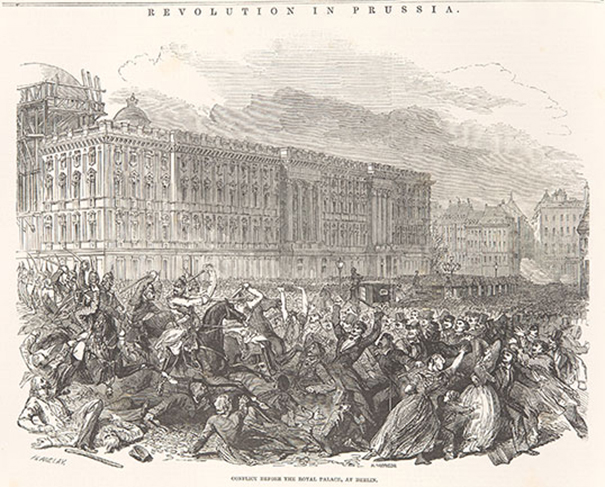
Fig. 2.4 ‘Revolution in Prussia: Conflict before the Royal Palace, At Berlin’, Illustrated London News (1 April 1848): 214.
[Reproduced by kind permission of the Syndics of Cambridge University Library NPR.C.313]
Mason Jackson, in his memoirs of the early years of the Illustrated London News, recalled:
So great was the interest felt in the exciting events of the year 1848, that the sale of the Illustrated London News was more than doubled in three months. The vigorous sketches of the French Revolution published week after week were so eagerly bought that the publisher was not always able to meet the demand. On one occasion he was freely pelted with flour and other harmless missiles because the London ‘trade’ could not get their supply soon enough to gratify their impatience. The noisy newsboys, in mocking imitation of the Paris mob which was then making the streets of that city ring with cries of ‘A bas Guizot!’ vented their indignation with the publisher of the Illustrated London News by shouting ‘A bas Little!’ ‘A bas Little!’64
The seriality of the revolutions freed the Illustrated London News from what Charles Knight had lamented as its ‘endless repetition’ of images of ‘Civic Processions and Banquets’.65 The ‘event’ of the European revolution became a mobile plurality, as it relayed and reproduced itself across boundaries. It created a different model of repetition that did not return over and again to the same scene, but rather watched an event extend and replicate itself across space and time. Crucially, the pictorial reportage of the 1848 French revolution also depended on the close relationship that already existed between the London magazines and the Paris press. The origins of the illustrated press had been international right from the beginning. In France, Le Magasin Pittoresque had been founded in 1833 by Eduard Charton, who had been helped by Charles Knight to establish a French version of Knight’s illustrated Penny Magazine.66 Knight explained that ‘the art of wood-cutting is imperfectly understood in France and Germany. We sell, therefore, to France and Germany many casts of our wood-cuts, at a tenth of what it would cost them to have them reengraved.’67 So Charton sent to London for the illustrations for Le Magasin Pittoresque. The practice of the resale of casts and stereotypes across the Channel persisted throughout the nineteenth century. The British printer Henry Vizetelly recalled in his memoirs that he sold Polydore Millaud, who founded Le Journal Illustré in 1864, ‘some thousands of old wood engravings and electrotypes, which had been published in the “Illustrated Times,” and which he [Millaud] unblushingly served up to his readers as engravings of current events’.68
The ‘penny magazines’ of the 1830s proliferated across Europe but, as discussed in Serial Forms, they were not licensed to carry news.69 By the early 1840s, the appearance of the Illustrated London News marked the start of a second generation of illustrated journals. The Illustrated London News paid the news tax and was therefore classified as a ‘newspaper’.70 Each weekly issue had 16 pages and promised up-to-date news reporting in its pictures rather than the largely miscellaneous or faintly topical illustrations offered by earlier illustrated journals. And it soon spawned European copies. L’Illustration: Journal Universal was launched in Paris in 1843.71 Also in 1843, the Illustrirte Zeitung launched in Leipzig; Il Mondo Illustrato in Turin in 1847; and the Illustración Española in Madrid in 1847.72 Harper’s Magazine appeared in 1850 and Frank Leslie’s Illustrated Newspaper in 1855, both in New York. (‘Frank Leslie’ was in fact the British Henry Carter, quondam head of the engraving department at the Illustrated London News.)73 The Illustrerad Tidning was launched in 1855 in Sweden and the Illustreret Tidende in 1859 in Copenhagen [see Figs. 2.5–2.10].

Figs. 2.5–2.10: Mastheads of Illustrated Journals
Fig. 2.5 Illustrated London News (London) (8 July 1848).
[Reproduced by kind permission of the Syndics of Cambridge University Library NPR.C.313]
Fig. 2.6 L’Illustration (Paris) (26 juin 1847).
[© Bibliothèque nationale de France]
Fig. 2.7 Illusterad Tidning (Stockholm), (21 Maj 1859).
[Credit: Royal Danish Library]
Fig. 2.8 Illustrirte Zeitung (Leipzig) (1 Juli 1843).
[© Bibliothèque nationale de France]
Fig. 2.9 Illustreret Tidende (Copenhagen) (12 October 1862).
[Credit: Royal Danish Library]
Fig. 2.10 Il Mondo Illustrato (Turin) (18 dicembre 1847).
[© Bibliothèque nationale de France]
These internationally connected journals tether themselves to the cities of their production by representing them on their mastheads. Only Il Mondo Illustrato does not use Turin on its masthead, for reasons which are discussed below.
Despite the insistence on their ‘national’ location in their mastheads, even in Italy and Germany, where no such stable sense of the ‘national’ yet obtained, the formats of these illustrated magazines are in fact strikingly internationally identical. They reproduce the same headers and sections (‘Foreign Countries’; ‘Railway News’; ‘Theatrical Novelties’), the same rebus puzzles, and, as we shall see, their illustrations were often literally identical too.74 German newspaper historian Ursula Koch notes that ‘[b]etween these three papers [L’Illustration, the Illustrated London News, and the Illustrirte Zeitung] there was an active exchange of clichés’, but these fast-moving imitations and repetitions are more significant than she suggests.75 The very word cliché, in French, derives from the printing technology of this period. In printing, ‘cliché’ came to mean a stereotype, electrotype or cast plate, or block reproducing words or images that could be used repeatedly. So, there was an active exchange of clichés between these papers, quite literally, but between them they are also creating an increasingly familiar and shared visual lexicon for European experience.76
Pictures on the Move
News illustration was news in itself. The unsigned editorial which opened the first edition of the Illustrated London News announced proudly that ‘[t]he public will have henceforth under their glance, and within their grasp, the very form and presence of events as they transpire, in all their substantial reality, and with evidence visible as well as circumstantial’.77 The illustrations are characterized as not only visual but tactile (‘within their grasp’), offering a form of immediate presence which is ontologically distinct from merely looking or reading. Similarly, L’Illustration announced itself in the preface to its first edition ‘L’ILLUSTRATION sera, en un mot, un miroir fidèle’, adding, with a sideways glance at Horace, that ‘[l]es choses qui arrivent à l’esprit par l’oreille sont moins faciles à retenir que celles qui lui arrivent par les yeux’ [L’Illustration will be, in a word, a faithful mirror…Things that enter the spirit by way of the ear are less easy to hold on to than those that arrive through the eyes].78 Thierry Gervais has written that wood engravings ‘sont pour l’hebdomadaire le moyen de réduire la distance intellectuelle, qui sépare le spectateur du sujet, au point de refléter l’actualité même’ [for the weeklies, [wood engraving] offered a way to reduce the mental distance that separated the spectator from the subject in order to reflect real current events].79 Certainly, L’Illustration saw its work as the reporting of ‘l’histoire contemporaine…enregistré chaque semaine, en les accompagnant d’une représentation pittoresque, tous les évènements du temps’ [contemporary history…all current events recorded every week and accompanied by visual representations].80 The promise of the reportage of ‘events as they transpire’ in the Illustrated London News was only to be delivered in 1848 when the revolutions offered the first real news challenge to the paper. Previously to this, it had relied on its resident artists to concoct or invent many of its ‘news’ engravings, working from written descriptions of recent or unfolding news events, and drawing them on woodblocks that were then sent to be carved at Ebenezer Landell’s workshop at St Bride’s Court.81
The obvious challenge for the production of illustrated news by the wood-engraving method was speed. Charles Knight felt that the difficulties of getting ‘artists and journalists…[to] work concurrently [so] that the news and the appropriate illustrations should both be fresh’ would prove insurmountable: ‘I knew something about hurrying on engravers for The Penny Magazine,’ he said, ‘but a Newspaper was an essentially different affair.’82 Freshness was not achieved without pain: the engravers’ work was highly time-pressured and it was not unusual to have to work through the night to meet a deadline. Edmund Evans, who worked as a wood engraver for the Illustrated London News, remembered, ‘I was often knocked up and…totally unfit for work a day or two after the drives of getting the blocks in to time’.83 For the speedier production of large full-page images, ‘a team of engravers might work on a single image, each of them cutting blocks to be assembled for printing and cleaned up by a master craftsman who would adjust the joins between the blocks with judicious cutting’.84 The artist John Gilbert was employed to illustrate the Parisian events, and he gave an ‘extraordinary display of [his]…powers of rapid work…on the breaking out of the revolution in Paris in 1848’.85 Ten or twelve of the sixteen pages of illustration in this double edition [of the Illustrated London News] were drawn in two or three days, ‘solely from the descriptions given in the daily papers. A French artist who happened to be in London drew three or four of the subjects, but these, also, were due to his own imaginative powers.’86
The rapidly unspooling events of 1848 themselves created new relationships with France that proved useful to the press. The celebrated French illustrator Paul Gavarni, for example, set out for London in November 1847, ‘where he knew himself to be as popular and as much admired as in Paris’, partly to escape debt and partly because he was politically out of sympathy with the Revolution.87 In London, ‘he produced from sketches sent him by his friends’, including Constantin Guys, ‘a series of wood blocks representing scenes in the Revolution of February, which were published in the “Illustrated London News” ’.88 As we have seen, the reselling of blocks or casts of blocks was already an established publishing practice. During the 1848 revolution sketches sent from Paris were worked up and engraved in London then sold back to Parisian publishers, published in both London and Paris, and then often sold on to be republished even further afield.89
‘Insurgent Prisoners at Paris Receiving Relief from their Families. Drawn by Gavarni’ [Fig. 2.11] appeared on the cover of the Illustrated London News on 22 July 1848.90 A week later the same image appeared in L’Illustration on 29 July [Fig. 2.12].91 In the Illustrated London News, viewers were told to ‘See Next Page’, where Garvarni’s image was insistently ‘interpreted’ by a reactionary poem in praise of the merciful women in the picture (‘Blessings on them!’) who are bringing succour and food to ‘the few that err’d’ in committing ‘deeds too hideous for a name’ (i.e. fighting in the revolution).92 Appearing in France, in L’Illustration, the same picture must necessarily have carried a different affect. The accompanying text insisted upon the return to normal life in Paris: ‘[l]e vrai peuple, les vrais ouvriers, le rentier rassuré, le commerçant qui reprend confidence’ [The real people, the real workmen, the landlord reassured, the trader regaining confidence].93 Gavarni’s image is not directly referenced in the text, but it seems to be presented as additional evidence of the revolution having been packed away and all the insurgents safely locked up. Another image in the same issue shows the tailors from the ateliers inside the Clichy prison.94 Nevertheless, viewing Garvarni’s lithograph at a distance in England must have been a different experience to seeing it close-up in France: and not everyone who saw L’Illustration would necessarily have felt the same way about the turn revolutionary events had recently taken.

Fig. 2.11 Paul Gavarni, ‘Insurgent Prisoners in Paris Receiving Relief from their Families’, Illustrated London News (22 July 1848): 33.
[Reproduced by kind permission of the Syndics of Cambridge University Library NPR.C.313]

Fig. 2.12 ‘Les femmes et les enfants des insurgés aux portes des prisones’, L’Illustration (29 juillet 1848): 325.
[© Bibliothèque nationale de France]
The insistent emphasis on authorship, in contrast to the anonymity of the large multiply authored woodcut prints routinely published in the Illustrated London News before the revolution, makes these images appear to occupy a new illustrative space. They seem to be offering themselves to the reader both as ephemeral news pictures and as fine-art reproductions of a kind that readers might collect, keep, and display.95 They are lithographs: lithography was a printing technology that never entirely took off in England, but was popular with French illustrators and artists, perhaps because it gave authority back to the artist who draws directly onto the stone block, so that the intermediary stage of transferring the drawing to the block is eliminated and a layer of mediation of the image removed.96
This established relationship between Paris and London is important because it facilitated the rapid production of dozens of images of the French revolution that were then diffused across Europe. These images could not have been produced so easily or in such numbers in Paris: first, because the technology was not available and second, once the revolution took off, the city became chaotic and unstable. On Saturday 26 February 1848, L’Illustration appeared with a slight delay for the first time since its launch in 1843. Its editorial explained that between 22 and 24 February ‘[l]es lecteurs de L’Illustration comprendront le retard apporté dans le service de ce numéro, quand ils sauront que nous n’avons pas trouvé, en temps utile, les imprimeurs à leur poste; que le chemin même de notre imprimerie, comme beaucoup d’autres quartiers de la ville, était devenu un champ de bataille, le théâtre d’une guerre civile’ [Readers of L’Illustration will forgive the delay in the delivery of this number, when they understand that we did not find our printers at their posts in good time, and that, like many other quarters of the town, the street that our printers is on had become a battle field, the theatre of a civil war].97 The publication of L’Illustration was delayed again during the insurrections between 22 and 26 June.
Ironically, then, it was non-revolutionary London that was supplying representations of the Paris revolution back to Paris and beyond. For example, a sketch taken on the spot by British artist James Duffield Harding, of a worker atop the barricade on the rue St Martin in Paris, first appeared as an engraving on 4 March 1848 in the Illustrated London News, and then a week later, on 11 March, in the Illustrirte Zeitung [Figs. 2.13 and 2.14].
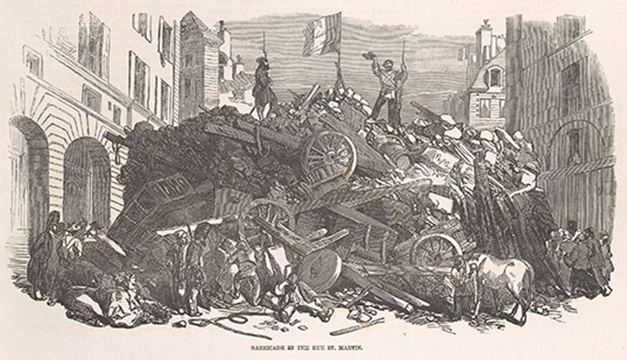
Fig. 2.13 ‘Barricade in the rue St. Martin’. Illustrated London News (4 March 1848).
[Reproduced by kind permission of the Syndics of Cambridge University Library NPR.C.313]

Fig. 2.14 ‘Barricade in der Rue St. Martin in Paris am 23 Februar’, Illustrirte Zeitung (11 März 1848): 177.
[© Bibliothèque nationale de France]
In London, this image appeared in the hugely successful ‘Supplement to the Illustrated London News: The French Revolution’ and, imitating the London example, the Illustrirte Zeitung then produced its own Revolution supplement.98 An image of a worker standing on a barricade was published in L’Illustration on 24 February 1848 and reappeared in the Illustrirte Zeitung on 25 March. It was subsequently reused as a template for a large lithograph issued in Frankfurt simply titled ‘Eine Barricade’ with the French tricolour flag redrawn with horizontal rather than vertical stripes for a German readership.99 This form of repeated representation had consequences in practice on the streets: the deterritorializing effects of print meant that the diffusion of images of the barricade led to the diffusion of barricades to Vienna, Berlin, Munich, Milan, Naples, Budapest, Frankfurt, Prague, and Dresden.100 The revolutionary lexicon of barricades, red bonnets, tricolour cockades, and the Marseillaise spread rapidly out of Paris. ‘[T]he illustrated newspaper’s transnational intelligibility’ meant that even the semi-literate and illiterate could interpret and imitate the scenes depicted. Presumably, it was for this reason that one of the first acts of many of the counter-revolutionary administrations was immediately to reinstate censorship of visual materials. As Mason Jackson put it in his history of the Illustrated London News, ‘the pictures speak a universal language, which requires no teaching to comprehend’.101 The pictures reinforced a narrative that was already familiar: ‘[b]arricades in the capitals, peasant demands for land reform, France as the instigator of an international crisis: these were “known” scenarios’.102 In Berlin one of the barricade leaders said that he could only command the attention of the unruly crowd by using ‘magic French words like “Citoyens! Liberté!”’103 In the library of the Russian revolutionary conspirators in St Petersburg in 1848, a notebook was found along with a pile of books on the French Revolution of 1789. The notebook was full of scribbled entries explaining the revolutionary vocabulary: ‘Barricades; Guillotine; National Assembly; National Guard’, and so on.104 And a participant in the Hungarian revolution recalled that his leader, Sándor Petőfi, had a room ‘filled with valuable engravings of the men of the ’89 revolution which he had brought from Paris. They represented Robespierre, St. Just, Marat, and Mme. Roland’.105 ‘We were all Frenchman’, he added, but it was the medium of print culture that made everyone a Frenchman in 1848.106 Yet these pictures could also speak very different languages in different places, and they were received and construed by very different readerships, crossing political boundaries and boundaries of opinion when they moved from city to city. In London, their informational content was probably largely read at a conscious distance and with disapproval, but in other places, they may also have been met with enthusiasm.
Usually there was a week or so of delay between the first appearance of the image and its reappearance in another country. But occasionally the same pictures appeared in England, France, Germany, or Italy on the same day, as for example the engraving of the ‘Death of the Archbishop of Paris’, which appeared in the Illustrated London News and in Illustrirte Zeitung on 8 July 1848 [Figs. 2.15 and 2.16].107
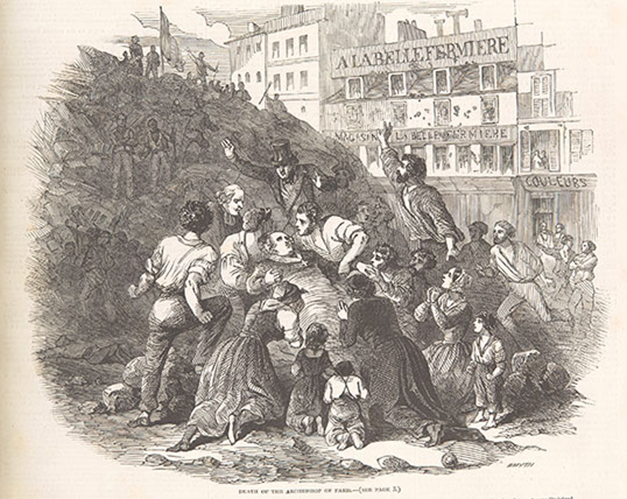
Fig. 2.15 ‘Death of Archbishop of Paris’, Illustrated London News (8 July 1848).
[Reproduced by kind permission of the Syndics of Cambridge University Library NPR.C.313]
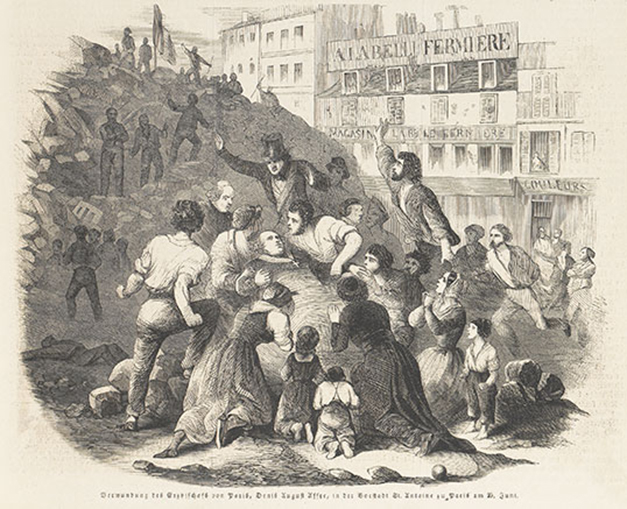
Fig. 2.16 ‘Tod des Erzbischofs von Paris’, Illustrirte Zeitung (8 Juli 1848).
[© Bibliothèque nationale de France]
The simultaneity achievable by the new stereotyping technology had become available just in time to meet the extraordinary synchronicity of European news in 1848. Axel Körner notices that ‘[n]ever before or since…has Europe witnessed a situation in which at almost the same time, all over the continent, an established political regime was overthrown and temporarily replaced by a new order’.108
In London, Punch published a topical cartoon about the revolutions, ‘The Great Sea Serpent of 1848’ [Fig. 2.17] on 4 November, riffing on the much-reported sighting of a sea serpent between the Cape of Good Hope and St. Helena in early August by H.M.S. Daedalus. A giant sea serpent with the face of Marianne, the personification of the French Republic, represents the revolutions that year and looms menacingly over a cowering group of kings and emperors crammed into a tiny boat which is named ‘L’ancien régime’. The giant scale of the serpent dwarfs the human figures and its long looping body appears like a series of bridges stretching far into the distance, suggesting the enormity and the connectedness of the revolutions across Europe. The Parisian Le Charivari republished the reversed image a couple of weeks later as ‘Apparition du serpent de mer’ [Fig. 2.18], and on 30 December the same image appeared in Illustrirte Zeitung [Fig. 2.19].109

Fig. 2.17 ‘The Great Sea Serpent of 1848’, Punch, or the London Charivari 15 (4 November 1848): 193.
[Reproduced by kind permission of the Syndics of Cambridge University Library T992.b.1.8]

Fig. 2.18 ‘Apparition du serpent de mer’, Le Charivari (23 décembre 1848), n.p.
[© Bibliothèque nationale de France]
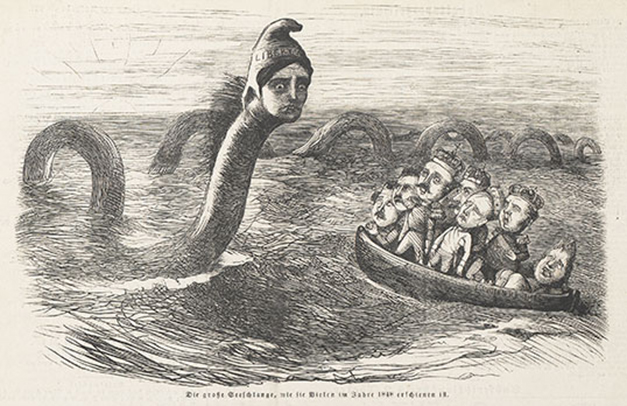
Fig. 2.19 ‘Die Große Seeschlange von 1848’, Illustrirte Zeitung (30 Dezember 1848): 436.
[© Bibliothèque nationale de France]
This image took a month to travel from England to France to Germany; but even if the readers of the illustrated journals were seeing an image of an émeute or insurrection a week or so after it actually happened, the revolution was still transacting so the picture continued to have traction and relevance as part of an ongoing sequence.
The illustrated press was intoxicated with its own modernity, and there is a striking self-consciousness in the illustrated papers about the role of the press itself in the revolution. It was now possible to publish newspapers of all political colours, and indeed of many actual colours: ‘every color of paper was used: the Chandelle démocratique appeared in scarlet, the Sanguinaire in pink, the Sorcière républicaine in white with yellow stripes, and the Souveraineté du peuple in green, while the Guillotine startled the public with red ink on white paper’.110 And the previously banned practice of colportage, or street-crying the news, was back: the streets of European cities were suddenly filled with news vendors hawking the latest editions of the papers with the hottest news. They provide a recurrent subject for illustration. On 1 April 1848, the Illustrated London News published ‘Newsvendor on the Boulevards’ [Fig. 2.20] and on 10 June 1848 the same illustration appeared in L’Illustration as ‘Le marchand de journeaux ambulant’ [Fig. 2.21].
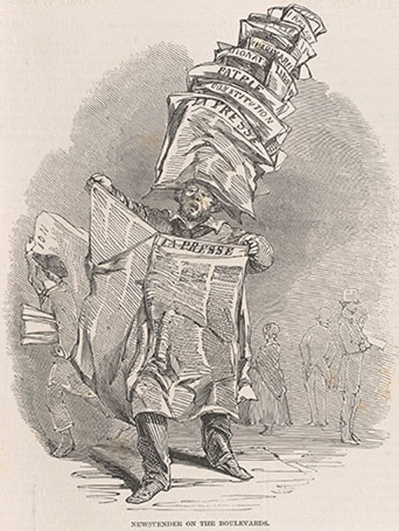
Fig. 2.20 ‘Newsvendor on the Boulevards’, Illustrated London News (1 April 1848): 211.
[Reproduced by kind permission of the Syndics of Cambridge University Library NPR.C.313]
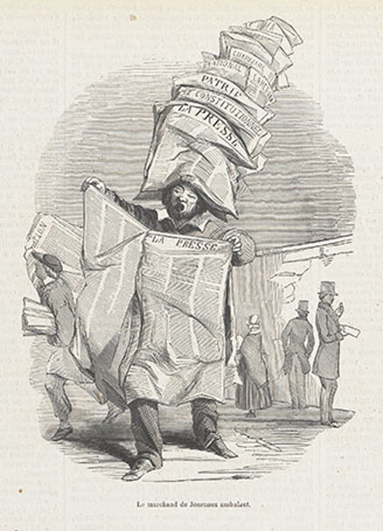
Fig. 2.21 ‘Le marchand des Journaux ambulant’, L’Illustration (10 juin 1848): 229.
[© Bibliothèque nationale de France]
In April 1848, L’Illustration published a series of images produced by the illustrator and erstwhile pupil of Delacroix, Andrieux, entitled ‘Les grandes industries du jour, scènes de moeurs par Andrieux’ [The great industries of the day: Scenes of Manners by Andrieux]. These depicted scenes from the streets of revolutionary Paris, including: ‘L’afficheur officiel—Le dernier décret du gouvernement provisoire’ [The Pasting Officer: the latest decree of the Provisional Government] and ‘Les crieurs de journaux—La onzième édition de la Presse; tirage de l’après-midi’ [The newspaper criers: the eleventh edition of La Presse; afternoon edition] [Fig. 2.22]. The joke here is about the seemingly endless effusions of the press, the newspapers issuing edition after edition in an attempt to keep up with the speed of daily events during this turbulent time. Perhaps the weekly illustrated press early adopted this method of representing the speed of news as a compensation for the necessary lag in its own reporting.

Fig. 2.22 ‘Les grandes industries du jour, scènes de moeurs par Andrieux: ‘Les Crieurs de journaux. – La onzième édition de la Presse; tirage de l’après-midi’, L’Illustration (1 avril 1848): 68.
[© Bibliothèque nationale de France]
Print historians Wolff and Fox have argued that ‘[a]fter the introduction of the telegraph in 1844, the illustration would always be stale compared with the news. The history of news illustration is in part that of a long effort to combat the time-lag inherent in the medium through as many short-cuts as possible’.111 They argue that consequently, early news illustrations tended toward ‘vagueness and generalization’.112 But, as we have seen, the telegraph was not fully functional for global news transmission until later in the 1850s, and this view seriously underestimates the impact of news illustration at a time when it was still seen as a powerful novelty. The illustrated journals early started to exploit the particular potentialities of ‘news’ images for their readerships. The Illustrated London News and its Continental siblings were primarily, although not exclusively, addressed to people of the middling class, although they reached a wider demographic than this.113 All of the European illustrated journals repeatedly published pictures of the newly formed or provisional representative bodies of 1848 because in 1848, constitutional governments were definitely news. The production of such images was also suited to the time rhythms of the illustrated weekly, as opposed to the daily, press.114 But there was another reason: the international debate was live and ongoing about the proper forms of governance and representation. The struggle between parliamentary and direct democracy was particularly dramatic in France, where, as we saw in the last chapter, the chamber of the National Assembly was invaded on 15 May 1848 by a crowd of radicals who wanted to establish an insurrectionary government in its place. But everywhere in Europe the tensions between old regime power and new constitutional forms were manifest and the new illustrated journals needed to find a way to represent new forms of political representation.115 Their solution was to show the people and the places in composite portraits and topographical pictures. They carry images of the German Das Reichsministerium [Fig. 2.23], the French National Assembly [Fig. 2.24], and other representative bodies of the newly emerging polities across Europe. The frequency with which all of the illustrated European papers published such images makes it clear that they were considered a particularly powerful use of the new graphic potential of the illustrated news press.

Fig. 2.23 ‘Das Reichsministerium’, Illustrirte Zeitung (16 Dezember 1848): 396.
[© Bibliothèque nationale de France]

Fig. 2.24 ‘Vue intérieure de la salle de l’Assemblé nationale’, L’Illustration (13 mai 1848): 169.
[© Bibliothèque nationale de France]
The Illustrated London News issued images of the members of the French Provisional Government as a series, in groups of three portraits a week [Fig. 2.25]. Punch was quick to notice this new use of illustration, and it used it to poke fun at fast-moving and unstable European revolutionary politics, suggesting that ‘in order to get through the 900 originals within any reasonable time, it will be advisable that their likenesses come out in instalments’, and it offers a stereotyped picture of the French Deputies, like a row of identical paper dolls [Fig. 2.26].116 This is, of course, a joke, but it reminds us that the serial form is indeed uniquely able to organize large-scale data in digestible ways. Punch goes on to boast that it has ‘a large stock of stereotyped statesmen, [and] skeleton heroes’ on file, ‘all complete except the nose and colour of the hair’ and ‘we shall have those transmitted to us by electric telegraph’ as soon as new leaders appear in ‘events so rapidly succeeding each other’.117
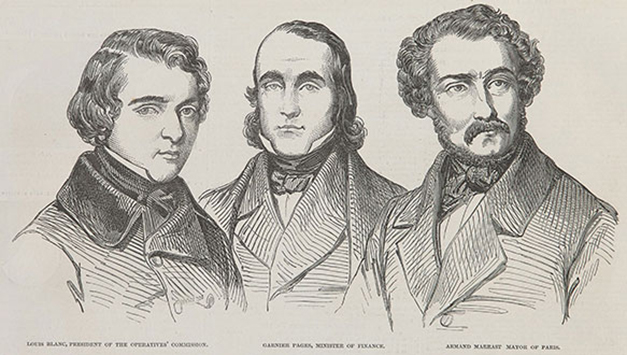
Fig 2.25 ‘The French Provisional Government: Louis Blanc, President of the Operatives’ Commission; Garnier Pages, Minister of Finance; Armand Marrast, Mayor of Paris’, Illustrated London News (18 March 1848): 181–2.
[Reproduced by kind permission of the Syndics of Cambridge University Library NPR.C.313]
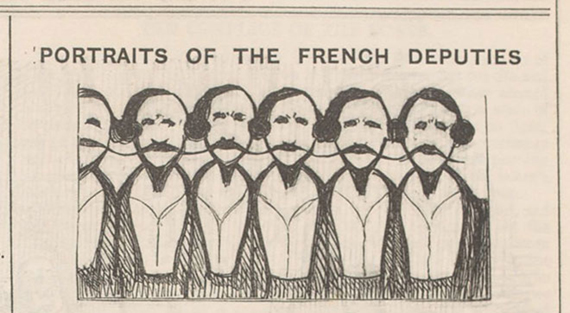
Fig. 2.26 ‘Portraits of the French Deputies’, Punch, or the London Charivari xiv (13 May 1848): 203.
[Reproduced by kind permission of the Syndics of Cambridge University Library T992.b.1.7]
After the violence of the June Days in Paris, though, the counter-revolution swung into action. The revolutionary programme split with the collapse of the ateliers, so that the workers and the bourgeoisie—or perhaps more accurately, the radicals and the liberals—no longer seemed united. At this point, it is possible to discern in the pages of L’Illustration a mounting anxiety about its own position.
L’Illustration did not use the image that appeared in the Illustrated London News on 1 July 1848 and in Illustrirte Zeitung just a week later, ‘Interior of a Chamber—a family of insurgents protecting a barricade in the Rue St Antoine’ [Figs. 2.27 and 2.28]. Instead, that same week, L’Illustration filled its edition with pictures of shelled and bombed-out buildings, fires ravaging the city, and well-organized phalanxes of troops taking back the streets of Paris.

Fig. 2.27 ‘Interior of a Chamber – a family of insurgents protecting a barricade in the Rue St Antoine’, Illustrated London News (1 July 1848): 418.
[Reproduced by kind permission of the Syndics of Cambridge University Library NPR.C.313]
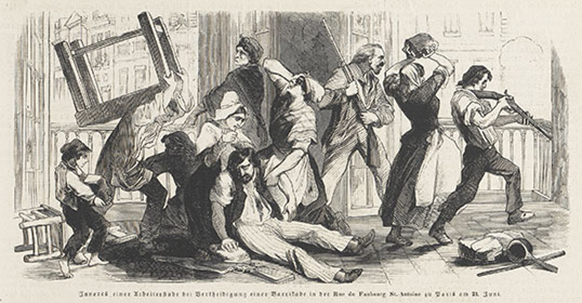
Fig. 2.28 ‘Inneres einer Abeiterstube bei Bertherdigung einer Barricade in der Rue de Faubourg St. Antoine zu Paris am 23 Juni.’ [‘Inside of a workers’ room while a barricade is being built in the Rue de Faubourg St. Antoine in Paris on June 23’] Illustrirte Zeitung (8 Juli 1848).
[© Bibliothèque nationale de France]
The image of an apparently deserted and ruined house [Fig. 2.29] in the French paper suggests defeat and an end to conflict, while the family actively cooperating to defend their barricade on the very same street [Figs. 2.27 and 2.28] which appeared in England and Germany does not. L’Illustration is already moving away from scenes of revolution and towards a celebration of the restoration of order on the streets of Paris. Images of families, including women and children, brandishing guns and hauling heavy furniture to defend barricades now needed to be overwritten with scenes of tranquil domesticity. One of the most curious instances of a republished image is of an engraving, originally issued as a giveaway with Punch in 1849, entitled ‘There is no place like home’ [Fig. 2:30]. A ruddy and smug John Bull and his family enjoy the peace and quiet of an England where no revolution has transpired, while the border of the print is illuminated with violent scenes of revolutionary upheaval and martial law from around Europe. The illustration itself in an English context is a graphic representation of the conservative reportage of the revolutionary events of 1848 consumed from a safe distance. In February 1849, L’Illustration used the same plate [Fig. 2:31], leaving the revolutionary ‘frame’ in place, but substituting a harmonious French family scene for John Bull’s English one. The print, now entitled ‘Où peut-on être mieux, qu’au sein de sa Famille’ [Where can one be better off than in the bosom of one’s family], is both a celebration of the success of the counter-revolutionary forces in Paris and an attempt to represent a safe distance in time and place from the imagery of the revolutionary Parisian streets, which L’Illustration had itself been carrying on its pages only months before.118

Fig. 2.29 ‘Ruines de la maison rue du faubourg Saint-Antoine, no.29’, L’Illustration (1–8 juillet 1848): 280.
[© Bibliothèque nationale de France]

Fig. 2.30 ‘There is no place like home’. Double-page spread. Punch, or the London Charivari (20 January 1849): 28–9.
[Reproduced by kind permission of the Syndics of Cambridge University Library T992.b.18]

Fig. 2.31 ‘Où peut-on être mieux qu’au sein de sa Famille’, L’Illustration (10 février 1849): 373.
[© Bibliothèque nationale de France]
At the end of the tumultuous year of revolutions, the Illustrated London News in its Christmas Supplement of 1848 offered a light-hearted ‘Anticipation of the Next Year’s Events’. In January, it predicted that France would be an Absolute Monarchy; in February ‘A Republic’; in March a ‘Limited Monarchy’; […] in July France proclaims a Sultan; in August, ‘Revolution in Paris. France nothing.’ In September, ‘France becomes miscellaneous, under several heads’; in October ‘France elects a Czar’;…and in December, ‘France extinct as a nation’.119 Partly, of course, this is a xenophobic distancing from other European nations in the wake of a year of tumultuous revolutions, but the ‘Anticipation’ also perhaps contains a buried joke about seriality itself, parodying the dizzying eventfulness of the Illustrated London News’s own reporting of European affairs as they had unfolded week by week across 1848.
Lynn Hunt has argued that visual images of the 1789 French Revolution may help us to understand how ‘people came quite literally to see the world differently’. Following her lead, Richard Taws has written recently of ‘visuality itself as a form of political praxis’ in revolutionary France.120 Hunt suggests that, while lots of work has been done on the circulation of single prints in the French revolutionary period, perhaps multiple images are important too, and we need to think about ‘the ways that the proliferation of prints helped to make society or “the social” more visible’, and how these images fed back into imitative practice, too.121 It is only at mid-century that the technology becomes available to allow printing on a scale that meant that serialized prints reached a wide public, and as illustration and part issue emerged as an international phenomenon together, the potential for the serial publication to model movement across time and space found its corollary in the movement of the revolution across Europe.122
‘Telegraphic’ Synchronicity
Apart from offering news pictures of the conflicts on the streets, barricades, processions and revolutionary fêtes, the illustrated press also put its new graphic powers to creative and sometimes surprising uses.123 Representing abstractions, such as the newly syncopated sense of time across Europe, or the competing constitutionalisms generated by the revolutions, posed a visual challenge. For example, L’Illustration of 14 October 1848 featured a full-page picture of a clock with multiple faces that displayed time in countries across the world [Fig. 2.32]. The same full-page image then reappeared in Illustrate Zeitung on 30 December 1848 [Fig. 2.33]. In its first iteration the clock displayed Paris time on the large central dial; in the second it displayed Leipzig time, the place of publication of the Illustrirte Zeitung. The image represents the relationality of time between cities in Europe, Asia and America, showing both their connectedness and the distance between them in terms of time lag.
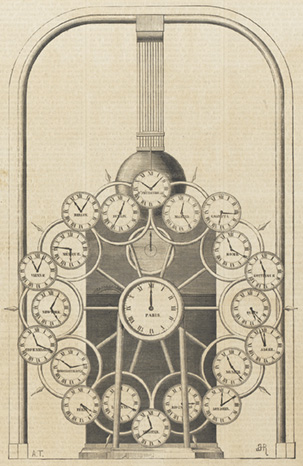
Fig. 2.32 ‘Horloge indiquant les heures dans les principals villes du globe par rapport au méridien de Paris’, L’Illustration (14 octobre 1848): 112.
[© Bibliothèque nationale de France]

Fig. 2.33 ‘Die Straßburger-Münsteruhr’, Illustrirte Zeitung (30 Dezember 1848): 433.
[© Bibliothèque nationale de France]
The adaptability of the central clock face to ‘centralize’ any European time zone is helpfully representative of the ways in which images that were floating internationally in 1848 could be temporarily tethered and localized to one particular place at a time, before moving on to another. The political situation in Europe in February and March 1848 was so extraordinary as to ‘appear…synchronized’, and even at the time this was reflected in a new self-consciousness in the press about synchronization itself.124
Synchronization is a recurrent theme in the illustrated journals, all of which are fascinated by the emerging communications technologies of rail and telegraph because of their potential to connect people across Europe and enmesh them in a common network. The invention of the telegraph in the 1830s had already attracted enormous press attention and had thus already begun its work of articulating space in new ways, even before the physical telegraph lines were fully in place. Throughout the 1840s, the illustrated newspapers report developments assiduously: L’Illustration illustrates the ‘Telegraphe electro-magnétique du professeur Morse’ in June 1847 [Fig. 2:34], and the Illustrated London News features ‘The Electric Telegraph Company’ in London in January 1848, but they are also keen to situate themselves as an important part of this globalizing media technology.

Fig. 2.34 Télégraphe electro-magnétique du professeur Morse’, L’Illustration (26 juin 1847): 260.
[© Bibliothèque nationale de France]
The imagery of the masthead of Il Mondo Illustrato does not depict Turin, the city of its production (like London for the Illustrated London News, or Paris for L’Illustration, or, indeed, Leipzig for Illustrirte Zietung). Instead, the masthead represents a composite of all of Italy, with a steam-train connecting the Coliseum to the leaning tower of Pisa and the baptistery at Florence. In the Italian peninsula, which had no capital and was not a country, the journal literally fantasizes and visualizes a unified Italy by collaging a composite of some of its most famous cities, connected by a yet non-existent railway network [Fig. 2.35].

Fig. 2.35 Detail of the masthead of Il Mondo Illustrato (1847).
[© Bibliothèque nationale de France]
The illustration on the first page of the sample edition, or prospectus, for Il Mondo Illustrato showed a heralding angel hovering over a globe encircled by a ‘girdle’. This eerily prefigured the imagery of telegraphic and electrical communications which was to come later in the century. By the 1870s, Puck’s promise to ‘put a girdle round about the earth’ in A Midsummer Night’s Dream had been appropriated by telegraph companies around the world, and by the late nineteenth century the idea of the ‘girdle about the earth’ as a telegraphic cable connecting the whole globe had become a platitude.125 The barely concealed fantasy life of the short-lived Il Mondo Illustrato is both telegraphic and universalizing as its illustrations enact its longing to insert Italy into the generalized imagination of a world Republic. Le Charivari announced, after all, in March 1848 that ‘France and Germany are now one and the same nation’.126 The ideas of interchangeability and universalism which course through the pages of these journals as they share illustrations and images of revolution are in fact ‘telegraphic’ avant la lettre. Bernhard Siegert has written on ‘the materiality of the symbolic’, by which he means ‘[t]he operation [of the symbolic] presupposes the thing: it helps to bring the thing into being in the first place’.127 The idea of a pan-European telegraphic network presupposed its existence and began the reorganization of space so that places were recalibrated into a new series of relays. And, as we shall see in the next chapter, this newly ‘joined-up’ European imaginary was crucial to the emergence of a sense of the people of Europe as joined-up too.
1 William Wordsworth, ‘To Toussaint L’Ouverture’, written in the summer of 1802, published Morning Post (2 February 1803). The Haitian revolution unfolded as a series of revolts and counter-revolutionary campaigns from 1791 to 1804. Toussaint Louverture died in prison in 1803, and his former general, Jean-Jacques Dessalines, finally won independence for Haiti. See Johnhenry Gozalez, Maroon Nation: A History of Revolutionary Haiti (New Haven, CT: Yale University Press, 2019).
2 Julius S. Scott, The Common Wind: Afro-American Currents in the Age of the Haitian Revolution (New York: Verso, 2018), p. 77.
3 Ibid., p. 118.
4 Adams, ‘Protest and the Scale Politics’, pp. 419, 420. Adams is obviously writing about a different moment in the technology of communications, but his article is suggestive. He suggests that ‘subordinated groups can achieve certain goals by exploiting the existing telecommunication infrastructure’: p. 219.
5 I am grateful to David Laven for very kindly sharing the manuscript of his forthcoming monograph with me. He concedes that these better communications ‘can give clues as to why quite different situations on the ground actually resulted in sometimes surprisingly similar outcomes’: David Laven, Italy, 1700–1870 (Taylor and Francis, forthcoming).
6 Christopher Clark, ‘Why Should We Think about the Revolutions of 1848 Now?’, London Review of Books 41:5 (7 March 2019): 12. Clark continues: ‘after all, the revolutions were the first overseas conflict to which several American newspapers sent correspondents’.
7 Print historians Michael Wolff and Celina Fox have argued that ‘[t]he city and the press depend upon each other’: Michael Wolff and Celina Fox, ‘Pictures from the Magazines’, in H. J. Dyos and Michael Wolff (eds), The Victorian City: Images and Realities (London: Routledge & Kegan Paul, 1973), vol. 2, pp. 559–82, p. 559.
8 Körner, ‘The European Dimension’, p. 9.
9 Jean-Pierre Bacot suggests that the international trading of illustrations in the European press ceases around 1850, whereas Rolf Reichardt argues that the process only begins around 1848: Jean-Pierre Bacot, La presse illustrée aux XIXe siècle: une histoire oubliée (Limoges: Presses universitaires de Limoges, 2005); Rolf Reichardt, ‘Das grösste Ereignis der Zeit: Zur medialen Resonanz der Pariser Februarrevolution’, in Friedrich Lenger and Ansgar Nünning (eds), Medienereignisse Der Moderne (Darmstadt: Wissenschaftliche Buchgesellschaft, 2008).
10 Carrier pigeons were used in the 1840s. Paul Julius Reuter came to public notice as a distributor of radical pamphlets in Berlin during the Revolution of 1848 and in the same year he briefly worked in Paris as a translator for the news service Havas. In Aachen, Reuter developed his own prototype news service in 1849 using electric telegraphy and carrier pigeons. He moved his news agency to London in 1851.
11 Clark, Absolute Bourgeois, p. 101.
12 Anderson, The Spectre of Comparisons, p. 29.
13 Hertz is discussing ‘the feeling of the uncanny’: Neil Hertz, ‘Freud and The Sandman’, The End of the Line: Essays on Psychoanalysis and the Sublime [1985] (Aurora, CO: Davies Group Publishers, 2009), pp. 113–34, p. 117.
14 Murialdi, Storia del giornalismo italiano, p. 41.
15 Emily Apter, ‘Literary World-Systems’, in David Damrosch (ed.), Teaching World Literature (New York: Modern Language Association of America, 2009), pp. 44–60, p. 46.
16 Fredric Jameson, ‘Sartre and History’, in Marxism and Form: 20th-Century Dialectical Theories of Literature (Princeton, NJ: Princeton University Press, 1971), pp. 206–305, p. 258.
17 John Tresch, ‘The Order of the Prophets: “Series” in Early French Socialism and Social Science’, History of Science 48 (2010): 315–42, p. 330. Proudhon became a member of the French parliament after the Revolution of 1848.
18 Jürgen Habermas has argued that the period from 1830 to 1870 was crucial in seeing a change from a ‘culture-debating’ to a ‘culture-consuming’ public.
19 [Anon.], ‘The Revolutionary Movement’, Illustrated London News (1 April 1848): 207.
20 William H. Stiles, Austria in 1848–49: Being a History of the Late Political Movements in Vienna, Milan, Venice, and Prague (New York: Harper & Brothers, 1852), vol. 1, p. 102.
21 Wolfram Siemann, Die deutsche Revolution von 1848/49 (Frankfurt am Main: Suhrkamp, 1985), p. 61, quoted in Körner, ‘The European Dimension’, p. 15.
22 William Smith O’Brien, NLI O’Brien Papers, Ms 449, personal memorandum, quoted in Seán MacConville, Irish Political Prisoners 1848–1922: Theatres of War (London: Routledge, 2003), p. 22.
23 Feargus O’Connor, report of speech, ‘Great Metropolitan Demonstration: The Republic for France and the Charter for England’, Northern Star (11 March 1848): 1.
24 [Frederick Douglass], ‘France’, Editorial, North Star (28 April 1848): 2.
25 [Anon.], [Editorial], Gazzetta Musicale di Milano ed Eco delle Notizie Politiche 7:12 (29 April 1848): 89.
26 Captain Frederick Chamier, A Review of the French Revolution of 1848, from the 24th February to the Election of the First President (London: Reeve, Benham and Reeve, 1849) vol. 1 [only one volume published], p. 272. This quotation concerns the events of 15 May. Chamier also calls February an ‘electric shock’: p. 88.
27 [Anon.], Reflections on the European Revolution of 1848, by a Superior Spirit (London: Longman, Brown, Green and Longmans, 1848), p. 12.
28 Letter to America from Niccolò Tommaseo, in Raccolta per ordine cronologico di tutti gli atti, decreti, nomine ecc. Del governo provvisorio di Venezia, nonchè scritti, avvisi, desideri ecc. di cittadini (Venice: Andreola, 1848–9), vol. 1, p. 355, quoted in Paul Ginsborg, Daniele Manin and the Venetian Revolution of 1848–49 (Cambridge: Cambridge University Press, 1979), p. 116 n. 114.
29 George G. Foster and Thomas Dunn English, The French Revolution of 1848: Its Causes, Actors, Events and Influences (Philadelphia: G.B. Zieber & Co., 1848), p. 115.
30 Louis Garnier-Pagès, Histoire de la revolution de 1848, 10 vols (Paris: Pagnerre, Libraire-Editeur, 1861–72), vol. 1, n.p. [Preface].
31 Hobsbawm, Age of Revolution, p. 308.
32 Eugene Kamenka, ‘Europe in Upheaval’, in Kamenka and Smith (eds), Intellectuals and Revolution, pp. 1–13, pp. 6–7.
33 See Hartmut Pogge von Strandmann, ‘1848–1849: A European Revolution?’, in Evans and von Strandmann (eds), The Revolutions in Europe, pp. 1–8. For discussions of the role of new media in more recent revolutions and protests, see Zeynep Tufecki, Twitter and Tear Gas: The Power and Fragility of Networked Protest (New Haven, CT: Yale University Press, 2019) and Manuel Castells, The Rise of the Network Society (2nd edn, Oxford: Wiley Blackwell, 2009).
34 Dominique Kirchner Reill concedes that this may have been the case in western Germany, the region which was the main focus of von Strandmann’s research. She argues ‘[i]n fact, in most of Europe the completion of rail links was delayed until after the 1848 revolutions; telegraph systems were mainly unheard of, and the literacy rates were particularly poor’: Dominique Kirchner Reill, Nationalists Who Feared the Nation: Adriatic Multi-Nationalism in Habsburg Dalmatia, Trieste and Venice (Stanford, CA: Stanford University Press, 2012), p. 279 n. 12. Jonathan Sperber also notes with surprise that ‘on a continent with a very sketchy rail net, and a partially constructed telegraph system, the upheavals of the spring of 1848 occurred in about one third of the time they would require in 1989’: Sperber, European Revolutions, p. 273.
35 Mark Traugott, The Insurgent Barricade (Berkeley, CA: University of California Press, 2010), p. 131.
36 The line between Paris and Brussels had been opened in 1846.
37 See Jill Harsin, Barricades: The War of the Streets in Revolutionary Paris, 1830–1848 (New York: Palgrave Macmillan, 2002), p. 81.
38 Georges Duveau, 1848: The Making of a Revolution, trans. Anne Carter (New York: Vintage Books, 1967), p. 174, quoted in Traugott, Insurgent Barricade, p. 13.
39 Emile de Girardin was director of La Presse, the first cheap newspaper in Paris. In 1836 Girardin had reduced its subscription price for the year from 80 to 40 francs, with the novel idea that advertisements would cover the deficit, and he was proved correct. His paper had 60,000 subscribers and offered good general news coverage: Chateaubriand, Dumas, and Lamartine were among its contributors. Girardin had been born poor and had made a start with a fabulously successful sheet called Le Voleur which, as its name suggests, stole and reprinted items from other publications.
40 The National was the paper of moderate republicans: its editor was Armand Marrast. The Réforme, founded in 1843, was much more radical but was considered less dangerous because it had barely two thousand subscribers and was constantly in financial trouble. Ferdinand Flocon, a friend of Karl Marx, was its editor and its sponsor was Ledru-Rollin: it supported the policies of Louis Blanc.
41 Illustrated London News (1 April 1848).
42 MF to Mary Rotch (23 May 1847), MF Letters 4, p. 273. Mary Rotch (b. 1777) was a member of a powerful and wealthy New Bedford Quaker family. She was 33 years older than Fuller and she enjoyed long friendships with both Fuller and Emerson.
43 Hobsbawm, Age of Revolution, p. 112.
44 F. B. Smith, ‘The View From Britain I’, p. 95.
45 AHC to A. P. Stanley (14 May 1848), AHC Remains, pp. 126–7. La grande Colère du père Duchesne was ‘one of the most colorful and popular revolutionary journals [of 1789], characterized by its free use of expletives’: see Robert Darnton and Daniel Roche (eds), Revolution in Print: The Press in France, 1775–1800 (Berkeley, CA: University of California Press and the New York Public Library, 1989), pp. 148–9. Its title was reused for a newspaper during the revolution of 1848.
46 Lewald, A Year of Revolutions, p. 80.
47 Ibid.
48 The historian Jonathan Sperber calculates that ‘[t]here were at least 171 different newspapers—different counts, including more ephemeral periodicals, note more than twice as many—published in Paris during the spring of 1848’, Sperber, European Revolutions, both quotations p. 151.
49 Charles Ledre, La Presse a` l’Assault de La Monarchie, 1815–1848 (Paris : Armand Colin, 1960), p. 216.
50 [Anon.], [Editorial], Gazzetta Musicale di Milano ed Eco delle Notizie Politiche 7:12 (29 April 1848): 89 and [Anon.], ‘Il Giornalismo di Milano dopo le nostre immortali cinque giornate’, Gazzetta Musicale di Milano ed Eco delle Notizie Politiche 7:12 (29 April 1848): 95.
51 von Strandmann, ‘1848–1849: A European Revolution?’, p. 3.
52 Robert Goldstein gives the following account of the eruption of European newspapers in this brief revolutionary period: ‘Throughout the Austrian Empire, the number of newspapers increased between 1847 and 1848 from seventy-nine (only nineteen of which were permitted to discuss political affairs) to 388 (306 of which discussed politics), and the number of Czech-language newspapers jumped from thirteen to fifty-two; in all of central Europe, the German-language press exploded from less than 950 in 1847 to about 1,700 two years later, including, in the Prussian Rhineland, a doubling of daily and weekly newspapers from thirty-six to seventy; in both Rome and Venice about 100 new newspapers began publishing. In Paris, an estimated 450 newspapers (some of them only one page and many of them ephemeral) were established and the total combined daily press run skyrocketed from 50,000 to 400,000.’ Robert Justin Goldstein, ‘Introduction: The Transformation of Life in Nineteenth-Century Europe’, in Robert Justin Goldstein (ed.), War for the Public Mind: Political Censorship in Nineteenth-Century Europe (Westport, CT: Praeger, 2000), pp. 1–34, p. 29. For these figures Goldstein cites Siemann, Die deutsche Revolution von 1848/49, translated as The German Revolution of 1848–49 trans. Christiane Banerji (New York, 1998), pp. 112–13, and Sperber, European Revolutions, pp. 151–2.
53 Sperber, European Revolutions, p. 162.
54 Daniela Bleichmar and Vanessa R. Schwartz, ‘Visual History: The Past in Pictures’, Representations 145 (Winter 2019): 1–31, p. 5. They also note that images remain ‘some of the least analyzed’ of our historical evidence.
55 Julia Thomas has argued that ‘illustrations dominated the cultural landscape of the nineteenth century’ and yet remain oddly ‘invisible’ in scholarship on the period: Julia Thomas, Nineteenth Century Illustration and the Digital: Studies in Word and Image (Cham: Palgrave Macmillan, 2017), p. 17.
56 Tom Gretton, ‘Representing the Revolution’, History Today 39:5 (1 May 1989): 39–44, p. 44. Gretton is writing about prints of the 1789 revolution.
57 For example, see Jeremy D. Popkin, Revolutionary News: The Press in France, 1789–1799 (Durham, NC: Duke University Press, 1990); Jack Richard Cense, Prelude to Power: The Parisian Radical Press, 1789–1791 [1976] (Baltimore, MD: Johns Hopkins University Press, 2019); Jeremy D. Popkin, Press, Revolution, and Social Identities in France, 1830–1835 (University Park, PA: University of Pennsylvania Press, 2002); W. J. Murray, The Right-Wing Press in the French Revolution, 1789–92 (Woodbridge: Boydell Press for the Royal Historical Society, 1985); Hugh Gough, The French Revolutionary Press: Press, Politics and the Public Sphere in Europe and North America, 1760–1820 (Cambridge: Cambridge University Press, 2002).
58 Peter Sinnema, Dynamics of the Printed Page: Representing the Nation in the Illustrated London News (Aldershot: Ashgate, 1998), p. 30.
59 William Andrew Chatto, ‘Wood-Engraving: Its History and Practice’, Illustrated London News (20 April 1844): 251. This is the first of a series of articles that ran from 20 April to 6 July 1844.
60 The historian of nineteenth-century journalism Laurel Brake has remarked that ‘illustration of all kinds seems to have been linked with serialization throughout the [nineteenth] century’: Laurel Brake, Print in Transition 1850–1910: Studies in Media and Book History (Basingstoke: Palgrave Macmillan, 2001), p. 31.
61 The success of the Illustrated London News was so intoxicating in 1848 that its owner, Herbert Ingram, made an abortive attempt to establish a cheap London daily newspaper to capitalize further on the European revolutions. The London Telegraph was edited by former ILN journalist and radical-sympathizer Thomas Hodgskin. It was published later than its competitors to crib all their news and the contents of their many expensive telegrams from abroad. It borrowed the feature of a feuilleton from the French papers (the first feature serial was The Pottleton Legacy by Albert Smith). In the event, the paper only ran from 1 February 1848 to 1 July 1848. Ingram blamed Hodgskin’s frequent editorial discussions of ‘bureaucracy’ and government machinery for its failure. See David Stack, Nature and Artifice: The Life and Thought of Thomas Hodgskin (1787–1869) (London: Royal Historical Society and Boydell Press, 1998), pp. 163–68. See also Charles Mackay, Through the Long Day, or, Memorials of a Literary Life During Half a Century, 2 vols (London: W.H. Allen & Co., 1887).
62 Henry Vizetelly, Glances Back Through Seventy Years: Autobiographical and Other Reminiscences [1893] (Cambridge: Cambridge University Press, 2010), vol. 1, pp. 233–4. See also Geoffrey Alan Cranfield, The Press and Society: From Caxton to Northcliffe (London: Routledge 1978), p. 171.
63 [Anon.], ‘Portraits of the French Deputies’, Punch, or the London Charivari 14 (13 May 1848): 203. Punch habitually laughs at ‘the illuminated journals’: in another example, it provides an illustration of the Chartist Procession, in which ‘our artist…following the pictorial practice of the present day, has drawn from his own imagination the exact representation’. The picture, which is part of Punch’s aggressive anti-Chartist campaign, is wildly inaccurate and shows Queen Victoria, the notoriously conservative Lord Sibthorpe, and the Duke of Wellington all taking part in the procession: [Anon.], ‘The Chartist Procession According to the Signatures of the Procession’, Punch, or the London Charivari 14 (29 April 1848): 175.
64 Mason Jackson, The Pictorial Press, Its Origin and Progress (London: Hurst and Blackett Publishers, 1885), p. 302.
65 Charles Knight, Passages of a Working Life, 3 vols (London: Bradbury & Evans, 1864), vol. 3, pp. 246–7.
66 Le Magasin Pittoresque, Premiere Livraison (31 December 1833). Charton writes that the idea: ‘à importer en France l’idée de livrer au plus humble prix un texte varié, entremêlé de gravures, et divisé des livraisons,’ came to him ‘seulement après avoir connu le succès des Magazines en Angleterre, et surtout celui publié à Londres…par M. Charles Knight, qui…a contributé a rendre moins décourageantes les premières difficultés de notre enterprise.’ [‘to import into France the idea of delivering a low-price miscellany, interspersed with engravings, and in serialized parts’ came to him ‘only after having seen the success of Magazines in England, and especially the one published in London…by Mr. Charles Knight, who…helped make the early difficulties of our business less discouraging’] Michele Martin notes that a German version of the format, the Pfennig-Magazin, was founded by J. J. Weber in Leipzig in the same year, 1833, and Weber went on to found the Illustrirte Zeitung in 1843: see Michèle Martin, Images at War: Illustrated Periodicals and Constructed Nations (Toronto: University of Toronto Press, 2006). The weekly Pfennig Magazin was the result of one of the French publishers of the Magasin Pittoresque teaming up with some German publishers to form the Geesellschaft zur Verbreitung gemeinnütziger Kenntnisse (a literal translation of the Society for the Diffusion of Useful Knowledge). Within a few years, circulation reached 60,000, many times more than any political newspaper published in this decade. In 1834, the first Dutch penny magazine, the Nederlandsch Magazijn ter verspreiding van algemeene en nuttige kundigheden, appeared in Amsterdam. Like its French and German contemporaries, it relied exclusively on illustrations bought from its British model. Penny magazines spread to Belgium, Russia, Italy, and Poland. In the case of the Penny Magazine a British model was transmitted to the Continent, but this was not always the case. The French Le Charivari, famous for its attacks on Louis Philippe, the ‘citizen-king’, was founded in 1832 and was the inspiration for Punch, or the London Charivari, founded nine years later: information from a lecture by Bernhard Fulda, kindly shared with the author by email; see also Eva-Maria Hanebutt-Benz, Studien zum deutschen Holtzstich im 19 Jahrhundert (Frankfurt am Main: Buchhändler-Vereinigung, 1983) and Hartwig Gebhardt, Illustrierte Zeitschriften in Deutschland am Ende des 19 Jahrhunderts. Zur Geschichte einer wenig erforschten Pressegattung (Hist. Komm. des Börsenvereins, 1983).
67 [Anon.], ‘The Commercial History of a Penny Magazine’, Monthly Supplement of the Penny Magazine (October–November 1833): 471.
68 Vizetelly, Glances Back Through Seventy Years, vol. 2, p. 321. The first issue of the Pictorial Times came out on 18 March 1843. The Illustrated Times Weekly Newspaper first appeared on 9 June 1855.
69 See Pettitt, ‘Yesterday’s News’, in Serial Forms, pp. 29–68. The cover illustration for Serial Forms is by J. J. Grandville, Second rêve—une promenade dans le ciel [Second dream—A stroll in the sky], a lithograph published in Le Magasin Pittoresque 27 (1847): 213.
70 Laurel Brake has commented that ‘the phenomenon of the weekly illustrated paper is particularly problematic’ because ‘[a]rguably, many weeklies are not comfortably a newspaper or a magazine (although they are certainly like all serials a “periodical”), but a combination of both, and greater than the sum of their parts. In the 19C the ILN purports to be a newspaper; a test would be if it paid stamp duty up until abolition in 1855.’ Laurel Brake, VICTORIA, https://list.indiana.edu/sympa/arc/victoria/2020-02/msg00089.html (11 February 2020). I have established that the ILN did indeed pay the news tax (stamp duty), as is made clear by an editorial supporting the abolition of the tax: [Anon.], ‘The Taxes on Knowledge’, Illustrated London News (2 August 1851): 137–8, p. 138.
71 The preface to the first issue of L’Illustration promised coverage of ‘événements politiques, cérémonies publiques, grandes fêtes nationales, désastres fameux, bruits de la ville, morts illustres, biographies contemporaines, représentations théâtrales, découvertes utiles, expositions, […] publications, […] faits glorieux de l’armée, modes, types, scènes populaires’ : [Anon.], ‘Preface’, L’Illustration: Journal Universal (1 September 1843): i. Marchandiau notes that L’Illustration boasted ‘the first use of photographic sources in the press, which occurred following the insurrection of June 1848’ and was also innovative in using foreign newspapers, news agencies, and, above all, field correspondents: Jean-Noel Marchandiau, L’Illustration 1843/1944: Vie et mort d’un journal (Toulouse: Éditions Privat, 1987), p. 25.
72 Although another source suggests Illustración Española was founded in 1849. Murialdi suggests that Il Mondo Illustrato (Torino) (1846) was considered ‘piu commerciale’ than Il Politecnico (later the ‘Rivista Europea’) (1839–44) but it closed after two years as the price of printing was too high: Murialdi, Storia del giornalismo italiano, p. 44.
73 Joshua Brown, Beyond the Lines: Pictorial Reporting, Everyday Life, and the Crisis of Gilded Age America (Berkeley, CA: University of California Press, 2002), pp. 17ff.
74 Ursula Koch makes this point: ‘[n]either Vienna nor Berlin, both with populations over 400,000, and the capitals of the two absolutist great powers of Austria and Prussia, were home to a German “trans-regional” press in 1848’. The closest thing was in Augsburg, absorbed into the Kingdom of Bavaria in 1806, with its ‘independent’ Allgemeine Zeitung read throughout Europe (circulation 10,400) produced by the Tubingen publishing house of Cotta, and Cologne, which had become Prussian in 1815, with its Kolnische Zeitung (Circulation 9,500), read throughout Northern Germany.’ Ursula E. Koch, ‘Power and Impotence of the Press in 1848: France and Germany in Comparison’, in Dieter Dowe (ed.), Europe in 1848: Revolution and Reform (New York: Berghahn Books, 2001), pp. 585–616, p. 588.
75 Koch, ‘Power and Impotence’, p. 587. Thomas Smits also supplies very useful technical and operational detail about the transnational supply of images between illustrated journals before 1850, particularly in Chapter 2: ‘The Transnational Trade in Illustrations of the News, 1842–1870’, but he gives no particular attention to 1848. Thomas Smits, The European Illustrated Press and the Emergence of a Transnational Visual Culture of the News, 1842–1870 (London: Routledge, 2020).
76 This practice was not uncommon and became more common as the nineteenth century progressed. Marianne Van Remoortel does an impressive job of tracking the reprinting of illustrations from the German fashion magazine Der Bazar: Technische Muster-Zeitung für Frauen, launched in 1854 in Berlin. Its illustrations were pirated as early as 1859 in the British Ladies’ Treasury (1857–95), The Dutch Gracieuse (1862–1936), the Philadelphia-based Lady’s Friend (1864–73), and possibly also the short-lived Polish Bazar (1865–6) and Danish Nordisk Mønster-Tidende (1874–1952). Contracts for the import of clichés were in place with the Englishwoman’s Domestic Magazine, the French La mode illustrée, the Spanish La moda elegante (1842–1927), and the Italian La novità (1864–1943). Later Der Bazar sold customized versions of its masthead to Novyi russkii bazar (1867–98), the Austro-Hungarian Magyar Bazár (1866–1904), the Czech Květy (1865–72) and Světozor (1872–99), and the New York Harper’s Bazaar (later Harper’s Bazaar; 1867–). See Marianne Van Remoortel, ‘Women Editors and the Rise of the Illustrated Fashion Press in the Nineteenth Century’, Nineteenth-Century Contexts 39:4 (2017): 269–95.
77 [Anon.], ‘Editorial’, Illustrated London News (14 May 1842): 1. ‘The circulation of the Illustrated London News was 130,000 copies a week by 1855’: Henrik Alvar Ellegård, The Readership of the Periodical Press in Mid-Victorian Britain (Göteborg: Göteborg University Press, 1957), p. 10. By the mid-1860s, ILN’s circulation was at over 300,000 copies a week, nearly five times the circulation of The Times.
78 [Anon.], ‘Préface’, L’Illustration (1 September 1843): i. For an interesting discussion of the relationship between the bound volume editions of collected periodicals (recueils) and single editions, see Alexandra Tranca, ‘The Illustrated Press and the Writing of History: The Recueils of L’Illustration in 1848’, Dix-Neuf 21:4 (2017): 280–96.
79 Thierry Gervais, ‘D’après photographie: Premiers usages de la photographie dans le journal
L’Illustration (1843–1859)’, Etudes photographiques 13 (2003): 56–85. He continues: ‘Au-delà de l’aspect pédagogique, cet usage des images exprime une forme de modernité journalistique qui se retrouve dans la démarche écrite des journalistes de l’hebdomadaire […] Récits et figures doivent exprimer la proximité avec l’événement, incarner l’objectivité d’un “réflecteur” .’
80 The editorial continues: ‘qui reproduirait l’histoire et l’image des personnages célèbres ou fameux, et qui nous montrerait, sous ce double aspect de la parole et du dessin, le mouvement de la politique, des arts, des sciences, des lettres, du théâtre, des moeurs et usages, et jusqu’aux fantaisies de la mode. L’Illustration sera pour nos fils cette représentation du temps actuel, et sa collection gagnera en importance historique et en intérêt curieux à mesure que les tableaux qu’elle présente s’éloigneront des regards et de la mémoire du lecteur. ‘Aux lecteurs de L’Illustration. Avis important pour ceux qui désirent acquérir ou compléter la collection de ce recueil’: L’Illustration (11 September 1847), p. 31.
81 In his memoirs, Henry Vizetelly noted that ‘the system pursued with the majority of engravings of current events [for the Illustrated London News]—foreign, provincial, and even metropolitan when these transpired unexpectedly—was to scan the morning papers carefully, cut out such subjects as furnished good subjects for illustration, and send them with the necessary boxwood blocks to the draughtsman employed’: Vizetelly, Glances Back Through Seventy Years, vol. 1, p. 232. Vizetelly notes that Illustrated London News artists had difficulty at the start in getting access to events in order to sketch them, as the illustrated paper was ‘not then the social power it has since become’: p. 233. He also notes that ‘not even a single engraving in the opening number derived from an authentic source!’: p. 237.
82 Quoted in Simon Houfe, The Dictionary of British Book Illustrators and Caricaturists (Woodbridge: Baron, 1978), p. 70.
83 Edmund Evans, The Reminiscences of Edmund Evans, ed. Ruari McLean (Oxford: Clarendon Press, 1967), p. 14. Quoted in Sinnema, Dynamics of the Printed Page, p. 54.
84 Beatrice Farwell, ‘The Charged Image’, in The Charged Image: French Lithographic Caricature 1816–1848 (Santa Barbara, CA: Santa Barbara Museum of Art, 1989), pp. 9–22, p. 11. Her examples here are L’Illustration and the Illustrated London News. See also William Mills Ivins, Prints and Visual Communication (Cambridge, MA: MIT Press, 1969), pp. 98–9.
85 Charles Norris Williamson, ‘Illustrated Journalism in England: Its Development: 1’, Magazine of Art (January 1890): 297–301, p. 301.
86 Ibid., p. 301. Williamson comments on how extraordinary this ‘imaginary’ illustration seems now that readers are used to ‘accuracy’ in illustrations.
87 Charles Home (ed.), ‘Daumier and Gavarni with Critical and Biographical Notes by Henri Frantz and Octave Uzanne. Special Autumn Number’, The Studio (Autumn 1904): Gxvi. Guillaume Sulpice Chevallier, known as Paul Gavarni (1804–66) wrote his own captions, unlike Daumier. Gavarni spent the whole period of the Second Republic in England where he was horrified by the misery of the English poor. In the late 1850s he gave up lithography altogether. On his return to France, his memories of England were published in Londres et les Anglais, illustrés par Gavarni (1862) by Émile de la Bédollière.
88 Home (ed.), ‘Daumier and Gavarni’, p. Gxviii.
89 Gavarni made a series of images to illustrate a translation of Reybaud’s famous book ‘Jerome Paturot à la recherché de la meilluere des Républiques’ published by the Illustrated London News and serialized throughout December 1848. While Gavarni was in Britain (1847–51) the English artist Louis Marvy taught him the vernis mou method of etching.
90 Gavarni’s lithographs, which were clearly superior in quality to other illustrations in the paper, were usually signed and announced as ‘by Gavarni’ or ‘after a drawing by Constantin Guys’.
91 Gavarni’s 1848 engravings were to appear again in the Penny Illustrated Paper as illustrations of the revolution of 1870 in Paris: see Wolff and Fox, ‘Pictures from the Magazines’, pp. 559–82.
92 Paul Gavarni, ‘Insurgent Prisoners in Paris Receiving Relief from their Families’, Illustrated London News (22 July 1848): 33. C.M., ‘Insurgent Prisoners in Paris Receiving Relief from their Families’, Illustrated London News (22 July 1848): 34. ‘Les femmes et les enfants des insurgés aux portes des prisones’, L’Illustration (29 April 1848): 325.
93 ‘Courrier de Paris’, L’Illustration (29 July 1848): 323–26, p. 324.
94 ‘L’atelier des tailleurs reunis dans les bâtiments de la Prison pour dettes, rue de Clichy’ illustrates a short article, ‘Association de tailleurs de Clichy’, which ends ‘C’est bon pour les goujats’ [It’s good for the cads], L’Illustration (29 July 1848): 332. The engraving follows an article which states definitively ‘Le communisme ne peut coexister avec la liberté’: Francis Wey, ‘Dictionnaire démocratique (4) Manuel du Citoyen. Communistes, Phalanstériens, fouriéristes’, L’Illustration (29 July 1848): 330–2.
95 Brian Maidment also mentions Hoffman, who drew for the ILN (along with Gavarni who did ‘Sketches from the French Revolution’, ILN (25 March 1848), p. 195) Hoffman, ‘A Revolutionary Meeting in a Cellar in Berlin’, ILN, (Supplement: History of the Revolutions in Europe, 1848), p. 440. Maidment argues that ‘despite an implicit drive towards unproblematic naturalism in the representation of topical issues, especially urban streetscapes, in the new graphic reportage of the 1840s, the wood-engraved image was nonetheless open to a variety of competing modes which had been firmly lodged in the reader’s consciousness in previous decades’, such as caricature, comedy, and the urban picturesque. Brian Maidment, ‘An Image of 1848: Reportage, Caricature, and Kenny Meadows’s “Dram-Drinker”’, in Boardman and Kinealy (eds), 1848, pp. 190–209, p. 197.
96 Lithography was always more popular in France. The artist draws directly and freely on the lithographic stone, whereas the woodblock print is multiply mediated. William Mills Ivins suggests that the English generally preferred woodblock printing for its ‘pedantic’ tidiness, which seems unconvincing as an explanation. Certainly, lithographic illustration is freer and looser in its lines. Ivins, Prints and Visual Communication, p. 101.
97 [Anon.], L’Illustration (26 February 1848): 401.
98 Peter Sinnema notes that the ILN double issue published in the first week of March was a sensation and was followed by a twelve-page supplement at the beginning of July: Sinnema, Dynamics of the Pictured Page, pp. 65ff. The German supplement was called Beilage zur Illustrirten Zeitung: Die revolution.
99 Traugott, Insurgent Barricade, pp. 150–1. As his authority, Traugott cites Ségolène Le Men, ‘1848 en Europe: L’image ‘à la conquête de l’ubiquité’, in Les révolutions de 1848: L’Europe des images, le printemps des peuples (Paris: Assemblée nationale, 1998), pp. 26–7, 161. I have located the Illustrate Zeitung image in the issue of 25 March 1848, p. 203, but L’Illustration did not appear on 24 February 1848 and the image does not appear in the February or March issues.
100 Mark Traugott, ‘Barricades as Repertoire: Continuities and Discontinuities in the History of French Contention’, Social Science History 17:3 (1993): 309–23, p. 316. For the revival of barricades in the 1871 Paris Commune, see Dennis Bos, ‘Building Barricades: The Political Transfer of a Contentious Roadblock’, European Review of History 12:2 (2005): 345–65.
101 Jackson, The Pictorial Press, p. 1, quoted in Sinnema, Dynamics of the Printed Page, p. 17.
102 John Breuilly, ‘1848: Connected or Comparable Revolutions?’, in Körner (ed.), 1848—A European Revolution?, pp. 31–49, p. 34.
103 Gustav Hesse quoted by Rudolph Stadelman, Social and Political History of the German 1848 Revolution (Athens, OH: Ohio University Press, 1975), p. 85, quoted in Traugott, Insurgent Barricade, p. 144.
104 Claus Møller Jørgensen, ‘Transurban Interconnectivities: An Essay on the Interpretation of the Revolutions of 1848’, European Review of History: Revue européenne d’histoire 19:2 (2012): 201–27, p. 207.
105 Excerpt from the memoirs of Mor Jokai, cited in Laszlo Deme, The Radical Left in the Hungarian Revolution of 1848 (Boulder, CO: East European Quarterly, 1976), p. 10.
106 Claus Møller Jørgensen also mentions the important role in transmitting revolutionary ideas and printed materials played by the German-speaking journeymen artisans who toured Europe; and the central role played by the University of Jena for pan-Slavism in Prague; along with that played by a small group of students returning from Paris to lead activities in Romania. Claus Møller Jørgensen, ‘Transurban interconnectivities’, p. 205. See also Michael J. Neufeld, ‘German Artisans and Political Repression: The Fall of the Journeymen’s Associations in Nuremberg, 1806–1868’, Journal of Social History 19:3 (1986): 491–502, p. 492. George S. Werner, ‘Traveling Journeymen in Metternichian South Germany’, Proceedings of the American Philosophical Society 125:3 (1981): 190–219, pp. 216ff; Orton, The Prague Slav Congress, p. 1.
107 The engraving is signed ‘SMYTH’ only in the Illustrated London News version. Denis-Auguste Affre was Archbishop of Paris from 1840 to 1848. He was killed by a bullet while trying to negotiate peace during the ‘June Days’ uprising. Whether the bullet was fired by insurgents or government troops was disputed at the time and has never been settled.
108 Axel Körner, ‘Introduction’ in Körner (ed.), 1848 – A European Revolution?, p. 11 (emphasis mine).
109 The sighting of the sea serpent was so topical that Punch speculated that it ‘will figure on hearth-rugs, dressing gowns, neck-handkerchiefs” this season’: [Anon.],‘The Sea Serpent’, Punch, or the London Charivari 15 (2 December 1848): 23. W. A. Coupe surveys the dawning of a culture of political caricature ‘under the influence of the French example’ in German periodicals in 1848: W. A. Coupe, ‘The German Cartoon and the Revolution of 1848’ Comparative Studies in Society and History 9:2 (January 1967):137–51, 153–67, p. 141.
110 Irene Collins, The Government and the Newspaper Press in France, 1814–1881 (London: Oxford University Press, 1959), p. 102.
111 Wolff and Fox, ‘Pictures in the Magazines’, p. 562 and p. 563.
112 Ibid.
113 See Chapter 3 on ‘Interiority and Readership’ in Sinnema, Dynamics of the Pictured Page, pp. 85–115. Images in the Illustrated London News were produced for a ‘respectable’ readership and not a radical one. But in 1848, the differentiation between these two groups was by no means as clear has it had been earlier in the century. See, for example, Vic Gatrell’s discussion of the different audiences for two very different prints of the public hanging and decapitation of the Cato Street conspirators in 1820. V.A.C. Gatrell, The Hanging Tree: Execution and the English People 1770–1868 (Oxford: Oxford University Press, 1994), pp. 298–314. In the Illustrated London News a newly liberal and ‘civic’ sensibility is addressed.
114 For more on the social and political importance of illustration in the nineteenth-century European press, and particularly the form of the ‘sketch’, see Martina Lauster, Sketches of the Nineteenth Century: European Journalism and its Physiologies 1830–1850 (Basingstoke: Palgrave Macmillan, 2007).
115 Annemarie McAllister discusses the significant non-appearance in the ILN of pictures of Chartist disturbances in England. All the images of Chartist activity are very tranquil and ordered, unlike the reporting of revolutionary insurrections abroad: Annemarie McAllister, ‘The Case of the Missing Chartist: How the Year of Revolutions was presented to the Readers of the Illustrated London News’ in Boardman and Kinealy (eds), 1848, pp. 225–42.
116 [Anon.], ‘Portraits of the French Deputies’, Punch, or the London Charivari 14 (13 May 1848): 203.
117 All quotations, [Anon.], ‘Portraits of the French Deputies’, p. 203.
118 See Albert Boime, Art in an Age of Civil Struggle, 1848–1871 [vol. 4 of A Social History of Modern Art] (Chicago: University of Chicago Press, 2007). Boime reads the altered Punch image in L’Illustration as an ‘indication of the reciprocity of these images between conservative journals’: p. 804 n. 82.
119 ‘Christmas Supplement’, Illustrated London News (23 December 1848): 415.
120 Taws, Politics of the Provisional, p. 8. L’Illustration, p. 8. Linda Hughes and others argue however that an illustration ‘is not self-sufficient; the image changes (by contextualizing) the text, but the text conditions what is seeable in the image’: Linda K. Hughes, ‘Inventing Poetry and Pictorialism in Once a Week: A Magazine of Visual Effects’, Victorian Poetry 48:1 (May 2010): 41–72, p. 46. While this must be generally true, I would still argue that the news illustrations of the 1848 revolutions were designed for international travel and therefore they communicate either without textual apparatus, or with quite different local ideological framings and interpretations.
121 Lynn Hunt, ‘Experience of Revolution’ French Historical Studies 32:4 (2009): 671–8, p. 677. For a different approach to researching periodical illustrations digitally, see the Illustrated Image Analytics project at North Carolina State University, https://ncna.dh.chass.ncsu.edu/, and see also Paul Fyfe and Qian Ge, ‘Image Analytics and the Nineteenth-Century Illustrated Newspaper’, Journal of Cultural Analytics (25 October 2018), https://culturalanalytics.org/article/11032.
122 Laurel Brake suggests that ‘usually illustration is a feature, often of importance, of part issue, which is essentially associated with widening access’: Brake, Print in Transition, p. 40. This fact forms part of John Ruskin’s objection to modern engraving practices in his Ariadne Florentina. Ruskin suggests engraving is designed to engage ‘the daily more bestial English mob railroad born and bred, which drags itself about the black world it has withered under its breath’. ‘“What is the habit of soul of every modern engraver?’ Ruskin asks, and answers, ‘[a]lways in a hurry; everywhere doing things which he knows to be wrong…continually doing things badly which he was able to do better; and appealing exclusively to feelings of the dull, and the judgment of the inattentive’: John Ruskin, Works of John Ruskin, ed. E. T. Cook and Alexander Wedderburn (London: George Allen, 1906) vol. 22, pp. 469, 358.
123 It was in L’Illustration, for example, that two of the first ever daguerrotypes were reproduced, showing the rue Saint-Maur-Popincourt on Sunday and on Monday ‘après l’attaque’ (1–8 July 1848), p. 276.
124 von Strandmann, ‘1848–1849: A European Revolution?’, p. 5.
125 William Shakespeare, A Midsummer Night’s Dream, Act 2, Scene 1. Puck promises to ‘put a girdle round about the earth | In forty minutes’, making time shrink, as well as space. The telecoms company, Cable and Wireless, were still using the phrase in a 1946 advertisement for their telegram service.
126 Le Charivari (22 March 1848), quoted in Koch, ‘Power and Impotence’, p. 608.
127 Bernhard Siegert, ‘Doors: On the Materiality of the Symbolic’, trans. John Durham Peters Grey Room 47 (Spring 2012): 6–23, p. 14.