
3
Debout, les damnés de la terre
Debout, les forçats de la faim1
Introduction: The Spectacle of the Ragged
Across the whole of Europe in 1848, it seemed as if the poor had stepped onto a stage for the first time. The spectacle of rags, and the coming into the light and into visibility of the ragged, effected a startling dramatization of social misery and marked the beginning of a pan-European transformation of the social into the political. By the time the 1848 revolutions ignited, ‘the ragged’ had become a serial term. Like Benedict Anderson’s ‘unbound series’ of ‘anarchists’ or ‘revolutionaries’, the ‘ragged’ had become another unbound series that travelled across national boundaries. This transnational hyper-visibility was in large part the result of popular media forms which had developed exponentially in the first half of the nineteenth century. The ragged could provoke fear, despair, disgust, sympathy, and revolutionary hope, and their repeated presence in newspapers, in periodicals, in novels, on stage, and in prints and cartoons made them an insistently serial phenomenon. A new iconography of rags was making the social political in 1848.
By the late 1830s, Ralph Waldo Emerson was already able to write in his notebook that ‘[a] ragged coat looks revolutionary’,2 and in the pan-European political imagination of the late 1830s and 1840s, rags and raggedness began to signify across national and linguistic boundaries as revolutionary. The poor who had been always among us were being reformatted from a stable ‘natural’ and biblical phenomenon into a serialized and growing threat. Extreme economic fluctuations across Europe between 1845 and 1848—an agricultural crisis from 1845 to 1847, which led to an industrial crisis from 1846 to 1848—contributed to the immiseration of the people in towns, cities, and the countryside.3 When starving labourers and the unemployed took to the streets across Europe, these abject scenes were made nationally and internationally visible as they were transmitted across long distances by a much more developed and internationally connected press than had existed in 1789. It became clear in the press that ‘every nation’ had its ‘thousands of the ignorant, degraded [and] miserable’, and that this immense and unfree part of the European population could no longer be hidden and ignored.4
Granted this new visibility in serial print, the poor and the downtrodden were developing the self-consciousness to imagine themselves as part of a ragged series with the potential to form a resistant collective. Representation in print created the unprecedented possibility of collective seeing, ‘making it possible to identify and organize around…problematic relations’.5 The ragged, the indigent, and those on starvation wages or unemployed could begin to see themselves as part of an international series. But this was not what Marx would identify as class consciousness. For example, in 1848 the feudal poor on large Prussian estates were suffering under a very different economic system to the factory workers of Manchester, but the revolution would reach them too, not through a collective class consciousness but through the serial representation of oppression that allowed them to identify themselves as part of that series. Rather than the somewhat static Marxist stratification of class, this model of seriality can help us to better understand the multiple and shifting dynamics of structural power relationships across Europe. It can help us better to see Marx’s prevarications around the ‘proletariat’, and his problematic exclusions and rigid boundaries between the ‘social scum’ and the deserving artisanal proletariat. The category of the ‘ragged’ coalesced not around strict principles of class inclusion and exclusion, but around a growing and internationally shared anxiety about what it was to be human.
The politicization of the social had been under way since the late eighteenth century. John E. Toews reminds us that, in Germany, for example:
Hegel, Gans, and Canové had already been aware of the pauperization [of German society] and social alienation as significant, troubling side effects of the freedoms of civil society, but it was only in the 1840s that the ‘social question’ moved into the center of intellectual and public concern, and presented the historical possibility—which could be conceived as either a threat or a hope—of a total negation of the existing system, in both its reactionary and its liberal aspects, in the name of more inclusive form of social and political community.6
But crucially, it was through the press that the ‘social question’ moved into the centre of public concern in the 1840s. The visible and proliferating poor were being increasingly documented. Starting in 1846, John Corson, an American physician, made a ‘professional tour’ of European hospitals through France, Belgium, Switzerland, Italy, Austria, Prussia, Great Britain, and Ireland, and he attested to ‘the ragged, unwashed, haggard little creatures that you see lurking about the docks, close alleys and dark passages of most European cities’.7 Engels writes of ‘the filth, the uninhabitableness of the houses’ in the poorest parts of Dublin, but adds that ‘the wretchedness of Dublin is nothing specific, nothing peculiar to Dublin, but something common to all great towns’.8 Corson sees ragged children begging in Avignon, Brussels, Leeds, London, Naples, and Rome and he notes the extreme case of the endemic destitution in Ireland, where ‘ragged beings, prostrated by generations of poverty…flock in myriads’.9 ‘For fear of exaggeration’ he borrows the words of Scottish minister Rev. Thomas Guthrie to describe the occupants of Edinburgh’s Grassmarket: ‘loungers, worse than Neopolitan lazzaroni…ragged and wretched old men, bold and fierce-looking women, and many a half-clad mother, shivering in cold winter, her naked feet on the pavement, a skeleton infant in her arms’.10 The international comparison is significant, and one which Charles Dickens pushes further in his 1846 Pictures from Italy when, in a description of ‘gay Naples’, he admonishes the reader: ‘lovers of the picturesque, let us not too studiously cut out of view the miserable depravity, degradation and wretchedness…it is not so well to find Saint Giles’s so repulsive and the Porta Capuana so attractive. A pair of naked legs and a ragged red scarf do not make all the difference.’11 The conscientious reader, Dickens suggests, must place the ragged of London and the ragged of Italy in the same Sartrean series. Understanding the ragged in this way as a series, rather than a national class or group, asks us to recognize that these individuals are positioned as ‘ragged’ not by any common biological or psychological characteristics, but by a specific set of material and immaterial social determinants. The American Henry Colman was in Europe from 1843 to 1845, and wrote breathlessly of London’s ‘populousness, its wealth, its gorgeousness, its dazzling splendour’, but was quick to add that ‘[h]ere, in the midst of plenty, men, women and children are dying of absolute starvation’.12 The poor were not invented in 1848, but their proliferation becomes a journalistic and literary theme in the late 1840s.
The pan-European sanitary reform movement of the 1840s is important to understanding the reconfiguration of a ragged underclass into a revolutionary threat.13 Edwin Chadwick’s influential Report on the Sanitary Condition of the Labouring Population of Great Britain, published in 1842, included extensive evidence from the ‘Conseil de salubrité’ of Paris, and from administrations in Brussels, Germany, and Austria, in order to describe an international ‘state of things…adverse to the rights of humanity and civilization’.14 The water-carriers and rag-pickers of Paris, Chadwick warns darkly, ‘were conspicuous actors in the revolution of 1830’.15 In an 1847 letter to Chadwick, fellow sanitary reformer Dr Lyon Playfair describes two British night-soil men tasting and rubbing human faeces into their eyes, which prompts Playfair to ask, ‘[c]ould the chiffonniers of Paris classed among the “classes dangereuses” equal these nightmen in their bestial habits?’16 Every abject beggar and homeless vagrant was not necessarily a revolutionary-in-the-making, of course, but the representation of so much social misery was an engine of the revolution. The representation of the poor was becoming a matter equally for politics, literature, and performance.
Ragged Performance: Chiffonniers and Rag-Pickers
The ragged trickster-scoundrel Robert Macaire had started life as a character in the French play L’Auberge d’Adrets (1823) [Fig. 3.1].17 Celebrity actor Frédéric Lemaître had improvised Macaire out of the script and into the hearts of his audience in his famous performances, so that Robert Macaire had become a household name in France by the 1840s [Fig. 3.2].18 Lemaître had taken his character directly off the Parisian streets and put him on the stage.19 Robert Macaire was the most popular play of the decade and was described by critic Théophile Gautier as ‘the great triumph of revolutionary art which followed the July Revolution’, because of ‘the sharp, desperate attack it makes on society and on mankind, as a whole’.20 Victor Hugo used the actor and the play to signal the coming 1830 revolution in his novel Les Miserables (1862) when the street urchin Gavroche tells his brothers ‘[j]e vous mènerai à Frédéric Lemaître…J’ai des billets, je connais des acteurs, j’ai même joué une fois dans une pièce’ [I will take you to Frédéric Lemaître…I have tickets and I know the actors, I even acted once in a play]. The various Macaire plays were repeatedly banned and censored under Louis Philippe, but in March 1848, after the February revolution, Lemaître’s own version of Robert Macaire burst back triumphantly uncensored onto the stage at the Porte Saint-Martin. Alongside his rendition of the ragged rogue Robert Macaire, Lemaître was accused of, or celebrated for (depending on the point of view of the commentator), further contributing to the insurrectionary mood in Paris with his performance of another ragged character, Jean. Jean is the lead character in the melodrama Le Chiffonnier de Paris [The Ragpicker of Paris] by the socialist playwright Félix Pyat, which also played at the Porte Saint-Martin theatre in Paris in the revolutionary years 1847 and 1848 [Fig. 3.3].21 Lemaître apparently had his chiffonnier costume worn for three weeks by a Parisian ‘navvy’ until the ragged clothes ‘were properly worn and torn and smeared with dust’.22 He drank with the chiffonniers in the Quartier Mouffetard, partly for purposes of research, and partly just because he liked to drink, and the day after the play opened (to great success) he was visited by a large deputation of chiffonniers who wanted to carry him about the city in triumph. The poor were seeing themselves represented not as humble and obedient, but as people with agency of their own, and the representation brought them a new self-confidence.

Fig. 3.1 Draner [Jules Renard], Robert Macaire. Ambigu, 1823 & 1880 (Frédéric Lemaître)’. This image, made after the actor’s death in 1876, commemorates Lemaître in his most famous role at the Théâtre de l’Ambigu.
[© Bibliothèque nationale de France]
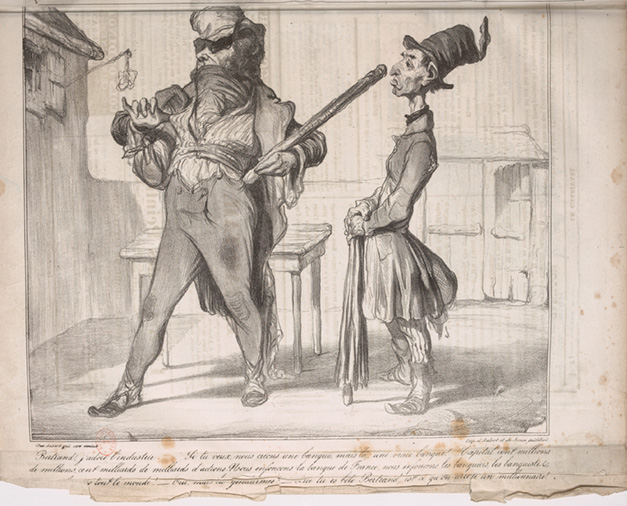
Fig. 3.2 Honoré Daumier, ‘Caricaturana’ or ‘Robert Macaire’, Le Charivari (20 août 1836): n.p. This was the first of a series of a hundred cartoons published in Charles Philipon’s daily paper between 20 August 1836 and 25 November 1838.
[© Bibliothèque nationale de France]
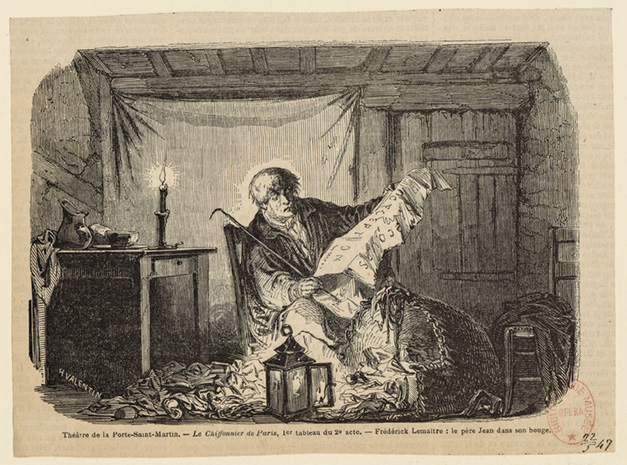
Fig. 3.3 Henry Valentin, ‘Theatre de Porte-Saint-Martin. - Le Chiffonnier de Paris, 1er tableau du 2e acte. - Frédérick Lemaître: le père Jean dans son bouge.’ (1847).
[© Bibliothèque nationale de France]
Parisian chiffonniers and chiffonnières scavenged through the city’s waste to find objects of value: rags, bottles, and anything else that could be resold. On his visit to Paris in 1846, the travelling doctor John Corson noticed ‘the poor rag-gatherer that goes drooping along, picking rubbish and bits of paper from the streets’.23 And Edwin Chadwick describes the Parisian chiffonniers in his sanitary report:
in the night time…the chiffonnier comes with a lantern and rakes among the refuse, and picks from it bones, rags, whatever might have been thrown away by accident, or the carelessness of the servants. The offensive filth of their persons and their occupation, makes them outcasts from other classes of workmen; they sleep amidst their collections of refuse, and they are idle during the day; they are like all men who live under such circumstances, prone to indulgence in ardent spirits; being degraded and savage, they are ready to throw away their wretched lives on every occasion.24
Chiffonniers were equipped with hooked sticks for fossicking through heaps of filthy rubbish, a lantern to use at night, and baskets on their backs to hold their finds:
every now and then a light was seen dancing about in the middle of the streets, generally moving, like a Will-o’the-wisp, near the ground, occasionally remaining stationary for some moments—then proceeding onwards—taking an uneven and zigzag motion about and then stopping for a short interval again. Those lights were shed by the flickering lights of the chiffonniers or rag-pickers.25
In the dead of night in the poorer districts only the chiffonniers and the police mouchards, or spies, were out on the Parisian streets.26 Pyat’s play compares two chiffonniers whose fortunes take them in very different directions.27 One, the capitalist, robs and kills, using his booty to invest, very successfully, in business. The other, the socialist Jean, simply tries to do good in the world. Parisian chiffonniers are always represented as politically ambiguous, embodying both the virtuous, redeemable poor and the irredeemably depraved criminal, so that they mobilize both fear and sympathy. The chiffonnier occupied a particularly fraught place in the European taxonomy of the poor. Chiffonniers were numbered among the insurgents of the June Days in Paris who were described as ‘déclassés de toute espèce’ [social outcasts of all types]: tramps, street-porters, organ-grinders, ragpickers, knife-grinders, tinkers, errand-boys, and all those who lived by the thousand little occupations of the streets of Paris, and also that confused, floating mass which is known as La Bohème’.28
As a part of this confused and floating Bohemian city life, the chiffonnier was often portrayed in the 1840s as the chiffonnier philosophe, as in a comic lithograph [Fig. 3.4] by Honoré Daumier. Chiffonniers could also, significantly, be female chiffonnières [Fig. 3.5], further troubling Marx’s gendered worker categories.29 The unease around the social and political knowledge and the mobility of this sub-class comes through, too, in Pyat’s hit play of 1847, Le Chiffonnier.

Fig. 3.4 Honoré Daumier, ‘Le Chiffonnier Philosophe. “Fume, fanfan, fume...n’y a qu’ la pipe distingue…” (Tout Ce Qu’on Voudra)’ Le Charivari (28 novembre 1847).
[© Bibliothèque nationale de France]
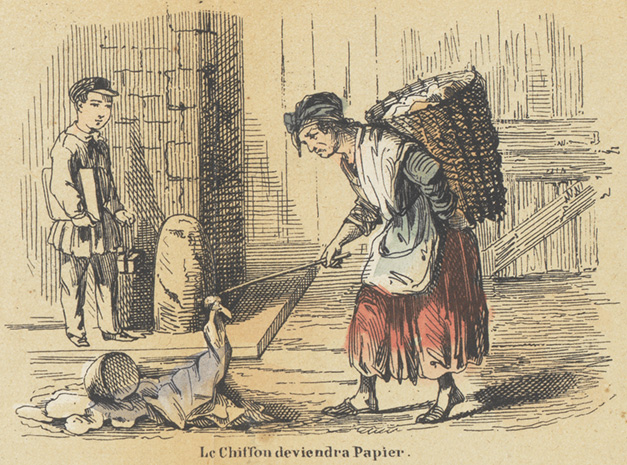
Fig. 3.5 ‘Le Chiffon deviendra Papier’ from ‘Une planche encyclopédique’, publiée avec texte par Le Journal de Mères et des Enfants à Paris (1850) (‘Rags will become Paper’ from an educational poster showing the process of paper-making).
[© Bibliothèque nationale de France]
Pyat’s Le Chiffonnier was a great success: it had opened in in the spring of 1847 and had played every day since. There is a story, almost certainly apocryphal, that Queen Victoria wept when she saw the play and asked Frédéric Lemaître whether there were really such poor people in Paris: his (probably imaginary) answer was: ‘[t]here are many, your Majesty; they are the Irish of Paris’—which, if he had only said it, would have served to further emphasize the transnational seriality of the ragged.30 In 1848, the theatres were now open even to the poorest Parisians. With Paris empty of its wealthier residents, free theatre tickets were handed out on the streets to keep Republican sympathies warm, and Alexandre Dumas was using his personal funds to keep the Théâtre Historique open.
Although he played Macaire in the West End, Lemaître was never to play Jean in London, but the play was translated and adapted by an actor-manager named Edward Stirling. A playbill announcing Stirling’s English version at the Olympic Theatre, just off Drury Lane in London in 1847, is revealing of what had been expurgated from the play in its transition to the London stage:
THE CHIFFONNIERS; or, RAG PICKERS OF PARIS are a class of individuals peculiar to that Metropolis, and differ wholly from the Bone Grubbers of London now so rarely seen…With [the chiffonniers] crime and misery are familiar, while their mysterious mode of life—moving about as they do—like midnight shadows—frequently brings them into connection with the darkest deeds.31
London ragpickers, or ‘Bone Grubbers’, we are reassured, are emphatically not like Parisian chiffonniers, and anyway, the London type is practically extinct, and can therefore pose no revolutionary threat. But rag-pickers and rag-and-bone men did exist in England right through the nineteenth century, and well beyond. Comparing the Parisian underclass of chiffonniers to British ‘bone-pickers, mud-rakers, people living on the produce of dung-heaps’, Chadwick remarks that ‘the close identity of their habits with those of the chiffonniers in Paris afford [sic] a striking proof of the similarity of the population produced by similarity of circumstances’.32 And he gives plenty of detailed evidence in his report of significant populations of ‘bone-pickers’ in London, Manchester, and Bath, as well as in the workhouses, many of whom, he claims are ‘known to the police’.33 Henry Mayhew described one bone-grubber he encountered at mid-century as wearing a ‘ragged coat…greased over, probably with the fat of the bones he gathered’, and Elizabeth Gaskell in Mary Barton describes ‘a wide dingy-looking street’ in Manchester, ‘consisting principally of public-houses, pawnbrokers’ shops, rag and bone warehouses, and dirty provision shops’.34 Dickens frequently refers to rag merchants and links them with urban criminality: Krook with his ‘RAG AND BOTTLE WAREHOUSE’ in Bleak House (1852–3) being the most conspicuous example.35 In Dombey and Son (1847), Florence Dombey is abducted by Mrs Brown, a rag collector, and in Our Mutual Friend (1864–5), Dickens refers to the Parisian scavengers as those ‘wonderful human ants [who] creep out of holes and pick up every scrap’ from the streets.36
In Stirling’s English version of The Rag Pickers, Jean unpacks his basket and tots up his night’s work, saying:
‘Paris cuts but a sorry figure, seen in the basket of a rag-picker. Who would think, now, that I had Paris, the world, in that basket? Yes—all things come, sooner or later, to the rag-picker’s basket. Love, glory, power, riches—[kicking the heap]—all settle and meet here. Let’s see.’37
He takes out an old soldier’s jacket, old love letters, a dog’s bone and continues: ‘[t]here go to the rag basket, it’s the general rendezvous, the common grace; its more than death, it is oblivion’.38
In England, as a result of very active and effective theatrical censorship, the basket is philosophized on stage as a generalized memento mori, but in Paris, it played a very different role. After the February revolution and free of the censorship laws, Lemaître devised a brilliant new piece of stage ‘business’ for his French audience:
In the well-known pannier [basket] scene his auditors were raised to a pitch of indescribable enthusiasm. Lemaître as the chiffonnier, hooked a Royal crown out of his hamper, and at this opportune ‘hit’ the whole audience rose en masse, and a roar, for it cannot be called a cry, of ‘Vive la Republique’ reverberated through the foundations of the edifice.39
During the Revolution there had been baskets lying underneath the guillotine to catch the falling heads. And couldn’t the crown be seen like the refuse of the streets, as a piece of redundant trash? This would be unthinkable in monarchic England, where the owner of that crown, Louis Philippe, the so-called ‘Citizen King’ of France, had fled to shelter and safety on 24 February in a cab under the false and very English name of ‘Mr Smith’. Queen Victoria, herself more European than English, a member of the extended royal family of France and Prussia, was terrified in the spring of 1848 for her ‘poor dear Family’. She received ‘Mr Smith’ and his wife with relief, worrying for ‘the many innocent sufferers among my relations’ on the Continent.40 The representation of the ragged of England was extremely fraught, given the energetic regime of repression and censorship that was tightening ever more punitively in reaction to events in Continental Europe in the 1840s. But, as we shall see, this did not stop the ragged of Britain recognizing that they too belonged to this European series. From 1848 on, the social phenomenon of the poor was to become the unignorable political question.
Politics: The Ragged, the Poor, the Labourers
In Chapter 5 of ‘The Eighteenth Brumaire of Louis Bonaparte’, Marx classes chiffonniers among the lumpenproletariat, or slum-proletariat: the ‘refuse, offal and wreck of all classes’, including the dregs of the bourgeoisie, suggesting that they had been rounded up and bribed to support the ascendancy of Louis Napoleon Bonaparte after 1848.41 According to Marx, Louis Napoleon ‘collects 10,000 loafers who are to impersonate the people as Snug the Joiner does the lion’.42 The chiffonniers are somehow fake, impersonating the people rather than belonging to the people, partly because they are for hire: Marx’s theory of value never extended to service industries. The value of labour, for Marx, reflected skill. Products in his economic system were goods manufactured or farmed by human labour. Marx’s skilled labourers made or grew things, while services remained invisible to him. He includes ‘discharged jailbirds, escaped galley slaves, rogues, mountebanks, lazzaroni, pickpockets, tricksters, gamblers, maquereaus, brothel keepers, porters, literati, organ-grinders’ in the same list of social ‘refuse’.43 He disregards domestic and reproductive labour for the same reason that he disregards the labour of the chiffonniers: it is supposedly not skilled.
Marx’s Manichean divisions between classes in a time of remarkable labour precarity and social fluidity are problematic: some of his ‘refuse, offal and wreck of all classes’ represent the more liminal and mobile social types. This creates a curious contradiction in the Marxist theory of labour, as Marx and Engels knew very well that industrial capitalism demanded a surplus of labour—a workforce on stand-by, as it were. But they both talk of a class of ‘loafers’, the ragged unemployable, as if they somehow deserve to be blamed for their condition. Those out of work are characterized in the Communist Manifesto as ‘social scum’.44 The chiffonniers represent one of the fault lines in Marx’s class thinking, revealing that it does not really make sense. Gareth Stedman Jones reminds us that ‘[i]n the unpublished manuscripts intended to form part of the second volume of Capital, [Marx] embarked upon a chapter on “classes” ’. But he found that he had nothing new to say, and after a little more than a page, he abandoned it.’45 Book 3 of Capital, The Process of Capitalist Production as a Whole, has a truncated ‘Chapter LII’ entitled ‘Classes’ which asks briskly, ‘The first question to be answered is this: What constitutes a class?’, but then grinds to a halt. As an editorial note explains, ‘Here the manuscript breaks off.’46
The déclassé, the social outcasts, the ‘wreck of all classes’, the ragged, were to some extent the drivers of the revolutions of 1848, although Marx only blames them for the June Days in Paris and the failure of the class alliance between the workers and the bourgeoisie. The scant data that exists about the composition of the revolutionary crowds in Paris in February 1848 suggests that some of the ragged fought alongside the ‘skilled artisan’ insurgents, as ‘workers drawn from the most proletarianized sectors—clothing and, to a lesser extent, textiles—were…overrepresented’.47 In the Communist Manifesto Marx and Engels grudgingly admit that the street workers were also agents of the revolution: ‘[t]he “dangerous class”, the social scum, that passively rotting mass thrown off by the lowest layers of the old society, may, here and there, be swept into the movement by a proletarian revolution.”48 Different translations render these people as ‘[t]he lumpen proletariat, that passive dung heap of the lowest levels of the old society’ and: ‘[t]he Mob,—this product of the decomposition of the lowest substrata of the old Social system’.49 Their revolutionary action, if it happens at all, happens accidentally and without agency: they are ‘swept into the movement’. This ‘out group’ is more likely to be found fighting on the other side, as ‘its conditions of life…prepare it far more for the part of a bribed tool of reactionary intrigue’.50 The mob, the lumpen proletariat, the dangerous class, the social scum: the conditions that prepare these people for ‘venal’ intrigue are the conditions of being ‘for hire’ like a street porter, or the ‘literati’ hack writers.51 These are people unable to achieve class consciousness, according to Marx and Engels, but this opens up the difficult question of how class consciousness is ever to be achieved. It is clearly not a matter of literacy, as Marx includes the ‘literati’ in the ‘social scum’. It seems to be largely street-workers that he anathematizes: the very same group that Henry Mayhew writes about in his series of articles in the Morning Chronicle in the 1840s as the ‘London Poor’.52 As Jacques Rancière has argued in an attack on historians who blindly accept—partly as a result of Marx’s powerful taxonomies—the idea of an ‘intelligent artisan class’ set apart, all workers are always for hire.53 Rancière points in particular to tailors and typographers, occupations that now ‘seem noble to us because they touch upon fashion or intellectuality’. Yet he shows that in the 1840s, ‘[t]hese trades were contemptible in [other] workers’ judgement, since they required little strength, skill or cleverness’.54 Indeed, ‘the newspaper L’Atelier felt obliged to ‘prove to the workers of all trades who had met there that a tailor handling his needle, a typographer aligning his letters of lead are just as worthy as a baker, a cabinetmaker or a tanner of the respectable title of “ouvrier” ’.55 Marx’s romanticization of the artisan ‘class’ rests on his idea that the workers are somehow supposed to emancipate themselves and then set to work on changing the political system, which amounts to an explicit separation of the social and political.56 But the fluctuation of trade and the consequent precarity of work in the first half of the nineteenth century made it difficult to police the boundaries of the heroic ‘revolutionary’ artisan working class, as Marx and Engels were always trying to do.
A similar problem emerges for Henry Mayhew. His moral taxonomizing of the London poor into those who will work, those who cannot, and those who will not is disrupted by a female typographer in the office of a Fleet Street daily newspaper, who is also a prostitute.57 ‘I’m neither one nor t’other;’ she says, ‘I’m only a mot who does a little typographing by way of variety.’58 Rancière warns historians that ‘we are not perceiving them [tailors and typographers] for what they really are: a marginal group at the frontier of encounters with the bourgeoisie, characterized by the same migrations and instabilities, the same ambiguities and contradictions that define the working class’.59 This is borne out by Mayhew’s cheerful typographer, who acknowledges the power of her own literacy: ‘I know I talk well, but you must remember what a lot has passed through my hands for the last seven years, and what a lot of copy I’ve set up. There is very little I don’t know, I can tell you.’60 There was just as much ambiguity and permeability around the edges of the so-called ‘bourgeoisie’, or ‘middle class’, in the 1840s, too, which might help answer political theorist Claude Lefort’s pertinent question about 1848: ‘which circumstances, which conflicts—and they can only have been social—and which aims…led highly differentiated and hierarchical societies to accept that peasants, shopkeepers and artisans should be admitted to assemblies in which decisions concerning public affairs were taken?’61 One of the powerful legacies of the dominant Marxist reading of 1848 is its blindness to the social movement around the edges, the mobility of the marginal, the improvised life of the streets, and the shifting and dynamic status of men (and women, but women are always near totally invisible to Marx) who are sometimes in work and sometimes out of work. Even more confusing to his categories are the many men and women in the 1840s who are resorting to any kind of work they can find, when in reality, the ‘portfolio career’ of the typographer-prostitute was unlikely to be unusual.
Hannah Arendt judged that the political agenda of the 1789 Revolution had ultimately been overwhelmed and sunk by the spectacle of social misery, the provisional polity undermined by ‘the social question in the form of the terrifying predicament of mass poverty’:62
And this multitude, appearing for the first time in broad daylight, was actually the multitude of the poor and the downtrodden, whom every century before had hidden in darkness and shame. What from then on has been irrevocable, and what the agents and spectators of revolution immediately recognized as such, was that the public realm—reserved as far as memory could reach, to those who were free, namely carefree of all the worries that are connected with life’s necessity, with bodily needs—should offer its space and light to this immense majority who are not free because they are driven by daily needs.63
During the 1789 Revolution Paris had been, in the words of one commentator, ‘crowded with spectres, emaciated and ragged, whose hideous and haggard features spoke only of vice and misery’, because the poor had ‘flocked to the city from all parts of the kingdom’.64 Destitution and despair had become visible in streets thronging with ‘[m]en, haggard and hungry, and without employment; women ragged and starving, and with their starving children in their arms’.65 The ‘immense majority’ of the unfree had walked into the physical city in 1789, but it would take another generation before the developing media could bring the ragged into visibility in the transnational public sphere of print.
Arendt’s argument that in 1789 in France, the political was derailed by the social question, depends on a distinction between political égalité and social inequality. Arendt totally separates the political from the social because she is invested in an overly severe classical model of the polis, and this allows her to sidestep issues of social exclusion. Arendt’s idealization of the ancient polis makes her unable to confront the changing requirements of political representation and citizenship in the eighteenth and nineteenth centuries.66 Her idea of citizenship is a closed and limited one: it stops at the gates of the city.67 But this classical ideal of the city-state is no longer applicable to the rapidly modernizing and connected landscape of Europe in the mid nineteenth century. The ‘modern history’ of 1848, when the ragged of Europe were moving en masse into visibility, demanded a different political model.68 In his extended discussion of who should hold power over life, Giorgio Agamben has suggested that ‘the politicization of bare life as such…constitutes the decisive event of modernity and signals a radical transformation of the political-philosophical categories of ancient thought’.69 His criticism of Foucault’s biopolitics is that it is too shallowly planted in ‘modernity’, and that the history of sovereignty and biopower go back to the beginnings of civilization. If so, 1848 surely represents a watershed moment in the establishment of a modern regime of biopower. The powerful representation of the ragged in the press and on stage was contributing to a growing sense of the humanity of the poor, and to the formulation of a humanitarian sensibility. The response of newly nationalizing states to this unignorable humanity would be the building of a politics which was no longer purely public and institutional (as Arendt imagined the Greek polis to be) but instead was fully social. The politics that grew out of 1848 would be a biopolitics that intervened in every aspect of a citizen’s life: education, housing, health, reproduction, and death. But the dark side of this care and concern for humanity would soon also become apparent. It was all directed towards creating productive bodies. Capitalism’s inexhaustible appetite for growth depended on relentlessly increasing productivity. With remorseless logic it would give and maintain life for some social groups while consigning others to death.
After witnessing the revolutionary events of 1848 in France and Germany, Fanny Lewald warned her German readers that ‘this suffering will turn against us even more strongly than it already has’.70 She saw very clearly that events were still unfolding as the ragged workers of Europe demanded a living wage: ‘[n]o regeneration arrives in finished condition, springing fully armed from the lap of time’, she said, urging the necessity ‘to allot the breadless worker work and bread’.71 During the 1840s, labour everywhere was becoming politicized. What united such disparate groups of labourers across Europe in 1848 was not their sudden discovery of a common class consciousness so much as their lack of bread.72 They shared a frustration at the bewildering difficulty of finding work, of ‘making a living’, and the humiliation of having so little power over their own lives. As Eric Hobsbawm says, ‘the revolution which broke out in the first months of 1848 was not a social revolution merely in the sense that it involved and mobilized all social classes. It was in the literal sense the rising of the labouring poor in the cities—especially the capital cities—of Western and Central Europe.’73 Powerful representations of the ragged also came out of the cities, a phenomenon of the urban press, but they reached the countryside too. Wolfram Siemann has argued that the horizons of peasant experience were limited to the peasant environment, but nevertheless rural disturbances and upheavals played an important part in the spread of revolution.74 As a connected series, the ragged of Europe could constitute a mobile and growing collective threat to different versions of localized and established power. It was not nationalism that united them either, as very often (in Jonathan Sperber’s words) ‘there was no national state to create a common framework of political experience’.75 It was labour, ‘the right to work’ and the right to live, that was to become a central driver of the international revolutionary moment of 1848.
The immiseration of the people had created the 1848 crisis. Economic historians who have mapped food shortages and crop failures across Europe from 1845 to 1847 conclude that ‘there is an almost perfect geographical match between economic crises and revolutionary activities’.76 The economic crisis had deepened and widened into a pan-European problem by 1846. Faced with the spectacle (and very real threat) of the hungry poor, the French Provisional Government, under the influence of one of its socialist members, Louis Blanc, passed a decree on 25 February 1848—only three days after the revolution—guaranteeing government-funded jobs to all. Albert the ouvrier was a member of the government as a representative of the worker class, and the Paris ateliers were very quickly set up. In Prussia, Aachen officials reported anxiously that ‘as long as workers can continue to be employed, absolutely no disorder is to be feared. How it will look in a few weeks, however, if no more resources are created, God knows.’77 The Prussian state’s inability to afford poor relief led to riots in March 1848 in Berlin, and the hurried ‘provision of public works’ by the King.78 And in London, the Chartist leader Feargus O’Connor insisted that ‘[h]e would not give a fig for the Charter, unless it carried with it a social change…the whole question was a labour question; from his starting into public life he had always looked at it as such’.79 Scholarly work on Chartism has revealed its deep significance to British politics and history, and rightly taken issue with the story of its ‘failure’. Not so much attention has been given to its self-conscious internationalism as a movement right from the start.80 The ragged series of Europe extended across the Channel to Britain. Indeed, nowhere appeared to visitors quite so shockingly ragged in the 1840s as England (except of course, Ireland).
Ragged England
When Blackwood’s Magazine bundled together ‘Hungarian, Croatian, and Wallachian tatterdemalionry [raggedness]’ in 1840, it described the miserable Eastern European, ‘whose figure is marked in every limb by serfage’, adding that this was ‘something that the free son of the west must see to understand’.81 But by the end of the same decade, the ‘free son of the west’ had plenty of examples of tatterdemalionry on his own doorstep. Throughout the 1840s, the British ragged were becoming intensely politicized. Mary Poovey suggests that the ‘precise historical referent’ for Edwin Chadwick’s placing of British ragged bone-pickers in the same politically dangerous category as Parisian chiffonniers was Chartism.82 It was in 1838, just as Chadwick was starting his campaign for sanitary reform, that William Lovett and Francis Place published the People’s Charter. In February 1839, the Convention of the Industrial Classes was held in London. On 6 May, a petition bearing 1,200,000 signatures in support of the Charter was presented to Parliament, and the leaders of the Convention threatened a general strike. Riots broke out in July, and again in September. Despite rigorous suppression, Chartism ‘had proved by 1842 that working men could and would organize in favor of political enfranchisement’.83 According to Poovey, it was the threat of working-class male political association which prompted Chadwick’s emphasis on the dangerous savagery of the bone pickers.
By 1848, the spectacle of the ragged was drawing closer and becoming more visible. British critics have generally agreed that ‘as far as England was concerned, 1848 was a pathetic non-event’; but far from a non-event, 1848 was more important to the national polity than was ever acknowledged at the time in the largely counter-revolutionary and loyalist British press.84 As a result of this deliberately skewed and heavily censored reportage, the importance of 1848 in Britain has never been fully appreciated. History was very effectively rewritten even as it happened. Nevertheless, in Britain in 1848 as much as anywhere else, the ‘political’ was reconfigured as the ‘social’ because the potential of the people to enter the public sphere as full citizens had been let out of the box forever. Edward Stirling’s playbill may have claimed that the British rag-picker and bone-grubber were less politicized than the Parisian chiffonnier, but we should not believe this. On the contrary: the spectacle of rags and the performance of raggedness were gaining in political power in the 1840s in England too, and the theatrical censors were increasingly wary of representations of raggedness on stage.
Raggedness on the streets of Britain, an industrialized country wealthy in large part due to textile manufacture, was a source of national embarrassment, and foreigners frequently commented on the peculiar abjection of the British poor in comparison to those of other countries. American journalist Margaret Fuller was deeply surprised and shocked by the conditions of the working poor in England and wrote that ‘[p]overty in England has terrors of which I never dreamed at home’.85 Another American, Henry Colman, describes hungry and ragged people staring into a London cook-shop window, so that ‘[y]ou are amazed that a thin, transparent plate of glass keeps them back from an actual onslaught’.86 Within a couple of years of this observation, two hundred miles or so away across the Channel, the thin glass was smashed, and ‘furniture, dresses, papers, curtains, were flying out of every broken window’ of the Palais Royal during the February 1848 revolution in Paris, while the Palace of the Tuileries was abandoned ‘with its smashed window-panes and shattered shutters’.87 In the Rue St. Denis ‘broken windows and broken lamps, and marks on the walls told that bullets had passed’.88
Inspired by these revolutionary events in Paris, on 6 March 1848 there was a ‘Ragged Revolution’ in London, ‘in imitation of the unhappy revolution which had recently occurred in another country’, as The Times put it, consigning it to the secondary status of a copy in an effort to block the real possibility of its belonging to the series of revolutions unwinding across Europe.89 A large crowd gathered in Trafalgar Square in London to demand the repeal of income tax.
The Times sneered at the ragged look of ‘the mob…judging by appearance, not a dozen probably were subject to the tax which they had assembled to oppose’.90 The raggedness of the crowd invalidated its protest as far as The Times was concerned, but radicals objected to the renewal of the income tax as ‘unbalancing the fiscal system in favour of property and against the interests of productive industry and labour’.91 Joseph Hume, Radical MP, claimed that income tax would ‘impede the operations of agriculture and manufactures, and diminish the funds for the employment of labour in all branches of productive industry, thereby increasing pauperism and crime’.92 The protest surely also had a more general target: a venting of rage against a British fiscal state which was deeply mistrusted and resented by radicals and Chartists as operating in favour of the propertied elite, without any care for the unenfranchised and unrepresented labourers who considered themselves to be the exploited creators of the country’s wealth.93 The would-be revolutionaries broke the plate-glass windows of the Reform Club on their way down Pall Mall: Punch reported sneerily that ‘the hatred of the mob seems to have been hurled principally against the panes of glass’ that glazed the windows of central London shops and offices [Fig. 3.6].94 Punch contemptuously cites this as evidence of the impotence of the crowd, but Isobel Armstrong has identified ‘a language of glass-breaking’ among working-class protestors which had a long history. It is ‘a praxis, a style’ which deliberately attacks property, not people, and abjures theft in order to register political dissent, so that the breaking of glass ‘constitutes a symbolic and ideological challenge’.95

Fig. 3.6 ‘The Effects of Our Own Revolution’, Punch, or the London Charivari (25 March 1848): 130.
[Reproduced by kind permission of the Syndics of Cambridge University Library T992.b.1.7]
The police responded with the usual brutality, and so provoked further violence from the crowd, and the authorities lost control of the streets on Monday evening. The riots continued unchecked for another two days, before heavy police and special constable reinforcements were drafted in and 127 arrests were made.96 This was far from the ‘pantomime farce of special constables, wearing armbands and carrying batons’ that were so ineffectual that in London ‘[t]he contrast with Paris or Vienna could hardly be more striking’, as historians have claimed.97 In its anxiously comic account of the riot, Punch announced ‘THE FOOT GUARDS HAVE FRATERNISED!’, following this announcement with ‘No they haven’t! The mistake occurred in consequence of a general (postman) in uniform tumbling over a chimney sweep, and in the dusk they were mistaken for a fusilier and a patriot embracing.’98 The alliance between the common soldiery and the people which had catalysed the revolution in France did not happen in London.99 The protest remained a protest, failing to ‘take’ as a revolution. The reasons for this have been much debated by historians. But the most obvious reason was the violent and uncompromising state repression of popular political activity. The myth of Britons as ‘free’ in this period was much repeated in the press, but there was little evidence of freedom on the streets. Repressive legislation after Peterloo had persisted, a new and relatively professionalized police force was assembled from 1829 onwards, and in addition voluntary special constables were being sworn in in their thousands during the revolutionary period of 1847–8.100 Heavy press censorship continued to ensure that the ragged could be held at a safe distance from ‘society’—although in the spring of 1848, nobody was entirely sure that this authority would hold.101 The failure of a revolution in England was surely nothing to do, as has been often suggested, with its superior civilization or the English national character with its supposed ‘solid, slow, reflective phlegmatic temperament which has saved us from so many errors’.102 There was enough resentment and raggedness in newly industrializing Britain to mean a revolution could, and probably would, have happened if the British surveillance state had not already been so well developed. Much of the evidence of the seriousness of Chartist resistance has vanished from the record. As Michel-Rolph Trouillot reminds us, ‘some peoples and things are absent in history’, and this absence ‘itself is constitutive of the process of historical production’.103
As a result of these highly developed state surveillance systems, an active and effective censorship regime and a loyal press, Chartism was deliberately ‘submerged into the national consciousness, beneath layers of false understanding and denigration’, and the national story was rewritten every day during the winter and spring of 1848 to show how British institutions had ensured political and social stability while Europe tottered and fell.104 The British government maintained a highly effective system of spies and infiltrators around the country, so that uprisings were generally put down before they were even got up. The relationship of Paris to France was not analogous to the relationship of London to the rest of Britain, where large provincial manufacturing cities were comparable in size and population to other European capitals. London had no national monopoly on radical unrest. Secularist and Owenite George Holyoake saw this as an opportunity for the radicals: ‘[w]e have equality of towns. When Paris is conquered, France submits; but when London shall be possessed, there will be Birmingham, Liverpool, Manchester, Glasgow, Edinburgh to subdue.’105 But the government was also well aware of the distribution of political threats across large urban centres, and its networks of surveillance reached across the whole nation. In 1848, the British Empire was reopened as a penal colony for anyone who was judged politically dangerous in Britain, and hundreds were deported.106 In the decades after 1815, the British fiscal-military state was largely concentrated on paying off the immense war debt and defending the property of the landed and commercial elites. Even with a reduction in military expenditure, there was little scope to rebalance the social contract by increasing social expenditure and decreasing the excise. And any such social reform was made even more unlikely as the end of the hostilities was immediately followed by the abolition of the income taxes that, during the Napoleonic war, had fallen disproportionally on the elites represented in Parliament. Some of the liberal elements of government in Westminster saw that political repression and censorship had their limits in keeping the interest of a disproportionately taxed middle class from aligning with the political demands of the industrial working population. They recognized that the government must offer reforms to forestall revolution. Yet these were slow to come: even the 1832 Reform Act left 92 per cent of the British adult population unrepresented in Parliament. The passing of the New Poor Law in 1834, dismantling of the modicum of a welfare state that had existed since Tudor times, was clearly intended to reduce the fiscal burden of the middle classes at the expense of the ragged poor. The repeal of the Corn Laws in 1846 was an important concession to both the British commercial middle classes and to working-class consumers, but in the short term it did nothing to help Ireland, where the potato famine was already deepening, and it was probably insufficient to defuse the mounting urban discontent of the ‘hungry ’40s’.107 After the shock of 1848, the British government realized that it had little choice but to accept some of the demands of radical MPs and moderate Chartists, and from 1849 to 1860, as the state contracted, the parliamentary focus was more squarely on constitutional reform, or ‘radical constitutionalism’, and on voluntary associationism and friendly societies—a direction which was taken in direct response to the spectacle of ragged revolution across Europe.108 Certainly, there was enough Chartist and proto-revolutionary activity across the country and in London in the spring of 1848 to cause considerable anxiety to the government, and the loyalist press did its best to downplay and defuse the growing threat.
‘The very hero of rags’, Charles Cochrane, the architect of the 1848 Trafalgar Square riot, was excoriated as a middle-class pretender and satirized in Punch in a letter purporting to be from an inmate of the Poor House to Cochrane: ‘I won’t have you make experiments with my misery—leave me alone. Let the poor wear their tatters in quiet; why should you tog yourself in their rags to act the philanthropist?’109 Cochrane is charged with faking raggedness. The British press were confused and inconsistent in their descriptions of the ragged working class. They wanted to mobilize disgust for the ‘mob’, the beggars, the poor and ragged, but they also saw clearly the dangers of exciting sympathy and humanitarian outrage instead. In the event, Cochrane was not present on 6 March.110 He had been intimidated by the government into staying at home.111 We can occasionally snatch glimpses of the public mood bursting through this vigorous regime of repression. At the end of February, the Chartist paper the Northern Star reported that the pit and gallery at Sadler’s Wells theatre ‘unanimously called for the Marseillaise Hymn which was played and received with enthusiastic plaudits’.112
Literature: G. W. M. Reynolds, Eugène Sue, and Serial Rags
Charles Cochrane’s place at the Trafalgar Square protest was taken spontaneously by another ‘hero of rags’, in a double sense. G. W. M. Reynolds was a hero of the ragged workers, a radical writer, and the hero-editor of the much-circulated ‘rags’ Reynolds’s Miscellany and the London Journal. Reynolds leapt to the ‘centre of the north terrace’ looking over the building site that was in the process of becoming Trafalgar Square, and, to the delight of the crowd, made an impassioned speech of support for the socialist Louis Blanc and the recent revolution in France.113 It helped that Reynolds was already known to this crowd: a London costermonger asserted that ‘Reynolds is the most popular man among them’, and Reynolds’s fiction seems to have been widely enjoyed by a genuinely ragged readership and listenership of street-workers:
What they love best to listen to—and indeed, what they are most eager for—are Reynolds’ periodicals, especially the ‘Mysteries of the Court’.…I’m satisfied that, of all London, Reynolds is the most popular man among them. They stuck to him in Trafalgar Square, and would again. They all say he’s a ‘trump’.114
Reynolds’s cheap serial fiction was circulating around London’s St Giles and the ragged districts of other British cities, carrying with it a very clear radical message.115 What made Reynolds a ‘trump’ was his representation of the city’s poor to themselves: as Umberto Eco said, ‘[t]he classes of whom he writes become the classes for whom he writes, the author is suddenly promoted to the rank of poet of the proletariat, the same proletariat he describes in his book’.116 In the backstreets of London, ‘the schoolboy, the apprentice, the milliner, the factory-girl, the clerk, and the small shopkeeper, [rush in] for their “London Journal”, “Family Herald”, “Reynolds’s Miscellany” ’.117 The poorer classes of London had recognized themselves for the first time in Dickens’s Sketches by Boz, but they saw themselves very differently in Reynolds’s serials.118 Reynolds’s message was not only more radical than Dickens’s, but it was also dangerously French.
The satirical illustrated monthly The Man in the Moon caricatured Reynolds’s Chartist celebrity in 1848, imagining him booted out of the Royal Italian Opera for shouting ‘The Charter for ever! No more Queens! No more tyrants!!’ during the recital of ‘God Save the Queen’, and then running into ‘a French patriot’ in a café: ‘He sees me—understands me—we fraternize, we embrace—I am soothed. He is an emissary from a club in the Rue aux Feves’ [Fig. 3.7].119

Fig. 3.7 [Anon.], ‘Dips into the Diary of Barrabas Bolt, Esq.’, Man in the Moon 3:17 (1848): 243. G.W.M. Reynolds is shown here fraternizing with a French socialist who resembles caricatures of the extreme French radical republican Louis Auguste Blanqui.
[Reproduced by kind permission of the Syndics of Cambridge University Library T900.e.6.3]
Literally, politically, and culturally, Reynolds moved frequently backwards and forwards between France and England. In his earliest literary success, Pickwick Abroad, he had sent the quintessential Dickensian Englishman Mr Pickwick to France and then he had sent the archetypal ragged French villain Robert Macaire to England for his 1840 novel Robert Macaire in England.120 As Lemaître continued to play Macaire all his long acting life, Reynolds could have seen his performance either on one of his frequent trips to Paris or at the London Lyceum in 1835, when Lemaître had brought Macaire to England. In 1844, Reynolds fastened upon another runaway French success and brought it over the Channel: Eugène Sue’s immensely popular newspaper serial Les Mystères de Paris (1842–3). Jean-Louis Bory remarked of Sue’s Mystères de Paris that, ‘[i]t cannot be denied that Sue is certainly in part responsible for the revolution of February 1848. February 1848 was like an irresistible saturnalia celebrated by Sue’s heroes, the labouring classes and the dangerous classes in the Paris of Les Mystères.’121 Reynolds’s anglicization in his The Mysteries of London (1844–8) remained faithful to the radicalism of the original.122 If Sue’s serial fiction could serialize the French ragged and poor labourers, around group political action (in Sartre’s terms), then would Reynolds be able to do the same in England, and make the poor ‘dangerous’?123 If so, Fraser’s Magazine might have been right, when it had cried in 1846, ‘[b]eware in England of the Roman Feuilleton’!124
Les Mystères de Paris enjoyed a huge readership in its original French-language version, both in France and beyond, partly because it was serialized daily between June 1842 and October 1843 as a roman-feuilleton in the Parisian daily newspaper Journal des débats. In an 1842 French lithograph [Fig. 3.9] that seems deliberately and ironically to reference Benjamin Haydon’s much engraved and circulated English painting of 1831, Waiting for the Times [Fig. 3.8], the artist Traviès, who was also the illustrator of Les Mystères, shows two ragged men, one reading the bottom of the front page of the Journal des débats—which was the precise page-placement of Sue’s serialized feuilleton story—while the other man asks for the paper next: ‘Après vous, monsieur, s’il vous plait!’.125 Haydon’s picture is set in a London coffee room and its protagonists are well-heeled, whereas Traviès’s characters are ragged, and the barefoot man on the right appears to have a basket slung over his shoulder and carries a stick, so he may be a chiffonnier. Traviès’s joke is on the incongruous politesse of these ragged characters, but the image also raises questions about the social penetration of newspapers and the politicization of fiction.
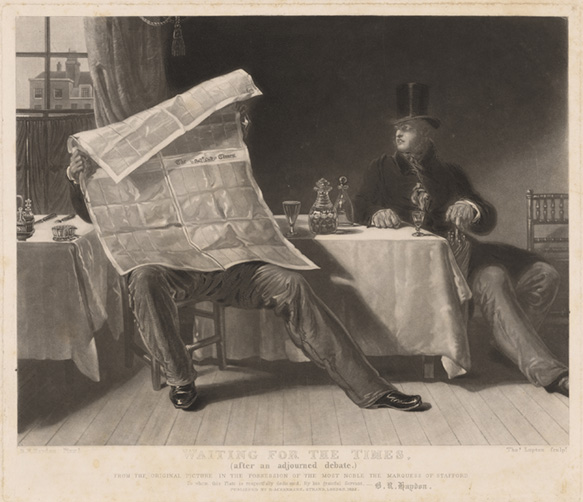
Fig. 3.8 Ackermann’s Print of Benjamin Haydon, ‘Waiting for The Times (after an adjourned debate)’ (1831).
[© The Trustees of the British Museum]

Fig. 3.9 Charles Joseph Traviès de Villers, ‘Caricatures du jour: la lecture des Mystères de Paris: “Après vous, monsieur, s’il vous plait!” ’ Le Charivari (7 novembre 1842): n.p.
[© Bibliothèque nationale de France]
This was a question being asked anxiously in England too. In 1844, G. H. Lewes counted ‘[f]ive translations [of Sue’s Mystères de Paris]…at this moment tempting English readers,—translations of all kinds and at all prices’, from cheap Holywell Street rags to Chapman and Hall’s more expensive illustrated volume version.126 He finds this profusion of Sue horrifying: ‘[a]re the outcasts of society so interesting, that we are to have a whole branch of literature devoted to them?’127 In a Punch cartoon of 1847 [Fig. 3.10], one London cabman asks another, ‘I say, Jim, vich do you give the prufferance? Eugene Shue or Halexander Dumas?’ In his hand the cabman holds not a book but a flimsy illustrated paper, clearly a cheap serial number. Dumas and Sue, wrote The Critic in 1846, ‘have become almost nationalised among us’.128 Punch’s title for its cartoon of the cabmen, ‘Literature at a Stand’, is a pun that suggests not only new working-class readerships but also the stagnation of ‘English’ literature under the invasion of French fiction. ‘Dumas is a staple commodity [in England]; Sue is voted delightful’, cried Blackwood’s in the same year as Punch’s cartoon appeared.129 For decades, the steady flow of French fiction and theatre into London had been taken for granted: as Michael Booth says, ‘French plays continued to supply plots for [English] melodramatists, and the novel proved fruitful for the adapter’.130 But by the late 1840s all things French were coming under new and increasing political suspicion in England. Alexandre Dumas had well-known republican and radical sympathies and, along with the ‘Marseillaise’, the Girodin chorus ‘Mourir pour la patrie’, from a famous Dumas drama, became a favourite of the workers during the 1848 revolution.131 In the spring of 1848, Dumas was publicly accused of plagiarizing English authors in the Athenaeum, and in June when his company, the Théâtre Historique, arrived in London, seeking refuge from the chaos of revolutionary Paris to perform his version of The Count of Monte Cristo at Drury Lane, the performance was shouted down by an organized gang of protestors on opening night. The Drury Lane Theatre was associated with Shakespeare, so that the protest seems to have been xenophobic and anti-French as well as anti-radical. John Mitchell of the St James’s Theatre invited the company to complete the run at his theatre, which frequently put on French plays, but the play was hostilely reviewed in the British press, and the company left sooner than they had planned.132

Fig. 3.10 ‘Literature at a Stand’, Punch, or the London Charivari (13 March 1847): 113.
[Reproduced by kind permission of the Syndics of Cambridge University Library T992.b.1.6]
The mobile serial format of Sue’s Les Mystères de Paris had meant that it spread rapidly across languages and national borders. In 1844, G. H. Lewes reckoned that ‘[t]en editions have been already printed at Paris,—as many at Brussels. The Germans are not backward with versions and imitations.’133 Apart from direct translations, Les Mystères also inaugurated a new genre. A trans-urban series of representations of the ragged travelled across Europe and America in the 1840s and was identified with the urban spread of revolutions. Paul Thiel’s Die Geheimnisse von Berlin [The Secrets of Berlin] (1844) was translated as The Mysteries of Berlin in New York in 1845; George Lippard’s The Quaker City (1845) was set in Philadelphia; The Mysteries of Montreal was an unfinished series (1846); George Thompson, City Crimes, or; Life in New York and Boston. A Volume for Everybody: Being A Mirror of Fashion, A Picture of Poverty, And a Startling Revelation of the Secret Crimes of Great Cities came out in 1849.134 In total, Sue’s Paris mystery spawned ‘more than one hundred novels set in places such as Paris, London, Berlin, Hamburg, Vienna, Amsterdam, Brussels, Lisbon, Milan, Melbourne, Montreal, St. Petersburg, and a host of cities in the United States’.135 The proliferating series of city novels and their stage adaptations (it was inevitable, perhaps, that Frédérick Lemaître should star in Paris in the stage version of the original Les Mystères) revealed the ‘transposability of modern cities’ in the minds of their populations.136 Paris could become London, Berlin, or Lisbon because urban streets and their populations of the ragged urban poor were ubiquitous and interchangeable.137 Patricia Okker has argued that serial fictions can ‘navigate local, national and transnational perspectives’ and point to the existence of ‘a larger transnational community [of authors, publishers, and readers] dispersed across regional and national borders’.138 In the 1840s, they could also point to a larger transnational community of the ragged and the suffering. These city novels and dramas helped to create a model of the city as a serial category: while geographically distant, cities were connected and urban experience was represented as ubiquitous, particularly for the poor. The representation of the city as generic was important: if all cities looked the same then any one of them, and indeed all of them, could have a revolution.139 The serialization of the modern city in print and in performance enabled the serialization of cities in political praxis, despite the great geographical and linguistic differences between them.
G. W. M. Reynolds’s The Mysteries of London, which ran as a hugely popular penny weekly serial from 1844 to 1848, was just one among many imitations of the French serial rag. Reynolds opens his series by topologizing the modern city, claiming that London is ‘city of fearful contrasts’.140 Later he suggests that his story will exceed even Sue’s, claiming that the notorious London ‘rookery’ ‘The Mint’ in Southwark is even more squalid than the Parisian slum and the dingy ‘tapis-franc’ [tavern] where Rodolphe confronts the Chourineur at the start of Les Mystères.141 Reynolds’s story throngs with ragged characters, some of whom are described as repellent, with ‘[m]atted hair, blear-eyes, grimy faces, pestiferous breaths, and hollow cheeks, combined with rags and tatters’ (I, XIX), and some of whom elicit sympathy, like two little children who ‘were both clothed in rags, and had neither shoes nor stockings upon their feet’ (I, XVII). Sometimes the tone is blank: ‘[r]ags and filth—squalor and dissipation—crushing toil and hideous want—ignorance and immorality; these are the features of the collier’s home, and the characteristics of the collier’s life’ (I, CXVI), and sometimes Reynolds makes a direct plea for the ragged:
If a poor devil, clothed in rags and very ugly, appears at the bar, the Foreman of the Jury just says, ‘Well, gentlemen, I think we may say Guilty; for my part I never saw such a hang-dog countenance in my life.’ But if a well-dressed and good-looking fellow is placed in the dock, the Foreman is most likely to say, ‘Well, gentlemen, far my part I never can nor will believe that the prisoner could be guilty of such meanness: so I suppose we may say Not Guilty, gentlemen.’ (I, XXVI)
Reynolds’s politically radical serial fiction was socially promiscuous, outselling even his rival, Dickens.142 Like Dickens, Reynolds built himself into a brand, and ‘the sprawling, proliferating, expansive nature of Reynolds’s multiple serials/series/volumes, with nine and a half million words’, not all of which were written by Reynolds himself, grew into what Mark Turner has described as ‘a print hub’.143 Without being ‘literary’ or sophisticated, Reynolds’s text was explicitly functioning on several interpretative levels, making itself available to different readerly constituencies.144 By presenting his political plots as melodramas, Reynolds radicalized serial popular fiction.145 Mysteries of London worked to anticipate politics and prepare its readers, many of whom (but not all) were working class, for real events. As Louis James noticed, ‘The Mysteries of London borrowed its appearance and many of its stylistic features from the newspaper and “miscellany” format, permitting abrupt transitions from political diatribe and sociological treatise to romance or Gothic narrative’.146 But perhaps those transitions were not all that abrupt, given that, in Reynolds’s hands, ‘romance’ and ‘Gothic narrative’ are themselves far from apolitical media.
In 1846, the hero of the first series of Mysteries of London, Richard Markham, has ‘the immortal honour of founding a purely democratic government in the finest State belonging to the Italian Peninsula’: the Utopian Italian republic Castelcicala, ‘the most beautiful, the best cultivated, and the finest portion of the Italian Peninsula’.147 A map is helpfully provided in the text [Fig. 3.11].

Fig. 3.11 Map of Castelcicala, G.W.M. Reynolds, The Mysteries of London (II, CLXXIV).
[Reproduced by kind permission of the Syndics of Cambridge University Library 8700.b.161]
An imaginary geography of this ‘by no means…unimportant country in the map of Europe’ combines actual Italian places such as Lipari and Friuli, displaced from their real co-ordinates, and imaginary places such as the regional capital, Montoni, which seems to be playfully named after the villain in Ann Radcliffe’s 1794 Gothic blockbuster The Mysteries of Udolpho.148 The Revolution led by Markham with the help of more than ‘two thousand Castelcicalan refugees in Paris and London’, and the subsequent creation of a Republic with Markham at its head as the Grand Duke of Castelcicala, were prophetic of actual revolutionary events yet to happen in Italy.149 The penny numbers of The Mysteries of London functioned as both a melodramatic entertainment and an unstamped newspaper for its poorer readers. A growing culture of popular miscellanies, news, and shows had been educating the British poor in the idea of citizenship since the 1820s, and the new availability of serials of all sorts had already started to give readers a sense of political belonging.150 Excluded from reading expensive newspapers, they were introduced in the pages of The Mysteries of London to the idea, if not quite the reality, of the Italian Risorgimento struggle. Their political literacy and geographical range were extended, and European events did eventually catch up. In February 1848, Reynolds’s weekly serial collided joyfully with the series of revolutions across Europe, and the fictional Italian Republic was joined by the real French one:
And when we reflect that it was a Revolution which evoked his [Richard Markham’s] brilliant qualities as a warrior and a statesman,—when we call to mind the fact that it was the cry of ‘Liberty’ which became the watch-word of his achievements and the herald of his triumphs,—we cannot do otherwise, on reaching this point in our narrative, than avail ourselves of so fitting an opportunity to notice the grand and glorious struggle that has so lately taken place in the capital of France.151
After an extended discussion of the merits of the new French republic, and a reminder of the onward progress of the revolutions across ‘[t]he States of Italy—Bavaria—and France’, Reynolds announces ‘We now proceed with the thread of our narrative’ and we return to the melodramatic story.152 Over the coming weekly numbers, fortuitously in synch with the turbulent European revolution, he is able to insert more and more political and foreign reportage. In the summer of 1848, all six points of the Charter are listed in the midst of the denouement of a marriage plot between Lord William Trevelyan and Agnes Vernon. Reynolds introduces the Charter on the scanty premise that while the aristocratic Lord Trevelyan may be a good man, ‘[a]ll men were originally equal; and in no country, therefore, should any privilege of birth give one family a right to monopolise the executive power forever’.153 He ends this intervention by begging his readers ‘not to stand still and gaze listlessly, while all the rest of the civilised world is in motion!’154
Along with Sue’s Mystères de Paris, Reynolds’s Mysteries of London remains one of the most contemporarily widely-read texts in the whole history of European literature. Through reading Reynolds, many people on the streets of the cities and towns of Britain knew—just as well as their French neighbours—that the civilized world was ‘in motion’ in these months. Many of Reynolds’s first British readers, however successfully they have been silenced in our national history since, felt passionately in 1848 that they were a part of the ragged series of Europe. ‘They confound us all together in the sweeping appellation of ‘the mob!’, cried Reynolds, but the generative potential of writing and reading meant that the poor were newly represented to themselves, and they were beginning to descry an identity for themselves as citizens rather than as a nameless part of an impoverished and disregarded mass.155 If we reconnect the literary writing of 1848 to this radical moment and plug it back into this connected series of ragged texts, it jumps back into a lively and urgent conversation with the popular serial fiction that is animating Europe. Chapter 4 reads Elizabeth Gaskell’s novel of 1848, Mary Barton, as part of this ragged European series and suggests that such a reading can restore to the novel its contemporary significance and power.
1 L’Internationale, lines 1–2 [Stand up, damned of the Earth | Stand up, prisoners of starvation]. The original French words of the ‘Internationale’ were written in June 1871 by Eugène Pottier (1816–87), a wood carver and previously a member of the Paris Commune. They were famously taken by Frantz Fanon as the title of his 1961 book about the dehumanizing effects of colonization. Unlike Marx and Engels, Fanon identifies ‘the people of shanty towns and the lumpen proletariat’ in The Wretched of the Earth as ‘one of the most spontaneously and radically revolutionary forces of a colonized people’: Frantz Fanon, The Wretched of the Earth, trans. Richard Philcox (New York: Grove, 2004), p. 80.
2 Ralph Waldo Emerson, ‘Notebook Delta’ (1837–8) in RWE JMN 12, p. 183. Notebook Delta was the repository of RWE’s thoughts for his lectures. The phrase had already appeared in the 1836 ‘Notebook MAN’: see RWE, JMN, p. 64. And in his 1837–8 ‘Human Culture’ lecture series in Boston it appeared again, slightly altered to ‘A single man in a ragged coat at an election looks revolutionary.’ ‘General Views’, The Early Lectures of Ralph Waldo Emerson, vol. II: 1836–1838, ed. Stephen E. Whicher, Robert E. Spiller, and Wallace E. Williams (Cambridge, MA: Belknap Press, 1964), p. 362. Emerson reused the phrase once more in his essay ‘The Senses and the Soul’, in The Dial (January 1842): 374–89, p. 378.
3 The potato famine that devastated Ireland extended across Continental Europe as well. ‘The harvest failures of 1845 and 1846 and the resulting famines came on top of rural pauperisation and urban discontent, and thus contributed to the revolutions of 1848 on the European Continent. The statement “an epidemic of potato late blight caused an epidemic of revolutions” is, perhaps, exaggerated but it contains a grain of truth.’ J. C. Zadoks, ‘The Potato Murrain on the European Continent and the Revolutions of 1848’, Potato Research 51 (2008): 5–45, p. 5.
4 John S. C. Abbott, The French Revolution of 1789 as Viewed in the Light of Republican Institutions (New York: Harper & Brothers, 1859), p. 151.
5 Deva Woodly suggests that ‘the concept [of seriality] is generally useful as a way of apprehending and explaining a range of social and political relations, both by better specifying those identities that political scientists are used to counting as relevant (such as gender, race, socioeconomic status and sexuality) and by making it possible to identify and organize around other kinds of problematic relations that we are not in the habit of seeing’; Deva Woodly, ‘Seeing Collectivity: Structural Relation through the Lens of Youngian Seriality’, Contemporary Political Theory 14:3 (August 2015): 213–33, p. 222.
6 John Edward Toews, Hegelianism: The Path Toward Dialectical Humanism, 1805–1841 (Cambridge: Cambridge University Press, 1980), pp. 362–3.
7 John Wesley Corson, Loiterings in Europe: or, Sketches of Travel in France, Belgium, Switzerland, Italy, Austria, Prussia, Great Britain, and Ireland (New York: Harper and Brothers, 1848), p. i and p. 320.
8 Friedrich Engels, The Condition of the Working Class in England, ed. David McLellan, trans. Florence Kelley-Wischnewetsky (Oxford: Oxford University Press, 1999), p. 46. Engels notes the internationalism of his study in a letter of 1845, written while he was composing The Condition of the Working Class: ‘I shall be presenting the English with a fine bill of indictment;…It need hardly be said that my blows…are meant for…the German bourgeoisie, to whom I make it plain enough that they are as bad as their English counterparts’: Engels to Marx (19 November 1844), Karl Marx/Frederick Engels Collected Works, vol. 38: Letters: 1844–51 (London: Lawrence & Wishart, 1982), pp. 9–14, pp. 10–11.
9 Corson, Loiterings in Europe, p. 357. The phrase ‘flock in myriads’ is significant as indicative of Corson’s feeling of being overwhelmed by the numbers of the ragged. See my discussion of biopolitical language in Chapter 7 of Pettitt, Serial Forms, pp. 251–86.
10 Rev. Thomas Guthrie, A Plea for Ragged Schools; or, Prevention better than Cure (London: James Nesbit & Co., 1847), p. 8, quoted in Corson, Loiterings in Europe, p. 321.
11 Charles Dickens, Pictures from Italy, ed. Kate Flint (London: Penguin, 1998), pp. 166–7 (emphasis original).
12 Henry Colman, European Life and Manners: In Familiar Letters to Friends, 2 vols (Boston: Charles C. Little & James Brown, 1849), all quotations vol. 1, p. 159.
13 As my purpose is European and comparative in this chapter, I do not do justice here to the British sanitary movement of the 1840s in all its ‘tentacular complexity’, as Mary Poovey has wonderfully put it. There is already a rich body of work exploring sanitary reform in the British context, headed up by Poovey’s own inspiring book, Making a Social Body: British Cultural Formation, 1830–1864 (Chicago: University of Chicago Press, 1995). She uses the ‘tentacular’ phrase on p. 116. See also Elaine Freedgood, ‘The Rhetoric of Visible Hands: Edwin Chadwick, Florence Nightingale and the Popularization of Sanitary Reform’, in Victorian Writing about Risk: Imagining a Safe England in a Dangerous World (Cambridge: Cambridge University Press, 2000), pp. 56–87; Patrick Joyce, ‘The Water and the Blood of the City: Naturalising the Governed’, in The Rule of Freedom: Liberalism and the Modern City (London: Verso, 2003), pp. 62–97; Lynda Nead, Victorian Babylon: People, Streets and Images in Nineteenth-Century London (New Haven, CT: Yale University Press, 2000); and Michelle Elizabeth Allen, Cleansing the City: Sanitary Geographies in Victorian London (Athens, OH: Ohio University Press, 2008).
14 Edwin Chadwick, ‘Report on the Sanitary Condition of the Labouring Population of Great Britain’, in Report to her Majesty’s Principal Secretary of State for the Home Department, from the Poor Law Commissioners, of an Inquiry into the Sanitary Condition of the Labouring Population of Great Britain; with Appendices (London: W. Clowes, 1842), p. 428. This phrase is cited by Chadwick from Classes dangereuses, vol. ii, p. 126.
15 Chadwick, ‘Report on the Sanitary Condition’, p. 93.
16 Dr Lyon Playfair to Edwin Chadwick (1 February 1847), quoted in David Trotter, ‘The New Historicism and the Psychopathology of Everyday Modern Life’, Critical Quarterly 42:1 (2000): 36–58, p. 50. The Playfair letter quoted by Trotter is in the Chadwick Collection of the Library of University College London: Chadwick MSS, 1588. The collection includes eight letters from Place to Chadwick, 1829–41. MSS, 1587.
17 The play was the result of a collaboration between at least three authors writing under the pseudonyms Benjamin Antier, Saint-Amant, and Paulyanthe. It was a huge success and much revived. A sequel to the play opened in 1832. Lemaître wrote his own version, called just Robert Macaire, which allowed him to extemporize in the role, and this was performed in 1834 at the Folies Dramatiques and again in 1835 at the Porte Saint- Martin. Balzac was familiar with both plays, and his novel L’Auberge rouge (1832) owes much to Robert Macaire. For a complete list of references to Robert Macaire in Balzac’s work, see La Comédie Humaine, xii, p. 1813. Gustave Flaubert, who was entranced by Lemaître’s performances as Macaire, was later to call Robert Macaire ‘the greatest symbol of our age’ and ‘the epitome of our times’.
18 See Marion Lemaire, Robert Macaire: la construction d’un mythe. Du personnage théâtral au type social. 1823–1848 (Paris: Honoré Champion, 2018).
19 L’Auberge d’Adrets was hissed and booed on its first night. The story goes that the next day, Lemaître was walking the boulevards considering how to rescue the production, when he ‘was faced accidentally by a person of the strangest gait. The man’s costume had been extremely elegant at one time, but it was worn to the last thread and hung almost in rags about his limbs; the sordidness of his dress, however, did not in the slightest degree affect the air of daring cynicism and conscious superiority which predominated in all his person. He used a rag for a handkerchief, but still he had one; his boots were torn and worn out, but they were made of patent leather, and the individual wore his ludicrous tatters as if he had been a millionaire.’ Lemaître followed this man, studied him, and entered into conversation with him. That night he appeared on stage as him. The play was an instant hit. Camille Barrère, ‘Frederick Lemaître’ [sic], The Gentleman’s Magazine 13:237 (October 1874): 447–59, pp. 451–2.
20 Théophile Gautier, Histoire de l’art dramatique en France depuis vingt-cinq ans, 5e série (Paris: Editions Hetzel, 1859). In French Gautier writes: ‘ce grand triomphe de l’art révolutionnaire, qui succéda à la révolution de juillet’ and ‘c’est l’audace, c’est l’attaque désespérée contre l’ordre sociale ou contre les hommes’: both quotations p. 260.
21 The discussion that follows of Pyat’s Le Chiffonnier and Stirling’s English version of the play was jointly researched with Professor John Stokes, and originally presented as ‘Rags, Ragpickers and Chiffonniers: Paris and London in 1848’ at the ‘Music in London: WC2’ seminar, King’s College London, 12 December 2019.
22 Barrère, ‘Frederick Lemaître’, p. 457.
23 Corson, Loiterings in Europe, p. 312. It should be added that Corson is celebrating the French state crêche system for the care of young children, and here is imagining that even this female chiffonnière might have access to such childcare facilities.
24 Chadwick, ‘Report on the Sanitary Condition’, p. 93.
25 George W. M. Reynolds, Robert Macaire in England (London: Thomas Tegg, 1840), pp. 181–2.
26 For a rich visual history of the chiffonnier, see Antoine Compagnon, Les Chiffonniers de Paris (Paris: Gallimard, 2017).
27 Théophile Gautier wrote of Le Chiffonnier de Paris (17 May 1847): ‘Le prologue nous montre deux chiffonniers; l’un est arrivé là après avoir dissipé foliment son patrimoine, l’autre n’a jamais connu de condition meilleure: grace au bleu, au trois-six et au fil-en-quaire, don’t il fait d’amples libations, ce dernier ne sent pas trop sa misère, qu l’ivresse illumine de reflets dorés.’ Gautier, Histoire de l’art dramatique en France, p. 84.
28 Rémi Gossez, ‘Diversité des antagonismes sociaux vers le milieu du XIXe siècle’, Revue économique 7:3 (May 1956): 439–58, p. 451. Gossez writes: ‘vagabonds, portefaix, joueurs d’orgues, chiffonniers, rémouleurs, rétameurs, commissionnaires et tous ceux qui vivaient des mille petits metiers des rues de Paris, et aussi tout cette masse confuse, flottante qu’on appelait ‘la bohême’ (translation my own). The announcement of the closure of the ateliers [workshops] in Paris and the elections in June 1848 were the catalysts for the uprising of the working poor against the Provisional Government. Smallholders in rural France, mostly illiterate, were also worried by the ascendancy of socialism in Paris, which they saw as a threat to their property. They voted overwhelmingly for the ‘forces of order’ and backed Louis Napoleon, Napoleon’s nephew, whom they saw as the second coming of his heroic uncle. T. J. Clark defines the ‘Bohemia’ of the late 1840s as qualitatively different to that of bourgeois students living (off their rich fathers) in the Latin Quarter for a few years after the 1830 revolution, all of whom ended by rejoining the bourgeoisie. The new bohemia became ‘an unassimilated class, wretchedly poor, obdurately anti-bourgeois’ and a ‘confused, indigent, shifting population’. Clark says we should put it alongside ‘the classes dangereuses. It was this dangerous element—this mob of unemployed, criminals, and déclassés of every sort, the first victims, the first debris of industrialism—which made up one part of the rebel fighting force in June 1848.’ Clark, Image of the People, p. 33. This seems an overly confident taxonomy to me.
29 For the long history of rags in France, see Daniel Roche, The Culture of Clothing: Dress and Fashion in the Ancien Regime, trans. Jean Birrell (Cambridge: Cambridge University Press, 1994), p. 381. Mary Poovey describes Chadwick’s target for ‘domestication’ as the ‘all-male non-domestic associations represented so horrifically by the French chiffonniers’—but chiffonniers were not all male, and they often lived in family groups. Poovey explains that Chadwick’s reason for criminalizing all-male non-domestic associations was obvious: Chartism. As she says, ‘the Chartist movement had proved by 1842 that working men could and would organize in favor of political enfranchisement. These politicized activities by working men constitute the implicit referent of the savagery of Chadwick’s bone pickers and itinerant poor.’ Mary Poovey, ‘Domesticity and Class Formation: Chadwick’s 1842 Sanitary Report’, in Making a Social Body, pp. 115–31, p. 123. The second quote is from an earlier version of this chapter: Mary Poovey, ‘Domesticity and Class Formation: Chadwick’s 1842 Sanitary Report’, in David Simpson (ed.), Subject to History: Ideology, Class, Gender (Ithaca, NY: Cornell University Press, 1991), pp. 65–83, p. 79.
30 See Robertson, Revolutions of 1848, p. 54. There is no record of Victoria seeing Le Chiffonnier de Paris but she saw Frédéric Lemaître act on several occasions. George Rowell records Victoria’s reactions to Lemaître in 1845: ‘he depicted quite admirably the “aventurier character of Don César, full of noble and generous feelings” in Don César de Bazan (Queen Victoria’s Journal, 24 February 1845); and she saw him in Trente Ans dans la Vie d’un Jouer (“very interesting but dreadful…we only got back at half past 12”) (Queen Victoria’s Journal, 5 March 1845). But by 1852, she saw him in Ruy Blas and thought him “very old, without a tooth in his head…a disagreeable performance”’ (Queen Victoria’s Journal, 27 March 1852): George Rowell, Queen Victoria Goes to the Theatre (London: Elek, 1978), pp. 43, 44.
31 Playbill in Theatre Museum London collection. My thanks to John Stokes for this quotation.
32 Edwin Chadwick, ‘Report on the Sanitary Condition’, p. 95. Chadwick also quotes the French police on the revolt of the Parisian chiffonniers caused by their attempts to modernize street-cleaning in Paris, p. 94.
33 Edwin Chadwick, ‘Report on the Sanitary Condition’, p. 95.
34 In Kingsley’s Alton Locke, the determined Crossthwaite vows that he will impoverish himself to protest against his working conditions: ‘I will sweep a crossing—I will turn cress-gatherer, rag-picker—I will starve piecemeal’, suggesting that these are the most precarious jobs in the urban economy: Charles Kingsley, Alton Locke: Tailor and Poet, An Autobiography [1850] (London: Chapman & Hall, 1856), p. 83. Walter Benjamin thought the Parisian ragpicker ‘the most provocative figure of human misery’, ‘clothed in rags and occupied with rags’: Benjamin, The Arcades Project, both quotations p. 349.
35 Charles Dickens, Bleak House (London: Bradbury & Evans, 1853), p. 35 (capitals original). See also [Charles Dickens and Mark Lemon], ‘A Paper-Mill’, Household Words 1 (31 August 1850): 529–31. There was an acute rags shortage in 1850: see [Harriet Martineau], ‘How to Get Paper’, Household Words 10 (28 October 1854): 241–5. Dickens also represented a paper mill in Our Mutual Friend. Only in the 1870s did pulp paper really come into manufacture and use. For the history of paper manufacturing see Sven A. Anderson, ‘Trends in the Pulp and Paper Industry’, Economic Geography 18:2 (1942): 195–202.
36 Deborah Wynne, in an excellent article on the use of rags in the nineteenth century, suggests that ‘[a]n understanding of Victorian practices of cloth recycling as a socially responsible activity helps to foreground Dickens’s idea of rags recycling as a paradigm for society’s duties towards destitute children’: Deborah Wynne, ‘Reading Victorian Rags: Recycling, Redemption, and Dickens’s Ragged Children’, Journal of Victorian Culture 20:1 (2015): 34–49, p. 35.
37 Edward Stirling, The Ragpicker of Paris and the Dress-Maker of St. Antoine (London: Samuel French, 1847), p. 11.
38 Ibid.
39 [Anon.], ‘Scenes in The French Theatre.—On Sunday’, The Times (Wednesday 1 March 1848): 7.
40 RA VIC/QVJ, 25 February 1848; RA VIC/QVJ, 2 April 1848. Quoted in Yvonne M. Ward, ‘Queen Victoria and the Cabinet d’Horreurs’, in Boardman and Kinealy (eds), 1848, pp. 173–88, pp. 174, 183.
41 Marx, ‘The Eighteenth Brumaire’, p. 149. The chiffonniers are explicitly mentioned in this passage: ‘[a]longside decayed roués with dubious means of subsistence and of dubious origin, alongside ruined and adventurous offshoots of the bourgeoisie, were vagabonds, discharged soldiers, discharged jailbirds, escaped galley slaves, rogues, mountebanks, lazzaroni, pickpockets, tricksters, gamblers, maquereaus, brothel keepers, porters, literati, organ-grinders, rag-pickers, knife grinders, tinkers, beggars—in short, the whole indefinite, disintegrated mass, thrown hither and thither, which the French term la bohème; from this kindred element Bonaparte formed the core of the Society of December 10.’ Maquereaus (literally, mackerel fish) was a slang term for pimps.
42 Marx, ‘The Eighteenth Brumaire’, p. 149. The reference is, of course to Shakespeare’s A Midsummer Night’s Dream, Act One, Scene Two. Marx originally misremembered the lion as played by Bottom. But Nick Bottom plays Pyramus: it is Snug the Joiner who takes the part of the lion in Pyramus and Thisbe. More recent editions silently correct the error.
43 Marx, ‘The Eighteenth Brumaire’, p. 149.
44 ‘The “dangerous class” [lumpenproletariat], the social scum, that passively rotting mass thrown off by the lowest layers of the old society, may, here and there, be swept into the movement by a proletarian revolution; its conditions of life, however, prepare it far more for the part of a bribed tool of reactionary intrigue.’ Karl Marx and Frederick Engels, ‘Manifesto of the Communist Party’ [February 1848], Karl Marx/Frederick Engels Collected Works, vol. 6: Marx and Engels: 1845–1848 (London: Lawrence & Wishart, 1976), pp. 477–519, p. 494. The translation was made by Richard Dixon and others.
45 Stedman Jones, ‘Elusive Signifiers’, p. 449.
46 Marx trips himself up by trying to assign a distinct class-identity to the three income-types: ‘wages, profit and ground rent’ but he immediately realizes that this would mean that ‘physicians and officials, e. g., would also constitute two classes, for they belong to two distinct social groups, the members of each of these groups receiving their revenue from one and the same source’. After another uncertain sentence, the chapter ends. Karl Marx, ‘Classes’, in Karl Marx/Frederick Engels Collected Works, vol. 37: Karl Marx: Capital Volume III (London: Lawrence & Wishart, 1998), pp. 870–2, p. 871.
47 Mark Traugott, ‘The Crowd in the French Revolution of February,1848’, American Historical Review 93:3 (1988): 638–52, p. 648. Traugott suggests that the preponderance of textile workers is merely due to their large proportion in the working population in Paris at the time. Traugott’s article supports the conventional view that ‘[t]he typical February insurgent, according to this compilation of the compensation records, was a male, thirty-five years old in 1848, married, and the head of a small household. He was likely to have been born in the provinces, where he received only a rudimentary primary education, and to have come to Paris to work as an artisan in one of the skilled trades that flourished in the capital.’ He concludes that most of the fighting in February and July 1848 in Paris was by ‘members of the laboring classes, specifically by the highly skilled and relatively privileged artisans who predominated in the Parisian labor force’: pp. 644, 651. However, by Traugott’s own admission, this data is poorly differentiated and he notes that occupational data was recorded in a vague and haphazard way (so that levels of skill are not clear). Traugott also does not seem to consider that perhaps not all families made compensation claims for injuries and familial deaths in the revolution. The more indigent they were, the less likely they would be to do so.
48 Marx and Engels, ‘Manifesto of the Communist Party’, p. 494.
49 These two translations are given in full in the Cambridge Companion to The Communist Manifesto. Terrell Carver translates this sentence as: ‘[t]he lumpen proletariat, that passive dung heap of the lowest levels of the old society, is flung into action here and there by the proletarian revolution, though by its whole situation in life it will be readier to sell itself to reactionary intrigues’: Terrell Carver and James Farr (eds), Cambridge Companion to The Communist Manifesto (Cambridge: Cambridge University Press, 2015), pp. 237–60, p. 244. And Helen Macfarlane translates the title as ‘The Manifesto of the German Communist Party’ and gives this version: ‘[t]he Mob,—this product of the decomposition of the lowest substrata of the old Social system,—is partly forced into the revolutionary Proletarian movement. The social position of this portion of the people makes it, however, in general a ready and venal tool for Reactionist intrigues’: Cambridge Companion to The Communist Manifesto, pp. 261–82, p. 268.
50 Marx and Engels, ‘Manifesto of the Communist Party’, p. 494.
51 ‘Venal’ is Helen Macfarlane’s word: Cambridge Companion to The Communist Manifesto, p. 268.
52 Lawrence Wilde suggests that not everyone agrees with Marx that the lumpenproletariat are ‘the bribed tool of reactionary intrigue’, pointing out that ‘Mikhail Bakunin…solidly backs the revolutionary potential of the lumpenproletariat, as do more recent writers such as Frantz Fanon and Herbert Marcuse’: Lawrence Wilde, ‘Marx’s Concept of Class in “The Eighteenth Brumaire of Louis Bonaparte” ’, in Francis Barker et al. (eds), 1848: The Sociology of Literature, pp. 1–12, pp. 8, 9.
53 Jacques Rancière, ‘The Myth of the Artisan: Critical Reflections on a Category of Social History’, International Labor and Working-Class History 24 (Fall 1983): 1–16. Rancière argues that ‘the period of “initial” worker socialism, the one which, through the strikes and associations of the 1830s, and through the republican organizations, utopian groups, workers’ literature and the press of the 1840s, led to the workers’ eruption of 1848. Indeed, we are accustomed to seeing the worker of ’48 as the typical representative of artisanal culture’: p. 1.
54 Rancière, ‘Myth of the Artisan’, p. 2.
55 Rancière, ‘Myth of the Artisan’, p. 2.
56 Jacques Rancière has pointed to Marx’s separation of the social and political as one of the weaknesses of his philosophy, suggesting that Marx sees ‘emancipation’ as happening in a realm of the social which is never contiguous with the realm of the political. Jacques Rancière, Dis-agreement, pp. 82ff.
57 Emily Steinlight has argued that this woman self-confessedly belongs neither to the working class nor to the sub-class of prostitutes, chiffonniers, and street workers, thus calling Mayhew’s whole system of class-differentiation into question: Emily Steinlight, Populating the Novel: Literary Form and the Politics of Surplus Life (Ithaca, NY: Cornell University Press, 2018), p. 94.
58 Henry Mayhew, London Labour and the London Poor, 4 vols (London: Griffin, 1861), vol. 4, p. 256: ‘mot’ is slang for a prostitute.
59 Jacques Rancière, ‘The Myth of the Artisan’, p. 11. He adds, ‘but also a particular category of intellectuals, more intellectual, in a sense, than we are, for their intellectuality is a victory over their condition’ (emphasis original).
60 Henry Mayhew, London Labour, vol. 4, p. 256.
61 Claude Lefort, Democracy and Political Theory, trans. David Macey (Cambridge: Polity Press in Association with Basil Blackwell, 1988), all quotations pp. 53–4.
62 Hannah Arendt, On Revolution, pp. 16–17. Arendt points out that the spectacle of the poor and destitute ‘played hardly any role in the course of the American Revolution’—a revolution disregarded by Marxists, but one which she considers much more successful than the French version: p. 17.
63 Arendt, On Revolution, p. 41.
64 Abbott, The French Revolution of 1789, p. 151.
65 Abbott, The French Revolution of 1789, p. 72.
66 For a discussion of Arendt’s racism, see Introduction to this volume, p. 16 n. 55.
67 It may be that ‘the small city-state of Athens has stunted the Western imagination, especially with respect to what constitutes political activity and citizenship’: DeLuca and Peeples, ‘From Public Sphere to Public Screen’, p. 129.
68 Claude Lefort has questioned Arendt’s reading of revolution, in particular ‘the clear-cut distinction she establishes between the political realm and the private realm, and the related distinction between political equality and social inequality’: Lefort, Democracy and Political Theory, all quotations pp. 53–4.
69 Giorgio Agamben, Homo Sacer: Sovereign Power and Bare Life, trans. Daniel Heller-Roazen (Stanford, CA: Stanford University Press, 1998), p. 4.
70 Lewald, A Year of Revolutions, p. 154.
71 Lewald, A Year of Revolutions, pp. 61, 103.
72 See Helge Berger and Mark Sporer, who say, ‘[a]pplying standard quantitative methods to a data set of 27 European countries, we show that it was mainly immediate economic misery, and the fear thereof, that triggered the European revolutions of 1848’: Helge Berger and Mark Sporer, ‘Economic Crisis and the European Revolutions of 1848’, Journal of Economic History 61:2 (2001): 293–326, p. 293.
73 Hobsbawm, The Age of Revolution, p. 305.
74 Siemann, Die Deutsche Revolution von 1848/49, pp. 184ff. Taxation and the restoration of common land rights were causes of peasant grievances, and hunger was a unifying political motivation. Nationalism had very little traction as a political idea in the rural areas of most of Europe.
75 Sperber is referring here specifically to the Rhinelands: Jonathan Sperber, Rhineland Radicals (Princeton, NJ: Princeton University Press, 1991), p. 3.
76 Berger and Sporer, ‘Economic Crisis’, p. 295.
77 Quoted in Sean Eddie, ‘The 1848 Revolution in Prussia: A Financial Intepretation’, in Julian Hoppit, Duncan Needham, and Adrian Leonard (eds), Money and Markets: Essays in Honour of Martin Daunton (Woodbridge: Economic History Society and Boydell Press, 2019), pp. 109–25, p. 115.
78 Eddie, ‘The 1848 Revolution in Prussia’, p. 125.
79 Feargus O’Connor, speech, reported in Proceedings of the National Convention, which assembled at the Literary and Scientific Institution, John Street, London 4–17 April 1848 (London: National Convention of Chartists (London), 1848), p. 4. See also Feargus O’Connor, report of speech, ‘Great Metropolitan Demonstration’, in which O’Connor is reported as saying ‘[h]e would not give a fig for a political change, unless it carried a social one with it’: Northern Star (11 March 1848), p. 1.
80 There are some noble exceptions. Margot Finn’s excellent After Chartism is one.
81 [Anon.], ‘The Austrians’, Blackwood’s 48 (October 1840): 487–505, p. 491. The Oxford English Dictionary defines a tatterdemalion as a ‘person in tattered clothing; a ragged or beggarly fellow; a ragamuffin’.
82 Poovey, Making a Social Body, p. 126.
83 Poovey, Making a Social Body, p. 127. David Trotter discusses and complicates Poovey’s argument by pointing out that Chadwick and Francis Place were correspondents and colleagues even when Place was involved in (moderate) Chartism. Trotter presents the ‘hypothesis that the sanitary reformers sometimes sought to control anxiety by converting it back into fear’, and suggests that Playfair’s description of the night-soil workers (see p. 122) is designed ‘not to make the nightmen seem even more dangerous than they actually are, by associating them with a politicized lumpenproletariat, but, on the contrary, to humanise them, to find in their otherwise incomprehensible bestiality a semblance of intent, a semblance of identifiable feeling: something to be afraid of’: Trotter, ‘The New Historicism and the Psychopathology of Everyday Modern Life’, p. 50.
84 John Goode, ‘1848 and the Strange Disease of Modern Love’, in John Lucas (ed.), Literature and Politics in the Nineteenth Century: Essays (London: Methuen, 1971), pp. 45–76, p. 45.
85 MF, Dispatch 8 (December 1846), Sad but Glorious, p. 88.
86 Colman, European Life and Manners, vol. 1, p. 159.
87 J. Palgrave Simpson, Pictures from Revolutionary Paris, Sketched during the First Phasis of the Revolution of 1848, 2 vols (Edinburgh: William Blackwood and Sons, 1849), vol. 1, pp. 67, 106.
88 Simpson, Pictures from Revolutionary Paris, vol. 1, p. 57.
89 The Times (18 March 1848): 7.
90 [Anon.],‘The Open-Air Meeting in Trafalgar-Square’, The Times (7 March 1848): 8.
91 Martin Daunton, Trusting Leviathan: The Politics of Taxation in Britain, 1799–1914 (Cambridge: Cambridge University Press, 2001), p. 88. After 1815, ‘[t]he tax system, the corn and navigation laws, chartered monopolies, and the limited franchise meant that the state was now widely criticized by radicals as biased and partisan’: Martin Daunton, State and Market in Victorian Britain: War, Welfare, and Capitalism (Woodbridge: Boydell Press, 2008), p. 3.
92 Joseph Hume MP, Parliamentary Debates, 3rd series, 102 (26 February 1849), cols. 123–5. Quoted in Daunton, Trusting Leviathan, p. 87.
93 ‘After Waterloo, the British fiscal state was deeply resented and criticized, to a much greater extent than in the eighteenth century: trust was lost and needed to be rebuilt by the British political élite.’ Daunton, Trusting Leviathan, p. 61.
94 Edward Stillingfleet Cayley, The European Revolutions of 1848, 2 vols (London: Smith, Elder & Co., 1856), vol. 1, p. 232. The ‘mob’ was stirred up by Cochrane, and although the conservative Cayley describes it dismissively as made up of ‘pick-pockets, thieves, dirty-boys and spectators, who were here and there addressed by persons who alluded to the revolution in Paris’, adding that the crowd consisted of ‘fifteen thousand persons only’, the event was serious enough to be energetically and violently put down by the police: pp. 231–2. [Anon.], ‘The Effects of Our Own Revolution’, Punch, or the London Charivari 14 (25 March 1848): 130.
95 Isobel Armstrong, Victorian Glassworlds: Glass Culture and the Imagination 1830–1880 (Oxford: Oxford University Press, 2008), pp. 57, 63, 68.
96 David Goodway notes that on the Monday, there had been just 1,189 police on duty or reserve in London; two days later, there were 2,460. He also cites evidence of the police mismanagement of the protest. David Goodway, London Chartism 1838–1848 (Cambridge: Cambridge University Press, 1982), pp. 111–14. See also Roger Swift, ‘The “Specials” and the Policing of Chartism in 1848’ in Boardman and Kinealy (eds), 1848, pp. 48–59.
97 Mitchell, ‘Britain’s Reaction to the Revolutions’, p. 83. Mitchell makes the mistake of underestimating government press censorship at the time and relying on the very unreliable Punch for his accounts of the Chartist uprisings.
98 [Anon.], ‘Another Account’, Punch, or the London Charivari 14 (18 March 1848): 115–16, p. 116.
99 Frank McLynn discusses the huge police and army presence both on the streets and in reserve in Britain in the spring and early summer of 1848: Frank McLynn, The Road Not Taken: How Britain Narrowly Missed a Revolution, 1381–1926 (London: The Bodley Head, 2012), pp. 336–8.
100 Simon Schama writes that before the Chartist meeting on 10 April, the Duke of Wellington assumed command of the army; 85,000 special constables were sworn in to supplement 8,000 regular troops and the Metropolitan Police was expanded to 4,000 men: Simon Schama, A History of Britain, vol. 3: The Fate of Empire 1776–2000 (London: BBC Worldwide, 2002), p. 140.
101 For an assessment of how close Britain came to revolution in 1848, see John Saville, 1848: The British State and the Chartist Movement (Cambridge: Cambridge University Press, 1987); Edward Royle, Revolutionary Britannia? Reflections on the Threat of Revolution in Britain, 1789–1848 (Manchester: Manchester University Press, 2000). E. P. Thompson famously asserted that Britain was ‘within an Ace’ of a revolution in 1830: E. P. Thompson, The Making of the English Working Class [1963] (London: Penguin, 2013), p. 898. His claim has been contested as exaggerated, by, among others, Nancy D. LoPatin, Political Unions, Popular Politics and the Great Reform Act of 1832 (Basingstoke: Macmillan, 1999). LoPatin argues that political unions across the country worked to maintain order and campaigned for reform: pp. 1–4.
102 [Anon.], The Economist 6:244 (29 April 1848): 477.
103 Michel-Rolph Trouillot, Silencing the Past: Power and the Production of History (Boston, MA: Beacon Press, 1995), p. 49.
104 Saville, 1848: The British State, p. 202 and see pp. 226–7; Ian Haywood, The Revolution in Popular Literature: Print, Politics and the People 1790–1860 (Cambridge: Cambridge University Press, 2004), pp. 218–39. David Goodway agrees that only fierce repression broke the Chartist movement.
105 George Jacob Holyoake, ‘Why have we had no revolution in England?’, Reasoner 7:1 (4 July 1849): 1. Holyoake added, ‘[a] provisional government in London would be useless without a Cromwell’: p. 1. Edward Royle points out that, in reality, the textile-manufacturing town of Lyons had been an important centre of revolution in France, as had many other provincial towns, but he concedes that France was not as industrialized as Britain: Royle, Revolutionary Britannia, p. 149.
106 Miles Taylor says that ‘[t]he renewal in 1848 of the transportation of prisoners to the colonies was the cornerstone of the British state’s containment of Chartism and of post-Famine disorder in Ireland’: Taylor, ‘The 1848 Revolutions’, p. 153. Along with deportation, emigration schemes were useful to the British government: ‘[e]mpire was to some extent relieving Britain of the population pressures being experienced in continental Europe’: p. 159.
107 The 1815 Corn Laws had provided protection for Irish corn exports to England and by 1841 Ireland was exporting enough grain to England to feed two million people. The opening up of trade in corn was not beneficial to Ireland’s grain trade, as Robert Peel clearly stated: ‘[i]f there be a part of the United Kingdom which is to suffer by the withdrawal of protection…it was Ireland’: House of Commons Debate on Corn Laws (5 May 1846), pp. 122–8, quoted in Christine Kinealy, ‘Peel, Rotten Potatoes and Providence: The Repeal of the Corn Laws and the Irish Famine’, in Andrew Marrison (ed.), Freedom and Trade: Free Trade and its Reception, 1815–1960 (London: Routledge, 1988), pp. 50–62, p. 59. For an excellent and complex assessment of the state of the nation in the early nineteenth century, see the work of Boyd Hilton, particularly Corn, Cash, Commerce: The Economic Policies of the Tory Governments, 1815–1830 (Oxford: Oxford University Press, 1977); The Age of Atonement: The Influence of Evangelicalism on Social and Economic Thought (Oxford: Clarendon Press, 1988); and A Mad, Bad, and Dangerous People? England 1783–1846 (Oxford: Clarendon Press, 2006). See also Peter Mandler, Aristocratic Government in the Age of Reform: Whigs and Liberals, 1830–1852 (Oxford: Clarendon Press, 1990).
108 John Saville, 1848: The British State. Jonathan Sperber discusses the liberalism of 1840s England compared to that of other European countries in the same period: Sperber, European Revolutions, pp. 66–71. Important too was religion in Britain. Edward Royle judges that Anglican evangelicals had considerable influence on the British ruling classes, and concludes that ‘it may be that their non-commissioned officers in the reserve armies of Methodism and Nonconformity made a greater impact on the middling sections of society. However they operated, the combined forces of religious revival may have called people’s minds to higher things, softened the edges of social conflict and, where they did contribute to radical organisation and consciousness, turned that onto constitutional and non-revolutionary channels’: Royle, Revolutionary Britannia?, pp. 167–8. Miles Taylor suggests that ‘[n]ot until the late 1860s did Britain see the sort of constitutional change which, directly and indirectly, was the legacy of 1848 in Europe’: Taylor, ‘The 1848 Revolutions’, p. 146. Martin Daunton says that ‘[r]ather than simply experiencing defeat, the Chartists were “reconciled to the mainstream of radical and parliamentary politics”’: Daunton, Trusting Leviathan, p. 105; internal quotation from Taylor, Decline of British Radicalism, p. 99. I would argue that it is the British Government which is reconciled to Chartism and not the other way around.
109 [Anon.], ‘The Ragged Revolution: Ragged Letters’, Punch, or the London Charivari 14 (29 April 1848): 176.
110 Cochrane had been informed that the demonstration was in breach of the ‘one-mile’ law (57 George III., c.19) which declared public meetings held within one mile of Westminster Hall while Parliament was sitting to be illegal. Cochrane had decided not to risk attending.
111 The Trafalgar Square riot and window-breaking in March was followed on 4 April by a Chartist Convention to prepare the presentation of the third great national petition calling for the People’s Charter to be made law and to organize what would happen if it was rejected. This was followed on 10 April by the much-anticipated Chartist ‘monster meeting’ at Kennington Common.
112 Northern Star (4 March 1848).
113 In 1848, the square was surrounded by raised terraces which were reached by steps. See the account of G. W. M. Reynolds’s role in the Trafalgar Street riots in Mary L. Shannon, Dickens, Reynolds, and Mayhew on Wellington Street: The Print Culture of a Victorian Street (London: Routledge, 2016), pp. 75–82; and see also Ian Haywood, ‘George W. M. Reynolds and “The Trafalgar Square Revolution”: Radicalism, the Carnivalesque and Popular Culture in Mid-Victorian England’, Victorian Literature and Culture 7:1 (2002): 23–59.
114 Henry Mayhew, ‘Literature of the Costermongers’, in London Labour and the London Poor, 4 vols (London: Frank Cass and Co., 1967), vol. 1, p. 25. This edition is a reprint of the first edition published in 1861–2. The original articles appeared in The Morning Chronicle (1849–50).
115 Ian Haywood says ‘[t]he extent to which Reynolds radicalized the experience of reading popular periodical fiction has been largely overlooked’: Ian Haywood, ‘George W.M. Reynolds and the Radicalization of Victorian Serial Fiction’, Media History 4:2 (1998): 121–39, p. 124.
116 Umberto Eco, ‘Rhetoric and Ideology in Sue’s Les mystères de Paris’, International Social Science Journal 19 (1967): 551–69, p. 555.
117 Charles Knight, The Old Printer and the Modern Devil (London: John Murray, 1854), p. 264. See also Anne Humpherys and Louis James (eds), G. W. M. Reynolds: Nineteenth-Century Fiction, Politics, and the Press (Aldershot: Ashgate, 2008).
118 See my discussion of Sketches by Boz in Pettitt, Serial Forms, pp. 199–211.
119 [Anon.], ‘Dips into the Diary of Barrabas Bolt, Esq.’, Man in the Moon 3:17 (1848), 235–244, pp. 242–3. The Man in the Moon, 5 vols (1847–9) was a sixpenny monthly edited by Albert Smith and Angus Bethune Reach, both of whom had worked with Punch and the Illustrated London News. The Rue aux Fèves is on the Îsle de la Cité in Paris and features in Eugène Sue’s Mystères de Paris, as it is on the Rue aux Fèves that Rodolphe saves La Goualouse.
120 This was Reynolds’s Pickwick Abroad, Or, The Tour in France: A Series of Papers (1838), a near-piracy which perhaps contributed to Dickens’s subsequent harshness in his public criticisms of Reynolds’s politics. For more on Reynolds’s French allegiances, see Louis James, ‘G. W. M. Reynolds and the Literature of France’ and Rohan McWilliam, ‘The French Connection: G. W. M. Reynolds and the Outlaw Robert Macaire’, both in Humpherys and James (eds), G. W. M. Reynolds, pp. 19–32 and pp. 33–49 respectively.
121 Umberto Eco, ‘Rhetoric and Ideology’ p. 568. The internal quotation is from Jean-Louis Bory, ‘Présentation’ to Les Mystères de Paris (Paris: Pauvert, 1963), translation by Eco.
122 For example, Umberto Eco claims that ‘the influence…of Les Mystères on the popular uprising of 1848…seems proven’: Eco, ‘Rhetoric and Ideology’, p. 568.
123 Firat Oruc suggests that ‘[s]eriality is social form that situates plebeianized subjectivity in an indeterminate and interchangeable relation to the external world. In other words, it constructs individuals outside themselves through intersubjective interaction in the common’: Firat Oruc, ‘Plebeianization, Un/Bound Seriality, and Global Modernism’, Criticism 55: 2 (Spring 2013): 279–97, p. 281.
124 [Anon.], ‘A Letter to Oliver Yorke on French Newspapers and Newspaper Writers, French Farceurs and Feuilletonists, French Duellists, French Actresses, etc.’, Fraser’s Magazine 33: 198 (June 1846): 674–83, p. 683.
125 Charles Joseph Traviès de Villers (known simply as Traviès), single-sheet lithograph, 1842. I discuss Benjamin Haydon’s painting in ‘Yesterday’s News’, in Pettitt, Serial Forms, pp. 29–68. Traviès produced more lithographs of the Parisian poor than even Daumier. Himself a serious drinker, he knew the cheap dives of Paris well. It was partly for this insider knowledge that he was chosen to illustrate Les Mystè res de Paris. Lithography was never quite respectable and this was particularly true in England, where it was disdained in favour of steel engraving for the genteel bourgeois market and wood engraving for lower-end publications: Beatrice Farwell, The Charged Image, p. 16.
126 [G. H. Lewes], ‘Les Mystères de Paris. Par Eugène Sue, 10 vols. Paris 1841. Le Juif Errant. Par Eugène Sue, 2 vols. Bruxelles, 1844’, British and Foreign Review 18:35 (August 1844): 217–38, p. 219.
127 Ibid., p. 231.
128 [Anon.], ‘Journal of French Literature’, Critic 3:61 (28 February 1846): 197–9, p. 197, quoted in Juliette Atkinson, French Novels and the Victorians (Oxford: Oxford University Press, 2017), p. 295.
129 [Frederick Hardman], ‘Charles de Bernard’, Blackwood’s 61:379 (May 1847): 589–605, p. 590, quoted in Atkinson, French Novels, p. 297. For a reading of Alexandre Dumas’s The Count of Monte Cristo as a ‘proto-revolutionary’ novel see Pettitt, Serial Forms, pp. 287–93.
130 Michael Booth, Prefaces to English Nineteenth-Century Theatre (Manchester: Manchester University Press, 1980), p. 24.
131 The chorus is sung in the final scene of Le Chevalier de Maison Rouge, a Dumas drama that had played at Théâtre Historique in the summer of 1847: Robertson, Revolutions of 1848, p. 29.
132 The Drury Lane Theatre had become very much associated with Shakespeare under Macready’s direction from 1841 to 1843. See Atkinson, French Novels, p. 310. [G. H. Lewes], ‘Literary Impostures Unveiled. Gallery of Apocryphal and Disguised’, Athenaeum (1 April 1848): 333–4. See also Marcus Tomalin, The French Language and British Literature, 1756–1830 (London: Routledge, 2016), who argues that ‘the full range of linguistic and literary interactions involving France and Britain during this period…have never received the sustained attention they deserve’: p. 15.
133 [Lewes], Les Mystères de Paris, p. 219. Lewes considers Les Mystères ‘an immoral work’: p. 226.
134 Paul Féval then took Reynolds’s version back to Paris as Les mystères de Londres (1843–4) and Reynolds imitated himself in The Mysteries of the Court of London (1848–55/6). Other examples include Heinrich Börnstein, Die Geheimnisse von St Louis (1851 in America, 1851 in Germany and then translated into English by Friedrich Munch, 1851–2). Edward Zane Carroll Judson wrote The Mysteries and Miseries of New York; Alessandro Sauri, I misteri di Milano (1857); Donald Cameron, The Mysteries of Melbourne Life (1873); and Mikaël Gortschakov [Henry Llewellyn Williams Jr] The Mysteries of St. Petersburg (1880). See Stephen Knight, The Mysteries of the Cities: Urban Crime Fiction in the Nineteenth Century (Jefferson, NC: MacFarland & Co., 2012) and also Part III: ‘The City Mystery Novel in England and the United States’, in Daniel Stein and Lisanna Wiele (eds), Nineteenth-Century Serial Narrative in Transnational Perspective, 1830s–1860s: Popular Culture—Serial Culture (Cham: Palgrave Macmillan, 2019), pp. 191–328.
135 Daniel Stein, ‘Serial Politics in Antebellum America: On the Cultural Work of the City-Mystery Genre’, in Frank Kelleter (ed.), Media of Serial Narrative (Columbus, OH: Ohio State University Press, 2017), pp. 53–73, p. 54. These novels were multiply adapted and put on stage, too: see Nicholas Daly, ‘The Streets of Wherever: French Melodrama and Anglophone Localization’, in The Demographic Imagination and the Nineteenth-Century City: Paris, London, New York (Cambridge: Cambridge University Press, 2015), pp. 46–76.
136 Kate Newey, ‘Attic Windows and Street Scenes: Victorian Images of the City on Stage’, Victorian Literature and Culture 25:2 (1997): 253–62, p. 254.
137 Mark W. Turner, ‘Serial Culture in the Nineteenth Century: G.W.M. Reynolds, the Many Mysteries of London and the Spread of Print’, in Stein and Wiele (eds), Nineteenth-Century Serial Narrative, pp. 193–212. Kate Newey has also pointed out that the Anglo-French cross-pollination is multiple, Sue had been influenced in his turn by Pierce Egan’s Tom and Jerry, and Paris and London passed the representation of the urban backwards and forwards: Newey, ‘Attic Windows and Street Scenes’, p. 253.
138 Patricia Okker, ‘Introduction: The Transnational Serial’, in Patricia Okker (ed.), Transnationalism and American Serial Fiction (New York: Routledge, 2012), pp. 1–11, pp. 3, 2. Okker is speaking about American serial fiction, but the point holds for nineteenth-century Europe too.
139 Although I agree with Mark Turner that serial print is by its very nature transnational, I also agree with him when he adds the caveat ‘I would not wish to suggest that serial forms transcend place’; but, as Turner continues, ‘it is striking just how integral seriality is to the global media and the communications industry by the end of the century’: Turner, ‘Serial Culture in the Nineteenth Century’, p. 209.
140 G. W. M. Reynolds, The Mysteries of London, Series One 2 vols (London: George Vickers, ? October 1844 – 26 September 1846) vol. I, Prologue. The series continues as G. W. M. Reynolds, The Mysteries of London, Series Two 2 vols (London: George Vickers, 3 October 1846 – 16 September 1848) Further citations are by volume and chapter number and by page number from this edition.
141 ‘There is no part of Paris that can compare with the Mint in squalor, filth, or moral depravity;—no—not even the street in the Island of the City, where Eugene Sue has placed his celebrated tapis-franc [tavern].’ Reynolds, Mysteries of London (II, CXCII), p. 188. The slum area of ‘Liberties of the Mint’ just south of the Thames was being cleared as Reynolds was writing. By the middle of the nineteenth century, the construction of the Marshalsea Road, linking Borough High Street with Southwark Bridge Road, would open up what had been for centuries a hidden refuge of the poor and indigent.
142 Juliette Atkinson remarks of Sue and Dumas that ‘[t]heir expert use of the roman-feuilleton, which fed their works to the French reading public in daily doses, and to the English in weekly ones, further underscored their omnipresence’: Atkinson, French Novels, p. 294. But their use of the serial form did not so much underscore their omnipresence as create it: see Stephen Knight, G. W. M. Reynolds and His Fiction: The Man Who Outsold Dickens (London: Routledge, 2018).
143 Turner, ‘Serial Culture in the Nineteenth Century’, pp. 201, 209. Reynolds wrote the first two series of Mysteries of London (consisting of the four volumes—two volumes in each series—discussed here) between 1844 and 1848. Thomas Miller wrote a third series, and E. Leman Blanchard a fourth. Reynolds started a new series of his own, The Mysteries of the Court of London (1848–56) set in the time of George III and George IV, which was as successful as the original Mysteries of London.
144 Anne Humpherys says Reynolds’s fictions particularly appealed to those on the border between an emerging lower-class readership and a middle-class one: Anne Humpherys, ‘The Geometry of the Modern City: G. W. M. Reynolds and “The Mysteries of London” ’, Browning Institute Studies 11 (1983): 69–80, p. 70.
145 Each number of The Mysteries of London comprised eight pages of double-column text with an accompanying woodcut engraving. See Haywood, ‘Radicalization of Victorian Serial Fiction’, for more on the dual political and fictional registers of the journal: ‘Reynolds uses page formatting to emphasize the parallelism of Paris and London, where the footnoted accounts of French action convey the authenticated “evidence” for the credibility of Reynolds’s exhortations to reform in the main or “upper” text: republicanism is the solution to London’s mysteries, including the dilemma faced by the heroine in the woodcut’: p. 127.
146 See Louis James, ‘The Trouble with Betsy: Periodicals and the Common Reader in Mid-Nineteenth-Century England’, in Joanne Shattock and Janet Woolf (eds), The Victorian Periodical Press: Samplings and Soundings (Leicester: Leicester University Press, 1982), passim. Ian Haywood discusses the politics of the page layout of Mysteries of London in Haywood, ‘Radicalization of Victorian Serial Fiction’, pp. 122–3. See also Juliet John, ‘Reynolds’s Mysteries and Popular Culture’, in Humpherys and James (eds), G. W. M. Reynolds, pp. 161–77.
147 Reynolds, Mysteries of London (III, CCV), p. 397; (II, CLXXIV), p. 103.
148 Reynolds, Mysteries of London (II, CLXXIV), p. 103.
149 Reynolds, Mysteries of London (II, CLV), p. 51.
150 For an extended version of this argument, see Pettitt, Serial Forms.
151 Reynolds, Mysteries of London (IV, CLVII), p. 199.
152 Reynolds, Mysteries of London (IV, CLVII), p. 202.
153 Reynolds, Mysteries of London (IV, CLXV), p. 232. Ian Haywood discusses this scene and its interruption in Ian Haywood, ‘The Literature of Chartism’, in Juliet John (ed.), The Oxford Handbook of Victorian Literary Culture (Oxford: Oxford University Press, 2016), pp. 83–102, p. 100.
154 Reynolds, Mysteries of London (IV, CLXV), p. 234.
155 Reynolds, Mysteries of London (IV, CLXV), p. 233.