
8
What happens when you are both at home and not at home during a revolution? Elizabeth Barrett Browning’s Casa Guidi Windows poses this question through a series of interrupted views. This long poem about 1848 is written as if the tumultuous events of that year were imperfectly glimpsed through the windows of Barrett Browning’s drawing-room in Florence, ‘where she always sat’.1 A drama of interpretation and partial vision, the two-part poem was written between 1847 and 1851, spanning a moment of hope for the Risorgimento republicans in Florence and its interruption and collapse when monarchist troops marched back into the city in 1849. The first part of the poem recounts the Florentine celebration on 12 September 1847 when Grand Duke Leopold II promised a new constitution, a guardia civile, and a free press, while the second part records the entry of the Austrian imperial army of occupation on 2 May 1849. In Barrett Browning’s words, Casa Guidi Windows represents ‘the discrepancy between aspiration and performance, between faith and dis-illusion, between hope and fact’.2 A poem that breaks dramatically in half between action completed and action yet to take place, Casa Guidi Windows launches a serious investigation into the commensurability of aesthetic and political practice, at, in T. J. Clark’s words, ‘a time when art and politics could not escape each other’.3 Barrett Browning reports giving birth to her son, Pen, in the interval between its two parts, and the poem’s consideration of the stop–start time of revolution plays explicitly against biological, gestational, and generational time.
The publication of Casa Guidi Windows in 1851 and its immediate translation into Italian marked the fuller entry of the Brownings, who had arrived in Tuscany in 1846, into the Italian and expatriate nationalist community in Florence. In a speech to the Piedmont Chamber of Deputies in 1852, the Prime Minister of Piedmont, Massimo d’Azeglio, quoted lines from the poem.4 That it had entered into Italy’s public political life thrilled Barrett Browning. At the salon of Margherita Mignaty in via Larga, the Brownings encountered Italian artists and intellectuals, including some of the so-called ‘Macchiaioli’ painters. One of this group, Michele Gordigiani, painted Barrett Browning in 1858, and, according to her husband, produced an ‘[i]ncomparable portrait, by far the best ever taken!’5 Many of the Macchiaioli painters had fought in 1848, and in the 1850s they were developing a new pictorial language for the Risorgimento by deploying everyday scenes, often using compositions that placed women in domestic spaces by windows, just as Barrett Browning had done in Casa Guidi Windows.6 Both her poem and their paintings ask how the domestic is replicated in the political, and what complicated meanings ‘home’ accrues during a nationalist revolution. Both explore the physical imaginary of power and offer overlapping and conflicting ways of imagining space. Painters and poet use windows to stage a transfer of energy between home and street, private and public. But framed windows also create a partial blocking and an insistence on a mediation, a transmission across a boundary, an uncertain delivery into the other space, a space that is hidden and beyond. Macchiaoili pictures and Casa Guidi Windows articulate the difficulty and the risks of creating the social in a highly mediated world.
This chapter investigates the links between political liberalism and visual and literary form at an intense moment of European revolution. How does Barrett Browning find aesthetic shape for new forms of political experience? How does she represent the civic body, both in terms of the bodily presence of individual citizens and as an abstract ‘exposition of political philosophy’, even though she disclaims such an aim in her ‘Advertisement’ to the published poem?7 In Casa Guidi Windows, she explains, ‘no continuous narrative, nor exposition of political philosophy, is attempted by [the writer]. It is a simple story of personal impressions.’8 But the poem derives much of its energy from the collision of bodies within the actual spaces of the city, and from the collision of this actual city against the abstract space of an imagined Florentine republic.
There was real hope in 1848 that Austrian rule could be overthrown and that Italy could unite as a nation. Of course, we know now that this denouement would take until 1860, and possibly even until 1870, but in 1848 and during the remarkable pan-European Springtime of the Peoples, independence for Italy looked as if it might actually be in reach.
Casa Guidi: Permeable Privacy
What her little son Pen called the ‘dlawing loom’ at Casa Guidi was where Barrett Browning spent most of her life from 1847, and where she did all her writing.9 This is the drawing room famously memorialized in a watercolour by Robert Browning’s friend and art-tutor, Giorgio Mignati, after Barrett Browning’s death in 1861 [Fig. 8.1]. In an obituary, Kate Field reverentially remembered that ‘[a] quaint mirror, easy-chairs and sofas, and a hundred nothings that always add an indescribable charm, were all massed in this room. But the glory of all, and that which sanctified all, was seated in a low arm-chair near the door.’10 Near one of the doors, she could have said. As anyone will have noticed who has visited the apartment on the piano nobile of the Palazzo Guidi, now a museum run by the Landmark Trust, the drawing room has many doors leading off it into several other rooms in the apartment.11 It is both a private and a porous space. While Robert worked in the privacy of his ‘retreat’ on the other side of the apartment, a ‘long room filled with plaster casts and studies’, his wife ‘wrote in pencil, on scraps of paper, as she lay on the sofa in her sitting room open to interruption from chance visitors, or from her little omnipresent son; simply hiding the paper beside her if anyone came in, and taking it up again when she was free.’12 Barrett Browning’s poem is about an interrupted revolution, and she was often interrupted while she was writing it: by the nurse, by her servant Wilson, by little Pen who, for example, arrived at her side ‘with paper & scissors’, trying to ‘persuad[e] me into cutting out a house for him, when I was busy—’, and by the literary callers who hunted her down when they passed through Florence.13 The drawing room of Casa Guidi was never an entirely private space. Thackeray’s daughter remembered a visit there, ‘the door opening and shutting…to the quick step of the master of the house, to the life of the world without as it came to find her in her quiet nook’.14 From Casa Guidi’s drawing room, two tall glazed doors open onto a narrow stone terrace, ‘a balcony filled with plants, [which] looks out upon the old iron-gray church of San Felice’.15 The terrace is an intermediate space hanging over the street, neither fully outside nor inside: this is the liminal position which Barrett Browning often adopts in Casa Guidi Windows to think about the relationship between public and private political life and the practice of citizenship.16
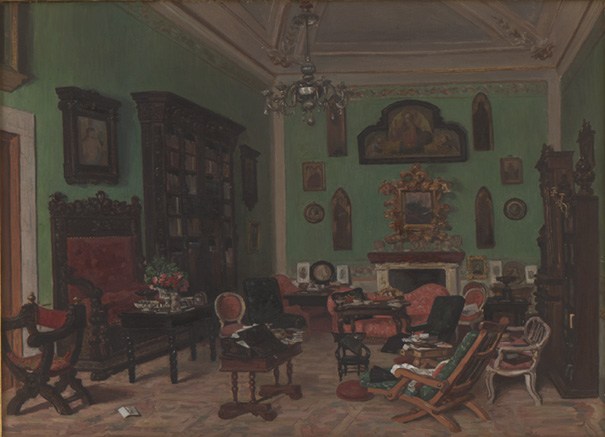
Fig. 8.1 Giorgio Mignati, ‘Salon at Casa Guidi’ (1861), watercolour. [Special Collections, F.W. Olin Library, Mills College]
There was another way in which the Brownings’ drawing room was porous. ‘One’s imagination is outstripped. I say to my husband, when he goes to look at the newspaper, “Bring me news of a revolution or two”. And he brings me news of three.’17 In April 1848, Barrett Browning was in thrall to the news which made its way into her quiet room: of a chain of revolutions that was transmitting rapidly across Europe. Both the Brownings were avid readers of newspapers; ‘[a] small table, strewn with writing materials, books, and newspapers, was always at her side’, remembered Field, and they received British journals, such as the Athenaeum, by post, although ‘[t]he post from England was slow and arrived with much delay’.18 They regularly read the French papers: Le Siècle, La Presse, Le Moniteur, and ‘Mr Tulk sends us Galignani’s till we are quite grateful to him’.19 The English-language Gaglignani’s Messenger, published in Paris, ‘include[d] the “leading articles” of all the best English & French gazettes’, although the Brownings sometimes found its social news unhelpfully Francocentric.20 Current periodicals and newspapers were also available in the reading rooms of the subscription libraries: a particularly wide range of Italian and foreign papers was on offer at the Gabinetto Vieusseux, a well-stocked lending library, reading room, and centre of cultural exchange founded by the Swiss merchant and scholar Giovan Pietro Vieusseux in 1820.21 By the Brownings’ time in Florence, the Vieusseux had become strongly identified with Risorgimento politics and Vieusseux himself played an important role in organizing revolutionary militia and circulating nationalist texts.22 One of the Vieusseux circle, the Venetian nationalist poet and intellectual Niccolò Tommaseo, was to write the epitaph for Barrett Browning which still graces the external wall of Casa Guidi. Tommaseo remarked that ‘Vieusseux has a sharp eye for discovering young writers like Carlo Cattaneo and Giuseppe Mazzini, who were little known before 1830’.23 By the late 1840s, the library was an established meeting place for nationalist sympathizers. Robert Browning’s signature first appears in the Vieusseux’s Libro dei Soci (‘Book of Members’) on 1 May 1847.24 The Libro became a useful register of foreign residents’ addresses in Florence: as Barrett Browning wrote to a friend, ‘Robert has been already in search of your Colonel Forester &c, but failed in finding names at the library.’25 This liberal establishment was also open to women, and, although it was Robert who visited every morning, his wife also occasionally accompanied him, modestly choosing off-peak times to do so: ‘I insisted on going out yesterday morning with my husband to Vieusseux’s before anybody else had arrived, . . to read the newspapers.’26 When Leopold II lifted press censorship in Florence in 1847, the Brownings became enthusiastic readers of the surge of nationalist newspapers that ensued: the radical republican and Mazzinian L’Alba (which rapidly increased its printing from three times a week to daily) and La Patria, a more moderate liberal paper.27 They also read the short-lived English-language Tuscan Athenaeum, another liberal publication, set up by a fellow Florence resident, Thomas Trollope.28 They may also have seen some of the lower-end illustrated satirical publications such as La vespa [The Wasp], Il birichino [The Rogue], La zanzara [The Mosquito], and Il chiarivari, as they were all taken by Vieusseux’s.29 Even after the restoration of Austrian rule in 1851, Tuscany remained more liberal than many other states in the peninsula: Barrett Browning remarked in 1852 that, despite the publication of the vehemently nationalist Casa Guidi Windows, ‘our “carta di soggiorno” [official leave to remain] was sent to us duly. The government is not overlearned in literature, oh no.’30 Nevertheless, getting their hands on up-to-date newspapers and books remained a perennial problem for the Brownings. Barrett Browning dreamed of having books on tap, ‘[a]ltogether, if I could but get a supply of French books .. turning the cock easily .. it would be perfect,’ she opined in 1848:
but as to anything new in the book-way, Vieusseux seems to have made a vow against it, & poor Robert comes & goes in a state of desperation between me & the bookseller, (“But what CAN I do, Ba?”) & only brings news of some pitiful revolution or other which promises a full flash of republican virtues, & falls off into the fleur de lis as usual. Think of our not having read Lucresia yet?—George Sand’s. And Balzac is six or seven works deep from us—but these are evils to be borne.31
Resources were certainly limited in Florence. For foreign books there was Brecker’s on via Maggio, very close to the Brownings, and Vanni’s on via de Tornabuoni, but neither was greatly reliable in terms of stock.32 The Brownings’ celebrity meant that they were often sent works by fellow authors, and Field noticed that the occasional tables in their drawing room ‘were covered with…gaily bound volumes, the gifts of brother authors’. The Brownings were generous in lending out their personal copies. So generous, that Barrett Browning found herself having to apologize to Anna Jameson: because Robert had lent it out, she had not yet had the chance to read the copy of Jameson’s 1848 Sacred and Legendary Art that the author had sent to her, as ‘books are hungered & thirsted for in Florence, and although the English reading club has them, they can’t go fast enough from one to another’.33
Accelerated Print in Florence 1847–8
In such a climate of scarcity the fioritura, or ‘flowering’, of the Florentine press between 1848 and 1849 was intense and exciting [Fig. 8.2], and metaphors of free communication and unhindered circulation flow like an underground river through the first part of Casa Guidi Windows.34 The ‘journalistic scene’ in Florence in 1847–8 was tumultuous.35 Florence’s expatriate Anglophone community lost no time in joining this noisy tumult with the liberal English-language Tuscan Athenaeum, which hastened ‘to avow our heartfelt delight at the dawning prospect of a career of social progress and civil amelioration’ and to ‘declare our cordial sympathy with, and admiration for, the sovereigns and citizens of Italy, who with admirable cooperation have entered together upon the great work of Italian regeneration’.36 The Tuscan Athenaeum kept a close watch on the European papers, and fired off editorials excoriating The Times in England or the French Journal des Débats, and ‘complaining about the treatment of Italy by the Morning Post, the Morning Herald and the Standard which refer to the situation as “the Italian nuisance” and wish the whole of Italy had been given to Austria to begin with’.37 The Journal des Débats was bitterly criticized in the Italian press too, for its ‘calumnies written against Italy’ [Fig. 8.3]. The liberalism of the Tuscan Athenaeum was mocked by the (very short-lived) Anglo-Tuscan Advertiser, which took a much more conservative position: ‘[e]very sensible man in times like those should a k [sic] himself what he could possibly gain by change; let him keep his eye upon his neighbour [France] and he will see enough in the next six months to make him heartily sick of revolutions’.38 A heated public conversation had begun.
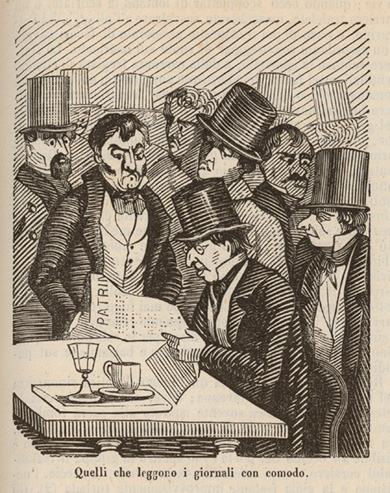
Fig. 8.2 ‘Quelli che leggono i giornali con comodo. Attualità Caricature di Japhet’ [Those who read the newspapers in comfort], Il Mondo Illustrato (18 dicembre 1847): 809.
[© Bibliothèque nationale de France]
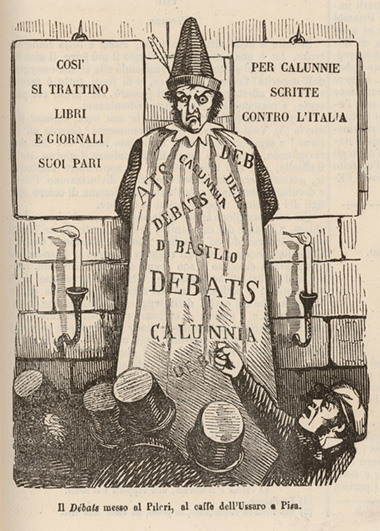
Fig. 8.3 ‘Il Débats messo al Pileri, al caffè dell’Ussaro a Pisa. Attualità Caricature di Japhet’ [The Débats newspaper put in the pillory, at the caffè dell’Ussaro in Pisa], Il Mondo Illustrato (18 dicembre 1847): 809. The caffè dell’Ussaro was a meeting place in Pisa for intellectuals and supporters of the Italian national cause.
[© Bibliothèque nationale de France]
‘I read the newspapers as I never did in my life, & hope & fear in paroxysms’, cried Barrett Browning in the spring of 1848.39 For the first time, the steady beat of the serial rhythms of the modern press could be felt in Florence. It is difficult to overstate how exciting it was for a city which had struggled to maintain an intellectual life under censorship suddenly to be permitted to live that life openly, and to maintain a public political conversation which could continue day after day. The Tuscan Athenaeum explained that ‘[a]ccustomed as the English have been from time immemorial, as one may say, to a free expression of their thoughts, they cannot conceive what the word Censorship means, especially in Italy’.40 Its memory was short: the heavy taxing of news in Britain from 1819 until mid-century kept a lot of ordinary working people out of the political conversation, and functioned as effectual censorship.41 From her viewpoint in Italy, Barrett Browning was able to be unusually clear-sighted about such English exceptionalism: ‘[it would] be good if we are induced to come down from the English pedestal in Europe of incessant self-glorification’.42 In 1847, the new Florentine papers and journals are teeming with a sense of life renewed. For example, in its first editorial in June, the newly launched L’Alba, meaning ‘the dawn’, was explicit about the power of serial publication:
The periodical serial: orderly, constant, which ultimately triumphs over all opposition, which pierces all the mists of ignorance…The Newspapers are like a drop that, falling every day, breaks hard boulders. With that Power, which is the sum of constancy, of continuity, of seriality; Newspapers are the vernacularization for the people of the ideas transmitted by the great writers from their solitude…This is the case wherever true newspapers can thrive, in France, England, Germany: and it will soon also be the case here, we believe, in our own Italy.43
The editors of L’Alba saw that the unstoppable ongoing serial, with its iterative and reiterative capability, could exercise an unprecedented social power, like the revolution itself. After being unable to write or speak openly of politics for so long, the Florentine intelligentsia was intoxicated. The populist La vespa was delighted to belong to this new ‘large family of daily newspapers’, their dailiness meaning that they ‘die as soon as born; rot as soon as dead, and metamorphose themselves as soon as they are putrefied into a confetti bag, or into a milliner’s paper pattern; or into a wrapping for salami sausage, or are used for something even worse….’44 The very ephemerality of the press, and the disposability of yesterday’s stale newspapers, was itself a triumph because it showed the conversation would continue fresh with today’s new edition. Old, dead things would no longer suffice. Vieusseux’s discovery, the writer Carlo Cattaneo, also immediately recognized the insistent power of the dailiness of the press: the new sense of speed and motion which it lent to the city, accelerating away from the stagnant past. ‘I am a journalist’, he announced proudly, ‘which means a man who takes one day at a time. Last week’s things are dead, more than dead, ancient like mummies to me.’45 The struggle of the Catholic Church to hang on to the temporal power restored to it in 1815 by the Congress of Vienna had resulted in a deadening insistence on the providential which seemed to bypass the social realities of the contemporary world.46 Barrett Browning’s Casa Guidi Windows shares with the Risorgimento press an iconoclastic sense of the privileged place of to-day: whatever is vital, ‘For me who stand in Italy to-day’, as she puts it.47 No longer would Italy have to cannibalize its own past to survive: ‘Alas, this Italy has too long swept | Heroic ashes up for hour-glass sand; | Of her own past’ (I: 188–90, pp. 6–7). On the contrary, in her poem, Italy declares that ‘We hurry onward’ (I: 240, p. 8); ‘We do not serve the dead—the past is past’ (I: 217, p. 7); it cannot ‘drag us backward.’ (I: 232, p. 8). In Part One of the poem, it is—in other words—a re-entry into serial time that will free the Florentines from the dead weight of history: ‘the heart of Italy must beat’ (I: 8, p. 1) with the ongoing rhythm of life.
As La vespa put it in 1848, ‘from all sides there surged a mania, an itch, so to speak, to write; and a crowd of newspapers flooded the café tables and the reading rooms’.48 Surging, crowds, and floods all feature in Barrett Browning’s poem, too. Describing Florence on the bright September day that Leopold II declared a new constitution, she writes, ‘…for the heart of man beat higher | That day in Florence, flooding all her streets | And piazzas with a tumult and desire.’(I: 451–53, p. 14)49 The energy of the crowd fascinated her as she watched it being compressed into the narrow streets and the enclosed piazzas of the city: ‘Long live the people! How they lived! and boiled | And bubbled in the cauldron of the street.’ (II: 118–19, p. 42) The bubbling and boiling of the people hovers on the edge of threatening, and this was also recognized by the Tuscan Athenaeum, which urged Leopold to make further reforms quickly to prevent violent revolution:
Friends! Steam is a dangerous thing, and involves explosion, misfortune and destruction…when too forcibly compressed…when no vent is permitted to it. But from the mildly murmuring spout of your beneficent kettle on the domestic hearth, Madam, it issues harmless, nay salutary and desirable. Now the nature of revolutions is strictly analogous, in this respect, to steam.50
Taking the heat off the streets and returning it to ‘the beneficent…domestic hearth’, the Tuscan Athenaeum suggests the compressed energy of revolution can be managed and channelled into civic order. Yet it also understands modern Italy’s need for what Barrett Browning calls ‘life’s brave energy’ (I: 174, p. 6): ‘[b]ut we also know what “moderate” too often means in the mouths of the timid and the selfishly contented. We know that the moderate movement of such persons, amounts to something very similar to complete stagnation.’51
The model of civic life that Barrett Browning offers in Casa Guidi Windows is of packed bodies, ‘Feet, knees, nerves, sinews, energies divine’ (I: 1043, p. 33), touching, close together, people squashed against other people, almost corpuscle to corpuscle.52 Such density of bodies is necessary for ‘the beating of heart to heart, the response of hand to hand’ which Barrett Browning celebrates as key to a civilized community.53 Of a crowd in the Piazza San Marco in Venice, where she and Robert were staying in 1851, she wrote:
the crowd sweeps round & round us—and, what is a great charm to me, a real Italian crowd, a crowd not of a fashionable class, or of a bourgeois class, or of any other class in particular, but of a good breathing, living humanity . . men, women, & children . . such heaps of rosy children not asleep yet . . the rich & the poor, noble & artizan, all mixed together, walking together, listening to the same music, yes, and eating the same ices (ices are so cheap) & sitting on the same chairs side by side.54
Although she claims to dislike ‘systems’ such as ‘socialism’, she says ‘I do repudiate with my heart, as I would willingly with my hand, the class-divisions, the walls & fences between man & man, as they are built up in England.’55 Because her imagination is insistently three-dimensional, she imagines ‘class-divisions’ as a material architecture of ‘walls & fences’. Casa Guidi Windows is a poem that fully inhabits the built environment of Florence, understanding its political history through its public spaces: the walls, buildings, squares, churches, and public sculptures which embody its history and its republican past. The public sphere, for Barrett Browning, is a powerfully physical and embodied space. Casa Guidi Windows tracks the physical locations in Florence where bodies have been made ‘public’: the ‘plain flat stone’ of the pavement of the public street where Dante used to sit, now the place that the people of Florence choose to gather for the political procession; the church of St Maria Novella where the people prayed for deliverance during the plague of 1527; and the Piazza de’ Pitti, where ‘Savonarola’s soul went out in fire | Upon our Grand-duke’s piazza.’ (I: 256–7, p. 9). When she looks up at the jubilant people at their windows and balconies, she sees stone become flesh: ‘[t]here was not an inch of wall, not alive, if the eye might judge’.56 Writing to her brother about an unfavourable notice of one of her poems, she makes an explicit connection between the pressing crowd in the streets and the abstract public sphere of print: ‘[w]hen women go into a crowd they can’t help being jostled a little by greasy coats—happy they, if nobody treads on their toes!…When you have a wife, George, keep her out of print, if you object to jostling, for she will avoid it on no other conditions.’57 In Casa Guidi Windows she is wary of a distinction between abstracted citizens and actual breathing people, instinctively grasping its falsity. She feels the same energy in both, in the same way that she says ‘I, who am sensible, hold to steam engines & the rapping spirits’, suggesting that the material and the spiritual are not contradictory categories.58 She explores the possibility that it is only through a feedback loop between the abstractions of the imagined ‘republic’ and the fleshly actuality of the people themselves that a republic can flourish: ‘here’s |A crowd to make a nation!’ The poet calls for a ‘leader, teacher’ to ‘stand plain’, ‘And build the golden pipes and synthesize | This people-organ for a holy strain’ (I: 813–14, pp. 25–6). The ‘people-organ’ is a thing built of flesh, one of the res publica, the ‘public things’ that underpin the revolution, and an—admittedly somewhat disturbing—synthesis of the political medium and the political message. The people of Florence dematerialize and rematerialize throughout the poem as Barrett Browning attempts to locate their place in the politics of the future.
Casa Guidi Windows: Part One
On 24 June 1848, Barrett Browning was sitting in her drawing room with the windows open, writing a letter to her sister: ‘[w]hile I write there’s a Punch talking under the windows, just as he wd talk in Wimpole Street. You know, or may not know, Punch is Neapolitan by extraction—but I forget that, & unawares fancy myself in London.’59 London and Florence meld into one through their shared noisy street life. Casa Guidi was in the heart of Florence and was noisy, as was the city more generally: ‘I am very sorry you are not comfortable’, Barrett Browning wrote to a friend who had recently arrived in Florence, ‘—but for noise, the streets are noisy throughout Florence, you would find. It’s my drawback here.’60 The Anglo-Tuscan Advertiser notes in 1848 that ‘a military Band plays for one hour daily, opposite the Palace [Palazzo Pitti] commencing at 11 o’clock’, music which must have been loudly audible in the Brownings’ apartment every morning.61 Throughout the excitement of 1848, ‘an occasional firing of guns for a victory, or a cry in the streets “notizie della guerra—leggete signori [news of the war, read all about it gentlemen!]” ’ reached Barrett Browning in her room.62 And after she gave birth to Pen in 1849, ‘the republicans of Florence did us the honour to keep festa round the tree of liberty planted at our palazzo-door, with guns & cannons & a band of music & patriotic songs from morning till night, yes, & half the night through three days after my confinement’.63 Little wonder then, that Casa Guidi Windows opens with sound rather than sight—a child’s song heard, not seen, through the window: ‘I heard last night a little child go singing | ’Neath Casa Guidi windows, by the church, | “O bella libertà, O bella!” ’(I: 1–3, p. 1). The poet refuses to be ‘Cooped up in music’ (I: 164, p. 6), preferring to sing ‘With birds, with babes’ (I: 157, p. 6), so that the opening image of the poem is of a vertical flight of birdsong—‘high…upspringing…to sky from perch…rise,’ (I: 5–9, p. 1) soaring up from street level to take a bird’s eye view of the city.
In a work much concerned with viewing and spectacle, the windows of the poem’s title have naturally become the focus of much critical attention.64 Barrett Browning reverse-engineered the windows in her poem to make them appear to be those opening out of her drawing room onto her little terrace, but in fact she watched the September procession from the front windows of the palazzo: ‘[w]e went to a window in our palazzo which had a full view, and I had a throne of cushions piled up on a chair’, and not those of her own apartment from which she could have seen very little, apart from the blank wall of the church opposite [Fig. 8.4].65 While this retro-fitting and re-engineering of space may appear deceitful, it is one of the primary aesthetic strategies which repeats throughout the whole poem. Casa Guidi Windows relentlessly reconfigures space and the disposition of bodies in spaces, superimposing ancient and modern physical locations, to model and explore in the abstract the possibilities of a new Florentine republic. Building a series of virtual spaces in order to explore the politics of representation, Barrett Browning is less interested by windows than critics have imagined. She is more interested in portals: breaks and tears in the surface of time and space. Writing to John Ruskin about Mary Mitford’s death, Barrett Browning thanked him for his description of her friend, ‘by the window not only of the house in Berkshire, but of the house of the body and of the material world—an open window through which the light shone, thank God.’66 Windows for this poet could also be the portals between body and soul, between the transcendent and the material universe, and in this Christian-spiritualist poem she uses perforations in time-space as powerful exchange points through which she can descry an emergent civic future for Florence with a fervency that ultimately verges on the eschatological.67
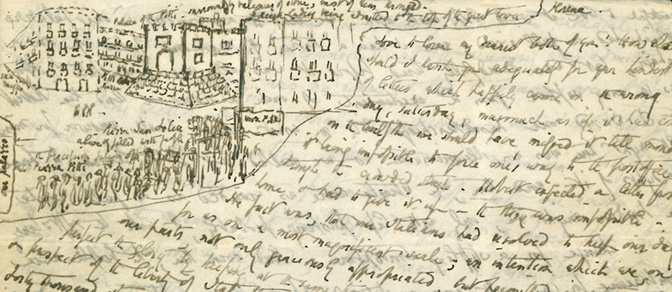
Fig. 8.4 Tiny sketch by Elizabeth Barrett Browning of Piazza San Felice during the September procession on the first page of a letter to her sisters Arabella and Henrietta Moulton-Barrett (Florence, 13 September 1847) The Brownings’ Correspondence 14, p. 307. The editors explain the locations in the sketch. In the centre, above the crowd: ‘Piazza San Felice alive & filled with people’; to the right: ‘viva P. IX’; to the left: ‘The procession ending up at Piazza Pitti’; vertical in left margin: ‘our palazzo’ [i.e. Casa Guidi]; above in left margin: ‘via maggio’; top margin: ‘Palace of the Pitti—surrounded by balconies of stone, most of them thronged’; below (starting at ‘balconies’): ‘Foreign ladies being admitted to the top of the great tower’.
[Image courtesy of The Camellia Collections]
Casa Guidi Windows uses multiple images of electrical energy, of flash and flow.68 Nevertheless, communication in Part One of the poem is never unimpeded or transparent. The poem starts with the mediation of popular song, and, as Isobel Armstrong has pointed out, ‘the many-times-mediated present, dominates both sections’.69 The images in Part One are often somehow secondary: reflections, colours, projections and screens, all images that suggest not only mediation, but also a folding and doubling of the material and the abstract world:
I can but muse in hope upon this shore
Of golden Arno as it shoots away
Through Florence’s heart beneath her bridges four:
Bent bridges, seeming to strain off like bows,
And tremble while the arrowy undertide
Shoots on and cleaves the marble as it goes,
And strikes up palace-walls on either side,
And froths the cornice out in glittering rows,
With doors and windows quaintly multiplied,
And terrace-sweeps, and gazers upon all,
By whom if flower or kerchief were thrown out
From any lattice there, the same would fall
Into the river underneath, no doubt,
It runs so close and fast ’twixt wall and wall.
How beautiful!
(I: 52–66, pp. 2–3)
Reflections in the river destabilize the built city by doubling it: ‘With doors and windows quaintly multiplied,’ and this multiplication suggests a political arithmetic of democracy. But this is an ephemeral and fragile version of democracy: one that is writ in water.
And all the thousand windows which had cast
A ripple of silks in blue and scarlet down
(As if the houses overflowed at last),
Seemed growing larger with fair heads and eyes
(I: 478–81, p. 15)
…
While through the murmuring windows rose and sunk
A cloud of kerchiefed hands,—
(I: 491–2, p. 16)
From this viewpoint, the structure of the city itself presents a dense perforated surface through which peep heads, eyes, and hands, all lopped off: the synecdoche of citizenry. Never entirely visible on the ‘terrace-sweeps’, the people appear fleetingly at the doors and windows of the homes of Florence, only to disappear again in Part Two. At the start of Part One, ‘The very windows, up from door to roof, Flashed out a rapture of bright heads’ (I: 519–20, p. 16), but ‘rapture’, ‘gazers’, and ‘gazing’ become self-conscious and deeply ambivalent terms for the poem as it explores the affective charge of collectivity. ‘How we gazed, | From Casa Guidi windows’ (I: 470–7, p. 15), remembers the poet, and the ‘we’, and not a solitary ‘I’, is an important gesture to community. Writing to her sister, Barrett Browning described her evening stroll by the Arno to see the illumination in honour of the new Constitution: ‘the people were embracing for joy’, she writes, in ‘a state of phrenzy or rapture’.70 But despite the joyful physicality of the jubilant crowd, there is a hint of warning in the emphasis on its rapturous gaze. Gazing and rapture suggest a visual immersion so deep that it engenders a kind of paralysis of the viewer. Throughout the poem, Barrett Browning uses the rapt gaze to suggest a political desire that falls short of revolutionary agency. Gazing is not the same, she suggests, as seeing. After all, ‘’tis easier to gaze long | On personations, masks, and effigies, | Than to see weak live creatures crushed by strong.’ (I: 46–8, p. 2) Her artist-hero Michel Angelo suggests that the republican energy embodied, literally, by his sculptures which ‘wait in marble scorn’ (I: 74, p. 3) will one day ‘stir | This gazing people when their gaze is done’ (I: 138–39, p. 5). The gazing Italians are held in suspended animation awaiting a galvanizing touch to rebel against their oppressors.
In Part Two of the poem, as the Austrians march into Florence the communal ‘we’ collapses into a solitary ‘I’, and the gaze hardens into blank horror: ‘From Casa Guidi Windows, gazing, then, | I saw and witness how the Duke came back.’ (II: 286–7, p. 48) This is the gazer overwhelmed as the illusory arithmetic of democracy is cancelled out by the immensity of tyranny: ‘Then, gazing, I beheld the long-drawn street | Live out, from end to end, full in the sun, | With Austria’s thousands’ (II: 299–301, p. 48). The inactive non-participation of a ‘gazing’ people is precisely the reason that the revolution was defeated. Disappointed by the Florentines’ reluctance to fight to defend their constitutional gains, Barrett Browning admonishes Mazzini: ‘Set down thy people’s faults; set down the want | Of soul-conviction; set down aims dispersed, | And incoherent means.’ (II: 527–9, p. 550), adding bitterly that ‘To grant the “civic guard” is not to grant | The civic spirit, living and awake.’ (I: 745–6, p. 23) Barrett Browning half acknowledges here the fault line that ran right through the so-called ‘Risorgimento’. The republican democrats’ attempts and failure to energize a mass revolt from the Italian peasantry ran up against the liberal-moderate ‘reform’ position which supported a brokering of power with the Austrians. Mazzini’s ‘utopian’ democratic idealism was frequently contrasted with Cavour’s diplomacy and ‘realpolitik’. Barrett Browning’s poem is caught between the two positions, although her admiration of Cavour ultimately suggests her liberal-moderate position and her support for what Antonio Gramsci would later call ‘a passive revolution’, ‘where the conservative (“moderate”) liberals had out-manaeuvred [sic] the revolutionary liberals (republican democrats) and come to a compromise with the existing feudal order’.71 Chapter 10 suggests that Barrett Browning’s position radicalized later in the 1850s.72 But in 1849, the Tuscan Athenaeum was sadly right that ‘the regeneration of a nation after long years of misrule and depression is not to be accomplished by a cockade and a hurrah, and so home to supper, and get up the next morning, “great, glorious, and free” ’.73
Physical Spaces and Public Screenings
Barrett Browning’s long poem is uncannily sensitive to the virtualization of politics and alert to the riskiness of a public sphere which rests upon image-projection and broadcast dissemination rather than rational exchange or dialogue. When Duke Leopold appears at his Palace window with his children at his side in an apparent gesture of support for the people, Barrett Browning is already aware of the spectrality of this ‘image-event’.74 Leopold is creating a public ‘screening’:
Nor was it ill when Leopoldo drew
His little children to the window-place
He stood in at the Pitti, to suggest
They too should govern as the people willed.
What a cry rose then! Some, who saw the best,
Declared his eyes filled up and overfilled
With good warm human tears which unrepressed
Ran down.
(I: 557–64, p. 18)
Casa Guidi Windows is, among other things, a witness report of regime-change in both media and governance, and Barrett Browning understands how intimately the two are connected. She grasps the emergent order of ‘publicity’ in which both newspapers and affective public image-making have a role first in creating a new public and then representing it to itself. Her poem charts the revolutionary attempt to jump from the ancient to the modern, and the inauguration—however briefly—of a public sphere in Italy. That Leopold’s tears are ‘unrepressed’ is lexically significant and clearly relates the wider politics of the poem. ‘Unrepressed’ reverses and snaps shut into ‘repression’ in Part Two, when Popes are once again bound to ‘repress | Inquiry, meditation, argument’ (I: 996–7, p. 31). Jürgen Habermas wrote that the governing lord of the high Middle Ages ‘displayed himself, presented himself as an embodiment of some sort of “higher” power .…They [the lords] represented their lordship not for but “before” the people.’75 The people gazing at Duke Leopold on that golden September day interpreted the moment when he drew his family to the window as an abdication of lordly power, and an intention instead ‘to govern as the people ruled’. The domestic presence of his ‘little children’ seemed to underwrite the bourgeois public sphere inaugurated by his new constitution, and his ‘good warm human tears’ seem to flow ‘for’ the people and not ‘before’ the people.
On 12 September 1847, the crowd standing joyfully at the windows interpreted the Duke’s gestures as ceding power to the people. Even as it represents the elation of this moment, though, Casa Guidi Windows hints that this is not democracy, merely its image. Not the substance, but the performance of it. The viewpoints are treacherous and Barrett Browning deliberately distorts the visuality of the poem so that the crowd is collectively visible to itself and the Duke is visible to all of the crowd (although if we read closely, the word ‘suggest’ and the ‘some who saw the best declared’ already begin to undermine this collective view). Such transparency is not possible in a crowded city under military occupation, in which sightlines are blocked and fractured. In reality, the population is dispersed widely across the city and Barrett Browning sees the scale of the challenge of creating the social and the collective in a modern urban space. She is both hopeful and suspicious of the changing role of communications media in achieving this. In Florence in 1848, civic power and political power are tangled and conflictual, and the distinction of society from the state depended on a developing idea of a public sphere which could mediate between the two.76 Casa Guidi Windows asks how best to mediate between the city and its rulers and how to make full citizens out of Florentines, how to ‘best begin | By making each a man, till all be peers’ (I: 773–4, p. 24).77
Because of the political events of 1848, themselves dependent to an extent on a series of breakthroughs in printing technologies, something resembling a public sphere had quite suddenly become visualized and virtualized through the transnational media. As we have seen, pictures in the illustrated news press of revolutionary crowds in the piazzas and squares of Europe had established a new visual grammar of the ‘public’. If the parameters of the public sphere are always contingent on the media available, the public sphere of Casa Guidi Windows is not, nor can it be, a Habermasian one.78 As a writer, Barrett Browning naturally understands the importance of print and representation, but she never underestimates the importance of bodily co-presence, physical proximity, and civic inclusiveness. In this sense, her public sphere resembles Hannah Arendt’s polis more than Habermas’s public sphere. Barrett Browning sees that, as much as writing and text, living bodies are in play in the politics of 1848, and her poem celebrates and participates in ‘the richness and turbulence of the sense-making process’.79 She is, after all, in the odd situation of writing a political poem about a largely illiterate culture [Fig. 8.5]. At mid-century, Paolo Murialdi tells us, ‘[i]n Italy, the illiterate exceeded 75 per cent of the population, which was approximately 25 million souls’.80 To exclude, as Habermas’s model of the public sphere does, the ‘analfabeti’ (illiterate), would be to exclude more than three-quarters of Italians from understanding or having an opinion about their own governance. This, Barrett Browning is not prepared to do, believing, as she does, that illiterate people have strong opinions about their own social situation. She is, therefore, very attentive to what is intelligible without written language. Casa Guidi Windows, as has often been remarked, is a very visual poem, invested in seeing, gazing, and attempting to interpret events from fragmentary and incomplete visual evidence.81 This is partly the effect of any contemporary moment, in which we are always immersed and always unable fully to comprehend, but it is also the effect of illiteracy and cultural exclusion. Barrett Browning’s Italian was good, but certainly not good enough to understand the argot used by the Florentine populace, so that Italy, and even large parts of Florence, remained foreign to her, and this foreignness may have helped her to ‘see with my own eyes & feel with my own spirit, & not with other people’s eyes & spirits,’ as she wrote in a letter.82 In the same letter, she describes herself as a ‘democrat’, and this is crucial to understanding her poem.83 When the poem dips down to the level of the street, it finds a radically mixed crowd of bodies: peasants and people of different ages, sexes and classes, some disabled, and all crushed together—‘Rude men’; ‘two-months’ babies’ and their mothers; ‘lovers pressed’ together; ‘peasant maidens’ and ‘old blind men,’ who ‘pattered with their staves and slid their shoes | Along the stones, and smiled as if they saw.’ (I: 524–36, p. 17) That the people perhaps do not or cannot see, that their sight is not yet unobstructed, does not stop Barrett Browning asserting that ‘I am simply a DEMOCRAT, and hold that the majority of a nation has the right of choice upon the question of its own government,…even where it makes a mistake’.84 It is for this reason that she worries about the reception of her poem in England, even in liberal circles, asking Mary Mitford, ‘[t]ell me how you like the poem .. honestly, truly .. which numbers of people will be sure to dislike profoundly and angrily, perhaps’.85
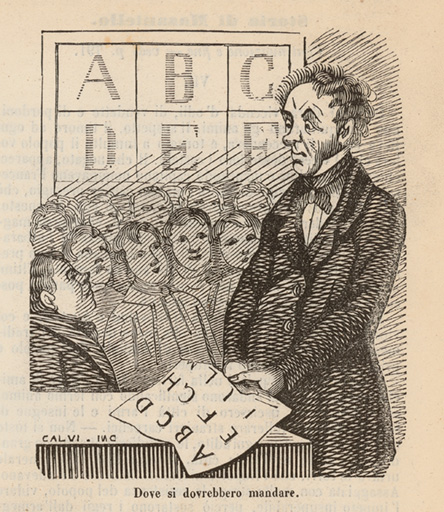
Fig. 8.5 ‘Dove si dovrebbero mandare. Attualità Caricature di Japhet’ [Where they should be sent], Il Mondo Illustrato (18 dicembre 1847): 809.
[© Bibliothèque nationale de France]
Images and the visual, then, are important in the poem not because they represent reality but because Barrett Browning knows that they create it for most Italians who are still excluded from the written word. She sees that, partly due to the illiteracy of many Florentines, the revolution is welcomed as a festival in Florence, but she worries that its performativity and provisionality reveal the emptiness behind it: in a sense, it is all material, and not ‘abstracted’ enough. She suspects that even the literate revolutionaries in Florence have been playing dress-up and acting without fully understanding the political stakes of what they do: ‘[w]hat they comprehend best in the “Italian League” is probably a league to wear silk velvet & each a feather in his hat .. to carry flags, & cry vivas, & keep a grand festa-day in the piazzas’.86 Images, says media sociologist John Hartley, ‘are the place where collective social action, individual identity and symbolic imagination meet—the nexus between culture and politics’.87 Barrett Browning knows that powerful images can project both ways—against the people as well as on behalf of the people—and her poem enacts exactly this switch point as the images of building, hope, and light which seem to belong to ‘the people of Florence’ in Part One of the poem collapse into rubble, disappointment, and darkness as they are appropriated by the Austrians in Part Two.88 ‘The mime | Changed masks, because a mime’ (II: 241, p. 46), she sighs, alive to the shallowness of visual representation and its inadequacy in building a democracy. She tells the people of Florence: ‘Ye mimicked lightnings with a torch,—the crack | Of the actual bolt, your pastime circumvents’ (II: 323–4, p. 49). What seemed like a power that belonged to the people was merely a representation of power and a performance. Real militarized power immediately extinguished it. Representation reverses, and the symbols of the Florentines unravel and undo themselves: ‘We chalked the walls with bloody caveats | Against all tyrants’ (II: 153–4, p. 43), but now ‘Rub out those chalked devices, set up new | The Duke’s arms, doff your Phrygian caps, and mend | The pavement of the piazzas broke into | By barren poles of freedom’ (II: 259–63, p. 47). The ‘we’ seems here to be a literate ‘we’, capable at least of scrawling on the walls of the city, and this again reveals the uncomfortable split between the ‘revolutionary’ Florentines in the poem and the vast illiterate majority of Italians. The stage props of revolution, the graffiti, the Phrygian caps and the liberty trees, do not make a revolution. ‘Grand Duke out, Grand Duke in—The bells in the church opposite rang for both—They first planted a tree of liberty close to our door, and then they pulled it down’, wrote Barrett Browning to Mary Mitford.89 She is disillusioned by the people, after all. The demos she had prematurely celebrated is revealed to be merely a crowd of ‘mutes and cowards’: ‘such a republic as we have had in Florence, without a public—imposed by a few bawlers & brawlers on many mutes and cowards, .. why the sooner it goes to pieces, the better of course’.90 Her disillusionment reveals a romantic attachment to an idea of ‘the people’ as a politicized and self-conscious entity in Italy, which does not yet exist, but which she has tried to conjure into being through her poem.
By 1850, the Florentine Republic which had been declared in February 1849 had undoubtedly gone to pieces. Grand Duke Leopold had returned in July 1849, the city was occupied, and the press was placed back under strict censorship. The Duke abolished the liberal constitution he had granted in 1848. Barrett Browning wrote miserably to a friend, ‘[t]he state of politics here is dismal. Newspapers put down.’91 Part Two of Casa Guidi Windows echoes with emptiness as the Austrians march in: ‘[t]he people shrank back to let them pass, in the deepest silence . . not a word spoken, scarcely a breath drawn’.92 The Florentines retreat into their homes, shutting their doors and windows. The streets are clear and orderly, and a strange silence reigns: ‘Then, gazing, I beheld the long-drawn street.’ (II: 299, p. 48). The Austrian army will ‘shovel off’ the ‘mud’ of the collapsed revolution, ‘To leave the passage free in church and street.’ (II: 734–5, p. 61). But nothing circulates: there is only a stifling silence in the network of empty streets. Barrett Browning seems to suggest, perhaps counterintuitively, that the revolution depended on fullness and density rather than on free-flow and rapid motion. In an article celebrating ‘Florence in 1848’, the Tuscan Advertiser had commended the ‘wide and handsome street[s] of modern houses and shops’ that had replaced ‘old-fashioned tenements, narrow lanes, and squalled alleys’ in Florence, noting that ‘the bridges, and quays of the Arno are ornamented with massive iron columns, supporting handsome gas lamps’.93 But in 1849, this ‘wide and handsome’ modern city is dead and useless to its citizens as the imperialist soldiers march through it:
sword and bayonet,
Horse, foot, artillery,—cannons rolling on
Like blind slow storm-clouds gestant with the heat
Of undeveloped lightnings each bestrode
By a single man, dust-white from head to heel,
Indifferent as the dreadful thing he rode,
Like a sculptured Fate serene and terrible.
(II: 301–7, p. 48)
In Part One, Michel Angelo’s white marble sculptures embodied a Republican promise for the ‘unborn’ (I: 78, p. 3): ‘Three hundred years his patient statues wait’ (I: 80, p. 3), while in Part Two the Austrian soldiers ‘dust-white from head to heel’(II: 305, p. 48) present the frightening appearance of statues come to petrify the city ‘Like a sculptured Fate’ (II: 307, p. 48). A complex network of images of petrification and melting plays across the architectural and public forms of the city so that the buildings and statues sometimes seem mobile while the people seem immobile. Part Two opens as the daily bodily bustle of Florence is frozen, and the poem itself metrically enacts this collapse and failure:
I wrote a meditation and a dream,
Hearing a little child sing in the street.
I leant upon his music as a theme,
Till it gave way beneath my heart’s full beat,
Which tried at an exultant prophecy
But dropped before the measure was complete—
(II: 1–6, p. 39)
The interrupted serial has given way and ‘dropped before the measure was complete—’ and ‘exultant prophecy’ has failed, as if the singing bird of Part One has plummeted from the sky.94
But wherefore should we look out any more
From Casa Guidi windows? Shut them straight,
And let us sit down by the folded door.
(II: 425–7, p. 52)
The poet shuts the windows. The people are folded back into their homes and the poem turns away from the political and back to the domestic, or so many critics have suggested. But does it? Perhaps, as Miguel Abensour has argued, ‘democracy is not domestic or capable of being domesticated to the very extent that it remains faithful to its “savage essence”: the resistance to domestication. Democracy, like an impetuous river that incessantly overflows its bed, cannot “go back home” and submit to the established order.’95 This seems closer to Barrett Browning’s unsettled use of ‘home’ in Part Two of Casa Guidi Windows. She spent more time ‘at home’ than most: ‘[s]he habitually sat in dark rooms and was so little out of doors that her accuracy of observation was all the more remarkable’, as her upstairs neighbour at Casa Guidi remembered.96 But rather than making her into an ‘angel of the house’, this gave her a profound disregard for the domestic. Like Elizabeth Gaskell, she refused the bourgeois boundaries between work, home, public, private, art, writing, and mothering.97 Indeed, she was justly suspicious of the ‘privacy’ of home. In a charming reply to William Makepeace Thackeray’s equally charming rejection of her poem ‘Lord Walter’s Wife’, which he felt was a little too risqué for the Cornhill Magazine, she wrote, ‘I am deeply convinced that the corruption of our society requires, not shut doors and windows, but light and air’.98 ‘Lord Walter’s Wife’ is a powerful dramatic monologue about marriage, adultery, and the sexual double-standard from the point of view of a woman. Barrett Browning policed the boundary of the domestic not to defend it but, on the contrary, to expose it, throw it open, and reconnect it to healthy public space.
I have grown weary of those windows. Sights
Come thick enough and clear enough in thought,
Without the sunshine; souls have inner lights.
(II: 430–3, p. 52)
The ‘exultant prophecy’ of Part One may have ‘dropped’, but in Part Two, Barrett Browning demonstrates that resignation, thwarted action, and fatalistic inertia are all powerful twins of the prophetic imagination.99 Part Two uses soul-light instead of sun-light to see the unseeable: to imagine an unthinkable future. The Casa, the house, clears away around her and vanishes and the poem inhabits instead the virtual and overlapping spaces of ‘timespace’, moving between the temporal and the transcendental. The effect is disorientating and unstable, because prophecy is a mode which both undoes and remakes a serial narrative. As Christopher Bundock argues, prophecy works against historical understanding, staging ‘[a] struggle between the organization and disorganization of historical knowledge’.100 Prophecy requires the failure of the serial ‘Till it gave way beneath my heart’s full beat’, because the loss of sequence means that the past and the future become oddly indistinguishable and illegible. It is the incoherence and aseriality of prophecy that creates the space for revolutionary thought.101
We will trust God. The blank interstices
Men take for ruins, He will build into
With pillared marbles rare, or knit across
With generous arches, till the fane’s complete.
(II: 776–9, p. 73)
Casa Guidi Windows is an intersticial poem—it exists in the in-between of the interrupted revolutionary process, of seeming failure, retreat, collapse, and the hope of another chance. The ‘blank interstices’ of this characteristically architectural and concrete image of a future yet to be built are the portals through timespace through which peep possibilities for change and revolution—the real ‘windows’ of the poem: windows of opportunity for the reprisal of the struggle.
Therefore, this apparently bipartite poem turns out not to have a simple hinged structure—a folding out followed by a folding in. Instead, it creates a complex and dynamic model of ‘an endless logic of challenge and transformation’.102 Esther Schor has noticed that ‘the processions of 1847 and 1849 have been read as mutually cancelling, suggesting palindromic futility or quietism’, but she has argued that it is the poet’s vision and ‘vehement revision’ that matters: ‘the second narrative expressly reconfigures the images of Part I’.103 But even this imposes too rigid a sequential structure: in my reading, both parts shed light on one another and, rather than building sense in sequential ways, they challenge the very idea of the serial continuum, by hurling the past into the future. And, paradoxically, this is what will make it possible to continue. Walter Benjamin writes of the French Revolution of 1789 that: ‘to Robespierre ancient Rome was a past charged with the time of the now [Jeztzeit] which he blasted out of the continuum of history. The French revolution viewed itself as Rome reincarnate.’104 Barrett Browning is detonating Florence’s Republican history in a similar way. Benjamin’s dislike of Hegelian models of ‘progress’ made him suggest ‘a political messianism in which the revolutionary classes make the continuum of history explode’.105 Unlike Benjamin’s essay, Barrett Browning’s political poem is messianic in a fully Christian sense, but it also understands the necessity of travelling in what might seem to be the ‘wrong’ direction. Barrett Browning called herself ‘liberal and democratical’, and defined herself against the out-and-out violent revolutionaries.106 The central problem of her poem is the collision of revolutionary desire with moderate liberal politics: the classic conundrum of 1848.
Casa Guidi Windows culminates with the time of the Old Testament with which Barrett Browning chooses to end her 2,002-line poem, whose last line is: ‘The self-same cherub-faces which emboss | The Vail, lean inward to the Mercy-seat.’ (II: 782–3, p. 63) In the verses of the book of Exodus that she references in these lines, God gives detailed instructions to Moses on how to build and furnish the Tabernacle and secure a future for the Jewish people. The ‘Mercy-seat’ for example shall be ‘of pure gold: two cubits and a half shall be the length thereof, and a cubit and a half the breadth thereof’.107 A curtain (vail) embroidered with cherubim will divide the Ark of the Covenant from the rest of the temple space.108 The poem delivers us as far as the ‘Vail’, another kind of screen, which divides us from the holiest of holies. But, as Barrett Browning well knew, Christian biblical typology read this Old Testament story in the context of prophecy and fulfilment. The Vail will be rent by the crucifixion of Christ, which, Christian theologians speculate, will thereafter offer Christians direct access to God. Typological readers, ‘who see the movement from type to antitype are lifted out of their own time to the trans-temporal realities…[and] can see lines of meaning going back and forth between the Testaments and across and above time.’109 Typological biblical reading is radical beyond mere revisionism. It does not set out to reinterpret the past but to transform time. By analogy, then, the Republican future of Italy is already secure.
Casa Guidi Windows both transforms time by its own poetic form and bears witness to the transformation of the people of Florence. Italian print historian Galante Garrone has written that ‘[d]uring the Restoration [of Austrian rule in 1849–50], the illusion—or for others, the spectre—of the freedom of the press, which was first enjoyed in all its fullness and then crushed, remained in the air; and this also prevented things from returning to how they had been before the Revolution’.110 After 1848, things never flowed backwards as far again:
You kill worms sooner with a garden-spade
Than you kill peoples: peoples will not die.
(II: 340–1, p. 49)
The sequence is interrupted only in order for it to be recalibrated. The intersticial break is necessary to create something new. And it is said that one earthworm sliced in two will survive as two worms.111 In the pause between the writing of Part One (1848–9) and Part Two (1850–1) of Casa Guidi Windows, Barrett Browning met and had long political conversations with Margaret Fuller, who had just experienced the 1848 revolution in Rome very much at first hand.112 Barrett Browning also created something else entirely and astonishingly new: a baby. These events made a new epoch in her life, and were highly significant, too, for Part Two of Casa Guidi Windows.113
1 Kate Field, ‘Elizabeth Barrett Browning’, Atlantic Monthly 8 (1861): 370 (emphasis original).
2 Elizabeth Barrett Browning, ‘Advertisement’, Casa Guidi Windows (London: Chapman & Hall, 1851), pp. v–vii, pp. vi–vii.
3 Clark, Image of the People, p. 9.
4 Massimo Taparelli d’Azeglio (1798–1866), writer, painter, and patriot, had been wounded fighting the Austrians in 1848. He served as Piedmont’s prime minister from May 1849 until his resignation in October 1852, at which time he recommended Camille de Cavour for the post. In an 1852 address to the Piedmont Chamber of Deputies, d’Azeglio quoted from the passage concerning Charles Albert in Casa Guidi Windows (II, 694–723). Manzoni’s son-in-law, he was also a novelist and painter. The Brownings had read his novel Niccolò de’ Lapi (Paris, 1841), a historical novel set in early fifteenth-century Florence, in Pisa in 1846 and EBB had described it as ‘the dullest, heaviest, stupidest, lengthiest’ book ever. EBB to Anna Brownell Jameson (Collegio Ferdinando, Saturday–[21 November 1846]), The Brownings’ Correspondence 14, pp. 46–8, p. 47. But when she met him in the flesh in 1859, EBB thought him a very impressive person. ‘Azeglio disbelieves in any aim of territorial aggrandizement on the part of France. He is full of hope for Italy. It is 48 over again, said he, but with matured actors. He finds a unity of determination among the Italians wherever he goes.’ EBB to Isa Blagden (Bocca di Leone [25] March [1859]), The Brownings’ Correspondence 26, pp. 100–2, p. 101.
5 This is written in pencil by Robert Browning on the reverse of Gordigiani’s portrait: Mildred Robertson Nicoll (ed.), The Letters of Annie S. Swan (London: Hodder & Stoughton, 1945), p. 58. Gordigiani’s painting of EBB and his companion painting of Robert Browning were commissioned by a wealthy American couple, the Eckleys. Gordigiani originally painted the portrait in 1858, but then repainted it in June and July 1859. Mrs Sophie Eckley and EBB were intimate friends in 1858 and 1859, but by September 1859 the friendship had broken off quite abruptly. EBB speaks of this rift in veiled terms in a letter to Isa Blagden: EBB to Isa Blagden (Villa Alberti, Siena, Tuesday. [6–7 September 1859]), The Brownings’ Correspondence 26, pp. 284–7. Both these Gordigiani portraits are now in the National Portrait Gallery, London.
6 The standard works in English on the Macchiaioli painters are Norma Broude, The Macchiaioli: Italian Pictures of the Nineteenth Century (New Haven, CT: Yale University Press, 1987) and Albert Boime, The Art of the Macchia and the Risorgimento: Representing Culture and Nationalism in Nineteenth-Century Italy (Chicago: University of Chicago Press, 1993). There is also, of course, an extensive literature in Italian.
7 Elizabeth Barrett Browning, ‘Advertisement’, Casa Guidi Windows (London: Chapman & Hall, 1851), pp. v–vii, p. v.
8 Ibid., p. v.
9 EBB to Arabella Moulton-Barrett (Florence. Saturday. Sunday, Monday– [12–14] Nov. [1853]), The Brownings’ Correspondence 19, pp. 333–42, p. 338.
10 Field, ‘Elizabeth Barrett Browning’, p. 370.
11 The piano nobile is usually the first floor, sometimes the second, of a palazzo, with apartments that offer the best views and are somewhat removed from the noise and smells of the street.
12 Field, ‘Elizabeth Barrett Browning’, p. 370. Alexandra Orr, ‘Writing Aurora Leigh’, in Martin Garrett (ed.), Elizabeth Barrett Browning and Robert Browning: Interviews and Recollections (Basingstoke: Macmillan Press, 2000), p. 95 (henceforth cited as EBB/RB Recollections). Orr adds that this interrupted worktime was bad enough in Florence, but much worse in the more sociable Paris, where she was writing Aurora Leigh between December 1855 and June 1856. Indeed, Orr says, ‘it baffles belief’: p. 95.
13 EBB to Arabella Moulton-Barrett (Casa Tolomei (Alla Villa) Bagni di Lucca. August. 15. [1853]) The Brownings’ Correspondence 19, pp. 223–34, pp. 231, 230.
14 Anne Thackeray Ritchie, ‘This generous humility of nature’, in EBB/RB Recollections, pp. 74–6, 74. Alison Chapman thinks interestingly about EBB’s drawing room as ‘symbolically both a private and public space’, and she suggests that Casa Guidi was, in its own quiet way, a kind of literary salon: Alison Chapman, Networking the Nation: British and American Women’s Poetry and Italy, 1840–1870 (Oxford: Oxford University Press, 2015), p. 70.
15 Field, ‘Elizabeth Barrett Browning’, p. 370.
16 See Richard Cronin’s idea of the poem as about finding the right mix of public and private engagement: Richard Cronin, ‘Casa Guidi Windows: Elizabeth Barrett Browning, Italy and the Poetry of Citizenship’, in Alison Chapman and Jane Stabler (eds), Unfolding the South: Nineteenth-Century British Women Writers and Artists in Italy (Manchester: Manchester University Press, 2003), pp. 35–50.
17 EBB to Fanny Dowglass (Direct Poste Restante, Florence, 6 April [1848]), The Brownings’ Correspondence 15, pp. 45–7, p. 46. She continues: ‘And then the peculiar features of these movements—the manner in which the breath of the people bows down fields of drawn swords, like the breath of God Himself! & the moderation, .. the profession at least, of such doctrines as fraternity & peace! Strange—wonderful it all is.’: p. 46 (ellipsis original).
18 Field, ‘Elizabeth Barrett Browning’, p. 370. Giuliana Artom Treves, The Golden Ring: The Anglo-Florentines 1847–1862, trans. Sylvia Sprigge (London: Longmans, Green and Co., 1956), p. 24.
19 EBB to Arabella Moulton-Barrett (Florence—March 14 & 15. [1848]), The Brownings’ Correspondence 15, pp. 29–37, p. 31. Charles Augustus Tulk (1786–1849) was a Swedenborgian writer and politician.
20 EBB to Arabella Moulton-Barrett ([Florence] March 3d—& a few days later. [1849]), The Brownings’ Correspondence 15, pp. 230–6, p. 235. In 1836, Armand Dutacq founded Le Siècle and Emile de Girardin founded La Presse, the first cheap newspapers in France. Both were opposition papers, unlike the moderate conservative and Orleanist Le Consitutionnel, which was France’s third largest newspaper after La Presse and Le Siècle. In 1852 on a trip to Paris, the Brownings became acquainted with newspaper journalists on these papers: ‘[w]e had here in this room, the chief writers for the “Presse” and the “National” ’, Paul Émile Forgues of Le National and Eugène Pelletan of La Presse. EBB to Julia Martin (138 Avenue des Ch. Elysées. Feb. 27. [1852]), The Brownings’ Correspondence 18, pp. 40–5, p. 42.
21 Giovan Pietro Vieusseux founded the series Antologia di Vieusseux (1821–1832) which was vitally important to the development of the Risorgimento in Italy and to European revolutionaries more generally. An 1847 advertisement in the English-language Tuscan Athenaeum listed the journals taken by Vieusseux: ‘This establishment is regularly supplied with the most esteemed English, American, Irish, Spanish, French, Italian and German newspapers, Journals, Pamphlets, etc.—The ENGLISH PAPERS ARE: Times, Morning-Post, Morning Chronicle, Globe, Daily News, Dublin-Evening-Mail, Bell’s Life in London, Galignani’s, The Examiner, The Athenaeum, Naval and Military-Gazette, Illustrated London News, Punch, Army-List, Navy-List, Edinbourg Review [sic], Quarterly Review, Blackwood’s Magazine, Foreign Quarterly and Westminster-Review, Weekly Courier and New York Enquirer, Weekly Herald, Weekly Picayon, New York Weekly Sun, Bombay Times and Tuscan Athenaeum.—For the reading of these periodical publications, and books of reference, exclusively confined to the rooms.’ Tuscan Athenaeum 6 (4 December 1847).
22 Although Vieusseux offered an extensive range of books, he did not stock novels or political works, as he saw them as ephemeral. In 1827, he wrote that ‘nowadays, more than in the past, we are not only already satiated but also weary with a literature made up of words’: Laura Desideri, ‘La biblioteca del Gabinetto di Giovan Pietro Vieusseux’, Antologia Vieusseux (January–April 2002): 5–34, p. 26. However, in the 1840s novels do start to appear in the Vieusseux catalogue, perhaps as a result of the pressure of demand. Vieusseux was also the publisher of the influential Florentine periodical Antologia. See also Ernesto Sestan, La Firenze di Vieusseux e di Caponi (Florence: Olschki, 1986). For a discussion of Vieusseux’s involvement in supplying arms to the National Guard, see Andrea Giorgi e Stefano Moscadelli, ‘“Leggo sempre volentieri le lettere del vostro bravo corrispondente”: Reti di persone e instituzioni nelle corrispondenze di storiche ed eruditi nei decenni centrali dell’Ottocento’, in Andrea Giorgi et al., Erudizione cittidina e fonti documentarie. Archivi e ricerca storica nell’Ottocento Italiano (Florence: Firenze University Press, 2019), pp. 71–165, p. 93.
23 ‘Vieusseux ha l’occhio acuto anche nello scoprire giovani scrittori come Carlo Cattaneo e Guiseppe Mazzini, poco conoscuito prima del 1830.’ Tommaseo quoted in Murialdi, Storia del giornalismo italiano, p. 40. Carlo Cattaneo, famous for his leading role in Milan’s Cinque Giornate, and Giuseppe Mazzini were to become two of the major political theorists and rhetoricians of the Italian Risorgimento. Tommaseo’s memorial to EBB was commissioned by the City of Florence: ‘Qui scrisse e mori | Elisabetta Barrett Browning | che in cuore di donna conciliava | scienza di dotto e spirit di poeta | e fece del suo verso aureo anello | Fra Italia e Inghilterra. | Pone questa memoria | Firenze grata | 1861.’ [Here wrote and died Elizabeth Barrett Browning who in the heart of a woman reconciled a scholar’s learning and a poet’s spirit and made of her verse a golden ring between Italy and England. Grateful Florence sets this memorial 1861.] Tommaseo himself was resident in Florence from 1827 to 1830 and an important writer on Vieusseux’s Antologia. In 1830 he had to flee to Paris after publishing an article supporting the Greek Revolution that displeased the Austrians. He lived in Paris, Corsica, and Venice before returning to Florence in 1859.
24 See http://www.vieusseux.it/librosoci/librosoci_list.php?qs=Browning.
25 EBB to Sarah Jane Cust (Florence, 24 October [sic, for 17] [1853]), The Brownings’ Correspondence 19, pp. 317–20, p. 319.
26 EBB to Jane Wills-Sandford (Casa Guidi, Tuesday [3 May 1853]), The Brownings’ Correspondence 19, pp. 86–7, p. 86 (ellipsis original). EBB is keen to read the notices of ‘our play’. She notes that it ‘seems to be a success…& I am quite pleased’. On 25 April 1853 Robert Browning’s play Colombe’s Birthday was performed at the Haymarket for the first time. It had been published in 1844 by Moxon in Browning’s Bells and Pomegranates series. When they first arrived in Florence in 1847, EBB visited the Medicean Gallery where she saw the collection of beautiful wax flowers, but ‘[t]he anatomical exhibition, also in wax, Robert would not let me see—nor did I desire it, for various reasons—though women are admitted indiscriminately, & the Italians come in crowds’: EBB to Arabella Moulton-Barrett ([Florence], 29 August [1847]), The Brownings’ Correspondence 14, pp. 288–95, p. 293. It seems that EBB was keen to maintain a distance between English and Italian gendered etiquette.
27 The Tuscan Athenaeum welcomed these two new newspapers thus: the Alba displays ‘an unflinching determination to speak boldly what it believes to be the truth at all seasons and at all times; with a fervour and an eloquence which carries captive the understanding, and fits men bravely…Taken together, they form one powerful body, of which the Patria may be said to represent the philosophical mind, whilst the Alba is the representative of common sense and the heart.’ Tuscan Athenaeum 3 (13 November 1847): 17.
28 ‘The Tuscan Athenaeum was the brainchild of liberal British residents in Florence, in particular Thomas Adolphus Trollope and Theodosia Garrow (later Trollope). Thomas was the brother of the prolific novelist Anthony Trollope and son of the writer Frances Trollope, who, after a stint in America, had settled in Florence. He wrote about Italian affairs for English periodicals and produced several volumes on Italy’s culture and history that were widely read at the time.’ Isabelle Richet, ‘Publishing beyond Borders: The Roman Advertiser, the Tuscan Athenaeum, and the Creation of a Transnational Liberal Space’, Victorian Periodicals Review 51:3 (Fall 2018): 464–82, p. 467.
29 L’Alba (14 June 1847–12 April 1849) and La Patria (2 July 1847–30 November 1848) were successful and serious newspapers. Il Sabatino (1847–8), which in 1848 changed its name to Il Popolano. Il Chiarivari (1848–9). Il Birichino: Rivisita Critica-Umoristica della Democrazia Progressiva was a very brief and very cheap (two soldi) inflammatory rag; and La vespa (14 October 1848–2 July 1849) was, similarly, a cheap illustrated satirical rag.
30 EBB to John Kenyon (Casa Guidi–Novr 23 [1852]), The Brownings’ Correspondence 18, pp. 273–77, p. 275.
31 EBB & RB to Anna Brownell Jameson (Florence, 15 July [1848]), The Brownings’ Correspondence 15, pp. 111–14, p. 112. By falling off into the ‘fleur de lis’, EBB means that revolutions are constantly being put down by troops acting on behalf of aristocratic or monarchic governments.
32 Madame Brecker kept a small bookshop and rental library which specialized in English books at 1789 Via Maggio, Florence. See Murray’s Handbook for Travellers in Central Italy (London: John Murray, 1861), p. 81. She did not initially stock enough copies of Aurora Leigh to meet the demand in Florence and had to order more. In 1858, Robert Browning bought ‘an homœopathical treatise from Vanni’s’: EBB to Euphrasia Fanny Haworth (Casa Guidi, Wednesday [10 March 1858]), The Brownings’ Correspondence 25, pp. 61–3, p. 61. Vanni’s was also ‘a circulating library for French and Italian works’: Murray’s Handbook for Travellers in Central Italy, p. 80.
33 EBB to Anna Brownell Jameson ([Florence] April 2d [1850]), The Brownings’ Correspondence 16, pp. 88–91, p. 88. Anna Jameson, Sacred and Legendary Art (2 vols, 1848). The editors of the Brownings’ Correspondence have been unable to identify the ‘English reading club’. One possibility might be the new reading room advertised in 1847 in the Anglo-Tuscan Advertiser: ‘The Florence Cercle de Reunion New Reading Rooms and Circulating Library [which] are most delightfully placed immediately upon the banks of the Arno…French, English, and other Journals, books of reference and amusement, are supplied in abundance. The Library has been augmented by many hundred volumes of the latest works, from England…the entrance is at N.3343 Borgo Ognisanti, in a line with the Hotel d’Italie.’ The Anglo-Tuscan Advertiser and Florence Record of Literature Science and Art 1 (2 September 1848): 4.
34 P. Emiliani Giudici wrote that ‘[t]he liberty of the press was in fact the spark for which so many centuries had waited.…Political journals then began to appear in every city of Tuscany…The Alba and the Patria came out in Florence, at Pisa the Italia, the Corriere Livornese in Leghorn, the Popolo in Siena, besides many others which for independence of thought, for sound sense and eloquence are no inferior to the best English journals.’ P. Emiliani Giudici, ‘National Independence in Italy. By the learned author of the Storia delle belle lettore d’Italia’, Tuscan Athenaeum 1 (20 October 1847): 3. Alison Chapman suggests that ‘[t]he free and revolutionary flow of the Arno [in Casa Guidi Windows] thus also figures the newly circulating print culture’: Chapman, Networking, p. 79.
35 ‘La scena giornalistica diventa tumultuosa per l’importanza degli eventi, per le accresciute passioni politiche e patriottiche e per le migliori condizioni in cui opera l’attività editorale, sia quella improvvisata sia quella più organizzata.’ [The journalistic scene became tumultuous because of the importance of events, because of the growth of political and patriotic passions; and because editorial work was operating under better conditions, both the ad hoc type and the more organized kind.] Murialdi, Storia del giornalismo italiano, p. 48.
36 Tuscan Athenaeum 1 (20 October 1847); 2.
37 Tuscan Athenaeum 10 (31 December 1847): 79.
38 Tuscan Athenaeum 6 (4 December 1847): 1. ‘Notice to Correspondents’, Anglo-Tuscan Advertiser and Florence Record of Literature Science and Art 3 (Saturday 30 September 1848): 4. The Advertiser was ‘Printed over the Grain Market by the Tipographical [sic] Society.’ Its second issue apologized for multiple typographical and spelling errors, ‘the compositors not understanding the language, will be a great stumbling block to perfection’: Anglo-Tuscan Advertiser and Florence Record of Literature Science and Art 2 (Saturday 16 September 1848): 1.
39 EBB to John Kenyon ([Florence] May 1– [1848]), The Brownings’ Correspondence 15, pp. 66–9, p. 67.
40 ‘On the Political Press of Italy’, Tuscan Athenaeum 5 (27 November 1847): 34.
41 See Pettitt, ‘Yesterday’s News’, in Serial Forms, pp. 29–68.
42 EBB is here commenting on the Crimean War, ‘Our close, stifling, corrupt system’, in EBB/RB Recollections, p. 87. Esther Schor reads Casa Guidi Windows as aimed primarily at the British Reform debate: ‘the georgic imagery has another, strategic function: to offer an English audience an idealized, conservative vision of reform occurring not in a fast-changing, industrialized society, but in a traditional, stable, agricultural one.’ Esther Schor, ‘The Poetics of Politics: Barrett Browning’s Casa Guidi Windows’, Tulsa Studies in Women’s Literature 17:2 (Autumn 1998): 305–24, p. 318.
43 Editorial, L’Alba 1 (Florence, 14 June 1847): 2. The original reads:
quella successione periodica, ordinate, costante, che trionfa alfine di tutte le opposizioni, che squarcia tutte le nebbie dell’ignoranza…I Giornali sono quale goccia che ogni giorno cadendo infrange i duri massi. Con quella Potenza, che è la somma, della costanza, della continuata, della successione; Giornali sono i volgarizzatori pel popolo delle idee che i grandi scrittori trasmettono dalla solitudine…Essi lo sono là dove Giornali veri sussister possono, lo sono in Francia, in Inghilterra, in Germania: lo saranno di qui innanzi, lo crediamo, anche in questa nostra Italia.
44 ‘Il nostro foglio appartiene alla numerosa famiglia dei giornali…di morire appena nati, di putrefarsi appena morti, e di metamorfosarsi appena putrefatti o in un cartoccio di confetti, o in un modello da crestàja, o in un involto di salumi se non si cambia in peggio.’ La vespa (14 ottobre 1848), n.p.
45 ‘Io sono gioranlista, il che vuol dire uomo che sta lì al giorno a giorno. Le cose della settimana scorsa per me sono cose morte, stramorte, antiche come le mummie.’ Carlo Cattaneo, quoted in A. Galante Garrone, ‘I giornali della Restaurazione’, in Alessandro Galante Garrone and Franco Della Peruta (eds), La Stampa Italiana del Risorgimento (Bari: Laterga, 1979), p. 204.
46 The temporal (political and secular) power of the Catholic Church had been abolished by Napoleon Bonaparte, who dissolved the Papal States and incorporated Rome and Latium into his French Empire in 1809. The temporal power was restored by the Great Powers at the conclusion of the Napoleonic Wars in the 1815 Congress of Vienna. In November 1848, following the assassination of his minister Pellegrino Rossi, Pope Pius IX fled Rome. On 9 February 1849, the newly elected Roman Assembly proclaimed the Roman Republic. Subsequently, the Constitution of the Roman Republic abolished the temporal power, although the independence of the pope as head of the Catholic Church was guaranteed. At the end of June 1849, the Roman Republic was crushed by 40,000 French troops sent by Louis Napoleon Bonaparte. The temporal power was restored and maintained by a French garrison. In 1859–60, the Papal States lost Romagna, Marche, and Umbria. These regions were incorporated into the Kingdom of Italy, and the temporal power was reduced to Rome and the region of Lazio. Following the Austro-Prussian War, Austria recognized the Kingdom of Ital so that the revival of the temporal power of the Bishop of Rome was deemed impossible.
47 Elizabeth Barrett Browning, Casa Guidi Windows [1851], ed. Julia Markus (New York: Browning Institute, 1977), Part I: ll. 52–66, pp. 2–3 (emphasis added). All subsequent references are given to this edition in parentheses in the text.
48 ‘Fra tutte le sante e civili Instituzioni che ci portò il risorgimento a questa Italia, sempre combattuta, ma sempre diletta e grande, quella vi fù della libertà della stampa. E allora surse da ogni lato una mania, un prurito, per dir cosi, di scrivere; e una folla di Giornali inondò i tavolini di caffè e le sale dei gabinetti di lettura.’ La vespa (Firenze 20 October 1848), front page.
49 The Right and the Law of a Constitution was not officially granted in Florence until February 1848, but the promise was made the previous September.
50 Tuscan Athenaeum 3 (13 November 1847): 18 (emphasis original).
51 Tuscan Athenaeum 1 (20 October 1847): 1–2. Nevertheless, the paper devotes two editorials to the importance of the ‘rule of law’.
52 See Richard Sennett, Flesh and Stone: The Body and the City in Western Civilization (London: Penguin, 1994).
53 EBB to Arabella Moulton-Barrett (Venice– June 5th [–6] [1851]), The Brownings’ Correspondence 17, pp. 41–8, p. 43.
54 Ibid, p. 42.
55 Ibid, p. 43.
56 EBB to Arabella & Henrietta Moulton-Barrett (Florence [13 September 1847]), The Brownings’ Correspondence 14, pp. 300–8, p. 300.
57 EBB to George Goodin Moulton-Barrett (43 Via Bocca di Leone. Jan [8–] 10 [1854]), The Brownings’ Correspondence 20, pp. 59–67, p. 60. EBB continues: ‘and even then, she may wear a gown too high or too low, or of the wrong colour or fashion…& you may have to fight a duel for her.’
58 EBB to John Kenyon ([Florence] [mid-March 1855]), The Brownings’ Correspondence 21, pp. 110–13, p. 111.
59 EBB to Henrietta Moulton-Barrett (Florence, 24 June [1848]), The Brownings’ Correspondence 15, pp. 90–7, p. 93. Elizabeth Barrett lived at her father’s house in Wimpole Street in London before eloping to Italy with her husband in 1846.
60 EBB to Euphrasia Fanny Haworth ([Florence] [?11] [April 1858]), The Brownings’ Correspondence 25, p. 92.
61 The Anglo-Tuscan Advertiser and Florence Record of Literature Science and Art 1 (it seems only issue one and issue three are here) (Saturday 2 September [sic] 1848), p. 2. Price 1 Paul.
62 EBB to Mary Russell Mitford (Florence– July 4– [1848]), The Brownings’ Correspondence 15, pp. 97–102, p. 98.
63 EBB to Anna Brownell Jameson (Florence. April 30. [1849]), The Brownings’ Correspondence 15, pp. 257–61, pp. 259–60.
64 Alison Chapman has neatly summarized much of the recent critical thinking about the windows of the poem. Simon Avery sees the windows ‘as an important structuring device’, for they allow the poet a ‘threshold position’ that situates her ‘just within the “feminized” domestic space but also on the edge of the “masculinized” public/political space’: Simon Avery, ‘“Twixt Church and Palace of a Florence Street”: Elizabeth Barrett Browning and Italy’, in Simon Avery and Rebecca Stott, Elizabeth Barrett Browning [2003] (London: Routledge, 2014), pp. 156–80, p. 160. Leigh Coral Harris argues that the windows separate yet link the outside spectacle with the inside spectator, allowing the poem to occupy a transitional space between subjective and objective accounts: Leigh Coral Harris, ‘From Mythos to Logos: Political Aesthetics and Liminal Poetics in EBB’s Casa Guidi Windows’, Victorian Literature and Culture 28 (2000): 109–31, pp. 117–18. Steve Dillon and Katherine Frank note that in the poem ‘what’s inside and what’s outside get mixed up’: ‘Casa Guidi Windows is at once a title that transforms through poetic circulation the ocular emphases of contemporary tours and historical eye-witnesses, but also reinforces the boundaries around a private person’s “intensity.” ’ Steve Dillon and Katherine Frank, ‘Defenestrations of the Eye: Flow, Fire, and Sacrifice in Casa Guidi Windows’, Victorian Poetry 35 (1997): 471–92, pp. 477, 481–2. For Richard Cronin, ‘[t]he windows secure the distinction between the room and the street, between private and public spaces, which civil society must admit if its citizens are to enjoy their right to a private life that is not freed from public responsibility’: Cronin, ‘Casa Guidi Windows: Elizabeth Barrett Browning, Italy and the Poetry of Citizenship’, p. 50. ‘At the intersection between private citizen and public spectacle’, Isobel Armstrong argues, ‘the window’s boundary creates a spatial ambiguity that hovers between privately owned property and public territory—the space that is not yours’: Isobel Armstrong, ‘Casa Guidi Windows: Spectacle and Politics in 1851’, in Chapman and Stabler (eds), Unfolding the South, pp. 51–69, p. 56. See Chapman, Networking, p. 74. Compare also Helen Groth on the ‘uneasy balance between public and private registers’ in the poem: Helen Groth, Victorian Photography and Literary Nostalgia (Oxford: Oxford University Press, 2003), p. 146.
65 EBB to Arabella & Henrietta Moulton-Barrett (Florence [13 September 1847]), The Brownings’ Correspondence 14, pp. 300–8, p. 301. EBB began writing Part One of the poem at the end of October 1847 during her temporary residence in an apartment in Piazza Pitti itself, where the Brownings had moved on 19 October after a dispute over rent. They moved back to Palazzo Guidi, now unfurnished, in May 1848.
66 EBB to Mr Ruskin (Paris, 102 Rue de Grenelle, Faubourg St. Germain, 5 November [1855]), The Brownings’ Correspondence 21, pp. 343–47, p. 343.
67 The visionary atmosphere of parts of Casa Guidi Windows has been attributed to EBB’s heightened consciousness due to her habitual use of morphine, an opiate. Julia Ward Howe wrote scornfully of EBB’s drug use in her ‘One Word More with E.B.B’: ‘I shrink before the nameless draught | That helps to such unearthly things, | And if a drug could lift so high, | I would not trust its treacherous wings.’ Julia Ward Howe, ‘One Word More with E.B.B’, in Words for the Hour (Boston, 1857): 146. Howe had been offended by the Brownings’ lukewarm reception of her first poetry collection published in 1854, although she later regretted her verse attack on EBB.
68 This has often been noticed. Steve Dillon and Katherine Frank claim that ‘what first and foremost characterizes Casa Guidi Windows is “flow” ’: Dillon and Frank, ‘Defenestrations of the Eye’, p. 474. Alison Chapman suggests that EBB picks up the electrical imagery of flash directly from L’Alba, although it was omnipresent, as I show in Chapter 2 of this volume, in the reporting of the 1848 revolutions: ‘on 15 September 1847 L’Alba describes the celebration of the previous Sunday as an extraordinary event in the history of Florence, “che segnano un’epoca negli annali delle nazioni” [that marks an epoch in the annals of the nations] (p. 80). The account emphasizes: “quell’entusiasmo, quell’ebbrezza, che come fluido elettrico passava da uomo ad uomo, e percorrendo tutti gli ordini sociali dal mercantino al principe, dal militare al frate, dal fanciullo al vecchio, dall’uomo alla donna, dal campagnolo al cittadino, metteva tutti in effervescenza, e li rendeva quasi maniaci di gioia” [that enthusiasm, that elation, like an electric current passing from man to man, and running through all the social ranks from small merchants to princes, from soldiers to priests, from the young to the old, from men to women, from rustics to city-dwellers, which excited everyone and rendered them almost mad with joy]’: Chapman, Networking, pp. 79–80. Leigh Coral Harris shows how the flashing and flowing was seen as a ‘failure’ of the poem when it first came out, when critics focused, ‘on this poem’s structural failures—too fluid, too female, too Italian’ because it ‘serves as a way to dispel the threat of a woman’s engagement with politics’: Harris, ‘From Mythos to Logos’, p. 125.
69 Armstrong, ‘Casa Guidi Windows: Spectacle and Politics in 1851’, p. 53.
70 EBB to Arabella & Henrietta Moulton-Barrett (Florence [13 September 1847]), The Brownings’ Correspondence 14, pp. 300–8, p. 301.
71 Lucy Riall, The Italian Risorgimento: State, Society and National Unification (London: Routledge, 1994), p. 2. For a useful summary the historiography of the Risorgimento in Italy, see Axel Körner and Lucy Riall, ‘Introduction: The New History of Risorgimento Nationalism’ Nations and Nationalism 15:3 (2009): 396–401.
72 Margaret Forster suggests in her biography that Barrett Browning’s ‘political understanding…never developed beyond the standard liberal viewpoint of her times. This meant she was for justice, freedom and prosperity for “the people” with only the most vague idea of both who “the people” were and what the realisation of this objective would entail.’ Margaret Forster, Elizabeth Barrett Browning: A Biography (London: Vintage, 1998), pp. 219–20. I do not agree that Barrett Browning’s political position remained static.
73 Tuscan Athenaeum 1 (20 October 1847), p. 2.
74 The phrase is from DeLuca and Peeples, ‘From Public Sphere to Public Screen’, p. 126.
75 Jürgen Habermas, The Structural Transformation of the Public Sphere, trans. Thomas Burger (Cambridge, MA: MIT Press, 1989), pp. 7–8. Habermas says that ‘[i]n medieval documents “lordly” and “publicus” were used synonymously; publicare meant to claim for the lord’: p. 6. For Habermas, the idealized rational and liberal public sphere of the European eighteenth century appears as a brief interlude between two different forms of barbarity, for in the twentieth century ‘the world fashioned by the mass media is a public sphere in appearance only’: p. 171.
76 Craig Calhoun suggests that ‘[s]pecifically, distinction of society from the state was basic to the early modern development of liberalism. The idea of the public sphere was understood to mediate between the two.’ Craig Calhoun, The Roots of Radicalism: Tradition, the Public Sphere, and Early Nineteenth-Century Social Movements (Chicago: University of Chicago Press, 2012), p. 122.
77 In Tuscany, Leopold II initially accepted the demands for a constitution and sent troops to fight alongside the army of the Kingdom of Sardinia against the Austrians; but by the autumn of 1848 he was having second thoughts, and after fleeing from Florence, he began negotiating with the Austrians and with the exiled Pope. In Florence a republic was declared in February 1849, but the following month the decisive victory of the Austrians at Novara effectively put a stop to this phase of the Risorgimento. The Tuscans themselves were divided and irresolute; in the end, one of the rival factions took control of what government there was, and invited the Grand Duke to return, which he did in July 1849—preceded by a 10,000-strong Austrian army of occupation. From the balcony of their apartment in Casa Guidi, the Brownings saw the Austrian troops march past to take possession of the city.
78 Craig Calhoun argues that ‘the public sphere remains an ideal, but it becomes a contingent product of the evolution of communicative action, rather than its basis’: Craig Calhoun, ‘Introduction: Habermas and the Public Sphere’ in Craig Calhoun (ed.), Habermas and the Public Sphere (Cambridge, MA: MIT Press, 1992), p. 32.
79 Elizabeth Butler Breese argues that public spheres can be mapped on axes where at one extreme ‘individuals become a public through copresence, and at the [other extreme] individuals become a public primarily through interaction with symbolic representations of publics though the mass media’: Elizabeth Butler Breese, ‘Mapping the Variety of Public Spheres’, Communication Theory 21 (2011): 130–49, p. 135. See also Billie Murray, ‘The Sphere, the Screen, and the Square: “Locating” Occupy in the Public Sphere’, Communication Theory 26 (2016): 450–68, p. 459. DeLuca and Peebles suggest the move to screen has transformed the public sphere: ‘In comparison to the public sphere’s privileging of rationality, embodied conversations, consensus, and civility, the public screen highlights dissemination, images, hypermediacy, publicity, distraction, and dissent.’ DeLuca and Peeples, ‘From Public Sphere to Public Screen’, p. 125 (emphasis original).
80 ‘In Italia, gli analfabeti superano il 75 per cento della populazione che è, all’incirca, di 25 millione di anime.’ Murialdi, Storia del giornalismo italiano, p. 54. It is true, however, that literacy remained much higher in cities than in the countryside, so literacy levels in Florence were probably higher than this.
81 See, for example, Helen Groth, ‘A Different Look: Visual Technologies and the Making of History in Elizabeth Barrett Browning’s Casa Guidi Windows’, Textual Practice 14:1 (2000): 31–52. Groth finds in the poem ‘evidence of her engagement with optical debates that were taking place in the periodical press which she read so avidly’: p. 36.
82 EBB to John Kenyon ([Paris],138. Avenue des Ch. Elysées, 15 Feb.[–16]–[1852]), The Brownings’ Correspondence 18, pp. 17–22, p. 17. EBB writes this in explicit justification of the politics of Casa Guidi Windows.
83 Ibid, p. 18.
84 EBB to Mary Russell Mitford (138 Avenue des Ch. Elysées. [21–22 January 1852]), The Brownings’ Correspondence 17, pp. 243–6, p. 245 (emphasis original). She is writing in justification of the politics of Casa Guidi Windows and of her position on the coup that made Louis Napoleon Emperor of France in 1852, which she defends as a democratic decision, however mistaken. She blames the liberals and the socialists for this outcome: ‘None of you in England understand what the crisis has been in France & how critical measures have been necessary. Lamartine’s work on the revolution of ’48 is one of the best apologies for Louis Napoleon—&, if you want another, take Louis Blanc’s work on the same.’ EBB to Anna Brownell Jameson (Casa Guidi– Florence. March 17– [1853]), The Brownings’ Correspondence 19, pp. 15–17, p. 16.
85 EBB to Mary Russell Mitford (Venice, 4 June [1851]), The Brownings’ Correspondence 17, pp. 39–41, p. 40 (ellipses original).
86 EBB to Julia Martin (Florence (Decr 3– [1848])), The Brownings’ Correspondence 15, pp. 173–7, p. 174 (ellipsis original). She continues, ‘Better & happier in this, than in stabbing prime-ministers or hanging up their dead bodies to shoot at, .. & not much more childish, than these French patriots & republicans, who crown their great deeds by electing to the presidency such a man as Prince Louis Napoleon simply because ‘C’est le neveu de son oncle’!’ [He is the nephew of his uncle], p. 174 (ellipsis original).
87 John Hartley, The Politics of Pictures: The Creation of the Public in the Age of Popular Media (New York: Routledge, 1992), p. 3.
88 DeLuca and Peeples, ‘From Public Sphere to Public Screen’, pp. 130–1.
89 EBB to Mary Russell Mitford (Florence. April 30. [1849]), The Brownings’ Correspondence 15, pp. 262–5, p. 263.
90 Ibid. EBB is here referring to the potential fall of the French Republic too.
91 EBB to Julia Martin (Florence. Jany 30– [1851]), The Brownings’ Correspondence 16, pp. 266–9, p. 268.
92 EBB to Henrietta Moulton-Barrett (Florence -23 - [2]4 - [2]5 - [May 1849]), The Brownings’ Correspondence 15, pp. 277–86, p. 284 (ellipsis original).
93 [Anon.], ‘Florence in 1848’, Anglo-Tuscan Advertiser and Florence Record of Literature Science and Art 1 (Saturday 2 September [sic] 1848): 1. The article continues: ‘omnibuses, equal to those of London or Paris, traverse the city in every direction; stage-coaches with horns blowing (as used to be the case in London in its olden times) are to be seen driving rapidly in, and out of the town at all hours…whilst in the country there are railroads in full activity, and in progress to eight different points, that to Leghorn is now open throughout as a distance that used to take 16 hours Posting to accomplish is now done with ease in 3/4. [sic]’. The propagandist tone can be explained by the Advertiser’s concern to allay fears about ‘revolutionary’ Italy and to encourage British travellers to visit the city.
94 The poem, according to Matthew Reynolds, ‘aims, not to “lull the throbs of pain” but to amplify them, and it does that by making the pulse of the verse beat loudly.’ Matthew Reynolds, The Realms of Verse, 1830–1870: English Poetry in a Time of Nation-Building (Oxford: Oxford University Press, 2001), p. 95.
95 Miguel Abensour, Democracy Against the State: Marx and the Machiavellian Movement, trans. Max Blechman and Martin Breaugh (Cambridge: Polity Press, 2011), p. 107. The phrase ‘savage essence’ is Claude Lefort’s. Abensour was a student of Lefort’s. Lefort’s version of democracy remained more negative than Abensour’s: he saw ‘democracy’ as an endlessly contested space, a kind of power vacuum, at the core of society.
96 Eliza Ogilvy, ‘Recollections of Mrs Browning’, in EBB/RB Recollections, pp. 63–6, p. 63.
97 See Pettitt, Serial Forms, pp. 267–72.
98 EBB to W. M. Thackeray (Rome, 126 Via Felice, 21 April [1861]), The Letters of Elizabeth Barrett Browning, ed. Frederic G. Kenyon (London: Smith, Elder, & Co., 1897), vol. 1, pp. 445–6, p. 445. Hereafter cited as EBB Letters.
99 For example, William Morris imagined the Paris Communards going ‘to their foredoomed fruitful ending’ (William Morris, ‘The Pilgrims of Hope’ [1885–1886] in Scenes from the Fall of Troy and Other Poems and Fragments: The Collected Works of William Morris ed. May Morris [1912] (Cambridge: Cambridge University Press, 2012), vol. 24, p. 404. Esther Schor argues that EBB ‘finds a redemptive source in the poet’s own prophetic inspiration, what she sublimely calls an “inbreak of angels” ’ (I, 393): Schor, ‘The Poetics of Politics’, p. 319.
100 Christopher M. Bundock, Romantic Prophecy and the Resistance to Historicism (Toronto: Toronto University Press, 2016), p. 31.
101 See Orianne Smith, ‘Revolution, History, and the Failure of Romantic Prophecy’, The Eighteenth Century 60:1 (Spring 2019): 119–21.
102 Alison Chapman also sees it as bipartite: ‘its visionary and revisionary nature, underlined by its bipartite structure: it is a poem in process that parallels the messy birth of creating a nation out of Italy’: Chapman, Networking, p. 66. ‘Its [democracy’s] indeterminacy sets in motion an endless logic of challenge and transformation’: James D. Ingram, ‘The Politics of Claude Lefort’s Political: Between Liberalism and Radical Democracy’, Thesis Eleven 87 (November 2006): 33–50, p. 40.
103 Schor, ‘The Poetics of Politics’, both quotations p. 310.
104 Walter Benjamin, Thesis XIV, Illuminations, p. 253.
105 Malcolm Bull glosses Benjamin thus: ‘Against a conception of the future as a “progression through a homogeneous, empty time” in which progress and catastrophe, civilisation and barbarism, are forever perpetuated in the ineradicable suffering of the toiling masses, Benjamin juxtaposes another conception of history—not an eschatology in which the future is foreclosed by eternity, but a political messianism in which the revolutionary classes make the continuum of history explode.’ Malcolm Bull, Seeing Things Hidden: Apocalypse, Vision and Totality (London: Verso, 1999), p. 150.
106 EBB suspected Jessie Mario White to have been involved, or at least to have approved of, a Mazzinian plot to assassinate Napoleon III on 14 January 1858, and she wrote to RB’s sister: ‘I think that the time has come for all, who are liberals & democraticals to stand out from among the abettors of such things, & to keep clean from being jostled—.’ EBB to Sarianna Browning ([Florence] [ca. 17 June 1858]), The Brownings’ Correspondence 25, pp. 135–7, p. 137.
107 Exodus 25:17, Holy Bible, King James Version.
108 EBB had to send instructions for her proof editor, Sarianna Browning, to correct ‘rail’ to ‘vail’ in the last line of the poem: ‘the allusion being of course to the Jewish temple’: EBB to John Kenyon (Paris, 8 July 1851), Browning Correspondence 17, pp. 66–70, p. 70. ‘AND thou shalt make a vail of blue, and purple, and scarlet, and fine twined linen, of cunning work, with cherubims shall it be made.’ Exodus 26:31, ‘and the vail shall divide unto you between the holy place and the most holy’ Exodus 26:33 (both quotations from the King James Version).
109 Gerald R. McDermott, ‘Preface’, in Tibor Fabiny, Figura and Fulfillment: Typology in the Bible, Art and Literature (Eugene, OR: Wipf & Stock, 2016), pp. xi–xii, p. xii.
110 A. Galante Garrone, ‘I giornali della Restaurazione’, in Galante Garrone and Della Peruta (eds), La Stampa Italiana del Risorgimento, p. 6. The original reads: ‘durante la Restaurazione, il miragio—o per altri lo spettro—della libertà di stampa, prima goduta nelle sue pienezza e poi travolta, rimase nell’aria; e anche questo impedì che le cose tornessero com’erano prima della Rivoluzione.’
111 Wrongly, apparently. But the half of the worm with the head and vital organs will generally survive and regenerate its tail.
112 Part One of Casa Guidi Windows seems to have been started in November or December 1848 and completed by Spring 1849, when EBB sent it to Blackwood’s Edinburgh Magazine with the title ‘A Meditation in Tuscany’. Part Two was probably started in the Summer of 1849, but the bulk of the work took place in the Autumn of 1850. Martin Garrett, A Browning Chronology: Elizabeth Barrett and Robert Browning (Basingstoke: Palgrave Macmillan, 2000), pp. 77, 78, 84.
113 She sent an earlier version the first part of the poem, entitled ‘A Meditation in Tuscany’, to Blackwood’s Magazine in March 1848. It took Blackwood’s six months to reject it as obscure and already out of date. Undeterred, or not for very long, she revised her poem in the light of current events and wrote a second part.