
BY HERBERT APTHEKER
NOTE ABOUT HERBERT APTHEKER (1915–2003) BY MAT CALLAHAN
Herbert Aptheker’s pamphlet is presented here in its entirety, exactly as it appeared in 1939. For those unfamiliar with Aptheker, some background might be helpful. I relied on historians Sterling Stuckey and Robin D. G. Kelley, who at different times and in various publications gave their assessments of Aptheker’s life and work.
Sterling Stuckey (1932–2018) was a historian and author of many books and the seminal essay “Through the Prism of Folklore.”1 Stuckey noted in an essay devoted to Aptheker that “probably because he was Jewish and a member of the Communist Party,” Aptheker was denied regular employment in higher education.2 Yet his outsider status facilitated friendships with Carter G. Woodson and W. E. B. Du Bois. Those two scholars, preeminent in their field, were largely excluded from the white establishment and, like Aptheker, were effectively barred from teaching at white universities. Stuckey noted that “Aptheker learned far more of their outsider status and that of their people than perhaps any other white historian of his time.” Indeed, wrote Stuckey, “certainly by the fifties, no white historian was as greatly respected by African American scholars and artists as was Herbert Aptheker. Well before then, however, he was closely associated with Du Bois and, as early as 1937, shared important experiences with Woodson, the ‘father’ of Negro history.”
The quality Du Bois found most significant in Aptheker’s work, Stuckey argued, was expressed in the preface to Black Folk, Then and Now, where Du Bois wrote: “The Negro has long been the clown of history; the football of anthropology; and the slave of industry. I am trying to show here why these attitudes can no longer be maintained. I realize that the truth of history lies not in the mouths of partisans but rather in the calm Science that sits in between. Her cause I seek to serve, and wherever I fail, I am at least paying Truth the respect of earnest effort.”3
From Du Bois’s preface to Aptheker’s Documentary History of the Negro People Stuckey quoted: “It is a dream come true to have the history of the Negro pursued in scientific documentary form.”4 Pioneers such as William C. Nell, William Wells Brown, and George Washington Williams had been met “with tolerance, but with little sympathy or comprehension” since it was assumed, Stuckey continued to quote from Du Bois, that “Africans even in America had no record of thought or deed worth attention.” What followed, Du Bois wrote, was “the long hammering of Carter Woodson” and the “researches of a continuous line of students, African American and white, and especially the painstaking and thorough scholarship of Herbert Aptheker.”
Stuckey underscored another salutary claim made by Du Bois: that attempts to “excuse the shame of slavery by stressing natural inferiority which would render it impossible for Negroes to make, much less leave, any record of revolt or struggle, any human reaction to utter degradation” could not prevent a growing number of scholars from knowing “of the existence of wide literature which contradicted such assumptions and efforts.”5 Indeed, Stuckey noted, Aptheker rescued “from oblivion and loss the very words of scores of American Negroes who lived slavery, serfdom and quasi-freedom in the United States of America from the seventeenth to the twentieth century.” Stuckey added, “For fifteen years, Dr. Aptheker has worked to find and select 450 documents to make an authentic record of what it meant to be a slave … and what it meant to be free after the Emancipation Proclamation.” Stuckey concluded: “Not usually known to offer much praise, Du Bois hastened ‘to greet the day of the appearance of this volume, as a milestone on the road to Truth.’”
Robin D. G. Kelley, Gary B. Nash Professor of American History at UCLA and author of many books, including Hammer and Hoe: Alabama Communists During the Great Depression, Race Rebels: Culture, Politics, and the Black Working Class, and Thelonious Monk: The Life and Times of an American Original, was my other main source for information on Aptheker. Kelley noted, “I think I was about twenty-one years old when I discovered that Herbert Aptheker was not black.”6 Kelley went on to explain how, growing up in Harlem and immersed in local intellectual traditions, he became acquainted, early on, with Aptheker’s work. Kelley recalled his family having a copy of Aptheker’s American Negro Slave Revolts in particular.
While pursuing a graduate degree in history, Kelley discovered that Aptheker was marginalized by the profession. He explained that, “Back in the early to mid-1980s when I first started graduate school, Aptheker was not being taught at the graduate level, and most of the faculty I encountered—at the University of California, Los Angeles, and elsewhere—were indifferent if not downright hostile to his work.”7 Kelley, in fact, was discouraged from including Aptheker’s work in the exam lists required by courses in US history. Then, during the written portion of his qualifying examination, Kelley had the following encounter:
The last question on the exam asked us to write a substantive critical essay on a major historian. I planned to write about Aptheker since I had read so much of his work, but before I started typing I asked one of the faculty proctors if Aptheker falls under the category of “major.” “Absolutely not,” was the answer, delivered so abruptly I felt embarrassed for even asking the question. I then asked about W. E. B. Du Bois and received a slightly less hostile, though equally negative, response. “He is more of a sociologist than an historian,” I was told. So for the final ten pages or so I turned my attention to the late Ulrich B. Phillips. Needless to say, I passed.
Kelley concluded, “In this respect, I was right the first time: Herbert Aptheker is a ‘black historian.’ He stands in a long tradition of scholars who work with the goal of liberation in mind—a tradition that includes the likes of George Washington Williams, Carter G. Woodson, J. A. Rogers, John Hope Franklin, Rayford Logan, Elizabeth Ross Haynes, William Ferris, Drusilla Dunjee Houston, Benjamin Brawley, St. Clair Drake, William Leo Hansberry, Willis N. Huggins, John Jackson, Louise Kennedy, Charles Wesley, Sadie T. M. Alexander, John Henrik Clarke, and, of course, the grand old man himself: W. E. B. Du Bois.”8 Kelley added, “Had Aptheker repudiated his politics, remained silent on racism in the academy and the world at large, and churned out books primarily for his colleagues, he would have had a comfortable tenured job and a place among the pantheon of ‘major’ American historians.”
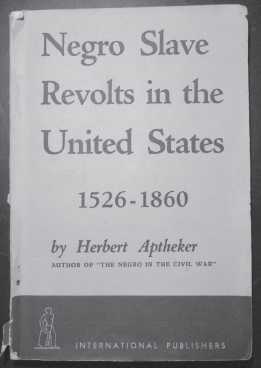
NEGRO SLAVE REVOLTS IN THE UNITED STATES, 1526–1860
BY HERBERT APTHEKER
I. INTRODUCTION
The wholly erroneous conception of life in the old South which is still dominant in our movies and novels and textbooks was invented by the slaveholders themselves. They and their spiritual—and even lineal—descendants have written the history of American Negro slavery. These Bourbons have been motivated by a desire to apologize for and, more than that, to justify a barbarous social system. To do this, they have been forced to commit every sin of omission, falsification and distortion. That they have done their job well is attested by the fact that the monstrous myth created by them is believed by most people today.
The apologists and mythologists who are responsible for this distorted picture of the slave system acknowledge as their pioneer and leader the late Professor Ulrich B. Phillips, of Georgia. His attitude clearly presents the approach of the entire school. In one of his early articles (1905), Phillips referred to himself as a person who had “inherited Southern traditions.” That by this he meant Bourbon traditions is indicated by his dedication of an early book (1908) “to the dominant class of the South.” Since he openly affirms such an allegiance, it is easy to imagine what he says of the old South. To Phillips, under the slave system “severity was clearly the exception, and kindliness the rule.” Indeed, at one point he places quotation marks around the word slavery, indicating that harsh word is hardly the proper one with which to label the system he describes.
And the opinions of this “authority” on the people who were enslaved are remarkable to behold. His works are filled with adjectives like stupid, negligent, dilatory, inconstant, obedient—used to describe the Negro. To Phillips the Negro people are cursed by “inherited inaptitude” and are “by racial quality submissive.” Thus American slavery emerges as a delightful social system admirably contrived for the efficient and undisturbed subordination of an inferior people.
WHAT WAS AMERICAN SLAVERY?
But the fact of the matter is that American slavery was a horrid form of tyrannical rule which often found it necessary to suppress the desperate expressions of discontent on the part of its outraged victims. The fundamental point to bear in mind is that for ninety per cent of the years of its existence and throughout some ninety per cent of the area it blighted, American slavery was, as Marx stated, “a commercial system of exploitation.” That is, American slavery, on the whole, was a staple producing system dependent upon a world market. There was, therefore, no limit to the exploiting drive of the slaveowners. And this system was quite as subject to business cycles, or periods of so-called prosperity, depression and panic, as any other system of private gain dependent upon a world market.
The peculiar feature of this staple-producing agricultural system was the fact that the laborers were owned by, were chattels of, the bosses or slaveholders. And the slaveholders, like employers the world over, were in business—that is, ran cotton or sugar or tobacco plantations—for the gain they could drive out of their workers, whom they literally owned.
So that instead of the delightful picture of a patriarchal institution in which, as a Phillipsian professor recently put it, the slave “was assured of an income proportioned to his necessities and not to his productiveness,” one has a large-scale commercial system of exploitation in which the laborers were rationed out, in normal times, a bare minimum of their animal needs. Objection or resistance of any kind made the worker liable to any punishment his boss should decide was proper—sale, branding, lashing, or some other more excruciating form of torture.
Moreover, productiveness was a most important determinant of the amount of the rations. The plantation slaves were divided according to their productivity into full hands, three-quarter hands, half hands and quarter hands. The less productive workers, the children, the aged, many of the women, the less skilled or less strong received less to eat (often fifty or sixty per cent less) than did the more productive workers, or the “prime” field hands, as they were called.
When the depression and panic came to this staple-producing slaveholding system the workers—the slaves—suffered. James Madison explained, in 1819, what conditions affected slaves, and the first item he listed was “the ordinary price of food, on which the quality and quantity allowed them will more or less depend.” Robert Hayne, a senator from South Carolina, while lamenting a depression in his native state, in January, 1832, declared that because of it the slaves were “working harder, and faring worse.” A Charleston slaveholder, writing in 1811 in the midst of the economic hardships of the moment, stated, “The wretched situation of a large proportion of our slaves is sufficient to harrow up the feelings of the most flinty heart.” John Randolph, a Virginia congressman, during the depression of 1814 and early 1815, felt that the slave “will suffer dreadfully” and noted his “tattered blanket and short allowance.” At a time when Andrew Jackson was short of funds and depression prevailed, in 1841, he received word from his Mississippi plantation that the slaves “were shivering and starving—provisions out and no shoes.”
Other factors tended to worsen the slaves’ condition. Soil exhaustion, for example, made the slaveholders drive their workers at a more rapid pace. Improvements expanding the market for plantation products, such as new industrial machines or better transportation facilities, had a like effect. A slave explained this, in the late 1850s, in blaming railroads for increased demand upon his labor, by remarking, “you see it is so much easier to carry off the produce and sell it now; ’cause they take it away so easy; and so the slaves are druv more and more to raise it.”
LIVING CONDITIONS
These factors lowered the slave’s general standard of living. But what was that standard? Hours of work were from sun-up to sun-down. Food consisted of corn and occasional meat or fish or molasses, with supplements from gardens, which some slaves were permitted to keep and which they might work in their “spare” time, as on Sundays. Another important supplementary source of nourishment came from what the slaves “took” from their masters. The masters called this stealing, but slaves felt themselves guilty of stealing only if they took the belongings of fellow slaves. Appropriating bread or milk or meat or clothing from the master was “taking,” not stealing, for the slaves declared “as we work and raise all, we ought to consume all.” Frequent application of this theory into practice was a great annoyance to the slaveholders, who decided that “stealing” was an inherent trait of the Negro. Surely the taking could not result from the slaves’ need for more bread and meat and clothes!
Slaveholders, themselves, are the authorities for determining what they spent on their chattels’ upkeep. One cotton planter of fifteen years’ experience, writing in the leading Southern periodical, that published by J. B. DeBow, declared that the masters’ expense was often underestimated. He then proceeded to give what he thought was a proper estimate. The cost of feeding one hundred slaves for one year he said was seven hundred and fifty dollars—seven dollars and fifty cents a year for each slave’s food—and this included the expenses of the “hospital and the overseer’s table.” The remaining items, clothing, shoes, bedding, sacks for gathering cotton, and other articles not enumerated also cost seven dollars and fifty cents per slave per year!
James Madison declared, in 1823, that the annual cost of a slave child in Virginia was from eight to ten dollars, and that the youngster became “gainful to his owner” at about nine or ten years of age. Forty-eight planters of Louisiana informed the United States Secretary of the Treasury in 1846 that the yearly expense of supporting the life of a prime field hand was about thirty dollars, and of others—children, aged, some women—fifteen dollars. A good idea of the habitations of the field hands may be obtained from an article by a Mississippi planter, again in DeBow’s publication. The gentleman’s purpose in writing the article was to appeal for better slave housing—such as he provided. He owned one hundred and fifty slaves and provided them with twenty-four cabins, each sixteen by eighteen feet. That is, about six slaves “lived” in a hut sixteen by eighteen feet, and this condition was proudly held up for emulation!
THE QUESTION OF CRUELTY
Time and again modern readers are assured, as by Phillips, that cruelty was exceedingly rare under American slavery. The essential argument used is that it is absurd to believe that men would abuse their own slaves—their own property. Normal people, the apologists say, do not maltreat their cows or pianos; then why be cruel to a slave representing a value of several hundred dollars? Thus a biography, published in 1938 by Harvard University (S. Mitchell, Horatio Seymour, p. 103), declares that “owners were hardly likely to be cruel or careless with expensive pieces of their own property,” just as most folks do not abuse their horses or automobiles.
It may first be remarked that society does find it necessary to maintain institutions for the prevention of cruelty to animals and to children, indicating the not infrequent existence of perverse, insane or malicious people. Slave society was certainly conducive to the production of such persons.
But, entirely apart from this first consideration, cruelty was an integral part of the slave system. The argument of interest would apply were the slaves horses or pianos or automobiles. But they were men and women and children. History certainly teaches us, if it teaches anything at all, that human beings have the glorious urge to be something better than they are at any moment, or to do something new, or to provide their offspring with greater advantages and a happier world than they themselves possess. People who are degraded and despised and sold and bought and arbitrarily separated from all that is familiar and dear will be unhappy. They will be discontented and will think, at least, of bettering their conditions. This last idea, if persisted in, was death to the slave institution, and it was precisely because the slaves were property, precisely because they were valuable and profitable, but rational, instruments of production, that cruelty was necessary.
Slavery was systematized cruelty. The slaves were machines to be driven as much as possible for the production of profit, and machines of an intelligent nature which had to be terrified and chained and beaten in order for their owners to maintain possession. Specific examples of physical cruelty (taken from unimpeachable sources) are innumerable. At least a few of these, which indicate a general condition, deserve mention.
There was the case of Mr. Symon Overzee of Maryland and his slave, Tony. Tony staged a sit-down strike all his own—surely one of the first in America—way back in 1656. What happened was this: Tony ran away and was retaken with the aid of bloodhounds. He then waited only until his wounds healed and again fled. He was again captured. Flight being now impossible, Tony sat down and refused to rise. He would not work as a slave. Mr. Overzee bound him in an upright position by his wrists and proceeded to beat him. Tony still refused to serve as a slave. Mr. Overzee then poured hot lard over him, and Tony died. This procedure was rather irregular, and Mr. Overzee was brought before a court. He explained the facts and was acquitted by the court because Tony was “incorrigible.”
The Grand Jury of Charleston, SC, in 1816, presented “as a most serious evil the many instances of Negro homicide, which have been committed within the city for many years,” and went on to refer to “the barbarous treatment of slaves” who were used “worse than beasts of burden.” A Mr. John Cooke was actually convicted in 1815 in North Carolina of the wanton murder of a slave under the most monstrous conditions. The Governor pardoned him. Said a native:
Some thought, as this was the first instance in which a white man had ever been convicted for killing a negro, it would be impolitic to hang him so unexpectedly. And others believing it would be wrong in all respects, to hang a white man for killing a negro. But whatever might have been the motives of his Excellency, we hear no dissatisfaction expressed by any at this act of clemency; yet we think it may be well to caution the unwary against the repetition of the too common practice of whipping negroes to death as … executive interposition may not be expected in all cases.
The British Consul in Charleston, SC, wrote in a private letter of January, 1854:
The frightful atrocities of slave holding must be seen to be described…. My next door neighbor, a lawyer of the first distinction, and a member of the Southern Aristocracy, told me himself that he flogged all his own negroes, men and women, when they misbehaved…. It is literally no more to kill a slave than to shoot a dog.
As a final piece of evidence is offered the statement of a Major in the United States Army, Amos Stoddard, who lived in Louisiana from 1804 to 1809. In 1811 he wrote of that region:
cruel and even unusual punishments are daily inflicted on these wretched creatures, enfeebled, oppressed with hunger, labor and the lash. The scenes of misery and distress constantly witnessed along the coast of the Delta, the wounds and lacerations occasioned by demoralized masters and overseers, most of whom exhibit a strange compound of ignorance and depravity, torture the feelings of the passing stranger, and wring blood from his heart. Good God! why sleeps thy vengeance!
WHY THE REVOLTS?
Vengeance did not sleep. Bourbon historians, who have made slavery idyllic and the slaves an inferior people, have little place in their works for accounts of this vengeance—this heroic anti-slavery struggle of the Negroes. Thus, for example, Phillips in his latest work, published after his death, declared that “slave revolts and plots were very seldom in the United States”; and two other eminent historians recently said the same thing—John D. Hicks: “Attempts at insurrection were extremely rare”; James G. Randall: “Surprisingly few instances of slave insurrections.”
The history of American slavery is marked by the occurrence of at least two hundred reported Negro conspiracies and revolts. This certainly demonstrates that organized efforts at freedom were neither “seldom” nor “rare,” but were rather a regular and ever-recurring phenomenon in the life of the old South.
Considerable explanation of this rebellious activity has already been given. We have seen that cruelty—that is, actual physical maltreatment—was an essential part of slavery. We have seen that the system, in so-called normal times, provided a bare animal sustenance to its victims. And we have observed the fact that economic disaster seriously depressed the already miserably low standards of the Negroes.
Economic depression had other results of a disturbing nature. It would naturally sharpen the tempers of the slaveowners or of their overseers, whose incomes depended upon the value of the crop they could force the slaves to produce. Bankruptcy and liquidation are, moreover, concomitants of depression and, when property was human beings, its liquidation carried many stories of woe. For it entailed an increase in the leasing or sale of thousands of slaves, which meant the forced separation of brother from sister, child from mother, husband from wife. Surely it is more than a coincidence that the years of severe economic depression coincide with the periods of greatest rebellious activity.
Another factor of considerable importance in arousing concerted slave unrest was the occurrence of an exciting or unusual event. Thus, the landing of a new provincial governor from England in one of the colonies here might lead to a belief on the part of the slaves that they were to be freed, and thereby cause the masters trouble, as occurred in Virginia during 1730. Again, the prevalence of revolutionary philosophy and activity, as from 1770 to 1783, or the rapid spread and growth of an equalitarian religion, as Methodism from 1785 to 1805, or a war against a foreign power, as against Great Britain from 1812 to 1815, or stirring debates in Congress over the question of slavery, as in 1820, or particularly exciting Presidential campaigns as those of 1840 and 1856—all clearly aroused subversive activity on the part of the slaves. The actual outbreak of a slave revolt seems also to have had a contagious effect, so that, for instance, the tremendous struggles for liberation of the slaves of the French West Indies (especially St. Domingo or Haiti) in the 1790s and early 1800s certainly inspired similar attempts in the United States. It is to be noted, too, that attempts at revolt evoked more stringent measures of repression, and the added pinch these created was at times probably important in causing new conspiracies or rebellions.
The more rapid growth of the Negro population as compared to that of the white was also a disturbing factor. This occurred for various reasons. When, in the late seventeenth and early eighteenth centuries, Negro slavery was found to be profitable in certain regions, greed led to an enormous spurt in the importation of slaves. This undoubtedly is an explanation for the considerable slave unrest in South Carolina in the 1730s. The settlement of new and fertile slave areas was likewise followed by a disproportionate growth of the Negro population and consequent slave unrest, as in Mississippi in 1835. Depression, on the other hand, in the great staple producing areas caused them to import less slaves. This meant a severe blow to the prosperity of the slave-raising and slave-exporting regions of the South, with a resultant rapid rise in their slave populations and a more dangerous social condition. This state of affairs prevailed, for instance, from about 1820 to 1831 in eastern Virginia and eastern North Carolina.
Urbanization and industrialization—which were occurring to some extent in the South from about 1840 to 1860—and their creation of a proletarian Negro were also exceedingly dangerous to a slave society. These phenomena were probably important in accounting for some slave outbreaks, especially those of the late 1850s.
SAFEGUARDS OF THE SLAVOCRATS
While the propaganda mill of the slavocratic oligarchy incessantly ground out its falsehoods concerning the innate cowardice and stupidity of the Negro and the delights of being a slave, the same group nevertheless maintained a whole series of devices and laws which it knew was necessary to keep the Negro in bondage.
Armed might was the main instrument of suppression. This comprised large detachments of regular troops of the United States Army, the efficient militia of each of the Southern states, the patrols or mounted bodies of armed men who scoured every piece of land in every county of the South at various intervals from one week to four weeks, the considerable bodies of guards present and active in every Southern city, volunteer military organizations in numerous areas of the South, and the continual presence of at least one armed white, master or overseer, on every plantation.
The activities of the slaves were severely limited. None might possess arms. It was illegal to teach a slave how to read or write. Writing or saying anything with a “tendency” to create unrest among the slaves was a serious crime. No slave might buy or sell or trade anything without his master’s permission. Slaves might not assemble without the presence of whites. They could not testify in any court in any case involving whites. Legal restrictions also hit free Negroes, so that their movements from county to county or from state to state were regulated or totally forbidden. They, too, could not testify in any court against a white person. They, as a rule, could not vote, and even their business activities were closely regulated and limited. In the two years immediately preceding the Civil War laws were passed in several Southern states having as their purposes the re-enslavement of free Negroes or their forced evacuation.
Numerous non-legal regulations and customs were important, too, in maintaining subordination. The opinion of a North Carolina judge rendered in 1852 indicated some of these:
What acts in a slave towards a white person will amount to insolence, it is manifestly impossible to define—it may consist in a look, the pointing of a finger, a refusal or neglect to step out of the way when a white person is seen to approach. But each of such acts violates the rules of propriety, and if tolerated, would destroy that subordination, upon which our social system rests.
A carefully nursed policy of division between the poor whites and the slaves on the basis of race hatred was another very important Bourbon device for retaining his power. Divisions amongst the slaves themselves were also fostered. Thus the domestic slaves were, generally, better treated than the field slaves. It was from this favored group that the slaveholders recruited spies and traitors to whom they gave considerable financial rewards together, often, with freedom—the greatest gift in the power of the “patriarchal” slaveholders!
The slaveholders’ religion had, so far as the slave was concerned, one message—be meek. In the words of the Rev. Dr. Nelson, who lived for many years in North Carolina:
I have been intimately acquainted with the religious opportunities of the slaves—in the constant habit of hearing the sermons which are preached to them. And I solemnly affirm that, during the forty years of my residence and observation in this line, I never heard a single one of these sermons but what was taken up with the obligations and duties of slaves to their masters. Indeed, I never heard a sermon to slaves but what made obedience to masters by the slaves the fundamental and supreme law of religion.
But the slaves had a different religion. Their God had declared that all men were created of one blood, and that the divine rule of doing unto others as one would have others do unto you was the true guide for religious behavior. Their God had cursed man-stealers and had himself taken slaves out of their bondage. Their God had denounced the oppressors and had praised the humble. Their God had declared that the first would be last and the last would be first.
II. THE REVOLTS AND CONSPIRACIES
Before discussing the slave revolts themselves it is important that it be understood that they form but one manifestation of the discontent of the Negro. Revolt was merely one method by which the slaves hoped to obtain their liberty. There were others, each of which merits extensive treatment. One of the most important of these was flight. In the history of slavery many tens of thousands of slaves succeeded in escaping from their enslavers. They fled wherever freedom loomed—the destinations varying with the different times and places—to the Dutch, the Indians, the Mexicans, the British armies, the Canadians, the French, the Spanish, to the Northern states and to the swamps and mountains and forests of the South.
Other slaves, particularly those who were leased by their masters for work in towns and cities, were able, by working in their spare time, to accumulate enough money to purchase their freedom (this was possible, of course, only if the master were willing and honest). There is considerable evidence to indicate that this was by no means infrequent, especially in the more northern of the slave states, like Tennessee, Kentucky and Missouri.
Enlistment and faithful service in the armed forces of the nation was another method whereby Negroes at times gained their freedom. Several hundreds, for example, became free in this manner in the two wars against Great Britain. Individual acts of terrorism, self-mutilation and self-destruction (sometimes, as in Charleston, in 1807, mass suicides), sabotage, as shamming illness, “careless” work, destruction of tools and occasionally strikes were other forms of protest against enslavement.
It is, finally, not to be forgotten that Negroes were leaders in the agitational and political movement against slavery, none being more important in these respects than Allen, Jones, Hall, Truth, Purvis, Remond, Garnet, Ruggles, Wright, Still, Tubman, Walker, Ray, Douglass and a host of others.
THE EARLIEST REVOLTS
The first settlement within the present borders of the United States to contain Negro slaves was the victim of the first slave revolt. A Spanish colonizer, Lucas Vasquez de Ayllon, in the summer of 1526, founded a town near the mouth of the Pedee river in what is now South Carolina. The community consisted of five hundred Spaniards and one hundred Negro slaves. Trouble soon beset the colony. Illness caused numerous deaths, carrying off, in October, Ayllon himself. The Indians grew more hostile and dangerous. Finally, probably in November, the slaves rebelled, killed several of their masters, and escaped to the Indians. This was a fatal blow and the remaining colonists—but one hundred and fifty souls—returned to Haiti in December, 1526.
The first slave plots and revolts in English America did not occur until the latter half of the seventeenth century. This is due to the fact that very few Negroes were there until about 1680. Thus in 1649 Virginia contained but three hundred Negroes, and twenty-one years later the Negroes numbered but two thousand, or some five per cent of the total population. It is also to be noticed that Negroes were not legally enslaved until about 1660, and not enslaved by custom until about 1640. The only crop produced by relatively large-scale labor in the seventeenth century was tobacco, and this was mainly raised by white indentured servants until about 1675.
With the opening of the eighteenth century and the development of large-scale cultivation of rice and indigo as well as tobacco, Negro slavery became important, and frequent and serious revolts occurred. By 1715 about one-third the population of Virginia, the Carolinas and Maryland were slaves (46,000 out of 123,150). Within five years importation of slaves became important in Louisiana also. Georgia adopted slavery by 1750, and four years later the five English provinces of Georgia, the Carolinas, Virginia and Maryland contained a quarter of a million Negro slaves out of a total population of 609,000.
On September 13, 1663 a favorite slave of a Mr. John Smith of Gloucester county, Virginia, betrayed an extensive conspiracy of Negro slaves and white indentured servants. An unknown number of the rebels was executed. The day of the betrayal was set aside by the colonists as one of thanksgiving and prayer to a merciful God who had saved them from extermination. The traitor was given his freedom and 5,000 pounds of tobacco.
There is evidence of several other slave plots in the seventeenth century, probably the most important of which was that of 1687 in Virginia. But, for the reasons made clear by the economic and population data already presented, the really serious uprisings do not occur until the early years of the next century. From that time until final emancipation, one hundred and sixty years later, the history of Negro slavery is filled with heroic and carefully planned mass plots or outbreaks.
It is manifestly impossible within the confines of this booklet to deal with each of these events, or even to exhaustively treat any of the main revolts. We shall, however, attempt to briefly describe the more important uprisings. (A complete list of plots and revolts will be found in the Appendix.)
1709–1730
A joint conspiracy of Negro and Indian slaves was uncovered and crushed in the counties of Surry and Isle of Wight, Virginia, in 1709. The court of investigation declared that “greate numbers” were involved. The next year another extensive conspiracy, this time only of Negro slaves, was again discovered in Surry county. A slave named Peter was the leader. Another slave, Will, was the traitor. His reward was freedom. South Carolina was greatly troubled by slave rebelliousness in 1711. According to the provincial legislature, this kept the inhabitants “in great fear and terror.”
A serious uprising occurred in New York City in 1712. A contemporary declared that the plot was formed January 1, “the Conspirators tying themselves to secrecy by Sucking ye blood of each Others hands.” Very early in the morning of April 8, about twenty-five Negro slaves set fire to a house, and then, with a few guns, clubs and knives ready, waited for the whites to approach. They did, and about nine were killed and seven severely wounded. The alarm soon spread and soldiers hastened to the disturbance. In about twenty-four hours most of the rebels were captured. Six, however, were not, for they committed suicide; “one shot first his wife and then himself and some who had hid themselves in Town when they went to Apprehend them Cut their own throats.”
Twenty-one slaves were executed. According to the account of the Governor:
some were burnt others hanged, one broke on the wheele, and one hung alive in chains in the town, so that there has been the most exemplary punishment inflicted that could be possibly thought of.
This revolt was important in leading Massachusetts and Pennsylvania to pass effective tariff regulations to cut down the importation of slaves.
An extensive revolt occurred in the drought-stricken and Indian-menaced area of Charleston, SC, in 1720. Precise numbers are unknown but many slaves were banished from the province, some hanged and others burned alive. The summer of 1730 witnessed the suppression of three serious slave outbreaks, one in five counties of Virginia, centering in Williamsburg, one in Charleston, SC, and one in Louisiana.
The unrest in Virginia seems to have been brewing for weeks prior to the main outbreak, for several suspected slaves were early arrested and lashed. Later, on a Sunday, two hundred slaves assembled and chose leaders for an insurrection planned for the near future. Betrayal came, however, and at least four of the leaders were executed. On October 28, 1730 it was ordered that henceforth, in Virginia, all who went to worship the Prince of Peace were to go armed.
Information concerning the Charleston plot of 1730 is far from satisfying, but it is certain that many Negroes were involved. Disagreement as to method among the slaves led to betrayal and the familiar report, “ringleaders executed.” One contemporary letter states that “had not an overruling Providence discovered their Intrigues, we had all been in blood.”
The unguarded speech of a slave woman who, on being beaten, shouted that Negroes would not be beaten much longer, led to investigation and the disclosure, after torture with fire, of a plot amongst the slaves of Louisiana, in 1730. The leader, Samba, had headed an uprising against whites in Africa and had been shipped to America. He and seven other men were “broke alive on the wheel,” and one slave woman was hanged “before their eyes.” Two years later the discovery of another plot here led to the hanging of another woman and the breaking of four more men on a wheel. As a further stimulus to contentment, the heads of the four men were strung on poles near the city of New Orleans. Incidentally, some idea of conditions in Louisiana at this time may be gained from the fact that though 7,000 slaves had been imported between 1719 and 1731, in the latter year there were less than 3,500 living.
1739–1741
There were three distinct uprisings in South Carolina in 1739. One of them, which took place in Charleston during March, involved a Spaniard and an Irishman, as well as slaves. The most serious, however, was that led by Cato. This started on a plantation at Stono, some twenty miles west of Charleston, on the ninth of September. The slaves killed the two guards of a magazine, armed themselves and set out for the Edisto river, to the west. Their aim was to escape into Spanish-held Florida, the Governor of which had promised liberty to all fugitive English slaves.
A contemporary wrote: “Several Negroes joyned them, they called out liberty, marched on with colours displayed, and two drums beating.” They destroyed and burned everything in their path in this bid for freedom, so that, as an eye-witness said, “The Country thereabout was full of flames.”
About thirty whites were killed, but not indiscriminately, for one—“a good man and kind to his slaves”—was spared. Scores of well-armed whites soon overtook the slaves, and in a surprise attack killed fourteen Negroes. In two more days of pursuit and battle twenty more rebels were killed and forty captured. These “were immediately some shot, some hang’d, and some Gibbeted alive.” About twenty were yet at large and in another engagement, in which the slaves “fought stoutly for some time,” ten more were killed. Apparently ten slaves made good their bid for freedom.
Early in June, 1740, a slave plot, involving at least two hundred Negroes in and about Charleston, was discovered a short time before it was to have matured. On the day set for the outbreak about one hundred and fifty Negroes had gathered but, while yet unarmed, they were surprised and attacked by the whites. Fifty were captured and hanged, ten a day. In this same month the city was swept by a terrific fire, doing well over a million pounds damage and necessitating aid from other colonies. This was at first ascribed to the slaves, but was later denied. The cause is not positively known, but it is certain that in the summer of 1741 at least two slaves were executed for incendiarism in Charleston.
It is this revolutionary activity, and the Negro’s habit of running away, that were important considerations impelling statesmen connected with the settlement of Georgia, like Oglethorpe and Egmont, to prohibit Negroes in that colony. This prohibition lasted until 1749. South Carolina itself passed laws in 1740 for the purpose of lessening the danger. Slave importations were taxed, the funds raised to be used for obtaining white Protestant settlers. Rather vague regulations requiring better food and clothes for the slaves were passed. It was also most generously provided that a master was not to work his slave more than fourteen hours a day in the winter or more than fifteen hours a day in the summer!
The slave plot of 1741 in New York City has been dealt with by historians as either a complete frameup resulting from a baseless panic, or as a real and considerable conspiracy. The truth is probably somewhere between those two ideas. Discontent certainly was rife. England was at the moment waging an unpopular and costly war against Spain and New York itself, early in 1741, was momentarily expecting attack. Probably of more importance was the fact that the winter of 1740–41 was a particularly severe one, six feet of snow being common in the city. The suffering among the poor generally and the slaves especially was most acute.
Yet the star witness against the conspirators, Mary Burton, as her own testimony establishes, was a liar, and the methods used to extract confessions from the prisoners, torture or promises of rewards, militate against their complete acceptance.
Nevertheless, beginning in March there were a series of suspicious fires and many contemporaries were convinced that some, at least, of these were set by Negro slaves and by white accomplices. Indeed, the Governor of the Province declared on June 20, “if the truth were ever known, there are not many innocent Negro men, and it is thought that some Negroes of the Country are accomplices and were ready to act there.” This last idea undoubtedly arose from the fact that there were frequent and suspicious fires in Hackensack, New Jersey, for which at least two slaves were executed, by burning, on the fifth of May.
Whatever may be the facts as to the justification for the panic aroused among the slaveholders, the results of that panic are unquestionable. About one hundred and fifty slaves and twenty-five whites were arrested. Four whites and thirteen slaves were burned alive. Eighteen Negroes were hanged, two of them in chains, seven who were indicted were not captured, and about seventy were banished.
DURING THE FIRST AMERICAN REVOLUTION
Abigail, the honest and forthright wife of John Adams, wrote to her husband (himself, at the moment, leading a revolution) in September, 1774, of the discovery of a fairly widespread plot for rebellion among the slaves of Boston. And she closed in this fashion: “I wish most sincerely there was not a slave in the province; it always appeared a most iniquitous scheme to me to fight ourselves for what we are daily robbing and plundering from those who have as good a right to freedom as we have.”
The revolutionary activity amongst the colonists certainly brought such ideas forcibly to the minds of the Negro slaves. The commotion enhanced the possibility of gaining freedom without, however, resorting to the desperate expedient of rebellion, and thousands of slaves grabbed the chance by flight and by enlistment in the opposing armies. It is also true that Mrs. Adams’ sentiments were held by many other white people, amongst them slaveholders, so that the period of America’s First Revolution witnessed hundreds of manumissions of slaves. These factors served as safety valves and cut down the number of plots and revolts. Nevertheless several occurred.
Probably the most important of these was that which rocked Pitt, Beaufort and Craven counties, North Carolina, in July, 1775. Two slaves betrayed the plot on the day set for the outbreak, the eighth of July. Immediately all was military activity. In Craven county alone forty slaves were arrested the first day and questioned before a citizens’ committee who found “a deep laid Horrid Tragick Plan” for rebellion. For several days thereafter, throughout the counties mentioned, dozens of slaves were apprehended (some of whom were armed, and some killed resisting arrest). The favorite sentence seems to have been “to receive 80 lashes each [and] to have both Ears crap’d.” Rather crude displays of “kindliness” to inflict upon people who, as Professor Philips has stated, were “by racial quality submissive”!
1791–1802
The next period of serious organized disaffection among America’s “docile” Negroes extended from 1791 through 1802. These years witnessed a remarkable conjunction of those types of events which were most conducive to slave unrest.
Economic distress was characteristic of the period throughout the South and was most acute in the regions of greatest unrest, Louisiana, North Carolina and Virginia. In the latter two states there was a considerable exodus of impoverished whites seeking better opportunities and this, together with a decline in the exportation of slaves, resulted in a much more rapid growth of the Negro population as compared with the white.
The period was also, of course, one of a great worldwide outburst of revolutionary activity. These were the years of the French Revolution, of the cry “liberty, equality, fraternity,” slogans representing precisely those things of which the Negro people, more than any other, were deprived. The year 1791 marked the beginning of the revolution of the Negro slaves in St. Domingo, which, after fourteen years of unsurpassed heroism, culminated in the establishment of an independent Negro republic. Both events filled American newspapers and formed the great topic of conversation in the North and in the South. The latter event, the Negro revolution, directly affected the South, for it caused an exodus of thousands of panic-stricken slaveholders, together with some slaves, into cities like Richmond, Norfolk and Charleston.
The general upsurge of revolutionary feeling gave a considerable impetus to anti-slavery sentiment. In the South this resulted in the freeing of hundreds of slaves by conscience-stricken masters, the growth of anti-slavery groups like the Quakers and Methodists and, indeed, the formation of emancipationist societies in several of the more northern of the slave states. In the North the period was marked by the enactment of gradual emancipation acts so that by 1802 every Northern state (except New Jersey, whose act came in 1804) had provided for the ultimate extinction of slavery.
It is to be noted that even in this early period, the anti-slavery feeling went, in some cases, to the extent of condoning if not urging slave rebellion. This was true of a Boston writer, J. P. Martin, who declared, in 1791, that if the American Revolution was just, then surely a rebellion of slaves would be just. It was true of the Kentuckian, David Rice, who in that state’s constitutional convention of 1792 declared that the slaves of St. Domingo were “engaged in a noble conflict.” It was true of a prominent citizen of Connecticut, Theodore Dwight, who published his sentiments in 1794. Similar ideas appeared in Northern newspapers of these years, and a Massachusetts Negro leader, Prince Hall, suggested, in 1797, that American Negroes would do well to imitate those of the French West Indies.
Finally, this was the period, beginning about 1795, of the spread of two great staple crops, sugar and cotton, due to the inventions of Boré and Whitney. It was, then, a period of extremely rapid transformation in the economic life of the South. It was a time of the very greatly increased commercialization of slavery. Slavery became more than ever before the foundation of a “big business,” a heartless big business whose markets were unlimited and whose workers were completely in the power of the bosses. These laborers represented, indeed, the system’s greatest investment, and that investment had to yield profits no matter what it meant in sweat and blood and tears.
Slave uprisings occurred in lower Louisiana in 1791 and in 1792. Details, however, are unknown. The latter year also witnessed very serious trouble during May, June and July, in Norfolk, Portsmouth, Hampton and the counties of Northampton, Greenbrier and Kanawha in Virginia, as well as in the neighborhood of Newbern, North Carolina. Many hundreds of slaves were implicated, scores were jailed, dozens lashed and several executed. There were sporadic attacks on whites, especially on patrols. Clubs, spears and some guns were found in the possession of slaves.
A Mr. Randolph of Richmond overheard three slaves, on the night of July 20, 1793, discussing plans for a forthcoming revolt and even allocating the property they were to seize. “The one who seemed to be the chief speaker said, you see how the blacks has killed the whites in the French Island [St. Domingo] and took it a while ago.” Other people, including John Marshall, Chief Justice of the Supreme Court of the United States, reported, as late as November 25, discoveries of plots in Petersburg, Portsmouth, Elizabeth City, and in Powhatan and Warwick counties, Virginia. The familiar story was repeated: mobilization and arming of the militias of the affected areas, the arrest of scores of slaves and the torture and execution of the rebel leaders.
The next major outbreak occurred in 1795 in Pointe Coupée parish in the (then) Spanish colony of Louisiana. The conspiracy was betrayed after disagreement among the leaders as to when to revolt. The militia was immediately armed, and with the aid of regular soldiers the plot was crushed. The slaves resisted arrest, and twenty-five of them were killed. Twenty-three others were executed, and the bodies of nine of these were left hanging near the churches of the region. Many others were severely lashed. It appears certain that at least three whites were implicated with the slaves and were banished from the colony. There is, also, evidence of a slave conspiracy in May of this year in St. Landry parish, Louisiana. A direct result of this rebellious activity in Spanish Louisiana was the banning of the slave trade.
Two months later the depredations of a group of outlawed runaway slaves and the killing of an overseer, led to an intense slave hunt in New Hanover county, North Carolina. At least four of these black Robin Hoods were captured and executed.
GABRIEL’S CONSPIRACY
The year 1800 is the most important one in the history of American Negro slave revolts. For it is the birth year of John Brown and of Nat Turner, the year in which Denmark Vesey bought his freedom, and it is the year of the great Gabriel conspiracy.
It is clear that this conspiracy, under the leadership of Gabriel, slave of Thomas Prosser, and of Jack Bowler, another slave (both of Henrico county, Virginia), was well formed by the spring of 1800. Apparently wind of this early reached the authorities, for Virginia’s Governor, James Monroe, expressed “fears of a negro insurrection” as early as April 22. Yet, as a contemporary declared, the plot was “kept with incredible Secrecy for several months” and it was not until August 9 that Monroe was warned, in a letter from Petersburg, of a forthcoming revolt. The military authorities were instantly informed of this.
The next disclosure came in the afternoon of the day, Saturday August 30, set for the outbreak. It was made by Mr. Mosby Sheppard, whose two slaves, Tom and, aptly enough, Pharaoh, had told him of the plot. Monroe acted immediately. He appointed three aides for himself, asked for and got the use of the federal armory at Manchester, posted cannon at the capitol, called into service at least six hundred and fifty troops, and gave notice of the conspiracy to every militia commander in the state.
“But,” as an eyewitness declared, “upon that very evening just about Sunset, there came on the most terrible thunder, accompanied with an enormous rain, that I ever witnessed in this State.” This storm flooded rivers and tore down bridges and made military activity for both the rebels and the slaveholders impossible. A patrol captain did, however, report observing an exodus of slaves out of Richmond, whereas, usually, on Saturdays, the slaves from the countryside flocked into the town.
As a matter of fact on that stormy night at least one thousand slaves had appeared at their agreed rendezvous, six miles outside of Richmond, armed with clubs and swords; but after vainly trying to advance in the face of the flood, the rebels dispersed.
The next day scores of slaves were arrested. About thirty-five Negroes were executed. At least four condemned slaves escaped from prison, and at least one committed suicide. The leader, Gabriel, a twenty-four year old giant of six feet two, was finally captured in Norfolk on September 25 and sent to Richmond. He was tried and condemned, but his execution was postponed for three days, until October 7, in the hope that he would talk. Monroe himself interviewed him, but reported that, “From what he said to me, he seemed to have made up his mind to die, and to have resolved to say but little on the subject of the conspiracy.”
Thomas Jefferson pointed out to Monroe that the “other states & the world at large will forever condemn us if we indulge a principle of revenge, or go one step beyond absolute necessity. They cannot lose sight of the rights of the two parties, & the object of the unsuccessful one.” Ten condemned slaves were reprieved and banished.
Certain features of this conspiracy merit special attention. It is certain that the motivating drive of the rebels, as one of their leaders said, was “death or liberty.” This spirit is also shown by their heroic behavior before the courts and the gallows of the slavocrats. John Randolph, who attended the trials, declared that the slaves “manifested a sense of their rights, and contempt of danger, and a thirst for revenge which portend the most unhappy circumstances.” Another lawyer who was present at the trials told an English visitor, Robert Sutcliff, of the courageous actions of the slaves. He declared that when one of the Negroes was asked,
what he had to say to the court in his defense, he replied, in a manly tone of voice: “I have nothing more to offer than what General Washington would have had to offer, had he been taken by the British officers and put to trial by them. I have ventured my life in endeavouring to obtain the liberty of my countrymen, and am a willing sacrifice to their cause; and I beg, as a favour, that I may be immediately led to execution. I know that you have pre-determined to shed my blood, why then all this mockery of a trial?”
And a resident of Richmond wrote, September 9, 1800: “Of those who have been executed, no one has betrayed his cause. They have uniformly met death with fortitude.”
It was this love of liberty which led the slaves to plan no harm to anti-slavery groups like the Methodists and the Quakers. The French inhabitants were also to be exempt from attack, for they personified to the slaves the ideals of liberty and equality. Poor white women were also in no case to be injured. The slaves expected too, or at least hoped that the poorer whites would join them in their struggle against the slaveholders. They counted, too, on the aid of the nearby Catawba Indians. Testimony offered at the trials directly implicated two Frenchmen, but they were never named and never captured.
It is not known how many slaves were involved in the conspiracy. One witness said 2,000, one 5,000 and one 10,000. The Governor of Mississippi thought 50,000 were implicated. Monroe himself said:
It was distinctly seen that it embraced most of the slaves in this city [Richmond] and neighbourhood, and that the combination extended to several of the adjacent counties, Hanover, Caroline, Louisa, Chesterfield, and to the neighbourhood of the Point of the Fork; [Columbia in Goochland county was known as Point of the Fork]—there was good cause to believe that the knowledge of such a project pervaded other parts, if not the whole of the State.
(In 1800 there were about 347,000 slaves in Virginia. In the regions specified by Monroe there were about 32,000 slaves.)
Serious unrest came to the surface again in 1802. Indeed, plots had been uncovered in Norfolk just three months after Gabriel’s capture, and again in the winter of 1801 in Petersburg. On January 2, 1802, trouble was once more reported from Petersburg and the militia was pressed into service. Five days later two slave conspirators were sentenced to death in Nottoway county, Virginia.
A letter of January 18 from a Negro to another in Powhatan referred to a plot and declared, “Our travelling friend has got ten thousand in readiness for the night.” Two slaves were hanged in Brunswick on February 12 (seven years, to the day, before Abe Lincoln saw the light). Two more were executed in April in Halifax, and many arrests were then reported from Princess Anne and Norfolk. A rebel was executed in the latter city in May. The editor of the Norfolk Herald thought this conspiracy was more widespread than that of 1800. Fears in Virginia were increased when, in May, plots were reported from North Carolina.
The trouble there was widespread, conspiracies being uncovered in the counties of Camden, Currituck, Bertie, Martin, Pasquotank, Halifax, Warren, Washington, Wake and Charlotte. Hundreds of slaves were arrested, scores lashed, branded and cropped, and about fifteen hanged. The finding of pikes and swords amongst the slaves was several times mentioned. Six Negroes, “mounted on horseback,” attacked the jail in Elizabeth City with the aim of rescuing their imprisoned comrades, but their attempt was defeated and four of them were captured. It appears that the leader of the North Carolina rebels was named Tom Copper and that he, with several followers, had been fugitive slaves for months.
There is good evidence that white people were accomplices of the slaves in the Virginia plots of 1802. Thus a Mr. John Scott, while informing the Governor of the trial and execution of slaves in Halifax, stated, “I have just received information that three white persons were concerned in the plot; that they have arms and ammunition concealed under their houses, and were to give aid when the negroes should begin.” A slave, Lewis, twice stated at his trial that whites, “that is, the common run of poor white people,” were involved. And Arthur Farrar, a slave leader, appealed for support from his fellow slaves with these words:
Black men if you have now a mind to join with me now is your time for freedom. All clever men who will keep secret these words I give to you is life. I have taken it on myself to let the country be at liberty this lies upon my mind for a long time. Mind men I have told you a great deal I have joined with both black and white which is the common man or poor white people, mulattoes will join with me to help free the country, although they are free already. I have got 8 or 10 white men to lead me in the fight on the magazine, they will be before me and hand out the guns, powder, pistols, shot and other things that will answer the purpose … black men I mean to lose my life in this way if they will take it.
Arthur was hanged in Henrico county on June 18, 1802.
1810–1816
The years 1810–1816 mark the next period of serious concerted slave unrest. Here again the familiar pattern of surrounding conditions is apparent. Severe depression, due to soil exhaustion, to the non-intercourse and embargo acts passed prior to the War of 1812, and the blockade and devastation brought by that war caused acute suffering in the slave states. The excitement incident to the waging of the war itself also affected the slaves.
There were other military events of the period affecting the slave areas, as the revolution in and American annexation of West Florida in 1810, and the slavocratic filibusters from 1811 to 1813, and again in 1816 against Texas and East Florida. Revolutionary struggles in Mexico and in South America (Simon Bolivar started his career in 1810) filled American newspapers. The anti-slavery activity of Bolivar (which was fostered by his Negro ally, Alexandre Petion, President of Haiti) was especially alarming to and anxiously discussed by the rulers of the slave states.
In March, 1810, two communications were found on a road in Halifax county, North Carolina. One was from a slave in Greene county, Georgia, to another slave, Cornell Lucas, of Martin county, NC; another, likewise to and from slaves, had been sent from Tennessee and was intended for Brunswick county, Virginia. The contents of both letters, even as to details, were similar, and one, that to Cornell Lucas, may be quoted in full:
Dear Sir—I received your letter to the fourteenth of June, 1809, with great freedom and joy to hear and understand what great proceedance you have made, and the resolution you have in proceeding on in business as we have undertook, and hope you will still continue in the same mind. We have spread the sense nearly over the continent in our part of the country, and have the day when we are to fall to work, and you must be sure not to fail on that day, and that is the 22d April, to begin about midnight, and do the work at home first, and then take the armes of them you slay first, and that will strengthen us more in armes—for freedom we want and will have, for we have served this cruel land long enuff, & be as secret convaing your nuse as possabel, and be sure to send it by some cearfull hand, and if it happens to be discovered, fail not in the day, for we are full abel to conquer by any means.—Sir, I am your Captain James, living in the state of Jorgy, in Green county—so no more at present, but remaining your sincer friend and captain until death.
General Thomas Blount, a North Carolina Congressman, informed the Governor of Georgia of these letters. This probably explains the passage in the latter’s legislative message referring to information he had received “from a source so respectable as to admit but little doubt of the existence of a plan of an insurrection being formed among our domesticks and particularly in Greene county.” A resident in Augusta, Georgia (about fifty miles east of Greene county) wrote to a friend April 9, 1810:
The letter from “Captain James” is but a small part of the evidence of the disposition of the Blacks in this part of the country. The most vigorous measures are taking to defeat their infernal designs. May God preserve us from the fate of St. Domingo. The papers here will, for obvious reasons, observe a total silence on this business; and the mail being near closing, I can say no more on the subject at present.
And so far as Georgia is concerned “no more on the subject” is known.
A letter of May 30, 1810, from a Virginia slaveholder, Richard W. Byrd of Smithfield, to the Governor, John Tyler, told of the discovery of insurrectionary schemes among the slaves of his neighborhood and of North Carolina. Many were arrested and lashed. Slave preachers, especially one named Peter, were declared to be the leading rebels. One had declared that “he was entitled to his freedom, and he would be damned, if he did not have it in a fortnight.” Early in June at least one slave, Sam, of Isle of Wight, and two others, Glasgow and Charlotte, of Culpeper, were found guilty of conspiracy. The woman was lashed, Sam was banished and Glasgow was executed. At the same time trouble was reported from Norfolk, but details are not known.
At the end of November, 1810, “a dangerous conspiracy among the negroes was discovered” in Lexington, Kentucky. “A great many Negroes were put in jail,” according to a resident, but what became of them is not reported.
On the afternoon of January 9, 1811, the people of New Orleans were thrown into the “utmost dismay and confusion” on discovering wagons and carts, straggling into the city, filled with people whose faces “wore the masks of consternation” and who told of having just escaped from “a miniature representation of the horrors of St. Domingo.” They had fled from a revolt of slaves, numbering about four hundred, of St. Charles and St. John the Baptist parishes, about thirty-five miles away from the city. These slaves, led by Charles Deslondes, described as a “free mulatto from St. Domingo,” rose on the evening of January 8, starting at the plantation of a Major Andry.
They were originally armed with cane knives, axes and clubs. After killing Andry’s son and wounding the Major, they took possession of a few guns, drums and some sort of flags, and started marching from plantation to plantation, slaves everywhere joining them. They killed at least one other white man and destroyed a few plantations.
Major Andry, according to his own statement, organized about eighty well-armed planters and, on the ninth of January, attacked the slaves, “of whom we made great slaughter.” Many, however, escaped this first attack and continued their depredations. Andry ordered “several strong detachments to pursue them through the woods, and, he wrote on January 11, “at every moment our men bring in or kill them.”
Meanwhile, in New Orleans, Governor Claiborne had, on January 9, appointed seven aides for himself, called out the militia and forbidden male Negroes from going at large. Brigadier-General Wade Hampton immediately left that city with four hundred militiamen and sixty United States Army men for the scene of action. Major Milton left Baton Rouge at about the same time with two hundred more soldiers.
These forces, very early in the morning of the tenth, attacked the rebellious slaves and decimated them. Sixty-six were killed or executed on the spot, sixteen were captured and sent to New Orleans, and seventeen were reported as missing and were “supposed generally to be dead in the woods, as many bodies have been seen by the patrols.” All those tried in New Orleans were executed, at least one, a leader named Gilbert, by the firing squad; and their heads were strung at intervals from the city to Andry’s plantation. Hampton reported on January 12 that Milton had been for the time being posted in the neighborhood to aid “various companies of the citizens, that are scouring the country in every direction.” At the same time a company of light artillery and one of dragoons were sent up the river to suppress “disturbances that may have taken place higher up.”
Governor Claiborne, writing January 19, said he was “happy to find … so few Slaves are now in the woods. I hope this dreadful Insurrection is at an end and I pray God! we may never see another.” What else occurred cannot be said, but this paragraph from a Louisiana paper is suggestive:
We are sorry to learn that a ferocious sanguinary disposition marked the character of some of the inhabitants. Civilized man ought to remember well his standing, and never let himself sink down to a level with the savage; our laws are summary enough and let them govern.
A law of April 25, 1811, provided for the payment by the Territory of twenty-nine thousand dollars as some compensation to the masters whose slaves were killed.
Repeatedly plots were uncovered and crushed during the War of 1812. Those of most interest occurred in Louisiana in 1812 and in South Carolina in 1813.
In New Orleans, August 18, 1812, “it was discovered that an insurrection among the negroes was intended.” The militia was immediately ordered out and was kept in service until the end of the month. White men and free Negroes were implicated with the slaves. One of these white men, Joseph Wood, was executed on September 13. “All the militia of the city were under arms—strong patrols were detailed for the night.” It is clear that another of the whites involved in this plot was named Macarty, and that he was jailed, but what became of him or of the slave rebels, is not known.
There is evidence of unrest among the slaves of South Carolina in 1812 and of the existence of a widespread secret slave society there in 1813. The members of this group waited, vainly, for British aid to afford an opportunity to effectively strike for freedom. A song, said to have been written by a slave, and sung by these conspirators at their meetings, has been preserved. Its last stanza and chorus are:
Arise! arise! shake off your chains!
Your cause is just, so Heaven ordains;
To you shall freedom be proclaimed!
Raise your arms and bare your breasts,
Almighty God will do the rest.
Blow the clarion’s warlike blast;
Call every Negro from his task;
Wrest the scourge from Buckra’s hand,
And drive each tyrant from the land!
Chorus: Firm, united let us be,
Resolved on death or liberty!
As a band of patriots joined,
Peace and plenty we shall find.
Early in 1816 Virginia was rocked by an indigenous John Brown, one George Boxley. In appearance he was anything but like Brown, but in ideas the two men were well nigh identical. Boxley was about thirty-five years old, six feet two inches tall, with a “thin visage, of a sallow complexion, thin make, his hair light or yellowish (thin on top of his head, and tied behind)—he stoops a little in his shoulders, has large whiskers, blue or grey eyes, pretends to be very religious, is fond of talking and speaks quick.” Contemporaries were in doubt as to “whether he is insane or not,” since he openly “declared that the distinction between rich and poor was too great; that offices were given rather to wealth than to merit; and seemed to be an advocate for a more leveling system of government. For many years he had avowed his disapprobation of the slavery of the Negroes, and wished they were free.” It was believed that his failure to be elected to the state legislature sometime prior to the War of 1812 his declining economic fortunes, and his failure to advance in position while fighting in that war had embittered him.
Be that as it may, late in 1815 George Boxley decided to attempt to free the slaves and formed a conspiracy in Spotsylvania, Louisa and Orange counties. A slave woman betrayed it, and early in 1816 about thirty slaves were arrested. Boxley, after vainly trying to organize a rescue party, fled. He finally surrendered and was imprisoned but, with the flame of a candle and a file smuggled to him by his wife, he escaped, in May. Though a reward of one thousand dollars was offered for him he was never captured. About six slaves were hanged and the same number banished.
A favorite, but unnamed, slave betrayed a plot involving many Negroes in and around Camden, South Carolina, one month after Boxley’s escape. The fourth of July was the day selected for the outbreak, which was to have been started by setting fire to several houses. Espionage was used to uncover the ramifications of this widespread conspiracy. A letter from Camden, dated July 4, stated that the slaves had been plotting since December, 1815, and that the local jail “is filled with negroes. They are stretched on their backs on the bare floor, and scarcely move their heads; but have a strong guard placed over them…. The negroes will never know who betrayed them, for they tried to engage all for a great distance round.”
The legislature purchased, for one thousand one hundred dollars, the freedom of the traitor and passed a law giving him fifty dollars a year for the rest of his life. At least six rebel leaders were hanged.
Two major expeditions were carried out in 1816 against large settlements of outlawed fugitive slaves, one in South Carolina, the other in Florida. The maroons were attacked in the first case by the state militia, and in the second by infantry and artillery units of the regular United States army. About three hundred Negroes and a few whites were killed in these engagements.
1821–1831
From 1821 through 1831 there were incessant reports of slave unrest throughout the South. And, once more, that decade was marked by severe economic depression. Suffering was increased, too, by natural calamities such as drought in the southeast in 1826, in the southwest in 1827 and again in the southeast in 1830. Excessive rains ruined crops in South Carolina and Louisiana in 1829. Because of this depression there was a much more rapid increase of the slave population than the white population in the eastern slave states.
Revolutionary sentiments and slogans were in the air, and Southern papers were filled with praise for revolutionists in Turkey, Greece, Italy, Spain, France, Belgium, Poland, South America, the West Indies and Mexico. (It was only home-grown rebels who were referred to as “banditti” by the local press.) Slave uprisings in Brazil, Venezuela, Martinique, Puerto Rico, Cuba, Antigua, Tortola and Jamaica also found their way into the local press and conversation. The decade witnessed, too, an upsurge in the anti-slavery movement in England (which freed her colonial slaves in 1833), in Mexico (which abolished slavery in 1829), and in the border slave states and the northern states of America.
The activities of large numbers of outlawed fugitive slaves, aided by free Negroes, assumed the proportions of rebellion in the summer of 1821 in Onslow, Carteret and Bladen counties, North Carolina. There were, too, plans for joint action between these maroons and the field slaves against the slaveholders.
Approximately three hundred members of the militia of the three counties saw service for about twenty-five days in August and September. About twelve of these men were wounded when two companies accidentally fired upon each other. The situation was under control by the middle of September, and although the militia “did not succeed in apprehending all the runaways & fugitives, they did good by arresting some, and driving others off, and suppressing the spirit of insurrection.” A newspaper report of May, 1824, disclosed that the “prime mover” of this trouble, Isam, “alias General Jackson,” was among those who escaped at the time, for he is there reported as dying from lashes publicly inflicted at Cape Fear, North Carolina.
DENMARK VESEY
The conspiracy in and around Charleston, SC, of 1822 was one of the most, if not the most, extensive in American history. It was led by a former slave, Denmark Vesey, who had purchased his freedom in 1800.
Vesey, like most of the other rebels, was deeply religious. In justifying his plans to his numerous followers he read to them “from the bible how the children of Israel were delivered out of Egypt from bondage.” Antislavery speeches uttered in Congress during the Missouri debates of 1820–21 were also known to and encouraged the conspirators.
If Vesey’s companion were to bow “to a white person he would rebuke him, and observe that all men were born equal, and that he was surprised that any one would degrade himself by such conduct; that he would never cringe to the whites, nor ought any who had the feelings of a man.” He had not heeded the urgings of the slaveowners that free Negroes go to Africa, “because he had not the will, he wanted to stay and see what he could do for his fellow-creatures,” including his own children, who were slaves. (These quotations are from the official record of the trials and all emphases are as in the original.)
Most of the other Negroes felt as Vesey did. Two of the rebels told a slaveholders’ court, “They never spoke to any person of color on the subject, or knew of any one who had been spoken to by the other leaders, who had withheld his assent.” Nevertheless, the leaders feared betrayal, and it came. One of them, Peter Poyas, had warned an agent, “Take care and don’t mention it to those waiting men who receive presents of old coats, etc., from their masters, or they’ll betray us.” The traitor was Devany, favorite slave of Colonel Prioleau.
Vesey had picked the second Sunday in July as the day to revolt. Sunday was selected because on that day it was customary for slaves to enter the city, and July because many whites would then be away. The betrayal led him to put the date ahead one month, but Vesey could not communicate this to his country confederates, some of whom were eighty miles outside the city. Peter Poyas and Mingo Harth, the two leaders first arrested, behaved “with so much composure and coolness” that “the wardens were completely deceived.” Both were freed on May 31, but spies were put on their trails. Another slave, William, gave further testimony and more arrests were made. The most damaging of these was the arrest of Charles Drayton, who agreed to act as a spy. This led to complete exposure.
One hundred and thirty-one Negroes were arrested in Charleston, and forty-seven condemned. Twelve were pardoned and transported, but thirty-five were hanged. Twenty were banished and twenty-six acquitted, although the owners were asked to transport eleven of these out of the state. Thirty-eight were discharged by the court. Four white men, American, Scottish, Spanish and German, were fined and imprisoned for aiding the Negroes by words of encouragement.
Although the leaders had kept lists of their comrades, only one list and part of another were found. Moreover, most of the executed slaves followed the advice of Poyas, “Die silent, as you shall see me do,” and so it is difficult to say how many Negroes were involved. One witness said 6,600 outside of Charleston, and another said 9,000 altogether were implicated. The plan of revolt, comprising simultaneous attacks from five points and a sixth force on horseback to patrol the streets, further indicated a very considerable number of rebels.
The preparations had been thorough. By the middle of June the Negroes had made about two hundred and fifty pike heads and bayonets and over three hundred daggers. They had noted every store containing arms and had given instructions to all slaves who tended or could easily get horses as to when and where to bring the animals. Even a barber had assisted by making wigs as a disguise for the slaves. Vesey had also written twice to St. Domingo, telling of his plans and asking for aid.
After the arrests of the leaders many of the slaves planned their rescue, and an attempt to revolt in the city was suppressed by state troops. It was felt necessary to bring in Federal troops during the time of the executions.
There was trouble outside Charleston in July. Early that month three slaves were executed in Jacksonboro, forty miles west of the city. In August the Governor offered a reward of two hundred dollars for the arrest or killing of about twenty armed Negroes harassing the planters. In September a guarded report came of the discovery and crushing of a slave plot in Beaufort, SC; “The Town council was in secret session. Particulars had not transpired.” They rarely did. Tighten restrictive laws, get rid of as many free Negroes as possible, keep the slaves ignorant, and your powder dry, hang the leaders, banish others, whip, crop, scourge scores, and above all keep it quiet, or, if you must talk, speak of the slaves’ “contentedness” and “docility”!
The Norfolk Herald of May 12, 1823, under the heading “A Serious Subject,” called attention to the activities, reaching revolt, of a growing number of pugnacious outlawed slaves in the southern part of Norfolk county, Virginia. The citizens of the region were in “a state of mind peculiarly harrassing and painful,” for no one’s life or property was secure. The Negroes had already obtained arms and had killed several slaveholders and overseers. Indeed, one slaveholder had received a note from these amazing men suggesting it would be healthier for him to remain indoors at night—and he did.
A large body of militia was ordered out to exterminate these outcasts and “thus relieve the neighbouring inhabitants from a state of perpetual anxiety and apprehension, than which nothing can be more painful.” During the next few weeks there were occasional reports of the killing or capturing of outlaws, culminating June 25 in the capture of the leader, Bob Ferebee. It was declared that he had been an outlaw for six years. Bob Ferebee was executed on the twenty-fifth of July.
The inhabitants of Edgecombe county, North Carolina, were much distraught in December 1825, “by the partial discovery of an insurrectionary plot among the blacks.” The slaves seem to have believed that the national government had set them free. The patrol was strengthened, the militia called out and the unrest crushed; but what that meant in human terms is not known.
Early in September 1826, seventy-five slaves—chained on a slave-ship going down the Mississippi, with the boat one hundred miles south of Lexington, Kentucky—in some way broke their chains, killed their four guards and another white passenger and managed to get into Indiana. All the rebels “except one or two” were captured, five were hanged, some banished from the country and the rest sold south. The same year, twenty-nine slaves on board the domestic slave-ship, Decatur, revolted, killed the captain and mate, and commanded another white to take them to Haiti. The boat was captured and taken into New York, where in some way every one of the slaves escaped. One, however, William Bowser, was later captured and executed in New York City on December 15, 1826.
A lady in Georgia wrote, in June, 1827, that a “most dangerous and extensive insurrection of the blacks was detected at Macon a few days since.” Three hundred slaves and one white man were involved, but no further particulars are known. Later that same month came the report of the destruction of a considerable group of slave outlaws in Alabama. These maroons had been exceedingly troublesome and were constantly gaining new recruits. They planned to build a fort just prior to their annihilation, and then “a great number of Negroes in the secret were to join them.” In the attack, during which the Negroes “fought desperately” with what poor weapons they had, three slaves were killed, several escaped, and others were wounded and captured. One white was wounded.
The years 1829 and 1830 were filled with rebellious activities. Space permits but the barest mention of the outstanding events. Large-scale slave incendiarism was common, most notably in Augusta and Savannah, Georgia, in 1829, and in New Orleans and Cambridge, Maryland, in 1830. But, of course, the slaves did not restrict themselves to fire.
In February 1829, slaves of several plantations forty miles north of New Orleans revolted. Militia suppressed the outbreak. At least two of the leaders were hanged. The Secretary of War wrote to the local commanding officer, Colonel Clinch, on March 17, 1829, to hold himself ready to aid the Governor of Louisiana, “on account of the insurrectionary spirit manifested by the black population in that state.”
Probably in this same month a widespread conspiracy was uncovered in the neighbourhood of Georgetown, South Carolina. The militia of the region was reinforced by troops and arms forwarded from Charleston. That the trouble was serious becomes clear from a letter of April 17, sent by the Attorney-General of the state to the military commander, General Allston, on the scene. The official comments that while the proceedings were not yet “bloody” he feared the General would “hang half the country. You must take care and save negroes enough for the rice crop.” The leaders of this plot, all slaves, were Charles Prioleau, Nat, Robert and Quico. Quico was banished. What became of the others is not known.
The agitation of western Virginia for a greater share in the governing of the state, which was accompanied by much talk about liberty and equality, culminated in the constitutional convention of 1829–30. The excitement affected the slaves and inspired them to concerted efforts for freedom. Alarm pervaded Richmond, and the counties of Mathews, Isle of Wight, Gloucester and Hanover. Fears were intensified with the report of the killing of one white and the wounding of another in Hanover County on July 4, 1829, by about eight slaves. Patrols, militia and volunteer military bodies were pressed into service and crushed, for the time being, the “spirit of dissatisfaction and insubordination,” to quote the Governor of Virginia.
In August 1829, a drove of sixty slaves, men and women, were marching on their way to be sold in the deep South when, between Greenup and Vanceburg, Kentucky, two of the slaves apparently began to fight with each other. One of the white drivers came at them with a whip, and immediately all the slaves dropped their filed chains. Two of the white drivers were killed, but a third, with the aid of a slave woman, succeeded in escaping and obtained assistance; all the slaves were soon captured. What became of them is not known.
The same county in Kentucky, Greenup, witnessed, early in December, the execution of four slaves who had rebelled while being sent south and had killed their master. According to Southern newspapers the slaves “all maintained to” the last, the utmost firmness and resignation to their fate. They severally addressed the assembled multitude, in which they attempted to justify the deed they had committed. One of the condemned slaves, the instant before being launched into eternity shouted, “death—death at any time in preference to slavery.”
By this same month of December 1829, copies of the revolutionary pamphlet denouncing slavery, written by a free Negro of Boston, David Walker (and first published in September) were found amongst slaves and some whites in Louisiana, Georgia, North Carolina and Virginia. This evoked tremendous fear and led to increased police and military measures. It also definitely seems to have inspired slave plots, particularly in Wilmington, North Carolina, in September 1830.
Going back, however, to December 1829, we find that Negroes aboard the domestic slave-trader, Lafayette (!), bound for sale at New Orleans from Norfolk, revolted, with the aim of reaching St. Domingo. The slaves stated that a similar effort was to be made by Negroes on another boat from the same port. The slaves “were subdued, after considerable difficulty, and twenty-five of them were bolted down to the deck, until the arrival of the vessel at New Orleans.”
Early in April 1830, a conspiracy was uncovered in New Orleans, and at least two slaves were hanged. Plots were discovered in and around Dorchester, Maryland, in July. In October a conspiracy involving at least one hundred Negroes, including some who were free, was crushed in Plaquemines parish, Louisiana, by the local militia. In November plots were reported from Nashville, Tennessee, and from Wilmington, North Carolina.
On December 14, 1830, the inhabitants of Sampson, Bladen, New Hanover, and Duplin counties, North Carolina, petitioned the legislature for aid because their “slaves are become almost uncontroulable.” Ten days later the residents of Newbern, Tarborough and Hillsborough in the same state were terrified by slave unrest. And “the inhabitants of Newbern being advised of the assemblage of sixty armed slaves in a swamp in their vicinity, the military were called out, and surrounding the swamp, killed the whole number.” A resident of Wilmington, NC, reported, on January 7, 1831, that: “There has been much shooting of negroes in this neighborhood recently, in consequence of symptoms of liberty having been discovered among them. These inhuman acts are kept profoundly secret.” In Mississippi, too, on the day, in 1830, of the birth of the humble Prince of Peace, slave conspiracies were reported, particularly in Jefferson County.
The disaffection and unrest continued into the early months of 1831. Because of this and at the urgent requests of local authorities, the United States government sent two companies of infantry to New Orleans, and five more companies to Fort Monroe, in Virginia.
NAT TURNER
The terror prevalent in the South due to this rebellious activity was soon transformed into hysteria as the result of the actions of a slave named Nat Turner. He had been born October 2, 1800, and lived all his life in Southampton county, Virginia. When, in August, 1831, he led a rebellion, he was officially described as follows:
5 feet 6 or 8 inches high, weighs between 150 and 160 pounds, rather bright complexion, but not a mulatto, broad shoulders, large flat nose, large eyes, broad flat feet, rather knock-kneed, walks brisk and active, hair on the top of the head very thin, no beard, except on the upper lip and the top the chin, a scar on one of his temples, also one on the back of his neck, a large knot on one of the bones of his right arm, near the wrist, produced by a blow.
Nat Turner was an intelligent and gifted man who could not reconcile himself to life as a slave. His religion offered him a rationalization for his rebellious feeling and, having taught himself how to read, he immersed himself in the stories of the Bible. His personality and keen mentality made him influential among his fellow-slaves and even with some neighboring poor whites.
In 1826 or 1827 he ran away, as his father had done successfully, and stayed away one month. Yet doubts overwhelmed him, and he felt that perhaps he “should return to the service of my earthly master.” He did, but the other slaves “found fault, and murmured against me, saying that if they had my sense they would not serve any master in the world.” In the spring of 1828 Turner, while working the fields, was finally convinced that he was to take up Christ’s struggle for the liberation of the oppressed, “for the time was fast approaching when the first should be last and the last should be first.”
The solar eclipse of February 12, 1831, was his sign. This fact has led chauvinistic historians to ridicule the “negro intelligence” (whatever that may mean) of Turner. The fact is that his (what would today be called) superstitious nature was common in his day among all people. Southerners still, generally, carried on agriculture according to the signs of the Zodiac. In 1833 under William Miller, a white citizen of New York, thousands of people were to be firmly convinced that the end of the world and the second coming of Christ were just around the corner. Indeed, that eclipse of 1831 itself led a white minister in New York City to prophesy that the whole city “South of Canal-Street would sink,” and some folks actually moved to the upper part of the city.
Following the eclipse, Turner told four slaves it was time to prepare for rebellion. Significantly they selected July 4 as the day on which to strike for freedom. But Turner was ill on that day and he waited for another sign. This came on August 13 in the peculiar greenish blue color of the sun. A meeting was called for Sunday, August 21.
Turner arrived last and noticed a newcomer.
I saluted them on coming up, and asked Will how came he there, he answered, his life was worth no more than others, and his liberty as dear to him. I asked him if he meant to obtain it? He said he would, or lose his life. This was enough to put him in full confidence.
Such were the “bandits,” as the slavocrats called them, that Nat Turner led.
In the evening of that Sunday this group of six slaves started on their crusade against slavery by killing Turner’s master, Joseph Travis, together with his family. Within twenty-four hours some seventy Negroes, several mounted, had covered an area of twenty miles and had killed every human being (with an important exception), about sixty in all, that they came upon. The exception was a family of non-slaveholding poor whites who, as the Governor of Virginia sarcastically but truthfully declared, were hardly any better off than the rebels.
When within three miles of the Southampton county seat, Jerusalem (now called Courtland), there was, against Turner’s advice, a fatal delay, and the Negroes—whose guns, according to the Richmond Compiler of August 29, were not “fit for use”—were overwhelmed by volunteer and state troops. Soon hundreds of soldiers, including cavalry and artillery units of the United States Army, swarmed over the county and, together with the inhabitants, slaughtered over one hundred slaves. Some, in the agony of death, “declared,” to quote an eyewitness, “that they was going happy fore that God had a hand in what they had been doing.” The killings and torturings ended when the commanding officer, General Eppes, threatened martial law.
Thirteen slaves and three free Negroes were immediately (and legally) hanged. According to Governor FIoyd, “all died bravely indicating no reluctance to lose their lives in such a cause.” Turner, himself, though he never left the county, was not captured until October 30. By November 5, after pleading not guilty, for, as he said, he did not feel guilty, he was sentenced to “be hung by the neck until you are dead! dead! dead!” on the eleventh of November. And on that day Nat Turner went calmly to his death.
The South was panic-stricken. Disaffected or rebellious slaves were, in the winter of 1831, arrested, tortured or executed in other counties of Virginia, in Delaware, Maryland, North Carolina (where at least three slaveholders died from fear!), Tennessee, Kentucky, South Carolina, Georgia, Alabama, Mississippi and Louisiana. The terror in the latter state was increased when it was discovered, according to Major-General Alexander Macomb, commanding officer of the United States Army, writing October 12, 1831, that “the coloured people in the (West Indian) Islands, had a correspondence with the Blacks of Louisiana, tending to further their insurrectionary dispositions.”
There is evidence, too, that the unrest extended to poor whites as well as Negroes, at least in Virginia and North Carolina. A letter to Governor Stokes of North Carolina, from Union county, dated September 12, 1831, declared that the slave rebels there were “assisted by some rascally whites.” A militia colonel of Hyde county told the same Governor on September 25 that non-slaveholding whites were refusing to join in slave-suppression activity for they said “they have no slaves of their own and ought not to be interrupted about the slaves of others.” Finally, a Baltimore newspaper of October 15, 1831, stated that so far as North Carolina was concerned the “extensive and organized plan to bring about desolation and massacre … was not altogether confined to slaves.”
The Governor of Virginia, in his legislative message of December 6, 1831, darkly hinted that the unrest was “not confined to the slaves.” Indeed, there exists a letter from a white man, Williamson Mann, to a slave, Ben Lee, dated Chesterfield county, August 29, 1831, which confirms this. The letter makes it clear that several whites, among whom a Methodist by the name of Edmonds is especially mentioned, were plotting to aid the slaves. Mr. Mann hoped the anti-slavery efforts might succeed so that “we poor whites can get work as well as slaves.”
1835–1840
The slaveholders of Madison and Hinds counties, Mississippi (where the Negro population had recently increased at a tremendous rate), became uneasy in June, 1835, due to rumors of an impending uprising. In that month a lady of the former county reported to her neighbors that she had overheard one of her slaves say, “she wished to God it was all over and done with; that she was tired of waiting on the white folks, and wanted to be her own mistress the balance of her days, and clean up her own house.”
A favorite slave was sent among the others as a spy and soon accused one Negro. This slave, “after receiving a most severe chastisement” confessed that a plot for a revolt had been formed and implicated the slaves of a Mr. Ruel Blake, as well as that man himself. One of Mr. Blake’s slaves was severely whipped, “but refused to confess anything—alleging all the time, that if they wanted to know what his master had told him, they might whip on until they killed him, that he promised that he would never divulge it.”
Other slaves were tortured and it was finally discovered that there was a general plot of the slaves in the neighborhood and that a number of white men were implicated. During July about fifteen slaves and six white men were hanged. Among the white men were at least two, Joshua Cotton and William Saunders, who were notorious criminals and were interested in rebellion only for plunder’s sake. It appears, however, that at least two of the white men, A. L. Donovan and R. Blake, actually hated slavery.
In October, 1835, an extensive conspiracy, said to have been instigated by white lumbermen, was unearthed and crushed in Monroe county, Georgia. This same month a plot involving at least one hundred slaves was discovered in Texas, which at the moment was rebelling against Mexico. The (slave) rebels were arrested, “many whipped nearly to death, some hung, etc.” The slaves had planned to divide the land once they had conquered their masters. In December, 1835, a confidential slave betrayed a plot in East Felidana, Louisiana. At least two whites were found to be implicated and were hanged. What happened to the slaves does not appear.
It is certain that great excitement prevailed in Tennessee and Georgia in 1836 due to reports of conspiracies and uprisings, but further details are lacking.
A conspiracy for rebellion among the slaves of Rapides parish, Louisiana, which a slaveholder described as “perfectly-planned,” was betrayed in October, 1837. About forty slave leaders were arrested and at least nine of these, together with three free Negroes were hanged. After two companies of United States troops entered the zone of trouble the Negroes were “completely subdued.” The betrayer of this plot was freed in 1838 and given five hundred dollars by the state to aid him in settling in some distant community.
The depression year of 1840 was very troublesome. Widespread slave disaffection was reported from Washington, DC, from Southampton county, Virginia, from “some part of North Carolina,” from Alabama and, especially, from Louisiana. The unrest in Louisiana centered in Iberville, Lafayette, St. Landry, Rapides and Avoyelles parishes. Many hundreds of slaves and several white men were arrested and scores of Negroes were legally and extra-legally killed. The massacre seems to have been most terrible in Rapides parish and it was only after a regiment of soldiers arrived “that the indiscriminate slaughter was stayed.”
THE PRE-CIVIL WAR DECADE
The question of slavery agitated the nation during the decade prior to the Civil War as never before. This was the period of Uncle Tom’s Cabin and the Impending Crisis, of the attack on Senator Sumner and the Dred Scott Decision, of the Kansas-Nebraska debates and the Kansas War, of the exciting elections of 1856 and 1860, and of a hundred other events forcing the slavery issue into the limelight. This reached the minds of the slaves. Moreover, an especially acute economic depression in the middle of the period, 1854–56, reached their stomachs. These, undoubtedly, are the two main reasons for the very great concerted slave unrest of the decade. Here only the most important plots and uprisings may be described.
A free Negro, George Wright, of New Orleans, was asked by a slave, Albert, in June, 1853, to join in a revolt. He declared his interest and was brought to a white man, a teacher by the name of Dyson, who had come to Louisiana in 1840 from Jamaica. Dyson trusted Wright, declared that one hundred whites had agreed to aid the Negroes in their bid for freedom, and urged Wright to join. Wright did—verbally.
He almost immediately betrayed the plot and led the police to Albert. The slave at the time of arrest, June 13, carried a knife, a sword, a revolver, one bag of bullets, one pound of powder, two boxes of percussion caps and eighty-six dollars. The patrol was ordered out, the city guard strengthened, and twenty slaves and Dyson were instantly arrested.
Albert stated that twenty-five hundred slaves were involved. He named none. In prison he declared that “all his friends had gone down the coast and were fighting like soldiers. If he had shed blood in the cause he would not have minded the arrest.” It was indeed reported by the local press that “a large number of negroes have fled from their masters and are now missing,” but no actual fighting was mentioned. Excitement was great along the coast, however, and the arrest of a white man, a cattle driver, occurred at Bonnet Clare. A fisherman, Michael McGill, testified that he had taken Dyson and two slaves carrying what he thought were arms to a swamp from which several Negroes emerged. The Negroes were given the arms and disappeared.
The local papers tended to minimize the trouble, but did declare that New Orleans contained “numerous and fanatical” whites, “cutthroats in the name of liberty—murderers in the guise of philanthropy.” They commended the swift action of the police and called for further precautions and restrictions. The last piece of information concerning this is an item telling of an attack by Albert upon the jailer in which he caused “the blood to flow.” The disposition of the rebels is not reported.
The year 1856 was one of extraordinary slave unrest. In the summer a large group of maroon Negroes in Bladen and Robeson counties, North Carolina, became very daring and dangerous, successfully fighting off attacks by armed slaveholders. In September a conspiracy involving over two hundred slaves, together with a white man named William Mehrmann and many of “the lower class of the Mexican population,” was discovered in Colorado county, Texas. The whites were forced to leave, and each of the two hundred slaves arrested was severely whipped, two dying under the lash. Three were hanged.
In October a plot involving some three hundred slaves and a few white men was reported from Ouchita and Union counties, Arkansas, and across the border in the parishes of Union and Claiborne in Louisiana. Early in November “an extensive scheme of negro insurrection” was discovered in Lavaca, DeWitt and Victoria counties, Texas. A letter from Victoria, of November 7, declared that the “negroes had killed off all the dogs in the neighbourhood, and were preparing for a general attack” when betrayal came. Whites were again implicated, one being “severely horsewhipped” and the others banished. What became of the slaves is not reported. A week later an extensive conspiracy for rebellion was disclosed in St. Mary parish, Louisiana. Many slaves together with three whites and a free Negro were arrested. The slaves were lashed, and at least one of the whites together with the free Negro were hanged.
During this same month of November plots were uncovered, always with a few whites implicated, in Fayette, Obion and Montgomery counties, Tennessee, in Fulton, Kentucky, and in New Madrid and Scott counties, Missouri. Again in December conspiracies were reported, occasionally outbreaks occurred, and slaves and whites were arrested, banished, tortured, executed in virtually every slave state.
It is clear that news of this mass discontent was censored. Thus a Georgia paper, the Milledgeville Federal Union, admitted it had “refrained from giving our readers any of the accounts of contemplated insurrections.” Similarly the New Orleans Daily Picayune stated it had “refrained from publishing a great deal which we receive by the mails, going to show that there is a spirit of turbulence abroad in various quarters.” Later it confessed that the trouble in Kentucky, Arkansas, Tennessee, Mississippi, Louisiana and Texas amounted “very nearly to positive insurrection.” Finally, the Washington correspondent of the New York Weekly Tribune stated on December 20 that the “insurrectionary movement in Tennessee obtained more headway than is known to the public—important facts being suppressed in order to check the spread of the contagion and prevent the true condition of affairs from being understood elsewhere.” Next week the same correspondent declared that he had “reliable information” of serious trouble in New Orleans leading to the hanging of twenty slaves, “but the newspapers carefully refrain from any mention of the facts.”
To the areas already mentioned as disturbed by slave disaffection may be added Maryland, Alabama, the Carolinas, Georgia and Florida. Features of the plots are worth particular notice. Arms were discovered among the slaves in, at least, Tennessee, Kentucky and Texas. Preparations for blowing up bridges were uncovered. Attacks upon iron mills in Kentucky were started but defeated. At least three slaveholders were killed in the same state. The date for the execution of four slaves in Dover, Tennessee, was pushed ahead for fear of an attempt at rescue, and a body of one hundred and fifty men was required to break up the same number of slaves marching to Dover for that very purpose.
A letter, passed along by whites as well as slaves, found December 24, 1856, on a slave employed by the Richmond and York railroad in Virginia, is interesting from the standpoint of white cooperation. It indicates, too, a desire for something more than bare bodily freedom. It reads:
My dear friend: You must certainly remember what I have told you—you must come up to the contract—as we have carried things thus far. Meet at the place where we said, and dont make any disturbance until we meet and d’ont let any white man know any-thing about it, unless he is trust-worthy. The articles are all right and the country is ours certain. Bring all your friends; tell them, that if they want freedom, to come. D’ont let it leak out; if you should get in any difficulty send me word immediately to afford protection. Meet at the crossing and prepare for Sunday night for the neighbourhood—
P.S. Dont let anybody see this—
Freedom—Freeland
Your old friend
W. B.
Another interesting feature of the plots of November and December, 1856, is the evidence of the effect of the bitter Presidential contest of that year between the Republican, Frémont, and the Democrat, Buchanan. The slaves were certain that the Republican Party stood for their liberation, and some felt that Colonel Frémont would aid them, forcibly, in their efforts for freedom. “Certain slaves are so greatly imbued with this fable that I have seen them smile when they were being whipped, and have heard them say that, ‘Frémont and his men hear the blows they receive.’” One unnamed martyr, a slave iron worker in Tennessee, “said that he knew all about the plot, but would die before he would tell. He therefore received 750 lashes, from which he died.”
The story of John Brown’s raid has so often been told that it need not be repeated in any detail. Suffice it to say that on the night of October 16, 1859, old John Brown led twelve other white men and five Negroes (four of whom, Copeland, Leary, Anderson, Green, were escaped slaves; one, Newby, a free Negro) in an attack upon the armory in Harper’s Ferry, Virginia (now West Virginia). The armory was taken, but Brown and his comrades were trapped and besieged. On October 18 a force of United States marines, led by Colonel Robert E. Lee, overpowered the rebels, seriously wounding Brown himself. The seven survivors of the battle were tried, convicted and hanged, Brown going to his death on December 2, 1859.
John Brown had in mind the establishment of centers of armed Negroes in the mountains of Virginia to which the slaves might flee and from which liberating forays might be conducted. The raid itself would not have been possible without the encouragement and financial aid offered by white and Negro abolitionists like Smith, Parker, Higginson, Sanborn, and Gloucester, Douglass, Still, Garnet.
To draw the lesson from the raid’s failure that the slaves were docile, as so many writers have done, is absurd. And it would be absurd even if we did not have the record of the bitter struggle of the Negro people against enslavement. This is so for two main reasons: first, Brown’s attack was made in the northwestern part of Virginia where slavery was of a domestic, household nature and where Negroes were relatively few; secondly, Brown gave the slaves absolutely no foreknowledge of his attempt. (Frederick Douglass, the great Negro leader, warned Brown that this would be fatal to his purpose.) Thus the slaves had no way of judging Brown’s chances or even his sincerity, and in that connection it is important to bear in mind that slave stealing was a common crime in the old South.
Panic seized the slavocracy. Rumors of plots and revolts flew thick and fast, many undoubtedly false or exaggerated both by terror and by anti-“Black Republican” politicians. Bearing this in mind, however, there yet remains good evidence of real and widespread slave disaffection following Brown’s attempt.
Serious trouble, taking the form of incendiarism, disturbed the neighborhood of Berryville, Virginia, in November, 1859. In December, Negroes in Bolivar, Missouri, revolted and attacked their enslavers with sticks and stones. A few whites were injured and at least one slave was killed. Later, according to a local paper:
A mounted company was ranging the woods in search of negroes. The owner of some rebellious slaves was badly wounded, and only saved himself by flight. Several blacks have been severely punished. The greatest excitement prevailed, and every man was armed and prepared for a more serious attack.
Still later advices declared that “the excitement had somewhat subsided.” What this “subsidence” meant in human suffering is unknown.
The years from 1860 through 1864 were filled with slave revolts and conspiracies. These have been described in detail in the writer’s work, The Negro in the Civil War (New York, 1938). Here it need merely be stated that, in these years, poor whites were almost invariably implicated as allies of the Negro slaves. Furthermore, at times, the plots very definitely had aims other than the end of slavery, such as distribution of the land, the work animals and the tools to the common people of the South. And the entire South was involved, from Maryland to Florida, from Kentucky to Texas.
III. EFFECTS OF THE REVOLTS AND CONSPIRACIES
There are few phases of ante-bellum Southern life and history that were not in some way influenced by the fear of, or the actual occurrence of, slave uprisings. In some cases the influences were plainly of a minor, if not of a merely formal nature. Such was surely the case when Southerners appealed in 1803 for the annexation of Louisiana in order to take it out of the hands of a possibly hostile and apparently revolutionary France, which might use that possession as a means of arousing slave rebellion in the United States. Similar arguments were used to justify the annexation of Texas and Florida.
Another argument, however, used in the Louisiana annexation case and in every subsequent territorial advance of the slavocracy, to the effect that the South needed new lands in order to lessen the danger of slave rebellion by checking the concentration of Negroes within a limited area, seems to have been a fairly important consideration in the minds of Southern leaders.
The possibility of slave rebellion, the necessity of guarding one-third of the population, and the inadvisability of arming that proportion of the population, created serious military difficulties for the United States and later, and particularly, for the Confederate States. When, for example, during the Revolution, South Carolina learned that the Continental Congress was seriously contemplating the wholesale arming of the slaves to fight the British (with future manumission understood), she threatened to withdraw from the contest with England and return to a colonial status. And, in other ways, throughout the Revolutionary War and the War of 1812, the United States was made keenly aware of military weakness due to the fear of servile disaffection. Similarly, as has been shown in the work previously referred to, this fear, and its not infrequent justification in actual outbreak, was a major military disadvantage to the Confederate States.
During years of national peace the military might of the United States government was concentrated in the Southern region, undoubtedly because of fear of rebellion. The use of this might for purposes of slave suppression occurred in Virginia in 1800, in Louisiana in 1811, in Florida in 1816 and 1820, in South Carolina in 1822, in Virginia in 1831, in Louisiana in 1837, in Florida again during the Second Seminole War from 1836–43, and in Virginia in 1859.
The South itself was, so far as about one-third of its population was concerned, a huge fortress in which prisoners were held, at hard labor, for life. Like any other fortress it was exceedingly well guarded. Militarism was a dominant characteristic of the region and was noticed by virtually every visitor. As an English traveler, Francis Baily remarked in 1796, every white man was a soldier. The carrying of some type of weapon was a universal characteristic of Southern white men. Well-trained militia companies and volunteer military units were numerous, patrols were everywhere, armed overseers were on all plantations, guards and standing armies (like the seventy soldiers maintained by Richmond after Gabriel’s conspiracy of 1800) abounded in the cities. Slavery was a chronic state of warfare, and all men who were not Negroes were, by law, part of the standing army of oppressors.
The violence and militarism, the chronic state of war, were most important factors in arousing opposition to the slave system amongst non-slaveholders. This is especially true of the Quaker element in the South; mass migrations of those devout people occurred particularly after periods of serious slave unrest. This was especially true in the years from about 1795–1805 and again from 1828–32, when thousands of Quakers from Virginia to Georgia removed from the South into Pennsylvania and the Northwest. It is also to be noted that there is evidence of migrations of other non-slaveholders, during serious slave unrest, from the very simple motive of fear. Why remain in an area subject to intermittent upheavals?
It has been mentioned that all white male citizens of the South were subject to patrol duty. The brunt, however, of this arduous duty fell upon the poor whites, not only because they were most numerous, but also because the wealthier whites easily paid the fine of from one dollar to five dollars for failure to perform patrol duty. This was of course impossible to the poor whites, and this class distinction aroused bitterness, especially since patroling was often dangerous and rarely pleasant. Another grievance of non-slaveholding whites arose from the fact that they were taxed (in common, of course, with slaveholders; though in some states, as North Carolina, the tax system favored the slaveholders) to support the slave suppression apparatus. Moreover, masters whose slaves were executed by the state were reimbursed the approximate value of the slave and this, again, added to the non-slaveholders’ tax bills.
Fear of slave disaffection was a factor in the widespread Southern opposition to urbanization and industrialization. Undoubtedly of greatest importance in keeping the pre-war South rural and agrarian was the fact that the institution of slavery froze billions of dollars of capital into human beings. Nevertheless the fear that proletarianized Negroes, congregated in common centers, would be more difficult to hold in enslavement was widespread, and did much to discourage large-scale manufacturing.
It has been shown that the prevalence of revolutionary sentiments and slogans invariably reached the consciousness of America’s slaves and affected their behavior. The slavocrats were keenly aware of this. The irreconcilability of a progressive political philosophy with the persistence of plantation slavery was well understood in the South. The fear that the former would lead to the destruction of the latter did much to hasten the South in its repudiation of Jeffersonian equalitarian doctrines. A Virginia aristocrat back in 1794 pointed out that the democrats favored the common, poor people and asked, “Who so poor as our slaves, who therefore so fit to participate in the spoils of the rich and to direct the affairs of the nation?” This is certainly a factor explaining the dominance of anti-Jeffersonianism in cities like Richmond and Charleston, and in the early substitution by the South of a superior “race” and property-rule philosophy for the Jeffersonian ideas of equality and democracy.
Slave rebellion at times frightened the ruling class into granting some concessions, as the establishing of legal minima of provisions for the Negroes. This occurred in South Carolina in 1740 and in Louisiana in 1795. More often it led the Bourbons to pass laws restricting or forbidding the foreign or the domestic slave trade. Other factors than fear were often behind such laws, as the desire to boost the price of the slaves already in the state, or, particularly from 1770 to about 1790, the widespread influence of the Jeffersonian concepts of individual freedom and economic independence, leading to opposition to slavery and, especially, to the slave trade. Yet the aim of cutting down slave outbreaks appears to have been the dominant motive. The period of the most numerous and most drastic anti-slave trade laws coincides with that period of most serious slave unrest, 1791–1802. These enactments (passed by the Federal government in 1794, 1800; by South Carolina in 1792, 1794, 1796, 1800, 1801; North Carolina, 1794; New Jersey, 1798; Maryland, 1796; Louisiana, 1796), indeed, had they not usually been quickly repealed and always laxly enforced, might well have caused the death of slavery.
As a matter of fact, other acts or bills having this, the end of slavery in view, were passed or nearly passed, throughout the nation during the 1790s. During that decade of depression and unprecedented slave unrest (in the West Indies as well as here), the slaveholders of the border areas came the closest they were ever to come to the peaceful abolition of slavery. Manumission was made easier in Maryland (1796), in New Jersey (1798), Kentucky (1708, 1800), Tennessee (1801). Serious, though futile, attempts were made in Maryland and Kentucky in 1799 to enact laws for gradual emancipation. The Territory of Mississippi had the same experience in 1798, and in 1802 a bill to forbid the importation into that Territory, for any purpose, of all male Negro slaves, passed the House but was defeated in the Council by two votes. These years, too, mark the enactment of emancipation laws in the Northern states. To the conventional reasons for this—relatively small number of slaves and unprofitableness of slavery in the North—is to be added the fear aroused by the examples of mass slave rebellion in the South, as well as a taste of this at home in the widespread arson activities of slaves in New York, Philadelphia, Newark, and Elizabeth, New Jersey, in 1796.
But the great plantation oligarchs of eastern Virginia and North Carolina, of South Carolina, Georgia and Louisiana, never seriously considered the elimination of slavery. With the return of prosperity in about 1802 (earlier in Louisiana) and the tremendous spurt in cotton and sugar production (together with, in 1803, the annexation of Louisiana), slavery became fastened upon the South.
Slavery was, then, not to be abolished but rather encouraged and fostered. Unrest was to be expected but a policy of blood and iron would, nevertheless, maintain the institution. To quote a Virginia slaveholder of 1800: “In a word, if we will keep a ferocious monster in our country, we must keep him in chains.”
The forging and refurbishing of these chains always followed slave rebellions. Every conceivable legal device was made use of to keep the Negroes in bondage. The whole system of oppression has been mentioned—military might, chauvinism, enforced ignorance, and the denial of freedom of speech, of press, of petition and of religion so far as the slave question was concerned.
Fear of slave rebellion was also the motivating force behind the movement for the colonization of free or freed Negroes in some area (Africa was favored) outside the United States. One of the earliest proposals of that kind was made in 1772 by a citizen of New Jersey after the discovery of a slave plot there. From then on every conspiracy or uprising renewed propaganda for the idea. There was considerable agitation for it after the Gabriel conspiracy in Virginia in 1800, but the Colonization Society was not formed until December, 1816, a year, it will be remembered, of considerable unrest.
Its essential purpose was well stated by John Randolph, speaking at its first meeting in Washington. He declared that the aim of the movement was “to secure the property of every master to, in, and over his slaves.” It was to do this by removing the free Negroes who were “one of the greatest sources of the insecurity” of slaveholding since, by their very existence, “they excited discontent” among the slaves.
Periods of increased slave discontent were periods of increased activity for this Society (until about 1835 when its impotence was clear to all). Yet, although most “respectable” channels of propaganda were friendly to it, and although wealthy individuals and Southern states liberally provided it with funds, the movement was a total failure. In its first (and most active) sixteen years of existence the Society managed to colonize only 2,203 Negroes. The essential reason for its utter failure was, from its beginning, the bitter and well-nigh unanimous opposition of the Negro people to any movement seeking to remove them from their native land and, by doing that, more securely enslave their brethren.
Colonization depended only upon persuasion. But, especially following serious manifestations of unrest, legal and extra-legal forces were brought to bear to make life in the South miserable for the free Negroes, and so force them to leave. All sorts of laws depriving these Negroes of civil and economic rights were passed with this in mind. Threats of violence were also not infrequent and, especially after the Turner revolt, caused the removal of many free Negroes. Just before the Civil War the desperate slavocracy was moving toward the enslavement of all free Negroes. Arkansas, in 1859, ordered all free Negroes to leave under pain of being sold into slavery, and both Florida and Georgia enacted laws requiring the enslavement of all “idle” or “vagrant” free Negroes. This created a mass exodus of free Negroes (what would today be called a “refugee problem”). Within three years many of these exiles were marching back into Arkansas and Florida and Georgia with guns on their shoulders and the song, “John Brown’s Body,” on their lips.
Walt Whitman once declared that “where liberty draws not the blood out of slavery, there slavery draws the blood out of liberty.” The slavocrats knew this and applied it first in their own bailiwick. For in the slave South freedom was but a shadow. By the 1820s the Bourbons had avowedly turned against the Declaration of Independence and denounced it as a ridiculous, and dangerous, concoction of glittering generalities. Of course one-third of the population of the South was beyond its pale, but, and here’s the point, to keep them beyond the pale it was necessary to vitiate everyone’s freedom, it was necessary to “draw the blood out of slavery.” First came the free Negroes and then the non-slaveholding whites. Their religion, their speech, their writings, their teachings had to conform to the slave system. If not they were forced to leave, lashed, tarred and feathered, or killed.
And you in the North are to say nothing. Slavery is our affair; we demand non-intervention. But this “non-intervention” (the thoroughly modern term was then used) is only to work one way. You are not to interfere in our affairs, but we may in yours; we demand that you curb your “fanatics,” stop denouncing slavery, stop sheltering fugitives, continue supporting an army to be used to overawe and suppress our slaves. We refuse to accept your petitions against slavery or, indeed, any petition having the faintest connection with slavery (so that the Congress of the United States actually tabled the Declaration of Independence when offered as a petition!), and we refuse to transmit your anti-slavery writings through the mail. Your Negro seamen are dangerous to us and we refuse to admit them into our ports. In a word, we may and will do what we think is necessary for the security of our slave property. If that restricts your activities or liberties, it is just too bad.
This inevitable broadening of the anti-slavery struggle into a battle for the maintenance of the democratic rights of the white people, as well as the obtaining of those rights for the Negro people, was probably the most important strengthening force of the entire Abolitionist movement. And one of the great causes of this nationalization of the anti-slavery crusade was the fear of slave rebellions and the measures taken to prevent or subdue their occurrence.
At least one other important effect of the slave rebellions is apparent. This is the added drive that they directly gave to the Abolitionist movement. The slavocrats were forever prating about the docility of their slaves, their lack of desire for freedom, and the delightful conditions of slavery. But here, time and again, came news of slaves conspiring and dying in an effort to leave the blessed state of Southern “patriarchal” slavery. Peculiar activity for docile men and women! Peculiar activity for human beings who did not want freedom!
Thus, Abolitionists would declare, following a revolt: “Insurrections are the natural and consequent productions of slavery—experience has proved this in all ages and in all nations where slavery has existed. Slavery ought to be, must be, and shall be abolished in these United States.” Or, in the inimitable words of William Lloyd Garrison, addressed to slaveholders after Nat Turner’s outbreak:
Ye patriotic hypocrites! … ye Christian declaimers for liberty! ye valiant sticklers for equal rights among yourselves! ye haters of aristocracy! ye assailants of monarchy! ye republican nullifiers! ye treasonable disunionists! be dumb! Cast no reproach upon the conduct of the slaves, but let your lips and cheeks wear the blisters of condemnation!
There is, too, clear evidence of the inspiration which immortal John Brown drew from Nat Turner (one of the old man’s heroes) and from the widespread slave discontent manifested in 1856. Both added to his hatred of slavery and his respect for the Negro people, and were influential in moving him to strike his noble and world-shaking blow against human bondage.
American slavery was a barbarous tyranny. It impoverished the land and the common people, Negro and white, of the South, tore away their freedom and attempted to destroy the liberty of all American citizens.
Its history, however, is not merely one of impoverishment, deprivation, and oppression. For imbedded in the record of American slavery is the inspiring story of the persistent and courageous efforts of the Negroes (aided, not infrequently, by the poor whites) to regain their heritage of liberty and equality, to regain their right to the elemental demands of human beings.
The effects of this struggle were national and world-shaking in its day. An awareness of its history should give the modern Negro added confidence and courage in his heroic present-day battle for complete and perfect equality with all other American citizens. And it should make those other Americans eager and proud to grasp the hand of the Negro and march forward with him against their common oppressors—against the industrial and financial overlords and the plantation oligarchs who today stand in the way of liberty, equality and prosperity.
That unity between the white and Negro masses was necessary to overthrow nineteenth-century slavery. That same unity is necessary now to defeat twentieth-century slavery—to defeat fascism.
SUGGESTED READING
The material in this booklet was mainly culled from highly dispersed, rare and out-of-the-way sources, such as contemporary newspapers, journals, diaries and memoirs. Much was obtained from manuscripts in the New York Public Library, the Congressional Library in Washington, and the Virginia (Richmond), North Carolina (Raleigh), and South Carolina (Columbia) state libraries and archives. Detailed references to these sources are impossible here.
Fairly complete references to published works on the subject will be found in the footnotes to the article by Harvey Wish in the Journal of Negro History (1937) XXII, pp. 299–320, and to the articles by the present writer in Science and Society (1937, 1938) I, pp. 512–38; II, pp. 386–92. The book published in Boston, December, 1938—Slave Insurrections in the United States, 1800–1865, by Joseph C. Carroll—also contains considerable references, but the work is so full of errors, both of commission and of omission, that it cannot be unqualifiedly recommended.
SLAVE PLOTS AND REVOLTS WITHIN THE PRESENT AREA OF THE UNITED STATES
The following table is a minimum list. Good contemporary evidence has been seen for each of the plots listed. Some alleged plots referred to in certain secondary works are not given here either because the references were erroneous or doubtful. Censorship was strong and it is highly probable that some plots were never reported. At times, too, slave disaffection was reported in such general terms that it is difficult to know whether concrete plots were behind the generalities. Such cases are not listed below. It is, furthermore, to be borne in mind that the table is, naturally, limited to the knowledge of its compiler. It is entirely possible that he missed some plots or even some uprisings. An asterisk indicates that at least two plots or revolts were reported within the given year and the indicated area.
|
Date |
Locality |
|
1526 |
S. C. |
|
1663 |
Va. |
|
1672 |
Va. |
|
1680s |
Va., N. Y., Md. |
|
1687 |
Va. |
|
1690s |
Va., Mass. |
|
1694 |
Va. |
|
1702 |
N. Y., S. C. |
|
1705 |
Md. |
|
1708 |
N. Y. |
|
1709 |
Va. |
|
1710 |
Va. |
|
1711 |
S. C. |
|
1712 |
N. Y. |
|
1713 |
S. C. |
|
1720 |
S. C., Mass. |
|
1721 |
S. C. |
|
1722 |
Va. |
|
1723 |
Va., Conn., Mass. |
|
1730 |
Va., S. C., La. |
|
1732 |
La. |
|
1733 |
S. C. |
|
1734 |
S. C., N. J. |
|
1737 |
S. C., Pa. |
|
1738 |
S. C. |
|
1739 |
S. C.,* Md. |
|
1740 |
S. C. |
|
1741 |
N. Y., N. J. |
|
1744 |
S. C. |
|
1747 |
S. C. |
|
1755 |
Va. |
|
1759 |
S. C. |
|
1760 |
S. C. |
|
1761 |
S. C. |
|
1765 |
S. C. |
|
1766 |
S. C. |
|
1767 |
Va. |
|
1768 |
Mass. |
|
1771 |
Ga. |
|
1772 |
N. J. |
|
1774 |
Ga., Mass. |
|
1775 |
N. C., S. C. |
|
1776 |
Ga. |
|
1778 |
N. Y. |
|
1779 |
Ga., N. J. |
|
1782 |
Va. |
|
1783 |
N. C. |
|
1786 |
Ga., Va. |
|
1787 |
S. C. |
|
1791 |
La. |
|
1792 |
La., N. C., Va. |
|
1793 |
Va., S. C. |
|
1795 |
La.,* N. C. |
|
1796 |
N. C., S. C., Ga., N. J., N. Y. |
|
1797 |
Va., S. C. |
|
1798 |
S. C. |
|
1799 |
Va. |
|
1800 |
Va., N. C., S. C. |
|
1801 |
Va. |
|
1802 |
Va.,* N. C. |
|
1803 |
N. C., Pa. |
|
1804 |
Ga., La., Pa. |
|
1805 |
N. C., S. C., Va., Md., La., Ga. |
|
1807 |
Miss. |
|
1808 |
Va. |
|
1809 |
Va., La. |
|
1810 |
Va., Ga., Ky., N. C., Tenn. |
|
1811 |
Va., La.* |
|
1812 |
Va., La., Ky. |
|
1813 |
D. C., S. C., Va. |
|
1814 |
Md., Va.* |
|
1816 |
Va., S. C.* |
|
1817 |
Md. |
|
1818 |
N. C. |
|
1819 |
Ga., S. C. |
|
1820 |
Fla., Va. |
|
1821 |
N. C. |
|
1822 |
S. C.* |
|
1823 |
Va. |
|
1824 |
Va. |
|
1825 |
N. C. |
|
1826 |
Miss. |
There were also scores of revolts on slave ships, both domestic and foreign. At least two of these, that on the foreign trader Amistad (1839) and that on the domestic trader Creole (1841) attracted nationwide and, indeed, international attention. In both cases the rebels secured their liberty.