
CHAPTER 23
____________________________
Helen Doe
On 29 December 1830 a poster was placed in the town of Fowey advertising a meeting to consider changes to the port environment. It was addressed to merchants, shipowners, pilots, mariners and others ‘interested in the trade of the port’.1 The inhabitants of Fowey had realised that facilities needed to be improved in order to encourage more trade. They had the advantage of a large and natural deep-water harbour well placed between Plymouth and Falmouth, but they wanted to gain their share of trade. Other British ports were reaping the benefits of the nineteenth-century trade expansion and visitors to London and Liverpool could see the changes in the busy docks. So it was in Cornwall, as ports such as Falmouth, Fowey and even the Isles of Scilly became more involved in foreign trade.
If the main evidence of direct foreign trade from eighteenth-century Cornwall was in relation to the fishing industry, this altered during the nineteenth century, with a major change in shipping and widespread investment. Merchant shipping expanded nationally as the maritime industry grew and great changes came from technological innovation. The English merchant fleet expanded from 9,360 wooden sailing vessels of 1.05 million tons in 1788 to 16,000 vessels totalling 8.9 million tons by 1913, a fleet which was by then 93 per cent steam.2 Yet despite the advance of steam, iron and the large new shipping companies, the locally owned wooden sailing vessel remained a major factor until the 1880s. In 1879 sail still accounted for 63 per cent of the tonnage in the United Kingdom, 82 per cent of the number of ships registered and 60 per cent of the men employed in merchant shipping.3 The trade surge had its own reflection in the shipping of Devon, much of it being carried in the wooden sailing vessels, although coastal shipping remained an important factor. Cornwall was also to benefit from the increase in trade and its merchant shipping fleet grew at a rapid rate, bringing some prosperity to the fortunate investors in the mid-century boom. This chapter will examine this growth in merchant shipping in the nineteenth century and its impact on the county.
Growth of Shipping and Foreign Trade
The 1786 shipping act, entitled the Act for the Further Increase and Encouragement of Shipping, instructed that the details of ships and the names, residence and occupations of their owners must be registered in the ships’ home port by the local Customs authorities.4 In the context of this chapter, when ports are referred to it is in relation to their status as a Customs port. A head port such as Falmouth also included other locations, such as Penryn, within its boundary and occasionally these boundaries changed to include or exclude a location.

23.1 Falmouth Docks showing sailing vessels at anchor Postcard (Helen Doe)
Throughout the nineteenth century statistics on ship registration and trade, taken from the returns made by the Customs authorities, were regularly reported to Parliament. These show that from 1829 to 1870 Cornwall’s expansion in sailing ships was at a rapid rate. In 1829 the number of vessels over fifty tons registered in the Cornish ports was 270, with a total tonnage of 22,291. By 1870 there were 535 ships with a total tonnage of 66,770 (see Figure 23.1). The number of ships nearly doubled and the tonnage trebled. This growth was at a faster rate than that seen in Devon or England as a whole. The Cornish maritime industry embraced the new opportunities with enthusiasm and the profile of the ports changed between 1829 and 1870 as more ships over fifty tons were registered; Scilly in particular grew from five vessels over fifty tons to a fleet of twenty-nine mainly deep-sea traders. The vessels in 1829 were not very large: Cornwall had just seven vessels over 200 tons and four of those were based in Falmouth.5 The ships being added to the register were built both locally and elsewhere. Plantation ships from Canada were sailed across with loads of timber and then sold and rerigged for use in Britain.6 Other vessels came from locations across Britain.
Figure 23.1 Vessels over fifty tons registered in Ports 1829 and 1870

Source: BPP, 1830 XXVII: Return of Number of Ships belonging to Ports in United Kingdom, 1829;: BPP, 1871 LXI: Return of Number of Sailing and Steam vessels registered at each Port of Great Britain and Ireland, 1870 (note. sailing vessels only extracted)
In January 1822 in one week ten vessels sailed from Truro bound for Wales and one for Liverpool; from Charlestown two vessels sailed for Swansea and two coastwise to Mevagissey. In the same week, from Fowey, one vessel sailed for Bristol, one for Liverpool and two for Swansea, while one left for New Orleans, one for Jamaica and three for St Michaels in the Azores.7 Locally registered ships did not just carry local trade. The coastal trade remained a major factor for local shipping but ships could and did trade from and to any port anywhere in the world and owners sought the most profitable trades. Fowey had long-term links with foreign trade so the expansion in that port of larger vessels (moving from 65 vessels over fifty tons in 1829 to 140 by 1871 (Figure 23.1)) is not unexpected.
Availability of cargoes and freight rates drove the industry, not the location of the home port or the address of the registered owners. So in 1871 it was reported in the West Briton newspaper that Truro ships were in the Buenos Aires trade, carrying freights of rock salt from Cadiz or coals from Wales at 30s to 33s per ton and returning with hides and tallow from 45s to 47s 6d from Rio Grande.8 The Thetis of Fowey, in her short career from 1873 to 1876, carried china clay from Fowey to New York at 20s 6d per ton, oranges from St Michaels (Azores) to London at £6 10s per ton, coal from Cardiff to Madeira at 13s per ton, iron from Porthcawl to Naples at 10s 6d per ton, oilcake from New York to Invergordon (Scotland) at 15s per ton and hides from Paysandu (Uruguay) to Bristol at 47s 6d per ton. Her best-paid passage was £450 for a cargo of pineapples from Tarpam Bay (Eleuthera, Bahamas) to London in April 1874. In her three years she carried only two cargoes of clay from Fowey and brought no freight into that port.9
The Thetis was built for the fruit trade, but as this was highly seasonal, being mainly conducted in the winter months, owners could not afford to specialise too narrowly, as her career demonstrates. The fruit trade underwent a dramatic expansion mid-century and much of it was carried in small wooden sailing ships. David Williams examined the citrus trade in oranges and lemons, mainly from Iberia, the Mediterranean and the Azores.10 However, the trade also encompassed the West Indies, from where bananas and pineapples were imported. Fruit was brought back in small fast vessels the majority of which remained under 150 tons. The consignments had to be small so as not to crush the fruit, which was individually wrapped and packed in boxes, and to avoid market gluts that depressed prices.11 Although Williams quotes the numbers of vessels from both Devon and Cornwall that took fruit into London and Liverpool, vessels from the South West also used Bristol as a port of entry for fruit.12
Shipping Investors
Published shipping directories such as Clayton’s and Lloyd’s Register usually give just one name as the owner of a vessel. From mid-century this was the managing owner or agent of the ship, appointed by the rest of the shareholders to manage the day-to-day business usually for a fee. This individual was not always the majority shareholder and in the case of managing agents did not hold any shares. Only an examination of the shipping registers can show who owned most shares.13 William Geake of Bank House, St Columb, was a professional managing owner. He was a minority shareowner in Jane Slade, Silver Stream and Lydia Cardell. James Clunes, the managing owner of the Martha Edmonds, held twenty-four shares in 1878 while Edward Rillston, a local draper, held twenty-six. Similarly, John Tregaskes of Par held just two shares in the Emmeline Jenkins, for which he was the registered managing owner.14
In 1865 Falmouth had ninety-nine vessels registered in the port. The vessels ranged from the smallest, the 42-ton Tiburnia, managed by Mary Withey of Mylor, to the 426-ton Feronia, managed by John Downing of Falmouth. William Banks of Penryn had a fleet of six smaller, mainly coastal, vessels, while Edwin Pope had eight vessels all involved in foreign trade. The Staghound was in trade with Newfoundland and the 112-ton Merry Hart with Smyrna. On the register were vessels built in Quebec, Yarmouth, Brixham, Whitby, Mevagissey and Llanelli.15
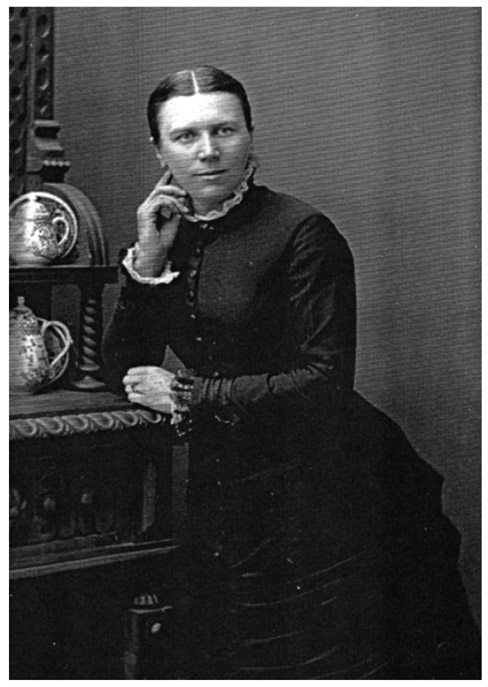
23.2 Mary Hicks Hayes, Managing owner of Koh I Noor, Gem and Perseverance (Isabel Pickering)
Even the smallest of places were actively involved in shipping. Thomas Roseveare of Boscastle together with his partner William Sloggatt owned shares in seven ships but regularly hired a further twenty-five ships to take their goods from Boscastle, Tintagel and Wadebridge. They dealt mostly in slate, oats and grain as exports but their imports were wide-ranging.16
In 1829 the Isles of Scilly had only five vessels over fifty tons (Figure 23.1) yet, without any change in trade to and from the islands, it saw a massive boom in shipping investment and local shipbuilding. Scilly was a particular example of a place that had little in the way of exports and yet embraced long-distance trade. A contemporary recalled the impact on the islands after the end of the kelp trade:17
It was thought that after the kilping was done away with people would not get any employment, but about that time shipbuilding began to go ahead on the islands. Small schooners were built for the fruit trade to St Michael’s and other ports and it was found to pay so well that they could not get men to build them fast enough; they had to get ship-wrights from wherever they could. There were four master builders and all the young men were learning the shipwright business, which increased very fast; and shortly after that they began to build larger vessels for the Mediterranean and different parts of the world, and this trade was carried on for a great number of years. The shipowners had got some very fine vessels – large schooners, brigs and barques – trading in most parts of the world.18
Francis Banfield was a local man who was a major player in this expansion. In 1861, at the age of thirty-eight, he was noted as a shipowner and Lloyd’s agent.19 He was the managing owner of a fleet of twelve ships, all of which were sizeable. They ranged in size from the 48-ton coastal vessel Star to the 528-ton John Banfield, built in 1859, and traded to the Mediterranean, South America, Bermuda, Mauritius and China.20 His father’s vessel, Chieftain, of 300 tons, won the tea race to London in 1847.21 Mumford, a local shipbuilder, was the managing owner of three vessels from 109 tons to 215 tons that traded to South America and Madeira. James Phillips, a local draper and grocer, owned four vessels also trading to the West Indies and South America. It was a new fleet, as, in 1865, 75 per cent had been built in the last twenty years. Half were locally built and the rest had been purchased from places such as Yarmouth, Sunderland, Bideford, Dartmouth, Ramsgate and Quebec.22
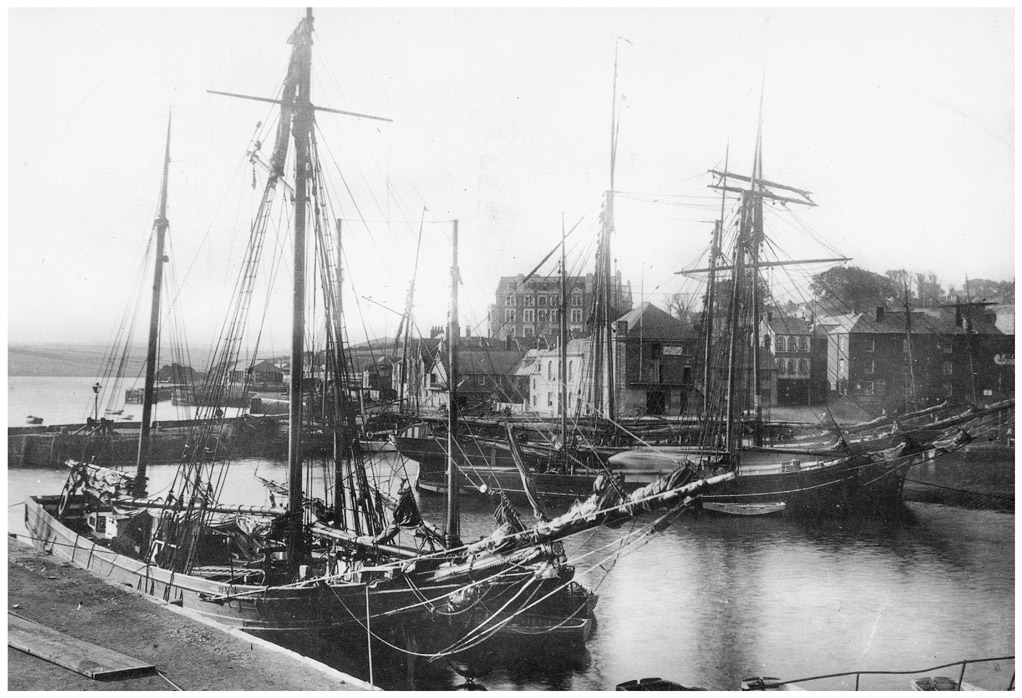
23.3 Vessels moored in Padstow harbour Postcard (Helen Doe)
The numbers of vessels over fifty tons belonging to the ports on the north coast of Cornwall also increased. One or two of the Padstow vessels were very large indeed, such as the 1009-ton Windsor, built in 1850, but there were also quite a few smaller craft often owned by their masters. This was the case for about 30 per cent of the 103 vessels on the register in 1865.23 Padstow still built largely for coastal shipping, as the copper ore and coal trade was a feature of that coast, and these ships were known as the Welsh fleet. In the nineteenth century the majority of the ownership of the fleet was in Devon and Cornwall rather than south Wales. St Ives vessels also featured heavily in the Welsh trade. Later in the century, as the copper ore trade declined, coal continued to be an important coastal cargo.24 In St Ives the fishing fleet was still a formidable part of the shipping registered in the port, while in the new Customs registration port of Hayle, Harvey’s, described as merchants, had a fleet of nine sailing vessels including the 342-ton Glencairn, built in 1852. In 1856 this was trading from Penzance to the West Indies.25 Another of Harvey’s ships was the 137-ton Welsh Girl, presumably mainly in the coal and copper trade, but which also sailed to Tobago.26
Community Benefits
Shipping had a unique ownership system as, under maritime law, there could be many owners of a ship, each able to hold a share in his or her own right. This share could be sold, mortgaged, bequeathed or gifted without any need to refer to the other owners and owners were liable only for their own shares. In 1824 the maximum number of owners was limited to thirty-two and the maximum number of shares in a ship to sixty-four.27 These owners were not mere investor names, but were effectively the board of directors. Shipownership was widespread within the local port communities, as the following extract shows:
The fleet of ships belonging to the Scilly Islands numbered between 60 and 70; the greater part of them were owned by the inhabitants, and it was said that they were paying thirty per cent at that time. A shipping company was got up in £10 shares and did very well, and after that another was started in £5 shares, so that every person who had money to lay out might have a chance of getting good interest for it.28
Women were investors in local shipping and not just passively, as many bought and sold shares in their own right. The port of Fowey had a large number of women investors; indeed, between 1841 and 1880 12 per cent of the available shares were held by women.29 In Penzance in 1870 the aptly named Girl of the Period had six woman shareholders.30 Women were also managing owners. Mary Withey of Mylor, who has already been mentioned, managed two Falmouth-based vessels. In 1865 almost every Cornish port had examples of women managing ships’ business on behalf of the other investors.31
The growth in locally owned vessels brought many benefits to local communities. Sailmaking, ship repair, victualling, blockmaking and chandlery were some of the local trades that prospered. Increased port activity brought benefits in increased port revenue. New and more imposing houses were built for newly enriched master mariners. Every port town has examples of houses built for men who started their trade at the age of about fourteen as mariners and then prospered as their careers developed. Mariners were very well placed to benefit from a good career: a man could work his way up through the stages of seafaring until eventually he became master. The next step was to gain a share in the vessel. Masters were very often also minor shareowners, as the view was that the master who was not just a salaried employee but also a shareholder would have greater concern both for the vessel and cargo. The careful master could also do some trading on his own behalf in order to build up a retirement fund. Often masters were given a percentage commission on the value of the homeward freight which ‘enabled them to make the progression from master to owner’.32
Shipbuilding
The Cornish shipbuilding industry gained from this growth in shipping, both from increased repair business and from new building work. As early shipping registers from 1786 have survived only for St Ives, Fowey, Penzance and Scilly, a county-wide view of shipbuilding before 1840 is possible only from the 1805 survey of shipwrights, although it too has its limitations, as not all businesses are named. Numbers of shipwrights only are given for Fowey, St Ives and St Agnes. Mevagissey and Falmouth were at this time the largest shipbuilding locations.33
Mevagissey, at the time, had a larger population than the town of Fowey. Its shipbuilding output was in vessels built for fishing, local trading and smuggling. Accounts have survived of one of the shipbuilding partnerships, Dunn and Henna, and they give an excellent view of the types of vessels built and the range of customers, from seine owners to Guernsey merchants. The majority of the output from the yard between 1800 and 1809 was under 120 tons and cutters, luggers and small boats were the main vessel types.34 Two Cornish firms were more ambitious and submitted bids to the Navy Board to build warships as the drive to build up the fleet against Napoleon became intense. Such contracts were highly competitive. Cornwall was never as successful as the Devon builders in this regard, and the contracts carried risks. Nickels of Fowey went bankrupt trying to complete the order and the ship was eventually launched by his trustees,35 while in Falmouth the subcontractors working for Richard Symons did not feel secure in their business relationship. In December 1805 they wrote directly to the Navy Board attempting to get information on the contract:
Honble sirs
We have taken the liberty of acquainting your Hon board that in Sept 1804 we contracted with Mr. Rich Symons for building HM Brig Avon upon conditions that if the said Brig was launch 4 weeks before the Contract was up we was to receive the sum of two hundred pounds Extra to our agreement by the ton on such Conditions as he received the Premium that was offered by your Honours to allow him 5 shillings per ton Every week that the Brig was launched before the contract We humbly beg the favour of an answer to know if the said Contract is paid or payable which will greatly oblige
Your honourable servants
Jno Treneer
James Trethowan36
Wisely, the Navy Board ignored the letter, preferring not to get involved with subcontractors. In the event in April 1806 the Avon was launched six weeks early and a premium of £573 13s 1d was paid. However, in the same year a second navy brig, Dispatch, was launched over two months late, incurring a penalty of £300.37 The end of the war brought this specialised activity to an end, but the growth of merchant trading led to new opportunities.
The long tradition of building small fast vessels was beneficial, as shipbuilders used their expertise in the market for fast ships for the fruit trade. Newspaper announcements of launchings often referred to ships as being built for the fruit trade, as in the case of the 140-ton Weasel, launched in 1855 by Thomas Ferris at Point.38 Butson and Brokenshaw, who had previously worked in Mevagissey building smuggling cutters, now set themselves up in their own yards in Fowey and Polruan building schooners.39 Shipbuilding expanded around the coast of Cornwall. Table 23.1 shows the number and size of Cornish-built vessels in what was to be the final phase of the expansion in wooden shipping. The scale of the vessels built in Scilly is particularly noticeable and ships built in these islands traded far and wide.40
Table 23.1 Cornish Built Vessels 1865–1880
|
Total Tonnage |
No. Ships |
Av. Size (mean) |
|
|
Scilly |
2466 |
11 |
224 |
|
Penzance |
471 |
12 |
39 |
|
Newlyn |
496 |
25 |
20 |
|
Mousheole |
62 |
4 |
16 |
|
Porthleven |
560 |
25 |
22 |
|
Falmouth |
6693 |
81 |
83 |
|
Truro |
4437 |
53 |
84 |
|
Mevagissey |
625 |
8 |
78 |
|
Fowey |
5564 |
38 |
146 |
|
Looe |
805 |
7 |
115 |
|
Calstock/Cremyll |
924 |
24 |
39 |
|
Bude |
183 |
3 |
61 |
|
Hayle |
7179 |
47 |
153 |
|
Padstow |
7786 |
63 |
124 |
|
Newquay |
2009 |
24 |
84 |
|
St Ives |
1384 |
65 |
21 |
Source: Bartlett Library, National Maritime Museum Cornwall. George Hogg database of ships built in Cornwall.
Late Nineteenth Century Ships and their Trade
Steamships began to impact on foreign trade by the 1880s as greater efficiency enabled them to compete more effectively. On 27 February 1883 in the port of London the 125-ton Swift of Fowey, with a crew of five men, arrived to discharge her cargo of 2,197 bags of phosphate from Antwerp, while elsewhere the 2,458-ton steamship Adriatic of the Ismay line of Liverpool, with a crew of 118, discharged her cargo from New York of meat, fruit, furs, leather, wood and other varied merchandise. On the same day in Bristol the 149-ton Jane Slade of Fowey unloaded 2,254 packages of oranges from St Michaels in the Azores. The West Indies would still continue for a few years to provide cargoes for Cornish ships. In 1884 the Mary Johns of Falmouth came into Bristol with sugar from Barbados for the firm of T. Daniel and Sons,41 while the last fruit shipment carried by the Jane Slade was 3,000 dozen pineapples from Cat Island for Tatham, Bromage and Co in London in 1889. Thereafter the coastal trade would offer freights for sailing vessels, but it was the end of an era, as fewer ships were built or registered locally.

23.4 Steam tug Countess of Jersey towing a ship in Fowey c. 1880, note the ropewalk on the hill (Jim Matthews collection)
The effect of this decline was felt by the shipping investors:
I belonged to the last company that was got up, and I believe most of the people on the islands who could raise £5 or £10 belonged to it to try their luck. There was £5,100 laid out in vessels, and after they had been running two years the accounts were made up, and owing either to bad captains or mistakes, the shares that were bought at £5 were only worth £2. Most of the small shareholders sold their shares at £2 and the company was broken up; but some of the large shareholders kept one of the vessels and run her for a great number of years, almost bringing the shares up to £5 again.
Since that time, as fast as shipping has got up it has gone down again. At one time there were nearly 70 ships belonging to Scilly, and now there is only one little coal vessel of 100 tons belonging to the port.42
Many mariners went into steam, but the shipbuilders of Cornwall, with the exception of a few in Falmouth and Harvey’s of Hayle, were unable to move across to the newer technology. Some shipbuilders went out of business and some were left to continue the repair and maintenance of the still considerable but aging fleet of wooden ships that was now employed in the bulk coastal trades.
Conclusion
Cornish ports are regularly classed as mineral ports and a one-way trade is assumed, but the ships owned by nineteenth-century Cornish investors traded across the world. The Cornish ports continued to be exporters of minerals, copper, tin and, increasingly during the nineteenth century, china clay. Fish exports declined during the period as the appearance of the pilchard shoals became increasingly erratic. Imports were still dominated by coal, timber and miscellaneous domestic requirements, but shipping activity entering and clearing the ports was constant and growing. The surge in investment was not merely in locally trading ships, but in ships that on occasions rarely saw their home ports. Now the cargoes they carried were more than just minerals, fish or smuggled goods. The schooners, brigs and barquentines carried fruit, oil, hides, tea; anything that brought an investment return. The Isles of Scilly were a particularly clear example of investment opportunism. Such investment fuelled local shipbuilding activity and local maintenance and repair business benefited from the ships from other locations that were added to the registers. The local shipbuilders built not only fishing vessels but also fine deep-sea sailing vessels, including warships. Cornish-built ships travelled the world in the nineteenth century as a part of the growth in mercantile trade that had been developing since the commercial revolution of the eighteenth century. The shipping boom of the nineteenth century brought an era of prosperity to Cornish ports and left its mark in the master mariner houses built for the newly rich.
Notes and References
1 Cornwall Record Office [hereafter CRO]: R/5088 Fowey poster advertising meeting to discus navigation marks.
2 David J. Starkey, ‘The Ports, Seaborne Trade and Shipping Industry of South Devon, 1786–1914’, in Michael Duffy, Stephen Fisher, Basil Greenhill, David Starkey, Joyce Youings (eds), The New Maritime History of Devon, Vol. II: From the Late Eighteenth Century to the Present Day (London: Conway, 1994), pp. 32–47, at p. 33.
3 British Parliamentary Papers [hereafter BPP], 1880 LXV: Tables of Number of Sailing and Steam Vessels belonging to United Kingdom and on Register 1869–79.
4 1786 An Act for the Further Increase and Encouragement of Shipping (26 Geo III, c.60).
5 BPP, 1871 LXI: Return of Number of Sailing and Steam vessels registered at each Port of Great Britain and Ireland, 1870 (note, sailing vessels only noted).
6 C.H. Ward-Jackson, Ships and Shipbuilders of a West Country Seaport: Fowey 1786–1939 (Truro: Twelveheads, 1986), p. 107.
7 R.M. Barton, Life in Cornwall in the Early Nineteenth Century (Truro: Dyllansow Truran, 1997), pp. 117–18.
8 R.M. Barton, Life in Cornwall in the Late Nineteenth Century (Truro: Bradford Barton, 1972), p. 215.
9 Basil Greenhill, The Merchant Schooners (London: Conway, 1988), pp. 273–81.
10 D.M. Williams, ‘Growth, Market Shifts and Technological Change: The Citrus Trade to Britain in the Nineteenth Century’, in Klaus Friedland (ed.), Maritime Food Transport (Koln: The International Commission for Maritime History, 1994), pp. 327–47, at p. 330.
11 Williams, ‘The Citrus Trade to Britain’, pp. 326, 337.
12 Williams, ‘The Citrus Trade to Britain’, p. 340; Bristol Reference Library [hereafter BRL]: Bristol Presentments 23 January 1851, 1 January 1874.
13 For a more detailed look at investors and managing owners see Helen Doe, Enterprising Women in Shipping in the Nineteenth Century (Woodbridge: Boydell and Brewer, 2009).
14 CRO: MSR/FOW/Fowey Shipping Registers.
15 M. Stammers (ed.), Clayton’s Directory of Shipping 1865 [hereafter Clayton’s Directory] (Liverpool: Merseyside Maritime Museum, n.d.).
16 Peter Skidmore, ‘Thomas Pope Rosevear of Boscastle’, Troze 3:3 (June 2012), pp. 9–11, www.nmmc.co.uk, online journal of the National Maritime Museum Cornwall.
17 Kelp was a seaweed that was burnt and its ash used in the manufacture of glass and soap.
18 Robert Maybee, Sixty Eight Years Experience on the Scilly Islands published 1884 quoted in E. L Bowley, The Fortunate Islands: The Story of the Isles of Scilly (St Mary’s: Author, 1945), pp. 104–11.
19 The National Archives [hereafter TNA]: RG 1600, Scilly Is Census 1861.
20 Clayton’s Directory; Lloyd’s Register of Shipping, 1866 (London, annual).
21 R.M. Barton, Life in Cornwall in the Mid-Nineteenth Century (Truro: Bradford Barton, 1971), p. 133.
22 Clayton’s Directory; Lloyd’s Register of Shipping, 1866; TNA: RG 1600 Scilly Is Census 1861.
23 Clayton’s Directory.
24 P.H. Stanier, ‘The Copper Ore Trade of South West England’, The Journal of Transport History 5 (1979), pp. 18–35, at pp. 19–31.
25 Lloyd’s Register of Shipping, 1856.
26 Lloyd’s Register of Shipping, 1856; National Maritime Museum Cornwall, Bartlett Library Cornish Ships database.
27 1825 Act for the Registering of British Vessels (6 Geo 4, c.110).
28 Maybee, Sixty Eight Years Experience on the Scilly Islands, p. 110.
29 Helen Doe, ‘Waiting for her Ship to come in: The Female Investor in Nineteenth Century Shipping’, Economic History Review 63:1 (February 2010), pp. 85–106, at p. 93.
30 CRO: MSR/PENZ/3 Penzance Shipping Registers.
31 Clayton’s Directory.
32 Robin Craig, ‘Printed Guides for Master Mariners as a Source of Productivity Change in Shipping, 1750–1914’ in Robin Craig (ed.), British Tramp Shipping, 1750–1914 (St John’s, Newfoundland: International Maritime Economic History Association, 2003), pp. 121–36, at p. 123
33 BPP, 1805 VIII: An account showing the number of shipwrights and also of apprentices employed in the merchant yards of Great Britain according to the returns made to the Admiralty in April 1804, pp. 467–91.
34 Helen Doe, ‘The Smugglers’ Shipbuilder’, The Mariner’s Mirror 92 (2006), pp. 427–42.
35 Helen Doe, ‘Positions, Patronage and Preference: Political Influence in Fowey before 1832’, in Philip Payton (ed.), Cornish Studies: Twelve (Exeter: University of Exeter Press, 2004), pp. 249–67, at p. 259.
36 TNA: ADM 106/1642 Treneer and Trethowan 18 December 1805.
37 TNA: ADM 49/102 An Account of Ships of War built in the Merchant Yards.
38 R.M. Barton, Life in Cornwall in the Late Nineteenth Century (Truro: Bradford Barton, 1972), p. 16.
39 Doe, ‘The Smuggler’s Shipbuilder’, p. 435.
40 Helen Doe, ‘The Long Reach of the Small Port: Influences and Connections in Small English Ports in Nineteenth Century’, in M. Schulte Beerbuhl (ed.), Cosmopolitan Networks in Commerce and Society, GHIL Bulletin No. 2 (London: German Historical Institute, 2011), pp. 133–50.
41 BRL: Bristol Presentments Thursday, 26 June 1884.
42 Maybee, Sixty Eight Years Experience on the Scilly Islands, pp. 110–11.