
CHAPTER 25
____________________________
Alston Kennerley
Cornwall’s extensive and rugged coastline and its position in the Western Approaches dividing the St George’s and Bristol Channels from the English Channel have ensured that its interaction with commercial shipping has always been significant in the life and economy of the county. From ancient times until the nineteenth century this was the wind-propelled, wooden-hulled ship in all its varied and developing forms. But from the 1820s power-driven ships began, slowly at first, supplanting sailing ships and by the twentieth century it was becoming clear that wind propulsion was a fading technology. This change was a world-wide development led for many decades by Britain, which also saw wooden ships replaced by those built in iron and then steel, from the start bringing into service vessels which were generally larger than the ships being replaced. Changes in ship construction and propulsion, like those of navigation and communications, were of national and international importance. But their results, including the decline in commercial sail, still had a significant impact in a comparatively small locality such as Cornwall. In the past ships were the major form of transport between locations within the county and between Cornwall and other parts of Britain, often preferred, weather permitting, to over-land options, and essential where the movement of bulky goods was concerned. The ability of small ships to penetrate far inland up rivers as well as along the coast and across the channels was important in commodity distribution, whether originating in Britain or from overseas. It was with the opening of the oceans and European colonisation, which created long-distance shipping between Europe and the rest of the world, that Cornwall’s significance to world-wide shipping increased and, particularly, the rise of Falmouth was promoted from the seventeenth century as an international ship servicing hub as well as a port involved in coastal and international trade.1
Changes in a locality’s involvement with shipping may be identified through the rise and decline in the main shipping-related activities ashore, some being more amenable to quantifiable approaches than others and all subject to some form of qualification, particularly when trying to present county-wide data. Potentially quantifiable, where Cornish data can be separated from national data, are the records of ship movements aggregated for customs ports, commercial records of shipping interacting with Falmouth and data on shipbuilding in the county. Changes in the scale of shipowning, of other shipping-related activity ashore and of seafaring employment may also be sought, though the evidence is more uncertain. But the decline in sail propulsion did not sound the death knell of the shipping business in Cornwall. The growth of steam shipping ensured continued maritime economic activity in all relevant spheres, but larger sea-going vessels could be a threat to small and remote ports unable to adapt. Perhaps more of an impact on shipping movements through the forty or more Cornish port locations, particularly in relation to coastal trade, was the competition posed by the introduction and improvement of land-based transportation systems. In the nineteenth century (1859) came the connection with the national rail system and in the twentieth the improvement in the road network, the rise in motorised transport and even the development of air services. Some of the minor ports would cease to have any involvement with commercial shipping. Of these smaller port locations some have survived in connection with the fishing and maritime recreation industries, while some locations have withdrawn from all maritime activity.2
In connection with accumulating data on imports and exports and a variety of legal requirements Britain had by the mid-nineteenth century developed elaborate recording and annual reporting arrangements.3 These required ships’ masters to report formally their arrival at the customs house, ‘entering inwards’, and, before departing, to seek ‘clearance outwards’ – effectively, permission to proceed to sea.4 The resulting movement information is for numbers of vessels and the aggregated ships’ volumes (earning capacity) in tons of 100 cubic feet. Customs ports are not synonymous with commercial ports. Data for several small ports may be included under that of a larger port name, and the limits of customs ports do not necessarily respect county boundaries. For example, data for Saltash and Calstock on the River Tamar but in Cornwall are included with that for Plymouth. Despite these limitations, the aggregated data is representative of the majority of movements in and out of Cornish ports.
To assess the decline in the use of commercial sailing ships the data for vessels entering inwards is presented in Table 25.1 for selected years from 1881 to 1920. By 1881 steam ships had made inroads but sail still represented over two-thirds of the total movements in numbers of ships and aggregate tonnage. Thereafter the pattern of decline is clear and by 1920 only 11 per cent of the tonnage was sail, though the number of ship movements holds up at 36 per cent.5 This reflects the increasing disparity in size between sail and power-driven vessels and the ability of a limited number of smaller sailing vessels to reach the surviving small port locations. The mean tonnage of steam vessels using Cornish ports consistently increases, whereas that of sail hovers at under 100 tons. Figures 25.1 and 25.2 graphically illustrate the decline of sail and the rise of steam vessels using Cornish ports. Table 25.1 conceals a marked disparity between the five customs ports, as they had become after 1883, when Hayle had been included with Penzance and Truro with Falmouth. Falmouth and Fowey had much more shipping activity and Padstow and Scilly much less than the other ports, with Penzance in between. In Figures 25.3 and 25.4 1881 data for Truro has been merged with that of Falmouth and data for Hayle with that for Penzance to enable comparison with the later sample years. Except for Falmouth in 1911, when there is some recovery compared with 1901, the numbers of sailing ships entering the five ports shows a steady decline. By 1920, compared with Falmouth and Fowey, the numbers entering Padstow, Penzance and Scilly are negligible. In terms of tonnage the pattern is not dissimilar. However, as Gordon Jackson argues, Falmouth’s position in the data has to be questionable owing to vessels coming within harbour limits but calling only for orders and not to discharge cargo.6
![Table 25.1 Vessel Entries into Cornish Customs Ports, 1881–1920 (Coastal and from Foreign; with cargo and in ballast) Sail Steam Sail & Steam Year No. % Tonnage % Mean No. % Tonnage % Mean No. Tonnage 1881 5364 82 761648 83 142 1173 18 154658 17 132 6537 1891 4624 80 381621 53 83 1176 20 337125 47 287 5800 1901 3647 59 293556 31 80 2544 41 656321 69 258 6191 1911 3154 48 228759 22 73 3367 52 828933 78 246 6521 1920 1511 36 143969 11 95 2718 64 1205524 89 444 4229 Sources: David J. Starkey, et al. (eds), Shipping Movements in the Ports of the United Kingdom, 1871–1913: A Statistical Profile (Exeter, 1999), 122–23, 130–31, 144–45, 188–89, 190–91, 212–13, 226–27; Annual Statement of Navigation & Shipping, BPP, 1921 [Cmd 1442] XXXIV. Notes: this data summates the customs ports data for Falmouth, Fowey, Hayle, Padstow, Penzance, Scilly and Truro.](the-maritime-history-of-cornwall.files/image110.png)
Figure 25.1 Vessel Entries into Cornish Ports 1881-1920: Numbers

Source: as Table 25.1
Figure 25.2 Vessel Entries into Cornish Ports 1881–1920: Tonnage
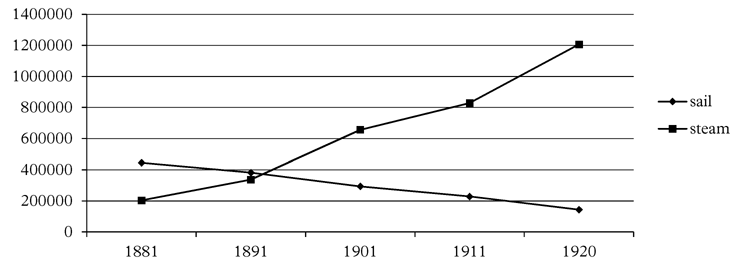
Source: as Table 25.1
Figure 25.3 Sailing Ship Entries at Cornish Ports 1881–1920: Numbers
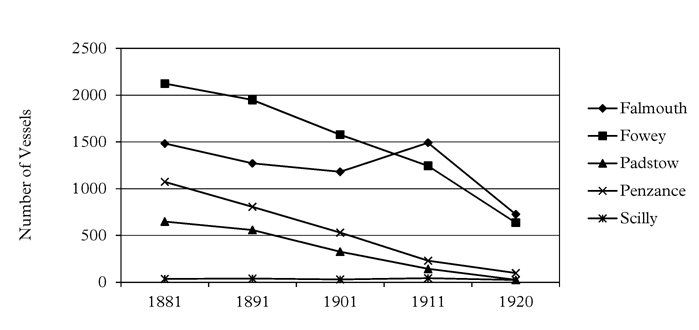
Source: as Table 25.1
Figure 25.4 Sailing Ship Entries at Cornish Ports 1881–1920: Tonnage

Source: as Table 25.1
That the decline in sail was an international phenomena may be demonstrated by reference to a set of data collected for commercial reasons, but that takes more account of ships passing the Cornish coastline but making contact on account of seeking delivery instructions for their cargoes (calling for orders), sheltering from the weather, calling for repair following storm or collision damage, picking up a Channel Pilot or when in need of water, provisions, medical attention and, in the case of powered vessels, fuel. Such a record was kept by the Falmouth shipping agents, who also managed the Lloyd’s Signal Station at Lizard Point, G.C. Fox & Co., a family business of extensive and long-standing interests in Falmouth.7 Although there is overlap with the data on entries into the Falmouth customs port this compilation includes vessels of all nationalities which came within communication range without formally entering the port. Indeed, for some the contact was no more than the passing of instructions on the ‘order port’ for the cargo, perhaps in a signals exchange when off the Lizard or by coming into anchor off Falmouth and receiving the orders by word of mouth. Before the electric telegraph network was widespread instructions, often likely to come via London from the final owners of the cargo, needed at least a return of post before receipt. Telegraph, and later telephone, messages greatly reduced this delay.8 But there were plenty of examples where an immediate reply was not forthcoming, causing ships to wait at anchor for days and even weeks.9 Ships calling for orders, the great majority in the Fox data, were inward bound to European ports from all parts of the world, often following passages of many months and often in need of provisions, equipment and repair, and they thus offered good business to the ship chandlers and repairers of Falmouth.

In Table 25.2 the pattern of decline between 1881 and 1920 is not dissimilar from that shown in Table 25.1 in percentage terms, and there is a similar pattern of increase in powered vessel data. The real difference is that this table picks up international shipping and the size of vessels, both sail and power, is much larger. Although much fewer in number, sailing ships increase in size to over 1,500 tons, reflecting the survival of the large steel sailing vessel in the bulk carrying trades in competition with the steam tramp ship. But, examining the 1935 data, that survival is of very few ships operating exclusively in the Australian grain trade. Powered vessels also increase in size over the same period, though the numbers decline after 1910. A factor here is that newer powered vessels were more likely to have radio communication than were sailing vessels, particularly by the 1920s, and therefore had no need to call for orders, though the other reasons for calling remained valid. In the case of Finland, at least, the legislation requiring the fitting of radio communication apparatus was not made retrospective and the surviving fleet represented in 1935 was all owned by Gustaf Erikson in the Finnish port of Mariehamm.
Of course, many foreign-going ships making their landfall off Cornwall or the Scilly Islands, destined direct to European or British ports on the south or east coasts, and those for Irish or west coast ports, need make no communication with the county, except perhaps to ask to be reported by the Lloyd’s Signal Stations at the Scilly Islands, Penzance or the Lizard.10 By day a passing ship flew its national flag and its unique ‘signal letters’, a four flag hoist, and would automatically be reported in the shipping press. More complex messages could be sent using the International Code of Signals.11 The adoption of the morse code and flashing light apparatus allowed more rapid communication by day and by night. But there was also an elaborate system of pyrotechnic night signals which ships could use to identify the company to which they belonged. Thus a ship belonging to the Royal Mail Steam Packet Company when off the Lizard could burn ‘A yellow pyrotechnic light, and a Roman candle throwing up white balls to a height not exceeding 150 feet, fired simultaneously’, while a Union Castle ship showed ‘A blue light burned on the bridge, followed immediately by a Roman candle throwing five blue balls to a height not exceeding 150 feet’.12 The intensity of signals activity at the Lizard is illustrated in Table 25.3, a return for 1930. The proportion of sailing vessels is small and they are mostly in the coastal trade. About forty ships were reported daily. Each report involved flag or flashing light signalling with each ship. The reports were then telegraphed in batches every four hours.
Table 25.3 Activity at Lloyd’s Signal Station at the Lizard, 1930
|
Number of vessels that passed within signalling range |
|||
|
Steamers of apparently 500 tons and upwards |
Overseas |
6654 |
|
|
Coasters |
6070 |
||
|
Steamers of apparently 100 to 500 tons |
Overseas |
27 |
|
|
Coasters |
6848 |
||
|
Sailing vessels |
Overseas |
22 |
|
|
Coasters |
216 |
||
|
Yachts |
178 |
||
|
Total number of vessels passed |
20015 |
||
|
Number which showed their distinguishing code |
6795 |
||
|
signals |
|||
|
Number of vessels reported |
|||
|
To Lloyd’s |
Steamers |
13611 |
|
|
Sailing vessels |
41 |
||
|
To owners or agents |
In Uk |
4698 |
|
|
Abroad |
494 |
||
|
To officers’ families |
64 |
||
|
Number of vessels that received orders |
50 |
||
|
Voluntarily |
1005 |
||
|
Flashing light signals |
Station’s demand |
3769 |
|
|
Lost |
4198 |
||
Source: National Archive, BT 166/38, return from the Lizard Signal Station for 1930
The following examples offer an insight into Falmouth’s interaction with this bulk commodity sector of shipping. For 24 December 1881 the Fox register records eighteen vessels: fourteen sail and four steam.13 Ten of the sailing vessels were inward from overseas and received orders for seven British ports and three European. Their cargoes included wheat from New Zealand, Portland (Oregon) and San Francisco, maize from Philadelphia, locust beans from Cyprus, sugar from Java, barley from Russia, nitrate from Chile and palm oil from west Africa. Four sailing ships were outward-bound. Two, for the USA and Argentina, put in ‘wind bound’ by westerly winds. The barque, Palestine, 427 tons laden with coal from Shields on the River Tyne to Singapore, put in for repair, being ‘slightly leaky’. Joseph Conrad was her second mate and it would be over eight months before she was finally repaired and sailed on her voyage to final disaster in the Java Sea, the subject of Conrad’s story Youth.14 The fourth outward-bound vessel was the barque Fortuna, 490 tons, in ballast from Brake (River Weser, Germany) to Bordeaux. She had collided with an unknown vessel at 2 a.m. that day off Start Point and her starboard quarter was smashed. Of the steamers two were inward-bound with wheat, calling for orders, one was outward with coal, and one was a tug. Tramp steamers were often under-powered and until the twentieth century still carried some sail, though it might not be used all that often. They could suffer as much as sailing ships from the same operational difficulties.
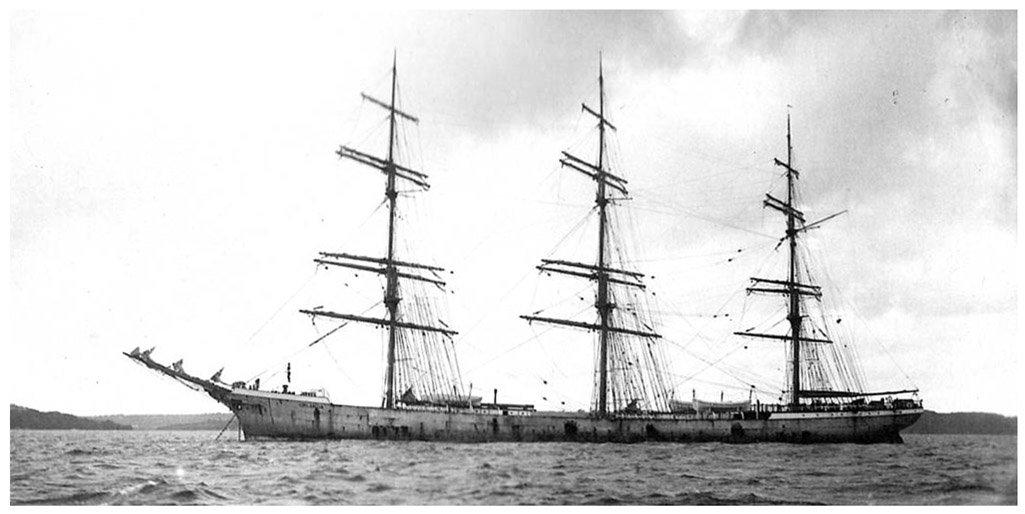
25.1 German ship, Orlando at Falmouth (University of Exeter Clutterbuck collection)
A period of bad weather might see a procession of ships arriving with damage and injuries. On 5 November 1899 the barque Battle Abbey, 1465 tons, from Hamburg for Seattle with cement, put in with the truss of one of its yards broken. She was followed by the barque Iris, 752 tons, from Hango, Finland to Capetown with deals, with her deck load adrift and a man sick. Then on 6 November came the four-masted barque Glenogil, 2193 tons, from Tocopilla, Chile, for Hamburg with nitrate. The iron work of her upper main topsail yard had carried away and the topmast damaged. On 7 November the ship Marydown, 2381 tons, with rice from Rangoon ordered to Hamburg came in. Her captain, cook and a seaman had died during the voyage. The four-masted barque Palgrave, 3078 tons, from Dunkirk for Philadelphia with chalk, came in with her rigging slack and crew exhausted. Most of these ships were towed in by the tugs Saxon and Dragon, then based in Falmouth. Such tugs often cruised the approaches on the look-out for such vessels and the towage fees they could charge. The Falmouth ship repairers were well equipped to handle the repairs to ships, but Falmouth was also well able to handle the human element. In the first half of the twentieth century the local seamen’s charities, including the Royal Cornwall Sailor’s Home, the British Sailors’ Society and the Missions to Seamen, remained important in the provision of social support ashore and through visiting ships. Ships unfamiliar with European waters came looking for a Channel pilot, though pilots also cruised the approaches in the hope of besting others, as pilotage was a self-employed competitive business. Pilotage was often a source of friction between licensed and unlicensed pilots, but in the second half of the nineteenth century it was increasingly regulated by Act of Parliament. Voluntary licensing for pilots operating off-shore was introduced in 1872, such pilots already being known as Channel or North Sea pilots, but the practice was not restricted to licensed men only.15 These were not compulsory pilotage areas.
By 1920 barely one sailing ship a week was being recorded in the Fox register. Further, of the fifty-nine noted that year only four were British ships: the Bellands, a four-masted barque of 2,939 tons with grain from Buenos Aires ordered to Hull; the Leader, a ketch of 65 tons with salt from Gloucester to Mevagissey; the Alice A. Leigh, a four-masted barque of 2,819 tons in ballast from Lisbon to Newcastle; and the Garthforce (16 November) a ship of 1,859 tons from Taltal ordered to Liverpool with nitrate. The Leader is an example of the survival of sail in the coastal trade, with vessels still taking cargoes to smaller ports. This is a rare appearance of a coastal vessel in the Fox register, though the customs data for Falmouth records 689 sail entries in the coastal trade and 654 steam for 1920.
Over three-quarters of the sailing ships in the Fox register were inward-bound to Europe from overseas. In centuries past there had always been something of a seasonality in the movement of shipping, with curtailments of activity in the mid-winter bad weather months and in connection with the ripening of crops and readiness for shipment. Despite the world-wide nature by this latter period of carriage of cargoes in sailing ships, the operation of these ships throughout the year and the mix of cargoes involved, the monthly data of arrivals for orders set out in Table 25.4 show continued evidence of some seasonality. In 1881, 1899 and 1910 the seven northern hemisphere summer months from March to September contain over three-quarters of the arrivals compared with the five winter months.
For an insight into the decline in commercial sail in the coastal trade, port records of cargo handling at Fowey reveal the demise by the 1930s. The bulk cargoes involved were staples of sail in the coasting trade, of which coal was by far the most important. In 1921 twenty-eight different sailing vessels were discharged by the Great Western Railway.16 There were very few repeat voyages by the same ship. These ships discharged 4,135 tons (weight) of coal, 1,569 tons of cement, 121 tons of ship’s stores, 63 tons of sand and 7 tons of clay. Steam ships discharged 11,376 tons of coal, 431 tons of cement and 80 tons of sand. In 1930 no sailing vessels were handled at Fowey by the Great Western Railway, but it discharged 59,937 tons of cargo from steamers, very little of which was not coal. Coal, of course, powered the railway, local industry and domestic heating. But there was also a trade in bunker coal for steamships, and the source used suggests that some smaller ships may have discharged direct to visiting steamers. In 1921 the ‘broker’ for most of the sailing ships was Couch. Others included Hannan, Hobbs, Stephens and Toyne. Some were well-known local names involved in sail shipping, though they also handled steamers. The last sailing vessel in this record was the Elsa (290 tons volume) which discharged 51 tons of hoops on 4 December 1929. Prior to that the Standard (420 tons) came with 462 tons of staves on 20 August 1929. The last coal cargo discharged by the Great Western Railway from a sailing vessel was one of 345 tons from the Hilda (350 tons), but sailing ships were already rare in 1924 when the Jane Slade (250 tons) discharged 248 tons of coal in August. The imports represented here were not, of course, the whole cargo activity in the commercial port of Fowey.

25.2 Crew of topsail schooner, Jane Banks, in 1931 The ship was working from Par and Fowey in the 1930s, John Raddings is in the centre (David Raddings)
Commercial ship registration and building have been examined in Chapter 23. The regional studies by Jones and by Starkey, with Cornwall subsumed within the other counties of the south-west peninsula, demonstrate decline in both sectors. Registering a ship in a port is no guarantee that the owners reside there or that the ship is manned and operated in that port or at nearby ports. The most extreme example is the registration at St Ives by Edward Hain of his steam tramps, which were operated in the world’s bulk trades and were far too large ever to enter their home port. But the relationship was much more likely to be true for the small wooden sailing traders which managed to find cargoes in the international as well as the coastal trades. The decline in sailing ship registrations at south-western ports started in the late 1860s. By 1900 the numbers had halved and the aggregate tonnage had reduced by two-thirds. The mean tonnage of vessels fell from about 100 to 56 tons. However, the move to smaller vessels enabled the survival of a small number of sail trading vessels into the 1930s, owing to a concentration on schooner and ketch rigged vessels with small manning demands and the maneuverability to reach those small harbours and quays identified above. With only occasional ships being ordered outside the south-west region a decline in building followed the decline in local registration. South-west sailing-ship building plummeted. In Cornwall in the late 1860s all the customs ship registration ports had shipbuilding activity; in 1913 only Falmouth, Fowey and Penzance appear in the returns, and at much reduced levels.
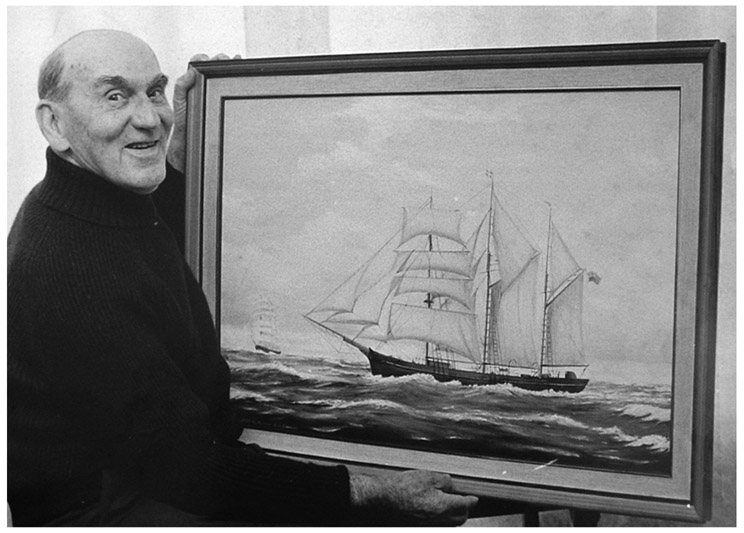
25.3 Bert Carrivick, the last master of the Waterwitch of Par (Pat Carrivick)
Shipbuilding and shipowning businesses could be carried on by the same person, of course. This was the case with what was probably the last fleet of small commercial sailing vessels to be owned in Britain, that of John Stephens of Fowey, who had been a shipbuilder at nearby Charlestown.17 Despite losses during the First World War, the fleet was built up again and survived until 1937, when the last three vessels were sold. Other owners included Kellow and Slade, also in Fowey, Couch and Philips of St Austell and Jenkin of Newquay. Early on, in particular, the backbone of their international operations was in the Atlantic fruit and stockfish trades, but some made passages further afield. In the home trade such sailing coasters were to be found working between Cornish port locations and other British ports with cargoes such as stone, gravel, coal, manure, bricks, slates and china clay (see Chapters 19 and 22). One involved in this last trade was the Waterwitch, sold abroad with the break-up of the Stephen’s fleet. A key factor in the demise of this final sector of British commercial sail was the development of the small motor coaster, which was able to operate more reliably and intensively and thus produce better returns.

25.4 Bill Tregaskes caulking the Jane Banks at Tregaskes yard Par in 1930s (David Raddings)
The final aspect in considering Cornwall’s involvement in commercial sail is that of manning. Cornwall’s tradition in seafaring manning is of course extensive, particularly if that of the sea-fishing industry is included. As in other areas with local shipowning, there was a natural relationship between Cornish-owned ships being crewed in Cornish ports. Particularly strong was the appointment of local men as masters and mates, because they were known to owners. Sailing ships in the coastal trade would try to return to their home port regularly and those trading overseas might well make a call on returning, even if their cargoes were destined elsewhere, by listing it as an orders port. Youths gained their first sea experiences in their local harbours and on short passages along the coast. As the numbers of berths in sail declined men set on sea careers had little option but to seek employment in steam ships operating from and to ports outside the county. Wastage from the sea has always been high, and others would find work ashore, perhaps in the many sea-related occupations that were part of the port employment scene.
The commercial sailing ship may have disappeared, but Cornwall’s involvement with wind propulsion has not. Much of recreational sea-going is in sailing craft and the numbers of such vessels moored in Cornish harbours, for example at marinas, keeps the interest alive. Publicity occurs from time to time when Falmouth, in particular, becomes the base port for the so-called tall ships races. And film and television regularly turns to Cornwall for sailing ship scenes using the square rigged craft based in Charlestown.
Notes and References
1 J.C.A. Whetter, ‘The Rise of the Port of Falmouth, 1600–1800’, in H.E.S. Fisher (ed.), Ports and Shipping in the South West (Exeter: University of Exeter Press, 1971), pp. 1–30.
2 But see Gordon Jackson, ‘The Significance of Unimportant Ports’, International Journal of Maritime History 13:2 (December 2001), pp. 1–17.
3 For an explanation see David J. Starkey (ed.), Shipping Movements in the Ports of the United Kingdom, 1871–1913: a Statistical Profile (Exeter: University of Exeter Press, 1999), ‘Introduction’.
4 George J. Bonwick and E.C. Steer, Ship’s Business (Wokingham: Maritime Press, 1951), pp. 85–92, 227.
5 For comparisons with other United Kingdom customs ports in the twentieth century on the same basis, see Gordon Jackson, The History and Archaeology of Ports (Tadworth: World’s Work 1983), p. 167.
6 Jackson, The History and Archaeology of Ports, p. 118.
7 The discussion here refers to the registers of ship arrivals maintained by G.C. Fox & Co. Surviving volumes, from which the statistical samples are drawn, are held in the Bartlett Library at the National Maritime Museum Cornwall in Falmouth. The column heads are: Date of Arrival, Vessels’ Names (ms. ‘s/s’ indicates steamship), Agent, Captains’ Names, Where from, Where Bound (ms. ‘or’ port ordered to), Rig, Tons, Cargo, Owners’ Names, Residence, Consignees, Residence, Shippers (mostly blank), Remarks. See also Alston Kennerley, ‘A North West European Shipping Communications and Servicing Hub: Falmouth for Orders, Repair and Supply, 1881–1935’, International Journal of Maritime History 22:1 (June 2010), pp. 111–38.
8 Alan Cameron and Roy Farndon, Scenes from Sea and City: Lloyd’s List 1734–1984 (Colchester: Lloyd’s of London Press, 1984), Chapter 23, ‘From Signal Station to Satellite: 250 Years of Communications’.
9 Maritime Notes and Queries 2 (June 1874), p. 32; (December 1874), p. 84; 4 (September 1881), pp. 27, 34, 61 125; 11 (1896), pp. 114, 156. This London publication contains reprints from the Shipping and Mercantile Gazette of readers’ questions concerning the fact and interpretation of documentation and regulation such as charter-parties, insurance, masters and mates, seamen, wages, and pilotage, and the responses of the experts consulted. Calling for orders in the context of ship’s voyage charters was repeatedly addressed.
10 Lloyd’ Calendar, 1906 (London: Lloyd’s, 1906), passim. This paragraph is mainly based on this annual publication. See also James Tait, Tait’s New Seamanship (Glasgow: James Brown, 1917), section II, ‘Signalling’, and W.K. Stewart, Brown’s Signalling (Glasgow: Brown, Son & Ferguson, 1947) for the 1930s and 1940s.
11 With roots in Captain Marryat’s code of signals (1817), an internationally agreed Commercial Code of Signals (London: William Mitchel, 1857) was adopted in the late 1850s, which was revised in 1900 and again in 1931.
12 Lloyd’s Calendar, 1906, ‘Night Signals of Steamship Lines’, pp. 177–210.
13 The Remarks column of the Fox register contains annotations about the reason for the call at Falmouth, and in the case of orders information the action taken by the agency, in abbreviated form.
14 Jerry Allen, The Sea Years of Joseph Conrad (London: Methuen, 1967), pp. 153–60, 170. Allen has Palestine reaching Falmouth on 10 January 1881, which is clearly incorrect. Youth, which names Palestine’s Captain correctly as Beard, but calls the ship Judea, was published in 1902: see Joseph Conrad, Youth, Heart of Darkness, The End of the Tether (Cambridge: Cambridge University Press, 2010).
15 Maritime Notes and Queries 2 (December 1874), p. 143; Merchant Shipping Act, 1872, 35 & 36 Vict, c.73, Section 11.
16 Helen Doe Collection, ‘Great Western Railway: Vessels Discharged at Fowey’ (28 February 1920 to 31 January 1931). This manuscript ledger differentiates steam from sailing vessels by vessels names and by weight of cargo discharged. Its main purpose was to record the piece rates paid to stevedores for handling cargoes.
17 Basil Greenhill, ‘The Rise and Fall of the British Coasting Schooner’, Mariner’s Mirror 27:1 (January 1941), pp. 243–59; C.H. Ward-Jackson, The Last Log of the Schooner ‘Isabella’ (London: National Maritime Museum, 1976).