
A GUIDE TO PRONOUNCING ROMANIZED CHINESE (WADE-GILES AND PINYIN)
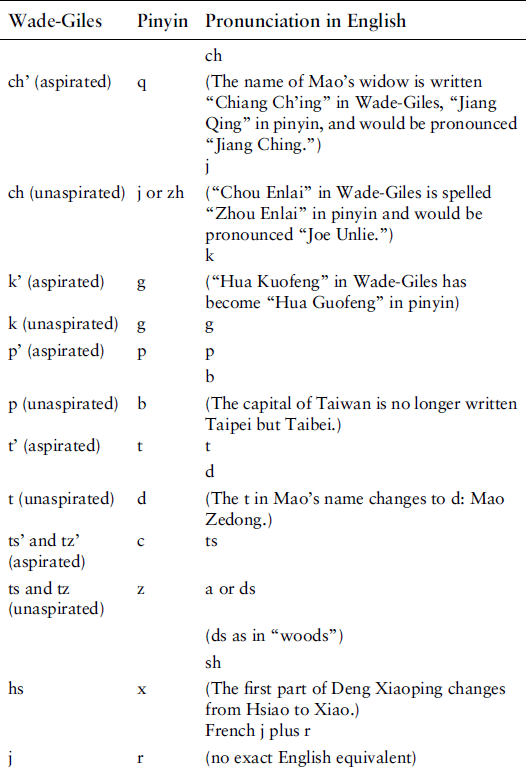
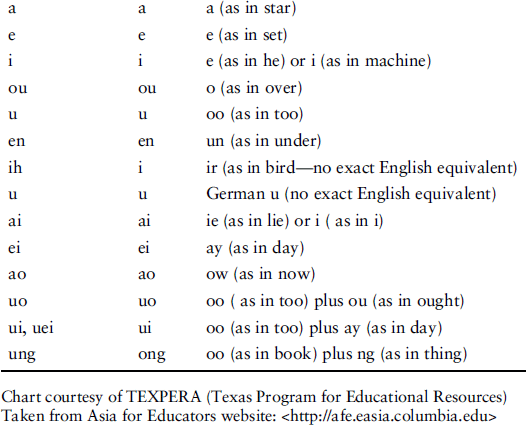
Since Chinese uses characters rather than an alphabet, many different systems of romanization have been developed over the years to help Americans and Europeans learn to pronounce the Chinese characters. Until the establishment of the People’s Republic of China in 1949, the Wade-Giles system had been the predominant system, and it is still used as the official romanization system in Taiwan. In their attempts to simplify the Chinese language and to increase literacy among the Chinese people, the People’s Republic of China (PRC) developed a new system, known as the pinyin system. This system is now used by US newspapers and many book publishers.
The following are a few tricks to pronouncing Chinese words which are romanized using pinyin:

JEFFREY N. WASSERSTROM
When asked to free associate about China as a country, many people will begin by referring to it as a large place with a giant population. They may also describe it as a nation that in recent years has been transformed by an economic boom, seen its status in the global order rise dramatically, and now is home to some of the world’s most massive and polluted cities. Some will mention the irony of it still being governed by a Communist Party, but by one that curiously accepts capitalists into its ranks. They may also bring up the fact that parts of it now look strikingly modern yet it remains a country strongly shaped by its past. One thing that many will stress is that China has an incredibly long history, meaning that to make sense of its present, it is crucial to keep in mind enduring cultural traditions that began in the era of the country’s great axial age sage Confucius (551–479 bce). It is common to assume that the contemporary country needs to be seen as the product of ideas, beliefs, institutions, and practices that go back to Confucius or even further. A phrase that has recently assumed mantra-like qualities via its appearance in everything from textbooks and newspaper editorials to speeches by leaders is that “5,000 years of Chinese civilization” lie behind and inform what goes on in the People’s Republic of China (PRC). For those who teach and write about modern Chinese history for a living, such as the stellar array of specialists in different recent periods responsible for the chapters that follow, the set of widely believed ideas about China just described, especially the notion of China’s massive size and the longevity of its “civilization,” are both a blessing and a curse.
They are a blessing because the assumption that the country is important and shaped by history means that we do not have to work as hard to justify our interest in and passion for our subject as some of our colleagues working on other places. They are a curse because, when taken together, the constellation of notions just outlined distorts important things about both the kind of country China was in previous centuries and the kind of place the PRC is now.
Consider, for example, the way that a fascination with China’s great size, when combined with a belief in the shaping power of something called “Chinese civilization” stretching back in supposedly continuous form for many millennia, can warp the geographical imagination. Many people inside and outside of the country find it natural to assume that when they see a map of the PRC, which was founded in 1949, it portrays a country that may have grown a bit over time but nevertheless always looked something like it does now. In terms of the location of its borders, this kind of thinking goes, surely they are not so different from what they were back when the ruler of the Han Dynasty (206 bce–220 ace) held power—while the Roman emperor Hadrian was building a wall at the other end of Eurasia. Or further back still, when the first emperor of the short-lived Qin Dynasty (221–206 bce), the celebrated and infamous unifier (as closely associated with the Great Wall as Hadrian is with his eponymous one), brought together smaller warring states to form a single great country. Perhaps, many will acknowledge, the specific locations of some borders were once not quite the same, but surely the differences were minor rather than fundamental or just a matter of a specific territory, such as Taiwan in recent times, being politically part of or separate from China proper.
At least, this powerful though inaccurate logic goes, there are basic things about China’s territorial spread that have been constant. Is it not true, for example, that the country has long been and is still defined in terms of the flow through it of three great rivers: the Yellow River that moves across its northern plain and takes its name from the color of the rich loess soil that lines it; the Yangzi River that bisects the PRC of today and connects inland provinces such as Sichuan to the Pacific Ocean via the great port of Shanghai; and the Pearl River in the South that ends in a delta region that includes both Guangzhou (Canton) and Hong Kong? And since the first emperor’s day, hasn’t the Great Wall he built defined the northern edge of China proper, with land just beyond it alternately being claimed by the Chinese ruler and by nomadic groups of Mongol and Manchu dwellers on the steppes? The problem is that “no” is the right answer to both of these questions.
This is because, in reality, what we now think of as “China” has been of wildly varying sizes and shapes in different eras—and not just because Taiwan has not always been part of it and that some regions to the far west that are now part of the PRC (such as Tibet in the far west and north of that Xinjiang) have sometimes, like Mongolia and Manchuria, been outside of Chinese control. The “China” of some emperors was many times smaller than that outlined on today’s maps, in some cases containing only a handful of the more than a dozen provinces that make up the PRC. Even to speak of a “China” of Confucius’ day is misleading, since that foreign term and its Chinese language variants would not be coined for centuries, but if one is said to have existed, only the Yellow River flowed through it. Conversely, during the last century-and-a-half of the Song Dynasty (960–1279), Chinese emperors governed the ports that lined the Yangzi and Pearl rivers and their deltas but held no sway over the Yellow River’s fertile loess plateau.
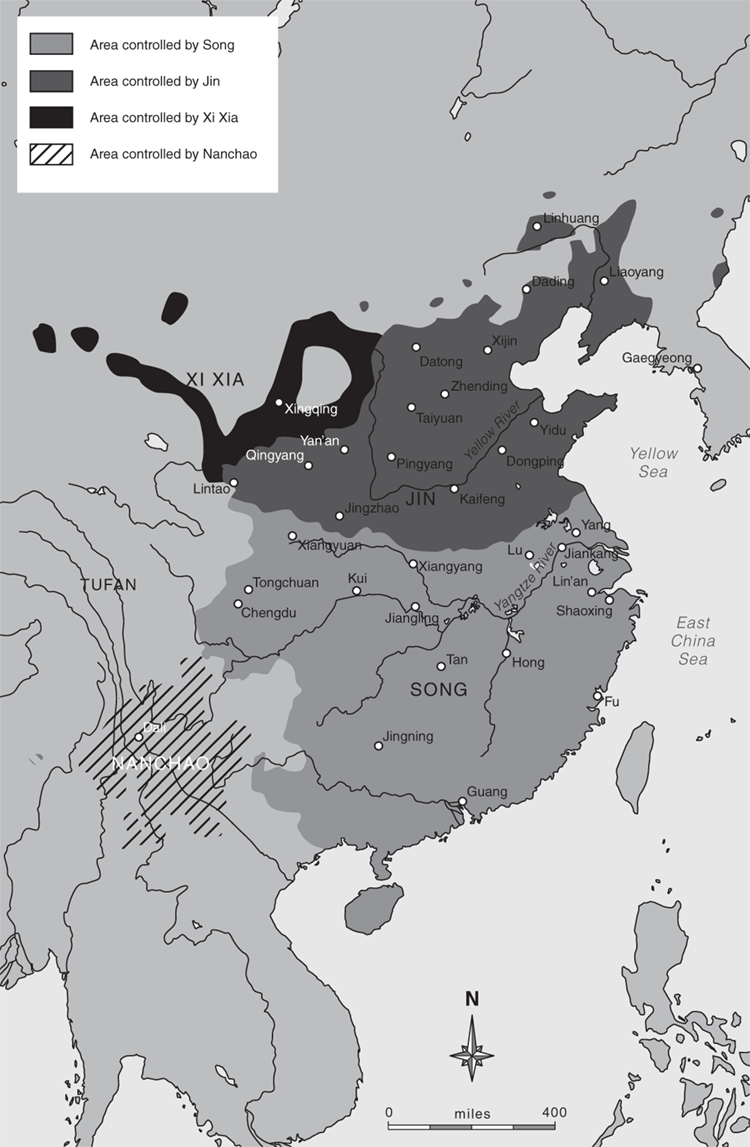
1. China during the Song dynasty (960–1279).

2. The People’s Republic of China.
There are equally significant problems with thinking of the first emperor’s Great Wall as a symbol of continuity and a marker of an enduring border. The first emperor was obsessed with large projects, as the massive army of terra cotta warriors built to accompany him into the afterlife suggests, and he was responsible for the erection of major fortifications. What we see labeled on maps now as “The Great Wall,” however, does not trace the location and length of his creations, even if in legend and lore those are described as having been kept up by each ruler who followed him. Rather, some of his successors maintained or extended and others ignored the Qin Dynasty walls. And the lines that read “Great Wall” on current maps trace the path of this famous barrier not as it has been for more than 2,000 years but as it has been for roughly half-a-millennium. Similarly, the images of the Great Wall that flashed on television screens around the world to introduce segments of the 2008 Beijing Games, while sometimes accompanied by commentaries that described it as a symbol of China’s ancient past, showed an object that only began to look the way it does now once more than a dozen centuries had passed since the first emperor had died.
One challenge in writing an overview of Chinese history, as this brief summary of issues of continuity over time suggests, is when to begin the story—when to say that “China” in any meaningful use of that term began. One option is to start with a very early dynasty, the Xia, which is mentioned in documents of two millennia ago as having existed more than a millennium before the documents themselves were written. Perhaps better thought of as rooted in myth than provable fact, allusions to it are folded into comments about “five thousand years” of Chinese history. We are on firmer ground in the Shang Dynasty, which is famous for its oracle bones, even if there are disputes over figuring out just when it existed, with some saying it fell around 1122 bce and others placing its demise almost a century-and-a-half later in 1046 bce. Via different logics, one could begin with the time of Confucius and other sages of the sixth through third centuries bce, or with the first emperor of the Qin. The issue here, fortunately, is not finding a time to begin the history of China, though noting how difficult it is to do that is useful, but rather finding a beginning for modern China. Even here, however, there are many places that such a more chronologically circumscribed narrative might begin. Some scholars, including Naito Konan (1866–1934), arguably the most important Japanese Sinologist of all time, have made strong cases for thinking of China’s modern age beginning during the Song Dynasty (960–1279), a time of great economic and technological breakthroughs. Another tradition, which informs many PRC histories and is tied to Marxist ideas of class struggle and a progression from “feudal” to “bourgeois” to “socialist” eras, sees China’s modern period beginning after the first Opium War (1839–42), a violent clash discussed in detail in the second chapter of this book, and ending with the lead-up to the founding of the Chinese Communist Party (CCP) in 1921. PRC textbooks refer to this period as bringing a close to a long era of “feudal” rule in China, and present the era that follows as best characterized as contemporary times. Here, we opt for a third alternative: that of locating the origins of the modern age rather imprecisely in the period when the fortunes of the Ming Dynasty (1368–1644) began to decline to the south of the Great Wall, while to the north of it, the Manchu groups who would eventually found the new Qing Dynasty (1644–1911) were gaining in strength.
One attraction of this starting point for an account of modern China is that, while many things that happened earlier continue to exert an influence on China today, this is the era when some key symbols of China’s “five thousand years of civilization” came into existence or at least took their most familiar form. The case of the Great Wall has already been cited. It is, moreover, by no means the only famous edifice that is often presented as a symbol of continuity with ancient times but really should be associated with the Ming. The Forbidden City is another such case in point: a site that is indeed hundreds of years old, but one that television viewers are often encouraged to assume is far older than it really is.
It is not only buildings that make a starting point near to the Ming–Qing transition attractive for an account of modern China. The varied ideas and practices that come to mind now when “Confucianism” is mentioned can be traced back to many points in the past, but recent work stresses the important role of late Ming encounters between Chinese scholars and Jesuits from the West in what historian Lionel Jensen has dubbed the “manufacturing” of a Confucian creed that began to seem comparable in some ways to what Westerners referred to as a religion. And it is no accident that the standard term for a valuable piece of Chinese pottery is “Ming Vase,” for as the next chapter stresses, the period marked an inflection point in the production and global spread of China’s justly famed porcelain.
Another attraction of starting with the fall of the Ming and rise of the Qing is that recent generations of scholars have shown that, as important as the coming of the West was in shifting the course of Chinese history, demographic and other developments that preceded the Opium War were also crucial in putting strains on the imperial system that helped account for its eventual demise. There is no magic moment when China became “modern,” but to understand many of the phenomena and dilemmas that have been crucial parts of the Chinese story during the country’s event-filled last two centuries, including the revolutions that established first the Republic of China (in 1912) and then the PRC (in 1949), starting several hundred years earlier makes sense.
A final point worth making about the value of beginning our tale in the late Ming/early Qing era is that it was then that some of the most enduring works of Chinese popular culture were created. Two pervasively significant Chinese novels, with characters whose names remain as widely known in China as Shakespearean creations are in many parts of the world, date from that time. One is Hong Lou Ming (The Dream of the Red Chamber—also sometimes translated as The Story of the Stone), an eighteenth-century work that has inspired sequels and spin-offs, films and television series, and even theme parks that recreate the large family compound and elaborate gardens that are the setting for its scenes of elite life.
Another famous novel from the time, Xi You Ji (Journey to the West), incorporates animals with magical and allegorical sides into the historically based tale of the monk, Xuanzang, who brought key Buddhist texts from India to China. Its beloved characters, such as the mischievous Monkey King, also live on now in many formats, making appearances in animated films and inspiring toys and computer games.
There is a great value in placing these two works side by side at the start of an account of modern Chinese history, for the differences between them draw our attention to a final distorting assumption that many people unfamiliar with China’s past bring to a book like this, especially at a time when Beijing’s current leaders are emphasizing the need to ensure that the country adheres to “Chinese values,” as if a singular, unified cultural tradition has existed since the days of Confucius. China, some readers may be tempted to assume, has long been a place where order is prized and chaos feared, where family relations are at the heart of all important stories, where reverence for seniority, respect for ritual, and the pursuit of harmony are woven into the fabric of daily life.
Only in truly exceptional moments, such as the wildest days of Maoist extremism, this logic suggests, have these characteristics of “Chineseness” been temporarily forgotten, to terrible effect.
If the only great novel from late Ming/early Qing times that remained known and had proved steadily popular were Hong Lou Meng, then fiction could be invoked to support this misleading idea. The fact is, though, that Xi You Ji, which celebrates disruption and a form of playfulness far removed from staid ritual, has been and continues to be enjoyed by the same populace that is drawn to the placidity and wistfulness of Hong Lou Meng. Just as any account of Western civilization that pays attention to Greece but not to Rome is bound to be flawed, so, too, the reader should keep in mind that Chinese civilization has always had more than one strand. Readers should proceed through the chapters to come ready to encounter a China of varying sizes and shapes, which has a cultural heritage that has been marked by change as much as by continuity and which has room for not just Confucian solemnity but also the mischievous irreverence of the Monkey King.