
Part I
THE OPENING EPISODE OF THE HISTORY of democracy saw the birth of public assemblies – gatherings in which citizens freely debated, agreed and disagreed, and decided matters for themselves, as equals, without interference from tribal chiefs, monarchs or tyrants. Let’s call it the age of assembly democracy.
The origins of this age come shrouded in uncertainty. Some have tried to spin the story that the roots of democracy are traceable to Athens. Ancient Greece, they say, is where it all began.
The idea that democracy was made in Athens stretches back to the nineteenth century, courtesy of figures such as George Grote (1794–1871), the English banker-scholar-politician and co-founder of University College London. It tells how, once upon a time, in the tiny Mediterranean town, a new way of governing was invented. Calling it dēmokratia, by which they meant self-government, or rule (kratos) by the people (dēmos), the citizens of Athens celebrated it in songs and seasonal feasts, in stage dramas and battle victories, in monthly assemblies and processions of proud citizens sporting garlands of flowers. So passionate were they about this democracy, runs the story, that they defended it with all their might, especially when spears and swords rimmed their throats. Genius and guts earned Athens its reputation as the wellspring of democracy, as responsible for giving democracy wings, enabling it to deliver its gifts to posterity.
FROM EAST TO WEST
The Athens legend still grips the popular imagination and is repeated by scholars, journalists, politicians and pundits. But here’s the thing: it’s false.
Let’s begin with the word itself. ‘Democracy’ has no known wordsmith, but in the mid-fifth century BCE, the word dēmos appeared in Athenian inscriptions and in literary prose; perhaps it was used earlier, but few inscriptions survive before this period, and prose written between c. 460 and 430 BCE has been lost. Antiphon (c. 480–411 BCE), one of the pioneers of public oratory, mentions in his ‘On the Choreutes’ the local custom of making offerings to the goddess Dēmokratia. The historian Herodotus (c. 484–425 BCE) speaks of her. So does the military commander and Athenian political pamphleteer Xenophon (c. 430–354 BCE), who dislikes the way democracy weakens oligarchs and aristocrats. There’s also an important passage on democracy in The Suppliants, a tragedy by Aeschylus. First performed around 463 BCE and a great favourite of Athenian audiences, it reports a public meeting at which ‘the air bristled with hands, right hands held high, a full vote, democracy turning decision into law’.
So far, so simple. But there’s evidence that the d-word is much older than commentators on classical Athens have made out. We now know that its roots are minimally traceable to the Linear B script of the Mycenaeans, seven to ten centuries earlier. This late Bronze Age civilisation centred on the fortified city of Mycenae, located to the south-west of Athens, in today’s orange-and olive-growing region of Argolis. For more than 300 years, its military held sway in much of southern Greece, Crete, the Cyclades islands and parts of south-west Anatolia in western Asia. It is unclear exactly how and when the Mycenaeans began to use the two-syllable word dāmos (or dāmo  ) to refer to a group of powerless people who once held land in common, or three-syllable words such as dāmokoi, meaning an official who acts on behalf of the dāmos. But it’s possible that these words, and the family of terms we use today when speaking about democracy, have origins further east – for instance, in the ancient Sumerian references to the dumu, the children of a geographic place who share family ties and common interests.
Archaeologists have made another discovery that contradicts the Athens legend. The first models of assembly-based democracy sprang up in the lands that correspond geographically to contemporary Syria, Iraq and Iran. The custom of popular self-government was later transported eastwards, towards the Indian subcontinent where, from around 1500 BCE, assembly-based republics first appeared. As we’ll see, assemblies also travelled westwards, first to Phoenician cities such as Byblos and Sidon, then to Athens, where during the fifth century BCE it was said with swagger to be unique to the West, a sign of its superiority over the politically depraved ‘barbarism’ of the East.
Evidence suggests that this period began around 2500 BCE, in the geographic area that’s today commonly known as the Middle East. There, public assemblies formed in the vast river basins etched from desert hills and mountains by the Tigris and Euphrates rivers and their tributaries, and in the cities that sprang up for the first time in human history.
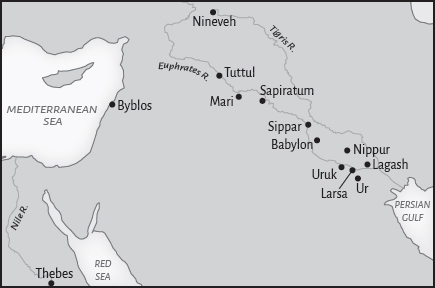
Established in areas of fertile soil and abundant water, the principal ancient cities of Syria-Mesopotamia were the cradles of self-government by assemblies between c. 3200 and 1000 BCE.
The ancient Syrian-Mesopotamian cities of Larsa, Mari, Nabada, Nippur, Tuttul, Ur, Babylon and Uruk today mostly resemble windswept heaps of grey-brown earth. But around 3200 BCE, they were centres of culture and commerce. Their imposing temples, the famous ziqqurats – often built on massive stone terraces or gigantic artificial mountains of sundried bricks – made travellers gasp with delight. Typically situated at the centre of an irrigated zone, where land was valuable, these places reaped the bounty of dramatic local increases in agricultural production. They fostered the growth of specialised artisan and administrative skills, including scribes’ use of the rectangular-ended stylus to produce wedge-shaped cuneiform writing, and they served as conduits of long-distance trade in such raw materials as copper and silver.
The cities varied in size from 40 to around 400 hectares; they felt crowded in a way our earth had never before known. Their dynamics shaped every feature of Syria-Mesopotamia, including its patterns of government. Kings are conventionally thought to have dominated this region during these centuries. But permanent conflicts and tensions – over who got how much, when and where – shaped the institution of kingship on matters such as land ownership and trade. In fact, kings of the time were not absolute monarchs – despite what later historians with Western prejudices have said. Archaeological evidence confirms that, at least 2000 years before the Athenian experiment with democracy, the power and authority of kings was restrained by popular pressure from below, through networks of institutions called ‘assemblies’. In the vernacular, they were known as ukkin in Sumerian and pŭhrum in Akkadian.
For this insight that assemblies functioned as a counterweight to kingly power, we’re indebted to the Danish scholar Thorkild Jacobsen (1904–1993). He identified what he termed a flourishing ‘primitive democracy’ throughout Syria-Mesopotamia, especially in early second millennium Babylonia and Assyria. He liked to say that, to its peoples, the region resembled a political commonwealth owned and governed by gods, who were widely believed to gather in assemblies – with the help of humans, who formed assemblies in imitation.
Was there any substance in Jacobsen’s idea of ‘primitive democracy’? There are doubts. The teleology lurking within the word ‘primitive’ – the inference that this was the first of its kind, a prototype for what was to follow – raises tricky questions about the historical connections between the assemblies of the Greek and Mesopotamian worlds. It also supposes that despite the many differences in the character and practice of democracy across time and space, there is an unbroken evolutionary chain that links assembly-based democracy and modern electoral democracy, as if the vastly different peoples of Lagash and Mari and Babylon were brothers and sisters of James Madison, Winston Churchill, Jawaharlal Nehru, Margaret Thatcher and Jacinda Ardern. There’s the risk of overstretching the word ‘democracy’ as well. If terms such as ‘primitive democracy’ (or ‘proto-democracy’, coined around the same time by the Polish-American anthropologist Bronisław Malinowski) are used too freely, we fall into the trap of characterising too many societies as ‘democratic’ just because they lack centralised institutions and accumulated monopolies of power, or because they prohibit violent oppression. Matters aren’t helped by the anachronistic use of the word with Linear B origins, ‘democracy’. And then there is the least obvious but most consequential objection: by calling the assemblies of Syria-Mesopotamian ‘primitive’, there is a danger of overlooking their originality.
But Jacobsen’s work remains important because it reminds us that the ancient assemblies of Syria-Mesopotamia are the fossils present in the ruins of Athens and other Greek democracies, and the assemblies of the later Phoenician world. These much older assemblies of Syria-Mesopotamia teach us to rethink the origins of democracy. They invite us to see that democracy of the Greek kind had Eastern roots, and that today’s democracies are indebted to the first experiments in self-government by peoples who have been, for much of history, written off as incapable of democracy in any sense. Ex oriente lux: the lamp of assembly-based democracy was first lit in the East, not the West.
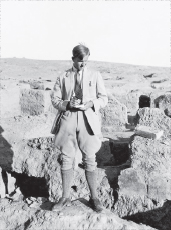
Thorkild Jacobsen in Iraq, taking notes during the clearance of a large residential quarter in the ruins of the Sumerian city Tell Asmar, c. 1931–1932.
IMITATING THE GODS
What did these assemblies look like? How did they function? Here we come across something both fascinating and puzzling. These early citizens’ assemblies were inspired by myths that gave meaning and energy to people’s everyday lives.
For the people of Syria-Mesopotamia – as for Greeks 2000 years later – the cosmos was a conflict-ridden universe manipulated by powerful forces with individual personalities. These deities had emerged from the watery chaos of primaeval time, and they were to be feared because they controlled everything: mountains, valleys, stones, stars, plants, animals, humans. Their fickleness ensured that the land was racked periodically by thunderstorms, which caused torrential rains and halted travel by turning the ground to mud. The local rivers rose unpredictably at their command, smashing barriers and inundating crops. Scorching winds smothered towns in suffocating dust at the deities’ behest.
The whole world was in motion, yet it was said that the deities had won an important victory over the powers of chaos and had worked hard to bring energy and movement into the world, to create order through dynamic integration. The resulting balance was the outcome of negotiations that took place in an assembly – a divine council that issued commands to decide the great coming events, otherwise known as destiny.
There were reckoned to be some fifty gods and goddesses, but the shots were called by an inner circle of seven. The most influential figure was Anu, the god of the sky, a rider of storms who convened the ‘ordained assembly of the great gods’. These gods were believed to have the ability to grant some of their powers to humans. Their favour could be bought. In Syria-Mesopotamia, getting a god was a means of self-empowerment. Letters were written to the gods, and festivals of wailing processions calling on them to act aroused popular interest. In every dwelling there was a shrine to the household’s chosen god, who was worshipped and presented with daily offerings. The practice of mimicking the gods’ self-governing methods was supposed to have the same effect: by emulating their capacity for oratory and collective decision-making, normally through negotiation and compromise based on public discussion, the earthly arts of self-government could flourish. So in Syria-Mesopotamia, the custom of gathering together to decide things had pagan and polytheistic roots. When citizens of various occupations and standing gathered to consider some or other matter, they thought of themselves as participating in the world of the deities, as suppliants of their benevolence.

Anu, also called An in Sumerian, was considered the divine personification of the sky, the ancestor of all ancient Mesopotamian deities and demons, and the supreme source of authority for the other gods and all earthly rulers. In at least one text, he is described as the figure ‘who contains the entire universe’.
Deep Christian and modern prejudice against this kind of mythical thinking later ensured that the ancient assemblies of Syria-Mesopotamia went unrecognised in histories of democracy. Something else played a part in this ignorance: the political economy of literacy. Writing was first used to facilitate the ever more complicated accounting that had become vital for the expanding cities and temple economies. The surviving evidence suggests that while writing enabled the birth of a significant literature in Syria-Mesopotamia, literacy was limited to elites. Recordkeeping was mostly for tracking trade and commerce, and for the administration of public institutions, such as temples and palaces, and so restricted to governmental institutions and the wealthy. This had the effect of rendering the assemblies mostly invisible to later observers. The effect was reinforced, paradoxically, by the strength of these assemblies: exactly because centralised bureaucracies such as the palace monopolised economic and administrative recordkeeping, the decentralised politics that took place in the assemblies went unrecorded – or so the evidence implies.
The old Sumerian and Akkadian words for assembly, ukkin and pŭhrum, are believed to refer, as in English, to both an informal gathering of people and a governing body. Some of them were rural. During the second millennium, for instance, tent-dwelling pastoralists from north-west Mesopotamia gathered regularly to thrash out matters of common concern. City meetings to hear disputes and issue legal judgements were commonplace. The assemblies’ mandate included the power to tread on the toes of monarchs – as noted in a political text called Advice to a Prince, a clay tablet recovered from the world’s oldest library, at Nineveh, in modern-day northern Iraq. Written in Babylon towards the end of the second millennium BCE, it warned monarchs that the gods and goddesses would not look kindly upon their meddling with the freedoms of city and country life. If a greedy prince ‘takes silver of the citizens of Babylon and adds it to his own coffers’ or ‘hears a lawsuit involving men of Babylon but treats it frivolously’, Marduk, lord of heaven and earth, ‘will set his foes upon him [and] will give his property and wealth to his enemy’. Similar penalties were listed for such wrongdoings as the failure to heed advice, the improper conviction or unjust imprisonment of citizens, and attempts to force citizens to work in the fields or temples. The text reminded princes, present and future, that the assemblies of Babylon, Nippur and Sippar had each established – with divine help – immunity from despotic or arbitrary rule: ‘Anu, Enlil, and Ea, the great gods who dwell in heaven and earth, in their assembly affirmed the freedom of those people from such obligations.’1
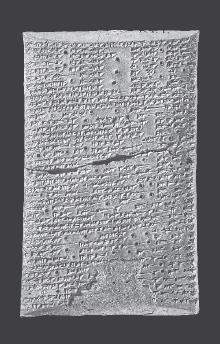
Advice to a Prince was copied from the original text around 700–650 BCE and stored in the Library of Ashurbanipal, a collection of approximately 30,000 stone texts uncovered in the 1840s in the ancient Assyrian city of Nineveh.
Sceptics might understandably ask: for the powerful, weren’t assemblies mighty useful political tools – an ear to the ground for princes otherwise deafened by distance from their subjects? And didn’t assemblies also operate as channels for mobilising support in favour of princely policies – so giving these a more than fighting chance of being adopted?
Assemblies were indeed vital channels of communication between governors and governed in small communities, where rulers found it virtually impossible to avoid mixing with those over whom they exercised power. But like the Greek democracies that followed more than a millennium later, the ancient assemblies of Syria-Mesopotamia were venues in which public learning, as well as the suspicion of power and the art of what would later be called politics (making judgements in public about who gets how much, when and how), were cultivated. In the country and the city, these assemblies shaped people’s lives. They played a role in matters ranging from disputes over water and land to questions of taxation and public safety. Over time, popular assemblies were based within the larger temples of cities. These temples, especially during the first millennium BCE, served not only as places of worship but also as spaces of deliberation and buffers against arbitrary exercises of governmental power. That was true too of the local assemblies within a city: each quarter had its residents’ assembly, which doubled as a court of law that heard and resolved disputes among neighbours.
The polycentric quality of the ancient assemblies of Syria-Mesopotamia ensured that they were not just organs of local monarchs, or of the temples, or of rich and powerful imperial rulers. They were a formidable political force in their own right. But how inclusive were they? We know that attendance at some assemblies was genuinely large. The assemblies weren’t secular – the distinction between the sacred and the profane wasn’t meaningful to the peoples of the region, as it wasn’t for the Greeks. The elders of a city typically played a guiding role. While the evidence either way is thin, it seems doubtful that women were regularly included. Slaves and children normally had no voice. But there is a record of a domestic slave attending an assembly meeting in the merchant city of Kanesh. From the Old Babylonian period (c. 1700 BCE) there’s also a record of an assembly attended by all residents – the men and women of every background and occupation – of an outpost on the Euphrates called Haradum, whose mayor, Habasanu, was accused of embezzling taxpayers’ funds.2 Elsewhere, potters, gardeners, bird-catchers and soldiers in service of the local temple were among the ‘commoners’ who sat regularly in assemblies. There were gatherings convened by particular crafts or professions, such as merchants. There is even some interesting evidence, from exactly the same time as Athenian democracy was blossoming, suggesting the existence of self-governing associations of foreigners, like the assemblies of Egyptian and other immigrants in fifth-century Babylonia. Such assemblies never happened in Athens.
BYBLOS AND A PAPYRUS SCROLL
These early assemblies proved geographically contagious. They spread eastward, into what is today the Indian subcontinent, where sometime after 1500 BCE, in the early Vedic period – a thousand years before Athenian democracy – republics governed by assemblies became common.3 Thanks to the river trade and caravan routes that filtered through Syrian-Mesopotamian cities such as Mari and Tuttul and Nabada, the custom of assembly-based deliberations migrated westwards, towards the Mediterranean coasts that came to be controlled by the Phoenician sea peoples, as well as towards our Greek cousins, who cheekily claimed for themselves the honour of inventing assemblies by giving them a new name: democracy.
A rare papyrus scroll discovered in the late nineteenth century, miraculously preserved in the desert sands of Egypt, reveals the important role the Phoenicians played in keeping assemblies alive. It documents the misfortunes of a diplomat named Wen-Amon, from the city of Thebes. He travelled by sea around 1100 BCE to the thriving Phoenician port of Byblos, 700 kilometres east of Athens. There, his envoy was to purchase from local merchants fine-quality timber hewn from the cedar forests of the nearby mountains. The business was straightforward: with the permission of the local prince, the cedar would be loaded onto a ship by slaves, freighted to the east end of the Mediterranean Sea, unloaded in Thebes and transformed by the best local craftsmen into a river barge, to be used in the sacred fleet of Egyptian ruler Ramesses XI (c. 1100–1070 BCE), in honour of Amon, the god of fertility and patron of pharaohs.
Despite protracted wrangles about payment, and delays caused by winter snow, the timber was eventually hauled by a team of 300 oxen and loaded onto the ship anchored at the Byblos port. But hours before setting sail, the fickle deities struck. Poor Wen-Amon and his crew found themselves surrounded by a hostile fleet of eleven ships manned by the neighbouring Theker people. Upset by his trade, they demanded his arrest by the local authorities. A large crowd, puffing with excitement, gathered around the crescent-shaped harbour. A message was sped by runner to the local prince, Zakar-Ba’al, calling upon him to resolve the crisis. Confusion reigned. Wen-Amon and his crew feared for their lives.
The prince arrived at the harbour. To calm tempers, he provided the envoy with flagons of wine, a sheep for roasting and a songstress to spread cheer. The prince informed Wen-Amon that he wanted to take measure of the dispute and consider his options overnight. ‘When morning came,’ reads the rare document, Zakar-Ba’al ‘had his mw-‘dwt summoned, and he stood in their midst, and he said to the Theker: “Why have ye come?”’4
The document records that Wen-Amon and his men were escorted safely beyond the harbour, where strong winds filled their sails, giving them a porpoise start on the Theker pirates. The rest of what happened at Byblos remains unclear, which doesn’t much matter here because the details are uninteresting compared to the strange little word – mw-‘dwt – that appears in the text. Some archaeologists either leave this masculine noun in transcript form –  – or they translate it, misleadingly, as ‘bodyguard’. It is actually an old Semitic word for ‘assembly’ or ‘council’ (mô‘ēd in Hebrew), and it is used in Biblical passages, such as the reference to those who are ‘famous in the congregation’, the ‘men of renown’ who gather in ‘the assembly’ (Numbers 16:2). The same word crops up in Exodus 27:21, where Moses commands the Israelites to fetch oil made from hand-crushed olives: ‘Aaron and his sons shall arrange for [the lamps to burn], from evening until morning, in God’s presence, in the assembly tent.’

Papyrus fragment of the report of Wen-Amon, discovered in 1890 at al-Hibah, Egypt, and purchased a year later by the Russian Egyptologist Vladimir Goleniščev. It is now in the collection of the Pushkin State Museum of Fine Arts in Moscow.
EARLY GREEK ASSEMBLIES
Wen-Amon’s tale tells us that a species of self-government existed a full five centuries before the Athenian experiment with democracy. At the time of his expedition, Byblos – later called Gebal and today known as Jbeil, located in the troubled republic of Lebanon – was a small but thriving maritime city-state. Its reputation ran high in the ancient world of the Mediterranean not only for its wood and paper – some treasured words such as ‘book’ (biblìon = booklet), ‘Bible’ (biblos = papyrus, scroll) and ‘bibliography’ are associated with it – but also for its system of government by assembly. It even gets a mention in the Bible, where the region is described as a zone of free trade and commerce. ‘Thy borders are in the midst of the seas’ runs a well-known passage, which tells not only of the prized wheat, honey, oil and balm from the land of Israel and fine-quality ship masts hewed from the ancient cedars of Lebanon, but also speaks of an assembly comprising ‘the elders of Gebal and her wise men’ (Ezekiel 27:9).
The story of Wen-Amon bears a more general point: thanks to the Phoenicians, democratic assemblies took root among the Greek-speaking citizen states scattered throughout the Mediterranean. These assemblies initially flourished quite separately from Athens – certainly well before the last decade of the sixth century BCE, when the citizens of that city began to build a democracy. Evidence of these early assemblies has been ravaged by time. The fragments that survive have not been blessed with the intense efforts at archaeological resuscitation applied to Athens. Matters have been made worse by the sloppy organisation of underfunded museums, and by the private pilfering of the treasures in their collections. Yet traces of reliable evidence still remain – such as the reference to ‘the dēmos’ on a reddish volcanic rock, found in southern Chios and dated to 575–550 BCE, and a small block of grey schist from the temple of Apollo Delphinius at Dreros, dated to 650–600 BCE. This chunk of stone is of great interest because it may be the oldest surviving Greek law, and the first to mention ‘the damioi’, a body involved in deciding matters of common concern to the city.

The Dreros law carved on this stone reads: ‘The city has thus decided; when a man has been a kosmos, the same man shall not be a kosmos again for ten years. If he does act as a kosmos, whatever judgements he gives, he shall owe double, and he shall lose his rights to office, as long as he lives, and whatever he does as kosmos shall be nothing. The swearers shall be the kosmos and the damioi and the twenty of the city.’
We now know that there were altogether some 200 Greek citizen states such as Dreros and Chios. Up to half of them tasted democracy at one time or another. The details of these early dēmokratiai, as they were locally known, aren’t altogether good news for today’s democrats. They suffered defeat and destruction, either by military conquest, or by conspiracies of the rich, or by single-minded tyrants; or by all three forces, in some combination or sequence. Their bad fortune reminds us of the utter contingency of democracy – of just how easily it can be scattered to the winds.
But there were plenty that endured, some of them predating Athens by more than a generation. These resilient assemblies teach us to consider the wide variety of ways in which democracy can be built and can survive difficulties. They also alert us to the amazing diversity of species of assembly democracy. Consider the prosperous island state of Chios, located just five miles off the coast of Asia, where, around 575–550 BCE, a maritime democracy was founded. The polity depended on a sizeable slave-labour population engaged in viticulture and an elite exporting that wine and trading in commodities. Rich landowners wielded considerable political clout, and it’s probable they tried to enforce their will on a council of magistrates, a body that the islanders called the boule demosie – which is why a stone tablet on public display reminded the aristocracy daily to behave themselves, to remember that the final say in public matters belonged to the dēmos.

Ancient Greek democracies dating from the seventh century BCE included citizen states on both the mainland and the islands of the Mediterranean.
Among the oldest and most fascinating cases of Greek democracy is the Corinthian-founded citizen state of Ambracia. The colony was established sometime between 650 and 625 BCE, on the bend of a navigable river a few miles inland from the sea, in the midst of a fertile wooded plain. Self-government by public assembly there dates to around 580 BCE – more than seventy years before the assembly in Athens was convened. True to the rule that democratic states are rarely founded democratically, the assembly-based democracy of Ambracia was born of an uprising against the harsh rule of dictator Periander. He apparently aroused widespread indignation after rumours circulated that, during a heavy drinking session, he had asked his young male lover whether he had yet fallen pregnant. The slight caused by that remark in a society tolerant of male homosexuality yet ambivalent towards women is barely understandable to us. So grave was the insult that it seems to have caused Periander’s spurned lover to hatch a plot to overthrow the ruler. He galvanised a coalition of the local dēmos and Periander’s enemies – presumably disaffected property holders. According to Aristotle, ‘the dēmos joined with the tyrant Periander’s enemies to throw him out and then took over the constitution itself’.5
Government run by the poorest men happened throughout the Greek world – such as in the prosperous Sicilian city of Syracuse, where democracy was born around 491 BCE with an uprising against the ruling landowners (called the hoi gamoroi). Practically all other towns in Sicily followed suit; tyranny and oligarchy and monarchy, the three main political alternatives of the period, suffered widespread defeat there during the fifth century. By the 460s BCE, popular self-government had also come to a number of cities in southern Italy, to the sickle-shaped Ionian island of Corcyra (today’s Corfu) and to the Peloponnesian mainland. From one of its states, Elis, comes an intriguing inscription, the tail end of a lengthy law dating probably from the early years of the fifth century BCE. It shows that in Elis, written laws could be superseded not by a court judgement (dika), but only by means of a public enactment that had the consent of a body called the ‘whole people assembled’ (damos plethyon).
For some time, neighbouring Mantinea had also been a vibrant farming democracy governed by a class of small landholders called the dēmos ho georgikos – a social group that was the backbone of the best and oldest kind of democracy, in Aristotle’s opinion. In Mantinea, as in maybe 100 other citizen states of the Greek world, assembly democracy proved to be a novel cure for tyranny and the abuse of power – a new method of self-government that was practised throughout the region, including most famously in Athens, where, during the course of the fifth century BCE, democracy came to mean rule by an assembly of adult male citizens.
THE RISE OF ATHENIAN DEMOCRACY
What was life like in Athens, once considered the birthplace of assembly democracy? Around 507 BCE, when the transition to democracy began, its resident population numbered about 30,000 men, slaves, women and children. As democracy took root, that figure doubled. It was swelled by tens of thousands of foreign residents, called metics, and by traders and travellers who entered its gates annually, passing through its winding, crooked streets and into the arms of a city that locals thought had been blessed by the deities.
The pnyx, a bowl-shaped open-air amphitheatre on a hill overlooking the city, was where their assembly met. Athenian citizens also had another public space: the agora, located beneath the north-west slope of the Acropolis. This town square was considered the hub of their city-state, which became the most powerful in the Greek world. And they thought of themselves, proudly, as a democracy. By that, the democrats of Athens meant that their polity was owned collectively: not just by men from prominent families or wealth, but also by carpenters, farmers, shipbuilders, sailors, shoemakers, spice sellers and blacksmiths. Democracy was valued as a form of government in which the people ruled as equals, citizens banding together and rescuing themselves, collectively and individually, from the natural ruin brought on by the passing of time and the progression towards death. By countering human frailty, places such as the agora and the pnyx functioned as public shelters. They provided a sense of what Athenians called aidós: meaningful wellbeing and mutual respect. It was as if these public spaces infused citizens with a sense of grounded reality, daily confirmed by the presence of others. That is what the melancholic ‘weeping philosopher’ Heraclitus (c. 540–480 BCE) meant when he said that the awake shared a common public world, whereas those who took no interest in the city’s affairs were in effect asleep, turning their backs on the polity to pursue private interests.
Athenian democracy wasn’t secular in any recognisably modern European sense. Current-day champions of ‘deliberative democracy’ and citizens’ assemblies often claim that their proposals are true to the founding spirit of Athenian-style democracy, but this is to forget that the entire ethos of assembly democracy blended the sacred and the profane, to the point where talk of the separation of religion and politics would have made no sense to Athenians. Its democracy had room for dissenters, certainly. In the early 440s BCE, the first sophist, Protagoras of Abdera (481–411 BCE), told Athenians that man was the measure of all things – including the deities, who perhaps existed only in men’s minds. Others probably agreed, or pondered the same thought in silence. But the reality was that Athenian democracy was widely seen through supernatural eyes. Athenians learned from an early age, through religious cults and the rituals practised within their households, that life was anchored in a polytheistic universe of gods and goddesses – and that this community of deities infused the earthly democracy with a strong sense of sacred standards.

The Acropolis at Athens (1846), an idealised image of democratic Athens at its height, portrays affluent and well-educated citizens gathered in the agora, below the Parthenon and the Acropolis (which is topped by the colossal statue of Athena).
As in Syria-Mesopotamia, the citizens of Athens invested great hopes in their deities. They also feared them. The public trial and execution of the philosopher Socrates in 399 BCE for importing false gods into the city, and for impiously corrupting its youth, confirmed that individuals who snubbed the acknowledged deities would suffer harsh punishment. The priests and elders loved to remind citizens of a story taken originally from Homer: that at the entrance of the home of Zeus, the god of freedom, stood two large barrels; from these he dispensed ill to some newcomers, good to others, and to the rest a few ladles of good from one barrel and a bit of ill from the other. Such tales put the whole city on edge.
We may scoff at these deep feelings for the sacred. But many citizens of Athens truly believed that gods such as Zeus would punish the polity – for instance, by bringing foul weather or failed harvests, or the death of oak trees – if its members behaved unjustly.
The Athenians’ fear of gods and goddesses had a flipside, for they believed that the deities put a spring in the step of mortals. The deities gave guidance, offered protection and imbued the lives of the devout with meaning. Put more exactly: they helped Athenians cope with the contingencies of life. Not only did their presence explain natural disasters and otherwise inexplicable events, such as droughts and epidemics; they could come to the rescue, especially in sticky situations, when wise solutions to problems had to be found. They also helped define the vital issues. Divination – approaching gods and goddesses, or consulting the female oracles, whose job was to pass on messages from the deities – reminded citizens of their mortality, and of their need for humility. The deities daily alerted Athenians to the need to practise the delicate art of peaceably approaching those who might prove capricious or dangerous, negotiating with them and reaching decisions made on the basis of mutual trust and respect. Divination also served as a brake on leaders who were too clever by half, or too headstrong to consider others. It put power on a leash.
There was a striking resemblance between the methods of divination and democracy. There were many Athenian gods and goddesses, but no clear revelations, no sacred books, no official creeds. The deities were partisan – they conspired and took sides – but they were open to persuasion; there was room for playing noughts and crosses with them. So just as the deities had to be approached, consulted and their advice interpreted before decisions could be made, so democracy was a practice in which citizens felt moved to gather respectfully in public, to decide as equals how they should live together, in the face of broader uncertainty. The relationship between the deities and humans was unequal; the gods and goddesses had the power to inconvenience or to destroy human beings. But it was exactly that power imbalance that made it necessary for citizens in the agora to please the deities by mimicking their customs.
GENDER, SLAVERY AND POWER
The worship of the goddess Dēmokratia was part of this equation. Athenian democracy was a deeply gendered affair. Democracy was protected by a goddess, but many male citizens still supposed a sharp division between the public life of the agora and the privacy of the household – where women became pregnant and suffered the tearing pains of childbirth, their children were raised on stories and myths and taught to read and write, and cleaning, food preparation and other daily chores were done with the help of domestic servants. The good citizen came equipped with a phallus, which reminds us too that there were deep connections between homosexuality and democracy in its Athenian form. Its democracy was a phallocracy. Waited on by underlings, men bonded and ruled as equals. They formed associations and spent much time together in public. They drew pleasure from their efforts to preen young boys for public life. Men mingled, held hands and kissed in the company of others. The display of male affection and love was tied to the intensive pursuit of physical beauty, the lust after pleasure and the deep aversion to growing old – at the expense of women and slaves.
The whole system of Athenian democracy rested upon slavery. That fact later tormented democrats, as we are going to see. But in Athens the connections ran so deep and wide that an outside observer might have been forgiven for thinking that democracy was a clever alibi for the enslavement of the many by the few. The same observer might have seen that within Athenian democracy some citizens grew wealthier, giving them the means to import and acquire slaves, especially for work in agriculture, manufacturing and mining. That was why the growth of democracy went hand-in-hand with the expansion of slavery, and why owning slaves was a much-prized benefit of citizenship.

The goddess Dēmokratia crowning the personified Dēmos – the people – in an Athenian relief dated to around 336 BCE.
Slavery of course predated democracy, and there were many types of slaves, but to be a citizen meant being a cut above a slave, who was merely a human being (anthropos). There were no political parties or trade unions in democratic Athens. Slaves were the property of citizens. They could be bought and sold, bequeathed or confiscated, penetrated or beaten, according to the whims of their masters. In the richer households, slave women worked as maids, cooks, bakers, seamstresses, knitters and hairdressers; male slaves were servers, housekeepers, doorkeepers and attendants for the male children. Meanwhile, entertainers, dancers and prostitutes, male and female, serviced the carnal needs of citizens, whether in cheap brothels or in the luxurious ambience of drink-soaked symposia.
Slave labour was used extensively in marble quarrying, while in the lead-and silver-mining industries, ruthless exploitation generated great wealth for the polity and produced individual fortunes (a leading fifth-century military general, Nicias, reportedly owned 1000 slaves, whom he hired out as miners, under the supervision of a trusty Thracian slave named Sosias). Slaves were heavily involved in specialist crafts, such as lyre making and tannery, as well as in the manufacture of goods such as clothing, weapons, knives, lamps and pots and pans. They helped build and repair roads. They worked in the government mint, cleaned streets and even served as bouncers who kept order in the assembly, in the courts and in the agora. Their sweat was invested in temple repairs and public building programs, for instance on the Acropolis and at the sanctuary of Eleusis, located a day’s walk west of Athens.
Given Athens’ reliance on slave labour, it’s significant that very few extended poems, plays or philosophical texts of the period defended slavery. It may be that the most oft-quoted example, from Aristotle, was not at all representative of the range of views held by Athenian citizens. Many slave owners seemed to suffer an ailment that could be called democratic anguish, either because they felt pangs of shame or because they knew from practical experience that when they treated their slaves as beasts they never got the best from them. A famous Athenian law against hubris displayed the ambivalence. Carried over from pre-democratic times, it was designed to protect poorer citizens against being treated like slaves. The law specifically outlawed acts of gratuitous violence bent on their humiliation and abuse. Yet it went further, stipulating that anyone who killed a slave was required to undergo a purification ceremony to appease the deities – and could expect to face legal action, perhaps even the charge of homicide, initiated by another master. Orators frequently spoke in defence of the law, heaping praise on the ‘generosity’ of Athenians and sometimes pointing out that the law implied the banning of all types of hubris against all residents of Athens.
PARRHĒSIA AT THE PNYX
In an age before the printing press, mass media and internet, when news and rumours were circulated by the wheel, the horse or word of mouth, oratory was an Athenian specialty. Athens was a literate polity, in the sense that at least some of its citizens could read, aloud to others if necessary. But the oratory it became known for was on display at the pnyx, where the whole citizen body, called the ekklesia, met to decide laws that governed the city-state. Sessions there were often blustery. ‘ The city is full of freedom and unrestrained speech and there is licence within it for a man to do as he likes,’ complained an enemy of democracy, the philosopher Plato (c. 427–347 BCE), who went on to note that the echoes produced by the rock walls of the pnyx ‘redouble the din of the criticism and the praise’.6

The speakers’ platform at the pnyx, within sight of the Acropolis, is where sometimes lengthy orations were delivered to the assembly.
Plato’s complaint seems overdone. There’s much lingering evidence of citizens’ self-discipline. They were acutely aware of the dangers of violent feuds (they called them stasis), and there’s no doubt that within the assembly, threatened or actual violence was not tolerated. Well-trained heralds plus detachments of archers and slaves were usually on hand to enforce its rules and customs. Citizens, seated in the round on bare rock, propped up on their elbows or lying on cushions brought from home, expected others to respect the obligation to speak spontaneously, to trade in what they called frank speech, or parrhēsia. There were jokes aimed at the rich and charges of disreputable private behaviour. There was talk of corruption and signs of disquietude about the type of blind arrogance called hybris. Sessions were sprinkled with satire: speakers commonly persuaded others by making them laugh. There were hijinks and moments of self-mockery. Some sessions resembled the closing scene of a much-loved satire by Aristophanes (445–385 BCE), Knights, in which the figure of old-man Demos is jabbed and jostled by a slave and a sausage seller.7
But the assembly was often gripped by sobriety. Speakers issued reminders that to be a citizen meant being the ‘equal and peer’ of others. It was often said that democracy was a special type of government that enabled each citizen to enjoy isonomia (equality before the law), the entitlement to speak and the freedom to ‘rule and be ruled in turn’. The spirit of democracy was summarised by the skilled orator and pre-Socratic philosopher Democritus (c. 460–370 BCE). The well-run polity, he liked to say, is the strongest protection against human greed and folly; if the polity is safe, all is safe, whereas if it is lost, all is lost. Democracy is the best form of polity because it ensures frank speech. It gives a hard time to the foolish and to the arrogant. Frank speech fosters the spirit of equality and mutual aid; it counters selfish desires and ambitions with cheerfulness (euthymia). According to Democritus, democracy, by protecting frank speech, also ensures that the mistakes of men who held office are remembered longer than their successes.
DIRECT DEMOCRACY?
The celebration of frank speech in the Athenian assembly was combined with hostility to factions and suspicion of political factions in particular. There was no great love of majority rule; the preference was for consensus decision-making. Even voting (diaphora) was regarded with some suspicion because it meant disagreement and division in the polity. Civil war was a constant fear. Athens was a no-party democracy that dreamed of reaching unanimous decisions through public debate that produced unquestionably good decisions.

David Van Reybrouck, author of Against Elections (2016) and champion of deliberative democracy, observing a meeting of Belgium’s first country-wide citizen assembly, the G1000 Citizens’ Summit, held on 11 November 2011.
This belief in the binding power of public assembly later came to be seen as the greatest advantage of ‘direct’ or ‘pure’ democracy. Today’s friends of deliberative democracy, those who say its quintessence is cool-headed public deliberation by citizens, hearken back to Athenian democracy as a form of government not only of the people and for the people, but also by the people – to a far greater extent, and much more meaningfully, than in today’s large states and non-governmental organisations. Such thinking is traceable to the eighteenth-century Genevan political thinker Jean-Jacques Rousseau (1712–1778). ‘Among the Greeks,’ he claimed, ‘all that the people had to do, they did themselves. They met constantly in public assembly. They lived in a mild climate. They were not greedy. Slaves did all the necessary work. The people’s main concern was with their own liberty.’8
Never mind the slavery, the subordination of women or the belief in the deities, and the fact that Athens wasn’t the birthplace of assembly democracy. The fans of direct democracy typically overlook the point that ‘the people’ cannot in practice govern unless chosen representatives are empowered to handle certain tasks on its behalf. Exactly because all citizens cannot be in the same place at the same time to handle a range of different matters, democracy requires deputation. The specialisation of tasks shows that ‘the people’ can never act as an undivided body. Such a group may try to imagine itself standing shoulder to shoulder, listening ear to ear. But self-government requires delegates, whose decisions on behalf of the group invariably trigger political tensions among citizens.
The assembly democracy of Athens illustrates these unavoidable dynamics of representation. We’ll look at them in more detail in the coming pages, but for now it’s enough to say that for all the praise of its exemplary qualities as a ‘direct’ or ‘participatory’ democracy, several kinds of mediating institutions stood in the way of the fiction that Athens was a system based on the direct rule of the sovereign dēmos. One was the powerful body known to Athenians as the Areopagus, the seat of the oldest and most august court in Athens, a kind of fifth-century House of Lords.
Then consider the way that in the name of the dēmos, Athenians performed duties vicariously for others. Every citizen was eligible for a year’s service to a body known as the Council of 500. Its citizen-senators certainly weren’t parliamentary representatives in our modern sense: required to swear an oath to serve the dēmos faithfully, they had no direct power to make or amend laws. Rather, they resembled a steering group or a supervisory executive, whose main job was to draft and guide legislation for the assembly. The other functions of the council changed over time but included such essential tasks as the inspection of ships and cavalry, and scrutinising newly allotted officials to determine their fitness for office in a process known as dokimasia. It tried magistrates accused of wrongdoing and worked with public bodies responsible for matters such as the leasing of mines and the sale of confiscated property.
The Council also elected by lot, again on a rotating basis, a small inner group of fifty senators known as prytaneis. Aged thirty or over, these senators were paid to supervise day-to-day administration of the government, as well as to handle disputes among citizens. They were expected to serve for one-tenth of the year (one prytany) and sometimes to work overnight. While Athens slept, these paid senators kept watch over the city.
In these and other ways, the citizens of Athens, in the name of the people, placed their interests in the hands of others. The odd thing is that the word ‘representation’ and its more modern meanings were unknown to Athenians. Only in the nineteenth century did Greeks come to have a word – antiprosopos – for speaking directly about ‘representation’, which initially had the rather strange meaning of standing before or opposite someone or something, for instance an enemy or opponent on the battlefield. The Athenian assembly sometimes spoke of an ‘appointed messenger’, such as an envoy or ambassador, whose job was to convey decisions or requests to a foreign power. They also had a word for ‘guardian’ or ‘steward’, who was entrusted with supervising arrangements already agreed by citizens. Yet ‘representation’ was not in their political dictionary.

A random selection machine known as a kleroterion, used to choose jurors to serve within Athens’ various courts of law.
The question of language is important, because it was as if Athenians could not say with accuracy what they were doing. They also had no lexicon for understanding what would later be called the separation of powers, even though the demarcation and disbursement of political offices was commonplace. Athens had no civil service or bureaucracy in today’s sense, but an estimated 700 officials were employed annually in the business of administration. There were market inspectors and assessors of weights and measures, whose job was to protect buyers of goods in the marketplace. City magistrates, helped by slaves, tackled tasks such as maintaining public buildings, policing the streets and removing rubbish. Ambassadors were dispatched abroad to defend the interests of Athens. Jurors had to be assigned to courts, and magistrates to offices.
Service as a juror was expected of all male citizens aged thirty or over. Athens had a system of courts known as dikasteria. The word from which it derived, dikastes, meant both juror and judge. This was a democracy without lawyers. No trained judges presided. The magistrates in charge were amateurs. Their one-year term of office, which they held only once in their lives, involved administrative functions, not matters of legal substance. The law was not seen as the Law, the special domain of a privileged class of legal experts. It was regarded simply as rules made and applied by jurors themselves. There was no written constitution to guide deliberation; delegates decided what was right and wrong in each case.
BANISHING THE DEMAGOGUES
It was through these arrangements that the citizens of Athens, when judged by our standards, had an acute sensitivity to crafty manipulation, both from inside and outside the assembly. In the absence of political parties and periodic elections, they experimented with many different ways of placing public checks and balances on the exercise of power. Consider the custom of graphē paranómōn, a procedure by which citizens, under oath, brought suits against proposed or actual laws that were allegedly based on rash decisions and in contravention of existing laws. Or ostrakismos (ostracism), a forerunner of modern methods to ensure limited terms of office to political incumbents. This was a tactic to block the rise of demagogues, plotters and tyrants by banishing unduly popular leaders from the city for ten years, if a minimum number of voters favoured the expulsion. The banished were given ten days to quit the city. The demagogue suitably named Hyperbolus was among them; in 416–415 BCE he was banished to the island of Samos, where several years later he was murdered, leading the assembly to put an end to the practice.
In its heyday, ostracism was a democratic method of defending democracy against democratic excess. The word itself meant ‘judgement by shards’, because shards or potsherds made from clay (ostraka), the cheapest available writing materials, were used as ballots to vote against would-be demagogues, those scheming citizens suspected of wanting too much power. Once a year, the assembly met to decide whether there were potential oligarchs in its midst – in effect, it was an unpopularity contest. If a majority of the quorum of 6000 decided there were, then a day and time was set, usually two months later, for a hearing before the assembly. Since it was in the interests of both the friends and opponents of the candidates for ostracism to show up – whoever ended up with the most votes lost – turnout at the second vote was usually high. The agora throbbed with nervous tension. To keep the assembly as calm as possible, discussion before the final vote was restricted. The contest concluded with the unusual custom of fencing off a large open area of the agora, where the final vote was taken. After casting their votes, citizens had to remain within the enclosure until the votes were counted and the name of the sacrificed was announced, to prevent fraud. It was one man, one vote, one victim.

Ostraka cast against Aristeides, Themistokles, Kimon and Pericles in Athens in the fifth century BCE.
THE ENEMIES OF DEMOCRACY
Looking back on the age of assembly democracy, it’s clear that the advent of dēmokratia caused great commotions and almighty backlashes. This was, after all, a time in which politics was still dominated by propertied aristocrats locked in competition with each other, as well as with their democrat opponents. What this self-styled class of aristocrats had in common was their deep disgust for democracy. The word crossed their lips with a snarl. They loathed the assemblies. Whenever they heard talk of dēmokratia, it confirmed to them that Athens had taken a wrong turn, foolishly placed power in the hands of an ignorant and self-interested sectional group. This crazed dēmos was to be despised and feared. It was poor and property-less, ignorant and excitable. Worst of all, it was driven by a wolfish hunger for political power. They pointed out that the word dēmokratia meant manipulation, trickery and violence. Hence their conviction that it had to be given a bad name.
To understand their train of thinking, ponder for a moment the verb kratein. Nowadays it is usually translated (through the Latin word regulare) as ‘to rule’ or ‘to govern’, but that does damage to its original connotations, which were in fact much harsher. Strange as it may seem to us, when Athenians used the word they spoke the language of military manoeuvring and conquest. Kratein means to be master of, to lord over, to get the upper hand over somebody or something, to possess (in modern Greek the same verb means to keep or hold). The noun kratos, from which the compound dēmokratia was formed, referred to might, strength, a triumphant victory, especially through the application of force. The now-obsolete verb dēmokrateo brimmed with these connotations: it meant to democratise in the sense of grasping power and exercising control over others. So for some Athenians, and most certainly for its enemies, dēmokratia had the opposite meaning it has today.
In our times, when people speak positively of democracy, they typically mean free and fair elections, peaceful power-sharing through compromise, equality based upon legally guaranteed respect for others’ dignity. For its Athenian foes, in striking contrast, dēmokratia was a menace. They treated it as a calamitous form of mob rule in which the lowbrow dēmos acts high-handedly in pursuit of its own interests; they insisted that the narrow preoccupations of the dēmos were not synonymous with the common good. The fact that democracy was depicted as a woman reinforced the point: in a dēmokratia, the dēmos holds kratos and so, much like a woman, it is prone to act deviously, to get its way by using trickery and force against its opponents.

In c. 387 BCE, outside the city walls of Athens, anti-democrat Plato founded a philosophical academy whose scholars mostly shared his view of democracy as a disorderly and dangerous form of rule by the ignorant.
Violent shenanigans triggered by the lust for power were very much on Plato’s mind when he remarked that democracy was a two-faced form of government, ‘according to whether the masses rule over the owners of property by force or by consent’.9 Democracy was for him a gimcrack invention that destroyed good government by pandering to the ignorant poor. He likened it to a ship manned by saphead sailors who refuse to believe that there is any such craft as navigation – idiots who treat helmsmen as useless stargazers. Switching metaphors, Plato even called it theatrocracy: the presumption that commoners are qualified to talk about everything, in defiance of immutable political laws, leads to posturing, the rhetorical seduction of the powerless, and lawlessness among the powerful. Dēmokratia is a type of fake government in which the people are ruled while seeming to rule.
Plato’s view not only reminds us that Athenian philosophy was largely anti-democratic – something like a spiteful reaction against the ethos of equality, contingency and public openness nurtured by democracy. Since writing in philosophical ways about democracy required wealth, leisure and distance from the scuttle and fizz of political life, and since by contrast democracy required citizens to dedicate themselves to public life, the silence of the Athenian democrats about their own democracy enabled its octopoid enemies to squirt ink into its face. Efforts to silence democrats by polluting their reputation was the first recorded example of how democracy’s enemies tried to destroy it – by robbing their opponents of their own language and trashing its practical achievements.
Since the friends of Athenian democracy either mistrusted or never used writing as an instrument of public expression, recorded history was forfeited to their opponents. That is why Athens produced no great theorists of democracy. It is also why virtually all the written commentaries on Athenian democracy were hostile to its novelty, especially to the way it stirred up public resistance to the rule of the rich. Democrats paid heavily for their unwritten defence. Firm believers in their own originality, convinced they had a goddess onside, Athenian democrats underestimated the risk of their own obliteration, which is what nearly happened. In matters of memory, they put themselves at the mercy of a class of nobles that dreamed of crushing the ugly beetle of democracy underfoot. This class of amnesiacs had something sinister in mind: they wanted nobody to record for posterity what democrats had to say.

‘Is there a democratic way of speaking about democracy?’ asked Nicole Loraux (1943–2003), a scholar of classical Athens revered for her critical analyses of the enemies of democracy and her pioneering accounts of its myths, politics and gendered customs.
HUBRIS
The anti-democrats fought fiercely, with more than words, for which they were twice rewarded towards the end of the fifth century. During the thirty-year Peloponnesian War (431–404 BCE), waged by Athens and its allies against Sparta, two coups d’état briefly interrupted democratic government. Both interludes were named for the number of conspirators who grabbed the reins of power: the Four Hundred (411 BCE) and the Thirty (404 BCE). Rearguard actions by men of property were to be repeated often in the story of democracy and, as in our times, they backed rogue governments favouring the rich. That’s why Athenian democrats understood that when it comes to determining who gets how much, when and how, everybody should watch their backs. Politics produces losers, especially when some grow greedy for power. Athenian democrats were convinced that the deities would heap downfall and destruction, or nemesis, on kings, tyrants and lords who chased after worldly success, blindly gambled with their power, sometimes risking everything for the sake of gain. Hubris was their name for such gluttony. Ruin was said to be its penalty. Cupidity – the lust after money, fame, material goods or power – was stupidity.
This awareness of the dangers of arbitrary power prompted a troubling question for local democrats: would the deities turn a blind eye to the meteoric rise to power of a city-state that became an empire – the first-ever democratic empire?
By 450 BCE, Athens had no fewer than 160 vassal states. There was a robust sense among Athenians that they were superior to local states and to Asiatic peoples ruled by Persians. They regarded their democracy with pride. The reputation of Athens as a pompous busybody (polypragmon) constantly striving for power over others became synonymous with democracy itself. Consider Thucydides’ famous account of the funeral oration delivered by Pericles at the beginning of the Peloponnesian War. ‘For this land of ours, in which the same people have never ceased to dwell in an unbroken line of successive generations, they by their valour transmitted to our times a free state [and] the empire we now possess,’ Pericles reportedly boasted.
We live under a form of government which does not emulate the institutions of our neighbours; on the contrary, we are ourselves a model … [O]ur government is called a democracy, because its administration is in the hands, not of the few, but of the many … And our city is so great that all the products of all the earth flow in upon us … We are also superior to our opponents in our system of training for warfare … Wealth we employ rather as an opportunity for action than as a subject for boasting … For we alone regard the man who takes no part in public affairs, not as one who minds his own business, but as good for nothing; and we Athenians decide public questions for ourselves or at least endeavour to arrive at a sound understanding of them, in the belief that it is not debate that is a hindrance to action, but rather not to be instructed by debate before the time comes for action … In short, I say that our city as a whole is the school of Hellas.10
Talk of Athens as headmaster of the whole Greek world burned like dung in the fires of empire. It fostered public belief in the citizenly virtue of military prowess; it twinned dēmokratia and military success. Imperial power necessitated the mobilisation of troops – in return, they expected a share of government. The Athenian army had initially been largely self-funded: the wealthier citizens served in the cavalry on their own horses, mounted on their own saddles. The growth of lightly armed infantries of poorer hoplites made the case for political inclusion irrefutable. Democracy’s logic of enfranchisement also meant that as the Athenian navy grew in power and influence, the poorest citizens, the thetes, who formed the bulk of naval crews, pressed for equality with their fellow citizens; for a time, the sea and democracy seemed to be twins. War made everyone equal in the struggle to escape the clutches of death. It encouraged painful toil that produced honour. It confirmed men’s sense of machismo (the Athenians spoke of aretē). It helped banish the cruel ‘melancholy’ Pericles mentioned in his funeral oration. War blessed life with unshakeable meaning; it bracketed worries that men were mere shadows of shadows, beings destined to endure only briefly, like a day passing into the night.

At its height in the mid-fifth century BCE, the Athenian Empire colonised important parts of the territory of modern-day southern Italy and the coastlines of Turkey, North Africa and the Middle East.
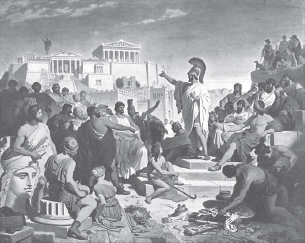
Pericles’ famous funeral oration was delivered at the end of the first year of a twenty-eight-year war between Athens and Sparta. ‘When the bodies had been buried,’ reported the historian Thucydides, ‘Pericles, son of Xanthippus, climbed on a step, from where all the people could see and hear him, and gave this discourse.’
Empire also brought wealth to Athens, which was used partly to pay for its machinery of government and to conscript vast numbers of Athenian males. Save for a small number of states that negotiated to keep their nominal independence by providing ships that sailed in the Athenian fleets, by the early 440s BCE all cities of the empire were required to pay an annual tribute, as well as duties on exports and imports that passed through the hub port of Piraeus.
The extent to which the wealth generated by empire was vital to Athenian democracy’s flourishing is still hotly disputed by historians. But there’s little doubt that among the most potent effects of empire was to expand the power of the military in the day-to-day functioning of the polity. The Athenians were good democrats. They were also good fighters. In consequence, during the fifth century, Athens found itself at war on average two out of every three years; never once did it enjoy more than a decade of peace. With the introduction of paid military service in the 450s, war came to dominate the everyday lives of Athenians, as well as their culture and politics. Citizenship and military service grew indistinguishable; the spirit and institutions of democracy felt deeply martial.
DEMOCRACY’S DOWNFALL
Hindsight makes it clear that the dalliance of democracy and armed force proved fatal for Athens. The zenith of empire in the fifth century led to restrictions upon political freedoms at home. Empire bred demagoguery. It gave undue prominence to elected military leaders such as Kimon and Pericles, who (unusually) were entitled to hold office for several successive terms. These men of the battlefield were authorised to interrupt assembly proceedings to introduce their own business. That meant that their enormous power to determine the city’s fate, unchecked by parties or laws, came to depend heavily on their skilful rhetorical massaging of the dēmos. Pericles cultivated his charisma by likening himself to Athens’ courier ship, the Salaminia: while enjoying office for nearly a quarter of a century, from 454 to 429 BCE, he appeared before the assembly only when pressing public matters required urgent attention. His absence bred intrigue and excitement. Thucydides and others understandably complained that when he did appear in public, he spoke and acted like an arrogant monarch. ‘Hatred and unpopularity have become the lot of all who have aspired to rule others,’ Pericles said to mourners gathered to honour dead soldiers. But he added, defiantly:
Remember, too, that if your country has the greatest name in all the world, it is because she has never bent before disaster; because she has expended more life and effort in war than any other city, and has won for herself a power greater than any hitherto known … it will be remembered that we held rule over more Hellenes than any other Hellenic state, that we carried out the greatest wars against their united or separate powers, and inhabited a city unrivalled by any other in its resources or magnitude.
The great leader’s words presaged the beginning of the end of the Athenian experiment with democracy. Its decline was protracted; setbacks came camouflaged in victories. But growing militarisation of political life in support of empire began to turn Athens into its own worst enemy – into a source of envy and jealousy among the states within and beyond its empire. At home, it unleashed a malignant force that the Athenians called delusion (ate). A restrictive citizenship law passed in 451 BCE aimed to prevent foreign residents and freed slaves from becoming Athenian citizens; they were treated as the enemy within. On several occasions, every available citizen was compulsorily drafted into the navy or army to fight against a neighbouring city; and laws were passed by the assembly to enable citizenship to be stripped from those found guilty of desertion or draft dodging.
The ruinous compact between democracy and armed force had wider, geopolitical implications, with bad news for local democracies – such as the Aegean island of Melos, which was blockaded by Athens in 416–415 BCE. The siege had frightful effects. Starvation followed by discord and treachery resulted in the unconditional surrender of the Melians. The Athenian democrats wasted no time in pulling apart the local polity. In the name of democracy, they executed all men of military age and sold the women and children into slavery, leaving infants and the elderly to the local wolves. Five hundred citizen-settlers were soon shipped to Melos. The island became a colony of Athens. The rule of democracy was sealed, in cruelty and blood.
What were the lessons of the campaign against Melos? For a start, it showed that democratic states could be good at war, and capable of inflicting terrible violence upon neighbours. It proved, as well, that violence was a double-edged sword for Athens. Violence encouraged rivals to seek, and win, the ultimate prize: forcing Athens to its knees, where its hypocrisy and hubris were drowned in blood.
In 359 BCE, Athens was forced to submit to the well-armed kingdom of Macedon, led by Philip II. His giant army of 32,000 troops crushed the democrats and their allies at the Battle of Chaeronea, in Boeotia, to the north-west of Athens. The Macedonians soon tightened the noose around the necks of the Athenians, who in 322 BCE suffered another catastrophic defeat during the Greek-led rebellion against Macedonian rule, known as the Lamian War. Athens was forced this time to pay a much higher price. As part of the peace settlement, Macedonian troops stormed the city and promptly replaced its democratic government with an oligarchy. Somewhere between 12,000 and 22,000 citizens were disfranchised. Some were packed off to remote Thrace. Prominent democrats, among them Hyperides and Demosthenes, were executed.
Democrats regained control of Athens several times, but in the end the Macedonians would have nothing of it. In 260 BCE, the Macedonian king Antigonus Gonatas ordered his troops to recapture the city. The ideals and institutions of the most powerful assembly democracy of the ancient world were no more.