
Part II
IF THE HISTORY OF DEMOCRACY was a straightforward tale in which times changed but everything else remained the same, this short book would be nearing its end. For better, and not worse, the history of democracy isn’t like that. So there should be no surprise that a startling upheaval in the story is about to happen, a change that produced a second historical phase of democracy. Let’s call it the birth of electoral democracy.
Assembly democracy was born of the Near East and the Phoenician and Greek worlds. From around the twelfth century CE, democracy entered a new era whose centre of gravity was the Atlantic region – the watery geographic triangle that stretched from the shores of Europe, across to Baltimore and New York, and down to Caracas, Montevideo and Buenos Aires. It witnessed the birth of an imaginatively new understanding of democracy – as popular self-government based on the election of representatives who hold office and govern on behalf of the people, for a while. The region also witnessed the invention of many new institutions and customs – parliaments, written constitutions, political parties, polling stations, independent publishers and daily newspapers – designed to underwrite periodic elections. As we are going to see, electoral democracy aroused great public excitement and hopes among the downtrodden for a better-governed world cleansed of bossing and bullying. But it was dogged by internal contradictions and fierce opposition from its frightened enemies.
This lengthy period opened with the birth of parliamentary assemblies in northern Spain. It ended on a sad and sorry note, during the 1920s and 1930s, with the near-global destruction of representative democratic institutions by the bloody forces of war, revolution, dictatorship and totalitarian rule that racked the first half of the twentieth century. By 1941, there were fewer than a dozen electoral democracies left on our planet. In between, over the course of eight centuries, extraordinary things happened.
‘GOVERNMENT DEMOCRATICAL, BUT REPRESENTATIVE’
How to make good sense of this long transition? Let’s begin by consulting a salient letter written in the summer of 1816 by former US president Thomas Jefferson. Pondering the changes to government and political thinking during his lifetime, he minced no words: the arrival of electoral democracy had fundamentally altered the dynamics of the modern world. He explained that although the ancient Greeks knew nothing of the principles of electoral representation, the truth was the ‘direct democracy’ of the assembly required institutions of ‘representation’ that served to protect and to nurture the will of its citizens. According to Jefferson, it did not occur to the Greeks ‘ That where the citizens cannot meet to transact their business in person, they alone have the right to choose the agents who shall transact it’. Greek citizens, orators and political thinkers alike didn’t see the possibility of breaking free from the false choice between self-government of the people and rule by a few – oligarchy.
The defining novelty of the modern era, Jefferson continued – America and Western Europe were foremost in his mind – was its invention of a new type of self-governing republic based on periodic elections. He made no mention of the disfiguring of elections by rum-soaked parades, vote buying, gun battles and riotous brawls, and said not a word of his slaveowner’s conviction that a multiracial society with free black people was impossible. He instead concluded that the experiment in combining ‘government democratical, but representative, was and is still reserved for us’. The new representative system had no historical precedent. It offered ‘ The people’ a method of protection ‘against the selfishness of rulers not subject to their control at short periods’. In providing such protection, the experiment with electoral democracy ‘rendered useless almost everything written before on the structure of government’.1
The bold words raised big questions, to do with the tricky matter of when and how a new era had been triggered by inventions that invested the word ‘democracy’ with a brand-new meaning unknown to the Greeks. How did it come to be redefined as electoral democracy? How did it manage to take root on every continent? Why, in its European birthplace, did it ultimately fail as a political experiment? And most importantly, are the unique historical circumstances that gave rise to it now behind us – are we living in a world beyond the age of election-centred democracy?
THE LANGUAGE OF CHOICE
‘Persons attempting to find a motive in this narrative will be prosecuted; persons attempting to find a moral in it will be banished; persons attempting to find a plot in it will be shot,’ Mark Twain wrote in the preface to The Adventures of Huckleberry Finn. The story of the birth and development of electoral democracy is not exactly a Twainian mystery, but crooked and kinked its birth patterns certainly were.
Let’s take an example that illustrates just how complicated are the origins of electoral democracy: the language of elections. By the early years of the nineteenth century, as Jefferson pointed out, ‘free and fair’ elections were thought to be the heart and soul of this new form of democracy. But the vocabulary of elections is a magpie’s nest of different words with disparate origins. The word ‘election’ stems from the Latin ‘ To choose; to pick out [from among several possibilities]’. The group term for those who choose, the ‘electorate’, is much more recent; its first recorded usage dates only from 1879. Before then, the word that everybody used was ‘electors’. The general entitlement to vote is nowadays called ‘ The franchise’, but that word (in thirteenth-century English) originally meant ‘privilege or right’ and ‘freedom, exemption from servitude or domination’. Talk of the franchise later came to refer to the legal immunity from prosecution, only then to evolve into several new meanings, including the act of granting a right or privilege (as when a sovereign monarch granted exemption from arrest), an ‘elective franchise’ (the right to vote) or, as in today’s use of the word, a licence granted by a business to someone to sell or trade its products within a given area.
Then there are terms such as ‘representative’. It comes from the Latin repraesentare –serving to portray, depict or display – but the later meaning of a representative chosen to act on behalf of others was quite possibly a gift from the world of early Islam, where the practice of appointing wakīl to handle distant legal, commercial and religious matters was customary (wakīl is also one of the names of God, meaning ‘dependable’). And there is the word ‘voting’, from the Latin votum. It entered English during the fourteenth century to mean ‘ To wish or to vow’ and ‘ To promise or dedicate’, then was transformed in Scotland around 1600 to mean expressing a choice in an election. ‘Poll’ was also used to describe the act of casting a vote. In its old Dutch and Germanic origins – and in several surviving dialects – it meant ‘head’. During the last years of the sixteenth century, it came to refer to the new custom of conducting a vote by head count, designed to put an end to the corrupt practice of elections being decided by those who shouted loudest in favour of their candidate. That word stems from the days of the Roman Republic, where the Latin candidatus meant ‘clothed in white’. It referred to political men who dressed in white togas as part of their bid to become members of the governing and advisory assembly of the aristocracy known as the Senate.
The language of elections reminds us that the beginnings of electoral democracy are complex. It was not a straightforwardly ‘modern’ invention, as we often think, but had roots in medieval Europe. It was not primarily the offspring of the ‘modernisation’ processes analysed by academics, or born of ‘ the emergence and development of the modern nation-state’, as scholar David Runciman suggests.2 Nor was it the progeny of the eighteenth-century American Revolution, as political scientist Francis Fukuyama has claimed. It was neither the work of the aristocracy nor simply an expression of ‘ The rise of the bourgeoisie’, or of liberalism, as was commonly thought by Karl Marx, Harold Laski, Carl Schmitt and other political writers who pondered the subject during the past two centuries. Multiple forces and events within the Atlantic region conspired to produce electoral democracy. It was often a child of unintended consequences, neither preordained nor inevitable. Its birth and survival, as well as its mutation and eventual death, defied simple formulae and universal laws. And fascinating is the way that several of its key institutions were never originally thought by their inventors to have anything to do with ‘democracy’. Usually, they despised the word.
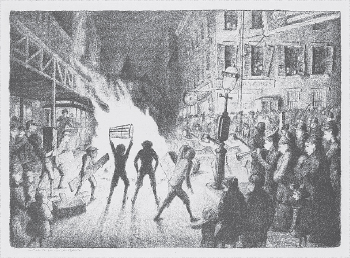
Election Night Bonfire (1928) captures what New York–based artist Glenn O. Coleman called the ‘mad beauty’ and the rough-and-tumble excitement aroused by working-class voting in an era dominated by political party bosses and fat-cat business donors.
Many hands were responsible for crafting the institutions of electoral democracy. Monarchs, monks, shepherds, women, statesmen and aristocrats all played a part. So too did artisans, republicans, clergymen, moneylenders, city dwellers, farmers, soldiers, publishers, devout Muslims and God-fearing Protestant dissidents. Since it preserved, in its principles and its practice, the understanding of democracy as popular self-government – the right of voters to gather freely in public meetings, for instance – electoral democracy was also indebted to the ancient Greek world of assembly democracy.
Throughout the Atlantic region, there were red-hot disagreements over what exactly representation meant, who was entitled to represent whom, and what had to be done when representatives snubbed or frustrated those they supposedly represented. The merits of elected government were also hotly disputed. But what was common to this period was the growing awareness that government by elected representatives had a definite magnetism for millions of people convinced it could deliver them a better way of life.
REIMAGINING DEMOCRACY
Many centuries after the disappearance of democracy in Athens, assemblies continued to flourish at particular times and places throughout the Atlantic region. Public meetings known as contiones were convened regularly by the rulers of the Roman Republic, which survived until 27 BCE. Assemblies reappeared in the Faroe Islands and Iceland, where from around 930 a midsummer al-thing or alping convened annually; in the Swiss cantons, governed by citizens’ assemblies variously called landsgemeinde, talschaft and teding; and in British American colonies such as Virginia, where the first assemblies dating from the early seventeenth century were attended and controlled by slaveowning Protestant men of wealth.
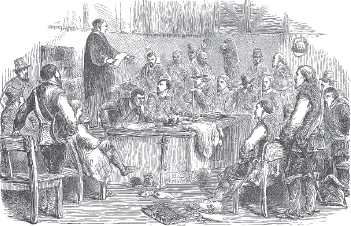
The inaugural session of the House of Burgesses, the first elected legislative assembly in the American colonies, in Jamestown, Virginia, 1619.
So the train of assembly-based democracy didn’t simply terminate at one historical station, where passengers alighted, then boarded the next train of electoral democracy. There were breakthroughs, setbacks, dramatic upheavals and slow-motion ruptures. And more than a few moments when the early champions of periodic elections seemed not to grasp the long-term democratic significance of their doings.
A case in point is the invention of the phrase ‘representative democracy’. The twinned words were first used towards the end of the eighteenth century by constitution-makers, political writers and citizens when referring to a new type of elected government founded on popular consent. What’s not clear is who coined it. There’s evidence that the oxymoron has Anglo-Dutch-French-American parentage. There are many odd moments when the phrase was spoken but neither its meaning nor its historic significance was understood by those who uttered it. Eighteenth-century Frenchman Charles-Louis de Secondat, Baron de Montesquieu (1689–1755), a modestly wealthy member of the Bordeaux aristocracy who served for a while as the deputy president of the Bordeaux parlement, pointed out in The Spirit of the Laws (1748) that in a democracy ‘ The people, in whom the supreme power resides, ought to have the management of everything within their reach’, but ‘ That which exceeds their abilities must be conducted by their ministers’.3
Ministers? What did it mean to entrust the people’s business to them? The French nobleman who had been foreign minister under Louis XV, the Marquis d’Argenson (1694–1757), was well placed to answer such questions. He was among the first writers to tease out both the meaning of the word and the new definition of democracy as popular representation. D’Argenson wrote of the difference between ‘false’ and ‘ True’ democracy:
False democracy soon collapses into anarchy. It is government of the multitude; such is a people in revolt, insolently scorning law and reason. Its tyrannical despotism is obvious from the violence of its movements and the uncertainty of its deliberations. In true democracy, one acts through deputies, who are authorised by election; the mission of those elected by the people and the authority that such officials carry constitute the public power.4
His unorthodox reasoning was that democracy needn’t be feared because it wasn’t mob rule. Little wonder his book was banned by the royal authorities and circulated clandestinely in manuscript form for three decades before its posthumous publication.
Others soon set about exploring and popularising the links between democracy and ‘deputies … authorised by election’, and their contributions travelled across oceans and through whole continents – fast. On the other side of the Atlantic, James Madison (1751–1836), drafter of the new US Constitution and later president of the republic, expressed disdain for the word ‘democracy’ yet counted himself among those who saw the novelty of the American political experiment in ‘ The delegation of the government … to a small number of citizens elected by the rest’.5 Alexander Hamilton (c. 1755–1804) was perhaps the first American revolutionary to nudge the words ‘representation’ and ‘democracy’ together, even at one point using the brand-new phrase ‘representative democracy’, without understanding its significance. It’s weird to think that some of the most precious terms in the history of democracy were coined as if in a dream, but so it was with Hamilton and the new phrase. He was normally hostile to popular rule, which he condemned as a formula for ‘ Tyranny’ and ‘deformity’ led by ‘an ungovernable mob’. Yet on one occasion, shortly after the Declaration of Independence, Hamilton denied that ‘instability is inherent in the nature of popular governments’. Such governments, he said, could be ‘happy, regular and durable’ if they took the form of ‘representative democracy, where the right of election is well secured and regulated and the exercise of the legislature, executive, and judiciary authorities is vested in select persons, chosen really and not nominally by the people’.6
The same point was made more bluntly by a fellow Scot, James Wilson (1742–1798), an erudite Presbyterian lawyer who also helped draft the 1787 Constitution. Wilson noted that the new federal constitution of the American republic was doubly unusual: it recognised that ‘representation is made necessary only because it is impossible for the people to act collectively’, in consequence of which the new republic was ‘purely democratical’, since ‘all authority of every kind is derived by representation from the people and the democratic principle is carried into every part of the government’.7
These were blue-sky ways of rethinking democracy, which by now meant a type of government where voters, faced with a genuine choice between at least two alternatives, elected leaders who acted in their interests. Lord Henry Brougham’s widely read account of the principles of representation put things clearly. ‘ The essence of representation,’ wrote the Edinburgh-born parliamentarian known for his advocacy of free trade, the abolition of slavery and the enfranchisement of the middle classes, ‘is that the power of the people should be parted with, and given over, for a limited period, to the deputy chosen by the people, and that he [sic] should perform that part of the government which, but for this transfer, would have been performed by the people themselves.’8
THE ROLE OF REPRESENTATION
Curious readers will ask: why was this new way of thinking about democracy as popular representation seen as a step forward, an improvement upon assembly democracy?
The standard response historians often give is that electoral democracy was a functional response to territorial imperatives – a practical solution to the problem of how to exercise power responsibly within large-scale territorial states and empires, in which great distances prevented citizens from meeting in face-to-face assemblies. The case for electoral democracy was much more compelling. Thomas Jefferson’s insistence that under conditions of representative democracy ‘ There is a fullness of time when men should go, and not occupy too long the ground to which others have a right to advance’9 is a vital clue to the ingenious argument made by late eighteenth-and nineteenth-century publicists, constitution-makers, journalists and citizens.
Jefferson in effect pleaded a case for electoral democracy centred on political leadership. Unlike monarchy and despotism, democracy requires guidance, inspiration and support from popular leaders when handling complicated political matters, he said. True leaders who lead because they get people to look up to them, rather than dragging people by the nose. Yet he quickly added that representative democracy keeps leaders grounded. It grants them the authority to govern, but it also puts them on trial, mocks them, makes jokes at their expense and threatens scoundrels with loss of office. It provides citizens with a way of ditching lousy leaders who tell lies, cheat, prevaricate, promise miracles or act like demagogues. Unlike unelected monarchs and power-hungry tyrants and despots, elected representatives hold office only temporarily. Representative government is thus a brilliant formula for peace, a way of avoiding civil war by creating space for political dissent and offering losers an olive branch: the hope of running again for office, the reassurance that there are no misfits in the polity.
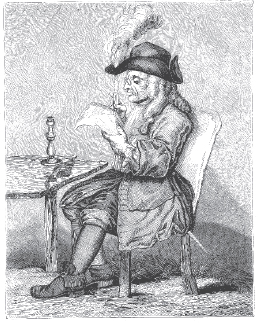
The Politician (1775), a satirical etching by John Keyse Sherwin, is based on a sketch by the English artist William Hogarth, whose shortsighted friend, the lacemaker and politician Ebenezer Forrest, is here portrayed absentmindedly setting fire to his hat while reading a newspaper.
Leadership on a leash was one thing. Another benefit of electoral democracy, its supporters claimed, was its recognition that social disagreements and conflicts are legitimate. The point was captured by Jefferson’s close political friend Thomas Paine (1737–1809). ‘Athens, by representation, would have outrivaled her own democracy,’ wrote the author of the biggest-selling books of the eighteenth century, including Rights of Man (1791). He thundered in favour of ‘representation ingrafted upon democracy’ as a new type of government that allowed for disagreements. It rejected monarchy and its outdated belief in a unified body politic; it was superior to the ‘simple democracy’ of ancient Athens, whose dēmos was under constant pressure to seek harmony, to act as if social diversity and divisions of political opinion were an impediment to popular rule. Electoral democracy, in contrast, openly acknowledged the legitimacy of social divisions and competition among different political parties. It spurned the idea that disagreement was undemocratic, and that the body politic should be undivided and guided by the infallible will of an imaginary People. ‘A nation is not a body, the figure of which is to be represented by the human body,’ Paine explained, ‘but is like a body contained within a circle, having a common centre, in which every radius meets; and that centre is formed by representation.’10
This was an excitingly fresh way of thinking about the opportunities and dangers of handling political power. It became the philosophical basis for periodic elections with multiple political parties. Multi-party competition, which first happened in the United States during the 1820s, was among the core inventions of the age of electoral democracy. Once denounced as dangerous ‘factions’ and ‘conspiracies’, political parties became living reminders that any body politic was materially divided by different opinions and interests. In this new equation, parties did more than mobilise votes. They expressed disagreements, formulated policies, promoted literacy, provided jobs and welfare for their supporters, and prepared representatives for holding government office.
Parties also helped guarantee that an electoral democracy would be an unusual type of polity in which non-governmental associations known as ‘civil society’ could flourish. The principle was thoroughly modern: through bodies such as businesses, trade unions, churches, taverns, restaurants, scientific associations and printing houses, ran the reasoning, civil societies provided space for citizens to band together to pursue and protect their interests, to live their different lives as free equals, at a distance from governments, which would be kept on their toes by citizens armed with the right to vote for the party representatives of their choice.
The insistence that ‘ the people’ is never a homogenous body and that democracy cannot exist without means to represent differences in opinion was used by the early champions of electoral democracy to justify ridding the world of the hereditary stupidity of monarchs such as George III. Representative government attacked the fallacy that sperm, eggs and refined manners were the secrets of good government. It instead supposed that, since political talk of ‘ The people’ is a hollow abstraction, it is best to encourage the non-violent, public airing of different interests and opinions, handled by responsible leadership guided by the principles of good government laced with political compromise.
The eighteenth-century champions of representation also offered a pragmatic justification of their new type of government. Representative democracy was considered a remedy for the practical problem that not all citizens can be involved in making all the decisions that affect their lives, even if they have the time and means to do so. The principle that everyone who is affected by a decision has an inalienable right to be involved in forming and applying that decision was seen to be unworkable, too Greek. People must delegate the task of government to chosen representatives, so the argument ran. The job of these representatives is to monitor the expenditure of public money. They make representations to the government and its bureaucracy on behalf of their constituents. They debate issues and make laws. Governing on behalf of the people, they craft foreign policy. ‘In its original state,’ wrote Paine, echoing D’Argenson, ‘simple Democracy was no other than the commonhall of the ancients. As these democracies increased in population, and the territory extended, the simple democratical form became unwieldy and impracticable.’ But, by grafting representation onto democracy, ‘we arrive at a system of government capable of embracing and confederating all the various interests, and every extent of territory and population’.11
THE FIRST PARLIAMENT
The leap of imagination was astonishing; Jefferson and Paine gave voice to an epochal change in the meaning of democracy, which raises the practical question of when and how electoral democracy happened. To find an answer, let’s visit the twelfth century, at the moment of the birth of a core institution of electoral democracy: parliamentary assemblies.
Parliaments were a new type of governing body, a place for assembled representatives of various social interests, drawn from a wide geographical radius, to make laws. Where were they born? Contrary to some devoutly English accounts, which suppose that parliamentary assemblies were ‘incomparably the greatest gift of the English people to the civilisation of the world’,12 parliaments were in fact an invention of what is today northern Spain, in a region defined by power struggles among Christian revivalists bent on militarily evicting Muslims from the lands of Islam. Momentum was provided by a bellicose address in 1095 by Pope Urban II (1088–1099) before a large crowd gathered at Clermont, a French town today famous for the chain of extinct volcanoes surrounding it. The text of the speech hasn’t survived, but various chroniclers tell us that Urban attributed the impending disaster facing Christianity to God’s punishment for human wickedness – and that he called upon his hearers to recover grace by fighting for the cross, in the name of Europe. What exactly was required to ‘go forward in happiness and in confidence to attack the enemies of God’ (these were his reported words) was left to the good judgement of Christian-minded princes. Among them was King Alfonso IX of León (1188–1230), a savvy young ruler who pioneered an effective way of snatching fields and towns from the Muslims of northern Iberia.
The first-ever parliament Alfonso IX convened was born of despondency. Many Christian communities living in northern Spain had understandably grown concerned about their future. The seventh century had seen the followers of the Prophet Mohammed conquer Syria, Palestine, Egypt and the North African coast. During the next century, Muslims advanced to the gates of Constantinople and, after conquering Spain, entered southern France. The ninth century saw the sack of Rome, and Saracen forces occupy Sicily and the coasts and foothills of southern Italy. Fears that Christianity might disappear altogether were compounded by the loss of Jerusalem, and by the sense that the Christian world was fraying at its African and Asian edges. Nestorian and Jacobite churches were cut off by the Saracens’ occupation of much of Asia Minor – and then of Persia. The church in Abyssinia was similarly quarantined, while in Syria, Egypt and elsewhere, tens of thousands of Christians felt squeezed by the combined forces of what they saw as discriminatory taxation and contemptuous toleration by Islamic rulers.
So the stage was set for a Christian fightback, led by Alfonso IX. At the ripe age of seventeen, he donned the crown of a kingdom that was under intense military pressure, not only from neighbouring kingdoms, but also from the Moorish armies that had first begun swiping swathes of land 400 years earlier. Repeated invasions by these Muslim armies threatened to sap the whole fiscal base of Alfonso’s kingdom. The old custom whereby Muslim governors contributed money to the Christian kings of the region, known locally as parias, had collapsed. New taxes had been imposed on the churches and towns, but these proved highly unpopular. Petitions began to pour in to the new king’s officials.
Alfonso IX caught his realm by surprise by deciding to fight his way out of a tight corner by reconquering territory that he and many of his subjects considered rightfully Christian. Strapped for cash, he slapped taxes on all Christians in his realm. In the era before the slogan ‘no taxation without representation’, his court set about enlisting support. The prince’s aim was to defend and expand his kingdom, even if that meant making political compromises that might dilute his kingly powers. The move he made was as improbable as it was astonishing: he formed a parliament of representatives.
Alfonso IX turned first to the local nobility, the warrior aristocrats committed to the preservation and expansion of their lands. Convinced that monarchs had the Christian duty to wage unending war against Muslim infidels, they were sure that success in war was not only a commandment of Pope Urban II, but also necessary to enhance their own power and bolster government by good Christian princes. Alfonso IX also saw that war required winning over the bishops of the Church, the estate that saw itself as the guardian of souls and spiritual protector of God’s lands. With the region permanently besieged, and strategically vital towns such as León now resembling walled fortresses, Alfonso IX also sought to court wealthy citizens. Contemporary documents referred to them as cives or boni homines: ‘good men’ with a reputation for leadership that stemmed from their election as officers of town councils, called fueros. They were well placed to deliver to the king both townsmen trained to bear arms and much-needed cash.
The modern practice of parliamentary representation was born of this medieval triangle comprising nobles, bishops and moneyed citizens. It was in the former Roman town of León, in the spring of March 1188 – a full generation before King John’s Magna Carta of 1215 – that Alfonso IX convened the first-ever cortes, as contemporaries soon christened it, using the local term both for counsellors who advise and serve a monarch and for the city where a king resides. Delegates from all three of the region’s estates – men of war, souls and money – met within the sandstone cloisters of the magnificently modest church of San Isidoro.
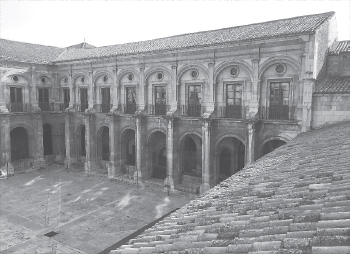
The cloistered Basílica de San Isidoro in León, northern Spain, was where the first parliament convened, in 1188. The church was named after the former archbishop of Seville, famous for his maxim that only those who govern well deserve to be called true monarchs.
The assembly wasn’t the usual gathering of courtly sycophants. In fact, it was the first recorded convention of all three estates – the interests of the towns had hitherto been ignored in meetings convened by the region’s monarchs. It produced up to fifteen decrees (the authenticity of several is disputed) that together amounted to something like a constitutional charter. The king promised that hereon he would consult with and accept the advice of the bishops, nobles and ‘good men’ of the towns in matters of war and peace, pacts and treaties. The bishops, until now forbidden to take oaths of allegiance to temporal power, joined the knights and town citizens in pledging that they too would work for peace and justice. The participants determined that property and security of residence were inviolable. They resolved that judicial proceedings and the laws they produced would be respected; and that the king’s realm would be guided wherever possible by the general laws inherited from earlier times. It was also agreed that there would be future assemblies of the king and representatives chosen by the three estates.
REPRESENTATIVE GOVERNMENT
The good Christian representatives of the first-ever parliament could not have known their contribution to the coming age of electoral democracy. Yet the León assembly was of profound historical importance. Not only did it reject the old custom of courtiers meeting to reaffirm fealty to their sovereign’s will; it also showed that political deals among conflicting interests could be struck by following the rules of fair play, without resorting to naked force or treating opponents as enemies. In stark contrast to Athenian democrats’ belief that democracy could only function when citizens shared an undivided sense of political community, the cortes supposed the likelihood of competing and potentially conflicting interests, and the desirability of peaceful compromise among them. Moreover, it supposed that the chances of reaching workable agreements were improved by limiting the numbers of decision-makers – to perhaps several dozen representatives, though we can’t be sure – some of whom were required to travel great distances from remote parts of the realm. Governments could govern without losing the trust and consent of their distant subjects, it affirmed, exactly because those involved in making decisions had the power to snap at the heels of the monarch, to defend the interests of their subjects, in the presence of the king.
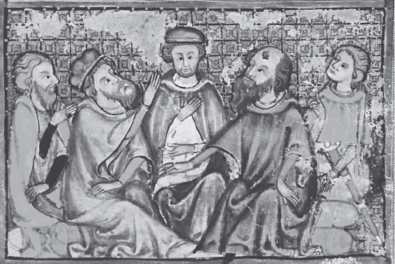
Representatives of the three estates, later known as procuradores, considered themselves agents authorised to act on behalf of others, in defence of their group interests, in the presence of León’s King Alfonso IX.
This method of representative government soon became fashionable. It quickly took root elsewhere in northern Spain, where parliaments were especially active for the next three centuries.
These early parliaments weren’t pushovers before power, mere gossip parlours or talk shops, as later critics of electoral democracy liked to quip. They handled common grievances, ranging from the conduct of war, relations with Muslims and Jews, and the environmental damage caused by the monarch’s animals, through to forcible military recruitment, the appointment of ambassadors, standards of weights and measures, and the living conditions of the peasantry. Parliaments often seemed unafraid of making themselves a nuisance when monarchs tried to decide things arbitrarily, without regard for their subjects’ wishes. Monarchs could rarely claim a grant (sometimes called a servicio) or impose taxes without their consent. Parliaments often collected taxes through their own agents and treasuries, prescribed how they should be spent and even demanded audits of the king’s budget. Representative assemblies in rural areas meanwhile handled matters such as crop irrigation systems (the water tribunals of drought-prone Catalonia and Murcia are an example) and the allocation and coordination of cattle-grazing rights through mobile assemblies of shepherds called mestas. In these and other ways, parliaments served more than the interests of the dominant estates. They opposed arbitrary, arcane and violent rule, acted as a counterweight to petty tyranny and absolute monarchy, and, by stirring up demands for popular representation, nurtured the democratic spirit of ‘liberty’ and ‘equality’ commonly associated with later forms of representative government.
It’s easy in retrospect to see the originality and long-term political impact of these new methods of representative government. Parliaments soon spread to other parts of Europe, migrated across oceans and helped give birth to a large family of institutions whose cumulative result was a wide variety of democracies in representative form. Some electoral democracies, as in Latin America and the United States, chose to rely on elected presidents exercising powers quite separate from their parliaments. Others, such as Greece, India and the Federal Republic of Germany, opted for parliamentary government with prime ministers or presidents directly answerable to the legislature. Canada, New Zealand and Australia instead chose parliamentary government headed by a monarch with largely ceremonial powers. There were highly centralised and federal systems of representative government, while some polities opted for highly decentralised systems of confederation, as in the newly independent republic of the United States and in Switzerland. Cities also proved important laboratories of representative self-government. Republican opposition to monarchy flourished in urban areas. So did local elections, city councils, independent judiciaries, habeas corpus (prohibitions upon torture and imprisonment) and, much later, elected governments that provided public transportation, parks and libraries for the use and enjoyment of their citizens. The point is that the book of electoral democracy lacked a consistent plot. There were many loose pages, odd paragraphs, a few completed but mostly unfinished outlines of possible themes. But amid all the clutter there was one common theme that lived on until the early decades of the twentieth century: democracy came to mean the self-government of people by representatives chosen in periodic elections.
As a practical way of handling power, electoral democracy proved that not everything turns full circle, and that new things do happen under the sun. It triggered great political disputes, centred on the thorny question of the meaning of representation. Lives were upended by revolutions. Blood was spilled. There were times, as in the early parliaments of northern Spain, when representatives broke the mandate of peaceful debate, fighting with fists and swords over two broadly conflicting definitions of representation. Were they mere servants and mouthpieces of their constituents, who needed to keep them on a short leash, or were they to be treated as free-spirited guardians of the whole political community? Should representatives have a set of carefully worded, binding instructions (poderes), forcing them to do as they were told? Was it best practice to give them a grilling when they returned from a session of parliament, as frequently happened in the Catalonian town of Barcelona, which used a permanent standing committee – Vintiquatrena de Cort, the Commission of the 24 – to keep tabs on its representatives’ public and private lives? Were they sometimes obliged to say no to their constituents, to stand above the fray and work selflessly for the higher political good? If so, might unanimity on important measures be mandatory? Might consensus sometimes require the physical ejection of recalcitrants from parliament, kicking and shouting? How sensible was the method used by the cortes of Aragon, which elected officers to vet representatives by putting them through a test, known as the habilitacion, designed to guarantee their commitment to unanimity? Was it true (as the local joke had it) that the passage of every law in Aragon was nothing short of a divine miracle?
THE CONSENT OF THE GOVERNED
Representative government produced moments of mirth, but it also gave birth to a large family of institutions and practices designed to handle the serious business of tempering governmental power. Among the most significant were written constitutions, of the kind agreed by the first parliamentary assembly in Léon. They came to be considered important means for protecting the principle of equality (of those who counted) under the law, restricting the hubris of governments claiming a popular mandate, and stopping seizures of power by an army or powerful political faction, such as the land-owning aristocracy.
Within the sprawling body of Christian believers known as the Church, there were also councils and synods of representatives. Councils comprised church representatives meeting to discuss matters of faith and order, and to issue decrees in spiritual and earthly matters. Easily the most spectacular was the Council of Constance, an assembly of representatives that began in November 1414 in the imperial city of Constance, in Swabia (a southern region of present-day Germany). It lasted four years and attracted huge crowds of Christians and other witnesses to its proceedings. Convened by the king of Hungary, Sigismund of Luxembourg, the 600-strong council was tasked with resolving a rather serious problem. The Church was split by the existence of no fewer than three popes – John XXIII, Gregory XII and Benedict XIII – who each claimed exclusive title to the head of the Church. The question was: how on earth could the worldly trinity be combined into one? The council acted like a latter-day constitutional convention or a political party conference. Delegates agreed to elect a pope, but on the condition that further meetings took place, because the council derived its authority directly from Christ – so the pope’s powers were only held on trust, for the benefit of the Church. The council was adamant: the Supreme Pontiff was the minister, not the sovereign, of the Church. His government rested upon the consent of the governed.
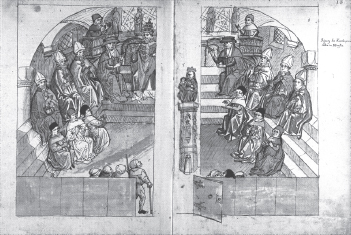
Scholars, bishops and cardinals debating with Pope John XXIII – the winner of the pope-off – at the Council of Constance, held during the years 1414–1418.
The principle that earthly power requires the consent of the faithful later resurfaced in the covenant movement championed by Protestant Calvinists in the Scottish lowlands and highlands during the sixteenth century. It was among the weightiest inventions in the history of electoral democracy. Note how so many of its basic institutions were marked by the cross. ‘ The democratic movement is the heir of the Christian movement,’ remarked the nineteenth-century anti-philosopher Friedrich Nietzsche (1844–1900).13 He was right. The whole idea of a covenant was based on the conviction that God is the source of all things human, the great watchman who looks unkindly on mortals who dare act as His substitute. ‘Think on this and reflect: he who resists power resists God’ were the words famously used by Ivan the Terrible (1530–1584) to justify absolute obedience to rulers, regardless of their stupidity or cruelty. The covenanters wanted nothing of such power-hungry poppycock. That’s why they called on the faithful to band together with fellow believers to rein in earthly rulers who supposed they were divine. A seventeenth-century Glasgow preacher and supporter of a national covenant signed by 60,000 people from all walks of life, Alexander Henderson (1583–1646), used words in a sermon that would soon scare tyrants and fuel more than a few political revolutions: ‘Whenever men begin to go out of line, forget their own subordination, then those that are under them become no way subject to them, because they go out of the right order.’14
Similar reasoning fuelled the fight for press freedom, the principle that citizens should refuse to let their state representatives claim exclusive control over printing presses. Liberty of the press was initially justified in Christian terms, for instance in John Milton’s Areopagitica (1644), which crafted the clever argument that the resilience of faithful believers must be daily tested by the words of the devil, circulated through books, newspapers, novels and pamphlets. Press freedom later became a core demand in the secular struggle for civil and political liberties, especially the right to vote. The demand first took root in the northern and western regions of Europe, including Ireland and the British Isles, from where it subsequently spread to the American colonies, Upper Canada and throughout Spanish America.
Parliaments, written constitutions, councils of representatives, liberty of the press: none of these institutions was known to the ancient world of assembly democracy. That’s true as well for voting in periodic elections. The custom of raising hands, placing stones in a pot or handing in ostrakia were common in the ancient assemblies, but voting was not understood as an act of representation. Choosing representatives in free and fair periodic elections stood at the core of the new bundle of institutions called electoral democracy. Yes, voting for representatives had deep and tangled roots, extending back to the early Spanish parliaments and to power struggles within the medieval Christian Church. Yet when revisiting the history of elections, especially from the eighteenth century, it is hard to miss the novelty of the blood, sweat and tears invested in the historic life-and-death struggles for ‘one person, one vote’.
The universal franchise was the great utopian energiser of early modern democratic politics. Passionate tracts and thrilling poems were written in its honour. Walt Whitman’s ‘Election Day, November, 1884’ lionised American elections as the ‘choosing day’, a ‘swordless conflict’ and ‘scene and show’ more powerful than the thunderous falls of Niagara and the mighty Mississippi. The universal franchise and free elections aroused great expectations of uncorrupted and affordable government, political equality, social dignity and even the collective harmony of a classless society. Australian-born Muriel Lilah Matters (1877–1969), the first woman to speak in the British House of Commons – from the public gallery, chained to its railings – was sure of its public cleansing effects. Emily Pankhurst and other suffragettes were among those who predicted it would bring about the end of militarism. ‘ The ballot is as essential to democracy as the bayonet is to despotism,’ wrote Walter Thomas Mills (1856–1942), the American socialist publisher and co-founder of the United Labour Party in New Zealand. ‘Majority rule is the only rational method of administering the affairs of a free state. The elective franchise must be universal. It must be given on equal terms to all who share in the advantages and bear the responsibilities of living within the borders of such a state.’15
More than a few people sacrificed their lives for the principle and practice of uncorrupted elections, among them Francisco Madero (1873–1913), a Mexican democrat with a difference. A wealthy landowner with a social conscience, he was sure that representative democracy could not be imported into Mexico; it was not a purchasable commodity, or a weapon that could be packed in soldiers’ backpacks and discharged through the barrel of a gun. Democracy was a sensibility. It had to come from the hearts of citizens. That is why Madero worked tirelessly to alter perceptions of power, building a citizens’ network that campaigned for free and fair elections, and for the departure of Mexican dictator Porfirio Díaz. Electoral democracy demanded a radical change of mind, body and soul, Madero told his supporters. The apostle quit smoking, destroyed his private wine cellar, abandoned siestas and stopped eating meat; at one point, partly to escape the swelling crowds greeting him with ‘Viva!’, he spent forty days and forty nights in the desert, under the Milky Way, near a ranch he called ‘Australia’.
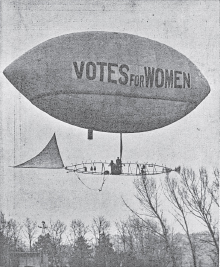
Aiming to lift the spirits of the campaign for women’s suffrage in Britain, Muriel Matters hired an airship to drop pamphlets over London on 16 February 1909, the day King Edward VII officially opened parliament. The underpowered 80-foot airship, with Matters seated in its basket, was blown off course by adverse winds and never reached Westminster, but the daring act generated considerable publicity for the cause, which finally succeeded in 1928, when women in England, Wales and Scotland received the vote on the same terms as men (over the age of twenty-one).
For Madero, the personal was political. That conviction blessed him, as it would later bless millions of citizens and their chosen representatives, with a profoundly felt faith in the democratic cause, and in the power of magnanimous leadership. ‘Neither poverty, nor prison, nor death frighten me,’ he wrote.16 Madero’s faith was rewarded by his election to the presidency with a nearly 90 per cent majority; at thirty-seven, this made him one of Mexico’s youngest leaders. Just two years later, he was rewarded again with a bullet through the neck in the middle of the night – courtesy of a plot co-organised by the American ambassador, Henry Lane Wilson.
RESISTANCE AND VICTORIES
Demands for the universal franchise brimmed and bubbled with democratic spirit throughout the Atlantic region, but its opponents grew frightened. ‘Democracy’ was for them a dirty morpheme. Nicholas Oresme’s famous French translation of Aristotle’s Politics, commissioned for court use by Charles V around 1370 and eventually printed in 1489, contains an illustration whose right (angelic) side includes monarchy, aristocracy and timocracy – rule by a wealthy propertied class guided by honour. Its left (devilish) side contains images of tyranny, oligarchy and democracy. Democracy is symbolised by commoners and soldiers, and by a half-dead victim slumped in a pillory.
Three centuries later, shortly after French Jacobins executed Louis XVI, democracy was given similar rough treatment by the leading English satirist James Gillray (1756–1815).
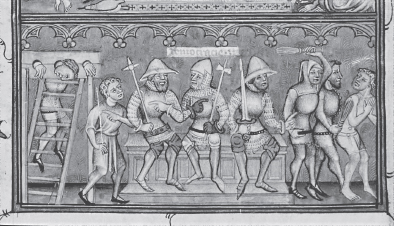
Democracy as recklessly violent government in Nicholas Oresme’s fourteenth-century French translation of Aristotle’s Politics.
Democracy is a bug-eyed, mouthy ruffian, a hirsute plebeian wearing a French cockade, a bloody dagger tucked in his belt, passing gas. Well into the nineteenth century, the iconography remained the same. For its sworn enemies, democracy was a synonym for rabbles of beasts, foul-smelling and rough-talking commoners dressed in rags, spreaders of ignorance and untamed passions, fomenters of chaos and class violence. There was plenty of talk of democracy as properly the possession of the ‘white race’, as in the treatise Die Demokratie von Athen by the Hungarian historian and politician Gyula (Julius) Schvarcz (1839–1900).17 The suggestion that folks of different wealth, race and gender were entitled to be treated equally within a political community, no matter its size or composition, bred snap and snarl. Long-serving Cornell University president Andrew White (1832–1918) warned that most potential voters were ‘not alive even to their own most direct interests’ and that the universal franchise would hand power to ‘a crowd of illiterate peasants, freshly raked from Irish bogs, or Bohemian mines, or Italian robber nests’.18 Mobilising the language of hostility to foreigners, women, the lower class and inferior races, Charles Francis Adams Jr, the grandson of John Quincy Adams and great-grandson of John Adams, similarly cautioned that, in the American context, ‘universal suffrage can only mean in plain English the government of ignorance and vice – it means a European, and especially Celtic, proletariat on the Atlantic coast, an African proletariat on the shores of the Gulf, and a Chinese proletariat on the Pacific’.19 Down south in Buenos Aires, Paul Groussac (1848–1929), the French-born conservative master of Argentine letters, playwright and head of the national library, denounced ‘levelling democracy’ as a recipe for ‘moral regression’ and barbarism. And elsewhere in Spanish America, more than a few well-placed public figures sided with the famous remark by Venezuelan soldier and strongman Simon Bolívar that he felt in the marrow of his bones only an ‘able despotism’ could successfully rule the peoples of Spanish America.20
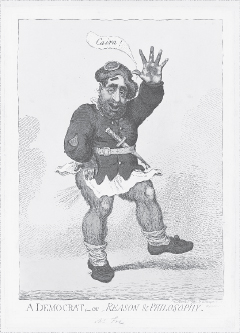
James Gillray’s A Democrat, or Reason & Philosophy (1793) was completed shortly after Louis XVI’s guillotining, the French declaration of war on Britain and the Dutch Republic, and the spread of revolutionary violence and terror in Paris. The democrat (based on local opposition leader Charles James Fox) is portrayed as a crazed sans-culotte celebrating the execution of the king and singing the revolutionary anthem ‘Ca Ira’ (‘All Will Be Well’): ‘All will be well, all will be well! / We’ll have no more nobles or priests. / The aristocrats will swing from the posts. / And equality will reign in the streets.’
On the other side of the Atlantic, the founding statement of the German Conservative Party – drafted in 1876 by party leader Otto von Helldorff-Bedra with the help of a fellow Otto, Bismarck – warned against ‘ The increasing degeneration of the masses’. Universal suffrage was demonic; what was needed was a political order based on monarchy, a strong state, ‘ordered’ economic freedom and what it called the ‘natural groups and organic divisions of the people’. Just across the North Sea, the famous historian of law Henry Sumner Maine’s feistier insistence that the one-person, one-vote principle was a drag on progress was widely cited. ‘Universal suffrage,’ he wrote, ‘would certainly have prohibited the spinning-jenny and the power-loom. It would certainly have forbidden the threshing-machine. It would have prevented the adoption of the Gregorian Calendar; and it would have restored the Stuarts.’21
Gruff words, vinegar sentiments, but historical trends proved more beneficent. By the early decades of the twentieth century, opposition to the one-person, one-vote principle was tempered, gradually worn down and defeated politically in the Atlantic region. Efforts to help citizens to better control and improve the quality of their chosen representatives blossomed. The dangers posed by majority rule (‘The tyranny of a multitude is a multiplied tyranny’, snapped the Anglo-Irish conservative writer and politician Edmund Burke22) and the merits of proportional representation were recognised. So was boycotting, an Irish invention. Political energies were invested in ridding elections of the corrupting effects of hand-in-the-air balloting, voter intimidation and pork-barrel bribery. The secret ballot – usually called the Australian ballot, as it was imported from the state of Tasmania – proved popular in places as far apart as Dublin, Salem, Boston, Caracas and Montevideo. The practice involved printing ballots containing the names of all candidates, distributing these at well-policed polling places, and requiring voters to mark them in secret and place their preferences in a sealed box, after which they were counted by officials, who were sworn to political neutrality.
American democrats pushed electoral innovations. They concentrated on reforms such as the direct election of senators (rather than appointing them via states and legislatures). The first breakthroughs happened in the states of Oregon and Nebraska, and soon after triumphed at the federal level in 1913, with the ratification of the Seventeenth Amendment to the Constitution. It was trumpeted as a great victory, the people’s deserved triumph over the ailing system of state-appointed senators that had been adopted at the 1787 Constitutional Convention, partly on the spurious ground that slaveowning senators elected for longer periods by state legislatures would be gentleman representatives insulated from the selfish people of their own states.
The young American democracy also experimented with recall mechanisms designed to get rid of charlatans and blunderers. A champion of such innovations was doctor-turned-property-developer John Randolph Haynes, who led the Direct Legislation League of Los Angeles. He saw himself as a defender of ‘ The mass of citizens’ rendered ‘helpless between elections’, and in speech after speech deplored ‘inefficiency, extravagance and corruption’. He and his supporters managed to win approval for the inclusion of a recall clause in the Los Angeles city charter of 1903. At the state level, Oregon was the first to adopt the same measure, in 1908. Seventeen more states soon followed. In every case, the working principle was: if a sizeable number of citizens (usually between 10 and 40 per cent) were unhappy with the performance of their duly elected representatives in between elections, these representatives could be recalled before their terms expired. It was a way of giving a boot in the backside of dud politicians, who were either removed from office or allowed to complete the original term as if on a suspended sentence.
Americans also experimented with a modern version of the ancient Greek rule that citizens can initiate laws or amendments by referendum. In 1898 in the state of South Dakota, this rule had strong support within the trade unions as a valued weapon in the arsenal of what was called ‘a people’s legislation’. Progressives never managed to codify the initiative federally, but the referendum did come to be adopted widely at the state, county and local levels throughout the country. During the twentieth century, it was used by a remarkably wide spectrum of interests for different purposes, such as the enfranchisement of women, the abolition of the death penalty and the establishment of an eight-hour working day on public works projects (all this happened in Oregon). It came in two forms. The ‘indirect initiative’ specified that voters were mandated to submit petitions to the legislature for action. The more common ‘direct initiative’ specified that any matter could be drafted by any voter, but required the signature of usually between 5 and 15 per cent of registered voters before it could be put on the ballot, either at the next scheduled election, or at an election called especially to consider the proposition.
STATES AND EMPIRES
Referenda and recall, liberty of the press, periodic elections, political parties and parliaments: these institutions and the ways of thinking they promoted were both effective and unprecedented. Put paradoxically, electoral democracy fundamentally altered the history of democracy. It did so by proving that democracy could come to have two quite different, if entangled, meanings backed by different languages, different ways of thinking and different sets of institutions. The new politics of ‘government democratical, but representative’ also transformed the political geography of electoral democracy. As time passed, and despite its localised origins in towns and villages, businesses and religious bodies, electoral democracy came to exist mainly within bordered, territorially defined states backed up by standing armies and law-making and taxation powers. That’s why today we habitually speak of ‘democracy in France’, or ‘South African’ or ‘Chilean’ democracy. These states are qualitatively bigger and more populous than the political units of assembly democracy. Most democratic states of the Greek world – Argos and Mantinea, for instance – were no bigger than a few score square kilometres.
Empires also played a strange but interesting role in transforming the political geography of democracy. The thought that empires could hatch democratic innovations seems far-fetched, if not oxymoronic. After all, the two little words ‘democracy’ and ‘empire’ aren’t happy family members, or even friendly neighbours. Electoral democracy: a form of polity in which power relations are regarded as contingent and permanently in need of checking and humbling through periodic elections. Empire: a jumbo-sized state whose economic, cultural, political and military powers extend well beyond its borders, and whose diverse lands and peoples are controlled by an emperor or imperial ruling group. Those who rule empires claim universal jurisdiction over their subjects based on such criteria as religion, race, tradition or ‘civilised’ manners. They back up their claims, ultimately, by their monopoly over the means of wealth extraction, cultural production, administration and violence. In other words, empires are dominant powers whose rulers are prone to rank themselves as superior to all their rivals combined. Imperial thinking was on display in the motto ‘AEIOU’ (‘Austria is ruler of the whole world’), used by Frederick III (1415–1493) and other monarchs of the Habsburg Empire. As we have seen, Pericles had something similar in mind: the strength of democratic Athens, he said at the beginning of the Peloponnesian Wars, lay in her possession of naval forces more numerous and efficient than those of the rest of Hellas.
Imperialist mindsets help explain why empires developed a bad name, especially in modern democratic circles, where the word is dogged by charges of arrogance, resource greed and the domination and murder of peoples. This anti-democratic reputation is warranted. And yet, modern empires aren’t cut from the same cloth. During the age of electoral democracy, three different types of empires made their mark on the world. Like the twentieth-century Soviet empire, some set out to crush all opposition and all the trimmings and trappings of electoral democracy by exercising ruthless centralised control over their subjects. There were empires that combined centralised control with substantive power-sharing with their subjects, for instance, the Ottomans’ use of consultative assemblies (meshwerets) or the Austro-Hungarian rulers’ reliance on a bicameral parliament known as the Reichsrat (Imperial Council). And then there were empires that functioned, despite their violence, greed and vanity, as midwives of electoral democracy.
Consider the British Empire: following the loss of its American colonies, nineteenth-century British government officials used a mix of three different types of governing strategies that marked their empire and its ‘colonial possessions’ with tessellated qualities. There were Crown colonies, such as Bechuanaland (today’s Botswana) and Sarawak (a state of Malaysia), in which the empire granted little or no local say in matters of legislation, with administration carried out by public officers reporting to Westminster. There were colonies, such as India, which were granted representative institutions but prohibited from self-government because the Crown doubted they were ready. And, following the imperial rule that distant colonies functioned with least trouble when they were granted a measure of self-government, there were trusted dominions, granted both representative institutions and the power to govern, subject only to the Crown’s veto on legislation and Westminster’s control over the colonial governor.
It was in this last group of (typically white-dominated) colonies that impressive – by the standards of the day – innovations took place in electoral democracy. In 1791, a local house of assembly was granted in French-speaking Québec, then a British colony known as Lower Canada. A year later, free elections were held, based on a rule that enabled anyone who had reached the age of twenty-one to vote, so long as they owned property or paid annual rents and hadn’t been convicted of treason or a serious criminal offence. The upshot was that all tenants – male or female, French-or English-speaking – paying the modest minimum annual rent of £10 were enfranchised. Large numbers of women voted, for the first time anywhere in the British Empire – 136 years before all women over twenty-one in Britain gained full voting rights. Women’s right to vote was only temporary. It was legally abolished after Confederation (1867), but during the election of 1820 in the town of Trois-Rivières, a local judge, noting that ‘here women vote just as men do, without discrimination’, reported that a man entered the polling place only to be told that he could not vote because his property was in his wife’s name. Red-faced, he was ordered to bring her to the polls, since she was the qualified voter in their family.23
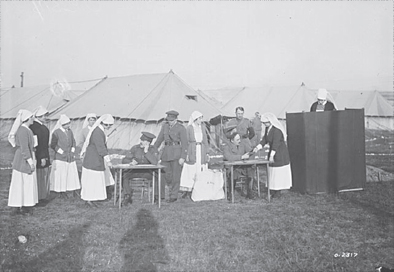
War has often been a catalyst of democratic breakthroughs, and so it was for Canada’s ‘Bluebird’ nurses stationed overseas during World War I. These women, serving at the Ontario Military Hospital in Orpington, England, in December 1917, were among the first to vote legally in a federal election since Confederation. All Canadian women won full voting rights the next year, after decades of petitioning, public rallies and acts of civil disobedience.
THE SOVEREIGN PEOPLE LEGEND
When looking back at these extraordinary developments, it’s safe to say that the citizens of assembly democracies would have been puzzled by the novelty and scale of electoral democracy, even dumbfounded by its appearance. ‘Ever since the birth of modern societies,’ the nineteenth-century French liberal author and politician François Guizot (1787–1874) told a Paris audience during a famous course of public lectures on the subject, ‘ Their condition has been such that in their institution, in their aspirations, and in the course of their history, the representative form of government … has constantly loomed more or less distinctly in the distance, as the port at which they must at length arrive, in spite of the storms which scatter them, and the obstacles which confront and oppose their entrance.’24 Only doctrinaire liberal believers that history was on their side could have thought so optimistically about the future of representative government. In reality, things never went smoothly. Its champions were dogged by double standards, especially when they blocked women, slaves and the labouring classes from the gateways to government.
Outpourings of frustration were understandably widespread. Nineteenth-century novelist George Eliot (1819–1880) sarcastically likened elections to ceremonies of public deliberation and disappointment, with the catharsis of ticking and crossing before the slaughter of the result. ‘Universal peace is declared,’ she wrote, ‘and the foxes have a sincere interest in prolonging the lives of the poultry.’ Not only did periodic elections generate bitter resistance and disaffection; in places as different as France and Argentina, electoral democracy was also vulnerable to pathologies of its own making – flaws that dented its self-confidence and lifted the spirits and gritted the teeth of its enemies.
The champions of electoral democracy saw it as a means to admit differences of opinion and apportion blame for bad political leadership. It enabled citizens to complain publicly and let off steam about their leaders. It promoted open competitions for power, and it made room for tripping up whole governments and throwing them from office, if and when they failed, as surely they would in the end.
But let’s pause to attend to this unusual feature of electoral democracy: the way its plea for multi-party pluralism contradicted and debunked the idea of a unified Sovereign People. Electoral democracy encouraged citizens and their elected representatives to cast doubt on the belief that there existed a unified body called ‘ The people’ – a dēmos – that is the supreme source of worldly political power and authority. More than a few advocates of representative democracy, Thomas Jefferson among them, correctly spotted that this notion of the Sovereign People – which owed much to the ancient Greek world and something to Roman law and had its immediate roots in late medieval and early modern Europe – was actually a weird riff on the doctrine of the divine right of monarchs, the belief that kings and queens enjoy a God-given right to rule their subjects. The Sovereign People idea was a case of what anthropologists call animism: an instance of humans projecting onto the world their belief in an imagined God and then supposing that ‘ The people’ were gifted and graced by this God to rule. It indulged the fantasy that ‘ The people’ are the singular constituting power – the pouvoir constituant, as French thinkers described it. It turned ‘ The people’ into a potential tyrant. Vox populi, vox dei: the voice of the people is the voice of God.
Listen for a moment to the words of the great American republican John Adams. The queue of adjectives he formed when analysing ‘ The people’ was normally reserved by his fellow New Englanders for when they spoke of God: ‘All intelligence, all power, all force, all authority,’ he wrote, ‘originally, inherently, necessarily, inseparably, and inalienably resides in the people.’25 That way of speaking, suitably distilled for public consumption, was to reappear as ‘We, the People’, the first three words of the American federal constitution adopted in Philadelphia in mid-September 1787. The words confirmed that ‘ The people’ are the rightful animators of the world. They call the shots. They cannot be contradicted. The People are power beyond morality. They know what is right and what is wrong. They know how things must be.
The defenders of electoral democracy cast opprobrium on simple-minded formulations of a magical people blessed with magical power – though they didn’t put it in exactly this way. In effect, they issued a call to abandon the grand abstraction of ‘ The people’ so that diverse flesh-and-blood peoples could live together and govern themselves well. But matters were messy. Most champions of electoral democracy continued to cling to the belief that ‘ The people’ is a handy fiction in those moments when the enfranchised population, despite their differences of background and opinion, make an appearance as the ‘sovereign’ force. At election time, voters cast judgement on their representatives, sometimes harshly; ‘ The people’ confer praise and applaud wildly, or they grow angry and vent their frustrations loudly. That followed from the principle, Benjamin Franklin said when debating the wording of the new constitution of the United States, that in ‘free Governments, the rulers are the servants and the people their superiors and sovereigns’.26 In between elections, ‘ The people’ would resemble a dormant colossus, looking on with interest, all eyes and ears, mainly in silence, waiting for the next opportunity to pass judgement on those they elected to govern them for a while.
The upshot was that electoral democracy expressed two contradictory interpretations of ‘ The people’: an abstract, imaginary Sovereign People deemed the rightful foundation of good government, and a real, actual populace shaped by diverse tastes and party competition and a variety of interest groups dwelling within civil society. From the end of the eighteenth century, when people first began speaking about representative democracy, this contradiction caused endless trouble, but electoral democracy nevertheless did what assembly democracy never managed to do. It challenged a metaphysical principle – the Sovereign People – that belonged to monarchist and absolutist ways of thinking. We could say that electoral democracy began the process of democratising the belief that democracy is essentially the rule of the sovereign people. It did so in a way unknown to the ancients.
Here’s how: for electoral democrats, elections were much more than a method of choosing leaders or a means to periodically cheer up the disappointed with an opportunity to get rid of rogues and rascals. Elections remind citizens that they’re members of a disunited ‘people’. If decisions were always unanimous, and representatives always virtuous, impartial, competent and fully responsive to their constituents, elections would simply lose their purpose. Voters and their representatives would be mere mirrors of each other. Representation would become a meaningless principle; and political conflicts fuelled by the disjunction between what ‘is’ and what ‘can be’ or ‘ought to be’ would wither away. But since people aren’t always in agreement and representatives aren’t angels, and since in the eyes of the represented they never quite get things right and often get them badly wrong, elections are a vital means of disciplining them for having let down their electors. Through elections, the friends of representative democracy concluded, electors – a fictional body called ‘ The people’ who in reality rarely see eye to eye about public and private matters – get their chance to remove representatives from office, and to replace them with substitutes who get on with governing, but only for a limited period.
POPULISM
This political reasoning stirred up public trouble. Bitter disagreement about electoral methods and fury at elected representatives plagued electoral democracy. As a new historical form of democracy, it also provoked serious dispute about the exact meaning of ‘ The people’. Compared with assembly democracy, electoral democracy called into question the belief that good government must be based on the unanimous or near-unanimous opinion of a body of people meeting face-to-face. This new type of democracy certainly preserved the old tradition of popular assemblies in town-hall meetings, political party rallies and public demonstrations. But what was also new about electoral democracy was its insistence that, for reasons of diversity and distance, ‘ The people’ could not regularly assemble, and therefore they had to govern through their elected representatives backed by political parties operating within civil society.
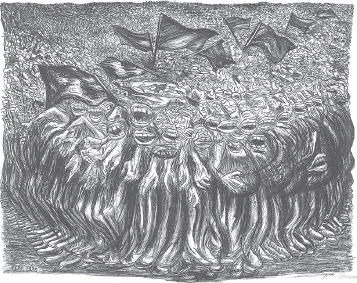
Las Masas (The Masses), by the celebrated Mexican muralist José Clemente Orozco (1883–1949), is an ambivalent portrayal of popular sovereignty where ‘the masses’ of workers and peasants resemble a new headless force, with multiple eyes and mouths, feet and hands, a flag-waving people mobilised against an implicit enemy. The 1935 image recalls the violence that erupted at the beginning of the 1910 Mexican Revolution, which claimed the lives of up to 1.5 million people and forced several hundred thousand into exile.
Hard-line believers in the Sovereign People doctrine found this new formula objectionable. The trouble was this: when measured by the oft-quoted definition of democracy as ‘government of the people, by the people, for the people’ (the words famously used by Abraham Lincoln at Gettysburg to honour soldiers who perished in the American Civil War), electoral democracy was a dud. It promised government based on the principle that ‘ The people’ are ultimately ‘sovereign’, yet in practice did the opposite. Not only did it condone the tearing apart of ‘ The people’ by bickering, self-interested, divisive political parties and parliaments; electoral democracy was a formula for handing power to elected leaders who push aside ‘ The people’ by speaking and acting on their behalf and consulting them directly just once in a while, during elections. Only then, in the lonely hour of the last instance, were ‘ The people’ entitled to have the final say in determining who governs. Electoral democracy wantonly dishonoured the principle vox populi, vox dei. It offered a recipe for disappointment: the triumph of the will of elected representatives over the views and interests of people robbed of their sovereignty.
It comes as no surprise that with the spread of competitively fought elections, first in churches and cities and later within whole states and empires, electoral democracy was regularly plagued by populist outbursts. Ancient assembly democrats worried themselves sick about demagoguery, but populism, a word coined only in the mid-nineteenth century, turned out to be a serious autoimmune disease of electoral democracy. Demagogues promising the earth and acting in the name of ‘ The people’ became commonplace. They helped stir up hopes of redemption, provoked fear, annoyance and ressentiment among disgruntled voters and, the American novelist James Fenimore Cooper said in the 1830s, spread ‘intrigue and deception’, ‘sly cunning and management’ and ‘appeals to passions and prejudices rather than to reason’.27
Let’s look at an early case of populism, in Argentina, where in the 1820s the textbook caudillo General Juan Manuel de Rosas (1793–1877) showed how electoral democracy could give birth to a thoroughly modern species of fear-ridden ‘democratic caesarism’ unknown to the ancients.28 It’s worth remembering that in the age of electoral democracy, Spanish America was no backwater. Between 1810 and 1830, following Napoleon’s 1807 invasion of peninsular Spain, every part of its Spanish American empire experimented with the methods of representative self-government. The odyssey turned most of the continent (Brazil remained a slaveowning constitutional monarchy closely tied to Portugal) into the freest place on earth – on paper at least. There was widespread praise for the principles of republican independence, confederation and federated government. Periodic elections backed by written constitutions, freedom of the press and multi-party systems became fashionable. Several Argentinian provinces daringly set the pace: their suffrage laws, the most advanced in the world, excluded women and indentured labourers with black skin, but otherwise extended the vote to all adult men, regardless of their education or class. ‘Every free man,’ announced the Law of Buenos Aires in August 1821, ‘born in the country or a simple resident, of 20 years of age or above, or before if married, is entitled to vote.’
General Rosas took full advantage of the trend. He touted himself as a brave and fearsome leader, a one-man government who was the saviour of his people and a lovable demagogue. He said he had been saddled with the task of cleansing a ‘hell in miniature’, a body politic infected with the virus of political anarchy, financial instability and low public morale. On a balmy autumn evening in Palermo, near Buenos Aires, he delivered a passionate speech to his supporters in proto-democratic language under a clump of ombu trees, famous for their wide, creeping roots and hollow trunks. The man who liked to dress in hat and poncho, silver spurs on his heels, whip in hand, ready to mount his horse at any moment, said that his ideal was a form of government defined by ‘ The autocratic dictators who have been the first servants of the people’.29
Rosas set about experimenting with the art of using elections, plebiscites and petitions to outflank his political opponents. The legislature and courts were neutered. Elections were transformed into plebiscites, awash in loud music, oaths of allegiance and fireworks. At every opportunity, Rosas offered perks to his supporters: local justices of the peace, military officers, administrators, journalists at prominent newspapers, ranch owners, wealthy merchants and anybody else willing to become vassals to the great leader. Rosas excelled at encouraging public demonstrations of solidarity. The faithful were instructed to dress in red, the colour of his Federalist forces. Women were urged to carry red flowers, preferably roses, and to wear red ribbons in their hair. The style for men was openly macho: fierce faces; hirsute chests; red caps, bandannas and silk badges calling for death to his enemies.
The man of the People also liked to pose as a man of God. Rosas cosied up to the clergy, many of whom responded by wearing red ribbons, preaching in his favour and organising street processions with portraits of him held aloft, later to be displayed at the rosemary-scented altars of local churches. New infantry and artillery units were meanwhile built up. Nearly half of his annual government budget was eventually devoted to the military, while for reasons of paranoia and megalomania he built a new private police force called the mazorca. It functioned as a death squad, carrying out selective assassinations (an estimated 2000 people lost their lives) and sniffing out and hunting down the ‘group enemies’ of ‘ The people’. Luckily for the real people of the Argentine provinces, Rosas was toppled by an alliance between his domestic opponents and Brazilian troops, and forced into exile – to Britain, where in recognition of his ‘kindness to the British merchants who had traded with his country’ he was granted asylum and welcomed with a 21-gun salute. Populism was good for business but bad for democracy.
DEMOCRATIC REVOLUTION
The populism of Rosas showed that electoral democracy was vulnerable to pathologies of its own making, above all endangered by demagoguery the worship of leaders hungry for followers. From the end of the eighteenth century until well into the 1930s, the political matter of who counted as ‘ The people’ triggered other great troubles. Eventually the working classes and women were acknowledged as worthy of the franchise. Some colonial peoples, such as in Senegal, were even blessed with the right to vote. And the formal abolition of slavery happened; in the United States, a bloody civil war marked off electoral from slave-based assembly democracy.
As we have seen, the radical dream of extending and universalising the practice of ‘one person, one vote’ was born of many different power conflicts, quite a few of them bitterly fought in the name of ‘ The people’ and in opposition to ruling groups, whether princes, bishops and priests, landowners or imperial monarchs. Disputes about who exactly ‘ The people’ were and who was entitled to represent them put every electoral democracy on edge. There were insurrections, boycotts and plenty of state violence. Whether groups, such as the clergy, the propertied classes or people in particular geographic regions, were entitled to privileged representation proved controversial. In Britain, the liberal philosopher and politician John Stuart Mill (1806–1873) championed ‘plural voting’, with the number of votes enjoyed by each person proportionate to their level of education: an ‘ordinary unskilled labourer’ would have one vote while a ‘graduate of any university, or a person freely elected a member of any learned society’ would have at least six.30
Strife erupted over the related question of whether and when minorities could legitimately trump the wishes of majorities, to prevent a ‘ tyranny of the majority’ (John Adams), for instance through schemes of proportional representation or by exercising powers of veto and amendment in upper chambers based on different principles of representation. Up until the 1930s, during fits of populism, spiteful politicking and cost-cutting, the governments of Nebraska, Nova Scotia, Prince Edward Island, Manitoba, New Brunswick and Queensland – all states or provinces within a federation – voted to abolish their upper chambers. Federated states more typically preserved their bicameral systems, with upper chambers elected on a different basis of representation, usually territory. Imaginative schemes of ‘functional representation’ were championed by groups such as the Austro-Marxists and the English guild socialists, who advocated workers’ control of industry, joint economic boards and other government plans for enabling workers’ representation, of the kind that flourished briefly after World War I in Germany, Czechoslovakia and other central European countries.
The troubles surrounding who was entitled to vote and what representation meant also produced many neologisms, such as ‘aristocratic democracy’ (that first happened in the Low Countries at the end of the sixteenth century), and new references, beginning in the United States, to ‘republican democracy’. Later phrases such as ‘social democracy’ (coined in Berlin working-class circles around 1840), ‘liberal democracy’ and ‘Christian democracy’ – even ‘bourgeois democracy’, ‘workers’ democracy’ and ‘socialist democracy’ – also spread.
The new terms expressed the many different kinds of group and class struggles for equal access to government that in the end often resulted, by hook and crook, in victories for the universal franchise in local iterations and institutions. It seemed to millions that the core modern democratic principle of free and fair periodic elections had history on its side. Especially from the second half of the eighteenth century, struggles for representative government and, later, its democratisation, generated great public excitement, pandemonium and hopes for a better future.
With a whiff of empowerment of ‘ The people’ permanently in the air, the final two centuries of the age of electoral democracy unleashed what the nineteenth-century French writer and politician Alexis de Tocqueville (1805–1859) accurately called a ‘great democratic revolution’ in favour of political and social equality.31 He noted that electoral democracy promised a dignified way of life based on the equality principle, and predicted that the enslavement of people by ‘aristocratic’ masters as well as the domination of women by men were among the inequalities that would have trouble surviving the democratic revolution. Excuses and alibis for inequality would sound ever more wooden, and publicly unconvincing.
Tocqueville did worry that the modern democratic revolution might be stifled by an all-powerful paternal state that ushered in a new kind of despotism. He was equally aware that the building of empires – he was among the champions of the French colonisation of Algeria – required clampdowns on electoral democracy, and that colonial rule was therefore vulnerable to democratic resistance by the colonised. His writings display a strong sense that electoral democracy was permanently on trial, but he didn’t foresee the organised efforts to roll back the franchise – as in the United States, where African Americans, following the bloody civil war waged in support of their emancipation, found themselves victimised by racist forces bent on narrowing and stealing the right to vote from certain groups, particularly black and poor people.32 He also underestimated the dangers of populism and, as we’re about to see, the challenges posed to electoral democracy by market systems of commodity production and exchange.
And yet Tocqueville was onto something: electoral democracy did indeed help turn the modern world upside-down and inside-out. It dealt a substantial blow against class hierarchy, male privilege, political bossing and colonial servitude. The modern democratic revolution sent shock waves outwards from the Atlantic region to the whole world. Fuelled by the earliest rowdy struggles and breathtaking acts, such as the artisan uprisings in the Low Countries, the public execution of King Charles I in England and Louis XVI in France, and the slave uprising against French colonial rule in Saint-Domingue (now Haiti), it threw into question all forms of anti-democratic bigotry that treated inequalities among people as ‘natural’. Slaves, women and workers won the franchise. At least on paper, and except for indigenous peoples, representation was eventually democratised, to include the bulk of the population. The spirit of electoral democracy took root in the Philippines, where a coalition of middle-class citizens and peasant rebels led by Emilio Aguinaldo proclaimed independence from Spanish imperial rule (the uprising was soon crushed by American annexation and military intervention). Elections also arrived in the Republic of China, where eventually, in 1948, more than 150 million citizens cast their votes in a general election.
Men casting their votes using ink brushes (máo bǐ) during the first Legislative Yuan election in China, held between 21 and 23 January 1948. It was boycotted by the Communist Party and turnout was low, but an estimated 150 million ballots were cast by citizens from the provinces and municipalities, the regions of Tibet and Mongolia, various occupational groups and citizens resident overseas. This was the largest election conducted in the era of electoral democracy and the last contested national election held on mainland soil.
WAR AND CAPITALISM
By the early years of the twentieth century, the politics of good government based on votes for all was everywhere on the move. Victory seemed to be around the corner. Italy was sometimes cited as an example of the progress being made: its 1861 general election, dominated by aristocrat powerbrokers, resulted in the unification of the country as the Kingdom of Italy. But change had been fiercely opposed by the Pope; and in any case voting was restricted to literate men over twenty-five who paid taxes. The 1913 general elections remained a man’s world, but the right of suffrage was extended to three new categories of men: those who were twenty-one or older and literate; illiterate men who’d reached the age of thirty; and all men who had served in the Italian army or navy. The trend seemed fortuitous. History was on the side of the universal franchise and representative government, or so many observers thought. They were mistaken – deeply mistaken.
Electoral democracy was about to be pushed into swamps teeming with political predators. For a start, no solution was found for the damage caused by imperial rivalries and fierce competition among armed nation-states. From around 370 BCE, during the era of assembly democracy, a remarkable cluster of citizen states in Arcadia, in the Peloponnese, formed themselves into the Arcadian League. Designed to bring peace to a region that had been dominated by Spartan power, the League resembled a simplified version of today’s European Union, in that it attempted to fashion a two-tiered confederacy bound by the rules of democratic negotiation and compromise. Run by a regional assembly called the myrioi, or ‘ Ten thousand’, it maintained a standing army based at its new capital, Megalopolis. It was the first-ever recorded experiment in cross-border democracy.
Nothing like that happened in the age of electoral democracy. Remarkably, during the 1920s, especially in trade union and social democratic and suffragette circles, there was talk for the first time of ‘international democracy’. But in its European heartlands, following a devastating world war, an influenza pandemic and the collapse of every continental empire, the language and practical hopes for cross-border democracy were swept aside. Electoral democracy found itself entrapped in a political inferno in which sovereign territorial states prevailed, locked horns for two decades (1918–1938) and brought on another catastrophic global war. As in the age of assembly democracy, the institutions of self-government were ultimately no match for the death-dealing calamities of war. Electoral democracy buckled, on a global scale.
In his famous Fourteen Points speech in January 1918, outlining a roadmap for ending World War I and fostering collective security, US president Woodrow Wilson (1856–1924) urged leaders and citizens everywhere to support the principle of a ‘society of free nations’. There was no mention of electoral democracy, but Wilson clearly had in mind a future in which every state and its people enjoyed self-determination based on law-abiding government and the commitment to free elections, plus freedom of commerce. The desire was to replace war and rumours of war with peaceful cooperation among self-governing states, backed by a ‘general association of nations’ abiding by ‘covenants for the purpose of affording mutual guarantees of political independence and territorial integrity to great and small states alike’. But it proved illusory. Soon there would be just eleven ‘free nation’ electoral democracies left on our planet.33
Two global storms of steel had ruinous effects on the ideals and structures of electoral democracy. The doctrine of self-governing ‘sovereign’ states protective of their nations, a word often used interchangeably with the phrase ‘a people’, had promised much. It had offered citizens a sense of purpose and dignity, a feeling of belonging to a bordered territory, of being ‘at home’ by sharing with others not only the right to vote but also a common understanding of food and songs and jokes and historical memories, even bodily gestures. In practice, the growth of rough-handed states oiled by leaders’ fanatical populist appeals to nationhood proved to be divisive, exclusionary and bellicose. Bovine language used by leaders such as Chancellor Otto von Bismarck – ‘Germans! Think with your blood!’ – helped prepare people for war. In colourful pseudo-democratic language, populist demagogues such as Benito Mussolini then drew the military conclusions. Since ‘war is the normal state of the people’, he bellowed, ‘speeches made to the people are essential to the arousing of enthusiasm for a war’. How best to whet the appetite for battle? Plant ‘ The national flag’ on the ‘dunghill’ of their popular indignity. Get them to see that there are ‘only two fatherlands in the world – that of the exploited and that of the exploiters’. Then, he concluded, the people yearning for self-determination and justice would be willing to march to war for their fatherland, proving that ‘fifty thousand rifles’ are worth more than ‘five million votes’.34
The arousal of ‘ The people’ in nation-states armed to the teeth turned out to be Europe’s murderous gift to itself, and to the rest of the world. War was the inevitable product of bickering states fuelled by nationalist pretensions. So was civil war, as happened in Ireland, whose partition into two states in 1920 sparked pogroms and gun battles and forced the Catholic minority to live in a Northern Ireland ruled by a British nationalist Protestant majority. Nearly 3000 civilians were killed during the subdivision of the island into two nation-states.
Electoral democracy was equally cursed by another threat for which there was no easy remedy: the challenge of reconciling the democratic vision of equality with the destruction and greed of profit-hungry capitalist economies. We’ve seen that Greek assembly democracies placed restrictions on commodity production and exchange; when adult male citizens met in public, they saw themselves as the higher-order beneficiaries of the necessaries of life produced by women and slaves in the lower sphere of the oikos. Politics trumped economics. Assembly democrats didn’t believe there was such a thing as an ‘economy’, whose laws of accumulation had to be respected for the sake of unending economic growth. At various points, the champions of modern electoral democracy also took a stand against the fetishism of economics. In the name of equality, property qualifications for elected representatives were abolished. Electoral democracy helped begin the process of liberating children from the cruelties of starvation, the whip and family bossing and bullying. It made room for independent trade unions, peaceful picketing and political parties committed to ending wage slavery and reckless accumulation.
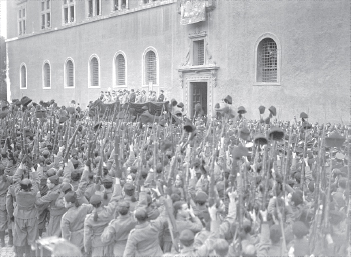
Soldiers and fascist paramilitaries raised their black fezzes in honour of Mussolini at a commemoration of the March on Rome in Piazza Venezia on 27 October 1929.
Factory safety inspectorates and boards of health were established. Local governments were pressured to provide sewers, rubbish removal and clean running water.
The welfare state reforms of the Uruguayan governments led by José Batlle y Ordóñez (1856–1929) were exemplary. They demonstrated for the first time anywhere in Spanish America that it was possible to use the institutions of representative government to create a more egalitarian society – in effect, to produce a type of electoral democracy that rested on more democratic social foundations. Against fierce opposition from hostile employers, Batlle fought tooth and nail for the eight-hour working day, unemployment insurance, night-work restrictions, retirement pensions and enforceable safety standards. The point was to de-commodify everyday life, to weaken the grip of market forces in favour of social equality. Under Batlle’s direction, free universal high-school education and women’s entry to university were approved. He said repeatedly that education was the right of ‘all, without distinction of social class’; at one point, he shocked some citizens by saying that the talented poor should be given the opportunity to become scholars, while the untalented rich should plant potatoes.35
These were impressive achievements, but despite them electoral democracy across the world was profoundly damaged by a system of aggressive, profit-driven commodity production and exchange called capitalism. The American political economist Thorstein Veblen (1857–1929) noted how easily electoral democracy could be converted into ‘a cloak to cover the nakedness of a government that does business for the kept classes’.36 Some critics of capitalism emphasised how its promises of ‘free labour’ were contradicted by the great violence it heaped upon people, whether by freebooters, pirates and slave traders, or by factory industrialists and colonial merchants hungering after wealth. Others noted the way the capitalist mentality corroded the democratic spirit of dignified equality for all people. Capitalism fed and spread greed, an appetite for arbitrary power fuelled by narcissism, vulgar conformity, stupidity and demagoguery.37
In a widely read pamphlet circulated shortly after Hitler was appointed Chancellor of Germany, the English public intellectual Harold Laski underscored the practical impossibility of combining capitalism and parliamentary democracy. ‘Representative democracy seems to have ended in a cul-de-sac,’ he wrote. The ultimate root of the present difficulties, Laski argued, was ‘ The inability of the principle of equality to find expression in a framework of institutions which deny it the possibility of effective entrance’. That was his way of saying that the chief impediment was an economic system founded on the control rich and powerful individuals, families and corporations had over resources in oil, coal, steel and high finance. Since the ‘governing class is not willing to alter the essential characteristics of capitalist society to its disadvantage’, the political priority had to be a ‘ Thoroughgoing institutional adjustment’, Laski concluded. Violence was to be avoided. Its use directly threatened the principles and practices of democracy. Instead, the urgent priority was to alter, through trade unions and general elections, the balance of power between the state and the economy by offering ‘ To the masses the potentiality of capturing the political machinery and using it to redress the inequalities to which the economic régime gives rise’.38
Throughout the 1920s and 1930s, similar complaints were issued by millions of citizens and their representatives. They recognised that self-government based on the principle of one person, one vote, wasn’t easily reconciled with an economy premised on the concentration of wealth and power in a few hands. There was a background history to the complaints. Yes, there were moments when the ethics and institutions of electoral democracy and capitalism seemed inseparable. The famous formula ‘no bourgeois, no democracy’ captured the way the spread of capitalism in parts of the world helped erode older forms of unequal dependency of the feudal, monarchic and patriarchal kind.39 The advance of commodity production and exchange also triggered productive tensions between state power and property-owning and creditor citizens jealous of their public liberties. The principle of ‘no taxation without representation’ – a child of sixteenth-century cities in the Low Countries – was born of those tensions. The frictions between states and markets also created space for the formation and flourishing of civil societies. The restless dynamism, technical innovation and enhanced productivity of modern capitalism extended material improvement and made possible the rise of a middle class. Capitalism even had the unintended consequence of laying the foundations for the radicalisation of civil society, in the shape of powerful mass movements of workers protected by trades unions, political parties and governments committed to widening the franchise and building welfare-state protections.
Capitalism and electoral democracy seemed to be buddies, but the bitter truth is that the partnership had always been troubled. Electoral democracy found itself threatened by capitalism’s rapaciousness, the way it worsened inequality and produced class-structured outcomes, recklessly exploited nature and bred speculative bubbles, whose inevitable bursting generated wild downturns. Throughout the age of electoral democracy, these busts often bred manias and brought fear and misery to people’s lives. In the process, they destabilised democratic institutions, forcing them to fall like tender buds in a snap frost – as happened spectacularly, on a global scale, during the 1920s and 1930s.
THE END OF ELECTORAL DEMOCRACY
Besieged by collapsing banks, flights of capital and mass unemployment, electoral democracy in many countries was rocked by great public disturbances, pressures for institutional reform, trumpet calls for revolution against parliamentary government, and state violence. Groups that felt threatened by electoral democracy desperately pushed back. ‘ The further democratisation advanced,’ reports a distinguished historian, ‘ The more likely it was to find large parts of the bourgeoisie on the side of those who warned against, criticised or opposed further democratisation.’40 The timing of the bourgeois disaffection with electoral democracy was fateful: it came at the moment when the right to vote for representatives finally came to be seen as a universal entitlement. Something had to give. Give it did.
Electoral democracy had appeared to come of age throughout the Atlantic region, including Europe, where between 1919 and 1921 most restrictions on voting were lifted, first for adult men and later – usually much later – for all adult women. But as pressure for the inclusion of women, colonial subjects and the lower classes grew, governments began to be pulled and stretched by multi-party systems that triggered wild swings from one political faction to another. Elections, party competition and power sharing suddenly seemed unfair, ineffective and unresponsive to the needs of millions – not only to the swelling ranks of new voters, but also to landholders and their military allies. Hanging on a hair, governments came and went at an alarming rate; after 1918, there were hardly any European countries blessed by governments that lasted longer than twelve months. Some parliaments suffered a nervous breakdown, made fractious by the multiplication of angry parties and the repeated collapse of executive authority; it was not uncommon to witness chambers ruined by representatives spitting insults, or throwing chairs, as if they were attending a carnival of asses. With civil societies frayed by class, ethnic and national divisions, the resulting social tensions and political conflicts soon took their toll. Parliamentary government imploded. Armed opposition to electoral democracy sprouted devils’ horns.
Among the chief foes of democracy during this period were the champions of purple tyranny: strong states ruled by monarchs bent on turning back the tide of universal suffrage and parliamentary democracy. Yugoslavia’s constitution was rewritten after the 1929 royal coup staged by King Alexander (who had earlier acceded to the throne because his elder brother was deemed unfit after kicking his servant to death in a fit of rage). The new constitution transferred executive power to the king, who appointed half the upper house of parliament directly, and guaranteed that legislation could become law with the approval of one house alone, so long as it had the king’s approval. The new electoral system effectively rolled back the franchise, restoring open balloting in rural constituencies, as public employees were bribed and bullied into voting for the governing party.
Calls for strong leadership and emergency decrees also flourished. The trumpets sounded for armed dictatorships, backed by talk of ‘ The people’. ‘I am convinced,’ said the Portuguese dictator António Salazar (1889–1970) in 1934, ‘ That within twenty years, if there is not some retrograde movement in political evolution, there will be no legislative assemblies left in Europe.’41 He meant it. So did Marshal Józef Piłsudski (1867–1935), former commander-in-chief of the Polish army, who stepped into the political vacuum produced by unstable government, hyperinflation and the assassination of the Polish president, Gabriel Narutowicz (1865–1922). Staging a coup d’état in 1926, Piłsudski rigged elections, gaining 46.8 per cent of the vote in the 1930 elections; arrested and put on trial the main opposition leaders; and, in 1935, imposed a new constitution that legalised dictatorship.
The notable exception to the trend on the European continent was Czechoslovakia. The seventh-largest economy in the world and by far the most durable electoral democracy of middle Europe, it was destroyed from the outside by a third type of anti-democratic politics never before experienced in the history of democracy: totalitarianism. It first burst onto the political scene in Russia and Italy, and soon spread to Weimar Germany, whose permanent crisis paved the way for the rise of Hitler; in Japan, there was ‘fascism from above’, or ‘cool fascism’, the phrase coined by the journalist Hasegawa Nyozekan (1875–1969). What was so menacing about totalitarianism was its sinister pretence to be a superior form of democracy. Its defenders scorned elections. Hitler harped on about parliamentary democracy as a great threat to natural-born ruling elites. Bespectacled General Tōjō Hideki (1884–1948), wartime leader of Japan’s fascist government, banned political parties and, in late April 1942, arranged a ‘General Election to Support the Greater East Asia War’. The new totalitarians swore that the totalitarian state was the embodiment of the Sovereign People in the Leader. The 1918 Bolshevik ‘Declaration of the Rights of the Working and Exploited People’ and the Nazis’ pompous talk of a Volksgemeinschaft, or ‘people’s community’, expressed the sentiment that totalitarianism was rule of the mobilised masses, for the masses, by the leaders of the masses, backed by the iron fists of uncompromising political power, organised propaganda, terror, concentration camps and the worship of violence.
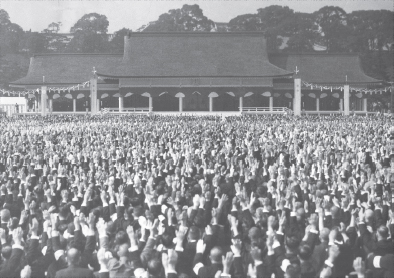
A mass rally celebration of the 2600th anniversary of Japanese emperors at the Imperial Palace, Tokyo, in November 1940. After the national anthem, music performances, and speeches by prime minister Fumimaro Konoe and Emperor Hirohito, all broadcast live on national radio, the crowd of 50,000 people shouted three times ‘Long live His Majesty the Emperor’.
As if by a conspiracy of devils, the experiences of total war and economic crisis, and the rise of purple tyranny, military dictatorship and totalitarianism together proved that electoral democracy wasn’t blessed with inevitability. Its fortunes certainly weren’t helped by attacks on its core principles by prominent intellectuals and journalists. Italy’s leading liberal, Benedetto Croce (1866–1952), said elections with universal suffrage were recipes for destroying freedom and favouring demagogues and other adventurers. In his Phantom Public (1925), America’s most distinguished political columnist, Walter Lippmann (1889–1974), caused a minor sensation by suggesting that representative democracy was founded on the bogus myth of ‘ The sovereign and omnicompetent citizen’. Most voters, he said, had but ‘a casual interest in facts’. They were mainly muddled and befuddled creatures, ‘as bewildered as a puppy trying to lick three bones at once’.
Similar thinking guided the newfangled business of opinion polling and public relations. The nephew of Sigmund Freud, Edward Louis Bernays (1891–1995), was among its founders. Styling himself a ‘public relations counsel’, he pushed the frontiers of sampling and public persuasion techniques towards what he called ‘ The engineering of consent’. He was sure voters were suggestible creatures, driven by libidinal energies in need of sublimation, restraint and ordering. Intelligently crafted publicity blitzes stage-managed by experts and leaders could change beliefs. His contributions to the Committee on Public Information, a Washington-based propaganda unit tasked with convincing the American people that World War I would ‘make the world safe for democracy’, convinced him of this. Here is Bernays explaining his conviction that electoral democracy had no future:
The conscious and intelligent manipulation of the organized habits and opinions of the masses is an important element in democratic society. Those who manipulate this unseen mechanism of society constitute an invisible government which is the true ruling power of our country … We are governed, our minds are molded, our tastes formed, our ideas suggested, largely by men we have never heard of … It is they who pull the wires which control the public mind.42
The metaphors were bad news for anyone who still believed that voters in free and fair elections chose their representatives rationally and wisely. Talk of invisible wire-pullers controlling public minds was a frontal assault on the principles of ‘government democratical, but representative’. It reminds us that there was no golden age of electoral democracy, simply because – with fewer than a dozen exceptions – almost everywhere in the world, its pure form was stillborn during the first three decades of the twentieth century. Its opponents fought hammer and tongs, and with great success, against its alleged incompetence, its fatal flaws and supposed evil effects. They wanted to prove by their actions that electoral democracy – said by Winston Churchill to be the worst form of government except all those other forms that had hitherto been tried – was mere gibberish. Success came their way. Using radio, newspaper and film propaganda, tanks and fighter planes, poisonous gas, barbed wire and concentration camps, they showed that history could be made to orphan electoral democracy – to kidnap and then kill its soul and substance.