
1
THE RUSSIAN REVOLUTION WAS MEANT to spark off revolution throughout Europe. But that plan didn’t work, and what was left was a revolutionary state in Russia – the Russian Soviet Federal Socialist Republic (RSFSR), with Moscow its capital. But there had been upheavals with a variety of outcomes in non-Russian regions of the Russian Empire too. The Baltic provinces chose independence; the Polish provinces opted to enter a newly created Polish state. But by the end of the civil war set off by the October Revolution, other regions had established their own soviet republics, often with a little help from the new revolutionary state’s Red Army.
In December 1922, the Ukrainian and Belorussian soviet republics and Transcaucasus Federation joined the Russian soviet republic in a Union of Soviet Socialist Republics. Its capital was Moscow (the old imperial capital, Petrograd, would have to get used to being second city). Its emblem was the hammer and sickle, with the motto (written in Russian, Ukrainian, Belorussian, Georgian, Armenian, and Azeri): ‘Proletarians of the world, unite!’
The Constitution of the new Union gave the republics the right to secede, although for close to seventy years, none ever invoked that right. In the 1920s and ’30s, five additional Central Asian republics (Uzbekistan, Turkmenistan, Tajikistan, Kazakhstan and Kirgizstan) were carved out of the RSFSR, and the Transcaucasus Federation split into its three constituent parts: Georgia, Armenia and Azerbaijan. In 1939, the three Baltic states (Latvia, Lithuania and Estonia) and Moldavia were incorporated into the Soviet Union as a result of secret clauses of the 1939 Nazi–Soviet Pact, bringing the total number of republics in the Union to fifteen.
The Soviet Union was clearly a successor state to Imperial Russia, albeit with a slightly diminished territory. Whether that meant that it, too, was an empire – with Russians ruling a bunch of internal colonies in the form of national republics – was a matter of dispute. The Western powers, hostile to the Bolshevik regime and hoping for its downfall, saw it as an empire, and an illegitimate one at that. The Bolsheviks, however, had a completely different way of seeing their Union. Many of the party’s leadership were not Russian at all but belonged to one of the old Russian Empire’s oppressed minorities, such as Latvians, Poles, Georgians, Armenians and Jews. They were sworn enemies of Russian imperialism who had grown up resenting increasing discrimination against non-Russians in the last years of the Empire. They saw their role inside and outside the Soviet Union as one of liberating former colonial subjects, particularly in Asia (including the Central Asian territories conquered by the Russian Empire in the nineteenth century). According to the mantra of the 1920s, ‘Russian chauvinism’ was the ‘greatest danger’, meaning that of all nationalisms in the Soviet Union, the one that was pernicious was the Russian.
The Bolsheviks were committed Marxist internationalists for whom nationalism was false consciousness. Nonetheless, they recognised its popular appeal and its tendency to multiply in response to attempts to eradicate it. The Bolsheviks were not going to make that mistake: their strategy was to encourage non-Russian nationalisms, not only through administrative use of the native language and furthering of national cultures but also through the creation of separate territorial administrations, starting at the level of republic (for example, Ukraine) and going right down to the level of village Soviet (there was an array of Jewish, Belorussian, Russian, Latvian, Greek and other ‘autonomous districts’ within the Ukrainian republic). It was one of the paradoxes of Soviet rule that its administrative structures not only protected national identities but also helped to create them.
THE PROBLEM OF BACKWARDNESS
The Bolsheviks were modernisers and rationalisers through and through: modernisation in the form of state-led industrial development was their core program and a large part of what they meant by socialism. They considered Russia’s backwardness vis-a-vis the West as a great challenge to be overcome, yet in their analysis, Russia also had its own internal ‘Orient’ – Central Asia – to modernise and civilise via capital investment in infrastructure and industry as well as literacy schools and affirmative action programs. For the Union as a whole, modernisation and the jettisoning of tradition were high on the short-term as well as the long-term agenda. Imperial Russia’s Julian calendar, thirteen days behind the Gregorian calendar used in the West, was an early victim (meaning that once the calendar changed in 1918, the ‘October Revolution’ was commemorated on 7 November). Changes to the old orthography, emancipation of women from a range of legal shackles, legalisation of abortion, no-fault divorce, disestablishment of the Orthodox Church (seen as a particularly egregious repository of superstition) and abolition of social estates were all introduced within months of the Bolsheviks’ seizing power.
How backward was Russia before the Revolution? ‘Backwardness’ is a slippery concept that always implies a comparison with something admired as more advanced; in Russia’s case, the comparison was with Western Europe. Pulling Russia out of backwardness and into the West had been Peter the Great’s mantra two centuries earlier, and building the new capital, St Petersburg (as close as possible to Europe), and forcibly shaving the boyars’ beards were among his strategies. Russia had done well enough under Peter’s successors – notably Catherine the Great, correspondent of the Enlightenment philosophers Diderot and Voltaire – to be recognised as a Great Power in Europe by the early nineteenth century, a reputation solidified by the defeat of Napoleon’s armies on Russia’s steppes. Its territories increased in the course of the nineteenth century as it expanded southwards into the Caucasus and overran small Central Asia sovereign states ruled by khans to the east. But it was not until the early 1860s that the peasants were emancipated from serfdom as part of Alexander II’s Great Reforms. The country was also a latecomer to the industrial revolution: Russia’s industrial take-off was in the 1890s, half a century behind Britain, and it relied heavily on state sponsorship (like Japan in the same period) and foreign investment.
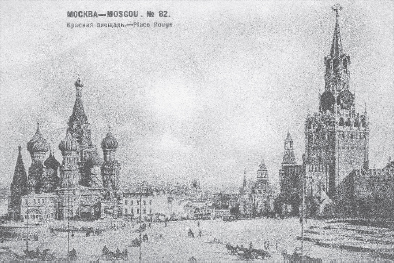
Moscow’s Red Square as it looked around 1900. Note that the name predates the Communists (‘red’ connoting beautiful). St Basil’s is on the left, the Kremlin on the right.

Moscow’s Lubyanka Square as it looked around 1900. It was renamed Dzerzhinsky Square in 1926.
At the time of Russia’s first modern census in 1897, the Empire’s population was 126 million, of which ninety-two million lived in European Russia (including what is now Ukraine and the eastern part of Poland). The rest was divided between the Empire’s Polish provinces and the Caucasus, both with around nine million, followed by Siberia and Central Asia. While the urban population of European Russia had tripled between 1863 and 1914, the degree of urbanisation and industrialisation sharply declined the further one moved away from the Western frontier, the Polish provinces being by far the most developed region of the Empire. In Siberia, 92 per cent of the population was rural. Less than a third of the Empire’s population in the ten-to-fifty-nine age group was literate, but this masked substantial disparities between men and women, urban and rural, young and old. Among people in their twenties, 45 per cent of men were literate, though only 12 per cent of women; for people in their fifties, the male literacy rate was 26 per cent with the female a mere 1 per cent.
In addition to the highly developed cities of Warsaw and Riga (which would be lost to the Soviet Union after the Revolution), the Union had a rapidly growing mining and metallurgical industry in the Donbass region of what is now Ukraine, much of it foreign-owned, with a workforce recruited largely from villages in Russia. St Petersburg, Moscow, Kiev, Kharkov and the port city of Odessa on the Black Sea were also industrialising, while Baku (in Azerbaijan, on the Caspian Sea) was becoming a major oil centre.
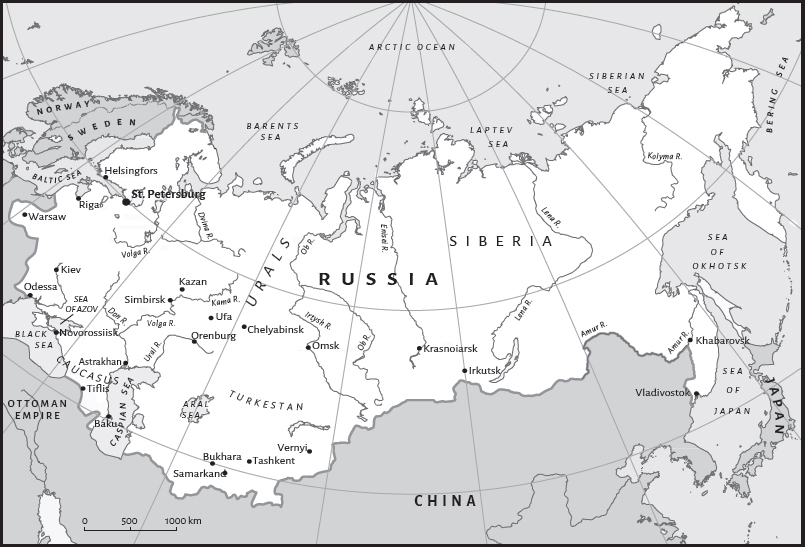
Imperial Russia
For administrative and census purposes, the population was still divided into social estates (sosloviia) – nobility, clergy and townspeople, and peasantry, each group with its own rights and duties to the Tsar – although such estates had long vanished in Western Europe and struck Russia’s Western-oriented intelligentsia as an embarrassing anachronism. The peasantry, at 77 per cent, was by far the largest estate, with townspeople and other urban estates accounting for only 11 per cent. The intelligentsia, or educated class, was a modern anomaly not accommodated by the estate scheme.
While Russia was a multinational empire, the concept of nationality was too modern for the tsarist regime, and the 1897 census gathered information only on religious confession and native language. ‘Russian’ was the language claimed by two-thirds of the Empire’s population, but that included what we would now call Ukrainian and Belorussian speakers: only 44 per cent were listed as ‘Great Russians’. As for religion, about 70 per cent were Russian Orthodox (including a couple of million Old Believers who had split off from the church in the seventeenth century), with 11 per cent Muslim, 9 per cent Roman Catholic and 4 per cent Jewish.
In Western Europe, particularly Britain, Russia became a byword for unenlightened autocracy, a process helped by energetic propaganda from exiled Russian revolutionaries benefiting from Britain’s generous asylum policies. The tsarist practice of exiling dissidents to Siberia was known and reviled throughout the ‘civilised’ world, just as Gulag would be during the Cold War. Despite its size and great power status, the precariousness of tsarist power became evident when in 1905, following humiliating defeat in a war with Japan, it barely survived a revolution that covered the breadth of its territory and took more than a year to quell. The revolution of 1905 provided Russian radicals with a heroic legend and a spontaneously generated revolutionary institution, the popularly elected soviet (literally, council), combining executive and legislative powers. Lev Trotsky, a Marxist of the Menshevik faction, achieved instant fame as the charismatic leader of the Petersburg Soviet, but the Bolshevik leader Vladimir Lenin, returning like Trotsky from emigration, arrived late for the revolution in 1905 and played only an inconspicuous part.
REVOLUTIONARIES IN WAITING
If you wanted to have a revolution in Russia, looking to the downtrodden peasantry for support might have seemed the obvious course. That was indeed the reasoning of the first generation of revolutionaries, the so-called Narodniks (Populists) who dominated the radical scene in the 1860s and ’70s. Mindful of the long tradition of peasant revolt in Russia, they saw the peasants as potential overthrowers of the Tsars as well as a source of untainted moral wisdom. But peasants gave Narodnik emissaries short shrift, perceiving them as members of an urban elite with which they had nothing in common. It was disappointment at that rejection that paved the way for the rise of Marxism in the revolutionary movement in the 1880s. Disciples of the German socialist thinkers Karl Marx and Friedrich Engels, the Russian Marxists offered a ‘scientific prediction’ of the inexorable ‘necessity’ of revolution, since capitalism was historically predestined to give way to socialism. The industrial proletariat, generated by the processes of capitalism itself, was the revolutionary agent chosen by history, meaning that the peasantry became (at least theoretically) irrelevant. Commitment to the revolution, previously justified on moral grounds, was reconfigured as something closer to a rational choice, rooted in an understanding of historical necessity (Gesetzmässigkeit in German and zakonomernost’ in Russian – but in the English-speaking world, an alien concept). These were deep philosophical waters, truly grasped only by the chosen few, but all Russian, and later Soviet, Marxists knew what zakonomerno meant: that was when things went as, in principle, they were supposed to (as distinct from the ‘accidental’ and ‘spontaneous’ way they often went in practice).
Marxist revolutionaries in Russia identified with the industrial working class, but initially most of them were offspring of the nobility or the intelligentsia. As in other developing countries in the late nineteenth and twentieth centuries, higher education in Russia meant Westernisation, which often brought radicalisation as a by-product; the first characteristic (Westernisation) implied alienation from the local population, the second (radicalisation) a sense of mission to lead it. Educated Russians with radical ideas had largely appropriated the term ‘intelligentsia’ for themselves, contemptuously excluding people with the same kind of education who went on to work for the state. (The fact that Alexander II’s Great Reforms had been carefully drafted by a group of ‘enlightened bureaucrats’ working behind the scenes did not affect this judgement: what were mere reforms when thoroughgoing revolution and spiritual rebirth were needed?) It was the intelligentsia’s self-appointed function to criticise the government (any government, as became clear after the collapse of tsarism) and act as the conscience of the society, and this, of course, brought it into constant conflict with the imperial authorities, notably the Okhrana, or secret police. For most, radical politics was not a day job. But a minority became full-time professional revolutionaries, often during their student days, which soon led to arrests, prison terms, exile within Russia, escape from exile (not that difficult) and, if parental funds permitted it, emigration. All the revolutionary factions, no matter whether they declared their social base to be peasants or workers, were led by revolutionary intellectuals, most of whom had spent long years in emigration in Europe.
Vladimir Lenin, born Vladimir Ulyanov in 1870 in the Volga town of Simbirsk (renamed Ulyanovsk in 1924 after Lenin’s death and still, rather surprisingly, bearing that name), was a law student in Kazan when he became radicalised, partly by the execution of his elder brother for involvement in a plot against the emperor. The Ulyanovs were professional middle class in our terms (the father an inspector of schools who rose high enough to become non-hereditary nobility) and mainly Russian in terms of ethnicity, though there was some German and Jewish in the mix. Lenin’s embrace of revolution brought him into the Marxist League of Struggle for the Emancipation of the Working Class in St Petersburg, which won him the usual punishment of administrative exile within Russia, followed by voluntary exile outside Russia, supported financially by his mother. He joined the motley group of Russian and other Eastern European revolutionaries who congregated in London, Paris, Geneva, Zurich and Berlin – a world full of seedy lodging houses, passionate hairsplitting arguments with other revolutionaries, police spies, informers, loneliness and long hours spent in libraries.
Within his Marxist revolutionary group, ethnic Russians like Lenin and his wife, Nadezhda Krupskaya, were less numerous than Jews, Poles, Latvians and other members of national minorities within the Russian Empire, who, from the late nineteenth century, were increasingly harassed by Imperial Russian authorities and subject to policies of Russification. Lenin was notable in revolutionary circles for his intransigence and need to dominate his own small faction, which became known as the Bolsheviks after a split in the social democratic movement engineered by Lenin in 1903. The term ‘Bolshevik’ was derived from the Russian for ‘majority’, while their opponents were labelled ‘Mensheviks’, from the Russian for ‘minority’ – a neat sleight of hand on Lenin’s part, as it was actually the Mensheviks who were in the majority.

Vladimir, a schoolboy, is front right in this 1879 studio portrait of the Ulyanov family; his older brother Alexander (to be executed as a terrorist at the age of twenty-one) stands at left.
Russian Marxists had a basic problem: according to the Marxist understanding of the laws of history, ‘their’ revolution – the one to which they had dedicated their lives – was not next on the historical agenda, but the one after next. This was because Russia was still only at the beginning of the capitalist phase, with a bourgeoisie too weak or passive to have carried out the bourgeois liberal revolution against the autocracy that was historically overdue. As a result, unlike Britain and Germany, it was not yet ‘ripe’ for proletarian socialist revolution. The Mensheviks, apart from some mavericks like Trotsky, took this immaturity argument seriously (probably their major doctrinal difference with Lenin); the Bolsheviks in practice did not. But it would be wrong to accept at face value the Mensheviks’ claims that the Bolsheviks were consequently bad Marxists. As their actions in power would later demonstrate, a Marxist understanding of class war and historical necessity was deeply ingrained in the party leaders, and, moreover, there were Marxist ways of justifying the legitimacy of proletarian revolution in Russia (the theory that the weakest link in the imperialist chain would be the first to snap, for example). The truth was that any revolutionary worth his salt was going to find a way round the theoretical prohibition on revolution.
Another problem for Marxist revolutionaries was the comparative weakness of the Russian proletariat. True, the proletariat was highly concentrated in large-scale enterprises (a revolutionary plus), but its number was still embarrassingly small, a bit over three million in 1914, out of a total population already over 125 million in 1897. This weakness was partly compensated by Lenin’s concept of the revolutionary party, which was to consist of full-time revolutionaries and act as the ‘vanguard’ of the proletariat. It was the task of the vanguard to open workers’ eyes to their historic revolutionary mission, and these workers – now labelled ‘conscious’ – would in turn act as a vanguard for the unenlightened but often rebellious masses. According to Russian police observations in 1901, the Bolsheviks were having some success with this project: the police noted that in the working-class milieu, ‘the easygoing Russian young man has been transformed into a special type of semiliterate “intelligent”, who feels obliged to spurn family and religion, to disregard the law and to deny and scoff at constituted authority’, and such people acquire authority over the ‘inert mass of workers’.
Lenin was the most uncompromisingly revolutionary within the Russian Marxist emigration, as well as the most authoritarian – intolerant of challenges within his faction, and insistent on the importance of organisation and professional leadership in the revolutionary movement, as opposed to popular spontaneity. But he was not a one-dimensional character. Married to Krupskaya, who was a teacher and educational theorist by vocation, he shared, at least to some degree, her conviction that enlightenment of the people was the deep purpose of revolution, making the provision of schools, literacy classes and libraries for the masses a key revolutionary task. To be sure, Lenin, unlike Krupskaya, was a natural politician with a strong sense of mission, for whom faction fighting and the struggle for power were the stuff of life. It was mainly during political doldrums that he had time to worry about popular enlightenment.
WORLD WAR I AND REVOLUTION
In January 1917, in exile in Zurich, Lenin lamented that he did not expect to see the Russian Revolution in his lifetime. It was a reasonable judgement that turned out to be wrong. The war years had not been a source of much pleasure to him, or to the international socialist movement in general. The hope had been that if war broke out between the imperialist competitors, workers would refuse to back the government and fire on their fellow proletarians. What happened was the opposite: workers and many socialist intellectuals suddenly became patriots, falling into line with their governments and being swept up in the intense nationalist enthusiasm that marked the early stages of the war. Lenin was unusual in continuing to hold that this was an imperialist war in which workers had no stake, and moreover arguing that for the Russian revolutionary cause, the best outcome would be Russia’s defeat. It was not a popular view among his émigré colleagues, and the Bolshevik Party fragmented further.
Russia’s military unpreparedness quickly became evident – the Imperial Army didn’t even have enough rifles for its initial call-up – and by 1915, with the Germans transferring forces to the Eastern Front, enemy troops had taken much of the Empire’s western provinces. The defeats, occupations and evacuations were shocking to the initially patriotic public. Two and a half million Russian POWs were in German hands by the end of the war, and there were almost two million military casualties, not counting the vast numbers wounded and invalided, and an only slightly smaller number of civilian casualties. As of February 1917, the army had conscripted a total of over fifteen million men, mainly peasants, leaving women to till the fields on their own. In the face of the German threat to the Empire’s western provinces, the Russian army deported perhaps as many as one million Jews to the interior of the country (the Pale of Settlement, in which most Jews were required to live, was close to the western border) as well as a quarter of a million Russo-Germans; in addition, six million refugees fled eastwards into the Russian hinterland to avoid the fighting.
Discontent was rising among the political and military elites as well as the hard-pressed civilian population and the battered ranks of the conscript army. It was rumoured that Emperor Nicholas II, an inept and indecisive figure, was under the thrall of his wife, Empress Alexandra, and their shady protégé Grigory Rasputin, who claimed to have healing powers over their haemophiliac child, Alexei, heir to the throne. Rasputin was murdered in December 1916 by the dissolute young Prince Felix Yusupov, who saw himself as defending the autocracy. Senior officers in the army were sufficiently alarmed by the situation to start talking to leaders of the recently created Duma (a parliament that was a product of the 1905 revolution). They collectively decided that Nicholas, who clearly did not enjoy the role of ruler, should be asked to abdicate on his own behalf and that of Alexei in favour of a brother who, it was hoped, would provide stronger leadership. Nicholas agreed and abdicated, but the brother turned the plotters down, leaving them confused and without a Plan B. That was the February Revolution, occurring in early March according to our calendar, which the Marxists labelled ‘bourgeois liberal’ (despite the fact that the plotters mainly belonged to the nobility and few were liberals). The February Revolution produced a stop-gap institution unpromisingly called the Provisional Government, which undertook to call a Constituent Assembly at some future time to decide how Russia should be governed. The Allies, desperate to keep Russia fighting in the war, immediately recognised the new government. That was one of the few things going for it.
The mood of rank-and-file conscripts in the army was grim. This was largely because of casualties, defeats and the unexpectedly long time away from home, but resentment at the Tsar’s removal in 1914 of the traditional vodka allowance for soldiers no doubt played a part. The prohibition, applied to the civilian population as well, removed an important source of state revenue and caused a diversion of grain to the illegal making of home-brew, which in turn produced bread shortages. A wave of popular discontent in the winter of 1916–1917 started with women workers queuing for bread in Petrograd (the capital had been renamed at the start of the war because ‘St Petersburg’ sounded too German) and spread into the armed forces, from which men sick of being cannon fodder started to desert. As the spring agricultural sowing drew nearer, more and more peasant soldiers left for their villages, their officers proving powerless to stop them. In the big cities, police started to melt away when faced with the growing crowds celebrating the Tsar’s abdication. It was a classic revolutionary situation – not because the forces of revolution were irresistible, even in the big cities where protest was strongest, but because the old regime had lost that mysterious thing called legitimacy, both with the populace and the elite, and its army and police had stopped being reliable protectors.
The heady moment of liberation associated with the February Days remained long in popular memory. Now there was revolution on the streets, or at least cheering demonstrators, and mirabile dictu for the Marxists, many of them were workers. An improvised popular body, modelled on the Petersburg Soviet of 1905 and consisting of deputies directly elected in factories and army units, came into being more or less at the same time as the Provisional Government. When the Petrograd Soviet declared itself the representative of popular revolution, demanding the right to co-sign any instructions to the army, the latter saw no choice but to comply. Thus the ‘dual power’ came into being – in essence a power-sharing arrangement between the Provisional Government and the Petrograd Soviet. It was a remarkable institutional expression of the belief of the Soviet’s socialist leaders (initially mainly Mensheviks) that as Russia was not yet ripe for proletarian revolution, the bourgeois liberals should have their historically mandated term – under the watchful eye of the proletariat.
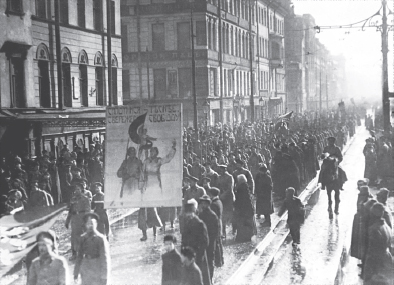
Revolutionary demonstration in Petrograd, February 1917. The banner reads: ‘ Freedom, equality, brotherhood.’
Within the revolutionary movement, the general mood was exalted, self-congratulatory and supportive of socialist unity. But there was a lone dissenter: Lenin. It took him a month or more to return from Zurich across the front (the war, of course, was still in progress), but he and a number of other revolutionaries finally got the Germans to permit transit of the famous ‘sealed train’ across German territory to Sweden and thence via Finland to Russia. He arrived at Petrograd’s Finland Station in April, greeted by an enthusiastic crowd, including reconciliation-minded socialists from the Soviet. Lenin quickly put an end to the happy mood of unity. There should be no more power-sharing with the Provisional Government, he announced. His new slogan, ‘All power to the soviets!’, meant forgetting about the bourgeois liberal revolution that the other Marxists thought Russia had to have and going straight to proletarian revolution. It was not just the Mensheviks who were appalled. So were those of Lenin’s own Bolshevik faction who had reached the capital earlier and basically fallen into line with the socialist united front. Even Lenin’s wife was startled: ‘Ilyich has gone crazy,’ she was reported to have muttered, sotto voce, to an old comrade standing nearby.
The next months saw the economic situation worsen, desertions from the army increase and huge demonstrations of workers and soldiers and sailors from garrisons near the capitals filling Petrograd and Moscow streets; the Provisional Government and the army high command made a desperate attempt to get the army in shape for summer fighting. In Petrograd, where the political action was, the Bolsheviks’ intransigent stance appealed to the demonstrators, their membership and influence shot up, and some action-oriented Mensheviks like Trotsky broke ranks to join the Bolsheviks. But in the crackdown after the biggest demonstration in early July, Lenin felt obliged to flee to Finland to avoid arrest. Alexander Kerensky, a lawyer from a minor socialist party, took over the leadership of the Provisional Government from Prince Lvov, but the situation in the army and the capital failed to improve and the Germans continued to advance, taking Riga (Latvia’s capital, still part of the Russian Empire) in August. This brought German forces uncomfortably close to Petrograd.
In September came high drama: an attempted military coup led by General Lavr Kornilov, recently appointed commander-in-chief by Kerensky and charged with the task of restoring discipline in the military. The relationship of Kornilov and Kerensky was murky, as that of Mikhail Gorbachev and the coup leaders of August 1990 would be seventy-three years later: it is possible that Kornilov saw himself acting for Kerensky rather than against him. In any case, the coup failed, owing to the prompt action of railway workers who stopped his echelons reaching the capital, and Kerensky’s standing was fatally damaged.
Lenin, supported by Trotsky, decided that the time had come to make the bid for power that demonstrators on the streets had been calling for since July. The October Revolution was achieved almost as quietly in Petrograd as the February Revolution had been, although later legends made it a much more daring and bloody affair. With a national Congress of Soviets assembled at a girls’ school in Petrograd, and Trotsky having done the necessary preparatory work within the Petrograd Soviet, Lenin emerged from his Finnish hide-out and announced that the Bolsheviks were leading a soviet takeover of power and abolishing the Provisional Government. The Mensheviks walked out of the congress, but it was a gesture that damaged only themselves. Kerensky, having donned women’s clothes as disguise, was already in flight.
A surprise awaited those who thought that ‘all power to the soviets’ meant that some soviet body – the Petrograd Soviet, perhaps, or some executive agency elected by the Congress of Soviets – would take over the leadership of the country. It turned out – and many Bolsheviks were among those surprised – that the new government was to be a Council of People’s Commissars (in effect, a state cabinet) whose just-appointed members were read out to the congress by Lenin’s spokesman: all were Bolsheviks, with Lenin as chairman. The Bolsheviks had taken power.
ESTABLISHMENT OF BOLSHEVIK RULE AND CIVIL WAR
While the Bolsheviks would have passionately rejected the thought, October had been an easy victory. Failure in war had discredited the old regime, and failure to get out of the war had done the same for the Provisional Government. Wartime exigencies concentrated millions of discontented men (with arms) in cities and garrisons, giving the revolutionaries a large constituency to draw on. The industrial working class, too, was highly concentrated in a relatively small number of big cities – making the task of revolutionary organisation there easier. And on top of that, many of Russia’s largest capitalist enterprises had been foreign-owned, meaning that some of their owners and managers had already left at the outbreak of war and the remainder were much easier to dislodge than if they had been locals. But of course, the seizure of power in Petrograd in October was only the beginning. It remained to be seen whether the Bolsheviks could hold onto this power, extend it to the rest of Russia and learn how to govern.
With Marxist punctiliousness, the Bolsheviks described their newly established rule as a ‘dictatorship of the proletariat’ whose task, with the ‘vanguard’ party as its instrument, was to carry the country forward through the transitional period until it was ready for socialism. Socialist critics might quibble about whether it was really the proletariat that was now in power, but in the circumstances of the civil war (which broke out in mid-1918 and continued for more than two years), the question of the party’s proletarian credentials was a secondary one. Dictatorship was the more salient concept, and in effect – despite some quasi-parliamentary trimmings – it was a dictatorship of the Bolshevik Party. The Bolsheviks expected opposition from the old governing and land-owning classes and the urban bourgeoisie, and they were open about the fact that terror would be used against such ‘class enemies’; the Cheka – the acronym for the All-Russian Extraordinary Commission for Struggle against Counter-Revolution, Sabotage and Speculation – was set up in December 1917 to deal with them.
In the name of social justice, the Cheka practiced forcible ‘expropriation’ of the property of the bourgeoisie and nobility, including their houses and apartments. There was no shortage of lower-class volunteers for expropriation brigades; indeed, one of the Bolsheviks’ minor problems in 1917–1918 was that common criminals had got in on the act, showing up at the door of bourgeois apartments as expropriators on their own behalf rather than the state’s and turning confiscation into a private enterprise. When this came to the Bolsheviks’ attention, they denounced the offenders as ‘lumpen proletarians’ rather than true members of the working class. But as lumpen was simply a Marxist pejorative for proletarians who lacked the proper socialist consciousness, it was difficult for an outsider to tell the lumpen proletarians from the real ones.
Much of this revolutionary action was taking place in the big cities where Bolshevik control was firmest. In the countryside, independent of any effective state control, the peasants were settling scores in their own way, driving out landlords and burning down their manor houses. When that had been largely accomplished, they often turned on the more prosperous members of their own communities, the so-called kulaks, and, in the newly fashionable terminology, ‘expropriated’ them.
The civil war was bloody and brutal on both sides, leaving complex legacies of bitterness and grievance. Jews in the western regions of the country were subjected to pogroms whose savagery exceeded those of the late tsarist period. Anarchy and confusion reigned in the provinces. ‘White’ (anti-Bolshevik) armies, led by officers of the old Imperial Army and more or less actively supported by Russia’s former wartime allies (Britain, France and the United States) and Japan, formed on the peripheries, hoping to overthrow the Bolsheviks and restore the old regime. In the Ukrainian provinces, Ukrainian nationalists, Bolsheviks, anarchists and Whites established precarious regimes (the capital, Kiev, changed hands five times in a year) in the context of German and later Polish military incursions. Mensheviks took power in Georgia in mid-1918, fighting Ottoman Turks and Armenians; Bolsheviks set up a commune in Baku whose leaders were executed by the British. A short-lived Volga Republic came into being in Samara, courtesy of trainloads of armed Czech prisoners of war (socialists but anti-Bolshevik), who were on their way to Vladivostok on the Pacific with the intention of sailing round the world to join the Allied military effort on the Western Front. The Japanese sent tens of thousands of troops into the Russian maritime provinces and Siberia.
The Bolsheviks had managed at great cost to pull Russia out of the European war in the spring of 1918, and the punitive treaty they signed with the Germans at Brest-Litovsk would have deprived them of much valuable territory in Ukraine, had it not become null and void on the Germans’ defeat by the remaining Allies eight months later. But the Bolsheviks had not yet escaped the meshes of war, since civil war broke out within half a year of their seizure of power. Nor, arguably, did they altogether wish to escape. Up to this point, military valour had had no part in the Bolshevik pantheon of virtues; there was not even a paramilitary tradition. Yet a zest for fighting the ‘White’ enemy quickly emerged in the party and among its supporters, and Lenin himself, though he never acquired the military patina embraced by many of his colleagues, probably thought that victory in civil war was a good way of legitimising Bolshevik rule. In any case, there would have been no avoiding civil war, even without the provocation of the execution of the Tsar and his family in the Urals capital of Ekaterinburg in mid-1918 (by local Bolsheviks, but with at least tacit approval from the centre). Officers of the dispersed Imperial Army, now jobless, wanted a fight, and the Allies, freed from November 1918 from the demands of the European war, were happy to provide backup.
For their part, the Bolsheviks managed the significant feat, under Trotsky’s leadership, of creating a new ‘Red Army’ that by the end of the civil war was five million strong, the country’s major employer and, in many parts of the country, the effective administrative power rather than the nominal civilian institutions. This was made possible by the fact that, given the way the civil war was fought, with small episodic engagements rather than large-scale bloody confrontations across trenches, the chances of dying were much less than for conscripts in the old imperial forces, and the Bolsheviks were relatively tolerant of deserters (who often showed up again after the sowing or harvest). In any case, only a minority of those on army rations were actually combat troops. The Whites, with officers aplenty, had more difficulty than the Reds recruiting rank-and-file soldiers; and the support they had from the Allies, while not enough to turn the military tide, was sufficiently visible to arouse Russian popular indignation against ‘foreign intervention’.

Trotsky, represented as a Red devil in a White Army propaganda poster entitled ‘Peace and Freedom in the Soviet Land’
The victorious outcome, achieved by the winter of 1920–1921, is often attributed to the peasants’ preference, when the chips were down, for Reds over Whites, who they feared would bring back the landlords. The same was probably true of the Empire’s non-Russians, unenthusiastic about the Whites’ attachment to ‘Russia one and indivisible’. The White Armies, uncoordinated and often poorly led, had the disadvantage of being scattered around the peripheries of a large country whose transport and distribution networks flowed outwards from the centre. The end of the Civil War led to an exodus of the Whites over the southern borders, with many settling in Yugoslavia, Czechoslovakia and Bulgaria, and over the eastern borders to China, where many ended up in Harbin, in effect a Russian city in Manchuria. The emigration of between one and two million people, including many from the elites, constituted a very substantial loss of talent for the new regime, but also the permanent removal of a political threat.
As of the beginning of 1921, there was a bit of mopping up to do in Central Asia, the Caucasus and the Far East, but the outcome of the civil war was clear: the Reds had won, and the territory they ruled was not hugely reduced from that of the old Russian Empire. The Baltic states and Finland had been allowed to depart. The Polish provinces – the most urbanised and industrialised part of the old Empire – had been lost after a military clash between the Red Army and the forces of the new Polish state that resulted in the Red Army’s defeat and a useful lesson for the Bolshevik leaders: when Polish workers saw Soviet troops advancing on Warsaw in 1921, they perceived them as Russian invaders rather than proletarian liberators.
As of 1922, the Communist Party membership comprised 72 per cent Great Russians, 6 per cent Ukrainians, 5 per cent Jews, 3 per cent Latvians and 2 per cent Georgians. That meant that about three of every thousand Soviet citizens of all nationalities were Communist Party members, with Jews, Georgians and Russians somewhat over-represented according to population share and Ukrainians under-represented. The strong preponderance of Russians in the party was a product of civil war recruitment, which brought total numbers up from 24,000 in 1917 to over 700,000 in March 1921, and made it a mass party for the first time. It was also, in contrast to the situation before 1917, overwhelmingly a men’s party, with memories of fighting in the civil war as the bonding agent. At the beginning of 1922, women made up under 8 per cent of party membership.
The Bolshevik leaders felt a degree of unease about the Union’s territorial similarity with the old Empire and the possibility of being misrecognised as Russian imperialists by its erstwhile subjects. Lenin repeatedly urged kid-glove treatment of non-Russians and avoidance of ‘even the slightest rudeness or injustice’ that might be misconstrued in national terms. He clashed with Stalin about how to handle the Georgians, the most obstreperous territorially based nationality left now that the Poles were gone. Stalin, a Georgian himself, was less tolerant of those Georgian Communists whose prickly national pride was offended by being subsumed in the Transcaucasus Federation. From his point of view, it was all pretty simple: if the peripheries of the old Russian Empire were lost to the new revolutionary state, that would only damage the international revolutionary movement, since they ‘would inevitably fall into the cabal of international imperialism’. So it was a binary choice: ‘either with Russia, which means liberation from the imperialist yoke, or with the Entente, which means the imperialist yoke is inevitable imperialist. There is no third option’. Their union on the territory of the old Russian Empire would be the first step on the way to a ‘World Socialist Soviet Republic’.