
2
THE WAY THE BOLSHEVIKS WROTE THE HISTORY, they surged into power as the party of the industrial working class. That wasn’t pure fantasy – the crowds on the streets of Moscow and Petrograd in July were for them, and the party had had an influx of new members. In October 1917, they had the largest number of delegates in the elected national Congress of Soviets. In the elections to the Constituent Assembly held in November, they ran second, with 25 per cent of the national vote, to the peasant-oriented Socialist Revolutionary (SR) party – but by December that party had split, with several left SRs entering Lenin’s government.
The Bolsheviks’ notion of representation, however, was a distinctly non-parliamentary one. They saw their party as the chosen representative of the working class, and in their mind, this was a one-off historic choice, an indissoluble union. The Bolsheviks could not conceive of the possibility that workers might turn to other political representatives if they became dissatisfied with the new regime. But under the prevailing dire economic and military circumstances, such dissatisfaction was extremely likely. In fact, it was manifest, along with renewed worker interest in other (socialist) political parties as early as the spring of 1918. By the end of 1920, the Kronstadt sailors – early and firm supporters of the Bolsheviks in 1917 – had come out in revolt, calling for ‘soviets without Communists’ (the Bolsheviks had renamed themselves as the Russian Communist party in 1918 and would become the Communist Party of the Soviet Union in 1924). The Kronstadt revolt was a terrible symbolic repudiation for the Bolsheviks, but it did not turn them from their path. The power to lead Russia out of backwardness into socialism via ‘proletarian dictatorship’ had fallen into their hands, and they were not about to let it drop.
Worker dissatisfaction was not the Bolsheviks’ only problem with the working class. There was the more alarming possibility that the class itself was unravelling. Soldiers and sailors of the Imperial Army, serving as temporary proletarians throughout the revolutionary year, had demobilised. As for industrial workers, some were now on the wrong side of the western border, and many of those who remained in Russia and Ukraine had disconcertingly vanished from the cities, going back to their native villages to survive on their family plots. This was not how proletarians were meant to behave, according to Marx, and it had been easy for the Bolsheviks to forget that Russia’s first-generation proletariat still had strong ties to the peasantry, which meant that when factories shut down and hunger ravaged the towns, they had the option of simply going home and becoming peasants again. Of the ‘conscious’ workers actively supporting the Bolsheviks, many had volunteered for the Red Army or had gone on to full-time party work. As the civil war ended, the victors looked around for the class that was meant to be their social support and found it gone. ‘Permit me to congratulate you on being the vanguard of a non-existent class,’ mocked a political opponent.
Relations with the peasantry were rocky, but this at least was a predictable problem. The Bolsheviks had retrospectively sanctioned the peasants’ spontaneous land seizures, which improved their standing in rural areas, but their requisitioning of grain to feed the cities and the army – carried out by armed workers’ and soldiers’ brigades that brought few if any manufactured goods to offer in return – was widely resented, as was the Bolsheviks’ habit of trying to split the peasantry into opposing camps. The Bolsheviks assumed that class exploitation existed in the village just as it did in the town, with kulaks the exploiters and poor peasants their victims. But peasants mainly rejected this class model, thinking of their villages as unitary communities dealing with the outside world through the traditional village organisation, the mir. In Ukraine, a ‘Green’ peasant army under Nestor Makhno fought the Bolsheviks on the one side and the Whites on the other. In the central Russian city of Tambov, a major peasant revolt was suppressed only after the dispatch of fifty thousand Red Army troops.
At the end of the civil war, the Red Army was the backbone of the Soviet administration as well as a de facto literacy school for peasant soldiers and a training site for the recruitment of future Communist administrators (‘cadres’). But the Red Army could not perform these functions indefinitely. Keen students of revolutionary history, the Bolsheviks were well aware that the French Revolution had ended when Napoleon Bonaparte, a former corporal of the Revolutionary Army that had conquered much of Europe, declared himself emperor. That was not going to happen in Russia. Two million men had been demobilised from the Red Army by early 1921, and the Politburo would soon move the army’s charismatic leader, Trotsky, to other work.

‘Kulak and Priest’, poster by Viktor Deni. Note the pig’s snout on the kulak.
The end of the civil war threw the question of how the Bolsheviks proposed to govern into sharp relief. Scarcely any thought had been given to this earlier, partly because in the early years there was a real expectation of international revolution, which would have obviated the necessity of creating a separate national revolutionary government for Russia. But by the early 1920s, it was clear that the postwar wave of revolutionary activity in Europe had collapsed and Russia would have to go it alone. Future international revolution remained an article of faith, however, and the Communist International (Comintern), set up in 1919 to unite communist parties around the world under Moscow’s leadership, was there to prove it. The Soviet Union and the Comintern were now looking eastwards as well as westwards: a Congress of Peoples of the East held in Baku in September 1920 proclaimed solidarity with victims of colonial exploitation and support for their liberation movements. However, since revolution had so far triumphed only in Russia, it was now imperative to work out the arrangements for what Stalin was later to call ‘socialism in one country’.
The Bolsheviks assumed that in the long term the revolution would guarantee all citizens work, free education and medical care, and social-welfare protection – but none of that could be provided on a universal basis immediately, given the poverty of the state and the chaotic aftermath of war. In the short term, what was on offer was a ‘dictatorship of the proletariat’. On the one hand, this meant Bolshevik Party rule in an effectively one-party state (the left SRs had quit the government in mid-1918, while other socialist parties were gradually being squeezed out of existence); on the other, it meant preferential treatment for workers in the state’s distribution of scarce resources. In common parlance, then as now, ‘dictatorship’ usually implied rule by one man assuming dictatorial powers: Napoleon was the historic example, and Mussolini – with a party of ideologically committed volunteers to mobilise the masses behind him – the contemporary one. Mussolini’s posturings as Il Duce were much ridiculed in the Soviet press, and personal dictatorship was definitely not what Lenin had in mind. In the party’s Politburo, Lenin, despite his great authority as party founder, insisted on his status as no more than the first among equals.
Lenin, however, had made himself head of the government (the Council of People’s Commissars) in October 1917, and may well have envisaged this as the supreme authority in the new system. In fact, it turned out otherwise. The renaming of government ministries as ‘People’s Commissariats’ did not disguise their line of descent from the tsarist bureaucracy, and the employment of non-Communist ‘experts’ further damaged their standing. The party, which quickly acquired its own parallel regional and local network, staffed by full-time Communist appointees, proved a formidable competitor for primacy. From the end of the civil war, it was usually the local party secretary who was number-one man in a given locality, with the chairman of the local soviet (now part of the state apparatus) number two. In the centre, the same process took a bit longer because of Lenin’s unique authority as head of the government, but by the time of his death in 1924 it was clear that the Politburo held the dominant position.
The Politburo of the first half of the 1920s consisted of about ten people elected by the party’s Central Committee (which was itself elected at more or less annual party congresses by delegates from the party’s local branches). Its function was to decide on major policy issues – but in addition to policy, there was the question of appointments, an urgent task as the new regime established itself. Top party appointments, as well as government and military assignments, had to be approved by the Politburo, but below that level the party also needed a body in charge of staffing the new party bureaucracy nationwide. This was handled by the Central Committee’s secretariat, headed from 1922 by General Secretary Joseph Stalin, a Politburo member. Among the key appointments under his control were the secretaries of the party at the regional and district level – the local executors of ‘proletarian dictatorship’.
The proliferation of new institutions, each with its own incomprehensible acronym or initials (Tseka, Ispolkom, Sovnarkom, VTsIK), bewildered contemporaries and was spoofed in many popular anecdotes, such as the one about legendary theatre director Konstantin Stanislavsky mixing up GUM, a state department store in Moscow, with the GPU, the Cheka’s successor as security police. But even revolutionary institutions have a habit of slipping into familiar patterns. As the system settled down and historical precedents quietly reasserted themselves, the office of regional and republican first party secretary came to resemble that of provincial governor in tsarist times, not least in having great local power tempered only by dependence on continuing central approval (from the party secretariat and Politburo).
As for the soviets, they fell into secondary roles. At the national level, the elected body that was to be known in the 1930s as the Supreme Soviet performed a quasi-parliamentary function, with its delegates (nominated by the party) carefully chosen to give appropriate representation to workers, peasants, members of ethnic minorities and women. For most of the interwar period, its chairman, who also served as formal head of the Soviet state, was Mikhail Kalinin, a respected party elder of working-class and peasant origins. At the local level, soviet executive committees, now staffed by centrally appointed rather than locally elected personnel, were transformed into regional and district branches of the central People’s Commissariats.
In the first years, the Bolshevik leaders were struggling to invent a new system on the go and make it work. The problems were enormous, in particular that of finding trustworthy cadres who could both understand instructions and use initiative. Lenin is often credited with saying that any cook could run the government. What he actually wrote, in response to ‘bourgeois’ criticism, was that he was neither so stupid as to think that any cook could immediately step in and run the state without training nor so prejudiced as to assume that only people born into privilege were capable of doing so. In fact, the Bolsheviks’ strategy was to use ‘conscious’ industrial workers – not the lowest stratum of urban society but a middling socio-economic class, probably in the top 15 per cent of the Russian population – as a prime recruitment ground for administrators. The promotion of cooks, once they were trained and raised in consciousness, could come later.
The Red Army was another important source of Bolshevik cadres. The demobilisation of the early 1920s brought a flood of non-commissioned officers and literate soldiers – exposed during their army service to Bolshevik ideas – back to the towns and villages, and ready for leadership roles. An unintended consequence was a degree of cultural militarisation of what had been a civilian-minded party. It sometimes seemed as if the fifty-year-old Lenin was the only man in the party still wearing a suit: the stereotypical Bolshevik administrator of the 1920s was a young man with civil war experience in army boots and jacket, topped with a worker’s cap. (The relatively few women in such roles dressed in the same way, or at least as much like a man as possible.)

Trotsky, Lenin and Kamenev shown visiting the Red Army on the Polish front of the Civil War, 5 May 1920. Note Lenin’s civilian dress, while the other two are in military garb.
THE NEW ECONOMIC POLICY
During the civil war, the Bolsheviks had nationalised everything in sight in the towns, including trade, responding both to ideology and the practical requirements of a war economy. Given how poorly the regime’s writ ran outside the big cities, the villages were essentially left to manage their own affairs, although they were subjected to periodic requisitioning raids by the Reds (and, in the territories they held, the Whites). Rationing, introduced in the towns during the European war, remained in force, and as always happens with rationing, the black market flourished. Rampant inflation drove down the value of the currency, which some hopeful enthusiasts took to be a sign of the ‘withering away of money’ that Marx had predicted would occur under socialism. Administrative collapse and chaos could also be interpreted as the ‘withering away of the state’ attendant upon socialism, of which Lenin had written as recently as mid-1917. But, in the middle of a civil war, the withering away of the state was the last thing Lenin desired. The state needed to be strong (a proletarian dictatorship), and most urgently, it needed to function.
The Communists had won the civil war, but that was about the only bright spot on the horizon. The urban economy and industrial infrastructure were smashed. The country was under boycott from the Western powers, which had not forgiven Russia’s withdrawal from the European war at a crucial moment. ‘Atheistic communism’ was condemned from the pulpits of the West, and horror stories of cannibalism and ‘socialisation of wives’ abounded. A generally unspoken subtext with particular circulation in Germany and Eastern Europe was that the wild men who had taken over Russia were a bunch of Jews, as foretold in the anti-Semitic Protocols of the Elders of Zion. This was a little closer to the mark than was comfortable for the Bolsheviks. No longer confined to the Pale, young Jews from the western regions flocked into Moscow and Petrograd, joined the Communist Party in substantial numbers and rose quickly in the new administration. Next to Latvians, Jews were the ethnic group most over-represented in the party. (Jews made up 4.3 per cent of party members in 1927 and 1.8 per cent of the total population.) The Central Committee elected by the Tenth Party Congress in March 1921 was multi-ethnic, like the old Russian Empire itself, and included Georgians, Jews, Ukrainians, Latvians and other nationalities, but Russians predominated. In the Politburo, however, three of the five voting members (Trotsky, Grigory Zinoviev and Lev Kamenev) were Jews, with one Georgian (Stalin) and one Russian (Lenin) – though admittedly the three candidate members (Nikolai Bukharin, Mikhail Kalinin and Vyacheslav Molotov) were Russian as well.
The Bolshevik Party was firmly committed to industrial modernisation (in Marxist terms, a precondition for socialism), and they intended to accomplish it with the help of central state economic planning, a conceptual innovation for peacetime, though practised as a wartime expedient during World War I by Germany and other belligerents. But as of 1921, there were urgent economic tasks that were way beyond the capacity of Russia’s embryonic planning organs to handle. A partial restoration of the market was the only immediate option, Lenin decided, though it was to be understood as a strategic temporary retreat. Under the New Economic Policy (NEP), banks and big industrial enterprises stayed in state hands, but retail trade and small industry returned to private hands or cooperatives, and peasants were once again able to sell their produce on the market. This move was a disappointment to Communist enthusiasts, and it took all of Lenin’s authority to get it through.
The result was a rapid recovery of small business and trade in the towns, but also of aspects of urban life that Bolsheviks found depressingly retrograde: restaurants frequented by ‘bourgeoisie’ and their fur-wearing wives, cabarets and prostitution. The Bolsheviks hated the new trading bourgeoisie, known as Nepmen, and regarded them not only as ‘class enemies’ but also as crooks – which was not completely farfetched, given that the NEP economy retained many features of the black market it had replaced, including a dependence on goods removed by whatever means necessary from state warehouses. Industry, especially large-scale industry, lagged behind, primarily because of a shortage of capital: the new Soviet state was cash-strapped, there were no local capitalists left to invest and foreign capitalists were no longer welcome.

‘Lenin Cleanses the Land of Scum’: drawing by Viktor Deni (after Mikhail Cheremnykh), 1920. Tsars, priests and capitalists are the scum.
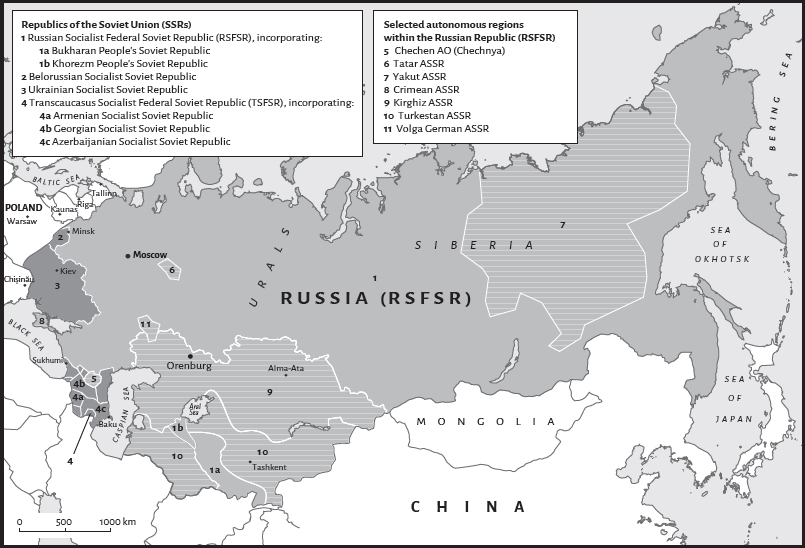
USSR in 1922, showing all Union republics and selected autonomous regions
In the non-Russian republics and regions, the main story was the integration of historically Muslim Central Asia, where the confrontation over traditional and Soviet mores focused particularly on the unveiling of women. Soviet nationality policy distinguished between ‘backwards’ ethnic groups (such as Uzbeks and Bashkirs) and those that were on a cultural level with (or above) the Russians (such as Ukrainians, Georgians and Jews), but ‘indigenisation’ – the use of local languages and the education and promotion of local cadres – was the watchword everywhere (even if in Ukraine, its implementor in the 1920s was Lazar Kaganovich, a Jew with rusty Ukrainian from a village childhood).
Some observers abroad were encouraged to hope that with NEP, Russia was recovering from its bout of revolutionary madness and returning to normal. This was exactly what the Bolshevik leaders feared – to have won the revolution politically, only to lose it economically and socially. Tentative feelers emerged from the West to re-establish relations on the basis of partial forgiveness of the tsarist debts (which the Bolsheviks refused to honour) and resumption of trade. But on the foreign trade question, Lenin was adamant: it should remain a state monopoly, for fear the imperialists would use it as a wedge, as in tsarist times, for pushing Russia back into a position of colonial subservience. A corollary of this attitude to foreign trade was that state borders had to be kept tightly shut to prevent the cross-border smuggling of goods that flourished in the first years after the Revolution – and later, to keep out dangerous Western ideas as well. The result of that self-imposed isolation from the world, which was to last to some degree for almost the whole life of the Soviet Union, was a kind of aggressive cultural insularity conveyed through the Soviet trademark combination of boastfulness and a sense of inferiority in dealing with the West.
Lenin insisted that relaxing economic policies did not mean political relaxation. It was just like an army engaged in tactical retreat, he wrote: discipline must be unwavering to prevent retreat turning into a rout. The country effectively had a one-party system by the end of the civil war, so the main possible arena for conflict was the party itself. Lenin had never tolerated much disagreement in the Bolshevik Party before the revolution, but in 1917 and the first years in power, he tolerated it willy-nilly on a number of issues – among others, whether or not to take power in October (Zinoviev and others had doubts); whether to sign the Brest-Litovsk Treaty with the Germans in 1918 (Bukharin and the ‘left Communists’ were against); and whether Tsarists officers (‘bourgeois specialists’) could be used, under appropriate control, in the Red Army during the civil war (Trotsky was for, Stalin against).
By the end of 1920, factional struggle had not just become established practice within the party but had also generated an issue of principle. A group called ‘Democratic Centralists’ advocated more democracy within the party, while Lenin thought there was already too much. If the Democratic Centralists had won, the party might have become an umbrella for a range of organised factions seeking support for particular agendas, with outcomes decided by votes that all accepted as binding – but such pluralism went against the grain for most rank-and-file Bolsheviks, who wanted decisive rather than democratic leadership and tended to view disagreements at the top with disapproval. In any case, Lenin was not about to let this happen. At the Tenth Party Congress, he shamelessly mobilised his own faction – including Stalin and candidate Politburo member Molotov – to push through a resolution ‘On party unity’ that banned factions. That provided Lenin’s group with a useful weapon to use against opponents, who could now be accused of violating the ban on factionalism. But it would be a mistake to jump to the conclusion that the resolution actually caused factions in the party to disappear. In fact, they flourished throughout the 1920s as never before – until Stalin put an end to them.
WHERE TO NOW?
The 1920s were often nostalgically represented in retrospect as a golden age of pluralism and permissiveness. But ‘golden age’ was not how it felt at the time; an age of anxiety was more like it. Workers were worried about unemployment. Peasants, especially the older ones, were baffled by the Bolsheviks’ Westernised vocabulary and alien frame of reference: Who was Karlo-Mars? What was levoliutsiia (a mishearing of the equally incomprehensible revoliutsiia)? Why did young people from the towns call themselves komsomoltsy (Komsomol was the acronym for Communist Union of Youth) and mock the priests? If Lenin was the new Tsar, why didn’t they call him that? Why did the Bolsheviks’ ‘women’s departments’ try to draw decent peasant and working-class women out of their proper sphere into public life, and why were men now able to throw over their wives and children in so-called ‘postcard divorces’? Ordinary townspeople – the ones the Bolsheviks called ‘petty-bourgeois philistines’ – were apprehensive because they felt buffeted by barely understood political storms and were afraid of what the Bolsheviks might do next. The intelligentsia (later to become propagators of the ‘golden age’ myth) were annoyed, at the time, that the Bolsheviks called them ‘bourgeois’, ignored their pretensions to moral leadership and would not let them run institutions like universities and state theatres without political oversight. It was a time of great avant-garde vitality in the arts, but also of bitter artistic factionalism, the competing factions being constantly at one another’s throats and denouncing one another to the authorities.

Anatoly Lunacharsky (on the right), the first People’s Commissar of Enlightenment (1917–1929), with his secretary and brother-in-law Igor Sats (later one of the editors of Novy Mir) in the mid-1920s
Party members were also full of anxiety. They worried about whether they could do the managerial jobs for which they were often ill prepared. They felt threatened by capitalist spies and subversion, foreign military attack, a revanche of the pernicious bourgeoisie and the influence of kulaks, priests, Nepmen and other ‘class enemies’. They were fearful, too, of ‘masking’: that is, bourgeois pretending to be proletarian, and kulaks pretending to be poor peasants – a totally justified fear, insofar as the Bolsheviks’ policies of favouring and rewarding proletarians and penalising the bourgeoisie led all sorts of people into such deceptions. They worried about exhaustion and poor health within the precious cohort of ‘Old Bolsheviks’, and disillusionment and suicide among the young. They dreaded a ‘Thermidorian degeneration’ of the party, such as had occurred in the wake of the French Revolutionary terror. Civil war veterans missed their wartime camaraderie. Komsomol enthusiasts, too young to have fought, loudly bemoaned the party’s alleged loss of militant spirit.
Lenin, in his last years, developed worries of his own about whether the party had the competence and culture to carry out the enormous tasks it had taken upon itself. In some of his late writings, he could sound almost like a 1917 Menshevik deploring the ‘prematurity’ of the October Revolution. But he was a sick man in those years, effectively removed by illness from the magic circle of power, and this was surely a major contributing cause of his pessimism. Lenin was only fifty in 1920, but his health had been affected by the bullet wound he received in a 1918 assassination attempt, and in May 1922 he had a stroke. He tried to keep working, but then came a second stroke in December, ending his participation in political life. There was a third stroke in March 1923, and on 21 January 1924 he died.
In the twenty months of his illness, isolated with his wife in his dacha outside Moscow, his anxiety about Russia’s backwardness and the party’s low cultural level became almost an obsession. The passivity of the masses, Lenin feared, left Communists to do all the heavy lifting, but the Communists themselves were mainly poorly educated and consequently at the mercy of government bureaucrats (old-regime holdovers) with different values. ‘If we take Moscow, with its 4700 Communists in responsible positions, and if we take that huge bureaucratic machine, that gigantic heap, we must ask: who is directing whom?’, he commented almost despairingly in 1922.
In this period, Lenin also became strongly critical of the party’s ‘oligarchical’ tendencies, meaning, in effect, its rule by a Politburo of which he was no longer an active member due to his illness. Some historians have interpreted these late writings as evidence of Lenin’s conversion to participatory democracy and pluralism. The possibility of such an interpretation would have considerable importance for future framing of debate within the Soviet Communist Party, since it allowed a ‘democratic’ Lenin to be invoked (as he was in the post-Stalin period) as a kind of counter-Stalin – a champion of legality against oppressive and arbitrary state power. Whether it is an accurate representation of Lenin in real life is more doubtful. As a skilled dialectician, Lenin was always capable of switching abruptly from one side of an argument to the other. He certainly deeply resented being cut out of the Politburo loop on doctors’ orders. However, he had never complained about a Politburo oligarchy when he was heading it, and even during his illness, he neither suggested that the ban on factions should be lifted nor that the increasingly moribund soviets should be encouraged to resume active participation in political life. What undoubtedly did resurface in Lenin’s last years was a humanist concern for the enlightenment of the people via the provision of schools, literacy classes, reading rooms and libraries, something he and his wife – now his sole companion – had always shared.
THE SUCCESSION STRUGGLE
Even before his death, Lenin’s illness precipitated a faction fight within the leadership – so much for the ban on factions! – that was waged for half a decade and ultimately resulted in Stalin’s emergence as the new leader. It was not initially conceptualised as a leadership fight but as a struggle to retain Politburo unity. Initially, the perceived threat to that unity was Trotsky – a civil war hero, with a popular fame second only to Lenin, but a latecomer to the Bolshevik Party and, to those who had read their French Revolutionary history, the man most likely to emerge as a Bonaparte and hijack the revolution. Most of the rest of the Politburo, including Stalin, Zinoviev and Bukharin, joined ranks to close him out, and succeeded.
Lenin was not directly involved in these wrangles, but shortly after his second stroke he wrote a letter to the Central Committee – known to historians, though not to Lenin, as his ‘Testament’ – summing up the capacities of various senior party members, including Trotsky, Stalin, Zinoviev and Bukharin. Distributing faint praise and criticism more or less equally, this document in its original form neither endorsed nor disqualified any of the potential candidates for leadership. But a few days later, Lenin added a postscript on Stalin, saying that he was ‘too rude’ and lacked the qualities necessary to be the party’s general secretary. This assessment was provoked by a quarrel between Krupskaya and Stalin. The Politburo had given Stalin the thankless task of seeing that the doctors’ orders to keep newspapers and official papers from Lenin were followed, but Krupskaya, who thought it agitated the patient more to be kept in ignorance, disobeyed. When Lenin heard that Stalin had abused her on this account, he weighed in with an extraordinarily un-Bolshevik statement – a real reversion to the honour code of his youth – that he could have no dealings with a man who had insulted his wife.
Lenin’s comments hurt Stalin personally – he is said to have fled Moscow and holed up alone in a dacha for several days after the letter was produced – and caused him considerable political embarrassment. But at the time they were made, Stalin was not perceived by anyone, except perhaps himself, as a plausible successor to Lenin. He was the colourless backroom man with a Georgian accent who, as general secretary, did the boring organisational work that other Politburo members had no time for. Even in the fight with Trotsky in 1923–1924, Stalin was just one of a Politburo group, the ‘Central Committee majority’, defending party unity from Trotsky’s challenge. The group included Zinoviev, head of the Leningrad branch of the party and the Comintern, who probably thought of himself as its leader, and the popular but younger and somewhat lightweight Bukharin, who was editor of the party newspaper, Pravda, and would succeed Zinoviev as head of the Comintern in 1926.
The succession struggle was the basic issue underlying the factional conflicts of the 1920s, though it was not openly acknowledged as such, and the party, lacking a Führerprinzip or an office to go with it, formally had no individual leader to replace. But then Lenin died, and everything changed as a result of an outpouring of popular demand – taken up by some of the party leaders, but not originating from them – that he be essentially deified. ‘Lenin lives’ became the slogan of the day, and his followers were exhorted to carry out his legacy. To the horror of his atheist widow and many of his comrades, his body was embalmed and placed in a mausoleum next to the Kremlin. The Lenin cult had been well and truly launched and so, tacitly, had the assumption that the party required a leader (in Russian, vozhd’).
While succession was the major underlying issue in the faction fighting of the 1920s, there were also policy issues at stake. Of these, the overarching one was whether to go with aggressive policies that were popular in the party or conciliatory ones that appealed to the population. Picking fights with some alien group – Nepmen, kulaks, priests, ‘bourgeois specialists’, capitalist foreigners – and using state power to crush it was a good strategy for maintaining the party’s sense of revolutionary identity and purpose. But making concessions to the population, particularly the peasantry, in order to win them over and make the regime more secure, was clearly the prudent course. It was the latter approach that prevailed for most of the 1920s.
The conflict with Trotsky started on issues of policy, not party leadership, while Lenin was still alive. The issues were the growth of bureaucratism within the party, a lack of consultation with the rank and file, and the excessive power of a small ‘Old Bolshevik’ elite, concerns close to those Lenin had expressed. The ‘New Course’ manifesto that Trotsky put out in 1923 was a call for generational change that initiated widespread discussion within the party. In the winter of 1923–1924, the selection of delegates for the upcoming Thirteenth Party Congress turned into something like a real election campaign in local party branches, with some delegates supporting Trotsky’s theses, others those of the ‘Democratic Centralists’ (who had been raising the issue of party democracy since 1920) and still others the ‘Central Committee majority’ line of Zinoviev and Stalin – which won, but in the face of substantial dissent.

Lenin Mausoleum: a 1950s view of Alexey Shchusev’s granite constructivist monument from the 1920s, set in Red Square against the Kremlin wall
Trotsky’s faction was then labelled an ‘Opposition’ to the ‘Central Committee majority’, as neat a piece of branding as Lenin’s in 1903, when he called his minority faction of the Social Democratic Labour Party the ‘Bolsheviks’. Zinoviev, Kamenev and Stalin were now the triumvirate in control, and in mid-1924, Zinoviev, with Politburo backing, launched a campaign, ‘Face to the countryside’, to bring more economic and cultural resources to the villages and convince the peasants that proletarian power was on their side. Bukharin took up the theme with a call to peasants to ‘get rich’, which was also an implicit plea to Communists to stop labelling any modern-minded, prosperous peasant a kulak exploiter. There was also a push to revitalise the soviets, once bastions of popular democracy but now languishing. For a few years, the practice of limiting candidates in soviet elections to those nominated by the local party was abandoned: with party and Komsomol organisations relaxing their control, locals were free to put forward their own candidates and vote more or less for whom they liked.
Thus there were democratic flickers in the mid-1920s, both within the party and the soviets. But the experiment with soviet democracy soon faded (too many villagers wanted to elect local authority figures whom the local party regarded as class enemies), and party democracy fared no better. After the comparatively close-run quasi-election of May 1924, Stalin, as head of the party secretariat, put more effort into stacking the congress by selecting Moscow-approved delegates in the regions. This was facilitated by the fact that the factions gained little traction in the party outside the capitals. Local Communists were inclined to put Politburo conflicts into the age-old Russian category of ‘fighting among the boyars’ and to view Oppositionists as privileged frondeurs.
Stalin’s control over the appointments of regional party secretaries – who in turn were often sent as delegates from their regions to the party congresses that elected the Central Committee and ultimately the Politburo – established a ‘circular flow of power’ greatly to Stalin’s advantage. But there was more to those regional party secretaries than simply playing the clients to Stalin’s patron. They were ‘little Stalins’, surrounded by ‘families’ of their own political clients, without whom Moscow could not have governed the provinces. To be sure, there were recurrent scandals and occasional purges, but overall, the power of the first party secretary in his fiefdom, and as a lobbyist for it with Moscow, would be a constant for the whole life of the Soviet Union.
By the mid-1920s, with the economy back to semi-normal functioning after the disruption of the civil war, it was time to think more seriously about a fundamental party commitment: industrialisation. Everyone agreed on the necessity of rapid industrialisation to create the prerequisites for socialism, but opinion was divided on how rapid it should be and where the money for investment in thousands of new factories, mines, hydro-electric schemes and railways should come from. Some, including Trotsky at times, were in favour of the cautious use of foreign investors, despite Lenin’s strictures on that issue, but it was unclear whether any foreign capitalists would want to invest, not to mention whether such a policy could be sold to the party as a whole. Five years earlier, it had been possible to hope that the whole issue of how to manage Russia’s economic development would be made moot by the victory of revolution in the West, enabling Russia to join up with Germany and other more advanced economies. Now that hope was gone, and Stalin was only stating the obvious when he put forward the slogan ‘Socialism in one country’ – there was no other option on offer.
But if industrialisation had to be launched without foreign investment, that money had to be found somewhere in the domestic economy, and unfortunately most of those with money (the ‘exploiters’) had already been expropriated. ‘Squeezing the peasants’ – that is, making them pay more for the goods they bought from the town and giving them less for the goods they brought to market – looked like a good option to many. But it was scarcely compatible with the ‘Face to the countryside’ policies favoured by Zinoviev, and there was also the worry that too much pressure on the peasantry might precipitate revolts.
After a year or so, Stalin manoeuvred Zinoviev and Kamenev, the other two members of the anti-Trotsky triumvirate, into a new Opposition that, too late for any real political impact, joined forces with Trotsky’s Opposition. As the dance of the factions became ever more complicated, it became harder to see which policies the various factions were identified with. Trotsky was generally a maximalist (‘leftist’), pushing for the most ambitious and quickest plan of economic development. Bukharin, a radical on social questions in the early ’20s, had swung around and become a ‘rightist’. Stalin sometimes looked like a rightist and sometimes a leftist, recalling the contemporary joke that ‘the party line never deviates’, accompanied by hand gestures showing it veering first to the left, then the right.
Along with the cult of Lenin, a new pernicious cult was taking hold – that of the party and the correctness of its ‘line’. ‘The party is always right’ had become the mantra, and before too long, respected Old Bolsheviks were being forced to make abject apologies for their Oppositionist views in front of jeering and whistling delegates at the annual party congresses. Krupskaya, who had joined the Zinoviev Opposition in 1925, was the rare exception who stood up to the heckling and declined to apologise, even mocking – as only Lenin’s widow could have dared to do – the idea that the party could not err.
It was perhaps surprising that Stalin, part of the 1 per cent of party members who were Georgian as against the 72 per cent who were Russians, should have landed the leadership prize at the end of the 1920s. Although he spoke Russian with an accent, he increasingly identified as Russian. A great advantage, undoubtedly, was that his two main competitors – Trotsky and Zinoviev – were Jewish, and, as Trotsky himself acknowledged, a Jewish leader was a bridge too far for the general population of the country, and perhaps for the party’s rank and file as well. If Bukharin, a genuine Russian, had been a better politician, he might have had a chance against Stalin, but by the time he made his move it was too late. The Jewish issue was not openly exploited by Stalin, but it almost certainly coloured the party debate on Stalin’s ‘Socialism in one country’, in which Trotsky was painted into a corner as the internationalist. Of course internationalism was a core Leninist party policy. But the word was also taking on connotations as a marker for Jewishness.
The Bolsheviks were not averse to using terror against class enemies, and had done so freely during the civil war before pulling back somewhat during NEP. But they always expressed strong disapproval of allowing ‘the revolution to eat its own children’ (that is, using terror as a weapon against party opponents), as in the French Revolution. Under Lenin, those defeated in policy conflicts were not forced out of the party, and by common consent, the Cheka and its successor, the GPU, left the party leaders alone. That changed late in 1927, when leading Oppositionists were expelled from the party and those who refused to break with the Opposition were sent off into internal exile by the GPU. Trotsky’s destination was Alma-Ata, on the Chinese border in Kazakhstan, although by a strange oversight he was allowed to take all his books and papers (which subsequently ended up in Harvard’s Widener Library), and keep up an extensive correspondence with his followers exiled to different parts of the country. Two years later (February 1929), in an extraordinary break with party tradition, he was deported from the Soviet Union – his home country – as a traitor to the revolution. Eleven years after that, he would be murdered in Mexico by Stalin’s assassin.
Trotsky, an arrogant man, always despised Stalin and was slow to see him as a real political threat. Stalin was neither an orator nor a theorist (two areas, highly valued in the party, in which Trotsky excelled), and having been educated in an Orthodox seminary in Georgia before dropping out to become a professional revolutionary, he was not even an intellectual in Trotsky’s eyes. He was no cosmopolitan: instead of spending years in emigration, his revolutionary apprenticeship had been served in prison and internal exile. There were no towering achievements in his biography, such as heading the Petersburg Soviet in 1905 or creating the Red Army from nothing in the civil war. Lenin’s snub in the ‘Testament’ had been a substantial political setback. He was a ‘grey blur’ (to quote the memoirist Nikolai Sukhanov); a mere ‘creature of the bureaucracy’, as Trotsky would later claim; a ‘crude man’, as he admitted himself when apologising for his rudeness to Krupskaya during Lenin’s illness. Trotsky scarcely even bothered to be polite to him, still less to those who supported him, a group that from the mid-1920s included several Politburo members, notably Molotov, ex-Red Cavalry man Klim Voroshilov and Kaganovich, a candidate member of the Politburo who was first secretary of the party in Ukraine.

Dzerzhinsky Square (formerly Lubyanka) in Moscow, with a statue of Felix Dzerzhinsky by Yevgeny Vuchetich, erected in 1958. Secret police headquarters are partially visible on the right.
Trotsky’s contempt – generally echoed, until the Soviet archives opened in the 1990s, by historians – was woefully off the mark. Stalin was not a mediocrity, he was not stupid and he was nobody’s creature. If others played a more stellar part in the policy debates of the 1920s, it was Stalin who came to a simple conclusion about the way forward. Lenin had led the party to victory in the political revolution of October, but the economic revolution – crucial in Marxist terms – was still to come. Stalin would be the man to lead it.