
3
IF THE SOVIET UNION STILL REQUIRED a second revolution, an economic one, how was it to be carried out? Obviously not by people spontaneously coming out onto the streets, as in 1917. This revolution needed to be planned (after all, its purpose was to realise the idea of centralised economic planning) and directed from Moscow. Historians have often called it a ‘revolution from above’, stressing the ‘from above’ aspect. That is quite accurate, as long as the ‘revolution’ part is not overlooked. The extraordinary thing about Stalin’s economic-transformation program is that it was, in fact, carried out by quasi-revolutionary means – to achieve its aims, Stalin mobilised the party and its supporters for violence against other parts of the population.
It might seem odd to present a program of planned, state-sponsored industrialisation as if it were a revolutionary war against ‘class enemies’ and ‘foreign interventionists’. But Stalin was, after all, a revolutionary: violence and the stirring up of class resentments were things he knew how to do. The party knew how to do them as well. In terms of economic rationality, the method was very wasteful, but given the militant mindset of the party and its civil war formation, it had its own political rationality.

Vera Mukhina’s iconic statue, Worker and Collective Farm Woman, was first shown in the Soviet pavilion at the International Exhibition in Paris in 1937.
The ‘Great Break’ of 1929–1932, as Stalin himself called it, had three aspects. The first was forced-pace industrialisation, carried out according to a Five-Year Plan worked out by the state planning agency; the second was agricultural collectivisation; and the third was ‘cultural revolution’, a term the Soviets invented long before its replay in the 1960s by the Chinese Communists. The violence surrounding all three new aspects of the program served to intimidate the non-Communist population and cow it into submission. But its purpose was also to rally Stalin’s own troops – Communists, young Communists, ‘conscious’ urban workers – by letting them do what at this point they still really wanted to do, which was to pick fights with people they considered their enemies.
As is common at moments of domestic crisis, an alleged foreign threat was invoked as a stimulus to action. Although there was no real evidence that the (admittedly hostile) Western capitalist powers were preparing any immediate military operations against the Soviet Union, the Soviet press had for months been playing up a war scare. The cultural revolution – conceptualised as a movement to overthrow ‘bourgeois dominance’ in the cultural sphere – tied in with this, since it was launched early in 1928 with dramatically publicised show trials of engineers (‘bourgeois specialists’) on charges of industrial sabotage and spying for foreign intelligence agencies. This started a witch-hunt in the factories against ‘wrecker’ engineers, whose privileged social status workers often resented.
It was industrialisation, not agricultural collectivisation, that was at the centre of the economic agenda of Stalin’s revolution. Collectivisation was actually a secondary objective that, given predictable peasant resistance, might prudently have been left until a later date. But it was class-war imperatives, not prudence, that won arguments in the Soviet Communist Party in 1928. Not for the first time, peasants and the Soviet government were engaged in a tussle about prices for agricultural goods. The state could have raised its procurement prices, but conventional wisdom among the economists held that the only way to finance industrialisation was to ‘squeeze’ the peasantry. In a brief, rare foray outside the capital, Stalin went to Siberia to look at the situation for himself. He came back with the news that ‘kulaks’ were holding back grain from the market, trying to drive the prices up, and that this amounted to political sabotage. New punishments for ‘hoarding’ were introduced; more peasant resistance ensued. The program of all-out collectivisation launched in the winter of 1929 was meant to solve the problem once and for all by making the newly formed collective farms the sole legal marketer of grain and the state their only customer. The kulak problem would also be solved definitively by kicking the kulaks out of the village.
Meanwhile, in the towns, another class enemy was under siege in a campaign to de-privatise the urban economy. With the help of the GPU, Nepmen and small traders and manufacturers were put out of business (and often into prison as well). This was another rash and ill-thought-out policy that required the state to set up its own retail network in a hurry, almost without advance planning. The outcome was shortages, rationing (another measure that conveyed wartime crisis to the population) and their corollary, rapid growth of the black market.
COLLECTIVISATION AND CULTURAL REVOLUTION
Collectivisation was supposed to be a voluntary process. But in the villages there were few signs of any spontaneous desire to collectivise, and coercion was built into the fabric of the program via a parallel process called ‘dekulakisation’, which meant that the land and dwellings of people labelled kulaks were seized and the ‘kulaks’ themselves were deported by the GPU and resettled in distant parts of the Soviet Union. The slogan was ‘liquidation of kulaks as a class’, but as few old-style kulaks exploiting the labour of poor peasants remained in the villages (partly as a result of efforts to curb such practices in the 1920s), any unpopular figure in the village could be so labelled and duly punished. Brigades of Communists and urban volunteers were sent out to the villages to organise collectivisation, which essentially meant persuading peasants to sign up for the kolkhoz (collective farm) under the implicit threat of being expelled from the village as kulaks if they did not. On signing up, peasants were required to hand over their horses to plough the collective fields that would now be consolidated out of the traditional strips of individual households; sometimes the collectivisers took other animals as well.
For all the contemporary excitement about planning, collectivisation was launched virtually without preparation; the process was largely made up on the fly. No clear instructions were given either to collectivisers or to the peasants, and necessary facilities such as collective stables had not been ordered. When things went wrong, Stalin blamed overzealous local officials. Soviet propaganda represented collectivisation as a move from small-to large-scale farming and from age-old manual techniques to modern mechanised ones. But there were not enough tractors and combine harvesters to go round, and the peasants did not know how to use them. In addition, despite all the publicity given to enormous new collective farms with names like ‘Giant’, it proved too hard as a general rule to set up functioning agricultural units larger than the existing villages, so smaller farms were (quietly) settled for.
Collectivisation was enforced nationwide, but there were regional variations. In Kazakhstan, where the native herding population was still largely nomadic, it was a corollary of compulsory sedentarisation, provoking mass resistance and flight across the border into China. Georgia, with its agricultural focus on fruit, wine and technical crops, rather than grain, got a milder version than the norm, thanks to the protective efforts of local Communist leaders, including Lavrenty Beria. In areas with ethnically mixed populations, the majority ethnic group sometimes tried to pin the kulak label on a comparatively prosperous minority group such as German farmers. More ethnic tensions were created by dumping deported Russian and Ukrainian kulaks in such places as Kazakhstan.
Five to six million peasants, constituting about 4 per cent of all peasant households, were victims of dekulakisation (including those who fled to the towns under threat of expropriation). Of the two million deported outside their own regions, the majority were resettled in uncultivated rural areas and a substantial minority sent to work on new industrial construction sites. There were no large-scale revolts in European Russia: the extraordinary measure of out-of-the-blue terror proved a sufficient deterrent for most peasants; anger and passive resistance, however, were widespread. Peasants slaughtered their livestock rather than handing them over, and hid grain to avoid delivering their procurements quotas. Rumours circulated that collectivisation was the coming of Antichrist, and that the collectivisers were about to cut off the women’s hair and institute communal marriage. In a popular form of resistance, groups of peasant women (less likely than men to be arrested) followed the collectivisers round the village, demonstratively weeping and singing hymns.
One of the most remarkable aspects of collectivisation was the parallel campaign against priests and the church in the Russian and Ukrainian countryside, and against Buddhism and Islam in other regions of the country. This clearly indicates that ‘class war’ violence was an integral part of the process, since anyone seriously hoping to persuade peasants to change their traditional farming and marketing habits would surely not add insult to injury by going after the local church or mosque. But that is just what urban brigades of Komsomols did when they came in to ‘collectivise’, gleefully vandalising churches, digging up graveyards and dancing around with skeletons, and taking down the church bells ‘as scrap metal for industrialisation’. Meanwhile, the GPU was quietly arresting priests and deporting them to the interior along with the ‘kulaks’. How deep Russian peasants’ Christian faith was before this assault on the church is debatable, but persecution certainly reinforced it. As for the urban collectivisers, some were sorry for the peasants, but many believed in the threat from class enemies in the countryside, especially when angry peasants took pot shots at them or stealthily waylaid them at night and threw them into the river. It was a baptism by fire (though not too much fire) that joined the heroic legends of civil-war struggle in Communist mythology.
In the cities and towns, cultural revolution ranged from the carnivalesque to the curricular. The Soviet Komsomols never went quite as far as the Chinese Red Guards, who in their later Cultural Revolution would parade actual live victims through the streets in dunces’ caps, but the Komsomols also had their parades where effigies of priests and Nepmen were mocked and sometimes burnt. ‘Light cavalry’ brigades invaded government offices, scattering files around and accusing the employees of being ‘bureaucrats’. In Central Asia, the unveiling of women became more coercive and widespread. University students held meetings to denounce ‘bourgeois’ professors, who then had to publicly confess their political sins and promise to introduce Marxist texts into their syllabi. The most egregious actions of cultural revolutionaries sometimes earned rebukes from party leaders, but generally it was seen as ‘excess’ in a good cause – that of overthrowing tradition and dislodging the bourgeoisie from its position of cultural dominance. The enthusiasm of young Communists for the job was unmistakable: as one contemporary observer put it, they had been itching to be ‘unleashed’.
A less anarchic aspect of cultural revolution was the drive for affirmative action (to use an anachronistic term) on behalf of workers, poor peasants and ‘backwards’ ethnic groups that took high priority in the late 1920s. Women were on the affirmative action list too, but with much lower priority in this period, which also saw the disbanding of the Central Committee’s women’s department. Affirmative action meant both direct promotion into managerial jobs and preferential admission to higher and technical education, the latter being accompanied, in good cultural revolutionary style (but not without anguish on the part of the educational authorities), by purging existing students who came from bourgeois, kulak and clerical families. Affirmative action was something new on the international scene in 1930; there was not even a contemporary English-language term to describe it. Marxist theorists might disdain the program, since workers should not wish to leave their class, but working-class, peasant and non-Russian families appreciated the opportunity for advancement. Future national leaders Nikita Khrushchev and Leonid Brezhnev, along with a raft of native-son leaders in the republics, were among the grateful beneficiaries.

Industrial construction sites under the first Five-Year Plan (1928–1932)

Multiculturalism in the 1930s: Georgian Joseph Stalin and Russian Klim Voroshilov in Central Asian robes presented to them by prize-winning collective farmers of Turkmenistan and Tajikistan in 1936. Sergo Ordzhonikidze, in military jacket, is on the right.
INDUSTRIALISATION
The first Five-Year Plan was the earliest effort in national economic planning for the Soviet Union (and, as Soviet propagandists reiterated, for the world), focusing on rapid development of heavy industry, particularly mining, metallurgy and machine-building. The ambitious plan was to double the state’s investment in industry over the past five years and achieve a tripling of output from the prewar level. The problem of where to find the capital investment was never satisfactorily solved: in the short run, collectivising the peasants did not prove an effective method of ‘squeezing’, since the expenses were greater than anticipated and the returns slower to come through. An increase in state vodka production (needed, as Stalin wrote to Molotov in 1930, to pay for military expansion) helped fill the gap, as did a sharp, unplanned drop in the standard of living in the towns.
Not having much capital to throw at the problem, the Soviet state threw cheap labour. Women joining the workforce for the first time – the main focus of women’s emancipation in this period – were one important source, with almost ten million women entering paid employment in the course of the 1930s; the urban unemployed constituted another reserve. But the primary labour source tapped was the peasantry, with kulak deportation a major contributor to this process, and the GPU, together with Gulag’s growing network of labour camps, becoming a key industrial supplier. In addition, millions of young peasants left the villages for the towns during collectivisation, some fleeing dekulakisation or the kolkhoz and others simply seeking opportunity now that jobs in the towns had opened up. In the years of the first Five-Year Plan, one peasant left the village and became a wage-earner for every three who stayed and became kolkhozniks. An extraordinary twelve million moved permanently from village to town in the period of 1928–1932 alone.
Had anyone had the gall to point it out, collectivisation was serving the same function in the Soviet Union as the enclosure movement in eighteenth-and nineteenth-century England, which had ruthlessly driven farmers off the land, thus providing the labour force for the industrial revolution, as Marx had noted. To what degree this result was anticipated and formed part of the regime’s collectivisation strategy is unclear. Stalin, at any rate, was not telling. In a strikingly mendacious speech celebrating the success of collectivisation in abolishing rural poverty, he claimed – in a year when the Soviet urban population increased by four million – that because of the attractions of the kolkhoz, the traditional ‘peasant flight’ from village to town had become a thing of the past.
In drafting the first Five-Year Plan and its successors, the big arguments were about what new plants, railways and hydro-electric schemes the state should build, and where to build them. This had some unacknowledged resemblance to porkbarrel politics in the West. One of the most heated and long-running debates was about whether to focus development on Ukraine, which had more modern infrastructure but was uncomfortably close to the western border, or in the Urals, less modern in its industrial base but geographically more secure. A long-standing assumption among Soviet planners and politicians was that the country’s industrially less-developed regions, such as Siberia, Central Asia and the Caucasus, should have priority. But there were competing imperatives, including security ones: with the build-up of the country’s defence capability as one of the major objectives of the first Five-Year Plan, Stalin was inclined to favour the Russian/Ukrainian heartland over non-Slavic regions as a location for defence-related plants. These choices were for the Politburo to make, however, not Stalin alone, and the decision process involved heavy and continuous lobbying from the republics and regions for their favourite projects. Such lobbying – and, more generally, the representation of regional interests in Moscow – became a key task of republican and regional first secretaries. A number of Politburo members also had their own territories to defend at budget time, none more (or more successfully) than the People’s Commissar for Heavy Industry, Stalin’s fellow Georgian, Sergo Ordzhonikidze.
Magnitogorsk, the great metallurgical complex built in the Urals in the middle of nowhere, was a quintessential construction project of the first Five-Year Plan, embodying many of its contradictions. Heavily dependent on the labour of convicts and deported kulaks under GPU guard, with ‘wrecker’ engineers removed from more salubrious regions working alongside newly trained Communists, Magnitogorsk was also a mecca for young Komsomol volunteers, fired up with a sense of fighting against the odds to ‘conquer nature’ and build Soviet industry in the empty steppe. It was a classic frontier town, full of hardship but also plenty of adventure and comradeship, a place where people’s origins could often be forgotten, and an erstwhile kulak’s son could become a Stakhanovite (super-achieving) worker and then join the Komsomol. ‘New Soviet man’ was being forged here, if not exactly in the form envisaged in the blueprints.

Happy life on the collective farm (1931), as depicted in F.F. Kondratov’s poster for the spectacle Flax staged at Moscow’s Theatre of Worker Youth
A distinctive culture of boasting emerged in the Soviet press, which every day proclaimed the country’s ‘achievements’ (a key word of the 1930s) in the building of socialism: so many tons of iron ore mined, so many blast furnaces put into operation, so many miles of railway track laid, so many kilowatt-hours of electricity produced by the new hydro-electric plants. There were ‘no fortresses that Bolsheviks could not storm’, Stalin said, using one of the military metaphors that had become ubiquitous. But many ‘ambushes’ and ‘tactical retreats’ occurred along the way. Soviet planning, at this point, meant deciding priorities among competing projects and setting output targets and urging enterprises to ‘overfulfil’ them – not working out in detail where a particular tractor factory would get the rubber for its tires. Consequently, industrial enterprises had an informal army of ‘agents’ paid out of plant directors’ slush funds to search out the necessary supplies and make sure it was dispatched in their direction.
With shortages of food and consumer goods even more critical than that of industrial raw materials, Soviet citizens honed similar skills to the best of their ability. ‘It is better to have a hundred friends than a hundred rubles,’ the Soviet saying went; access to goods through ‘connections’ was the key, while having the money to pay for them was secondary. This applied as much to the worker in a shoe factory who could slip a pair of galoshes to a friend from the kolkhoz in exchange for potatoes, as to a district party secretary or an academician. ‘Whom do you go to?’ the wife of police chief Nikolai Ezhov asked the wife of the poet Osip Mandelstam when they chanced to meet at an elite resort. She meant: ‘Who is your patron?’ High-minded Nadezhda did not at first understand the question, but her husband did, explaining: ‘We go to Nikolai Bukharin.’
RESULTS
The first two Five-Year Plans did produce industrial breakthrough, though at tremendous cost and with massive wastage. Soviet figures claimed a doubling on gross industrial production between 1928 and 1932 and a further doubling in the next Five-Year Plan period, for an average annual growth rate of almost 17 per cent for the period of 1928–1940. Western analysts (and revisionist Soviet economists of the 1980s) put that annual growth rate closer to 10 per cent, but even that was quite impressive. Some production indices like oil, coal, lorries and tractors already showed steep rises by the end of the first Five-Year Plan. But much of the effort of the first plan went into creating plants producing such resources as pig iron and rolled steel, and these were not functional until the mid-1930s. The only consumer item whose production went up was vodka, which by the mid-1930s was supplying up to a fifth of total state revenues.
Full employment was basically achieved during the first Five-Year Plan, and unemployment disappeared from the Soviet repertoire of social problems for the next sixty years. But the diversion of funds to heavy industry meant that social-welfare programs were chronically underfunded, generally available only to urban wage and salary earners and, in practice, often restricted to privileged groups such as workers in key industries.
In terms of the geographical distribution of industrial production, the Urals, Siberia and Central Asia had increased their share substantially (though in the case of Central Asia from a very low base). The Soviet Union was still a long way behind its Western capitalist competitors but had pulled level with Japan. It is possible, as some economists have argued, that similar results could have been achieved less wastefully by more moderate policies – but perhaps only in a country whose political culture embraced moderation.
The big failure was collectivisation, which set back Soviet agriculture for decades, alienated the peasantry and made food shortages endemic in the towns. After Stalin’s death, Soviet politicians would say that it was not collectivisation itself but its ‘excesses’ that were to blame. But the excesses were part of the package. In the short term, the high procurements targets imposed on the collective farms hit hardest in the major grain-growing regions of the country. The present-day Ukrainian government claims this famine, known in Ukraine as ‘Holodomor’, was the result of a conscious plan on Stalin’s part to kill Ukrainians; however, the results were equally devastating in southern Russia and Kazakhstan. It seems unlikely that Stalin actually wanted to kill peasants; rather, he wanted the state to take the greatest possible amount of grain out of the villages consistent with its peasant producers surviving until the spring sowing. The trouble was that nobody knew what that amount was, and Stalin certainly pushed local officials to go for the maximum and refused to listen when told that the peasants had no more hidden reserves. A bizarre rhetoric about peasants ‘acting a famine’ and ‘pretending to be ruined’ entered Soviet discourse, and by the time Stalin was finally convinced that they were not pretending but actually dying, it was too late. Entry to the towns had to be blocked against peasants fleeing starvation in the winter of 1932–1933, and come spring, grain had to be sent out from state reserves for the sowing. Famine deaths (unadmitted by the Soviets until decades later) have been calculated at upwards of five million. The famine left deep scars, but remained publicly unmentionable for half a century until, during perestroika, Ukrainian party secretary Volodymyr Shcherbytsky broke silence on the seventieth anniversary of the founding of the Ukrainian Soviet republic.
‘CONGRESS OF VICTORS’
Contrary to custom, which dictated that annual national party congresses be held to discuss important policies and elect the Central Committee and Politburo, none occurred between 1930 and 1934. In 1930, the Sixteenth Party Congress had seen the relatively easy defeat of a ‘right’ faction in the party led by Bukharin and Alexei Rykov, Lenin’s successor at the head of the government, which advocated a more moderate approach to collectivisation and industrialisation. This was the last open faction in the party, signifying the long-delayed implementation of Lenin’s 1921 ban on factions. Any subsequent factional organisation had to be small-scale and conspiratorial, and was quickly nipped in the bud. A growing Stalin cult emerged around this same time, which involved crediting all government initiatives to Stalin personally and thanking him profusely for everything from a happy childhood to local overfulfilment of the cotton plan. Like Lenin, although perhaps less sincerely, Stalin publicly dismissed the cult, attributing it to the simplicity of the masses, who were used to having a Tsar, and presented himself to foreign interviewers as a modest, unpretentious man.
The Seventeenth Party Congress, representing a party whose membership was now approaching two million, styled itself as ‘the Congress of Victors’. But it was a hard-won victory, if such it could be called with the famine scarcely over, and there must have been many in the party elite who privately blamed Stalin for the agricultural problems that followed collectivisation. Always suspicious, Stalin’s temperament had been soured by the suicide of his wife at the end of 1932. Omnipresent tributes to the ‘great leader and teacher’ were not going to convince him that everyone loved him. From his perspective, there had to be discontent out there – the question was exactly where, so that it could be found and rooted out. The tools to do this existed, the powers and jurisdiction of the security organs (renamed NKVD in 1934) having been greatly expanded by the campaigns against kulaks and Nepmen and the growth of Gulag.
Now that the ‘war’ had been won, Stalin and the party leadership energetically promoted the idea of a return to normality. Of course, it was a new normal, with villages collectivised, smokestack industry spreading across the country, towns springing up from nothing, an urban workforce full of yesterday’s peasants, an increased police presence and more terror still a looming possibility. Stalin’s new slogan, ‘Life has become better, comrades; life has become more cheerful’, may have substituted the wish for the fact, but at least it offered an encouraging statement of intent. Rationing had been lifted and there were goods – for a price – in new ‘commercial’ state stores. Peasant households were allowed to grow non-grain crops on their private plots and own one cow (but still not a horse). Christmas trees, previously condemned as a bourgeois relic, were allowed back; wedding rings, ditto, reappeared for sale. Arrested engineers were quietly released, many simply returning to their old jobs. Students were sent back to their classes and had be polite to their professors again. Trade unions were encouraged to rethink their function, from their old role of protecting labour against management to a new one as providers and distributors of worker perks such as vacations and rest homes; they could even become managers of football teams.

Stalin at ease with close associates – Vyacheslav Molotov and Valerian Kuibyshev, second and third from left; Sergo Ordzhonikidze and probably a blurred Sergei Kirov in front; Dimitrov and Stalin on sofa; Klim Voroshilov, far right, behind Stalin – in 1934
In the memory of many people, the 1930s was a wonderful and exciting time to grow up – with the prospect of adventure (going off to ‘conquer nature’ and ‘build socialism’ in distant regions) and a sense of collective purpose that elevated one’s own life from triviality. This sense of purpose and disdain for triviality was meant to be mirrored in literature and the arts – writers were now labelled ‘engineers of the human soul’. ‘Socialist realism’ was the recommended method: it meant the ability to see the lineaments of the radiant future through the often messy and chaotic present, which translated stylistically into the use of traditional forms easily appreciated by a mass audience and the avoidance of avant-garde quirkiness. For creative artists, and the intelligentsia generally, there were pluses and minuses in the new post-cultural-revolutionary norm. Admonitory instructions on how to write and paint were a minus, but on the plus side was generous remuneration for what you wrote and painted, along with privileges and social status unknown since the Revolution. As of the mid-1930s, it seemed like more carrot than stick. Stalin had lent his personal prestige to the elevation of high culture and education, something that was to remain characteristic of the Soviet Union until the end.
There were even signs of political relaxation. A new Constitution of the USSR announced in 1936 that it was time to stop fighting ‘class enemies’, since the enemy classes had been liquidated and the classes that remained were ‘non-antagonistic’. This was a dubious proposition in Marxist theory but otherwise a reassuring message. In addition, the Constitution guaranteed all the basic freedoms, including those such as freedom of speech and assembly that definitely did not exist in the Soviet Union at that point. Stalin put a lot of personal time and effort into drafting this document, and from its prominence in his personal archive, one must assume he was proud of the results.
Many have seen the ‘Stalin’ Constitution as a cynical propaganda ploy to deceive the West, but it was in fact directed at least as strongly towards a Soviet audience. In a new approach to gauging public opinion (pioneered the previous year on a draft law banning abortion, which was widely disapproved of outside the urban elite), the draft Constitution had been made the subject of a much-publicised ‘national conversation’ in which Soviet citizens were urged to volunteer their opinions on clauses of the document, and large numbers of them did so.
In line with the new Constitution, it was also announced that multiple candidates could be nominated in upcoming soviet elections, an attempt similar to that made in the mid-1920s to ‘revitalise soviet democracy’. That mid-1920s experiment had fizzled because too many ‘enemies’ had been nominated. It remained to be seen if the replay would meet the same fate.
In parallel with relaxation at home was the Popular Front in the Moscow-directed international communist movement. For much of the 1920s, the Comintern had spent its energies fighting European social democrats, but the Nazis’ coming to power in Germany in 1933 showed the folly of that, and the Popular Front of 1935 (a coalition of communist, socialist and radical parties against fascism) was the belated result.
Diplomatically, too, the Soviet Union took a more moderate and conciliatory course in the 1930s, joining the League of Nations and re-establishing diplomatic relations with the United States for the first time since the Revolution. Foreign Minister Maxim Litvinov did his best to further an anti-fascist coalition with the Western democracies, although residual suspicions on both sides made this uphill work.
THE GREAT PURGES
If impulses towards relaxation could be seen in many areas in the mid-1930s, there were also countervailing tendencies increasing political tension. One came from the international situation. The Soviet Union had called wolf on the threat of war before, but with the rise of Nazi Germany in central Europe, a new power that was strongly anti-communist and anti-Soviet, and bent on expansion towards the east, that threat had become real, putting the idea of any real return to normalcy in jeopardy. The second was domestic, arising out of the murder of Politburo member and Leningrad party leader Sergei Kirov by a disgruntled former Komsomol member in December 1934. The murderer was immediately apprehended, but speculation swirled – as in the wake of President Kennedy’s assassination in the United States in the 1960s – that someone had put him up to it.
Stalin has often been suspected in the West, and Nikita Khrushchev even hinted at his possible involvement in his 1956 ‘Secret Speech’, but no evidence to confirm this ever turned up from the archives. Stalin himself pointed the finger at the defeated Opposition, with the result that Zinoviev and Kamenev were arrested on suspicion of conspiracy. For good measure, ‘class enemies’ – the usual suspects in the Soviet Union – were deported en masse from Leningrad to the hinterland by the secret police. More class enemies (female librarians of noble birth, who Stalin thought might have been planning to poison the party leaders) were found in the Kremlin administration, for which its head – Georgian Avel Enukidze, an old friend of Stalin’s – was fired and subsequently arrested.
Enukidze was one of those who, as Stalin put it, mistakenly thought that in light of the great victory of the first Five-Year Plan, they could ‘now afford to rest, to take a nap’. The call for vigilance was an increasingly intrusive background to the ‘return to normality’ policies of the mid-1930s. In June 1935, Zinoviev and Kamenev were tried for Kirov’s murder, but the outcome was inconclusive; a year later, they were tried again, to maximum publicity in the first of the so-called Moscow show trials, and sentenced to death for involvement in the murder and other terrorist plots.
One of the party’s periodic membership reviews was underway, resulting in so many expulsions for various derelictions, including sympathy with the Opposition, that in some regions, as of early 1937, there were more former members of the Communist Party than there were current members – a nice illustration of the paradox that the capacity of Stalin’s regime to attract enthusiastic support was equalled only by its ability to turn supporters into (real or imagined) enemies. All of these ex-Communists were supposed to be registered on local blacklists and kept under observation.
Another paradox emerged when the ‘democratic’ tendency in the electoral policy of the mid-1930s took a repressive turn. As political tensions grew, it became less and less acceptable for local party branches to allow nomination of ‘dubious’ candidates. With no formal announcement, the soviet elections that were held at the end of 1937 turned out to follow the old single-candidate procedures. A parallel democratic experiment in the party turned out, probably contrary to the origin intention, to be almost purely intimidatory when it was implemented in the spring of 1937. This was bad timing, coming in the wake of the second Moscow show trial of former Oppositionists and the call of the February–March Central Committee plenum for vigilance against enemies, including those with responsible party positions. With all party officers up for re-election and no lists of approved candidates being supplied by party branches, the obligatory pre-election meetings became sites of escalating denunciations and almost unbearable tension, as nobody knew whom it was safe to nominate. At one factory in provincial Russia, eight hundred members of the factory party organisation attended meetings every evening for more than a month before they managed to come up with a new party committee.
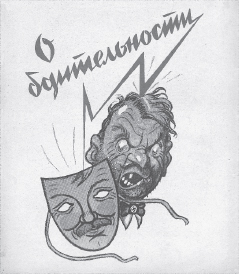
‘On Vigilance’, a 1937 cartoon of the Great Purges era by Iu Ganf. Citizens were urged to unmask hidden enemies of the people.
The process of terror we call ‘the Great Purges’, often obliquely referred to by Soviet citizens as ‘1937’, was unequivocally launched early that year at the Central Committee plenum, which raised the spectre of sabotage of industry by its Communist leaders, and corruption and betrayal on the part of republican and regional party secretaries. Stalin was undoubtedly the initiator of this new terror, although at the plenum he had Molotov give the opening report. The second Moscow show trial, held the previous month in a blaze of national publicity, provided a dramatic backdrop. Defendants, including Ordzhonikidze’s deputy at the People’s Commissariat of Heavy Industry, were accused of wrecking, terrorism, espionage and treason, and all confessed before being sentenced to death and immediately executed. ‘Shoot the mad dogs!’ was the much-quoted cry of prosecutor Andrei Vyshinsky. It was echoed in meetings of indignation throughout the country.
Ordzhonikidze fought hard but unavailingly in the last months of 1936 to get his deputy off the list of defendants in the upcoming show trial, and then committed suicide rather than see the cohort of Soviet industrialists he had nurtured destroyed. The industrial leaders, often accused of ‘wrecking’ and blamed for industrial accidents, were among the first in the firing line, along with republican and regional party secretaries (many of whom were also members of the party’s Central Committee), who were accused of dictatorial methods, abuse of power in their republics and regions, and nepotism. In other words, they were accused of doing their jobs according to the implicit job descriptions that had developed in the 1930s. Where the republican leaders were nationals of the republics they led, as was the case in Ukraine, Uzbekistan, Armenia, Georgia and the Tatar Autonomous Republic, they were also accused of ‘bourgeois nationalism’. Their extensive patronage networks enabled the process to snowball, ultimately bringing down entire republican and regional leaderships. In Turkmenistan, the carnage was so great that the local party was left for months without a Central Committee.
The purge spread to the army in June 1937, when Marshal Mikhail Tukhachevsky and virtually all the top military command (except for Politburo member Klim Voroshilov) were convicted in a closed court martial of conspiracy with the Germans and summarily executed. The officers (‘Judases who have been bought by the fascists’) were knocked off without lifting a finger to save themselves, let alone trying to get rid of Stalin – one of several examples in Soviet history of the army dog that failed to bark.
Arrests throughout the elite continued through 1937, fuelled by a steady stream of opportunistic denunciations against bosses, fellow workers and neighbours flowing in to the authorities. Even Politburo members were not exempt from the fear of a midnight knock on the door (although most in fact survived), and in a suspension of the normal rules of the game, they were unable to save clients or even family members from arrest. Prominent members of the intelligentsia fell victim to the purge, often in the wake of the disgrace of a political patron. Tramps, religious sectarians and habitual criminals were picked up in the interests of public order. Ethnic groups such as Poles, Finns and Germans who could be suspected of loyalty to an outside power were targeted, and those living near the border were deported en masse to distant areas of the Soviet Union.
As the terror showed signs of flagging in 1938, a third Moscow show trial featuring Bukharin and former GPU chief Genrikh Yagoda was held. As before, the defendants all publicly confessed, an act interpreted by ex-Communist Arthur Koestler in his novel Darkness at Noon as a last service to the party by these dedicated Bolsheviks. Perhaps, but it was also their last chance for public utterance, and it seems both men attempted to combine the required confession with an implicit counter-narrative contradicting it. (‘If I had been a spy,’ Yagoda said, ‘dozens of countries could have closed down their intelligence services.’)
Like medieval witch-hunts, the Great Purges acquired their own deadly momentum in a population already conditioned to violence and suspicion. Ending it by fiat from the top was likely to be a much tricker enterprise than starting it had been. Stalin went at it gradually, letting the purge wind down through 1938 before symbolically ending it by calling in Lavrenty Beria as new police chief to purge the purgers – the secret police itself, and its former head, Nikolai Ezhov. In another ‘dog that failed to bark’ episode, the secret police offered no resistance to their own destruction. Ezhov, visibly in disfavour since April 1938, sat passively for more than six months until the axe finally fell, drinking steadily to pass the time.
Bringing the purge to an uneventful conclusion, with his own position intact and his reputation in the country apparently enhanced, has to count as a virtuoso political performance on Stalin’s part, but what had been the point of the whole thing? Molotov, interviewed later in life, said it was necessary to eliminate a potential fifth column in the coming war. Whatever the rationales – elimination of possible fifth columns, catching foreign spies, clearing away dead wood in the administration and opening the way for promotions of the new cohort trained in the early 1930s – they seem inadequate justification for decimating the army command, the party’s Central Committee and government, and the top industrial leadership. But perhaps, following the Bolsheviks’ favourite French Revolutionary analogy, revolutions do have an internal logic that predisposes them to eat their own children as they themselves expire. There is also a logic that terror – as in the Revolution and then in collectivisation – begets more terror. In 1934, Stalin warned his colleagues in the leadership that destroying the ‘enemy classes – capitalists, kulaks and the rest – did not get rid of the Soviet Union’s security problem, since individual members of these former classes survived, not only aggrieved but now also masked and invisible to the watchful state. There undoubtedly were many such people concealing a grievance, in the party and the population in general, and the scattershot approach of the Great Purges could be seen as a means of neutralising these invisible enemies. But executing 700,000 ‘counter-revolutionaries’ and sending a million more to Gulag was a costly way to do it.
In the aftermath of the Great Purges, the senior ranks of all institutions – party, government, military, security – were largely staffed by novices, often newly minted graduates of lower-class origins with party cards who had been rushed through training. To look at the archives of 1939 is to glimpse a devastated bureaucracy, full of missing parts and desperately trying to find people to fill the gaps, barely functional. Institutional memory had been lost; new appointees were struggling. This of course was a temporary situation: within a year or so, the jobs got filled and people learned how to do them. Possibly, overall, they did them better than their predecessors, being younger and better educated. But note the date: 1939. After all the crying wolf of earlier years, war was finally coming.