
9
Wherein the first agrarian states arise • The world population grows dramatically • Cycles of rise and decline blight human history • Trade between states enhances collective learning • The evolution of printing sends knowledge sharing into overdrive, circulating among larger segments of the population.
WE ARE NOW STARTING CONVENTIONAL HISTORY. Nine chapters in. More startlingly, we will be covering the majority of conventional history (the first 6000 years) in one chapter. It’s possible to do this by following the broad overarching patterns of complexity and collective learning. These patterns serve as a kind of ‘universal acid’ for the jumble of names, dates and events that form the totality of human affairs. Just like Darwinian evolution helps us make sense of the grim slaughter of billions of species in the fossil record.
Agrarian states still harnessed unprecedented power from the Sun for their crops and livestock, with 80 to 90 per cent of people remaining farmers. But collective learning gradually made agriculture more efficient, leading to the spread of farming across the Earth and the appearance of something new: cities, bureaucracies, armies, artisans, scribes and rulers who did not engage in farming. The next level in structural complexity. Collective learning caused the world’s population to increase, but it did not keep pace with agrarian birth rates, leading to recurrent population crises which kicked off worsening civil violence and even the fall of empires. These population cycles which influenced political events are known as ‘secular cycles’. Those trends form the deeper tides which propelled much of the ‘swirling foam’ atop the waves of conventional history.
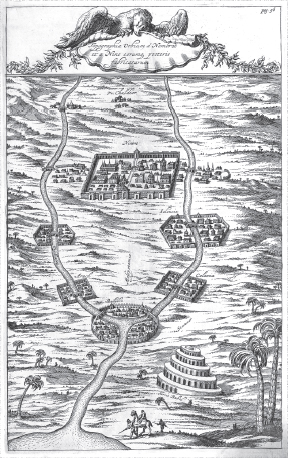
A seventeenth-century map of Babylon and Nineveh
RISE OF THE CITY
By 5500 years ago (3500 BC), the world population had grown from 8 million foragers at the invention of agriculture to 50 million people. That was a lot more potential innovators for collective learning, and the pace accelerated accordingly. The transition from the Early Agrarian Era to the Era of Agrarian States (starting 5500 years ago) is defined by:
1.the appearance of large cities with a division of labour (non-farmers being supported by surplus food crops)
2.the appearance of writing
3.the beginning of secular cycles (driving the rise and fall of empires).
In order to support a city, where many of the inhabitants are not engaged in farming, you need to grow surplus food in the countryside. Collective learning got to work in the Fertile Crescent around 7000 years ago. Hardier tools made of soft metal slowly replaced those of wood, stone and bone. Higher-yield crops were selectively bred by farmers over thousands of years. Irrigation introduced water to soils that were normally dry, unlocking previously untapped nutrients for plants. Using animals to plough fields cut up the soil much faster than any human could. Combined with favourable climates in the region 6000 years ago, farming productivity exploded by leaps and bounds. This surplus food allowed villages and towns to grow larger and larger.
In Sumer, the town of Eridu grew from a farming village to a city of 10,000 people by 5500 years ago (3500 BC). Between 5500 and 5200 years ago, a number of cities that size sprang up. But these were not as large as Uruk, to the north-west of Eridu. Fifteen times larger in land area, Uruk had up to 80,000 residents. This was a permanent human settlement on a scale never seen before.
With growing collective learning came more crops, which supported increased societal complexity. Uruk had a very pronounced division of labour, where non-farmers were fed by an increasingly efficient agrarian surplus. The city was ruled by a caste of priests headed by a priest-king. Under them were scribes who handled the complex logistics of the city. Palaces and temples were built by a large artisanal and labour force numbering in the thousands. Soldiers maintained law and order and manned the city walls. The city had a burgeoning linen and wool industry, many wealthy merchants, and slaves who were coerced to perform work as household servants or labourers. Outside the city, farmers would have constituted roughly 90 per cent of the population and the priests owned 30 to 65 per cent of the land. A good portion of farmers, too, would have been slaves.
Slavery appeared almost immediately with large human settlements. If there were enough crops to support a ruling class, and enough crops to feed soldiers to protect them, there were enough troops to coerce people to do work against their will. Often there were pretexts to legitimise slavery: someone got into debt, or was a criminal whose crimes were not heinous enough for execution, or was of a foreign religion or ethnicity. But in the majority of cases, slaves were enemy captives from a war. For over 5000 years, until just a few centuries ago, slavery was the rule for all agrarian states and abolition was the very rare exception.
Warfare began. Sumerian cities needed farmland to feed their populations and keep them wealthy. Armies of thousands of troops began to form for the first time in human history. Uruk dominated in the period 5500 to 5000 years ago. Thereafter, increased competition from other city-states led to horrific violence. Uruk was conquered and sacked by its rival city Ur 4550 years ago (2550 BC). There had always been violence in primate dominance hierarchies, even in human foraging ones, but now the bloodshed occurred on the scale of thousands of dead or enslaved people, with no sign that the cycle would ever stop repeating itself.
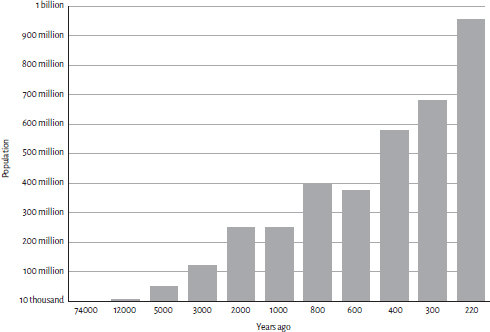
Population growth from the genetic bottleneck to the Industrial Revolution
RISE OF WRITING
Uruk has the honour of providing us with the oldest surviving writing, inscribed by sticks into clay tablets dated to 5500 years ago (3500 BC). These writings discussed agricultural produce and livestock. From 5500 to 4500 years ago, Sumerian writing evolved from the pictographic (where symbols had no relation to how the word was spoken in Sumerian) to a wealth of syllabic symbols for complex songs, poems and histories, along with the addition of a system of numbers. Writing patterns would undergo similar evolutions in other agrarian states as they arose and evolved across the world.
In terms of collective learning, the advantages of written records are fairly self-evident. Instead of passing on all knowledge by oral tradition – where if there is a generation with whom it is not shared, it disappears – written records can slumber in an archive for centuries, only to be rediscovered. One can also communicate more complex and abstract information than if it were transmitted orally. This would include details of a history, but also calculations made in mathematics. All told, the written record made it less likely that the knowledge would be forgotten, as frequently happened in the foraging era. The only limitation to collective learning at the time was that very few people beyond scribes and priests would have been literate. Most parents and children, and most masters and apprentices, would have continued to pass on information by speech and physical demonstration.
RISE AND FALL OF EMPIRES
The city-state of Akkad arose somewhere to the north of Sumer roughly 4300 years ago (2300 BC). Its ruler, Sargon, conquered all of Sumer, all of Mesopotamia, pushed into the Levant, landed in Crete and got as far north as Anatolia, as far east as Elam and as far south as the tip of the Arabian Peninsula. Multiple cultures were incorporated into the Akkadian Empire, and in some cases the Akkadian language was imposed on subjugated peoples. But even this empire lasted until only around 4150 years ago (2150 BC), when it collapsed.
This would not be the last time such a thing would occur.
This is a phenomenon known as a secular cycle, which drives the rise and fall of empires. Around 4200 years ago (2200 BC), droughts, an exhaustion of the soil from overuse, and the increased levels of salt in the soil from short-sighted irrigation techniques seems to have significantly reduced the carrying capacity. This appears to have kicked off a population crisis, where famines were more frequent, uprisings by various cities and aristocrats became more common, and the Akkadian Empire’s control over Mesopotamia weakened as the empire shrank. Eventually the empire was destroyed by Gutian ‘barbarian’ invasions.
Ultimately, there is a relationship between collective learning, carrying capacity and the socio-political stability of an empire. The key to this is that despite the fact that collective learning was gradually increasing the carrying capacity – so that the world population increased from 50 million people 5500 years ago (3500 BC) to 954 million people 200 years ago (1800 AD) – population levels frequently outstripped the carrying capacity.
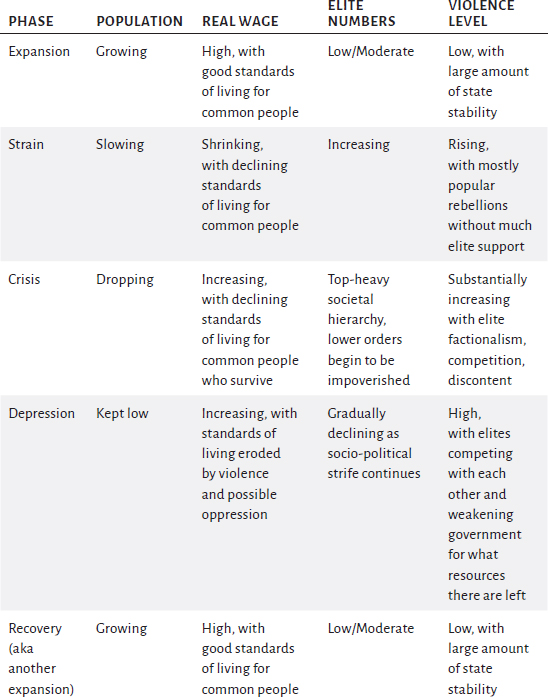
Agrarian people had so many babies that their innovations in agriculture simply could not keep pace. So, instead, there were cycles of rise and decline every few centuries that had a profound impact on micro-historical events.
The pattern was as follows:
1.Expansion: when the population is still low and expanding, things are prosperous for the average person because there is more land, more food and higher wages, the ruling family has fairly good control over the aristocracy, and the empire is generally stable and able to expand its territory.
2.Strain: as the population approaches the carrying capacity, the average person pays more for basic essentials and gets paid less for their work (if they get paid at all), rents go up, peasants sell off their land because it no longer supports them, and land and wealth coalesce in the hands of the very wealthy and they multiply in number.
3.Crisis: when famine or disease or some other disaster reduces the population, the wealthy lose their peasants, their taxpayers and the source of wealth from rents and payments for agricultural produce.
4.Depression; the wealthy begin competing with each other in tremendous civil wars and uprisings, and also competing with the government, until 1) an invading army takes over, 2) the population of the elite is reduced to the point that peace and stability reigns again for another population recovery, or 3) the empire collapses completely and the region becomes depopulated.
Collective learning gradually raises the carrying capacity, but this does not keep pace with population growth, so a kingdom or empire is thrown into these cycles of rise and fall every few centuries. This is how some of the big trends we’ve been observing have an influence on small-scale historical events.
It is also how humans differ from other species in nature. Usually when a species hits the carrying capacity of its ecosystem, the population crashes and then quickly recovers when the small number of survivors enjoy more food. But in the human case, there is an extra layer of complexity where large-scale violence and civil war can hold a population low for decades after the population crash.
Across the ancient world, we see this pattern playing out – in Mesopotamia, in the Egyptian Old, Middle and New Kingdoms, and in China with the Xia, Shang and Zhou dynasties. The collapse of each is led by a period of population strain, disease and civil infighting, and is often finished off by foreign invasion and occasionally by a brief ‘dark age’ where history grows quiet.
Almost every civil war, state collapse and era of prosperity and imperial expansion has some connection to this pattern from 3000 BC to 1800 AD (and longer, where agrarian states did not quickly industrialise).
COMPLEXITY IN AGRARIAN STATES
In terms of structural intricacy (the number and diversity of building blocks, networks and connections in a system), agrarian states represent a huge leap forward in complexity. Instead of groups of a few dozen foragers, or early farming communities of a few hundred farmers, there were now cities of tens of thousands, with people doing a dramatic range of different jobs other than farming (a greater diversity of building blocks). These people were increasingly connected in states and empires composed of millions. Between these states, trade routes were growing stronger and more numerous.
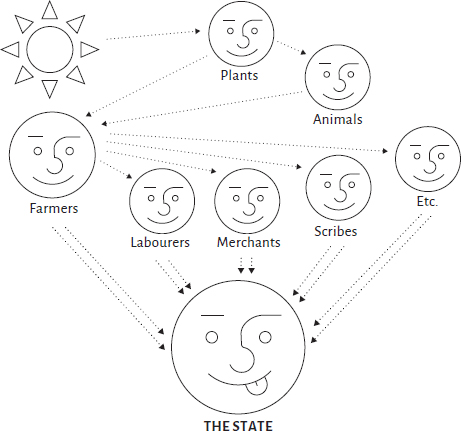
In terms of energy flows, we can also see complexity increasing. As in Early Agrarian societies, most of the energy comes from the Sun. Plants absorb this energy via photosynthesis and these plants are then eaten by humans and animals (which humans also eat or from which humans harness their energy for labour). The food and wealth generated from farming goes to support non-farmers (artisans, scribes, soldiers, merchants, cooks, architects, kings and so on) in the rest of the agrarian civilisation.
At the highest level, at the government of the state, much of the energy flows from all this farming and economic activity is taken in the form of rents, tributes and taxation. Currency itself is representative of the energy flows, because currency represents value, and can be used for goods and services. So in order to conduct the complex business of the state, governments harness a greater density of energy flow (average 100,000 erg/g/s) than has been seen before in foraging or early farming societies, or anything else in the Universe.
One can compare an agrarian state to an organism. The latter seeks out food (energy) to sustain or increase its complexity. In the same way, an agrarian state seeks land and wealth. Both organisms and states also compete for these resources. And if either runs out of energy flows, they die. The fossils of animals, the skeletons of humans and the ruins of ancient civilisations all have that in common. They were something great but are no more. They are symbolic of the endgame of the Second Law of Thermodynamics.
EVOLUTION OF AGRARIAN STATES
Between 5500 years ago (3500 BC) and 2000 years ago (circa 1 AD), the world population grew from 50 million to 250 million people. Some 90 per cent of them existed in Afro-Eurasia, 8 per cent of them existed in the Americas, and 2 per cent existed in Australasia and the Pacific. 5500 years ago (3500 BC) the city-states of Mesopotamia and the kingdom of Egypt only controlled 0.2 per cent of the Earth’s terrestrial surface. By the time East Asia, West Africa and the Americas produced their first Agrarian States (the last of these rising in the Americas about 3000 years ago), that percentage grew to 6 per cent. By 1000 AD, the land area controlled by Agrarian States had increased to 13 per cent. The vast majority of the Earth’s land was populated by stateless farmers or foragers, or was uninhabited by humans.
The world at this time can be divided into four zones: Afro-Eurasia, the Americas, Australasia and the Pacific. These divisions are based on collective learning. No collective learning was passed between these world zones before the so-called Age of Explorations and their unification in one single web of collective learning. But there was information exchange between states and peoples within the Americas, Australasia or the Pacific. These same goes for the continents of Africa, Europe and Asia (though long-distance exchange could take several generations), which is why they are grouped into the Afro-Eurasian world zone.
Afro-Eurasia had the major advantage in collective learning. It had the largest populations – for instance, the large and sprawling Achaemenid Empire in 480 BC contained an estimated 50 million people, or 40 per cent of the world population at the time. Agriculture had first arisen in Afro-Eurasia, as had agrarian states, so it makes sense that the largest clusters of populations existed in East Asia, India, the Mediterranean and West Africa, rather than elsewhere in the world. It is here we see the rise and fall of the various Chinese dynastic empires, the Persian, Greek and Roman empires, the origin and disappearance of the Indus River Valley civilisation and the gold-rich states of Mali.
The vast masses of millions of people in Afro-Eurasia prompted the evolution of diseases. Agrarian states were not any more sanitary than Early Agrarian societies (where people were sedentary, lived at close quarters with livestock and drank contaminated water) and the larger populations allowed diseases more opportunity to evolve in deadlier and deadlier forms. Smallpox, bubonic plague and a cocktail of other diseases swept across Afro-Eurasia multiple times in the Agrarian Era. This world zone acting as a petri dish for human contagion was to have a grim impact on the Americas, Australasia and the Pacific with the unification of the world zones.
The Americas first adopted agriculture around 5000 years ago (circa 3000 BC) and the first states emerged in Mesoamerica around 3000 years ago (circa 1000 BC). There was slight lag behind Afro-Eurasia in agriculture, which is why the American world zone had only 8 per cent of the world population. Nevertheless, the cordon sanitaire of the Atlantic allowed the human experiment to run independently and much the same results occurred. In 500 AD, the city of Teotihuacan hosted a population of nearly 200,000 people, which is massive by any pre-modern standard. The agrarian states of the Olmecs, Mayans, Aztecs and (further south) Incas all carry the trappings of advanced civilisations.
THE WORLD BEYOND AGRARIAN STATES
Large tracts of Northern Europe, the Sahara and Arabian deserts, and the plains of Central Asia remained stateless for many centuries – populated either by Early Agrarian societies or nomadic foragers. These hinterlands posed a major threat for agrarian states, should the states weaken during a crisis or depression phase of a secular cycle. It is not a coincidence that so many Chinese dynasties, for instance, were founded by ‘barbarian’ invaders, or that the Germanic invasions supplanted the Roman Empire in Europe.
Central and South Africa, from the Sahara to the Cape, resisted agriculture and states for a much longer period. The delay in agriculture is because Sub-Saharan Africa is one of the best environments for human foraging and one of the least forgiving for sedentary farming. Nevertheless, agriculture had spread into Central Africa by 1500 BC and managed to pierce deep into the Congo, with some cultures adopting agriculture by 500 BC. The practice of agriculture reached southern Africa by 300 AD. A few agrarian states began to appear in these regions just prior to the unification of the world zones circa 1500 AD.
North America saw Early Agrarian societies emerge by 600 AD, most notably the Pueblo societies of the US south-west. The most impressive settlements that arguably could be called an agrarian state were in Chaco Canyon, which held 5000 people and was built between 850 and 1150 AD. Beyond in the Great Plains, California, the eastern seaboard and Canada, semi-sedentary cultures mixed farming and foraging, while some exclusively foraged. But for the arrival of Europeans, agrarian states would probably have arisen in these regions as well.
In the Australasian world zone, the people escaped the trap of sedentism and the unsanitary conditions of agriculture completely. In terms of health, it was certainly far more preferable for people to forage, especially because Aboriginal practices were so productive. Aboriginal people used fire to burn down forests, kill game and expose edible plants, and to clear paths for travel, while the fire-loving eucalyptus forests quickly recovered. The Australian continent was able to support somewhere between an impressive 500,000 and 1 million foragers.
The Pacific world zone was only inhabited by humans in the last 5000 years, and some islands less than 2000 years ago. New Zealand was only settled in 1280 AD due to the lack of sailing winds blowing down from the north. The populations in this world zone consisted of islands of a few hundred people through to larger island chains that contained thousands. For instance, the Hawaiian Islands supported up to 30,000 people, and there was a degree of domestication and irrigation there that arguably could be called agriculture.
THE SILK ROADS
There were many agrarian civilisations spread across Afro-Eurasia who could potentially share collective learning. But often these states were separated by vast distances, huge deserts or impenetrable forest, and travellers might be captured or killed on their arduous journeys. So for 3000 years, transmission of collective learning was slow. The first trade route that crossed the entire Afro-Eurasian world zone did not exist until 50 BC. The Silk Roads allowed slow transmission of goods and information from China to India to Persia to the Mediterranean and, via the Saharan trade routes, to West Africa.
Despite the name, the Silk Roads did not just transmit silk, spices or other commercial goods. They also transmitted religions, inventions and mathematical ideas. For instance, Hindu numerals were invented in the 400s AD, were picked up by the Arabs during the Islamic invasions (hence the misnomer ‘Arabic numerals’) and made their way into Europe in the Middle Ages, replacing the clunkier system of Roman numerals.
Due to its large populations, many luxury goods and spices, China was the centre of gravity for trade along the Silk Roads. Chinese goods were slowly transported piecemeal across Central Asia, often by nomads, and often taking more than one generation, but ultimately flooded into Middle Eastern and Mediterranean markets. In return, the West gave the East grapes, manufactured products and horses. But the balance of trade lay with the larger populations of Asia.
The land-based route of the Silk Roads was an agonising journey from East Mediterranean ports across the grit of Mesopotamia and Persia, and over numerous mountain ranges and deserts into India and China. These Central Asian routes not only meant a harsh commute but engagement with numerous nomadic and imperial forces, who might kill or rob you. Otherwise, the sea route ran down the Red Sea to Aksum (which made a fortune, allowing its tiny population to become a mercantile superpower in the first millennium BC), on to one of the many ports of India and then onwards to Indochina and South China. It was by these sea routes that Islam spread from India to Malaya and Indonesia.
Afro-Eurasia had a conduit through which collective learning could flow through hundreds of different agrarian states on a super-continent which in 1000 AD was populated by roughly 300 million people. The overwhelming majority of trade was not carried out by one merchant from one end of the Silk Roads to another, and the transmission of trade goods and information could take years or even generations to travel across Afro-Eurasia. Nevertheless, the Silk Roads were kicking off a slow, creeping revolution. Contemporaries at the time would not have noticed this, but it would soon provoke massive changes in human history.
THE EVOLUTION OF PRINTING
In the pre-modern world, the greatest limitation to written knowledge was its circulation. The vast amount of collective learning still occurred orally in the pre-modern period, with all the slowness and flaws that method produces. Literacy still remained in the hands of scribes, bureaucrats, philosophers and the elite. Written works remained scarce and expensive. Printing would change all that.
Original Chinese printing was done with woodblocks, emerging at the end of the Han period in 220 AD. Each page had to be carved into the blocks, slowing efficiency. Woodblocks were extremely bulky and hard to store and transport, every new copy or variation being started from scratch. In 1045 AD, Bi Sheng invented movable type, where words were placed onto clay tablets which could be rearranged to create a new sequence of words and then be imprinted on the page. Numerous Chinese philosophical, scientific and agricultural works were regularly produced. Some books had a circulation of thousands.
The Koreans in the 1200s AD invented a metal moveable type. The advantages of metal moveable type are that it is durable, smaller and easier to rearrange, and ultimately produces books at a faster rate. The Koreans did not use a press of any kind. They laid thin paper over inked type and took the impression by rubbing it with a wooden spatula. This was painfully slow. Nevertheless, with woodblocks or metal moveable type applied by spatulas, the impact of early printing in China and Korea was to reproduce more copies of written knowledge at a faster rate than could be done by hand, increasing the number of books in circulation and the array of knowledge that could reach any one person who was literate. It must be noted that in East Asia, slower woodblock printing remained the dominant form until the nineteenth century, setting a limit on the collective learning that could be derived from the wider circulation of works.
In Europe, Gutenberg’s printing press was invented around 1450 AD and combined metal moveable type (imported via the Silk Roads from the East) with a wine press (one of alcohol’s many virtuous usages) for quick composition of new pages and then relatively fast imprinting upon paper. This revolutionised printing. In the 1460s, three men could make 200 copies of a book in 100 days with a Gutenberg-style printing press. The same number of copies would take three medieval scribes thirty years. During the sixth century AD, Benedictine monasteries made a rule of housing around fifty books. The largest library in the mid-fifteenth century West was that of the Vatican. It contained around 2000 books. A private scholar of middling rank could easily acquire that many in the seventeenth or eighteenth century.
There were an estimated 8 million copies of books produced in the fifty years between 1450 and 1500 AD. This quite likely exceeds the entire number of books that were hand-copied in Europe since the year 500 AD. Between 1500 and 1600 AD, between 140 and 200 million books were printed. This proffered the Europeans a tremendous advantage in collective learning that aided the spread of the Renaissance and Reformation and would trigger the Scientific Revolution.
Greater profusion of information, greater connectivity and a gradually rising rate of literacy meant that another explosion in complexity was just around the corner.